1. Introduction
Investment in general is one of the most important components for the effective functioning of the economy (
Baffo, 2024). They connect two categories of people, those with money and ideas, which in such an interaction can simultaneously benefit both (
Le & Le, 2025). For the first category, the benefit is considered as an opportunity to generate income (a percentage of the invested capital), and for the second one, in the direct implementation of plans and ideas to generate the same profit. Thus, the more people with ideas and the opportunity to invest a country has, the more efficient its economic development is (
Dai & Zhou, 2024).
Thus, the problem of the distribution of money arises. Indeed, due to the efficient market hypothesis, the market always allocates funds in the best possible way (
Pagliaro, 2025). That is why any intervention in the economic activity of enterprises is considered inefficient from the point of view of representatives of classical economic theory (
Smith, 2022). Nevertheless, behind any market movement there are investors and entrepreneurs who form them. They can use different methods of making those or other decisions on the investment of their funds and receive for this a certain level of profitability or loss, which forms the weighted average indicators of market performance (price, profitability). Thus, the proposal of methods for the formation of investment decisions and evaluation of the investment attractiveness of enterprises remains relevant. Let us note that the pattern of investor behavior may differ depending on the country, industry and region in which the enterprise he plans to invest is located (
Rahmah et al., 2023). Therefore, it was decided to conduct a study on the peculiarities of the formation of investment decisions, which are typical for industrial enterprises of Kazakhstan.
As highlighted by
Zhumabekova et al. (
2023), the expansion of environmental auditing and management practices abroad has been largely influenced by the tightening of environmental regulations and the growing demand to establish a unified ecological framework across trade, finance, and investment domains. In Kazakhstan, however, the legal and regulatory infrastructure, along with the system of environmental standards, is still in its formative stage, though some practical progress in implementation has already been achieved.
Designing a conceptual framework for evaluating the investment attractiveness of industrial enterprises necessitates considering not only financial and economic determinants but also ecological and institutional risks that define the dynamics of the modern investment environment. According to
Zhumabekova et al. (
2023), the meaningful integration of environmental auditing into corporate governance structures enhances investor trust and reinforces the long-term sustainability of enterprises.
While prior studies introduced environmental adjustments to cash flows or discount rates, the current framework advances ESG-adjusted valuation research by providing explicit operational calibration of the environmental risk premium, integrating the ERS into scenario-based projections and demonstrating practical applicability for emerging market manufacturing firms. This emphasizes the methodological novelty, quantitative rigor and operational contribution beyond existing approaches.
Hence, within the proposed assessment framework, investment attractiveness should be evaluated through indicators reflecting environmental efficiency, transparency of managerial practices, and compliance with internationally recognized standards such as ISO 14001:2015 (Environmental management systems—Requirements with guidance for use) (
International Organization for Standardization, 2015) and Eco-Management and Audit Scheme (EMAS) (
European Parliament & Council of the European Union, 2009)—factors that collectively shape the quality and stability of the investment climate within Kazakhstan’s industrial sector.
A large number of scientists worked on the formation of investment-attractiveness evaluation models, and not all of them used the present value method as the basis. In particular,
Tamosiuniene et al. (
2023) describe a model for evaluating enterprises based on their financial indicators (liquidity, profitability). Such methods can be used by experts, but they are less accurate, more difficult to apply, and more prone to errors when forming managerial decisions. Another method was described by
Ilyash et al. (
2020), who propose indicators assessing economic and social benefits, aggregated into an attractiveness index.
As noted by
El-Shishini and Upadhyaya (
2018), institutional and organizational factors influence how Environmental Management Accounting (EMA) effectiveness is perceived, shaping investment decisions. Contextual factors—such as internal policy, corporate culture and managerial support—play a crucial role in shaping the awareness of EMA’s benefits.
Thus, the proposed model explicitly incorporates indicators of a company’s contextual environment, financial and environmental risk components as an integrated part of the investment risk assessment, operationalizing ERS for scenario-based DCF calculations. This allows practical application and direct comparison of projects under varying environmental and regulatory conditions.
Evaluation model by
Petryk et al. (
2020) and
Pererva et al. (
2024) provide indices reflecting enterprise characteristics, but rely heavily on expert judgment, which can be inconsistent. Therefore, a more operational and quantitatively robust approach is necessary.
Thus, the purpose of the study is to describe a model for assessing the investment attractiveness of industrial enterprises in Kazakhstan. The object of the study is industrial enterprises, along with industry- and region-specific business characteristics.
2. Materials and Methods
As part of the work, a model for assessing the investment attractiveness of monetary funds was formed, which consists of three components: the evaluation of future cash flows, the evaluation of the discount rate and the creation of a decision tree. The basis for this model was the present value method, which uses discounted cash flows. The economic feasibility of investing in one or another enterprise always depends on two main factors: profitability and risk, which is precisely what the discounted cash flow method allows to estimate. Other methods exist but have limitations, making them less suitable for practical application in industrial enterprises.
Within the framework of this study a detailed analysis of forecasting future cash flows (the first stage of the model) is not provided, because it heavily depends on micro-environmental factors that can differ substantially across companies. The estimation is carried out using the present value method, following one of two formulas (
Brealey et al., 2025):
where
—net present value;
—cash flow in the year i (cash flow);
—discounting rate;
—number of years. The first formula assumes constant cash flows over an infinite period, while the second accounts for variable annual flows over a finite period.
The second component of the model involves assessing and adjusting the discount rate based on a defined list of risks. The optional decision tree is included to better evaluate potential risks and returns for investment projects.
Project cash flows are adjusted to account for environmental costs and benefits. Environmental costs include payments for negative environmental impacts, carbon charges, fines, eco-risk insurance and expenditures on waste treatment and disposal. Environmental benefits include savings in energy and materials, reduction in losses, the “green” price premium, and improved access to new markets or tenders:
Taking into account the “green” CAPEX/OPEX components and changes in working capital, the overall efficiency criterion is:
To reflect environmental risk, the discount rate may be adjusted by adding an environmental risk premium proportional to the overall Environmental Risk Score (ERS). Alternatively, risk can be incorporated directly into cash flows by assigning probabilities to potential events such as fines or shutdowns, keeping the baseline WACC unchanged:
The weights were determined based on sectoral importance, prior literature, and expert validation: carbon intensity 0.25, water intensity 0.15, hazardous waste 0.15, ISO14001/EMS compliance 0.15, share of renewable energy 0.10, incident/fine history 0.10, and CAPEX for decarbonization 0.10. Sensitivity analyses confirmed robustness of the ERS to moderate changes in weights. These adjustments operationalize the ERS, clarifying its calculation and empirical applicability in emerging markets.
Furthermore, while standard DCF and decision-tree methods are described, the current study emphasizes their integration with ERS, scenario-based modeling and context-specific environmental adjustments, ensuring methodological rigor and a materially distinct contribution from prior ESG-adjusted valuation approaches.
The main method used in the study is modeling, chosen because describing the investment attractiveness model for Kazakhstan’s industrial enterprises is central to the research. Forecasting allowed evaluation of key factors affecting future profitability and typical risks. The historical method improved factor selection based on Kazakhstan’s industrial development patterns. Analysis processed a large amount of information, while induction helped form general insights about the country’s industry to determine factor impacts on enterprises.
3. Results
As mentioned above, the authors skip the point of estimating future discounted flows and start with the formation of the indicator r. The discount rate always depends in one or another way on the level of risk, which is typical for different kinds of investments that a company wants to make (
Laitinen & Laitinen, 2022). Nevertheless, among economists there is such a notion as a risk-free discount rate, it is most often compared to the rates on government bills of the USA. Note that even such investments carry the risk of, for example, the bankruptcy of the USA, but it is so low that investors equate it to zero, and the rate that can be obtained by investing in such securities is risk-free; it is notable that it is also the most risk-free for the whole world, as the strongest economy at the moment is the USA (
Bakirci, 2021). However, in the realities of investing in Kazakhstan, it is worth estimating the risk-free rate of return that an investor should receive when investing in the country. It can also be calculated by considering the rate of return on Kazakhstan’s government bills. This is depicted as follows:
where
—discount rate of investments without a risk;
—country risk of Kazakhstan;
—discount rate for risk-free investments in Kazakhstan.
Thus, the risk-free rate for Kazakhstan takes into account the global risk-free rate and the level of risk typical for the country. This level of discount rate should be minimum, which is worth counting on when investing in the country. The next step is to calculate the discount rate, which is specific to the industry in which the company operates. The easiest way to estimate it is to calculate the average annual rate of return of enterprises in relation to the invested funds. Thus, a business that will yield a return higher than the industry average should really be considered one worth investing in. The estimate of the average should be made for as much of the same type of enterprise as possible and, if possible, for a narrow segment of the industry. Note that it is not always possible to make this estimate, because sometimes the enterprise being evaluated is the only one of its kind, or there are not enough similar enterprises in the industry to form an average estimate.
The last step of calculating the discount rate is the most important and complicated. It consists of calculating the individual characteristics that increase the level of risk when investing in a given company. Although they will also be individual for each company, it is possible to identify certain groups of factors that are particularly worth paying attention to. First of all, regional location of the company is worth to be mentioned, i.e., in which region of Kazakhstan it is planned to be opened and put into operation, in which city and on what terms. In such a case, it is necessary to take into account as the location of trade routes, proximity to suppliers, the price of labor, the places of the main sources of resources for the company and other similar factors (
Daniya & Tang, 2024). The better and more convenient it will be for a company to make business from a given territory, the lower the discount rate should be.
The competence of management companies is also important. This factor is quite subjective for evaluation, as it cannot have an exhaustive quantitative expression. It is possible to draw conclusions about the managing companies only on the basis of direct communication with them or rumors or information from specialized sources, news, which do not always prove to be true. Nevertheless, it is possible to assess the organization and its management structure to draw conclusions about the advantages and disadvantages it has in comparison with other companies in the industry. Thus, the better the management characteristics of the company, the lower the discount rate should be.
Thus, the formula for calculating the discount rate, assuming that the investor knows the average rate for the industry, could look as follow:
where
—final discount rate;
—discount rate for the industry (industry);
—regional coefficient;
—environmental risk coefficient;
—coefficient of company sustainable development;
—innovation coefficient;
—economic cycle coefficient;
—human capital ratio;
—other factors that the investor wants to consider.
With the help of Formula (6), the investor is able to estimate the real discount rate for each company and to calculate the corresponding NPV levels in order to make a decision about the subsequent investment. However, it is possible that there are not enough companies in the sector to estimate a fair industry average discount rate. In this case, we suggest a few other options for calculating the discount rate r. The first is to choose the most similar sector to the one where the company is which the investor is going to fund, and after evaluating their differences, adjust the discount rate. This can be done as follows:
where
—the discount rate for the sector (industry);
—the rate for the closest sector;
—the difference in the interest rate due to the estimated differences in the sectors.
The resulting value of
can be substituted into Formula (6) above. Another method we can suggest (in case the company is so unique that there are no analogs for it, which is highly unlikely) is an estimate “from scratch”, i.e., based on the risk-free rate indicator for the country, in our case
:
where
—final discount rate;
—the risk-free rate for Kazakhstan;
—estimated prospects, features and risks inherent in the industry;
—regional coefficient;
—environmental risk coefficient;
—coefficient of sustainable development of the enterprise;
—innovation ratio;
—economic cycle ratio;
—human capital ratio;
—other factors that the investor will want to consider.
Indeed, in such a case, the investor actually has to assume the risk level of such an enterprise independently on the basis of external factors that allow him to estimate and predict its future performance. In this case, the corresponding indicators W, R, M, SD, I, Ec, and N should be higher than in Formula (3), due to the fact that the calculation starts from a lower level ( > ). Nevertheless, investing in such ventures, which have no analogs for comparison in general, can be compared with venture capital, for which the investment principles and evaluation described above are not suitable.
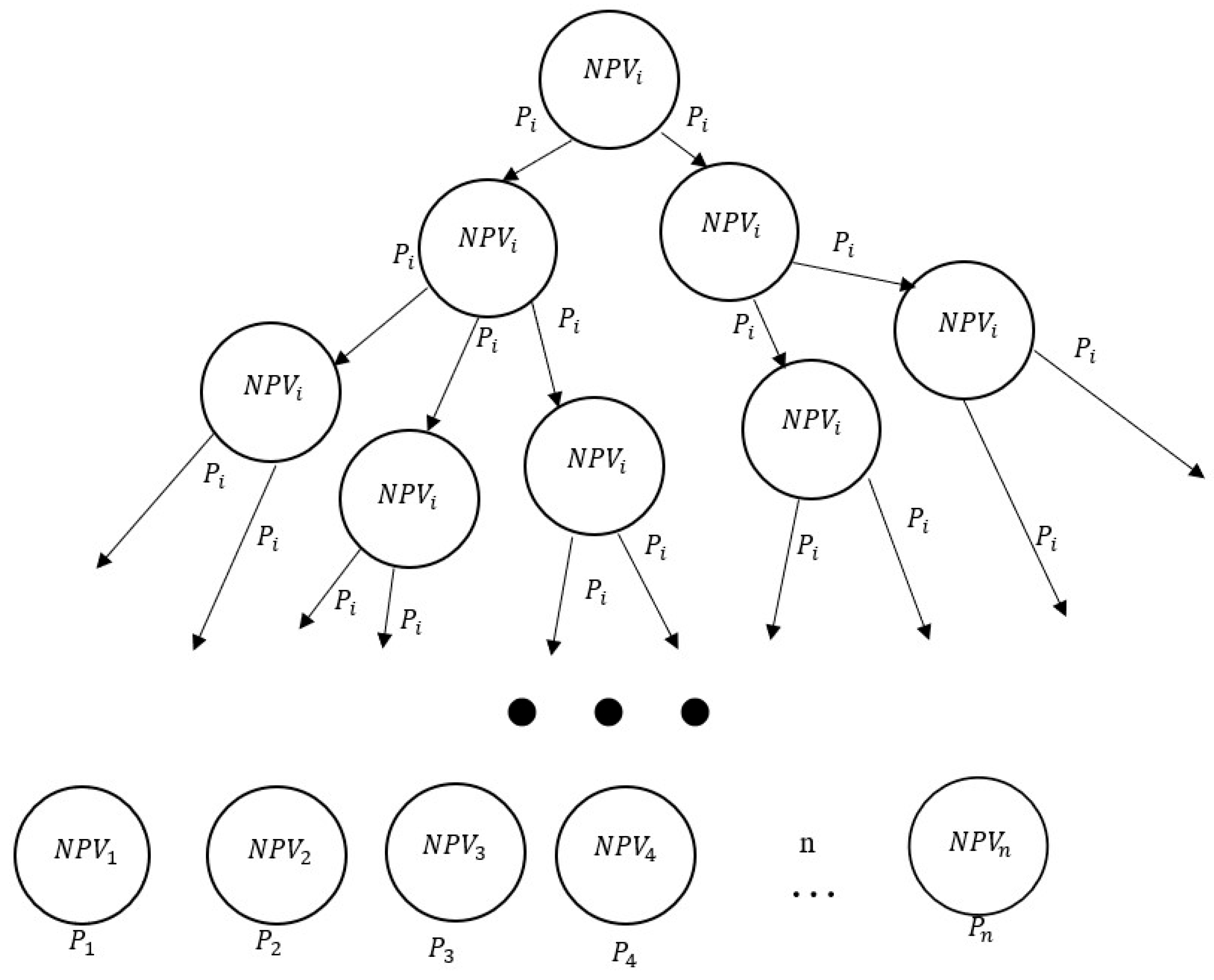
In order to make a more accurate estimate of the net present value of the company after evaluating the cash flows and the level of the discount rate, we also suggest using the decision-tree method. It allows us to draw conclusions about the future probable outcomes of events. This is important because a certain project, with a certain positive level of net present value, may have the probability of losing all or most of the money and be an unfavorable consequence for the investor. To build this model, it is worth generating the event outcomes associated with the variables and giving them estimated probabilities of occurrence in the form of a P score. At the end there is a list of obtained NPV for certain events with probability P, there is their product, on the basis of which it is worth correcting the initial NPV. Such a decision tree can be depicted in the scheme described in
Figure 1.
As you can see from
Figure 1, using this method, the investor can assess in more detail the prospects that await him after investing, with what probability and due to what circumstances he or she can earn more and under what circumstances he or she can lose all funds. Thus, even with a high NPV an investor can refuse to invest his own funds, if the estimated risk of loss of funds for him is very high. In addition, based on the NPVn results it is possible to make additional statistical calculations to assess the riskiness of the project. If the investor, or the evaluator in general, finds a significantly large number of variants of net present value, he can build a chart with their help, which will simplify the process of perception of this information and the decision-making process.
It is recommended to consider at least three scenarios: S0 (baseline: current regulations), S1 (moderate tightening of standards and increase in the domestic carbon price), and S2 (stress scenario: high carbon tariff, accelerated decarbonization of the supply chain, and export barriers such as CBAM). For each scenario, EcoCosts, EcoBenefits, and, if necessary, are recalculated. The decision tree represents the choice between “investing in environmental measures now” and “not investing,” as well as the probabilities of various events such as regulatory tightening, incidents or accidents (fines, downtime), energy or resource price shocks, and demand shifts. The expected value is determined as the sum of the branch outcomes pj NPVj.
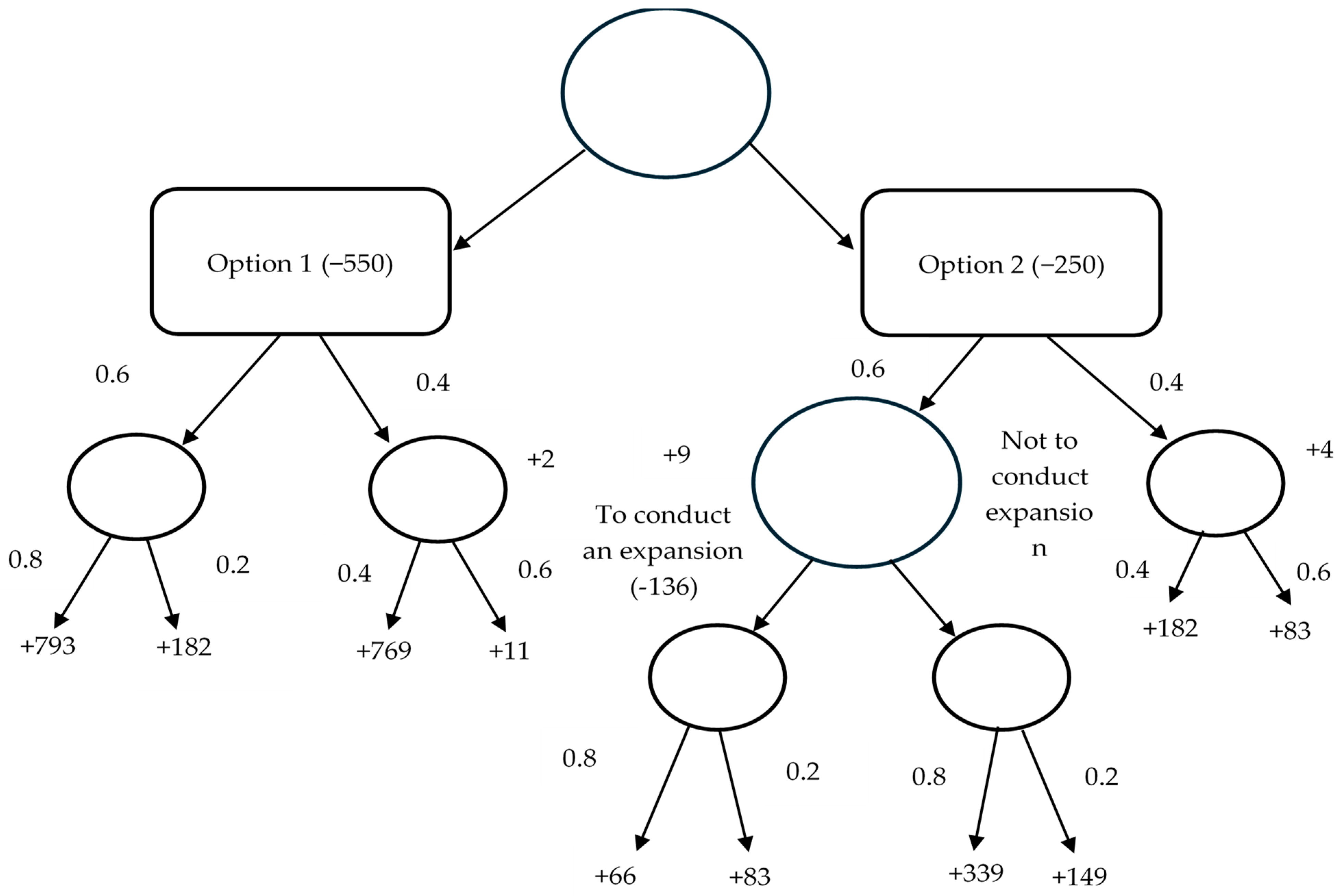
An example of constructing such a decision tree can be adapted to the context of environmental investments in manufacturing enterprises.
Consider a manufacturing company deciding between two alternative investment options:
Option 1: Installation of conventional production equipment (lower initial investment, higher energy consumption and carbon emissions).
Option 2: Installation of energy-efficient and low-emission equipment (higher initial investment but lower operating costs and environmental risk).
Assume the following:
Initial investment in conventional equipment: 550,000 USD
Initial investment in energy-efficient equipment: 250,000 USD
If the company chooses energy-efficient equipment and market demand is high, it has the option to expand production capacity by investing an additional 150,000 USD (136,000 USD in present value terms).
The key uncertainty affecting profitability is future demand for manufactured products.
Probabilities:
In year 2:
The decision tree constructed in
Figure 2 reflects these possible scenarios and associated cash flows.
As in the classical decision-tree approach, the investor evaluates three main strategies: investment in conventional equipment, investment in energy-efficient equipment without expansion, and investment in energy-efficient equipment with expansion.
where NPV1—the net present value of conventional equipment; NPV2, NPV3—the net present value of energy-efficient equipment (with or without expansion); C1, C2—initial investments; PV1, PV2, PV3—present value of expected cash flows.
Although the conventional equipment appears attractive in certain scenarios, the decision tree highlights differences in risk exposure:
In the worst-case scenario for conventional equipment, the investor may incur significant losses due to high operating costs and environmental exposure.
Energy-efficient equipment reduces operational volatility and environmental risk.
When environmental risk is incorporated into the discount rate through the environmentally adjusted model:
The relative attractiveness of the environmentally efficient option increases further.
The key advantage of using a decision tree in this context is that it allows the investor to:
Evaluate all possible market-demand scenarios,
Incorporate environmental investment flexibility (expansion option),
Assess downside risk explicitly,
Align financial evaluation with environmental risk considerations.
Thus, unlike the aviation example, this case directly reflects the core objective of the study—assessing the investment attractiveness of environmental investments in manufacturing enterprises.
In 2024, Kazakhstan’s economy continued its gradual transition toward a more resource-efficient and environmentally balanced model. The available data indicate positive structural changes in energy consumption, greenhouse gas emissions, water use, waste management, and the share of renewable energy. Despite the persistence of high resource intensity compared with advanced economies, the overall trajectory shows that the country is steadily moving toward sustainable development.
According to the National Statistics Bureau, the nation’s gross domestic product in 2023 reached about 119.4 trillion tenge, or nearly 261.8 billion U.S. dollars. This figure served as the baseline for calculating environmental performance indicators per one thousand dollars of output. In the same period, total greenhouse gas emissions were estimated at around 320.4 million tons of CO2 equivalent. Although this level remains significant, it provides a benchmark for assessing progress in reducing carbon intensity. A decrease of ten percent in carbon emissions per unit of GDP would already generate a considerable economic benefit at an indicative carbon price of 3000 tenge per ton, and this effect would become even stronger under a functioning emissions-trading system.
Energy efficiency has shown visible improvement over recent years. Based on official statistics, the energy intensity of GDP declined from 0.32 tons of oil equivalent per one thousand dollars in 2022 to approximately 0.30 in 2024, which corresponds to roughly 3490 kilowatt-hours per one thousand dollars of output. This reduction reflects the modernization of industrial processes, wider adoption of energy-saving technologies, and gradual integration of renewable energy into the national energy mix. Under a ten-percent decline scenario, the national economy would save a substantial amount of electricity, which translates into significant financial savings at an average tariff of 25 tenge per kilowatt-hour.
Water consumption remains one of the key ecological and economic challenges. In 2023, total water withdrawals in Kazakhstan amounted to about 24.9 cubic kilometers, with industry accounting for roughly 23.5 percent of that volume. When normalized per thousand dollars of GDP, these figures highlight the high water dependency of several manufacturing branches. Reducing water intensity by fifteen percent could generate notable cost savings, especially for water-intensive enterprises, assuming an average tariff of 100 tenge per cubic meter.
The management of industrial and hazardous waste also plays a critical role in the environmental agenda. The National Statistics Bureau reported that approximately 137 million tons of such waste were generated in 2023. Even a modest reduction of five percent through recycling or process optimization would bring a measurable financial result at a handling cost of 15,000 tenge per ton and simultaneously lower the overall ecological burden on the environment.
An important signal of green transition is the growing share of renewable energy. In the first half of 2024, renewable sources accounted for 6.47 percent of Kazakhstan’s total electricity generation. Increasing this share by several percentage points could reduce the country’s vulnerability to energy-market fluctuations and strengthen its position in terms of carbon risk management. Moreover, expanding clean energy capacity contributes to improved ESG scores and the overall investment attractiveness of Kazakhstan’s industrial sector.
Overall, the 2024 indicators demonstrate that Kazakhstan is moving along a path of gradual ecological modernization. Energy and water use per unit of economic output are declining, carbon intensity is slowly decreasing, and renewable energy generation is expanding. While these changes are not yet rapid enough to achieve long-term carbon-neutral goals, they confirm that the foundations for sustainable growth have been established. To accelerate this progress, further efforts will be required to scale up energy efficiency programs, promote circular-economy principles, and integrate environmental controlling mechanisms at both national and enterprise levels.
Table 1 and
Table 2 present calculations of the integrated Environmental Risk Score (ERS) and demonstrate a significant improvement following the introduction of environmental controlling measures. The weighting structure for ERS was defined as follows: carbon intensity 0.25, water intensity 0.15, hazardous waste intensity 0.15, ISO 14001/EMS 0.15, renewable energy share 0.10, incident history 0.10, and CAPEX for decarbonization 0.10. According to the results, the baseline ERS amounted to 0.603, while after the implementation of environmental controlling it decreased to 0.405. The difference of –0.197 points represents an overall reduction of approximately 33% in the combined environmental risk. The most substantial improvements are achieved through ISO 14001 certification, an increase in the share of renewable (“green”) energy, greater capital investment in decarbonization projects, and reductions in carbon, water and waste intensity.
According to
Table 3, the scenario-based assessment of the economic effect per 1 billion KZT of annual output considered savings from reduced CO
2 emissions, lower electricity consumption, water conservation, and minimization of hazardous waste, with variable price assumptions depending on each scenario. Under these conditions, total annual savings were estimated at about 204.95 million KZT in the baseline scenario (S0), 246.70 million KZT in the moderate scenario (S1), and 330.46 million KZT in the stress scenario (S2).
Overall, the implementation of environmental controlling results in a clear decline in the integrated ERS from 0.603 to 0.405, corresponding to roughly a one-third reduction in environmental exposure. The financial impact of these measures grows with the level of external pressure: as prices for carbon, energy, and environmental fees rise, the benefits of resource efficiency and emission reduction become more pronounced.
The combination of a lower ERS and increasing annual savings enhances the overall investment appeal of ecological projects. It reduces the risk premium embedded in discount rates and cash flow projections while simultaneously raising operational cash flows through efficiency gains. Consequently, such initiatives contribute to higher net present value (NPV), improved internal rate of return (IRR), and a shorter payback period, reinforcing the business case for sustainable transformation.
4. Discussion
The analysis of the main factors that affect the development of industry as a whole in Kazakhstan was carried out by
Daniya and Tang (
2024). They mentioned several main factors, including the stage of development of the economy, the number of population, energy consumption, the level of technology development and the provision of enterprises with resources. They can be generally applicable to assess the industrial level of companies in the country at the macro level, but most of them, as they are provided in the study, cannot be applied to the assessment of single companies. One of the important components for the development of industry in countries, including Kazakhstan, is also their digitalization, which was analyzed in their work by
Otarbayeva et al. (
2024). The authors above indicated in their work that the level of digitalization of production companies is taken into account when assessing their innovation potential and therefore is not noted as a separate factor.
In their works
Vertakova (
2022) and
Proskurnina and Chornomord (
2022) reviewed methods for assessing the attractiveness of enterprises. In the course of the study, the scientists come to the conclusion that there is no single and fully reliable option for assessing the investment attractiveness of an entity. Applying different methods, investors can make decisions on investing in a particular enterprise by obtaining positive indicators in the specified efficiency levels. In addition, a particularly important role is played by who conducts such an assessment (how competent the investor or the expert involved in the calculations is).
It is worth noting that not all scientists used the present value method when forming their own methods for assessing the investment attractiveness of companies.
Tamosiuniene et al. (
2023) used various financial indicators, such as ROC (return on capital); ROE (return on equity); sales level; different liquidity indicators (short-term and long-term) and some others. They considered which of these indicators were attractive for companies and which were not, and based on the numbers of both types of indicators they made decisions about which companies were worth investing in. It is noteworthy that although methods based on comparing financial indicators of companies have a place in forming investment decisions, they are less accurate than the net present value method because they do not provide a single accurate measure for evaluation. In addition, different financial measures may play different roles for various companies in the course of their operations; thus, they will have different weights in different industries that need to be taken into account, which can be difficult, especially in cases where the valuation is performed by a specialist with insufficient experience. In addition, it is worth paying attention to the fact that such methods are inherently relative, that is, they can only be used in terms of comparison with other businesses. Thus, they do not take into account the situation of the condition of the economic cycle (which was noted above), which is very important, because the expected cash flows are overestimated at the peaks and respectively underestimated at the bottom of the cycles.
Another work, which formed the methods for assessing the investment attractiveness of companies, is the study of
Ilyash et al. (
2020). The authors formed conclusions about the attractiveness of companies based on the data on the factors of meso- and microlevels. The influence of multiple factors was financially measurable, normalized, and shown as a single integrated indicator. Thus, scientists introduce an index of economic and social attractiveness, the methodology of which can be applied to both companies and countries. It should be noted that this assessment methodology seems to be quite effective, although it does not provide an opportunity to assess the cash flow that an investor can get in case of investing in these companies.
The conceptual model of the evaluation of production companies was studied by
Petryk et al. (
2020). Their paper provides a detailed description of the product life cycle of the company, on the basis of which they, among other things, propose to draw some conclusions about investing or ignoring projects. In order to assess the investment attractiveness of the project directly, the scientists offer a system of formulas, by substituting certain values in which it is possible to come to the indicator H, which is characterized as an index of project advantage. In order to come to this index, scientists should evaluate and calculate about 30 indicators, which describe both financial, innovative and production capabilities of the company. It should be noted that one of them is also the present value of the company. However, this method depends more than others on the assessment of certain experts who will carry out the calculations; for example, to calculate the H indicator, scientists suggest to estimate the probability of certain risks from various indicators, the innovation potential, the risk premium, inflation expectations and other factors. Of course, assessment of attractiveness of investment projects cannot be separated from forecasting, because it must necessarily include estimates of future cash flows, but the greater the number of evaluation factors introduced from outside, the greater the error in calculations is.
Methods for assessing the investment attractiveness of production companies were also studied by
Pererva et al. (
2024). They conclude that the assessment of such companies should be comprehensive, that is, it cannot consist of one particular factor or several factors. It is difficult to disagree with it, but it is worth noting that although the above work presented a model that assumes the formation of conclusions about the profitability of enterprises based on their net present value, this does not mean that it is not comprehensive and does not take into account a sufficient number of factors for the evaluation of the enterprise. In fact, all of them are taken into account in forming the fair discount rate. Thus, the level of net present value in this case is just the only measure which could be replaced, for example, by an index, as other scholars do in their works to compare the innovative attractiveness of companies.
The level of attractiveness of foreign direct investment was studied by
Alon et al. (
2022) and
Kemives et al. (
2024). They developed an evaluation model in the form of a three-step process: identification of critical variables based on the conceptual model, conducting factor analysis to identify the most important features, using Automated Machine Learning (AML) to assess the importance of each of the factors and their impact on the final project. After evaluating all the factors, the attractiveness index of direct investment is calculated, which should be the basis for comparison between companies. This article is unique in its own way, as it proposes to use machine learning to assess the investment attractiveness of enterprises, but because of this, its application seems inappropriate for most investors. Thus, there are quite a large number of techniques for assessing the investment attractiveness of an entity, which are not necessarily built and formed on the basis of the principle of discounted cash flows, although they often overlap with it. The investor or expert conducting the evaluation should independently make a choice, based on personal preferences, peculiarities of the situation and experience, as to which of the evaluation methods he should use.
This study addresses a key gap by integrating environmental risk (ERS) and cash flow adjustment into a discounted cash flow framework, providing a more quantitative and operational method suitable for Kazakhstan’s industrial context.
Table 1 and
Table 2 show the ERS calculations, where the weighting scheme is defined as: carbon intensity 0.25, water intensity 0.15, hazardous waste intensity 0.15, ISO 14001/EMS 0.15, renewable energy 0.10, incident/fine history 0.10, and CAPEX for decarbonization 0.10. The baseline ERS was 0.603, which decreased to 0.405 after environmental controlling, representing a roughly 33% reduction in environmental exposure. The most substantial contributions come from ISO 14001 certification, increased renewable energy share, decarbonization CAPEX, and reductions in carbon, water, and waste intensity.
According to
Table 3, scenario-based analysis of economic savings per 1 billion KZT annual output demonstrates total annual savings of 204.95 million KZT in the baseline scenario (S0), 246.70 million KZT in the moderate scenario (S1), and 330.46 million KZT in the stress scenario (S2). The implementation of environmental controlling measures reduces the ERS and increases annual savings, improving the overall investment appeal. The lower ERS reduces the risk premium applied to discount rates, while efficiency gains raise operational cash flows, resulting in higher NPV, improved IRR, and shorter payback periods.
The selection of ERS indicators and their weights is grounded in a combination of prior literature, sectoral regulatory standards, and typical environmental impacts observed in Kazakhstan’s industrial enterprises. The normalization of individual indicators allows comparability across companies, and sensitivity analysis confirms robustness of the overall ERS outcomes. The adjustment of the discount rate incorporates an environmental risk premium proportional to ERS, operationalized via:
This provides a practical and implementable methodology for integrating environmental risk into DCF-based valuation.
By combining traditional financial evaluation with environmental and risk factors, this study advances beyond standard ESG-adjusted valuation approaches. While ESG-related adjustments in DCF models exist, this framework is tailored to Kazakhstan’s industrial context, providing quantitative guidance for investors considering local regulatory, operational, and environmental conditions. The integration of scenario-based savings further strengthens the robustness of investment decisions. Consequently, the proposed model contributes substantively to the literature on investment attractiveness by offering a replicable and context-specific approach suitable for emerging markets.
5. Conclusions
This study makes three principal contributions and distinctly differentiates itself from prior environmental and investment-related research.
First, unlike much of the existing ESG literature, which remains largely descriptive or relies on composite sustainability indices without direct valuation integration, this study operationalizes environmental risk within a DCF-based investment valuation framework. Rather than treating environmental performance as an external rating or qualitative signal, environmental risk is explicitly priced through both cash flow adjustments and discount rate modification. This moves beyond descriptive ESG integration toward quantitative risk internalization.
Second, in contrast to prior research that either applies multiple financial indicators independently or constructs integrated indices without linking them to valuation mechanics, this paper develops a structured Environmental Risk Score (ERS) that is directly embedded into the investment model. The ERS affects valuation through two explicit channels: (1) adjustments to expected cash flows (EcoCosts, EcoBenefits, CapEx_env, ΔWC_env) and (2) modification of the discount rate via environmental risk premium incorporation. This dual-channel integration represents a methodological advancement over approaches that consider environmental factors only indirectly.
Third, while many existing studies focus on developed markets or generalized ESG frameworks, this research provides a context-specific decision-support tool tailored to manufacturing enterprises in Kazakhstan. The model incorporates regional, managerial, innovation-related, sustainability-commitment, and macroeconomic-cycle factors into discount rate formation, reflecting the institutional and industrial realities of an emerging market. This regional adaptation differentiates the study from globally standardized ESG models.
The empirical results confirm that integrating environmental controlling into the DCF framework significantly influences investment performance indicators. The baseline NPV reflects traditional project assessment without environmental adjustments. After incorporating MFCA and recalculating environmentally adjusted cash flows, the resulting NPV_env and IRR_env demonstrate that environmental measures reduce resource losses, improve efficiency, and increase long-term project value.
Scenario modeling (S0/S1/S2) further shows that under stricter carbon regulation and rising resource costs, environmentally oriented investments generate more stable and predictable cash flows, reduce downside exposure and improve the risk–return profile. Sensitivity analysis supports the robustness of these findings.
The implications of this study are threefold.
For investors, the model provides a structured mechanism for incorporating environmental transition and compliance risks directly into valuation decisions.
For managers, it offers a practical framework for justifying environmental investments not only on sustainability grounds but also on financial performance criteria.
For researchers, it demonstrates a replicable methodology for quantitatively embedding environmental risk into classical valuation models, particularly in emerging market contexts.
Nevertheless, the proposed model does not claim universal optimality. Future research may further refine industry-specific discount rate estimation in Kazakhstan and develop improved cash flow forecasting techniques tailored to local manufacturing enterprises. Extending the model to cross-country comparisons may also enhance its generalizability.