Article

Risk Management of Venture Investing in an Innovative Financial Economy in the Era of Global Uncertainty


by
Elena G. Popkova
1,*,
Nasrgiza S. Kasimova
2,
Yuliya V. Chutcheva
3 and
Grisha M. Amirkhanyan
4
1
Faculty of Economics, RUDN University, Miklukho-Maklaya St. 6, 117198 Moscow, Russia
2
Faculty of Economics, Tashkent State University of Economics, Islam Karimov St., 49, Tashkent 100066, Uzbekistan
3
Institute of Economics and Management of Agro-Industrial Complex, Russian State Agrarian University—Moscow Timiryazev Agricultural Academy, Timiryazevskaya St., 127434 Moscow, Russia
4
Faculty of Marketing and Business Management, Armenian State University of Economics, Nalbandyan St. 128, Yerevan 0025, Armenia
*
Author to whom correspondence should be addressed.
J. Risk Financial Manag. 2026, 19(3), 200; https://doi.org/10.3390/jrfm19030200
Submission received: 11 January 2026 / Revised: 26 February 2026 / Accepted: 27 February 2026 / Published: 8 March 2026
(This article belongs to the Special Issue Financial Regulation and Risk Management amid Global Uncertainty)

Abstract

The goal of this paper was to develop an approach to managing the investment mechanism in an innovative financial economy, which would fit the modern era of global uncertainty. To achieve this, we conducted trend, correlation, and regression analyses of risk management in venture investing in BRICS+ based on statistics for the period of global uncertainty (2014–2025). The compiled econometric model of the effectiveness of risk management in venture investing in the innovative financial economy of BRICS+ amid global uncertainty highlighted differences in approaches to managing the investment mechanism in this economy, depending on the level of risk it entails. In the age of free trade, the approach involved the use of the two tools of risk management of venture investing within the state management of an innovative economy: acceleration of economic growth and energy transition. In the current age of global uncertainty, there is a need for a new approach. It is developed in this paper and involves the use of market management tools: high-tech exports and the export of intellectual property objects. The perspectives of accelerating the development of an innovative financial economy of BRICS+ in the age of global uncertainty include the revision of the approach to the management of the investment mechanism in an innovative financial economy. For this, it is recommended to increase revenues from selling rights for intellectual property objects at a higher rate compared to recent years and to make a transition to an increase in the share of high-tech exports in the structure of industrial exports. The advantages of the proprietary model include the disclosure of the poorly studied experience of developing countries, accounting for global uncertainty (in the world economy), and a larger period of empirical research of the economies of the countries of BRICS+, which encompasses 2014–2025 and ensures a fuller and more precise and reliable interpretation of the dynamics of risks of venture investing and return on the measures of risk management in these countries.

1. Introduction

Risk is the key system-forming factor in the innovative economy, as it determines its essence. Innovations are also important for disclosing the potential for the economic development of economic systems under any conditions, regardless of the phase of the economic cycle or the technological mode of these systems. However, the role of innovation in economic development changes significantly when the critical risk threshold is crossed. Innovative economic development is, a priori, activated through the investment mechanism, the core of which is venture capital—the sphere of this mechanism’s action could be called an innovative financial economy (Khan et al., 2025). Management of this mechanism must be tailored to the economy’s risk profile.
The theoretical basis of this research is the concept of risk management of venture investing, which belongs to the theory of financial economy, as a wider sphere of scientific research. The past literature describes in detail the classification of venture investing practices by the criterion of the phases of the economic cycle (the mass character of practices and the large scale of venture investing in the phase of the economy’s growth and, accordingly, the scarcity of practices and the small scale of venture investing in the phase of decline) and by the criterion of technological modes (changes in venture investors’ preferences in the course of the change in technological modes with the highest investment attractiveness of disruptive innovations). At the same time, the classification of venture investing practices by the criterion of risk burden on the economy has not yet been clearly formulated in the scientific literature, and this criterion has been poorly studied.
The contextual motivation for the risk management of venture investing consists in the following. In a low-risk economic environment, innovation’s role is to ensure the economy’s global competitiveness. Thus, from the beginning of this century (2000) to 2022, the conditions for economic activity were clearly regulated by WTO norms, and the economic landscape was relatively stable and predictable. In particular, due to the dominance of free trade, barriers to world markets were at a constant low level, and the terms for resolving foreign trade disputes were clear and consistently observed (Bogoviz et al., 2017; Kaplan & Strömberg, 2003).
During that period, innovations were used to distinguish against the background of many rivals, which were in relatively equal economic conditions. Innovations were implemented to strengthen the competitive positions of domestic manufacturers in local markets, which faced an increasing presence of foreign rivals who often enjoyed a “scale effect” and practised price dumping. Innovations were necessary to preserve national entrepreneurship, reduce dependence on imports, accelerate economic growth, and increase exports (Bezrukova et al., 2016).
The attractiveness of economic systems to venture investing was then determined by the general favourability of their business climates. Any innovations strengthened the uniqueness of products and raised their chances for market success. Therefore, the return on venture investments depends mainly on the regulatory and legal protection of investors’ rights (in particular, the protection of intellectual property rights) and on opportunities to implement the results of R&D (in particular, foreign sales of intellectual property objects and innovative products). That is why the government was the primary actor in managing the venture investment mechanism, since the investment policy determined the intensity of the economy’s innovative development.
The situation changed drastically in 2022, when the world economy’s free trade landscape was replaced by one of sanctions. Though the WTO is formally functioning, and the foreign trade agreements it regulates have not been officially cancelled, there are serious limitations on international trade sanctions (Nikian et al., 2023). The barriers of world markets are high and subject to changes, the terms of foreign trade agreements are reconsidered, and the resolution of foreign trade disputes is unpredictable (X. Luo, 2025).
As a result, the modern world economy is characterised by a high-risk environment. Given this, the period from 2022 until now (and continuing, for the upper limit of the current period is open) could be called an era of global uncertainty. Instead of the means for maximising profit with clear, equal, and fixed “rules of the game” and conditions, as was the case in the era of free trade, innovations became a means of adapting to the changing economic landscape in the era of global uncertainty (Ye, 2025).
Innovations are still used for import substitution, but not to help domestic suppliers compete with foreign rivals. Instead, they are used to ensure national economic security amid the unpredictability of import supply. Among the targeted outcomes of innovative economic activities, achieving product uniqueness has taken a back seat. The main role belongs to the development of import-substituting national production, which can fully satisfy domestic demand with similar or even lower efficiency (in terms of the price–quality ratio) than foreign rivals (Zhang et al., 2025).
In the era of global uncertainty, the commercial value of export activities remains high. In most cases, domestic sales cannot guarantee a return on venture investments due to the insufficient volume of the national market. This requires the export of innovative products on profitable terms. The results of R&D are not always in demand in the domestic economy, and often, to return venture investments, it is necessary to sell rights to the created intellectual property for export. A limited presence of foreign rivals violates the functioning of the market mechanism, reducing incentives to observe intellectual property rights and decreasing the level of regulatory and legal protection of these rights (Liu et al., 2024).
Given the era of global uncertainty, the business climate alone is not sufficient to ensure the attractiveness of economic systems to venture investors. The government cannot, through investment policy, independently create incentives for venture investment in the economy strong enough to achieve the required rate of its innovative development, as was the case in the age of free trade. The decisive factors in the return on venture investments in the modern world are investment risk and the success of its management.
That is why it is expedient to reconsider the approach to managing the investment mechanism in an innovative financial economy amid global uncertainty. The new approach should be based on the risk management of venture investing. The problem is that it is unclear exactly how the tools of risk management used for venture investing in an innovative financial economy in the era of global uncertainty work.
This is a literature (Feng et al., 2026; Vazirani & Bhattacharjee, 2026a, 2026b; Xue et al., 2026) gap that needs to be addressed to expand opportunities and improve the efficiency of risk management in venture investing in an innovative financial economy amid global uncertainty. The literature review (Aydın, 2026; Gyamfi et al., 2026; Ho et al., 2026; Milanzi, 2026; Nassani et al., 2025; Sngryan, 2022; Xu et al., 2025) revealed not only the standard factors influencing venture investing, which are amenable, to a certain level, but also state risk management of venture investing, such as economic growth rate (Nguyen & Lee, 2025; Pradhan et al., 2017) and energy transition (Heeß et al., 2026; Jiancheng et al., 2026; Kolte et al., 2023; Bergougui et al., 2026; Lin & Xie, 2024), the following market tools of this management.
The level of patenting innovations in the country, which determines the strength of the institutional foundation for the regulatory and legal registration and protection of rights to intellectual property objects (Galoyan et al., 2023). The export of intellectual property objects, which ensures the realisation of rights to these objects in foreign trade and the corresponding revenues (Civelek et al., 2024). Foreign trade sales of innovative (high-tech) products (Sozinova et al., 2023). The promotion of industrial design in the country, which creates opportunities for implementing innovations and, accordingly, their commercialisation (Tadevosyan, 2023).
However, the contribution of the above tools to the fight against venture risks is not specified in the existing literature. This led to the following research question: Which risk management tools for venture investing in an innovative financial economy are most efficient in the era of global uncertainty, and how is the set of these tools different from that of the age of free trade?
A critical literature review revealed the main disadvantages of the existing econometric models, which analyse the effectiveness of risk management in venture investing in an innovative financial economy in the conditions of uncertainty. The established disadvantages include a lack of knowledge on the experience of developing countries, a focus on local uncertainty (volatility of certain markets) without accounting for global uncertainty (in the world economy), and the limited character of most empirical studies of the countries of BRICS+ due to small periods.
Using the latest publications by Annin et al. (2025), Bai and Wang (2025), and Shen (2025), which indicate the increased attention of venture investors to the market flexibility of an innovative financial economy in recent years, we offer the hypothesis H: In the era of global uncertainty, the most efficient tools are the market tools of risk management of venture investing in an innovative financial economy, with the secondary role of government tools, which were the key ones in the age of free trade.
This paper aimed to develop an approach to managing the investment mechanism in an innovative financial economy amid global uncertainty. This goal was achieved by consistently resolving two research tasks in the paper. The first task consists in identifying the implications of risk management of venture investing in an innovative financial economy in the era of global uncertainty, and the differences in these implications from the age of free trade. The second task consists in the development of recommendations to improve the risk management of venture investing in the age of global uncertainty.

2. Materials and Methods

2.1. Subject Area of the Study

In the modern era of global uncertainty (2014–2025), the sharpest rise in risk in an innovative financial economy was observed in the BRICS+ countries, which are most susceptible to international sanctions (Ettayib et al., 2025). This was the reason for selecting the BRICS+ countries as the research object in this paper. The sample includes all ten current members of this group of countries: Brazil, China, Egypt, Ethiopia, India, Indonesia, Iran, Russia, SAR, and the UAE.
The theoretical foundation of this research is the concept of risk management of venture investing (as part of the theory of financial economy), the conceptual apparatus of which was determined based on the existing literature. It consists in the following. Financial risks—possible financial losses: The higher their value and probability, the greater the financial risk (Litvinova, 2022; Matevosyan et al., 2024).
Investment risks—possible (emerging with certain probability) financial losses of investors, which include losses due to a lack of return on investments and lost profit due to a failure to achieve the targeted (planned) profitability of investment projects (Oyetunji et al., 2025; Zhou et al., 2025).
Venture investing is a specific investment activity. Its main feature is investing resources in innovative projects, which increases investment risks (Aas et al., 2025; Guo et al., 2025). The risks of venture investing include possible financial losses for venture investors, including returns below expectations and lost investment returns due to a failure to achieve the targeted (planned) profitability of investment and innovation projects. Its probability is determined by the outcomes of investment and innovation projects and the success of their commercialisation (Hao et al., 2025; Hoch & Lohwasser, 2023; Shi et al., 2025).
Risk management in venture investing is the practice of financial risk management that aims to minimise the potential financial losses for venture investors. It can be implemented in three (not necessarily alternative, possibly mutually supplementing) ways: (1) Through the reduction in the value of potential losses (through the diversification of investment projects and the insurance of investment risks); (2) through reduction in the probability of the negative results of implementing innovative projects (projects are terminated, R&D had not led to the creation of innovations) by a more thorough selection of projects for investing (e.g., preferring projects aimed at the creation of disruptive innovations); (3) through a reduction in the probability of the negative results of the commercialisation of innovations (when R&D led to the creation of innovations but they are not in demand in the market or cannot be implemented due to various reasons) by a more thorough selection of the economic environment to implement investment and innovation projects (Akadiri & Ozkan, 2025; Ben Ameur et al., 2025; Glavina, 2024; Li et al., 2025; P. Luo & Liu, 2025; Sofyanty et al., 2025).
When studying financial risk management in the era of global uncertainty, special attention should be paid to such a method of risk management of venture investing as reducing the probability of the negative results of the commercialisation of innovations through a more thorough choice of economic environment for the implementation of investment and innovation projects, since other methods of investment risk management are standard. Their application does not depend on the level of market risk, i.e., it is not specific to a high-risk economic environment.
Limited opportunities for commercialising innovations are the main difference in the era of global uncertainty; thus, it requires in-depth research. Therefore, this paper selected risk management in venture investing in an innovative financial economy amid global uncertainty as its subject area.
The source of information and empirical data studied in this paper is the materials from WIPO (2025) on the topic of venture investing, as well as the statistics of the World Bank, presented in Table 1.
During factor analysis in this paper, the resulting (dependent) variable is the value of deals in an innovative financial economy, concluded by venture investors (“Venture capital (VC) investors, deals/bn PPP$ GDP”, its abbreviation is VID), as the indicator of investment activity in an innovative financial economy, from the statistics by WIPO (2025), and reflects its investment attractiveness, the most important component of which are the risks of venture investing. The factor (independent) variables are the following indicators, which reflect the efficiency of using the tools of market management of the risks of venture investing.
The level of patenting innovations in the country in value terms (MMRvi1), according to the statistics by the World Bank (2026e), is as follows: “patent applications are worldwide patent applications filed through the Patent Cooperation Treaty procedure or with a national patent office for exclusive rights for an invention—a product or process that provides a new way of doing something or offers a new technical solution to a problem. A patent provides protection for the invention to the owner of the patent for a limited period, generally 20 years”.
Revenues from the export of intellectual property objects (MMRvi2) according to the statistics by the World Bank (2026a) are as follows: “charges for the use of proprietary rights (such as patents, trademarks, copyrights, industrial processes and designs including trade secrets, franchises), and charges for licenses to reproduce or distribute (or both) intellectual property embodied in produced originals or prototypes (such as copyrights on books and manuscripts, computer software, cinematographic works, and sound recordings) and related rights (such as for live performances and television, cable, or satellite broadcast). This indicator is expressed in current prices, meaning no adjustment has been made to account for price changes over time. This indicator is expressed in United States dollars”.
The share of high-tech exports in the structure of industrial exports (MMRvi3) according to the statistics by the World Bank (2026c) is as follows: “High-technology exports are products with high R&D intensity, such as in aerospace, computers, pharmaceuticals, scientific instruments, and electrical machinery”.
Objects of industrial design, created in the country, in value terms (MMRvi4) according to the statistics by the World Bank (2026d) are as follows: “industrial design applications are applications to register an industrial design with a national or regional Intellectual Property (IP) offices and designations received by relevant offices through the Hague System. A resident application refers to an application filed with the IP office of, or acting for, the state or jurisdiction in which the first named applicant in the application is resident. Design count is used to render application data for industrial applications across offices, comparable, as some offices follow a single-class/single-design filing system while others have a multiple class/design filing system”.
The control variables are the economic growth rate (Egr) according to the statistics by the World Bank (2026b), as the indicators of favourability of general investing conditions in an economic system, determined by the phase of the economic cycle, and the share of renewable energy consumption (Etr) according to the statistics by the World Bank (2026f) is the indicator of the energy transition risk.

2.2. Research Design and Methodology

The design of this research envisages two stages, with each stage corresponding to one of the tasks posed and ensuring its completion. At the first stage of the research, regression analysis is used to determine the implications of risk management for venture investing in an innovative financial economy in the era of global uncertainty, and to compare these implications with those in the age of free trade.
This method is used to find the regression dependence of investment activity in an innovative financial economy (VID) on the application of the tools of market management of the risk of this investing, which belong to market (MMRvi1–4) management, and on general economic conditions, which are not subject to market self-regulation and are subject, to a certain extent, to state management (EGr and Etr). The econometric research in this paper is conducted based on standard works in financial econometrics and panel data analysis (Enders, 2015; Engle & Granger, 1987; Hamilton, 1994; Hamilton, 2020; Phillips, 1986; Stock & Watson, 2015; Tsay, 2010; Tsay, 2023; Wooldridge, 2010), which ensures the proper use of applied econometric methods and ensures the reliability of the authors’ empirical conclusions in the studied financial and macro-financial context.
The research model has the following form:
VID = a + b1MMRvi1 + b2MMRvi2 + b3MMRvi3 + b4MMRvi4 + b5Egr + b6Etr, e
In model (1), a is a constant, and b is the regression coefficient. Model (1) is compiled separately for each selected time period: based on the data for 2021 (10 observations) and based on the data for 2025 (10 observations). Model (1) is compiled based on panel data, which includes 120 observations across ten countries of BRICS+ for twelve periods (2014–2025).
That is, the econometric research in this paper is conducted according to the key principles of financial econometrics and panel data analysis, presented in the works by Arellano (2003), Baker et al. (2016), Baltagi (2021), Bloom (2009), Cameron and Trivedi (2005), Cameron and Trivedi (2022), Ewens et al. (2018), Gompers and Lerner (2004), Greene (2018), Griliches (1990), Hall et al. (2005), Hayashi (2000), Hellmann and Puri (2002), Kaplan and Strömberg (2004), Korteweg and Sørensen (2010), La Porta et al. (1998), Lerner (2009), Metrick and Yasuda (2011), Newey and West (1987), Puri and Zarutskie (2012), Rajan and Zingales (1998), and Wooldridge (2020). We study the totality of panel data for 2014–2025. The achievement of positive management results is indicated by positive regression coefficients in model (1) (b > 0).
According to the standards of empirical financial research, given in the scientific literature on the topic of the foundations of econometrics and panel data analysis—Angrist and Pischke (2009), Diebold (2015), Kaplan and Strömberg (2003), Kortum and Lerner (2000), Fama and French (1993), Gompers and Lerner (2001)—the following is done.
(1) Disclosing the process of data generation (creation of econometric models). The purpose of data generation is to analyse connections between economic indicators (factors: indicators of the efficiency of using the tools of market management of venture investing risks—MMRvi1, MMRvi2, MMRvi3, MMRvi4, Egr and Etr) based on real statistical data, reveal new regularities of the change in the value of deals in an innovative financial economy, made by venture investors (VID) under the influence of the set of these factors and check the hypothesis H. To achieve this purpose, we use data united into a stationary set of panel data for 2014–2025. The regression and correlation analysis methods are used.
(2) Explaining econometric specifications in the regression equation, which is expressed by research model (1). Research model (1) includes a stochastic disturbance (e), i.e., a residual, which is the stochastic component of the error terms. Variables in research model (1) have a stochastic nature. The selected methodology—panel data analysis—is justified by severe data limitations, especially with the very small sample size.
(3) The assumptions of research model (1) are as follows. On the circle of interconnected variables and the character of the connection between them: There is an assumption of the presence of a functional (at which a certain value of the factor variable corresponds to the strictly determined value of the resultant variable) connection between the value of deals in an innovative financial economy, made by venture investors (VID), and the factors that influence it. The indicators of the efficiency of using the tools of market management of venture investing risks are as follows: MMRvi1, MMRvi2, MMRvi3, MMRvi4, Egr and Etr.
On the significance of the indicators (factors): The indicators are included in the model based on the following theoretical substantiation of their significance and the expedience of their inclusion (they have a significant effect on the final result). The four factor variables are as follows: (1) the level of patenting of innovations in the country in value terms (MMRvi1); (2) the revenues from the export of intellectual property objects (MMRvi2); (3) high-tech exports (MMRvi3); and (4) created domestic objects of industrial design in value terms (MMRvi4) are generally recognised standard tools of market management of venture investing risks. The control variables—economic growth rate (Egr) and energy transition (Etr)—are generally recognised standard factors influencing venture investing, which are amenable, to a certain extent, to state risk management of venture investing. There is an absence of a close correlation between the explanatory factors (MMRvi1, MMRvi2, MMRvi3, MMRvi4, Egr and Etr), since this would have distorted the real results of evaluation.
(4) The analysis is supplemented by robustness checks. The overall quality of regression equations is a compilation of the correlation matrix, the calculation of coefficients of multiple correlation, and the F-test. The reliability of the established regression dependencies within each selected factor variable is assessed using Student’s t-test. Standard errors are taken into account. The proof of unit-root testing using the Augmented Dickey–Fuller (ADF) test is provided: by computing the p-value, each panel dataset is checked for statistical stationarity—the absence of a unit root.
Also, stochastic properties of the regression residuals are studied and proven. The error term is not treated as Gaussian noise—an assumption that is highly implausible for macro-financial and venture investment data, which typically exhibit heteroskedasticity, serial correlation, structural breaks, and non-Gaussian behaviour. A diagnostic test is reported for the autocorrelation. Using these tests, standard errors, test statistics, and reported “significance” are checked for reliability. Results of the regression analysis are deemed reliable only if all these tests are successfully passed and have small standard errors.
In the paper, descriptive correlations, regression coefficients, and causal interpretations are combined into a proper identification strategy. We have added a discussion of endogeneity, reverse causality, and omitted-variable bias. According to the standards of scientific research, conducted in financial econometrics, the hypothesis in this paper is subjected to carefully designed statistical testing under clearly stated assumptions.
Thus, the results are reliable empirical proof. The identification strategy takes into account the omitted variables: financial development, legal institutions, capital-market depth, sanctions exposure, commodity cycles, and exchange-rate regimes, which is a limitation of the compiled model. At the second stage of the research, we use the method of trend analysis to develop recommendations for the improvement of the risk management of venture investing in the age of global uncertainty.

3. Results

3.1. Differentiation of the Models of Risk Management of Venture Investing Depending on the Level of Risks in an Innovative Financial Economy

In the first stage of this research, to reveal the consequences of risk management in venture investing in an innovative financial economy in the era of global uncertainty and the difference between the age of free trade, we perform a regression analysis of the data in Table 1. One part of this analysis is the compilation of the correlation matrix; the results are presented in Table 2. This test is used to conduct a diagnostic test for autocorrelation.
The results in Table 2 demonstrate that there are no duplicate variables, due to which all factor variables (MMRvi1–4, Egr and Etr) can be preserved (there is no need to exclude any variables). At the same time, the correlation matrix reveals the interconnection between the studied variables, highlighting the expedience of their systemic study, which is conducted in this paper.
Given this, we determined the regression dependence of investment activity in an innovative financial economy (VID) on the application of tools of the market management of the risks of investing, which belong to market (MMRvi1–4) management, and on factors influencing venture investing, which are amenable, to a certain extent, to the state risk management of venture investing (Egr and Etr). The results for the selected periods are shown in Table 3.
The results from Table 3 show that the level of investment activity in an innovative financial economy in BRICS+ in 2014–2025 was 51.33%, determined by the considered factors and the application of risk management tools to this investing. The model of the risk management of venture investing in the era of free trade took the following form:
VID = 0.0232 − 0.0001MMRvi1 + 0.0182MMRvi2 + 0.0030MMRvi3 + 0.0001MMRvi4 + 0.0024Erg − 0.0008ETr, e = 0.0604
According to model (2), regression coefficients took positive values only with four of the five considered factor variables. At MMRvi2: An increase in revenue from selling the rights for intellectual property objects of 1 billion BoP, current US$ in the countries of BRICS+ amid global uncertainty (2014–2025), led to an increase in the value of deals in an innovative financial economy, concluded by venture investors, of 0.0182 bn PPP$ GDP. The standard error at this variable (0.0045) is small, and Student’s t-test was passed at the level of significance of 0.001 (t-Stat = 4.0735, p-value = 0.0001).
At MMRvi3: The growth of the share of high-tech exports in the structure of industrial exports by 1% in the countries of BRICS+ amid global uncertainty (2014–2025) led to an increase in the value of deals in an innovative financial economy, concluded by venture investors, of 0.0030 bn PPP$ GDP. The standard error at this variable (0.0013) is small, and Student’s t-test was passed at the level of significance of 0.001 (t-Stat = 2.2854, p-value = 0.0242).
At MMRvi4, but even though the standard error at this variable (0.0004) is small, Student’s t-test was not passed (t-Stat = −0.1833, p-value = 0.8549). That is why the created objects of industrial design in value terms do not have a statistically significant effect on the risks of venture investing and the fight against these risks in the countries of BRICS+ amid global uncertainty.
At Egr: The acceleration of the annual rate of economic growth by 1% in the countries of BRICS+ amid global uncertainty (2014–2025) ensured an increase in the value of deals in an innovative financial economy, concluded by venture investors, of 0.0001 bn PPP$ GDP.
The stochastic properties of regression residuals were studied and established. The standard error of model (2) is small: 0.0604. The proof of unit-root testing according to the Augmented Dickey–Fuller (ADF) test is the p-value, given which the panel dataset was checked for statistical stationarity, for the absence of a unit root. Model (2) is correct (having passed the F-test) at the significance level of 0.001 (F significance equals 0.000004, and F observed equals 6.7386), and it has no heteroscedasticity, which, in aggregate, confirms its high quality.
In model (2), all initial assumptions were confirmed: (1) on the circle of interconnected variables and the character of their interconnection, the assumption on the presence of a functional connection between the value of deals in an innovative financial economy, made by venture investors (VID), and factors that influence it, the indicators of the efficiency of using the tools of market management of venture investing risks—MMRvi1, MMRvi2, MMRvi3, MMRvi4, Egr and Etr; (2) on the significance of the indicators (factors); (3) on the absence of a close correlation between the explanatory factors (MMRvi1, MMRvi2, MMRvi3, MMRvi4, Egr and Etr), since this would have distorted the real results of the evaluation.
With the onset of the era of global uncertainty, the return on application of the considered tools of risk management of venture investing changed significantly. As a result, a new approach to managing the investment mechanism in an innovative financial economy has been developed. It is adapted to the high-risk market environment of the BRICS+ economic system. In the new approach, the dominating tools are the tools of market management through the realisation of rights for intellectual property objects and the growth of the share of high-tech exports in the structure of industrial exports, supplemented by the acceleration of the annual rate of economic growth with the help of state regulation measures.

3.2. Recommendations for the Acceleration of the Development of the Innovative Financial Economy in the Era of Global Uncertainty

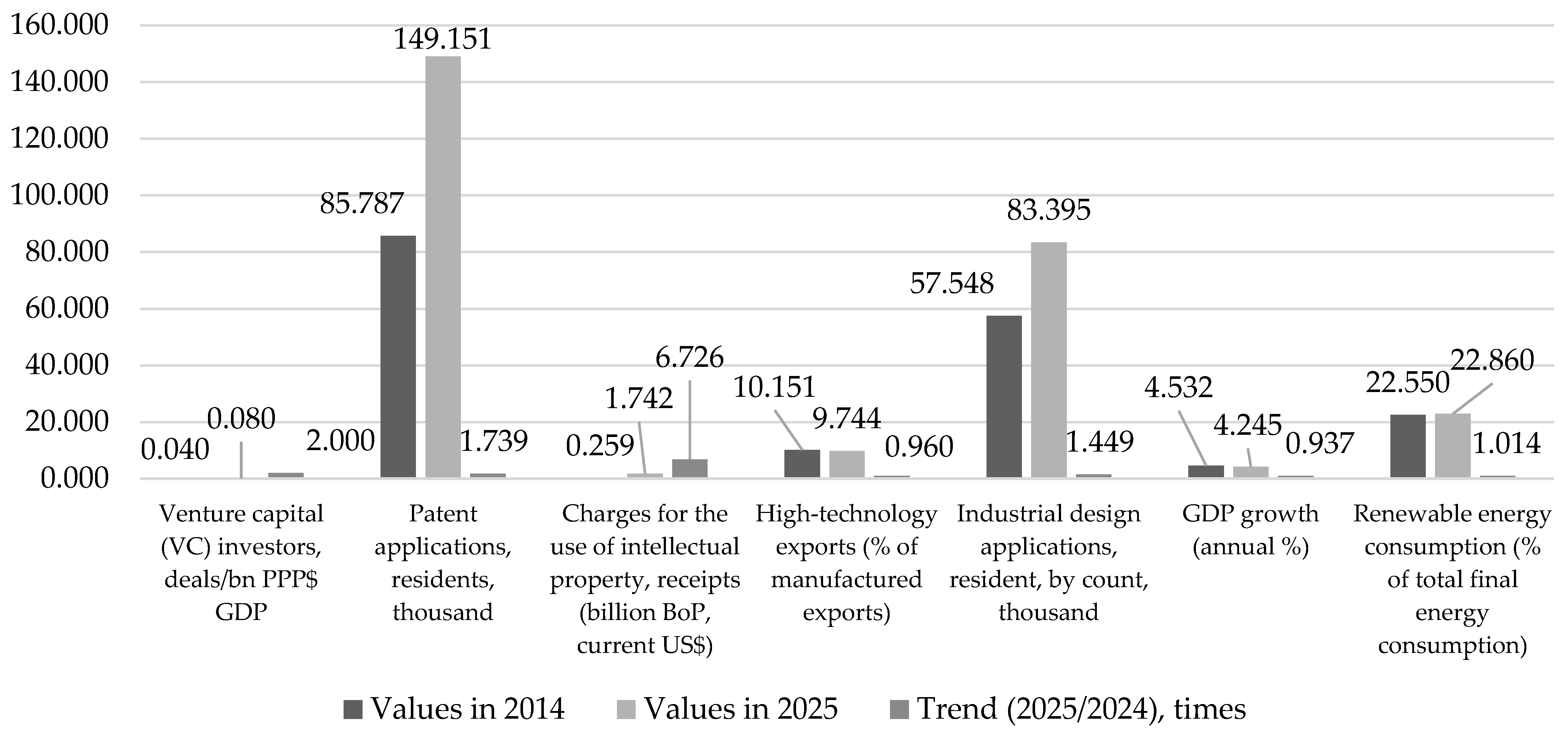
Within the second stage of the research, to solve the task of developing recommendations to improve the risk management of venture investing in the age of global uncertainty, we conducted the trend analysis of the data from Table 1. Its results are shown in Figure 1.
The analysis in Figure 1 highlights two trends of growth of the risk burden on venture investing in BRICS+: a slowdown of the annual rate of economic growth by 0.93 times (from 4.532% in 2014 to 4.245% in 2025) and a reduction in the share of high-tech exports in the structure of industrial exports by 0.96 times (from 10.151% in 2014 to 9.744% in 2025).
In the last four years, the value of deals in an innovative financial economy, concluded by venture investors, grew by two times (from 0.04 bn PPP$ GDP in 2014 to 0.08 bn PPP$ GDP in 2025). In isolation from the revealed trends of the growth of the risk burden on venture investing in BRICS+ with the preservation of only the investment trend by 2029, it is possible to expect an increase in the value of deals in an innovative financial economy, concluded by venture investors, in BRICS+, up to 0.16 bn PPP$ GDP.
The trends of the past (2014–2025) regarding the growth of risk burden on venture investing in BRICS+ will remain until 2036; the forecast includes the slowdown of the annual rate of economic growth by 6.24% (down to 3.98% by 2036) and a reduction in the share of high-tech exports in the structure of industrial exports by 4.04% (down to 9.35% in 2036).
This allows us to expect a reduction (compared to 2025) in the value of deals in an innovative financial economy, concluded by venture investors, by 3.55% (down to 0.077 bn PPP$ GDP). To avoid an increase in the risk burden and accelerate the development of an innovative financial economy in the age of global uncertainty, the recommendations for the countries of BRICS+ include raising the revenue from selling rights for intellectual property objects with a higher rate compared to recent years (in particular, the revenue grew only by 5.26% in 2026 compared to 2026) and making a transition from a decrease to an increase in the share of high-tech exports in the structure of industrial exports.

4. Discussion

Scientific results, obtained in this paper, contribute to the literature by Akadiri and Ozkan (2025), Ben Ameur et al. (2025), Glavina (2024), Li et al. (2025), P. Luo and Liu (2025), and Sofyanty et al. (2025), ensuring the development of the concept of the risk management of venture investing (within the theory of financial economy) through a specification of the contribution of the set of the accessible management tools to the fight against the risks of venture investing (Table 4).
As shown in Table 4, in the conditions of high global uncertainty (2014–2025) in BRICS+, such market-based risk management tools for venture investing as the stimulation of patenting of innovations (unlike Galoyan et al., 2023) and the popularisation of industrial design (unlike Tadevosyan, 2023) proved inefficient in BRICS+.
It was proven that, in BRICS+, such market tools of risk management of venture investing as the export of intellectual property objects (in support of Civelek et al. (2024)) and stimulation of the development of domestic world brands and their products (in support of Sozinova et al. (2023)) are characterised by the highest return and are the main ones.
Unlike Sngryan (2022), it was revealed that such a government tool of risk management of venture investing in BRICS+, such as raising customs duties, is efficient only in a high-risk environment of the financial economy. This tool is inefficient in a low-risk environment (in the era of free trade), and it became the main one (most efficient) in the era of global uncertainty.
Standard factors that influence venture investing and are amenable, to a certain extent, to state risk management of venture investing are much less significant in BRICS+ in the age of global uncertainty. They include economic growth (unlike Nguyen & Lee, 2025; Pradhan et al., 2017), which is insignificant for venture investing, and energy transition (unlike Heeß et al., 2026; Jiancheng et al., 2026; Kolte et al., 2023; Bergougui et al., 2026; Lin & Xie, 2024), the return on which is substantial, but this tool of the risk management of venture investing in the age of global uncertainty has become secondary. Therefore, state management of the risks of venture investing in BRICS+ in the age of global uncertainty has moved to the background.
As a result of the conducted correlation and regression analysis, multiple R business checks, and their results, we confirmed all three assumptions of research model (1). On the circle of interconnected variables and the character of the connection between them, we derived the following results: the assumption of the presence of functional (at which a certain value of the factor variable corresponds to the strictly determined value of the resultant variable) connection between the value of deals in an innovative financial economy, made by venture investors (VID), and the factors that influence it; indicators of the efficiency of using the tools of market management of venture investing risks—MMRvi1, MMRvi2, MMRvi3, MMRvi4, Egr and Etr—this connection was described mathematically with the help of model (2) for 2014–2025.
On the significance of the indicators (factors): The indicators are included in the model based on the following theoretical substantiation of their significance and the expedience of their inclusion (they have a significant effect on the final result). The four factor variables are as follows: (1) level of patenting of innovations in the country in value terms (MMRvi1); (2) revenues from the export of intellectual property objects (MMRvi2); (3) high-tech exports (MMRvi3); (4) created domestic objects of industrial design in value terms (MMRvi4) are generally recognised standard tools of market management of venture investing risks. The control variables are economic growth rate (Egr) and energy transition (Etr): They are generally recognised standard factors that influence venture investing and are amenable, to a certain extent, to state risk management of venture investing. Given the absence of a close correlation among the explanatory factors (MMRvi1, MMRvi2, MMRvi3, MMRvi4, Egr and Etr), which would have distorted the evaluation results, this was confirmed by the compiled correlation matrix in Table 2. At the same time, this matrix revealed the interconnection between the studied variables, emphasising the experience of their systemic study, which is conducted in this paper.
Thus, the hypothesis H has been proven. In support of Annin et al. (2025), Bai and Wang (2025), and Shen (2025) and by the example of BRICS+, we demonstrated that, in the era of global uncertainty (considered by the example of 2014–2025), the most efficient tools are the market tools of risk management of venture investing in an innovative financial economy (which includes high-tech exports and the export of intellectual property objects) with the secondary importance of the government tools (which is brought down to the acceleration of economic growth and energy transition), which are the key ones in the era of free trade.

5. Conclusions

Summing up this research, let us highlight its main results. We have compiled an econometric model of the effectiveness of risk management in venture investing in an innovative financial economy, BRICS+, amid global uncertainty.
Based on the created model, we revealed differences in approaches to managing the investment mechanism in an innovative financial economy depending on the level of risk in it. In the era of free trade, the approach involved using two risk management tools for venture investing within state management of an innovative economy: the acceleration of economic growth and energy transition. In the current era of global uncertainty, there is a need for a new approach. It was developed in this paper, and it involves the foundation of the tools of market management: high-tech exports and the export of intellectual property objects.
Perspectives of accelerating the development of an innovative financial economy BRICS+ in the era of global uncertainty are connected with the revision of the approach to managing the investment mechanism in an innovative financial economy. If the past (2014–2025) trends of the growth of risk burden on venture investing are preserved in BRICS+ by 2036, the forecast is a slowdown of the annual rate of economic growth by 6.24% and a reduction in the share of high-tech exports in the structure of industrial exports by 4.04%. Due to this, a decline (compared to 2025) in the value of deals in an innovative financial economy, concluded by venture investors, by 3.55% is expected (down to 0.077 bn PPP$ GDP).
To avoid an increase in the risk burden and accelerate the development of an innovative financial economy in the age of global uncertainty, recommendations for the countries of BRICS+ include raising revenue from the realisation of rights for intellectual property objects with a higher rate compared to recent years and making a transition to the growth of the share of high-tech exports in the structure of industrial exports.
A new econometric model expanded the scientific view of the effectiveness of risk management in venture investing in an innovative financial economy in the conditions of uncertainty, dealing with the disadvantages of previous models and possessing a range of advantages compared to them. The proprietary model’s advantages include the disclosure of the poorly studied experience of developing countries, consideration of global uncertainty (in the world economy), and a large period of empirical study of the economies of the countries of BRICS+, which covers 2014–2025 and ensures a fuller and more precise and reliable interpretation of the dynamics of risks of venture investing and return on the measures of risk management in these countries.
It should be noted that the limitations of the paper’s results, based on the new compiled econometric model of the effectiveness of risk management in venture investing in an innovative financial economy, include the focus on the experience of BRICS+ and a generalised view of the period of global uncertainty. To deal with these limitations in future scientific works, it would be expedient to conduct further research encompassing the experience of other developing countries and comparing them with developed countries.
Also, in the course of future scientific research, it would be expedient to differentiate global uncertainties, in particular, with the allocation of uncertainty caused by the pandemic (2020–2023) and its side effects, post-pandemic uncertainty, etc. In future scientific works, it is offered to compare and reveal the specifics of the risks of venture investing and their risk management in the conditions of each specific global uncertainty.

Author Contributions

Conceptualization, E.G.P.; methodology, N.S.K.; formal analysis, Y.V.C.; investigation, G.M.A.; data curation, N.S.K.; writing—original draft preparation, Y.V.C.; writing—review and editing, E.G.P.; visualization, G.M.A.; supervision, E.G.P.; project administration, N.S.K.; All authors have read and agreed to the published version of the manuscript.

Funding

This research received no external funding.

Institutional Review Board Statement

Not applicable.

Informed Consent Statement

Not applicable.

Data Availability Statement

Data is contained within the article and will be made available on request.

Conflicts of Interest

The authors declare no conflict of interest.

References

  1. Aas, T. H., Rossfjord, M., & Østlie, K. (2025). Evaluating innovation in equity investment decisions: Insights from venture capital, private equity and equity fund perspectives. International Journal of Innovation Management, 29(9–10), 2540014. [Google Scholar] [CrossRef]
  2. Akadiri, S. S., & Ozkan, O. (2025). Energy, critical minerals, and precious metals: Navigating interconnectedness and portfolio strategies in investment risk management. Resources Policy, 110, 105747. [Google Scholar] [CrossRef]
  3. Angrist, J. D., & Pischke, J.-S. (2009). Mostly harmless econometrics. Princeton University Press. [Google Scholar]
  4. Annin, K., Ababio, K. A., & Sarpong, S. (2025). Dynamic risk spillover in international real estate investment trusts: Implications for asset investors. Asia Pacific Financial Markets, 32(4), 1519–1550. [Google Scholar] [CrossRef]
  5. Arellano, M. (2003). Panel data econometrics. Oxford University Press. [Google Scholar]
  6. Aydın, A. (2026). The impact of economic factors on environmental degradation: Price instability, monetary growth and renewable energy investments. Journal of Economic Studies, 53(1), 123–134. [Google Scholar] [CrossRef]
  7. Bai, Z., & Wang, P. (2025). From medium to risk factor: How crypto investment elevates fraud victimisation. Finance Research Letters, 86, 108592. [Google Scholar] [CrossRef]
  8. Baker, S. R., Bloom, N., & Davis, S. J. (2016). Measuring economic policy uncertainty. Quarterly Journal of Economics, 131(4), 1593–1636. [Google Scholar] [CrossRef]
  9. Baltagi, B. H. (2021). Econometric analysis of panel data (6th ed.). Wiley. [Google Scholar]
  10. Ben Ameur, H., Ftiti, Z., & Louhichi, W. (2025). Do ESG investments improve portfolio diversification and risk management during times of uncertainty. Journal of International Financial Markets Institutions and Money, 103, 102199. [Google Scholar] [CrossRef]
  11. Bergougui, B., Ghosh, S., Doğan, B., Samour, A., & Nepal, R. (2026). When does high-tech research investment enable green energy transition? Energy Conversion and Management X, 30, 101598. [Google Scholar] [CrossRef]
  12. Bezrukova, T. L., Gyiazov, A. T., & Bazieva, A. M. (2016). Modelling and forecasting of innovative development of entrepreneurial structures under the global competition. Actual Problems of Economics, 182(8), 344–351. [Google Scholar]
  13. Bloom, N. (2009). The impact of uncertainty shocks. Econometrica, 77(3), 623–685. [Google Scholar] [CrossRef]
  14. Bogoviz, A. V., Lobova, S. V., Ragulina, Y. V., Luchitskaya, L. B., & Shutova, T. V. (2017). Boosting innovative activity in companies: Problems and potential. Journal of Applied Economic Sciences, 12(6), 1690–1701. [Google Scholar]
  15. Cameron, A. C., & Trivedi, P. K. (2005). Microeconometrics: Methods and applications. Cambridge University Press. [Google Scholar]
  16. Cameron, A. C., & Trivedi, P. K. (2022). Microeconometrics using stata (3rd ed.). Stata Press. [Google Scholar]
  17. Civelek, M., Kljucnikov, A., Hajduk, L., Hlawiczka, R., & Durda, L. (2024). Marketing innovation: The role of internal and external factors from a resource-based view and institutional theory perspective. Transformations in Business and Economics, 23(3A (63A)), 826–846. [Google Scholar]
  18. Diebold, F. X. (2015). Time series econometrics. Princeton University Press. [Google Scholar]
  19. Enders, W. (2015). Applied econometric time series (4th ed.). Wiley. [Google Scholar]
  20. Engle, R. F., & Granger, C. W. J. (1987). Co-integration and error correction: Representation, estimation, and testing. Econometrica, 55(2), 251–276. [Google Scholar] [CrossRef]
  21. Ettayib, M., Trari, M.-H., & Mimouni, Y. (2025). The asymmetric impact of economic policy uncertainty, trade and geopolitical risk on firm-level investment in BRICS countries fresh insights from multiple thresholds NARDL approach. SN Business and Economics, 5(10), 153. [Google Scholar] [CrossRef]
  22. Ewens, M., Nanda, R., & Rhodes-Kropf, M. (2018). Cost of experimentation and the evolution of venture capital. Journal of Financial Economics, 128(3), 422–442. [Google Scholar] [CrossRef]
  23. Fama, E. F., & French, K. R. (1993). Common risk factors in the returns on stocks and bonds. Journal of Financial Economics, 33, 3–56. [Google Scholar] [CrossRef]
  24. Feng, Y., Hao, B., & Huang, J. (2026). Shaping the link: Venture capitalists’ investment portfolio and start-ups’ technological portfolio. Journal of Small Business Management, 1, 1–35. [Google Scholar] [CrossRef]
  25. Galoyan, D., Mkrtchyan, T., Hrosul, V., Buhrimenko, R., Smirnova, P., & Balamut, H. (2023). Formation of adaptation strategy for business entities in the context of digital transformation of the economy. Review of Economics and Finance, 21(1), 616–621. [Google Scholar]
  26. Glavina, S. (2024). AI in financial industry: Ethic issues. Journal of Trends and Challenges in Artificial Intelligence, 1(1), 15–20. [Google Scholar] [CrossRef]
  27. Gompers, P., & Lerner, J. (2001). The venture capital revolution. Journal of Economic Perspectives, 15, 145–168. [Google Scholar] [CrossRef]
  28. Gompers, P., & Lerner, J. (2004). The venture capital cycle (2nd ed.). MIT Press. [Google Scholar]
  29. Greene, W. H. (2018). Econometric analysis (8th ed.). Pearson. [Google Scholar]
  30. Griliches, Z. (1990). Patent statistics as economic indicators: A survey. Journal of Economic Literature, 28(4), 1661–1707. [Google Scholar]
  31. Guo, Y., Yang, C., & Pan, F. (2025). Strategic coupling in global financial networks: Divergent trajectories of domestic and foreign venture capital investments in the Yangtze River Delta, China. Geoforum, 166, 104406. [Google Scholar] [CrossRef]
  32. Gyamfi, B. A., Yadav, A., Agozie, D. Q., & Asongu, S. A. (2026). Renewable energy, Public–Private partnership investment, technological innovation and trade in Malaysia: Examining the economic growth threshold. Renewable Energy, 259, 125160. [Google Scholar] [CrossRef]
  33. Hall, B. H., Jaffe, A., & Trajtenberg, M. (2005). Market value and patent citations. RAND Journal of Economics, 36(1), 16–38. [Google Scholar]
  34. Hamilton, J. D. (1994). Time series analysis. Princeton University Press. [Google Scholar]
  35. Hamilton, J. D. (2020). Time series analysis (2nd ed.). Princeton University Press. [Google Scholar]
  36. Hao, B., Feng, Y., Tan, H., & Ye, M. (2025). Taking a second look at the bait: Attention to upside potential versus downside risk in venture capitalists’ staged investment. Entrepreneurship Theory and Practice, 49(1), 283–311. [Google Scholar] [CrossRef]
  37. Hayashi, F. (2000). Econometrics. Princeton University Press. [Google Scholar]
  38. Heeß, P., Schönecker, J., Weibelzahl, M., & Wolf, L. (2026). Navigating the energy transition: A review of factors influencing renewable energy investments. Renewable and Sustainable Energy Reviews, 228, 116416. [Google Scholar] [CrossRef]
  39. Hellmann, T., & Puri, M. (2002). Venture capital and the professionalization of start-up firms. Journal of Finance, 57(1), 169–197. [Google Scholar] [CrossRef]
  40. Ho, T. L., Nguyen, B.-C. X., & Ho, T. H. (2026). Is there a trade-off between economic growth, foreign direct investment, international trade and environmental degradation? A comparison between Asian developed and developing countries. Foreign Trade Review, 61(1), 53–78. [Google Scholar] [CrossRef]
  41. Hoch, F., & Lohwasser, T. S. (2023). No risk no funding? The distinct effects of institutional strength and institutional stability on venture capital investments. International Journal of Entrepreneurial Venturing, 15(2), 184–211. [Google Scholar] [CrossRef]
  42. Jiancheng, X., Boateng, S. A., Karikari, F. A., Khan, S., Sackitey, G. M., & Fumey, M. P. (2026). Financial markets and renewable energy transitions: Evidence from energy investment, domestic credit, market capitalisation and institutional quality. Energy, 346, 140286. [Google Scholar] [CrossRef]
  43. Kaplan, S. N., & Strömberg, P. (2003). Financial contracting theory meets the real world. Review of Economic Studies, 70, 281–315. [Google Scholar]
  44. Kaplan, S. N., & Strömberg, P. (2004). Characteristics, contracts, and actions: Evidence from venture capitalist analyses. Journal of Finance, 59(5), 2177–2210. [Google Scholar]
  45. Khan, S., Ullah, A., Pinglu, C., & Kashif, M. (2025). Impact of financial technology innovation on sustainable transition finance: The moderating role of globalisation in BRI, advanced and emerging economies. Clean Technologies and Environmental Policy, 27(3), 1479–1503. [Google Scholar] [CrossRef]
  46. Kolte, A., Festa, G., Ciampi, F., Meissner, D., & Rossi, M. (2023). Exploring corporate venture capital investments in clean energy—A focus on the Asia-Pacific region. Applied Energy, 334, 120677. [Google Scholar] [CrossRef]
  47. Korteweg, A., & Sørensen, M. (2010). Risk and return characteristics of venture capital-backed entrepreneurial companies. Review of Financial Studies, 23(10), 3738–3772. [Google Scholar]
  48. Kortum, S., & Lerner, J. (2000). Assessing the contribution of venture capital to innovation. RAND Journal of Economics, 31, 674–692. [Google Scholar]
  49. La Porta, R., Lopez-de-Silanes, F., Shleifer, A., & Vishny, R. (1998). Law and finance. Journal of Political Economy, 106(6), 1113–1155. [Google Scholar] [CrossRef]
  50. Lerner, J. (2009). Boulevard of broken dreams: Why public efforts to boost entrepreneurship and venture capital have failed. Princeton University Press. [Google Scholar]
  51. Li, X., Zhang, Q., & Fan, Z. R. (2025). Managerial overconfidence, inefficient investment and stock price crash risk. Finance Research Letters, 83, 107685. [Google Scholar] [CrossRef]
  52. Lin, B., & Xie, Y. (2024). Driving renewable energy innovation investments: Is venture capital a novel strategic choice? Evidence from China. Renewable Energy, 237, 121856. [Google Scholar] [CrossRef]
  53. Litvinova, T. N. (2022). Risks of Entrepreneurship amid the COVID-19 crisis. Risks, 10(8), 163. [Google Scholar] [CrossRef]
  54. Liu, X.-Y., He, W., Duan, H.-P., & Fan, R. (2024). The impact of financial sanctions on economic policy uncertainty: Global evidence. Pacific Basin Finance Journal, 88, 102558. [Google Scholar] [CrossRef]
  55. Luo, P., & Liu, X. (2025). Dynamic investment in new technology and risk management. Review of Quantitative Finance and Accounting, 65(2), 817–835. [Google Scholar] [CrossRef]
  56. Luo, X. (2025). Benefits and risks of corporate investment under the constraints of transnational investment laws. International Review of Economics and Finance, 104, 104677. [Google Scholar] [CrossRef]
  57. Matevosyan, A., Grigoryan, A., Khachatryan, M., Matevosyan, M., Israyelyan, S., & Hovakanyan, L. (2024). The Recommended approach to eps risk factor assessment. Journal of Lifestyle and SDGs Review, 5(1), e03015. [Google Scholar] [CrossRef]
  58. Metrick, A., & Yasuda, A. (2011). Venture capital and the finance of innovation (2nd ed.). Wiley. [Google Scholar]
  59. Milanzi, S. A. (2026). Governance-driven synergies between foreign direct investment, renewable energy capacity, and economic growth. Journal of Governance and Regulation, 15(1), 243–250. [Google Scholar] [CrossRef]
  60. Nassani, A. A., Imran, M., Khan, S., Zaman, K., Khan, H. U. R., & Haffar, M. (2025). Financial integration and economic growth: Impact of renewable energy investments, technology transfer, and climate change on Europe and Central Asian economies. Financial Innovation, 11(1), 41. [Google Scholar] [CrossRef]
  61. Newey, W. K., & West, K. D. (1987). A simple, positive semi-definite, heteroskedasticity and autocorrelation consistent covariance matrix. Econometrica, 55(3), 703–708. [Google Scholar] [CrossRef]
  62. Nguyen, A. T., & Lee, S.-H. (2025). The relationship between trade openness, foreign direct investment, government expenditure, and economic growth in ASEAN countries. Economics Innovative and Economics Research Journal, 13(4), 55–72. [Google Scholar] [CrossRef]
  63. Nikian, A., Khademi Zare, H., Lotfi, M. M., & Fallah Nezhad, M. S. (2023). Redesign of a sustainable and resilient closed-loop supply chain network under uncertainty and disruption caused by sanctions and COVID-19. Operations Management Research, 16(2), 1019–1042. [Google Scholar] [CrossRef]
  64. Oyetunji, A. K., Omotayo, T., & Zulu, S. (2025). Influence of Flood risk awareness and communication on real estate investment decision-making. Sage Open, 15(4), 21582440251387868. [Google Scholar] [CrossRef]
  65. Phillips, P. C. B. (1986). Understanding spurious regressions in econometrics. Journal of Econometrics, 33(3), 311–340. [Google Scholar] [CrossRef]
  66. Pradhan, R. P., Arvin, M. B., Nair, M., & Bennett, S. E. (2017). Venture capital investment, financial development, and economic growth: The case of European single market countries. Venture Capital, 19(4), 313–333. [Google Scholar] [CrossRef]
  67. Puri, M., & Zarutskie, R. (2012). On the life cycle dynamics of venture-capital- and non-venture-capital-financed firms. Journal of Finance, 67(6), 2247–2293. [Google Scholar]
  68. Rajan, R. G., & Zingales, L. (1998). Financial dependence and growth. American Economic Review, 88(3), 559–586. [Google Scholar]
  69. Shen, W. (2025). Optimal investment and risk control for an insurer in a jump-diffusion market with regime-switching. Methodology and Computing in Applied Probability, 27(4), 95. [Google Scholar] [CrossRef]
  70. Shi, H., Li, T., Yang, F., & Qiao, L. (2025). Modeling uncertainties associated with single-valued neutrosophic multi-attribute decision-making for performance evaluation of risk investment in small and medium-sized high-technology venture enterprises. Neutrosophic Sets and Systems, 75, 319–340. [Google Scholar] [CrossRef]
  71. Sngryan, S. (2022). Assessing the effects of trade liberalisation with third countries: The case of the Eurasian Economic Union. Journal of Liberty and International Affairs, 8(2), 35–46. [Google Scholar] [CrossRef]
  72. Sofyanty, D., Romadhoni, R., Handriadi, H., Makhsudovna, I. S., Anwar, Z., & Mamadiyarov, Z. (2025). Strategic decision analysis for investment portfolios: Computational risk assessment in transportation asset management. Journal of Applied Science Engineering Technology and Education, 7(2), 337–348. [Google Scholar] [CrossRef]
  73. Sozinova, A. A., Denisov, I. V., Benčič, S., & Stolyarov, N. O. (2023). Intellectual economic growth in the ‘knowledge economy’ as the basis for the development of international trade in modern global markets. International Journal of Trade and Global Markets, 18(2–3), 230–241. [Google Scholar] [CrossRef]
  74. Stock, J. H., & Watson, M. W. (2015). Introduction to econometrics (3rd ed.). Pearson. [Google Scholar]
  75. Tadevosyan, R. (2023). Innovations and international competitiveness: Countrylevel evidence. Economics and Sociology, 16(3), 248–260. [Google Scholar] [CrossRef]
  76. Tsay, R. S. (2010). Analysis of financial time series (3rd ed.). Wiley. [Google Scholar]
  77. Tsay, R. S. (2023). Financial time series and their characteristics. Wiley. [Google Scholar]
  78. Vazirani, A., & Bhattacharjee, T. (2026a). The impact of time constraints on new venture investment decisions: An experimental study. Venture Capital, 28(1), 93–117. [Google Scholar] [CrossRef]
  79. Vazirani, A., & Bhattacharjee, T. (2026b). Why new venture investors overvalue some investment proposals and undervalue others: Experimental evidence. Journal of Alternative Investments, 28(3), 68–93. [Google Scholar] [CrossRef]
  80. WIPO. (2025). Global innovation index 2025. Available online: https://www.wipo.int/web-publications/global-innovation-index-2025/en/gii-2025-results.html (accessed on 8 December 2025).
  81. Wooldridge, J. M. (2010). Econometric analysis of cross section and panel data (2nd ed.). MIT Press. [Google Scholar]
  82. Wooldridge, J. M. (2020). Introductory econometrics: A modern approach (7th ed.). Cengage. [Google Scholar]
  83. World Bank. (2026a). Charges for the use of intellectual property, receipts (BoP, current US$). Available online: https://data.worldbank.org/indicator/BX.GSR.ROYL.CD (accessed on 24 February 2026).
  84. World Bank. (2026b). GDP growth (annual %). Available online: https://data.worldbank.org/indicator/NY.GDP.MKTP.KD.ZG (accessed on 24 February 2026).
  85. World Bank. (2026c). High-technology exports (% of manufactured exports). Available online: https://data.worldbank.org/indicator/TX.VAL.TECH.MF.ZS (accessed on 24 February 2026).
  86. World Bank. (2026d). Industrial design applications, resident, by count. Available online: https://data.worldbank.org/indicator/IP.IDS.RSCT (accessed on 24 February 2026).
  87. World Bank. (2026e). Patent applications, residents. Available online: https://data.worldbank.org/indicator/IP.PAT.RESD (accessed on 24 February 2026).
  88. World Bank. (2026f). Renewable energy consumption (% of total final energy consumption). Available online: https://data.worldbank.org/indicator/EG.FEC.RNEW.ZS (accessed on 24 February 2026).
  89. Xu, X., Tan, L., & Zhao, J. (2025). Sustainable finance and renewable energy investment as dual drivers of economic growth and environmental sustainability in the European Union. Research in Economics, 79(4), 101065. [Google Scholar] [CrossRef]
  90. Xue, L., Zhang, Y., Xiao, Y., & He, L. (2026). Corporate venture capital (CVC) investments and digital transformation: Analysis of moderating effects based on industry level. Technology Analysis and Strategic Management, 38(2), 140–154. [Google Scholar] [CrossRef]
  91. Ye, Y. (2025). Monetary policy uncertainty, inefficient investment, and stock price crash risk. Finance Research Letters, 85, 108064. [Google Scholar] [CrossRef]
  92. Zhang, L., Jia, J., & Cai, X. (2025). The impact of China’s outward foreign direct investment on the external risk exposure of industrial chains in countries along the belt and road. Sustainability, 17(21), 9547. [Google Scholar] [CrossRef]
  93. Zhou, B., Qin, M., & Zhan, F. (2025). Industrial policy, enterprise investment risk taking and innovative activities. Finance Research Letters, 86, 108526. [Google Scholar] [CrossRef]
Figure 1. Results of the trend analysis. Source: Authors.
Jrfm 19 00200 g001
Table 1. Factors and results of risk management of venture investing in an innovative financial economy.
YearCountries of BRICS+ Venture Capital (VC) Investors, Deals/bn PPP$ GDPPatent Applications, Residents, ThousandCharges for the Use of Intellectual Property, Receipts (Billion BoP, Current US$)High-Technology Exports (% of Manufactured Exports)Industrial Design Applications, Resident by Count, ThousandGDP Growth (Annual %)Renewable Energy Consumption (% of Total Final Energy Consumption)
VIDMMRvi1MMRvi2MMRvi3MMRvi4EGrETr
2014Brazil0.0004.660.3812.373.690.5041.70
China0.100801.140.6829.70548.437.4611.90
Egypt0.0000.750.001.251.832.925.40
Ethiopia0.0000.000.009.130.0010.2691.40
India0.10012.040.669.226.177.4133.90
Indonesia0.0000.700.069.332.535.0129.30
Iran0.00013.680.001.558.774.980.90
Russia0.00024.070.6712.133.180.743.30
SAR0.1000.800.146.660.771.417.60
UAE0.1000.030.0010.170.114.630.10
2015Brazil0.0004.640.5814.493.29−3.5543.70
China0.100968.251.0830.43551.486.9812.20
Egypt0.0000.720.000.801.634.375.30
Ethiopia0.0000.020.006.190.0010.3991.50
India0.10012.580.478.026.838.0033.40
Indonesia0.0001.060.058.892.654.8826.60
Iran0.0000.000.001.430.00−1.420.90
Russia0.00029.270.7315.992.62−1.973.20
SAR0.1000.890.137.410.721.327.60
UAE0.1000.040.005.300.077.090.10
2016Brazil0.0005.200.6516.003.40−3.2845.40
China0.1001204.981.1630.25631.956.7812.60
Egypt0.0000.920.000.501.754.355.10
Ethiopia0.0000.010.006.830.009.4390.40
India0.10013.200.527.666.758.2633.00
Indonesia0.0001.100.058.002.585.0327.80
Iran0.00014.930.001.4015.818.821.00
Russia0.00026.800.5515.792.910.193.40
SAR0.1000.700.146.661.090.667.80
UAE0.1000.060.002.620.085.660.10
2017Brazil0.0005.480.6414.313.531.3245.30
China0.1001245.714.8030.91610.826.8913.10
Egypt0.0001.030.000.572.064.184.90
Ethiopia0.0000.010.005.840.009.5690.80
India0.10014.960.667.367.536.8032.50
Indonesia0.0002.270.058.452.325.0725.20
Iran0.00015.260.001.3617.823.031.00
Russia0.00022.780.7312.323.791.833.20
SAR0.1000.730.165.681.011.167.90
UAE0.1000.060.002.840.11−1.060.20
2018Brazil0.0004.980.8314.743.701.2246.90
China0.1001393.825.5631.55689.106.0713.50
Egypt0.0001.000.000.861.675.555.00
Ethiopia0.0000.010.0113.650.008.3690.00
India0.10016.290.789.048.933.8732.90
Indonesia0.0001.410.068.212.435.0222.00
Iran0.00011.910.000.7214.61−2.361.00
Russia0.00024.930.8811.363.822.203.20
SAR0.1000.660.185.270.980.268.00
UAE0.1000.060.002.900.051.270.30
2019Brazil0.0005.460.6414.074.23−3.2847.50
China0.1001243.576.6030.82691.772.3414.30
Egypt0.0001.030.002.351.723.556.20
Ethiopia0.0000.000.009.420.006.0689.30
India0.10019.450.8710.229.38−5.7833.50
Indonesia0.0003.090.068.091.80−2.0719.80
Iran0.00011.570.000.9317.494.441.00
Russia0.00023.341.0112.914.41−2.653.20
SAR0.1000.570.154.900.98−6.178.70
UAE0.1000.060.003.000.07−8.690.70
2020Brazil0.0005.280.6311.354.264.7650.00
China0.1001344.828.5831.28752.348.5714.90
Egypt0.0000.980.002.551.763.296.70
Ethiopia0.0000.010.0013.100.005.6490.70
India0.10023.141.2511.038.969.6936.10
Indonesia0.0001.310.088.422.303.7021.90
Iran0.00011.400.000.7514.904.130.90
Russia0.00023.761.169.194.825.873.70
SAR0.1000.540.135.620.974.869.80
UAE0.1000.040.005.380.054.550.90
2021Brazil0.0004.670.719.004.523.0246.50
China0.1001426.6411.7630.22785.863.1315.20
Egypt0.0000.880.003.172.256.596.10
Ethiopia0.0000.000.008.550.005.3290.60
India0.10026.270.8710.2117.507.6134.90
Indonesia0.0001.400.127.202.965.3120.20
Iran0.00010.210.000.3813.904.350.90
Russia0.00019.571.449.736.13−1.443.50
SAR0.1001.800.145.550.732.069.70
UAE0.1000.070.008.960.107.511.00
2022Brazil0.0004.670.759.114.523.2446.50
China0.1001426.6413.3127.77785.865.4115.20
Egypt0.0000.880.163.402.253.766.10
Ethiopia0.0000.000.003.210.006.5990.60
India0.10026.271.1712.6817.509.1934.90
Indonesia0.0001.400.218.312.965.0520.20
Iran0.00010.210.000.8113.905.330.90
Russia0.00019.570.749.736.134.083.50
SAR0.1001.800.215.520.730.819.70
UAE0.1000.070.009.290.104.301.00
2023Brazil0.1004.670.929.854.523.4246.50
China0.1001426.6410.9126.57785.864.9815.20
Egypt0.0000.880.003.162.252.406.10
Ethiopia0.0000.000.003.750.007.6190.60
India0.10026.271.5314.9317.506.4934.90
Indonesia0.0001.400.219.082.965.0320.20
Iran0.00010.210.000.8113.903.660.90
Russia0.00019.570.639.736.134.343.50
SAR0.1001.800.174.960.730.539.70
UAE0.3000.073.518.960.103.991.00
2024Brazil0.1004.671.0911.114.523.4246.50
China0.1001426.6410.1326.28785.864.9815.20
Egypt0.0000.880.003.812.252.406.10
Ethiopia0.0000.000.003.750.007.6190.60
India0.10026.271.7318.5717.506.4934.90
Indonesia0.0001.400.198.712.965.0320.20
Iran0.00010.210.000.8113.903.660.90
Russia0.00019.570.559.736.134.343.50
SAR0.1001.800.225.710.730.539.70
UAE0.4000.073.518.960.103.991.00
2025Brazil0.1004.671.0911.114.523.4246.50
China0.2001426.6410.1326.28785.864.9815.20
Egypt0.0000.880.003.812.252.406.10
Ethiopia0.0000.000.003.750.007.6190.60
India0.10026.271.7318.5717.506.4934.90
Indonesia0.0001.400.198.712.965.0320.20
Iran0.00010.210.000.8113.903.660.90
Russia0.00019.570.559.736.134.343.50
SAR0.1001.800.225.710.730.539.70
UAE0.3000.073.518.960.103.991.00
Source: Compiled by the authors based on WIPO (2025), World Bank (2026a, 2026b, 2026c, 2026d, 2026e, 2026f).
Table 2. Correlation matrix.
VIDMMRvi1MMRvi2MMRvi3MMRvi4EGrETr
VID1.0000------
MMRvi10.28821.0000-----
MMRvi20.41010.86631.0000----
MMRvi30.29960.82880.71961.0000---
MMRvi40.28900.99760.86410.82601.0000--
EGr0.02040.16810.09780.12920.17261.0000-
ETr−0.2216−0.1084−0.09560.0731−0.10890.35931.0000
Source: Calculated and compiled by the authors.
Table 3. Results of the regression analysis, correlation analysis, the F-test, and Student’s t-test.
Spheres of AnalysisElements of AnalysisResults of Analysis
Regression statisticsMultiple R0.5133
Standard error0.0604
Observations120
Analysis of variances and the F-test-dfSSMSF
Regression60.14750.02466.7386
Residual1130.41240.0036
Total1190.5599
Significance F0.000004
Level of significance0.001
Coefficients and Student’s t-testVariablesCoefficientsStandard errort-Statp-Value
Y-intercept0.02320.01261.84200.0681
MMRvi1−0.00010.0002−0.71240.4777
MMRvi20.01820.00454.07350.0001
MMRvi30.00300.00132.28540.0242
MMRvi40.00010.00040.18330.8549
EGr0.00240.00181.33520.1845
ETr−0.00080.0002−3.16430.0020
Source: Calculated and compiled by the authors.
Table 4. Risk management of venture investing in the era of global uncertainty compared to the age of free trade.
Type of ToolsTools of Risk Management of Venture InvestingThe Literature in Which the Tools Are Described and Which Is Based on the Experience of the Free Trade AgeReturn (Regression) on the Tools in BRICS+ in the Age of Global Uncertainty (2014–2025)
Market toolsLevel of patenting of innovations in the countryGaloyan et al. (2023)Not achieved (the tool is ineffective)
Export of intellectual property objectsCivelek et al. (2024)The highest (regression: 0.0182, level of significance: 0.001)—the main tool
High-tech exportsSozinova et al. (2023)The highest (regression: 0.0030, level of significance: 0.001)—the main tool
Popularisation of industrial design in the countryTadevosyan (2023)Not achieved (the tool is ineffective)
Standard factors influencing venture investing, which are amenable, to a certain extent, to state risk management of venture investingEconomic growthNguyen and Lee (2025), Pradhan et al. (2017)Not achieved (the tool is ineffective)
Energy transitionHeeß et al. (2026), Jiancheng et al. (2026), Kolte et al. (2023), Bergougui et al. (2026), Lin and Xie (2024)Significant—secondary tool (regression: 0.0024, level of significance: 0.20)
Source: Developed and compiled by the authors.
Disclaimer/Publisher’s Note: The statements, opinions and data contained in all publications are solely those of the individual author(s) and contributor(s) and not of MDPI and/or the editor(s). MDPI and/or the editor(s) disclaim responsibility for any injury to people or property resulting from any ideas, methods, instructions or products referred to in the content.