Article

Moderating Role of Risk Management Committee on Board of Directors’ Characteristics and Corporate Risk Disclosure Nexus: Emerging Market Evidence


by
Malek Hamed Alshirah
1 and
Ahmad Farhan Alshira’h
2,*
1
Department of Accounting, School of Business, Al al-Bayt University, Mafraq 130040, Jordan
2
Department of Accounting, School of Business, The University of Jordan, Amman 11942, Jordan
*
Author to whom correspondence should be addressed.
J. Risk Financ. Manag. 2026, 19(3), 188; https://doi.org/10.3390/jrfm19030188
Submission received: 7 January 2026 / Revised: 8 February 2026 / Accepted: 21 February 2026 / Published: 5 March 2026
(This article belongs to the Special Issue Financial Regulation and Risk Management amid Global Uncertainty)

Abstract

This study investigates the extent of corporate risk disclosure (CRD) in Jordanian non-financial organizations while also looking at the impact of four unique board of directors’ features—namely, board size, the regularity of board meetings, CEO duality, and board experience—on the degree of risk disclosure. The study also examines the risk management committee’s (RMC) moderating function in improving the correlation between the traits of the board of directors and risk disclosure, a subject that has not been covered well in the Jordanian setting. The study analyzed 900 annual reports from non-financial companies listed on the Amman Stock Exchange (ASE) between 2014 and 2023. To evaluate risk disclosure, the reports were subjected to content analysis using counts of risk-related phrases. The hypotheses were tested using a random effects regression model. The number of risk disclosure statements varies from 2 to 10 per business, with an average of 24. Although CEO duality has a detrimental impact on risk disclosure levels, the findings demonstrate that industry sector and board competence have a positive effect. The leverage, the sort of audit company, the size of the firm, the frequency of board meetings, or the size of the board have no discernible effect. In particular, having an RMC significantly enhances the positive effects of board features on risk reporting. This study provides the first empirical data in Jordan on the impact of the RMC on the relationship between the traits of the board of directors and corporate risk disclosure in the non-financial industry. As a result, it fills a major gap in the literature on risk disclosure and corporate governance. Furthermore, it is the first study to use a modern and thorough measure for evaluating risk disclosure while also taking into account data from both before and after the changes to the Jordanian Corporate Governance Code. The study’s findings are made more relevant, rigorous, and contextual by this two-way contribution.

1. Introduction

The business climate has gotten much more complicated in recent years due to fast technological advancements, economic instability, and geopolitical uncertainty, which have left companies vulnerable to a variety of internal and external hazards (Baroma, 2014; Woods et al., 2017). As a result, businesses are under increasing pressure to be open about how they identify, manage, and disclose risks (Ali & Taylor, 2014; Mazumder & Hossain, 2018). Following a number of financial catastrophes and corporate scandals, legislators and regulators have emphasized the significance of increased transparency and accurate financial reporting as ways to rebuild trust and boost market confidence (Ibrahim et al., 2019; Aryani & Hussainey, 2017; Ntim et al., 2013).
Corporate risk disclosure (CRD) is essential for lowering information asymmetry since it gives stakeholders useful information about a company’s risk profile and business uncertainties. Previous research indicates that efficient risk disclosure increases transparency, aids informed decision-making, and boosts stakeholder trust (Hassan, 2009; Abraham & Cox, 2007; Linsley & Shrives, 2006; Cabedo & Tirado, 2004). Due to the fact that no one theory can completely account for companies’ disclosure conduct, the literature on corporate disclosure uses a variety of theoretical viewpoints to account for differences in disclosure practices (Linsley & Shrives, 2000). In the risk disclosure literature, agency theory and signaling theory are two of the most popular frameworks. Agency theory highlights conflicts of interest between managers and shareholders caused by information asymmetry, implying that risk disclosure can lower agency costs by increasing monitoring and accountability (Foerster et al., 2014; Arnold & De Lange, 2004; Solomon et al., 2000). From this vantage point, managers might employ disclosure to show that their actions are in the best interests of shareholders (Watson & Marston, 2002; Latham & Jacobs, 2000).
Signaling theory supports this perspective by suggesting that managers voluntarily disclose risk-related information to demonstrate competence, trustworthiness, and skill in risk management, especially in situations of increased uncertainty (Hassan, 2009; Abraham & Cox, 2007; Linsley & Shrives, 2006). Consequently, companies with greater risks are more inclined to provide comprehensive risk information in order to support performance results and allay investor fears (Agyei-Mensah & Buertey, 2019; Hassanein & Hussainey, 2015; Elshandidy et al., 2013). The intimate connection between agency and signaling theories implies that combining both views yields a more complete account of how businesses disclose risks (Linsley & Shrives, 2005; Watson & Marston, 2002; Morris, 1987).
The majority of empirical data on risk disclosure comes from wealthy countries, despite the increasing literature on the subject (Macchioni et al., 2014; Lajili, 2009; Linsley & Shrives, 2006). Because of disparities in institutional quality, enforcement procedures, and ownership models, the generalizability of these results to developing countries is still uncertain (Nahar et al., 2016). The disclosure habits of emerging economies, which frequently have weaker regulatory enforcement and greater managerial discretion, may be greatly impacted.
When it comes to analyzing business risk disclosure, Jordan is a particularly pertinent case. According to prior research, Jordanian companies’ risk disclosure is still rather low, particularly when it comes to quantitative and future-oriented risk data (Kutum, 2014; Sawalqa, 2014; Al-Shattarat et al., 2010). This deficiency has been linked to principle-based accounting standards, a lack of compulsory disclosure requirements, and enforcement difficulties, all of which contribute to lower transparency and disclosure quality (Alhadab, 2018; Al-Akra & Ali, 2012).
Additionally, empirical data regarding the effects of board characteristics on risk disclosure in Jordan is still lacking, even though disclosure-related choices are made by boards of directors. The extent of risk disclosure is not adequately explored in existing research, which either takes a broad approach to disclosure or concentrates on particular risk groups (Moumen et al., 2016; Elzahar & Hussainey, 2012). Furthermore, despite the growing acknowledgement of RMC as crucial governance mechanisms for improving the quality of risk oversight and disclosure, their moderating role in the link between board traits and risk disclosure has received little attention, particularly in developing nations (Zureigat, 2011; Dong & Zhang, 2008).
In order to fill these gaps, this study offers a thorough analysis of the link between board attributes and the degree to which Jordanian businesses disclose their risks. Additionally, it examines the RMC moderating influence on the development of this connection. This research adds to the corporate governance and disclosure literature by concentrating on a developing market environment. It also provides regulators, politicians, and professionals who are working to raise the bar for transparency and risk reporting with useful information.

2. Theoretical Framework

Scholars have looked at a variety of theoretical viewpoints throughout the years in an attempt to comprehend the governance mechanisms that influence corporate strategic choices (Bruton et al., 2010). The Resource Dependence Theory (RDT) and Agency Theory (AT) have emerged as two of the most important frameworks for studying governance structures and their effects on firm behavior (Clarke, 2014; Hillman et al., 2009). The fundamental issue addressed by AT is the conflict of interest between shareholders and managers. It contends that governance tools, like board monitoring, supervisory responsibilities, and executive incentives, are crucial for aligning managerial behavior with shareholder interests and lowering agency costs (Eisenhardt, 1989). In this structure, the board of directors functions as the main internal control mechanism, overseeing management and making sure that corporate choices are in the shareholders’ best long-term interests (Vitolla et al., 2020). By highlighting the significance of outside resources in determining corporate strategies, the Theory of Resource Dependence broadens this perspective. According to RDT, companies depend on external networks, strategic alliances, and access to financial and informational resources in order to remain competitive and manage uncertainty (Pfeffer & Salancik, 2015). The board, in this view, contributes not just by oversight but also by being able to obtain useful external resources and establish strategic connections for businesses.
The AT offers a compelling explanation for the topic of corporate risk disclosure. In order to prevent scrutiny, safeguard their own interests, or give an excessively upbeat assessment of the company’s performance, managers may have reasons to conceal or minimize risk-related information. As a result, the difference in knowledge between managers and shareholders widens.
To increase transparency and reduce managerial discretion, AT advises that an efficient and independent board actively oversee, review, and approve risk-related disclosures (Rossi & Cebula, 2015; Yoo & Rhee, 2013). This governance role is reinforced by the RMC. From the perspective of AT, the RMC strengthens board oversight by concentrating on the identification, evaluation, and mitigation of organizational risks. By preventing managers from concealing vital risk data, its oversight reduces agency conflicts and enhances the credibility and scope of corporate risk reporting. From an RDT perspective, the RMC offers businesses specialized knowledge, technical skills, and connections to outside resources pertaining to risk. With the aid of this function, the committee assists the organization in dealing with environmental uncertainty and enhances its capacity to provide thorough and forward-looking risk disclosure. The RMC may be viewed as a governance tool that simultaneously promotes internal monitoring (AT) and increases access to strategic resources (RDT) by combining both theoretical lenses. The RMC dual function makes it a vital moderating factor between board characteristics and corporate risk disclosure, especially in developing nations where institutional frameworks are still developing.

3. Literature Review and Hypothesis Development

3.1. Board Size

Increasing the size of the board improves management’s effectiveness by making sure that managers do not exploit shareholders (Singh & Harianto, 1989). Consequently, bigger boards can be better able to settle disagreements between minority and insider owners (Allegrini & Greco, 2013). Additionally, adequate representation on the board of directors likely strengthens the company’s supervisory capacity, which decreases information asymmetry (Pangestuti et al., 2017). According to AT, in this context, a larger board size improves the quality of financial reporting (W. A. W. Ismail et al., 2010; Peasnell et al., 2005; Xie et al., 2003; Klein, 2002; Vafeas, 2000), since larger boards are linked to better managerial supervision, a wider range of expertise, and greater stakeholder representation (Peasnell et al., 2005; Klein, 2002). This guarantees that the public has access to trustworthy and consistent information, such as risk data (Khalil & Maghraby, 2017; Moumen et al., 2016). In a similar vein, W. A. W. Ismail et al. (2010) discovered that larger boards are better at monitoring than smaller ones. Additionally, research by Allegrini and Greco (2013), Wang and Hussainey (2013), Ntim et al. (2013), and Zaheer (2013) has demonstrated a link between board size and disclosure behavior. However, earlier research on the correlation between board size and risk disclosure has yielded contradictory results. For instance, several studies have found a strong correlation between the number of members on the board and the disclosure of corporate risks (Moumen et al., 2016; Elshandidy & Neri, 2015; Al-Shammari, 2014; Nazieh & Ezat, 2014; Mokhtar & Mellett, 2013; Ntim et al., 2013). In contrast, prior studies have suggested that board size has a detrimental impact on corporate risk disclosure (Al-Maghzom et al., 2016; Mousa & Elamir, 2014). As a result, a number of research have found no correlation between the size of the board and the amount of risk disclosure (Khalil & Maghraby, 2017; Allini et al., 2016; Elzahar & Hussainey, 2012). This study predicts a positive correlation between board size and the amount of risk disclosure since prior research has shown that larger boards are more likely to disclose information about risks. Consequently, the following recommendation is made by this study in light of these theoretical perspectives:
H1. 
A positive correlation exists between the size of the board and the extent of risk disclosure.

3.2. Board Meetings

A higher frequency of meetings of the board of directors might improve the efficiency of business management (Vafeas, 1999; Conger et al., 1998). Frequent meetings also put more pressure on management to share more information (Barros et al., 2013). Regular board meetings are seen as a dedication to the ongoing communication between directors and shareholders, which makes it easier to share more complete information (Brick & Chidambaran, 2010). In addition, well-run board meetings are more likely to carry out their responsibilities and oversee the procedures involved in producing financial statements. Frequent board meetings, according to AT, help a board better monitor and advise management, thereby reducing the agency problem (Ntim & Osei, 2011). The RDT asserts that board meetings bring in outside resources, which improves the board’s capacity to monitor. For instance Laksmana (2008), O’Sullivan et al. (2008), and Barros et al. (2013) all discovered a strong relationship between the number of board meetings and the number of voluntary disclosures. The frequency of board meetings is thus likely to be favorably associated with the degree of risk disclosure, according to AT and the discussion above. In light of this, the theory below is proposed:
H2. 
There exists a positive correlation between the frequency of board meetings and the extent of risk disclosure.

3.3. CEO Duality

The board’s capacity to control agency costs is likely to be restricted by the merging of the roles of chairman and CEO into one person (Neifar & Jarboui, 2018; Elzahar & Hussainey, 2012; Li et al., 2008). Furthermore, according to AT, this dual position gives the CEO more personal authority and reduces the board’s regulatory authority (Neifar & Jarboui, 2018; Gul & Leung, 2004), this may have a negative impact on the board’s effectiveness (Samaha et al., 2012) and lead to more informational asymmetry and less transparency. The CEO may have complete control over the board of directors when one individual holds both roles and makes all decisions at the center, raising the possibility of opportunistic behavior. This results in insufficient risk disclosure because a person with two jobs is more likely to give managers priority over shareholders and may restrict shareholders’ access to critical risk information (Al-Shammari, 2014). As a result, businesses with CEO dualism may offer less complete information (Allegrini & Greco, 2013). The connection between corporate reporting and role duality on the board of directors has been examined in a number of studies. Role duality has been linked to risk disclosure (Carmona et al., 2016; Elshandidy & Neri, 2015). In contrast, various research, such as those by Alkurdi et al. (2019), Ibrahim et al. (2019), Musa et al. (2018), Neifar and Jarboui (2018), Elgammal et al. (2018), Ezat and El-Masry (2008) and Al-Shammari (2014), has shown that role duality significantly increases the risk of exposure. Additionally, several studies have demonstrated that there is no discernible relationship between the degree to which businesses disclose risk and the degree of role duality (Cheng & Courtenay, 2006; Elzahar & Hussainey, 2012; Ho & Wong, 2001; Ntim et al., 2013). Given these results, it is expected that the dual nature of the CEO and chairman roles will result in less transparency and less risk disclosure. This research thus hypothesizes the following, which is based on AT and argues that the functions of the chairman and CEO should be distinct:
H3. 
A negative correlation exists between CEO duality and the extent of risk disclosure.

3.4. Board Expertise

Boards of directors should carry out their oversight duties effectively with members who have the requisite skills (Hillman & Thomas, 2003). This may result in more transparency (Williams & O’Reilly, 1998) and the creation of accurate and useful financial statements (Dahya et al., 1996; Naiker & Sharma, 2009). According to AT, a board with a variety of backgrounds is an effective monitoring tool (Allini et al., 2016). According to Fama and Jensen (1983), agency expenses and similar problems may be lessened by a board of directors with knowledge in fields like accounting, finance, and information technology. When the board has strong monitoring skills, management’s opportunistic conduct is reduced (Anderson et al., 2004). According to RDT, a larger board with informed directors can strengthen the monitoring system, offer insightful advice to management, and increase the company’s access to vital competitive resources. Additionally, directors who sit on several boards provide outside resources and educated viewpoints that can help the business gain access to external networks and resources (Kakanda et al., 2017; Kiel & Nicholson, 2003). In this scenario, Agrawal and Chadha (2005) contend that directors who have a solid background in accounting and finance are better able to improve the caliber of publicly available data and create reliable financial statements. Furthermore, R. Ismail and Rahman (2011) discovered a connection between a director’s skill and the degree to which risk is disclosed. In contrast, Allini et al. (2016) discovered that the board’s educational diversity has a detrimental impact on the degree of risk disclosure. The insights from AT, resource dependency theory, and prior study suggest that having knowledge and skills, particularly in accounting and finance, allows the board of directors to make better informed choices, which improves the quality of risk disclosure. Therefore, this research offers a hypothesis:
H4. 
A positive correlation exists between the expertise of the board and the extent of risk disclosure.

4. The Influence of the Risk Management Committee on the Connection Between the Board of Directors and Corporate Risk Disclosure

The connection between board attributes and corporate risk disclosure (CRD) is well explained by agency and signaling theories, but they are not enough to account for how particular governance mechanisms increase the efficacy of disclosure. The RMC, which has the power to change or improve the link between board characteristics and the results of risk disclosure, is a crucial governance framework in this area. The RMC, from an AT standpoint, serves as an advanced monitoring system intended to reduce information asymmetry and prevent managers from taking advantage of opportunities. The RMC improves the board’s capacity to oversee managerial risk-taking behavior and disclosure choices by devoting specific attention and specialized knowledge to risk oversight. With increased monitoring capabilities, risk disclosure becomes more complete, precise, and reliable, enhancing accountability. When backed by an active RMC, board attributes like independence, competence, meeting frequency, and the separation of the CEO and chair roles are therefore predicted to have a greater impact on CRD (Ahmed Sheikh et al., 2013; Y. S. Malik et al., 2020). In addition to this perspective, resource dependency theory highlights the board’s function in supplying vital resources such as knowledge, data, and external connections. By including members with specific expertise in risk management, regulation, and strategic decision-making, the RMC enhances this resource-providing role. The board’s ability to identify, evaluate, and convey complicated risks is improved by these tools, which in turn raises the bar for the caliber and extent of risk disclosure (Cohen et al., 2019). From this perspective, the RMC not only oversees management but also promotes intelligent and strategic disclosure procedures.
Furthermore, stewardship theory posits that when directors behave in a professional and organization-oriented manner, disclosure choices are more likely to reflect long-term corporate interests than short-term managerial motivations (Keay, 2017). However, in situations where institutional enforcement is weaker, like in developing markets, stewardship alone might not be enough. As a result, the RMC and other formal governance structures are still necessary to maintain transparency and adherence to disclosure rules. The RMC, which combines agency, resource dependence, and stewardship viewpoints, is anticipated to improve monitoring effectiveness and strengthen the board’s informational and strategic capacity, thereby softening the link between board features and CRD. In particular, well-structured boards can only turn their characteristics into successful risk disclosure when backed by an RMC that fosters data-driven decision-making, risk-focused discussion, and coordinated risk communication (Stulz, 2008). Without an RMC, even boards with positive attributes might have trouble monitoring complicated risk disclosure because of information overload and a lack of risk competence.
Previous empirical evidence indicates that risk oversight organizations, such audit committees and the RMC, may have an impact on disclosure practices and company results, but the conclusions are still context-dependent and varied (Elamer & Benyazid, 2018; Gatzert & Martin, 2015; Hoyt & Liebenberg, 2015). Furthermore, the absence of cohesive theoretical frameworks has hindered a full comprehension of the RMC actual moderating function (Acharyya, 2008). Additional empirical study is therefore necessary to see how the RMC affects the link between board characteristics and corporate risk disclosure, especially in developing market settings like Jordan. This research suggests that the RMC moderates the association between board traits and the disclosure of business risk, based on the aforementioned theoretical considerations and previous literature. Based on the theoretical viewpoints and literature covered above, this research makes the following presumptions:
H5. 
Risk management committee moderates the relationship between the board size and the level of risk disclosure.
The risk disclosure may be hampered by the coordination issues and decreased monitoring capacity that might arise with larger boards. By centralizing risk monitoring and organizing risk discussions, the RMC enables larger boards to better utilize their size to provide more thorough and reliable risk reporting (AT). Furthermore, the RMC effectively channels varied knowledge from larger boards into concentrated risk management initiatives, enhancing the caliber of disclosure (RDT).
H6. 
Risk management committee moderates the relationship between the frequency of board meetings and the level of risk disclosure.
Frequent board meetings alone may not ensure effective risk disclosure if discussions are not risk-focused. The RMC prepares risk analyses and recommendations, increasing the informational efficiency of board meetings and enabling boards to leverage meeting frequency for better risk disclosure outcomes (Agency and Resource Dependence theories).
H7. 
Risk management committee moderates the relationship between CEO duality and level of risk disclosure.
CEO duality can reduce board independence and weaken oversight, potentially lowering transparency. The RMC acts as a counterbalancing mechanism, strengthening independent monitoring and limiting managerial discretion over disclosure decisions. As a result, the negative impact of CEO duality on risk disclosure is mitigated by an active RMC (AT).
H8. 
Risk management committee moderates the relationship between board expertise and the level of risk disclosure.
Board expertise enhances oversight only when effectively applied. The RMC integrates specialized risk management knowledge into board decision-making, enabling directors to leverage their expertise for higher-quality, more comprehensive risk disclosure (RDT).

5. Methodology

5.1. Sample

Between 2014 and 2023, 90 Jordanian businesses made up the original sample for this research. Due to its important function in creating employment and promoting overall economic development, Jordan’s non-financial industry was deemed vital to the national economy. The bulk of Jordan’s economic power is derived from the manufacturing and service industries. According to recent statistics, essential industries such pharmaceuticals, textiles, and chemical products account for around 25% of the nation’s GDP. The services sector, which generates more than 60% of GDP and encompasses important industries like tourism, education, telecommunications, and finance, is responsible for this production (Zaidan & Melhem, 2025). These two sectors serve as the foundation of Jordan’s economy and employment prospects. As a result, enhancing the quality of financial reporting in this sector requires the creation of efficient risk disclosure practices. The Amman Stock Exchange (ASE) states that the characteristics of the Board of Directors, the RMC, and Corporate Risk Disclosure are all covered in corporate annual reports. Businesses with inadequate or missing data were not included in the sample. We examined a total of 90 enterprises in this study, covering 900 firm-year observations. The Central Bank of Jordan’s stringent corporate governance regulations, as well as other regulatory bodies, did not cover the financial sector’s enterprises (Al-Akra et al., 2009). In addition, financial institutions have unique structural features and disclosure obligations (Zeitun & Tian, 2007). In addition, their financial reporting frameworks differ significantly from those used by non-financial institutions (Hassan, 2013).

5.2. Dependent Variable and Content Analysis

As shown in Table 1, all risk-related claims are evaluated and placed into one of the five risk categories. The Disclosure Index approach, which is used to measure RD, the dependent variable in Figure 1, is based on the studies of Ibrahim and Hussainey (2019) and T. H. Ismail and El-Deeb (2022). In this study, corporate risk disclosure (CRD) was measured using a Risk Disclosure Index, which serves as the dependent variable. The index consists of 24 indicators across five categories: Strategic Risk Disclosure (10 indicators): Market competition, market areas, technological development, regulatory changes, economic changes, mergers and acquisitions, launch of new products, business portfolio, management of strategic risk, research and development. Operational Risk Disclosure (6 indicators): Patents and other industrial property rights, information technology risks, reputation and brand development, environmental risks, health and safety, project deliveries. Financial Risk Disclosure (4 indicators): Interest rate, exchange rate, liquidity, credit. Damage Risk Disclosure (2 indicators): Insurances, significant legal actions. Risk Management Disclosure (2 indicators): Risk management policy, risk management organization, performance measurement.
All risk-related sentences in annual reports of 900 publicly listed Jordanian firms (2014–2023) were identified and assigned to the corresponding risk category. Each sentence was coded as present (yes) or absent (no) according to the relevant indicator. Two independent coders performed this process to ensure systematic application of the coding rules. Inter-coder reliability was assessed using Cohen’s Kappa (0.87), indicating strong agreement between coders. Any discrepancies were resolved through discussion to ensure consistency. This approach ensures that CRD is measured in a systematic, multi-dimensional, and methodologically robust manner, incorporating a clear index, structured classification, detailed indicators, rigorous coding, and verified reliability.

5.3. Models of the Study

This study utilized several multiple regression models to investigate the impact of board of directors’ characteristics on the level of corporate risk disclosure.
CRD = β0 + β1 BSIZit + β4 BMit + β3 CEOit + β4 BEXPit + β5 SIZEit + β6 SCTRit + β7 BIG4it + β8 LEVERit + εit
The effect of the RMC on the board of directors’ influence over corporate risk disclosure was analyzed using this regression model:
CRD = β0 + β1 BSIZit + β2 BMit + β3 CEOit + β4 BEXPit + β5 SIZEit + β6 SCTRit + β7 BIG4it + β8 LEVERit + β9 (RMC × BSIZ)it + β10 (RMC × BM)it + β11(RMC × CEO)it + β12 (RMC × BEXP)it + εit
It was used for each company (i) and each year (t).
Definitions of all variables used in the current analysis are presented in Table 1.

6. Results

6.1. Descriptive Statistics of Dependent Variable

Table 2 lists the summary statistics for the total number of risk-related remarks and their frequency in the annual reports of 90 Jordanian companies between 2014 and 2023. As shown in Table 2, each claim is assessed for its risk and put into one of five risk categories. The dependent variable RD in Figure 1 is evaluated using the disclosure index technique established by Ibrahim and Hussainey (2019) and T. H. Ismail and El-Deeb (2022). This approach was chosen because it is thought to be more inclusive and, in the Jordanian context, relatively new. Our research employs a comprehensive risk disclosure index that includes 24 aspects across five risk categories: strategic (10 items), operational (7 items), financial (5 items), damage (2 items), and risk management (2 items). Because it considers the major risk variables in Jordanian businesses, the index is constructed in this manner. Each annual report is thoroughly assessed and given a yes or no, for a possible score of 24.
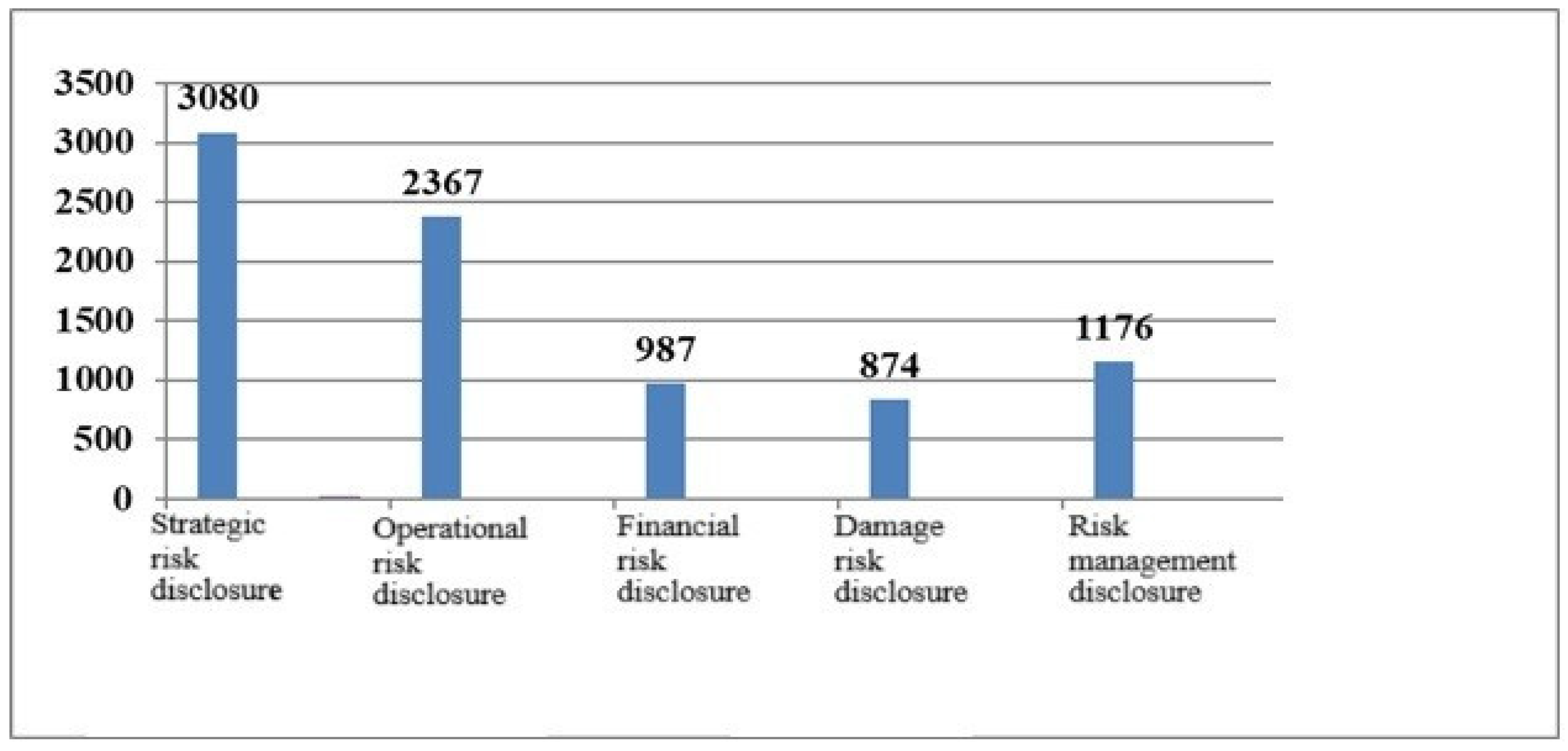
The risk disclosure statements are divided into five major categories, as seen in Figure 1. Strategic risk disclosure is the most frequently mentioned category, accounting for around 36.46% of all risk disclosures, according to the data, with 3080 statements. This indicates that Jordanian companies are quite concerned about long-term uncertainties pertaining to competition, market share, regulatory changes, and innovation. This result is consistent with prior research, such as Oliveira et al. (2018), who found 19.3% for strategic risk disclosure, and Linsley and Shrives (2006), who discovered 31.7%. The second most frequently mentioned category is operational risk, which accounts for 2367 sentences, or 28.02% of the total. Previous studies have shown this to be true in a variety of contexts, including Oliveira et al. (2011), who discovered 15.4% in Portuguese and Spanish enterprises, and Amran et al. (2009), who discovered 30% in Malaysian companies. In a similar vein, Mokhtar and Mellett (2013) found that Egyptian businesses place a high priority on operational risk, particularly in the domains of health and safety, IT infrastructure, and quality assurance. Risk management disclosure ranks third with 13.92% of the total number of statements (1176). The growing significance of this broader category demonstrates that companies are more dedicated to sharing their whole risk management plans and organizational structures. In some emerging markets, risk management knowledge is often undervalued and seen as an internal issue; this conclusion is more important than similar discoveries there. 11.58% of all assertions (978 in total) are dedicated to financial risk disclosures, which address interest rate, credit, and liquidity concerns. This percentage is still significant, particularly since IFRS requires these risks to be disclosed, even if they are less than the strategic and operational categories in the current analysis. In earlier studies, Linsley and Shrives (2006) and Al-Shammari (2014) found similar findings of 20.7% and 26.7%, respectively, suggesting that there are some differences between markets in terms of context and regulation. Damage risk disclosures, which address insurance and legal issues, account for the lowest proportion at 10.03% (847 comments). This low percentage is not unusual in developing markets, where such disclosures are frequently optional and might be suppressed to protect one’s reputation. Amran et al. (2009) came to the same conclusion and also found that Malaysian companies are unaware of these topics. According to the distribution pattern, Jordanian companies prioritize strategic and operational risks over financial, damage-related, and governance-related disclosures. Jordan’s regulatory environment, where some risk reporting categories remain voluntary and lack sufficient enforcement, may be to blame for this difference. Although this proportion is lower than the strategic and operational groups in the current study, it is still notable, especially given that IFRS mandates the disclosure of these risks. Although there are some variances between nations in law and context, Linsley and Shrives (2006) and Al-Shammari (2014) found similar percentages of 20.7% and 26.7%, respectively. Damage risk disclosures, which address insurance and legal concerns, cover the fewest number of statements at 10.03% (847 statements). In developing countries, where such disclosures may be voluntary and covered to safeguard one’s reputation, this low percentage is common. The distribution pattern, which mirrors Amran et al. (2009) in that it also demonstrates that Malaysian businesses are unaware of these categories, reveals that Jordanian firms give priority to operational and strategic risks over financial, damage-related, and governance-related disclosures. This discrepancy could be explained by Jordan’s regulatory environment, where certain risk reporting categories are still optional and poorly enforced.
Table 3 displays the descriptive statistics for the sample’s continuous variables. The average board size (BSIZ) aligns with earlier studies on Jordanian firms, like Alsmady (2018) and K. Al Daoud (2018), which reported mean board sizes of 8.51 and 8.795, respectively. The average board size is between 4 and 13, with 8.037 members. The average number of board meetings (BM) held annually is 7.949, with a range of four to eighteen meetings, which is consistent with the 7.33 meetings that Qadorah and Fadzil (2018) recorded. The average proportion of board members with financial and accounting competence (BEXP) ranges from 0% to 96%, according to data from K. Al Daoud (2018) and Makhlouf et al. (2018), who found average percentages of 31% and 29.6%, respectively. The JCGC mandates that Jordanian firms hold at least six meetings each year, which is supported by these data. The average firm size (SIZE) is 7.497, as determined by the natural logarithm of total assets. This outcome is consistent with prior research done by Mardini et al. (2013), Siam et al. (2018), and Alsmady (2018), who found averages of 7.90, 7.217, and 7.45, respectively. Earlier studies have also demonstrated leverage ratios between 35% and 38.3% (Siam et al., 2018; Makhlouf et al., 2018; Abu Qa’dan & Suwaidan, 2018), and the average leverage ratio (LEVER) is 32.372%, which varies widely. Table 4 displays the summary statistics for the dichotomous variables. CEO duality, where one person serves as both the CEO and board chair, is present in 32.18% of business years, suggesting that about one-third of Jordanian firms employ this governance model. This is similar to the 39.8% figure that Al Daoud discovered in 2018. Industry categories place 52.13% of all businesses in the industrial sector (SECTR), which is somewhat more than the 46% reported by K. A. Al Daoud et al. (2014). The type of audit industry reveals that Big 4 firms (BIG4) carry out audits for 60.37% of company-years, while auditors outside the Big 4 perform the remaining 39.63%. According to Kikhia’s (2014) analysis, the Big Four firms conduct 37.1% of Jordan’s audits. The fact that 71.72% of the sample firms have RMC, which earlier research has highlighted as playing a key role in improving corporate governance and risk management, supports the findings. M. Malik et al. (2021) claim that RMC facilitates the resolution of conflicts of interest between the board and management, which leads to better monitoring processes and better financial results. Elamer and Benyazid (2018) came to a similar conclusion, finding that RMCs improve company performance by assisting businesses in making wiser investment choices and mitigating operational hazards. According to Hoyt and Liebenberg (2015), companies with RMC are more equipped to evaluate their risk exposures, which results in improved decision-making and less income fluctuation. In addition, the Financial Reporting Council (FRC, 2017) recommended that listed firms create RMC in order to improve risk management and protect the interests of investors. Furthermore, Lechner and Gatzert (2018) demonstrated a link between the market value, the company’s performance, and the ownership of RMC. In line with the high rate of RMC adoption among Jordanian businesses in this study, these studies typically highlight the widespread use of RMC as a best practice in risk management and governance.

6.2. Diagnostic Tests

The data panel must undergo a series of tests in order to determine its validity. The variance inflation factor (VIF) and the correlation matrix test are used to look for multicollinearity. Table 5 presents the Pearson correlation coefficients for the independent variables. It can be inferred that there is no multicollinearity since all of the variables have correlations below 0.455 and none of the correlations are above 0.9. For this reason, multicollinearity is not an issue for this model. The VIF values, as shown in Table 6, range from 1.204 to 2.124, which is far less than 10. The average VIF for all independent variables is only 1.439 in a single regression. That all VIFs are below 10, as Kline (2005) and Silver (1997) have shown, provides additional evidence that there are no problems with multicollinearity.
In order to look for any problems with heteroscedasticity, this research employed the Breusch-Pagan-Godfery/Cook-Weisberg Test. Additionally, the Wooldridge test was performed to determine whether an autocorrelation issue existed. The Breusch-Pagan-Godfery/Cook-Weisberg test, which is shown in Table 7, yielded a p-value that was not statistically significant (0.1789 > 0.05). As a result, the data used in the study can be assumed to be devoid of heteroscedasticity. Additionally, the Wooldridge test’s p-value is insignificant (0.0808 > 0.05), indicating that there is no autocorrelation problem in the study’s data.
Numerous tests were performed to identify the best model for the study. The pooled OLS model and the random effects model can be distinguished using the Lagrange Multiplier test (LM). The LM test, as shown in Table 8, yields a statistically significant result (0.000 < 0.05). Therefore, the random effects technique (Gujarati & Porter, 2009) is the most suitable for this study. The Hausman specification test distinguishes between the fixed and random models. The Hausman test, which is displayed in Table 8, does not have statistical significance (0.0775 > 0.05). As a result, the RE model is chosen and utilized for data analysis.

6.3. Regression Analysis Results

The model was estimated using a random effects technique. In addition to control variables (firm size, industry type, audit company type, and leverage), Table 9 shows the relationship between the dependent variable (corporate risk disclosure) and the independent variables (characteristics of the board of directors). At the 1% level, the model fits the data well and has statistical significance, as evidenced by a p-value of 0.000 and an R2 of 0.325.
The board size has little effect on the disclosure of business risk, as evidenced by the fact that the coefficient for board size is negative but not statistically significant (Coef. = −0.006, t = −0.02, p = 0.898). According to resource dependency theory and AT, bigger boards should have a wider range of skills and more monitoring, which should result in increased disclosure (W. A. W. Ismail et al., 2010; Klein, 2002). But these theories contradict this conclusion. For Jordanian companies, K. Al Daoud (2018) and Alsmady (2018) found similar modest outcomes. According to the AT claim that smaller boards are better at oversight (Lipton & Lorsch, 1992), this conclusion is supported. Therefore, H1 is refuted. Even though board meetings and risk disclosure are positively correlated, the connection is not statistically significant (Coef. = 0.329, t = 1.73, p = 0.123). This demonstrates that, in contrast to what Conger et al. (1998) and Vafeas (1999) assert in accordance with AT, increased meetings do not always lead to greater risk disclosure. The results of Allini et al. (2016) and Qadorah and Fadzil (2018) were consistent. One potential reason is the high concentration of ownership in Jordan, which is managed by informal networks. As a result, the validity of H2 is disproven. The evidence that CEO duality has a significant detrimental impact on risk disclosure (Coef. = −2.893, t = −1.83, p = 0.044) supports the notion that separating the CEO and board chair duties promotes transparency. This conclusion is consistent with AT, which states that duality weakens board oversight and increases agency expenses (Neifar & Jarboui, 2018). This conclusion is supported by the research carried out by Al-Shammari (2014) and Elgammal et al. (2018), which validate H3. The board’s competence has a positive and significant effect on risk disclosure (Coef. = 7.248, t = 2.42, p = 0.030). Experienced directors enhance the board’s monitoring and the quality of financial reporting, which validates the forecasts made by AT and resource dependence (Pfeffer & Salancik, 2015). This is in agreement with the conclusions of Alzoubi (2016) and Makhlouf et al. (2018), and it backs H4. Although the size of the business has a positive effect on risk disclosure, it is not statistically significant (Coef. = 1.740, t = 1.32, p = 0.232). According to the audit business (Coef. = 1.915, t = 1.12, p = 0.271), the coefficient is positive but not statistically significant, suggesting that there is no real distinction between the risk disclosure levels of firms audited by Big 4 and non-Big 4 auditors. The findings are consistent with those of Aldaoud (2015) and Alhadab (2018). This kind of sector is strongly associated with risk disclosure (Coef. = 4.157, t = 2.46, p = 0.020), suggesting that industrial enterprises are more likely to release risk data than service firms. This conclusion is supported by earlier research by Cooke (1992), Mangena and Pike (2005). Similarly, Aljifri and Hussainey (2007) and Hassan (2009) also discovered no link between firm size and disclosure in Jordan, lending further credence to this result. Despite its benefits, leverage has little effect on risk disclosure (Coef. = 0.017, t = 0.77, p = 0.521). Miihkinen (2012) and Linsley and Shrives (2006) previously demonstrated that leverage had no influence on disclosure in Jordan, which is in line with their findings.

6.4. The Moderating Effect of Risk Management Committee

According to the study, the RMC is essential in determining the link between the board of directors’ characteristics and the level of risk disclosure. Table 10 displays the findings of the second model, which takes into account the RMC’s moderating influence. This regression model’s R2 value of 0.412 shows a significant improvement over the 0.325 value for the main regression presented in Table 9 (the direct relationship). As Hair et al. (2006) pointed out, this rise in R2 highlights the importance of the moderator. The RMC, in other words, is in charge of monitoring the interaction between the board of directors and the public disclosure of business risks.
According to the data, the interaction between the board size and the RMC has a statistically significant positive effect on risk disclosure (Coef. = 0.026, t = 2.49, p = 0.013). The presence of an RMC enhances the beneficial impact of bigger boards on improving risk disclosure, which implies that the existence of an RMC strengthens this influence. According to earlier research, like Lokman et al. (2014), RMCs support boards—particularly larger ones—in becoming more effective by promoting better oversight and minimizing coordination issues. Research like this supports this conclusion. By enhancing communication and oversight among board members, the RMC is expected to encourage more transparency in risk reporting. The frequency of board meetings is also closely correlated with the RMC (Coef. = 0.025, t = 2.09, p = 0.024), suggesting that the RMC has a greater positive impact on risk disclosure as a result of frequent board meetings. This backs up the idea that RMC guide board discussions in the direction of key risk issues, which ultimately enhances the caliber of supervision during meetings. Prior research, such as Cohen et al. (2019) and Beasley (1996), emphasizes the important role that RMC has in improving risk management by influencing meeting agendas and empowering the board to handle difficult risk problems. However, the connection between CEO duality and RMC has a significant and detrimental effect on risk disclosure (Coef. = 0.030, t = 2.80, p = 0.001). This implies that having an RMC may help lessen the negative impact that CEO duality may have on risk disclosure procedures. This finding is supported by AT, which argues that the CEO’s dual role as board chair could undermine the board’s oversight capacity (Neifar & Jarboui, 2018). An active RMC, on the other hand, has the potential to offer unbiased monitoring to offset this concentration of power, promoting transparency and risk disclosure. Research done by Anderson and Reeb (2003) and Jaggi et al. (2009) lends additional credence to the significance of governance structures like RMC in addressing problems related to CEO duality. The connection between board experience and RMC has a beneficial effect on risk disclosure (Coef. = 0.082, t = 3.59, p = 0.000), indicating that an RMC enhances the manner in which board members employ their skills to encourage risk disclosure. This evidence supports the theoretical viewpoint that highlights the synergistic benefits of having a competent board combined with robust governance systems. Pfeffer and Salancik (2015) and Chang et al. (2017) demonstrated that specialized committees enhance the quality of disclosures and the effectiveness of board oversight; thus, the existence of an RMC probably enables well-informed directors to make better use of their knowledge in risk monitoring and reporting.

7. Theoretical and Practical Implications

By emphasizing the crucial role that the RMC plays in improving the impact of board traits on business risk disclosure, this study builds on the current knowledge base on risk disclosures and corporate governance. By showing that a specialized RMC enhances the board’s capacity to manage risks and foster transparency, the results advance AT and resource dependency theory. In particular, the research comes to the conclusion that while some board features, like its size, meeting frequency, CEO dualism, and skill set, may have a limited or inconsistent direct effect on risk disclosure, their impact is amplified when backed by an active RMC. This supports the idea that formal risk oversight systems are essential governance tools that allow boards to carry out their supervisory responsibilities more effectively. The findings also emphasize that it is necessary to examine the relationships between governance systems rather than looking at each one in isolation. The observed positive moderation effects suggest that pairing RMC with certain board characteristics creates synergies that enhance disclosure practices by increasing our understanding of how various governance mechanisms interact to address agency challenges and information inequalities.
From a practical standpoint, this study provides useful recommendations to regulators, legislators, and business boards, especially in developing nations like Jordan. Businesses that want to improve their corporate risk disclosures and gain investor confidence should concentrate on establishing and improving their RMC, as demonstrated by the RMC notable positive impact. Business boards should, in addition to focusing on structural concerns, make sure that specialized committees, like the RMC, are actively involved. This may help focus discussions on risk concerns, make the most of the board’s knowledge, and address any possible governance issues, like CEO duality. To increase transparency and accountability in financial reporting, regulatory agencies and standard-setting bodies may consider mandating or promoting the establishment of RMC. The existence of an RMC might be a crucial sign for investors and stakeholders of strong governance and efficient risk management, allowing them to make knowledgeable judgments about risk and investment.

8. Conclusions

The goal of this research is to examine how certain board of director traits, such as its size, meeting frequency, CEO duality, and experience, affect the degree to which a business discloses risk. It enhances our understanding of how managers handle risk disclosure in the annual reports of Jordanian publicly traded companies, a topic that has not previously been given much attention, by building on existing knowledge of risk disclosure. While prior studies have looked at the factors that influence risk disclosure, few have considered the possible constraints on how effectively corporate governance may enhance risk disclosure (Alshirah et al., 2020). This study adds to the body of knowledge by introducing and examining the RMC role in balancing the relationship between risk disclosure and corporate governance, which has not been given much attention in the past. This is the first study of this moderating effect in the Jordanian market, according to the researcher. Additionally, the findings are limited to Jordan because the research is solely conducted there. Comparing various countries may, in the opinion of some, paint a more thorough picture of the diversity in risk disclosure methods seen worldwide. Finally, although they could have contained more useful information, annual reports were the main data source, and other commercial documents like interim reports, websites, prospectuses, and press releases were overlooked. Additionally, the objectivity and scalability of future research that handles large datasets could be improved by using computer-based textual analysis methods. An empirical analysis was conducted on a sample of 900 yearly reports from companies listed in Jordan between 2014 and 2023. The number of risk-related phrases in a document was determined using content analysis, while random effects regression models were used to test the hypotheses. According to the study’s conclusions, the quantity of risk data provided is contingent upon the board’s competence and the particular sector at issue. This demonstrates how boards composed of knowledgeable and experienced directors can utilize their knowledge to oversee the financial reporting process and enhance the correctness and quality of financial reporting. In contrast, the existence of two CEOs has a detrimental effect on the disclosure of risk. According to the AT, the CEO and board chair should share responsibilities because this centralizes power in the CEO and reduces board oversight, leading to less transparency (Samaha et al., 2012). This conclusion supports this theory. Surprisingly, the study found that the amount of risk disclosure was not significantly impacted by the size of the board, the frequency of meetings, the size of the business, the type of audit firm, or the leverage. In any case, the RMC mediating function confirms all expected outcomes, demonstrating that an RMC greatly enhances the connection between board traits and corporate risk disclosure. Furthermore, the study identifies several deficiencies that leave space for further research in the future. First and foremost, the research concentrates on a limited number of corporate governance variables while disregarding other potentially important variables that may have an impact on risk disclosure. Future studies may build upon this focus by examining how risk disclosure affects factors like share prices, business value, analyst predictions, and the cost of capital. Second, using content analysis to assess claims about risk may lead to subjective bias. In conclusion, qualitative techniques like interviewing regulators, managers, and users of annual reports may offer a more complete picture of risk disclosure procedures. This research provides useful guidance to regulators, politicians, and business boards in developing nations like Jordan from a practical perspective. Businesses looking to improve their corporate risk disclosures and boost investor confidence should give priority to forming and strengthening RMC, as evidenced by the RMC considerable positive impact. In addition to concentrating on structural concerns, business boards should also make sure that specialized committees like the RMC actively participate. This might help focus discussions on risk concerns, make the most use of the board’s expertise, and address potential governance challenges, such as CEO dualism. In order to increase the transparency and accountability of financial reporting, regulatory and standard-setting organizations may want to think about requiring or promoting the establishment of RMC. The existence of an RMC might be a crucial sign of responsible governance and successful risk management for investors and stakeholders, allowing them to make educated judgements about risk and investment. From a real-world standpoint, this study provides useful guidance to regulators, lawmakers, and company boards, especially in developing nations like Jordan. As demonstrated by the RMC significant positive impact, companies looking to improve their corporate risk disclosures and gain investor confidence should focus on establishing and strengthening RMC. The business board should focus on structural concerns as well as guarantee the active participation of specialized committees, such as the RMC. This may facilitate focused discussions on risk concerns, make the most of the board’s competence, and address any possible governance problems, such as the dual role of the CEO. To enhance transparency and accountability in financial reporting, regulatory authorities and standard-setting organizations may consider mandating or promoting the establishment of RMC. The existence of an RMC may be a crucial sign for investors and stakeholders that a company is well-run and managing its risks effectively, allowing them to make wise choices about risk and investment.

Author Contributions

Conceptualization, A.F.A. and M.H.A.; methodology, A.F.A. and M.H.A.; validation, A.F.A. and M.H.A.; formal analysis, A.F.A. and M.H.A.; investigation, A.F.A. and M.H.A.; resources A.F.A. and M.H.A. data curation, A.F.A. and M.H.A.; writing—original draft preparation, A.F.A. and M.H.A.; writing—review and editing, A.F.A. and M.H.A.; visualization, A.F.A. and M.H.A.; supervision, A.F.A. and M.H.A. All authors have read and agreed to the published version of the manuscript.

Funding

This research received no external funding.

Institutional Review Board Statement

Not applicable.

Informed Consent Statement

Not applicable.

Data Availability Statement

The original contributions presented in this study are included in the article. Further inquiries can be directed to the corresponding author.

Conflicts of Interest

The authors declare no conflicts of interest.

References

  1. Abraham, S., & Cox, P. (2007). Analysing the determinants of narrative risk information in UK FTSE 100 annual reports. The British Accounting Review, 39, 227–248. [Google Scholar] [CrossRef] [Scilit]
  2. Abu Qa’dan, M. B., & Suwaidan, M. S. (2018). Board composition, ownership structure and corporate social responsibility disclosure: The case of Jordan. Social Responsibility Journal, 15(1), 28–46. [Google Scholar] [CrossRef] [Scilit]
  3. Acharyya, M. (2008, April 14–16). In measuring the benefits of enterprise risk management in insurance: An integration of economic value added and balanced score card approaches [Paper presentation]. 2008 ERM Symposium, Chicago, IL, USA. [Google Scholar]
  4. Agrawal, A., & Chadha, S. (2005). Corporate governance and accounting scandals. Journal of Law and Economics, 48(2), 371–406. [Google Scholar] [CrossRef] [Scilit]
  5. Agyei-Mensah, B. K., & Buertey, S. (2019). Do culture and governance structure influence extent of corporate risk disclosure? International Journal of Managerial Finance, 15(3), 315–334. [Google Scholar] [CrossRef] [Scilit]
  6. Ahmed Sheikh, N., Wang, Z., & Khan, S. (2013). The impact of internal attributes of corporate governance on firm performance evidence from Pakistan. International Journal of Commerce and Management, 23(1), 38–55. [Google Scholar] [CrossRef] [Scilit]
  7. Al-Akra, M., & Ali, M. J. (2012). The value relevance of corporate voluntary disclosure in the Middle-East: The case of Jordan. Journal of Accounting and Public Policy, 31(5), 533–549. [Google Scholar] [CrossRef] [Scilit]
  8. Al-Akra, M., Jahangir Ali, M., & Marashdeh, O. (2009). Development of accounting regulation in Jordan. International Journal of Accounting, 44(2), 163–186. [Google Scholar] [CrossRef] [Scilit]
  9. Al Daoud, K. (2018, October). The role of the Audit Committee and the Board of Director in mitigating the practice of earnings management: Evidence from Jordan. In Proceedings of Business and Management Conferences (No. 6809892). International Institute of Social and Economic Sciences. [Google Scholar]
  10. Al Daoud, K. A., Ismail, K. N. I. K., & Lode, N. A. (2014). The timeliness of financial reporting among Jordanian companies: Do company and board characteristics, and audit opinion matter? Asian Social Science, 10(13), 191–201. [Google Scholar] [CrossRef] [Scilit]
  11. Aldaoud, K. A. M. (2015). The influence of corporate governance and ownership concentration on the timeliness of financial reporting in Jordan [Unpublished doctoral dissertation]. Universiti Utara Malaysia.
  12. Alhadab, M. M. (2018). Real and accrual earnings management around initial public offerings in Jordan. International Business Research, 11(1), 204–216. [Google Scholar] [CrossRef] [Scilit]
  13. Ali, M. M., & Taylor, D. (2014). Corporate risk disclosure in Malaysia: The influence of pre-dispositions of Chief Executive Officers and chairs of Audit Committee. Research Journal of Finance and Accounting, 5(2), 92–106. [Google Scholar]
  14. Aljifri, K., & Hussainey, K. (2007). The determinants of forward-looking information in annual reports of UAE companies. Managerial Auditing Journal, 22(9), 881–894. [Google Scholar] [CrossRef] [Scilit]
  15. Alkurdi, A., Hussainey, K., Tahat, Y., & Aladwan, M. (2019). The Impact of corporate governance on risk disclosure: Jordanian evidence. Academy of Accounting and Financial Studies Journal, 23(1), 1–16. [Google Scholar]
  16. Allegrini, M., & Greco, G. (2013). Corporate boards, audit committees and voluntary disclosure: Evidence from Italian listed companies. Journal of Management and Governance, 17(1), 187–216. [Google Scholar] [CrossRef] [Scilit]
  17. Allini, A., Rossi, F., & Hussainey, K. (2016). The board’s role in risk disclosure: An exploratory study of Italian listed state-owned enterprises. Public Money & Management, 36(2), 113–120. [Google Scholar]
  18. Al-Maghzom, A., Hussainey, K., & Aly, D. (2016). Corporate governance and risk disclosure: Evidence from Saudi Arabia. Corporate Ownership and Control Journal, 13(2), 1–22. [Google Scholar] [CrossRef] [Scilit]
  19. Al-Shammari, B. (2014). An investigation of the impact of corporate governance mechanisms on level of corporate risk disclosure: Evidence from Kuwait. International Journal of Business and Social Research, 4(6), 51–70. [Google Scholar]
  20. Al-Shattarat, W. K., Haddad, A. E., & Al-hares, O. M. (2010). The extent of voluntary disclosure in an emerging capital market: The case of Jordan. Journal of Modern Accounting and Auditing, 6(10), 39–51. [Google Scholar]
  21. Alshirah, M. H., Abdul Rahman, A., & Mustapa, I. R. (2020). Board of directors’ characteristics and corporate risk disclosure: The moderating role of family ownership. EuroMed Journal of Business, 15(2), 219–252. [Google Scholar] [CrossRef] [Scilit]
  22. Alsmady, A. A. (2018). The effect of board of directors’ characteristics and ownership type on the timeliness of financial reports. International Journal of Business and Management, 13(6), 276–287. [Google Scholar] [CrossRef] [Scilit]
  23. Alzoubi, E. S. S. (2016). Disclosure quality and earnings management: Evidence from Jordan. Accounting Research Journal, 29(4), 429–456. [Google Scholar] [CrossRef] [Scilit]
  24. Amran, A., Bin, A., & Hassan, B. (2009). Risk reporting: An exploratory study of risk management disclosure in Malaysian annual reports. Managerial Auditing Journal, 24(1), 39–57. [Google Scholar] [CrossRef] [Scilit]
  25. Anderson, R. C., Mansi, S. A., & Reeb, D. M. (2004). Board characteristics, accounting report integrity, and the cost of debt. Journal of Accounting and Economics, 37(3), 315–342. [Google Scholar] [CrossRef] [Scilit]
  26. Anderson, R. C., & Reeb, D. M. (2003). Founding-family ownership and firm performance: Evidence from the S&P 500. The Journal of Finance, 58(3), 1301–1328. [Google Scholar]
  27. Arnold, B., & De Lange, P. (2004). Enron: An examination of agency problems. Critical Perspectives on Accounting, 15(6–7), 751–765. [Google Scholar] [CrossRef] [Scilit]
  28. Aryani, D. N., & Hussainey, K. (2017). The determinants of risk disclosure in the Indonesian non-listed banks. International Journal of Trade and Global Markets, 10(1), 58–66. [Google Scholar] [CrossRef] [Scilit]
  29. Baroma, B. (2014). The association between the level of risk disclosure and corporation characteristics in the annual reports of Egyptian companies. American Journal of Business, Economics and Management, 2(1), 9–16. [Google Scholar]
  30. Barros, C. P., Boubaker, S., & Hamrouni, A. (2013). Corporate governance and voluntary disclosure in France. Journal of Applied Business Research, 29(2), 561–577. [Google Scholar] [CrossRef] [Scilit]
  31. Beasley, M. S. (1996). An empirical analysis of the relation between the board of director composition and financial statement fraud. Accounting Review, 71, 443–465. [Google Scholar]
  32. Brick, I. E., & Chidambaran, N. K. (2010). Board meetings, committee structure, and firm value. Journal of Corporate Finance, 16(4), 533–553. [Google Scholar] [CrossRef] [Scilit]
  33. Bruton, G. D., Filatotchev, I., Chahine, S., & Wright, M. (2010). Governance, ownership structure, and performance of IPO firms: The impact of different types of private equity investors and institutional environments. Strategic Management Journal, 31(5), 491–509. [Google Scholar] [CrossRef] [Scilit]
  34. Cabedo, J. D., & Tirado, J. M. (2004). The disclosure of risk in financial statements. Accounting Forum, 28(2), 181–200. [Google Scholar] [CrossRef] [Scilit]
  35. Carmona, P., Fuentes, C. D., & Ruiz, C. (2016). Risk disclosure analysis in the corporate governance annual report using fuzzy-set qualitative comparative analysis. Revista de Administração de Empresas, 56(3), 342–352. [Google Scholar] [CrossRef] [Scilit]
  36. Chang, Y. K., Oh, W. Y., Park, J. H., & Jang, M. G. (2017). Exploring the relationship between board characteristics and CSR: Empirical evidence from Korea. Journal of Business Ethics, 140, 225–242. [Google Scholar] [CrossRef] [Scilit]
  37. Cheng, E. C., & Courtenay, S. M. (2006). Board composition, regulatory regime and voluntary disclosure. The International Journal of Accounting, 41(3), 262–289. [Google Scholar] [CrossRef] [Scilit]
  38. Clarke, T. (2014). The impact of financialisation on international corporate governance: The role of agency theory and maximising shareholder value. Law and Financial Markets Review, 8(1), 39–51. [Google Scholar] [CrossRef] [Scilit]
  39. Cohen, S. M., Boobis, A. R., Dellarco, V. L., Doe, J. E., Fenner-Crisp, P. A., Moretto, A., Pastoor, T. P., Schoeny, R. S., Seed, J. G., & Wolf, D. C. (2019). Chemical carcinogenicity revisited 3: Risk assessment of carcinogenic potential based on the current state of knowledge of carcinogenesis in humans. Regulatory Toxicology and Pharmacology, 103, 100–105. [Google Scholar] [CrossRef] [Scilit] [PubMed]
  40. Conger, J., Finegold, D., & Lawler, E. (1998). Appraising board room performance. Harvard Business Review, 76, 136–148. [Google Scholar]
  41. Cooke, T. E. (1992). The impact of size, stock market listing and industry type in disclosure in the annual reports of Japanese listed corporations. Accounting and Business Research, 22(87), 229–237. [Google Scholar] [CrossRef] [Scilit]
  42. Dahya, J., Lonie, A. A., & Power, D. M. (1996). The case for separating the roles of chairman and CEO: An analysis of stock market and accounting data. Corporate Governance: An International Review, 4(2), 71–77. [Google Scholar] [CrossRef] [Scilit]
  43. Dong, N. Y., & Zhang, J. R. (2008). Does ownership structure matter when CPA deciding types of audit opinions. Journal of Modern Accounting and Auditing, 4(4), 44–48. [Google Scholar]
  44. Eisenhardt, K. M. (1989). Building theories from case study research. Academy of Management Review, 14(4), 532–550. [Google Scholar] [CrossRef] [Scilit]
  45. Elamer, A. A., & Benyazid, I. (2018). The impact of risk committee on financial performance of UK financial institutions. International Journal of Accounting and Finance, 8(2), 161–180. [Google Scholar] [CrossRef] [Scilit]
  46. Elgammal, M. M., Hussainey, K., & Ahmed, F. (2018). Corporate governance and voluntary risk and forward-looking disclosures. Journal of Applied Accounting Research, 19(4), 592–607. [Google Scholar] [CrossRef] [Scilit]
  47. Elshandidy, T., Fraser, I., & Hussainey, K. (2013). Aggregated, voluntary, and mandatory risk disclosure incentives: Evidence from UK FTSE all-share companies. International Review of Financial Analysis, 30, 320–333. [Google Scholar] [CrossRef] [Scilit]
  48. Elshandidy, T., & Neri, L. (2015). Corporate governance, risk disclosure practices, and market liquidity: Comparative evidence from the UK and Italy. Corporate Governance: An International Review, 23(4), 331–356. [Google Scholar] [CrossRef] [Scilit]
  49. Elzahar, H., & Hussainey, K. (2012). Determinants of narrative risk disclosures in UK interim reports. The Journal of Risk Finance, 13(2), 133–147. [Google Scholar] [CrossRef] [Scilit]
  50. Ezat, A., & El-Masry, A. (2008). The impact of corporate governance on the timeliness of corporate internet reporting by Egyptian listed companies. Managerial Finance, 34(12), 848–867. [Google Scholar] [CrossRef] [Scilit]
  51. Fama, E. F., & Jensen, M. C. (1983). Agency problems and residual claims. The Journal of Law and Economics, 26(2), 327–349. [Google Scholar] [CrossRef] [Scilit]
  52. Financial Reporting Council. (2017). Developments in corporate governance and stewardship 2016. Financial Reporting Council, 24. Available online: https://cgov.pt/images/ficheiros/2018/developments-in-corporate-governance-and-stewardship-2016.pdf (accessed on 8 February 2026).
  53. Foerster, S. R., Sapp, S. G., & Shi, Y. Q. (2014). The effect of voluntary disclosure on firm risk and firm value: Evidence from management earnings forecasts. Advances in Quantitative Analysis of Finance and Accounting, 12, 179–213. [Google Scholar] [CrossRef] [Scilit]
  54. Gatzert, N., & Martin, M. (2015). Determinants and value of enterprise risk management: Empirical evidence from the literature. Risk Management and Insurance Review, 18(1), 29–53. [Google Scholar] [CrossRef] [Scilit]
  55. Gujarati, D., & Porter, D. (2009). Basic econometric. McGraw-Hill International. [Google Scholar]
  56. Gul, F. A., & Leung, S. (2004). Board leadership, outside directors’ expertise and voluntary corporate disclosures. Journal of Accounting and Public Policy, 23(5), 351–379. [Google Scholar] [CrossRef] [Scilit]
  57. Hair, J. F., Anderson, R. E., Tatham, R. L., & Black, W. C. (2006). Multivariate data analysis (6th ed.). Prentice Hall. [Google Scholar]
  58. Hassan, M. (2009). UAE corporations-specific characteristics and level of risk disclosure. Managerial Auditing Journal, 24(7), 668–687. [Google Scholar] [CrossRef] [Scilit]
  59. Hassan, M. (2013). The influence of corporate governance structures on compliance with mandatory IFRSs disclosure requirements in the Jordanian context. International Journal of Research in Business and Social Science IJRBS, 2(3), 14–26. [Google Scholar] [CrossRef] [Scilit]
  60. Hassanein, A., & Hussainey, K. (2015). Is forward-looking financial disclosure really informative? Evidence from UK narrative statements. International Review of Financial Analysis, 41, 52–61. [Google Scholar] [CrossRef] [Scilit]
  61. Hillman, A. J., & Thomas, D. (2003). Boards of directors and firm performance: Integrating agency and resource dependence perspectives. Academy of Management Review, 28(3), 383–396. [Google Scholar] [CrossRef] [Scilit]
  62. Hillman, A. J., Withers, M. C., & Collins, B. J. (2009). Resource dependence theory: A review. Journal of Management, 35(6), 1404–1427. [Google Scholar] [CrossRef] [Scilit]
  63. Ho, S. S. M., & Wong, K. S. (2001). A study of the relationship between corporate governance structures and the extent of voluntary disclosure. Journal of International Accounting, Auditing & Taxation, 10, 139–156. [Google Scholar]
  64. Hoyt, R. E., & Liebenberg, A. P. (2015). Evidence of the value of enterprise risk management. Journal of Applied Corporate Finance, 27(1), 41–47. [Google Scholar] [CrossRef] [Scilit]
  65. Ibrahim, A., Habbash, M., & Hussainey, K. (2019). Corporate governance and risk disclosure: Evidence from Saudi Arabia. International Journal of Accounting, Auditing and Performance Evaluation, 15(1), 89–111. [Google Scholar] [CrossRef] [Scilit]
  66. Ibrahim, A. E. A., & Hussainey, K. (2019). Developing the narrative risk disclosure measurement. International Review of Financial Analysis, 64, 126–144. [Google Scholar] [CrossRef] [Scilit]
  67. Ismail, R., & Rahman, R. A. (2011). Institutional investors and board of directors’ monitoring role on risk management disclosure level in Malaysia. The IUP Journal of Corporate Governance, 10(2), 37–61. [Google Scholar]
  68. Ismail, T. H., & El-Deeb, M. S. (2022). The effect of corporate governance, dividend policy and informativeness of risk disclosure on the firm value: Egyptian evidence. Afro-Asian Journal of Finance and Accounting, 12(6), 761–789. [Google Scholar] [CrossRef] [Scilit]
  69. Ismail, W. A. W., Dunstan, K., & Van Zijl, T. (2010). Earnings quality and corporate governance following the implementation of Malaysian code of corporate governance. In Journal of Contemporary Accounting and Economics (JCAE) and Seoul National University (SNU) Joint Symposium (pp. 1–40). The Hong Kong Polytechnic University. [Google Scholar]
  70. Jaggi, B., Leung, S., & Gul, F. (2009). Family control, board independence and earnings management: Evidence based on Hong Kong firms. Journal of Accounting and Public Policy, 28(4), 281–300. [Google Scholar] [CrossRef] [Scilit]
  71. Kakanda, M. M., Salim, B., & Chandren, S. (2017). Corporate governance, risk management disclosure, and firm performance: A theoretical and empirical review perspective. Asian Economic and Financial Review, 7(9), 836–845. [Google Scholar] [CrossRef] [Scilit]
  72. Keay, A. (2017). Stewardship theory: Is board accountability necessary? International Journal of Law and Management, 59(6), 1292–1314. [Google Scholar] [CrossRef] [Scilit]
  73. Khalil, A., & Maghraby, M. (2017). The determinants of internet risk disclosure: Empirical study of Egyptian listed companies. Managerial Auditing Journal, 32(8), 746–767. [Google Scholar] [CrossRef] [Scilit]
  74. Kiel, G. C., & Nicholson, G. J. (2003). Board composition and corporate performance: How the Australian experience informs contrasting theories of corporate governance. Corporate Governance: An International Review, 11(3), 189–205. [Google Scholar] [CrossRef] [Scilit]
  75. Kikhia, H. Y. (2014). Board characteristics, audit committee characteristics, and audit fees: Evidence from Jordan. International Business Research, 7(12), 98–110. [Google Scholar] [CrossRef] [Scilit]
  76. Klein, A. (2002). Audit committee, board of director characteristics, and earnings management. Journal of Accounting and Economics, 33(3), 375–400. [Google Scholar] [CrossRef] [Scilit]
  77. Kline, B. (2005). Principles and practice of structural equation modeling (2nd ed.). Guilford Press. [Google Scholar]
  78. Kutum, I. (2014). Investigating voluntary risk disclosure: The case of Jordanian banks. Journal of Modern Accounting and Auditing, 10(12), 1153–1166. [Google Scholar]
  79. Lajili, K. (2009). Corporate risk disclosure and corporate governance. Journal of Risk and Financial Management, 2(1), 94–117. [Google Scholar] [CrossRef] [Scilit]
  80. Laksmana, I. (2008). Corporate board governance and voluntary disclosure of executive compensation practices. Contemporary Accounting Research, 25(4), 1147–1182. [Google Scholar] [CrossRef] [Scilit]
  81. Latham, C. K., & Jacobs, F. A. (2000). Monitoring and incentive factors influencing misleading disclosures. Journal of Managerial Issues, 12(2), 169–187. [Google Scholar]
  82. Lechner, P., & Gatzert, N. (2018). Determinants and value of enterprise risk management: Empirical evidence from Germany. The European Journal of Finance, 24(10), 867–887. [Google Scholar] [CrossRef] [Scilit]
  83. Li, J., Pike, R., & Haniffa, R. (2008). Intellectual capital disclosure and corporate governance structure in UK firms. Accounting and Business Research, 38(2), 137–159. [Google Scholar] [CrossRef] [Scilit]
  84. Linsley, P. M., & Shrives, P. J. (2000). Risk management and reporting risk in the UK. Journal of Risk, 3(1), 115–129. [Google Scholar] [CrossRef] [Scilit]
  85. Linsley, P. M., & Shrives, P. J. (2005). Transparency and the disclosure of risk information in the banking sector. Journal of Financial Regulation and Compliance, 13(3), 205–214. [Google Scholar] [CrossRef] [Scilit]
  86. Linsley, P. M., & Shrives, P. J. (2006). Risk reporting: A study of risk disclosures in the annual reports of UK companies. British Accounting Review, 38(4), 387–404. [Google Scholar] [CrossRef] [Scilit]
  87. Lipton, M., & Lorsch, J. W. (1992). A modest proposal for improved corporate governance. The Business Lawyer, 48(1), 59–77. [Google Scholar]
  88. Lokman, N., Mula, J. M., & Cotter, J. (2014). Importance of corporate governance quality and voluntary disclosures of corporate governance information in listed Malaysian family controlled business. International Journal of Sustainable Development & World Policy, 3(1), 1–24. [Google Scholar]
  89. Macchioni, R., Allini, A., & Rossi, F. (2014). Does corporate governance characteristics affect non-financial risk disclosure in government-owned companies? the Italian experience. Financial Reporting, 1, 5–31. [Google Scholar]
  90. Makhlouf, M. H., Al-Sufy, F. J., & Almubaideen, H. (2018). Board diversity and accounting conservatism: Evidence from Jordan. International Business Research, 11(7), 130–141. [Google Scholar] [CrossRef] [Scilit]
  91. Malik, M., Shafie, R., & Ku Ismail, K. N. I. (2021). Do risk management committee characteristics influence the market value of firms? Risk Management, 23(1), 172–191. [Google Scholar] [CrossRef] [Scilit]
  92. Malik, Y. S., Sircar, S., Bhat, S., Sharun, K., Dhama, K., Dadar, M., Tiwari, R., & Chaicumpa, W. (2020). Emerging novel coronavirus (2019-nCoV)—Current scenario, evolutionary perspective based on genome analysis and recent developments. Veterinary Quarterly, 40(1), 68–76. [Google Scholar] [CrossRef] [Scilit] [PubMed]
  93. Mangena, M., & Pike, R. (2005). The effect of audit committee shareholding, financial expertise and size on interim financial disclosures. Accounting and Business Research, 35(4), 327–349. [Google Scholar] [CrossRef] [Scilit]
  94. Mardini, G. H., Tahat, Y., & Power, D. (2013). Determinants of segmental disclosures: Evidence from the emerging capital market of Jordan. International Journal of Managerial and Financial Accounting, 5(3), 253–276. [Google Scholar] [CrossRef] [Scilit]
  95. Mazumder, M. M. M., & Hossain, D. M. (2018). Research on corporate risk reporting: Current trends and future avenues. The Journal of Asian Finance, Economics and Business, 5(1), 29–41. [Google Scholar] [CrossRef] [Scilit]
  96. Miihkinen, A. (2012). What drives quality of firm risk disclosure? The impact of a national disclosure standard and reporting incentives under IFRS. The International Journal of Accounting, 47(4), 437–468. [Google Scholar] [CrossRef] [Scilit]
  97. Mokhtar, E. S., & Mellett, H. (2013). Competition, corporate governance, ownership structure and risk reporting. Managerial Auditing Journal, 28(9), 838–865. [Google Scholar] [CrossRef] [Scilit]
  98. Morris, R. (1987). Signalling, agency theory and accounting policy choice. Accounting and Business Research, 18(69), 47–56. [Google Scholar] [CrossRef] [Scilit]
  99. Moumen, N., Ben Othman, H., & Hussainey, K. (2016). Board structure and the in formativeness of risk disclosure: Evidence from MENA emerging markets. Advances in Accounting, 35, 82–97. [Google Scholar] [CrossRef] [Scilit]
  100. Mousa, G. A., & Elamir, E. A. H. (2014). The effect of governance mechanisms on the quality of risk disclosure: Using bootstrap techniques. American J. Finance and Accounting, 3(2/3/4), 25–27. [Google Scholar] [CrossRef] [Scilit]
  101. Musa, M., Hill, C., Sotiropoulos, F., & Guala, M. (2018). Performance and resilience of hydrokinetic turbine arrays under large migrating fluvial bedforms. Nature Energy, 3(10), 839–846. [Google Scholar] [CrossRef] [Scilit]
  102. Nahar, S., Azim, M., & Jubb, C. (2016). The determinants of risk disclosure by banking institutions: Evidence from Bangladesh. Asian Review of Accounting, 24(4), 426–444. [Google Scholar] [CrossRef] [Scilit]
  103. Naiker, V., & Sharma, D. S. (2009). Former audit partners on the audit committee and internal control deficiencies. The Accounting Review, 48(2), 559–587. [Google Scholar] [CrossRef] [Scilit]
  104. Nazieh, A., & Ezat, M. (2014). Risk disclosure for EGX 100 Egyptian listed companies: Trends, determinants and consequences. Egyptian Journal of Commercial Studies, 38(4), 79–152. [Google Scholar]
  105. Neifar, S., & Jarboui, A. (2018). Corporate governance and operational risk voluntary disclosure: Evidence from Islamic banks. Research in International Business and Finance, 46, 43–54. [Google Scholar] [CrossRef] [Scilit]
  106. Ntim, C. G., Lindop, S., & Thomas, D. A. (2013). Corporate governance and risk reporting in South Africa: A study of corporate risk disclosures in the pre-and post-2007/2008 global financial crisis periods. International Review of Financial Analysis, 30, 363–383. [Google Scholar] [CrossRef] [Scilit]
  107. Ntim, C. G., & Osei, K. A. (2011). The impact of corporate board meetings on corporate performance in South Africa. African Review of Economics and Finance, 2(2), 83–103. [Google Scholar]
  108. Oliveira, J., Lucia, R., & Craig, R. (2011). Voluntary risk reporting to enhance institutional and organizational legitimacy evidence from Portuguese banks. Journal of Financial Regulation and Compliance, 19(3), 271–288. [Google Scholar] [CrossRef] [Scilit]
  109. Oliveira, J., Serrasqueiro, R., & Mota, S. N. (2018). Determinants of risk reporting by Portuguese and Spanish non-finance companies. European Business Review, 30(3), 311–339. [Google Scholar] [CrossRef] [Scilit]
  110. O’Sullivan, M., Percy, M., & Stewart, J. (2008). Australian evidence on corporate governance attributes and their association with forward-looking information in the annual report. Journal of Management & Governance, 12(1), 5–35. [Google Scholar]
  111. Pangestuti, D., Takidah, E., & Anggraini, R. (2017). Firm size, board size, and ownership structure and risk management disclosure on Islamic banking in Indonesia. Journal Akuntansi Dan Keuangan Islam, 5(2), 121–141. [Google Scholar]
  112. Peasnell, K. V., Pope, P. F., & Young, S. (2005). Board monitoring and earnings management: Do outside directors influence abnormal accruals? Journal of Business Finance & Accounting, 32(7–8), 1311–1346. [Google Scholar] [CrossRef] [Scilit]
  113. Pfeffer, J., & Salancik, G. R. (2015). The external control of organizations: A resource dependence perspective. Stanford University Press. [Google Scholar]
  114. Qadorah, A. A. M., & Fadzil, F. H. B. (2018). The Effect of board independence and board meeting on firm performance: Evidence from Jordan. Journal of Finance and Accounting, 6(5), 105–109. [Google Scholar] [CrossRef] [Scilit]
  115. Rossi, F., & Cebula, R. J. (2015). Does the board of directors affect the extent of corporate R&D? Evidence from Italian listed companies. Economics Bulletin, 35(4), 2567–2580. [Google Scholar]
  116. Samaha, K., Dahawy, K., Hussainey, K., & Stapleton, P. (2012). The extent of corporate governance disclosure and its determinants in a developing market: The case of Egypt. Advances in Accounting, Incorporating Advances in International Accounting, 28(1), 168–178. [Google Scholar] [CrossRef] [Scilit]
  117. Sawalqa, F. A. (2014). Corporate governance mechanisms and voluntary disclosure compliance: The case of banks in Jordan. International Journal of Academic Research in Accounting Finance and Management Sciences, 4(2), 369–384. [Google Scholar]
  118. Siam, Y. A., Idris, M., & Al-Okdeh, S. (2018). The moderating role of family control on the relationship between audit committee financial expertise and earnings management. International Journal of Business and Management, 13(12), 31–37. [Google Scholar] [CrossRef] [Scilit]
  119. Silver, M. (1997). Business statistics (2nd ed.). McGraw-Hill Publishing Company. [Google Scholar]
  120. Singh, H., & Harianto, F. (1989). Management board relationships, takeover risk, and the adoption of golden parachutes. Academy of Management Journal, 32(1), 7–24. [Google Scholar] [CrossRef] [Scilit]
  121. Solomon, J. F., Solomon, A., Norton, S. D., & Joseph, N. L. (2000). A conceptual framework for corporate risk disclosure emerging from the agenda for corporate governance reform. The British Accounting Review, 32(4), 447–478. [Google Scholar] [CrossRef] [Scilit]
  122. Stulz, R. M. (2008). Risk management failures: What are they and when do they happen? Journal of Applied Corporate Finance, 20(4), 39–48. [Google Scholar] [CrossRef] [Scilit]
  123. Vafeas, N. (1999). Board meeting frequency and firm performance. Journal of Financial Economics, 53(1), 113–142. [Google Scholar] [CrossRef] [Scilit]
  124. Vafeas, N. (2000). Board structure and the informativeness of earnings. Journal of Accounting and Public Policy, 19(2), 139–160. [Google Scholar] [CrossRef] [Scilit]
  125. Vitolla, F., Raimo, N., Rubino, M., & Garzoni, A. (2020). The determinants of integrated reporting quality in financial institutions. Corporate Governance: The International Journal of Business in Society, 20(3), 429–444. [Google Scholar] [CrossRef] [Scilit]
  126. Wang, M., & Hussainey, K. (2013). Voluntary forward-looking statements driven by corporate governance and their value relevance. Journal of Accounting and Public Policy, 32(3), 26–49. [Google Scholar] [CrossRef] [Scilit]
  127. Watson, A., & Marston, C. (2002). Voluntary disclosure of accounting ratios in the UK. British Accounting Review, 34, 289–313. [Google Scholar] [CrossRef] [Scilit]
  128. Williams, K. Y., & O’Reilly, C. A., III. (1998). Demography and diversity in organisations: A review of 40 years of research. Research in Organisational Behaviour, 20, 77–140. [Google Scholar]
  129. Woods, M., Linsley, P., & Maffei, M. (2017). Accounting and risk special issue. British Accounting Review, 49, 1–3. [Google Scholar] [CrossRef] [Scilit]
  130. Xie, B., Davidson, W. N., & DaDalt, P. J. (2003). Earnings management and corporate governance: The role of the board and the audit committee. Journal of Corporate Finance, 9(3), 295–316. [Google Scholar] [CrossRef] [Scilit]
  131. Yoo, T., & Rhee, M. (2013). Agency theory and the context for R&D investment: Evidence from Korea. Asian Business & Management, 12(2), 227–252. [Google Scholar] [CrossRef] [Scilit]
  132. Zaheer, N. (2013). Effects of duality, board Size and board composition on corporate governance disclosure in Pakistan. International SAMANM Journal of Finance and Accounting, 1(3), 1–16. [Google Scholar]
  133. Zaidan, H., & Melhem, M. J. (2025). The impact of board diversity on corporate social responsibility disclosure in Jordan: The moderating role of political connection. Review of Accounting and Finance. [Google Scholar] [CrossRef] [Scilit]
  134. Zeitun, R., & Tian, G. (2007). Capital structure and corporate performance: Evidence from Jordan. Australasian Accounting Business and Finance Journal, 1(4), 1–36. [Google Scholar] [CrossRef] [Scilit]
  135. Zureigat, Q. M. (2011). The effect of ownership structure on audit quality: Evidence from Jordan. International Journal of Business and Social Science, 2(10), 38–46. [Google Scholar]
Figure 1. Number of Risk Disclosure Sentences for Each Category of Risk.
Jrfm 19 00188 g001
Table 1. Measurement of Variables.
AcronymVariablesMeasurement
CRDCorporate Risk DisclosureAs determined by the quantity of risk-related statements found in the annual reports of Jordanian businesses.
BSIZBoard SizeThe total number of members on the board of directors serves as the metric.
BMBoard MeetingThe quantity of meetings held by the board during the fiscal year is the measure.
CEOCEO DualityMeasured as 1 if the duties of the CEO and Chairman are combined; 0 if they are split.
BEXPBoard ExpertiseMeasured by the ratio of board members with financial or accounting knowledge to all board members.
RMCRisk management committeeThe value of the dummy variable, which is used to measure RMC, is 1 if one exists and 0 otherwise.
SIZECompany SizeMeasured by the natural logarithm of all assets.
SECTRType of SectorMeasured by a dummy variable, 1 if a firm belongs to an industrial sector, 0 otherwise, and categorized as belonging to the industrial or services sector.
BIG4Audit Firm TypeMeasured by a dummy variable: 1 if the audit was conducted by a big 4 audit company, 0 if not.
LEVERLeverageMeasured by the ratio of a company’s total debt to its total assets.
Table 2. Descriptive Statistics of Risk Disclosure.
Risk DisclosureSumMeanMinMaxPercentage
Strategic risk disclosure30808.21809402136.46%
Operational risk disclosure23676.31744401328.02%
Financial risk disclosure9782.68817701111.58%
Damage risk disclosure8472.33241401510.03%
Risk management disclosure11763.08930301013.92%
Total Risk Disclosure844828.6352692 91 100%
Table 3. Descriptive Statistics for Continuous Variables.
Variable NameMeanSt.DevMinMaxSkewnessKurtosis
BSIZ8.0372.434140.4722.521
BM7.9492.9114191.7345.384
BEXP0.3230.21200.960.4682.370
SIZE7.4970.6935.8619.3550.3333.684
LEVER32.37223.02401040.7823.102
Table 4. Descriptive Statistics of Dichotomous Variables.
Variable NameObservationFrequencyPercentage
1010
CEO90023349232.1867.82
SECTR90037834752.1347.87
BIG490043828760.3739.63
RMC900520205 71.72 28.28
Table 5. Correlations Matrix of Study Variables.
Variables(1)(2)(3)(4)(5)(6)(7)(8)(9)(10)
(1) CRD1.000
(2) BSIZ0.1201.000
(3) BM0.2210.091.000
(4) CEO−0.383−0.294−0.0551.000
(5) BEXP0.334−0.037−0.035−0.181.000
(6) RMC−0.289−0.193−0.1670.169−0.0571.000
(7) SIZE0.3100.4670.250−0.3720.123−0.2581.000
(8) SECTR0.282−0.129−0.277−0.2560.1120.126−0.1301.000
(9) BIG40.1660.3130.184−0.146−0.128−0.2190.455−0.0841.000
(10) LEVER0.2680.1570.394−0.1760.089−0.2280.3700.0360.1681.000
Table 6. Standard Tests on VIF Results.
VariableVIF1/VIF
SIZE2.1240.586
BSIZ1.8270.173
LEVER1.6120.557
BIG41.3280.682
CEO1.4390.671
BM1.4370.673
BEXP1.3170.693
RMC1.2040.896
SECTR1.2570.753
Mean VIF1.439
Table 7. Breusch-Pagan-Godfery/Cook-Weisberg and Wooldridge Test.
Chi2(1)Prob > Chi2
Breusch-Pagan-Godfery/Cook-Weisberg Test1.8200.1789
Wooldridge Test3.4320.0808
Table 8. LM test and Hausman Test.
Chi2(1)Prob > Chi2
LM Test212.110.0000
Hausman Test24.200.0775
Table 9. Multiple Regression Results.
CRD = β0 + β1 BSIZit + β2 BMit + β3 CEOit + β4 BEXPit + β5 SIZEit + β6 SCTRit + β7 BIG4it + β8 LEVERit + εit
CRDCoef.Predict Signt-Valuep-ValueSig
BSIZ−0.006+−0.020.898
BM0.329+1.730.123
CEO−2.893−1.830.044**
BEXP7.248+2.420.030**
SIZE1.740+/−1.320.232
SECTR4.157+/−2.460.020**
BIG41.915+/−1.120.271
LEVER0.017+/−0.770.421
Constant5.301 0.530.594
Number of Obs900
R-Squared0.315
Prob > Chi20.000
** p < 0.05.
Table 10. The Moderating effect of RMC.
CRD = β0 + β1 BSIZit + β4 BMit + β3 CEOit + β4 BEXPit + β5 SIZEit + β6 SCTRit + β7 BIG4it + β8 LEVERit + β9 (RMC × BSIZ)it + β10 (RMC × BM)it + β11(RMC × CEO)it + β12 (RMC × BEXP)it + εit
CRDCoef.t-Valuep-ValueSig
BSIZ−0.493−1.200.231
BM0.2661.060.291
CEO−1.219−0.540.591
BEXP5.9240.890.375
SIZE1.7501.010.312
SECTR4.4822.660.008***
BIG41.4561.150.250
LEVER0.0110.380.701
RMC × BSIZ0.0262.490.013**
RMC × BM0.0252.090.024**
RMC × CEO−0.0302.800.001***
RMC × BEXP0.0823.590.000***
Constant4.8000.390.695
Number of Obs900
R-squared0.412
Prob > chi20.000
*** p < 0.01, ** p < 0.05.
Disclaimer/Publisher’s Note: The statements, opinions and data contained in all publications are solely those of the individual author(s) and contributor(s) and not of MDPI and/or the editor(s). MDPI and/or the editor(s) disclaim responsibility for any injury to people or property resulting from any ideas, methods, instructions or products referred to in the content.