
Determinants of Cryptocurrency Investment Decision: Integrating Behavioural and Technology Perspectives


Abstract
1. Introduction
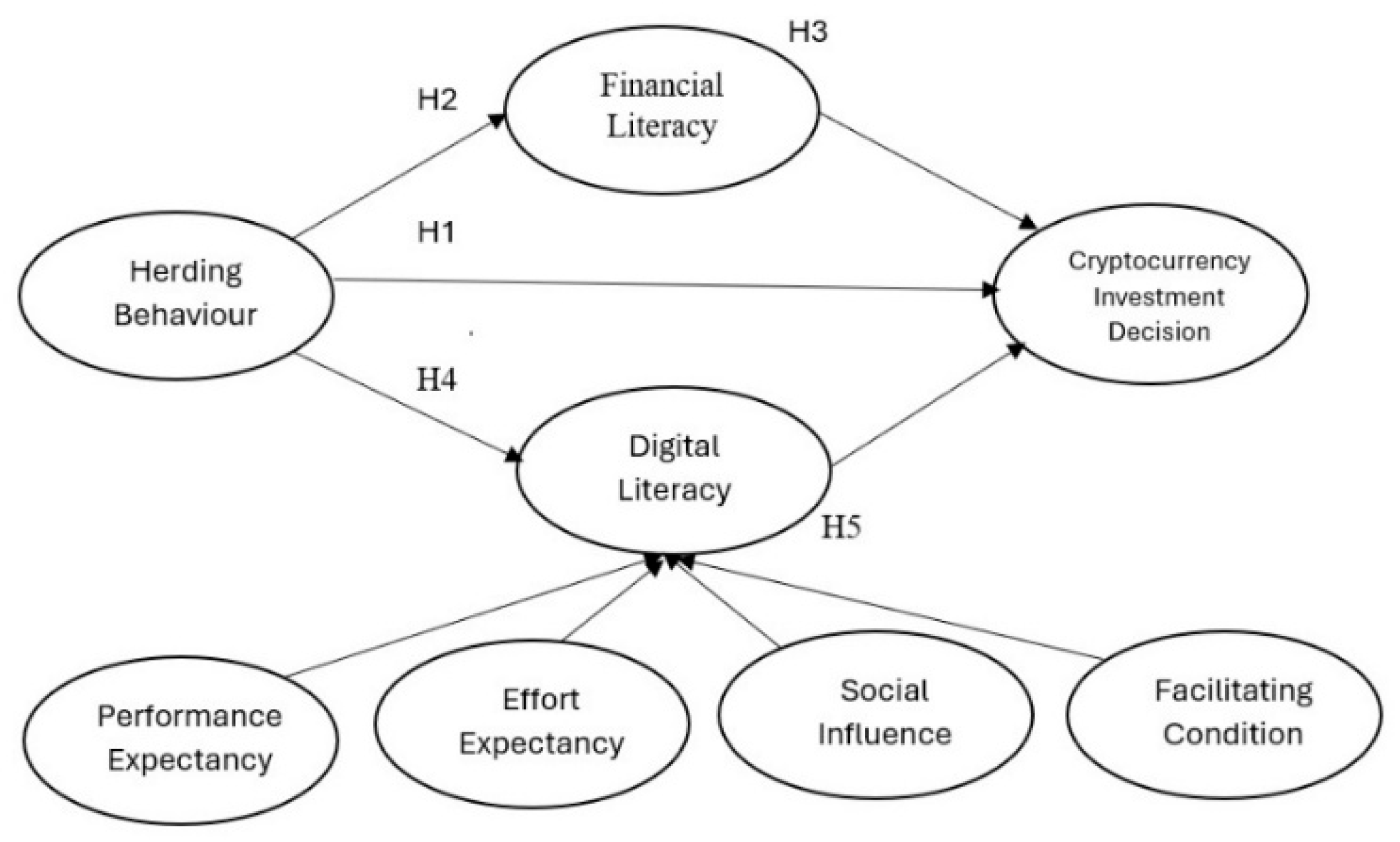
- Does herding behaviour positively affect cryptocurrency investment decisions?
- Does herding behaviour positively affect financial literacy?
- Does financial literacy mediate the effect of herding behaviour on cryptocurrency investment decisions?
- Does herding behaviour positively affect digital literacy?
- Does digital literacy mediate the effect of herding behaviour on cryptocurrency investment decisions?
2. Literature Review
2.1. Undepinning Theory
2.1.1. Theoretical Review
2.1.2. Conceptual Framework
2.2. Hypothesis Development
2.2.1. Relationship Between Herding Behaviour and Cryptocurrency Investment Decision
2.2.2. Relationship Among Herding Behaviour, Financial Literacy, and Cryptocurrency Investment Decision
2.2.3. Relationship Among Herding Behaviour, Digital Literacy, and Cryptocurrency Investment Decision
3. Data and Methods
3.1. Research Methodology
3.2. Operationalization of Variables
4. Results
4.1. Identity of Respondents
4.2. Common Method Bias
4.3. Confirmatory Factor Analysis
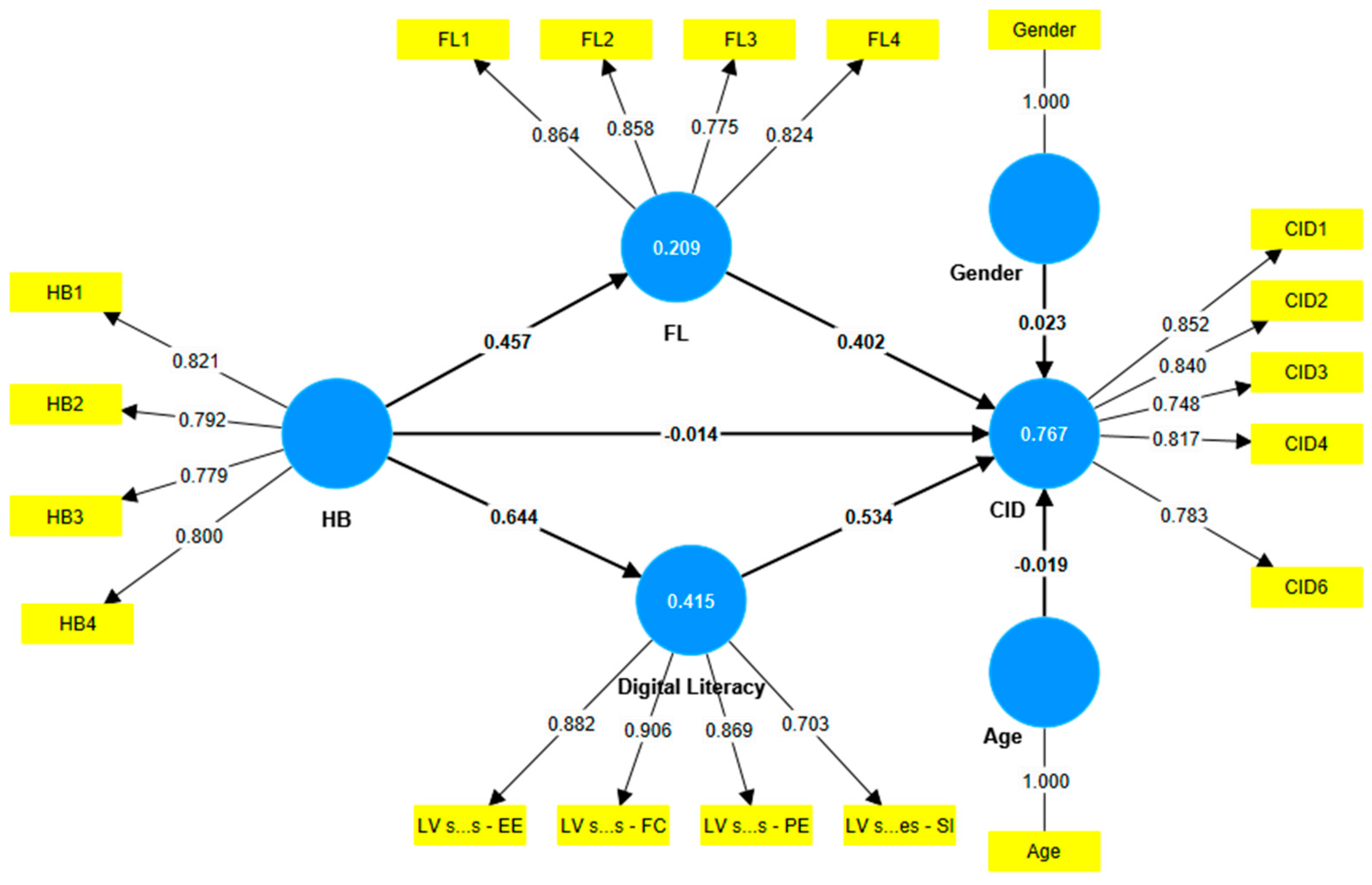
4.4. Hypothesis Testing
5. Discussion
5.1. Discussion of Findings
5.2. Theoretical Contribution
5.3. Managerial Implications
6. Conclusions
Author Contributions
Funding
Institutional Review Board Statement
Informed Consent Statement
Data Availability Statement
Conflicts of Interest
Appendix A
- Questionnaire:
- Identity of respondents
- Email:
- Gender:
- __Male __Female
- Education level:
- __High school __Diploma __Bachelor __Master __Doctor
- Age:
- __<20 years __20–29 years __30–39 years __40–49 years __>49 years
- Marital status:
- __single __married __divorced
- Cryptocurrency investing experience:
- __<1-year __1–2 years __2–5 years __5–10 years __>10 years
- Frequency of cryptocurrency investment:
- __daily __weekly __monthly __quarterly __six-monthly __yearly
- Percentage of income invested in cryptocurrencies:
- __no active income __<10% __10–20% __20–30% __30–40% __>40%
- Question related to variables and indicators, using likert scale from 1: strongly disagree to 5: strongly agree
- Performance Expectancy
- PE1: Cryptocurrency use will increase my chances of achieving my primary objectives
- PE2: I will be able to achieve my objectives more quickly if I use cryptocurrency
- PE3: Using cryptocurrencies will raise my quality of life
- Effort Expectancy:
- EE1: It will be simple for me to learn how to use cryptocurrency
- EE2: Understanding and using cryptocurrencies will not be difficult for me
- EE3: Using cryptocurrency will be easy for me
- Social Influence:
- SI1: Those who influence my decisions think I should invest in cryptocurrency.
- SI2: People I respect give me advice on cryptocurrency investments
- SI3: People who have an impact on my actions agree that cryptocurrency has many advantages
- Facilitating Condition
- FC1: I have access to trustworthy resources regarding cryptocurrency usage
- FC2: I can purchase and trade cryptocurrency on trustworthy and practical platforms
- FC3: I have the technology necessary to use cryptocurrency investment platforms effectively.
- FC4: I can get help or customer service for problems relating to cryptocurrencies
- Financial Literacy
- FL1: I believe that my understanding of cryptocurrency investing is adequate.
- FL2: I feel that I understand how to calculate the profit from index movements in cryptocurrency investments
- FL3: I feel that I understand the nature of the problems with cryptocurrency investment
- FL4: I know how to diversify risk in cryptocurrency investments
- Herding Behaviour
- HB1: Other investors’ crypto choices influence my investment choices
- HB2: My investing choices are influenced by the cryptocurrency volume selections made by other investors
- HB3: Usually, I respond quickly to shifts in the choices made by other investors and observe how they respond to the cryptocurrency market
- HB4: Other investors’ decisions on buying and selling cryptocurrencies have an impact on my investment decisions
- Cryptocurrency Investment Decision:
- CID1: I mostly earn more than the average return generated by the crypto market
- CID2: I decided all of my own cryptocurrency investments
- CID3: My cryptocurrency portfolio’s return validates my investment choices
- CID4: I would use cryptocurrency if I had the option
- CID5: I make all crypto investment decisions myself
- CID6: When an opportunity arises, I intend to use cryptocurrency
References
- Abbad, M. M. M. (2021). Using the UTAUT model to understand students’ usage of e-learning systems in developing countries. Education and Information Technologies, 26(1), 7205–7224. [Google Scholar] [CrossRef] [PubMed]
- Al-Mansour, B. Y. (2020). Cryptocurrency market: Behavioral finance perspective. Journal of Asian Finance, Economics and Business, 7(12), 159–168. [Google Scholar] [CrossRef]
- Alomari, A. S. A., & Abdullah, N. L. (2023). Factors influencing the behavioral intention to use cryptocurrency among Saudi Arabian public university students: Moderating role of financial literacy. Cogent Business and Management, 10(1), 2178092. [Google Scholar] [CrossRef]
- Amran, K. M., Adrianto, F., & Hamidi, M. (2024). Exploring digital literacy, financial literacy, and social media’s impact on cryptocurrency investment decisions. Jurnal Riset Entrepreneurship, 8(1), 15–33. [Google Scholar] [CrossRef]
- Amsyar, I., Christopher, E., Dithi, A., Khan, A. N., & Maulana, S. (2020). The challenge of cryptocurrency in the era of the digital revolution: A review of systematic literature. Aptisi Transactions on Technopreneurship (ATT), 2(2), 153–159. [Google Scholar] [CrossRef]
- Angela-Maria, F., Maria, P. A., & Miruna, P. M. (2015). An empirical investigation of herding behavior in CEE stock markets under the global financial crisis. Procedia Economics and Finance, 25(15), 354–361. [Google Scholar] [CrossRef]
- Bandura, A. (1977). Social learning theory. In Englewood cliffs. Prentice Hall. [Google Scholar] [CrossRef]
- Bandura, A. (1986). Social foundations of thought and action: A social cognitive theory. In Social foundations of thought and action: A social cognitive theory (pp. xiii, 617–xiii, 617). Prentice-Hall, Inc. [Google Scholar]
- Becker, J. M., Klein, K., & Wetzels, M. (2012). Hierarchical latent variable models in PLS-SEM: Guidelines for using reflective-formative type models. Long Range Planning, 45(5–6), 359–394. [Google Scholar] [CrossRef]
- Bikhchandani, S., & Sharma, S. (2001). Herd behavior in financial markets. IMF Staff Papers, 47(3), 279–310. [Google Scholar] [CrossRef]
- Boubaker, S., Karim, S., Naeem, M. A., & Rahman, M. R. (2024). On the prediction of systemic risk tolerance of cryptocurrencies. Technological Forecasting and Social Change, 198(3), 122963. [Google Scholar] [CrossRef]
- Bouri, E., Gupta, R., & Roubaud, D. (2019). Herding behavioral in cryptocurrencies. Finance Research Letters, 29(1), 216–221. [Google Scholar] [CrossRef]
- Briola, A., Vidal-Tomás, D., Wang, Y., & Aste, T. (2023). Anatomy of a Stablecoin’s failure: The Terra-Luna case. Finance Research Letters, 51(1), 103358. [Google Scholar] [CrossRef]
- Cohen, J. (1988). Statistical power analysis for the behavioral sciences (2nd ed.). Lawrence Erlbaum Associates. [Google Scholar]
- Coşkun, A., Şahin, M. A., & Ateş, S. (2016). Impact of financial literacy on the behavioral biases of individual stock investors: Evidence from Borsa Istanbul. Business and Economics Research Journal, 7(3), 1. [Google Scholar] [CrossRef]
- Dasman, S. (2021). Analysis of return and risk of cryptocurrency bitcoin asset as investment instrument (pp. 1–14). IntechOpen. [Google Scholar]
- de Best, R. (2023). Estimate of the monthly number of cryptocurrency users worldwide 2016–2022. Available online: https://www.statista.com/statistics/1202503/global-cryptocurrency-user-base/ (accessed on 15 September 2024).
- El Hajj, M., & Farran, I. (2024). The cryptocurrencies in emerging markets: Enhancing financial inclusion and economic empowerment. Journal of Risk Nad Financial Management, 17(10), 467. [Google Scholar] [CrossRef]
- Fatima, S., Jennings, N. R., & Wooldridge, M. (2024). Learning to resolve social dilemmas: A survey. Journal of Artificial Intelligence Research, 79(1), 895–969. [Google Scholar] [CrossRef]
- Furinto, A., Tamara, D., Yenni, & Rahman, N. J. (2023). Financial and digital literacy effects on digital investment decision mediated by perceived socio-economic status. E3S Web of Conferences, 426, 02076. [Google Scholar] [CrossRef]
- Grün, B., & Miljkovic, T. (2023). The automated bias-corrected and accelerated bootstrap confidence intervals for risk measures. North American Actuarial Journal, 27(4), 731–750. [Google Scholar] [CrossRef]
- Gupta, S., & Shrivastava, M. (2022). Herding and loss aversion in stock markets: Mediating role of fear of missing out (FOMO) in retail investors. International Journal of Emerging Markets, 17(7), 1720–1737. [Google Scholar] [CrossRef]
- Gurdgiev, C., & O’Loughlin, D. (2020). Herding and anchoring in cryptocurrency markets: Investor reaction to fear and uncertainty. Journal of Behavioral and Experimental Finance 25, 100271. [Google Scholar] [CrossRef]
- Hair, J. F., Risher, J. J., Sarstedt, M., & Ringle, C. M. (2019). When to use and how to report the results of PLS-SEM. European Business Review, 31(1), 2–24. [Google Scholar] [CrossRef]
- Hair, J. F., Sarstedt, M., Ringle, C. M., & Gudergan, S. P. (2017). Advanced issues in partial least squares structural equation modeling. Sage Publications. [Google Scholar]
- Hall, M. K., & Jasiak, J. (2024). Modelling common bubbles in cryptocurrency prices. Economic Modelling, 139, 106782. [Google Scholar] [CrossRef]
- Hartono, K. W., & Oktavia, T. (2022). The influence of cryptocurrency transaction as a currency in nft-based game transactions. International Journal of Emerging Technology and Advanced Engineering, 12(8), 167–179. [Google Scholar] [CrossRef]
- Hayes, A. F., & Preacher, K. J. (2010). Quantifying and testing indirect effects in simple mediation models when the constituent paths are nonlinear. Multivariate Behavioral Research, 45(4), 627–660. [Google Scholar] [CrossRef]
- He, X., & Hamori, S. (2024). The higher the better? Hedging and investment strategies in cryptocurrency markets: Insights from higher moment spillovers. International Review of Financial Analysis, 95(1), 103359. [Google Scholar] [CrossRef]
- Hidayat, R., & Moin, A. (2023). The influence of financial behavior on capital market investment decision making with mediating of financial literacy in yogyakarta. International Journal of Research in Business and Social Science, 12(8), 227–237. [Google Scholar] [CrossRef]
- Islam, K. M. A., Omeish, F., Islam, S., Sarea, A. M. Y., & Abdrabbo, T. (2024). Exploring individuals’ purchase willingness for cryptocurrency in an emerging context. Innovative Marketing, 20(2), 230–239. [Google Scholar] [CrossRef]
- Jariyapan, P., Mattayaphutron, S., Gillani, S. N., & Shafique, O. (2022). Factors influencing the behavioural intention to use cryptocurrency in emerging economies during the COVID-19 pandemic: Based on technology acceptance model 3, perceived risk, and financial literacy. Frontiers in Psychology, 12(1), 814087. [Google Scholar] [CrossRef]
- Kabakus, A. K., Bahcekapili, E., & Ayaz, A. (2023). The effect of digital literacy on technology acceptance: An evaluation on administrative staff in higher education. Journal of Information Science, 51(4), 930–941. [Google Scholar] [CrossRef]
- Kala, D., & Chaubey, D. S. (2023). Cryptocurrency adoption and continuance intention among Indians: Moderating role of perceived government control. Digital Policy, Regulation and Governance, 25(3), 288–304. [Google Scholar] [CrossRef]
- Kala, D., Chaubey, D. S., & Al-Adwan, A. S. (2023). Cryptocurrency investment behaviour of young Indians: Mediating role of fear of missing out. Global Knowledge, Memory and Communication, 1, 2047–2068. [Google Scholar] [CrossRef]
- Kaur, M., Jain, J., & Sood, K. (2023). “All are investing in Crypto, I fear of being missed out”: Examining the influence of herding, loss aversion, and overconfidence in the cryptocurrency market with the mediating effect of FOMO. Quality & Quantity, 58(1), 2237–2263. [Google Scholar] [CrossRef]
- Khan, M. A. (2025). Digital literacy and retail investing: Exploring market dynamics, efficiency, and stability in the digital era. Journal of Digital Literacy and Learning, 1(1), 1–20. [Google Scholar]
- Khechine, H., Raymond, B., & Augier, M. (2020). The adoption of a social learning system: Intrinsic value in the UTAUT model. British Journal of Educational Technology, 51(6), 2306–2325. [Google Scholar] [CrossRef]
- Khuzaini, Wahyuni, A., Irpan, M., & Setiadi, B. (2024). Investment behavior and strategy in cryptocurrency in Indonesia. Journal of Business and Management Studies, 6(4), 179–194. [Google Scholar] [CrossRef]
- Kock, N. (2015). Common method bias in PLS-SEM: A full collinearity assessment approach. International Journal of e-Collaboration (IJEC), 11(4), 1–10. [Google Scholar] [CrossRef]
- Kock, N. (2017). Common method bias: A full collinearity assessment method for PLS-SEM. In H. Latan, & R. Noonan (Eds.), Partial least squares path modeling: Basic concepts, methodological issues and applications (pp. 245–257). Springer International Publishing. [Google Scholar] [CrossRef]
- Kumari, V., Bala, P. K., & Chakraborty, S. (2023). An empirical study of user adoption of cryptocurrency using blockchain technology: Analysing role of success factors like technology awareness and financial literacy. Journal of Theoretical and Applied Electronic Commerce Research, 18(3), 1580–1600. [Google Scholar] [CrossRef]
- Kyriazis, N. A. (2020). Herding behaviour in digital currency markets: An integrated survey and empirical estimation. Heliyon, 6(8), e04752. [Google Scholar] [CrossRef]
- Lakens, D. (2021). The practical alternative to the p value is the correctly used p value. Perspectives on Psychological Science, 16(3), 639–648. [Google Scholar] [CrossRef] [PubMed]
- Lakonishok, J., Shleifer, A., & Vishny, R. W. (1992). The impact of institutional trading on stock prices. Journal of Financial Economics, 32(1), 23–43. [Google Scholar] [CrossRef]
- Lim, Y. (2023). Top crypto exchanges in Indonesia (2023 analysis). Available online: https://www.coingecko.com/research/publications/indonesia-crypto-exchanges (accessed on 24 October 2025).
- Liman, U. S. (2025). The financial services authority (OJK) noted that crypto transactions surged 335.91 percent in 2024. Antaranews.com. Available online: https://www.antaranews.com/berita/4642781/ojk-catat-transaksi-kripto-melonjak-33591-persen-pada-2024 (accessed on 24 October 2025).
- Liu, X., Wang, J., & Luo, Y. (2025). Acceptance and use of technology on digital learning resource utilization and digital literacy among chinese engineering students: A longitudinal study based on the UTAUT2 model. Behavioral Sciences, 15(6), 728. [Google Scholar] [CrossRef]
- Lusardi, A., & Mitchell, O. S. (2014). The economic importance of financial literacy: Theory and evidence. Journal of Economic Literature, 52(1), 5–44. [Google Scholar] [CrossRef] [PubMed]
- Mayr, S., Buchner, A., Erdfelder, E., Faul, F., & Universität, C. A. (2007). A short tutorial of GPower. Tutorials in Quantitative Methods for Psychology, 3(2), 51–59. [Google Scholar] [CrossRef]
- Merli, M., & Roger, T. (2014). What drives the herding behavior of individual investors? Finance, 34(3), 67–104. [Google Scholar] [CrossRef]
- Mnif, E., Mouakhar, K., & Jarboui, A. (2023). Energy-conserving cryptocurrency response during the COVID-19 pandemic and amid the Russia–Ukraine conflict. Journal of Risk Finance, 24(2), 169–185. [Google Scholar] [CrossRef]
- Mohammadyari, S., & Singh, H. (2015). Understanding the effect of e-learning on individual performance: The role of digital literacy. Computers and Education, 82, 11–25. [Google Scholar] [CrossRef]
- Mu’izzuddin, Ghasarma, R., Putri, L., & Adam, M. (2017). Financial literacy; strategies and concepts in understanding the financial planning with self-efficacy theory and goal setting theory of motivation approach. International Journal of Economics and Financial Issues, 7(4), 182–188. [Google Scholar]
- Munkh-Ulzii, Moslehpour, M., & Van Kien, P. (2018). Empirical models of herding behaviour for asian countries with confucian culture. Studies in Computational Intelligence, 753, 464–491. [Google Scholar] [CrossRef]
- Pangestu, S., & Karnadi, E. B. (2020). The effects of financial literacy and materialism on the savings decision of generation Z Indonesians. Cogent Business and Management, 7(1), 1743618. [Google Scholar] [CrossRef]
- Paretta, A., Ameylia, R., & Hendratno, S. (2024, September 26). Analysis of the impact of cryptocurrency loss risks and returns on Gen Z investment decisions. 7th International Research Conference on Economics and Business (IRCEB 2023), Malang, Indonesia. [Google Scholar] [CrossRef]
- Rodpangtiam, A., Boonchutima, S., & Mazahir, I. (2024). Perception of social media users regarding cryptocurrency investment adoption: A case of social media platform—Reddit. Cogent Business and Management, 11(1), 2402513. [Google Scholar] [CrossRef]
- Rubasinghe, D. I. (2017). Transaction verification model over double spending for peer-to-peer digital currency transactions based on blockchain architecture. International Journal of Computer Applications, 163(5), 24–31. [Google Scholar] [CrossRef]
- Samal, A., & Dasmohapatra, A. K. (2020). Impact of behavioral biases on investment decisions: A study on selected risk averse investors in india. International Journal of Advanced Science and Technology, 29(6), 2408–2425. [Google Scholar]
- Savithri, M., & Rajakumari, D. (2025). Analysis of investment factors and decisions among generation Z and generation X in Indian capital market. International Journal of Economics and Financial Issues, 15(1), 337–344. [Google Scholar] [CrossRef]
- Sekaran, U., & Bougie, R. (2016). Research methods for business: A skill builing approch (7th ed.). John Wiley & Sons. [Google Scholar]
- Setiyono, Tandelilin, E., Hartono, J., & Hanafi, M. M. (2013). Detecting the existence of herding behavior in intraday data: Evidence from the indonesia stock exchange. Gadjah Mada International Journal of Business, 15(1), 27–44. [Google Scholar] [CrossRef]
- Shmueli, G., Sarstedt, M., Hair, J. F., Cheah, J. H., Ting, H., Vaithilingam, S., & Ringle, C. M. (2019). Predictive model assessment in PLS-SEM: Guidelines for using PLSpredict. European Journal of Marketing, 53(1), 2322–2347. [Google Scholar] [CrossRef]
- Talwar, M., Talwar, S., Kaur, P., Tripathy, N., & Dhir, A. (2021). Has financial attitude impacted the trading activity of retail investors during the COVID-19 pandemic? Journal of Retailing and Consumer Services, 58, 102341. [Google Scholar] [CrossRef]
- Thi Chinh, N., The Anh, K., Nguyen Duc, D., Phuong Kim Quoc, C., & Linh, L. D. (2024). Impact of self-efficacy and mediating factors on Fintech adoption in the VUCA era. Journal of Eastern European and Central Asian Research (JEECAR), 11(4), 796–812. [Google Scholar] [CrossRef]
- Thung, J. L., & Wihardja, M. M. (2024). Understanding the role of indonesian millennials in shaping the nation’s future. ISEAS–Yusof Ishak Institute. [Google Scholar]
- Trisno, B., & Vidayana. (2023). Understanding herding behavior among Indonesian stock market investors. E3S Web of Conferences, 426, 01088. [Google Scholar] [CrossRef]
- Venkatesh, V., Davis, F. D., & College, S. M. W. (2012). Theoretical acceptance extension model: Field four studies of the technology longitudinal. Management Science, 46(2), 186–204. [Google Scholar] [CrossRef]
- Venkatesh, V., Morris, M. G., Davis, G. B., & Davis, F. D. (2003). User acceptance of information technology: Toward a unified view. MIS Quarterly, 27(3), 425–478. [Google Scholar] [CrossRef]
- Zhao, H., & Zhang, L. (2021). Financial literacy or investment experience: Which is more influential in cryptocurrency investment? International Journal of Bank Marketing, 39(7), 1208–1226. [Google Scholar] [CrossRef]
- Zheng, X., Xia, P., Wang, K., & Wang, H. (2024). ScamRadar: Identifying blockchain scams when they are promoting. In J. Chen, B. Wen, & T. Chen (Eds.), Communications in computer and information science: Vol. 1896 CCIS (pp. 19–36). Springer Science and Business Media Deutschland GmbH. [Google Scholar] [CrossRef]



| Construct | Indicators | Source |
|---|---|---|
| Herding Behaviour | HB1: Choice influence | (Kaur et al., 2023) |
| HB2: Volume influence | ||
| HB3: Market reaction | ||
| HB4: Decision impact | ||
| Digital Literacy | (Kala & Chaubey, 2023) | |
| Performance Expectancy | PE1: Goal achievement | |
| PE2: Faster objective | ||
| PE3: Quality of life | ||
| Effort Expectancy | EE1: Easy to learn | |
| EE2: Easy to understand | ||
| EE3: Easy to use | ||
| Social Influence | SI1: Influential other’s approval | |
| SI2: Advice from respected people | ||
| SI3: Social Endorsement advantage | ||
| Facilitating Condition | FC1: Access to resources | |
| FC2: Reliable platform | ||
| FC3: Adequate information | ||
| FC4: Availability support | ||
| Financial Literacy | FL1: Adequate knowledge | (Alomari & Abdullah, 2023) |
| FL2: Profit calculation skill | ||
| FL3: Understanding the crypto issue | ||
| FL4: Risk diversification skill | ||
| Cryptocurrency Investment Decision | CID1: Above average return | (Zhao & Zhang, 2021) |
| CID2: Independent decision-making | ||
| CID3: Portfolio validation | ||
| CID4: Willingness to use crypto | ||
| CID5: Expansion intention | ||
| CID6: Intention to use when possible |
| Questions and Category | Frequency | Percentage | |
|---|---|---|---|
| Gender | Male | 96 | 69.89 |
| Female | 42 | 30.11 | |
| Age (years) | <20 | 24 | 17.16 |
| 20–29 | 87 | 63.06 | |
| 30–39 | 15 | 11.19 | |
| 40–49 | 7 | 5.22 | |
| >49 | 5 | 3.36 | |
| Education | Master/Doctor | 8 | 5.58 |
| Bachelor | 99 | 71.38 | |
| Diploma | 7 | 4.83 | |
| High School | 25 | 18.22 | |
| Marital Status | Single | 112 | 81.04 |
| Married | 25 | 17.84 | |
| Divorce | 2 | 1.12 | |
| Experience in Trading (years) | <1 | 26 | 18.84 |
| 1–2 | 50 | 36.23 | |
| 2–5 | 51 | 36.96 | |
| 5–10 | 10 | 7.25 | |
| >10 | 1 | 0.72 | |
| Frequency of Trading | Daily | 52 | 37.68 |
| Weekly | 18 | 13.04 | |
| Monthly | 50 | 36.23 | |
| Quarterly | 6 | 4.35 | |
| Six-monthly | 2 | 1.45 | |
| Yearly | 10 | 7.25 | |
| Trading limit (% of income) | No active income | 18 | 13.38 |
| <10% | 28 | 20.45 | |
| 10–20% | 46 | 33.46 | |
| 20–30% | 8 | 5.95 | |
| 30–40% | 6 | 4.46 | |
| >40% | 31 | 22.30 | |
| CID | EE | FC | FL | HB | PE | SI | |
|---|---|---|---|---|---|---|---|
| Inner VIF | 2.060 | 1.109 | 1.812 | 2.451 | 1.387 | 1.207 | 1.250 |
| Variable | Measurement Items | Mean | SD | Loading |
|---|---|---|---|---|
| Performance Expectancy (PE) (AVE = 0.631, α = 0.705, CR = 0.836) | ||||
| PE.1 | Cryptocurrency use will increase my chances of achieving my primary objectives | 4.714 | 1.072 | 0.758 |
| PE.2 | I will be able to achieve my objectives more quickly if I use cryptocurrency | 4.576 | 1.163 | 0.865 |
| PE.3 | Using cryptocurrencies will raise my quality of life | 4.491 | 1.209 | 0.755 |
| Effort Expectancy (EE) (AVE = 0.551, α = 0.689, CR = 0.783) | ||||
| EE.1 | It will be simple for me to learn how to use cryptocurrency | 4.602 | 1.151 | 0.756 |
| EE.2 | Understanding and using cryptocurrencies will not be difficult for me | 4.591 | 1.193 | 0.852 |
| EE.3 | Using cryptocurrency will be easy for me | 4.628 | 1.171 | 0.597 |
| Social Influence (SI) (AVE = 0.593, α = 0.660, CR = 0.812) | ||||
| SI.1 | Those who influence my decisions think I should invest in cryptocurrency | 3.572 | 1.535 | 0.823 |
| SI.2 | People I respect give me advice on cryptocurrency investments | 4.409 | 1.329 | 0.654 |
| SI.3 | People who have an impact on my actions agree that cryptocurrency has many advantages | 4.160 | 1.412 | 0.821 |
| Facilitating Condition (FC) (AVE = 0.566, α = 0.617, CR = 0.796) | ||||
| FC.1 | I have access to trustworthy resources regarding cryptocurrency usage | 4.550 | 1.142 | 0.785 |
| FC.2 | I can purchase and trade cryptocurrency on trustworthy and practical platforms | 4.546 | 1.239 | 0.764 |
| FC.4 | I can get help or customer service for problems relating to cryptocurrencies | 4.357 | 1.279 | 0.706 |
| Financial Literacy (FL) (AVE = 0.614, α = 0.791, CR = 0.864) | ||||
| FL.1 | I believe that my understanding of cryptocurrency investing is adequate. | 4.167 | 1.329 | 0.783 |
| FL.2 | I feel that I understand how to calculate the profit from index movements in cryptocurrency investments | 4.309 | 1.295 | 0.803 |
| FL.3 | I feel that I understand the nature of the problems with cryptocurrency investment | 4.208 | 1.271 | 0.775 |
| FL.4 | I know how to diversify risk in cryptocurrency investments | 4.364 | 1.317 | 0.772 |
| Herding Behaviour (HB) (AVE = 0.561, α = 0.740, CR = 0.836) | ||||
| HB.1 | Other investors’ crypto choices influence my investment choices | 4.327 | 1.224 | 0.787 |
| HB.2 | My investing choices are influenced by the cryptocurrency volume selections made by other investors | 4.390 | 1.201 | 0.738 |
| HB.3 | Usually, I respond quickly to shifts in the choices made by other investors and observe how they respond to the cryptocurrency market | 4.175 | 1.260 | 0.717 |
| HB.4 | Other investors’ decisions on buying and selling cryptocurrencies have an impact on my investment decisions | 4.375 | 1.206 | 0.752 |
| Cryptocurrency Investment Decision (CID) (AVE = 0.543, α = 0.787, CR = 0.855) | ||||
| CID.1 | I mostly earn more than the average return generated by the crypto market | 4.580 | 1.270 | 0.778 |
| CID.2 | I decided on all my own cryptocurrency investments | 4.639 | 1.137 | 0.761 |
| CID.3 | My cryptocurrency portfolio’s return validates my investment choices | 4.379 | 1.203 | 0.725 |
| CID.4 | I would use cryptocurrency if I had the option | 4.130 | 1.320 | 0.785 |
| CID.6 | When an opportunity arises, I intend to use cryptocurrency | 4.520 | 1.120 | 0.623 |
| CID | EE | FC | FL | HB | PE | SI | |
|---|---|---|---|---|---|---|---|
| CID | |||||||
| EE | 0.707 | ||||||
| FC | 0.754 | 0.894 | |||||
| FL | 0.858 | 0.793 | 0.876 | ||||
| HB | 0.568 | 0.469 | 0.629 | 0.522 | |||
| PE | 0.837 | 0.658 | 0.823 | 0.829 | 0.536 | ||
| SI | 0.622 | 0.483 | 0.552 | 0.569 | 0.735 | 0.636 |
| Variable | Dimension | Outer Weight | t-Statistics | p-Values | Outer Loading | VIF |
|---|---|---|---|---|---|---|
| Digital Literacy | EE | 0.107 | 0.991 | 0.161 | 0.882 | 1.109 |
| FC | 0.451 | 3.095 | 0.001 | 0.906 | 1.812 | |
| PE | 0.276 | 2.105 | 0.018 | 0.869 | 1.207 | |
| SI | 0.427 | 4.554 | 0.000 | 0.703 | 1.205 |
| Hypothesis | Β | S.E. | t-Value | p-Value | BCI-LL | BCI-UL | f2 |
|---|---|---|---|---|---|---|---|
| H1: HB → CID | −0.016 | 0.066 | 0.628 | 0.265 | −0.211 | 0.506 | 0.003 |
| H2: HB → FL | 0.457 | 0.069 | 5.974 | 0.000 | 0.263 | 0.527 | 0.203 |
| H3: HB → DL | 0.643 | 0.065 | 9.039 | 0.000 | 0.051 | 0.169 | 0.529 |
| H4a: FL → CID | 0.443 | 0.080 | 5.041 | 0.000 | 0.451 | 0.675 | 0.182 |
| H4b: DL→ CID | 0.495 | 0.090 | 4.246 | 0.000 | 0.276 | 0.507 | 0.128 |
| AGE → CID | −0.019 | −0.020 | 0.642 | 0.521 | |||
| GEN → CID | 0.023 | 0.024 | 0.340 | 0.734 |
| Hypothesis | Β | STDEV | t-Statistics | p-Values | BCI-LL | BCI-UL |
|---|---|---|---|---|---|---|
| H4b: HB → FL → CID | 0.165 | 0.041 | 4.022 | 0.000 | 0.099 | 0.231 |
| H5b: HB → DL → CID | 0.224 | 0.058 | 3.829 | 0.000 | 0.130 | 0.231 |
Disclaimer/Publisher’s Note: The statements, opinions and data contained in all publications are solely those of the individual author(s) and contributor(s) and not of MDPI and/or the editor(s). MDPI and/or the editor(s) disclaim responsibility for any injury to people or property resulting from any ideas, methods, instructions or products referred to in the content. |
© 2026 by the authors. Licensee MDPI, Basel, Switzerland. This article is an open access article distributed under the terms and conditions of the Creative Commons Attribution (CC BY) license.
Share and Cite
Handoko, B.L.; Sundjaja, A.M.; Hendriana, E. Determinants of Cryptocurrency Investment Decision: Integrating Behavioural and Technology Perspectives. J. Risk Financial Manag. 2026, 19, 43. https://doi.org/10.3390/jrfm19010043
Handoko BL, Sundjaja AM, Hendriana E. Determinants of Cryptocurrency Investment Decision: Integrating Behavioural and Technology Perspectives. Journal of Risk and Financial Management. 2026; 19(1):43. https://doi.org/10.3390/jrfm19010043
Chicago/Turabian StyleHandoko, Bambang Leo, Arta Moro Sundjaja, and Evelyn Hendriana. 2026. "Determinants of Cryptocurrency Investment Decision: Integrating Behavioural and Technology Perspectives" Journal of Risk and Financial Management 19, no. 1: 43. https://doi.org/10.3390/jrfm19010043
APA StyleHandoko, B. L., Sundjaja, A. M., & Hendriana, E. (2026). Determinants of Cryptocurrency Investment Decision: Integrating Behavioural and Technology Perspectives. Journal of Risk and Financial Management, 19(1), 43. https://doi.org/10.3390/jrfm19010043