Article

Is There a Common Financial Cycle in Systemic Economies?

Economic Sciences, North-West University, Vanderbijlpark 1900, South Africa
J. Risk Financ. Manag. 2025, 18(3), 119; https://doi.org/10.3390/jrfm18030119
Submission received: 29 January 2025 / Revised: 15 February 2025 / Accepted: 19 February 2025 / Published: 24 February 2025
(This article belongs to the Special Issue Financial Risk Management and Quantitative Analysis)

Abstract

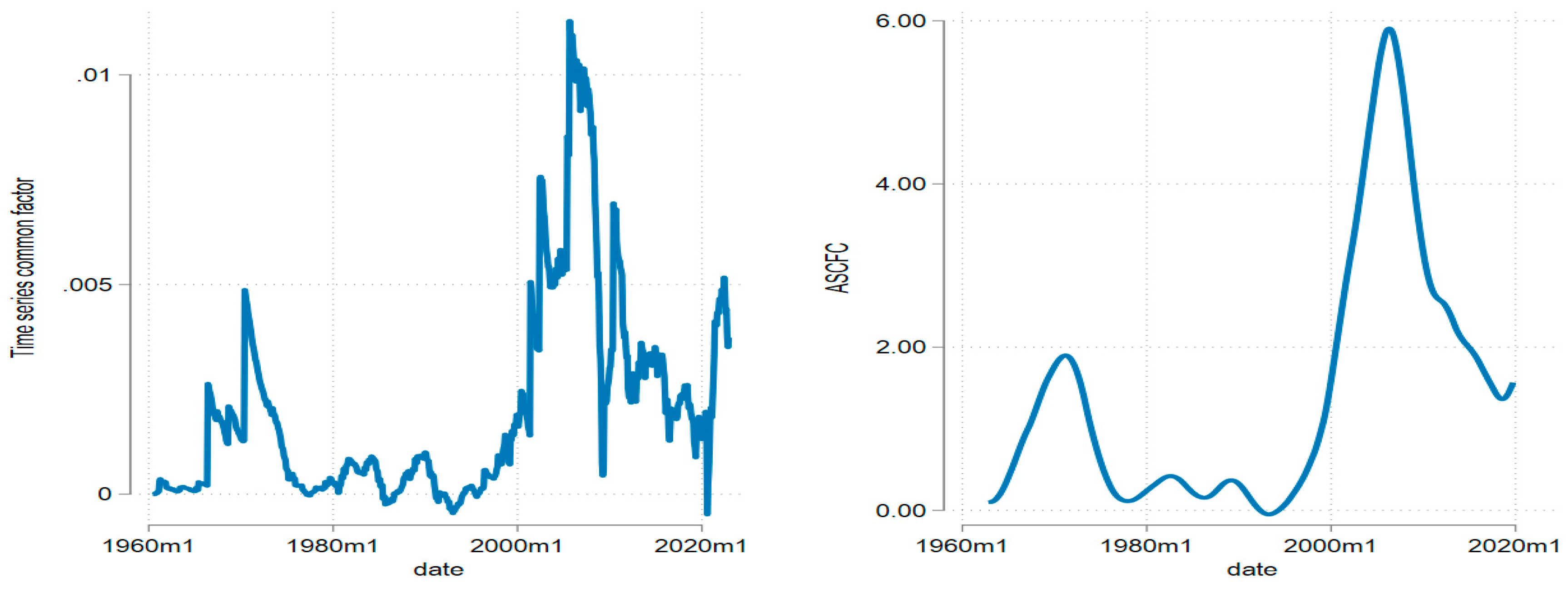
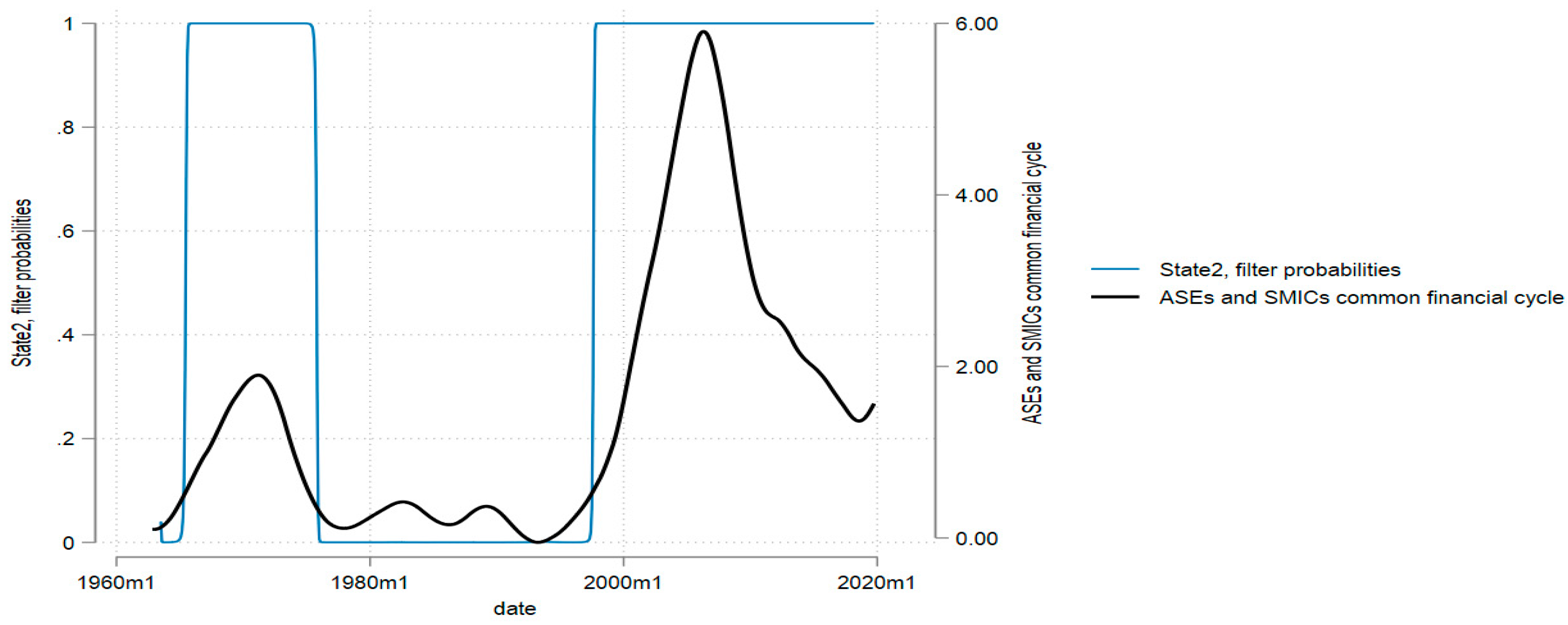
Countries such as advanced systemic economies (ASEs) and systemic middle-income countries (SMICs), considering macroprudential policy coordination, must ensure that their financial cycles are sufficiently synchronized. However, differences in the features and significance of financial cycles between ASEs and SMICs pose challenges in determining the extent of their synchronization. Accordingly, this study assesses whether a common financial cycle exists between these types of economies. The point of departure for this analysis is to examine the characteristics of the common financial cycle. To this end, this study employs data on capital flows, credit, house prices, share prices, and policy rates, utilizing the Markov switching dynamic regression model and the dynamic factor model to identify and analyze the cycle. The findings reveal strong evidence of a significant financial cycle, which explains 83% of the total variation across countries. This cycle is characterized by longer durations compared to domestic financial cycles and occurs less frequently than domestic cycles. Moreover, it exhibits high persistence in its contractionary and expansionary phases, with greater volatility in the contractionary phase. Based on these findings, it is recommended that ASEs and SMICs consider establishing a supranational prudential authority to coordinate and oversee macroprudential policy on behalf of the majority. Such an entity should play a proactive role, particularly during contractionary phases, to mitigate systemic risks and enhance financial stability across these interconnected economies.
Keywords: financial cycles; synchronization; macroprudential policy; policy coordination financial cycles; synchronization; macroprudential policy; policy coordination