Board Structure and Executive Compensation for R&D Spending in Innovative Companies Amid COVID-19


Abstract
1. Introduction
2. Literature Review
3. Hypothesis Development
3.1. Board Composition and R&D Spending
3.2. Executive Compensation and R&D Spending
4. Research Methodology
4.1. Data and Sample
4.2. Variable Measurement
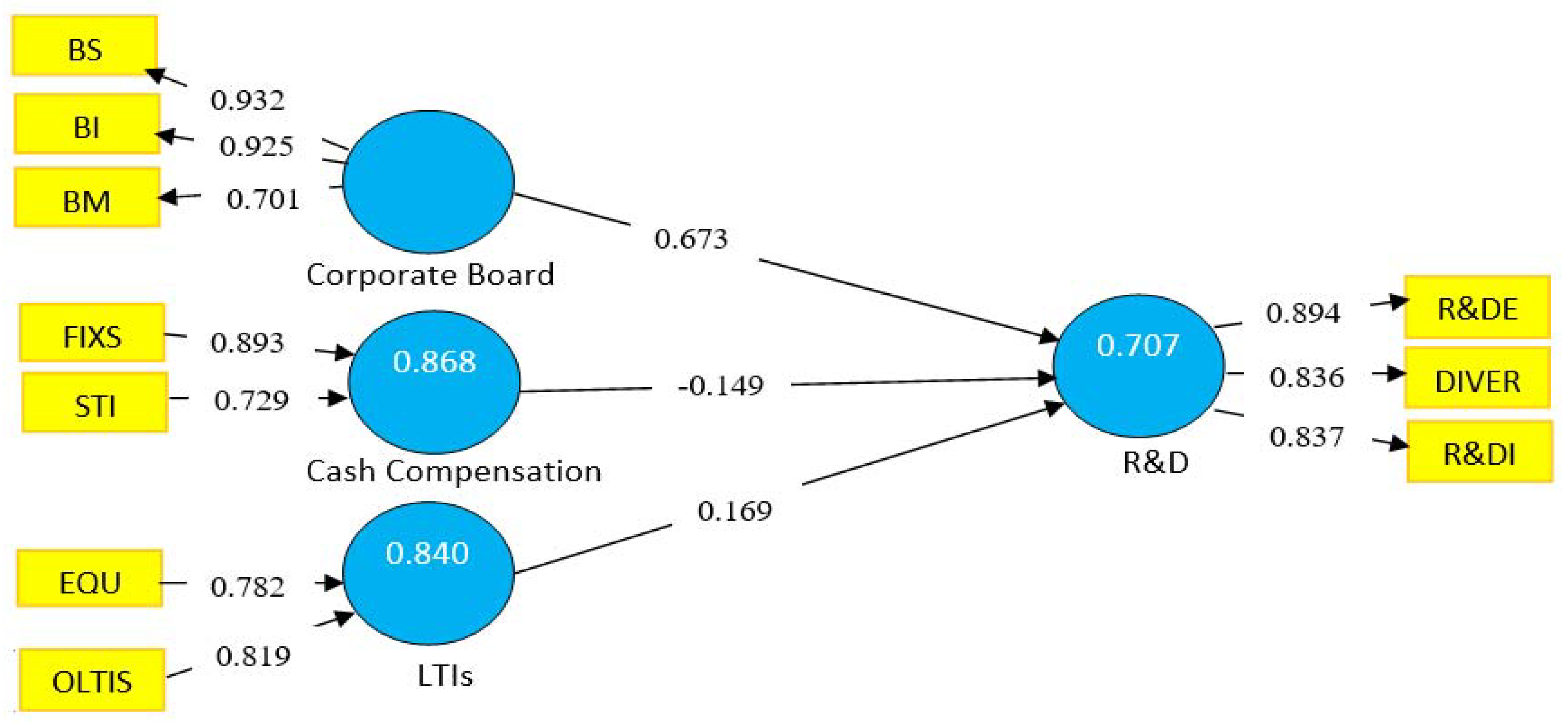
4.3. Study Model (Smart-PLS)
5. Results and Discussion
5.1. Reflective Measurement Scale
5.2. Discriminant Validity
5.3. Results of the Structural Model
5.4. Hypotheses Testing and Discussions
5.5. Robustness Check of Results
6. Conclusions and Recommendations
Funding
Institutional Review Board Statement
Informed Consent Statement
Data Availability Statement
Conflicts of Interest
References
- Adams, J. S. (1965). Inequity in social exchange. In Advances in experimental social psychology (Vol. 2, pp. 267–299). Academic Press. [Google Scholar]
- Akram, F., Abrar ul haq, M., & Umrani, W. A. (2019). Assessing the Effect of Managerial Power on Firm Performance through the Perceptual Lens of Executive Remuneration. Pertanika Journal of Social Sciences & Humanities, 27(1), 293–309. [Google Scholar]
- Akram, F., Murugiah, L., & Shahzad, A. (2017). Innovation as Mediator between Corporate Governance and Firm Performance: A Theoretical Perspective. International Journal of Innovative Knowledge Concepts, 5(11), 59–63. [Google Scholar]
- AlHares, A. (2020). Corporate governance mechanisms and R&D intensity in OECD courtiers. Corporate Governance: The International Journal of Business in Society, 20(5), 863–885. [Google Scholar]
- AlHares, A., Elamer, A. A., Alshbili, I., & Moustafa, M. (2020a). Board Structure and Corporate R&D Intensity: Evidence from Forbes Global 2000. International Journal of Accounting & Information Management, 28(3), 445–463. [Google Scholar]
- Anderson, M. C., Banker, R. D., & Ravindran, S. (2000). Executive compensation in the information technology industry. Management Science, 46(4), 530–547. [Google Scholar] [CrossRef] [Scilit]
- Anderson, R. C., & Bizjak, J. M. (2003). An empirical examination of the role of the CEO and the compensation committee in structuring executive pay. Journal of Banking & Finance, 27(7), 1323–1348. [Google Scholar]
- Balsmeier, B., Fleming, L., & Manso, G. (2017). Independent boards and innovation. Journal of Financial Economics, 123(3), 536–557. [Google Scholar] [CrossRef] [Scilit]
- Banker, R. D., Byzalov, D., & Xian, C. (2013). Research & Development intensity and executive compensation. Temple University. [Google Scholar]
- Baranchuk, N., Kieschnick, R., & Moussawi, R. (2014). Motivating innovation in newly public firms. Journal of Financial Economics, 111(3), 578–588. [Google Scholar] [CrossRef] [Scilit]
- Barker, V. L., III, & Mueller, G. C. (2002). CEO characteristics and firm R&D investment. Management Science, 48(6), 782–801. [Google Scholar]
- Bebchuk, L. A., & Fried, J. M. (2005). Pay without performance: Overview of the issues. Journal of Applied Corporate Finance, 17(4), 8–23. [Google Scholar] [CrossRef] [Scilit]
- Bedford, A., Bugeja, M., Ghannam, S., Jeganathan, D., & Ma, N. (2023). Were CEO pay cuts during the COVID-19 pandemic merely symbolic? Shareholders’ reaction and outrage. Pacific-Basin Finance Journal, 79, 101993. [Google Scholar] [CrossRef] [Scilit]
- Bereskin, F. L., & Hsu, P. H. (2014). Bringing in changes: The effect of new CEOs on innovation. SSRN. [Google Scholar] [CrossRef]
- Biggerstaff, L., Blank, B., & Goldie, B. (2019). Do incentives work? Option-based compensation and corporate innovation. Journal of Corporate Finance, 58, 415–430. [Google Scholar] [CrossRef] [Scilit]
- Blibech, N., & Berraies, S. (2018). The impact of CEO’duality and board’s size and independence on firms’ innovation and financial performance. Journal of Business Management and Economics, 9(1), 022–029. [Google Scholar]
- Bushee, B. J. (1998). The influence of institutional investors on myopic R&D investment behavior. Accounting Review, 73(3), 305–333. [Google Scholar]
- Carberry, E., & Zajac, E. (2017). How US Corporations Changed Executive Compensation after Enron: Substance and Symbol. In Academy of management proceedings (Vol. 2017, p. 15134). Academy of Management. [Google Scholar]
- Chen, H. L. (2013). CEO tenure, independent directors and corporate innovation. Journal of Applied Finance and Banking, 3(5), 187–197. [Google Scholar]
- Chen, L. (2019). Research on the Influence of Executive Compensation Incentive on Company Growth. Academic Journal of Engineering and Technology Science, 2(3), 53–65. [Google Scholar]
- Chen, S. S., Ho, K. Y., & Ho, P. H. (2014). CEO Overconfidence and Long-Term Performance Following R&D Increases. Financial Management, 43(2), 245–269. [Google Scholar]
- Cheng, S. (2004). R&D expenditures and CEO compensation. The Accounting Review, 79(2), 305–328. [Google Scholar]
- Chiang, H. T., Chao, C. C., & Ou, T. Y. (2023). The Impact of Board Composition and Ownership Structure on Innovation Performance: An Empirical Study in Taiwan’s Electronics Industry. The International Journal of Business and Finance Research, 17(1), 13–34. [Google Scholar]
- Chin, W. W. (1998). The partial least squares approach to structural equation modeling. Modern Methods for Business Research, 295(2), 295–336. [Google Scholar]
- Dalziel, T., Gentry, R. J., & Bowerman, M. (2011). An integrated agency–resource dependence view of the influence of directors’ human and relational capital on firms’ R&D investment. Journal of Management Studies, 48(6), 1217–1242. [Google Scholar]
- Eklund, M. A., & Stern, H. J. (2021). How COVID-19 reshapes businesses and executive pay for sustainability. Corporate Governance and Sustainability Review, 5(1), 107–119. [Google Scholar] [CrossRef] [Scilit]
- Epstein, D., Angert, C., & Strain, C. (2017). Board of Director Composition, and Ownership and Their Relationship to Patents: An Empirical Study. Journal of Marketing Development and Competitiveness, 11(2), 78–87. [Google Scholar]
- Flammer, C. (2017). Long-Term Executive Compensation as a Remedy for Corporate Short-Termism. Seattle University Law Review, 41, 419. [Google Scholar]
- Fornell, C., & Cha, J. (1994). Partial least squares. Advanced Methods of Marketing Research, 40(7), 52–78. [Google Scholar]
- Fornell, C., & Larcker, D. F. (1981). Structural equation models with unobservable variables and measurement error: Algebra and statistics. Journal of Marketing Research, 382–388. [Google Scholar] [CrossRef] [Scilit]
- Geisser, S. (1975). The predictive sample reuse method with applications. Journal of the American Statistical Association, 70(350), 320–328. [Google Scholar] [CrossRef]
- Hair, J., & Alamer, A. (2022). Partial Least Squares Structural Equation Modeling (PLS-SEM) in second language and education research: Guidelines using an applied example. Research Methods in Applied Linguistics, 1(3), 100027. [Google Scholar] [CrossRef] [Scilit]
- Hair, J. F., Jr., Hult, G. T. M., Ringle, C., & Sarstedt, M. (2016). A primer on partial least squares structural equation modeling (PLS-SEM). Sage Publications. [Google Scholar]
- Hall, B. H., & Lerner, J. (2010). The financing of R&D and innovation. Handbook of the Economics of Innovation, 1, 609–639. [Google Scholar]
- Hon, A. H., & Lu, L. (2015). Are we paid to be creative? The effect of compensation gap on creativity in an expatriate context. Journal of World Business, 50(1), 159–167. [Google Scholar] [CrossRef] [Scilit]
- Honoré, F., Munari, F., & van Pottelsberghe de la Potterie, B. (2011). Corporate governance practices and companies’ R&D orientation: Evidence from European countries (No. 2011/01). Bruegel. [Google Scholar]
- Jensen, M. C., & Meckling, W. H. (1976). Theory of the firm: Managerial behavior, agency costs and ownership structure. Journal of Financial Economics, 3(4), 305–360. [Google Scholar] [CrossRef] [Scilit]
- Kim, H., Kim, H., & Lee, P. M. (2008). Ownership structure and the relationship between financial slack and R&D investments: Evidence from Korean firms. Organization Science, 19(3), 404–418. [Google Scholar]
- Kim, J., & Wang, X. (2018). Impact of Managers’ Traits and Compensation Structure on R&D Investments. Journal of Applied Business and Economics, 20(9), 42–51. [Google Scholar]
- Liu, R. (2014). Can compensation committees effectively mitigate the ceo horizon problem? The role of co-opted directors [Ph.D. Thesis, Florida International University]. FIU Electronic Theses and Dissertations. [Google Scholar]
- Lotfi, Z., & Rost, K. (2014). Pay-for-performance for top managers and innovation activities in firms. In Druid Society Conference. CBS. [Google Scholar]
- Lu, X., Sheng, Y., & Wang, J. (2020). The influence of executive compensation incentives on R&D investment: The moderating effect of executive overconfidence. Technology Analysis & Strategic Management, 32(10), 1169–1181. [Google Scholar]
- Manso, G. (2017). Creating incentives for innovation. California Management Review, 60(1), 18–32. [Google Scholar] [CrossRef] [Scilit]
- Mezghanni, B. S. (2010). How CEO attributes affect firm R&D investment? New evidence from a panel of French firms. In Crises et nouvelles problématiques de la Valeur (p. CD–ROM). Available online: https://hal.science/hal-00479532/document (accessed on 26 January 2025).
- Moursli, R. M. (2020). The effects of board independence on busy directors and firm value: Evidence from regulatory changes in Sweden. Corporate Governance: An International Review, 28(1), 23–46. [Google Scholar] [CrossRef] [Scilit]
- Nguyen, D., Nguyen, H., & Nguyen, K. S. (2018). Ownership feature and firm performance via corporate innovation performance. Journal of Asian Business and Economic Studies, 25(2), 239–250. [Google Scholar] [CrossRef] [Scilit]
- Pallant, J. (2007). SPSS survival manual: A step-by-step guide to data analysis using SPSS version 15. McGraw Hill. [Google Scholar]
- Park, S., & Gupta, S. (2012). Handling endogenous regressors by joint estimation using copulas. Marketing Science, 31(4), 567–586. [Google Scholar] [CrossRef] [Scilit]
- Patel, P. C., Guedes, M. J., Soares, N., & da Conceição Gonçalves, V. (2018). Strength of the association between R&D volatility and firm growth: The roles of corporate governance and tangible asset volatility. Journal of Business Research, 88, 282–288. [Google Scholar]
- Raza, S., Minai, M. S., ul Haq, M. A., Iy, A., & Zain, A. Y. M. (2018). Entrepreneurial network towards small firm performance through dynamic capabilities: The conceptual perspective. Academy of Entrepreneurship Journal, 24(4), 1–9. [Google Scholar]
- Rhaiem, K., & Amara, N. (2021). Learning from innovation failures: A systematic review of the literature and research agenda. Review of Managerial Science, 15, 189–234. [Google Scholar] [CrossRef] [Scilit]
- Ryan, H. E., Jr., & Wiggins, R. A., III. (2002). The interactions between R&D investment decisions and compensation policy. Financial Management, 31(1), 5–29. [Google Scholar]
- Sanyal, P., & Bulan, L. T. (2010). Innovation, R&D and managerial compensation. SSRN. [Google Scholar] [CrossRef] [Scilit]
- Sarstedt, M., Ringle, C. M., Cheah, J. H., Ting, H., Moisescu, O. I., & Radomir, L. (2020). Structural model robustness checks in PLS-SEM. Tourism Economics, 26(4), 531–554. [Google Scholar] [CrossRef] [Scilit]
- Semadeni, M., & Krause, R. (2019). Innovation in the Board Room. Academy of Management Perspectives, 34(2), 240–251. [Google Scholar] [CrossRef] [Scilit]
- Shadab, H. B. (2008). Innovation and corporate governance: The impact of Sarbanes-Oxley. University of Pennsylvania Journal of Business and Employment Law, 10(4), 955. [Google Scholar]
- Shaikh, I. A., O’Brien, J. P., & Peters, L. (2018). Inside directors and the underinvestment of financial slack towards R&D-intensity in high-technology firms. Journal of Business Research, 82, 192–201. [Google Scholar]
- Shang, Y., Xu, J., & Li, J. (2023). The impact of executive compensation incentive on corporate innovation capability: Evidence from agro-based companies in China. PLoS ONE, 18(9), e0291517. [Google Scholar] [CrossRef] [Scilit]
- Sheikh, M. F., Shah, S. Z. A., & Akbar, S. (2018). Firm performance, corporate governance and executive compensation in Pakistan. Applied Economics, 50(18), 2012–2027. [Google Scholar] [CrossRef] [Scilit]
- Shen, C. H. H., & Zhang, H. (2013). CEO risk incentives and firm performance following R&D increases. Journal of Banking & Finance, 37(4), 1176–1194. [Google Scholar]
- Shujuan, M., Meng, X., & Qingshun, M. (2018). Influential Research of Executive Incentive on R&D Investment—The Moderating of Ultimate Control Rights. Journal of Industrial Technological & Economics, 1, 6. [Google Scholar]
- Souder, D., & Shaver, J. M. (2010). Constraints and incentives for making long horizon corporate investments. Strategic Management Journal, 31(12), 1316–1336. [Google Scholar] [CrossRef] [Scilit]
- Stone, M. (1974). Cross-validatory choice and assessment of statistical predictions. Journal of the Royal Statistical Society: Series B (Methodological), 36(2), 111–147. [Google Scholar] [CrossRef] [Scilit]
- Vafeas, N., & Vlittis, A. (2019). Board executive committees, board decisions, and firm value. Journal of Corporate Finance, 58, 43–63. [Google Scholar] [CrossRef] [Scilit]
- Wang, H. C., Lou, Y. I., Venezia, C. C., & Buzzetto-Hollywood, N. A. (2019). Corportate Diversification and CEO Compensation: Evidence from the Moderating Effect of Stock Ownership. e-Finanse, 15(4), 83–92. [Google Scholar] [CrossRef] [Scilit]
- Wang, L., Liu, Z., Wang, Y., Ai, W., & An, Y. (2023). Executive Compensation Incentives and Corporate R&D Investments: An Analysis Based on the Moderating Effect of Managerial Power. Emerging Markets Finance and Trade, 59(8), 2664–2693. [Google Scholar] [CrossRef] [Scilit]
- Wang, B., Khalid, S., & Mahmood, H. (2024). R&D spending and economic policy uncertainty in Asian countries: An advanced panel data estimation study. Journal of the Knowledge Economy, 15(1), 4710–4729. [Google Scholar]
- Wuebker, R. J., & Klein, P. G. (2017). Corporate diversification and innovation: Managerial myopia or inefficient internal capital market. Academy of Management Proceedings, 2017(1), 11182. [Google Scholar] [CrossRef] [Scilit]
- Xu, Y., Ji, J., Li, N., & Borah, D. (2024). How do executive excess compensation affect enterprise technological innovation: Evidence from a panel threshold model of chinese biopharmaceutical companies. Journal of Business Research, 179, 114683. [Google Scholar] [CrossRef] [Scilit]


| Variables | Items | Measurement | Source |
|---|---|---|---|
| R&D | R&D Expense | Log of R&D expense | Lu et al. (2020) |
| Diversification | Measured as a dummy, 1 for yes and 0 for no | ||
| R&D Intensity | R&D/sales | ||
| Corporate Board | Board Size | Number of total directors | Liu (2014) |
| Board Independence | % of independent directors | ||
| Board Meeting | Number of board meetings held in a year | ||
| Cash Compensation | Short-Term Incentives | Sum of all one-year bonuses divided by total compensation | Liu (2014) |
| Fixed Salary | Ratio of fixed cash amount of compensation to total compensation | ||
| Long-Term Compensation | Equity Compensation | Ratio of the dollar value of shares rewarded as part of compensation | Lotfi and Rost (2014) |
| Long-Term Incentives (LTIs) | Ratio of long-term incentives and other long-term benefits to total compensation |
| Variables | Mean | Minimum | Maximum | Standard Deviation | Skewness | Kurtosis |
|---|---|---|---|---|---|---|
| Board size | 12.5 | 10 | 15.0 | 3.5355 | 0.110 | 1.200 |
| Independent directors | 7.00 | 0 | 14.0 | 9.8995 | 0.192 | 1.211 |
| Board meetings | 23.5 | 3 | 44.0 | 28.9914 | 0.175 | 1.207 |
| Fixed salary | 1.00 | 0.11 | 1.856 | 1.2346 | 0.244 | 1.109 |
| STIs | 0.50 | 0 | 0.916 | 0.6477 | 0.356 | 1.029 |
| Equity | 0.50 | 0 | 0.954 | 0.6746 | 0.812 | 0.636 |
| Other long-term incentives | 0.50 | 0 | 0.931 | 0.6583 | 0.407 | 1.159 |
| R&D | 80.3 | 0 | 160.648 | 113.5953 | 0.295 | 1.143 |
| Diversification | 26.0 | 29 | 23 | 4.2426 | 0.494 | 1.308 |
| Reflective Constructs | Items | Outer Loadings | Items Weights | t-Statistics | VIF | CR | AVE |
|---|---|---|---|---|---|---|---|
| Corporate Board | Board Size | 0.932 *** | -- | 29.372 | -- | 0.868 | 0.695 |
| Board Independence | 0.925 *** | -- | 32.318 | ||||
| Board Meeting | 0.701 *** | -- | 7.130 | ||||
| R&D | R&D Expense | 0.894 *** | -- | 3.561 | -- | 0.883 | 0.716 |
| Diversification | 0.836 *** | -- | 2.985 | ||||
| R&D Intensity | 0.837 *** | -- | 9.389 | ||||
| Cash Compensation | Fixed Salary | -- | 0.893 *** | 6.926 | 1.229 | Formative Constructs | |
| STIs | -- | 0.729 *** | 3.864 | 1.538 | |||
| Long-Term Compensation | Equity | -- | 0.782 *** | 4.230 | 1.034 | ||
| Other LTIs | -- | 0.819 ** | 4.650 | 1.020 | |||
| Corporate Board | R&D | |
|---|---|---|
| Corporate Board | 0.833 | |
| R&D | 0.723 | 0.760 |
| Hypotheses | Path Coefficients | t-Statistics | Decision | f2 | R2 | Q2 |
|---|---|---|---|---|---|---|
| Corporate Board → R&D | 0.673 *** | 3.273 | Accepted | 0.757 | 0.707 | 0.234 |
| Cash Comp → R&D | −0.149 * | 1.791 | Accepted | 0.081 | ||
| LTIs → R&D | 0.169 * | 1.682 | Accepted | 0.162 |
| Nonlinear Relationship | Path Coefficients | t-Statistics | RAMSEY’s Test |
|---|---|---|---|
| (Corporate Board)2 → R&D | 0.140 | 1.049 | F-value = 0.372, p-value = 0.759 |
| (Cash Compensation)2 → R&D | 0.031 | 0.864 | |
| (LTIs)2 → R&D | 0.201 | 1.280 |
| Variables | β | p-Values | |
|---|---|---|---|
| Gaussian copula of model 1 (endogenous variable; CB) | CB | 0.220 | <0.01 |
| CC | 0.203 | 0.619 | |
| LTIs | 0.110 | 0.822 | |
| c CB | 0.031 | 0.975 | |
| Gaussian copula of model 2 (endogenous variable; CC) | CB | 0.140 | <0.01 |
| CC | 0.227 | <0.01 | |
| LTIs | 0.119 | 0.788 | |
| c CC | 0.101 | 0.869 | |
| Gaussian copula of model 3 (endogenous variable; LTIs) | CB | 0.151 | <0.01 |
| CC | 0.129 | <0.01 | |
| LTIs | 0.114 | 0.079 | |
| c LTIs | 0.019 | 0.907 | |
| Gaussian copula of model 4 (endogenous variable; CB, CC) | CB | 0.145 | <0.01 |
| CC | 0.179 | <0.01 | |
| LTIs | 0.105 | 0.666 | |
| c CB | 0.100 | 0.805 | |
| c CC | 0.009 | 0.847 | |
| Gaussian copula of model 5 (endogenous variable; CC, LTIs) | CB | 0.205 | <0.01 |
| CC | 0.165 | <0.01 | |
| LTIs | 0.100 | 0.701 | |
| c CC | 0.002 | 0.988 | |
| c LTIs | 0.041 | 0.859 | |
| Gaussian copula of model 6 (endogenous variable; CB, LTIs) | CB | 0.198 | <0.01 |
| CC | 0.158 | <0.01 | |
| LTIs | 0.095 | 0.563 | |
| c CB | 0.018 | 0.606 | |
| c LTIs | 0.042 | 0.809 | |
| Gaussian copula of model 7 (endogenous variable; CB, CC, LTIs) | CB | 0.188 | <0.01 |
| CC | 0.147 | <0.01 | |
| LTIs | 0.109 | 0.833 | |
| c CB | 0.009 | 0.709 | |
| c CC | 0.049 | 0.407 | |
| c LTIs | 0.007 | 0.582 |
Disclaimer/Publisher’s Note: The statements, opinions and data contained in all publications are solely those of the individual author(s) and contributor(s) and not of MDPI and/or the editor(s). MDPI and/or the editor(s) disclaim responsibility for any injury to people or property resulting from any ideas, methods, instructions or products referred to in the content. |
© 2025 by the author. Licensee MDPI, Basel, Switzerland. This article is an open access article distributed under the terms and conditions of the Creative Commons Attribution (CC BY) license (https://creativecommons.org/licenses/by/4.0/).
Share and Cite
Abrar-ul-haq, M. Board Structure and Executive Compensation for R&D Spending in Innovative Companies Amid COVID-19. J. Risk Financ. Manag. 2025, 18, 69. https://doi.org/10.3390/jrfm18020069
Abrar-ul-haq M. Board Structure and Executive Compensation for R&D Spending in Innovative Companies Amid COVID-19. Journal of Risk and Financial Management. 2025; 18(2):69. https://doi.org/10.3390/jrfm18020069
Chicago/Turabian StyleAbrar-ul-haq, Muhammad. 2025. "Board Structure and Executive Compensation for R&D Spending in Innovative Companies Amid COVID-19" Journal of Risk and Financial Management 18, no. 2: 69. https://doi.org/10.3390/jrfm18020069
APA StyleAbrar-ul-haq, M. (2025). Board Structure and Executive Compensation for R&D Spending in Innovative Companies Amid COVID-19. Journal of Risk and Financial Management, 18(2), 69. https://doi.org/10.3390/jrfm18020069