1. Introduction
Environmental, Social, and Governance (ESG) criteria have emerged as critical benchmarks for assessing corporate sustainability, ethical performance, and long-term value creation in contemporary global markets. Originating from the broader paradigm of socially responsible investing, ESG assessment now functions as a strategic instrument for guiding corporate behaviour towards environmental stewardship, social responsibility, and sound governance practices (
Alsayegh et al., 2020). In emerging economies such as Thailand, ESG considerations are becoming more important. This trend is driven by greater investor awareness, changing societal expectations, and regulatory initiatives that promote transparency and sustainable growth.
Inclusion in ESG indices such as Thailand’s ESG100 signals that a firm meets strong sustainability and governance standards. It also shows investors and stakeholders that the firm is committed to responsible conduct. Although many studies in developed markets link strong ESG performance to lower risk, better reputation, and higher valuation, the causal evidence remains mixed. The effect on outcomes such as stock returns and operational efficiency is still unclear (
de Souza Barbosa et al., 2023;
Zhao et al., 2018). Furthermore, the extent to which these relationships hold in emerging markets is likely to be influenced by market maturity, institutional arrangements, and prevailing investor sentiment (
Wuttichindanon, 2017). In Thailand, the Stock Exchange of Thailand (SET) has, in recent years, strengthened ESG disclosure requirements and encouraged sustainability reporting (
Suttipun et al., 2021). These developments have created a conducive environment for firms to integrate corporate social responsibility into their strategic positioning. However, a key empirical question persists: Does inclusion in an ESG index such as ESG100 translate into tangible improvements in firm performance in the Thai capital market?
The potential link between ESG index inclusion and firm performance can be explained through several established theoretical perspectives. Stakeholder theory argues that strong ESG practices enhance stakeholder trust and cooperation, lowering conflict and improving long-term performance (
Taliento et al., 2019). The Resource-Based View (RBV) suggests that ESG capabilities—such as sustainability-oriented processes and governance structures—constitute valuable and hard-to-imitate resources that strengthen competitive advantage (
Ma, 2024). Although ESG capabilities are long-term, hard-to-imitate organisational resources, annual ESG100 inclusion represents only a short-term external recognition of these capabilities. A firm may still retain strong ESG attributes even in years when it drops out of the list. This distinction remains consistent with the RBV, as ESG100 inclusion acts as a recognition signal of underlying, persistent ESG resources rather than a change in the resources themselves. Legitimacy and neo-institutional theories further propose that ESG inclusion provides institutional endorsement and societal approval, reducing reputational and regulatory risks and improving operational stability (
Suttipun et al., 2021). In capital markets, signalling theory posits that ESG index inclusion sends a credible signal of management quality and reduced information asymmetry, potentially improving investor confidence and financing conditions (
Hu et al., 2023). Finally, agency theory links ESG practices to stronger governance systems that mitigate agency conflicts and improve financial discipline (
Adams & Jayasekara, 2024). Together, these complementary mechanisms offer a theoretical rationale for expecting ESG index inclusion to influence firm performance.
To address this question, this study employs a staggered difference-in-differences (DiD) approach to compare the performance trajectories of ESG100-listed firms against non-ESG100 peers over time. This design allows us to estimate the effect of ESG index inclusion more credibly. It also controls for unobserved firm characteristics and time-related shocks. However, this study focuses on short-term firm performance following first-time ESG100 inclusion, by using a staggered DiD. The analysis captures effects in the immediate post-recognition window and does not evaluate longer-term strategic or operational outcomes that may unfold over multiple years.
Despite the rapid expansion of ESG-related research, several gaps remain. First, the existing literature provides limited evidence on whether the inclusion of firms in sustainability indices produces measurable improvements in firm performance in emerging markets, where institutional environments differ fundamentally from those in developed economies. Second, prior studies often rely on cross-sectional designs or static event windows, offering little insight into the dynamic effects of ESG index inclusion. Third, the literature has not fully addressed selection bias and treatment-timing heterogeneity, which may distort causal inference in ESG-performance research. By integrating propensity score matching with a staggered difference-in-differences design, this study provides more credible causal evidence on the performance implications of ESG index inclusion in Thailand’s market context. The combination of these methodological advances and the focus on an emerging ASEAN economy constitutes the novelty of this research.
2. Literature Reviews
2.1. Theoretical Foundations
2.1.1. Stakeholder Theory and Resource-Based View (RBV)
Stakeholder theory asserts that firms engaging in ESG practices proactively address the interests of a broad constituency, including employees, customers, suppliers, communities, and regulators, alongside shareholders. Such engagement fosters trust, loyalty, and cooperation, thereby reducing stakeholder conflict, securing a social licence to operate, and strengthening reputational capital—factors conducive to long-term performance and competitive positioning (
Ma, 2024;
Taliento et al., 2019).
The Resource-Based View (RBV) complements this perspective by framing ESG-related capabilities as strategic resources that are valuable, rare, inimitable, and non-substitutable. Organisational cultures oriented towards sustainability, robust governance frameworks, and advanced environmental innovations can differentiate firms, enhance efficiency, reduce operational risks, and open new market opportunities (
Ma, 2024;
Shi et al., 2025;
Yue, 2024). Corporate ESG recognition also offers external validation of these strategic assets and stakeholder alignments, signalling adherence to high sustainability and responsibility standards. This legitimacy strengthens brand equity and reinforces the competitive advantage envisaged by RBV (
Taliento et al., 2019).
2.1.2. Legitimacy Theory and Neo-Institutional Theory
Legitimacy theory posits that firms disclose ESG information and seek ESG recognition to align with societal norms and values. This legitimacy mitigates reputational risks, regulatory scrutiny, and stakeholder activism. In emerging markets, where institutional frameworks may be less mature, recognised ESG commitments help stabilise operating environments and improve resource access (
de Souza Barbosa et al., 2023;
Suttipun et al., 2021).
Neo-institutional theory extends this view by highlighting isomorphic pressures—regulatory mandates, industry norms, and peer practices—that compel ESG adoption. ESG index inclusion represents institutional endorsement, signalling conformity with accepted sustainability standards and fostering strategic alignment within the evolving business ecosystem (
de Souza Barbosa et al., 2023). By aligning formal structures with institutional expectations, firms secure legitimacy that enhances capital access, ensures operational continuity, and reduces the costs of external control (
Ma, 2024).
2.1.3. Signalling Theory
Signalling theory complements the preceding perspectives by explaining how ESG recognition operates as a credible market signal in contexts of information asymmetry. High ESG performers convey superior management quality, effective risk governance, and long-term strategic orientation to investors and other stakeholders. Inclusion in ESG indices or receipt of ESG awards indicates an enhanced capacity to manage non-financial risks, maintain regulatory compliance, and innovate sustainably—attributes that align with both stakeholder expectations and the strategic resource advantages outlined in RBV (
Hu et al., 2023;
Ma, 2024).
These signals can reduce investor uncertainty and increase confidence. As a result, firms may face a lower perceived risk premium and lower cost of capital. In turn, this facilitates favourable financing conditions, supports strategic growth, and attracts sustainability-focused investors and analysts, generating positive market responses and improving market liquidity and firm outcome. (
Ma, 2024).
2.1.4. Agency Theory and Corporate Governance
Agency theory addresses the inherent conflicts of interest between managers and shareholders, emphasising the role of governance in aligning managerial actions with long-term shareholder value. ESG recognition is often associated with enhanced corporate governance, as firms adopting transparent and responsible ESG practices typically implement stronger oversight structures and incentive mechanisms that promote managerial stewardship towards sustainability objectives (
Adams & Jayasekara, 2024).
Governance features such as board independence, gender diversity, and executive remuneration linked to ESG performance targets improve decision quality, strengthen accountability, and reduce agency costs. ESG recognition functions as both an external monitoring mechanism and a reputational safeguard, reinforcing governance quality and signalling to stakeholders a sustained commitment to responsible management. This, in turn, can enhance firm value and reduce systemic risks (
Heubeck, 2023;
Menicucci & Paolucci, 2024).
In sum, ESG recognition can influence firm performance through multiple, interrelated theoretical channels. Stakeholder theory and the Resource-Based View suggest that ESG engagement fosters valuable stakeholder relationships and develops unique organisational capabilities. Legitimacy theory and neo-institutional theory highlight how ESG conformity secures societal approval and institutional endorsement. Signalling theory emphasises ESG recognition as a credible market signal, reducing information asymmetry and enhancing investor confidence. Agency theory links ESG practices to stronger governance, greater managerial accountability, and reduced agency costs. Collectively, this integrated perspective explains how ESG index inclusion can enhance innovation, strengthen stakeholder relations, mitigate risk, improve financing conditions, reinforce governance, and sustain competitive advantage.
2.2. Overview of ESG–Financial Performance Relationship
2.2.1. Meta-Analytical Evidence on ESG-Financial Outcomes
- (i)
Profitability and Accounting Performance Outcomes
Meta-analyses examining the link between ESG engagement and accounting-based profitability measures—such as Return on Assets (ROA), Return on Equity (ROE), and EBITDA margins—generally report positive associations. Strong ESG performance is often linked to cost savings through energy efficiency, waste reduction, and enhanced employee productivity, alongside improved risk management that mitigates the financial impact of environmental penalties, labour disputes, and governance failures (
Lu et al., 2025). However, these effects are not uniform. Some studies report non-significant or even negative profitability impacts, particularly where ESG activities are treated as cost burdens rather than strategically integrated value drivers. Variations by firm size and sector are evident, with larger firms and those in environmentally sensitive industries benefiting more due to greater stakeholder scrutiny and scalability of ESG initiatives (
Zhao et al., 2018). Evidence from Thailand similarly reveals mixed relationships between CSR expenditure and profitability, underscoring the importance of alignment between ESG initiatives, strategic objectives, and institutional quality (
Suttipun et al., 2021).
- (ii)
Market-Based Performance Measures
Meta-analyses also document positive associations between ESG engagement and market-based indicators such as stock returns, Tobin’s Q, and abnormal returns. ESG performance often functions as a forward-looking signal of firm value, reflecting reduced operational and reputational risks and stronger prospects for sustainable growth. Investors increasingly regard ESG as a proxy for management quality, which lowers perceived uncertainty, stimulates demand for securities, and supports higher market valuations (
N. Wang et al., 2022). The strength of this relationship is shaped by moderating factors, including governance quality, institutional robustness, and capital market maturity. Firms in jurisdictions with advanced regulatory frameworks and investor protections tend to experience more pronounced market gains from ESG adoption (
Taliento et al., 2019). Moreover, in periods of market turbulence—such as financial crises or the COVID-19 pandemic—firms with higher ESG ratings have demonstrated resilience, characterised by lower volatility and reduced downside risk, thereby offering greater protection to investors (
Lu et al., 2025).
- (iii)
Payout Policy
A growing body of evidence suggests that firms with stronger ESG performance are more likely to adopt stable and consistent dividend policies, aligning shareholder returns with sustainable business practices. For instance, a meta-analysis of Southeast Asian firms reported a positive association between ESG performance and dividend payout levels, indicating that sustainability-oriented firms are more inclined to maintain regular and higher dividend distributions as a signal of commitment to both stakeholder and shareholder value (
Sucitawati & Utama, 2025). Similarly, research on Pakistani firms found that environmental, social, and governance dimensions significantly shape dividend policies, with dividends mediating the link between ESG performance and investor trust. Superior ESG ratings were shown to foster greater financial stability and market confidence through transparent and consistent capital return strategies (
Ramzan & Ul Hameed, 2024). Complementing this, longitudinal evidence from China demonstrates that comprehensive ESG disclosure and management strengthen long-term financial performance, thereby underpinning dividend stability as part of enhanced corporate reputation and governance credibility (
Liu & Fill, 2025). Collectively, these findings underscore the role of ESG engagement in reinforcing financial discipline and mitigating agency conflicts through dividend policy.
2.2.2. ESG Recognition and External Shocks
Evidence from meta-analyses and quasi-experimental studies indicates that firms with strong ESG performance demonstrate greater resilience during environmental, social, and market crises, maintaining revenue growth and reducing idiosyncratic risk more effectively than peers. This resilience is linked to enhanced risk management, stakeholder trust, and adaptive capacity, with effects often stronger in supportive institutional environments (
Aevoae et al., 2022;
Yang et al., 2024).
From a market perspective, ESG index recognition can act as a stabilising factor during downturns, reducing volatility and downside risk by signalling superior governance and sustainability capacity. However, short-term abnormal return effects are mixed, reflecting varying investor expectations and market maturity (
Beloskar & Rao, 2023;
Lu et al., 2025). Post-crisis, sustained ESG integration has also been shown to accelerate recovery and foster long-term value creation through innovation and governance improvements (
Shi et al., 2025).
From event-based evidence, ESG index recognition frequently enhances liquidity through increased trading volumes, analyst coverage, and institutional investor interest, especially from sustainability-focused funds (
Durand et al., 2019;
Suresha et al., 2022). This improved liquidity can lower the cost of capital and indirectly support firm value (
Roy et al., 2022). Longer-term, inclusion is often associated with gains in market capitalisation and earnings per share, although accounting profitability improvements may lag as ESG strategies take time to translate into operational outcomes (
Shi et al., 2025).
The literature generally suggests a positive association between ESG engagement and firm performance, covering profitability, market valuation, and payout policy, although outcomes often vary across industries, institutional contexts, and firm characteristics. ESG practices are argued to enhance operational efficiency, foster stakeholder trust, and improve risk management, thereby contributing to stronger financial outcomes and greater resilience in times of crisis. While evidence on ESG index inclusion indicates mixed short-term market reactions, it points more consistently to improvements in liquidity, investor attention, and, over the longer term, firm value. These insights highlight the potential of ESG100 recognition in Thailand to shape firm performance through signalling effects, increased market visibility, and strengthened stakeholder relations.
Although multiple theoretical lenses discussed earlier can jointly explain the potential effects of ESG100 recognition, the present study organises these theories into three dominant mechanisms that guide the hypotheses. First, stakeholder theory and the resource-based view suggest that ESG recognition supports stronger stakeholder relations and the development of valuable organisational capabilities, which in turn may enhance accounting profitability; these mechanisms motivate H1 as below:
H1 (Accounting performance). Firms that are included in the ESG index exhibit higher accounting performance compared to non-included firms.
Second, legitimacy theory, neo-institutional theory, and signalling theory propose that ESG index inclusion functions as an external endorsement and credible information signal that can reduce information asymmetry, improve investor confidence, and support higher market valuation, forming the theoretical basis for H2 as below:
H2 (Market valuation). Firms that are included in the ESG index experience enhanced market valuation compared to non-included firms.
Finally, agency theory highlights how ESG recognition strengthens governance structures and managerial accountability, which may translate into more disciplined cash distribution and stable payout policies, providing the rationale for H3.
H3 (Payout policy). Firms that are included in the ESG index adopt more favourable payout policies compared to non-included firms.
While these theories may overlap in scope, the mapping presented here reflects the dominant conceptual pathways linking ESG100 recognition to accounting, market, and payout outcomes.
3. Research Data and Methodology
3.1. Background
In Thailand, the Stock Exchange of Thailand (SET) and the Thaipat Institute have jointly advanced the integration of sustainability into the capital market through the publication of the ESG100 Index since 2015. The ESG100 Index annually recognises the top 100 listed firms that demonstrate superior performance across ESG dimensions, based on assessments of public disclosures, sustainability reports, and corporate governance practices (
Suttipun et al., 2021). This initiative aligns with Thailand’s broader regulatory and policy agenda that promotes transparency, accountability, and sustainable growth, consistent with international trends in responsible investment.
The Thai capital market provides a compelling and policy-relevant context for examining the effects of ESG recognition. Unlike many developed markets where ESG disclosure is mandatory or strongly standardised, Thailand operates within a semi-voluntary ESG disclosure environment in which firms face heterogeneous reporting incentives (
Katisart et al., 2023). This institutional setting, combined with Thailand’s rapid growth in sustainability initiatives led by the SET and the introduction of the ESG100 index, creates an opportunity to study how third-party ESG recognition affects firm performance in an emerging market where information asymmetry remains relatively high. Moreover, existing ESG–finance research in Thailand is limited and largely descriptive, leaving an empirical gap regarding whether ESG100 inclusion translates into measurable accounting, market, or payout responses (
Chaisalee & Manapreechadeelert, 2024). Therefore, analysing the impact of ESG100 recognition in Thailand not only addresses an important national policy agenda but also provides evidence from a major emerging market, contributing to global debates on the economic value of ESG recognition.
The ESG100 serves as a benchmark for sustainable business conduct, analogous to international indices such as the Dow Jones Sustainability Index (DJSI). Inclusion in the ESG100 signals a firm’s adherence to best governance and sustainability practices, often associated with superior market value, enhanced liquidity, and reputational capital (
Durand et al., 2019). Although the index does not impose mandatory disclosure requirements, it leverages voluntary ESG reporting practices to provide external validation of firms’ sustainability achievements. Prior research suggests that ESG recognition may influence firm activities through enhanced investor confidence, reduced information asymmetry, and improved access to capital (
Deng & Cheng, 2019;
Zhao et al., 2018).
Given the increasing prominence of ESG100 in Thailand’s capital market, it provides a quasi-natural experiment setting to evaluate the causal effect of ESG recognition on firm outcomes. However, unlike randomised interventions, ESG100 inclusion is based on eligibility criteria determined by ESG assessments, meaning treatment firms cannot be randomly assigned. To mitigate concerns of endogeneity and selection bias, recent studies employ quasi-experimental strategies, such as difference-in-differences (DiD) and propensity score matching, to evaluate the impact of sustainability index inclusion on firm performance (
Callaway & Sant’Anna, 2021;
Sun & Abraham, 2021). Building on this methodological foundation, the present study applies a staggered DiD approach to capture the dynamic and heterogeneous effects of ESG100 recognition on firm performance in the Thai context.
3.2. Data and Sample
This study explores the impact of firm inclusion in Thailand’s ESG100 index on subsequent firm performance by constructing a firm-level panel dataset encompassing the period from 2015 to 2024. The treatment group comprises firms first recognised in the annual ESG100 index published by the Thaipat Institute, while the control group consists of firms listed on the Stock Exchange of Thailand (SET) not included in the index during the same timeframe. To operationalise firm performance, we collect comprehensive financial and market indicators such as Return on Assets (ROA), Return on Equity (ROE), Tobin’s Q, Market-to-Book ratio, Dividend Payout Ratio, and Dividend Yield from the Refinitiv Eikon and SETSMART databases, ensuring high-quality data consistency and completeness.
Firm-year observations are structured longitudinally, accommodating both pre-treatment and post-treatment periods, which facilitates the estimation of causal effects surrounding ESG100 inclusion. The panel data is restricted to 2160 observations (284 unique firms) after excluding financial and utility sector firms, whose markedly different regulatory environments and accounting treatments could confound the analysis. This exclusion aligns with precedent in empirical studies exploring ESG effects in emerging markets, where sectoral heterogeneity is a known confounder (
Taechaubol, 2017). This approach enables an empirical investigation that captures heterogeneous responses across firms over time, recognising that ESG recognition may exert differential effects contingent on firm characteristics and market reactions (
Deng & Cheng, 2019).
The constructed firm-year panel is an unbalanced panel, as firms enter the sample in different years depending on data availability, and ESG100 publication cycles. Missing values in financial variables obtained from Refinitiv Eikon and SETSMART were handled using a listwise deletion approach, consistent with recent ESG–finance studies (
Little & Rubin, 2019). Firm-years with missing observations for any dependent, independent, or control variable were removed prior to estimation. This procedure ensures that all DiD estimations are conducted on a consistent set of observable firm-year data without applying interpolation or forward/backward filling, thereby preserving the integrity of the identification strategy.
The listing history of ESG100 members from 2015 to 2024 based on the official releases from the Thaipat Institute found that firms entered the ESG100 are staggered: some firms were recognised in the earliest year (2015), while others entered in subsequent years. Therefore, the staggered DiD design is appropriate because treatment timing varies and is not concentrated in a single year. We further confirm that first-time inclusion does not imply uninterrupted ESG100 membership thereafter. Several treated firms appear in only one or two consecutive years, while others exhibit intermittent membership. This heterogeneity supports our focus on immediate post-inclusion effects rather than long-run structural changes.
For the control group, we use all SET-listed firms not included in ESG100 in any year in which they are used as controls. We verified that no control firm appears in the ESG100 list during its control years, thereby preventing contamination of counterfactual estimates. After excluding the financial and utility sectors, the pool of eligible non-ESG100 firms is sufficiently large to support reliable propensity-score matching.
While the ESG100 dataset spans 2015–2024, long-term effects are not examined because ESG100 membership is not stable over time for many firms; the majority of newly included firms do not remain in the index for more than one to two years. This instability makes long-term treatment definitions unsuitable for causal inference and reinforces our focus on short-term post-recognition effects.
3.3. Variable Measurement
3.3.1. Dependent Variables
To capture firm performance, we employ a range of accounting-based, market-based, and payout-related indicators, consistent with prior ESG-performance research (
Lu et al., 2025;
Zhao et al., 2018). Specifically, accounting performance is measured using Return on Assets (ROA) and Return on Equity (ROE), which proxy for profitability and operating efficiency. Market valuation is assessed using Tobin’s Q and the Market-to-Book ratio (M/B), widely adopted measures of firm value relative to asset replacement costs and equity book values (
Martiny et al., 2024). To reflect financial flexibility and long-term value creation, we include payout policies that are captured by the Dividend Payout Ratio and Dividend Yield, indicating shareholder distribution behaviour and market returns respectively (
Roy et al., 2022;
Shi et al., 2025).
All variables are extracted from Refinitiv Eikon and SETSMART databases to ensure accuracy and comparability across firms and years. To mitigate the influence of extreme observations, all continuous dependent variables are winsorised at the 1st and 99th percentiles of their distributions (
Taechaubol, 2017).
3.3.2. Independent Variable
The main explanatory variable is ESG100 Inclusion, a binary indicator equal to one if firm
i is included in the Thaipat Institute’s ESG100 list in year
t, and zero otherwise. ESG100 recognition reflects external validation of a firm’s superior ESG practices across environmental, social, and governance dimensions, as assessed annually since 2015 (
Suttipun et al., 2021;
Wuttichindanon, 2017). The ESG100 index evaluates firms across three primary dimensions—environmental, social, and governance—using more than 100 indicators sourced from publicly available information such as annual reports, sustainability reports, Form 56-1 filings, corporate websites, and governance disclosures. The Thaipat Institute updates the ESG100 list annually, typically releasing it in the second or third quarter of each year following a structured screening and ranking process. Environmental indicators focus on resource use, emissions management, and environmental policy. Social indicators cover labour practices, community engagement, and stakeholder relations. And governance indicators assess board characteristics, transparency, risk controls, and shareholder rights. Firms are scored relative to their industry peers, and the top 100 firms with the highest composite ESG scores are selected for inclusion. This annual evaluation cycle provides clear temporal boundaries for identifying first-time ESG100 inclusion and supports the construction of treatment timing in the staggered DiD design.
3.3.3. Control Variables
Following established corporate finance and ESG research (
Deng & Cheng, 2019;
N. Wang et al., 2022), we control for a set of firm-specific characteristics that may influence performance outcomes. These include firm size (measured as the natural logarithm of book value of total assets), financial leverage (total liabilities to total assets), and tangibility (net PPE to total assets). In addition, firm growth (annual percentage change in sales revenue) is incorporated to capture expansion dynamics. All control variables are collected from the same financial databases, with continuous measures winsorised at the 1st and 99th percentiles to reduce the impact of outliers. This comprehensive variable construction ensures robust testing of the relationship between ESG100 recognition and firm performance in the Thai capital market.
3.4. Methodology
3.4.1. Traditional Difference-in-Differences (DiD)
The initial analytical framework employs the two-way fixed effects (TWFE) Difference-in-Differences (DiD) estimator to assess the average treatment effect of ESG100 inclusion on firm performance. This model contrasts the temporal change in outcomes between treated firms (in ESG100) and untreated firms (non-ESG100) before and after the treatment event. Formally, the model specification is:
where Y
it is firm performance outcome for firm i in year t, Post equals 1 for firm-year observations at or after the year of ESG100 inclusion, Treat equals 1 for firms that are ultimately included in the ESG100 index, Post
t × Treat
i is the treatment indicator (an interaction term indicating treatment exposure after inclusion), γ
i are firm fixed effects to control for time-invariant heterogeneity, δ
t are year fixed effects capturing common shocks, and X
it are time-varying control variables such as firm size, leverage, tangibility and firm growth. Standard errors are clustered at the firm level to account for serial correlation.
The TWFE DiD approach has been widely adopted in ESG research to analyse the effects of policy interventions and index inclusions on firm financial outcomes due to its intuitive causal interpretation and ability to control unobserved heterogeneity (
Taechaubol, 2017). Nonetheless, recent methodological critiques highlight that TWFE can produce biassed estimates when treatment timing is staggered across units, as later-treated firms may serve as controls for earlier-treated firms, violating the parallel trends assumption (
Harabida, 2021).
To address the limitations of the traditional TWFE model under staggered adoption settings, we apply the group-time Average Treatment Effect on the Treated (ATT) estimator proposed by
Callaway and Sant’Anna (
2021). This methodology explicitly allows for variation in treatment timing by estimating cohort-specific treatment effects relative to their treatment year and aggregating these effects in a manner robust to heterogeneous treatment effects and dynamic responses.
This approach is particularly suitable for our study, as firms are included in the ESG100 at different points within the study window, and the effects on firm performance may evolve over time post-inclusion. By leveraging this estimator, we mitigate the biases inherent in TWFE models and capture both contemporaneous and dynamic treatment effects with higher methodological rigour (
Bose et al., 2023). Moreover, this estimator accommodates flexible control groups by comparing treated firms only against firms not yet treated or never treated at a given time, reinforcing the underpinning parallel trends assumption through careful counterfactual construction (
Bose et al., 2023).
3.4.3. Staggered Difference-in-Differences: Sun and Abraham (2021)
Complementing the Callaway and Sant’Anna approach, we further implement the interaction-weighted (IW) estimator introduced by
Sun and Abraham (
2021). This estimator refines the estimation of event-study coefficients by re-weighting cohort-specific effects, thus eliminating bias introduced by negative weighting in TWFE models. The IW estimator facilitates a dynamic analysis of treatment effects over event time, revealing the trajectory of firm performance changes before and after ESG100 inclusion. This granularity permits an examination of potential anticipatory effects or delayed impacts, which are critical to understanding the temporal dynamics of ESG recognition effects (
X. Wang & Hu, 2022).
The interaction-weighted estimator of
Sun and Abraham (
2021) is designed to address the well-documented bias that arises in conventional two-way fixed-effects DiD models when treatment timing is staggered and treatment effects vary across cohorts. Instead of pooling all treated units together, their approach first estimates cohort-specific average treatment effects for each event time, using only appropriate comparison groups that have not yet been treated. These cohort-specific estimates are then aggregated using an interaction-weighted scheme that assigns weights proportional to the cohort size and variance. This procedure eliminates negative weighting and avoids contamination from already-treated units, thereby producing estimators that are unbiased under treatment heterogeneity and staggered adoption.
Moreover, we restrict the analysis to the first year after ESG100 inclusion (event time +1) for two methodological reasons. First, the ESG100 dataset reveals considerable instability in index membership: many firms appear in the index for only one year or intermittently thereafter. This makes longer-horizon treatment effects difficult to interpret causally because treatment status is not persistent. Second, staggered-adoption cohorts become thin beyond the first post-treatment year, reducing the support required for valid cohort-specific ATT estimation in the
Sun and Abraham (
2021) framework. Focusing on the one-year window therefore ensures both a clear interpretation of the treatment and stronger identification, consistent with the short-term performance recognition mechanism inherent in the ESG100 process.
Together with the Callaway and Sant’Anna approach, the IW estimator enhances the robustness and validity of causal inference by converging evidence across different methodological frameworks that explicitly account for complex treatment timing heterogeneity.
To sum up, this study employs a comprehensive, multi-step empirical strategy to evaluate the impact of ESG100 listing on firm performance:
Baseline estimation via the traditional TWFE DiD model provides an initial causal assessment incorporating firm and year fixed effects, controlling for observed and unobserved confounders.
Robustness checks using the Callaway and Sant’Anna group-time ATT estimator explicitly model staggered treatment timing and heterogeneous effects, enhancing causal identification.
Validation through the Sun and Abraham interaction-weighted estimator corrects bias in dynamic event-study analyses, allowing detailed examination of treatment effect evolution.
These complementary approaches collectively offer a methodologically rigorous framework suitable for disentangling the nuanced impacts of ESG100 inclusion on firm performance in the Thailand equity market, accounting for both short-term and longer-term effects and heterogeneous treatment timing. This methodological design aligns with good practices in recent ESG and corporate governance empirical investigations, ensuring that treatment effects are estimated with high internal validity while addressing methodological critiques of the conventional difference-in-differences framework (
Harabida, 2021).
3.4.4. Propensity-Score Matching
To mitigate selection bias and ensure comparability between firms recognised in the ESG100 index (treated firms) and those not recognised (control firms), we employed a propensity-score matching (PSM) approach. The basic logic was to generate a matched control sample by estimating the conditional probability that a firm is included in the ESG100 list, given a vector of pre-treatment firm characteristics (
Rosenbaun & Rubin, 1983). This procedure enabled us to create a counterfactual group that closely resembles the treated firms, thereby improving the internal validity of the subsequent staggered DiD analysis.
We implemented the PSM using a logit model, where the treatment indicator (ESG100 recognition) was regressed on a set of firm-level covariates averaged over a pre-treatment calendar window of three years. Specifically, we included financial structure (Debt to Equity ratio), asset structure (Tangibility), size (log total assets), and growth (Sale Growth). These covariates are standard in the ESG and corporate finance literature and predict both selection into ESG indices and firm performance (
Clarkson et al., 2008).
We adopt nearest-neighbour matching with replacement and a calliper of 0.1 on the logit of the propensity score, which is stricter than the conventional 0.2 guideline to improve balance (
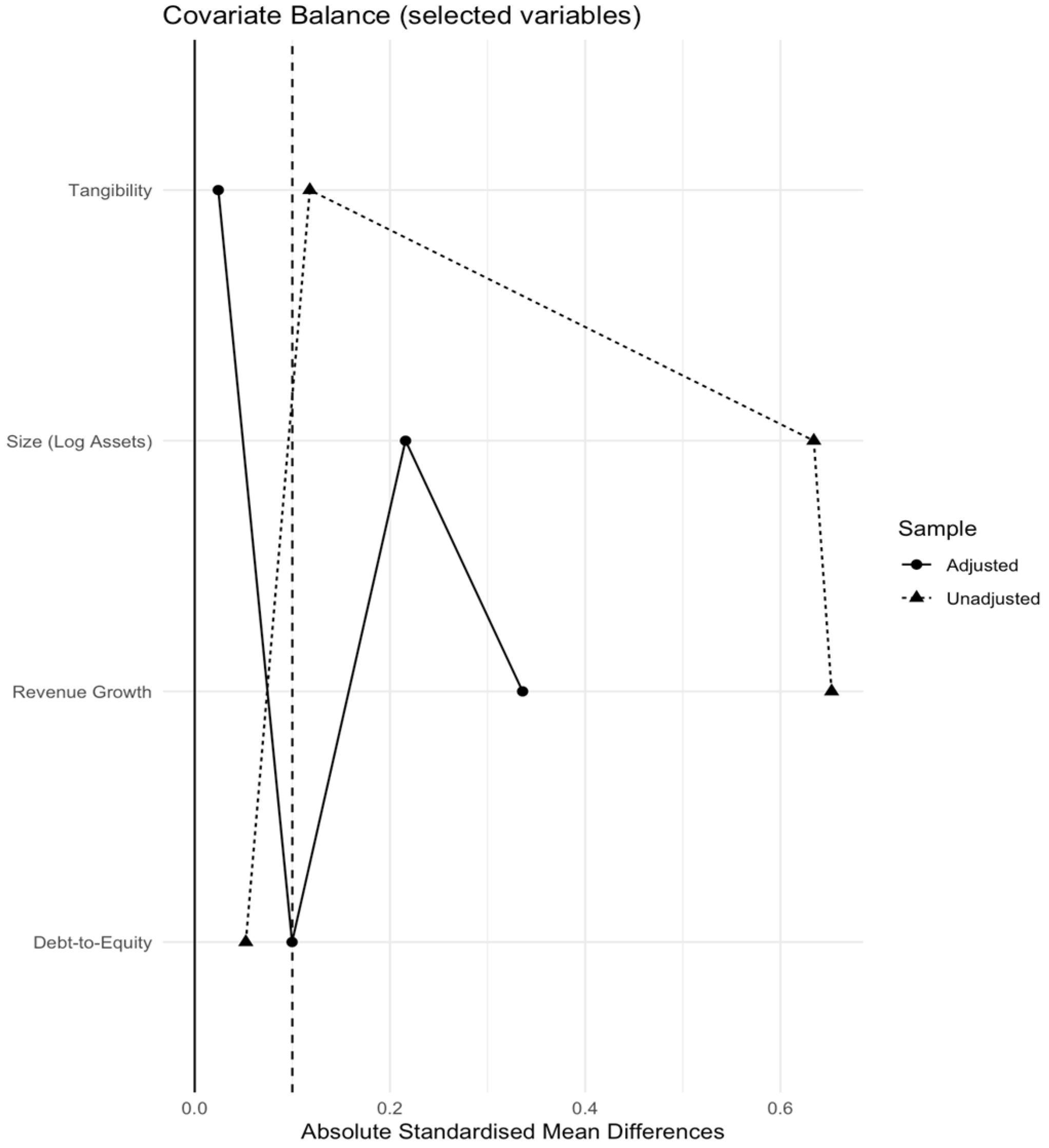
Austin, 2009). Because matching was implemented with replacement, some control firms could be selected more than once. To assess the extent of reuse, we inspected the frequency with which each control firm was chosen as a match. Among the 161 unique control firms in the matched sample, the median number of selections is 1, and the maximum number of times any single control firm is selected is 4. Thus, no individual control firm dominates the matched sample, and the effective sample size on the control side remains sufficiently large for subsequent DiD estimation. For robustness, we also consider optimal and full matching and trim observations outside the region of common support. Balance is assessed using standardised mean differences (SMDs) and Love plots; our target is |SMD| < 0.10 (preferably < 0.05) on all matching covariates. We report pre-/post-matching differences in means with
t-tests, significance stars, and percentage bias reduction. The matched sample is then carried forward into the staggered DiD estimators (
Callaway & Sant’Anna, 2021;
Sun & Abraham, 2021), as outlined in our methodology section.
To ensure the validity of the matching procedure, we report a comprehensive set of PSM diagnostics. Panel A of
Table 1 presents the matched sample sizes, showing that 123 treated firms were successfully matched with 161 control firms. The raw ESG100 dataset (2015–2024) indicates that 130 firms form the potential treatment pool. For PSM estimation, the three-year pre-treatment window produces 123 treated firms with complete covariate histories. The corresponding control pool consists of 259 firms that never appear in ESG100 during the pre-treatment period. This distribution provides an adequate treated-to-control ratio for nearest-neighbour matching and yields a final matched sample of 123 treated firms and 161 control firms (Panel A,
Table 1).
We confirm that control firms are true non-treated firms: none of them appear in any ESG100 edition during the years in which they act as controls. To address concerns regarding potential ‘future-treated’ contamination, we further restricted the control pool to firms that never appear in any ESG100 edition throughout the full sample period (2015–2024). This ensures that the counterfactual group contains only firms that are never included by ESG100 at any point. The results remain consistent and robust under this stricter control-group specification. This ensures that the counterfactual group is uncontaminated by firms with ESG100 exposure or anticipation effects. Given the size of the control pool and the strict calliper of 0.1, the matched sample retains strong overlap and exhibits satisfactory covariate balance. Additionally, the number of treated firms is sufficient to support subgroup analyses by firm size. The treated firms split into 61 small and 62 large firms (based on median market capitalisation), both exceeding the minimum threshold commonly recommended for cohort-specific ATT estimation in staggered DiD frameworks.
Panel B of
Table 1 also reports differences in the pre-treatment covariates between firms later recognised by ESG100 (treatment) and non-recognised firms (control) before and after matching. Matching was implemented on pre-period firm characteristics using nearest neighbour with replacement and a calliper, targeting the ATT. Before matching, the treated firms are observably different from controls. In particular, treated firms are larger (Size in log assets: mean difference = 1.114 *,
p < 0.01) and exhibit lower sales growth on average (mean difference = −0.087 *,
p < 0.01). Tangibility differs only slightly (0.026). Debt-to-equity is lower among treated firms (−5.111), suggesting milder leverage prior to recognition.
After matching, mean differences are markedly reduced for most covariates. Tangibility is essentially equalised (Δ = −0.005, bias reduction 79.5%). Size is much closer across groups (Δ = 0.380 **, bias reduction 65.9%), although some residual imbalance remains. Sales growth also converges (Δ = 0.045, bias reduction 48.5%). By contrast, debt-to-equity shows a sign reversal and a larger raw mean difference (Δ = 9.736, reported bias reduction −90.5%). This pattern indicates that, when assessed in raw units, leverage did not improve—and may have worsened—after matching. Also, Panel C presents McFadden’s pseudo-R2 values from the propensity score models, which decrease from 0.239 before matching to 0.063 after matching, confirming a marked reduction in systematic differences between the two groups. Collectively, these diagnostics demonstrate that the matching procedure effectively improves covariate balance and mitigates observable selection bias.
Two points help reconcile the table with the balance plot. First,
Table 1 reports raw mean differences; for variables with high dispersion (e.g., leverage), the raw gap can be large even when the standardised difference is small. Secondly, the matching algorithm optimises the multivariate distance across covariates; reducing imbalance everywhere simultaneously may leave some residual gap in an individual variable.
Figure 1 displays Absolute Stadardised Mean Differences (ASMD) for the four focal controls—Debt-to-Equity, Tangibility, Size, and Sale Growth—before (dashed triangles) and after (solid circles) matching. The vertical dashed line at 0.10 is the conventional threshold for adequate balance. Debt-to-Equity and Tangibility fall below 0.10 after matching, indicating good balance despite the raw mean in
Table 1. Size and Sale Growth show substantial improvements relative to their pre-match values, although their ASMDs remain just above 0.10. This suggests mild residual imbalance which is addressed in the outcome models via firm and year fixed effects, inclusion of these controls, and clustered standard errors.
To sum up, this study employs the staggered DiD estimators and the PSM procedure because they provide key advantages over alternative causal designs in ESG index research. First, ESG100 inclusion occurs at different points in time across firms, making traditional two-way fixed-effects DiD inappropriate due to treatment-timing heterogeneity. Recent methodological work shows that such settings require estimators explicitly robust to dynamic and heterogeneous treatment effects (
Callaway & Sant’Anna, 2021;
Sun & Abraham, 2021). Second, ESG index assignment is not random: firms with stronger governance, larger size, or better disclosure are systematically more likely to enter the ESG100. PSM therefore reduces selection bias by creating a counterfactual group with similar pre-treatment characteristics, improving internal validity relative to unmatched DiD or simple panel regressions (
Austin, 2009). Third, compared with alternatives such as instrumental variables, regression discontinuity, or synthetic control, the combined PSM–staggered-DiD approach is more suitable because ESG index inclusion does not follow sharp thresholds or strong exclusion restrictions. And the availability of multiple treated cohorts allows for more reliable cohort-specific ATT estimation. This combined design is increasingly used in ESG and corporate governance studies because it accommodates non-random treatment assignment, staggered policy adoption, and evolving ESG effects over time (
Bose et al., 2023;
X. Wang & Hu, 2022). Consequently, this approach aligns well with the institutional realities of ESG100 inclusion and provides a rigorous identification strategy for estimating its performance effects.
3.5. Causality Validation Tests
To strengthen causal interpretation and verify that ESG100 inclusion precedes subsequent changes in firm performance, we perform a placebo DiD test in which false treatment years are randomly assigned to firms in the pre-treatment period. If the estimated placebo coefficients are insignificant, this confirms that the observed effects are not driven by spurious time trends or unobserved shocks unrelated to ESG100 inclusion. For each treated firm, we randomly assign a pseudo ESG index inclusion year that occurs strictly within the pre-treatment period and re-estimate the TWFE DiD model using this placebo treatment indicator.
The placebo estimates are statistically insignificant across all performance measures: ROA (
p = 0.234), ROE (
p = 0.192), Tobin’s Q (
p = 0.725), market-to-book ratio (
p = 0.722), dividend payout (
p = 0.104), and dividend yield (
p = 0.129). These null effects indicate the absence of pre-treatment jumps in performance and provide strong evidence that the observed changes in firm outcomes occur
after actual ESG100 inclusion. These validation procedures, combined with the dynamic event-study results from the
Callaway and Sant’Anna (
2021) and
Sun and Abraham (
2021) estimators (shown in the following section), provide strong evidence of parallel pre-trends and reinforce the temporal causality assumption underlying the staggered DiD framework.
4. Research Results
Table 2 summarises the distribution of all variables for the matched panel (2160 firm-year observations). Profitability is moderate on average: ROA has a mean of 4.43, and ROE averages 11.20. The wide ranges—particularly for ROE—indicate heavy tails and occasional loss-making or exceptionally profitable years. Such dispersion provides room for performance changes following ESG100 inclusion (H1), but it also motivates robust inference and clustered standard errors. Market-based valuations are modest. Tobin’s Q averages 1.30, while Market-to-Book is 2.06 on average. The median Tobin’s Q below one suggests that for many firms market value is at or below replacement cost, typical of more capital-intensive segments. Thus, any post-recognition re-rating would be detectable in Tobin’s Q and M/B (H2). Cash-flow and payout measures show economically meaningful distributions with mass at zero. The mean Dividend Payout ratio is 0.72, and Dividend Yield averages 0.04. The zeros reflect non-payers in some years. There is ample cross-sectional variation to test H3 (changes in payout policy/yield after ESG100 recognition).
Control variables display plausible magnitudes. Debt-to-Assets averages 25.82, indicating moderate leverage with substantial dispersion. Tangibility (tangible/total assets) has a mean of 0.32, suggesting that, on average, one-third of assets are tangible. Firm Size (ln total assets) averages 22.51, evidencing size heterogeneity typical of a broad market index. Sales Growth averages 0.10, positively skewed.
Taken together, the means and medians indicate right-skewed distributions for valuation and payout variables and substantial cross-sectional variation across all constructs. These features are consistent with using fixed effects and clustered (firm-level) standard errors in the subsequent staggered DiD estimations, and with reporting robustness checks that mitigate the influence of outliers (e.g., winsorisation or log-transformations for ratios bounded at zero).
Table 3 shows that the controls are only weakly related to outcome variables, so multicollinearity is not a concern for the DiD models. Therefore, these correlations with the controls are modest (|r| ≤ 0.38), and we keep Debt-to-Assets, Tangibility, Firm Size, and Sales Growth in all specifications to absorb residual cross-sectional differences without introducing multicollinearity. The DiD estimates then identify the post-ESG100 effect net of leverage, asset structure, scale, and growth.
4.1. Main DiD Results
Panel A of
Table 4 presents the difference-in-differences (DiD) estimates for accounting-based outcomes (ROA and ROE). Contrary to H1, the interaction term (Post × Treat) is consistently negative and statistically insignificant across all model specifications, suggesting that ESG100 index inclusion does not enhance accounting profitability. While the treatment dummy (Treat) shows positive and significant coefficients for both ROA (β = 4.610,
p < 0.01) and ROE (β = 9.676,
p < 0.01), these results reflect systematic performance differences between treated and control firms rather than improvements attributable to ESG100 recognition. Moreover, the negative and significant coefficients on the post-treatment dummy (Post) across both outcomes indicate an overall decline in firm performance over the post-inclusion period, irrespective of ESG100 recognition. Taken together, these findings provide no support for H1.
Panel B of
Table 4 reports results for market-based measures (Tobin’s Q and MTB). The interaction term (Post × Treat) remains statistically insignificant in all specifications, failing to provide evidence that ESG100 recognition improves firm market valuation. Nevertheless, the treatment dummy shows a weakly positive and significant effect on Tobin’s Q (β = 0.1516,
p < 0.1) and MTB (β = 0.4081,
p < 0.1), implying that firms selected into the ESG100 index tend to exhibit higher valuation ratios even before their inclusion. In contrast, the post-treatment dummy is consistently negative and significant for both Tobin’s Q (β = −0.1366,
p < 0.05) and MTB (β = −0.2468,
p < 0.01), suggesting that market valuations of Thai listed firms generally decline in the post-treatment period. Thus, H2 is not supported.
Panel C of
Table 4 examines the effects on payout measures. Unlike accounting and market outcomes, here the results provide partial support for H3. Specifically, ESG100 inclusion significantly increases dividend payout ratios, as indicated by positive and statistically significant interaction effects (Post × Treat) across multiple specifications (β = 0.2591,
p < 0.1; β = 0.2573,
p < 0.05; β = 0.2380,
p < 0.05). This finding suggests that ESG100 recognition may encourage firms to enhance shareholder distributions via cash dividends. Regarding dividend yield, the interaction term is not statistically significant across the specifications. The significant coefficients on Treat and, in some models, on Post, reflect level differences between treated and control firms and common time shocks, respectively, rather than the causal effect of ESG100 inclusion. Accordingly, the results do not provide evidence that ESG recognition leads to an increase in dividend yield.
Overall, the results indicate that ESG100 index inclusion does not lead to improvements in accounting or market-based performance but is associated with higher dividend payouts. This pattern suggests that while ESG100 recognition may not enhance operational or valuation outcomes in the short term, it influences corporate financial policy by promoting greater shareholder distributions.
4.2. Moderating Effects of Firm Size
To evaluate whether the effect of ESG100 recognition differs between small and large firms, this study examines the moderating role of firm size using a simple interaction-based approach. Firm size is included as an interaction term in the difference-in-differences framework, and the moderating effect is assessed by comparing how ESG100 inclusion affects performance outcomes across firms of different sizes. This approach allows a clear and intuitive interpretation of whether large firms experience stronger, weaker, or similar performance responses relative to smaller firms following ESG index inclusion. To formally assess the moderating role of firm size, we compare the ESG100 treatment effects across firms of different size levels using a straightforward narrative interpretation of the interaction terms. The analysis focuses on whether the performance changes associated with ESG100 inclusion are larger for big firms or small firms. This approach makes the moderating influence of firm size transparent and easy to interpret.
Panel A of
Table 5 reports the moderating role of firm size on accounting outcomes. The interaction term (Post × Treat) alone becomes negative and significant, suggesting that ESG100 index inclusion may slightly decrease firm accounting performance. However, when firm size is introduced as a moderator (Post × Treat × Size), the coefficients become positive and statistically significant for ROA (β = 2.101,
p < 0.05; β = 1.858,
p < 0.05). Similarly, for ROE, the interaction with firm size yields positive and significant effects (β = 4.139,
p < 0.05; β = 3.044,
p < 0.1). These findings suggest that large firms benefit more from ESG100 recognition in terms of profitability compared to their smaller counterparts. Importantly, this contrasts with the main DiD results in
Table 4, where ESG100 inclusion showed no significant effect on accounting measures overall. Thus, incorporating firm size as a moderating variable provides a clearer picture: the positive accounting benefits of ESG recognition are conditional on firm size, particularly favouring larger firms.
Panel B of
Table 5 presents the results for market valuation. Similarly to
Table 4, the direct interaction term (Post × Treat) remains insignificant across all models. The triple interaction (Post × Treat × Size) is also statistically insignificant for both Tobin’s Q and MTB, indicating that firm size does not substantially alter the relationship between ESG100 recognition and market-based valuation. This reinforces the earlier conclusion that ESG100 inclusion does not generate significant changes in capital market perceptions, regardless of firm size. However, the consistently negative and significant coefficients for the post-treatment dummy (e.g., Tobin’s Q: β = −0.1954,
p < 0.05; MTB: β = −0.3097,
p < 0.05) suggest that market-wide declines in firm valuation persist even after controlling for size, in line with the baseline results.
Panel C of
Table 5 shows that ESG100 recognition continues to influence corporate payout policy. The Post × Treat coefficient remains positive and significant across multiple specifications for dividend payout ratios (β = 0.3118,
p < 0.05; β = 0.2540,
p < 0.1; β = 0.4039,
p < 0.05). These results are consistent with
Table 4 and confirm that ESG recognition is associated with higher dividend payouts. The moderating role of firm size (Post × Treat × Size), however, is negative and insignificant, suggesting that the positive payout effects of ESG recognition apply to firms regardless of size. Panel C of
Table 5 also provides limited evidence that ESG100 recognition influences dividend yield. The Post × Treat coefficient becomes positive and statistically significant in some model (β = 0.0083,
p < 0.05), indicating a modest increase in dividend yield following ESG inclusion. However, the Post × Treat × Size interaction term is consistently insignificant, suggesting that this effect does not vary meaningfully with firm size. Overall, ESG recognition is associated with a slight improvement in dividend yield, but without a size-dependent pattern.
Linking
Table 4 and
Table 5 together reveals important nuances. The baseline DiD results indicated that ESG100 inclusion had little to no impact on accounting and market performance, but did influence payout policies. When firm size is introduced as a moderator, however, the results reveal that large firms experience significant gains in accounting performance (ROA and ROE), while smaller firms do not. For market performance, size does not alter the null effects, reinforcing that ESG recognition is not immediately priced in by investors. For payout policy, firm size plays no moderating role, suggesting that any observed changes in dividends are not driven by differences between small and big firms.
Overall, the moderating analysis demonstrates that the performance implications of ESG100 recognition are heterogeneous across firm size. Large firms reap accounting benefits in profitability following ESG inclusion, while small firms do not. Market outcomes and dividend payouts remain unaffected regardless of size. These findings highlight that ESG index recognition shapes firm behaviour more comprehensively when firm heterogeneity, such as size, is accounted for, thereby offering a clearer and more complete picture than the baseline DiD results alone.
4.3. Robustness Test: Dynamic Effects of ESG Index Recognition
To assess the robustness of the baseline DiD results, this study applies the
Callaway and Sant’Anna (
2021) estimator, which accommodates treatment heterogeneity across cohorts and allows for a dynamic event-study specification.
Table 6 reports both the Overall Average Treatment Effect on the Treated (ATT) and the dynamic effects relative to the event time.
The dynamic ATT estimates are based on 284 firms (123 treated and 161 matched controls). The number of treated firms contributing to each event-time coefficient (k = −3 to +3) ranges from 38 to 61 firms, while the control group consistently exceeds 100 firms at every event time. This ensures that each ATT estimate is supported by an adequate number of observations for reliable inference under the
Callaway and Sant’Anna (
2021) estimator.
In this framework, overall ATT represents the average effect of ESG100 inclusion across all post-treatment periods for the treated firms relative to their matched controls. It summarises the average post-treatment effect without differentiating across specific years. Event-time coefficients (k = −3 to +3) measure the treatment effect at different relative time points around ESG100 inclusion, where k = 0 denotes the year of first inclusion, negative values (k = −1, −2, −3) capture pre-treatment years, and positive values (k = 1, 2, 3) capture post-treatment years. By construction, k = −1 serves as the reference period, hence no coefficient is estimated for that year. Statistical significance of these coefficients indicates whether ESG100 inclusion led to performance changes at specific points in time, while pre-treatment coefficients (k < 0) allow for testing of parallel trends.
Panel A of
Table 6 shows that the overall ATT for accounting measures is negative, with ROA (β = −1.2286, SE = 0.6356) and ROE (β = −2.7794, SE = 2.0115) both declining after ESG100 inclusion. Although largely insignificant, the negative effect on ROA becomes marginally significant at k = 3 (β = −1.9292,
p < 0.1). This result echoes the baseline DiD findings in
Table 4 and
Table 5, where ESG100 recognition was not associated with improved accounting performance, instead it may slightly decrease accounting outcomes. For market measures, Tobin’s Q and MTB remain insignificant across all leads and lags, further confirming that ESG100 inclusion does not affect firm market valuation. However, the estimated effects on dividend payout and yield are not significant, a pattern that contrasts with the earlier evidence.
Panel B reveals that small firms experience more pronounced negative effects. The overall ATT is significantly negative for both ROA (β = −2.5881,
p < 0.05) and ROE (β = −4.9178,
p < 0.1). Dynamic effects confirm this pattern, as ROA (β = −3.1422,
p < 0.05) and ROE (β = −6.3258,
p < 0.1) decline significantly at k = 1, immediately after ESG100 inclusion. These results reinforce the moderating role of firm size (
Table 5), demonstrating that smaller firms tend to suffer deteriorations in accounting profitability following ESG recognition.
Panel C shows that for large firms, the overall ATT for ROA and ROE is negative but insignificant, and none of the dynamic coefficients reach statistical significance. These results align with the moderating model in
Table 5, which suggested that larger firms are better positioned to absorb or benefit from ESG recognition, while smaller firms are more vulnerable. Importantly, the absence of significant declines for large firms underscores the robustness of the earlier conclusion that firm size is a critical determinant in shaping ESG performance outcomes.
The dynamic event-study results here broadly reinforce the main findings. First, these results support for Baseline DiD Results (
Table 4): there is no evidence that ESG100 recognition improves accounting or market performance. Here, we observe a small negative effect on accounting outcomes. Second, the results here also support for Moderating Effects Model (
Table 5): significant negative effects on small firms’ profitability validate the earlier finding that ESG100 recognition primarily benefits larger firms. However, the results may not provide supporting evidence, as the dividend payout effects that appeared significant in the baseline DiD (
Table 4) are not significant in the dynamic specification, possibly due to the shorter time windows (k = −3 to +3) and reduced statistical power.
Overall, the robustness analysis using
Callaway and Sant’Anna’s (
2021) estimator confirms that ESG100 recognition does not enhance firm performance in the pooled sample, but it disproportionately harms smaller firms while leaving larger firms relatively unaffected. The inclusion of dynamic effects strengthens the credibility of the main results, demonstrating that the performance implications of ESG recognition are conditional on firm size and persist over time.
4.4. Robustness Test: Staggered DiD Results (Sun & Abraham, 2021)
To further test the robustness of the baseline findings, this study employs the
Sun and Abraham (
2021) staggered DiD estimator, which addresses treatment heterogeneity across cohorts and improves upon standard two-way fixed effects models.
Table 7 reports event-time coefficients relative to the year prior to ESG100 index inclusion (year −1), for both the pooled sample (Panel A) and subsamples split by firm size (Panels B and C). Outcomes are grouped into accounting performance (ROA, ROE), market valuation (Tobin’s Q, MTB), and payout policy (dividend payout and dividend yield).
4.4.1. Direct Effects Under the Staggered DiD Framework
The pooled staggered DiD estimates in Panel A of
Table 7 show no evidence that ESG100 inclusion improves accounting or market performance. ROA and ROE both decline around the inclusion year, while Tobin’s Q and MTB also fall significantly at year 0, indicating short-term valuation pressures rather than gains. By contrast, payout responses are modest: dividend payout increases slightly but remains statistically insignificant, whereas dividend yield shows small but significant rises in year 0 and year +1. Overall, these results suggest that ESG100 recognition does not enhance profitability or market valuation, but is associated with a limited upward adjustment in dividend yield.
Small firms (Panel B of
Table 7) exhibit consistently more adverse responses to ESG inclusion. Their accounting performance deteriorates more sharply, with declines in ROA and ROE at the event year, mirroring the negative effects reported in earlier robustness tests. Market valuation also falls meaningfully, as Tobin’s Q and MTB both drop in year 0 and further weaken at year +1, indicating that the market penalises smaller ESG entrants. Dividend behaviour remains subdued: payout ratios fall and yields remain largely unchanged. Taken together, the results suggest that ESG index inclusion imposes short-term financial costs on smaller firms across profitability, valuation, and payout dimensions.
Large firms (Panel C of
Table 7) display greater resilience and, in several dimensions, more favourable post-inclusion adjustments. Accounting performance shows only mild and insignificant declines in year 0, and ROE rebounds by year +1, consistent with the stronger pre-event profitability observed among larger ESG firms. Market valuation also improves over time: although year-0 effects are negligible, MTB increases significantly by year +1, indicating a delayed positive market response once ESG index inclusion is absorbed. Dividend policy strengthens considerably, with large firms increasing both payout and yield in the inclusion year and the following year.
4.4.2. Interaction Effects of Firm Size Under the Staggered DiD Framework
Panel D of
Table 7 reports the interaction effects between firm size and ESG100 inclusion within the staggered DiD framework of
Sun and Abraham (
2021). These estimates assess whether larger firms experience systematically different accounting, market, or payout responses following index inclusion. All event-time coefficients are measured relative to year −1, while the “Size Group” coefficient captures the overall moderating influence of being a large firm. For accounting performance, the interaction terms provide limited evidence of a consistent size-moderating effect. ROA and ROE coefficients around the inclusion year are small and statistically insignificant, and the size interaction terms are positive but imprecisely estimated. These patterns align with the earlier findings, where smaller firms exhibited sharper profitability declines, whereas larger firms were comparatively resilient. The positive (though insignificant) size coefficients thus suggest that larger firms may experience marginally better accounting outcomes following ESG index inclusion, consistent with the moderating role observed in previous tables.
For market valuation, the event-time coefficients again show no meaningful improvement associated with ESG inclusion. Tobin’s Q and MTB both fall around the event year, and the size interaction terms are close to zero, indicating no systematic valuation differential between small and large firms in this specification. Although earlier dynamic results suggested that larger firms might experience delayed gains in MTB, the interaction analysis implies that such effects are not uniform across periods. For payout measures, the coefficients on dividend payout and dividend yield fluctuate over event time, but the size-group interaction terms are uniformly small and statistically insignificant. These findings are consistent with the earlier results in
Table 5, indicating that firm size does not systematically moderate the effect of ESG100 inclusion on dividend policy. Although subgroup analyses suggested that larger firms may exhibit stronger dividend adjustments in certain years, the coefficient estimates in Panel D of
Table 7 show that such differences are not persistent and do not constitute a formal moderating effect.
4.4.3. Comparative Insights and Robustness Implications
The staggered DiD estimates provide a valuable robustness check that both confirms and elaborates upon the earlier results. In line with the baseline DiD analysis (
Table 4), the findings indicate that ESG index inclusion does not deliver improvements in accounting or market performance for the pooled sample. If anything, index inclusion appears to coincide with short-term declines in profitability and valuation measures. The effects on dividend policy are somewhat more encouraging, though still modest in scope, with evidence of temporary increases in shareholder returns.
These results also reinforce the importance of firm size as a moderating factor, as shown in the earlier heterogeneity model (
Table 5). The evidence is clear that smaller firms bear the costs of ESG index inclusion more heavily, displaying declines in accounting outcomes. In contrast, larger firms demonstrate a greater degree of resilience: they are able to sustain their accounting performance, avoid the immediate penalties observed in the market, and, notably, respond with significant increases in dividend distributions.
The interaction analysis in Panel D (
Table 7) adds additional nuance to the robustness checks. Although the interaction terms are not statistically significant, their positive coefficients suggest that larger firms tend to exhibit slightly more stable accounting performance following ESG100 inclusion. This directional pattern is consistent with the earlier results. The market valuation results are consistent with the prior models, offering no strong evidence of size-driven heterogeneity. Finally, payout policies are also consistent with earlier findings.
Table 5 and
Table 7 consistently show that firm size does not moderate the dividend response to ESG100 inclusion, as all size-related interaction terms are small and statistically insignificant.
Finally, the robustness analysis is consistent with the dynamic event-study results (
Table 6). It confirms the temporal dimension of ESG index effects: the adverse consequences are concentrated in the period of index inclusion, particularly for smaller firms, while the potential benefits for larger firms tend to emerge with a delay. Taken together, these results suggest that the financial implications of ESG recognition are far from uniform; rather, they depend critically on firm size and unfold over time, underscoring the value of incorporating heterogeneity and dynamic perspectives into the analysis.
5. Discussion
The findings of this study suggest that first-time inclusion in Thailand’s ESG100 index, on average, does not translate into immediate, across-the-board improvements in conventional performance metrics. Neither accounting profitability (ROA, ROE) nor market valuation (Tobin’s Q, Market-to-Book) showed consistent significant upticks post-inclusion, failing to provide robust support for H1 and H2. This aligns with prior evidence that the financial impact of ESG adoption is often modest or inconclusive in the short run (
Lunawat et al., 2025;
Thapa et al., 2025). In the context of an emerging market, the absence of a clear boost to profitability or market multiples may reflect the substantial costs and organisational adjustments required by ESG initiatives, which can offset short-term gains if such initiatives are not yet fully integrated into core operations (
Lu et al., 2025). Notably, however, we do observe a distinct change in corporate financial policy following ESG index recognition: dividend payout ratios increase significantly, with a concomitant (though more muted) rise in dividend yields. This provides support for H3, indicating that firms respond to ESG100 inclusion by augmenting shareholder distributions. Such behaviour suggests that while ESG recognition alone might not enhance operational efficiency or investor perceptions of firm value in the near term. However, it does influence managerial decisions on cash distribution, potentially as a strategy to maintain investor confidence and signal financial strength. In other words, companies appear to use higher dividends as a credible signal that strong ESG commitment can coexist with, or even bolster, shareholder value. This aligns with signalling and agency theories, which suggest that ESG-oriented firms may reduce information asymmetry and agency conflicts through transparent, shareholder-friendly actions. This finding enriches the theoretical narrative by highlighting an indirect channel—dividends—through which ESG recognition can benefit investors even when traditional performance metrics remain unchanged.
Crucially, the performance effects of ESG index inclusion are heterogeneous across firm size, underscoring the importance of firm characteristics in moderating ESG outcomes. The analysis revealed that large firms tend to experience more favourable (or less adverse) post-inclusion trajectories compared to smaller firms. In particular, larger ESG100 firms managed to sustain their profitability levels (and in some cases saw modest improvements), whereas their smaller counterparts showed no gains and even signs of declining ROA/ROE immediately after ESG recognition. This disparity aligns with the view that firm size and related resources condition the returns on ESG investment: bigger companies often possess greater slack resources, better risk management systems, and higher stakeholder visibility, enabling them to capitalise on ESG reputational benefits more effectively (
Zhao et al., 2018). Smaller firms, by contrast, may face proportionally higher compliance costs and implementation challenges, treating ESG practices as a cost burden rather than as value-driving strategic assets (
Hasanuddin & Natsir, 2025).
Our results corroborate prior studies which found that ESG engagements yield non-uniform effects, with positive impacts concentrated in firms that can achieve economies of scale in sustainability efforts or enjoy stronger stakeholder support. Moreover, the lack of any significant market valuation response even for large firms suggests that investors in the Thai market remain cautious or unconvinced about the immediate economic payoff of ESG index membership. This is consistent with international evidence of mixed short-term market reactions to sustainability index inclusion, especially in markets of nascent maturity (
Goyal & Soni, 2024). It is conceivable that in Thailand’s emerging capital market, ESG100 inclusion serves more as a confirmation of known corporate quality (already priced in by investors) than as new information that would revalue a firm upward. Our findings, therefore, align with the perspective that ESG index recognition is not a guarantee of immediate financial improvement, but rather a strategic investment that may yield dividends (literally and figuratively) as firms continue to integrate ESG principles and as the surrounding ecosystem matures (
Shi et al., 2025).
To sum up, a more balanced interpretation of the results indicates that the overall effects of ESG100 recognition are modest. Across the full sample, accounting performance (ROA and ROE) and market valuation (Tobin’s Q and MTB) do not show statistically significant improvements following ESG inclusion, suggesting that ESG index inclusion does not translate into immediate financial gains for most Thai firms. The only positive effect appears in dividend policy, where ESG100 firms increase payout ratios. Although large firms exhibit some improvement in profitability after ESG inclusion—consistent with size-based moderation—the magnitude of these gains remains relatively small and does not generalise to smaller firms or to market-based outcomes. Taken together, these results suggest that ESG recognition yields selective rather than broad-based performance benefits, with the overall relationship being limited both in statistical significance and economic magnitude.
Our findings align with the broader international literature showing that ESG index inclusion often delivers symbolic or reputational benefits rather than immediate financial performance gains (
Blajer-Gołębiewska & Nowak, 2024). The mixed pattern observed here—neutral accounting and market outcomes but higher dividend payouts—suggests that Thai firms may use dividend policy as a strategic response to signal stability and strengthen investor confidence following ESG recognition. However, the absence of valuation effects implies that capital markets may not yet fully price ESG achievements, particularly in emerging markets. This reinforces the need to interpret the performance implications of ESG recognition cautiously and in context.
6. Research Implication
From a practical standpoint, these results carry several implications for Thailand’s ESG landscape. For corporate managers, the evidence tempers expectations that ESG index accolades will automatically enhance profitability or stock market performance. Firms—especially small and mid-sized ones—should avoid symbolic ESG adoption and instead focus on deeply embedding ESG practices into their operational strategy to unlock value. The finding that many companies increased dividends after ESG100 inclusion suggests that managers might use financial policy to balance sustainability efforts with shareholder returns. In line with agency theory, strengthening corporate governance around ESG (e.g., tying executive incentives to both sustainability and financial targets) can ensure that pursuing ESG goals does not come at the expense of shareholder interests. Smaller firms, in particular, may need support in building capabilities so that ESG initiatives become efficiency-enhancing rather than cost-prohibitive. This could involve investing in cleaner technologies that eventually reduce costs, or collaborating through industry networks to share best practices, thereby gradually turning ESG compliance into a source of competitive advantage rather than a mere obligation.
For investors, the mixed performance outcomes imply that ESG index membership should be interpreted with nuance. Inclusion in ESG100 is a positive signal of a firm’s commitment to responsible practices, but it is not a standalone predictor of short-term financial outperformance. Investors should therefore conduct due diligence beyond the ESG label—considering firm size, industry context, and governance quality—when allocating capital based on sustainability criteria. The observed propensity of ESG-recognised firms to maintain or increase dividend payouts is an encouraging sign for investors seeking income stability; it indicates that, in the Thai context, ESG leaders are not sacrificing shareholder returns and may, in fact, be proactively aligning with shareholder interests by returning cash. This reinforces the idea that ESG and traditional investor objectives need not be at odds, but investors should remain vigilant in monitoring how firms utilise resources post-recognition (for example, ensuring that ESG investments are efficacious and that dividend increases are sustainable).
For policymakers and regulators, the findings highlight a need to cultivate an environment in which ESG initiatives can more readily translate into tangible performance gains. Given that smaller firms do not reap the same benefits from ESG index inclusion as larger firms, regulators might consider tailored support and incentives to help those firms adopt sustainable practices without undermining their competitiveness. This could include subsidies or tax incentives for sustainability projects, public recognition programmes that go beyond the top-100 firms, or capacity-building initiatives such as training and consultation in ESG reporting and implementation. Strengthening the overall institutional framework is also crucial: more rigorous ESG disclosure standards and benchmarks, coupled with enforcement mechanisms, could enhance the credibility of ESG commitments and thus the confidence of investors in such firms. Additionally, policies that encourage investor participation in sustainable finance (for instance, promoting green funds or mandating institutional investors to consider ESG criteria) would increase demand-side pressure for ESG performance to be rewarded in the marketplace. Over time, as Thailand’s capital market matures in its embrace of ESG—with more comprehensive data, analyst coverage, and investor awareness—the signal provided by indices like ESG100 is likely to strengthen. In the interim, regulators should monitor for any unintended consequences, such as firms potentially boosting dividends at the expense of reinvesting in long-term projects post-ESG inclusion. Ensuring a balanced approach will help align the interests of stakeholders: encouraging companies to be sustainable and socially responsible while also delivering value to shareholders. By addressing these considerations, Thailand’s ESG ecosystem can evolve such that ESG index recognition becomes a more reliable catalyst for improved firm performance, fulfilling its promise as a lever for both corporate sustainability and financial success.
Overall, this study result underscores that ESG index inclusion alone is not a panacea for immediate financial improvement in emerging markets. The impact is nuanced—manifesting more in policy choices (like dividend distributions) than in instant profit or market revaluation—and significantly conditioned by firm-specific and contextual factors. These insights contribute to the growing literature by providing a theoretically grounded, empirically backed account of how ESG recognition plays out in a Thai setting, and they offer practical guidance for firms, investors, and regulators seeking to advance sustainable finance without losing sight of economic performance.
7. Conclusions
This study investigates whether first-time inclusion in Thailand’s ESG100 index enhances firm performance, using a robust staggered difference-in-differences design complemented by propensity-score matching. Across multiple performance dimensions, the baseline empirical results indicate that ESG100 inclusion does not lead to short-term improvements in accounting profitability or market valuation. However, the robustness checks and staggered DiD estimators of
Callaway and Sant’Anna (
2021) and
Sun and Abraham (
2021) reveal slight declines in both accounting performance and market-based measures following ESG index inclusion. In contrast, the evidence reveals that ESG100 inclusion is associated with significantly higher dividend payout ratios, suggesting that firms respond to ESG index inclusion by strengthening shareholder distribution policy rather than improving operational or market value. This pattern implies that ESG labels in emerging markets may function more as governance- or reputation-driven signals that influence financial policy rather than operational efficiency.
Importantly, firm size plays a key moderating role. While the overall sample exhibits no improvement in profitability, the moderating analysis demonstrates that larger firms benefit from ESG100 inclusion through higher ROA and ROE following inclusion. Smaller firms, however, experience either no changes or negative profitability effects. These size-contingent results highlight that the capacity to leverage ESG index inclusion depends on organisational resources, market visibility, and the ability to absorb the compliance and reporting costs associated with ESG practices. Taken together, the findings suggest that ESG100 inclusion in Thailand does not immediately translate into enhanced financial or market performance. Instead, its primary effect appears in payout policy and is conditional on firm heterogeneity.
Overall, while the study finds that the benefits of ESG100 inclusion are nuanced, the broader insight is that ESG index inclusion functions more as a governance or reputational signal than as a catalyst for short-term financial improvement—particularly in emerging markets. This interpretation underscores the importance of institutional development, reporting quality and firm-level capability in translating ESG index inclusion into tangible value.
The findings of this study also contribute to the theoretical discourse surrounding ESG and corporate behaviour. From an ESG theory perspective, the results suggest that index-based ESG inclusion in emerging markets operates primarily through governance and policy-adjustment mechanisms rather than immediate operational or market-based performance gains. In terms of stakeholder theory, the limited short-term profitability effects imply that stakeholder-oriented practices may require longer time horizons and sufficient organisational resources—conditions more commonly found among larger firms—to generate measurable financial outcomes. Finally, the study enriches signalling theory by showing that ESG100 inclusion functions as a credible but partial signal: it influences payout policy more than market valuation, indicating that capital markets may interpret ESG signals cautiously when institutional ESG integration is still developing. Collectively, these insights clarify how ESG index inclusion shapes firm behaviour in emerging markets and highlight the theoretical boundary conditions under which ESG signals translate into tangible outcomes.
8. Research Limitations and Future Directions
Despite its contributions, this research has some limitations. Generalisability is constrained by the focus on a single emerging market (Thailand) and a specific ESG index; the findings may not directly extend to other countries or to different sustainability rating frameworks with varying criteria. The study also concentrates on relatively short-term outcomes in the years immediately following ESG index inclusion. It remains possible that longer-term effects could materialise as firms continue to integrate ESG principles or as investor awareness grows, outcomes which our analysis could not capture given the available timeframe. In addition, although advanced DiD estimators and matching techniques were applied to strengthen causal inference, the observational nature of the data means that unobserved firm characteristics or concurrent external factors might still influence the results. We focused on traditional financial indicators of performance, so any benefits of ESG recognition in areas such as risk reduction, innovation capacity, or stakeholder loyalty would not be reflected in our metrics. Another limitation of this study is the small number of first-time ESG100 entrants in each year, which may reduce statistical power and increase standard errors. This constraint is driven by the structure of the ESG100 programme itself and should be considered when interpreting short-term performance effects. These considerations suggest caution in interpreting the results and underscore the need for further investigation.
Looking ahead, future research could build on these findings in several ways. Studies covering different contexts—for example, other emerging economies or developed markets with analogous ESG indices—would help verify whether the patterns observed here hold under varying institutional and investor environments. Researchers should also examine the long-run trajectory of ESG-recognised firms beyond the initial post-inclusion period, to determine if performance improvements (or drawbacks) emerge over a longer horizon once sustainability practices mature and market perceptions catch up. Broadening the scope of outcomes would be valuable: for instance, exploring whether ESG index inclusion affects a firm’s risk profile, cost of capital, innovation output, or stakeholder satisfaction could provide a more holistic view of its impact. Further inquiry into moderating factors is likewise warranted. In particular, a deeper examination of why larger firms seem to leverage ESG recognition more effectively—perhaps due to greater resources, better access to capital, or heightened visibility—would offer insights into how smaller firms might overcome their disadvantages. By addressing these questions, future research can deepen our understanding of the mechanisms through which ESG recognition influences corporate behaviour and success. Ultimately, such work would help clarify the conditions under which ESG index accolades translate into tangible performance gains, guiding both corporate strategy and policy in the realm of sustainable finance.