Article

Model of Optimizing Correspondence Risk-Return Marketing for Short-Term Lending

1
Department of Economic Cybernetics, Taras Shevchenko National University of Kyiv, 01033 Kyiv, Ukraine
2
Department of Economic Cybernetics, National University of Life and Environmental Sciences of Ukraine, 03041 Kyiv, Ukraine
3
Department of Banking Business and Financial Technologies of Educational and Scientific Institute “Karazin Banking Institute”, V. N. Karazin Kharkiv National University, 61022 Kharkiv, Ukraine
4
Department of Finance, Banking, and Accountancy, Faculty of Management, Rzeszow University of Technology, 35-959 Rzeszow, Poland
*
Author to whom correspondence should be addressed.
J. Risk Financ. Manag. 2022, 15(12), 583; https://doi.org/10.3390/jrfm15120583
Submission received: 17 September 2022 / Revised: 27 October 2022 / Accepted: 15 November 2022 / Published: 6 December 2022
(This article belongs to the Section Business and Entrepreneurship)

Abstract

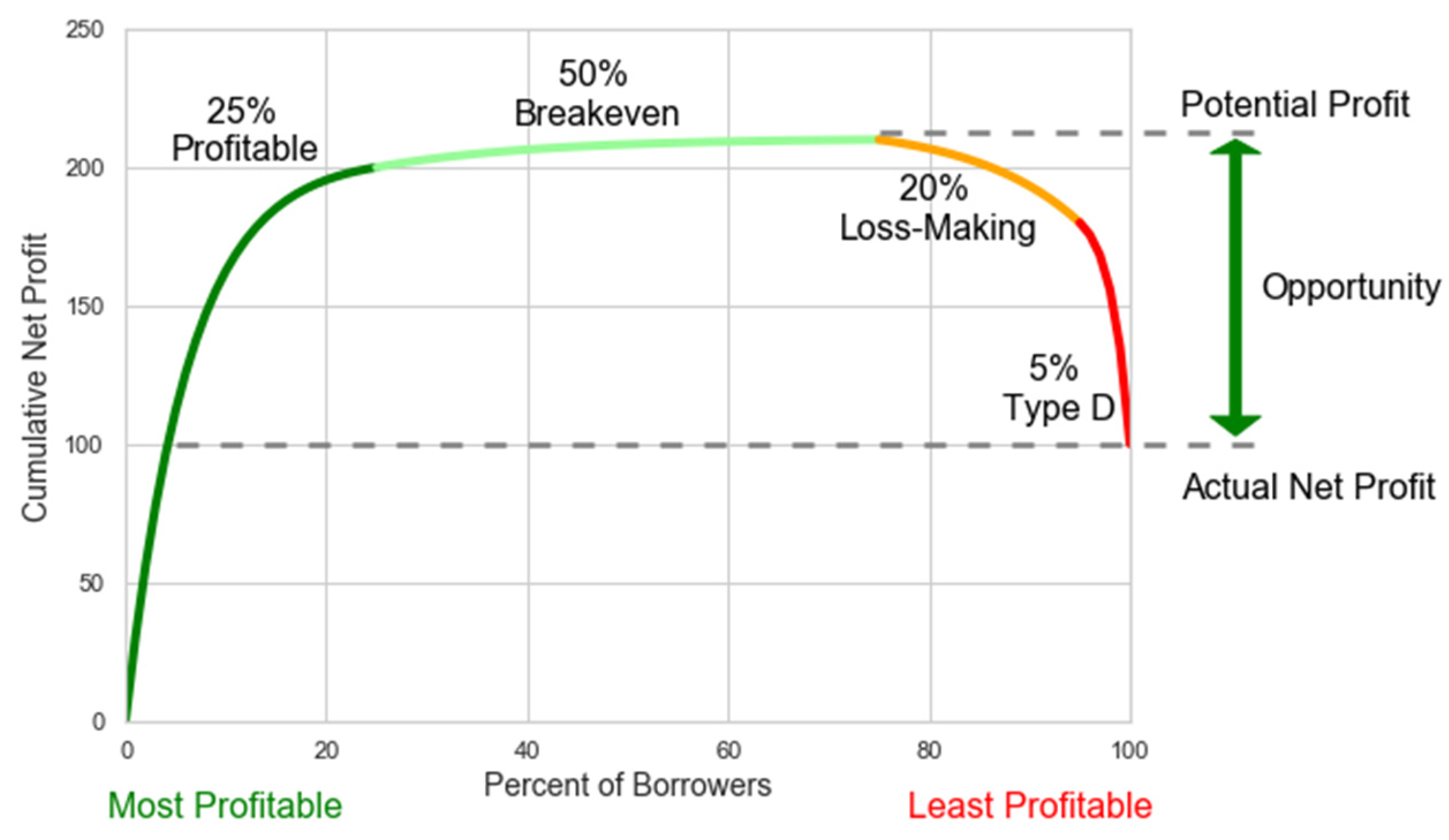
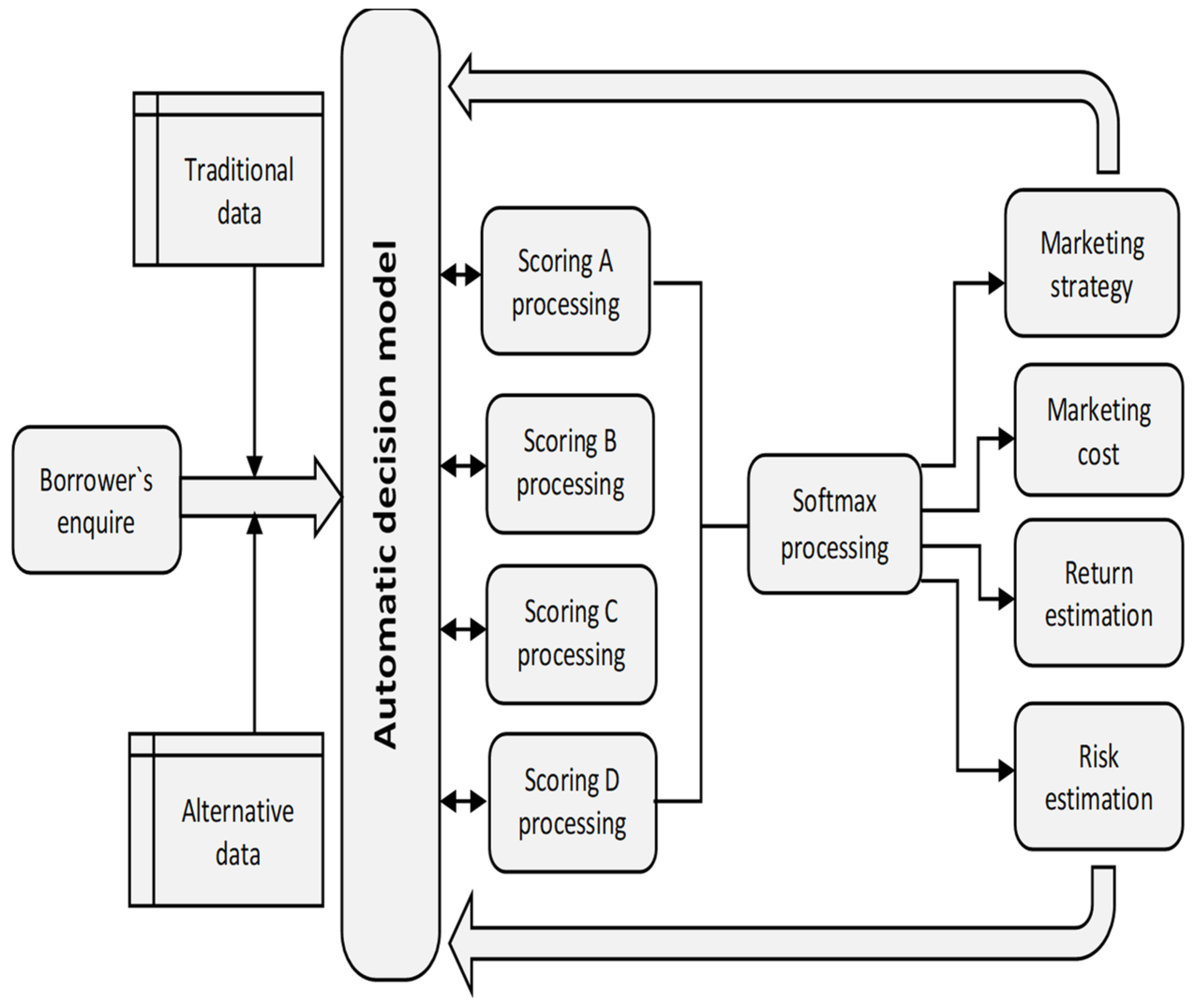
The modern credit market is actively changing under the influence of digitalization processes. Some of the drivers of these changes are financial companies that carry out, among other things, online lending. Online lending is objectively focused on short-term small loans, both payday loans (PDL) and short-term loans for SMEs. In our research, we applied a special segmentation of borrowers based on the whale-curve approach. Such segmentation leads to four segments of borrowers (A, B, C, and D) which are characterized by the specific features of profitability, risk, recurrent loan granting, and others. The model of optimal correspondence between “risk–return-marketing efforts” is elaborated in the mentioned segments. Marketing efforts are considered in the context of the optimization of the marketing-budget allocation. Our approach was essentially grounded in special scoring-tools that allow multi-layer assessment. A scheme of assessment of profitability, risk, and marketing-resources allocation for borrower’s inflow is constructed. The results can be applied to the customer relationship management (CRM) of online non-banking lenders.
Keywords: non-banking lending; payday loans; customer relationship management; profitability; risk estimation; marketing; scoring; segmentation non-banking lending; payday loans; customer relationship management; profitability; risk estimation; marketing; scoring; segmentation