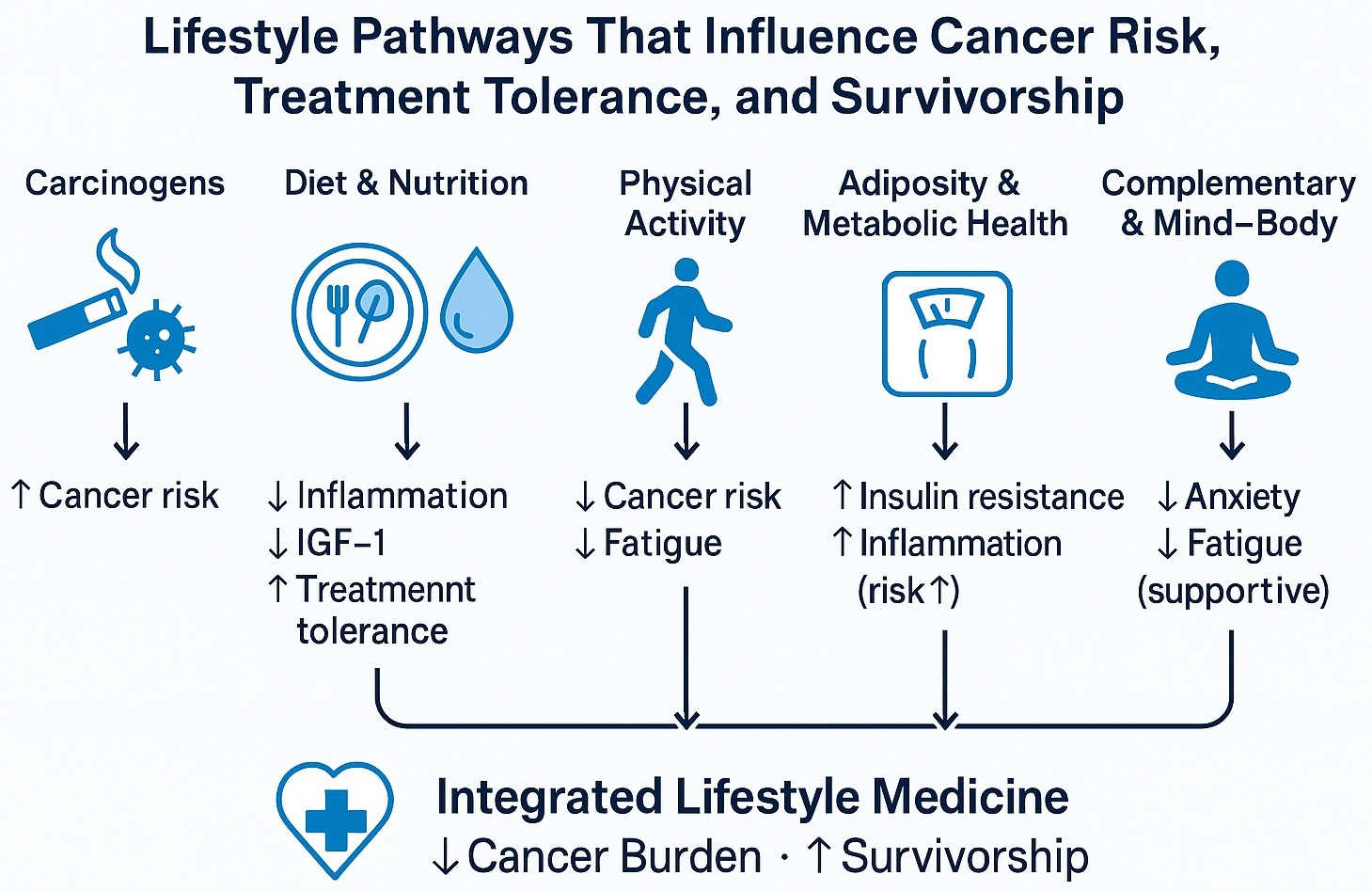


Lifestyle-Based Approaches to Cancer Prevention and Treatment: Diet, Physical Activity, and Integrative Strategies




Abstract
1. Introduction
2. Search Strategy and Literature Selection
3. Results and Discussion
3.1. Carcinogenic Exposures: Tobacco and Ultraviolet (UV) Radiation
3.1.1. Tobacco as a Carcinogen
3.1.2. Non-Ionizing Radiation as a Carcinogen
3.2. Dietary Strategies in Cancer Prevention and Treatment
3.2.1. Intermittent and Periodic Energy Restriction (IF/FMD)
Mechanistic Rationale: Cancer-Related Signaling and Nutritional Modulation
Fasting Regimens and Tumor Biology
Preclinical Evidence on Fasting
Clinical and Translational Evidence on Fasting
3.2.2. Ketogenic Strategies in Oncologic Metabolism (LC/KD)
Preclinical Evidence on Ketogenic Diet
Clinical and Translational Evidence on Ketogenic Diet
3.2.3. Vitamin D, Carotenoids and Signaling Axes
3.2.3.1. Vitamins and Signaling
- Breast Cancer
- Colorectal Cancer
- Lung Cancer
- Ovarian Cancer
3.2.3.2. Carotenoids and Retinoid-Related Pathways
- Head and Neck Cancer
- Breast Cancer
- Colorectal Cancer
- Lung Cancer
- Prostate Cancer
3.2.4. Cancer-Specific Evidence Summary for Dietary Strategies
3.3. Physical Activity, Sedentary Behavior, and Exercise Oncology
3.3.1. Prevention: Physical Activity and Cancer Risk
3.3.2. Physical Activity During and After Therapy
3.3.3. Adiposity and Metabolic Health
Obesity and Cancer: Epidemiology and Mechanisms
Clinical Weight-Loss Strategies in Oncology
Survivorship and Relapse Risk
3.3.4. Cancer-Specific Evidence Summary for Physical Activity, Sedentary Behavior, and Adiposity
3.4. Complementary and Mind–Body Approaches
Cancer-Specific Evidence Summary for Complementary and Mind–Body Interventions
4. Limitations
5. Conclusions and Future Perspectives
Supplementary Materials
Author Contributions
Funding
Institutional Review Board Statement
Informed Consent Statement
Data Availability Statement
Conflicts of Interest
References
- LoConte, N.K.; Gershenwald, J.E.; Thomson, C.A.; Crane, T.E.; Harmon, G.E.; Rechis, R. Lifestyle modifications and policy implications for primary and secondary cancer prevention: Diet, exercise, sun safety, and alcohol reduction. Am. Soc. Clin. Oncol. Educ. Book 2018, 38, 88–100. [Google Scholar] [CrossRef]
- Tripp, M.K.; Watson, M.; Balk, S.J.; Swetter, S.M.; Gershenwald, J.E. State of the science on prevention and screening to reduce melanoma incidence and mortality: The time is now. CA Cancer J. Clin. 2016, 66, 460–480. [Google Scholar] [CrossRef] [PubMed]
- Sun, Y.; Wu, J.; Yoon, H.-S.; Buchowski, M.S.; Cai, H.; Deppen, S.A.; Steinwandel, M.D.; Zheng, W.; Shu, X.-O.; Blot, W.J.; et al. Associations of dietary intakes of carotenoids and vitamin A with lung cancer risk in a low-income population in the southeastern United States. Cancers 2022, 14, 5159. [Google Scholar] [CrossRef] [PubMed]
- Anand, P.; Kunnumakara, A.B.; Sundaram, C.; Harikumar, K.B.; Tharakan, S.T.; Lai, O.S.; Sung, B.; Aggarwal, B.B. Cancer is a preventable disease that requires major lifestyle changes. Pharm. Res. 2008, 25, 2097–2116. [Google Scholar] [PubMed]
- Vernieri, C.; Nichetti, F.; Raimondi, A.; Pusceddu, S.; Platania, M.; Berrino, F.; de Braud, F. Diet and supplements in cancer prevention and treatment: Clinical evidences and future perspectives. Crit. Rev. Oncol./Hematol. 2018, 123, 57–73. [Google Scholar] [CrossRef]
- Cagigas, M.L.; De Ciutiis, I.; Masedunskas, A.; Fontana, L. Dietary and pharmacological energy restriction and exercise for healthspan extension. Trends Endocrinol. Metab. 2025, 36, 521–545. [Google Scholar] [CrossRef]
- Doyle, C.; Kushi, L.H.; Byers, T.; Courneya, K.S.; Demark-Wahnefried, W.; Grant, B.; McTiernan, A.; Rock, C.L.; Thompson, C.; Gansler, T.; et al. Nutrition and physical activity during and after cancer treatment: An American Cancer Society guide for informed choices. CA Cancer J. Clin. 2006, 56, 323–353. [Google Scholar] [CrossRef]
- National Cancer Institute. Complementary and Alternative Medicine. 2023. Available online: https://www.cancer.gov/about-cancer/treatment/cam (accessed on 30 September 2025).
- Carlson, L.E.; Zelinski, E.; Toivonen, K.; Flynn, M.; Qureshi, M.; Piedalue, K.-A.; Grant, R. Mind–body therapies in cancer: What is the latest evidence? Curr. Oncol. Rep. 2017, 19, 67. [Google Scholar]
- Cramer, H.; Lauche, R.; Langhorst, J.; Dobos, G.; Ward, L. Mind–body practices for cancer-related symptoms management: An overview of systematic reviews. Support. Care Cancer 2022, 30, 12345–12356. [Google Scholar]
- Deleemans, J.M.; Mather, H.; Spiropoulos, A.; Toivonen, K.; Baydoun, M.; Carlson, L.E. Recent progress in mind–body therapies in cancer care. Curr. Oncol. Rep. 2023, 25, 293–307. [Google Scholar] [CrossRef]
- Horneber, M.; Bueschel, G.; Dennert, G.; Less, D.; Ritter, E.; Zwahlen, M. How many cancer patients use complementary and alternative medicine: A systematic review and meta-analysis. Integr. Cancer Ther. 2012, 11, 187–203. [Google Scholar] [PubMed]
- Frenkel, M.; Slater, R.; Sapire, K.; Sierpina, V. Complementary and integrative medicine in lung cancer: Questions and challenges. J. Altern. Complement. Med. 2018, 24, 862–871. [Google Scholar] [CrossRef] [PubMed]
- David, A.; Hausner, D.; Frenkel, M. Cancer-related fatigue—Is there a role for complementary and integrative medicine? Curr. Oncol. Rep. 2021, 23, 145. [Google Scholar] [CrossRef] [PubMed]
- Pascual-Morena, C.; Garrido-Miguel, M.; Martínez-García, I.; Lucerón-Lucas-Torres, M.; Rodríguez-Gutiérrez, E.; Berlanga-Macías, C.; Fernández-Bravo-Rodrigo, J.; Patiño-Cardona, S. Association of Dietary Advanced Glycation End Products with Overall and Site-Specific Cancer Risk and Mortality: A Systematic Review and Meta-Analysis. Nutrients 2025, 17, 1638. [Google Scholar] [CrossRef]
- Sharifi-Zahabi, E.; Soltani, S.; Hajizadeh-Sharafabad, F.; Abdollahzad, H. Dietary advanced glycation end-products (dAGEs) are not associated with the risk of cancer incidence. A systematic review and meta-analysis of prospective cohort studies. Food Sci. Nutr. 2024, 12, 7788–7797. [Google Scholar] [CrossRef]
- Omofuma, O.O.; Turner, D.P.; Peterson, L.L.; Merchant, A.T.; Zhang, J.; Steck, S.E. Dietary advanced glycation end-products (AGE) and risk of breast cancer in the prostate, lung, colorectal and ovarian cancer screening trial (PLCO). Cancer Prev. Res. 2020, 13, 601–610. [Google Scholar] [CrossRef]
- Li, Y.; Hecht, S.S. Carcinogenic components of tobacco and tobacco smoke: A 2022 update. Food Chem. Toxicol. 2022, 165, 113179. [Google Scholar] [CrossRef]
- Larsson, S.C.; Carter, P.; Kar, S.; Vithayathil, M.; Mason, A.M.; Michaelsson, K.; Burgess, S.; Gill, D.; Zuber, V.; Holmes, M.V.; et al. Smoking, alcohol consumption, and cancer: A Mendelian randomisation study in UK Biobank and international genetic consortia participants. PLoS Med. 2020, 17, e1003178. [Google Scholar]
- Secretan, B.; Straif, K.; Baan, R.; Grosse, Y.; El Ghissassi, F.; Bouvard, V.; Benbrahim-Tallaa, L.; Cogliano, V. A review of human carcinogens—Part E: Tobacco, areca nut, alcohol, coal smoke, and salted fish. Lancet Oncol. 2009, 10, 1033–1034. [Google Scholar] [CrossRef]
- Wei, P.-L.; Chang, Y.-J.; Ho, Y.-S.; Lee, C.-H.; Yang, Y.-Y.; An, J.; Wu, C.-H.; Wu, D.-C. Tobacco-specific carcinogen enhances colon cancer cell migration through α7-nicotinic acetylcholine receptor. Ann. Surg. 2009, 249, 978–985. [Google Scholar]
- Hecht, S.S. Tobacco smoke carcinogens and breast cancer. Environ. Mol. Mutagen. 2002, 39, 119–126. [Google Scholar] [CrossRef] [PubMed]
- Jethwa, A.R.; Khariwala, S.S. Tobacco-related carcinogenesis in head and neck cancer. Cancer Metastasis Rev. 2017, 36, 411–423. [Google Scholar] [CrossRef] [PubMed]
- Caliri, A.W.; Tommasi, S.; Besaratinia, A. Relationships among smoking, oxidative stress, inflammation, macromolecular damage, and cancer. Mutat. Res./Rev. Mutat. Res. 2021, 787, 108365. [Google Scholar] [CrossRef] [PubMed]
- International Agency for Research on Cancer (IARC). Non-ionizing radiation, Part 2: Radiofrequency electromagnetic fields. IARC Monogr. Eval. Carcinog. Risks Hum. 2013, 102, 1–460. [Google Scholar]
- Stang, A.; Anastassiou, G.; Ahrens, W.; Bromen, K.; Bornfeld, N.; Jöckel, K.H. The possible role of radiofrequency radiation in the development of uveal melanoma. Epidemiology 2001, 12, 7–12. [Google Scholar] [CrossRef]
- Karipidis, K.K.; Benke, G.; Sim, M.R.; Kauppinen, T.; Giles, G. Occupational exposure to ionizing and non-ionizing radiation and risk of glioma. Occup. Med. 2007, 57, 518–524. [Google Scholar] [CrossRef]
- Gupta, S.; Sharma, R.S.; Singh, R. Non-ionizing radiation as possible carcinogen. Int. J. Environ. Health Res. 2022, 32, 916–940. [Google Scholar] [CrossRef]
- Bauer, A.; Diepgen, T.L.; Schmitt, J. Is occupational solar ultraviolet irradiation a relevant risk factor for basal cell carcinoma? A systematic review and meta-analysis of the epidemiological literature. Br. J. Dermatol. 2011, 165, 612–625. [Google Scholar] [CrossRef]
- Brandhorst, S.; Choi, I.Y.; Wei, M.; Cheng, C.W.; Sedrakyan, S.; Navarrete, G.; Dubeau, L.; Yap, W.K.; Park, R.; Vinciguerra, M.; et al. A periodic diet that mimics fasting promotes multi-system regeneration, enhanced cognitive performance, and healthspan. Cell Metab. 2015, 22, 86–99. [Google Scholar] [CrossRef]
- Levine, M.E.; Suarez, J.A.; Brandhorst, S.; Balasubramanian, P.; Cheng, C.-W.; Madia, F.; Fontana, L.; Mirisola, M.G.; Guevara-Aguirre, J.; Wan, J.; et al. Low protein intake is associated with a major reduction in IGF-1, cancer, and overall mortality in the 65 and younger but not older population. Cell Metab. 2014, 19, 407–417. [Google Scholar] [CrossRef]
- Tufail, M.; Jiang, C.-H.; Li, N. Altered metabolism in cancer: Insights into energy pathways and therapeutic targets. Mol. Cancer 2024, 23, 203. [Google Scholar] [CrossRef] [PubMed]
- Lin, X.; Xiao, Z.; Chen, T.; Liang, S.H.; Guo, H. Glucose metabolism on tumor plasticity, diagnosis, and treatment. Front. Oncol. 2020, 10, 317. [Google Scholar] [CrossRef] [PubMed]
- Mattson, M.P.; Longo, V.D.; Harvie, M. Impact of intermittent fasting on health and disease processes. Ageing Res. Rev. 2017, 39, 46–58. [Google Scholar] [CrossRef]
- Tiwari, S.; Sapkota, N.; Han, Z. Effect of fasting on cancer: A narrative review of scientific evidence. Cancer Sci. 2022, 113, 3291–3302. [Google Scholar] [CrossRef] [PubMed]
- Patterson, R.E.; Sears, D.D. Metabolic effects of intermittent fasting. Annu. Rev. Nutr. 2017, 37, 371–393. [Google Scholar] [CrossRef]
- Longo, V.D.; Mattson, M.P. Fasting: Molecular mechanisms and clinical applications. Cell Metab. 2014, 19, 181–192. [Google Scholar] [CrossRef]
- Safdie, F.M.; Dorff, T.; Quinn, D.; Fontana, L.; Wei, M.; Lee, C.; Cohen, P.; Longo, V.D. Fasting and cancer treatment in humans: A case series report. Aging 2009, 1, 988. [Google Scholar] [CrossRef]
- Brandhorst, S. Fasting and fasting-mimicking diets for chemotherapy augmentation. Geroscience 2021, 43, 1201–1216. [Google Scholar] [CrossRef]
- Longo, V.D.; Di Tano, M.; Mattson, M.P.; Guidi, N. Intermittent and periodic fasting, longevity and disease. Nat. Aging 2021, 1, 47–59. [Google Scholar] [CrossRef]
- Turbitt, W.J.; Demark-Wahnefried, W.; Peterson, C.M.; Norian, L.A. Targeting glucose metabolism to enhance immunotherapy: Emerging evidence on intermittent fasting and calorie restriction mimetics. Front. Immunol. 2019, 10, 1402. [Google Scholar] [CrossRef]
- Wei, M.; Brandhorst, S.; Shelehchi, M.; Mirzaei, H.; Cheng, C.W.; Budniak, J.; Groshen, S.; Mack, W.J.; Guen, E.; Di Biase, S.; et al. Fasting-mimicking diet and markers/risk factors for aging, diabetes, cancer, and cardiovascular disease. Sci. Transl. Med. 2019, 9, eaai8700. [Google Scholar] [CrossRef]
- Blaževitš, O.; Di Tano, M.; Longo, V.D. Fasting and fasting mimicking diets in cancer prevention and therapy. Trends Cancer 2023, 9, 212–222. [Google Scholar] [CrossRef] [PubMed]
- Lee, C.; Raffaghello, L.; Brandhorst, S.; Safdie, F.M.; Bianchi, G.; Martin-Montalvo, A.; Pistoia, V.; Wei, M.; Hwang, S.; Merlino, A.A.; et al. Fasting cycles retard growth of tumors and sensitize a range of cancer cell types to chemotherapy. Sci. Transl. Med. 2012, 4, 124ra27. [Google Scholar] [CrossRef] [PubMed]
- Bianchi, G.; Martella, R.; Ravera, S.; Marini, C.; Capitanio, S.; Orengo, A.; Emionite, L.; Lavarello, C.; Amaro, A.; Pfeffer, U.; et al. Fasting induces anti-Warburg effect that increases respiration but reduces ATP-synthesis to promote apoptosis in colon cancer models. Oncotarget 2015, 6, 11806. [Google Scholar] [CrossRef] [PubMed]
- Longo, V.D.; Cortellino, S. Fasting, dietary restriction, and immunosenescence. J. Allergy Clin. Immunol. 2020, 146, 1002–1004. [Google Scholar] [CrossRef]
- Vernieri, C.; Casola, S.; Foiani, M.; Pietrantonio, F.; de Braud, F.; Longo, V. Targeting cancer metabolism: Dietary and pharmacologic interventions anticancer metabolic therapies. Cancer Discov. 2016, 6, 1315–1333. [Google Scholar] [CrossRef]
- De Groot, S.; Vreeswijk, M.P.; Welters, M.J.; Gravesteijn, G.; Boei, J.J.; Jochems, A.; Houtsma, D.; Putter, H.; van der Hoeven, J.J.M.; Nortier, J.W.R.; et al. The effects of short-term fasting on tolerance to (neo)adjuvant chemotherapy in HER2-negative breast cancer patients: A randomized pilot study. BMC Cancer 2015, 15, 652. [Google Scholar] [CrossRef]
- Dorff, T.B.; Groshen, S.; Garcia, A.; Shah, M.; Tsao-Wei, D.; Pham, H.; Cheng, C.W.; Brandhorst, S.; Cohen, P.; Longo, V.D.; et al. Safety and feasibility of fasting in combination with platinum-based chemotherapy. BMC Cancer 2016, 16, 360. [Google Scholar] [CrossRef]
- Bauersfeld, S.P.; Kessler, C.S.; Wischnewsky, M.; Jaensch, A.; Steckhan, N.; Stange, R.; Kunz, B.; Brückner, B.; Sehouli, J.; Michalsen, A.; et al. The effects of short-term fasting on quality of life and tolerance to chemotherapy in patients with breast and ovarian cancer: A randomized cross-over pilot study. BMC Cancer 2018, 18, 476. [Google Scholar] [CrossRef]
- Vernieri, C.; Fucà, G.; Ligorio, F.; Huber, V.; Vingiani, A.; Iannelli, F.; Raimondi, A.; Rinchai, D.; Franza, L.; Maggi, C.; et al. Fasting-mimicking diet is safe and reshapes metabolism and antitumor immunity in patients with cancer. Cancer Discov. 2022, 12, 90–107. [Google Scholar] [CrossRef]
- De Groot, S.; Lugtenberg, R.T.; Cohen, D.; Welters, M.J.; Ehsan, I.; Vreeswijk, M.P.; Smit, V.T.H.B.M.; de Graaf, H.; Heijns, J.B.; Portielje, J.E.A.; et al. Fasting mimicking diet as an adjunct to neoadjuvant chemotherapy for breast cancer in the multicentre randomized phase 2 DIRECT trial. Nat. Commun. 2020, 11, 3083. [Google Scholar] [CrossRef] [PubMed]
- Allen, B.G.; Bhatia, S.K.; Anderson, C.M.; Eichenberger-Gilmore, J.M.; Sibenaller, Z.A.; Mapuskar, K.A.; Schoenfeld, J.D.; Buatti, J.M.; Spitz, D.R.; Fath, M.A. Ketogenic diets as an adjuvant cancer therapy: History and potential mechanism. Redox Biol. 2014, 2, 963–970. [Google Scholar] [CrossRef] [PubMed]
- Yancy, W.S., Jr.; Olsen, M.K.; Guyton, J.R.; Bakst, R.P.; Westman, E.C. A low-carbohydrate, ketogenic diet versus a low-fat diet to treat obesity and hyperlipidemia: A randomized, controlled trial. Ann. Intern. Med. 2004, 140, 769–777. [Google Scholar] [CrossRef] [PubMed]
- Dhamija, R.; Eckert, S.; Wirrell, E. Ketogenic diet. Can. J. Neurol. Sci. 2013, 40, 158–167. [Google Scholar] [CrossRef]
- Choi, J.-W.; Hua, T.N. Impact of lifestyle behaviors on cancer risk and prevention. J. Lifestyle Med. 2021, 11, 1. [Google Scholar] [CrossRef]
- Shimazu, T.; Hirschey, M.D.; Newman, J.; He, W.; Shirakawa, K.; Le Moan, N.; Grueter, C.A.; Lim, H.; Saunders, L.R.; Stevens, R.D.; et al. Suppression of oxidative stress by β-hydroxybutyrate, an endogenous histone deacetylase inhibitor. Science 2013, 339, 211–214. [Google Scholar] [CrossRef]
- Talib, W.H.; Mahmod, A.I.; Kamal, A.; Rashid, H.M.; Alashqar, A.M.D.; Khater, S.; Taha, M.O.; Awad, H.; Mahgoub, S.; Al-Hatamleh, M.A.I.; et al. Ketogenic diet in cancer prevention and therapy: Molecular targets and therapeutic opportunities. Curr. Issues Mol. Biol. 2021, 43, 558–589. [Google Scholar] [CrossRef]
- Zhang, N.; Liu, C.; Jin, L.; Zhang, R.; Wang, T.; Wang, Q.; Li, X.; Zhao, Y.; Chen, Y.; Xu, F.; et al. Ketogenic diet elicits antitumor properties through inducing oxidative stress, inhibiting MMP-9 expression, and rebalancing M1/M2 tumor-associated macrophage phenotype in a mouse model of colon cancer. J. Agric. Food Chem. 2020, 68, 11182–11196. [Google Scholar]
- Said, A.H.; Raufman, J.P.; Xie, G. The role of matrix metalloproteinases in colorectal cancer. Cancers 2014, 6, 366–375. [Google Scholar] [CrossRef]
- Elisia, I.; Krystal, G. The pros and cons of low carbohydrate and ketogenic diets in the prevention and treatment of cancer. Front. Nutr. 2021, 8, 634845. [Google Scholar] [CrossRef]
- Dmitrieva-Posocco, O.; Wong, A.C.; Lundgren, P.; Golos, A.M.; Descamps, H.C.; Dohnalová, L.; Dura, B.; Wucherpfennig, K.W.; Xavier, R.J.; Meissner, T.B.; et al. β-Hydroxybutyrate suppresses colorectal cancer. Nature 2022, 605, 160–165. [Google Scholar] [CrossRef] [PubMed]
- Pflanz, N.C.; Daszkowski, A.W.; James, K.A.; Mihic, S.J. Ketone body modulation of ligand-gated ion channels. Neuropharmacology 2019, 148, 21–30. [Google Scholar] [CrossRef] [PubMed]
- Mundi, M.S.; Mohamed Elfadil, O.; Patel, I.; Patel, J.; Hurt, R.T. Ketogenic diet and cancer: Fad or fabulous? J. Parenter. Enter. Nutr. 2021, 45, S26–S32. [Google Scholar]
- Fine, E.J.; Segal-Isaacson, C.; Feinman, R.D.; Herszkopf, S.; Romano, M.C.; Tomuta, N.; Bontempo, A.F.; Negassa, A.; Sparano, J.A. Targeting insulin inhibition as a metabolic therapy in advanced cancer: A pilot safety and feasibility dietary trial in 10 patients. Nutrition 2012, 28, 1028–1035. [Google Scholar] [CrossRef]
- Schmidt, M.; Pfetzer, N.; Schwab, M.; Strauss, I.; Kammerer, U. Effects of a ketogenic diet on the quality of life in 16 patients with advanced cancer: A pilot trial. Nutr. Metab. 2011, 8, 54. [Google Scholar] [CrossRef]
- Khodabakhshi, A.; Akbari, M.E.; Mirzaei, H.R.; Mehrad-Majd, H.; Kalamian, M.; Davoodi, S.H. Feasibility, safety, and beneficial effects of MCT-based ketogenic diet for breast cancer treatment: A randomized controlled trial study. Nutr. Cancer 2020, 72, 627–634. [Google Scholar] [CrossRef]
- Plotti, F.; Terranova, C.; Luvero, D.; Bartolone, M.; Messina, G.; Feole, L.; Scaletta, G.; De Cicco Nardone, C.; Angioli, R.; Benedetti Panici, P.; et al. Diet and chemotherapy: The effects of fasting and ketogenic diet on cancer treatment. Chemotherapy 2020, 65, 77–84. [Google Scholar] [CrossRef]
- Lane, J.; Brown, N.I.; Williams, S.; Plaisance, E.P.; Fontaine, K.R. Ketogenic diet for cancer: Critical assessment and research recommendations. Nutrients 2021, 13, 3562. [Google Scholar] [CrossRef]
- Bonetti, G.; Herbst, K.L.; Donato, K.; Dhuli, K.; Kiani, A.K.; Aquilanti, B.; Fioretti, F.; Caruso, P.; Medori, M.C.; Bianchi, G.; et al. Dietary supplements for obesity. J. Prev. Med. Hyg. 2022, 63, E160–E168. [Google Scholar]
- Munoz, A.; Grant, W.B. Vitamin D and cancer: An historical overview of the epidemiology and mechanisms. Nutrients 2022, 14, 1448. [Google Scholar] [CrossRef]
- L’Esperance, K.; Datta, G.D.; Qureshi, S.; Koushik, A. Vitamin D exposure and ovarian cancer risk and prognosis. Int. J. Environ. Res. Public Health 2020, 17, 1168. [Google Scholar] [CrossRef] [PubMed]
- Kiani, A.K.; Medori, M.C.; Dhuli, K.; Donato, K.; Caruso, P.; Fioretti, F.; Bianchi, G.; Aquilanti, B.; Bonetti, G.; Herbst, K.L.; et al. Clinical assessment for diet prescription. J. Prev. Med. Hyg. 2022, 63, E102–E124. [Google Scholar] [PubMed]
- Wang, W.; Hu, W.; Xue, S.; Chen, Q.; Jiang, Y.; Zhang, H.; Li, Y.; Zhao, X.; Liu, J.; Sun, Z.; et al. Vitamin D and lung cancer; association, prevention, and treatment. Nutr. Cancer 2021, 73, 2188–2200. [Google Scholar] [CrossRef] [PubMed]
- Sluyter, J.D.; Manson, J.E.; Scragg, R. Vitamin D and clinical cancer outcomes: A review of meta-analyses. J. Bone Miner. Res. Plus 2021, 5, e10420. [Google Scholar] [CrossRef]
- Hossain, S.; Beydoun, M.A.; Beydoun, H.A.; Chen, X.; Zonderman, A.B.; Wood, R.J. Vitamin D and breast cancer: A systematic review and meta-analysis of observational studies. Clin. Nutr. ESPEN 2019, 30, 170–185. [Google Scholar] [CrossRef]
- Abe, E.; Miyaura, C.; Sakagami, H.; Takeda, M.; Konno, K.; Yamazaki, T.; Yoshiki, S.; Suda, T. Differentiation of mouse myeloid leukemia cells induced by 1 alpha,25-dihydroxyvitamin D3. Proc. Natl. Acad. Sci. USA 1981, 78, 4990–4994. [Google Scholar] [CrossRef]
- Colston, K.; Colston, M.J.; Feldman, D. 1,25-dihydroxyvitamin D3 and malignant melanoma: The presence of receptors and inhibition of cell growth in culture. Endocrinology 1981, 108, 1083–1086. [Google Scholar] [CrossRef]
- Welsh, J. Vitamin D and breast cancer: Past and present. J. Steroid Biochem. Mol. Biol. 2018, 177, 15–20. [Google Scholar] [CrossRef]
- Narvaez, C.J.; Matthews, D.; LaPorta, E.; Simmons, K.M.; Beaudin, S.; Welsh, J. The impact of vitamin D in breast cancer: Genomics, pathways, metabolism. Front. Physiol. 2014, 5, 213. [Google Scholar] [CrossRef]
- Feldman, D.; Krishnan, A.V.; Swami, S.; Giovannucci, E.; Feldman, B.J. The role of vitamin D in reducing cancer risk and progression. Nat. Rev. Cancer 2014, 14, 342–357. [Google Scholar] [CrossRef]
- Blasiak, J.; Pawlowska, E.; Chojnacki, J.; Szczepanska, J.; Fila, M.; Chojnacki, C. Vitamin D in triple-negative and BRCA1-deficient breast cancer—Implications for pathogenesis and therapy. Int. J. Mol. Sci. 2020, 21, 3670. [Google Scholar] [CrossRef] [PubMed]
- Bauer, S.R.; Hankinson, S.E.; Bertone-Johnson, E.R.; Ding, E.L. Plasma vitamin D levels, menopause, and risk of breast cancer: Dose–response meta-analysis of prospective studies. Medicine 2013, 92, 123–131. [Google Scholar] [CrossRef] [PubMed]
- Vanhevel, J.; Verlinden, L.; Doms, S.; Wildiers, H.; Verstuyf, A. The role of vitamin D in breast cancer risk and progression. Endocr. -Relat. Cancer 2022, 29, R33–R55. [Google Scholar] [PubMed]
- Kim, H.; Lipsyc-Sharf, M.; Zong, X.; Wang, X.; Hur, J.; Song, M.; Nishihara, R.; Ng, K.; Wu, K.; Giovannucci, E.L.; et al. Total vitamin D intake and risks of early-onset colorectal cancer and precursors. Gastroenterology 2021, 161, 1208–1217. [Google Scholar] [CrossRef]
- Maalmi, H.; Walter, V.; Jansen, L.; Boakye, D.; Schöttker, B.; Hoffmeister, M.; Brenner, H. Association between Blood 25-Hydroxyvitamin D Levels and Survival in Colorectal Cancer Patients: An Updated Systematic Review and Meta-Analysis. Nutrients 2018, 10, 896. [Google Scholar] [CrossRef]
- Na, S.Y.; Kim, K.B.; Lim, Y.J.; Song, H.J. Vitamin D and colorectal cancer: Current perspectives and future directions. J. Cancer Prev. 2022, 27, 147–156. [Google Scholar] [CrossRef]
- Wesselink, E.; Kok, D.E.; Bours, M.J.; De Wilt, J.H.; Van Baar, H.; Van Zutphen, M.; Breedveld-Peters, J.J.; van Duijnhoven, F.J.; Boshuizen, H.C.; Weijenberg, M.P.; et al. Vitamin D, magnesium, calcium, and their interaction in relation to colorectal cancer recurrence and all-cause mortality. Am. J. Clin. Nutr. 2020, 111, 1007–1017. [Google Scholar] [CrossRef]
- Ng, K.; Sargent, D.J.; Goldberg, R.M.; Meyerhardt, J.A.; Green, E.M.; Pitot, H.C.; Hollis, B.W.; Pollak, M.N.; Fuchs, C.S. Vitamin D status in patients with stage IV colorectal cancer: Findings from intergroup trial N9741. J. Clin. Oncol. 2011, 29, 1599. [Google Scholar] [CrossRef]
- Yuan, C.; Sato, K.; Hollis, B.W.; Zhang, S.; Niedzwiecki, D.; Ou, F.-S.; Chang, I.; O’Neil, B.H.; Venook, A.P.; Mayer, R.J.; et al. Plasma 25-hydroxyvitamin D levels and survival in patients with advanced or metastatic colorectal cancer: Findings from CALGB/SWOG 80405 (Alliance). Clin. Cancer Res. 2019, 25, 7497–7505. [Google Scholar] [CrossRef]
- Pilz, S.; Tomaschitz, A.; Obermayer-Pietsch, B.; Dobnig, H.; Pieber, T.R. Epidemiology of vitamin D insufficiency and cancer mortality. Anticancer Res. 2009, 29, 3699–3704. [Google Scholar]
- Kilkkinen, A.; Knekt, P.; Heliövaara, M.; Rissanen, H.; Marniemi, J.; Hakulinen, T.; Albanes, D.; Virtamo, J. Vitamin D status and the risk of lung cancer: A cohort study in Finland. Cancer Epidemiol. Biomark. Prev. 2008, 17, 3274–3278. [Google Scholar] [CrossRef]
- Maj, E.; Filip-Psurska, B.; Switalska, M.; Kutner, A.; Wietrzyk, J. Vitamin D analogs potentiate the antitumor effect of imatinib mesylate in a human A549 lung tumor model. Int. J. Mol. Sci. 2015, 16, 27191–27207. [Google Scholar] [CrossRef] [PubMed]
- Verone-Boyle, A.R.; Shoemaker, S.; Attwood, K.; Morrison, C.D.; Makowski, A.J.; Battaglia, S.; Zhang, J.; Wooten, J.; Arshad, H.; Guru, K.; et al. Diet-derived 25-hydroxyvitamin D3 activates vitamin D receptor target gene expression and suppresses EGFR mutant non-small cell lung cancer growth in vitro and in vivo. Oncotarget 2016, 7, 995. [Google Scholar] [CrossRef] [PubMed]
- McGaffin, K.R.; Chrysogelos, S.A. Identification and characterization of a response element in the EGFR promoter that mediates transcriptional repression by 1,25-dihydroxyvitamin D3 in breast cancer cells. J. Mol. Endocrinol. 2005, 35, 117–133. [Google Scholar] [CrossRef] [PubMed]
- Qin, B.; Moorman, P.G.; Alberg, A.J.; Barnholtz-Sloan, J.S.; Bondy, M.; Cote, M.L.; Funkhouser, E.; Peters, E.S.; Schwartz, A.G.; Terry, P.; et al. Dairy, calcium, vitamin D and ovarian cancer risk in African-American women. Br. J. Cancer 2016, 115, 1122–1130. [Google Scholar] [CrossRef]
- Garland, C.F.; Mohr, S.B.; Gorham, E.D.; Grant, W.B.; Garland, F.C. Role of ultraviolet B irradiance and vitamin D in prevention of ovarian cancer. Am. J. Prev. Med. 2006, 31, 512–514. [Google Scholar] [CrossRef]
- Boscoe, F.P.; Schymura, M.J. Solar ultraviolet-B exposure and cancer incidence and mortality in the United States, 1993–2002. BMC Cancer 2006, 6, 264. [Google Scholar] [CrossRef]
- Tran, B.; Jordan, S.J.; Lucas, R.; Webb, P.M.; Neale, R. Association between ambient ultraviolet radiation and risk of epithelial ovarian cancer. Cancer Prev. Res. 2012, 5, 1330–1336. [Google Scholar] [CrossRef]
- Webb, P.M.; de Fazio, A.; Protani, M.M.; Ibiebele, T.I.; Nagle, C.M.; Brand, A.H.; Blomfield, P.I.; Grant, P.; Perrin, L.C.; Neale, R.E.; et al. Circulating 25-hydroxyvitamin D and survival in women with ovarian cancer. Am. J. Clin. Nutr. 2015, 102, 109–114. [Google Scholar] [CrossRef]
- Laczmanski, L.; Lwow, F.; Osina, A.; Kepska, M.; Laczmanska, I.; Witkiewicz, W. Association of the vitamin D receptor FokI gene polymorphism with sex- and non-sex-associated cancers: A meta-analysis. Tumour Biol. 2017, 39, 1010428317727164. [Google Scholar] [CrossRef]
- Christakos, S.; Dhawan, P.; Verstuyf, A.; Verlinden, L.; Carmeliet, G. Vitamin D: Metabolism, molecular mechanism of action, and pleiotropic effects. Physiol. Rev. 2016, 96, 365–408. [Google Scholar] [CrossRef] [PubMed]
- Gnagnarella, P.; Raimondi, S.; Aristarco, V.; Johansson, H.A.; Bellerba, F.; Corso, F.; Gandini, S. Vitamin D receptor polymorphisms and cancer. In Sunlight, Vit D, Skin Cancer; Springer: New York, NY, USA, 2020; pp. 53–114. [Google Scholar]
- Liu, Y.; Li, C.; Chen, P.; Li, X.; Li, M.; Guo, H.; Li, J.; Chu, R.; Wang, H. Polymorphisms in the Vitamin D Receptor (VDR) and the Risk of Ovarian Cancer: A Meta-Analysis. PLoS ONE 2013, 8, e66716. [Google Scholar] [CrossRef] [PubMed]
- Mostowska, A.; Sajdak, S.; Pawlik, P.; Lianeri, M.; Jagodzinski, P.P. Polymorphic variants in the vitamin D pathway genes and the risk of ovarian cancer among non-carriers of BRCA1/BRCA2 mutations. Oncol. Lett. 2016, 11, 1181–1188. [Google Scholar] [CrossRef] [PubMed]
- Carlberg, C.; Haq, A. The concept of the personal vitamin D response index. J. Steroid Biochem. Mol. Biol. 2018, 175, 12–17. [Google Scholar] [CrossRef]
- Leoncini, E.; Nedovic, D.; Panic, N.; Pastorino, R.; Edefonti, V.; Boccia, S. Carotenoid intake from natural sources and head and neck cancer: A systematic review and meta-analysis of epidemiological studies. Cancer Epidemiol. Biomark. Prev. 2015, 24, 1003–1011. [Google Scholar] [CrossRef]
- Chew, B.P.; Park, J.S. Carotenoid action on the immune response. J. Nutr. 2004, 134, 257S–261S. [Google Scholar] [CrossRef]
- Brewczynski, A.; Jablonska, B.; Kentnowski, M.; Mrowiec, S.; Skladowski, K.; Rutkowski, T. The association between carotenoids and head and neck cancer risk. Nutrients 2021, 14, 88. [Google Scholar] [CrossRef]
- Terao, J. Revisiting carotenoids as dietary antioxidants for human health and disease prevention. Food Funct. 2023, 14, 7799–7824. [Google Scholar] [CrossRef]
- Leoncini, E.; Edefonti, V.; Hashibe, M.; Parpinel, M.; Cadoni, G.; Ferraroni, M.; Serraino, D.; Matsuo, K.; Olshan, A.F.; Zevallos, J.P.; et al. Carotenoid intake and head and neck cancer: A pooled analysis in the International Head and Neck Cancer Epidemiology Consortium. Eur. J. Epidemiol. 2016, 31, 369–383. [Google Scholar] [CrossRef]
- Rowles, J.L., 3rd; Erdman, J.W., Jr. Carotenoids and their role in cancer prevention. Biochim. Biophys. Acta (BBA)—Mol. Cell Biol. Lipids 2020, 1865, 158613. [Google Scholar] [CrossRef]
- Peng, S.J.; Li, J.; Zhou, Y.; Tuo, M.; Qin, X.X.; Yu, Q.; Cheng, H.; Li, Y.M. In vitro effects and mechanisms of lycopene in MCF-7 human breast cancer cells. Genet. Mol. Res. 2017, 16, 13. [Google Scholar] [CrossRef] [PubMed]
- Hu, F.; Wang, Y.B.; Zhang, W.; Liang, J.; Lin, C.; Li, D.; Wang, F.; Zhao, Y. Carotenoids and breast cancer risk: A meta-analysis and meta-regression. Breast Cancer Res. Treat. 2012, 131, 239–253. [Google Scholar] [CrossRef] [PubMed]
- Mignone, L.I.; Giovannucci, E.; Newcomb, P.A.; Titus-Ernstoff, L.; Trentham-Dietz, A.; Hampton, J.M.; Willett, W.C.; Egan, K.M. Dietary carotenoids and the risk of invasive breast cancer. Int. J. Cancer 2009, 124, 2929–2937. [Google Scholar] [CrossRef] [PubMed]
- Tang, F.Y.; Shih, C.J.; Cheng, L.H.; Ho, H.J.; Chen, H.J. Lycopene inhibits growth of human colon cancer cells via suppression of the Akt signaling pathway. Mol. Nutr. Food Res. 2008, 52, 646–654. [Google Scholar] [CrossRef]
- Tang, F.Y.; Pai, M.H.; Wang, X.D. Consumption of lycopene inhibits the growth and progression of colon cancer in a mouse xenograft model. J. Agric. Food Chem. 2011, 59, 9011–9021. [Google Scholar] [CrossRef]
- Han, X.; Zhao, R.; Zhang, G.; Jiao, Y.; Wang, Y.; Wang, D.; Cai, H. Association of retinol and carotenoids content in diet and serum with risk for colorectal cancer: A meta-analysis. Front. Nutr. 2022, 9, 918777. [Google Scholar] [CrossRef]
- Gallicchio, L.; Boyd, K.; Matanoski, G.; Tao, X.G.; Chen, L.; Lam, T.K.; Shiels, M.; Hammond, E.; Robinson, K.A.; Caulfield, L.E.; et al. Carotenoids and the risk of developing lung cancer: A systematic review. Am. J. Clin. Nutr. 2008, 88, 372–383. [Google Scholar] [CrossRef]
- Le Marchand, L.; Hankin, J.H.; Kolonel, L.N.; Beecher, G.R.; Wilkens, L.R.; Zhao, L.P. Intake of specific carotenoids and lung cancer risk. Cancer Epidemiol. Biomark. Prev. 1993, 2, 183–187. [Google Scholar]
- Rafi, M.M.; Kanakasabai, S.; Reyes, M.D.; Bright, J.J. Lycopene modulates growth and survival associated genes in prostate cancer. J. Nutr. Biochem. 2013, 24, 1724–1734. [Google Scholar] [CrossRef]
- Lee, S.A.; Cai, Q.; Franke, A.A.; Steinwandel, M.; Wu, J.; Wen, W.; Zheng, W.; Blot, W.J.; Shu, X.-O. Associations of subtype and isomeric plasma carotenoids with prostate cancer risk in low-income African and European Americans. Cancer Epidemiol. Biomark. Prev. 2021, 30, 1846–1857. [Google Scholar] [CrossRef]
- Lu, Q.-Y.; Hung, J.-C.; Heber, D.; Go, V.L.W.; Reuter, V.E.; Cordon-Cardo, C.; Scher, H.I.; Marshall, J.R.; Zhang, Z.F. Inverse associations between plasma lycopene and other carotenoids and prostate cancer. Cancer Epidemiol. Biomark. Prev. 2001, 10, 749–756. [Google Scholar]
- Anderson, A.S.; Renehan, A.G.; Saxton, J.M.; Bell, J.; Cade, J.; Cross, A.J.; King, A.; Riboli, E.; Sniehotta, F.F.; Treweek, S.; et al. Cancer prevention through weight control—Where are we in 2020? Br. J. Cancer 2021, 124, 1049–1056. [Google Scholar] [CrossRef] [PubMed]
- Guthold, R.; Stevens, G.A.; Riley, L.M.; Bull, F.C. Worldwide trends in insufficient physical activity from 2001 to 2016: A pooled analysis of 358 population-based surveys with 1.9 million participants. Lancet Glob. Health 2018, 6, e1077–e1086. [Google Scholar] [CrossRef] [PubMed]
- Bull, F.C.; Al-Ansari, S.S.; Biddle, S.; Borodulin, K.; Buman, M.P.; Cardon, G.; Carty, C.; Chaput, J.-P.; Chastin, S.; Chou, R.; et al. World Health Organization 2020 guidelines on physical activity and sedentary behaviour. Br. J. Sports Med. 2020, 54, 1451–1462. [Google Scholar] [CrossRef] [PubMed]
- World Health Organization. Global Status Report on Physical Activity 2022; World Health Organization: Geneva, Switzerland, 2022; Available online: https://iris.who.int/bitstream/handle/10665/363607/9789240059153-eng.pdf (accessed on 30 September 2025).
- Cataldi, S.; Greco, G.; Mauro, M.; Fischetti, F. Effect of exercise on cancer-related fatigue: A systematic review. J. Hum. Sport Exerc. 2021, 16, 476–492. [Google Scholar] [CrossRef]
- Cataldi, S.; Amato, A.; Messina, G.; Iovane, A.; Greco, G.; Guarini, A.; Proia, P.; Fischetti, F. Effects of combined exercise on psychological and physiological variables in cancer patients: A pilot study. Acta Medica Mediterr. 2020, 36, 1105–1113. [Google Scholar]
- Cataldi, S.; Latino, F.; Greco, G.; Fischetti, F. Multilateral training improves physical fitness and fatigue perception in cancer patients. J. Hum. Sport Exerc. 2019, 14, S910–S920. [Google Scholar] [CrossRef]
- Fischetti, F.; Greco, G.; Cataldi, S.; Minoia, C.; Loseto, G.; Guarini, A. Effects of physical exercise intervention on psychological and physical fitness in lymphoma patients. Medicina 2019, 55, 379. [Google Scholar] [CrossRef]
- Pepe, I.; Petrelli, A.; Fischetti, F.; Minoia, C.; Morsanuto, S.; Talaba, L.; Cataldi, S.; Greco, G. Nonregular physical activity and handgrip strength as indicators of fatigue and psychological distress in cancer survivors. Curr. Oncol. 2025, 32, 289. [Google Scholar] [CrossRef]
- Poli, L.; Petrelli, A.; Fischetti, F.; Morsanuto, S.; Talaba, L.; Cataldi, S.; Greco, G. The effects of multicomponent training on clinical, functional, and psychological outcomes in cardiovascular disease: A narrative review. Medicina 2025, 61, 822. [Google Scholar] [CrossRef]
- Poli, L.; Mazić, S.; Ciccone, M.M.; Cataldi, S.; Fischetti, F.; Greco, G. A 10-week multicomponent outdoor exercise program improves hemodynamic parameters and physical fitness in cardiovascular disease adult and elderly patients. Sport Sci. Health 2025, 21, 239–249. [Google Scholar] [CrossRef]
- Poli, L.; Greco, G.; Cataldi, S.; Ciccone, M.M.; De Giosa, A.; Fischetti, F. Multicomponent versus aerobic exercise intervention: Effects on hemodynamic, physical fitness and quality of life in adult and elderly cardiovascular disease patients: A randomized controlled study. Heliyon 2024, 10, e36200. [Google Scholar] [CrossRef] [PubMed]
- Figlioli, G.; Piovani, D.; Tsantes, A.G.; Pugliese, N.; Nikolopoulos, G.K.; Hassan, C.; Repici, A.; Lleo, A.; Aghemo, A.; Bonovas, S. Burden of cancer attributable to high body mass index: A systematic analysis of the Global Burden of Disease Study 2021. Clin. Nutr. 2025, 48, 144–152. [Google Scholar] [CrossRef] [PubMed]
- World Cancer Research Fund/American Institute for Cancer Research. Diet, Nutrition, Physical Activity and Cancer: A Global Perspective. Continuous Update Project Expert Report 2018. 2018. Available online: https://www.wcrf.org/wp-content/uploads/2024/11/Summary-of-Third-Expert-Report-2018.pdf (accessed on 30 September 2025).
- McTiernan, A. Mechanisms linking physical activity with cancer. Nat. Rev. Cancer 2008, 8, 205–211. [Google Scholar] [CrossRef]
- Friedenreich, C.M.; Neilson, H.K.; Lynch, B.M. State of the epidemiological evidence on physical activity and cancer prevention. Eur. J. Cancer 2010, 46, 2593–2604. [Google Scholar] [CrossRef]
- Hojman, P. Exercise protects from cancer through regulation of immune function and inflammation. Biochem. Soc. Trans. 2017, 45, 905–911. [Google Scholar] [CrossRef]
- Oh, H.; Arem, H.; Matthews, C.E.; Wentzensen, N.; Reding, K.W.; Brinton, L.A.; Pfeiffer, R.M.; Moore, S.C.; Ziegler, R.G.; Gierach, G.L. Sitting, physical activity, and serum estrogen metabolism in postmenopausal women: The Women’s Health Initiative Observational Study. Br. J. Cancer 2017, 117, 1070–1078. [Google Scholar] [CrossRef]
- De Sousa, C.V.; Sales, M.M.; Rosa, T.S.; Lewis, J.E.; de Andrade, R.V.; Simões, H.G. The antioxidant effect of exercise: A systematic review and meta-analysis. Sports Med. 2017, 47, 277–293. [Google Scholar] [CrossRef]
- Gunter, M.J.; Xie, X.; Xue, X.; Kabat, G.C.; Rohan, T.E.; Wassertheil-Smoller, S.; Wylie-Rosett, J.; Ho, G.Y.; Waggoner, J.; Wassertheil-Smoller, S.; et al. Breast cancer risk in metabolically healthy but overweight postmenopausal women. Cancer Res. 2015, 75, 270–274. [Google Scholar] [CrossRef]
- Clemente-Suárez, V.J.; Martín-Rodríguez, A.; Redondo-Flórez, L.; Ruisoto, P.; Navarro-Jiménez, E.; Ramos-Campo, D.J.; Tornero-Aguilera, J.F. Metabolic health, mitochondrial fitness, physical activity, and cancer. Cancers 2023, 15, 814. [Google Scholar] [CrossRef]
- Ferioli, M.; Zauli, G.; Maiorano, P.; Milani, D.; Mirandola, P.; Neri, L.M. Role of physical exercise in the regulation of epigenetic mechanisms in inflammation, cancer, neurodegenerative diseases, and aging process. J. Cell. Physiol. 2019, 234, 14852–14864. [Google Scholar] [CrossRef] [PubMed]
- Nomikos, N.N.; Nikolaidis, P.T.; Sousa, C.V.; Papalois, A.E.; Rosemann, T.; Knechtle, B. Exercise, telomeres, and cancer: “The exercise–telomere hypothesis”. Front. Physiol. 2018, 9, 1798. [Google Scholar] [CrossRef]
- Papadimitriou, N.; Dimou, N.; Tsilidis, K.K.; Banbury, B.; Martin, R.M.; Lewis, S.J.; Kazmi, N.; Robinson, J.; Gunter, M.J.; Murphy, N.; et al. Physical activity and risks of breast and colorectal cancer: A Mendelian randomisation analysis. Nat. Commun. 2020, 11, 597. [Google Scholar] [CrossRef] [PubMed]
- Mazzilli, K.M.; Matthews, C.E.; Salerno, E.A.; Moore, S.C. Weight training and risk of 10 common types of cancer. Med. Sci. Sports Exerc. 2019, 51, 1845. [Google Scholar] [CrossRef] [PubMed]
- Rezende, L.F.; Lee, D.H.; Keum, N.; Wu, K.; Eluf-Neto, J.; Tabung, F.K.; Giovannucci, E. Resistance training and total and site-specific cancer risk: A prospective cohort study of 33,787 US men. Br. J. Cancer 2020, 123, 666–672. [Google Scholar] [CrossRef]
- Bird, S.R.; Hawley, J.A. Update on the effects of physical activity on insulin sensitivity in humans. BMJ Open Sport Exerc. Med. 2017, 2, e000143. [Google Scholar] [CrossRef]
- Inoue, M.; Tsugane, S. Insulin resistance and cancer: Epidemiological evidence. Endocr.-Relat. Cancer 2012, 19, F1–F8. [Google Scholar] [CrossRef]
- Wang, Q.; Zhou, W. Roles and molecular mechanisms of physical exercise in cancer prevention and treatment. J. Sport Health Sci. 2021, 10, 201–210. [Google Scholar] [CrossRef]
- Magné, N.; Melis, A.; Chargari, C.; Castadot, P.; Guichard, J.-B.; Barani, D.; Nourissat, A.; Largillier, R.; Jacquin, J.-P.; Chauvin, F.; et al. Recommendations for a lifestyle which could prevent breast cancer and its relapse: Physical activity and dietetic aspects. Crit. Rev. Oncol./Hematol. 2011, 80, 450–459. [Google Scholar] [CrossRef]
- Desnoyers, A.; Riesco, E.; Fülöp, T.; Pavic, M. Physical activity and cancer: Update and literature review. La Rev. De Médecine Interne 2016, 37, 399–405. [Google Scholar] [CrossRef]
- Gonçalves, A.K.; Florêncio, G.L.D.; de Atayde Silva, M.J.M.; Cobucci, R.N.; Giraldo, P.C.; Cote, N.M. Effects of physical activity on breast cancer prevention: A systematic review. J. Phys. Act. Health 2014, 11, 445–454. [Google Scholar] [CrossRef]
- Reis, A.D.; Garcia, J.B.S.; Diniz, R.R.; Silva-Filho, A.C.; Dias, C.J.; Leite, R.D.; Mostarda, C. Effect of exercise training and detraining in autonomic modulation and cardiorespiratory fitness in breast cancer survivors. J. Sports Med. Phys. Fit. 2017, 57, 1062–1068. [Google Scholar] [CrossRef]
- Amirsasan, R.; Akbarzadeh, M.; Akbarzadeh, S. Exercise and colorectal cancer: Prevention and molecular mechanisms. Cancer Cell Int. 2022, 22, 247. [Google Scholar] [CrossRef] [PubMed]
- Psaltopoulou, T.; Ntanasis-Stathopoulos, I.; Tzanninis, I.-G.; Kantzanou, M.; Georgiadou, D.; Sergentanis, T.N. Physical activity and gastric cancer risk: A systematic review and meta-analysis. Clin. J. Sport Med. 2016, 26, 445–464. [Google Scholar] [PubMed]
- Schmid, D.; Behrens, G.; Keimling, M.; Jochem, C.; Ricci, C.; Leitzmann, M. A systematic review and meta-analysis of physical activity and endometrial cancer risk. Eur. J. Epidemiol. 2015, 30, 397–412. [Google Scholar] [CrossRef] [PubMed]
- Behrens, G.; Jochem, C.; Keimling, M.; Ricci, C.; Schmid, D.; Leitzmann, M.F. The association between physical activity and gastroesophageal cancer: Systematic review and meta-analysis. Eur. J. Epidemiol. 2014, 29, 151–170. [Google Scholar]
- Moore, S.C.; Lee, I.-M.; Weiderpass, E.; Campbell, P.T.; Sampson, J.N.; Kitahara, C.M.; Keadle, S.K.; Arem, H.; Berrington de González, A.; Hartge, P.; et al. Association of leisure-time physical activity with risk of 26 types of cancer in 1.44 million adults. JAMA Intern. Med. 2016, 176, 816–825. [Google Scholar] [CrossRef]
- Schmid, D.; Ricci, C.; Behrens, G.; Leitzmann, M.F. Does smoking influence the physical activity and lung cancer relation? A systematic review and meta-analysis. Eur. J. Epidemiol. 2016, 31, 1173–1190. [Google Scholar] [CrossRef]
- Christensen, J.F.; Simonsen, C.; Hojman, P. Exercise training in cancer control and treatment. Compr. Physiol. 2011, 9, 165–205. [Google Scholar]
- Patel, A.V.; Friedenreich, C.M.; Moore, S.C.; Hayes, S.C.; Silver, J.K.; Campbell, K.L.; Courneya, K.S.; Schmitz, K.H.; Winters-Stone, K.M.; Gerber, L.H.; et al. American College of Sports Medicine roundtable report on physical activity, sedentary behavior, and cancer prevention and control. Med. Sci. Sports Exerc. 2019, 51, 2391. [Google Scholar] [CrossRef]
- Koelwyn, G.J.; Quail, D.F.; Zhang, X.; White, R.M.; Jones, L.W. Exercise-dependent regulation of the tumour microenvironment. Nat. Rev. Cancer 2017, 17, 620–632. [Google Scholar] [CrossRef] [PubMed]
- McCullough, D.J.; Stabley, J.N.; Siemann, D.W.; Behnke, B.J. Modulation of blood flow, hypoxia, and vascular function in orthotopic prostate tumors during exercise. JNCI J. Natl. Cancer Inst. 2014, 106, dju036. [Google Scholar] [CrossRef] [PubMed]
- Bigley, A.B.; Spielmann, G.; LaVoy, E.C.; Simpson, R.J. Can exercise-related improvements in immunity influence cancer prevention and prognosis in the elderly? Maturitas 2013, 76, 51–56. [Google Scholar] [CrossRef] [PubMed]
- World Health Organization. Obesity and Overweight: Fact Sheet; World Health Organization: Geneva, Switzerland, 2020; Available online: https://www.who.int/news-room/fact-sheets/detail/obesity-and-overweight (accessed on 30 September 2025).
- Simopoulos, A.P. Obesity and carcinogenesis: Historical perspective. Am. J. Clin. Nutr. 1987, 45, 271–276. [Google Scholar] [CrossRef]
- Hidayat, K.; Du, X.; Shi, B.M. Body fatness at a young age and risks of eight types of cancer: Systematic review and meta-analysis of observational studies. Obes. Rev. 2018, 19, 1385–1394. [Google Scholar] [CrossRef]
- World Cancer Research Fund. Diet, Nutrition, Physical Activity and Cancer: A Global Perspective. Body Fatness and Weight Gain and the Risk of Cancer. 2023. Available online: https://www.wcrf.org/wp-content/uploads/2024/10/Body-fatness-and-weight-gain_0.pdf (accessed on 30 September 2025).
- Ellulu, M.S.; Patimah, I.; Khaza’ai, H.; Rahmat, A.; Abed, Y. Obesity and inflammation: The linking mechanism and the complications. Arch. Med. Sci. 2017, 13, 851–863. [Google Scholar] [CrossRef]
- Harris, B.H.L.; Macaulay, V.M.; Harris, D.A.; Klenerman, P.; Karpe, F.; Lord, S.R.; Harris, A.L.; Buffa, F.M. Obesity: A perfect storm for carcinogenesis. Cancer Metastasis Rev. 2022, 41, 491–515. [Google Scholar] [CrossRef]

| Author, Year [Ref] | Design/Sample | Exposure Type | Main Findings |
|---|---|---|---|
| Li & Hecht, 2022 [18] | Comprehensive toxicological review | Tobacco smoke constituents | Identified > 79 carcinogens in tobacco; mechanistic evidence linking nitrosamines, PAHs, VOCs, cadmium to multiple cancers. |
| Larsson et al., 2020 [19] | Mendelian randomization (UK Biobank + consortia) | Smoking, alcohol | Strong causal association with lung, bladder, kidney, GI, pancreatic, liver cancers. |
| Secretan et al., 2009 [20] | Systematic review (IARC) | Tobacco, environmental exposures | Classified tobacco and tobacco smoke as Group 1 carcinogens for multiple organs. |
| Wei et al., 2009 [21] | In vitro study | Tobacco-specific NNK carcinogen | Increased colon cancer cell migration via α7-nAChR; mechanistic evidence for metastasis. |
| Hecht, 2002 [22] | Mechanistic review + human biomarker evidence | Tobacco-derived carcinogens | Demonstrated transfer and metabolic activation of PAHs in breast tissue of smokers. |
| Jethwa & Khariwala, 2017 [23] | Review of clinical epidemiology | Tobacco (alone or with alcohol) | 70–80% of HNSCC attributable to tobacco/alcohol; ~10× increased risk vs. non-smokers. |
| Caliri et al., 2021 [24] | Mechanistic review | Tobacco oxidative stress | Showed ROS/RNS-driven macromolecular damage as a central mechanism of carcinogenesis. |
| Stang et al., 2001 [26] | Case–control (hospital + population) | RF-EMF occupational exposure | Increased risk of uveal melanoma in RF-exposed workers (radios, mobile devices). |
| Karipidis et al., 2007 [27] | Case–control (Australia) | Occupational RF exposure | Potential increase in glioma risk among RF-exposed workers. |
| Gupta et al., 2022 [28] | Review (ICNIRP guidelines) | Non-ionizing radiation, UV | Summarized safety limits and carcinogenic potential of artificial UV exposure. |
| Bauer et al., 2011 [29] | Systematic review + meta-analysis | Occupational UV exposure | Strong association between solar UV exposure and basal cell carcinoma (BCC); 19 case–control + 5 cohort studies. |
| Author & Year [Ref] | Fasting Regimen | Definition |
|---|---|---|
| Patterson & Sears, 2017 [36] | Fasting | Complete caloric abstention or exclusion of selected foods for a defined interval |
| Patterson & Sears, 2017 [36]; Longo & Mattson, 2014 [37]; Safdie et al., 2009 [38]; Brandhorst, 2021 [39] | Intermittent fasting | Alternation of eating and energy-restriction or water-only intervals on 1–3 days per week |
| Longo et al., 2021 [40] | Periodic fasting | Severe energy restriction or water-only phases lasting ~48 h (up to 1 week in some protocols) |
| Turbitt et al., 2019 [41] | Short-term fasting | Time-limited abstention (≈12–72 h), e.g., alternate-day patterns |
| Brandhorst, 2021 [39]; Wei et al., 2019 [42] | Fasting-mimicking diet | Brief, hypocaloric, low-protein, plant-forward cycles aligned to treatment sessions |
| Author & Year [Ref] | Study Design | Tumor Type | Sample Size | Intervention (IF/FMD Protocol) | Main Outcomes |
|---|---|---|---|---|---|
| Bianchi et al., 2015 [45] | Preclinical (colon cancer models) | Colorectal cancer | n/a | Short-term fasting (STF) | Anti-Warburg shift, ↑ ROS, ↑ apoptosis, ↓ tumor growth. |
| Lee et al., 2012 [44] | Preclinical (mouse xenograft) | Breast, melanoma, neuroblastoma | n/a | 48 h fasting cycles + chemotherapy | Sensitization to chemotherapy; DSR/DSS; slowed tumor growth. |
| Turbitt et al., 2019 [41] | Preclinical/translational review | Immunotherapy-relevant tumors | n/a | IF + CR mimetics | Enhanced antitumor immunity and immunotherapy response. |
| Longo et al., 2021 [40] | Preclinical review | Multiple models | n/a | Periodic fasting | Improved stress resistance, metabolic remodeling, immune activation. |
| Safdie et al., 2009 [38] | Case series | Mixed solid tumors | 10 | 48–72 h fasting | Safe; reduced chemotherapy-related side effects. |
| de Groot et al., 2015 [48] | Randomized pilot trial | Breast cancer (HER2–) | 26 | 24–48 h fasting pre-chemotherapy | ↓ DNA damage; improved treatment tolerance. |
| Dorff et al., 2016 [49] | Pilot clinical trial | Various solid tumors | 20 | 24–72 h fasting cycles | Safe; reduced fatigue; metabolic modulation observed. |
| Bauersfeld et al., 2018 [50] | Randomized cross-over trial | Breast & ovarian cancer | 34 | Short-term fasting (48–72 h) | Improved QoL; fewer side effects. |
| Wei et al., 2019 [42] | Clinical metabolic study | Mixed populations | >100 | Cyclic 5-day FMD | ↓ IGF-1, ↓ glucose, ↓ CRP. |
| de Groot et al., 2020 [52] | Multicenter randomized Phase II trial (DIRECT) | Breast cancer | 131 | FMD during neoadjuvant chemotherapy | ↓ toxicity; favorable metabolic responses. |
| Vernieri et al., 2022 [51] | Translational clinical trial | Multiple solid tumors | 101 | 5-day cyclic FMD | Safe; metabolic & immunologic remodeling. |
| Brandhorst, 2021 [39] | Clinical/translational review | Chemotherapy augmentation | n/a | FMD cycles around chemotherapy | Improved treatment tolerance; favorable immunometabolic changes. |
| Author & Year [Ref] | Study Design | Tumor Type | Sample Size | Intervention Characteristics | Main Outcomes |
|---|---|---|---|---|---|
| Talib et al., 2021 [58] | Preclinical molecular analysis | Multiple cancer types (review of mechanistic pathways) | n/a | KD and ketone bodies (BHB, acetone) | ↓ IL-1β, ↓ TNF-α, ↓ IFN-γ; anti-inflammatory and potential anticancer actions. |
| Shimazu et al., 2013 [57] | Preclinical (cellular/animal models) | Multiple tumor models | n/a | β-hydroxybutyrate (BHB) exposure | BHB suppressed oxidative stress via HDAC inhibition; anti-inflammatory and cytoprotective effects. |
| Zhang et al., 2020 [59] | Preclinical (mouse model) | Colon cancer | n/a | KD intervention | ↑ oxidative stress; ↓ MMP-9 expression; shift of TAMs from M2 → M1; antitumor activity. |
| Said et al., 2014 [60] | Preclinical review | Colorectal cancer | n/a | KD-related metabolic modulation | Highlighted role of MMPs in tumor progression; KD may inhibit MMP-driven pathways. |
| Elisia & Krystal, 2021 [61] | Preclinical/clinical integrative review | Various cancers | n/a | Low carbohydrate/KD strategies | Summarized anticancer mechanisms and limitations; highlighted preliminary evidence. |
| Dmitrieva-Posocco et al., 2022 [62] | Preclinical (autochthonous CRC mouse model) | Colorectal cancer | n/a | KD-induced BHB; activation of HCAR2/HOPX | BHB inhibited tumor cell proliferation; suppressed CRC progression. |
| Pflanz et al., 2019 [63] | Preclinical neuropharmacological study | Various tumor types | n/a | Ketone bodies modulation of NMDA signaling | NMDA pathway modulation; altered NAD+/NADH ratio; ↑ ROS → pro-apoptotic effects. |
| Mundi et al., 2021 [64] | Translational review | Multiple tumors | n/a | KD metabolic mechanisms | Highlighted redox modulation and therapeutic potential in cancer. |
| Fine et al., 2012 [65] | Pilot clinical trial | Advanced cancers (mixed) | 10 | 4-week KD | Higher BHB associated with stable disease/partial remission; feasible & safe. |
| Schmidt et al., 2011 [66] | Pilot clinical trial | Advanced-stage cancers | 16 | KD ± oil–protein supplementation | ↓ weight; stable lipids; QoL improvements; no severe adverse events. |
| Khodabakhshi et al., 2020 [67] | Randomized controlled trial | Breast cancer | 60 | MCT-based KD | ↓ fasting glucose, ↓ weight, ↓ BMI, ↓ body fat; ↑ ketones; metabolic improvements. |
| Plotti et al., 2020 [68] | Clinical study | Various cancers | n/a | Fasting + KD | ↓ insulin; inverse correlation BHB–IGF-1; metabolic improvement. |
| Lane et al., 2021 [69] | Clinical/translational review | Glioblastoma, breast, liver, lung, pancreatic, colorectal, head & neck | n/a | KD in adult cancer patients (≥18 years) | Improved survival, PFS, treatment response; QoL improvements in selected studies. |
| Author & Year [Ref] | Study Design | Tumor Type | Sample Size | Main Findings |
|---|---|---|---|---|
| Hossain et al., 2019 [76] | Systematic review and meta-analysis of observational studies | Breast cancer | Multiple cohorts (thousands of women) | Lower vitamin D status consistently associated with higher breast cancer risk. |
| Bauer et al., 2013 [83] | Meta-analysis of prospective cohort studies | Breast cancer (postmenopausal) | 5206 cases/6450 controls | Nonlinear inverse association between plasma 25(OH)D and breast cancer risk in postmenopausal women. |
| Kim et al., 2021 [85] | Prospective cohort | Colorectal cancer (early-onset and precursors) | Large cohort of younger adults | Higher total vitamin D intake associated with reduced risk of early-onset CRC and precancerous lesions. |
| Yuan et al., 2019 [90] | Prospective cohort (CALGB/SWOG 80405) | Advanced/metastatic colorectal cancer | 1041 patients | Higher baseline 25(OH)D levels associated with better overall survival in metastatic CRC. |
| Webb et al., 2015 [100] | Prospective cohort | Epithelial ovarian cancer | 1631 women with EOC | Higher circulating 25(OH)D at diagnosis linked to improved survival in women with ovarian cancer. |
| Leoncini et al., 2015 [107] | Systematic review and meta-analysis | Head and neck cancers (oral, pharyngeal, laryngeal) | 16 epidemiological studies | Higher dietary carotenoid intake (β-carotene, β-cryptoxanthin, lycopene) associated with markedly reduced HNC risk. |
| Hu et al., 2012 [114] | Meta-analysis of observational studies | Breast cancer | 18 studies | Higher α-carotene intake significantly associated with reduced breast cancer risk; evidence for β-carotene less consistent. |
| Han et al., 2022 [118] | Meta-analysis (22 studies) | Colorectal cancer | 22 epidemiological studies | Higher serum/dietary β-cryptoxanthin, lycopene, α-carotene and β-carotene associated with lower CRC risk. |
| Gallicchio et al., 2008 [119] | Systematic review and meta-analysis | Lung cancer | 6 clinical trials + 25 observational studies | Overall modest inverse association between carotenoid intake and lung cancer risk; limited benefit from supplementation, especially in smokers. |
| Author & Year [Ref] | Study Design | Exposure/Intervention | Tumor Type/Outcome | Main Findings |
|---|---|---|---|---|
| Friedenreich et al., 2010 [139] | Narrative review of epidemiological studies | Habitual physical activity | Multiple cancers | Summarized consistent inverse associations between higher physical activity and risks of several common cancers, supporting a dose–response relationship. |
| Papadimitriou et al., 2020 [147] | Mendelian randomization analysis (UK Biobank) | Genetically proxied physical activity | Breast and colorectal cancer | Higher genetically predicted physical activity associated with reduced risks of breast and colorectal cancers, independent of BMI, supporting a causal role. |
| Amirsasan et al., 2022 [157] | Systematic review and mechanistic analysis | Physical activity (various domains) | Colorectal cancer | Numerous clinical trials and meta-analyses have demonstrated that exercise significantly reduces the risk of colorectal cancer, supporting its role as an effective preventive strategy. |
| Moore et al., 2016 [161] | Prospective pooled cohort (~1.44 million adults) | Leisure-time moderate-to-vigorous physical activity | 26 cancer sites | Higher leisure-time activity associated with lower risks of 13 cancers (including breast, colon, endometrial, kidney and bladder), with risk reductions up to ~20–25%. |
| Schmid et al., 2015 [159] | Systematic review and meta-analysis (33 studies) | Total and recreational physical activity | Endometrial cancer | Regular physical activity associated with ~20% lower risk of endometrial cancer; findings robust across study types and adjustment models. |
| Psaltopoulou et al., 2016 [158] | Systematic review and meta-analysis (10 cohort, 12 case–control studies) | Leisure-time and occupational activity | Gastric cancer | Higher levels of physical activity associated with ~19% lower gastric cancer risk compared with lowest activity categories. |
| Behrens et al., 2014 [160] | Systematic review and meta-analysis | Physical activity (various domains) | Gastroesophageal cancers | Greater physical activity associated with lower risk of esophageal and gastric cardia cancers, supporting a protective role beyond weight control. |
| Cataldi et al., 2021 [128] | Systematic review of clinical trials | Structured exercise training during/after therapy | Cancer-related fatigue | Exercise interventions consistently reduced cancer-related fatigue and improved functional capacity across heterogeneous cancer populations. |
| Fischetti et al., 2019 [131] | Non-randomized exercise intervention | Supervised multicomponent training | Lymphoma patients | Program improved physical fitness and psychological well-being in lymphoma patients undergoing or post-treatment, supporting exercise oncology in hematologic cancers. |
| Patel et al., 2019 [164] | ACSM roundtable (expert consensus) | Physical activity and sedentary behavior recommendations | Cancer prevention and survivorship | Concluded that regular aerobic and resistance exercise reduces cancer risk and improves treatment tolerance and survivorship outcomes; provided clinical prescription guidance. |
| Figlioli et al., 2025 [136] | Systematic analysis (Global Burden of Disease Study 2021) | High body-mass index (BMI) | Multiple cancers | Estimated that elevated BMI accounted for ~356,700 cancer deaths and 8.89 million DALYs globally in 2021, with increasing trends since 1990 and strongest associations for colorectal and pancreatic cancers. |
| Hidayat et al., 2018 [170] | Systematic review and meta-analysis of observational studies | Early-life body fatness | 8 adult cancer types | Higher body fatness at young ages associated with increased risk of several adult cancers, indicating long-term carcinogenic effects of childhood and adolescent adiposity. |
| World Cancer Research Fund/AICR, 2018 [137]; 2023 update [171] | Continuous Update Project reports | Body fatness, weight gain, physical activity, sedentary behavior | Multiple cancers | Concluded that excess body fat and weight gain convincingly increase risk of several cancers, while regular physical activity convincingly or probably decreases risk for breast, colorectal and other sites. |
| Author & Year [Ref] | Study Design/ Sample | Cancer Type | Intervention | Main Findings |
|---|---|---|---|---|
| Carlson et al., 2017 [9] | Overview of RCTs and observational studies | Breast, prostate, hematologic | Mind–body therapies (meditation, yoga, Tai Chi) | Improvements in fatigue, anxiety, depression, and QoL; moderate evidence for symptom management. |
| Cramer et al., 2022 [10] | Systematic review of mind–body interventions | Multiple cancers | Yoga, Tai Chi, Qigong | Consistent reduction in cancer-related fatigue and stress; mixed evidence for pain and sleep. |
| Deleemans et al., 2023 [11] | Review of recent clinical trials | Breast, gynecologic | Mind–body and integrative practices | Benefits for fatigue, sleep, QoL; growing evidence for immune-modulating effects. |
| Horneber et al., 2012 [12] | Systematic review & meta-analysis; >30 studies | All cancers | General CAM use (herbal medicine, supplements) | 33–47% of patients use CAM; variable quality; potential for harmful herb–drug interactions. |
| Frenkel et al., 2018 [13] | Narrative review | Lung cancer | Integrative medicine & supplements | Some supplements pose risk of interaction; CAM helpful for symptom relief with supervision. |
| David et al., 2021 [14] | Review on CRF | Multiple cancers | Integrative & mind–body therapies | Mind–body therapies effective for reducing CRF; limited but promising evidence. |
Disclaimer/Publisher’s Note: The statements, opinions and data contained in all publications are solely those of the individual author(s) and contributor(s) and not of MDPI and/or the editor(s). MDPI and/or the editor(s) disclaim responsibility for any injury to people or property resulting from any ideas, methods, instructions or products referred to in the content. |
© 2025 by the authors. Licensee MDPI, Basel, Switzerland. This article is an open access article distributed under the terms and conditions of the Creative Commons Attribution (CC BY) license (https://creativecommons.org/licenses/by/4.0/).
Share and Cite
Greco, G.; Petrelli, A.; Fischetti, F.; Cataldi, S. Lifestyle-Based Approaches to Cancer Prevention and Treatment: Diet, Physical Activity, and Integrative Strategies. Pathophysiology 2025, 32, 70. https://doi.org/10.3390/pathophysiology32040070
Greco G, Petrelli A, Fischetti F, Cataldi S. Lifestyle-Based Approaches to Cancer Prevention and Treatment: Diet, Physical Activity, and Integrative Strategies. Pathophysiology. 2025; 32(4):70. https://doi.org/10.3390/pathophysiology32040070
Chicago/Turabian StyleGreco, Gianpiero, Alessandro Petrelli, Francesco Fischetti, and Stefania Cataldi. 2025. "Lifestyle-Based Approaches to Cancer Prevention and Treatment: Diet, Physical Activity, and Integrative Strategies" Pathophysiology 32, no. 4: 70. https://doi.org/10.3390/pathophysiology32040070
APA StyleGreco, G., Petrelli, A., Fischetti, F., & Cataldi, S. (2025). Lifestyle-Based Approaches to Cancer Prevention and Treatment: Diet, Physical Activity, and Integrative Strategies. Pathophysiology, 32(4), 70. https://doi.org/10.3390/pathophysiology32040070