Review

Transient Glycocalyx Remodeling by Intravenous Hyaluronidase in Atherosclerosis: A Hypothesis-Generating Review


1
Pfützner Science & Health Institute, PSHI Praxis GmbH, Haifa-Alle 18, D-55128 Mainz, Germany
2
Department of Biotechnology & Bioinformatics, Technische Hochschule Bingen, D-55411 Bingen am Rhein, Germany
3
Institute for Digital Technology in Medicine and Dentistry, Institut Supérieur de Formation Continue, Schuttrange, L-5359 Luxembourg, Luxembourg
4
Healthcare Futurists GmbH, D-50935 Cologne, Germany
5
Practice for Integrative Environmental Medicine, D-66787 Wadgassen, Germany
6
Biologicum—Zentrum für Umweltmedizin, D-20251 Hamburg, Germany
7
MedDentcon GmbH, D-50667 Cologne, Germany
8
Swiss Mountain Clinic, CH-6540 Castaneda, Switzerland
*
Author to whom correspondence should be addressed.
Pathophysiology 2026, 33(2), 26; https://doi.org/10.3390/pathophysiology33020026

Submission received: 4 February 2026 / Revised: 24 March 2026 / Accepted: 7 April 2026 / Published: 10 April 2026
(This article belongs to the Section Cardiovascular Pathophysiology)

Abstract

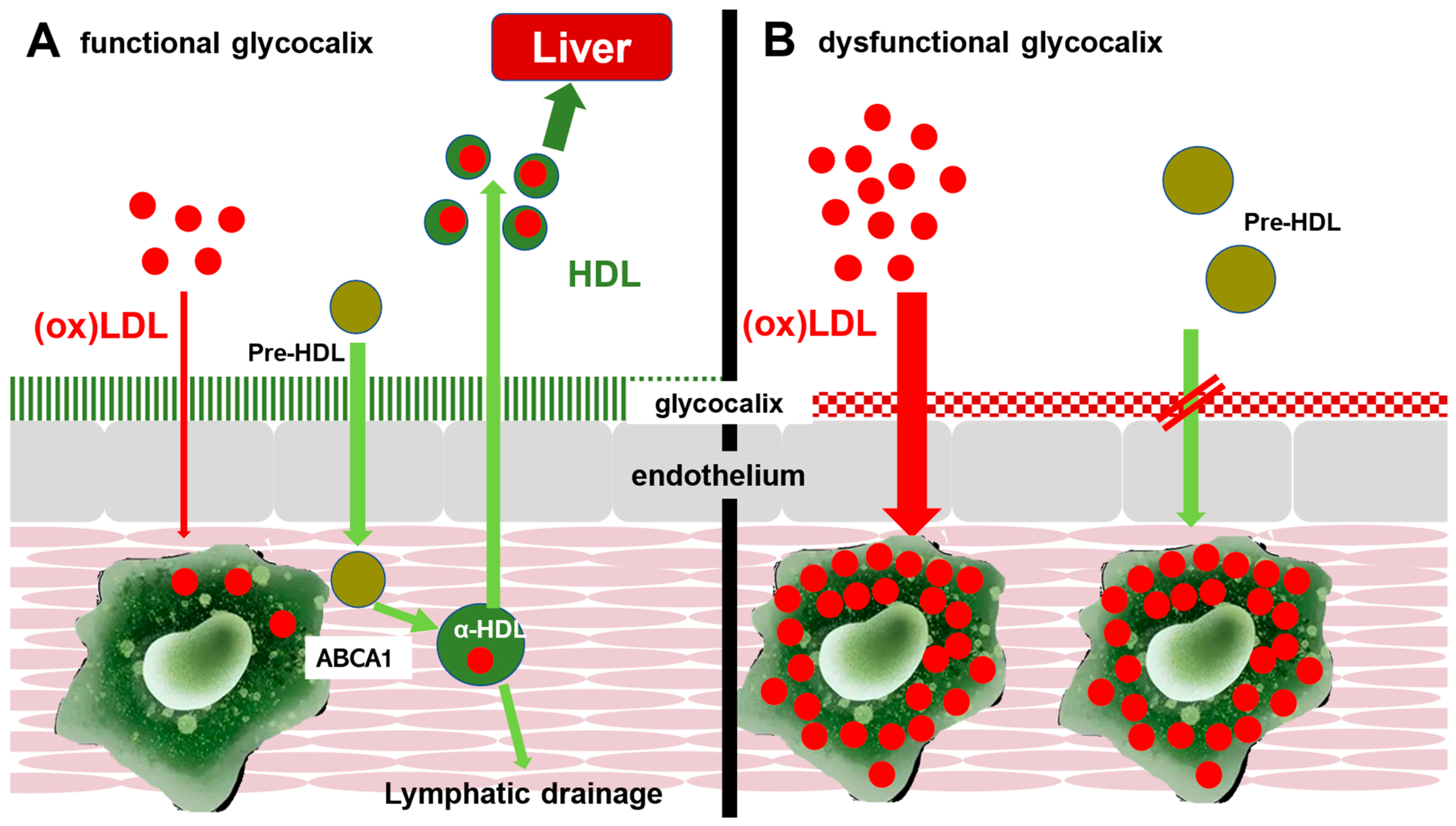
Atherosclerosis remains the leading cause of death worldwide and imposes a major healthcare burden. Physiologically, elimination of cholesterol from the arterial wall depends on reverse cholesterol transport (RCT). RCT requires access to HDL and apolipoprotein A-I (ApoA-I) to lesional macrophages/foam cells. The endothelial glycocalyx is a dynamic and injury-sensitive layer of proteoglycans and glycosaminoglycans (including hyaluronan). It contributes to vascular barrier properties, leukocyte adhesion, mechanotransduction, and macromolecular transport. In atherosclerosis, glycocalyx structure and function are altered; this may facilitate entry/retention of atherogenic lipoproteins and may also alter transport conditions relevant to cholesterol efflux pathways. This article presents a mechanistic hypothesis: short, transient, systemic hyaluronidase exposure could temporarily remodel glycocalyx/extracellular matrix components and thereby facilitate conditions permissive for regulated transport processes relevant to RCT. However, the proposed link between glycocalyx remodeling and improved lesional cholesterol efflux remains theoretical. Direct in vivo evidence that the endothelial glycocalyx is a dominant barrier limiting HDL- or ApoA-I-mediated cholesterol efflux from plaque macrophages is currently limited. Moreover, glycocalyx degradation is widely associated with endothelial dysfunction, increased permeability, inflammation, and thrombosis, all of which could aggravate rather than ameliorate atherosclerosis. Human pharmacokinetic data indicate a very short plasma half-life of circulating hyaluronidase activity, suggesting that any systemic enzymatic effect is brief. Nevertheless, the biological consequences of repeated degradation–regeneration cycles, especially in high-risk states such as diabetes, inflammation, oxidative stress, or chronic kidney disease, remain incompletely understood. Evidence supporting clinical benefit in atherosclerosis is currently limited to heterogeneous animal experiments, historical uncontrolled reports, and a small number of anecdotal case observations, whereas randomized trials have only been performed in other settings such as acute myocardial infarction and do not establish efficacy for plaque regression. We therefore provide a balanced evaluation of knowns, uncertainties, alternative interpretations, potential risks, dosing unknowns, and a translational research agenda including mechanistic preclinical studies, biomarker development, imaging, and carefully designed early-phase clinical investigation.
Keywords: atherosclerosis; hyaluronidase; glycocalix remodeling; reverse cholesterol transport; vascular barrier; endothelial dysfunction atherosclerosis; hyaluronidase; glycocalix remodeling; reverse cholesterol transport; vascular barrier; endothelial dysfunction