This is an early access version, the complete PDF, HTML, and XML versions will be available soon.
Integrating Physiatry and Palliative Care in Outpatient Oncology: A Clinical Framework for Bidirectional Referral and Co-Management
by
 ,
,
Emmanuel G. Villalpando
1, 
Jamie Fertal
2,
Finly Zachariah
3,
Jeannine M. Brant
4 and
Jessica T. Cheng
5,*
1
OPTI-West Physical Medicine and Rehabilitation Program, Casa Colina Hospital and Centers for Healthcare, Pomona, CA 91767, USA
2
Division of Supportive Medicine, Department of Supportive Care Medicine, City of Hope Orange County, Irvine, CA 92618, USA
3
Division of Supportive Medicine, Department of Supportive Care Medicine, City of Hope Comprehensive Cancer Center, Duarte, CA 91010, USA
4
Clinical Nursing Science & Innovation, City of Hope Comprehensive Cancer Center, Duarte, CA 91010, USA
5
Department of Supportive Care Medicine, City of Hope Orange County, Irvine, CA 92618, USA
*
Author to whom correspondence should be addressed.
Curr. Oncol. 2026, 33(7), 387; https://doi.org/10.3390/curroncol33070387 (registering DOI)
Submission received: 3 May 2026
/
Revised: 15 June 2026
/
Accepted: 23 June 2026
/
Published: 25 June 2026
(This article belongs to the Special Issue Cancer Rehabilitation: Innovations in Practice & Enhancing Survivorship Care)
Simple Summary
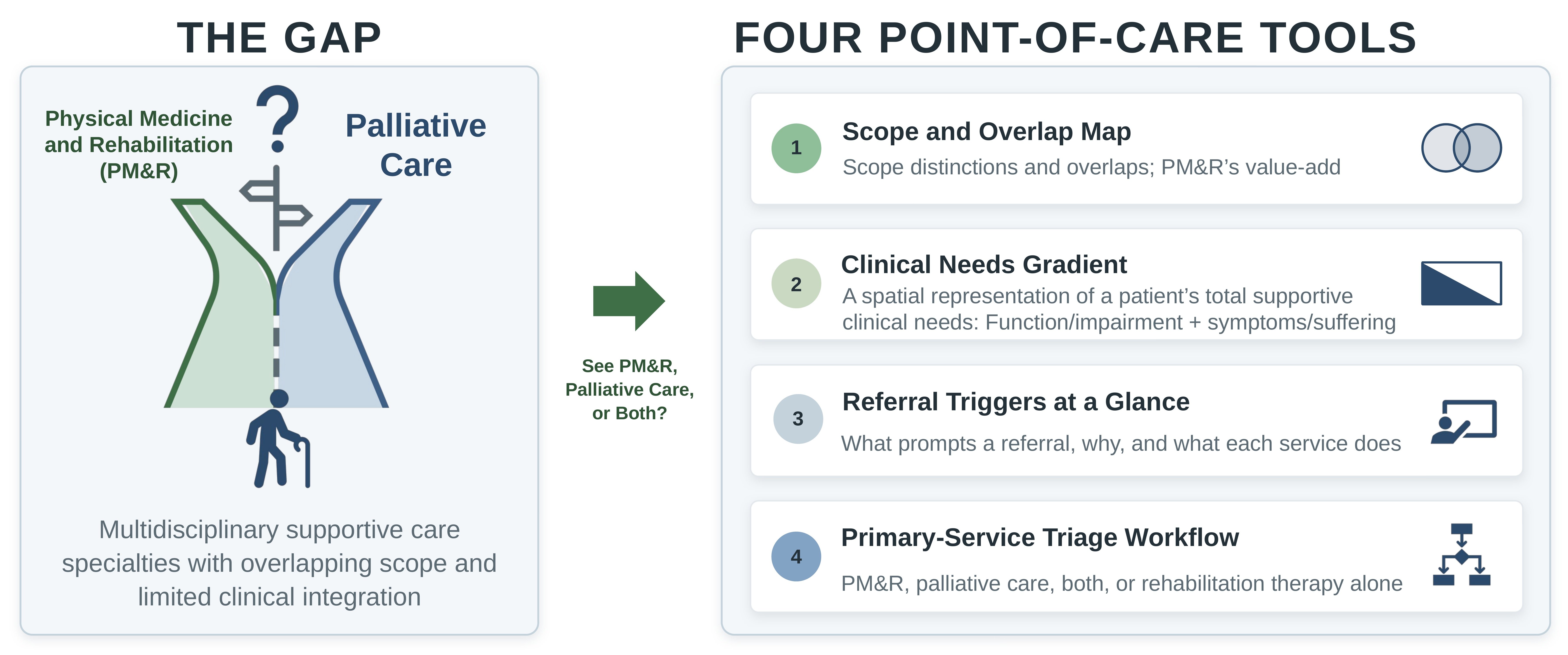
Patients with cancer often experience both complex symptoms and functional decline, but it is not always clear when physiatry, palliative care (PC), or rehabilitation therapy should be involved alone or in collaboration. This paper presents a practical clinical framework to guide those decisions. It defines the distinct and overlapping roles of physiatry and PC through four clinical tools—a scope and overlap map, a clinical-needs gradient, a referral trigger table linking rationale and management expectations, and a proposed triage workflow for determining which service should be the primary supportive service according to the patient’s current needs. The goal is to support earlier, needs-based referral and consistent care collaboration in oncology practice.
Abstract
Patients with cancer often experience intertwined symptom burden and functional decline that contribute to falls, unsafe transfers, uncontrolled symptoms, caregiver strain, and crisis-driven care. Physical medicine and rehabilitation (PM&R), also known as physiatry, and specialty PC both address suffering and quality of life through complementary clinical approaches; however, collaborative care with and between these two specialties is inconsistent in routine oncology practice. This paper presents a clinical implementation framework informed by targeted literature synthesis for bidirectional referral and co-management between PM&R and PC in oncology. The framework was informed by the PC referral criteria literature, cancer rehabilitation triage literature, trigger-based serious illness identification models, and implementation science. Four clinic-usable tools are proposed, including a scope and overlap map, a clinical-needs gradient, a referral trigger table linking common clinical signals to the reason for referral and expected clinical actions, and a primary-service triage workflow. This framework is intended to clarify which service is best positioned to be the primary supportive service according to the patient’s current needs, when rehabilitation therapy alone may be sufficient, and when co-management should be the default. This concept-to-practice model is designed to facilitate early, needs-based referrals and coordinated supportive care in oncology settings.