Omission of Axillary Lymph Node Dissection in Breast Cancer Patients with 1–2 Positive Sentinel Lymph Nodes: A Multicenter Real-World Cohort Study in a Chinese Population
by
 , and
, and
Chengye Hong
1,† ,
,
Jianhui Chen
2,†,
Yongwu Chen
3,
Liangqiang Li
1,
Xianqiang Du
1,
Debo Chen
1,* and
Weibin Lian
1,* 1
Department of Breast Surgery, Quanzhou First Hospital Affiliated to Fujian Medical University, Quanzhou 362000, China
2
Department of Breast Surgery, Zhangzhou Affiliated Hospital of Fujian Medical University, Zhangzhou 363000, China
3
Department of Breast Surgery, Longyan Second Hospital, Longyan 364000, China
*
Authors to whom correspondence should be addressed.
†
These authors contributed equally to this work.
Curr. Oncol. 2026, 33(5), 247; https://doi.org/10.3390/curroncol33050247
Submission received: 11 March 2026
/
Revised: 17 April 2026
/
Accepted: 24 April 2026
/
Published: 27 April 2026
(This article belongs to the Section Breast Cancer)
Simple Summary
In early-stage breast cancer, removing lymph nodes from the armpit has long been a standard procedure but may cause complications such as arm swelling and reduced mobility. Recent studies suggest that some patients with limited lymph node involvement may safely avoid this more extensive surgery. In this multicenter study of Chinese patients, we compared outcomes between those who underwent sentinel lymph node biopsy alone and those who received additional lymph node removal. We found no difference in disease-free survival between the two groups, suggesting that less invasive surgery may be a safe option for selected patients. These findings support a shift toward reducing surgical burden and may help guide future clinical practice and decision-making.
Abstract
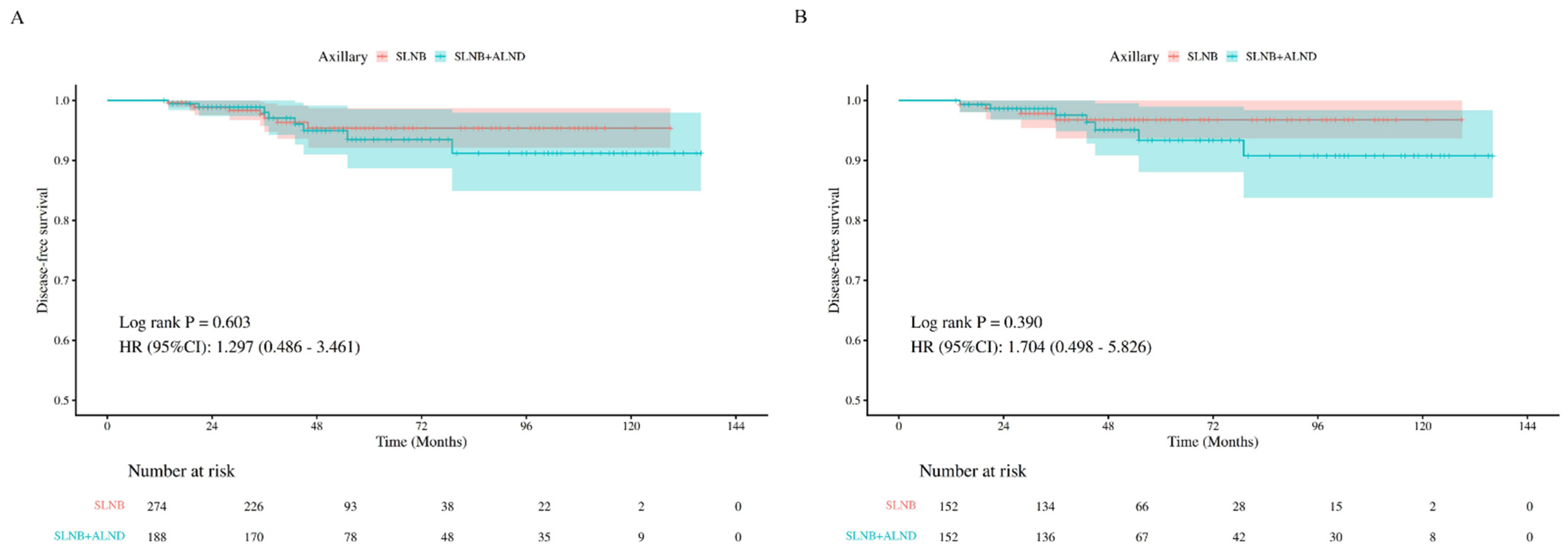
The optimal management of patients with limited sentinel lymph node metastasis in breast cancer, particularly regarding whether to perform additional axillary surgery, continues to be an area of clinical uncertainty in routine practice. This multicenter retrospective cohort study aimed to evaluate adherence to ACOSOG Z0011 criteria and the oncological safety of omitting ALND in a Chinese population. We included 462 women with clinical stage T1–2N0 breast cancer who underwent breast-conserving surgery and were found to have 1–2 positive SLNs between January 2013 and December 2021. All patients received adjuvant radiotherapy and systemic therapy. Patients underwent either sentinel lymph node biopsy alone (SLNB; n = 274, 59.3%) or SLNB followed by ALND (n = 188, 40.7%). Propensity score matching (1:1) was applied to balance baseline characteristics, yielding 152 matched pairs. Disease-free survival (DFS) was the primary endpoint. No significant difference in DFS was observed between the SLNB alone and SLNB + ALND groups in either the overall cohort or the matched cohort. Multivariable Cox regression analysis confirmed that the type of axillary surgery was not independently associated with DFS in patients with 1–2 positive SLNs treated with breast-conserving surgery. Logistic regression analysis indicated that surgeons were more likely to perform ALND in patients with a higher SLN tumor burden; compared with micrometastasis, macrometastasis in 1–2 SLNs and a sentinel lymph node metastasis ratio greater than one-third were significantly associated with the selection of ALND. These findings suggest that omission of ALND was not associated with a statistically significant difference in DFS and provide real-world evidence supporting the applicability of Z0011-based axillary management in the Chinese population; however, given the observational design and potential for residual confounding, these results should be interpreted with caution.