Deep Learning-Derived Pathomic Features Predict NCIT Efficacy in Resectable Locally Advanced ESCC: Clinical Utility and Mechanistic Insights
Simple Summary
Abstract
1. Introduction
2. Materials and Methods
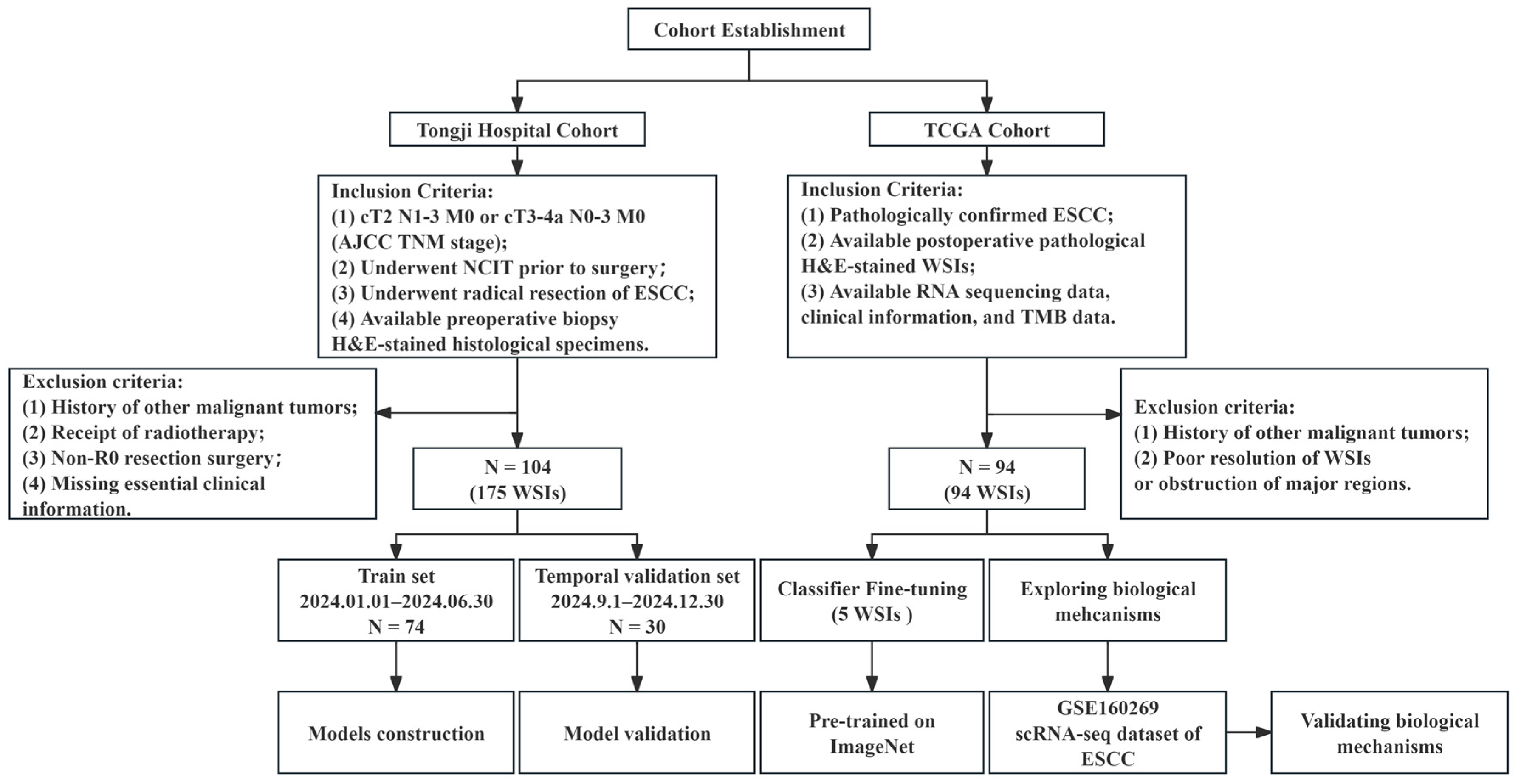
2.1. Patients and Dataset
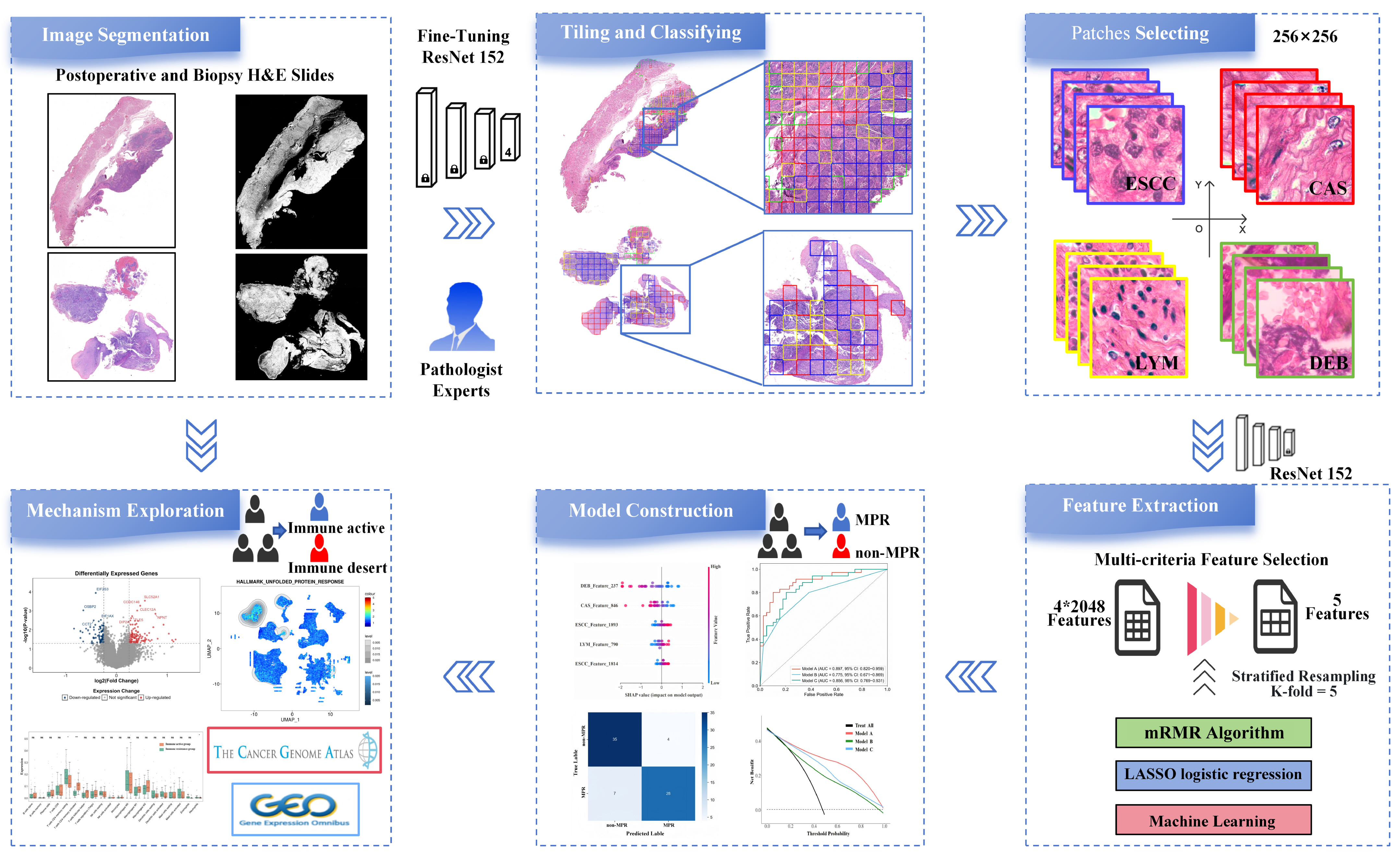
2.2. WSIs Preprocessing
2.3. Pathomic Feature Selection and Model Construction in Tongji Hospital Cohort
2.3.1. Case-Level Patches Feature Extraction and Fusion
2.3.2. Explore the Pathomic Signatures of Different NCIT Responses
2.4. Mechanism Explanation in the TCGA and GEO Dataset
2.5. Statistical Analysis

3. Results
3.1. Clinical Characteristics of the Cohort
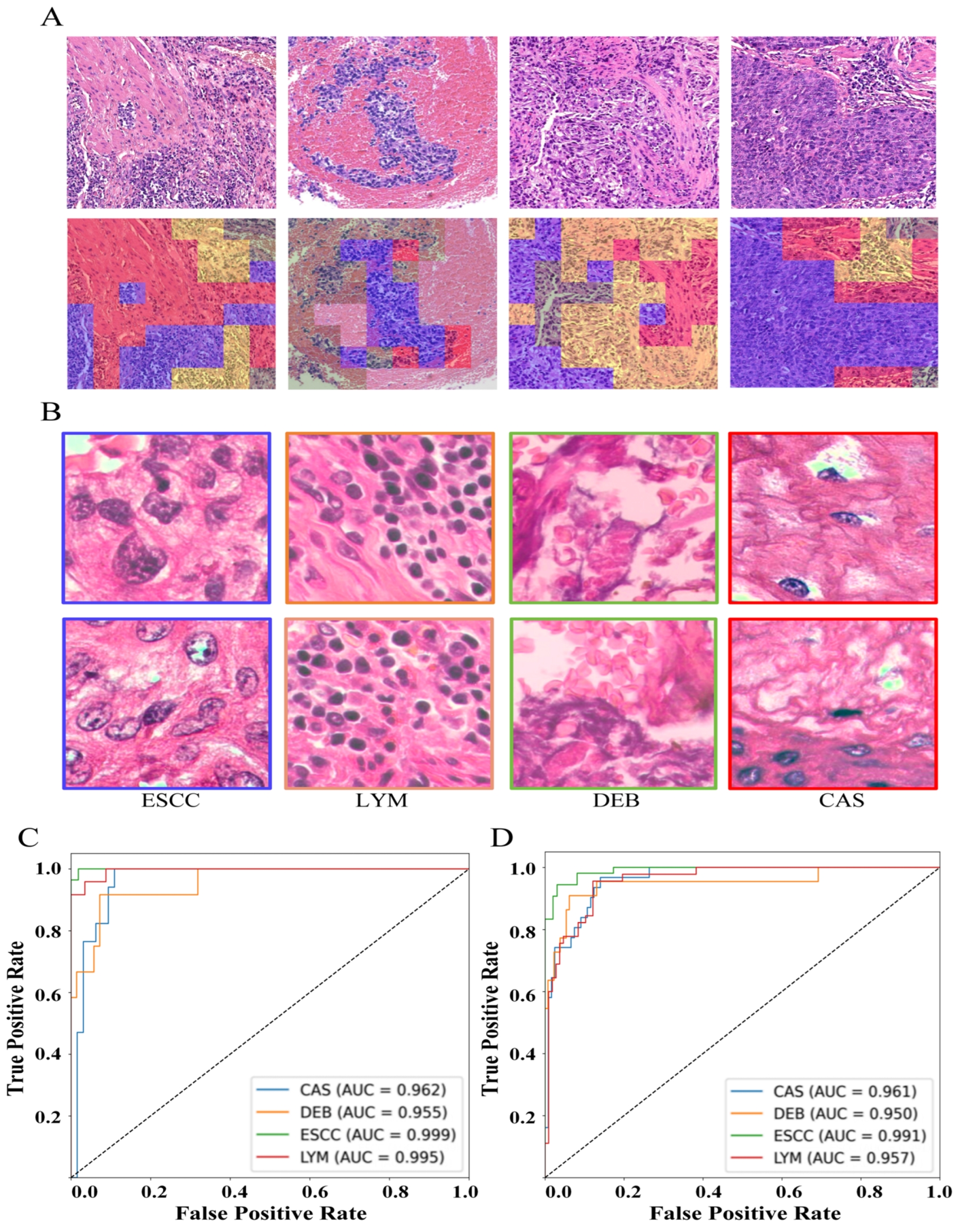
3.2. Construction of Pathomics Signatures Based on Different NCIT Responses
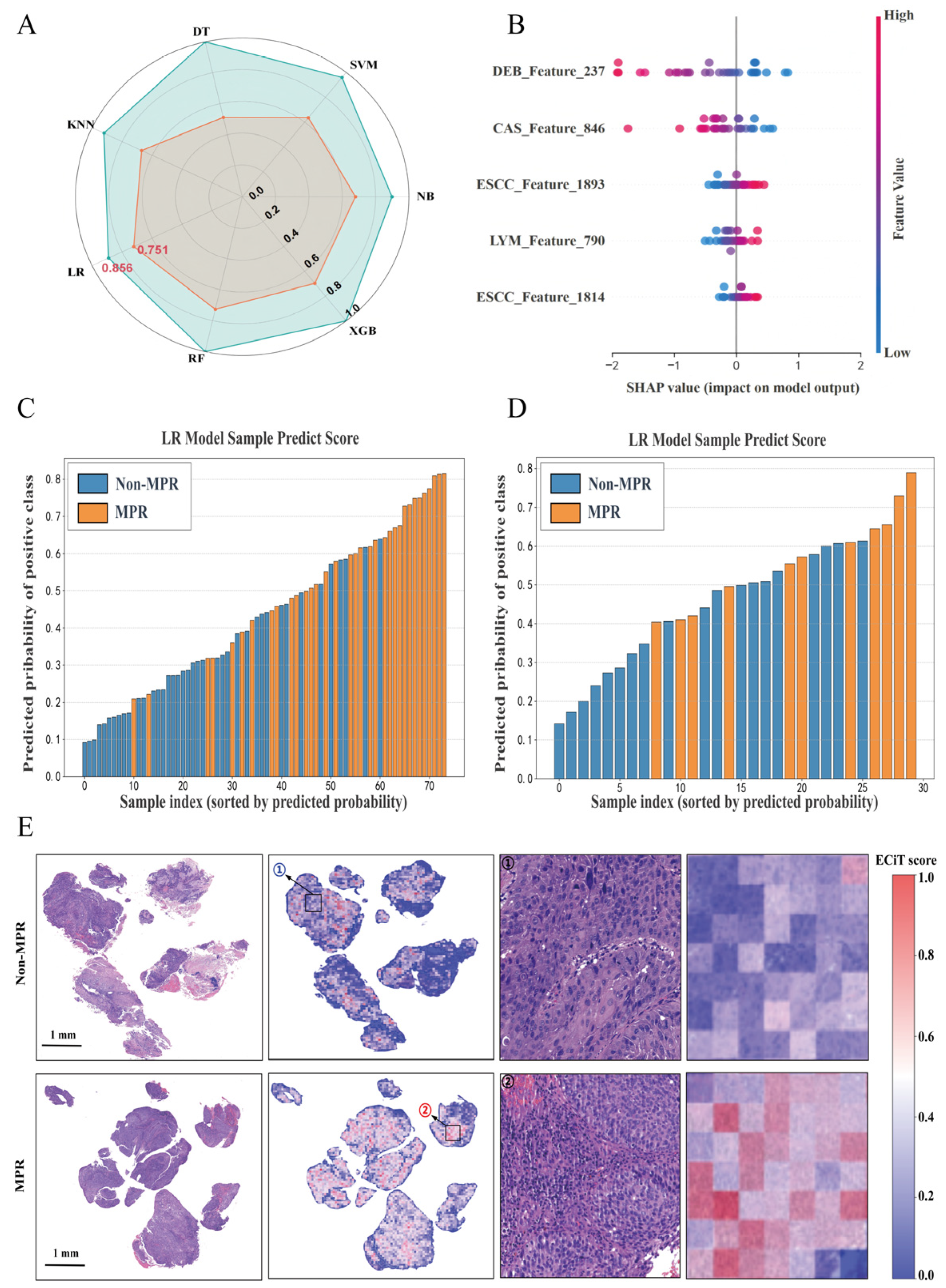
3.3. Performance of the Integrated Models in Predicting NCIT Response
3.4. Mechanistic Exploration of Pathomic Signatures in the TCGA Dataset
4. Discussion
4.1. Clinical Significance of the Predictive Model
4.2. Biological Insights into Pathomic Signatures
4.3. Innovation and Limitations
4.4. Future Research Directions
5. Conclusions
Supplementary Materials
Author Contributions
Funding
Institutional Review Board Statement
Informed Consent Statement
Data Availability Statement
Conflicts of Interest
Abbreviations
| AI | Artificial Intelligence |
| AUC | Area Under the Receiver Operating Characteristic Curve |
| CAS | Cancer-Associated Stroma |
| CNN | Convolutional Neural Network |
| DCA | Decision Curve Analysis |
| DEB | Necrotic Regions |
| DFS | Disease-Free Survival |
| DL | Deep Learning |
| EC | Esophageal Cancer |
| ESCC | Esophageal Squamous Cell Carcinoma |
| ESCCs | ESCC Cell Regions |
| ER | Endoplasmic Reticulum |
| GO | Gene Ontology |
| ICIs | Immune Checkpoint Inhibitors |
| KEGG | Kyoto Encyclopedia of Genes and Genomes |
| LYM | Tumor-Infiltrating Lymphocytes |
| LD | Lipid Droplets |
| MPR | Major Pathological Response |
| NCIT | Neoadjuvant Chemoimmunotherapy |
| NCRT | Neoadjuvant Chemoradiotherapy |
| NSCLC | Non-Small Cell Lung Cancer |
| OS | Overall Survival |
| pCR | Pathological Complete Response |
| ROC | Receiver Operating Characteristic Curve |
| SGD | Stochastic Gradient Descent |
| SNP | Single Nucleotide Polymorphism |
| TCGA | The Cancer Genome Atlas |
| TMB | Tumor Mutational Burden |
| TME | Tumor Microenvironment |
| TILs | Tumor-Infiltrating Lymphocytes |
| TLS | Tertiary Lymphoid Structures |
| TAMs | Tumor Associated Macrophages |
| WSIs | Whole-Slide Images |
| UPR | Unfolded Protein Response |
| GSEA | Gene Set Enrichment Analysis |
| GEO | Gene Expression Omnibus |
| ES | Enrichment Score |
References
- Bray, F.; Laversanne, M.; Sung, H.; Ferlay, J.; Siegel, R.L.; Soerjomataram, I.; Jemal, A. Global cancer statistics 2022: GLOBOCAN estimates of incidence and mortality worldwide for 36 cancers in 185 countries. CA Cancer J. Clin. 2024, 74, 229–263. [Google Scholar] [CrossRef]
- Abnet, C.C.; Arnold, M.; Wei, W.Q. Epidemiology of Esophageal Squamous Cell Carcinoma. Gastroenterology 2018, 154, 360–373. [Google Scholar] [CrossRef]
- Eyck, B.M.; van Lanschot, J.J.B.; Hulshof, M.C.C.M.; van der Wilk, B.J.; Shapiro, J.; van Hagen, P.; van Berge Henegouwen, M.I.; Wijnhoven, B.P.L.; van Laarhoven, H.W.M.; Nieuwenhuijzen, G.A.P.; et al. Ten-Year Outcome of Neoadjuvant Chemoradiotherapy Plus Surgery for Esophageal Cancer: The Randomized Controlled CROSS Trial. J. Clin. Oncol. 2021, 39, 1995–2004. [Google Scholar] [CrossRef]
- Yang, H.; Liu, H.; Chen, Y.; Zhu, C.; Fang, W.; Yu, Z.; Mao, W.; Xiang, J.; Han, Y.; Chen, Z.; et al. Long-term Efficacy of Neoadjuvant Chemoradiotherapy Plus Surgery for the Treatment of Locally Advanced Esophageal Squamous Cell Carcinoma: The NEOCRTEC5010 Randomized Clinical Trial. JAMA Surg. 2021, 156, 721–729. [Google Scholar] [CrossRef] [PubMed]
- Kato, K.; Machida, R.; Ito, Y.; Daiko, H.; Ozawa, S.; Ogata, T.; Hara, H.; Kojima, T.; Abe, T.; Bamba, T.; et al. Doublet chemotherapy, triplet chemotherapy, or doublet chemotherapy combined with radiotherapy as neoadjuvant treatment for locally advanced oesophageal cancer (JCOG1109 NExT): A randomised, controlled, open-label, phase 3 trial. Lancet 2024, 404, 55–66. [Google Scholar] [CrossRef] [PubMed]
- Doki, Y.; Ajani, J.A.; Kato, K.; Xu, J.; Wyrwicz, L.; Motoyama, S.; Ogata, T.; Kawakami, H.; Hsu, C.H.; Adenis, A.; et al. Nivolumab Combination Therapy in Advanced Esophageal Squamous-Cell Carcinoma. N. Engl. J. Med. 2022, 386, 449–462. [Google Scholar] [CrossRef]
- Luo, H.; Lu, J.; Bai, Y.; Mao, T.; Wang, J.; Fan, Q.; Zhang, Y.; Zhao, K.; Chen, Z.; Gao, S.; et al. Effect of Camrelizumab vs Placebo Added to Chemotherapy on Survival and Progression-Free Survival in Patients with Advanced or Metastatic Esophageal Squamous Cell Carcinoma: The ESCORT-1st Randomized Clinical Trial. JAMA 2021, 326, 916–925. [Google Scholar] [CrossRef] [PubMed]
- Wang, Z.X.; Cui, C.; Yao, J.; Zhang, Y.; Li, M.; Feng, J.; Yang, S.; Fan, Y.; Shi, J.; Zhang, X.; et al. Toripalimab plus chemotherapy in treatment-naïve, advanced esophageal squamous cell carcinoma (JUPITER-06): A multi-center phase 3 trial. Cancer Cell 2022, 40, 277–288.e3. [Google Scholar] [CrossRef]
- Lu, Z.; Wang, J.; Shu, Y.; Liu, L.; Kong, L.; Yang, L.; Wang, B.; Sun, G.; Ji, Y.; Cao, G.; et al. Sintilimab versus placebo in combination with chemotherapy as first line treatment for locally advanced or metastatic oesophageal squamous cell carcinoma (ORIENT-15): Multicentre, randomised, double blind, phase 3 trial. BMJ 2022, 377, e068714. [Google Scholar] [CrossRef]
- Qin, J.; Xue, L.; Hao, A.; Guo, X.; Jiang, T.; Ni, Y.; Liu, S.; Chen, Y.; Jiang, H.; Zhang, C.; et al. Neoadjuvant chemotherapy with or without camrelizumab in resectable esophageal squamous cell carcinoma: The randomized phase 3 ESCORT-NEO/NCCES01 trial. Nat. Med. 2024, 30, 2549–2557. [Google Scholar] [CrossRef]
- Takeuchi, H.; Ito, Y.; Machida, R.; Kato, K.; Onozawa, M.; Minashi, K.; Yano, T.; Nakamura, K.; Tsushima, T.; Hara, H.; et al. A Single-Arm Confirmatory Study of Definitive Chemoradiation Therapy Including Salvage Treatment for Clinical Stage II/III Esophageal Squamous Cell Carcinoma (JCOG0909 Study). Int. J. Radiat. Oncol. Biol. Phys. 2022, 114, 454–462. [Google Scholar] [CrossRef] [PubMed]
- Guo, X.; Chen, C.; Zhao, J.; Wang, C.; Mei, X.; Shen, J.; Lv, H.; Han, Y.; Wang, Q.; Lv, J.; et al. Neoadjuvant Chemoradiotherapy vs Chemoimmunotherapy for Esophageal Squamous Cell Carcinoma. JAMA Surg. 2025, 160, 565–574. [Google Scholar] [CrossRef]
- Baek, S.; Cha, J.; Hong, M.H.; Kim, G.; Koh, Y.W.; Kim, D.; Son, W.; Ock, C.Y.; Lee, S.; Hemberg, M.; et al. Comparative single-cell analysis of esophageal cancer subtypes reveals tumor microenvironment distinctions explaining varied immunotherapy responses. Cancer Commun. 2025, 45, 1194–1199. [Google Scholar] [CrossRef]
- Yang, H.; Wang, F.; Hallemeier, C.L.; Lerut, T.; Fu, J. Oesophageal cancer. Lancet 2024, 404, 1991–2005. [Google Scholar] [CrossRef]
- Chang, L.; Liu, J.; Zhu, J.; Guo, S.; Wang, Y.; Zhou, Z.; Wei, X. Advancing precision medicine: The transformative role of artificial intelligence in immunogenomics, radiomics, and pathomics for biomarker discovery and immunotherapy optimization. Cancer Biol. Med. 2025, 22, 33–47. [Google Scholar] [CrossRef] [PubMed]
- Shmatko, A.; Ghaffari Laleh, N.; Gerstung, M.; Kather, J.N. Artificial intelligence in histopathology: Enhancing cancer research and clinical oncology. Nat. Cancer 2022, 3, 1026–1038. [Google Scholar] [CrossRef] [PubMed]
- Bera, K.; Schalper, K.A.; Rimm, D.L.; Velcheti, V.; Madabhushi, A. Artificial intelligence in digital pathology—New tools for diagnosis and precision oncology. Nat. Rev. Clin. Oncol. 2019, 16, 703–715. [Google Scholar] [CrossRef] [PubMed]
- Zhang, W.Y.; Chang, Y.J.; Shi, R.H. Artificial intelligence enhances the management of esophageal squamous cell carcinoma in the precision oncology era. World J. Gastroenterol. 2024, 30, 4267–4280. [Google Scholar] [CrossRef]
- Terada, K.; Yoshizawa, A.; Liu, X.; Ito, H.; Hamaji, M.; Menju, T.; Date, H.; Bise, R.; Haga, H. Deep Learning for Predicting Effect of Neoadjuvant Therapies in Non-Small Cell Lung Carcinomas With Histologic Images. Mod. Pathol. 2023, 36, 100302. [Google Scholar] [CrossRef]
- Campanella, G.; Kumar, N.; Nanda, S.; Singi, S.; Fluder, E.; Kwan, R.; Muehlstedt, S.; Pfarr, N.; Schüffler, P.J.; Häggström, I.; et al. Real-world deployment of a fine-tuned pathology foundation model for lung cancer biomarker detection. Nat. Med. 2025, 31, 3002–3010. [Google Scholar] [CrossRef]
- Wang, Y.; Pan, X.; Lin, H.; Han, C.; An, Y.; Qiu, B.; Feng, Z.; Huang, X.; Xu, Z.; Shi, Z.; et al. Multi-scale pathology image texture signature is a prognostic factor for resectable lung adenocarcinoma: A multi-center, retrospective study. J. Transl. Med. 2022, 20, 595. [Google Scholar] [CrossRef]
- Wang, D.; Mu, S.; Zhang, M.; Tao, G.; Wang, S.; Shen, Y.; Xiao, G.; Zhang, X.; Han, B.; Cheng, L.; et al. A pathomics model for predicting response to chemo-immunotherapy in lung squamous cell carcinoma: A multicenter study. Lung Cancer 2026, 211, 108881. [Google Scholar] [CrossRef]
- Han, Z.; Zhang, Z.; Yang, X.; Li, Z.; Sang, S.; Islam, M.T.; Guo, A.A.; Li, Z.; Wang, X.; Wang, J.; et al. Development and interpretation of a pathomics-driven ensemble model for predicting the response to immunotherapy in gastric cancer. J. Immunother. Cancer 2024, 12, e008927. [Google Scholar] [CrossRef]
- Xiao, C.; Zhang, W.; Qiu, M.; He, D.; Jiang, D.; Wang, Z.; Shen, Y.; Chen, H.N. A transformer-based pathomics model using endoscopic biopsy WSIs for predicting pathological complete response to preoperative immunotherapy in colorectal cancer. Eur. J. Surg. Oncol. 2026, 52, 111182. [Google Scholar] [CrossRef]
- Luo, Y.; Tian, Q.; Xu, L.; Zeng, D.; Zhang, H.; Zeng, T.; Tang, H.; Wang, C.; Chen, Y. Development and interpretation of a pathomics-based model for the prediction of immune therapy response in colorectal cancer. Methods 2025, 241, 128–139. [Google Scholar] [CrossRef]
- Comes, M.C.; Lupo, A.; Bozzi, A.; Fanizzi, A.; Cirillo, A.; Nunzio, G.; Pastena, M.I.; Rizzo, A.; Guven, D.C.; Vitale, E.; et al. Enhancing early prediction of pathological complete response in breast cancer using attention-based convolutional neural networks in digital pathology. Digit. Health 2026, 12, 20552076261419242. [Google Scholar] [CrossRef] [PubMed]
- Yang, H.; Li, X.; Zhang, S.; Li, Y.; Zhu, Z.; Shen, J.; Dai, N.; Zhou, F. A one-dimensional convolutional neural network based deep learning for high accuracy classification of transformation stages in esophageal squamous cell carcinoma tissue using micro-FTIR. Spectrochim. Acta A Mol. Biomol. Spectrosc. 2023, 289, 122210. [Google Scholar] [CrossRef]
- Chen, Y.; Gao, R.; Jing, D.; Shi, L.; Kuang, F.; Jing, R. Classification and prediction of chemoradiotherapy response and survival from esophageal carcinoma histopathology images. Spectrochim. Acta A Mol. Biomol. Spectrosc. 2024, 312, 124030. [Google Scholar] [CrossRef] [PubMed]
- Li, B.; Qin, W.; Yang, L.; Li, H.; Jiang, C.; Yao, Y.; Cheng, S.; Zou, B.; Fan, B.; Dong, T.; et al. From pixels to patient care: Deep learning-enabled pathomics signature offers precise outcome predictions for immunotherapy in esophageal squamous cell cancer. J. Transl. Med. 2024, 22, 195. [Google Scholar] [CrossRef]
- Wang, X.; Zhao, J.; Marostica, E.; Yuan, W.; Jin, J.; Zhang, J.; Li, R.; Tang, H.; Wang, K.; Li, Y.; et al. A pathology foundation model for cancer diagnosis and prognosis prediction. Nature 2024, 634, 970–978. [Google Scholar] [CrossRef] [PubMed]
- Abas Mohamed, Y.; Ee Khoo, B.; Shahrimie Mohd Asaari, M.; Ezane Aziz, M.; Rahiman Ghazali, F. Decoding the black box: Explainable AI (XAI) for cancer diagnosis, prognosis, and treatment planning-A state-of-the art systematic review. Int. J. Med. Inform. 2025, 193, 105689. [Google Scholar] [CrossRef]
- Vahadane, A.; Peng, T.; Sethi, A.; Albarqouni, S.; Wang, L.; Baust, M.; Steiger, K.; Schlitter, A.M.; Esposito, I.; Navab, N. Structure-Preserving Color Normalization and Sparse Stain Separation for Histological Images. IEEE Trans. Med. Imaging 2016, 35, 1962–1971. [Google Scholar] [CrossRef] [PubMed]
- Huang, W.; Wang, X.; Zhong, R.; Li, Z.; Zhou, K.; Lyu, Q.; Han, J.E.; Chen, T.; Islam, M.T.; Yuan, Q.; et al. Multimodal radiopathomics signature for prediction of response to immunotherapy-based combination therapy in gastric cancer using interpretable machine learning. Cancer Lett. 2025, 631, 217930. [Google Scholar] [CrossRef] [PubMed]
- Stuart, T.; Butler, A.; Hoffman, P.; Hafemeister, C.; Papalexi, E.; Mauck, W.M., 3rd; Hao, Y.; Stoeckius, M.; Smibert, P.; Satija, R. Comprehensive Integration of Single-Cell Data. Cell 2019, 177, 1888–1902.e21. [Google Scholar] [CrossRef]
- Shi, L.; Li, C.; Bai, Y.; Cao, Y.; Zhao, S.; Chen, X.; Cheng, Z.; Zhang, Y.; Li, H. CT radiomics to predict pathologic complete response after neoadjuvant immunotherapy plus chemoradiotherapy in locally advanced esophageal squamous cell carcinoma. Eur. Radiol. 2025, 35, 1594–1604. [Google Scholar] [CrossRef] [PubMed]
- Gao, X.; Yang, L.; She, T.; Wang, F.; Ding, H.; Lu, Y.; Xu, Y.; Wang, Y.; Li, P.; Duan, X.; et al. Habitat-aware radiomics and adaptive 2.5D deep learning predict treatment response and long-term survival in ESCC patients undergoing neoadjuvant chemoimmunotherapy. Eur. J. Nucl. Med. Mol. Imaging. 2026, 53, 1651–1670. [Google Scholar] [CrossRef]
- Guo, G.; Cui, Y. New perspective on targeting the tumor suppressor p53 pathway in the tumor microenvironment to enhance the efficacy of immunotherapy. J. Immunother. Cancer 2015, 3, 9. [Google Scholar] [CrossRef]
- Captier, N.; Lerousseau, M.; Orlhac, F.; Hovhannisyan-Baghdasarian, N.; Luporsi, M.; Woff, E.; Lagha, S.; Salamoun Feghali, P.; Lonjou, C.; Beaulaton, C.; et al. Integration of clinical, pathological, radiological, and transcriptomic data improves prediction for first-line immunotherapy outcome in metastatic non-small cell lung cancer. Nat. Commun. 2025, 16, 614. [Google Scholar] [CrossRef] [PubMed]
- Ahrends, T.; Spanjaard, A.; Pilzecker, B.; Bąbała, N.; Bovens, A.; Xiao, Y.; Jacobs, H.; Borst, J. CD4(+) T cell help confers a cytotoxic T cell effector program including coinhibitory receptor downregulation and increased tissue invasiveness. Immunity 2017, 47, 848–861.e5. [Google Scholar] [CrossRef]
- Miggelbrink, A.M.; Jackson, J.D.; Lorrey, S.J.; Srinivasan, E.S.; Waibl-Polania, J.; Wilkinson, D.S.; Fecci, P.E. CD4 T-Cell exhaustion: Does it exist and what are its roles in cancer? Clin. Cancer Res. 2021, 27, 5742–5752. [Google Scholar] [CrossRef]
- Chen, X.; Cubillos-Ruiz, J.R. Endoplasmic reticulum stress signals in the tumour and its microenvironment. Nat. Rev. Cancer 2021, 21, 71–88. [Google Scholar] [CrossRef] [PubMed]
- Cubillos-Ruiz, J.R.; Bettigole, S.E.; Glimcher, L.H. Tumorigenic and Immunosuppressive Effects of Endoplasmic Reticulum Stress in Cancer. Cell 2017, 168, 692–706. [Google Scholar] [CrossRef]
- Hwang, S.M.; Chang, S.; Rodriguez, P.C.; Cubillos-Ruiz, J.R. Endoplasmic reticulum stress responses in anticancer immunity. Nat. Rev. Cancer 2025, 25, 684–702. [Google Scholar] [CrossRef]
- Bezawork-Geleta, A.; Devereux, C.J.; Keenan, S.N.; Lou, J.; Cho, E.; Nie, S.; De Souza, D.P.; Narayana, V.K.; Siddall, N.A.; Rodrigues, C.H.M.; et al. Proximity proteomics reveals a mechanism of fatty acid transfer at lipid droplet-mitochondria- endoplasmic reticulum contact sites. Nat. Commun. 2025, 16, 2135. [Google Scholar] [CrossRef] [PubMed]
- Mandula, J.K.; Chang, S.; Mohamed, E.; Jimenez, R.; Sierra-Mondragon, R.A.; Chang, D.C.; Obermayer, A.N.; Moran-Segura, C.M.; Das, S.; Vazquez-Martinez, J.A.; et al. Ablation of the endoplasmic reticulum stress kinase PERK induces paraptosis and type I interferon to promote anti-tumor T cell responses. Cancer Cell 2022, 40, 1145–1160.e9. [Google Scholar] [CrossRef] [PubMed]


| Variables | Total (%) * N = 104 | Train (%) N = 74 | Validation (%) N = 30 | ** p_Value |
|---|---|---|---|---|
| Age | 63.76 ± 6.63 | 63.36 ± 6.58 | 64.17 ± 6.93 | 0.581 |
| Sex | 0.673 | |||
| Female | 20 (29.23) | 15 (20.27) | 5 (16.67) | |
| Male | 84 (80.77) | 59 (79.73) | 25 (83.33) | |
| Smoking history | 0.914 | |||
| Never | 32 (30.77) | 23 (31.08) | 9 (30.00) | |
| Ever | 72 (69.23) | 51 (68.92) | 21 (70.00) | |
| Pretreatment TNM stage | 0.697 | |||
| II | 4 (3.85) | 2 (2.70) | 2 (6.67) | |
| III | 100 (96.15) | 72 (97.30) | 28 (93.33) | |
| Pretreatment T stage | 0.714 | |||
| T2 | 41 (39.42) | 30 (40.54) | 11 (36.67) | |
| T3 | 63 (60.58) | 44 (59.46) | 19 (63.33) | |
| Pretreatment N stage | 0.211 | |||
| N0-1 | 78 (75.00) | 58 (78.38) | 20 (66.67) | |
| N2 | 26 (25.00) | 16 (21.62) | 10 (33.33) | |
| ICI types | 0.668 | |||
| PD-1i | 79 (75.96) | 57 (77.03) | 22 (73.33) | |
| PD-L1i | 6 (5.77) | 5 (6.76) | 1 (3.33) | |
| CTLA4i | 19 (18.27) | 12 (16.22) | 7 (23.33) | |
| NCIT cycles | 0.486 | |||
| 1 | 1 (0.96) | 1 (1.35) | 0 (0.00) | |
| 2 | 94 (90.38) | 65 (87.84) | 29 (96.67) | |
| 3 | 9 (8.65) | 8 (10.81) | 1 (3.33) | |
| P53 status | 0.160 | |||
| Wild type | 41 (39.42) | 26 (35.14) | 15 (50.00) | |
| Mutant | 63 (60.58) | 48 (64.86) | 15 (50.00) | |
| MPR status | 0.323 | |||
| Non-MPR | 58 (55.77) | 39 (52.70) | 19 (63.33) | |
| MPR | 46 (44.23) | 35 (47.30) | 11 (36.67) | |
| 1-year RFS rate | 3 (2.88) | 2 (2.70) | 1 (3.33) | 0.684 |
Disclaimer/Publisher’s Note: The statements, opinions and data contained in all publications are solely those of the individual author(s) and contributor(s) and not of MDPI and/or the editor(s). MDPI and/or the editor(s) disclaim responsibility for any injury to people or property resulting from any ideas, methods, instructions or products referred to in the content. |
© 2026 by the authors. Licensee MDPI, Basel, Switzerland. This article is an open access article distributed under the terms and conditions of the Creative Commons Attribution (CC BY) license.
Share and Cite
Zhu, K.; Tong, J.; Duan, Y.; Li, Y.; Feng, Y.; Han, Y.; Xiao, X.; Han, Z.; Xia, S. Deep Learning-Derived Pathomic Features Predict NCIT Efficacy in Resectable Locally Advanced ESCC: Clinical Utility and Mechanistic Insights. Curr. Oncol. 2026, 33, 136. https://doi.org/10.3390/curroncol33030136
Zhu K, Tong J, Duan Y, Li Y, Feng Y, Han Y, Xiao X, Han Z, Xia S. Deep Learning-Derived Pathomic Features Predict NCIT Efficacy in Resectable Locally Advanced ESCC: Clinical Utility and Mechanistic Insights. Current Oncology. 2026; 33(3):136. https://doi.org/10.3390/curroncol33030136
Chicago/Turabian StyleZhu, Kunrui, Jie Tong, Yaqi Duan, Yiming Li, Yanqi Feng, Yuelin Han, Xiangtian Xiao, Zhuoyan Han, and Shu Xia. 2026. "Deep Learning-Derived Pathomic Features Predict NCIT Efficacy in Resectable Locally Advanced ESCC: Clinical Utility and Mechanistic Insights" Current Oncology 33, no. 3: 136. https://doi.org/10.3390/curroncol33030136
APA StyleZhu, K., Tong, J., Duan, Y., Li, Y., Feng, Y., Han, Y., Xiao, X., Han, Z., & Xia, S. (2026). Deep Learning-Derived Pathomic Features Predict NCIT Efficacy in Resectable Locally Advanced ESCC: Clinical Utility and Mechanistic Insights. Current Oncology, 33(3), 136. https://doi.org/10.3390/curroncol33030136