Not All Cancer Survivors Respond to a 4-Week mHealth Exercise Fatigue Intervention: Who Are the Responders?
Simple Summary
Abstract
1. Introduction
2. Materials and Methods
2.1. Study Population and Design
2.2. Measurements
2.3. Statistical Analysis
3. Results
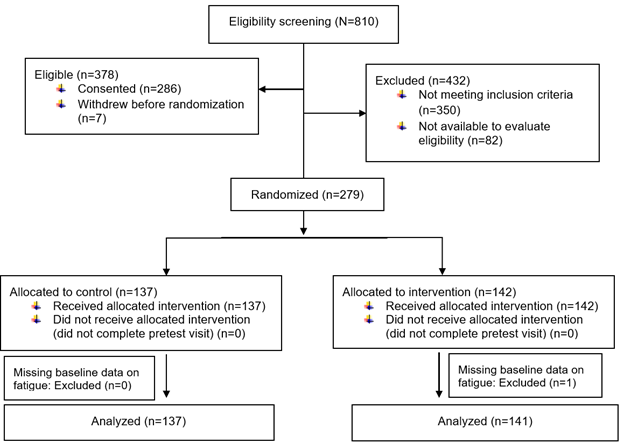
3.1. Sample Characteristics
3.2. Characteristics of Responders and Non-Responders
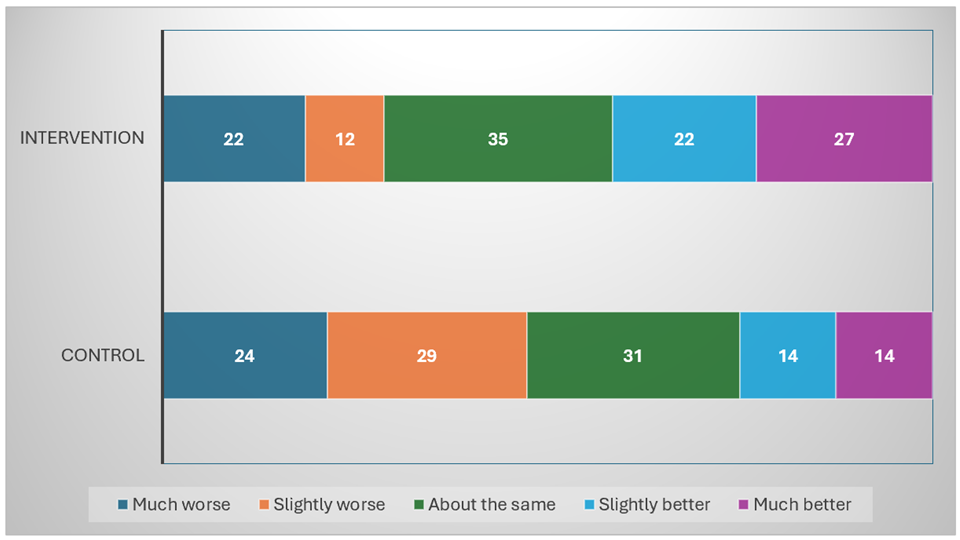
3.3. Pre–Post Intervention Change in Fatigue by Study Group
4. Discussion
5. Conclusions
Author Contributions
Funding
Institutional Review Board Statement
Informed Consent Statement
Data Availability Statement
Conflicts of Interest
References
- Geerts, J.A.; Siemerink, E.J.M.; Sniehotta, F.F.; Loman, L.J.M.; Bode, C.; Pieterse, M.E. A protocol for a feasibility study of Cognitive Bias Modification training (IVY) countering fatigue in people with breast cancer. Pilot Feasibility Stud. 2024, 10, 151. [Google Scholar] [CrossRef]
- Wilkie, D.J.; Schwartz, A.L.; Liao, W.C.; Fullwood, D.; Wu, Y.; Farquharson, T.W.; Yao, Y.; Gralow, J.R. Reduced cancer-related fatigue after tablet-based exercise education for patients. Cancer Control 2022, 29, 10732748221087054. [Google Scholar] [CrossRef]
- Jones, J.M.; Olson, K.; Catton, P.; Catton, C.N.; Fleshner, N.E.; Krzyzanowska, M.K.; McCready, D.R.; Wong, R.K.; Jiang, H.; Howell, D. Cancer-related fatigue and associated disability in post-treatment cancer survivors. J. Cancer Surviv. 2016, 10, 51–61. [Google Scholar] [CrossRef]
- Luctkar-Flude, M.; Groll, D.; Woodend, K.; Tranmer, J. Fatigue and physical activity in older patients with cancer: A six-month follow-up study. Oncol. Nurs. Forum 2009, 36, 194–202. [Google Scholar] [CrossRef]
- Silver, J.K.; Baima, J.; Mayer, R.S. Impairment-driven cancer rehabilitation: An essential component of quality care and survivorship. CA Cancer J. Clin. 2013, 63, 295–317. [Google Scholar] [CrossRef]
- Berger, A.M.; Mooney, K.; Alvarez-Perez, A.; Breitbart, W.S.; Carpenter, K.M.; Cella, D.; Cleeland, C.; Dotan, E.; Eisenberger, M.A.; Escalante, C.P.; et al. Cancer-related fatigue, Version 2.2015. J. Natl. Compr. Canc Netw. 2015, 13, 1012–1039. [Google Scholar] [CrossRef]
- Al Maqbali, M.; Al Sinani, M.; Al Naamani, Z.; Al Badi, K.; Tanash, M.I. Prevalence of Fatigue in Patients with Cancer: A Systematic Review and Meta-Analysis. J. Pain Symptom Manag. 2021, 61, 167–189.e114. [Google Scholar] [CrossRef] [PubMed]
- Hofman, M.; Ryan, J.L.; Figueroa-Moseley, C.D.; Jean-Pierre, P.; Morrow, G.R. Cancer-related fatigue: The scale of the problem. Oncologist 2007, 12, 4–10. [Google Scholar] [CrossRef] [PubMed]
- Mohandas, H.; Jaganathan, S.K.; Mani, M.P.; Ayyar, M.; Rohini Thevi, G.V. Cancer-related fatigue treatment: An overview. J. Cancer Res. Ther. 2017, 13, 916–929. [Google Scholar] [CrossRef] [PubMed]
- Berger, A.M.; Abernethy, A.P.; Atkinson, A.; Barsevick, A.M.; Breitbart, W.S.; Cella, D.; Cimprich, B.; Cleeland, C.; Eisenberger, M.A.; Escalante, C.P.; et al. NCCN Clinical Practice Guidelines Cancer-related fatigue. J. Natl. Compr. Canc Netw. 2010, 8, 904–931. [Google Scholar] [CrossRef]
- Campbell, K.L.; Winters-Stone, K.M.; Wiskemann, J.; May, A.M.; Schwartz, A.L.; Courneya, K.S.; Zucker, D.S.; Matthews, C.E.; Ligibel, J.A.; Gerber, L.H.; et al. Exercise guidelines for cancer survivors: Consensus statement from International Multidisciplinary Roundtable. Med. Sci. Sports Exerc. 2019, 51, 2375–2390. [Google Scholar] [CrossRef]
- Seiler, A.; Klaas, V.; Tröster, G.; Fagundes, C.P. eHealth and mHealth interventions in the treatment of fatigued cancer survivors: A systematic review and meta-analysis. Psychooncology 2017, 26, 1239–1253. [Google Scholar] [CrossRef]
- Schwartz, A.L. Cancer Exercise App. Available online: https://www.cancerexerciseapp.com (accessed on 29 June 2024).
- Maturana, F.M.; Soares, R.N.; Murias, J.M.; Schellhorn, P.; Erz, G.; Burgstahler, C.; Widmann, M.; Munz, B.; Thiel, A.; Nieß, A.M. Responders and non-responders to aerobic exercise training: Beyond the evaluation of V˙O2max. Physiol. Rep. 2021, 9, e14951. [Google Scholar] [CrossRef]
- Pimenta, S.; Machado, P.; Silva, C.G.; Luís Garcia, A.; Nogueira, T.; Silva, S.; Lares Dos Santos, C.; Martins, M.V.; Canha, A.; Oliveiros, B.; et al. Quality of life after preoperative home-based exercise training in patients with lung cancer: A responder analysis. Eur. Respir. J. 2024, 64, PA594. [Google Scholar] [CrossRef]
- Padilla, J.; Leary, E.; Limberg, J.K. Identifying responders versus non-responders: Incorporation of controls is required for sound statistical inference. Exp. Physiol. 2021, 106, 375–376. [Google Scholar] [CrossRef] [PubMed]
- Schwartz, A.L. The Schwartz Cancer Fatigue Scale: Testing reliability and validity. Oncol. Nurs. Forum 1998, 25, 711–717. [Google Scholar]
- Schwartz, A. Manual of Instructions of the Schwartz Cancer Fatigue Scale (SCFS). Available online: https://www.annaschwartzphd.com/wp-content/uploads/2016/02/SCFS-Guidelines-for-use.pdf (accessed on 9 July 2024).
- Schwartz, A.L.; Meek, P.M.; Nail, L.M.; Fargo, J.; Lundquist, M.; Donofrio, M.; Grainger, M.; Throckmorton, T.; Mateo, M. Measurement of fatigue. determining minimally important clinical differences. J. Clin. Epidemiol. 2002, 55, 239–244. [Google Scholar] [CrossRef] [PubMed]
- Kessels, E.; Husson, O.; van der Feltz-Cornelis, C.M. The effect of exercise on cancer-related fatigue in cancer survivors: A systematic review and meta-analysis. Neuropsychiatr. Dis. Treat. 2018, 14, 479–494. [Google Scholar] [CrossRef] [PubMed]
- Wilkie, D.; Lovejoy, N.; Dodd, M.; Tesler, M. Cancer pain intensity measurement: Concurrent validity of three tools–finger dynamometer, pain intensity number scale, visual analogue scale. Hosp. J. 1990, 6, 1–13. [Google Scholar] [CrossRef]
- Hu, Y.; Gu, S.; Bu, Z.; Liu, Z.; Dong, J.; Shi, J.; Xu, Y. Effect of exercise for patients with advanced lung cancer and cancer-related fatigue: A systematic review and meta-analysis. J. Sport Health Sci. 2025, 14, 101017. [Google Scholar] [CrossRef]
- Schwartz, A.L.; Mori, M.; Gao, R.; Nail, L.M.; King, M.E. Exercise reduces daily fatigue in women with breast cancer receiving chemotherapy. Med. Sci. Sports Exerc. 2001, 33, 718–723. [Google Scholar] [CrossRef]
- Mock, V.; Frangakis, C.; Davidson, N.E.; Ropka, M.E.; Pickett, M.; Poniatowski, B.; Stewart, K.J.; Cameron, L.; Zawacki, K.; Podewils, L.J.; et al. Exercise manages fatigue during breast cancer treatment: A randomized controlled trial. Psychooncology 2005, 14, 464–477. [Google Scholar] [CrossRef] [PubMed]
- Johansson, A.C.; Brink, E.; Cliffordson, C.; Axelsson, M. The function of fatigue and illness perceptions as mediators between self-efficacy and health-related quality of life during the first year after surgery in persons treated for colorectal cancer. J. Clin. Nurs. 2018, 27, e1537–e1548. [Google Scholar] [CrossRef] [PubMed]
- Cataldi, S.; Latino, F.; Greco, G.; Fischetti, F. Multilateral training improves physical fitness and fatigue perception in cancer patients. J. Hum. Sport Exerc. 2019, 14, 10. [Google Scholar] [CrossRef]
- Xu, A.; Wang, Y.; Wu, X. Effectiveness of e-health based self-management to improve cancer-related fatigue, self-efficacy and quality of life in cancer patients: Systematic review and meta-analysis. J. Adv. Nurs. 2019, 75, 3434–3447. [Google Scholar] [CrossRef]
- Barnett, A.G.; van der Pols, J.C.; Dobson, A.J. Regression to the mean: What it is and how to deal with it. Int. J. Epidemiol. 2005, 34, 215–220. [Google Scholar] [CrossRef]
- Ligibel, J.A.; Bohlke, K.; May, A.M.; Clinton, S.K.; Demark-Wahnefried, W.; Gilchrist, S.C.; Irwin, M.L.; Late, M.; Mansfield, S.; Marshall, T.F.; et al. Exercise, diet, and weight management during cancer treatment: ASCO guideline. J. Clin. Oncol. 2022, 40, 2491–2507. [Google Scholar] [CrossRef]


| Intervention (n = 141) | Control (n = 137) | ||
|---|---|---|---|
| Age, Mean (SD), [95% CI] | 52.2 (11.9) [50.2, 54.2] | 52.3 (13.2) [50.1, 54.6] | |
| Baseline Fatigue #, Mean (SD), [95% CI] | 14.3 (5.1) [13.5, 15.2] | 13.9 (5.0) [13.1, 14.8] | |
| Baseline Pain *, Mean (SD), [95% CI] | 1.9 (1.9) [1.6, 2.2] | 2.7 (2.3) [2.3, 3.1] | |
| Gender, n (%) | Female | 91 (65%) | 89 (65%) |
| Male | 50 (35%) | 48 (35%) | |
| Marital status, n (%) | Married/Partnered | 73 (52%) | 79 (58%) |
| Single | 38 (27%) | 35 (26%) | |
| Widowed | 8 (6%) | 3 (2%) | |
| Missing | 22 (16%) | 20 (15%) | |
| Education, n (%) | High school or less | 29 (21%) | 33 (24%) |
| Some college | 39 (28%) | 44 (32%) | |
| College or higher | 62 (44%) | 49 (36%) | |
| Missing | 11 (8%) | 11 (8%) | |
| Annual Family Income, n (%) | <$10,000 | 8 (6%) | 12 (9%) |
| $11–20,000 | 12 (9%) | 9 (7%) | |
| $21–30,000 | 11 (8%) | 11 (8%) | |
| $31–40,000 | 8 (6%) | 9 (7%) | |
| $41–50,000 | 21 (15%) | 11 (8%) | |
| >$50,000 | 60 (43%) | 50 (36%) | |
| Missing | 21 (15%) | 35 (26%) | |
| Race, n (%) | Caucasian | 123 (87%) | 127 (93%) |
| Other | 18 (13%) | 10 (7%) | |
| Cancer Stage, n (%) | 1–3 | 80 (57%) | 74 (54%) |
| 4 | 60 (43%) | 54 (39%) | |
| Missing | 1 (1%) | 9 (7%) | |
| Intervention (n = 141) | Control (n = 137) | |||||
|---|---|---|---|---|---|---|
| Non-Responder | Responder | Lost to Follow Up | Non-Responder | Responder | Lost to Follow Up | |
| n = 69 (49%) | n = 49 (35%) | n = 23 (16%) | n = 84 (61%) | n = 28 (20%) | n = 25 (18%) | |
| Age | 52.2 (12.9) [49.1, 55.3] | 51.5 (11.4) [48.2, 54.8] | 53.7 (9.7) [49.5, 57.9] | 53.6 (13.3) [50.7, 56.5] | 49.2 (12.8) [44.3, 54.2] | 51.4 (13.1) [46.0, 56.7] |
| Fatigue Level | 12.4 (3.8) [11.5, 13.3] | 17.6 (4.6) [16.3, 18.9] | 13.4 (6.3) [10.7, 16.1] | 12.2 (4.5) [11.2 13.1] | 17.5 (4.4) [15.8, 19.2] | 15.7 (4.6) [13.8, 17.6] |
| Pain Level * | 1.7 (1.7) [1.2, 2.1] | 2.2 (2.1) [1.6, 2.8] | 1.9 (1.9) [1.0, 2.7] | 2.3 (2.2) [1.8, 2.8] | 3.1 (2.3) [2.2, 4.0] | 3.5 (2.6) [2.4, 4.6] |
| Satisfied with Fatigue Level, n (%) | ||||||
| No | 22 (32%) | 33 (67%) | 9 (39%) | 31 (37%) | 16 (57%) | 15 (60%) |
| Not sure | 11 (16%) | 11 (22%) | 5 (22%) | 16 (19%) | 8 (29%) | 6 (24%) |
| Yes | 35 (51%) | 4 (8%) | 9 (39%) | 36 (43%) | 4 (14%) | 4 (16%) |
| Missing | 1 (1%) | 1 (2%) | 0 (0%) | 1 (1%) | 0 (0%) | 0 (0%) |
| Gender, n (%) | ||||||
| Female | 39 (57%) | 35 (71%) | 17 (74%) | 56 (67%) | 16 (57%) | 17 (68%) |
| Male | 30 (43%) | 14 (29%) | 6 (26%) | 28 (33%) | 12 (43%) | 8 (32%) |
| Marital Status, n (%) | ||||||
| Married/Partnered | 33 (48%) | 29 (59%) | 11 (48%) | 52 (62%) | 20 (71%) | 7 (28%) |
| Single | 18 (26%) | 16 (33%) | 4 (17%) | 24 (29%) | 6 (21%) | 5 (20%) |
| Widowed | 7 (10%) | 1 (2%) | 0 (0%) | 1 (1%) | 1 (4%) | 1 (4%) |
| Missing | 11 (16%) | 3 (6%) | 8 (35%) | 7 (8%) | 1 (4%) | 12 (48%) |
| Education, n (%) | ||||||
| High school or less | 16 (23%) | 9 (18%) | 4 (17%) | 20 (24%) | 8 (29%) | 5 (20%) |
| Some college | 17 (25%) | 17 (35%) | 5 (22%) | 27 (32%) | 10 (36%) | 7 (28%) |
| College or higher | 33 (48%) | 23 (47%) | 6 (26%) | 36 (43%) | 10 (36%) | 3 (12%) |
| Missing | 3 (4%) | 0 (0%) | 8 (35%) | 1 (1%) | 0 (0%) | 10 (40%) |
| Annual Family Income, n (%) | ||||||
| <$10,000 | 4 (6%) | 4 (8%) | 0 (0%) | 7 (8%) | 4 (14%) | 1 (4%) |
| $11–20,000 | 5 (7%) | 5 (10%) | 2 (9%) | 5 (6%) | 2 (7%) | 2 (8%) |
| $21–30,000 | 6 (9%) | 3 (6%) | 2 (9%) | 6 (7%) | 3 (11%) | 2 (8%) |
| $31–40,000 | 7 (10%) | 1 (2%) | 0 (0%) | 6 (7%) | 3 (11%) | 0 (0%) |
| $41–50,000 | 14 (20%) | 5 (10%) | 2 (9%) | 7 (8%) | 2 (7%) | 2 (8%) |
| >$50,000 | 25 (36%) | 26 (53%) | 9 (39%) | 36 (43%) | 8 (29%) | 6 (24%) |
| Missing | 8 (12%) | 5 (10%) | 8 (35%) | 17 (20%) | 6 (21%) | 12 (48%) |
| Race, n (%) | ||||||
| Caucasian | 56 (81%) | 47 (96%) | 20 (87%) | 79 (94%) | 25 (89%) | 23 (92%) |
| Other | 13 (19%) | 2 (4%) | 3 (13%) | 5 (6%) | 3 (11%) | 2 (8%) |
| Cancer Stage, n (%) | ||||||
| 1–3 | 42 (61%) | 27 (57%) | 10 (43%) | 46 (55%) | 14 (50%) | 14 (56%) |
| 4 | 27 (39%) | 21 (43%) | 12 (52%) | 35 (42%) | 13 (46%) | 6 (24%) |
| Missing | 0 (0%) | 0 (0%) | 1 (4%) | 3 (4%) | 1 (4%) | 5 (20%) |
| Group | Predictor | Estimate | Std Err | OR [95% CI] | p |
|---|---|---|---|---|---|
| Intervention | Baseline fatigue | 0.176 | 0.051 | 1.19 [1.08, 1.32] | <0.001 |
| Baseline Satisfaction = Not sure | 0.029 | 0.512 | 1.03 [0.38, 2.81] | 0.96 | |
| Baseline Satisfaction = Yes | −1.353 | 0.652 | 0.26 [0.07, 0.93] | 0.04 | |
| Race = White | 1.306 | 0.875 | 3.69 [0.66, 20.5] | 0.14 | |
| Control | Baseline fatigue | 0.208 | 0.060 | 1.23 [1.09, 1.38] | 0.001 |
| Baseline Satisfaction = Not sure | 0.759 | 0.584 | 2.14 [0.68, 6.72] | 0.19 | |
| Baseline Satisfaction = Yes | 0.036 | 0.740 | 1.04 [0.24, 4.42] | 0.96 | |
| Race = White | −0.679 | 0.845 | 0.51 [0.10, 2.66] | 0.42 |
| Group | Predictor | Estimate | Std Err | 95% CI | p |
|---|---|---|---|---|---|
| Intervention | Baseline fatigue | 0.229 | 0.064 | 1.26 [1.11, 1.42] | <0.001 |
| Baseline Satisfaction = Not sure | 0.036 | 0.571 | 1.04 [0.34, 3.17] | 0.95 | |
| Baseline Satisfaction = Yes | −1.329 | 0.677 | 0.26 [0.07, 1.00] | 0.05 | |
| Race = White | 1.554 | 0.921 | 4.73 [0.78, 28.8] | 0.09 | |
| Control | Baseline fatigue | 0.244 | 0.065 | 1.28 [1.12, 1.45] | <0.001 |
| Baseline Satisfaction = Not sure | 0.746 | 0.631 | 2.11 [0.61, 7.26] | 0.24 | |
| Satisfaction = Yes | −0.051 | 0.750 | 0.95 [0.22, 4.13] | 0.95 | |
| Race = White | −0.513 | 0.924 | 0.60 [0.10, 3.66] | 0.58 |
Disclaimer/Publisher’s Note: The statements, opinions and data contained in all publications are solely those of the individual author(s) and contributor(s) and not of MDPI and/or the editor(s). MDPI and/or the editor(s) disclaim responsibility for any injury to people or property resulting from any ideas, methods, instructions or products referred to in the content. |
© 2025 by the authors. Licensee MDPI, Basel, Switzerland. This article is an open access article distributed under the terms and conditions of the Creative Commons Attribution (CC BY) license (https://creativecommons.org/licenses/by/4.0/).
Share and Cite
Emmi, M.; Filion, M.; Yao, Y.; Schwartz, A.L.; Wilkie, D.J.; Yoon, S.L. Not All Cancer Survivors Respond to a 4-Week mHealth Exercise Fatigue Intervention: Who Are the Responders? Curr. Oncol. 2025, 32, 706. https://doi.org/10.3390/curroncol32120706
Emmi M, Filion M, Yao Y, Schwartz AL, Wilkie DJ, Yoon SL. Not All Cancer Survivors Respond to a 4-Week mHealth Exercise Fatigue Intervention: Who Are the Responders? Current Oncology. 2025; 32(12):706. https://doi.org/10.3390/curroncol32120706
Chicago/Turabian StyleEmmi, Morgan, Myriam Filion, Yingwei Yao, Anna L. Schwartz, Diana J. Wilkie, and Saunjoo L. Yoon. 2025. "Not All Cancer Survivors Respond to a 4-Week mHealth Exercise Fatigue Intervention: Who Are the Responders?" Current Oncology 32, no. 12: 706. https://doi.org/10.3390/curroncol32120706
APA StyleEmmi, M., Filion, M., Yao, Y., Schwartz, A. L., Wilkie, D. J., & Yoon, S. L. (2025). Not All Cancer Survivors Respond to a 4-Week mHealth Exercise Fatigue Intervention: Who Are the Responders? Current Oncology, 32(12), 706. https://doi.org/10.3390/curroncol32120706