1. Introduction
Electrocardiographic abnormalities are a frequent yet often underappreciated manifestation of catecholamine-secreting tumors. Among these, QT interval prolongation represents a critical but frequently overlooked marker of catecholaminergic cardiac involvement. Although the association between pheochromocytoma and QT prolongation was first described nearly a century ago, awareness remains limited in contemporary clinical practice. This case report focuses specifically on the dynamic ECG changes—particularly QT duration fluctuations—that accompany catecholamine surges and transient left ventricular dysfunction. By emphasizing the evolution of the QT interval throughout the clinical course, this vignette aims to underscore the importance of recognizing pheochromocytoma as a reversible cause of acquired long QT.
2. Detailed Case Description
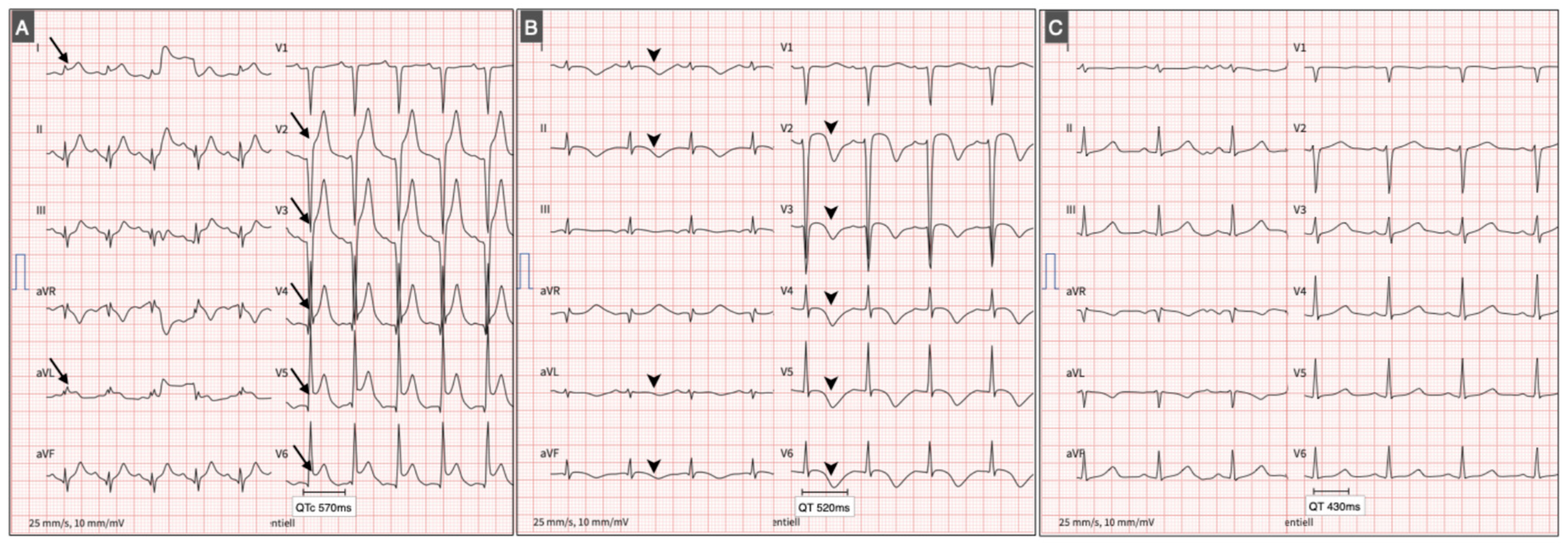
A 43-year-old woman was admitted to the emergency department with palpitations and chest pain. She had a history of presyncope and syncope five years earlier, with similar recurrent episodes over the past two years, each resolving spontaneously within 10 min. On arrival, she appeared pale, diaphoretic, tachycardic, and significantly hypertensive. Her initial electrocardiograms revealed tachycardia and anterolateral ST-segment elevation (
Figure 1A, Arrows). Coronary angiography demonstrated normal coronary arteries but left ventricular dysfunction, consistent with Takotsubo apical ballooning.
The association between pheochromocytoma and long QT syndrome has been recognized for nearly 90 years. The first description of a long QT syndrome (LQTS) was made in Zurich in 1936 by Hegglin, who documented the case of a patient with pheochromocytoma and QT prolongation [
1]. Subsequent reports have refined the classification of inherited and acquired long QT syndromes, including those associated with or without congenital deafness. However, cases of pheochromocytoma-associated LQTS remain rare and clinically significant.
Based on suspicion of a pheochromocytoma, the patient was treated with 5 mg of urapidil followed by 10 mg of labetalol. A differential diagnosis, including substance abuse, was excluded with a negative toxicology screen. The following day, a repeat ECG showed T-wave inversion (
Figure 1B, Arrowheads) and a prolonged QTc interval of 570 ms. Further imaging revealed an adrenal tumour, which was subsequently surgically removed. Genetic testing confirmed a diagnosis of neurofibromatosis type 1.
During the period between diagnosis and surgery, the patient was minimally symptomatic, experiencing occasional dizziness due to low blood pressure. However, her ECGs intermittently demonstrated tachycardia and dynamic changes in ST segments, T waves, and QT duration. Importantly, whenever the patient exhibited a prolonged QT interval, she simultaneously presented with left ventricular dysfunction consistent with Takotsubo syndrome. This finding underscores the dynamic and reversible nature of catecholamine-induced cardiomyopathy.
The European Society of Cardiology (ESC) now recognizes that left ventricular dysfunction in pheochromocytoma falls within the spectrum of Takotsubo syndromes [
2]. This case exemplifies a classic yet rare presentation, illustrating the interplay between pheochromocytoma, catecholamine surges, QT prolongation, and transient left ventricular dysfunction. Notably, prolonged QT syndrome in Takotsubo-induced pheochromocytoma places the patient at significant risk of sudden cardiac death [
3].
Postoperatively (
Figure 1C), the ECG showed near-complete normalization with a QTc interval of 430 ms. The resolution of both the prolonged QT interval and left ventricular dysfunction after tumour resection strongly supports the catecholamine-mediated pathophysiology.
3. Discussion
Prolongation of the QT interval is an important electrophysiological marker during states of adrenergic excess and should be systematically sought in hypertensive emergencies, phaeochromocytoma, and Takotsubo syndrome. In these settings, a prolonged QT interval indicates catecholamine-mediated myocardial involvement and is associated with an increased risk of torsades de pointes and sudden cardiac death.
Several mechanisms have been proposed for this prolongation. β-adrenergic activation increases calcium influx and sarcoplasmic reticulum loading, thereby prolonging phase 2 of the action potential and promoting early after depolarisations [
4]. α-adrenergic vasoconstriction, combined with increased myocardial workload, may induce functional subendocardial ischaemia, further delaying repolarisation. Excess catecholamines also cause functional inhibition of repolarising potassium currents, a mechanism described in Takotsubo syndrome and responsible for increased dispersion of repolarization [
5]. Myocardial oedema and transient ventricular dysfunction in Takotsubo further contribute to repolarisation delay, while stress-induced hypokalaemia may exacerbate QT prolongation.
In the present case, the close temporal association between catecholamine surges, QT prolongation, and transient left ventricular dysfunction supports a unified catecholamine-mediated pathophysiology. Normalisation of the QT interval after adrenalectomy confirms the reversible nature of this acquired long QT syndrome.
Given its diagnostic and prognostic significance, QT interval assessment should be an integral component of the evaluation of patients with suspected catecholamine excess, in order to reduce the risk of serious arrhythmic events.
4. Conclusions
This case highlights the educational value of recognizing pheochromocytoma as a reversible cause of long QT and Takotsubo cardiomyopathy. Given the potential for sudden cardiac events in such patients, early identification and appropriate management remain crucial.
Author Contributions
Conceptualization, S.T.C.; investigation, S.T.C. and M.C.; writing—original draft preparation, S.T.C.; writing—review and editing, S.T.C. and M.C. All authors have read and agreed to the published version of the manuscript.
Funding
This research was funded by Fonds Scientifique Cardiovasculaire, Fribourg.
Institutional Review Board Statement
According to our institutional ethics board policies of the Cantonal Ethics Committee Fribourg (ID number: 003-REP-CER-FR), case reports do not require formal ethics approval.
Informed Consent Statement
Written informed consent was obtained from the patient for publication of this case report and the accompanying images.
Data Availability Statement
The original contributions presented in this study are included in the article. Further inquiries can be directed to the corresponding author(s).
Acknowledgments
We thank the clinical staff involved in the patient’s care for their support. During the preparation of this manuscript, the authors used ChatGPT (GPT-5.1, OpenAI) to assist with language editing. The authors have reviewed and edited all output and take full responsibility for the content of this publication.
Conflicts of Interest
The authors declare no conflicts of interest.
Correction Statement
This article has been republished with a minor correction of the information included in the Institutional Review Board Statement. This change does not affect the scientific content of the article.
References
- Hegglin, R.; Holtzmann, M. EKG-Befunde beim Paragangliom der Nebenniere. Dtsch. Arch. Klin. Med. 1937, 180, 681. [Google Scholar]
- Ghadri, J.R.; Wittstein, I.S.; Prasad, A.; Sharkey, S.; Dote, K.; Akashi, Y.J.; Cammann, V.L.; Crea, F.; Galiuto, L.; Desmet, W.; et al. International Expert Consensus Document on Takotsubo Syndrome (Part I): Clinical Characteristics, Diagnostic Criteria, and Pathophysiology. Eur. Heart J. 2018, 39, 2032–2046. [Google Scholar] [CrossRef] [Scilit] [PubMed]
- Migliore, F.; Zorzi, A.; Peruzza, F.; Perazzolo Marra, M.; Tarantini, G.; Iliceto, S.; Corrado, D. Incidence and management of life-threatening arrhythmias in Takotsubo syndrome. Int. J. Cardiol. 2013, 166, 261–263. [Google Scholar] [CrossRef] [Scilit] [PubMed]
- López-López, J.R.; Shacklock, P.S.; Balke, C.W.; Wier, W.G. Local calcium transients triggered by single L-type calcium channel currents in cardiac cells. Science 1995, 268, 1042–1045. [Google Scholar] [CrossRef] [Scilit] [PubMed]
- Fan, X.; Yang, G.; Yang, Z.; Uhlig, S.; Sattler, K.; Bieback, K.; Hamdani, N.; El-Battrawy, I.; Duerschmied, D.; Zhou, X.; et al. Catecholamine induces endothelial dysfunction via Angiotensin II and intermediate conductance calcium activated potassium channel. Biomed. Pharmacother. 2024, 177, 116928. [Google Scholar] [CrossRef] [Scilit] [PubMed]
| Disclaimer/Publisher’s Note: The statements, opinions and data contained in all publications are solely those of the individual author(s) and contributor(s) and not of MDPI and/or the editor(s). MDPI and/or the editor(s) disclaim responsibility for any injury to people or property resulting from any ideas, methods, instructions or products referred to in the content. |
© 2025 by the authors. Licensee MDPI, Basel, Switzerland. This article is an open access article distributed under the terms and conditions of the Creative Commons Attribution (CC BY) license (https://creativecommons.org/licenses/by/4.0/).