

Mechanisms Involved in the Adverse Cardiovascular Effects of Selective Cyclooxygenase-2 Inhibitors

 , , , , , and
Abstract
1. Introduction
2. Definition and Mechanism of Action
3. Cardiovascular Safety of Coxibs
4. Risk of Adverse Cardiovascular Effect in Patients Without Underlying Cardiovascular Disease
5. Mechanisms Involved
5.1. Prothrombotic Mechanisms
5.1.1. Thromboxane A2 and Prostacyclin
5.1.2. Thrombomodulin and Protein C
5.1.3. Endocannabinoids
5.2. Renal Mechanisms
5.2.1. Prostaglandins and Prostacyclins as Antinatriuretics
5.2.2. Proinflammatory Cell Chemotaxis
5.2.3. Nitric Oxide Synthetase Inhibition
5.2.4. Angiotensin-2
5.2.5. Aldosterone
6. Genetic and Molecular Mechanisms
6.1. Single Nucleotide Polymorphisms
6.2. Metalloproteinases
6.3. Crosstalk
7. Conclusions
Author Contributions
Funding
Data Availability Statement
Acknowledgments
Conflicts of Interest
Abbreviations
| ADMA | Asymmetric dimethylarginine |
| AMI | Myocardial infarction |
| APC | Adenoma Prevention with Celecoxib |
| APPROVe | Adenomatous Polyp Prevention on Vioxx |
| CACNA1E | Calcium channel alpha subunit E1 |
| COX-2 | Cyclooxygenase-2 |
| COXIBS | COX-2 inhibitors |
| CVE | Cerebrovascular events |
| CVR | Cardiovascular risk |
| FT | Factor expression |
| L-NMMA | Monomethyl-L-arginine |
| MMP-1 | Matrix metalloproteinase-1 |
| MMP-3 | Matrix metalloproteinase |
| MMP-9 | Matrix metalloproteinase |
| NSAIDs | Nonsteroidal anti-inflammatory drugs |
| PPARδ | Peroxisomal proliferator activated receptor δ |
| PRECISION study | Prospective Randomized Evaluation of Celecoxib Integrated Safety vs. Ibuprofen or Naproxen |
| PRECISION-ABPM | Prospective Randomized Evaluation of Celecoxib Integrated Safety Versus Ibuprofen or Naproxen Ambulatory Blood Pressure Measurement. |
| PTGS1 | Prostaglandin-endoperoxide Synthase-1 |
| SNP | Single nucleotide polymorphisms |
| VEGFA | Vascular endothelial growth factor “A” |
| VIGOR | Vioxx and Gastrointestinal Outcomes Research |
References
- Littlejohn, E.A.; Monrad, S.U. Early Diagnosis and Treatment of Rheumatoid Arthritis. Prim. Care 2018, 45, 237–255. [Google Scholar] [CrossRef] [PubMed]
- Abramoff, B.; Caldera, F.E. Osteoarthritis: Pathology, Diagnosis, and Treatment Options. Med. Clin. N. Am. 2020, 104, 293–311. [Google Scholar] [CrossRef] [PubMed]
- Marjoribanks, J.; Ayeleke, R.O.; Farquhar, C.; Proctor, M. Nonsteroidal anti-inflammatory drugs for dysmenorrhoea. Cochrane Database Syst. Rev. 2015, 2015, CD001751. [Google Scholar] [CrossRef] [PubMed]
- FitzGerald, G.A.; Patrono, C. The coxibs, selective inhibitors of cyclooxygenase-2. N. Engl. J. Med. 2001, 345, 433–442. [Google Scholar] [CrossRef]
- Fu, J.Y.; Masferrer, J.L.; Seibert, K.; Raz, A.; Needleman, P. The induction and suppression of prostaglandin H2 synthase (cyclooxygenase) in human monocytes. J. Biol. Chem. 1990, 265, 16737–16740. [Google Scholar] [CrossRef]
- Hawkey, C.J. COX-2 inhibitors. Lancet 1999, 353, 307–314. [Google Scholar] [CrossRef]
- Batlouni, M. Nonsteroidal anti-inflammatory drugs: Cardiovascular, cerebrovascular and renal effects. Arq. Bras. Cardiol. 2010, 94, 556–563. (In Portuguese) [Google Scholar] [CrossRef]
- FitzGerald, G.A. COX-2 and beyond: Approaches to prostaglandin inhibition in human disease. Nat. Rev. Drug Discov. 2003, 2, 879–890. [Google Scholar] [CrossRef]
- Hawkey, C.J. COX-1 and COX-2 inhibitors. Best Pract. Res. Clin. Gastroenterol. 2001, 15, 801–820. [Google Scholar] [CrossRef]
- Bombardier, C.; Laine, L.; Reicin, A.; Shapiro, D.; Burgos-Vargas, R.; Davis, B.; Day, R.; Ferraz, M.B.; Hawkey, C.J.; Hochberg, M.C.; et al. Comparison of upper gastrointestinal toxicity of rofecoxib and naproxen in patients with rheumatoid arthritis. N. Engl. J. Med. 2000, 343, 1520–1528. [Google Scholar] [CrossRef]
- Konstam, M.A.; Weir, M.R.; Reicin, A.; Shapiro, D.; Sperling, R.S.; Barr, E.; Gertz, B.J. Cardiovascular thrombotic events in controlled, clinical trials of rofecoxib. Circulation 2001, 104, 2280–2288. [Google Scholar] [CrossRef]
- Solomon, D.H.; Schneeweiss, S.; Glynn, R.J.; Solomon, D.H.; Schneeweiss, S.; Glynn, R.J.; Kiyota, Y.; Levin, R.; Mogun, H.; Avorn, J. Relationship between selective cyclooxygenase-2 inhibitors and acute myocardial infarction in older adults. Circulation 2004, 109, 2068–2073. [Google Scholar] [CrossRef] [PubMed]
- Bresalier, R.S.; Sandler, R.S.; Quan, H.; Bolognese, J.A.; Oxenius, B.; Horgan, K.; Lines, C.; Riddell, R.; Morton, D.; Lanas, A.; et al. Cardiovascular events associated with rofecoxib in a colorectal adenoma chemoprevention trial. N. Engl. J. Med. 2005, 352, 1092–1102. [Google Scholar] [CrossRef] [PubMed]
- Silverstein, F.E.; Faich, G.; Goldstein, J.L.; Simon, L.S.; Pincus, T.; Whelton, A.; Makuch, R.; Eisen, G.; Agrawal, N.M.; Stenson, W.F.; et al. Gastrointestinal toxicity with celecoxib vs nonsteroidal anti-inflammatory drugs for osteoarthritis and rheumatoid arthritis: The CLASS study: A randomized controlled trial. JAMA 2000, 284, 1247–1255. [Google Scholar] [CrossRef] [PubMed]
- Solomon, S.D.; McMurray, J.J.; Pfeffer, M.A.; Wittes, J.; Fowler, R.; Finn, P.; Anderson, W.F.; Zauber, A.; Hawk, E.; Bertagnolli, M.; et al. Cardiovascular risk associated with celecoxib in a clinical trial for colorectal adenoma prevention. N. Engl. J. Med. 2005, 352, 1071–1080. [Google Scholar] [CrossRef]
- Nissen, S.E.; Yeomans, N.D.; Solomon, D.H.; Lüscher, T.F.; Libby, P.; Husni, M.E.; Graham, D.Y.; Borer, J.S.; Wisniewski, L.M.; Wolski, K.E.; et al. Cardiovascular Safety of Celecoxib, Naproxen, or Ibuprofen for Arthritis. N. Engl. J. Med. 2016, 375, 2519–2529. [Google Scholar] [CrossRef]
- Ruschitzka, F.; Borer, J.S.; Krum, H.; Flammer, A.J.; Yeomans, N.D.; Libby, P.; Lüscher, T.F.; Solomon, D.H.; Husni, M.E.; Graham, D.Y.; et al. Differential blood pressure effects of ibuprofen, naproxen, and celecoxib in patients with arthritis: The PRECISION-ABPM (Prospective Randomized Evaluation of Celecoxib Integrated Safety Versus Ibuprofen or Naproxen Ambulatory Blood Pressure Measurement) Trial. Eur. Heart J. 2017, 38, 3282–3292. [Google Scholar] [CrossRef]
- Coxib and Traditional NSAID Trialists’ (CNT) Collaboration; Bhala, N.; Emberson, J.; Merhi, A.; Abramson, S.; Arber, N.; Baron, J.A.; Bombardier, C.; Cannon, C.; Farkouh, M.E.; et al. Vascular and upper gastrointestinal effects of non-steroidal anti-inflammatory drugs: Meta-analyses of individual participant data from randomised trials. Lancet 2013, 382, 769–779. [Google Scholar] [CrossRef]
- Cheng, Y.; Austin, S.C.; Rocca, B.; Koller, B.H.; Coffman, T.M.; Grosser, T.; Lawson, J.A.; FitzGerald, G.A. Role of prostacyclin in the cardiovascular response to thromboxane A2. Science 2002, 296, 539–541. [Google Scholar] [CrossRef]
- Caughey, G.E.; Cleland, L.G.; Penglis, P.S.; Gamble, J.R.; James, M.J. Roles of cyclooxygenase (COX)-1 and COX-2 in prostanoid production by human endothelial cells: Selective up-regulation of prostacyclin synthesis by COX-2. J. Immunol. 2001, 167, 2831–2838. [Google Scholar] [CrossRef]
- Rabausch, K.; Bretschneider, E.; Sarbia, M.; Meyer-Kirchrath, J.; Censarek, P.; Pape, R.; Fischer, J.W.; Schrör, K.; Weber, A.A. Regulation of thrombomodulin expression in human vascular smooth muscle cells by COX-2-derived prostaglandins. Circ. Res. 2005, 96, e1–e6. [Google Scholar] [CrossRef]
- Kozak, K.R.; Jeffery Prusakiewicz, J.J.; Marnett, L.J. Oxidative Metablism of Endocannabinoids by COX-2. Curr. Pharm. Des. 2004, 10, 659–667. [Google Scholar] [CrossRef]
- Ghosh, M.; Wang, H.; Ai, Y.; Romeo, E.; Luyendyk, J.P.; Peters, J.M.; Mackman, N.; Dey, S.K.; Hla, T. COX-2 suppresses tissue factor expression via endocannabinoid-directed PPARδ activation. J. Exp. Med. 2007, 204, 2053–2061. [Google Scholar] [CrossRef]
- Brater, D.C. Effects of nonsteroidal anti-inflammatory drugs on renal function: Focus on cyclooxygenase-2-selective inhibition. Am. J. Med. 1999, 107, 65S–70S. [Google Scholar] [CrossRef]
- Whelton, A.; Schulman, G.; Wallemark, C.; Drower, E.J.; Isakson, P.C.; Verburg, K.M.; Geis, G.S. Effects of celecoxib and naproxen on renal function in the elderly. Arch. Intern. Med. 2000, 160, 1465–1470. [Google Scholar] [CrossRef]
- Cheng, H.F.; Harris, R.C. Renal effects of non-steroidal anti-inflammatory drugs and selective cyclooxygenase-2 inhibitors. Curr. Pharm. Des. 2005, 11, 1795–1804. [Google Scholar] [CrossRef]
- Zhang, M.Z.; Yao, B.; Wang, Y.; Fan, X.; Harris, R.C. Inhibition of cyclooxygenase-2 in hematopoietic cells results in salt-sensitive hypertension. J. Clin. Investig. 2015, 125, 4281–4294. [Google Scholar] [CrossRef] [PubMed]
- Ahmetaj-Shala, B.; Kirkby, N.S.; Knowles, R.; Al’Yamani, M.; Mazi, S.; Wang, Z.; Tucker, A.T.; Mackenzie, L.; Armstrong, P.C.; Nüsing, R.M.; et al. Evidence that links loss of cyclooxygenase-2 with increased asymmetric dimethylarginine: Novel explanation of cardiovascular side effects associated with anti-inflammatory drugs. Circulation 2015, 131, 633–642. [Google Scholar] [CrossRef] [PubMed]
- Qi, Z.; Hao, C.M.; Langenbach, R.I.; Breyer, R.M.; Redha, R.; Morrow, J.D.; Breyer, M.D. Opposite effects of cyclooxygenase-1 and -2 activity on the pressor response to angiotensin II. J. Clin. Investig. 2002, 110, 61–69. [Google Scholar] [CrossRef] [PubMed]
- Knights, K.M.; Winner, L.K.; Elliot, D.J.; Bowalgaha, K.; Miners, J.O. Aldosterone glucuronidation by human liver and kidney microsomes and recombinant UDP-glucuronosyltransferases: Inhibition by NSAIDs. Br. J. Clin. Pharmacol. 2009, 68, 402–412. [Google Scholar] [CrossRef]
- Braenne, I.; Willenborg, C.; Tragante, V.; Kessler, T.; Zeng, L.; Reiz, B.; Kleinecke, M.; von Ameln, S.; Willer, C.J.; Laakso, M.; et al. A genomic exploration identifies mechanisms that may explain adverse cardiovascular effects of COX-2 inhibitors. Sci. Rep. 2017, 7, 10252. [Google Scholar] [CrossRef]
- Folkman, J.; Shing, Y. Angiogenesis. J. Biol. Chem. 1992, 267, 10931–10934. [Google Scholar] [CrossRef]
- Gast, K.C.; Viscuse, P.V.; Nowsheen, S.; Haddad, T.C.; Mutter, R.W.; Wahner Hendrickson, A.E.; Couch, F.J.; Ruddy, K.J. Cardiovascular Concerns in BRCA1 and BRCA2 Mutation Carriers. Curr. Treat. Options Cardiovasc. Med. 2018, 20, 18. [Google Scholar] [CrossRef] [PubMed]
- Williams, M.E.; Marubio, L.M.; Deal, C.R.; Hans, M.; Brust, P.F.; Philipson, L.H.; Miller, R.J.; Johnson, E.C.; Harpold, M.M.; Ellis, S.B. Structure and functional characterization of neuronal alpha 1E calcium channel subtypes. J. Biol. Chem. 1994, 269, 22347–22357. [Google Scholar] [CrossRef] [PubMed]
- Germaine, C.G.S.; Bogaty, P.; Boyer, L.; Hanley, J.; Engert, J.C.; Brophy, J.M. Genetic Polymorphisms and the Cardiovascular Risk of Non-Steroidal Anti-Inflammatory Drugs. Am. J. Cardiol. 2010, 105, 1740–1745. [Google Scholar] [CrossRef] [PubMed][Green Version]
- Zhang, Y.; McCluskey, K.; Fujii, K.; Wahl, L.M. Different regulation of monocyte matrix metalloproteinase and TIMP-1 production by TNF-, granulocyte-macrophage CSF, and IL-1 through prostaglandin-dependent and independent mechanisms. J. Immunol. 1998, 161, 3071–3076. [Google Scholar] [CrossRef]
- Pillinger, M.H.; Marjanovic, N.; Kim, S.Y.; Scher, J.U.; Izmirly, P.; Tolani, S.; Dinsell, V.; Lee, Y.C.; Blaser, M.J.; Abramson, S.B. Matrix metalloproteinase secretion by gastric epithelial cells is regulated by E prostaglandins and MAPKs. J. Biol. Chem. 2005, 280, 9973–9979. [Google Scholar] [CrossRef]
- Wang, X.M.; Wu, T.; Lee, Y.S.; Dionne, R.A. Rofecoxib regulates the expression of genes related to the matrix metalloproteinase pathway in humans: Implication for the adverse effects of cyclooxygenase-2 inhibitors. Clin. Pharmacol. Ther. 2006, 79, 303–315. [Google Scholar] [CrossRef]
- Newby, A.C. Dual role of matrix metalloproteinases (Matrixins) in intimal thickening and atherosclerotic plaque rupture. Physiol. Rev. 2005, 85, 1–31. [Google Scholar] [CrossRef]
- Moreau, M.; Brocheriou, I.; Petit, L.; Ninio, E.; Chapman, M.J.; Rouis, M. Interleukin-8 mediates downregulation of tissue inhibitor of metalloproteinase-1 expression in cholesterol-loaded human macrophages: Relevance to stability of atherosclerotic plaque. Circulation 1999, 99, 420–426. [Google Scholar] [CrossRef]
- Rodrigues, A.D. Impact of CYP2C9 genotype on pharmacokinetics: Are all cyclooxygenase inhibitors the same? Drug. Metab. Dispos. 2005, 33, 1567–1575. [Google Scholar] [CrossRef]
- Sakane, J.J.; Monteiro, C.J.; Silva, W.; Silva, A.R.; Santos, P.M.; Lima, K.F.; Moraes, K.C. Cellular and molecular studies of the effects of a selective COX-2 inhibitor celecoxib in the cardiac cell line H9c2 and their correlation with death mechanisms. Braz. J. Med. Biol. Res. 2014, 47, 50–59. [Google Scholar] [CrossRef] [PubMed]
- Mosaad, S.M.; Zaitone, S.A.; Ibrahim, A.; El-Baz, A.A.; Abo-Elmatty, D.M.; Moustafa, Y.M. Celecoxib aggravates cardiac apoptosis in L-NAME-induced pressure overload model in rats: Immunohistochemical determination of cardiac caspase-3, Mcl-1, Bax and Bcl-2. Chem. Biol. Interact. 2017, 272, 92–106. [Google Scholar] [CrossRef] [PubMed]
- Zhou, X.; Liu, Y.; Xu, D.; Bao, J.; Cao, Y.; Jin, Y. Combined Therapy with Rosiglitazone, Rofecoxib and Celecoxib Enhances Cardiovascular Side Effects through Cytochrome P450 Pathway of Arachidonic Acid Metabolism in Diabetic Arthritis Model Rats. Pak. J. Zool. 2021, 53, 483. [Google Scholar] [CrossRef]
- Stiller, C.-O.; Hjemdahl, P. Lessons from 20 years with COX-2 inhibitors: Importance of dose-response considerations and fair play in comparative trials. J. Intern. Med. 2022, 292, 557–574. [Google Scholar] [CrossRef]
- Schjerning Olsen, A.M.; Fosbøl, E.L.; Lindhardsen, J.; Andersson, C.; Folke, F.; Nielsen, M.B.; Køber, L.; Hansen, P.R.; Torp-Pedersen, C.; Gislason, G.H. Cause-specific cardiovascular risk associated with nonsteroidal anti-inflammatory drugs among myocardial infarction patients–a nationwide study. PLoS ONE 2013, 8, e54309. [Google Scholar] [CrossRef]
- Andersohn, F.; Suissa, S.; Garbe, E. Use of first- and second-generation cyclooxygenase-2–selective nonsteroidal antiinflammatory drugs and risk of acute myocardial infarction. Circulation 2006, 113, 1950–1957. [Google Scholar] [CrossRef]
- Cannon, C.P.; Curtis, S.P.; FitzGerald, G.A.; Krum, H.; Kaur, A.; Bolognese, J.A.; Reicin, A.S.; Bombardier, C.; Weinblatt, M.E.; van der Heijde, D.; et al. Cardiovascular outcomes with etoricoxib and diclofenac in patients with arthritis: The MEDAL programme. Lancet 2006, 368, 1771–1781. [Google Scholar] [CrossRef]
- Nussmeier, N.A.; Whelton, A.A.; Brown, M.T.; Langford, R.M.; Hoeft, A.; Parlow, J.L.; Boyce, S.W.; Verburg, K.M. Complications of the COX-2 inhibitors parecoxib and valdecoxib after cardiac surgery. N. Engl. J. Med. 2005, 352, 1081–1091. [Google Scholar] [CrossRef]
- Farkouh, M.E.; Kirshner, H.; Harrington, R.A.; Ruland, S.; Verheugt, F.W.; Schnitzer, T.J.; Burmester, G.R.; Mysler, E.; Hochberg, M.C.; Doherty, M.; et al. Comparison of lumiracoxib with naproxen and ibuprofen in the Therapeutic Arthritis Research and Gastrointestinal Event Trial (TARGET), cardiovascular outcomes:randomized controlled trial. Lancet 2004, 364, 675–684. [Google Scholar] [CrossRef]

| Group | Selective COX-2 Inhibitors |
|---|---|
| First generation | Celecoxib and rofecoxib |
| Second generation | Valdecoxib and parecoxib |
| Third generation | Etoricoxib and lumiracoxib |
| Category | Specific Mechanism | Physiological or Molecular Alteration | Associated Cardiovascular Effects |
|---|---|---|---|
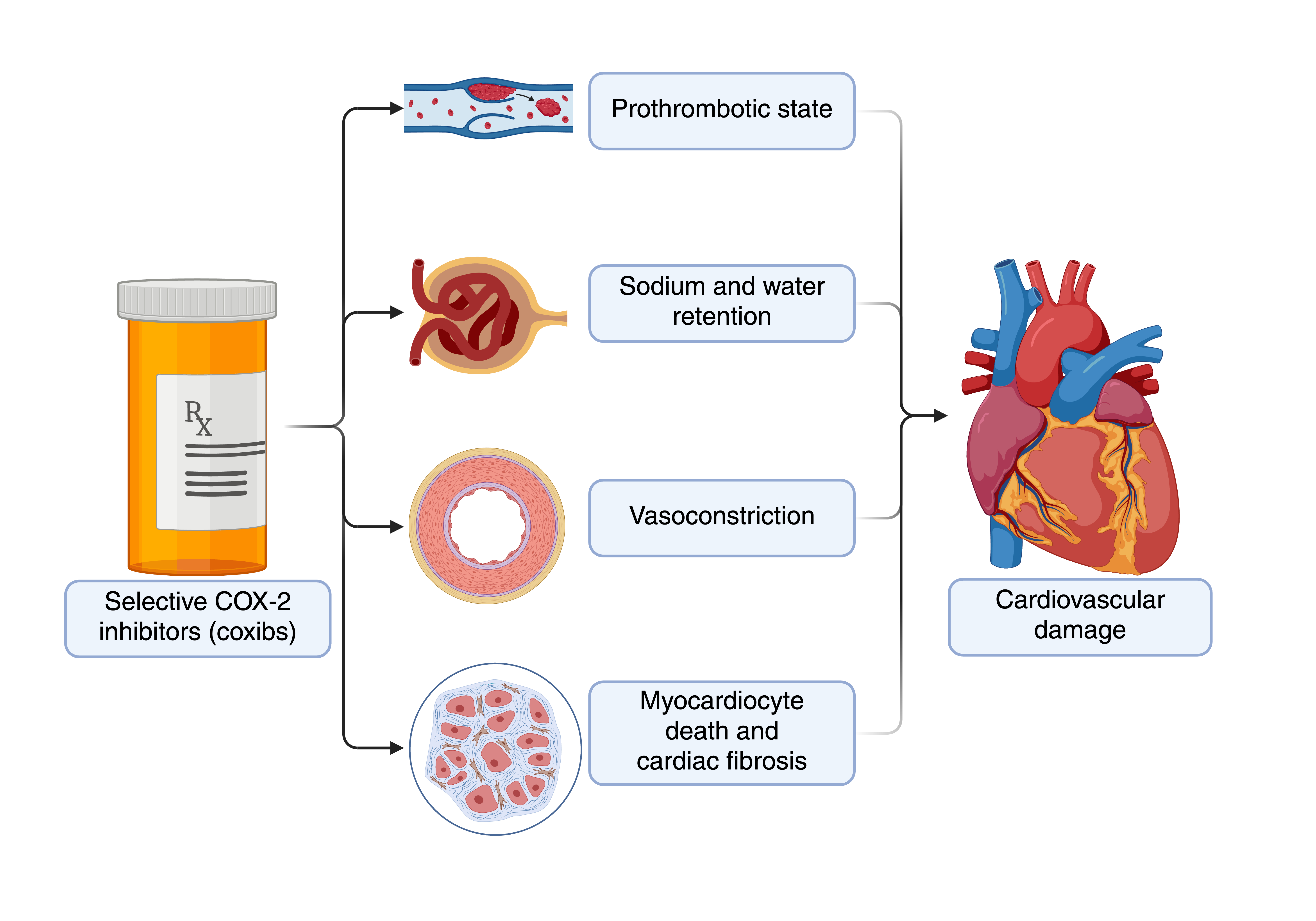
| Prothrombotic | ↓ Prostacyclin ↑ Thromboxane A2. | ↓ Vasodilation ↑ Platelet aggregation | ↑ Prothrombotic state Vascular damage |
| ↓ Thrombomodulin | ↑ FVa and FVIIIa | Impaired protein C activation | |
| ↓ PPARδ | Expression of FT Activation of coagulation cascade | Thrombosis | |
| Renal | ↓ Prostaglandins ↓ Prostacyclins | Infiltration of proinflammatory cells at the kidney ↓ Natriuresis | Edema Arterial hypertension Heart failure |
| ↑ ADMA and L-NMMA | ↓ Systemic nitric oxide. | ↑ Peripheral vascular resistance ↑ Arterial hypertension Vascular damage | |
| ↑ Vasopressor effect of angiotensin-2 | ↓ Renal medullary blood flow | Edema Arterial hypertension | |
| ↓ Aldosterone glucuronidation | ↑ Aldosterone | Arterial hypertension Water and sodium retention | |
| Genetic and Molecular | ↑ MMP-1, MMP-3 | Plaque rupture Vascular damage Tissue destruction | Coronary heart disease Prothrombotic |
| ↑ IL-8 | ↑ Metalloproteinase expression | Coronary heart disease Prothrombotic | |
| Peripheral Nervous System | VEGFA | ↓ Decrease in NOS Vasoconstriction Vascular damage | Arterial hypertension Prothrombotic Coronary heart disease |
| MMP-9 | VEGFA decreased | Arterial hypertension Prothrombotic Coronary heart disease | |
| BRCA1 | ↑ Migration of smooth muscle cells in the carotid muscle. | Arterial hypertension CVD | |
| CACNA1E | Alteration of voltage-gated calcium channels in blood vessels and myocardium | Arterial hypertension | |
| C-reactive protein in the 3′ untranslated region | Atherosclerosis | Metabolic syndrome Coronary heart disease | |
| Genotipo CYP2C9 | ↓ Clearance of coxibs | Increased cardiovascular adverse effects | |
| Crosstalk | Cardiomyocyte DNA damage Apoptosis, necrosis | Heart failure Cardiac injury CVD | |
| ↑ Caspase-3, Mcl-1, Bax and Bcl-2 Profibrotic | Cardiac apoptosis Cardiac fibrosis | Increased cardiac enzymes Arterial hypertension Heart failure | |
| ↑ 20-hydroxyeicosatetraenoic acid ↑ Endothelin-1 ↑ Brain natriuretic peptide | Vasoconstriction | Arterial hypertension Coronary heart disease |
| Drug | Associated Dose | Main Cardiovascular Effect | Key Clinical Study (Design/Population) | RR or HR (95% CI) | Conclusion | Absolute Risk | Reference |
|---|---|---|---|---|---|---|---|
| Rofecoxib | 25–50 mg/day | ↑ AMI and major thrombotic events | VIGOR (2000, RA, 8076 patients, active-controlled RCT vs. naproxen); APPROVe (2005, adenoma prevention, 2586 patients, placebo-controlled RCT) | VIGOR: ≈5× ↑ AMI risk; APPROVe: RR 1.92 (1.19–3.11) | Demonstrated the highest thrombotic CVR among all coxibs; withdrawn from the market in 2004 | ≈1/100 | [10,13] |
| Celecoxib | 200–400 mg BID | ↑ CVR at high doses (CV death, AMI, CVE); neutral at low/moderate doses | APC (2005, adenoma prevention, placebo-controlled RCT); PRECISION study (2016, OA/RA, non-inferiority RCT vs. ibuprofen and naproxen) | APC: HR 2.6–3.4; PRECISION: HR 0.93 (0.76–1.13) vs. naproxen | Dose-dependent CVR. Doses ≤ 200 mg/day considered safe in patients without pre-existing CVD | ≈0.8/100 | [15,16] |
| Etoricoxib | 60–90 mg/day | Thrombotic risk comparable to diclofenac | MEDAL (2006, OA/RA, >34,000 patients, non-inferiority RCT vs. diclofenac) | HR 0.95 (0.81–1.11) | Did not significantly increase risk vs. diclofenac, but both higher than placebo | ≈1.2/100 | [48] |
| Valdecoxib | 20–40 mg BID (after parecoxib 40 mg IV BID) | ↑ AMI, cardiac arrest, CVE, and pulmonary embolism after CABG surgery | Nussmeier et al. 2005 (post-CABG, double-blind RCT, 1671 patients) | RR 3.7 (1.0–13.5) | Very high CVR in post-cardiac surgery patients; withdrawn from market in 2005 | ≈1.5/100 | [49] |
| Parecoxib | 40 mg IV BID (followed by oral valdecoxib) | ↑ Serious CV events in post-cardiac surgery patients | Nussmeier et al. 2005 (same post-CABG trial) | RR ≈ 3.7 | Pro-drug of valdecoxib; similar CVR in perioperative settings; withdrawn in 2005 | ≈1.5/100 | [49] |
| Lumiracoxib | 400 mg/day | Arterial thrombosis like traditional NSAIDs | TARGET (2004, OA, 18,325 patients, active-controlled RCT vs. naproxen/ibuprofen) | RR ≈ 1.0 (NS) | No significant increase in CVR; withdrawn for hepatotoxicity | ≈0.10/100 | [50] |
| COXIBS (combined analysis) | — | ↑ Major cardiovascular events vs. placebo | CNT Collaboration (2013, meta-analysis, 280,000 participants) | RR 1.37 (1.14–1.66) | Overall ↑ average CVR, especially in patients with pre-existing CVD | ≈0.3/100 | [18] |
Disclaimer/Publisher’s Note: The statements, opinions and data contained in all publications are solely those of the individual author(s) and contributor(s) and not of MDPI and/or the editor(s). MDPI and/or the editor(s) disclaim responsibility for any injury to people or property resulting from any ideas, methods, instructions or products referred to in the content. |
© 2025 by the authors. Licensee MDPI, Basel, Switzerland. This article is an open access article distributed under the terms and conditions of the Creative Commons Attribution (CC BY) license (https://creativecommons.org/licenses/by/4.0/).
Share and Cite
Leal-Ramos, O.J.; Arias-Ruiz, L.F.; Huerta-Velázquez, J.M.; Lamoreaux-Aguayo, J.P.; Butcher, D.; López-Cuellar, A.B.; Orozco-Jiménez, K.I.; Torres-Bugarín, O. Mechanisms Involved in the Adverse Cardiovascular Effects of Selective Cyclooxygenase-2 Inhibitors. Cardiovasc. Med. 2025, 28, 5. https://doi.org/10.3390/cardiovascmed28010005
Leal-Ramos OJ, Arias-Ruiz LF, Huerta-Velázquez JM, Lamoreaux-Aguayo JP, Butcher D, López-Cuellar AB, Orozco-Jiménez KI, Torres-Bugarín O. Mechanisms Involved in the Adverse Cardiovascular Effects of Selective Cyclooxygenase-2 Inhibitors. Cardiovascular Medicine. 2025; 28(1):5. https://doi.org/10.3390/cardiovascmed28010005
Chicago/Turabian StyleLeal-Ramos, Oscar Jesus, Luis Felipe Arias-Ruiz, José Miguel Huerta-Velázquez, José Pablo Lamoreaux-Aguayo, Dalton Butcher, Asela Berenice López-Cuellar, Karina Iveth Orozco-Jiménez, and Olivia Torres-Bugarín. 2025. "Mechanisms Involved in the Adverse Cardiovascular Effects of Selective Cyclooxygenase-2 Inhibitors" Cardiovascular Medicine 28, no. 1: 5. https://doi.org/10.3390/cardiovascmed28010005
APA StyleLeal-Ramos, O. J., Arias-Ruiz, L. F., Huerta-Velázquez, J. M., Lamoreaux-Aguayo, J. P., Butcher, D., López-Cuellar, A. B., Orozco-Jiménez, K. I., & Torres-Bugarín, O. (2025). Mechanisms Involved in the Adverse Cardiovascular Effects of Selective Cyclooxygenase-2 Inhibitors. Cardiovascular Medicine, 28(1), 5. https://doi.org/10.3390/cardiovascmed28010005