NOAC: "NO Anticoagulation Without Consideration" Typical Scenarios of Stroke Prevention in Patients with AF

Abstract
Introduction
Clinical Scenario 1: Compliance, Frail Elderly, Impaired Renal Function
Clinical Scenario 2: Interactions

| Dabigatran | Apixaban | Rivaroxaban | Edoxaban * | |
|---|---|---|---|---|
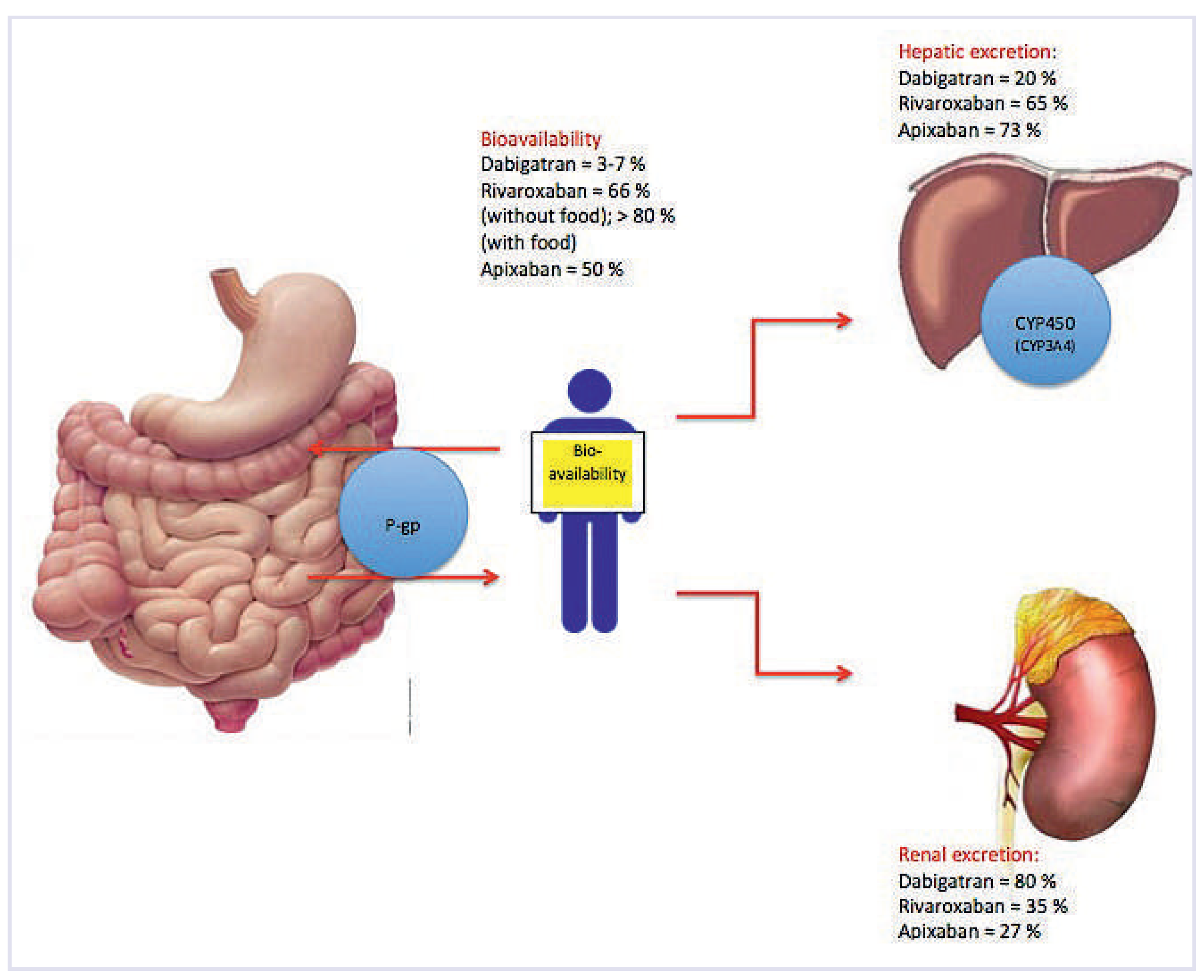
| Fraction of renal excretion | 80% | 27% | 35% | 50% |
| Approved for CrCl ≥ … | ≥30 mL/min | ≥15 mL/min | ≥15 mL/min | Not available |
Dosing in CKD
|
| 2.5 mg bid if 2 out of 3 factors present:
|
| Not available |
| Via | Dabigatran | Apixaban | Rivaroxaban | |
|---|---|---|---|---|
| Atorvastatin | P-Gp competition and CYP 3A4 inhibition | + 18% (AUC) | Minor increase | No effect |
| Digoxin | P-Gp competition | No effect | No effect | No effect |
| Verapamil | P-Gp competition (weak CYP3A4 inhibition) | + 12–180% | Moderate increase | Minor increase → Cave if CrCl 15–50 mL/min |
| Diltiazem | P-Gp competition und CYP3A4 inhibition | No effect | +40% | Minor increase → Cave if CrCl 15–50 mL/min |
| Quinidine | P-Gp competition | +50% | Moderate increase | +50% |
| Amiodarone | P-Gp competition | +12–60% | Moderate increase | Minor increase → Cave if CrCl 15–50 mL/min |
| Dronedarone | P-Gp and CYP3A4 inhibition | +70–100% | Moderate increase | Moderate increase |
| Ketoconazole; itraconazole; voriconazole | P-Gp competition, CYP3A4 inhibition | +140–150% | +100% | +160% |
| Fluconazole | CYP3A4 inhibtion | No data yet | Moderate increase | +42% |
| Cyclosporin | P-Gp competition | Strong increase | Moderate increase | +50% |
| Clarithromycin; erythromycin | P-Gp competition and CYP3A4 inhibition | +15–20% | Strong increase | +30–54% |
| HIV protease inhibitors | P-Gp competition and CYP3A4 inhibition | Strong increase | Strong increase | +153% |
| Rifampicin; St John’s wort; phenytoin; carbamazepine | P-Gp and CYP3A4/CYP2J2 inducers | −66% | −54% | −50% |
| Antacids (PPI, H2B) | GI absorption | −12–30% | No effect | No effect |
| Age ≥ 80 y. | Increased plasma level | |||
| Age ≥ 75 y. | Increased plasma level | |||
| Weight ≤ 60 kg | Increased plasma level | |||
| Red: Contraindicated/not recommended Orange: Reduce dose (dabigatran 2 × 110 mg; apixaban 2 × 2.5 mg; rivaroxaban 1 × 15 mg) Yellow: Consider dose reduction in presence of another “yellow” factor | ||||
Clinical Scenario 3: NOACs and Triple Anticoagulation
Clinical Scenario 4: NOACs and Cardioversion
Clinical Scenario 5: NOACs and Acute Stroke
Clinical Scenario 6: Surgical Procedure
Clinical Scenario 7: Bleeding Management, Monitoring and Therapy Reversal
Clinical Scenario 8: Prosthetic Heart Valves
Clinical Scenario 9: Compliance—Forgotten Dose(s)

Clinical Scenario 10: Liver Cirrhosis
Conclusion
Funding/potential competing interests
References
- Benjamin, E.J.; Wolf, P.A.; D’Agostino, R.B.; Silberhatz, H.; Kannel, W.B.; Levy, D. Impact of atrial fibrillation on the risk of death: The Framingham Heart Study. Circulation 1998, 98, 946–952. [Google Scholar] [CrossRef]
- Conen, D.; Chae, C.U.; Glynn, R.J.; Tedrow, U.B.; Everett, B.M.; Bruing, J.E.; et al. Risk of death and cardiovascular events in initially healthy women with new onset atrial fibrillation. JAMA 2011, 305, 2080–2087. [Google Scholar] [CrossRef]
- Birman-Deych, E.; Radford, M.J.; Nilasena, D.S.; Gage, B.F. Use and effectiveness of warfarin in Medicare beneficiaries with atrial fibrillation. Stroke 2006, 37, 1070–1074. [Google Scholar] [CrossRef]
- Hylek, E.M.; Evans-Molina, C.; Shea, C.; Henault, L.E.; Regan, S.; et al. Major hemorrhage and tolerability of warfarin in the first year of therapy among elderly patients with atrial fibrillation. Circulation 2007, 115, 2689–2696. [Google Scholar] [CrossRef] [PubMed]
- Patel, M.R.; Mahaffey, K.W.; Garg, J.; et al. Rivaroxaban versus warfarin in patients in non valvular atrial fibrillation. N Engl J Med. 2011, 365, 883–891. [Google Scholar] [CrossRef]
- Granger, C.B.; Alexander, J.H.; McMurray, J.J.V.; et al. Apixaban versus warfarin in patients with atrial fibrillation. N Engl J Med. 2011, 365, 981–992. [Google Scholar] [CrossRef]
- Connolly, S.J.; Ezekowitz, M.D.; Yusuf, S.; et al. Dabigatran versus warfarin in patients with atrial fibrillation. N Engl J Med. 2009, 361, 1139–1151. [Google Scholar] [CrossRef]
- Giugliano, R.P.; Ruff, C.T.; Braunwald, E.; Murphy, S.A.; Wiviott, S.D.; Halperin, J.L.; et al. Edoxaban versus warfarin in paients with atrial fibrillation. N Engl J Med. 2013, 369, 2093–2104. [Google Scholar] [CrossRef]
- Ruff, C.T.; Antman, E.M.; Giugliano, R.P.; et al. Comparison of the efficacy and safety of new oral anticoagulants with warfarin in patients with atrial fibrillation: A meta-analysis of randomised trials. The Lancet 2014, 389, 955–962. [Google Scholar] [CrossRef] [PubMed]
- The EINSTEIN Investigators. Oral Rivaroxaban for symptomatic venous thromboembolism. N Engl J Med. 2010, 363, 2499–2510. [Google Scholar] [CrossRef] [PubMed]
- The EINSTEIN Investigators. Oral Rivaroxaban for symptomatic pulmonary embolism. N Engl J Med. 2012, 366, 1287–1297. [Google Scholar] [CrossRef] [PubMed]
- Agnelli, G.; Buller, H.R.; Cohen, A.; et al. Oral Apixaban for the treatment of acute venous thromboembolism. N Engl J Med. 2013, 369, 799–808. [Google Scholar] [CrossRef]
- Olesen, J.B.; Lip, G.Y.H.; Kamper, A.-L.; Hommel, K.; et al. Stroke and bleeding in atrial fibrillation with chronic kidney disease. N Engl J Med. 2012, 367, 625–35. [Google Scholar] [CrossRef] [PubMed]
- Fox, K.A.; Piccini, J.P.; Wojyla, D.; Becker, R.C.; et al. Prevention of stroke and systemic embolism with rivaroxaban compared with warfarin in patients with non valvular atrial fibrillation and moderate renal impairment. Eur Heart J. 2011, 32, 2387–2394. [Google Scholar] [CrossRef] [PubMed]
- Steffel, J.; Hindricks, G.; et al. Apixaban in renal insufficiency: Successful navigation between the Scylla and charybdis. Eur Heart J. 2012, 33, 2766–2768. [Google Scholar] [CrossRef][Green Version]
- Friberg, L.; Benson, L.; Lip, G. Balancing stroke and bleeding risks in patients with atrial fibrillation and renal failure: The Swedish Atrial Fibrillation Cohort study. Eur Heart J. 2014, 139. [Google Scholar] [CrossRef]
- Steffel, J. Neue orale Antikoagulanzien bei eingeschränkter Nierenfunktion und Dialyse. Leading Opinions Nephrologie 2013, 2, 73–75. [Google Scholar]
- Camm, A.J.; et al. focused update of the esc guidelines for the management of atrial fibrillation: An update of the 2010 esc guidelines for the management of atrial fibrillation. Developed with the special contribution of the european heart rhythm association. Europace 2012, 14, 1385–1413. [Google Scholar]
- Mueck, W.; Lensing, A.W.; Agnelli, G.; Decousus, H.; Prandoni, P.; Misselwitz, F. Rivaroxaban: Population pharmacokinetic analyses in patients treated for acute deep vein thrombosis and exposure simulations in patients with atrial fibrillation treated for stroke prevention. Clin Pharmacokinet 2011, 50, 675–686. [Google Scholar] [CrossRef]
- Heidbuchel, H.; Verhamme, P.; Alings, M.; Kichhof, P.; et al. European Heart Rhythm Association Practical Guide on the use of new oral anticoagulants in patients with non-valvular atrial fibrillation. Europace 2013, 15, 625–651. [Google Scholar] [CrossRef]
- Lopes, R.D.; Pieper, K.S.; Horton, J.R.; Al-Khatib, S.M.; Newby, L.K.; Metha, R.H.; et al. Shortand long term outcomes following atrial fibrillation in patients with acute coronary syndromes with or without ST-segment elevation. Heart 2008, 94, 867–873. [Google Scholar] [CrossRef]
- Mega, J.L.; Braunwald, E.; Wiviott, S.D.; Bassand, J.P.; et al. Rivaroxaban in patients with a recent acute coronary syndrome. N Engl J Med. 2012, 366, 9–19. [Google Scholar] [CrossRef]
- Alexander, J.H.; Lopes, R.D.; James, S.; Kilarus, R.; et al. Apixaban with antiplatelet therapy after acute coronary syndrome. N Engl J Med. 2011, 365, 699–708. [Google Scholar] [CrossRef] [PubMed]
- Lopes, R.D.; Elliott, L.E.; White, H.D.; Hochman, J.S.; et al. Antithrombotic therapy and outcomes of patients with atrial fibrillation following primary percutaneous coronary intervention: Results from the APEX-AMI trial. Eur Heart J. 2009, 30, 2019–2028. [Google Scholar] [CrossRef] [PubMed]
- Lamberts, M.; Olesen, J.B.; Runwald, M.H.; et al. Bleeding after initiation of multiple antithrombotic drugs, including triple therapy, in atrial fibrillation patients following myocardial infarction and coronary intervention: A nationwide cohort study. Circulation 2012, 126, 1185–1193. [Google Scholar] [CrossRef]
- Dewilde, W.J.; et al. Use of clopidogrel with or without aspirin in patients taking oral anticoagulant therapy and undergoing percutaneous coronary intervention: An open label, randomised, controlled trial. Lancet 2013, 382, 1107–15. [Google Scholar] [CrossRef]
- Camm, A.J.; et al. Guidelines for the management of atrial fibrillation: The task force fort he management of atrial fibrillation of the european society of cardiology. Europace 2010, 12, 1360–1420. [Google Scholar]
- Verheugt, F.W.A. Antithrombotic Therapy During and After Percutaneous Coronary Intervention in Patients With Atrial Fibrillation. Circulation 2013, 128, 2058–2061. [Google Scholar] [CrossRef]
- Nagarkani, R.; Ezekowitz, M.D.; Oldgren, J.; Yang, S.; Chernick, M.; Aikens, T.H.; et al. Dabigatran versus warfarin in patients with atrial fibrillation: An analysis of patients undergoing cardioversion. Circulation 2011, 123, 131–136. [Google Scholar] [CrossRef]
- Jauch, E.C.; Saver, J.L.; Adams, H.P.; Bruno, A.; Connors, J.; Demaerschalk, B.; Khatri, P. Guidelines for the Early Management of Patients with Acute Ischemic Stroke. Stroke 2014, 44, 870–947. [Google Scholar] [CrossRef] [PubMed]
- Torn, M.; Rosendaal, F.R. Oral anticoagulation in surgical procedures: Risks and recommendations. Br J Haematol. 2003, 123, 676–682. [Google Scholar] [CrossRef] [PubMed]
- Sie, P.; Samama, C.M.; Godier, A.; Rosencher, N.; Steib, A.; Llau, J.V.; et al. Surgery and invasive procedures in patients on long term treatment with direct oral anticoagulants: Thrombin or factor-Xa inhibitors. Recommendations of the working group on perioperative Haemostasis and the French study group on thrombosis and haemostasis. Arch Cardiovas Dis. 2011, 104, 669–676. [Google Scholar] [CrossRef]
- Marlu, R.; Hodaj, E.; Paris, A.; Albaladejo, P.; Crackowski, J.L.; Pernod, G. Effect of non-specific reversal agents on anticoagulant activity of dabigatran and rivaroxaban. A randomised crossover ex vivo study in healthy volunteers. Thromb Haemos. 2012, 108, 217–224. [Google Scholar] [CrossRef]
- Escolar, G.; Arellano-Rodrigo, E.; Reverter, J.C.; Villalta, J.; Sanz, V.; Molina, P.; et al. Reversal of apixaban induced alterations of hemostasis by different coagulation factor concentrates: Studies in vitro with circulating human blood. AHA Emerging Science Series, June 20, 2012. Circulation 2012, 126, 520–521. [Google Scholar]
- van Ryn, J.; Ruehl, D.; Priepke, H.; Hauel, N.; Wienen, W. Reversibility of the anticoagulant effect of high doses of the direct thrombin inhibitor dabigatran, by recombinant factor VIIa or activated prothrombin complex concentrate. Haematologica 2008, 93 (Suppl 1), 148. [Google Scholar]
- Warkentin, T.E.; Margetts, P.; Connolly, S.J.; Lamy, A.; Ricci, C.; Eikelboom, J.W. Recombinant factor VIIa (rFVIIa) and hemodialysis to manage massive dabigatran-associated postcardiac surgery bleeding. Blood 2012, 119, 2172–2174. [Google Scholar] [CrossRef]
- Eikelboom, J.; Connolly, S.; Van de Werf, F.; et al. Dabigatran versus Warfarin in Patients with Mechanical Heart Valves. N Engl J Med. 2013, 369, 1206–1214. [Google Scholar] [CrossRef]
- Frost, C.E.; Yu, Z.; Wang, J.; Li, T.; Zeigler, C.; Schuster, A.; et al. Single dose safety and pharmacokinetics of apixaban in subjects with mild or moderate hepatic impairment. Clin Pharmacol Ther. 2009, 85, s34. [Google Scholar]
- Masood, S.; Van Thiel, D.; George, M.; Hoppensteadt, D.; Fareed, J. Differential augmentation of the anticoagulant responses by newly developed oral antiXa and anti-IIA drugs in patients with liver disease. FASEB J. 2009, 23 (Suppl.), abstract LB383. [Google Scholar] [CrossRef]
- Intagliata, N.; Henry, Z.; Shah, N.; Lisman, T.; Caldwell, S.; Northup, P. Prophylactic anticoagulation for venous thromboembolism in hospitalized cirrhosis patients is not associated with high rates of gastrointestinal bleeding. Liver 2014, 34, 26–32. [Google Scholar] [CrossRef] [PubMed]
- Kinjo, N.; Kawanaka, H.; Akahoshi, T.; Matsumoto, Y.; Kamori, M.; Nagao, Y.; Hashimoto, N.; Uehara, H.; et al. Portal vein thrombosis in liver cirrhosis. World J of Hepatology. 2014, 6, 64–71. [Google Scholar] [CrossRef] [PubMed]

| Low Bleeding Risk (HAS-BLED 0–2) | High Bleeding Risk (HAS-BLED ≥ 3) | |
|---|---|---|
| ACS & PCI | Radial approach recommended | Radial approach recommended |
| BMS or DES | Primarily BMS | |
| Month 0–6: VKA & clopidogrel & ASA | Month 0–1: VKA & clopidogrel & ASA | |
| Month 7–12: VKA & clopidogrel | Month 2–12: clopidogrel & VKA | |
| Month 13+: OAC monotherapy | Month 13+: OAC monotherap | |
| Elective BMS | Month 0–1: VKA & clopidogrel & ASA | Month 0–1: VKA & clopidogrel & ASA |
| Month 2–12: VKA & clopidogrel | Month 2+: OAC monotherapy | |
| Month 13+: OAC monotherapy | ||
| Elective DES (-olimus) | Month 0–3: VKA & clopidogrel & ASA | Not recommended |
| Month 4–12: VKA & clopidogrel | ||
| Month 13+: OAC monotherapy | ||
| Elective DES (paclitaxel) | Month 0–6: VKA & clopidogrel & ASA | Not recommended |
| Month 7–12: VKA & clopidogrel | ||
| Month 13+: OAC monotherapy |
| Clearance (mL/min) | Dabigatran | Apixaban | Rivaroxaban | |||
|---|---|---|---|---|---|---|
| Low Risk | High Risk | Low Risk | High Risk | Low Risk | High Risk | |
| ≥80 | ≥24 h ‡ | ≥48 h | ≥24 h | ≥48 h | ≥24 h | ≥48 h |
| 50–80 | ≥36 h | ≥72 h | ≥24 h | ≥48 h | ≥24 h | ≥48 h |
| 30–50 | ≥48 h | ≥96 h | ≥24 h | ≥48 h | ≥24 h | ≥48 h |
| 15–30 | Not recommended (ESC guidelines 2010/2012) | |||||
© 2014 by the author. Attribution - Non-Commercial - NoDerivatives 4.0.
Share and Cite
Bonetti, N.R.; Laube, E.S.; Beer, J.H. NOAC: "NO Anticoagulation Without Consideration" Typical Scenarios of Stroke Prevention in Patients with AF. Cardiovasc. Med. 2014, 17, 213. https://doi.org/10.4414/cvm.2014.00267
Bonetti NR, Laube ES, Beer JH. NOAC: "NO Anticoagulation Without Consideration" Typical Scenarios of Stroke Prevention in Patients with AF. Cardiovascular Medicine. 2014; 17(7-8):213. https://doi.org/10.4414/cvm.2014.00267
Chicago/Turabian StyleBonetti, Nicole R., Eva S. Laube, and Jürg H. Beer. 2014. "NOAC: "NO Anticoagulation Without Consideration" Typical Scenarios of Stroke Prevention in Patients with AF" Cardiovascular Medicine 17, no. 7-8: 213. https://doi.org/10.4414/cvm.2014.00267
APA StyleBonetti, N. R., Laube, E. S., & Beer, J. H. (2014). NOAC: "NO Anticoagulation Without Consideration" Typical Scenarios of Stroke Prevention in Patients with AF. Cardiovascular Medicine, 17(7-8), 213. https://doi.org/10.4414/cvm.2014.00267