

A 25-year-old male who underwent a mitral mechanical valve replacement in 1998 for a congenital mitral stenosis presented to the emergency department in another hospital for dyspnoea. A diagnosis of bronchitis was made and the patient was sent home with antibiotics.
Due to worsening of the dyspnoea, the patient was sent by his parents directly to a cardiologist 3 weeks later. He then admitted stopping his oral anticoagulation (acenocoumarol) by his own choice 8 weeks earlier.
On admission his vital signs were normal except marked sinus tachycardia. He had a physiological cardio-pulmonary auscultation.
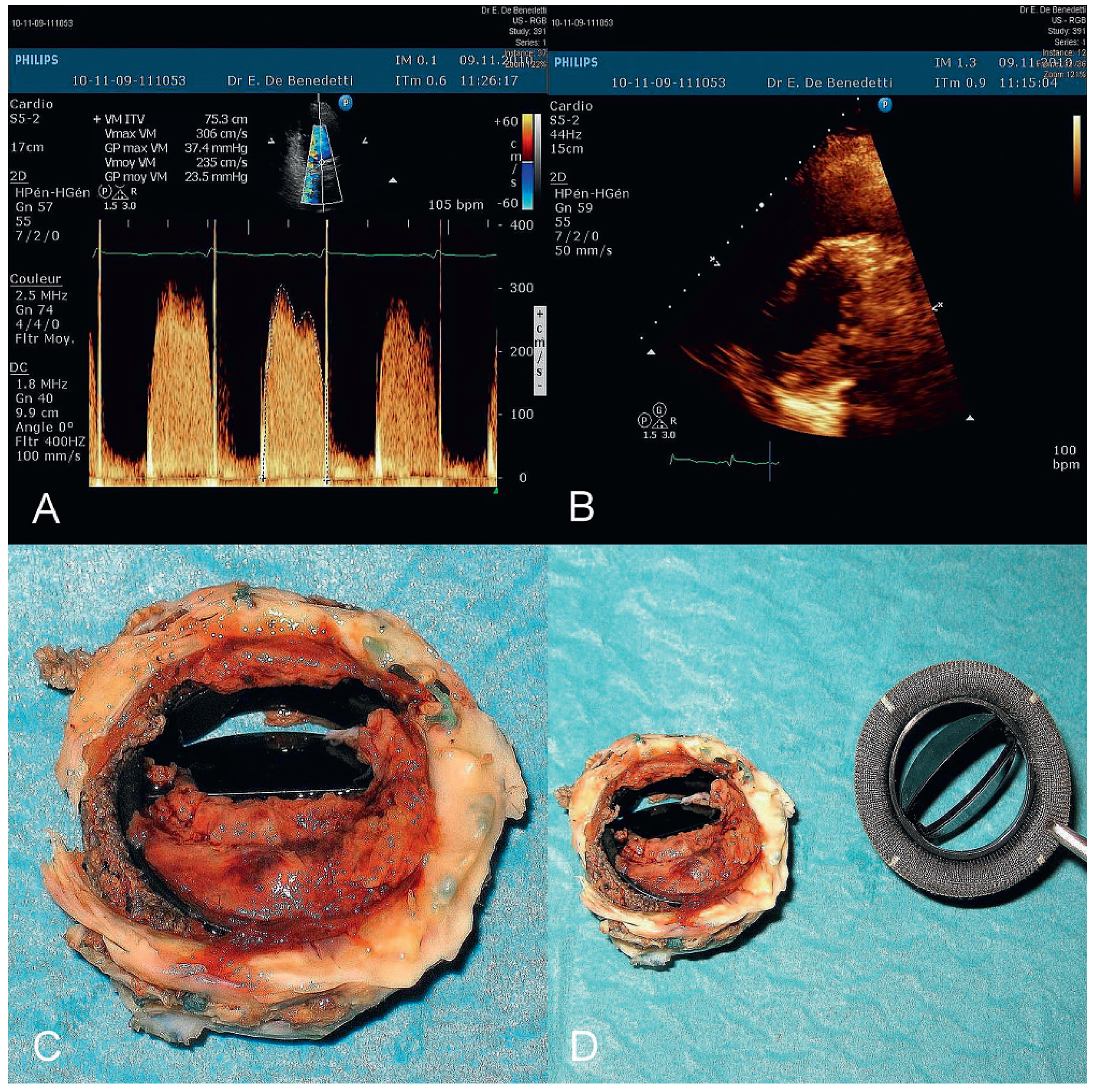
An immediate transthoracic echocardiography showed a marked increase of the gradient through the mitral prosthesis with a mean gradient of 23.5 mm Hg (Figure 1A), and a severe post-capillary pulmonary hypertension estimated at 69 mm Hg with a classical D-deformation of the interventricular septum (Figure 1B).
Figure 1.
(A) Mitral flow measured by pulsed Doppler (in apical four chamber view) showing a severe increase in the gradient through the mitral prosthesis (mean gradient at 23.5 mm Hg). (B) Parasternal view (short axis) of the left ventricle showing a typical D-deformation of the interventricular septum due to acute postcapillary systolic pulmonary hypertension (PAPs measured at 69.4 mm Hg). (C) Mechanical mitral valve after surgical extraction showing an extensive thrombosis with a complete blockage of one of the two leaflets. (D) On the left, there is the mechanical mitral valve with extensive thrombosis. On the right side, the new mechanical mitral valve before surgical implantation is shown.
The transesophageal echocardiography confirmed the diagnosis of valve thrombosis. Due to a rapid clinical deterioration and the left-sided location of the valve, the patient was transferred to the intensive care unit and underwent emergency replacement of the mitral prosthesis.
The surgeon found an extensive thrombosis (4 cm in diameter) of the mitral valve with a complete blockage of one of the two leaflets which stayed in a closed position (Figure 1C,D).
The post-operative course was uneventful and the patient is actually asymptomatic on regular anticoagulant treatment.
Funding/Potential Competing Interests
No financial support and no other potential conflict of interest relevant to this article were reported.
© 2011 by the author. Attribution - Non-Commercial - NoDerivatives 4.0.

