Next Article in Journal
Revidierte Schweizerische Richtlinien für Die Endokarditis-Prophylaxe
Previous Article in Journal
Von Gustav Mahlers «Maladie célèbre» zu den Modernen Endokarditis-Richtlinien
 
 
Cardiovascular Medicine is published by MDPI from Volume 28 Issue 1 (2025). Previous articles were published by another publisher in Open Access under a CC-BY (or CC-BY-NC-ND) licence, and they are hosted by MDPI on mdpi.com as a courtesy and upon agreement with Editores Medicorum Helveticorum (EMH).
Interesting Images

Insuffisance Mitrale: Apport de L’échographie Tridimensionnelle

by
Alain Delabays
*,
Mohamad Nasratullah
and
Xavier Jeanrenaud
Department of Cardiology, CHUV, Lausanne, Switzerland
*
Author to whom correspondence should be addressed.
Cardiovasc. Med. 2008, 11(12), 390; https://doi.org/10.4414/cvm.2008.01376
Submission received: 23 September 2008 / Revised: 23 October 2008 / Accepted: 23 November 2008 / Published: 23 December 2008

Case report

A 43-year-old man presented to the emergency department with palpitations. The ECG showed an atypical flutter with a 2:1 ventricular response rate. The patient experienced a spontaneous cardioversion and was prescribed a beta-blocking agent. He was sent for a cardiological evaluation 1 month later.
At that time, he had stopped his medication for two weeks and confessed a permanent arrhythmia for more than a week. He complained of dyspnoea on modest exertion like climbing stairs. The cardiac examination was impressive for an irregular tachyarrhythmia and a loud systolic murmur over the precordium, with maximal intensity in the apical region. There were no signs of left or right cardiac insufficiency. ECG showed an atypical flutter with an irregular ventricular response rate at approximatively 120 beats/min without signs of left ventricular hypertrophy or repolarisation abnormalities.
The transthoracic echocardiography confirmed the presence of a severe mitral regurgitation due to prolaps of the middle scallop of the posterior leaflet with ruptured chordae. The regurgitant orifice area was 1.5 cm2 using the PISA method. The left ventricle was not dilated nor hypertrophied with a preserved systolic function. Pulmonary systolic pressure was calculated at 30 mm Hg using the velocity of the tricuspid regurgitation jet.
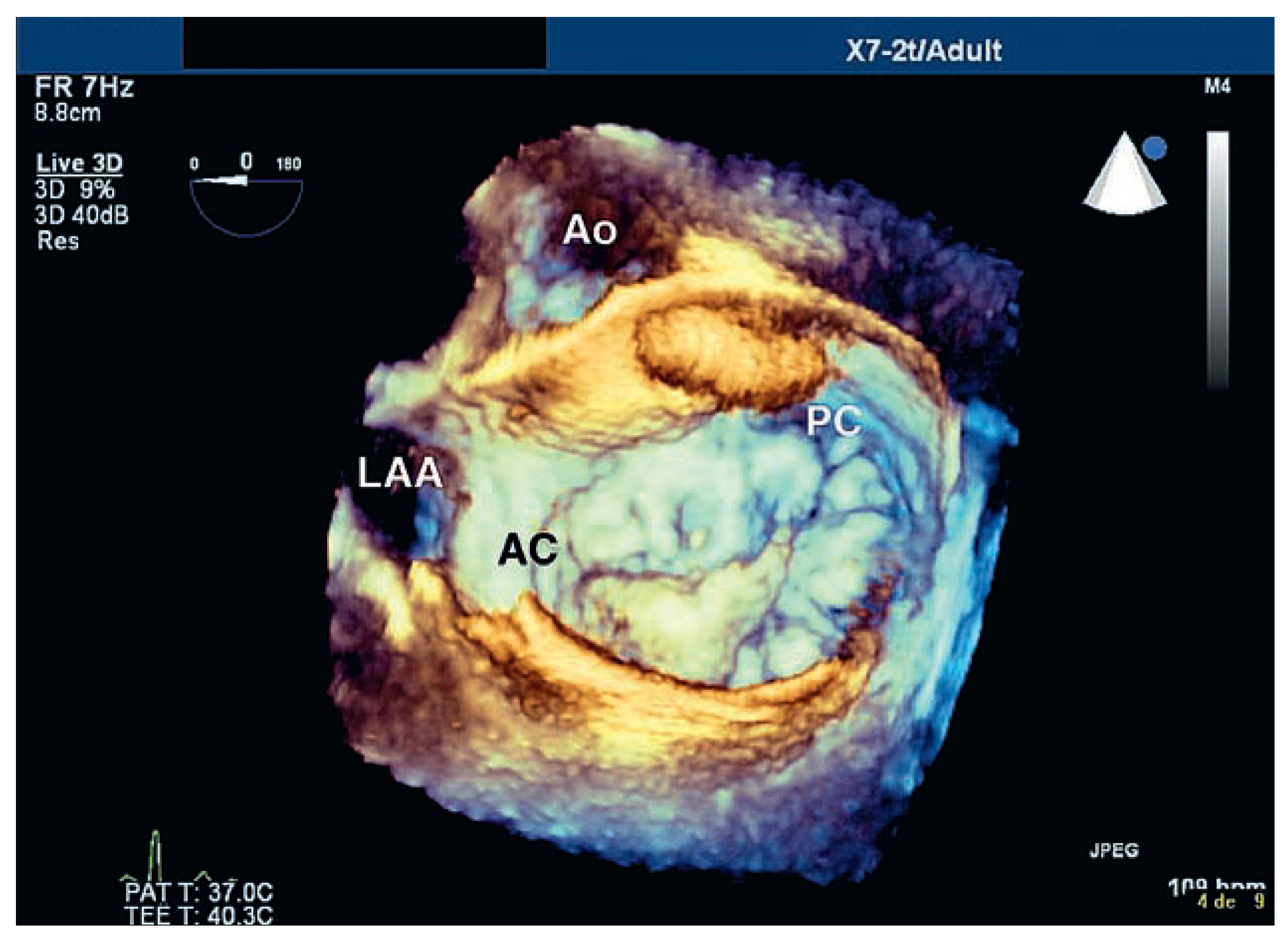
The patient was anticoagulated and prescribed metoprolol at increasing doses to control the ventricular response rate. A transoesophageal real-time 3 dimensional examination was undertaken as part of the preoperative evaluation. 2-dimensional views (fig. 1A–D) confirmed an extensive prolaps of the anterior and middle scallop of the posterior leaflet with ruptured chordae and severe consecutive regurgitation (effective regurgitant orifice area 1.7 cm2 by PISA). Real-time 3-dimensional views (fig. 2) nicely showed in one image the whole extension of the prolaps, which ultimately concerned mainly the anterior scallop with extension to the anterior portion of the middle scallop, with only a very limited juxtacommissural portion of preserved tissue. The size and shape of the regurgitant orifice could be well appreciated. Using a dedicated software (QLAB, Philipps Medical Systems), the mitral annulus and the leaflets could be reconstructed and quantified (fig. 3). Measurements like the various diameters of the annulus and its area, the area of the anterior and posterior leaflet, as well as the area of the prolapsing posterior leaflet could be obtained.
This imaging technique definitively refines our evaluation of mitral valve prolaps [1,2] and will provide cardiologists and cardiosurgeons with a lot of new informations to help them better plane mitral valve repair and also better understand failed mitral plasties.

Conflicts of Interest

There is no conflict of interest.

References

  1. Delabays, A.; Jeanrenaud, X.; Chassot, P.G.; Von Segesser, L.K.; Kappenberger, L. Localization and quantification of mitral valve prolaps using three-dimensional echocardiography. Eur J Echocardiography 2004, 5, 422–429. [Google Scholar] [CrossRef] [PubMed]
  2. Sugeng, L.; Shernan, S.; Salgo, Y.; Weinert, L.; Shook, D.; Raman, J.; et al. Live 3-dimensional transesophageal echocardiography: initial experience using the fully-sampled matrix array probe. J Am Coll Cardiol 2008, 52, 446–449. [Google Scholar] [CrossRef] [PubMed]
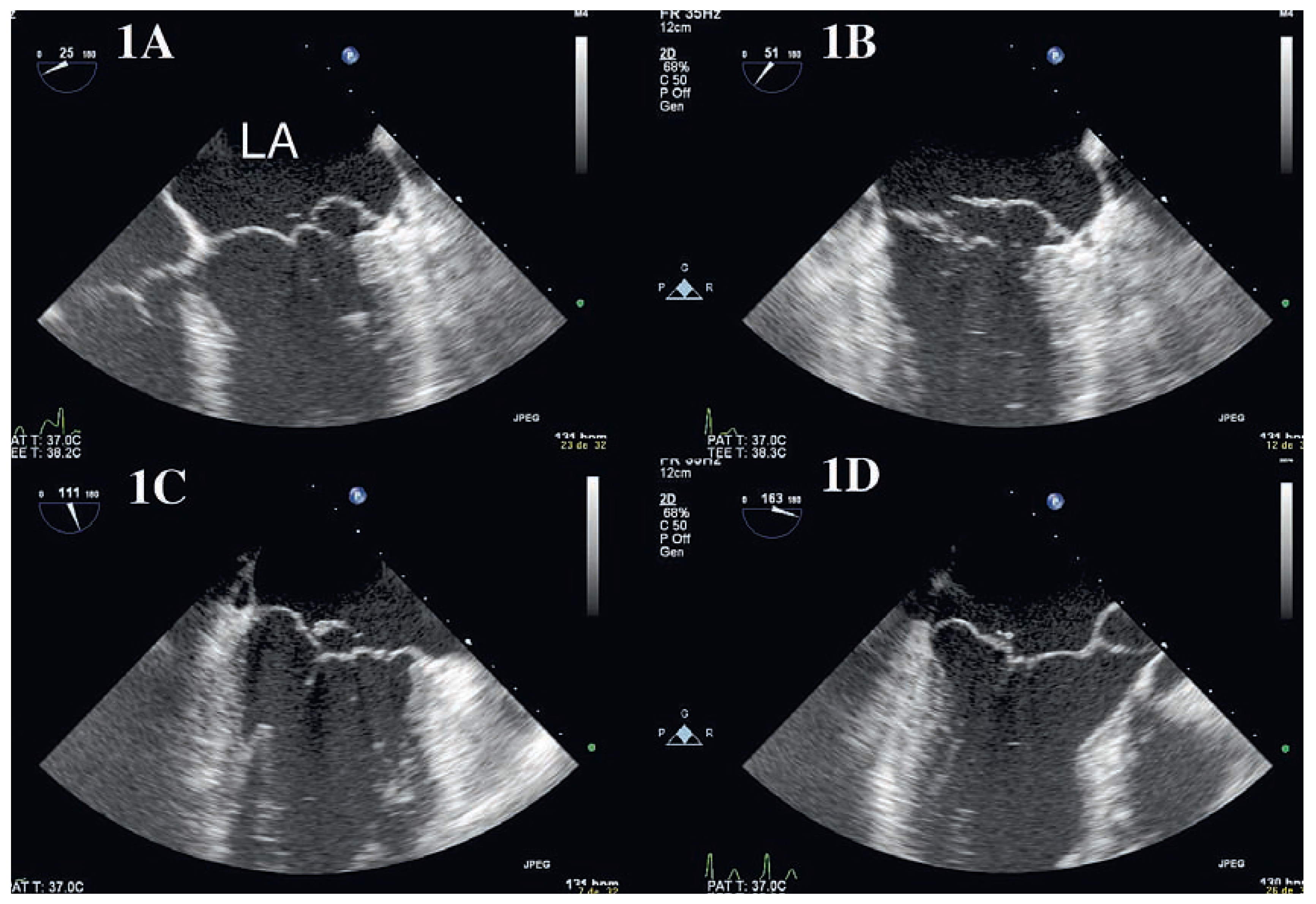
Figure 1. Standard TEE still frames in systole showing prolaps of the posterior leaflet at various rotational angles. By mentally positioning the cut-planes starting from a classical 4 chamber view (1A), the flail portion of the posterior leaflet can be localised to the anterior scallop (1B) with an extension toward the middle scallop (1A–C). LA = left atrium.
Cardiovascmed 11 00390 g001
Figure 2. 3D TEE view at the mitral valve, viewed from the left atrium. The extension of the flail portion of the posterior leaflet from the anterior commissure (AC) towards the middle scallop is well delineated. This so-called “unroofed view” of the mitral valve allows the surgeon to evaluate the pathology as if he had just opened the left atrium. PC = posterior commissure; Ao = aorta; LAA = left atrial appendage.
Cardiovascmed 11 00390 g002
Figure 3. Schematic representation of the mitral annulus, mitral valve leaflets and aortic annulus after tracing of these structures in the 3D data set using a dedicated software. Size, shape and various diameters of the annulus are computed. The angle between mitral and aortic annulus is illustrated. The area of the anterior and posterior mitral valve leaflets are calculated. Portions of leaflets above the plane of the annulus (prolapsing) are colorised in red and portions below the plane of the annulus (tenting) are shown in blue. The coaptation line is depicted in yellow. A = anterior; P = posterior; Ao = aorta; AL = antero-lateral; PM = postero-medial.
Cardiovascmed 11 00390 g003