1. Introduction
Over the years, the demand for agricultural food products has increased considerably. To meet this growing demand, agricultural production has been forced to intensify. However, the high production volumes, combined with stringent market quality standards, result in large amounts of by-products, commonly classified as agricultural residues or biomass. Among horticultural crops facing this challenge, eggplant (
Solanum melongena L.) represents a particularly relevant case due to its large-scale global production and the substantial proportion of non-commercial or processing-derived fractions generated along the value chain. According to the most recent data from the Food and Agriculture Organization of the United Nations (FAOSTAT database), global eggplant production reached approximately 92 million tons in 2024, with China and India accounting for the largest share of total output [
1]. Considering that fruit and vegetable processing can generate between 35–55% of total biomass as by-products (Depending on the region in the world, in addition to the accumulation of losses due to agriculture, post-harvest, processing, distribution, and consumption), this production scale implies the generation of millions of tons of underutilized eggplant residues annually [
2]. In most cases, these by-products receive little or no added value and are therefore improperly disposed of through practices such as open-field burning, discharge into water bodies, or soil compaction. Consequently, many of these residues are considered waste, leading to various environmental problems, including soil, water, and air pollution, as well as the spread of diseases [
3,
4].
Agricultural by-products can be broadly classified into two major groups: (i) crop residues left in the field, resulting from damage caused by pests and diseases, adverse abiotic factors, or economically unsustainable market prices for the harvest; and (ii) residues generated during the processing of agricultural products, arising from improper harvesting practices, pest or disease damage, or the failure to meet strict quality criteria related to size, shape, color, and weight. In both cases, these types of agricultural biomass are produced in large quantities, and their potential for utilization remains largely underexploited [
4].
To mitigate the negative effects of large-scale production of agricultural by-products classified as biomass, regulatory institutions have implemented management strategies to improve their handling and utilization. Among these approaches, the biomass valorization pyramid has been proposed as a framework to promote the production of high-value-added products from agricultural biomass, thereby contributing to the principles of the circular economy [
4,
5].
The recovery of bioactive compounds from diverse plant matrices, including stems, leaves, fruits, roots, flowers, peels, and seeds, is recognized as a primary route for valorizing agricultural biomass into high-value-added products. A broad spectrum of biological activities has been reported for these constituents, including phenolics, alkaloids, and terpenes. Furthermore, these metabolites demonstrate significant therapeutic potential for human health, and many are considered nutraceutical agents [
5].
Among plant-based nutraceutical sources, eggplant stands out for its high bioactive potential. The chemical composition of eggplant vegetative tissues has been characterized, with fruits exhibiting the highest concentrations of bioactive compounds and antioxidant capacity. Chlorogenic acid and its derivatives are the predominant phytochemicals and exhibit multiple health-promoting effects. However, recent studies have demonstrated their prominent role as anticancer agents, showing significant antiproliferative effects in various cancer cell lines [
6,
7,
8,
9,
10].
Additionally, eggplant peel—one of the main agro-industrial by-products—is particularly rich in phenolic compounds. Optimized enzyme-assisted extraction processes have reported total extract yields of up to ≈71.5%, with total phenolic contents around 2040 mg GAE L
−1 and anthocyanin concentrations near 578 mg C3G L
−1 [
11]. Furthermore, multi-frequency ultrasound extraction systems have demonstrated increases of 18–24% in total phenolic recovery compared with conventional extraction techniques, highlighting the technological feasibility and efficiency of valorizing eggplant biomass for the recovery of high-value compounds [
12].
Whole eggplant fruit biomass (peel and pulp combined) was selected as a sustainable valorization strategy to maximize the recovery of hydrophilic bioactive compounds from the complete edible matrix while avoiding additional fractionation processes that may increase processing costs, energy consumption, and agroindustrial waste generation. This approach aligns with circular economy principles focused on the integral utilization of horticultural biomass and agricultural residues. Although anthocyanins are mainly localized in the thin outer peel, the large pulp proportion characteristic of American/oblong eggplant varieties substantially dilutes their concentration in the whole biomass. In agreement with our previous metabolomic analysis [
6], the hydrophilic profile of these residues is predominantly composed of phenolic compounds such as chlorogenic, quinic, caffeic, and ferulic acids, whereas anthocyanins are present at comparatively low levels. Therefore, the present study focused on the characterization and evaluation of these predominant phenolic compounds.
Generally, the bioactivity of phenolic compounds in human health depends on their bioaccessibility and bioavailability, meaning the compounds that are available at the gastrointestinal tract and reach the bloodstream, respectively. In this sense, phenolic compounds have low bioavailability as most are degraded during gastrointestinal digestion. Therefore, in vitro models are used to assess their bioaccessibility, i.e., the fraction of compounds released in the intestinal phase [
13,
14].
The encapsulation process has been used in diverse research to improve the stability of bioactive compounds during storage and digestion. One of the most widely used techniques is microencapsulation, with spray drying being the most common due to its easy operation, low cost, and high efficiency in protecting bioactive compounds [
15,
16].
Although eggplant has been widely recognized for its bioactive potential, research has predominantly focused on peel-derived anthocyanins, often overlooking the valorization of the entire fruit biomass and agricultural residues that remain unharvested or are discarded in the field. As a result, the contribution of other phenolic compounds, particularly chlorogenic acid, which constitutes one of the major phenolics in eggplant tissues, has been comparatively underexplored. This represents an important opportunity for the sustainable utilization of eggplant biomass and the generation of value-added ingredients. Additionally, limited information is available regarding the preservation of these compounds through microencapsulation and the evaluation of their bioaccessibility, permeability, and biological activity following simulated gastrointestinal digestion. Therefore, the present study aimed to valorize eggplant fruit biomass through the development and optimization of a spray-dried microencapsulated hydrophilic extract and to evaluate its antioxidant capacity, bioaccessibility, permeability, and antiproliferative potential using in vitro models.
2. Materials and Methods
2.1. Materials
The following were used: Distilled water, methanol 100% (CTR Scientific, Monterrey, Nuevo Leon, Mexico), MDR (resistant maltodextrin, Fibersol-2) (Now foods, Bloomingdale, IL, USA), sodium hydroxide (Faga Lab, Mocorito, Sinaloa, Mexico), hydrochloric acid (Fermont, Monterrey, Nuevo Leon, Mexico), sodium chloride (J.T.Baker, Ecatepec, Estado de Mexico, Mexico). GA (Gum arabic 91%), PEC (Citrus peel pectin 85.3%), Folin–Ciocalteu reagent 2 M, sodium carbonate 99.5%, ammonium salt of 2,2-azinobis(3-ethylbenzothiazoline-6-sulfonic acid) 100% (ABTS), potassium persulfate 99.99%, 2,2-azobis(2-amidinopropane) dihydrochloride 99.78% (AAPH), fluorescein 93.4%, chlorogenic acid 97%, ferulic acid 99%, gallic acid 99%, quinic acid 98%, and caffeic acid 98%, 6-hydroxy-2,5,7,8-tetramethylchroman-2-carboxylic acid 99.5% (Trolox), human salivary α-amylase 1295 units/mg protein, porcine pepsin 541 units/mg protein, pancreatic lipase 640 units/mg protein, porcine pancreatin 8 X USP specifications, calcium chloride 97%, sodium bicarbonate 99.9%, potassium chloride 99.9%, magnesium chloride 100%, ammonium carbonate 35%, monopotassium phosphate 100%, all those material were acquired from Sigma-Aldrich, St. Louis, MO, USA. The cell lines Caco2 (human non-metastatic colon adenocarcinoma), FHC (normal human large intestine epithelial cells), and HCT 116 (long intestine epithelial cells; colon carcinoma) were purchased from ATCC (Manassas, VA, USA).
2.2. Collection and Processing of Biomass of Eggplant
Eggplant fruits named commercially Classic or American were collected randomly at the following coordinates: N24.6642637, W-107.590086 in June 2023, from a farm in Navolato, Sinaloa, Mexico. At the time of collection, the plants had been without irrigation for 4 days and without fertilization for 13 days. The fruits were washed with potable water, disinfected with sodium hypochlorite (50 ppm), then frozen at −18 °C, freeze-dried at −50 °C and 0.080 mbar for 6 days, followed by grinding in an Ika Werke M20 mill (Wilmington, NC, USA) and sieving through a 40-mesh sieve. Finally, the fruit powder was stored for future use.
2.3. Extraction of Hydrophilic Compounds
The extraction was carried out by macerating 1.5 g of fruit powder with 30 mL of absolute methanol. Methanol was selected due to its high efficiency for recovering hydrophilic phenolic compounds and its widespread use in analytical phytochemical studies aimed at maximizing extraction yield and metabolite profiling. The present study focused on evaluating the bioactive and functional properties of the extract at an experimental level rather than developing a directly food-grade formulation. The mixture was homogenized and agitated at 250 rpm for 24 h, then centrifuged at 10,000 rpm for 10 min at 4 °C. The solvent-to-solid ratio used during extraction was established through preliminary exploratory assays. Higher biomass concentrations generated excessive saturation of the extraction medium, limiting adequate agitation and sample homogenization. Therefore, the selected ratio was chosen to ensure appropriate mixing and efficient solvent interaction with the biomass matrix. The remaining extraction conditions, including extraction time, temperature, and agitation parameters, were selected according to Contreras-Angulo et al. [
6]. The supernatant was recovered and concentrated using a SpeedVac SyncorePlus Polyvap system (BÜCHI Labortechnik AG, Uster, Switzerland) at 40 °C, 100 mbar, and 230 rpm until no further solvent condensation was visually observed. To further promote methanol removal, the system was operated for additional time under lower-pressure conditions. Subsequently, the obtained extract was dried in an oven at 40 °C for 24 h to minimize the possibility of residual solvent presence. This temperature was selected because it does not significantly affect the stability of the evaluated phenolic compounds. Finally, the dry extract of eggplant fruit (EEF) was resuspended in 20 mL of distilled water and stored at −18 °C for future use [
6].
2.4. Microencapsulation Process by Spray Dryer
The microencapsulation process was carried out according to Bernal et al. [
17] and To et al. [
18], with slight modifications. The wall materials used for microencapsulation were selected based on their complementary functional properties during spray drying and their compatibility with food-related applications. MDR was selected due to its high solubility, low viscosity, good drying performance, and additional potential as a non-digestible dietary fiber with prebiotic functionality. GA was incorporated because of its emulsifying properties and its ability to improve the protection and stability of bioactive compounds during atomization and storage. PEC was included due to its film-forming capacity, biocompatibility, and potential contribution to controlled release and stabilization of hydrophilic compounds. The combination of these wall materials provides favorable physicochemical characteristics for microcapsule formation and has broad applicability in food and nutraceutical systems. The wall material consisted of 16.828 g of MDR (87.96%), 2.008 g of GA (10.5%), and 0.2962 g of PEC (1.54%), totaling 19.1322 g. The mixture was homogenized on a Cimarec stirring plate (Thermo Scientific, Waltham, MA, USA) at 900 rpm and heated to 60 °C until completely dissolved. It was then continuously stirred without heating until cooled to 40 °C, at which point the EEF was incorporated and stirred for 30 min to achieve homogeneity. The final mixture was subsequently processed using a Spray Dryer ADL311S (Yamato, Tokyo, Japan) under constant encapsulation conditions: A feed flow rate of 5.5 mL/min and an air flow rate of 0.42 m
3/min.
2.5. Microencapsulation Optimization
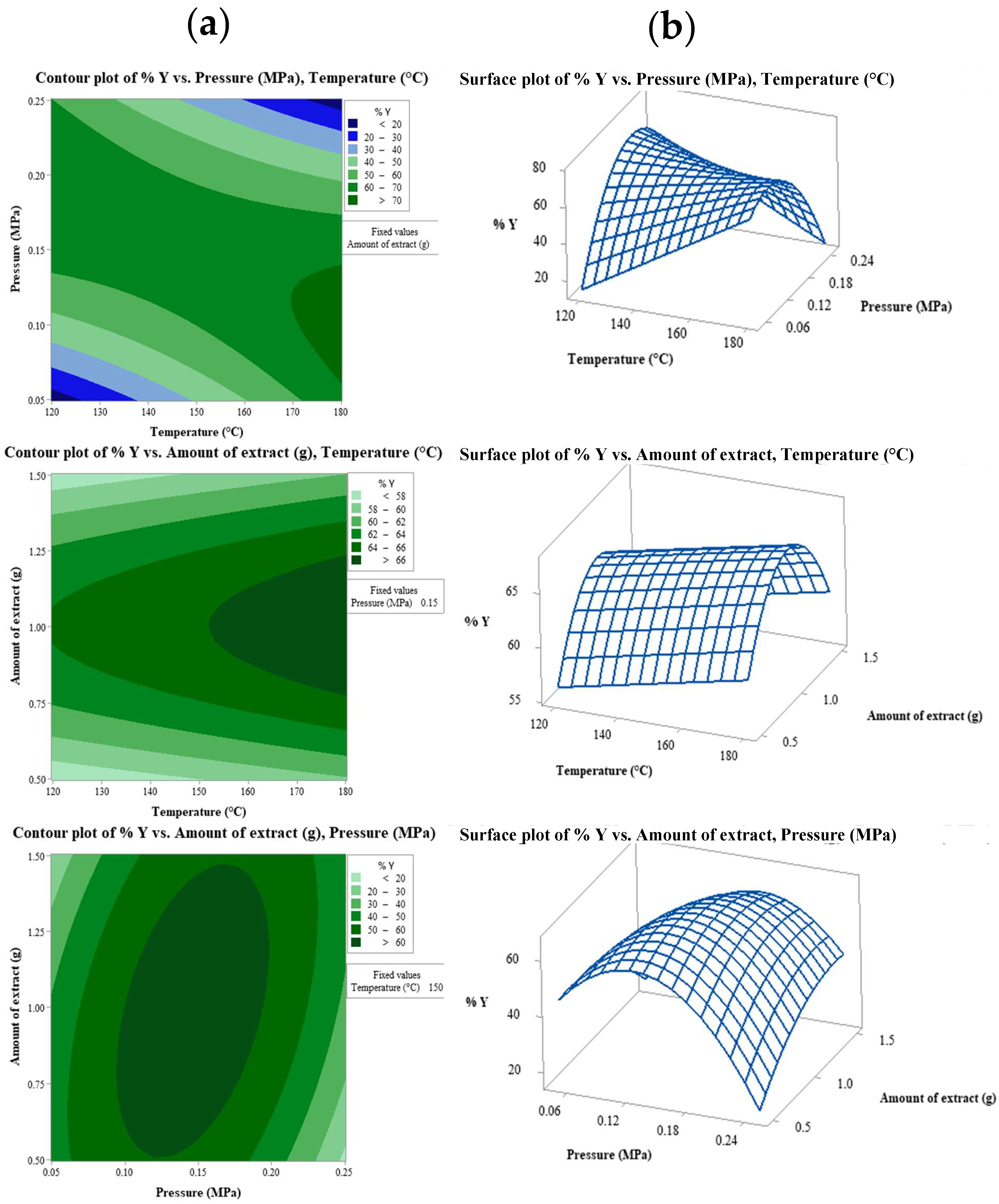
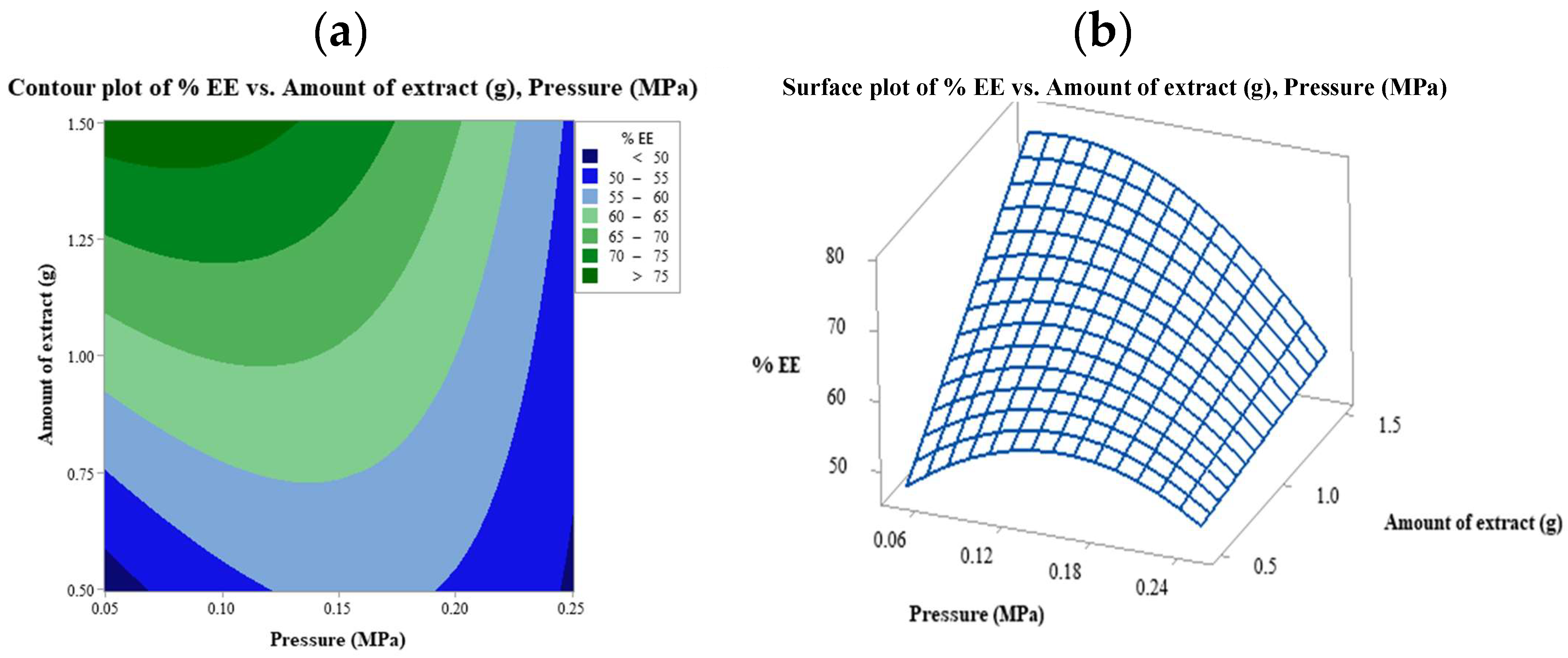
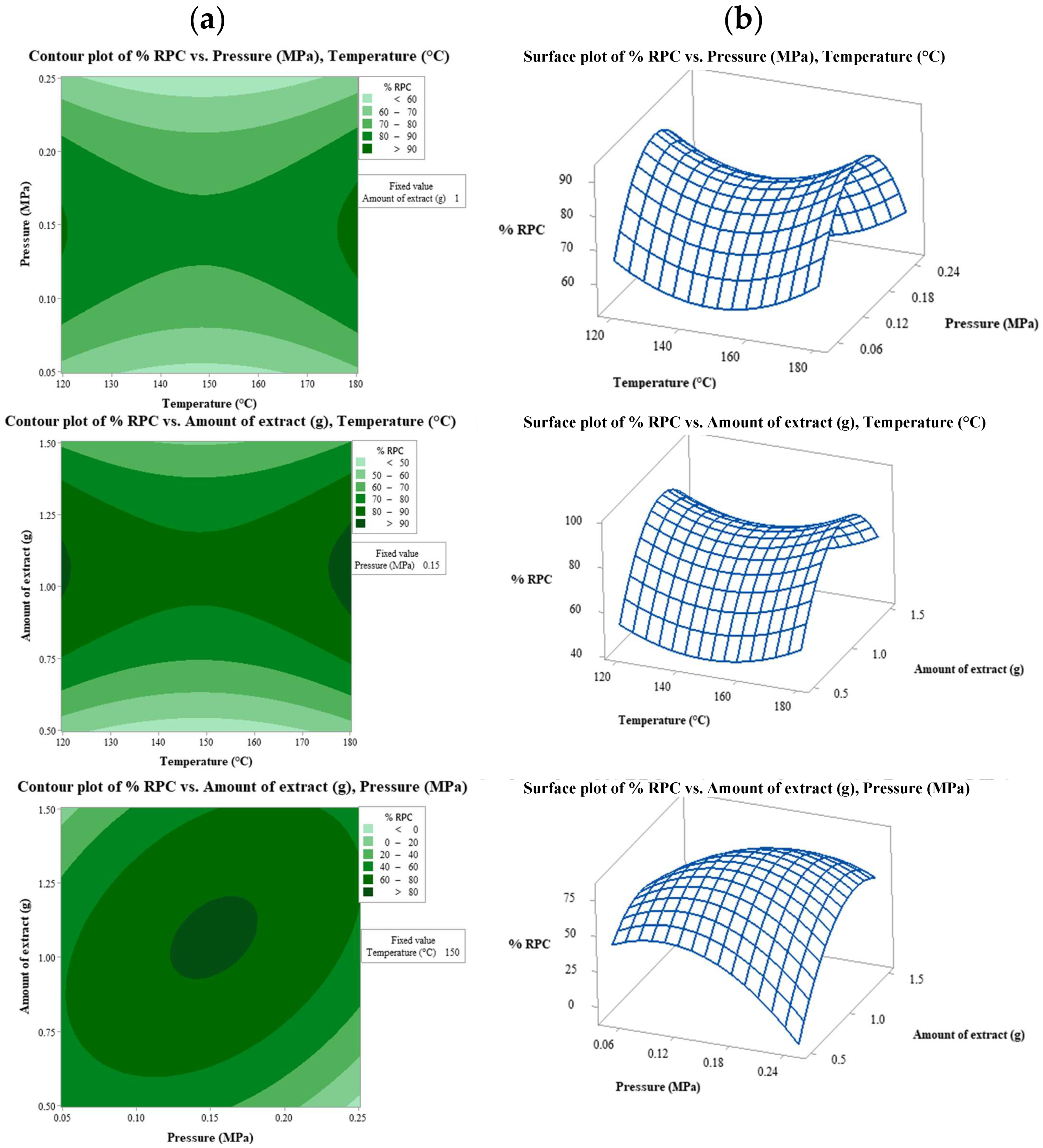
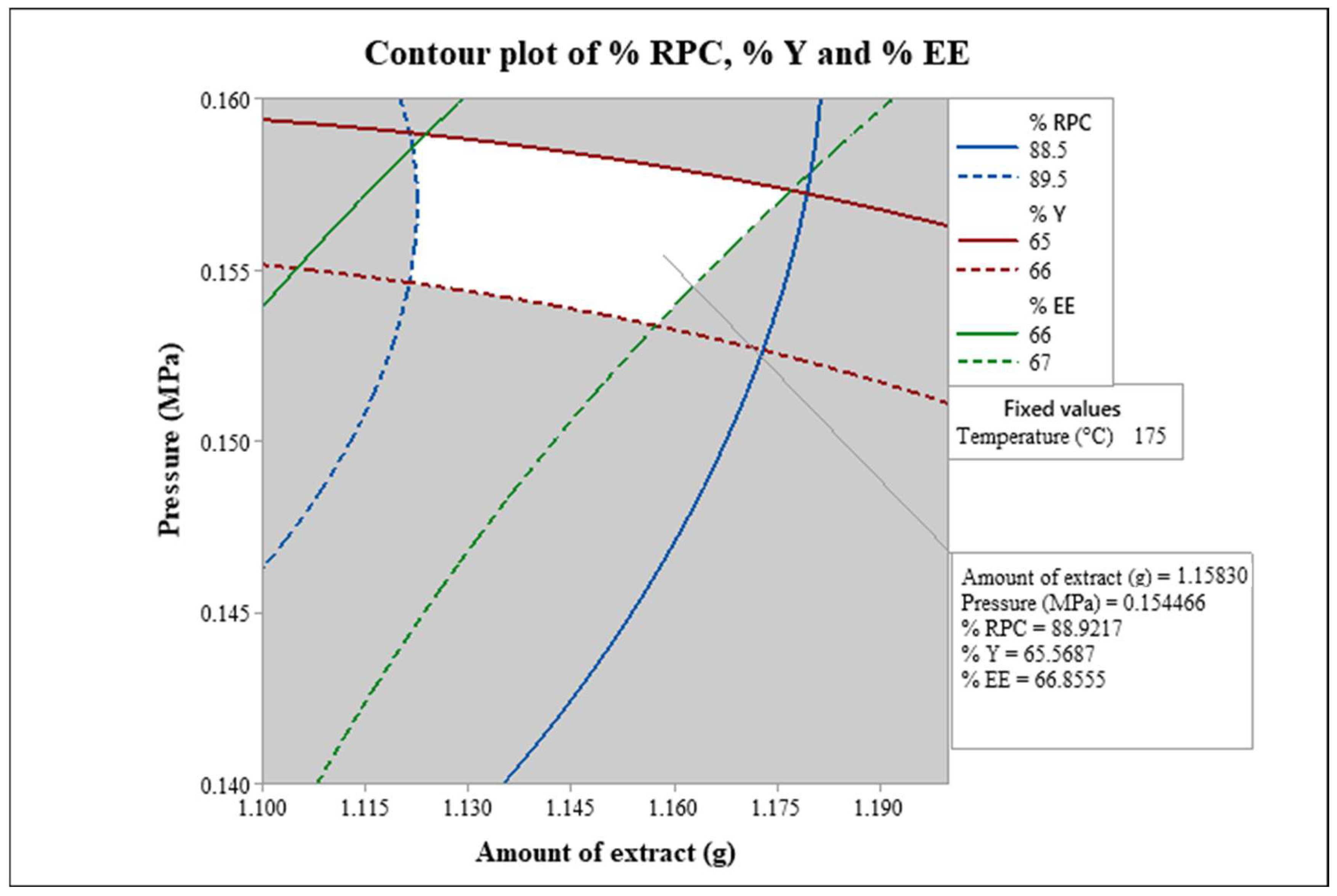
To optimize MDR-GA-PEC microparticles loaded with EEF, a central composite rotatable design of response surface methodology (RSM) was used. The factors considered were Inlet Temperature (°C), Pressure (MPa), and Amount of extract (g). The evaluated ranges included in the spray-drying optimization design were established based on preliminary exploratory assays and operational constraints associated with the encapsulation equipment. These preliminary evaluations allowed the identification of experimentally feasible conditions for microcapsule formation and process stability prior to optimization through RSM. The goal was to maximize the response variables of % encapsulation efficiency (EE), % yield (Y), and % retention of phenolic compounds (RPC). The recovered powders were stored in resealable bags at 4 °C for subsequent analyses.
% EE, % Y, and % RPC were calculated using the following equations:
where TPC = Total phenolic compounds (mg/g powder); SPC = Surface phenolic compounds (mg/g powder); WM = Wall material (mg/g powder).
where %EE represents encapsulation efficiency, calculated as the percentage of phenolic compounds retained within the microparticles relative to the total phenolic compounds present in the system; %Y corresponds to the encapsulation yield, determined as the percentage ratio between the recovered powder and the total solids introduced into the spray-drying system; and %RPC represents the retention percentage of phenolic compounds after spray drying relative to the initial phenolic content before encapsulation.
An optimal region was sought in which all response variables are maximized, achieved using the optimizer function (maximize) and the contour overlay. After the final model prediction, the optimal conditions of the process variables were replicated 4 times to subsequently evaluate the response-variable data, with which a t-student test was performed to verify if there is a significant difference or not, where if the model is adequate and reproducible, there should be no significant difference between the experimental data and the optimization prediction [
18].
2.6. Total and Surface Phenolic Compounds
Total phenolic compounds determination in the microencapsulated powder followed the methodology described by To et al. [
18]. Briefly, 200 mg of microencapsulated powder was dissolved in 2 mL of distilled water and agitated for 3 min to ensure complete and homogeneous release, after which the solution was analyzed using the Folin–Ciocalteu method.
To quantify surface compounds not retained within the microparticles, 200 mg of microencapsulated powder was dissolved in 2 mL of a 50:50 methanol-ethanol solution, and the mixture was agitated for 1 min to wash the microparticles. The mixture was then allowed to stand, enabling the separation of the microparticles from the supernatant containing the surface compounds [
19]. The supernatant was subsequently analyzed using the Folin–Ciocalteu method. In both cases, the results were expressed as mg chlorogenic acid equivalents per gram of sample (mg CAE/g sample).
2.7. In Vitro Release Assay of Encapsulated Compounds
The % release of hydrophilic compounds loaded in the microparticles was performed using the method described by da Silva et al. [
20] with slight modifications. A total of 2.5 g of microparticles was dispersed in 25 mL of distilled water, and the solution was agitated at 100 rpm on a stirring plate (Thermo Scientific Cimarec, Waltham, MA, USA). Aliquots of 500 µL were taken at 5 min intervals for 1 h, and the volume was replaced with distilled water. The aliquots were centrifuged at 9000 rpm at 4 °C for 10 min. The supernatant was recovered, and the phenolic compounds released over time were determined using the Folin–Ciocalteu method.
2.8. Morphological Evaluation by SEM
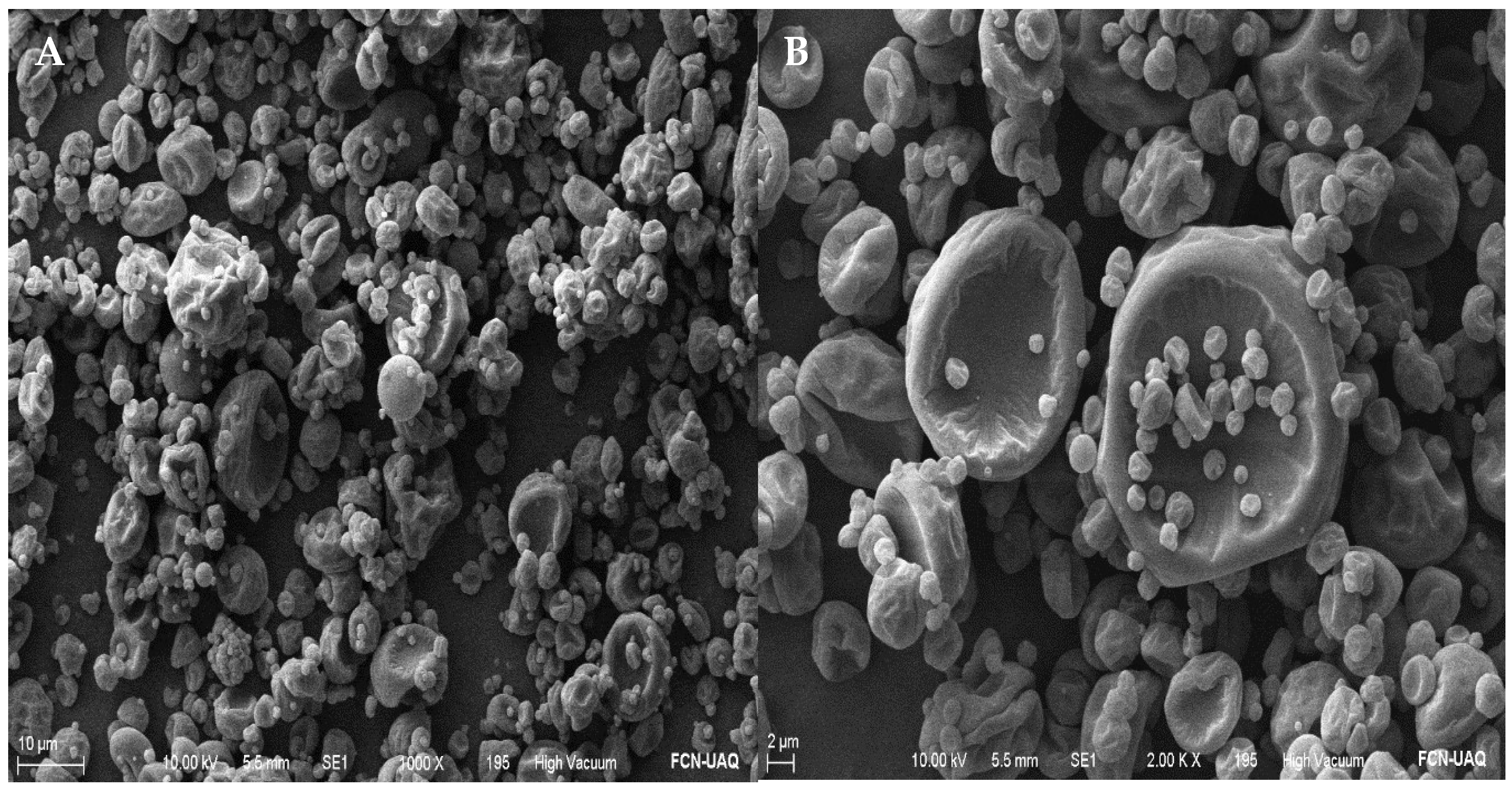
The morphology of the microparticles was analyzed using an environmental scanning electron microscope (SEM model EVO-50, Carl, Zeiss, Oberkochen, Germany). The sample was placed on a sample holder using double-sided carbon tape. Observation was conducted under high-vacuum conditions, using a secondary electron detector and an acceleration voltage of 10–15 kV (magnifications ×2000 and ×4000). Particle sizes were determined using ImageJ software (Version 1.46r, National Institutes of Health, Bethesda, MD, USA), where average diameters (µm) were measured for approximately 450 microparticles, which varied in three sizes, and the data were presented as mean ± standard deviation.
2.9. Moisture Content
The moisture content of the microencapsulated powders was determined by gravimetric analysis using the AOAC 925.09 method [
21]. A 1 g sample was dried in a forced-air oven at 110 °C for 24 h. The results were reported as a percentage (%).
2.10. Bioaccessibility
An in vitro static simulated gastrointestinal digestion (SGD) model was performed according to Brodkorb et al. [
22], with some modifications. This static in vitro digestion model (INFOGEST method) was selected because it reproduces key physiological gastrointestinal conditions, including oral, gastric, and intestinal pH transitions, digestive enzymes, incubation temperature, the chemical composition of digestive juices, and gastrointestinal residence times. These conditions allow the evaluation of the stability and release of phenolic compounds during gastrointestinal transit. For the preparation of digestive juices, stock solutions of salt (
Table S1) and digestive enzymes (
Table S2) were prepared. The SGD (
Table S3) was performed for the free extract, microencapsulated extract, control digestive juices without sample, and the wall material mixture. For SGD, 0.084 g of free extract and 1 g of microencapsulated powder were weighed and then digested as follows: The oral phase began with the addition of salivary amylase and oral fluid, incubated for 3 min at 37 °C and pH 7.0; then the gastric phase continued, adding gastric juice, pepsin, and lipase, incubated for 2 h at 37 °C and pH 3.0. Finally, the intestinal phase consisted of adding intestinal juice and pancreatin to the mixture, followed by incubation at 37 °C for 2 h at pH 7.0. At the end of the SGD, the samples were centrifuged at 10,000 rpm, 4 °C for 15 min, and the supernatant (digesta) was freeze-dried at −52 °C, 0.080 mbar, and stored at −18 °C for subsequent analysis.
2.11. Determination of Total Reducing Capacity (TRC)
The TRC was determined by the Folin–Ciocalteu method. In a 96-well plate, 10 µL of sample was added, followed by 230 µL of distilled water and 10 µL of 2 N Folin–Ciocalteu reagent. The mixture was incubated for 3 min, then 25 µL of 4 N sodium carbonate (Na
2CO
3) was added and incubated for 2 h at 25 °C. Finally, the absorbance of the samples was measured at 725 nm using a Synergy HT microplate reader (BioTek Instruments, Inc., Winooski, VT, USA) [
23]. The results were expressed in mg CAE/g sample.
2.12. Trolox Equivalent Antioxidant Capacity (TEAC) Assay
The assay is based on the inhibition of the ABTS* radical by antioxidants present in the sample. The ABTS radical was prepared using 7.4 mM ABTS and 2.6 mM potassium persulfate (K
2S
2O
8). Subsequently, the working solution was prepared by dissolving the radical in ethanol for extract evaluation and in water for microencapsulation, ensuring ethanol does not interfere with the wall material. In a 96-well plate, 10 µL of the sample and 190 µL of ABTS* radical were added, then incubated for 2 h at room temperature in the absence of light. Absorbance was measured at 734 nm using a Synergy HT microplate reader (BioTek Instruments, Inc., Winooski, VT, USA) [
24]. The results were expressed as millimoles of Trolox equivalents per gram of sample (mmol TE/g sample).
2.13. Oxygen Radical Absorbance Capacity (ORAC) Assay
The ORAC assay was conducted as described by Huang et al. [
25]. In a 96-well plate, 25 µL of the sample was combined with 150 µL of 0.96 µM fluorescein, followed by the addition of 50 µL of 95.8 µM AAPH. Absorbance was measured over 70 min at 70 s intervals at wavelengths of 485 nm and 528 nm using a Synergy HT microplate reader (BioTek Instruments, Inc., Winooski, VT, USA), with phosphate buffer as the blank. Results were expressed as µmol TE/g sample.
2.14. Cell Permeability Assay (Transwell)
The cell permeability assay was conducted following the methodology described by Pacheco-Ordaz et al. [
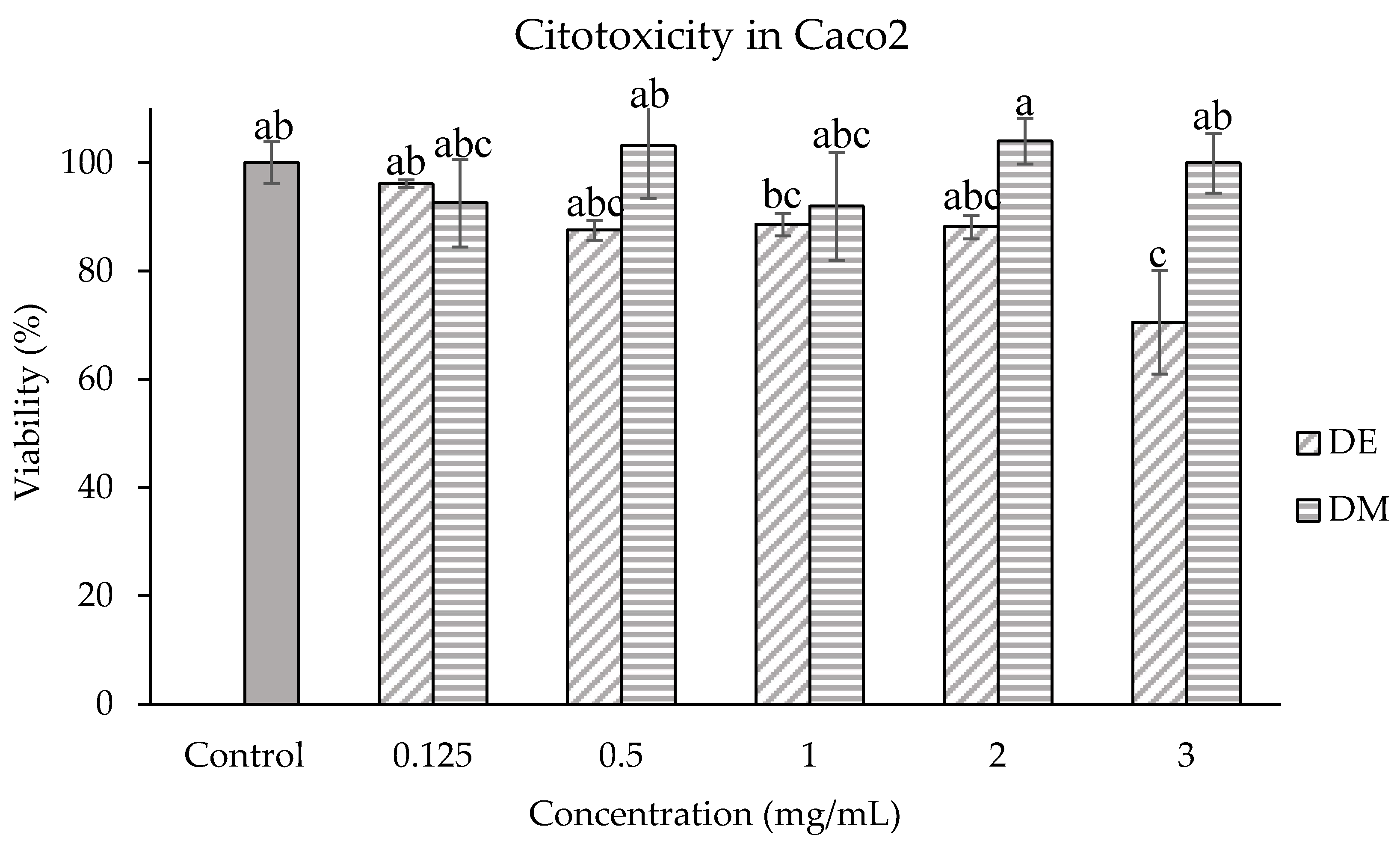
26]. Before performing the permeability test, the viability of Caco2 cells was assessed to determine the maximum concentration that did not compromise metabolite passage. Initially, Caco2 cells were seeded in 12-well plates at a density of 1 × 10
5 cells/insert in Transwell inserts (polycarbonate membrane, 12 mm inner diameter, 1.12 cm
2 growth surface, and 0.4 µm pore size, Corning
®). For cell growth, 1.5 mL of medium (DMEM-F12, 5% fetal bovine serum, and 1% antibiotic) was added to the basal compartment and 0.5 mL of cell suspension to the apical compartment. Incubation conditions were at 37 °C with 5% CO
2. Cells were allowed to grow and differentiate into a monolayer over 21 days. After that period, the medium was removed (from both apical (AP) and basolateral (BL)), and the monolayer was washed with Hank’s balanced salt solution. The digests (digested free extract (DE) and digested microencapsulated (DM)) were diluted in Hank’s balanced salt solution and placed in the apical compartments of the Caco2 monolayers. The experiment was conducted over 120 min, with 300 µL samples collected from each well in the BL compartment at intervals of 30, 60, 90, and 120 min. Additionally, 200 µL of Hank’s balanced salt solution was added to maintain the medium volume. Samples were lyophilized for subsequent analysis by UPLC coupled to an Xevo TQ-S mass spectrometer Waters Corporation, Milford, MA, USA) to quantify the bioactive compounds that permeated.
To assess monolayer integrity, 0.4 mL of lucifer yellow (LY, 100 µM) solution was added to the AP compartment, while Hank’s balanced salt solution was placed in the BL compartment. After a 2 h incubation, 100 µL samples were collected from both compartments and transferred to a 96-well plate. Fluorescence was then measured at 530 nm (emission) and 485 nm (excitation) using a Synergy HT microplate reader (BioTek Instruments, Inc., Winooski, VT, USA). The permeability coefficient (Papp) was used to determine LY permeability and monolayer integrity, calculated using the following equation:
where dQ/dt is the change in drug concentration in the receptor solution (μM/s), V is the volume of the BL solution (mL), A is the membrane surface area (cm
2), and C
0 is the initial concentration in the AP compartment (μM). The Papp of LY should be less than 1 × 10
−6 cm/s for intact membranes. A standard curve of LY was used to determine its concentration in the samples.
2.15. Characterization of Free and Microencapsulated Extracts by Ultra-Performance Liquid Chromatography–Mass Spectrometry–Triple Quadrupole (UPLC-MS-TQ)
The identification and quantification of polyphenols in the EEF, both free and microencapsulated, were carried out using a UPLC class H coupled to an Xevo TQ-S mass spectrometer (Waters Corporation, Milford, MA, USA) using an ACCQ TAG ULTRA C18 column (1.7 µm, 2.1 × 100 mm) with a 10 µL injection volume. Phenolic compounds were separated using a gradient elution of solution A (Acetonitrile + 0.1% formic acid) and solution B (5 mM ammonium formate, pH 3.0) at a flow rate of 0.3 mL/min. The gradient elution procedure was as follows: 0 min, 10% (A), 90% (B); 0.5 min, 10% (A), 90% (B); 5 min, 90% (A), 10% (B); 5.1 min, 90% (A), 10% (B); 8 min, 10% (A), 90% (B). Compound ionization was achieved via electrospray ionization with the following parameters: capillary voltage of 3.21 kV, sampling cone voltage of 30 V, desolvation gas flow rate of 650 L/h, and temperature of 400 °C. A collision energy ramp of 10–75 V was employed. Identification was performed using retention time and MRM transitions, and quantification was achieved using calibration curves with standards of phenolic acids, including chlorogenic, ferulic, gallic, quinic, and caffeic acids, to compare the area under the curve of the obtained peaks. Data were expressed as mean ± standard deviation with three replicates, and results were presented in µg/g of sample.
2.16. Cell Viability Assay
For viability assays, FHC cell line was cultured in DMEM-F12 supplemented with 10% fetal bovine serum and 1% antibiotics. Cells were incubated at 37 °C with 5% CO2 until they reached confluence. Viability was evaluated using two cell proliferation methods: the Celltiter 96® kit for the FHC cell line.
Cell viability for the FHC cell line was evaluated using the method outlined by Pacheco-Ordaz et al. [
26], with minor modifications. The Celltiter reagent reacts with dehydrogenase enzymes in viable cells, producing a soluble colored formazan whose absorbance is measured with a Synergy HT microplate reader (BioTek Instruments, Inc., Winooski, VT, USA). Initially, 200 µL of FHC cells were seeded at a density of 2 × 10
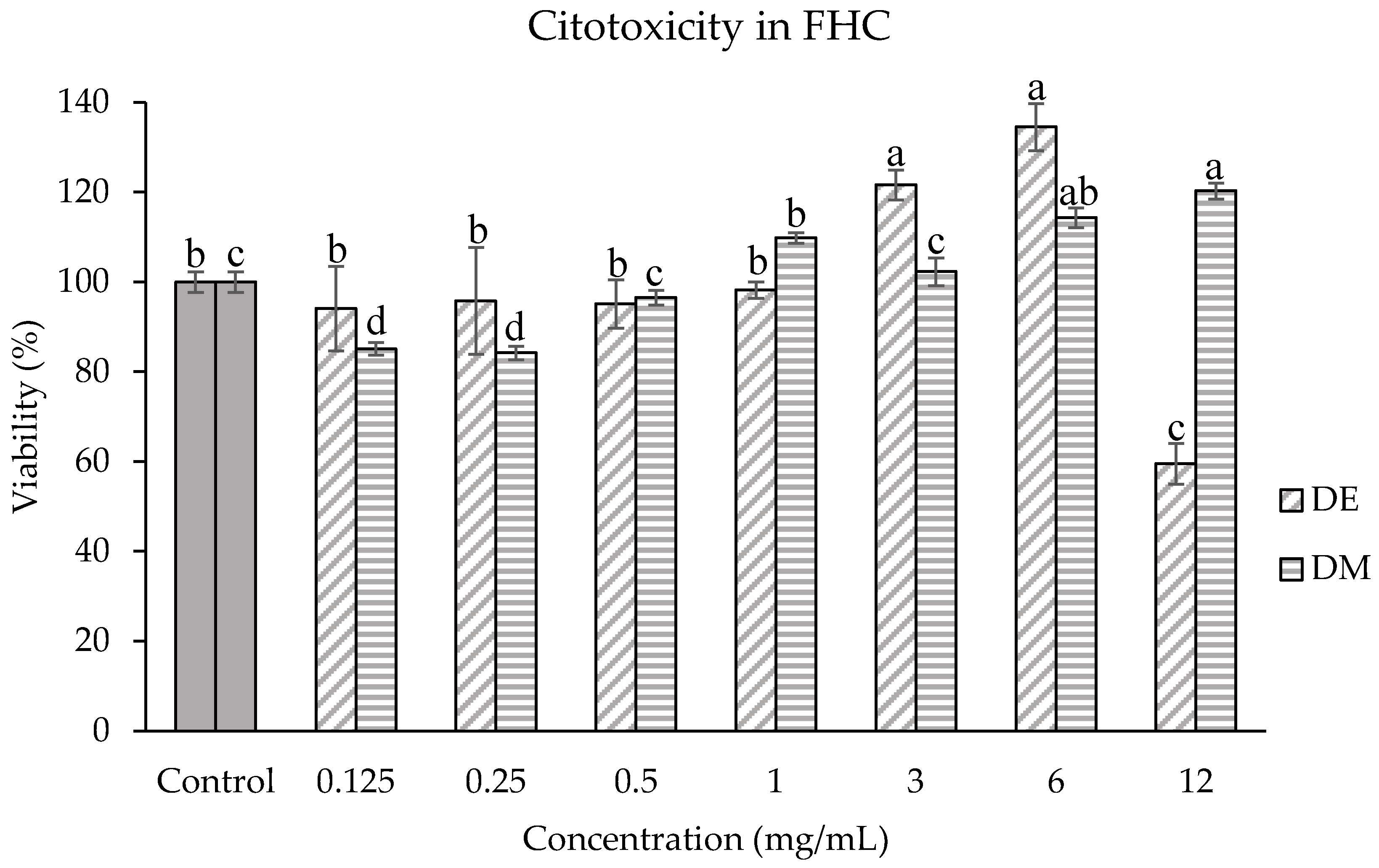
4 cells per well in a 96-well microplate and incubated for 24 h. After incubation, cells were treated with 200 µL of the samples DE and DM at different concentrations (0.125, 0.25, 0.5, 1, 3, 6, and 12 mg/mL) and incubated for an additional 24 h. Next, the treatments were removed, and each well was washed with PBS to remove any residual DE and DM, preventing interference from reducing compounds with the tetrazolium salt. Finally, 100 µL of fresh medium and 10 µL of Celltiter solution were added to each well, and the mixture was incubated for 45 min. The number of viable cells was determined by measuring formazan absorbance at 490 nm using a Synergy HT microplate reader (BioTek Instruments, Inc., Winooski, VT, USA), and results were expressed as a percentage of viability.
2.17. Antiproliferative Activity
Antiproliferative activity in the HCT 116 cell line was assessed using the Mosmann et al. [
27] methodology with minor modifications. Cells were seeded at a density of 10,000 cells per well in a 96-well plate and incubated at 37 °C with 5% CO
2. Once the cells adhered, the culture medium was replaced with treatments (DE, DM at 0.5, 1, 2, 3, 6, 10 mg/mL), and assessments were made at 24 and 48 h. 5-fluorouracil (5-FLU) at 200 µM was used as a control. After removing the treatments, 100 µL of fresh medium and 20 µL of MTT reagent were added, and the mixture was incubated for 2 h. Then, 100 µL of solubilization solution was added, and the mixture was incubated for 12 h to dissolve the formazan crystals. Absorbance was measured at 590 nm using a Synergy HT microplate reader (BioTek Instruments, Inc., Winooski, VT, USA). The results are expressed as a percentage of viability (Equation (5)).
2.18. Statistical Analysis
The 3-factor optimization design resulted in 20 runs, which were analyzed using Analysis of variance (ANOVA). Considering that the overall model was significant (p < 0.05), the minimum determination coefficient (R2) was 0.7, and there was no lack of fit (p > 0.05), the results were deemed satisfactory. Once the optimal conditions were established, appropriate statistical analyses were performed for each assay type. For TRC, TEAC, ORAC, bioaccessibility, phenolic acid content, and antiproliferative activity (Concentration required to inhibit 50% of cell viability (IC50)) assays, data were analyzed using a Student’s t-test, since there is only one factor with two levels (free extract and microencapsulated for antioxidant assays; digested and non-digested for bioaccessibility and phenolic acid content; 24 and 48 h for antiproliferative activity IC50).
For cell viability, antiproliferative activity, and release profile assays, a one-way ANOVA was performed (concentrations for cell assays and time for the release profile).
To understand the release profile behavior and calculate IC50, logarithmic and linear regression analyses were performed. Tukey’s mean comparison was conducted at the p < 0.05 significance level. Each experiment was performed in triplicate and analyzed using Minitab 19 (Minitab LLC, State College, PA, USA).
4. Discussion
The results of this study achieved the objective of optimizing microencapsulation conditions to improve the bioaccessibility of the EEF, as well as to demonstrate the antiproliferative effect of the digested extracts (DE and DM) on HCT 116 colon cancer cells.
Regarding the optimization, the predicted %RPC values were higher than those reported by To et al. [
18], who optimized the wall material mixture (MDR-GA-PEC and β-cyclodextrin) for spray-drying microencapsulation of hydrophilic grapefruit peel extract, and obtained a similar wall material mixture to that used in this research. However, their % RPC was lower at 78.86 ± 0.14% compared with 85.91 ± 2.77% for the optimized microencapsulated eggplant extract (OME). Conversely, the % EE was higher at 77.78 ± 0.09% compared with 63.53 ± 1.39%. This difference between %EE and %RPC could be due to the different types of extracts being microencapsulated, as the chemical composition of hydrophilic grapefruit extract significantly differs from that of OME. The former generally has a higher flavonoid content, such as naringenin, while the latter is richer in phenolic acids like chlorogenic acid derivatives. Therefore, the molecular interactions with the wall material mixture will differ, even though the composition of the wall materials is quite similar in both cases.
Regarding microparticle morphology, a properly produced microparticle is shown, as morphology depends on the wall material used. GA and PEC are wall materials that produce indentations, as seen in
Figure 5. The figure also displays three particle sizes, corresponding to three different wall materials, with each type generally having a well-defined size. Another important factor for a proper microparticle is its moisture content, with a maximum acceptable value of 5%. The use of MDR enables the production of microparticles with indentations and irregular shapes, with a moisture content of 4.91 ± 0.04%. This contributes to the formation of physically and chemically stable microparticles that prevent aggregation and clumping, thereby improving distribution and increasing contact area [
28]. Considering all these factors, the OME meets the quality standards for properly produced microparticles. Although additional physicochemical characterization techniques such as particle size distribution, zeta potential, and particle dispersion analyses could provide complementary information regarding microparticle stability, aggregation behavior, surface interactions, and dispersion properties, the primary focus of the present study was the evaluation of phenolic compound stability and antioxidant behavior during simulated gastrointestinal digestion. Therefore, the analytical approach was centered on the functional performance of the encapsulated extract rather than on exhaustive structural characterization of the microparticle system. Nevertheless, these complementary characterization techniques may be valuable in future studies specifically focused on the physicochemical optimization and structural properties of the encapsulation matrix.
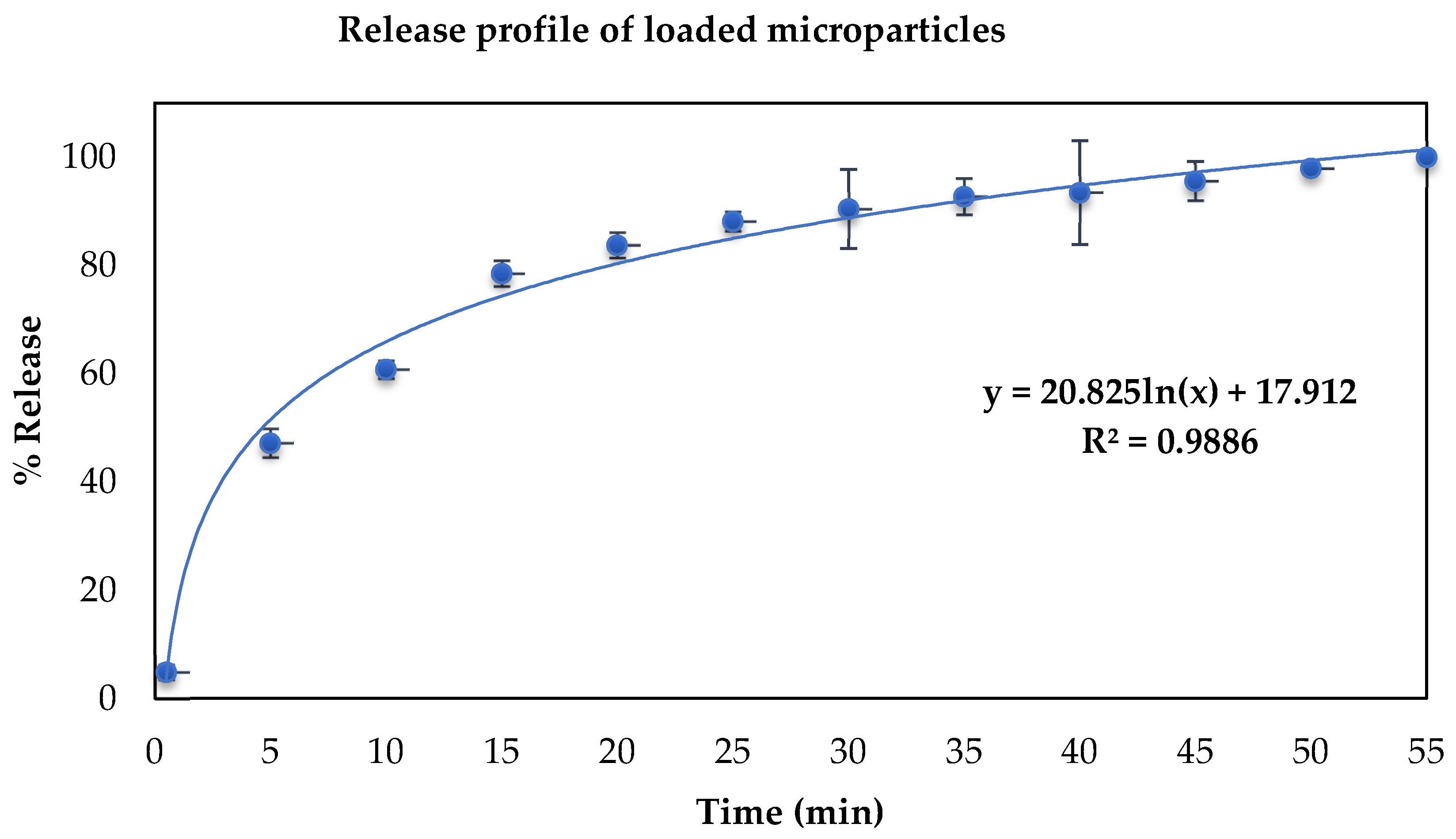
The release of bioactive compounds (
Figure 6) exhibited a logarithmic release pattern. This behavior is consistent across all studies of encapsulated compound release, in which the release time and kinetics of each sample depend on the wall material and the extract type (i.e., molecular interactions between the extract and the wall material). Other studies have reported that 100% of the polyphenols are released within 40–50 min. Notably, in the wall material mixture used, MDR releases 100% of the compounds within 30 min, GA within 5 min, and PEC takes more than 30 min. According to the wall material composition of the OME, it is mainly composed of MDR (87.96%), which aligns with the 35 min mark for 100% release, since the PEC content (1.54%) slightly extends the release time and counteracts the rapid release of GA (10.5%) [
29,
30]. However, the release assay was performed under simplified aqueous conditions with constant agitation, which mainly reflects the diffusion behavior of the hydrophilic matrix rather than the actual gastrointestinal environment. The rapid release observed (~35 min) is likely related to the high water solubility of the encapsulating materials, facilitating the diffusion of phenolic compounds into the medium. Therefore, this assay should be considered a preliminary evaluation of release kinetics under ideal conditions. In contrast, the SGD model provides a more physiologically relevant assessment, since it includes enzymatic activity, pH changes, and gastrointestinal conditions. The TRC and antioxidant capacity of the extract decrease significantly before and after microencapsulation. This pattern is common in the microencapsulation of hydrophilic extracts because of the equipment’s design. For example, Bernal et al. [
17] encapsulated an aqueous extract of Mexican oregano with maltodextrin using spray drying under optimal conditions, aiming, like in this study, to minimize the loss of these compounds after microencapsulation. They observed a 59% reduction in TRC, compared with a 44.9% decrease in OME (
Table 3). Regarding antioxidant capacity (measured by TEAC and ORAC), a decrease was also noted. For instance, Ydjedd et al. [
31] reported that encapsulating carob fruit with methylcellulose retained only 0.38% and 1% of the antioxidant capacity, respectively, compared with the total fed. In contrast, the OME preserved 50% and 80% of these capacities. This variation in TRC reduction and antioxidant capacity may be due to differences in interactions between the wall material and the extract compounds, as well as in the operating conditions of the equipment. Additionally, the reduction in TRC and TEAC after spray drying may be associated with thermal degradation, oxidation, or structural modification of phenolic compounds during atomization and rapid dehydration processes, which are commonly reported during spray-drying microencapsulation of plant extracts [
17,
22]. Phenolic hydroxyl groups are particularly susceptible to oxidation under elevated temperatures and oxygen exposure, directly affecting electron-transfer-based antioxidant assays such as TEAC [
24]. Furthermore, some phenolic compounds may become partially entrapped or interact with the wall materials through hydrogen bonding or matrix incorporation, reducing their immediate extractability during analytical determination. Despite these reductions, the OME preserved a considerable proportion of antioxidant activity, particularly ORAC capacity, suggesting that the MDR-GA-PEC wall material system provided substantial protection against oxidative degradation during microencapsulation.
In addition to phenolic acids, anthocyanins present in the peel may also contribute to the antioxidant activity of
S. melongena L. Comprehensive phytochemical analyses have demonstrated that eggplant peel contains significant levels of anthocyanins, particularly in purple cultivars, which contribute to its pigmentation and antioxidant properties [
11,
12,
32,
33]. However, phenolic acids—especially chlorogenic acid—have consistently been reported as the predominant phenolic compounds in eggplant pulp and are considered the major contributors to total antioxidant capacity [
10,
33,
34,
35]. In the present study, the whole fruit (peel and pulp) was used as a raw material; however, the peel accounts for a smaller proportion of total fruit mass, which may limit the quantitative contribution of anthocyanins to the overall reducing capacity of the extract compared with the more abundant hydroxycinnamic acids.
Moreover, the extraction methodology significantly influences metabolite recovery and characterization. Studies focused on anthocyanin extraction from eggplant peel have shown that optimized or assisted extraction strategies—such as enzyme-assisted extraction or multi-frequency ultrasound—are required to maximize anthocyanin yield and stability [
11,
12]. In contrast, conventional polar solvent extraction favors the recovery of highly abundant phenolic acids present in the pulp, particularly chlorogenic acid [
6,
10,
36]. Therefore, the limited characterization of anthocyanins in the present work should be interpreted considering both their lower proportion in whole-fruit biomass and the extraction strategy employed, which was oriented toward recovering total phenolics rather than selectively enriching peel anthocyanins.
When evaluating the percentage bioaccessibility of free and microencapsulated extracts after SGD, the percentage varies depending on the method used to assess bioaccessibility. It can be measured using TRC, TEAC, and ORAC, so the type of extract and the chemical modifications it may undergo during this process influence the increase or decrease in bioaccessibility (
Table 4). Although static digestion models cannot fully reproduce the complexity of in vivo gastrointestinal processes, they are widely accepted as standardized tools for estimating the bioaccessibility of bioactive compounds under controlled physiological conditions. In the case of TRC bioaccessibility, the results coincide with those of Vergara et al. [
36], where the bioaccessibility of the spray-dried microencapsulated purple potato extract is 20% higher than that of the free extract, while in our study, OME showed a 29% increase, demonstrating that microencapsulation protected the bioactive compounds after SGD. The same effect was observed in TEAC. The increased bioaccessibility could be explained primarily by the fact that the release of encapsulated bioactive compounds may be slower, as shown in
Figure 6. Upon release from the microcapsule, some bioactive compounds may be transformed due to the pH conditions of in vitro digestion, where phenolic compounds may be deprotonated or partially hydrolyzed [
37].
On the other hand, the bioaccessibility of TEAC and ORAC has been shown to differ from each other in different ways. For TEAC in the OME, the percentage bioaccessibility increases significantly. However, for ORAC, there is no significant difference, unlike the percentage bioaccessibility of the microencapsulated carob fruit extract, where DPPH (similar to TEAC) retained only 1.6% in DM and 7% in ORAC [
31]. The discrepancies observed between the methods could be associated with the mechanisms of each method, since, while TRC and TEAC values showed a significant increase after gastrointestinal digestion, ORAC values did not show statistically significant differences. In this regard, it is important to mention that both TRC and TEAC act through the single electron transfer (SET) mechanism; furthermore, both methods are sensitive to the slightly alkaline pH of the intestinal phase, which may lead to the deprotonation of phenolic hydroxyl groups, thus increasing the electron donation rate [
38]. On the other hand, the ORAC assay is based on hydrogen atom transfer (HAT), and, precisely because of deprotonation in an alkaline medium, the hydrogen from the hydroxyl group is lost, which limits the method’s observable effect [
37].
The contrasting bioaccessibility patterns observed for chlorogenic, quinic, and caffeic acids are structurally interconnected, as chlorogenic acid is an ester of caffeic and quinic acids. The marked decrease in chlorogenic acid after SGD, particularly during the intestinal phase, is consistent with previous reports indicating that alkaline conditions promote hydrolysis of caffeoylquinic derivatives [
39,
40,
41]. This degradation pathway explains the concomitant detection and increased bioaccessibility of quinic acid, which has been reported to appear in the intestinal phase as a product of ester cleavage reactions during digestion [
41].
Environmental conditions, such as pH, strongly influence phenolic stability, as phenolic acids are generally less stable under alkaline intestinal conditions [
40]. Similar reductions in chlorogenic acid bioaccessibility after digestion have been described in plant extracts and microencapsulated systems [
41], confirming that structural transformation during SGD is a key determinant of compound fate.
In agreement with these findings, quinic acid was one of the most abundant compounds detected after digestion. In the free extract, a concentration of 49,125.30 ± 1257.07 µg/g of DE was found, which differs from the report by Silva et al. [
32], who identified a concentration of 1300 ± 202 µg/g in eggplant fruit, approximately 37.8 times lower than in our study. Such differences may be attributed to fruit maturity, genotype, cultivation conditions, geographic origin, and environmental stressors, which are known to modulate secondary metabolite production in plant biomass [
33,
34,
35].
The higher bioaccessibility of quinic acid in the microencapsulated sample compared with the free extract may reflect both its intrinsic stability and its formation from chlorogenic acid breakdown during SGD [
42].
In the case of caffeic acid, bioaccessibility values exceeding 100% in the free extract likely indicate its release from bound phenolic forms or its generation through chlorogenic acid hydrolysis, rather than a true increase in concentration. Comparable behavior has been described in complex plant matrices subjected to in vitro digestion models, where phenolic compounds are liberated from macromolecular associations [
43]. However, when caffeic acid is evaluated as a pure standard, substantial degradation has been reported during digestion, retaining only 6.9–8.7% in the intestinal phase [
40], highlighting the critical role of matrix composition and molecular interactions.
Lastly, there were no significant differences in the bioaccessibility of ferulic acid between the microencapsulated and free extracts, indicating a reduction of over 50%. The hypothesis is that ferulic acid is indeed loaded in the wall material mixture, as there appear to be no interactions, and it is released similarly to the free extract. Wanyo et al. [
44] obtained values similar to those observed in the intestinal phase of purple rice bran extracts, with bioaccessibility of 65.82 ± 12.72% and 69.29 ± 15.61%. Moreover, their research highlighted that ferulic acid can degrade or transform in acidic pH during the gastric phase and is more stable at high pH levels between 7 and 11. It is important to note that bioaccessibility values can also vary depending on the SGD method, extraction technique, and compounds present in the extract and microparticle.
Overall, these findings demonstrate that bioaccessibility is governed not only by encapsulation efficiency and wall material interactions, but also by dynamic structural interconversion among phenolic acids during digestion. Therefore, the observed decrease in chlorogenic acid and the simultaneous increases in quinic and caffeic acids reflect coordinated chemical transformations throughout SGD rather than independent behavior of the compounds.
Among the evaluated phenolic acids, only quinic acid effectively permeated. Our findings align with the literature, which reports that Papp values above 70 × 10
−6 indicate complete absorption in the human intestine [
45]. This also aligns with the classification described by Yee et al. [
46], which categorizes compounds as very low permeability (<1 × 10
−6), moderately permeable (>1 × 10
−6 and <10 × 10
−6), and highly permeable (>10 × 10
−6).
According to Lipinski’s rule of five, a guideline for evaluating whether compounds and drugs can be administered orally, the chemical structure of quinic acid makes it highly permeable. The criteria are no more than five hydrogen bond donors, no more than 10 hydrogen bond acceptors, a molecular weight less than 500 Daltons, and a (log P) value less than 5.
Quinic acid complies with Lipinski’s rule of five, having the following properties: five hydrogen bond donors, six hydrogen bond acceptors, a molecular weight of 192.17 Daltons, and a log P of −2.1. Our results agree with those reported by Colombo et al. [
47], who used a dynamic in vitro model and found that quinic acid is highly permeable within 1 h. They also noted that this compound does not appear to depend on cell culture contact and has low absorption, which could be explained by an active efflux mechanism that occurs during quinic acid saturation.
The fact that quinic acid was the only compound detected in the basolateral compartment suggests that it may represent one of the main bioaccessible and potentially absorbable metabolites after gastrointestinal digestion of eggplant extracts. Since chlorogenic acid can undergo hydrolysis during digestion, the presence of quinic acid may reflect both its intrinsic abundance and its generation from chlorogenic acid degradation. Furthermore, since the permeability and chemical structure of quinic acid are already known, future studies could employ in silico approaches to predict its pharmacokinetic behavior and biotransformation, thereby supporting subsequent in vivo investigations. In addition, molecular docking studies may help elucidate potential mechanisms underlying its biological activity, either for quinic acid itself or for metabolites generated during its biotransformation.
Caffeic acid was not permeable in our study; the same behavior was observed by Colombo et al. [
47]. In another study, caffeic acid was shown to be a poorly permeable polyphenol in Caco2 cell models, with intestinal permeability values ranging from 0 to 20% [
48]. According to Mortelé et al. [
49], the low permeability of chlorogenic acid may be related to active BL-AP transport, with a higher Papp on the AP-BL side. Lastly, the low permeability of ferulic acid may have been influenced by the conditions of the Caco2 monolayer experiment, as it contradicts the expected results in BL recovery. It is reported that this compound complies with Lipinski’s rule of five, with two hydrogen-bond donors, four hydrogen-bond acceptors, a molecular weight of 194.18 Daltons, and a log P of 1.5. These characteristics enable permeability through passive transport, as reported by Villela-Castrejón et al. [
50], who obtained a Papp of 12.91 × 10
−6 for ferulic acid within 12 h. This could be one reason we did not identify a significant amount in our experiment, which evaluated permeability for only 2 h; the authors report that ferulic acid permeability is time-dependent. Another possible cause of the low permeability of ferulic acid could be competition for the monocarboxylate transporter (MCT) in the presence of fluorescein and other acids, such as benzoic acid. Thus, permeability also depends on the concentration of ferulic acid in the sample and can be affected by changes in apical pH [
51]. It is important to highlight that carrier-mediated transport is <20%, with passive diffusion as the primary mechanism [
52].
This experiment evaluated the effect of digested samples (DE and DM) to generate more precise information on how digestion affects phenolic compounds and, consequently, their effectiveness on cell viability. In this regard, few studies have evaluated digested extracts. Our results were similar to those reported by Olejnik et al. [
53], who tested a digested extract of
Sambucus nigra L. fruit on a non-transformed colon cell line (NCM460), obtaining 90% viability at a concentration of 7.97 ± 0.16 mg/mL and 50% viability at a concentration of 12.71 ± 0.45 mg/mL. In the same study, they reported a dose–response effect, which differs from ours, suggesting that time-dependent effects may be more evident at 48 h than at 24 h. However, this observation should be interpreted cautiously, as additional time-course studies would be necessary to confirm whether the observed reduction in cell viability is truly time-dependent.
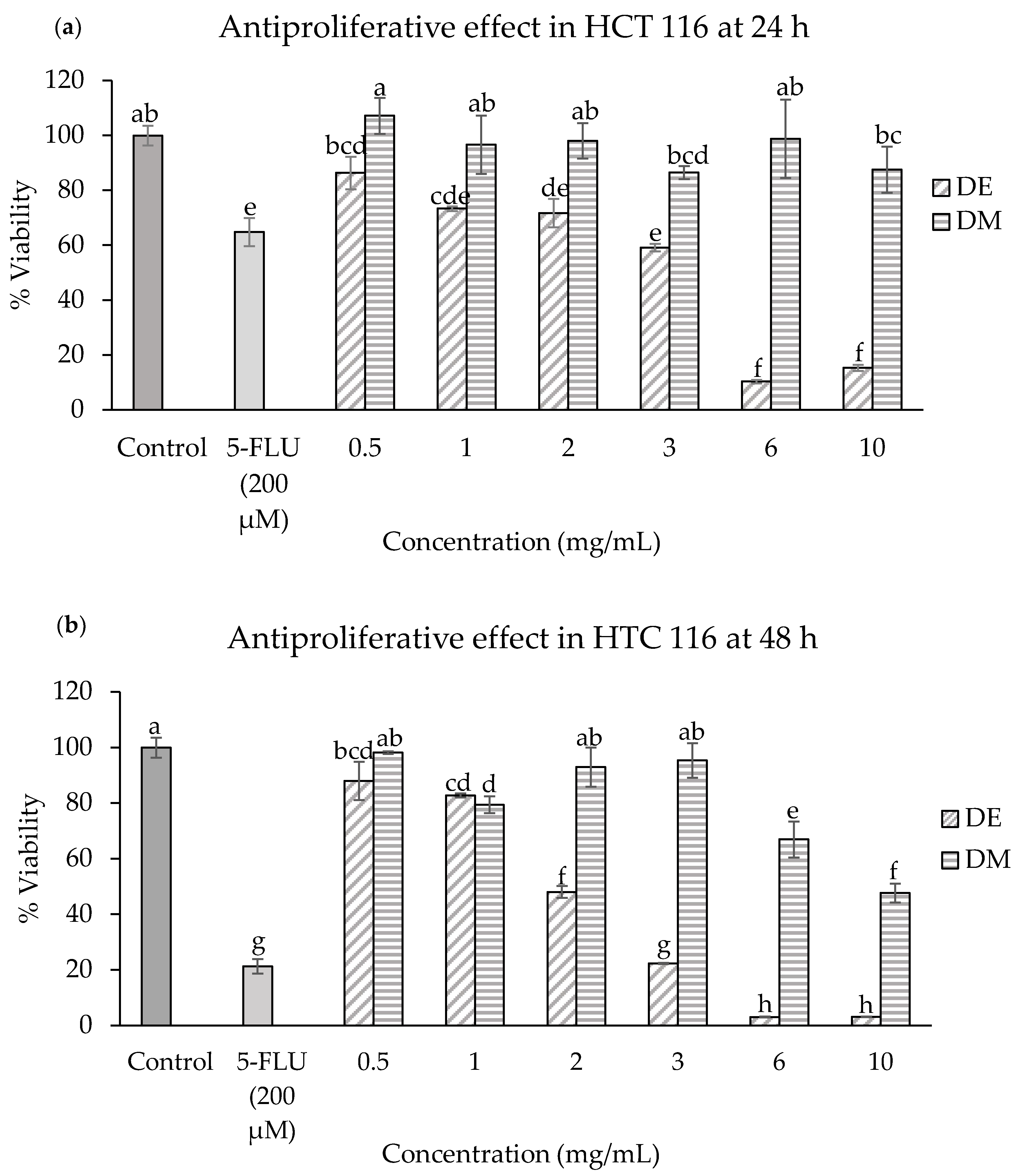
While the extracts did not exhibit marked cytotoxicity in healthy cells, they did show a high effect on HCT 116 colon cancer cells. As mentioned, the best results for inhibiting cell viability were obtained with DE, which also showed an effect similar to that of 5-FLU at 200 µM. In comparison, Lee et al. [
54] found an IC
50 of 2.5 mg/mL after 24 h of treatment on HCT 116 with an ethanolic extract of sorghum bran rich in phenolic compounds. This concentration is lower than that found in this study, but the difference is due to the sorghum bran extract not being digested. Consequently, it does not evaluate the effects of compound profile changes during passage through the gastrointestinal tract, and the compounds present in the sorghum bran extract differ from those in the EEF.
Castaldo et al. [
55] evaluated a lyophilized and digested coffee infusion on HT-29 cells (colon adenocarcinoma). The results of the digested sample at 2 mg/mL after 24 and 48 h of treatment was a reduction in cell viability to 77% and 65%, respectively. In contrast, our results are superior, as using the regression resulting from the experiments to achieve the same cell viability would require 1.35 ± 0.3 mg/mL at 24 h and 1.65 ± 0.1 mg/mL at 48 h. This can be attributed to the profile of bioaccessible compounds and the colon cancer cell line used for the study.
Our results are superior to those reported by Cordeiro-Massironi et al. [
56], who evaluated the cell viability of a digested aqueous peanut skin extract (
Arachis hypogaea) after 48 h of treatment. The IC
50 value obtained was 9.4 mg/mL in the HCT 116 cell line. It is important to note that quinic acid was the most abundant metabolite after SGD at a concentration of 25,459.9 ± 512 µg/g, slightly lower than the concentration of the digested eggplant extract in our study.
While the phenolic compound profile is key to elucidating the compounds responsible for antiproliferative activity, an extract contains many unidentified compounds. However, the role of chlorogenic acid and its caffeoylquinic derivatives in inhibiting colorectal cancer proliferation has been studied in several cell lines (HT-29, SW480, SW620, HCT 116, Caco2, CT26) [
35].
Although the phenolic acid profile was comprehensively quantified in this study, it is important to clarify that the chemical characterization was intentionally focused on this metabolite group, as hydroxycinnamic acids—particularly chlorogenic acid and related derivatives—have been consistently reported as the predominant phenolic compounds in eggplant fruit [
10,
33,
34,
35]. Extensive compositional analyses of eggplant pulp and whole fruit have demonstrated that phenolic acids represent the major fraction compared with other metabolite classes [
6,
33,
35]. Therefore, the analytical strategy was aligned with the primary objective of evaluating bioaccessibility, permeability, and antiproliferative activity of these dominant compounds. Other secondary metabolites, such as anthocyanins and flavonoids—mainly concentrated in the peel—were not individually characterized in this work, despite their documented presence in eggplant matrices [
6,
32,
33], which represents a methodological limitation. Consequently, while the biological activities observed can be largely attributed to the identified phenolic acids, the potential contribution of additional non-characterized metabolites cannot be excluded. Future studies integrating broader metabolomic or untargeted profiling approaches would allow a more comprehensive characterization of the phytochemical composition of eggplant-derived extracts.
It is also essential to determine whether DM samples retain their bioactivity. It should be considered that they are compounds diluted in an encapsulating material, so when released, there is a smaller amount. Consequently, higher doses are required to test their antiproliferative activity compared with free extracts. For example, in our study, the extract-to-encapsulating material ratio was 1:16, meaning the extract was diluted 16 times, which has a lesser effect on reducing cell viability. Considering this dilution, the 8.79 mg/mL (
Table 7) corresponds to 0.549 mg/mL of extract in the DM. Therefore, if it is considered that the extract is actually available without the wall material, the microparticle would have a better effect since a smaller amount of metabolites is needed for the IC
50.
Lastly, it is important to note that if a 50% reduction in cell viability is observed, the substance or sample is considered cytotoxic according to the international standard ISO 10993-5:2009, which suggests that both DM and DE may exert antiproliferative effects on HCT 116 cells under the experimental conditions evaluated [
57]. These findings support the valorization of eggplant biomass as a sustainable source of bioactive compounds for health-oriented formulations.




 ,
,