Article

Morus alba Calli: A Sustainable Source of Phytochemicals and Nutritive Supplements

1
Department of Pharmaceutical and Pharmacological Sciences, University of Padova, Via Marzolo, 5, 35131 Padua, Italy
2
Department of Molecular Medicine, University of Padova, Via Gabelli 63, 35121 Padova, Italy
*
Author to whom correspondence should be addressed.
Nutraceuticals 2026, 6(1), 10; https://doi.org/10.3390/nutraceuticals6010010
Submission received: 21 November 2025 / Revised: 15 January 2026 / Accepted: 23 January 2026 / Published: 2 February 2026

Abstract

Morus alba L., a member of the Moraceae family, is known for its positive effects on human health, linked to the presence of different classes of secondary metabolites, including flavonoids, stilbenoids, and alkaloids, found in different parts of the plant. Stilbenoids, in particular, are mainly present at the root cortex level and, owing to their valuable activities, have attracted scientific interest in recent years. Since roots are a non-renewable source, in this study, M. alba in vitro callus cultures were established. The biomass with the appropriate growth and texture was selected for juice extraction, and the total phenol, flavonoid, and proanthocyanidin contents, along with the antioxidant activity, were estimated in the juices. The analyses throughout the callus growth cycle revealed the juice of 14-day-old calli to be the richest, resulting in the most active. In this juice, the LC-MS/MS-DAD analysis unveiled the presence of seventeen stilbenoids. Together with the data obtained by the nutritional analysis, the results showed that M. alba cell cultures have the potential to be utilised for producing innovative healthy food materials, bridging the gap between the ever-increasing natural-based-product demand and the need for more environmental, social, and economic development.

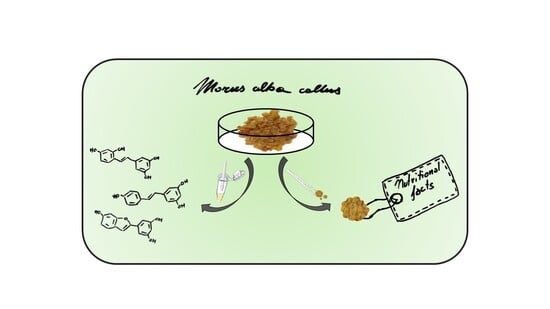
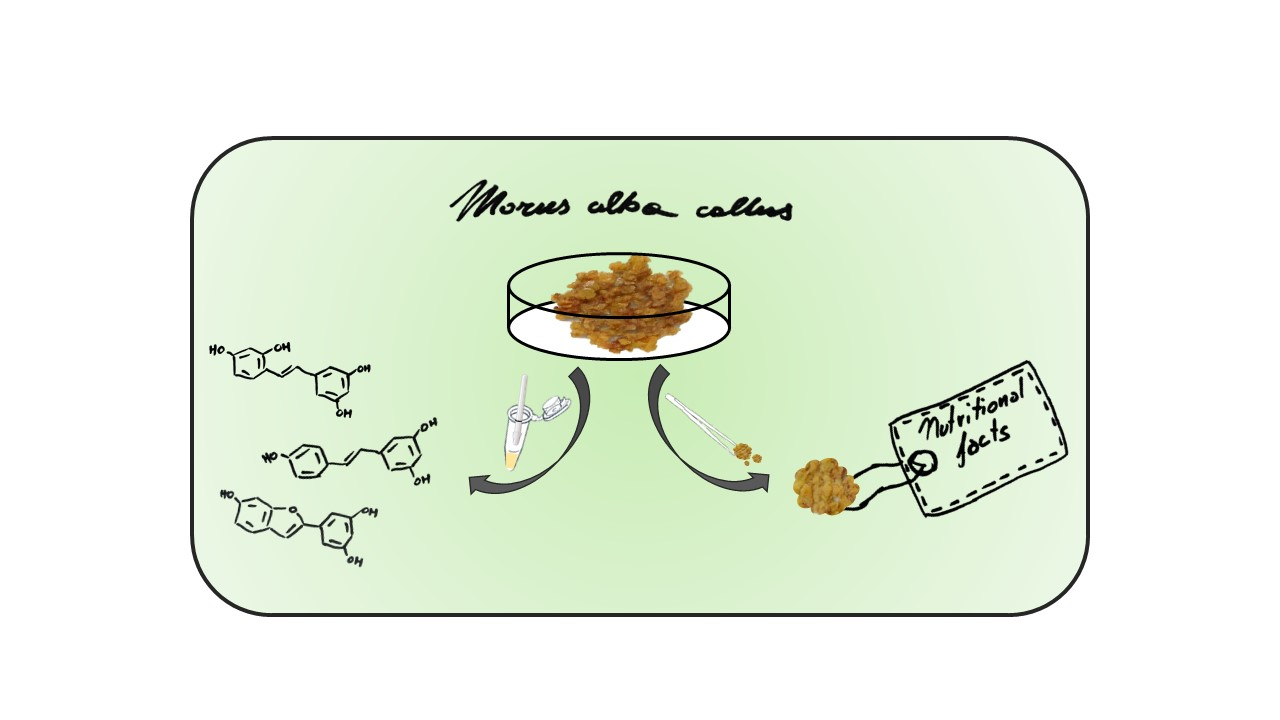
Graphical Abstract

1. Introduction

Secondary metabolites (SMs) are compounds that do not function directly in primary biochemical activities supporting plant growth and development but have an important ecological role, such as the deterrent effects on predators, attraction of pollinators, and discouragement of competing plant species. These low-molecular-weight compounds produced by plants have provided mankind with valuable drugs for centuries, as well as with phytochemicals used in both cosmetics and foods [1,2]. However, conventional methods of producing secondary metabolites often face complex challenges that hinder their efficiency, sustainability, and scalability. Among them, the availability of adequate quantities of raw material is not always guaranteed due to several factors, such as the limited geographical distribution, seasonal dependency, slow growth rate, climatic adversities, and pathogen attack. Additionally, SMs are usually present in quantities less than 1% of the dry weight of plant biomass, and SM biosynthesis occurs primarily during specific stages of the developmental cycle [3].
Beyond these limitations, environmental vulnerability forces a shift from the conventional SM production approach. Indeed, numerous medicinal plant species, primarily harvested from natural environments, face threats from unsustainable collection practices and habitat loss. An alternative, one that has been used for many products, is chemical synthesis or semi-synthesis. However, the high costs and often low total yields have led to the search for new strategies for producing biologically active plant metabolites. Given these challenges, plant cell culture is a viable option for efficiently producing SMs for commercial applications [3,4,5].
In vitro plant culture, based on the concept of plant cell totipotency introduced by Haberlandt in 1902, is the general term for the culture of plants, cells, tissues, and organs on synthetic media under aseptic conditions and defined physical and chemical parameters. Plant cell cultures have numerous applications in basic research, as well as in environmental and commercial fields. Moreover, in vitro plant cultures allow the production of metabolites of pharmacological, cosmetic, and food interest [6]. The production of secondary metabolites in vitro from plant cell cultures could represent at least a solution to the problem of raw material availability. Eventually, in vitro cell culture production systems offer a promising solution by circumventing the limitations of the in vivo plant-based extraction approach, from the perspectives of cultivation, extraction, and production, offering the following: continuous year-round production independent of geographical and climate constraints; uniform quality material production free of pesticides; the possibility of high concentrations of products of interest, which can be rapidly produced [7].
The Moraceae is one of the many families of which members are recognised for their diverse applications in many fields, including cosmetics, agriculture, and pharmaceuticals. Among these, Morus alba L. (white mulberry) has been extensively researched due to its widespread distribution and cultivation. M. alba has a long history of use in traditional medicine, owed to different medicinal parts like branches, leaves, fruits, and root bark rich in various bioactive compounds, including flavonoids, alkaloids, amino acids, and other phytochemicals [8]. Mulberry’s secondary metabolites are associated with a broad spectrum of potential pharmacological activities, including antioxidant, anti-inflammatory, anti-diabetic, cytotoxic, anti-cancer, hepatoprotective, cardioprotective, and neuroprotective effects, in addition to being helpful for the maintenance of general health [9,10,11,12,13]. Mainly, flavonoids, benzofurans, stilbenes, and Diels–Alder adducts are considered as primary chemical constituents with bioactive potentials within Morus plants [8]. In particular, in the root bark, a large array of chemical compounds, such as stilbenoids and flavonoids, has been identified as major classes, exhibiting a wide range of pharmacological actions [14]. In traditional Chinese medicine, root-based preparations are used for the treatment of inflammation-based pathologies. In more recent times, pharmacological in vitro and in vivo studies have shown that root extract or its components inhibit inflammatory mediators and inflammation [12,14]. Unlike other parts of the plant, the roots represent a non-renewable source; to obtain their constituents, the plant may be sacrificed.
This study aimed to establish in vitro callus cultures of M. alba as a sustainable source of valuable phytochemicals. The calli obtained from the stem explant resulted in the most promise in terms of growth and consistency; therefore, this material was used for the juice extraction. These juices, extracted during the whole growth cycle, were investigated for the total phenol, flavonoid, and proanthocyanidin contents, along with the antioxidant activity. The preliminary LC-MS/MS analysis highlighted the predominant presence of the stilbenoid component, and seventeen compounds belonging to this class have been characterised, most naturally occurring in the plant roots. In addition, since plant cell cultures have shown great potential for food purposes [15], M. alba calli were also investigated for their nutritional value.

2. Materials and Methods

2.1. In Vitro Callus Cultures

Seeds of Morus alba L. were purchased from Saflax® (Münster, Germany) (https://saflax.de/en/white-mulberry-tree; accessed on 12 January 2026). The seeds were washed with tap water and detergent, then scarified by immersion in pure sulphuric acid for 5 min and surface sterilised with commercial bleach 15% (v/v) for 10 min. Seeds were then washed three times with sterile distilled water. The germination medium contained half-strength MS macro- and micro-salts and vitamins [16], 2% (w/v) sucrose, and 1% (w/v) agar. The pH of the medium was adjusted to 5.7 before autoclaving. After sterilisation, the seeds were placed in Petri dishes on the surface of the germination medium and cultivated in a tissue culture chamber at 25 ± 1 °C under cool-white fluorescent lights (36 lmol m−2 s−1) with a 16/8 h photoperiod. When the plantlets reached 1–2 cm in height, they were transferred to sterile vessels containing the same medium; once they reached 15 cm in height, they were used to obtain the explants.
Leaf, stem, and root explants from about 3-week-old plantlets were used for callus induction. Leaf and stem explants were about 0.8–1.2 mm in length, whilst root explants consisted of small clumps of roots. All the explant types were placed in Petri dishes, adhering to the solid media, using 8 explants per dish. Leaf explants were placed in the media, half with the abaxial surface and half with the adaxial surface adhering to it. The explants were cultured on solidified LTV, B5, WPM, and MS [16,17,18,19] solid media (1% w/v agar), supplemented with 3% of sucrose (w/v) and with 1 mg/L dichlorophenoxyacetic acid (2,4-D) as a plant growth regulator. The explants were cultivated in a growth chamber at 25 ± 1 °C in a 16/8 h photoperiod. The characteristics of the newly formed calli, such as growth rate, colour, and texture, were recorded every two to three days. Calli were regularly observed under a stereomicroscope to detect morphological characteristics and potential for regeneration (Stereomicroscope S9i, Leica, Wetzlar, Germany). The selected callus cell line was first subcultured every 6 weeks. Thereafter, depending on the growth rate and morphological characteristics of the callus culture, the subcultivation time was shortened to 4 weeks.

2.2. Plant Calli Extraction

Stabilised calli grown in MS medium were harvested by taking a portion of material from different Petri dishes to ensure uniform sampling; the procedure was repeated during the cell growth cycle at three different times, namely, after 14, 28, and 42 days of growth. The juices were obtained, as reported by Dalla Costa et al. [20], by squeezing the defrosted calli, which were maintained at −18 °C. Briefly, calli were squeezed and put in an ultrasound bath (Branson, Milan, Italy) for 40 min; after centrifugation at 13,200 rpm, the liquid upper phase, called juice, was separated and used for the analyses.

2.3. Colourimetric Analyses for the Determination of Total Phenols, Flavonoids, Proanthocyanidins, and Antioxidant Activity During the Growth Cycle

The analyses were performed on the juices obtained from calli harvested on the 14th, 28th, and 42nd day of the growth cycle. The Folin–Ciocâlteau colourimetric assay [21] was utilised for the juices’ total phenol content (TPC) determination. Concisely, an appropriate volume of juice (diluted up to 200 µL in the testing tube) was added to 1 mL of Folin–Ciocâlteu reagent (Fluka, Buchs, Switzerland), diluted in a ratio of 1:10. After 4 min, 800 µL of saturated sodium carbonate (75 g/L) was added. A HeλIOS spectrophotometer (Thermo Electron Corporation, Waltham, MA, USA) was used to read the absorbance at 765 nm, after 30 min incubation, at room temperature and in the dark [20]. The sample absorbances were plotted against gallic acid (Fluka, Buchs, Switzerland) standard curve (y = 0.0462x − 0.009, R2 = 0.9997; concentrations between 1 and 10 µg/mL). The results are expressed as μg of gallic acid equivalent per mL of juice. The results are reported as means ± standard deviation (SD) of samples analysed in duplicate.
The modified aluminium chloride colourimetric assay [22] was utilised for the juices’ total flavonoid content (TFC) determination. Briefly, an appropriate volume of juice (diluted up to 500 µL in the testing tube) was added to 0.15 mL aluminium chloride. The absorbance was read at 420 nm, after 10 min incubation, at room temperature and in the dark [20]. The sample absorbances were plotted against quercetin (Merck, Milan, Italy) standard curve (y = 0.0474x − 0.0502, R2 = 0.9994; concentrations between 1 and 12 µg /mL). The results are expressed as μg of quercetin equivalent per mL of juice. The results are reported as means ± standard deviation (SD) of samples analysed in duplicate.
The modified vanillin colourimetric assay [23] was utilised for the juices’ total proanthocyanidin content (TPcC) determination. Briefly, an appropriate volume of juice (diluted up to 25 µL in the testing tube) was added to 1 mL of 1% vanillin (Merck, Milan, Italy) in sulphuric acid solution at 70%. The absorbance was read at 500 nm, after 15 min incubation, at room temperature and in the dark [20]. The sample absorbances were plotted against catechin (Merck, Milan, Italy) standard curve (y = 0.1258x + 0.0068, R2 = 0.9999; concentration between 0.6 and 4.5 μg/mL). The results are expressed as μg of catechin equivalent per mL of juice. The results are reported as means ± standard deviation (SD) of samples analysed in duplicate.
The modified DPPH radical method assay [24] was utilised for the juices’ antioxidant activity. An appropriate volume of juice (diluted up to 100 µL in the testing tube) was added to 400 µL DPPH radical (Sigma Aldrich, Milan, Italy) solution (0.1 mM, in ethanol). The absorbance was read at 517 nm, after 30 min incubation, at room temperature and in the dark [20]. The sample absorbances were plotted against ascorbic acid (Sigma Aldrich, Milan, Italy) reference curve (y = 11.768x − 0.9896, R2 = 0.9994; concentration between 0.8 and 6 µg/mL). The antioxidant activity was calculated based on the discolouration of DPPH radical solution in the presence of antioxidant activity, and the results, means ± standard deviation (SD) of samples analysed in duplicate, are expressed as the percentage of inhibition of 12 µL of juices.

2.4. LC-MS/MS Analysis

M. alba juice, extracted from 14-day-old calli, was analysed, as reported by Dalla Costa et al. [20], using an Agilent 1290 Infinity II coupled with the Agilent 6550 mass spectrometer (Agilent Technologies Inc., Santa Clara, CA, USA); a column Gemini 5 μm C6-Phenyl column (250 × 4.6 mm) (Phenomenex, Bologna, Italy) was used for the compound separation. The flow rate was 0.75 mL/min, the injection volume was 5 μL, and the column temperature was kept at 40 °C. The gradient, water with 0.1% (v/v) formic acid (eluent A), and acetonitrile (eluent B), was set as follows: 0–8 min, 97% A; 8–26.5 min, 75% A; 26.5–40 min, 20% A; 40–42 min 97% A. Chromatograms were acquired at 325 nm; and UV–Vis spectra were recorded in the 190–700 nm range. For MS and MS2 detection, the Dual AJS ESI source was operated in negative-ion mode. The gas temperature was set at 300 °C with a flow of 5 L/min, while the sheath gas temperature was 250 °C with a flow of 11 L/min. The nebuliser pressure was set at 35 psi, and the capillary and fragmentor voltages were 3500 V and 260 V, respectively. In the case of MS2 analysis, the compound fragmentation patterns were recorded at different collision energies (0, 10, and 20 eV) with an isolation width of 4 m/z. The MassHunter Workstation Data Acquisition 10.0 (Agilent Technologies Inc., Santa Clara, CA, USA) program was used for data acquisition, and the MassHunter Qualitative Analysis 10.0 (Agilent Technologies Inc., Santa Clara, CA, USA) software was used for data processing.

2.5. Nutritional Analysis

The nutritional value was assessed on fresh callus samples by “EPTANORD food analysis and consulting” (Conselve, Padova, Italy), as already reported [25]. Briefly, the moisture content, ash content, and fat content were measured according to ISTISAN 1996/34, and expressed in g/100 g [26]. The protein content was measured according to ISO 1871:2009 and expressed in g/100 g [27]. The fibre content was measured according to AOAC Official Method 985.29 1986 and expressed in g/100 g [28]. The total carbohydrates were calculated according to ISTISAN 1996/34 and expressed in g/100 g [26]. The energy value was determined according to Reg UE 1169/2011 (25 October 2011) and expressed in kilocalories (kcal/100 g).

2.6. Statistical Analysis

Chemical results are reported as mean ± standard deviation (SD) of two independent experiments, each one performed in duplicate, based on the material’s stability, which was shown throughout the entire stabilisation period. The low variability observed (coefficient of variation < 5%) indicates good analytical precision and supports the reliability of the measurements obtained in both independent experiments. In addition, following the main goal of sustainability, we reduced the number of experiments, minimising resource consumption such as time, materials, and energy.
Statistical analysis was performed using one-way analysis of variance (ANOVA) using GraphPad Prism v 7.05 (San Diego, CA, USA). Statistical significance was calculated using one-way ANOVA with Tukey’s multicomparison post-test; p values < 0.05 were considered statistically significant.

3. Results and Discussion

3.1. In Vitro Callus Culture Establishment

Previous studies reporting in vitro cultures of Morus spp. described MS basal medium added with different plant growth regulators, alone or in combination [29,30]. To match callogenesis with salt combinations, in this study, we tested four different basal media, namely LTV, B5, WPM, and MS, all supplemented with the same concentration of 2,4-D. Two basal media (B5 and MS), among the most commonly used to induce callogenesis in numerous species, were utilised. Additionally, two media (WPM and LTV), which, although not exclusively, can be used for woody plants, were also employed [31]. The auxin 2,4-D is a hormone that is often of fundamental importance in inducing cellular dedifferentiation. At this stage of the study, it was decided not to use hormone balances to more easily evaluate the influence of the basal medium. Three explant sources were tested because it is known that the explant type can influence not only callus formation and growth rate, but also the characteristics of the calli themselves, like texture and regenerability. The reactivity of the explants and the endogenous hormones play an important role, even though the explant source varies among different species [32,33].
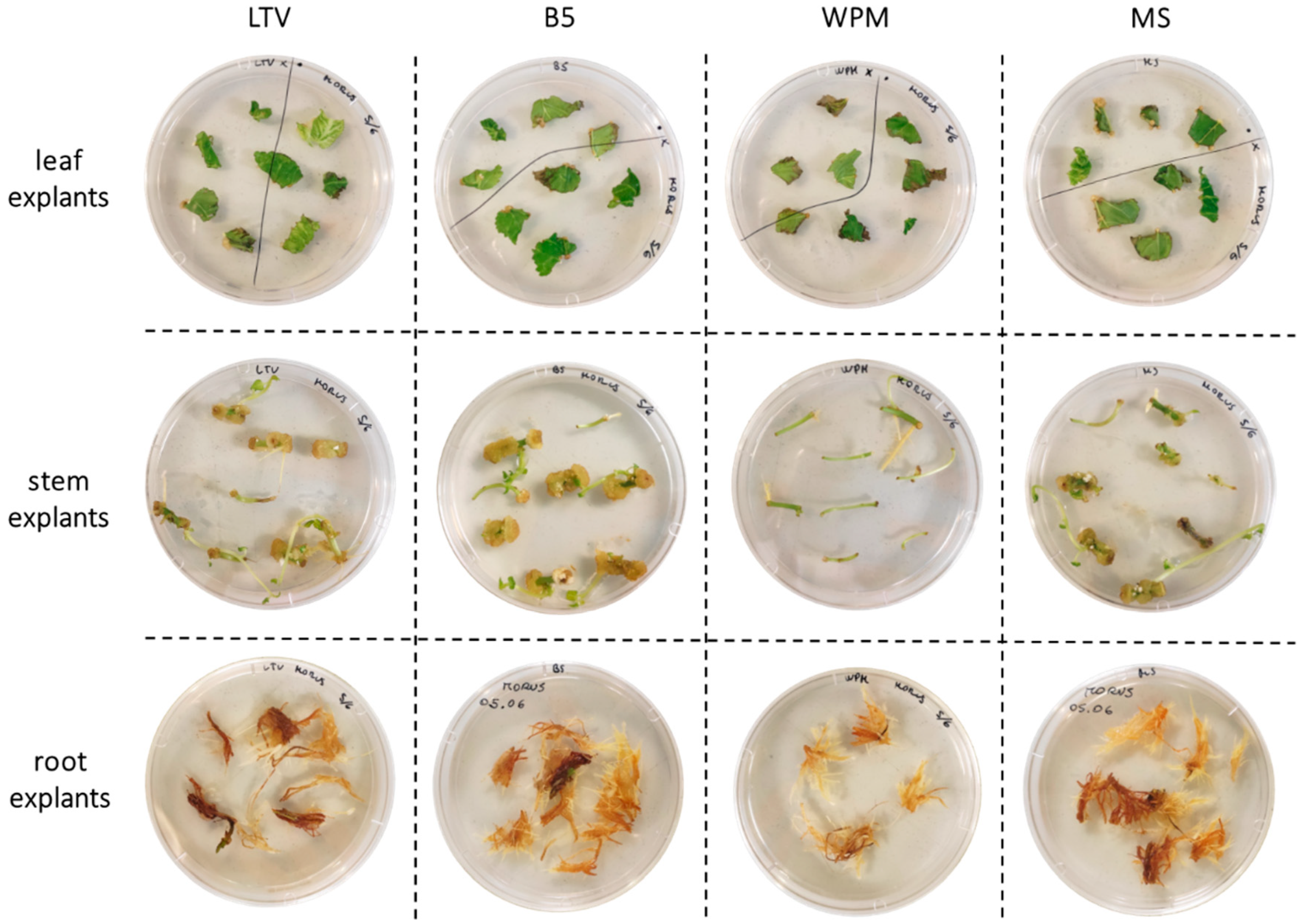
It was observed that the type of explant seems to have a greater influence on callogenesis compared to the basal medium. The leaf and stem’s callogenesis initiated rapidly after 4–10 days of culture in all the tested media. Given the material reactivity, after one month, it has been possible to evaluate the explants’ responsivity. Figure 1 shows the explants’ responsiveness in the four media, after one month from the culture establishment.
After one month, leaf explants showed clear signs of response to the in vitro conditions; the leaf blade started to bend and swell (Figure 1). Roughly, leaf explants responded similarly to in vitro conditions in all media; the callogenesis started close to the cut area and mostly near the veins. No differences were observed between explants adhering to the media with the abaxial and adaxial faces. The roots did not produce callogenesis but organogenesis, as can be seen by the newly formed root organs (Figure 1). Stem explants grew well in the in vitro conditions (Figure 1), showing a high callogenesis in LTV, B5, and MS media, whereas in WPM medium, callogenesis was less pronounced and the calli resulted in tiny aggregates. These results highlight that although all plant cells have the capacity for totipotency, the ease in expression of that capacity varies in plant species and varieties, even in cells of the same plant. The explant type, the age of the explant, and the differences in endogenous hormones and nutrients in various parts of the explants may explain the differences in regenerative abilities [34].
Table 1 reports a summary of each explant type behaviour during the callogenesis phase and the following subculture period (eight subcultures) in all the media tested.
For root explants, the results obtained after eight subcultures confirmed the early observations; no callogenesis was observed in all the media considered, but they gave birth to new roots. The best callogenesis initiation and propagation was reached in MS medium, both for leaf and, mostly, stem explants. However, over time, leaf explants gave birth to organogenesis in MS medium, together with forming recalcitrant and small callus aggregates that tended to shrivel, even if characterised by an adequate initial growth rate. On the other hand, the stem explant in MS medium showed the greatest growth rate during the time, keeping the initial friable appearance. For the reasons above, after eight subcultures, only the biomass established in MS medium was maintained, and the other material was discarded.
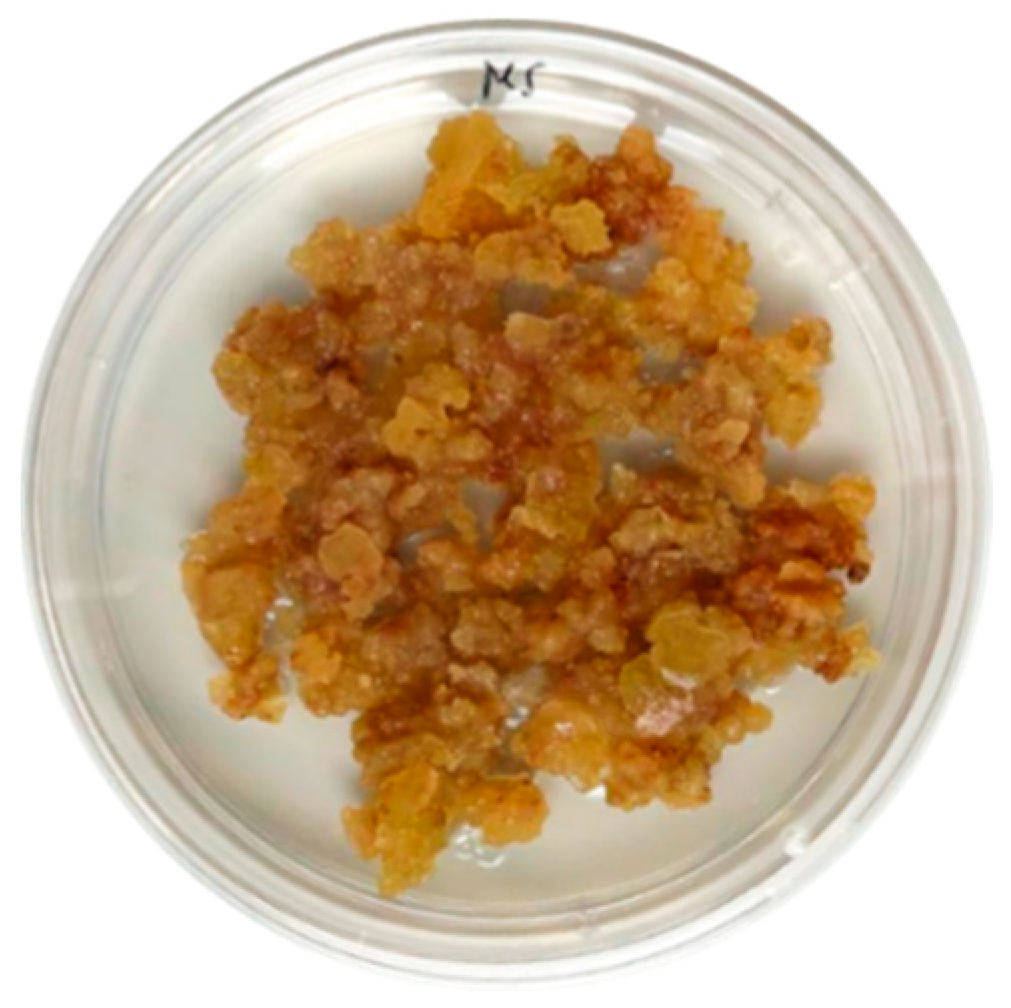
During the following subcultures of MS calli, after an initial biomass oxidation likely due to oxidation of the material at the end of the growth cycle, the material was subcultured more frequently. Then, the calli increased their growth rate and biomass again, and the calli doubled their biomass during the growth cycle and turned light brown. Moreover, the callus texture resulted in being exceptionally friable and juicy (Figure 2), optimal features for the in vitro culture development. Hence, stabilised M. alba calli, established in MS medium, were used for the subsequent analyses.

3.2. Colourimetric Analyses for the Determination of Total Phenols, Flavonoids, Proanthocyanidins, and Antioxidant Activity During the Growth Cycle

The extraction protocol was based on the mechanical pressing of the in vitro biomass, obtaining the so-called juice instead of extracting it with conventional solvent processes. This choice was made for two main issues: safety aspects, taking a glance at a more sustainable research protocol, and reducing the formation of artefacts. The formation of artefacts cannot be ruled out a priori even in the case of juice, given the presence of enzymes (e.g., esterases, glucosidases) that could cause the modification of some metabolites. However, artefacts occur more frequently during the sample preparation and extraction protocol, but also during the separation or detection phase of the analysis, especially as a consequence of the interaction with chemical solvents [35].
Considering that in vitro cell metabolism can change during the growth cycle as a result of cellular activity, preliminary colourimetric assays were carried out to evaluate the secondary metabolism performance of the materials during the growth cycle. The growth cycle is generally set between four and six weeks, depending on the species and culture conditions. At the end of the cycle, the material must be transferred into a fresh medium to replenish nutrients and eliminate potentially toxic exudates [36]. During the callus growth cycle, the production of secondary metabolites often peaks during the stationary phase, but this does not always occur [37,38,39]. Therefore, calli were harvested three times during the growth cycle: at one point in the initial phase, one point in the mid-cycle, and one point at the end of the growth cycle, namely, after the 14th, 28th, and 42nd day.
The analysis of the juices throughout the growth cycle was focused on the class of phenolic compounds. The interest in these compounds, which are typical components of foods such as fruits, vegetables, cereals, and beverages, is mainly related to their benefits in health promotion [40,41]. The broad class of phenolic compounds includes, among many others, the subclasses of flavonoids and proanthocyanidins. Both of these groups of compounds are present in many food plants, and their intake has been correlated with positive effects on health status [40,41]. It has been reported that including different types of flavonoids in the daily diet is highly recommended to reduce the risk of several life-threatening diseases [42,43]. Proanthocyanidins, on the other hand, are among the phenolic compounds whose structures and roles in plants and humans are still partially unknown [44]. However, proanthocyanidins, especially the oligomeric ones, are also recognised as active ingredients in medicinal plants and considered as new natural antioxidants [45,46].
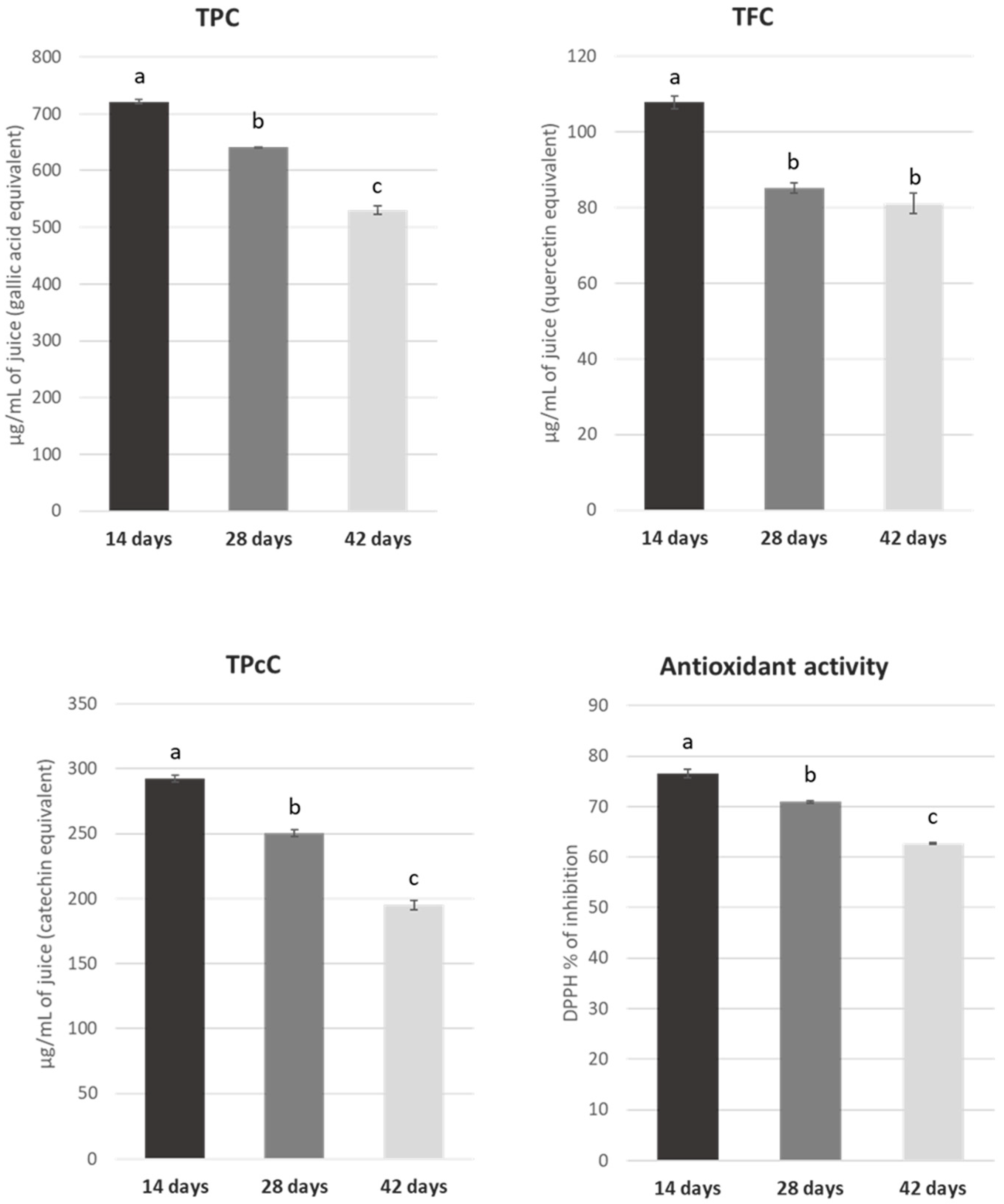
The total phenol (TPC), flavonoid (TFC), and proanthocyanidin (TPcC) contents, and the antioxidant activity of M. alba callus juices during the growth cycle are reported in Figure 3.
The colourimetric analyses revealed a high TPC (from 721.05 to 530.30 µg/mL on the 14th and 42nd days, respectively), of which the proanthocyanidins represent a high percentage (from 292.34 to 195.04 µg/mL on the 14th and 42nd days, respectively), followed by the flavonoids (107.78 µg/mL on the 14th day). The juices obtained from the calli on the 14th day of growth were the richest in all the metabolites, whereas the juices from the 42nd day were the poorest, except for the total flavonoid content. Indeed, after 42 days of growth, the flavonoid content of the juices obtained from these calli was not statistically different from that at 28 days of growth: 81.04 and 85.16 µg/mL, respectively.
During the callus growth cycle, the production of secondary metabolites often is at its highest point during the stationary phase, but this is not the rule; in fact, secondary metabolites can be synthesised more often near the stationary phase and also during the logarithmic phase [37,38,39]. Our results highlighted a higher phenol production in the first mid-part of the growth cycle, and a decrease during the following phases.
The results related to antioxidant activity during the growth cycle show that the antioxidant activity of juices matched the content of the analysed secondary metabolites. Indeed, the juice obtained on the 14th day in culture reported the highest antioxidant activity, whereas the juice obtained on the 42nd day was the poorest (Figure 3). The antioxidant activity can be correlated to the phenolic compounds in the juices, confirming a good correlation between the phenolic content and antioxidant capacity, as previously reported by Polumackanycz et al. [47] in two Morus species. In our study, the antioxidant activity was extremely high: 12 µL of juice provided DPPH radical inhibition ranging from 77% to 63%, related, respectively, to juices harvested at 14 and 42 days of the growth cycle, and gave the same inhibition of 3.29 and 2.71 µg of ascorbic acid, tested in the same conditions. It is difficult to compare these results with other plant extracts or Morus extracts’ antioxidant activities reported in other studies, since the antioxidant properties depend on several factors, among which are their quantitative and qualitative compositions due to different extraction protocols, solvents, and matrices used for the extraction, even if the same plant is taken into consideration. These uncertainties support the necessity of standardising the DPPH radical method at least for comparing the same food or food-derived samples [48,49].

3.3. Main Compound Characterisation

After the preliminary analyses of M. alba juices, attention was focused on the phenolic fraction, which consists of a stilbenoid backbone, considering that this class has received the greatest attention in Morus species and has been of interest to the scientific community.
Based on compound molecular weights, fragmentation patterns, and UV spectra, further supported by literature data (e.g., [23,50,51]), a total of seventeen compounds were detected in M. alba callus juice. The retention times, the maxima of UV absorptions, the parental ions expressed as [M-H] m/z, the fragmentations, and the tentative compound characterisation are reported in Table 2.
The seventeen compounds identified in M. alba juice belonging to the stilbenoid class, C6-C2-C6 compounds consisting of two benzene rings linked by an ethane (bibenzyls) or ethene (stilbenes) bridge, were as follows: simple stilbenes (e.g., resveratrol or oxyresveratrol), benzofuranic compounds (e.g., moracin M), mono and di-glucoside derivatives (e.g., piceid, mulberroside A, and mulberroside E), as well as three-glucosilated molecules (e.g., oxyresveratrol triglucoside). Among the seventeen characterised stilbenoids, thirteen were identified, whereas five peaks (namely, 1, 2, 4, 6, and 9) were designed as resveratrol, oxyresveratrol, and benzofuranic derivatives based on the UV spectra and fragmentation patterns (Table 2).
Stilbenes are phytoalexins produced by certain plants in response to biotic or abiotic stresses, and, in recent years, they have attracted attention for human consumption owing to their biological properties [52]. Among these, resveratrol has received much attention for its simple chemical structure and therapeutic applications. In recent years, oxyresveratrol, another natural hydroxystilbene, has been greatly investigated because it exhibits a more powerful antioxidant activity when compared to resveratrol, due to the presence of an additional hydroxyl group [53]. Oxyresveratrol is a potent antioxidant and effective scavenger through its protective effects against reactive oxygen and nitrogen species, in addition to several other activities [53]. Also, mulberroside E shows great antioxidant activity [50]. Oxyresveratrol, along with its diglucoside mulberroside A, also found in M. alba juices, shows antibrowning activity and, therefore, has been used as a raw material for skin-whitening cosmeceuticals [52]. Moreover, data from the literature show that the glycosylation of oxyresveratrol can enhance its activity [54]. Beyond the glucoside form of stilbenoids, moracins are also capable of free-radical scavenging and lipid peroxidation (such as in Alzheimer’s disease) [53]. Moracin M has been found in glucoside form (compounds 7, 13, and 15) and also as aglycone (compound 17) in M. alba juice.
The literature is full of data on stilbenoid content in different plant organs of M. alba. However, comparison is rather difficult because of the different approaches used in the studies and because, in the case of quantitative data, these are related only to a single stilbenoid. Roots represent the major source of active stilbenoids in the industrial production of traditional medicines and cosmeceuticals [55,56,57]. As for the in vitro cultures of M. alba, they have been appropriately established for studying the stilbenoid production under diverse stimuli, since the stilbenoid content in mulberry plants can vary, being sensitive to several factors such as source, phenotype, plant part, environment, and harvesting season [58]. Except for in one of our previous works, in which HPLC-DAD analysis of M. alba callus juices highlighted the glucosilated forms of oxyresveratrol and resveratrol as the main compounds [59], as far as we know, published papers have focused on a single compound or a handful of compounds. As examples, Komaikul et al. [60] and Komaikul et al. [60,61] studied the increase in mulberroside A production after several elicitations and using different bioreactors, whereas other authors evaluated the increase in stilbenoid content after adding feeding precursor along with elicitors [62,63].

3.4. Nutritional Value Estimation

The nutritional analyses were performed on the fresh calli, and based on the water content, the results were converted to dry weight to facilitate a better comparison with other products. The total content of moisture, ashes, carbohydrates, fibre, proteins, and fats (except the moisture for the dry weight) is reported in Table 3 and is expressed as a percentage of fresh weight and dry weight.
As already reported, the applicability of plant cell culture (PCC) material as a whole for food purposes is a concept only recently introduced; therefore, the comparison with other papers is limited.
One of the major works on the nutritional characterisation of PCC was produced by Nordlund et al. [64]. Three different in vitro biomasses derived from berries were evaluated in terms of several contents, including dry matter, elemental composition, carbohydrates, protein, and fatty acids. The dry matter of the samples resulted in less than 3 and 4%; these data are comparable to our material (4.4%). The protein contents of the berry samples ranged from 13.7 and 18.9% (DW), obtained by the amino acid composition analyses. Meanwhile, applying the nitrogen-to-protein conversion factor (as was applied for our samples) to the nitrogen content of those berry samples [64], the protein percentage would increase from 23.8 to 45.0%, similar to our cell line (32.7% DW). The total protein content of two cell lines was also studied by Häkkinen et al. [15] through amino acid composition. Their data aligned with the data reported before for dry weight. The total protein content also resulted in comparable or lowest values applying the nitrogen-to-protein conversion factors to the percentage of nitrogen found in a study investigating the potential of in vitro-grown industrial hemp calli as a new generation of energy crop [65]. In the same study, the humidity of the three callus lines resulted in lower values, and the mass left behind after 800 °C, associated with inorganic materials (hashes), resulted in 12.23 and 15.66%, whereas in our sample, it resulted in lower values. The fibre contents of our samples (34% of dry weight) were comparable to those reported by Nordlund et al. [64] as well.
Comparing the nutritional analyses of plant cell culture lines with those of their parental plant, we found that mulberry fruits contain less moisture (around 70–80%) and less protein compared to M. alba calli, and a comparable or higher fat content in the fresh weight [66]. Plant cell culture also showed a comparable amount of protein to that of mulberry leaves from different species and a higher fibre content (DW) [67].

4. Conclusions

This study highlights that the in vitro plant cell culture approach offers a promising solution for metabolite synthesis. The results obtained for M. alba calli indicate that this material could exert good potential in several areas, like cosmetics and pharmaceuticals, based on the richness of secondary metabolites belonging to the stilbenoid class. Indeed, plant cell cultures can be a feasible method for the sustainable production of valuable molecules within a short and efficient production cycle, reaching a “new generation” of high-quality bioactive phytochemicals. Moreover, M. alba plant cell cultures have shown great potential as nutritional food alternatives, especially given the appreciable protein content, comparable to plants considered to be protein-rich sources, and the good fibre content, which lays the groundwork for further investigations. Even if, until now, only a handful of plant cell and tissue culture-based products are on the market, due to the challenges of process efficiency and the complex regulatory landscape, the results of this work highlight plant cell culture technology as a sustainable tool and viable option for the production of various added-value nutritional and healthy materials; offering opportunities in areas where traditional agriculture is constrained by climate change. Further investigations on the secondary metabolism content and a more detailed nutritional composition, together with safety and compliance aspects that should be met before commercialisation, will encourage the exploitation of this biomass. Based also on the most efficient production system, this material could be used as an entire biomass for human consumption, as a source of nutraceuticals, or as a source of valuable phytochemicals.

Author Contributions

Conceptualization, V.D.C. and R.F.; methodology, V.D.C., and R.F.; software, V.D.C. and P.B.; validation, V.D.C. and R.F.; formal analysis, V.D.C.; investigation, V.D.C. and R.F.; resources, A.P., P.B., and R.F.; data curation, V.D.C., A.P., and R.F.; writing—original draft preparation, V.D.C.; writing—review and editing, A.P., P.B., and R.F.; supervision, R.F. All authors have read and agreed to the published version of the manuscript.

Funding

This research received no external funding.

Institutional Review Board Statement

Not applicable.

Informed Consent Statement

Not applicable.

Data Availability Statement

The original contributions presented in this study are included in the article. Further inquiries can be directed to the corresponding author.

Conflicts of Interest

The authors declare no conflicts of interest.

References

  1. Mohaddab, M.; El Goumi, Y.; Gallo, M.; Montesano, D.; Zengin, G.; Bouyahya, A.; Fakiri, M. Biotechnology and In Vitro Culture as an Alternative System for Secondary Metabolite Production. Molecules 2022, 27, 8093. [Google Scholar] [CrossRef]
  2. Shruti; Bharadvaja, N. Biotechnology Based Strategies for Secondary Metabolites Enhancement: A Review. Vegetos 2023, 37, 1211–1220. [Google Scholar] [CrossRef]
  3. Wilson, S.A.; Roberts, S.C. Recent Advances towards Development and Commercialization of Plant Cell Culture Processes for the Synthesis of Biomolecules. Plant Biotechnol. J. 2012, 10, 249–268. [Google Scholar] [CrossRef]
  4. Wawrosch, C.; Zotchev, S.B. Production of Bioactive Plant Secondary Metabolites through in Vitro Technologies—Status and Outlook. Appl. Microbiol. Biotechnol. 2021, 105, 6649–6668. [Google Scholar] [CrossRef]
  5. Chandran, H.; Meena, M.; Barupal, T.; Sharma, K. Plant Tissue Culture as a Perpetual Source for Production of Industrially Important Bioactive Compounds. Biotechnol. Rep. 2020, 26, e00450. [Google Scholar] [CrossRef] [PubMed]
  6. Prashant, S.P.; Bhawana, M. An Update on Biotechnological Intervention Mediated by Plant Tissue Culture to Boost Secondary Metabolite Production in Medicinal and Aromatic Plants. Physiol. Plant. 2024, 176, e14400. [Google Scholar] [CrossRef] [PubMed]
  7. Davies, K.M.; Deroles, S.C. Prospects for the Use of Plant Cell Cultures in Food Biotechnology. Curr. Opin. Biotechnol. 2014, 26, 133–140. [Google Scholar] [CrossRef] [PubMed]
  8. Fatima, M.; Dar, M.A.; Dhanavade, M.J.; Abbas, S.Z.; Bukhari, M.N.; Arsalan, A.; Liao, Y.; Wan, J.; Shah Syed Bukhari, J.; Ouyang, Z. Biosynthesis and Pharmacological Activities of the Bioactive Compounds of White Mulberry (Morus alba): Current Paradigms and Future Challenges. Biology 2024, 13, 506. [Google Scholar] [CrossRef]
  9. Dadhwal, R.; Banerjee, R. Ethnopharmacology, Pharmacotherapeutics, Biomedicinal and Toxicological Profile of Morus Alba L.: A Comprehensive Review. S. Afr. J. Bot. 2023, 158, 98–117. [Google Scholar] [CrossRef]
  10. Ozturk, M.; Kamili, A.N.; Altay, V.; Rohela, G.K. Mulberry: From Botany to Phytochemistry; Springer Nature: Cham, Switzerland, 2024; ISBN 978-3-031-49116-0. [Google Scholar]
  11. Chen, C.; Mohamad Razali, U.H.; Saikim, F.H.; Mahyudin, A.; Mohd Noor, N.Q.I.; Morus Alba, L. Plant: Bioactive Compounds and Potential as a Functional Food Ingredient. Foods 2021, 10, 689. [Google Scholar] [CrossRef]
  12. Wang, Y.; Ai, Q.; Gu, M.; Guan, H.; Yang, W.; Zhang, M.; Mao, J.; Lin, Z.; Liu, Q.; Liu, J. Comprehensive Overview of Different Medicinal Parts from Morus Alba L.: Chemical Compositions and Pharmacological Activities. Front. Pharmacol. 2024, 15, 1364948. [Google Scholar] [CrossRef]
  13. Porasar, P.; Gibo, R.; Gogoi, B.; Sharma, D.; Bharadwaj, A.; Gam, S.; Hazarika, D.; Dutta, K.N. A Systematic Review on the Phytochemistry, Isolated Compounds, Nutritional Benefits, Pharmacology and Toxicology of the Plant Species Morus alba L. Discov. Plants 2025, 2, 7. [Google Scholar] [CrossRef]
  14. Wei, H.; Zhu, J.-J.; Liu, X.-Q.; Feng, W.-H.; Wang, Z.-M.; Yan, L.-H. Review of Bioactive Compounds from Root Barks of Morus Plants (Sang-Bai-Pi) and Their Pharmacological Effects. Cogent Chem. 2016, 2, 1212320. [Google Scholar] [CrossRef]
  15. Häkkinen, S.T.; Nygren, H.; Nohynek, L.; Puupponen-Pimiä, R.; Heiniö, R.-L.; Maiorova, N.; Rischer, H.; Ritala, A. Plant Cell Cultures as Food—Aspects of Sustainability and Safety. Plant Cell Rep. 2020, 39, 1655–1668. [Google Scholar] [CrossRef]
  16. Murashige, T.; Skoog, F. A Revised Medium for Rapid Growth and Bioassays with Tobacco Tissue Cultures. Physiol. Plant. 1962, 15, 473–497. [Google Scholar] [CrossRef]
  17. Litvay, J.D.; Verma, D.C.; Johnson, M.A. Influence of a Loblolly Pine (Pinus taeda L.). Culture Medium and Its Components on Growth and Somatic Embryogenesis of the Wild Carrot (Daucus carota L.). Plant Cell Rep. 1985, 4, 325–328. [Google Scholar] [CrossRef]
  18. Gamborg, O.L.; Miller, R.A.; Ojima, K. Nutrient requirements of suspension cultures of soybean root cells. Exp. Cell Res. 1968, 50, 151–158. [Google Scholar] [CrossRef] [PubMed]
  19. McCown, B.H.; Lloyd, G. A Mineral Nutrient Formulation for Microculture of Woody Plant Species. HortScience 1981, 16, 453. [Google Scholar]
  20. Dalla Costa, V.; Piovan, A.; Varfaj, I.; Marcotullio, M.C.; Brun, P.; Filippini, R. From “Maraschino” to Cell Cultures: A Deep Study on Prunus cerasus L. Cell Culture Juices. Molecules 2025, 30, 1089. [Google Scholar] [CrossRef]
  21. Li, H.; Cheng, K.; Wong, C.; Fan, K.; Chen, F.; Jiang, Y. Evaluation of Antioxidant Capacity and Total Phenolic Content of Different Fractions of Selected Microalgae. Food Chem. 2007, 102, 771–776. [Google Scholar] [CrossRef]
  22. Aparna, B.; Hema, B.P. Preliminary Screening and Quantification of Flavonoids in Selected Seeds of Apiaceae by UV-Visible Spectrophotometry with Evaluation Study on Different Aluminium Chloride Complexation Reaction. IJST 2022, 15, 857–868. [Google Scholar] [CrossRef]
  23. Truzzi, E.; Marchetti, L.; Gibertini, G.; Benvenuti, S.; Cappellozza, S.; Giovannini, D.; Saviane, A.; Sirri, S.; Pinetti, D.; Assirelli, A.; et al. Phytochemical and Functional Characterization of Cultivated Varieties of Morus alba L. Fruits Grown in Italy. Food Chem. 2024, 431, 137113. [Google Scholar] [CrossRef] [PubMed]
  24. Suriyaprom, S.; Kaewkod, T.; Promputtha, I.; Desvaux, M.; Tragoolpua, Y. Evaluation of Antioxidant and Antibacterial Activities of White Mulberry (Morus alba L.) Fruit Extracts. Plants 2021, 10, 2736. [Google Scholar] [CrossRef] [PubMed]
  25. Dalla Costa, V.; Piovan, A.; Brun, P.; Filippini, R. Unconventional Material from In Vitro Plant Cell Cultures: Vitis Labrusca Var. Isabella Case Study. Appl. Sci. 2025, 15, 9139. [Google Scholar] [CrossRef]
  26. ISTISAN 96/34; Baldini, M.; Fabietti, F.; Giammaroli, S.; Onori, R.; Orefice, L.; Stacchini, A. Methods of Analysis for the Chemical Control of Foods. Istituto Superiore di Sanità: Rome, Italy, 1996.
  27. ISO 1871:2009; Food and Feed Products. ISO: Geneva, Switzerland, 2009.
  28. AOAC 985.29-1986; Total Dietary Fiber in Foods. Enzymatic-Gravimetric Method. AOAC International: Rockville, MA, USA, 2003.
  29. Sahoo, Y.; Pattnaik, S.K.; Chand, P.K. Plant Regeneration from Callus Cultures of Moms indica L. Derived from Seedlings and Mature Plants. Sci. Hortic. 1997, 69, 85–98. [Google Scholar] [CrossRef]
  30. Ohyama, K. Tissue Culture in Mulberry Tree. JARQ 1970, 5, 30–34. [Google Scholar]
  31. Dixon, R.A. Isolation and Maintenance of Callus and Cell Suspension Cultures. In Plant Cell Culture—A Pratical Approach; Dixon RA: Washington, DC, USA, 1985. [Google Scholar]
  32. Bhau, B.S.; Wakhlu, A.K. Effect of Genotype, Explant Type and Growth Regulators on Organogenesis in Morus alba. Plant Cell Tissue Organ Cult. 2001, 66, 25–29. [Google Scholar] [CrossRef]
  33. Mostafa, H.H.A.; Wang, H.; Song, J.; Li, X. Effects of Genotypes and Explants on Garlic Callus Production and Endogenous Hormones. Sci. Rep. 2020, 10, 4867. [Google Scholar] [CrossRef]
  34. Long, Y.; Yang, Y.; Pan, G.; Shen, Y. New Insights Into Tissue Culture Plant-Regeneration Mechanisms. Front. Plant Sci. 2022, 13, 926752. [Google Scholar] [CrossRef]
  35. Verpoorte, R.; Kim, H.K.; Choi, Y.H. Trivialities in Metabolomics: Artifacts in Extraction and Analysis. Front. Mol. Biosci. 2022, 9, 972190. [Google Scholar] [CrossRef]
  36. Kumar, P.P.; Loh, C.S. Plant Tissue Culture for Biotechnology. In Plant Biotechnology and Agriculture; Elsevier: Amsterdam, The Netherlands, 2012; pp. 131–138. ISBN 978-0-12-381466-1. [Google Scholar]
  37. Bourgaud, F.; Gravot, A.; Milesi, S.; Gontier, E. Production of Plant Secondary Metabolites: A Historical Perspective. Plant Sci. 2001, 161, 839–851. [Google Scholar] [CrossRef]
  38. Chattopadhyay, S.; Farkya, S.; Srivastava, A.K.; Bisaria, V.S. Bioprocess Considerations for Production of Secondary Metabolites by Plant Cell Suspension Cultures. Biotechnol. Bioprocess Eng. 2002, 7, 138–149. [Google Scholar] [CrossRef]
  39. Pan, Y.; Li, L.; Xiao, S.; Chen, Z.; Sarsaiya, S.; Zhang, S.; ShangGuan, Y.; Liu, H.; Xu, D. Callus Growth Kinetics and Accumulation of Secondary Metabolites of Bletilla Striata Rchb.f. Using a Callus Suspension Culture. PLoS ONE 2020, 15, e0220084. [Google Scholar] [CrossRef]
  40. Sun, W.; Shahrajabian, M.H. Therapeutic Potential of Phenolic Compounds in Medicinal Plants—Natural Health Products for Human Health. Molecules 2023, 28, 1845. [Google Scholar] [CrossRef]
  41. Rahman, M.M.; Rahaman, M.S.; Islam, M.R.; Rahman, F.; Mithi, F.M.; Alqahtani, T.; Almikhlafi, M.A.; Alghamdi, S.Q.; Alruwaili, A.S.; Hossain, M.S.; et al. Role of Phenolic Compounds in Human Disease: Current Knowledge and Future Prospects. Molecules 2021, 27, 233. [Google Scholar] [CrossRef]
  42. Dias, M.C.; Pinto, D.C.G.A.; Silva, A.M.S. Plant Flavonoids: Chemical Characteristics and Biological Activity. Molecules 2021, 26, 5377. [Google Scholar] [CrossRef]
  43. Ullah, A.; Munir, S.; Badshah, S.L.; Khan, N.; Ghani, L.; Poulson, B.G.; Emwas, A.-H.; Jaremko, M. Important Flavonoids and Their Role as a Therapeutic Agent. Molecules 2020, 25, 5243. [Google Scholar] [CrossRef] [PubMed]
  44. Mannino, G.; Chinigò, G.; Serio, G.; Genova, T.; Gentile, C.; Munaron, L.; Bertea, C.M. Proanthocyanidins and Where to Find Them: A Meta-Analytic Approach to Investigate Their Chemistry, Biosynthesis, Distribution, and Effect on Human Health. Antioxidants 2021, 10, 1229. [Google Scholar] [CrossRef] [PubMed]
  45. Zhao, Y.; Jiang, C.; Lu, J.; Sun, Y.; Cui, Y. Research Progress of Proanthocyanidins and Anthocyanidins. Phytother. Res. 2023, 37, 2552–2577. [Google Scholar] [CrossRef]
  46. Qi, Q.; Chu, M.; Yu, X.; Xie, Y.; Li, Y.; Du, Y.; Liu, X.; Zhang, Z.; Shi, J.; Yan, N. Anthocyanins and Proanthocyanidins: Chemical Structures, Food Sources, Bioactivities, and Product Development. Food Rev. Int. 2023, 39, 4581–4609. [Google Scholar] [CrossRef]
  47. Polumackanycz, M.; Wesolowski, M.; Viapiana, A. Morus alba L. and Morus nigra L. Leaves as a Promising Food Source of Phenolic Compounds with Antioxidant Activity. Plant Foods Hum. Nutr. 2021, 76, 458–465. [Google Scholar] [CrossRef] [PubMed]
  48. Dawidowicz, A.L.; Wianowska, D.; Olszowy, M. On Practical Problems in Estimation of Antioxidant Activity of Compounds by DPPH Method (Problems in Estimation of Antioxidant Activity). Food Chem. 2012, 131, 1037–1043. [Google Scholar] [CrossRef]
  49. Hwang, S.-J.; Lee, J.-H. Comparison of Antioxidant Activities Expressed as Equivalents of Standard Antioxidant. Food Sci. Technol. 2023, 43, e121522. [Google Scholar] [CrossRef]
  50. Thomas Pannakal, S.; Eilstein, J.; Prasad, A.; Ekhar, P.; Shetty, S.; Peng, Z.; Bordier, E.; Boudah, S.; Paillat, L.; Marrot, L.; et al. Comprehensive Characterization of Naturally Occurring Antioxidants from the Twigs of Mulberry (Morus alba) Using On-line High-performance Liquid Chromatography Coupled with Chemical Detection and High-resolution Mass Spectrometry. Phytochem. Anal. 2022, 33, 105–114. [Google Scholar] [CrossRef]
  51. Wan, J.; Cheng, S.; Wang, Y.; Wen, C.; Wei, Y.; Wang, D.; Ouyang, Z. Systematic Analysis of Bioactive Components of Distinct Medicinal Organs of Mulberry by High-Performance Liquid Chromatography with Electrospray Ionization Mass Spectrometry and Molecular Docking. Pharmacogn. Mag. 2021, 17, 428–437. [Google Scholar]
  52. Fang, L.; Sharma, A.R.; Aniemena, C.; Roedel, K.; Henry, F.; Moussou, P.; Samuga, A.; Medina-Bolivar, F. Elicitation of Stilbenes and Benzofuran Derivatives in Hairy Root Cultures of White Mulberry (Morus alba). Plants 2022, 12, 175. [Google Scholar] [CrossRef] [PubMed]
  53. Wen, P.; Hu, T.-G.; Linhardt, R.J.; Liao, S.-T.; Wu, H.; Zou, Y.-X. Mulberry: A Review of Bioactive Compounds and Advanced Processing Technology. Trends Food Sci. Technol. 2019, 83, 138–158. [Google Scholar] [CrossRef]
  54. Shimoda, K.; Kubota, N.; Uesugi, D.; Kobayashi, Y.; Hamada, H.; Hamada, H. Glycosylation of Stilbene Compounds by Cultured Plant Cells. Molecules 2020, 25, 1437. [Google Scholar] [CrossRef]
  55. Zhou, J.; Li, S.; Wang, W.; Guo, X.; Lu, X.; Yan, X.; Huang, D.; Wei, B.; Cao, L. Variations in the Levels of Mulberroside A, Oxyresveratrol, and Resveratrol in Mulberries in Different Seasons and during Growth. Sci. World J. 2013, 2013, 380692. [Google Scholar] [CrossRef]
  56. Zhu, W.; Zhong, Z.; Liu, S.; Yang, B.; Komatsu, S.; Ge, Z.; Tian, J. Organ-Specific Analysis of Morus Alba Using a Gel-Free/Label-Free Proteomic Technique. IJMS 2019, 20, 365. [Google Scholar] [CrossRef]
  57. Kim, J.-H.; Doh, E.-J.; Lee, G. Quantitative Comparison of the Marker Compounds in Different Medicinal Parts of Morus Alba L. Using High-Performance Liquid Chromatography-Diode Array Detector with Chemometric Analysis. Molecules 2020, 25, 5592. [Google Scholar] [CrossRef] [PubMed]
  58. Komaikul, J.; Kitisripanya, T.; Likhitwitayawuid, K.; Sritularak, B.; Tanaka, H.; Putalun, W. Improvement of Stilbenoid Production by 2-Hydroxypropyl-β-Cyclodextrin in White Mulberry (Morus alba L.) Callus Cultures. Nat. Prod. Res. 2019, 33, 2762–2769. [Google Scholar] [CrossRef]
  59. Dalla Costa, V.; Piovan, A.; Brun, P.; Filippini, R. Morus Alba L. Cell Cultures as Sources of Antioxidant and Anti-Inflammatory Stilbenoids for Food Supplement Development. Molecules 2025, 30, 2073. [Google Scholar] [CrossRef] [PubMed]
  60. Komaikul, J.; Kitisripanya, T.; Tanaka, H.; Sritularak, B.; Putalun, W. Enhanced Mulberroside A Production from Cell Suspension and Root Cultures of Morus alba Using Elicitation. Nat. Prod. Commun. 2015, 10, 1934578X1501000730. [Google Scholar] [CrossRef]
  61. Komaikul, J.; Kitisripanya, T.; Inyai, C.; Likhitwitayawuid, K.; Sritularak, B.; Tanaka, H.; Putalun, W. Phytostilbenoid Production in White Mulberry (Morus alba L.) Cell Culture Using Bioreactors and Simple Deglycosylation by Endogenous Enzymatic Hydrolysis. In Vitro Cell. Dev. Biol.-Plant 2019, 55, 199–208. [Google Scholar] [CrossRef]
  62. Inyai, C.; Boonsnongcheep, P.; Komaikul, J.; Sritularak, B.; Tanaka, H.; Putalun, W. Alginate Immobilization of Morus Alba L. Cell Suspension Cultures Improved the Accumulation and Secretion of Stilbenoids. Bioprocess Biosyst. Eng. 2019, 42, 131–141. [Google Scholar] [CrossRef] [PubMed]
  63. Pongkitwitoon, B.; Simpan, K.; Chobsri, T.; Sritularak, B.; Putalun, W. Combined UV-C Irradiation and Precursor Feeding Enhances Mulberroside A Production in Morus Alba L. Cell Suspension Cultures. ScienceAsia 2020, 46, 679. [Google Scholar] [CrossRef]
  64. Nordlund, E.; Lille, M.; Silventoinen, P.; Nygren, H.; Seppänen-Laakso, T.; Mikkelson, A.; Aura, A.-M.; Heiniö, R.-L.; Nohynek, L.; Puupponen-Pimiä, R.; et al. Plant Cells as Food—A Concept Taking Shape. Food Res. Int. 2018, 107, 297–305. [Google Scholar] [CrossRef]
  65. Norouzi, O.; Hesami, M.; Pepe, M.; Dutta, A.; Jones, A.M.P. In Vitro Plant Tissue Culture as the Fifth Generation of Bioenergy. Sci. Rep. 2022, 12, 5038. [Google Scholar] [CrossRef]
  66. Jan, B.; Parveen, R.; Zahiruddin, S.; Khan, M.U.; Mohapatra, S.; Ahmad, S. Nutritional Constituents of Mulberry and Their Potential Applications in Food and Pharmaceuticals: A Review. Saudi J. Biol. Sci. 2021, 28, 3909–3921. [Google Scholar] [CrossRef]
  67. Yu, Y.; Li, H.; Zhang, B.; Wang, J.; Shi, X.; Huang, J.; Yang, J.; Zhang, Y.; Deng, Z. Nutritional and Functional Components of Mulberry Leaves from Different Varieties: Evaluation of Their Potential as Food Materials. Int. J. Food Prop. 2018, 21, 1495–1507. [Google Scholar] [CrossRef]
Figure 1. Callogenesis of leaf, stem, and root explants in LTV, B5, WPM, and MS media after one month of in vitro cultivation.
Nutraceuticals 06 00010 g001
Figure 2. Stabilised calli of M. alba in MS medium.
Nutraceuticals 06 00010 g002
Figure 3. Total phenol (TPC), total flavonoid (TFC), and total proanthocyanidin (TPcC) contents, and antioxidant activity (DPPH radical inhibition) of M. alba callus juices during the growth cycle (14th, 28th, and 42nd days of growth). The significant differences at p < 0.05 are denoted by different Latin letters.
Nutraceuticals 06 00010 g003
Table 1. Organogenesis, callogenesis, and callus growth rate for each starting material (leaf, stem, and root) in each basal medium during the following subcultures. nd: not detected a.
MediumStarting MaterialOrganogenesisCallogenesisCallus Growth Rate
LTVleafRscatteredvery low
stemA/Rmediumhigh
rootRndnd
B5leafRscatteredmedium
stemA/Rmediumhigh
rootRndnd
WPMleafRscatteredmedium
stemA/Rlowhigh
rootRndnd
MSleafA/Rlowhigh
stemA/Rhighvery high
rootRndnd
a A = aerial part; R = root.
Table 2. Tentatively identified stilbenoids.
RT
LC-MS
UV
max
[M-H]
m/z
FragmentationTentative Compound
118.7216–324549407oxyresveratrol derivative
218.8216–sh 228–304–312713445–339trans-resveratrol derivative
319.6218–324729567–405–243oxyresveratrol triglucoside
419.9198–322723665–567–515–465oxyresveratrol derivative
520.2214–304–312597
[M+HCOO]
551–389–227mulberroside E
620.4216–320723625–581benzofuranic stilbenoid derivative
721.3214–312611
[M+HCOO]
565–241moracin M diglucoside
821.5200–sh218–278–sh300613
[M+HCOO]
567–405–243–177mulberroside A
922.5212–336695401benzofuranic stilbenoid derivative
1022.9216–324405243oxyresveratrol glucoside
1123.5218–328405243–175oxyresveratrol glucoside isomer
1223.7214–304435
[M+HCOO]
389–227resveratrol glucoside
1324.7216–310449
[M+HCOO]
403–241moracin M glucoside
1425.4216–318435
[M+HCOO]
389–227–206–162piceid
1526.4214–316449
[M+HCOO]
403–241moracin M glucoside isomer
1633216–306–318227185–143trans-resveratrol
1733.5216–314241181–117moracin M
Table 3. Moisture (only for fresh weight), ashes, carbohydrates, fibre, proteins, fats, and kcal expressed as the percentage of fresh and dry weight. FW: fresh weight; DW: dry weight.
% FW% DW
Moisture95.6-
Ashes0.122.7
Carbohydrates122.7
Fibre1.534
Proteins1.4432.7
Fats0.36.8
Kcal15341
Disclaimer/Publisher’s Note: The statements, opinions and data contained in all publications are solely those of the individual author(s) and contributor(s) and not of MDPI and/or the editor(s). MDPI and/or the editor(s) disclaim responsibility for any injury to people or property resulting from any ideas, methods, instructions or products referred to in the content.