The Organization of Home Palliative Cancer Care by Primary Health Care: A Systematic Review

 ,
,  , , ,
, , ,
Highlights
- Addresses the growing global demand for palliative cancer care amid aging populations and rising chronic disease burden.
- Examines how Primary Health Care can reorganize palliative cancer care to reduce hospital dependence and improve equitable access.
- Identifies organizational components associated with the delivery of home-based palliative care and selected health-system outcomes.
- Highlights gaps in current care models and the need for system-level integration between generalist and specialized palliative care.
- Reinforces the role of Primary Health Care as the coordinating hub for palliative cancer care, guiding future policy and service planning.
- Calls for investment in training, integrated pathways, and sustainable community-based services, especially in low- and middle-income countries.
Abstract
1. Introduction
2. Methods
2.1. Information Sources and Search Strategy
2.2. Eligibility Criteria
2.2.1. Participants
2.2.2. Interventions
2.2.3. Context
2.2.4. Outcomes
2.2.5. Types of Studies
2.3. Data Extraction (Selection and Coding)
2.4. Strategy for Data Synthesis
- Organizational components of the model, such as care coordination mechanisms, case management, multidisciplinary teams, shared records, and structured pathways.
- Characteristics relevant to interpreting service organization, such as country income classification (low-/middle-/high-income) and level of PC development [24].
- Patient-related and health system outcomes, such as emergency department (ED) visits, hospitalizations, time spent at home, place of death, and costs.
- Model content, including consultations, health professionals involved, communication strategies, and duration and intensity of case management in home care.
3. Results
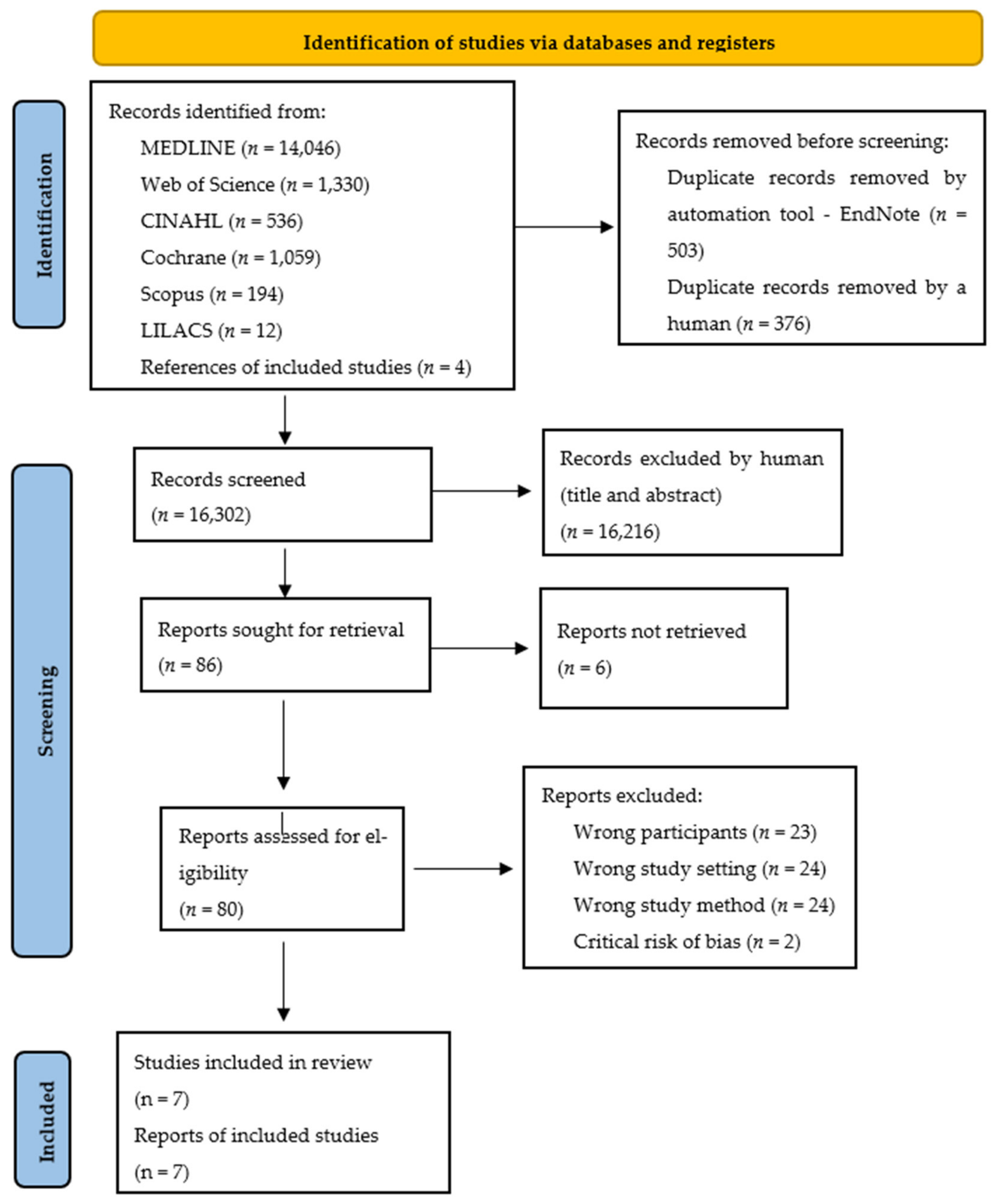
3.1. Study Selection
3.2. Study Characteristics
3.3. Types of Study Interventions
3.4. Main Results of the Primary Outcomes
3.5. Main Results of Secondary Outcomes
3.6. Organizational Components of Home-Based Palliative Care Models Coordinated by PHC
3.7. Risk of Bias and Reported Limitations
4. Discussion
5. Limits and Strengths
6. Conclusions
Supplementary Materials
Author Contributions
Funding
Institutional Review Board Statement
Informed Consent Statement
Data Availability Statement
Conflicts of Interest
Abbreviations
| ED | Emergency Department |
| EOL | End of Life |
| HDI | Human Development Index |
| ICD | International Classification of Diseases |
| PC | Palliative Care |
| PHC | Primary Health Care |
References
- Rimmer, B.; Crowe, L.; Todd, A.; Sharp, L. Assessing unmet needs in advanced cancer patients: A systematic review of the development, content, and quality of available instruments. J. Cancer Surviv. 2022, 16, 960–975. [Google Scholar] [CrossRef] [Scilit] [PubMed]
- Alizadeh, Z.; Rohani, C.; Rassouli, M.; Ilkhani, M.; Hazrati, M. Bridging the Gap and Developing a Home-Based Palliative Care Model for Cancer Patients. Asia Pac. J. Oncol. Nurs. 2024, 11, 100583. [Google Scholar] [CrossRef] [Scilit] [PubMed]
- Bergström, S.; Hållberg, H.; Berglund, A.; Bergqvist, M.; Holgersson, G. Stable Longitudinal Symptom Intensity in Cancer Patients during End-of-Life Palliative Care at Home: Prospective Cohort Study. BMJ Support. Palliat. Care 2025, 16, 1170–1179. [Google Scholar] [CrossRef] [Scilit] [PubMed]
- Hojjat-Assari, S.; Rassouli, M.; Madani, M.; Heydari, H. Developing an Integrated Model of Community-Based Palliative Care into the Primary Health Care (PHC) for Terminally Ill Cancer Patients in Iran. BMC Palliat. Care 2021, 20, 100. [Google Scholar] [CrossRef] [Scilit] [PubMed]
- Peeler, A.; Afolabi, O.; Adcock, M.; Evans, C.; Nkhoma, K.; van Breevoort, D.; Farrant, L.; Harding, R. Primary Palliative Care in Low- and Middle-Income Countries: A Systematic Review and Thematic Synthesis of the Evidence for Models and Outcomes. Palliat. Med. 2024, 38, 776–789. [Google Scholar] [CrossRef] [Scilit] [PubMed]
- Corrêa, M.I.; Bruera, E.; Alves, J.d.O.; Souza, S.; Aguiar, M.Á.d.F.; Drummond-Lage, A.P. Transforming End-of-Life Care: Impact of the “Melhor em Casa” Home-Based Palliative Care Program in Brazil. J. Palliat. Med. 2025, 28, 917–923. [Google Scholar] [CrossRef] [Scilit] [PubMed]
- Hosseini, H.; Rassouli, M.; Hayati, H.; Heydari, H. The Effect of Community-Based Palliative Supportive Care Integrated with Primary Health Care (PHC) on the Outcomes of Terminally Ill Cancer Patients. BMC Prim. Care 2025, 26, 139. [Google Scholar] [CrossRef] [Scilit] [PubMed]
- de Nooijer, K.; Pivodic, L.; Van Den Noortgate, N.; Pype, P.; Evans, C.; Van den Block, L. Timely Short-Term Specialized Palliative Care Service Intervention for Older People with Frailty and Their Family Carers in Primary Care: Development and Modelling of the Frailty+ Intervention Using Theory of Change. Palliat. Med. 2021, 35, 1961–1974. [Google Scholar] [CrossRef] [Scilit] [PubMed]
- Engeser, P.; Glassman, J.; Leutgeb, R.; Szecsenyi, J.; Laux, G. Early Integration of Palliative Care for Outpatients with Advanced Cancer in General Practice: How Is the Situation? A Cohort Study. Ann. Palliat. Med. 2021, 10, 2843–2848. [Google Scholar] [CrossRef] [Scilit] [PubMed]
- Jordan, R.I.; Allsop, M.J.; ElMokhallalati, Y.; Jackson, C.E.; Edwards, H.L.; Chapman, E.J.; Deliens, L.; Bennett, M.I. Duration of Palliative Care before Death in International Routine Practice: A Systematic Review and Meta-Analysis. BMC Med. 2020, 18, 368. [Google Scholar] [CrossRef] [Scilit] [PubMed]
- O’Hanlon, C.E.; Giannitrapani, K.F.; Lindvall, C.; Gamboa, R.C.; Canning, M.; Asch, S.M.; Garrido, M.M.; ImPACS Patient and Caregiver Panel; Walling, A.M.; Lorenz, K.A. Patient and Caregiver Prioritization of Palliative and End-of-Life Cancer Care Quality Measures. J. Gen. Intern. Med. 2022, 37, 1429–1435. [Google Scholar] [CrossRef] [Scilit] [PubMed]
- Verhoef, M.J.; de Nijs, E.; Horeweg, N.; Fogteloo, J.; Heringhaus, C.; Jochems, A.; Fiocco, M.; van der Linden, Y. Palliative Care Needs of Advanced Cancer Patients in the Emergency Department at the End of Life: An Observational Cohort Study. Support. Care Cancer 2020, 28, 1097–1107. [Google Scholar] [CrossRef] [Scilit] [PubMed]
- World Health Organization (WHO). Integrating Palliative Care and Symptom Relief into Primary Health Care—A WHO Guide for Planners, Implementers and Managers; WHO: Geneva, Switzerland, 2018; Available online: https://www.who.int/publications/i/item/integrating-palliative-care-and-symptom-relief-into-primary-health-care (accessed on 2 January 2023).
- Davis, M.P.; Temel, J.S.; Balboni, T.; Glare, P. A Review of the Trials Which Examine Early Integration of Outpatient and Home Palliative Care for Patients with Serious Illnesses. Ann. Palliat. Med. 2015, 4, 99–121. [Google Scholar] [CrossRef] [Scilit] [PubMed]
- van Gaans, D.; Erny-Albrecht, K.; Tieman, J. Palliative Care Within the Primary Health Care Setting in Australia: A Scoping Review. Public Health Rev. 2022, 43, 1604856. [Google Scholar] [CrossRef] [Scilit] [PubMed]
- Silva, T.C.; Nietsche, E.A.; Cogo, B.S. Palliative Care in Primary Health Care: An Integrative Literature Review. Rev. Bras. Enferm. 2022, 75, e20201335. [Google Scholar] [CrossRef] [Scilit] [PubMed]
- Paraizo-Horvath, C.M.S.; Fernandes, D.S.; Russo, T.M.D.S.; Souza, A.C.; Silveira, R.C.C.P.; Galvão, C.M.; Mendes, K.D.S. Identification of People for Palliative Care in Primary Health Care: Integrative Review. Cienc. Saude Colet. 2022, 27, 3547–3557. [Google Scholar] [CrossRef] [Scilit]
- Swenne, J.I.E.; Hansen, T.F.; Nissen, R.D.; Steffensen, K.D.; Stie, M.; Søndergaard, J.; Jensen, L.H. Early Integration of Basic Palliative Care in Cancer: Scoping Review of Cross-Sectorial Models—Components, Facilitators, Barriers. BMJ Support. Palliat. Care 2024, 14, e2349–e2365. [Google Scholar] [CrossRef] [Scilit] [PubMed]
- Atreya, S.; Salins, N. End-of-Life Care Education as Blended Learning Approach for General Practitioners: A Scoping Review. J. Cancer Educ. 2023, 38, 1440–1458. [Google Scholar] [CrossRef] [Scilit] [PubMed]
- Higgins, J.P.T.; Thomas, J.; Chandler, J.; Cumpston, M.; Li, T.; Page, M.J.; Welch, V.A. (Eds.) Cochrane Handbook for Systematic Reviews of Interventions Version 6.3; John Wiley & Sons: Hoboken, NJ, USA, 2022. [Google Scholar]
- da Silva, M.M.; Barros, T.; Baixinho, C.L.; Costa, A.; Sá, E.; Henriques, M.A. The Organization of Home Palliative Cancer Care by Primary Health Care: A Systematic Review Protocol. Int. J. Environ. Res. Public Health 2023, 20, 5085. [Google Scholar] [CrossRef] [Scilit] [PubMed]
- Page, M.J.; McKenzie, J.E.; Bossuyt, P.M.; Boutron, I.; Hoffmann, T.C.; Mulrow, C.D.; Shamseer, L.; Tetzlaff, J.M.; Akl, E.A.; Brennan, S.E.; et al. The PRISMA 2020 Statement: An Updated Guideline for Reporting Systematic Reviews. BMJ 2021, 372, n71. [Google Scholar] [CrossRef] [Scilit] [PubMed]
- International Associations for Hospice and Palliative Care (IAHPC). Global Consensus Based Palliative Care Definition; The International Association for Hospice and Palliative Care: Houston, TX, USA, 2018; Available online: https://hospicecare.com/what-we-do/projects/consensus-based-definition-of-palliative-care/definition/ (accessed on 9 September 2026).
- Worldwide Hospice Palliative Care Alliance. Global Atlas of Palliative Care, 2nd ed.; Worldwide Hospice Palliative Care Alliance: London, UK, 2020; Available online: http://www.thewhpca.org/resources/global-atlas-on-end-of-life-care (accessed on 2 January 2023).
- Webber, C.; Viola, R.; Knott, C.; Peng, Y.; Groome, P.A. Community Palliative Care Initiatives to Reduce End-of-Life Hospital Utilization and In-Hospital Deaths: A Population-Based Observational Study Evaluating Two Home Care Interventions. J. Pain Symptom Manag. 2019, 58, 181–189.e1. [Google Scholar] [CrossRef] [Scilit] [PubMed]
- Mracek, J.; Earp, M.; Sinnarajah, A. Palliative Home Care and Emergency Department Visits in the Last 30 and 90 Days of Life: A Retrospective Cohort Study of Patients with Cancer. BMJ Support. Palliat. Care 2021, 14, e2632–e2641. [Google Scholar] [CrossRef] [Scilit] [PubMed]
- Haltia, O.; Hirvonen, O.M.; Saarto, T.; Lehto, J.T. Impact of the Regional Palliative Care Pathway on Emergency Room Visits and Hospitalizations. Anticancer. Res. 2021, 41, 1701–1706. [Google Scholar] [CrossRef] [Scilit] [PubMed]
- Larrañaga, I.; Millas, J.; Soto-Gordoa, M.; Arrospide, A.; San Vicente, R.; Irizar, M.; Lanzeta, I.; Mar, J. Impacto de la Identificación de Pacientes en un Programa de Cuidados Paliativos del País Vasco [The Impact of Patient Identification on an Integrated Program of Palliative Care in Basque Country]. Aten. Primaria 2019, 51, 80–90. [Google Scholar] [CrossRef] [Scilit] [PubMed]
- Maetens, A.; Beernaert, K.; De Schreye, R.; Faes, K.; Annemans, L.; Pardon, K.; Deliens, L.; Cohen, J. Impact of Palliative Home Care Support on the Quality and Costs of Care at the End of Life: A Population-Level Matched Cohort Study. BMJ Open 2019, 9, e025180. [Google Scholar] [CrossRef] [Scilit] [PubMed]
- Martoni, A.A.; Strocchi, E. Accessibilità di Cure Palliative Domiciliari e Luogo del Decesso dei Malati Oncologici: Analisi dei Dati della Regione Emilia-Romagna [Accessibility of Home Palliative Care and Place of Death of Cancer Patients: Data Analysis of the Emilia-Romagna Region]. Recent. Prog. Med. 2018, 109, 185–192. [Google Scholar] [CrossRef] [Scilit] [PubMed]
- Yosick, L.; Crook, R.E.; Gatto, M.; Maxwell, T.L.; Duncan, I.; Ahmed, T.; Mackenzie, A. Effects of a Population Health Community-Based Palliative Care Program on Cost and Utilization. J. Palliat. Med. 2019, 22, 1075–1081. [Google Scholar] [CrossRef] [Scilit] [PubMed]
- Nordly, M.; Skov Benthien, K.; Vadstrup, E.S.; Kurita, G.P.; von Heymann-Horan, A.B.; von der Maase, H.; Johansen, C.; Timm, H.; Kjellberg, J.; Sjøgren, P. Systematic Fast-Track Transition from Oncological Treatment to Dyadic Specialized Palliative Home Care: DOMUS—A Randomized Clinical Trial. Palliat. Med. 2019, 33, 135–149. [Google Scholar] [CrossRef] [Scilit] [PubMed]
- Canny, A.; Mason, B.; Stephen, J.; Hopkins, S.; Wall, L.; Christie, A.; Skipworth, R.J.; Bowden, J.; Graham, L.; Kendall, M.; et al. Advance Care Planning in Primary Care for Patients with Gastrointestinal Cancer: Feasibility Randomised Trial. Br. J. Gen. Pract. 2022, 72, e571–e580. [Google Scholar] [CrossRef] [Scilit] [PubMed]
- Blay, C.; Martori, J.C.; Limon, E.; Lasmarías, C.; Oller, R.; Gómez-Batiste, X. Cada Semana Cuenta: Uso de Dispositivos Sanitarios y Costes Relacionados de una Cohorte Comunitaria de Personas con Enfermedades Crónicas Avanzadas [Every Week Counts: Use of Health Services and Related Costs of a Community-Based Cohort of People with Advanced Chronic Diseases]. Aten. Primaria 2019, 51, 359–366. [Google Scholar] [CrossRef] [Scilit] [PubMed]
- Evans, J.M.; Mackinnon, M.; Pereira, J.; Earle, C.C.; Gagnon, B.; Arthurs, E.; Gradin, S.; Walton, T.; Wright, F.; Buchman, S. Building Capacity for Palliative Care Delivery in Primary Care Settings: Mixed-Methods Evaluation of the INTEGRATE Project. Can. Fam. Physician 2021, 67, 270–278. [Google Scholar] [CrossRef] [Scilit] [PubMed]
- Look Hong, N.J.; Liu, N.; Wright, F.C.; MacKinnon, M.; Seung, S.J.; Earle, C.C.; Gradin, S.; Sati, S.; Buchman, S.; Mittmann, N. Assessing the Impact of Early Identification of Patients Appropriate for Palliative Care on Resource Use and Costs in the Final Month of Life. JCO Oncol. Pract. 2020, 16, e688–e702. [Google Scholar] [CrossRef] [Scilit] [PubMed]
- Fernando, G.V.C.; Athauda, L.; Perdamaian, T.K.; Kondasinghe, J.S.; Prathapan, S. Facilitators and Barriers Primary Care Physicians Face in Providing Palliative Care in Low- and Middle-Income Countries: A Mixed Methods Systematic Review. BMC Prim. Care 2026, 27, 34. [Google Scholar] [CrossRef] [Scilit] [PubMed]
- Scaccabarozzi, G.; Amodio, E.; Pellegrini, G.; Limonta, F.; Lora Aprile, P.; Lovaglio, P.G.; Peruselli, C.; Crippa, M. The “ARIANNA” Project: An Observational Study on a Model of Early Identification of Patients with Palliative Care Needs through the Integration between Primary Care and Italian Home Palliative Care Units. J. Palliat. Med. 2018, 21, 631–637. [Google Scholar] [CrossRef] [Scilit] [PubMed]
- Cai, J.; Zhang, L.; Guerriere, D.; Fan, H.; Coyte, P.C. What Variables Contribute to the Achievement of a Preferred Home Death for Cancer Patients in Receipt of Home-Based Palliative Care in Canada? Cancer Nurs. 2021, 44, 214–222. [Google Scholar] [CrossRef] [Scilit] [PubMed]
- Chan, H.Y.-L.; Chung, C.K.-M.; Tam, S.S.-C.; Chow, R.S.-K. Community Palliative Care Services on Addressing Physical and Psychosocial Needs in People with Advanced Illness: A Prospective Cohort Study. BMC Palliat. Care 2021, 20, 143. [Google Scholar] [CrossRef] [Scilit] [PubMed]
- Huang, P.-T.; Kung, P.-T.; Kuo, W.-Y.; Tsai, W.-C. Impact of Family Physician Integrated Care Program on Decreasing Utilization of Emergency Department Visit and Hospital Admission: A Population-Based Retrospective Cohort Study. BMC Health Serv. Res. 2020, 20, 470. [Google Scholar] [CrossRef] [Scilit] [PubMed]
- Campagna, S.; Borraccino, A.; Politano, G.; Benso, A.; Dalmasso, M.; Dimonte, V.; Gianino, M.M. Determinants Associated with the Risk of Emergency Department Visits among Patients Receiving Integrated Home Care Services: A 6-Year Retrospective Observational Study in a Large Italian Region. Int. J. Health Policy Manag. 2021, 10, 605–612. [Google Scholar] [CrossRef] [Scilit] [PubMed]
- Howard, M.; Langevin, J.; Bernard, C.; Tan, A.; Klein, D.; Slaven, M.; Barwich, D.; Elston, D.; Arora, N.; Heyland, D.K. Primary Care Clinicians’ Confidence, Willingness Participation and Perceptions of Roles in Advance Care Planning Discussions with Patients: A Multi-Site Survey. Fam. Pract. 2020, 37, 219–226. [Google Scholar] [CrossRef] [Scilit] [PubMed]
- Antunes, B.; Rodrigues, P.P.; Higginson, I.J.; Ferreira, P.L. Determining the Prevalence of Palliative Needs and Exploring Screening Accuracy of Depression and Anxiety Items of the Integrated Palliative Care Outcome Scale—A Multi-Centre Study. BMC Palliat. Care 2020, 19, 69. [Google Scholar] [CrossRef] [Scilit] [PubMed]


| Title, Year | Country, HDI and Level of PC | Objective | Type of Study and Risk of Bias | Sample Size/Participants | Purpose of the Intervention/Comparator | PHC Role | Main Outcomes/Effects Estimate (95% CI) |
|---|---|---|---|---|---|---|---|
| Community Palliative Care Initiatives to Reduce End-of-Life Hospital Utilization and In-Hospital Deaths: A Population-Based Observational Study Evaluating Two Home Care Interventions, 2019 [25] | Ontario, Canada, HDI very high Level 4b | To evaluate the impact of interventions aimed at planning for a home death (Yellow Folder) and managing symptoms in the home (Symptom Response Kit) on place of death and hospital utilization among palliative home care patients | Ecological and retrospective cohort study ROBINS-I V2-Moderate | Final cohort 5900 patients; 4538 decedents | Yellow Folder to facilitate EOL planning at home and Symptom Response Kit; the comparator was the absence of both interventions | Program-led with PHC integration. Home PC organized by care coordinators; later supported by a Supportive Care Team with palliative training | Death in the community: - Yellow Folder vs. neither intervention—RR 1.66; CI not reported. - Symptom response vs. neither intervention—RR1.79 (1.55 to 2.05) Both vs. neither intervention—RR 2.20 (2.05 to 2.36) |
| Palliative home care and emergency department visits in the last 30 and 90 days of life: a retrospective cohort study of patients with cancer, 2021 [26] | Calgary, Canada, HDI very high Level 4b | To evaluate the association of specialist palliative home care on emergency department visits in the 30 and 90 days prior to death | Retrospective cohort study ROBINS-I V2-Moderate | 6976 adults who died of cancer; 51% were men, 49% were women | Home PC vs. generalist home care vs. no home care. ED use measured in the last 30 and 90 days of life; prior ED use assessed over 90–365 days | Home care (HC) delivery included palliative HC and generalist HC; timing of first palliative contact captured PC access | ED visit in last 30 days: - Generalist HC vs. Palliative HC—OR 1.19 (1.06 to 1.34) - No HC vs. Palliative HC—OR 1.54 (1.31 to 1.82) ED visit in last 90 days: - Generalist HC vs. Palliative HC—OR 1.48 (1.32 to 1.67) - No HC vs. Palliative HC—OR 1.66 (1.39 to 1.99) |
| Impact of the regional palliative care pathway on emergency room visits and hospitalizations, 2021 [27] | Finland, HDI very high Level 3b | To explore the effect of palliative care pathway including home care and end-of-life care beds in the community hospitals supported by a palliative care unit in the secondary hospital on emergency room visits and hospitalizations | Retrospective cohort study ROBINS-I V2-Moderate | 112 patients with advanced cancer and a palliative treatment goal visited the ED in both 2009 and 2015; median age 69 years, 46% women | Regional PC pathway including home PC teams, EOL beds in community hospitals, a general practitioner/nurse coordinator in each community, and a PC outpatient unit. Comparator: before vs. after pathway implementation in 2009 and 2015 | Integrated Tiered Network; pathway explicitly linked primary and secondary care; communities provided PHC via general practitioner-led community hospitals and home care units | Revisit ED rate 59% to 38% (p < 0.01); secondary hospital admissions 56% to 45% (p = 0.016); community hospital admissions 12% to 28% (p < 0.001). No numerical effect estimate or CI was reported; the study states differences in revisits were insignificant and hospitalizations increased in one setting, but without extractable estimates. |
| The impact of patient identification on an integrated program of palliative care in the Basque Country, 2019 [28] | Basque Country, Spain, HDI very high Level 4b (Spain) | To evaluate the process and the economic impact of an integrated palliative care program | Comparative cross-sectional study ROBINS-I V2-Moderate | Population of 160,000; deceased patients in 2012 (1023) and 2015 (1142) | To ensure that patients with PC needs received appropriate support in the EOL. Comparator: pre-intervention (2012) vs. post-intervention (2015) | Specialist-led with PHC coordination; integrated model using primary care centers, general practitioner/nurse coordination, and home care contacts | 2015 vs. 2012: higher likelihood of V66.7 identification—OR 1.14 (1.13 to 1.16¨); increased opioid prescribing—OR 1.48 (1.45 to 1.50); slight increases in hospital death—OR 1.03 (1.01 to 1.05) and hospital admissions OR 1.03 (1.01 to 1.05), and higher total costs—OR 1.04 (1.00 to 1.09) |
| Impact of palliative home care support on the quality and costs of care at the end of life: a population-level matched cohort study, 2019 [29] | Belgium, HDI very high Level 4b | To evaluate the impact of palliative home care support on the care quality and costs in the last 14 days of life | Retrospective cohort study ROBINS-I V2-Moderate | A total of 8837 individuals who received home PC during the final 720 to 15 days of life were matched, via propensity score, to 8837 individuals who received standard care | To advise family doctors, other healthcare professionals, informal carers, and volunteers involved in providing home PC. Exposure: palliative home care support vs. none; sensitivity analyses separated home PC, multidisciplinary team visit, and palliative nursing/physiotherapy at home | Generalist-led with Specialist Support; some quality indicators counted family physician or other primary care professional contacts in the last 14 days | The home-support group had more contacts with family physicians: mean 3.1 vs. 0.8 in the control group, with SD 6.5 vs. 1.2. Home death—OR 4.08 (3.86 to 4.31); ED use—OR 0.54 (0.51 to 0.57); Hospital admission—OR 0.45 (0.43 to 0.46); Diagnostic testing—OR 0.43 (0.41 to 0.45); Blood transfusion—OR 0.47 (0.40 to 0.54); Surgery—OR 0.19 (0.14 to 0.26) |
| Accessibility of home palliative care and place of death of cancer patients: data analysis of the Emilia-Romagna Regio, 2018 [30] | Bologna, Italy, HDI very high Level 4b | To evaluate the possible impact of the ANT Foundation program on health data relating to the location where cancer patients die within the Local Health Care system area (AUSL) of Bologna, compared to what happens in the other AUSLs of the Emilia-Romagna Region (ERR) where it is not present | Comparative cross-sectional study ROBINS-I V2-Moderate | 1023 decedents in 2012 (control) and 1142 in 2015 (intervention). | The model was tailored to each patient’s needs, primarily for those with a short-term prognosis, with the main objective of promoting home death | Strong primary care involvement plus hospital/home-hospitalization pathways and shared electronic records. | Among patients followed by ANT, home death reached 64.6% vs. 14.6% among those not followed; hospital death was 18.7% vs. 42.3%, and hospice death 16.6% vs. 40.7%. No numerical effect estimate or CI was reported |
| Effects of a Population Health Community-Based Palliative Care Program on Cost and Utilization, 2019 [31] | United States of America, HDI very high Level 4b | To evaluate utilization and cost outcomes of a standardized, population health community-based palliative care program provided by nurses and social workers | Retrospective propensity-adjusted study ROBINS-I V2-Moderate | 804 high-risk Medicare Advantage members identified; 176 in the PC group and 570 in standard-care controls for evaluation | Nurse and social worker community-based PC vs. standard telephonic health-plan case management. | Specialist-led with PHC Coordination. Community-based program delivered by nurses and social workers; patients were selected by a proprietary predictive model | Total medical cost, pharmacy cost, hospital admissions, hospital days, ED visits. 20% reduction in total medical costs ($619 per enrolled member per month), 33% reduction in hospital admissions, 38% reduction in ICU admissions, and 12% reduction in hospital days. No numerical effect estimate or CI was reported |
| Organizational Component | 25 | 26 | 27 | 28 | 29 | 30 | 31 |
|---|---|---|---|---|---|---|---|
| Case management | X | ✓ | X | X | X | X | ✓ |
| Multidisciplinary teams | X | X | X | X | ✓ | X | X |
| 24/7 availability | X | ✓ | X | X | X | ✓ | X |
| Anticipatory care planning | ✓ | X | ✓ | X | X | X | ✓ |
| Shared records/electronic records | X | X | X | ✓ | X | ✓ | X |
| Anticipatory medication/emergency kits/medication education | ✓ | X | X | X | X | X | ✓ |
| Professional training/capacity building | ✓ | X | X | ✓ | X | ✓ | ✓ |
| Structured referral pathways | X | X | ✓ | ✓ | X | X | X |
| Specialist support integrated with PHC | X | ✓ | ✓ | ✓ | ✓ | ✓ | X |
Disclaimer/Publisher’s Note: The statements, opinions and data contained in all publications are solely those of the individual author(s) and contributor(s) and not of MDPI and/or the editor(s). MDPI and/or the editor(s) disclaim responsibility for any injury to people or property resulting from any ideas, methods, instructions or products referred to in the content. |
© 2026 by the authors. Licensee MDPI, Basel, Switzerland. This article is an open access article distributed under the terms and conditions of the Creative Commons Attribution (CC BY) license.
Share and Cite
da Silva, M.M.; Thiago, T.d.A.B.S.; Crespo, M.d.C.A.; Telles, A.C.; Baixinho, C.L.; Costa, A.; Sá, E. The Organization of Home Palliative Cancer Care by Primary Health Care: A Systematic Review. Int. J. Environ. Res. Public Health 2026, 23, 1226. https://doi.org/10.3390/ijerph23091226
da Silva MM, Thiago TdABS, Crespo MdCA, Telles AC, Baixinho CL, Costa A, Sá E. The Organization of Home Palliative Cancer Care by Primary Health Care: A Systematic Review. International Journal of Environmental Research and Public Health. 2026; 23(9):1226. https://doi.org/10.3390/ijerph23091226
Chicago/Turabian Styleda Silva, Marcelle Miranda, Thayna de Assis Barros S. Thiago, Maria da Conceição Albernaz Crespo, Audrei Castro Telles, Cristina Lavareda Baixinho, Andreia Costa, and Eunice Sá. 2026. "The Organization of Home Palliative Cancer Care by Primary Health Care: A Systematic Review" International Journal of Environmental Research and Public Health 23, no. 9: 1226. https://doi.org/10.3390/ijerph23091226
APA Styleda Silva, M. M., Thiago, T. d. A. B. S., Crespo, M. d. C. A., Telles, A. C., Baixinho, C. L., Costa, A., & Sá, E. (2026). The Organization of Home Palliative Cancer Care by Primary Health Care: A Systematic Review. International Journal of Environmental Research and Public Health, 23(9), 1226. https://doi.org/10.3390/ijerph23091226