Article

Faith over Protection, Faith as Foundation: A Mixed-Methods Joint Display Study of Religion, Spirituality, and PrEP Decision-Making Among Black Cisgender Women in the United States


1
Graduate College of Social Work, University of Houston, Houston, TX 77204, USA
2
Bursky School of Public Health, Washington University in St. Louis, St. Louis, MO 63130, USA
3
School of Social Work, Boston College, Chestnut Hill, MA 02467, USA
4
Community Wellness Project, St. Louis, MO 63101, USA
5
Department of Population Medicine, Harvard Medical School, Boston, MA 02215, USA
6
Health Justice, New York, NY, USA
*
Author to whom correspondence should be addressed.
Int. J. Environ. Res. Public Health 2026, 23(9), 1219; https://doi.org/10.3390/ijerph23091219
Submission received: 1 July 2026 / Revised: 3 September 2026 / Accepted: 10 September 2026 / Published: 15 September 2026
(This article belongs to the Special Issue Women and Pre-Exposure Prophylaxis for HIV Prevention)

Highlights

Public health relevance—How does this work relate to a public health issue?
  • Black cisgender women in the United States experience a disproportionate HIV burden yet remain underrepresented in PrEP research, messaging, and implementation efforts.
  • This study examines how religion and spirituality shape HIV prevention decision-making, including PrEP use, stigma, communication, and trust, in a priority population for HIV prevention.
Public health significance—Why is this work of significance to public health?
  • The study shows that religion and spirituality function as a multidimensional context for PrEP decision-making, acting as both a potential barrier and a potential facilitator of HIV prevention engagement.
  • By integrating quantitative and qualitative findings, the study identifies how moral reasoning, stigma, trusted institutions, and communication norms influence Black women’s PrEP-related decisions.
Public health implications—What are the key implications or messages for practitioners, policy makers and/or researchers in public health?
  • Faith-partnered PrEP interventions should be co-designed with Black women and faith leaders and should frame HIV prevention within trusted, culturally and spiritually resonant community contexts.
  • Public health practitioners and researchers should move beyond one-dimensional assumptions about religiosity and develop intersectionally tailored HIV prevention strategies that address stigma while leveraging faith-based trust and infrastructure.

Abstract

Background: Black cisgender women in the United States bear a disproportionate burden of new HIV diagnoses, yet fewer than 1 in 10 women who could benefit from pre-exposure prophylaxis (PrEP) receive a prescription. Religion and spirituality are central to many Black women’s lives and may shape sexual health decision-making in complex ways, but their role in PrEP engagement has been undertheorized. Methods: We conducted a convergent mixed-methods study integrating cross-sectional survey data from the ReachHER study (N = 397 Black cisgender women) with qualitative, semi-structured interviews (different sample of N = 30 Black cisgender women). Three religion/spirituality items—general religiosity, religion in medical decisions, and religion in sexual decisions—were examined in exploratory bivariate analyses with prior PrEP awareness, current PrEP use, HIV testing in the past 12 months, and primary care provider access using Pearson χ2 tests. Prior PrEP awareness was assessed before participants received standardized PrEP education. Qualitative data were analysed using reflexive thematic analysis. A joint display integrated the two datasets. Results: General religious/spiritual identification and religion in medical decisions were associated with current PrEP use in bivariate analyses, and religious/spiritual identification was also associated with HIV testing in the past 12 months. Five qualitative themes emerged: (1) religion as part of a broader belief system; (2) religion as cultural and identity intersection; (3) religion as a barrier to sexual health communication; (4) faith over protection as a driver of PrEP hesitancy and stigma; and (5) religious institutions as trusted intervention spaces. Conclusions: In this mixed-methods study, religion/spirituality functioned as an ambivalent but consequential multidimensional context for PrEP decision-making among Black cisgender women, simultaneously constraining sexual discourse and providing trusted infrastructure for prevention. Faith-partnered, intersectionally tailored PrEP interventions warrant further study.

1. Introduction

Black cisgender women remain disproportionately affected by HIV in the United States, accounting for the majority of new HIV diagnoses among women despite representing roughly 14% of the US female population [1,2]. Pre-exposure prophylaxis (PrEP) is a highly effective preventive medication but only ~8% of women who could benefit from its use have received a prescription [3]. Persistent disparities reflect intersecting structural, interpersonal, and cultural barriers including medical mistrust rooted in historical and contemporary racism; gendered racism in clinical encounters; PrEP messaging that has centered MSM and transgender women; and lack of culturally tailored sexual health communication [4,5,6,7,8].
Religion and spirituality are foundational to many Black women’s identities; ~87% of Black Americans identify as Christian and ~83% pray daily [9]. Faith institutions are among the most trusted community spaces and have long served as sites for health promotion [9,10,11]. Prior studies suggest religiosity is often associated with delayed sexual debut, sexual negotiation, and other protective sexual or health behaviors across Black populations and related samples [12,13]. However, religious frameworks can also constrain sexual health communication, reinforce abstinence-only messaging, and contribute to HIV- and PrEP-related stigma [11,14,15,16]. Few studies have examined how religion/spirituality specifically shapes PrEP decision-making among Black cisgender women. Existing literature suggests that the influence of religion and PrEP can be complex, with studies showing both negative associations between religiosity and PrEP-related outcomes, as well as positive relationships between religious involvement, supportive faith-leader messaging, and PrEP willingness [10,17]. Research on faith-based health interventions also suggests that the church may be a powerful setting for HIV prevention, but religious norms about sexuality could reinforce stigma or discourage prevention behaviors simultaneously [18]. Since religion can function as both a barrier and facilitator to HIV prevention, it should be understood that religion is not uniformly protective or detrimental to PrEP uptake, but is instead informed by social and cultural contexts influenced by how Black individuals understand sexuality, HIV risk, and methods of prevention.
Drawing on Crenshaw’s intersectionality [19] and Bond and colleagues’ application to PrEP [4], we conceptualize religion as embedded in the intersecting systems of race, gender, class, and sexuality that shape Black cisgender women’s access to and acceptance of biomedical HIV prevention. Religion is not external to structural racism; it is part of how Black women navigate it [20,21].
This convergent mixed-methods study addresses the gap by integrating survey and interview data from Black cisgender women in the United States (survey) and in St. Louis (interviews). Limited research has integrated quantitative measures of religiosity with Black women’s own accounts of how religion may influence PrEP-related attitudes and behaviors. By using this methodology, our study adds to the literature by providing a more nuanced understanding of religious mechanisms influencing decision-making in this understudied population. We ask: (1) How are dimensions of religiosity/spirituality (general, medical, sexual) associated with PrEP awareness, current PrEP use, HIV testing, and primary care provider access? (2) How do Black cisgender women describe the role of religion/spirituality in their sexual health and HIV prevention decisions? (3) When these strands are integrated in a joint display, what convergence, expansion, and tension emerge? We hypothesized—following the literature—that religion would function as a multidimensional context rather than a unidirectional barrier or facilitator.

2. Materials and Methods

2.1. Study Design

This study utilized a convergent mixed-methods design [22,23] integrating cross-sectional survey data with qualitative semi-structured in-depth interviews. Following Fetters, Curry, and Creswell [22], quantitative and qualitative strands were collected and analyzed in parallel and integrated via a joint display at the interpretation stage. The analytic focus is on how religion/spirituality matters for PrEP outcomes and, mechanistically, how religion functions in Black cisgender women’s prevention decision-making.

2.2. Quantitative Component

2.2.1. Study Design, Participants, and Recruitment

The quantitative strand drew on data from a cross-sectional, web-based survey of Black cisgender women in the United States (the ReachHER study) conducted between May and August 2023 to examine HIV prevention and sexual health experiences. Eligibility criteria required participants to (1) self-identify as Black or African American; (2) self-identify as a cisgender woman; (3) be 18–55 years of age; (4) report receptive vaginal and/or anal sex in the prior 12 months; (5) report no prior HIV diagnosis; and (6) be able to read and complete the survey in English.
To maximize reach and geographic diversity, participants were recruited through two complementary strategies: (1) the Qualtrics online research panel (Qualtrics, Provo, UT) and (2) targeted advertisements on social media platforms, including Facebook and Instagram. The Qualtrics panel comprises individuals who opt in to participate in surveys in exchange for modest compensation and has been effective in successfully engaging study participants in prior HIV and PrEP research with Black Americans, balancing efficiency, national reach, and engagement of populations that are often underrepresented in clinic-based sampling [7,24,25]. Panel-based recruitment was designed to yield a non-probability but geographically diverse national sample of Black cisgender women rather than a population-representative sample.
All participants provided electronic informed consent prior to beginning the survey. The instrument was anonymous and self-administered through the Qualtrics platform and required approximately 30 min to complete. To safeguard privacy, no IP addresses or browser cookies were collected. Participants who completed the survey received a $25 electronic gift card. Only fully completed surveys were retained for the analytic sample, yielding N = 397 respondents for the present analyses. Detailed participant-flow counts for survey initiation, exclusion, and incomplete responses were not retained in a form that permitted reliable reconstruction for this revision. All study procedures were reviewed and approved by the Boston College Institutional Review Board (IRB Protocol No. 23.033.01).

2.2.2. Data Collection Procedures

The online survey captured a broad range of sociodemographic characteristics, social and structural conditions, sexual health behaviors, and HIV prevention-related attitudes and experiences (Supplementary Materials). The instrument was designed to generate detailed information on participants’ perceptions of, exposure to, and engagement with PrEP, as well as the religion and spirituality measures that anchor the present analyses (described in 2.2.2 [Measures]).

2.2.3. Measures

Religiosity. Three single-item ordinal indicators were utilized on a 4-point scale (1 = not important, 4 = very important), reverse-coded so higher scores equaled greater importance: general religious/spiritual self-identification (rel1); importance of religion/spirituality in medical decisions (rel2); and importance of religion/spirituality in sexual decisions (rel3).
Outcomes. Dichotomous outcomes included prior PrEP awareness (yes/no), defined by the item “Before your participation in this study, had you ever heard of PrEP?”; current PrEP use (yes/no), based on the item “Are you currently being prescribed PrEP by a healthcare professional?” with affirmative responses indicating PrEP as a daily pill or PrEP as a shot every two months; HIV testing in the past 12 months (yes/no); and having a primary care provider (yes/no).
Covariates. Covariates collected included age, sexual orientation, nativity, parental nativity, education, relationship status, employment, income, and insurance.

2.2.4. Additional PrEP Awareness and Decision Context Measures

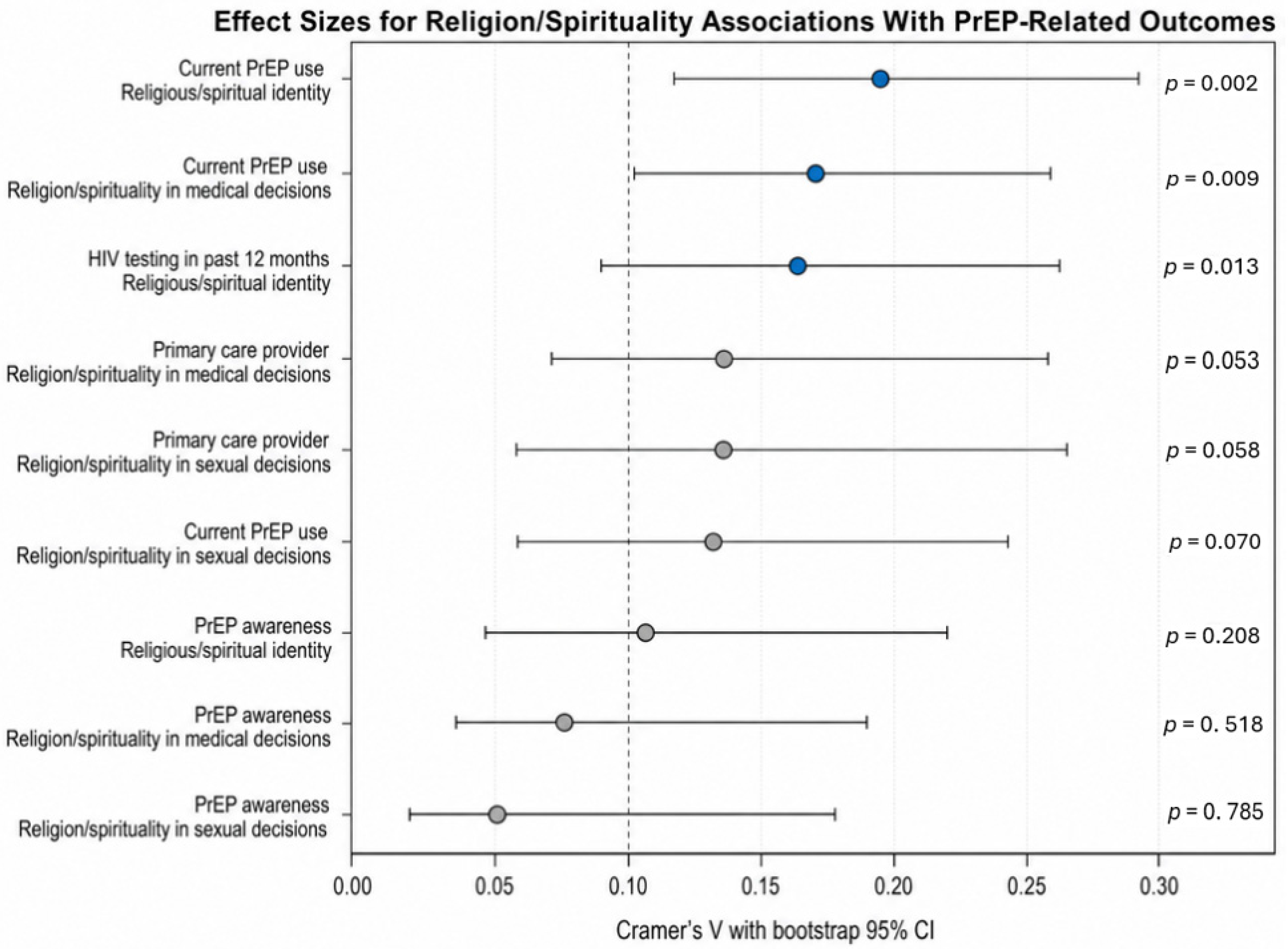
Descriptive statistics summarized predictors and outcomes. Bivariate associations were tested with Pearson χ2 (α = 0.05, two-tailed). Because the quantitative component was designed as descriptive/exploratory within a convergent mixed-methods study and some outcome cells were sparse, we did not fit multivariable regression models. Analyses were conducted using R v4.3. To characterize the magnitude and uncertainty of the bivariate associations presented in Figure 1, Cramer’s V was calculated for each chi-square test. Nonparametric bootstrap confidence intervals were estimated using 1000 participant-level resamples with replacement, maintaining the original sample size in each resample. Cramer’s V was recalculated in each resample, and 95% percentile confidence intervals were defined by the 2.5th and 97.5th percentiles of the resulting bootstrap distribution. A fixed random seed of 123 was used for reproducibility. These effect sizes and confidence intervals were intended to describe the relative magnitude and precision of the observed associations rather than to support causal inference or adjusted predictions.

2.2.5. Statistical Analysis

Descriptive statistics summarized predictors and outcomes. Bivariate associations were tested with Pearson χ2 (α = 0.05, two-tailed). Analyses were conducted using R v4.3. Findings are intended to be descriptive and associative rather than causal.

2.3. Qualitative Component

2.3.1. Sample and Procedures

Sampling, recruitment, eligibility, and interview procedures have been previously described in detail [26]. In brief, semi-structured interviews of 45–60 min were conducted via Zoom with Black cisgender women from St. Louis recruited through the Community Wellness Project and snowball sampling. Purposive sampling ensured diversity across US-born Black women, Caribbean-born Black women, African immigrants, and first-generation women of African and Caribbean descent. The interview guide explored PrEP awareness and knowledge, perceptions of existing PrEP campaigns, cultural and religious values shaping sexual health, and preferences for message framing and delivery (Supplementary Materials). Interviews were audio-recorded, transcribed verbatim, and de-identified.

2.3.2. Qualitative Analysis

Transcripts were imported into Dedoose (Los Angeles, CA) [27] and analyzed using Braun and Clarke’s reflexive thematic analysis [28]. A three-member team of Black qualitative researchers conducted independent open coding, iteratively developed a shared codebook, applied axial coding to cluster codes into themes, and refined themes through consensus discussions. For the present analysis, we focused on excerpts in which participants referenced religion, spirituality, faith, God, church, or Christian identity in relation to sexual behavior, PrEP, or health-seeking. Trustworthiness was supported by analyst triangulation, audit trails, and reflexive memoing.

2.4. Mixed-Methods Integration: Joint Display

Following Guetterman, Fetters, and Creswell [29], we constructed a joint display aligning each significant or near-significant survey finding with a corresponding qualitative theme, illustrative excerpt, and integrative interpretation. Integration was assessed in terms of convergence, complementarity/expansion, and tension/discordance [22,29].
Joint display construction proceeded in four steps. First, we identified all religion/spirituality-related survey findings that were statistically significant or near-significant and extracted the corresponding outcome patterns across response categories. Second, we matched each quantitative finding to the qualitative theme or themes that addressed the same substantive issue, such as moral reasoning, sexual health communication, stigma, or trusted institutions. Third, we selected illustrative excerpts that best represented the qualitative meaning of each linked theme. Fourth, we developed an integrative interpretation for each row that summarized the mixed-methods insight as convergence, complementarity/expansion, or tension/discordance. In this way, the joint display functioned not only as a reporting device, but also as an analytic tool for refining interpretation and identifying actionable implications for faith-partnered PrEP intervention.

2.5. Ethics

All procedures were approved by the Boston College Institutional Review Board (Protocol No. 23.033.01). All participants provided either electronic informed consent or verbal informed consent. The study was conducted in accordance with the Declaration of Helsinki.

3. Results

3.1. Sample Characteristics

Participants (N = 397) had a mean age of 33.42 years (SD = 9.78). Most identified as heterosexual (78.3%), were US-born (97.7%), and had health insurance (90.7%); 84.6% reported a primary care provider. Educational attainment was diverse, with 41.6% having some college/associate degree and 18.4% holding a bachelor’s degree or higher. Nearly half were single (44.6%). Religiosity was high: 83.2% identified as very or somewhat religious/spiritual; 77.5% reported religion/spirituality as very or somewhat important in medical decisions; 77.1% in sexual decisions. Full sample characteristics are presented in Table 1.

3.2. Quantitative Associations Between Religion/Spirituality and HIV Prevention Outcomes

Religious/spiritual self-identification (rel1) was associated with current PrEP use, χ2(3, N = 397) = 14.65, p = 0.002. Current PrEP use differed across religiosity categories and was 21.2% among women who identified as very religious/spiritual, 6.7% among somewhat religious/spiritual women, 17.9% among not very religious/spiritual women, and 14.3% among women who were not religious/spiritual at all.
Religion/spirituality in medical decisions (rel2) was associated with current PrEP use, χ2(3, N = 397) = 11.59, p = 0.009. Current PrEP use was 20.8% among women reporting religion/spirituality as very important in medical decisions, 10.8% among those reporting it as somewhat important, 7.4% among those reporting it as not very important, and 5.7% among those reporting it as not important at all.
Religion/spirituality in sexual decisions (rel3) was not statistically significantly associated with current PrEP use, χ2(3, N = 397) = 7.06, p = 0.070.
Religious/spiritual self-identification was also associated with HIV testing in the past 12 months, χ2(3, N = 397) = 10.72, p = 0.013. HIV testing in the past 12 months differed across religiosity categories and was 53.9% among very religious/spiritual women, 57.6% among somewhat religious/spiritual women, 33.3% among not very religious/spiritual women, and 35.7% among women who were not religious/spiritual at all.
None of the three religiosity variables were significantly associated with prior PrEP awareness (p = 0.208 to 0.785). Associations between religion in medical decisions and having a primary care provider, χ2(3, N = 397) = 7.68, p = 0.053, and between religion in sexual decisions and having a primary care provider, χ2(3, N = 397) = 7.48, p = 0.058, did not meet the conventional threshold for statistical significance. Figure 1 shows that the largest effect-size estimates were observed for associations involving current PrEP use and religious/spiritual self-identification or religion in medical decisions, whereas effect-size estimates for prior PrEP awareness were smaller. Full results appear in Table 2.

3.3. Qualitative Themes

Our analysis of interview data with 30 Black cisgender women (Table 3) yielded five themes that collectively illustrate the multifaceted ways religion often shapes sexual health decision-making among Black cisgender women: religion serves as a (1) broader belief system, (2) intersection with culture and identity, (3) barrier to sexual health communication, (4) driver of PrEP hesitancy and stigma, and (5) trusted space for intervention.

3.3.1. Theme 1: “Pleasing in God’s Sight”—Religion as Part of a Broader Belief System

Participants demonstrated how religion plays a significant role in their lives and influences how they navigate the world. Religion served as the basis for certain beliefs and shaped how sexual health was seen and practiced. It was also described as an organizing framework responsible for upholding morality, beliefs, and principles that are in alignment with God and the teachings of the church. Some participants described how their faith and belief system influenced their sexual health opinions and decision-making. Guiding their actions towards aligning what they have been taught and what they practice. For instance, some participants explained their decision not to engage in sex:
I’m a Christian, and my-my Christian values is like, when you are not married, you are not sexually active. So I’m not sexually active.
(participant 023)
Um, I think for me sex is also a complicated issue because, a, I haven’t had it, and, b, I’m a person of faith, which affects the way I view sex.
(participant 008)
One participant further discussed how the belief systems she was raised on perpetuate a certain way of looking at sex and sexual relations. While she mentioned abstaining from sex until marriage, she believed this choice precluded sexual health awareness, conversations, and relationships. She expressed wanting to find a partner with whom she can be aligned and openly discuss sex and sexual health, which also extends to faith values:
I think I’m-I’m imagining and-and intentionally looking for a future partner with the understanding that they would do—they would feel the same way likewise, um, which I understand even within faith context and all the things that I’m looking for, it can be hard sometimes for to find someone that aligns on that front and is willing to be open and has considered these questions and has the right view or, you know, the po—a positive view of-of sexual relationships.
(participant 008)
Another participant discussed religion as it relates to refraining from behaviors that are in disagreement with God; she described how Black women are told they should not be having sex and that related conversations should not be had. Simultaneously, she acknowledged that everyone is capable of “falling short” and there should be more support around the choices people make for themselves. Ultimately, she believed in an overarching belief that God’s support is present in one’s decisions:
“Oh. You shouldn’t be having sex. We’re not having this discussion.” But you should be having this discussion—if you’re wanting to be pleasing to the inner side of God.
(participant 059)
Don’t get me wrong. You’re supposed to discourage things that are not pleasing in God’s sight. And if you fall short—notice the “and”— what solutions can we provide for you? Because this is your choice. That’s what it should be. Your choice. And God gives you the will to choose.
(participant 059)
Moreover, participants’ overall belief in God as a protective figure guided their behavior. Participants prayed to God to never be exposed to HIV/AIDS, or expressed gratitude for being HIV-negative even after engaging in risky sexual behaviors with one participant saying:
I thank God for his mercy—um, because there are so many situations where I could have contracted HIV.
(participant 059)
This sentiment was similar for another participant who engaged in sexual activity. When asked how she presently protects herself against HIV and STIs, she discussed a preference for not using condoms and regular testing, stating:
So I guess the answer to your question is, I’m not doing anything. I’m just, you know, believing in God and going to my testing.
(participant 062)

3.3.2. Theme 2: “Religious as a People”—Religion as a Powerful Intersection with Culture and Identity

Participants demonstrated how the overlap of religion with other parts of their identity guided how they navigated the topic of sex and PrEP. One participant shared that since a lot of Black people come up in the Christian or Muslim faith, more pointed conversations around sexual health would be helpful. Another participant declared that her religious and racial identity would influence her choice about whether to take PrEP:
So, first of all, from—based on the perspective that I-I’ve lived in—as an African and then also, like, our cultural values and whatever religion, I would say that a normal African—no, I don’t want to.
(participant 025)
Place of birth and generational status (i.e., how individuals are categorized based on their family’s immigration history) were also tied to religious beliefs and impacted how participants navigated sexual health. One participant discussed how her faith, coupled with her being a child of immigrants, prevented discussions about sex even though being able to do so would have helped her take better care of her sexual health:
Um, I know for me what definitely would have made it easier, not because sex was demonized in my faith community, but I think it just wasn’t—and also immigrant. I will—I’ll say that. I’m-I’m a diaspora kid, and so also the immigrant, you know, reality, the immigrant-parent reality, um, and I think that those two things combined, faith and immigrant-parent realities, um, make it even harder for us to have these conversations.
(participant 008)
Furthermore, participants explored how the church played an important cultural role in their lives and affected what could be done to make people aware of PrEP:
If you are targeting, like, the older generation, I’m definitely gonna say church because, you know, um, I think just with—just from looking at, like, my, um, family, church is, like, very important, you know.
(participant 032)
Yeah. I totally agree with the churches, like the religious bodies, ‘cause we’re very religious as a people.
(participant 027)

3.3.3. Theme 3: Practice What They Preach—Religion as a Barrier to Sexual Health Communication

Participants expressed that the Christian faith taught them to refrain from certain behaviors and discussions; this created gaps in knowledge and support. For example, participants frequently were told not to engage in sex; thus, they weren’t provided with a space to talk about these things. Participants described how their religious upbringing impacted these conversations:
“I grew up in a very Christian—of course, religion plays a very huge training, our religion. It’s like, “Hey, you stay away from this. Stay away from that. Stay away from that.”
(participant 025)
I grew up in a very Christian, um, household. My mother is an ordained pastor, so, like, while she had, like, the safe sex conversations with us, it wasn’t—there weren’t—it wasn’t a lot of room to talk about being sexually active. It was like, “You shouldn’t be having sex,” type of conversation.
(participant 048)
Participants also described the sentiment that while sex education conversations might have been happening, their environment and the spaces where they grew up overall limited conversations about sexual health:
I got, like, the sex ed situation, so I was maybe in high school, and—I was probably in 11th grade, and most of the kids I knew in 11th grade, they were already experiencing their own sex ed within—their own lives. And I know, like—where I’m from is Arkansas, so they like to—provide, like, super—oh, just don’t have sex. Read the Bible.
(participant 031)
I mean, even sex education is very, like, limited, uh, in Ghana, in my home country.
(Participant 025)
Limiting discussions about sex also created barriers to receiving information about sexual health and services. When asked about the challenges associated with getting this care, one participant described having to seek other avenues for support; she explained this was due to the Christian faith creating difficulty in providing answers, especially when abstinence is preached:
Hands-down, being in the Christian faith because all too often, those questions are not answered. They’re all too often, “Oh. You should just be, uh, comp”—uh, abstinence. “You should not have sex.” And so those questions aren’t answered because of the Christian [crosstalk 05:58]—which that’s where you’re supposed to learn if you’re not-you’re supposed to be abstinent and you’re supposed to be pleasing to God. Like, you should be able to and get those questions answered. So that was the block, the faith— so my questions, when I did have-when I did have some issues with, um, a pregnancy, I had to go to Planned Parenthood and have those questions answered.
(Participant 059)
Additionally, this participant stated that her faith prevented her from being open with others about sex—she disclosed feelings of isolation and shame after being sexually active although she recognized that everyone has the capability of doing the “wrong” thing:
And if you are, um, not really having anyone to go to because you’re not supposed to be having sex. But we fall short. All of us. You know? And it’s scriptural […] But because I was ashamed of having fallen short, I couldn’t go to my parents because I wasn’t supposed to be having sex. It wasn’t an open conversation. I couldn’t go to a person of faith, um, because you’re not supposed to be having sex. So I stayed to myself.
(participant 059)

3.3.4. Theme 4: Faith over Protection—Religious and Moral Frameworks as Drivers of PrEP Hesitancy and Stigma

Consistent with religion as a barrier to sexual health communication, participants explained that because the church discourages certain actions and behaviors, people may not be willing to talk about or engage with PrEP. One participant shared her personal stance of discomfort:
Sometimes, church, people go with guilt because of church doctrine that said, “Hey, don’t do this.” So I feel like people might not be that open up. Yeah. For example, I will not feel—I will not really feel comfortable maybe discussin’ this [PrEP] with someone in a church setting.
(Participant 025)
Another participant shared that the church may not be a place where PrEP is discussed because it may lead people to act in ways that are in opposition to what is expected of them. She noted how talking about PrEP could be framed by the church and community as encouraging wrongful behavior:
I don’t know if church will necessarily, um, kinda talk about it, you know. Um, so and there is some things I just feel like they don’t really talk about, and I feel like sexual health is kinda one of it because it—they might think that oh, well, if we’re talkin’ about this, if we are putting it in, you know, everybody’s heads to, like, you know, do something they’re not supposed to be doing until marriage.
(participant 032)
In a similar fashion, some participants expressed that having PrEP as an option may in fact promote carelessness with sexual behavior and health. Whether it is assumed by older generations to be an excuse to do things people should not be doing, or personally believed to contribute to riskier behaviors, there were concerns surrounding the idea of PrEP:
I feel like, um, that may just encourage, quote/unquote, some irresponsibility on my part. Whereas if, um, this, say pill wasn’t there I’d probably be a little more cautious or mindful of what I do and who I do it with. Or, like, em- employ other measures to, you know, be safe.
(participant 027)
They feel like it’s just a pass to be promiscuous or whatever word they want to put on it. Um, so I-I definitely think people in my mom’s generation and up wouldn’t be as receptive to the idea of PrEP […] for some I think it would be seen as a pass to do things that they-they assume should not be done. I don’t know how much of that—is a contributing factor within culture or religiosity. I feel like it’s a very complicated issue, but, um—definitely-definitely both contribute.
(participant 008)
Other participants ultimately called on their belief in God as a means of protection; thus, PrEP was not considered to be needed. One participant discounted the need for PrEP and did not feel she needed to know anything further about it due to her faith and good health:
Thank you, Jesus. I haven’t had any sickness[…] and PrEP, I don’t see no reason for me to have to take PrEP, and I don’t see no reason for me to have to really get no clear understanding as to what this does.
(participant 003)

3.3.5. Theme 5: “Go to the Institutions They Trust the Most”—Religion as a Trusted Space for Intervention

Participants explained the importance of church and how messaging from this space could be effective for getting the word out about PrEP. Participants mentioned that religious institutions like the church are trusted sources in the community and a good place to hear and receive this information. Furthermore, one participant expressed that messaging should come from places where a lot of people in the neighborhood frequent:
I think community organizations are of the utmost importance, especially just how St. Louis is, that’s, you know, like, everybody knows everybody and the zip codes, church. Um, so you know, that’s where a trusted source is going to come from. That’s where everyone in the neighborhood is going to go.
(participant 033)
Participants also explored the importance of PrEP messaging coming from the church by emphasizing the church’s influence on what people do and believe. One participant explained that as religious people, they are more likely to go along with the church; as a result they would not automatically discount PrEP as bad and the message might hold more weight:
I think that’d be really useful. Most of us are religious, and they usually try to, like, stick to the church and what the church is doing. Um, so I feel like if it was coming from the church, then they won’t, like, write it off as something secular and inherently bad. Um, so if it’s coming from that space, then I think they’d take it more seriously.
(participant 006)
While the church is seen as a trusted source of information, it isn’t always included in important health discussions where it could have influence. Participants expressed the need for targeted interventions where the church has conversations about sex. While one participant described this in relation to holding space for children to learn regardless of whether they are having sex, this would create opportunities for sex to be comfortably and openly discussed:
So, I really wish that there were more interventions targeted towards diaspora kids or just all-all kids, honestly, um, but especially those within faith communities tailored to match their needs and the conversations that they may be having. So, even if they’re not intending to have sex, you know, before whatever point they choose, um, at least, there’s something more, you know, some kind of conversation. It’s not just, like, a silent conversation, you know. Someone can have conversations with them in a context that they feel comfortable and that their parents feel comfortable in.
(participant 008)
Another participant described a similar phenomenon where groups of people such as practicing Christians and the LGBTQ community want to be included in church-led conversations about sexual health and PrEP to prevent them from feeling silenced and ashamed:
And then in terms of those who actually practice the Christian faith, even if-even if—and I am quoting this—even if you are a Christian believer, um, that, just like the LGBTQ community wants to be included in that conversation— I’m telling you, the Christian community wants to be included because there are so many people who are made to be silent—and then they end up falling short. And they don’t go to anybody—[…] So if you don’t have that conduit, then you’re gonna feel ashamed to have a conversation.
(participant 059)
Participants described the methods religious institutions should use to promote PrEP. One participant explored methods of outreach the church could use to raise awareness in collaboration with trained healthcare providers, including promotional materials:
In the church, someone puttin’ up a banner, and there’s a table outside. Today, oh, there’s a nurse outside to talk about-to talk to you about PrEP. When you close church, feel free to stop by, and she has some giveaways. She will give you a pen or somethin’—when you get to her table. Yeah, that would also really help.
(participant 023)
Furthermore, participants expressed that the way the message is communicated is crucial for PrEP engagement. One participant used religious context to explain what kind of language should be used–the message should be presented in a way where PrEP is not seen as something negative:
I think it should first of all be—I don’t want to use the word persuasive, but make it—let the message sound like it is not a crime. It is not a sin. It is not bad to seek for PrEP health. I think that, because most Africans, because of how we live, everything that we are, we’re always concerned about what society will think about our people. Yeah. So put it in—out there that it is okay to do this. It is okay. It is not a sin. It is not—yeah. Let—creating that impression alone will help.
(Participant 025)
Participants agreed that certain phrases could be effective in getting people on board with PrEP. One participant explained that mentioning God’s creation as a vehicle for sexual health messaging would be suitable for PrEP:
It [safe sex] would be an appropriate word. It’s like—you could be like, “Oh, um, you know sex is part of our daily life. That’s how we’ve been created. God has give—and you know Africans, you like it in general.” And so like, “Oh, you know how God created sex, blah, blah, blah. But it’s okay to also do it in a safer way, right.”
(participant 025)

3.4. Mixed-Methods Integration: Joint Display

The joint display (Table 4) aligns each quantitative finding with the corresponding qualitative theme(s), illustrative excerpts, and an integrative interpretation. Patterns of convergence, expansion, and tension are noted.
The joint display summarized three patterns across the quantitative and qualitative strands. Convergence was observed where survey associations involving general religiosity or religion in medical decisions corresponded with qualitative accounts of faith coexisting with prevention behaviors (Themes 1 and 5). Expansion was observed where qualitative findings elaborated the mixed directions surrounding religion in sexual decisions and sexual health communication (Themes 2 and 3). Tension was observed where qualitative accounts described PrEP-related stigma within religious settings even as the survey findings did not show uniformly negative associations between religiosity and PrEP use (Theme 4).

4. Discussion

This study advances the field by showing that religion/spirituality is not a unidirectional barrier or facilitator of PrEP engagement among Black cisgender women, but rather a multidimensional context that shapes sexual health communication, moral reasoning, perceived stigma, and trust in prevention messaging. The integrated joint display supports the interpretation that religion/spirituality was associated with PrEP use and HIV testing in the survey, while the qualitative findings explain that religion shapes HIV prevention through moral reasoning, cultural identity, communication norms, stigma, and trusted community infrastructure.
Our findings are consistent with research that suggests religiosity may be associated with PrEP decision-making among Black cisgender women, though the direction and nature have varied across studies. For example, Elopre et al. found higher intrinsic religiosity among Black women unwilling to use PrEP [30]. Whereas Ransome et al. found religious service attendance and supportive messaging from faith leaders motivated greater PrEP willingness among Black Americans [10]. These divergent findings suggest specific dimensions of religious engagement, beliefs, and social context may better explain PrEP-related decision-making, beyond religiosity alone.
The finding that current PrEP use differed across religious/spiritual identification categories [13,16]. The qualitative data clarify that faith and prevention can coexist; participants articulated frameworks in which prayer, divine mercy, and biomedical prevention (PrEP, and testing) operate concurrently rather than competitively. This challenges binary depictions in prior literature [13,14] and aligns with emerging work on religious social capital as health-promoting [11]. Religiosity was unrelated to prior PrEP awareness but was associated with current PrEP use in unadjusted bivariate analyses, suggesting religion may shape not whether women know about PrEP but whether PrEP feels discussable, relevant, safe, and morally compatible. This distinction has implications for intervention: simply increasing PrEP information through faith venues may be insufficient; messaging must address legitimacy, shame, and identity congruence.
The qualitative theme of faith over protection identifies a moral logic in which trust in God can be positioned as an alternative or superior to biomedical prevention, sometimes layered with judgment of PrEP users. Reviewers may interpret the survey finding (more religious = more PrEP use) and this theme as contradictory. We argue, following the joint display, that this is a mixed-methods tension rather than a contradiction: it reflects the multidimensional role of religion, which can restrict sexual discourse while also providing moral language, trusted institutions, and prevention-oriented accountability. Rather than treating this pattern as a contradiction, we interpret it as evidence that religion functions in multiple ways across domains of belief, communication, stigma, and trust. Consistent with intersectional theorizing [4,19,20], religion was inseparable from race, gender, immigrant generation, and class in participants’ narratives. Faith was not external to structural racism but part of how Black women navigated medical mistrust, cultural belonging, and gendered expectations about sexuality. Interventions that decontextualize religion from these intersecting systems risk superficial cultural tailoring.
Participants identified churches, faith leaders, and women’s ministries as trusted infrastructure. Effective faith-partnered PrEP interventions should: (a) be co-designed with Black women congregants and faith leaders [10,11]; (b) use credible Black women messengers [26]; (c) frame PrEP within—not against—moral and spiritual language (e.g., self-stewardship, care for one’s body, protection of community); (d) actively address PrEP stigma and the “faith over protection” framing; and (e) provide concrete biomedical access pathways (linkage to providers, navigation support).
Our findings build upon prior qualitative research on PrEP deliberation among Black cisgender women by displaying how religion may coincide with low perceived risk for HIV, limited PrEP knowledge, stigma, healthcare distrust, and structural barriers [31]. As such, religious beliefs and contexts may be additional dimensions through which some of these factors are interpreted and negotiated. Future studies should examine religion through multidimensional constructs as opposed to using a single measure of religiosity; for example, exploring if PrEP decision-making is influenced by perceived religious stigma. Additionally, faith-informed PrEP interventions could engage faith leaders to develop relevant messaging and promote PrEP utilization.
Strengths include a robust mixed-methods design, a community-engaged partnership, a focus on Black cisgender women (a priority population frequently underrepresented in PrEP research [4,20,21]), and use of an integrative joint display. Several limitations should be noted. The quantitative sample was drawn through non-probability online recruitment, which may limit generalizability and introduce selection bias. The analytic sample was restricted to participants who completed the full survey, and detailed participant-flow data and formal comparisons of completers versus non-completers were not available for this revision, limiting our ability to assess potential selection effects directly. The quantitative analyses were descriptive and unadjusted, so residual confounding by sociodemographic or healthcare-access factors cannot be ruled out. Several contingency-table cells were small, particularly for current PrEP use within some religion/spirituality categories, which warrants caution in interpreting chi-square results. The cross-sectional design precludes conclusions regarding temporal ordering or causality. In addition, single-item religiosity measures do not capture the full multidimensionality of religious life, nor were participants asked to report their religious affiliation or denomination. The quantitative and qualitative strands drew on different sampling frames, and the qualitative narratives were predominantly Christian and church-based; the findings should therefore not be assumed to represent all religious or spiritual traditions. Qualitative findings are not statistically generalizable but offer transferable insight.
Future research should employ longitudinal designs, validated multidimensional religiosity measures (e.g., DUREL, BMMRS), and cluster-randomized faith-partnered intervention trials. Comparative work across denominations (Black Protestant, Catholic, Muslim, and African Traditional) and across diasporic communities is needed.

5. Conclusions

Religion and spirituality shape PrEP decision-making among Black cisgender women not as a single protective or risk factor, but as a multidimensional context that influences sexual health communication, perceived stigma, moral reasoning, and trust in prevention messaging. The integration of survey associations and qualitative themes via a joint display reveals an ambivalent but consequential role for faith: it can constrain sexual discourse and contribute to PrEP stigma while also providing trusted institutions, moral vocabulary, and community infrastructure for HIV prevention. Faith-partnered, intersectionally tailored PrEP interventions—co-designed with Black women congregants and faith leaders, using credible messengers, and framing PrEP within rather than against moral and spiritual language—represent a promising pathway for closing the persistent PrEP equity gap among Black cisgender women.

Supplementary Materials

The following supporting information can be downloaded at: https://www.mdpi.com/article/10.3390/ijerph23091219/s1, Material S1: Qualitative interview guide and Quantitative survey.

Author Contributions

Conceptualization, W.C.I., M.S.T. and P.M.; methodology, W.C.I., M.S.T., P.M. and L.S.; formal analysis, W.C.I., M.S.T., P.M. and L.S.; investigation, W.C.I., O.A., J.L.M. and O.J.B.; data curation, W.C.I.; writing—original draft preparation, W.C.I., M.S.T., P.M. and L.S.; writing—review and editing, all authors; visualization, W.C.I.; supervision, W.C.I.; project administration, W.C.I.; funding acquisition, W.C.I. All authors have read and agreed to the published version of the manuscript.

Funding

This work was supported by the US National Institute of Mental Health (NIMH) AIDS Research Centers (ARC) Program, Ujima Program under Grant P30 MH062246. The views expressed here are the authors’ own and do not necessarily reflect those of the funder.

Institutional Review Board Statement

The study was conducted in accordance with the Declaration of Helsinki and approved by the Institutional Review Board of Boston College (Protocol No. 23.033.01, approval date: 5 August 2022).

Informed Consent Statement

Verbal informed consent was obtained from all participants involved in the qualitative individual interviews. Online informed consent was obtained via the survey for all participants involved in the quantitative survey study.

Data Availability Statement

Deidentified data are available from the corresponding author upon reasonable request, subject to data use agreements consistent with IRB-approved protections.

Acknowledgments

We thank the participants who generously shared their experiences and the Community Wellness Project for partnership in recruitment and community engagement.

Conflicts of Interest

W.C.I. received an honorarium from Gilead for conference attendance in 2025 unrelated to this work and unrestricted medical education funds from ViiV Healthcare for work unrelated to this study. Author Oni J. Blackstock was employed by the Health Justice. The remaining authors declare that the research was conducted in the absence of any commercial or financial relationships that could be construed as a potential conflict of interest. The funders had no role in the design of the study; in the collection, analyses, or interpretation of data; in the writing of the manuscript; or in the decision to publish the results.

References

  1. Centers for Disease Control and Prevention. Centers for Disease Control and Prevention HIV Surveillance Report; Centers for Disease Control and Prevention: Atlanta, GA, USA, 2024.
  2. May, S.; Murray, A.; Sutton, M.Y. HIV Infection among Women in the United States: 2000–2017. AIDS Care 2020, 32, 522–529. [Google Scholar] [CrossRef] [Scilit] [PubMed]
  3. Mann, L.M.; Zhu, W.; Huang, Y.-L.A.; Kourtis, A.P.; Fanfair, R.N.; Hoover, K.W. Trends in Oral and Injectable HIV Preexposure Prophylaxis Prescriptions in the US, 2013–2023. JAMA 2024, 332, 1580–1583. [Google Scholar] [CrossRef] [Scilit] [PubMed]
  4. Bond, K.T.; Gunn, A.; Williams, P.; Leonard, N.R. Using an Intersectional Framework to Understand the Challenges of Adopting Pre-Exposure Prophylaxis (PrEP) among Young Adult Black Women. Sex. Res. Soc. Policy 2022, 19, 180–193. [Google Scholar] [CrossRef] [Scilit] [PubMed]
  5. Boudreaux, J.; Valdebenito, C.M.; Pichon, L.C. Identifying Access Barriers to PrEP Among Cisgender Black/African American Women in the United States: A Systematic Review of the Literature. Healthcare 2025, 13, 86. [Google Scholar] [CrossRef] [Scilit] [PubMed]
  6. Willie, T.C.; Kershaw, T.S.; Blackstock, O.; Galvao, R.W.; Safon, C.B.; Tekeste, M.; Ogburn, D.F.; Wilbourn, B.; Modrakovic, D.; Taggart, T. Racial and Ethnic Differences in Women’s HIV Risk and Attitudes towards Pre-Exposure Prophylaxis (PrEP) in the Context of the Substance Use, Violence, and Depression Syndemic. AIDS Care 2021, 33, 219–228. [Google Scholar] [CrossRef] [Scilit] [PubMed]
  7. Irie, W.C.; Calabrese, S.K.; Mayer, K.H.; Geng, E.H.; Blackstock, O.; Marcus, J.L. Social and Structural Factors Associated with Interest in HIV Preexposure Prophylaxis among Black Women in the United States. AIDS Care 2024, 36, 672–681. [Google Scholar] [CrossRef] [Scilit] [PubMed]
  8. Irie, W.C.; Croston, M.A.; Mahone, A. The Impact of Providers as Health Discussants on Black Women’s Interest in PrEP for HIV Prevention. J. Int. Assoc. Provid. AIDS Care 2024, 23, 23259582231225278. [Google Scholar] [CrossRef] [Scilit] [PubMed]
  9. Pew Research Center. Pew Research Center Faith Among Black Americans; Pew Research Center: Washington, DC, USA, 2021. [Google Scholar]
  10. Ransome, Y.; Bogart, L.M.; Nunn, A.S.; Mayer, K.H.; Sadler, K.R.; Ojikutu, B.O. Faith Leaders’ Messaging Is Essential to Enhance HIV Prevention Among Black Americans: Results from the 2016 National Survey on HIV in the Black Community (NSHBC). BMC Public Health 2018, 18, 1392. [Google Scholar] [CrossRef] [Scilit] [PubMed]
  11. Wingood, G.M.; Robinson, L.R.; Braxton, N.D.; Er, D.L.; Conner, A.C.; Renfro, T.L.; Rubtsova, A.A.; Hardin, J.W.; DiClemente, R.J. Comparative Effectiveness of a Faith-Based HIV Intervention for African American Women: Importance of Enhancing Religious Social Capital. Am. J. Public Health 2013, 103, 2226–2233. [Google Scholar] [CrossRef] [Scilit] [PubMed]
  12. McCree, D.H.; Wingood, G.M.; DiClemente, R.; Davies, S.; Harrington, K.F. Religiosity and Risky Sexual Behavior in African-American Adolescent Females. J. Adolesc. Health 2003, 33, 2–8. [Google Scholar] [CrossRef] [Scilit] [PubMed]
  13. Hill, T.D.; Burdette, A.M.; Ellison, C.G.; Musick, M.A. Religious Attendance and the Health Behaviors of Texas Adults. Prev. Med. 2006, 42, 309–312. [Google Scholar] [CrossRef] [Scilit] [PubMed]
  14. Jeffries, W.L., IV; Okeke, J.O.; Gelaude, D.J.; Torrone, E.A.; Gasiorowicz, M.; Oster, A.M.; McCree, D.H.; Bertolli, J. An Exploration of Religion and Spirituality among Young, HIV-Infected Gay and Bisexual Men in the USA. Cult. Health Sex. 2014, 16, 1070–1083. [Google Scholar] [CrossRef] [Scilit] [PubMed]
  15. Quinn, K.; Dickson-Gomez, J. Homonegativity, Religiosity, and the Intersecting Identities of Young Black Men Who Have Sex with Men. AIDS Behav. 2016, 20, 51–64. [Google Scholar] [CrossRef] [Scilit] [PubMed]
  16. Williams, T.T.; Pichon, L.C.; Latkin, C.A.; Davey-Rothwell, M. Practicing What Is Preached: Congregational Characteristics Related to HIV Testing Behaviors and HIV Discussions among Black Women. J. Community Psychol. 2014, 42, 365–378. [Google Scholar] [CrossRef] [Scilit] [PubMed]
  17. Vigliotti, V.; Taggart, T.; Walker, M.; Kusmastuti, S.; Ransome, Y. Religion, Faith, and Spirituality Influences on HIV Prevention Activities: A Scoping Review. PLoS ONE 2020, 15, e0234720. [Google Scholar] [CrossRef] [Scilit] [PubMed]
  18. Stewart, J.M.; Rogers, C.K.; Bellinger, D.; Thompson, K. A Contextualized Approach to Faith-Based HIV Risk Reduction for African American Women. West. J. Nurs. Res. 2016, 38, 819–836. [Google Scholar] [CrossRef] [Scilit] [PubMed]
  19. Crenshaw, K. Mapping the Margins: Intersectionality, Identity Politics, and Violence against Women of Color. Stan. Law Rev. 1990, 43, 1241. [Google Scholar] [CrossRef] [Scilit]
  20. Geter, A.; Sutton, M.Y.; Hubbard McCree, D. Social and Structural Determinants of HIV Treatment and Care among Black Women Living with HIV Infection: A Systematic Review: 2005–2016. AIDS Care 2018, 30, 409–416. [Google Scholar] [CrossRef] [Scilit] [PubMed]
  21. Chandler, R.; Hull, S.; Ross, H.; Guillaume, D.; Paul, S.; Dera, N.; Hernandez, N. The Pre-Exposure Prophylaxis (PrEP) Consciousness of Black College Women and the Perceived Hesitancy of Public Health Institutions to Curtail HIV in Black Women. BMC Public Health 2020, 20, 1172. [Google Scholar] [CrossRef] [Scilit] [PubMed]
  22. Fetters, M.D.; Curry, L.A.; Creswell, J.W. Achieving Integration in Mixed Methods Designs—Principles and Practices. Health Serv. Res. 2013, 48, 2134–2156. [Google Scholar] [CrossRef] [Scilit] [PubMed]
  23. Creswell, J.W. Designing and Conducting Mixed Methods Research; SAGE Publications, Inc.: Thousand Oaks, CA, USA, 2007. [Google Scholar]
  24. Bogart, L.M.; Ransome, Y.; Allen, W.; Higgins-Biddle, M.; Ojikutu, B.O. HIV-Related Medical Mistrust, HIV Testing, and HIV Risk in the National Survey on HIV in the Black Community. Behav. Med. 2019, 45, 134–142. [Google Scholar] [CrossRef] [Scilit] [PubMed]
  25. Ojikutu, B.O.; Pathak, S.; Srithanaviboonchai, K.; Limbada, M.; Friedman, R.; Li, S.; Mimiaga, M.J.; Mayer, K.H.; Safren, S.A. Community Cultural Norms, Stigma and Disclosure to Sexual Partners among Women Living with HIV in Thailand, Brazil and Zambia (HPTN 063). PLoS ONE 2016, 11, e0153600. [Google Scholar] [CrossRef] [Scilit] [PubMed]
  26. Irie, W.C.; Terry, M.; Apata, O.; Simmons, J.; Dale, S.K.; Marcus, J.L.; Blackstock, O. ‘Educating, Demystifying, Destigmatising’: Black Women’s Perspectives on Effective PrEP Messaging in the USA. Cult. Health Sex. 2025, 1–12. [Google Scholar] [CrossRef] [Scilit] [PubMed]
  27. Dedoose, version 10; SocioCultural Research Consultants, LLC: Redondo Beach, CA, USA, 2025.
  28. Braun, V.; Clarke, V. Using Thematic Analysis in Psychology. Qual. Res. Psychol. 2006, 3, 77–101. [Google Scholar] [CrossRef] [Scilit]
  29. Guetterman, T.C.; Fetters, M.D.; Creswell, J.W. Integrating Quantitative and Qualitative Results in Health Science Mixed Methods Research through Joint Displays. Ann. Fam. Med. 2015, 13, 554–561. [Google Scholar] [CrossRef] [Scilit] [PubMed]
  30. Elopre, L.; Boutwell, A.; Gordon, B.; Johnson, B.; Marrazzo, J.; Van Der Pol, B.; Mugavero, M.J. PrEP Service Delivery Preferences of Black Cis-Gender Women Living in the Southern United States. AIDS Behav. 2022, 26, 3469–3479. [Google Scholar] [CrossRef] [Scilit] [PubMed]
  31. Willie, T.C.; Knight, D.; Baral, S.D.; Chan, P.A.; Kershaw, T.; Mayer, K.H.; Stockman, J.K.; Adimora, A.A.; Monger, M.; Mena, L.A. Where’s the “Everyday Black Woman”? An Intersectional Qualitative Analysis of Black Women’s Decision-Making Regarding HIV Pre-Exposure Prophylaxis (PrEP) in Mississippi. BMC Public Health 2022, 22, 1604. [Google Scholar] [CrossRef] [Scilit] [PubMed]
Figure 1. Points represent Cramer’s V from bivariate chi-square tests of independence. Error bars represent nonparametric percentile bootstrap 95% confidence intervals based on 1000 participant-level resamples with replacement. Blue points indicate chi-square associations with p < 0.05, and gray points indicate associations with p ≥ 0.05. Confidence intervals are presented as descriptive measures of uncertainty. Current PrEP use was coded as daily oral or injectable PrEP versus no current PrEP use.
Ijerph 23 01219 g001
Table 1. Participant Characteristics (N = 397).
Characteristicn (%) or M (SD)
Age, years—M (SD)33.42 (9.78)
Sexual orientation
Heterosexual311 (78.3)
Gay/lesbian6 (1.5)
Bisexual54 (13.6)
Pansexual8 (2.0)
Asexual3 (0.8)
Questioning/Unsure2 (0.5)
Prefer to self-describe4 (1.0)
Prefer not to answer5 (1.3)
Self-identification/other4 (1.0)
Nativity
Born in the United States388 (97.7)
Born outside the United States9 (2.3)
Parental nativity
At least one parent born outside the US143 (36.0)
No parent born outside the US254 (64.0)
Educational attainment
Less than 12th grade19 (4.8)
High school diploma or GED140 (35.3)
Some college, Associate or Technical Degree165 (41.6)
Bachelor’s degree45 (11.3)
Graduate Degree28 (7.1)
Relationship status
Single177 (44.6)
Married/domestic partnership118 (29.7)
In a relationship/monogamous78 (19.6)
Divorced, separated, widowed15 (3.8)
In relationships/non-monogamous9 (2.3)
Employment status
Employed264 (66.5)
Unemployed94 (23.7)
Student39 (9.8)
Household income
Less than $15,000/year105 (26.4)
$15,001–$30,00098 (24.7)
$30,001–$50,00085 (21.4)
$50,001–$80,00076 (19.1)
More than $80,000/year33 (8.3)
Health insurance
Insured360 (90.7)
Uninsured37 (9.3)
Primary care provider
Has a PCP336 (84.6)
No PCP61 (15.4)
Religious/spiritual self-identification (rel1)
Very Religious/Spiritual165 (41.6)
Somewhat Religious/Spiritual165 (41.6)
Not Very Religious/Spiritual39 (9.8)
Not Religious/Spiritual At All28 (7.1)
Religion/spirituality in medical decisions (rel2)
Very Important178 (44.8)
Somewhat Important130 (32.7)
Not Very Important54 (13.6)
Not Important At All35 (8.8)
Religion/spirituality in sexual decisions (rel3)
Very Important173 (43.6)
Somewhat Important133 (33.5)
Not Very Important54 (13.6)
Not Important At All37 (9.3)
Note. M = mean; SD = standard deviation.
Table 2. Bivariate Associations Between Religion/Spirituality and PrEP-Related Outcomes.
PredictorOutcomePredictor CategoryYes, n/N (%)χ2dfNp
Religious/spiritual identityCurrent PrEP useVery Religious/Spiritual35/165 (21.2%)14.6533970.002
Somewhat Religious/Spiritual11/165 (6.7%)
Not Very Religious/Spiritual7/39 (17.9%)
Not Religious/Spiritual At All4/28 (14.3%)
Religion/spirituality in medical decisionsCurrent PrEP useVery Important37/178 (20.8%)11.5933970.009
Somewhat Important14/130 (10.8%)
Not Very Important4/54 (7.4%)
Not Important at All2/35 (5.7%)
Religion/spirituality in sexual decisionsCurrent PrEP useVery Important34/173 (19.7%)7.0633970.070
Somewhat Important13/133 (9.8%)
Not Very Important6/54 (11.1%)
Not Important at All4/37 (10.8%)
Religious/spiritual identityPrEP awarenessVery Religious/Spiritual69/165 (41.8%)4.5533970.208
Somewhat Religious/Spiritual55/165 (33.3%)
Not Very Religious/Spiritual17/39 (43.6%)
Not Religious/Spiritual At All14/28 (50.0%)
Religion/spirituality in medical decisionsPrEP awarenessVery Important75/178 (42.1%)2.2733970.518
Somewhat Important44/130 (33.8%)
Not Very Important22/54 (40.7%)
Not Important at All14/35 (40.0%)
Religion/spirituality in sexual decisionsPrEP awarenessVery Important65/173 (37.6%)1.0733970.785
Somewhat Important55/133 (41.4%)
Not Very Important19/54 (35.2%)
Not Important at All16/37 (43.2%)
Religious/spiritual identityHIV testing in past 12 monthsVery Religious/Spiritual89/165 (53.9%)10.7233970.013
Somewhat Religious/Spiritual95/165 (57.6%)
Not Very Religious/Spiritual13/39 (33.3%)
Not Religious/Spiritual At All10/28 (35.7%)
Religion/spirituality in medical decisionsHas a primary care providerVery Important159/178 (89.3%)7.6833970.053
Somewhat Important103/130 (79.2%)
Not Very Important47/54 (87.0%)
Not Important at All27/35 (77.1%)
Religion/spirituality in sexual decisionsHas a primary care providerVery Important153/173 (88.4%)7.4833970.058
Somewhat Important114/133 (85.7%)
Not Very Important41/54 (75.9%)
Not Important at All28/37 (75.7%)
Note. The n/N (%) column reports the number endorsing the outcome, the total number within the predictor category, and the corresponding row percentage. χ2 values are from Pearson chi-square tests of independence. Current PrEP use includes daily oral or injectable PrEP. PrEP awareness indicates having heard of PrEP before study participation. HIV testing was assessed for the past 12 months using Q80. All analyses were unadjusted, descriptive, and exploratory.
Table 3. Participant Demographics (N = 30).
Characteristicn (%)
Age
    M (SD)31.2 (10.7)
    Range18–63
Place of Birth
    United States22 (73.3)
    Outside United States8 (26.7)
    Ghana4(13.3)
    Nigeria3(10)
    Kenya1(3.3)
Parental Immigration Status
    Both parents born in US19 (63.3)
One or both parents born outside US11 (36.7)
       Both parents born outside US10 (90.9)
       Mother only born outside US1 (9.1)
Mothers Born Outside US (n = 11)
Country
Ghana4(36.4)
Haiti1(9.1)
Kenya2(18.2)
Nigeria3(27.3)
Trinidad and Tobago1(9.1)
Fathers Born Outside US (n = 10)
Country
Ghana5(50)
Kenya2(20)
Nigeria3(30)
Sexual Orientation
    Heterosexual26 (86.7)
    Gay/lesbian2 (6.7)
    Bisexual2 (6.7)
Relationship Status
    Single17 (56.7)
    Dating4 (13.3)
    In a relationship5 (16.7)
    Married3 (10)
    Engaged1 (3.3)
Sexually active with male partner21 (70)
Yes21 (70)
No9 (30)
Education Level
    Less than high school1 (3.3)
    High school/GED3 (10)
    Some college3 (10)
    Bachelor’s degree13 (43.3)
    Master’s degree8 (26.7)
    Doctorate/Professional2 (6.7)
Employment Status
    Employed full-time12 (40)
    Employed part-time4 (13.3)
    Student11 (36.7)
    Unemployed2 (6.7)
    Retired1 (3.3)
Annual Income
    Less than $10,0006 (20)
    $10,000–$19,9992 (6.7)
    $20,000–$29,9995 (16.7)
    $30,000–$39,9996 (20)
    $40,000–$49,9991 (3.3)
    $50,000–$59,9996 (20)
    $60,000–$69,9992 (6.7)
    $100,000–$149,9992 (6.7)
Residence
    St. Louis County16(53.3)
    City of St. Louis14 (46.7)
Note. All participants identified as Black or African American women. Percentages for parental immigration subcategories are calculated among those with one or both parents born outside the US (n = 11).
Table 4. Joint Display Integrating Survey Findings and Completed Qualitative Themes on Religion and PrEP Decision-Making.
Quantitative FindingQualitative ThemeIllustrative ExcerptMixed-Methods Interpretation
Religious/spiritual identity associated with current PrEP use, χ2(3, N = 397) = 14.65, p = 0.002 T1—“Pleasing in God’s Sight”: Religion as part of a broader belief system“Do not get me wrong. You are supposed to discourage things that are not pleasing in God’s sight. And if you fall short… what solutions can we provide for you? Because this is your choice.” (P059) Convergence. Religious identity shapes the moral logic through which PrEP becomes acceptable, questionable, or necessary—not a simple endorsement or rejection.
Religion in medical decisions associated with current PrEP use, χ2(3, N = 397) = 11.59, p = 0.009 T1—Religion as belief system; faith integrated with medical decision-making“So I guess the answer to your question is, I am not doing anything. I am just, you know, believing in God and going to my testing.” (P062) Convergence/Expansion. Faith and biomedical prevention coexist; divine protection and practical health action operate concurrently.
Religion in sexual decisions marginally associated with current PrEP use, χ2(3, N = 397) = 7.06, p = 0.070 T3—Religion as a barrier to sexual health communication“It was not a lot of room to talk about being sexually active. It was like, you should not be having sex, type of conversation.” (P048) Expansion. Religion operates in competing directions—supporting moral accountability while constraining sexual health discourse—explaining the weaker quantitative signal.
Religious/spiritual identity associated with HIV testing in past 12 mo, χ2(3, N = 397) = 10.72, p = 0.013 T1 + T4—Faith, protection, and prevention behavior“I thank God for his mercy… because there are so many situations where I could have contracted HIV.” (P059) Convergence. Religion is not incompatible with prevention; faith and testing coexist even when other prevention methods feel morally complicated.
Religion/spirituality NOT significantly associated with PrEP awareness (ps = 0.208–0.785)T2 + T3—Religion as intersection with culture and identity“Faith and immigrant-parent realities… make it even harder for us to have these conversations.” (P008) Expansion. Religion may not determine whether women have heard of PrEP, but it shapes whether PrEP feels discussable, safe, relevant, or compatible with identity and community.
Religion in medical/sexual decisions borderline associated with PCP access (ps = 0.053, 0.058)T5—Religious institutions as trusted intervention spaces“Go to the institutions that they trust the most… religious institutions, educational institutions, also leveraging family connections.” (Participant excerpt) Expansion. Faith institutions function as social infrastructure that bridges community trust and biomedical prevention.
Current PrEP use associated with religion variables—quantitative pattern and qualitative stigma narratives held in tension T4 + T5—Faith over protection (stigma) AND church as trusted space“If it was coming from the church, then they would not write it off as something secular and inherently bad.” (Participant excerpt) Tension framed as multidimensionality. Religion can suppress sexual discussion through stigma and simultaneously legitimize PrEP through trusted institutional channels. The apparent contradiction reflects religion’s multidimensional role rather than a true conflict.
Note. Convergence = strands point in the same direction; Expansion = qualitative explains/extends quantitative; Tension = surface discordance reframed as multidimensionality.
Disclaimer/Publisher’s Note: The statements, opinions and data contained in all publications are solely those of the individual author(s) and contributor(s) and not of MDPI and/or the editor(s). MDPI and/or the editor(s) disclaim responsibility for any injury to people or property resulting from any ideas, methods, instructions or products referred to in the content.