Functional Integration of Sport Sciences Graduates into Primary Care for Non-Communicable Disease Prevention: A Cross-National Ecological Evaluation of 34 Countries


Highlights
- Non-communicable diseases (NCDs) remain the leading cause of premature mortality worldwide, and increasing physical activity (PA) is a public health priority.
- Understanding how sport sciences graduates (SSGs) are incorporated into healthcare systems may inform strategies to strengthen PA promotion.
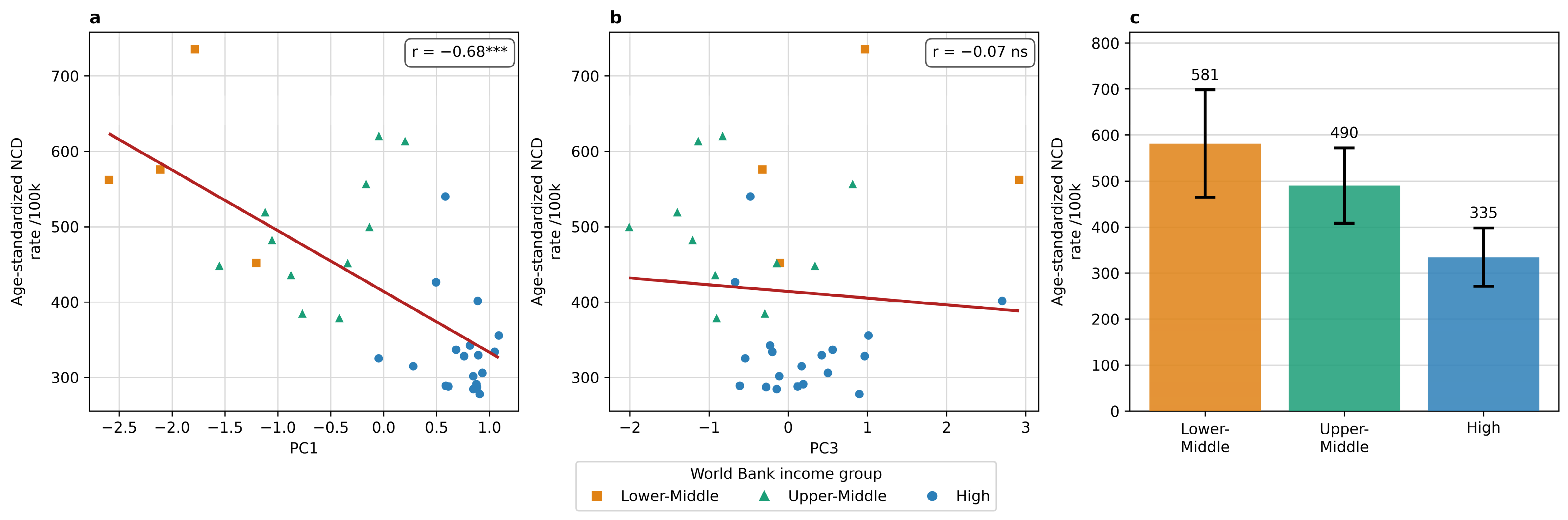
- Functional integration of SSGs into primary care was associated with lower national NCD mortality after adjustment for demographic and economic factors.
- These findings identify healthcare workforce organization as a potentially important system-level determinant of preventive health delivery.
- Health systems may benefit from evaluating policies that enable SSG to contribute to primary care-based PA promotion.
- Prospective and longitudinal studies are required to confirm causality and guide implementation of SSG integration models.
Abstract
1. Introduction
2. Materials and Methods
2.1. Research Design
- Principal component analysis (PCA): Employed for dimensionality reduction to capture the underlying demographic and economic profiles of each country.
- Generalized linear modeling (Gamma family, log link): Used to estimate the association between SSG institutional integration and age-standardized NCD mortality, complemented by a descriptive analysis of funding mechanisms.
2.2. Research Population and Sample
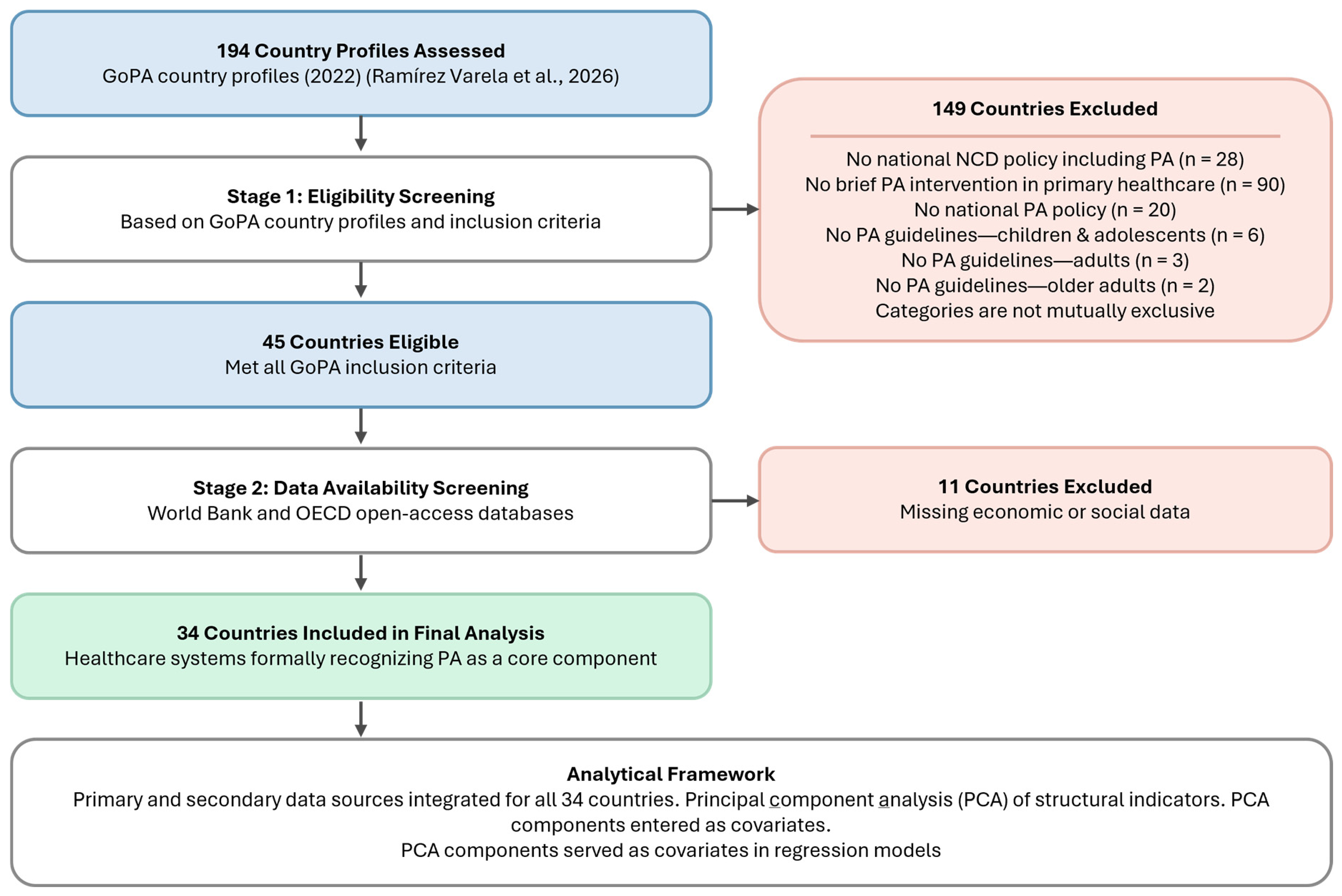
- Implementation of brief PA interventions within primary healthcare.
- The presence of a national NCD policy including PA (either operational or non-operational).
- Availability of national PA guidelines covering adolescents, adults, and older adults.
2.3. Data Collection
2.3.1. Primary Sources (Institutional Classification)
2.3.2. Secondary Data Sources (Quantitative Data)
- Demographic indicators: Data on population density and the proportion of the urban population were obtained from the United Nations Population Division [34].
- Economic and health indicators: Information on economic and health-related characteristics was retrieved from the WB and the OECD databases [35,36]. The variables included national income level, government health expenditure as a percentage of gross domestic product (GDP), and the Gini coefficient as a measure of income inequality.
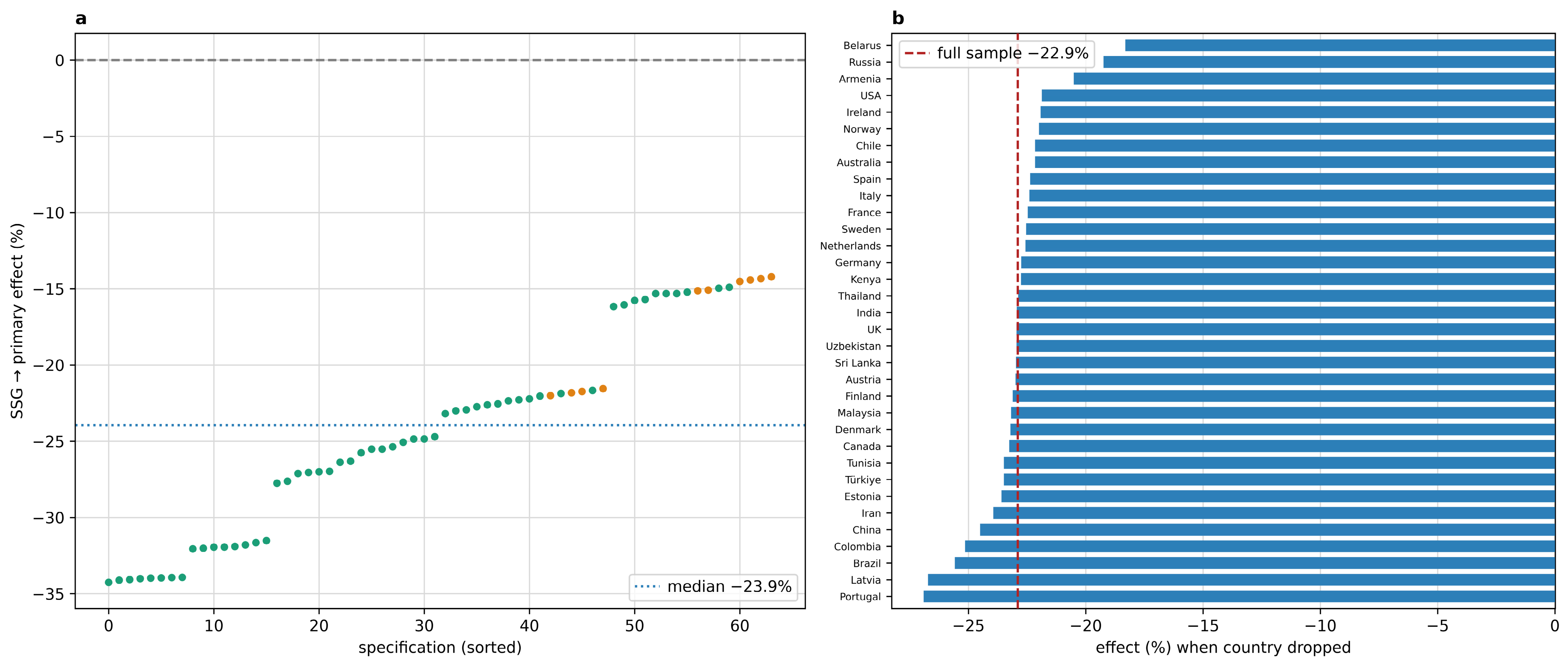
- NCD mortality rate: The outcome was the age-standardized NCD mortality rate (deaths per 100,000 both sexes, 2019) obtained from the WHO Global Health Observatory (indicator WHS2_131) [37] and standardized to the WHO World Standard Population. The 2019 vintage was the most recent complete pre-pandemic estimate; re-estimating Model A with the 2020 and 2021 vintages confirmed a stable association in direction and magnitude (Supplementary File S2).
2.3.3. Inter-Rater Reliability
2.4. Statistical Analysis
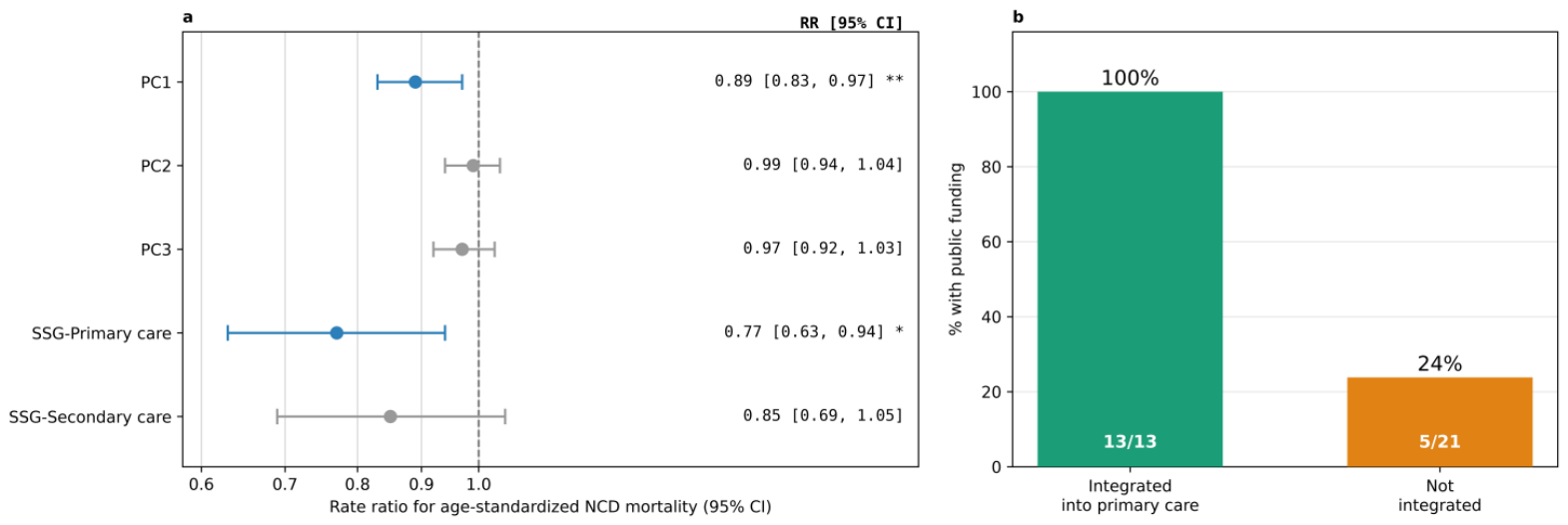
- Model A: Estimating age-standardized NCD mortality from the three principal components together with the primary- and secondary-care integration indicators, entered simultaneously as a single pre-specified model (no stepwise selection).
- Model B: Predicting public funding mechanisms in relation to scope of practice and recognition indicators. Given complete separation between primary-care integration and public funding at this sample size, Model B was analyzed descriptively (cross-tabulation with Fisher’s exact test) rather than by stepwise regression.
Model Quality Analysis
- Fitted model (Model A): log (E [age-standardized NCD mortality]) = β0 + β1·PC1 + β2·PC2 + β3·PC3 + β4·(primary-care integration) + β5·(secondary-care integration), estimated with a Gamma family and log link; the rate ratio for each predictor is exp(β).
3. Results
4. Discussion
Strengths and Limitations
5. Conclusions
Supplementary Materials
Author Contributions
Funding
Institutional Review Board Statement
Informed Consent Statement
Data Availability Statement
Acknowledgments
Conflicts of Interest
References
- World Health Organization. Noncommunicable Diseases. Available online: https://www.who.int/news-room/fact-sheets/detail/noncommunicable-diseases (accessed on 22 April 2026).
- Freihat, O.; Sipos, D.; Aamir, M.; Kovacs, A. Global burden and future projections of non-communicable diseases (2000–2050): Progress toward SDG 3.4 and disparities across regions and risk factors. PLoS ONE 2025, 20, e0336036. [Google Scholar] [CrossRef] [Scilit] [PubMed]
- Global Health Data Exchange. Global Burden of Disease Study 2023 (GBD 2023) Meningitis Mortality and Incidence Estimates 1990–2023. Available online: https://ghdx.healthdata.org/record/ihme-data/gbd-2023-meningitis-1990-2023 (accessed on 1 May 2026).
- Santos, A.C.; Willumsen, J.; Meheus, F.; Ilbawi, A.; Bull, F.C. The cost of inaction on physical inactivity to public health-care systems: A population-attributable fraction analysis. Lancet Glob. Health 2023, 11, e32–e39. [Google Scholar] [CrossRef] [Scilit]
- Barry, A.; Impouma, B.; Wolfe, C.; Campos, A.; Richards, N.C.; Kalu, A.; Diallo, C.B.; Barango, P.; Farham, B. Non-Communicable Diseases in the WHO African Region: Analysis of Risk Factors, Mortality, and Responses based on WHO data. Sci. Rep. 2025, 15, 12288. [Google Scholar] [CrossRef] [Scilit] [PubMed] [PubMed Central]
- Liu, W.; Dostdar-Rozbahani, A.; Tadayon-Zadeh, F.; Akbarpour-Beni, M.; Pourkiani, M.; Sadat-Razavi, F.; Barfi, V.; Shahedi, V. Insufficient Level of Physical Activity and Its Effect on Health Costs in Low- and Middle-Income Countries. Front. Public Health 2022, 10, 937196. [Google Scholar] [CrossRef] [Scilit]
- World Health Organization. Global Recommendations on Physical Activity for Health. Available online: https://www.who.int/publications/i/item/9789241599979 (accessed on 25 April 2026).
- Strain, T.; Flaxman, S.; Guthold, R.; Semenova, E.; Cowan, M.; Riley, L.M.; Bull, F.C.; Stevens, G.A.; Abdul Raheem, R.; Agoudavi, K.; et al. National, regional, and global trends in insufficient physical activity among adults from 2000 to 2022: A pooled analysis of 507 population-based surveys with 5·7 million participants. Lancet Glob. Health 2024, 12, e1232–e1243. [Google Scholar] [CrossRef] [Scilit]
- Katzmarzyk, P.T.; Friedenreich, C.; Shiroma, E.J.; Lee, I.M. Physical inactivity and non-communicable disease burden in low-income, middle-income and high-income countries. Br. J. Sports Med. 2021, 56, 101–106. [Google Scholar] [CrossRef] [Scilit]
- Friedenreich, C.M.; Stone, C.R.; Cheung, W.Y.; Hayes, S.C. Physical Activity and Mortality in Cancer Survivors: A Systematic Review and Meta-Analysis. JNCI Cancer Spectr. 2019, 4, pkz080. [Google Scholar] [CrossRef] [Scilit]
- Liang, Z.D.; Zhang, M.; Wang, C.Z.; Yuan, Y.; Liang, J.H. Association between sedentary behavior, physical activity, and cardiovascular disease-related outcomes in adults—A meta-analysis and systematic review. Front. Public Health 2022, 10, 1018460. [Google Scholar] [CrossRef] [Scilit]
- Kanaley, J.A.; Colberg, S.R.; Corcoran, M.H.; Malin, S.K.; Rodriguez, N.R.; Crespo, C.J.; Kirwan, J.P.; Zierath, J.R. Exercise/Physical Activity in Individuals with Type 2 Diabetes: A Consensus Statement from the American College of Sports Medicine. Med. Sci. Sports Exerc. 2022, 54, 353–368. [Google Scholar] [CrossRef] [Scilit] [PubMed]
- Matjasko, J.L.; Chen, Z.; Whitfield, G.P.; Whitsel, L.P.; Rose, K.; Roy, K. Inadequate Aerobic Physical Activity and Healthcare Expenditures in the United States: An Updated Cost Estimate. Am. J. Health Promot. 2025, 39, 1085–1087. [Google Scholar] [CrossRef] [Scilit]
- World Health Organization. Global Action Plan on Physical Activity 2018–2030: More Active People for a Healthier World. Available online: https://www.who.int/publications/i/item/9789241514187 (accessed on 29 March 2026).
- World Health Organization. WHO Guidelines on Physical Activity and Sedentary Behaviour; WHO: Geneva, Switzerland, 2020; Available online: https://www.who.int/publications/i/item/9789240015128 (accessed on 10 July 2026).
- O’Regan, A.; Pollock, M.; D’Sa, S.; Niranjan, V. ABC of prescribing exercise as medicine: A narrative review of the experiences of general practitioners and patients. BMJ Open Sport Exerc. Med. 2021, 7, e001050. [Google Scholar] [CrossRef] [Scilit]
- Leese, C.J.; Mann, R.H.; Al-Zubaidi, H.; Cockcroft, E.J. A movement for movement: An exploratory study of primary healthcare professionals’ perspectives on implementing the Royal College of General Practitioners’ active practice charter initiative. BMC Prim. Care 2024, 25, 112. [Google Scholar] [CrossRef] [Scilit]
- Sigal, R.J.; Armstrong, M.J.; Bacon, S.L.; Boulé, N.G.; Dasgupta, K.; Kenny, G.P.; Riddell, M.C. Physical Activity and Diabetes. Can. J. Diabetes 2018, 42, S54–S63. [Google Scholar] [CrossRef] [Scilit]
- Du Plooy, K.; Wishart, B.; Scarf, D. A qualitative study of former participants’ experiences of the Green Prescription program in Aotearoa New Zealand. BMC Public Health 2025, 25, 3251. [Google Scholar] [CrossRef] [Scilit]
- Ramírez Varela, A.; Martins, J.; Pratt, M.; Mejía-Grueso, J.; Cristão, R.; Onofre, M.; Hallal, P.C. The Global Observatory for Physical Activity (GoPA!) and Global Observatory for Physical Education (GoPE!) 2025 Country Cards. J. Phys. Act. Health 2026, 23, S1–S54. [Google Scholar] [CrossRef] [Scilit]
- World Health Organization. Global Status Report on Physical Activity 2022: Country Profiles. Available online: https://www.who.int/publications/i/item/9789240064119 (accessed on 1 November 2025).
- Tchirkov, V.; Didierjean, R.; Schuft, L.; Thomas, J.; Hupin, D. Methods and Barriers to the Prescription of Physical Activity to Patients with Chronic Illness: The Viewpoint of General Practitioners. Am. J. Biomed. Sci. Res. 2023, 19, 64–70. [Google Scholar] [CrossRef] [Scilit]
- O’Brien, M.W.; Shields, C.A.; Oh, P.I.; Fowles, J.R. Health care provider confidence and exercise prescription practices of Exercise is Medicine Canada workshop attendees. Appl. Physiol. Nutr. Metab. 2017, 42, 384–390. [Google Scholar] [CrossRef] [Scilit]
- Dunphy, R.; Blane, D.N. Understanding exercise referrals in primary care: A qualitative study of General Practitioners and Physiotherapists. Physiotherapy 2024, 124, 1–8. [Google Scholar] [CrossRef] [Scilit]
- Carrard, J.; Gut, M.; Croci, I.; McMahon, S.; Gojanovic, B.; Hinrichs, T.; Schmidt-Trucksäss, A. Exercise Science Graduates in the Healthcare System: A Comparison Between Australia and Switzerland. Front. Sports Act. Living 2022, 4, 766641. [Google Scholar] [CrossRef] [Scilit]
- Zhou, S.; Davison, K.; Qin, F.; Lin, K.F.; Chow, B.C.; Zhao, J.X. The roles of exercise professionals in the health care system: A comparison between Australia and China. J. Exerc. Sci. Fit. 2019, 17, 81–90. [Google Scholar] [CrossRef] [Scilit]
- O’Brien, M.W.; Shivgulam, M.E.; Waghorn, J.; Courish, M.K.; Fowles, J.R.; Nagpal, T.S. A content-analysis of job advertisements for exercise professionals in Canada: A need for clarification of qualifications. Appl. Physiol. Nutr. Metab. 2025, 50, 1–8. [Google Scholar] [CrossRef] [Scilit]
- Fortier, M.; Morgan, T.; Tomasone, J.; Jain, R. Integration of exercise professionals to help patients adopt and maintain healthy movement behaviour. Can. Fam. Physician 2024, 70, 611–613. [Google Scholar] [CrossRef] [Scilit]
- Kennedy, M.A.; Bayes, S.; Newton, R.U.; Zissiadis, Y.; Spry, N.A.; Taaffe, D.R.; Hart, N.H.; Galvão, D.A. Implementation barriers to integrating exercise as medicine in oncology: An ecological scoping review. J. Cancer Surviv. 2021, 16, 865–881. [Google Scholar] [CrossRef] [Scilit]
- World Bank. The Economic Impact of Non-Communicable Diseases in the Caribbean. Available online: https://www.worldbank.org/en/country/caribbean/brief/the-economic-impact-of-non-communicable-diseases-in-the-caribbean (accessed on 15 January 2026).
- Wang, C.; Zhang, P.; Zhu, Y.; Li, J.; Yang, Y.; Tan, X.; Yang, L.; Zeng, L.; Huang, W. A theoretical model of sports and health integration to promote active health. BMC Public Health 2025, 25, 1039. [Google Scholar] [CrossRef] [Scilit]
- Heuvelman, F.; Birkholz, L.; Tcymbal, A.; Lakerveld, J.; Beulens, J.W.J.; Woods, C.; Abu-Omar, K.; Volf, K.; Sandu, P.; Jankauskiene, R.; et al. The impact of public policy on socioeconomic equity in physical activity: A systematic review. Int. J. Behav. Nutr. Phys. Act. 2026, 23, 20. [Google Scholar] [CrossRef] [Scilit]
- Sun, J.; Ren, Y.; Qian, G.; Yue, S.; Szumilewicz, A. Development and application of the integration of physical activity into health care—A scoping review. Ann. Agric. Environ. Med. 2024, 31, 160–169. [Google Scholar] [CrossRef] [Scilit]
- United Nations, Department of Economic and Social Affairs, Population Division. World Population Prospects 2022. Available online: https://population.un.org/wpp/ (accessed on 10 July 2026).
- World Bank Gini Index. Available online: https://data.worldbank.org/indicator/SI.POV.GINI (accessed on 3 January 2026).
- World Bank Current Health Expenditure. Available online: https://data.worldbank.org/indicator/SH.XPD.CHEX.GD.ZS (accessed on 1 March 2026).
- World Health Organization. Global Health Estimates. Available online: https://www.who.int/data/global-health-estimates (accessed on 1 March 2026).
- McCormick, S.; Cukic, I.; Alexanders, J.; Yeowell, G.; Fatoye, F.; Kelly, B.M.; Fitzgerald, V.; Cable, T.; Doherty, P.; Deniszczyc, D.; et al. Exercise professionals in extended scope of practice roles: A qualitative exploration of a new model of rehabilitation. BMJ Public Health 2025, 3, e002322. [Google Scholar] [CrossRef] [Scilit]
- Dennis, S.; Ball, L.; Harris, M.; Refshauge, K. Allied health are key to improving health for people with chronic disease: But where are the outcomes and where is the strategy? Aust. J. Prim. Health 2021, 27, 437–441. [Google Scholar] [CrossRef] [Scilit]
- Craike, M.; Britt, H.; Parker, A.; Harrison, C. General practitioner referrals to exercise physiologists during routine practice: A prospective study. J. Sci. Med. Sport 2019, 22, 478–483. [Google Scholar] [CrossRef] [Scilit]
- Stanhope, J.; Weinstein, P. What are green prescriptions? A scoping review. J. Prim. Health Care 2023, 15, 155–161. [Google Scholar] [CrossRef] [Scilit]
- Mi, M.Y.; Perry, A.S.; Krishnan, V.; Nayor, M. Epidemiology and Cardiovascular Benefits of Physical Activity and Exercise. Circ. Res. 2025, 137, 120–138. [Google Scholar] [CrossRef] [Scilit]
- Carvalho, F.F.B.D.; Vieira, L.A.; Malhão, T.A.; Loch, M.R. Analysis of the implementation of the federal incentive for Physical Activity in primary care: Equity in focus. Saúde Debate 2025, 49, e9804. [Google Scholar] [CrossRef] [Scilit]
- Pearce, A.; Longhurst, G. The Role of the Clinical Exercise Physiologist in Reducing the Burden of Chronic Disease in New Zealand. Int. J. Environ. Res. Public Health 2021, 18, 859. [Google Scholar] [CrossRef] [Scilit]
- Brorsson Lundqvist, E.; Praetorius Björk, M.; Bernhardsson, S. Physical activity on prescription in Swedish primary care: A survey on use, views, and implementation determinants amongst general practitioners. Scand. J. Prim. Health Care 2023, 42, 61–71. [Google Scholar] [CrossRef] [Scilit]
- OECD. OECD Reviews of Public Health: Chile—A Healthier Tomorrow; OECD Publishing: Paris, France, 2019; Available online: https://www.oecd.org/health/oecd-reviews-of-public-health-chile-9789264309593-en.htm (accessed on 12 July 2026).
- Mellado Pena, F.; Leyton Dinamarca, B.; Kain Berkovic, J. Evaluation of the Chilean program “Vida Sana 2017” in participants under 20 years of age after 6 months of intervention. Nutr. Hosp. 2020, 37, 559–567. Available online: https://scielo.isciii.es/scielo.php?script=sci_arttext&pid=S0212-16112020000400020 (accessed on 12 July 2026).
- Louisiana State Board of Medical Examiners. Clinical Exercise Physiologists—Licensure (La. R.S. 37:3421 et Seq.). Available online: https://www.lsbme.la.gov/licensure/clinical-exercise-physiologists (accessed on 12 July 2026).
- Decree No. 2016-1990 of 30 December 2016 on the Conditions for Dispensing Adapted Physical Activity Prescribed by the Attending Physician to Patients with a Long-Term Condition. Available online: https://www.legifrance.gouv.fr/jorf/id/JORFTEXT000033748987 (accessed on 12 July 2026).
- Greco, G.; Fischetti, F. Adapted Exercise and Adapted Sport as Rights of Health Citizenship in Italy: A Legal–Policy Rationale and Framework for Inclusion in the Livelli Essenziali di Assistenza (LEA) and the Role of the Chinesiologo. Societies 2025, 15, 339. [Google Scholar] [CrossRef] [Scilit]
- World Health Organization. Latvia—Country Physical Activity Factsheet 2024; WHO: Geneva, Switzerland, 2024; Available online: https://cdn.who.int/media/docs/librariesprovider2/country-profiles/physical-activity/2024-country-profiles/physical-activity-2024-lva.pdf (accessed on 12 July 2026).
- Donabedian, A. Evaluating the Quality of Medical Care. Milbank Q. 2005, 83, 691–729. [Google Scholar] [CrossRef] [Scilit] [PubMed]
- Tesema, A.G.; Mabunda, S.A.; Chaudhri, K.; Sunjaya, A.; Thio, S.; Yakubu, K.; Jeyakumar, R.; Godinho, M.; John, R.; Eltigany, M.; et al. Task-sharing for non-communicable disease prevention and control in low- and middle-income countries in the context of health worker shortages: A systematic review. PLoS Glob. Public Health 2025, 5, e0004289. [Google Scholar] [CrossRef] [Scilit] [PubMed] [PubMed Central]
- Xiong, S.; Lu, H.; Peoples, N.; Duman, E.K.; Najarro, A.; Ni, Z.; Gong, E.; Yin, R.; Ostbye, T.; Palileo-Villanueva, L.M.; et al. Digital health interventions for non-communicable disease management in primary health care in low-and middle-income countries. npj Digit. Med. 2023, 6, 12. [Google Scholar] [CrossRef] [Scilit] [PubMed] [PubMed Central]
- World Health Organization. WHO Guideline: Recommendations on Digital Interventions for Health System Strengthening; WHO: Geneva, Switzerland, 2019; Available online: https://www.who.int/publications/i/item/9789241550505 (accessed on 10 August 2026).




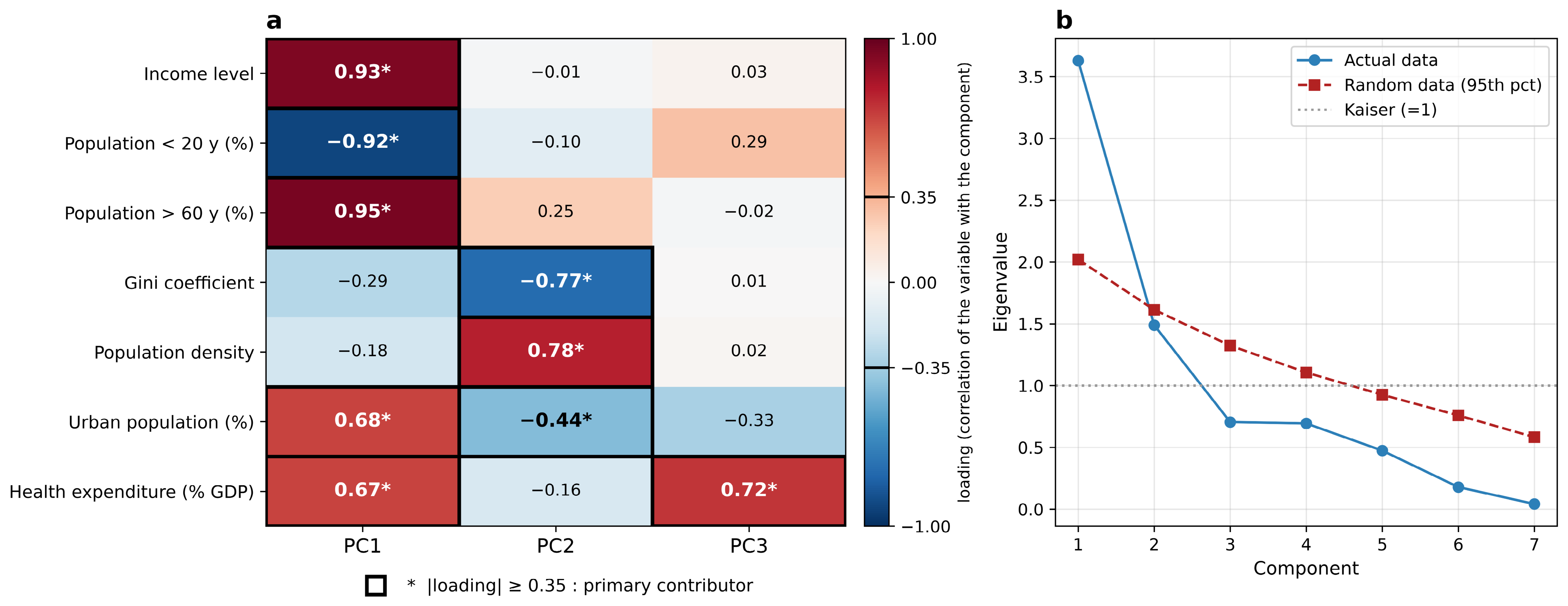
| Variable | PC1 | PC2 | PC3 |
|---|---|---|---|
| Income level | 0.489 * | −0.006 | 0.041 |
| Population < 20 years (%) | −0.481 * | −0.084 | 0.348 |
| Population > 60 years (%) | 0.497 * | 0.204 | −0.025 |
| Gini coefficient | −0.151 | −0.633 * | 0.008 |
| Population density | −0.095 | 0.636 * | 0.020 |
| Urban population (%) | 0.354 * | −0.358 * | −0.389 * |
| Health expenditure (% GDP) | 0.353 * | −0.132 | 0.852 * |
| Explained variance (%) | 50.32 | 20.65 | 9.78 |
| Cumulative variance (%) | 50.32 | 70.97 | 80.74 |
| Eigenvalue | 3.63 | 1.49 | 0.71 |
| Scope of Practice | Unregulated or Excluded | Semi-Formal/Institutional | Integrated Functional | Full Statutory | Total | Publicly Funded, n (%) |
|---|---|---|---|---|---|---|
| No health-system role | 14 | 0 | 0 | 0 | 14 | 1 (7) |
| Secondary care only | 1 | 3 | 3 | 0 | 7 | 4 (57) |
| Primary care | 4 | 4 | 2 | 3 | 13 | 13 (100) |
| Total | 19 | 7 | 5 | 3 | 34 | 18 (52.9) |
| Predictor | Rate Ratio | 95% CI | p |
|---|---|---|---|
| PC1 | 0.89 | 0.83–0.97 | 0.005 ** |
| PC2 | 0.99 | 0.94–1.04 | 0.705 |
| PC3 | 0.97 | 0.92–1.03 | 0.326 |
| SSG primary-care integration | 0.77 | 0.63–0.94 | 0.011 * |
| SSG secondary-care integration | 0.85 | 0.69–1.05 | 0.132 |
| Primary-Care Integration | Publicly Funded, n (%) | Not Funded, n | Total |
|---|---|---|---|
| Integrated | 13 (100) | 0 | 13 |
| Not integrated | 5 (24) | 16 | 21 |
Disclaimer/Publisher’s Note: The statements, opinions and data contained in all publications are solely those of the individual author(s) and contributor(s) and not of MDPI and/or the editor(s). MDPI and/or the editor(s) disclaim responsibility for any injury to people or property resulting from any ideas, methods, instructions or products referred to in the content. |
© 2026 by the authors. Licensee MDPI, Basel, Switzerland. This article is an open access article distributed under the terms and conditions of the Creative Commons Attribution (CC BY) license.
Share and Cite
Zidan, H.; Abouzeid, N.; Al-Nuaim, A.; Hassan, M.A. Functional Integration of Sport Sciences Graduates into Primary Care for Non-Communicable Disease Prevention: A Cross-National Ecological Evaluation of 34 Countries. Int. J. Environ. Res. Public Health 2026, 23, 1106. https://doi.org/10.3390/ijerph23091106
Zidan H, Abouzeid N, Al-Nuaim A, Hassan MA. Functional Integration of Sport Sciences Graduates into Primary Care for Non-Communicable Disease Prevention: A Cross-National Ecological Evaluation of 34 Countries. International Journal of Environmental Research and Public Health. 2026; 23(9):1106. https://doi.org/10.3390/ijerph23091106
Chicago/Turabian StyleZidan, Hosam, Nasser Abouzeid, Anwar Al-Nuaim, and Mohamed A. Hassan. 2026. "Functional Integration of Sport Sciences Graduates into Primary Care for Non-Communicable Disease Prevention: A Cross-National Ecological Evaluation of 34 Countries" International Journal of Environmental Research and Public Health 23, no. 9: 1106. https://doi.org/10.3390/ijerph23091106
APA StyleZidan, H., Abouzeid, N., Al-Nuaim, A., & Hassan, M. A. (2026). Functional Integration of Sport Sciences Graduates into Primary Care for Non-Communicable Disease Prevention: A Cross-National Ecological Evaluation of 34 Countries. International Journal of Environmental Research and Public Health, 23(9), 1106. https://doi.org/10.3390/ijerph23091106