Quality of Urban Green Space for Older Adults to Promote Physical Activity: A Systematic Review


Highlights
- Promoting physical activity in older adults helps support their independence by maintaining functional ability and overall health.
- The review considers urban green space (UGS), a key element of urban design, as an intervention to promote physical activity in older adults.
- This review examines how different dimensions of UGS (availability, accessibility, and attractiveness) influence physical activity in older adults.
- The review identifies key sources of heterogeneity, including variations in definitions of older adults, measurement approaches, and socioeconomic and geographic contexts of studies, which limit comparability across findings.
- More research is needed, especially qualitative and elder-engaged studies, to design UGS to support physical activity in this age group.
- Future research and policy should prioritize age-friendly design, standardized measures, and inclusive planning approaches to support active aging.
Abstract
1. Introduction
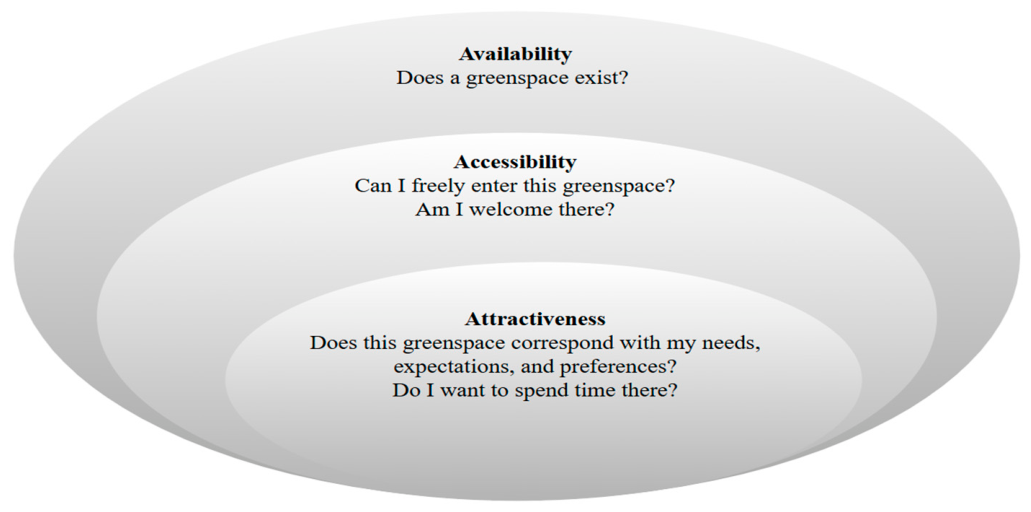
Conceptual Framework
2. Materials and Methods
2.1. Search Strategy and Search Terms
2.2. Inclusion and Exclusion Criteria
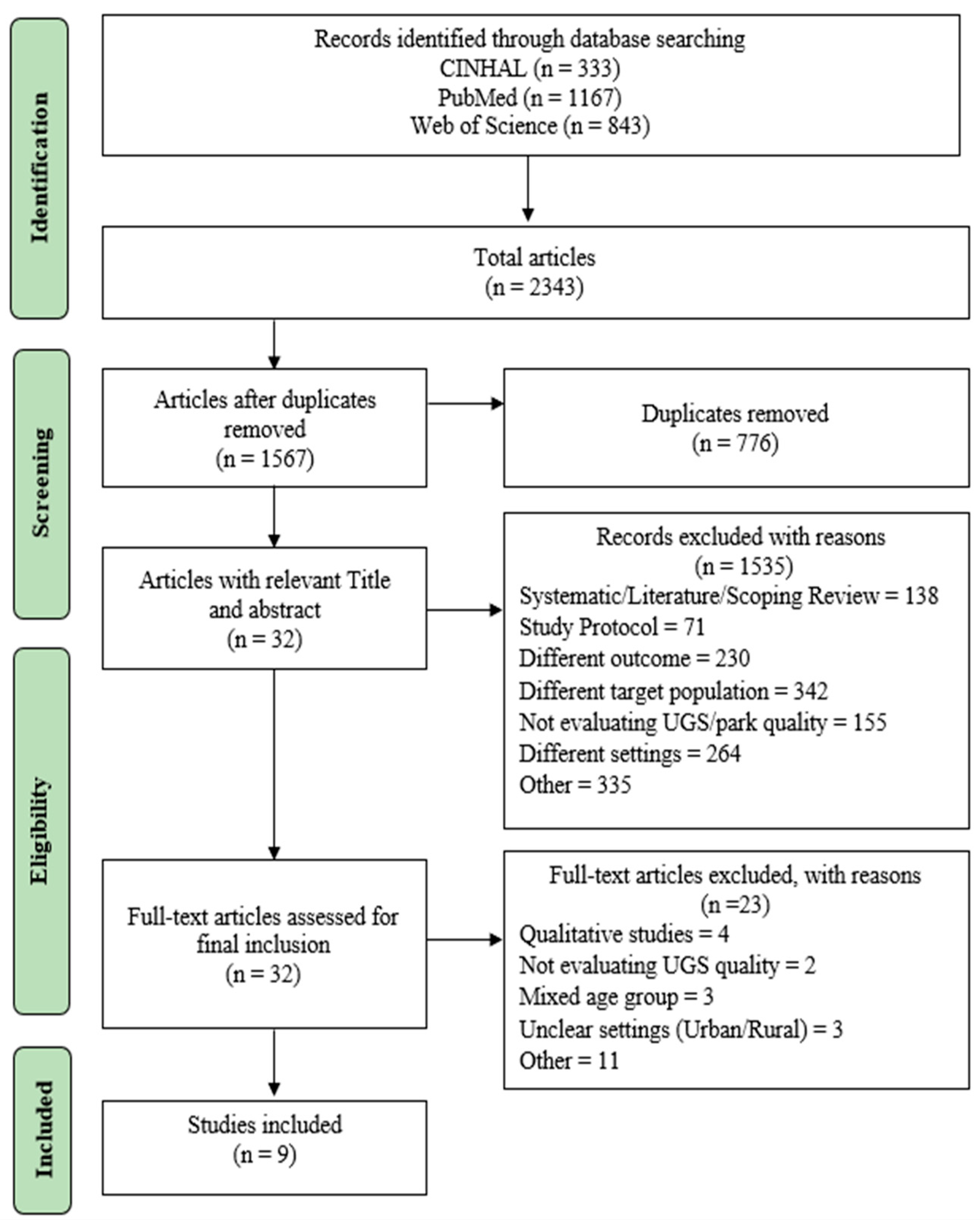
2.3. Study Screening and Selection
2.4. Data Extraction and Analysis
2.5. Study Quality Assessment Tool
3. Results
3.1. General Description of the Selected Studies
3.2. Description of UGS Studied
3.3. Measures Used in the Studies
3.3.1. PA Measures
3.3.2. UGS Measures
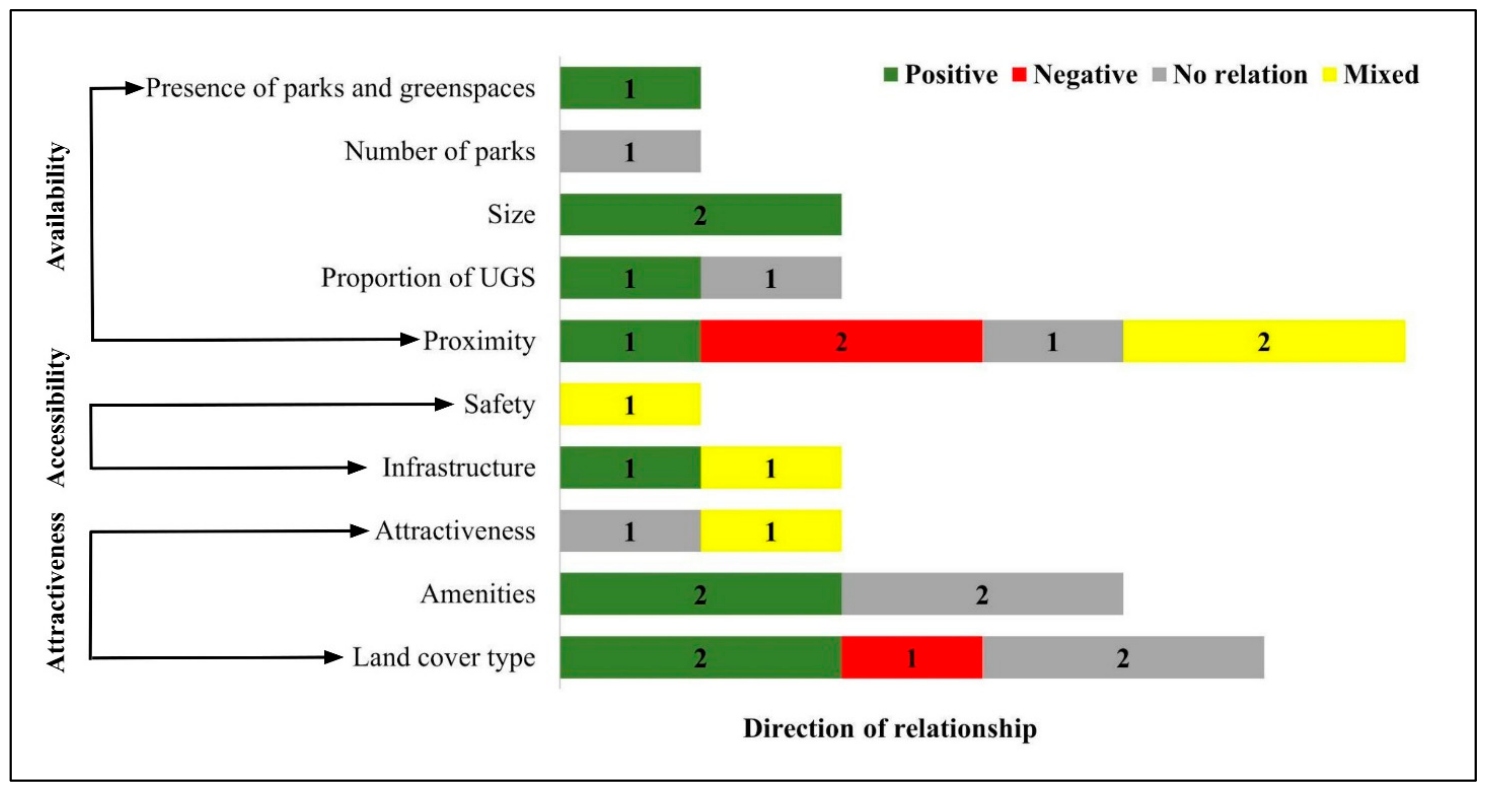
3.4. Relationship Between UGS Quality and PA
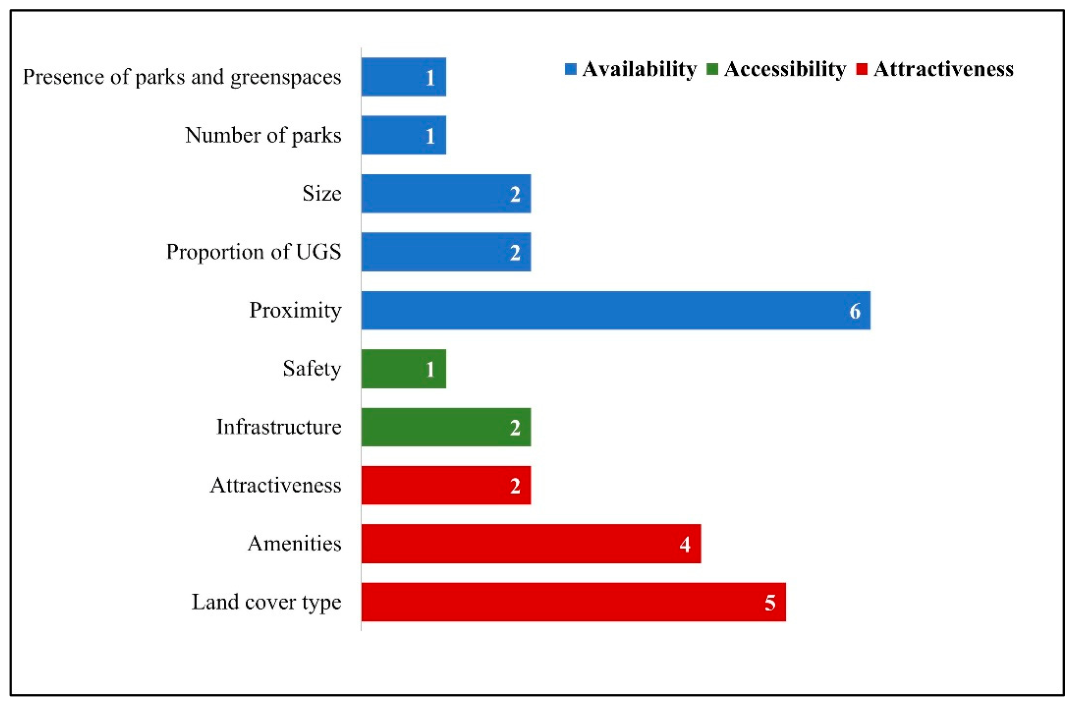
UGS Qualities Studied
3.5. Methodological Rigor
4. Discussion
4.1. Summary of Findings
4.2. Heterogeneous Findings
4.3. Limitations and Recommendations
5. Conclusions
Supplementary Materials
Author Contributions
Funding
Institutional Review Board Statement
Informed Consent Statement
Data Availability Statement
Conflicts of Interest
References
- Centers for Disease Control and Prevention. Healthy Aging: Promoting Well-Being in Older Adults. Available online: https://www.cdc.gov/grand-rounds/pp/2017/20170919-senior-aging.html (accessed on 20 March 2022).
- DiPietro, L.; Campbell, W.W.; Buchner, D.M.; Erickson, K.I.; Powell, K.E.; Bloodgood, B.; Hughes, T.; Day, K.R.; Piercy, K.L.; Vaux-Bjerke, A.; et al. Physical activity, injurious falls, and physical function in aging: An umbrella review. Med. Sci. Sports Exerc. 2019, 51, 1303–1313. [Google Scholar] [CrossRef] [Scilit] [PubMed]
- Quigley, A.; MacKay-Lyons, M.; Eskes, G. Effects of exercise on cognitive performance in older adults: A narrative review of the evidence, possible biological mechanisms, and recommendations for exercise prescription. J. Aging Res. 2020, 2020, 1407896. [Google Scholar] [CrossRef] [Scilit] [PubMed]
- Chodzko-Zajko, W.J.; Proctor, D.N.; Fiatarone Singh, M.A.; Minson, C.T.; Nigg, C.R.; Salem, G.J.; Skinner, J.S. Exercise and physical activity for older adults. Med. Sci. Sports Exerc. 2009, 41, 1510–1530. [Google Scholar] [CrossRef] [Scilit] [PubMed]
- World Health Organization. Global Status Report on Physical Activity 2022; World Health Organization: Geneva, Switzerland, 2022; Available online: https://www.who.int/publications/i/item/9789240059153 (accessed on 20 March 2022).
- Troiano, R.P.; Berrigan, D.; Dodd, K.W.; Mâsse, L.C.; Tilert, T.; Mcdowell, M. Physical activity in the United States measured by accelerometer. Med. Sci. Sports Exerc. 2008, 40, 181–188. [Google Scholar] [CrossRef] [Scilit] [PubMed]
- Vogel, T.; Brechat, P.-H.; Leprêtre, P.-M.; Kaltenbach, G.; Berthel, M.; Lonsdorfer, J. Health benefits of physical activity in older patients: A review. Int. J. Clin. Pract. 2009, 63, 303–320. [Google Scholar] [CrossRef] [Scilit] [PubMed]
- Padeiro, M.; de São José, J.; Amado, C.; Sousa, L.; Roma Oliveira, C.; Esteves, A.; McGarrigle, J. Neighborhood Attributes and Well-Being Among Older Adults in Urban Areas: A Mixed-Methods Systematic Review. Res. Aging 2022, 44, 351–368. [Google Scholar] [CrossRef] [Scilit]
- Xu, T.; Nordin, N.A.; Aini, A.M. Urban green space and subjective well-being of older people: A systematic literature review. Int. J. Environ. Res. Public Health 2022, 19, 14227. [Google Scholar] [CrossRef] [Scilit] [PubMed]
- Tabrizi, N.; Lak, A.; Moussavi A, S.M.R. Green space and the health of the older adult during pandemics: A narrative review on the experience of COVID-19. Front. Public Health 2023, 11, 1218091. [Google Scholar] [CrossRef] [Scilit] [PubMed]
- World Health Organization Regional Office for Europe. Urban Green Spaces and Health: A Review of Evidence; World Health Organization Regional Office for Europe: Copenhagen, Denmark, 2016; Available online: https://www.who.int/europe/publications/i/item/WHO-EURO-2016-3352-43111-60341 (accessed on 20 March 2022).
- Jabbar, M.; Yusoff, M.M.; Shafie, A. Assessing the role of urban green spaces for human well-being: A systematic review. Geojournal 2021, 87, 4405–4423. [Google Scholar] [CrossRef] [Scilit] [PubMed]
- Orstad, S.L.; Szuhany, K.; Tamura, K.; Thorpe, L.E.; Jay, M. Park proximity and use for physical activity among urban residents: Associations with mental health. Int. J. Environ. Res. Public Health 2020, 17, 4885. [Google Scholar] [CrossRef] [Scilit] [PubMed]
- Wang, H.; Dai, X.; Wu, J.; Wu, X.; Nie, X. Influence of urban green open space on residents’ physical activity in China. BMC Public Health 2019, 19, 1093. [Google Scholar] [CrossRef] [Scilit] [PubMed]
- Van Den Eeden, S.K.; Browning, M.H.E.M.; Becker, D.A.; Shan, J.; Alexeeff, S.E.; Thomas Ray, G.; Quesenberry, C.P.; Kuo, M. Association between residential green cover and direct healthcare costs in northern California: An individual level analysis of 5 million persons. Environ. Int. 2022, 163, 107174. [Google Scholar] [CrossRef] [Scilit] [PubMed]
- Ode Sang, Å.; Knez, I.; Gunnarsson, B.; Hedblom, M. The effects of naturalness, gender, and age on how urban green space is perceived and used. Urban For. Urban Green 2016, 18, 268–276. [Google Scholar] [CrossRef] [Scilit]
- Zhang, J.; Yu, Z.; Zhao, B.; Sun, R.; Vejre, H. Links between green space and public health: A bibliometric review of global research trends and future prospects from 1901 to 2019. Environ. Res. Lett. 2020, 15, 063001. [Google Scholar] [CrossRef] [Scilit]
- Park, K. Psychological park accessibility: A systematic literature review of perceptual components affecting park use. Landsc. Res. 2017, 42, 508–520. [Google Scholar] [CrossRef] [Scilit]
- Gidlow, C.; van Kempen, E.; Smith, G.; Triguero-Mas, M.; Kruize, H.; Gražulevičienė, R.; Ellis, N.; Hurst, G.; Masterson, D.; Cirach, M.; et al. Development of the natural environment scoring tool (NEST). Urban For. Urban Green 2018, 29, 322–333. [Google Scholar] [CrossRef] [Scilit]
- Levy-Storms, L.; Chen, L.; Loukaitou-Sideris, A. Older adults’ needs and preferences for open space and physical activity in and near parks: A systematic review. J. Aging Phys. Act. 2018, 26, 682–696. [Google Scholar] [CrossRef] [Scilit] [PubMed]
- Van Cauwenberg, J.; De Bourdeaudhuij, I.; De Meester, F.; Van Dyck, D.; Salmon, J.; Clarys, P.; Deforche, B. Relationship between the physical environment and physical activity in older adults: A systematic review. Health Place 2011, 17, 458–469. [Google Scholar] [CrossRef] [Scilit] [PubMed]
- Biernacka, M.; Kronenberg, J. Classification of institutional barriers affecting the availability, accessibility and attractiveness of urban green spaces. Urban For. Urban Green 2018, 36, 22–33. [Google Scholar] [CrossRef] [Scilit]
- Biernacka, M.; Kronenberg, J.; Łaszkiewicz, E. An integrated system of monitoring the availability, accessibility and attractiveness of urban parks and green squares. Appl. Geogr. 2020, 116, 102152. [Google Scholar] [CrossRef] [Scilit]
- Hassen, N. Green Paths to Mental Health: A Theoretical Framework; Wellesley Institute: Toronto, ON, Canada, 2016. [Google Scholar]
- World Health Organization Regional Office for Europe. Urban Green Spaces: A Brief for Action; World Health Organization Regional Office for Europe: Copenhagen, Denmark, 2017. [Google Scholar]
- Page, M.J.; McKenzie, J.E.; Bossuyt, P.M.; Boutron, I.; Hoffmann, T.C.; Mulrow, C.D.; Shamseer, L.; Tetzlaff, J.M.; Akl, E.A.; Brennan, S.E.; et al. The PRISMA 2020 statement: An updated guideline for reporting systematic reviews. BMJ 2021, 372, n71. [Google Scholar] [CrossRef] [Scilit] [PubMed]
- Joanna Briggs Institute (JBI). JBI Manual for Evidence Synthesis; Joanna Briggs Institute: Adelaide, Australia, 2021. [Google Scholar]
- Chong, S.; Mazumdar, S.; Ding, D.; Morgan, G.; Comino, E.J.; Bauman, A.; Jalaludin, B. Neighbourhood greenspace and physical activity and sedentary behaviour among older adults with a recent diagnosis of type 2 diabetes: A prospective analysis. BMJ Open 2019, 9, e028947. [Google Scholar] [CrossRef] [Scilit] [PubMed]
- Poppe, L.; Deforche, B.; Van Cauwenberg, J.; Brondeel, R.; Mertens, L.; Van De Weghe, N.; Benoit, S.; Veitch, J.; Van Dyck, D. The association between the number of parks near home and levels of physical activity among community-dwelling older adults: A longitudinal study. Cities 2022, 130, 103931. [Google Scholar] [CrossRef] [Scilit]
- Zhai, Y.; Li, D.; Wang, D.; Shi, C. Seniors’ physical activity in neighborhood parks and park design characteristics. Front. Public Health 2020, 8, 322. [Google Scholar] [CrossRef] [Scilit] [PubMed]
- Liu, Z.; Huang, W.; Lu, Y.; Peng, Y. Older adults’ choice of patterns of outdoor physical activity duration: A mixed multinomial logit model. Int. J. Environ. Res. Public Health 2021, 18, 8199. [Google Scholar] [CrossRef] [Scilit] [PubMed]
- Miralles-Guasch, C.; Dopico, J.; Delclòs-Alió, X.; Knobel, P.; Marquet, O.; Maneja-Zaragoza, R.; Schipperijn, J.; Vich, G. Natural landscape, infrastructure, and health: The physical activity implications of urban green space composition among the elderly. Int. J. Environ. Res. Public Health 2019, 16, 3986. [Google Scholar] [CrossRef] [Scilit] [PubMed]
- Zhang, R.; Liu, S.; Li, M.; He, X.; Zhou, C. The effect of high-density built environments on elderly individuals’ physical health: A cross-sectional study in Guangzhou, China. Int. J. Environ. Res. Public Health 2021, 18, 10250. [Google Scholar] [CrossRef] [Scilit] [PubMed]
- Zhang, R.; Duan, Y.; Brehm, W.; Wagner, P. Socioecological correlates of park-based physical activity in older adults: A comparison of Hong Kong and Leipzig parks. Int. J. Environ. Res. Public Health 2019, 16, 3048. [Google Scholar] [CrossRef] [Scilit] [PubMed]
- Zandieh, R.; Martinez, J.; Flacke, J. Older adults’ outdoor walking and inequalities in neighbourhood green spaces characteristics. Int. J. Environ. Res. Public Health 2019, 16, 4379. [Google Scholar] [CrossRef] [Scilit] [PubMed]
- Huang, N.-C.; Kung, S.-F.; Hu, S.C. The relationship between urbanization, the built environment, and physical activity among older adults in Taiwan. Int. J. Environ. Res. Public Health 2018, 15, 836. [Google Scholar] [CrossRef] [Scilit] [PubMed]
- Institute for Local Government. Understanding the Basics of Land Use and Planning: Glossary of Land Use and Planning Terms; Institute for Local Government: Sacramento, CA, USA, 2010. [Google Scholar]
- Kemperman, A.D.A.M.; Timmermans, H.J.P. Heterogeneity in urban park use of aging visitors: A latent class analysis. Leis. Sci. 2006, 28, 57–71. [Google Scholar] [CrossRef] [Scilit]
- Chow, H. Outdoor fitness equipment in parks: A qualitative study from older adults’ perceptions. BMC Public Health 2013, 13, 1216. [Google Scholar] [CrossRef] [Scilit] [PubMed]
- Lau, K.K.-L.; Yung, C.C.-Y.; Tan, Z. Usage and perception of urban green space of older adults in the high-density city of Hong Kong. Urban For. Urban Green 2021, 64, 127251. [Google Scholar] [CrossRef] [Scilit]
- Barnett, D.W.; Barnett, A.; Nathan, A.; Van Cauwenberg, J.; Cerin, E.; on behalf of the Council on Environment and Physical Activity (CEPA)—Older adults working group. Built environmental correlates of older adults’ total physical activity and walking: A systematic review and meta-analysis. Int. J. Behav. Nutr. Phys. Act. 2017, 14, 103. [Google Scholar] [CrossRef] [Scilit] [PubMed]
- Cerin, E.; Cain, K.L.; Conway, T.L.; Van Dyck, D.; Hinckson, E.; Schipperijn, J.; De Bourdeaudhuij, I.; Owen, N.; Davey, R.C.; Hino, A.A.F.; et al. Neighborhood environments and objectively measured physical activity in 11 countries. Med. Sci. Sports Exerc. 2014, 46, 2253–2264. [Google Scholar] [CrossRef] [Scilit] [PubMed]
- Foster, S.; Giles-Corti, B. The built environment, neighborhood crime and constrained physical activity: An exploration of inconsistent findings. Prev. Med. 2008, 47, 241–251. [Google Scholar] [CrossRef] [Scilit] [PubMed]
- Perry, M.; Cotes, L.; Horton, B.; Kunac, R.; Snell, I.; Taylor, B.; Wright, A.; Devan, H. “Enticing” but not necessarily a “space designed for me”: Experiences of urban park use by older adults with disability. Int. J. Environ. Res. Public Health 2021, 18, 552. [Google Scholar] [CrossRef] [Scilit] [PubMed]
- Motl, R.; Mcauley, E.; Distefano, C. Is social desirability associated with self-reported physical activity? Prev. Med. 2005, 40, 735–739. [Google Scholar] [CrossRef] [Scilit] [PubMed]
- Viinikka, A.; Tiitu, M.; Heikinheimo, V.; Halonen, J.I.; Nyberg, E.; Vierikko, K. Associations of neighborhood-level socioeconomic status, accessibility, and quality of green spaces in Finnish urban regions. Appl. Geogr. 2023, 157, 102973. [Google Scholar] [CrossRef] [Scilit]
- Hunter, R.F.; Christian, H.; Veitch, J.; Astell-Burt, T.; Hipp, J.A.; Schipperijn, J. The impact of interventions to promote physical activity in urban green space: A systematic review and recommendations for future research. Soc. Sci. Med. 2015, 124, 246–256. [Google Scholar] [CrossRef] [Scilit] [PubMed]
- de Keijzer, C.; Bauwelinck, M.; Dadvand, P. Long-term exposure to residential greenspace and healthy ageing: A systematic review. Curr. Environ. Health Rep. 2020, 7, 65–88. [Google Scholar] [CrossRef] [Scilit] [PubMed]



| Domains | Search Terms |
|---|---|
| Population | Aged, ageing, aging, elderly, older adults, older person, and senior/s |
| Intervention | Park, playground, green space, greenspace, sport field, recreation area, public ground, public park, outdoor, greenway, green infrastructure |
| Comparison | Any |
| Outcomes | Exercise, physical activity, physical health, walking, moderate-to-vigorous exercise, cycling, biking, bicycling, active play, leisure, sports |
| Study design | Quantitative studies only |
| Study | Location | Study Design | Population | Sample Size | Age Range; Mean Age; % Female | Socioeconomic Status (SES) | Green Space Type |
|---|---|---|---|---|---|---|---|
| Huang et al., 2018 [36] | Taiwan, China | Cross-sectional | Older adults living in urban areas | 2214 | ≥65 y; 74 y; 54.7% | Level of education: Illiterate 28%; Literate 17%. ≤6 years of education 30.4% ≥7 years of education 24.5% | Parks and green spaces |
| Chong et al., 2019 [28] | New South Wales, Australia | Cross-sectional, prospective cohort | Residents of the city with T2D | 18,094 | ≥45 y; 59.5 y; 52% | Majority non-English speakers; 1/4 did not complete high school | Parks and green spaces |
| Miralles-Guasch et al., 2019 [32] | Barcelona, Spain | Cross-sectional | Residents of senior centers | 122 | Age undefined; 54% aged 65–75 y; 44% | High- and low-income neighborhoods | UGS within the city’s urban continuum, size between 0.5 and 2 ha |
| Zandieh et al., 2019 [35] | Birmingham, United Kingdom | Cross-sectional | From social centers and eight selected wards | 173 | ≥65; 74.2 y; 57% | High- and low-deprivation areas | Neighborhood green spaces |
| Zhang et al., 2019 [34] | Hong Kong, China | Cross-sectional | Park users | 317 | ≥60 y; 69.96 y; 42% | Not mentioned | Six randomly selected urban parks in each city |
| Leipzig, Germany | 311 | ≥60 y; 72 y; 47.2% | |||||
| Zhai et al., 2020 [30] | Shanghai, China | Cross-sectional | Park users | 234 | ≥60 y; 60 y; 43.7% | Not mentioned | 15 neighborhood parks, size 3–10 ha |
| Liu et al., 2020 [31] | Dalian, China | Cross-sectional | From inner city, the fringe of the city and the area between the inner city and the fringe | 336 | >60 y; equally distributed; 49.7% | Not mentioned | Neighborhood green spaces |
| Zhang et al., 2021 [33] | Guangzhou, China | Cross-sectional | Residents for more than 6 months | 882 | >60 y; 79% aged 60–75 y; 56.3% | Not mentioned | Neighborhood parks and squares |
| Poppe et al., 2022 [29] | Ghent, Belgium | Longitudinal design | 431 community-dwelling older adults | Baseline 431; follow-up 147 | ≥65 y; 72–74 y; 52–54% | Occupational level before retirement, educational level | Urban public parks |
| General Categories | Tools Used to Identify or Assess UGS | Statistical Analysis | Factors Adjusted in Statistical Analysis | Type of PA Measure and Tools Used to Measure | UGS Quality Measured | Direction of Effects a | UGS Details | |
|---|---|---|---|---|---|---|---|---|
| Availability domain | ||||||||
| Zandieh et al., 2019 [35] | Number of parks | GIS analysis (proximity, attractiveness, size, and number) | Hierarchical linear regression | SES | Walking; “pedestrian route network” which is the length of all man-made roads and paths, using GIS and GPS devices | Number of parks | (0) | Neighborhood green spaces |
| Huang et al., 2018 [36] | Presence of parks and green spaces | GIS (buffer distance) | Multilevel hierarchical linear modeling | Median income of the township | Exercise, self-reported | Presence of parks and green spaces | (+) | Parks and green spaces |
| Chong et al., 2019 [28] | Proportion of UGS | GIS (network analysis) | Multiple regression | Sociodemographic characteristics (age, gender, country of birth) and area-level deprivation score | Walking, moderate-to-vigorous PA (MVPA); self-reported | % of GS within all buffer polygon-based road network buffers | (0) | Parks and green spaces |
| Miralles-Guasch et al., 2019 [32] | Proportion of UGS | GIS | Mixed-effects multilevel regression | Not clear | Active time; GPS devices, accelerometers, and PALMS software | Proportion of UGS | (+) | Parks and gardens within the city’s urban continuum < 1 ha |
| Poppe et al., 2022 [29] | Proximity | GIS (buffer distance) | Generalized Linear Mixed Models (GLMMs), longitudinal analysis, logistic regression | Age, occupational class, physical functioning | Moderate-to-vigorous physical activity (MVPA), light-intensity physical activity (LPA) | Number of parks within 500 m, 1000 m, and 2000 m | MVPA: (+) < 75 yrs (younger older adults), (−) for >75 yrs; LPA: (0) | Urban public parks |
| Liu et al., 2020 [31] | Proximity | GIS (network analysis) | Mixed multinomial logit model | Not clearly mentioned | Walking and self-reported active time | Proximity (0–800) m | (−) | Neighborhood green spaces |
| Miralles-Guasch et al., 2019 [32] | Proximity | GIS | Mixed-effects multilevel regression | Not clear | Active time; GPS devices, accelerometers, and PALMS software | Distance | (−) | Parks and gardens within the city’s urban continuum < 1 ha |
| Zandieh et al., 2019 [35] | Proximity | GIS analysis (proximity, attractiveness, size, and number) | Hierarchical (also known as multilevel) linear regression | SES | Walking: “pedestrian route network” which is the length of all man-made roads and paths, using GIS and GPS devices | Proximity | (0) | Neighborhood green spaces |
| Zhang et al., 2019 [34] | Proximity | Self-reported questionnaire | Hierarchical regression | Hong Kong: age, gender; Leipzig: marital status | Active time; SOPARC | Proximity | Hong Kong: (0); Leipzig: (+) | |
| Zhang et al., 2021 [33] | Proximity | GIS (buffer distance) | Linear regression | Age, gender, marital status, education level, income, lifestyle, and individual preferences including travel model, smoking, and drinking | Self-reported PA; MOS 36-Item Short-Form Health Survey (SF-36) | Distance | (+) | Neighborhood parks and squares |
| Zandieh et al., 2019 [35] | Size | GIS analysis (proximity, attractiveness, size, and number) | Hierarchical linear regression | SES | Walking; “pedestrian route network” which is the length of all man-made roads and paths, using GIS and GPS devices | Size | (+) | Neighborhood green spaces |
| Zhai et al., 2020 [30] | Size | Multiple stepwise regression analyses | Demographic attributes | Pedometer; self-reported energy expenditure | Park area | (+) | 15 neighborhood parks between 3 and 10 ha | |
| Accessibility domain | ||||||||
| Zhai et al., 2020 [30] | Infrastructure | Self-reported | Multiple stepwise regression analyses | Demographic attributes | Pedometer; self-reported energy expenditure | Trail length | (+) | 15 neighborhood parks between 3 and 10 ha |
| Zhang et al., 2019 [34] | Infrastructure | Self-reported questionnaire | Hierarchical regression | Hong Kong: age, gender; Leipzig: marital status | Active time; SOPARC | Park features | Hong Kong: (0); Leipzig: (+) | |
| Zhang et al., 2019 [34] | Safety | Self-reported questionnaire | Hierarchical regression | Hong Kong: age, gender; Leipzig: marital status | Active time; SOPARC | Park safety | Hong Kong: (0); Leipzig: (+) | 6 randomly selected urban parks in each city |
| Attractiveness domain | ||||||||
| Zhang et al., 2019 [34] | Amenities | Self-reported questionnaire | Hierarchical regression | Hong Kong: age, gender; Leipzig: marital status | Active time; SOPARC | Types of activity area | Hong Kong: (+); Leipzig: (+) | 6 randomly selected urban parks in each city |
| Miralles-Guasch et al., 2019 [32] | Land cover type | GIS | Mixed-effects multilevel regression | Not clear | Active time; GPS devices, accelerometers, and PALMS software | Forest, shrubland, grassland, | (0) | Parks and gardens within the city’s urban continuum < 1 ha |
| Zhai et al., 2020 [30] | Land cover type | Self-reported | Multiple stepwise regression analyses | Demographic attributes | Pedometer; self-reported energy expenditure | Total paved activity zone | (0) | 15 neighborhood parks between 3 and 10 ha |
| Zhai et al., 2020 [30] | Amenities | Self-reported | Multiple stepwise regression analyses | Demographic attributes | Pedometer; self-reported energy expenditure | Presence of outdoor fitness equipment | (+) | 15 neighborhood parks between 3 and 10 ha |
| Zhai et al., 2020 [30] | Amenities | Self-reported | Multiple stepwise regression analyses | Demographic attributes | Pedometer; self-reported energy expenditure | Presence of court | (0) | 15 neighborhood parks between 3 and 10 ha |
| Zandieh et al., 2019 [35] | Attractiveness | GIS analysis (proximity, attractiveness, size, and number) | Hierarchical linear regression | SES | Walking; “pedestrian route network” which is the length of all man-made roads and paths, using GIS and GPS devices | Attractiveness | (0) | Neighborhood green spaces |
| Zhang et al., 2019 [34] | Attractiveness | Self-reported questionnaire | Hierarchical regression | Hong Kong: age, gender; Leipzig: marital status | Active time; SOPARC | Attractiveness (visual appeal and overall pleasantness) | Hong Kong: (0); Leipzig: (+) | 6 randomly selected urban parks in each city |
| Zhai et al., 2020 [30] | Amenities | Self-reported | Multiple stepwise regression analyses | Demographic attributes | Pedometer; self-reported energy expenditure | Presence of water body/feature | (0) | 15 neighborhood parks between 3 and 10 ha |
| Miralles-Guasch et al., 2019 [32] | Land cover type | GIS | Mixed-effects multilevel regression | Not clear | Active time; GPS device, accelerometers, and PALMS software | Pavement | (+) | Parks and gardens within the city’s urban continuum < 1 ha |
| Miralles-Guasch et al., 2019 [32] | Land cover type | GIS | Mixed-effects multilevel regression | Not clear | Active time; GPS device, accelerometers, and PALMS software | Gravel | (−) | Parks and gardens within the city’s urban continuum < 1 ha |
| Zhai et al., 2020 [30] | Land cover type | Self-reported | Multiple stepwise regression analyses | Demographic attributes | Pedometer; self-reported energy expenditure | Total natural area in the park | (+) | 15 neighborhood parks between 3 and 10 ha |
| Study | UGS | PA | |||||
|---|---|---|---|---|---|---|---|
| Availability | Accessibility | Attractiveness | PA or Exercise | Walking | Active Time | Energy Expenditure | |
| Huang et al., 2018 [36] | GIS (buffer distance) | Self-reported | |||||
| Chong et al., 2019 [28] | GIS (network analysis) | Self-reported | |||||
| Miralles-Guasch et al., 2019 [32] | GIS (generate UGS location) | GIS (generate UGS location) | GPS device, accelerometer, and PALMS software | ||||
| Zandieh et al., 2019 [35] | GIS (network analysis) | GIS (network analysis) | GIS | ||||
| Zhang et al., 2019 [34] | Self-reported | System for Observation Play and Recreation in Communities (SOPARC) | |||||
| Zhai et al., 2020 [30] | Self-reported | Pedometer; self-reported | |||||
| Liu et al., 2020 [31] | GIS (network analysis) | Self-reported | |||||
| Zhang et al., 2021 [33] | GIS (buffer distance) | Self-reported | |||||
| Poppe et al., 2022 [29] | GIS (buffer distance) | Accelerometer | |||||
| Total | 9 | 2 | 4 | 3 | 2 | 3 | 1 |
| Study | Were the Criteria for Inclusion in the Sample Clearly Defined? | Were the Study Subjects and the Setting Described in Detail? | Was the Exposure Measured in a Valid and Reliable Way? | Were Objective, Standard Criteria Used for Measurement of the Condition? | Were Confounding Factors Identified? | Were Strategies to Deal with Confounding Factors Stated? | Were the Outcomes Measured in a Valid and Reliable Way? | Was Appropriate Statistical Analysis Used? | Total Criteria Met | % of Criteria Met |
|---|---|---|---|---|---|---|---|---|---|---|
| Huang et al., 2018 [36] | 1 | 1 | 0 | 1 | 1 | 1 | 0 | 1 | 6 | 75 |
| Chong et al., 2019 [28] | 1 | 1 | 1 | 1 | 1 | 1 | 0 | 1 | 7 | 87.5 |
| Miralles-Guasch et al., 2019 [32] | 1 | 1 | 1 | 1 | 0 | 0 | 1 | 1 | 6 | 75 |
| Zandieh et al., 2019 [35] | 1 | 1 | 1 | 1 | 1 | 1 | 1 | 1 | 8 | 100 |
| Zhang et al., 2019 [34] | 1 | 1 | 1 | 1 | 1 | 1 | 1 | 1 | 8 | 100 |
| Zhai et al., 2020 [30] | 1 | 1 | 1 | 1 | 1 | 1 | 0 | - | 5 | 62.5 |
| Liu et al., 2021 [31] | 1 | 1 | 1 | 0 | 0 | 0 | 0 | 1 | 4 | 50 |
| Zhang et al., 2021 [33] | 1 | 1 | 1 | 0 | 1 | 1 | 0 | - | 5 | 62.5 |
| Study | Were the Two Groups Similar and Recruited from the Same Population? | Were the Exposures Measured Similarly to Assign People to Both Exposed and Unexposed Groups? | Was the Exposure Measured in a Valid and Reliable Way? | Were Confounding Factors Identified? | Were Strategies to Deal with Confounding Factors Stated? | Were the Groups/Participants Free of the Outcome at the Start of the Study (or at the Moment of Exposure)? | Were the Outcomes Measured in a Valid and Reliable Way? | Was the Follow-Up Time Reported and Sufficient to Be Long Enough for Outcomes to Occur? | Was the Follow-Up Complete, and If Not, Were the Reasons for the Loss to Follow-Up Described and Explored? | Were Strategies to Address Incomplete Follow-Up Utilized? | Was Appropriate Statistical Analysis Used? | Total Criteria Met | % of Criteria Met |
|---|---|---|---|---|---|---|---|---|---|---|---|---|---|
| Poppe et al., 2022 [29] | 1 | 1 | 1 | 1 | 1 | 1 | 1 | 1 | 0 | 1 | 1 | 10 | 91 |
Disclaimer/Publisher’s Note: The statements, opinions and data contained in all publications are solely those of the individual author(s) and contributor(s) and not of MDPI and/or the editor(s). MDPI and/or the editor(s) disclaim responsibility for any injury to people or property resulting from any ideas, methods, instructions or products referred to in the content. |
© 2026 by the authors. Licensee MDPI, Basel, Switzerland. This article is an open access article distributed under the terms and conditions of the Creative Commons Attribution (CC BY) license.
Share and Cite
Sultana, N.; Braun, K.L. Quality of Urban Green Space for Older Adults to Promote Physical Activity: A Systematic Review. Int. J. Environ. Res. Public Health 2026, 23, 970. https://doi.org/10.3390/ijerph23080970
Sultana N, Braun KL. Quality of Urban Green Space for Older Adults to Promote Physical Activity: A Systematic Review. International Journal of Environmental Research and Public Health. 2026; 23(8):970. https://doi.org/10.3390/ijerph23080970
Chicago/Turabian StyleSultana, Nargis, and Kathryn L. Braun. 2026. "Quality of Urban Green Space for Older Adults to Promote Physical Activity: A Systematic Review" International Journal of Environmental Research and Public Health 23, no. 8: 970. https://doi.org/10.3390/ijerph23080970
APA StyleSultana, N., & Braun, K. L. (2026). Quality of Urban Green Space for Older Adults to Promote Physical Activity: A Systematic Review. International Journal of Environmental Research and Public Health, 23(8), 970. https://doi.org/10.3390/ijerph23080970