Longitudinal Associations of Past and Cumulative Terrorism Exposure with Community Violence Exposure Among Israeli Adolescents: Aggression and Severe Violence Commission as Moderators



Highlights
- Chronic terrorism exposure is a public health concern because its developmental consequences may extend beyond trauma-related distress to adolescents’ exposure to violence in their everyday social environments.
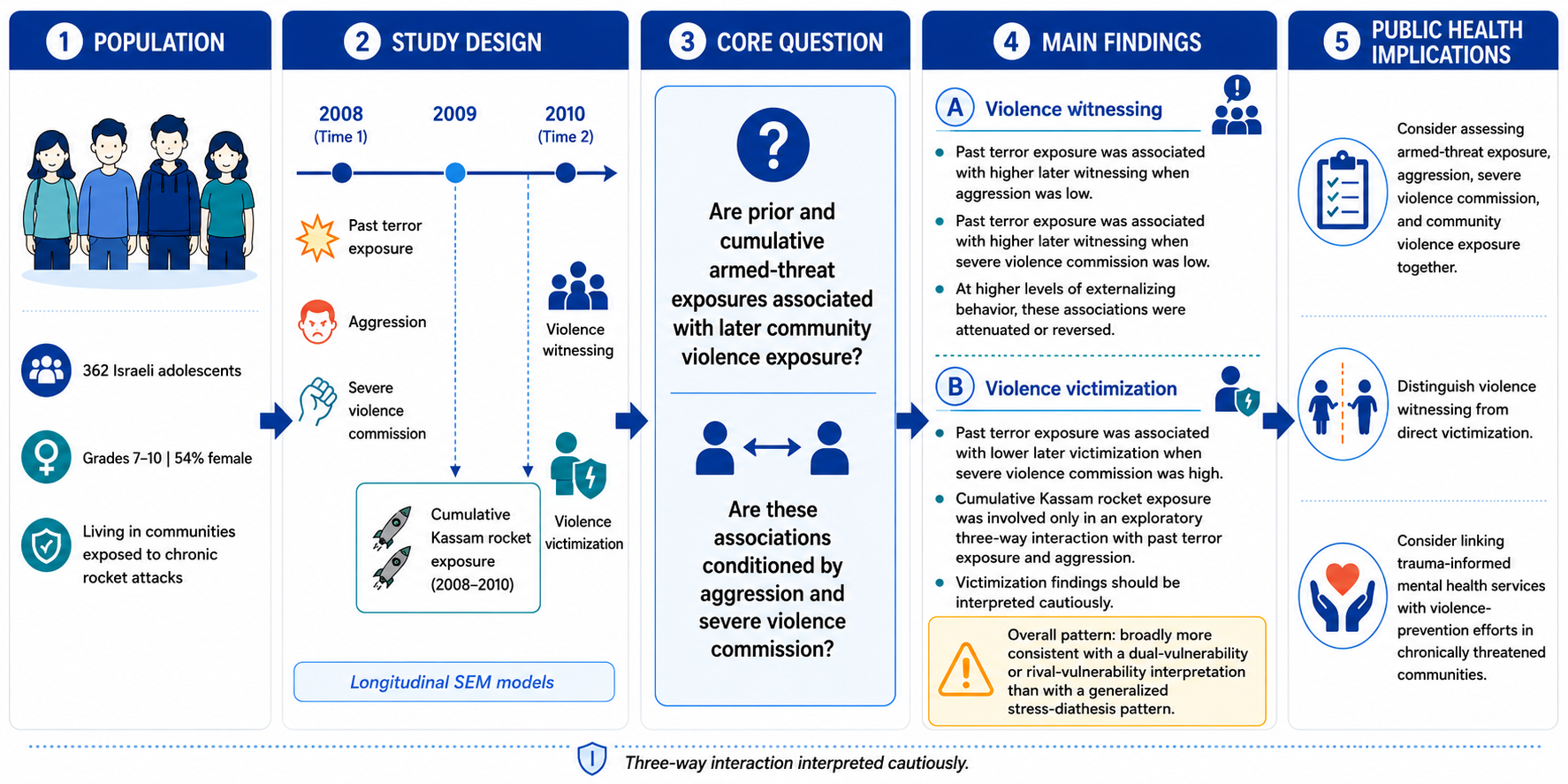
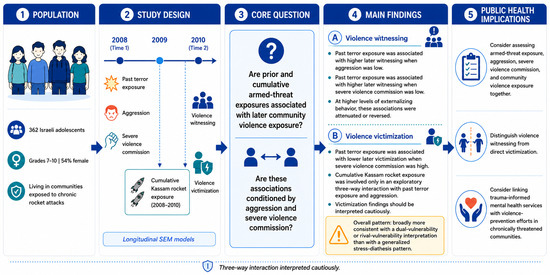
- This longitudinal study examines how past and cumulative terrorism exposure relate to community violence witnessing and victimization among Israeli adolescents living under chronic armed threat.
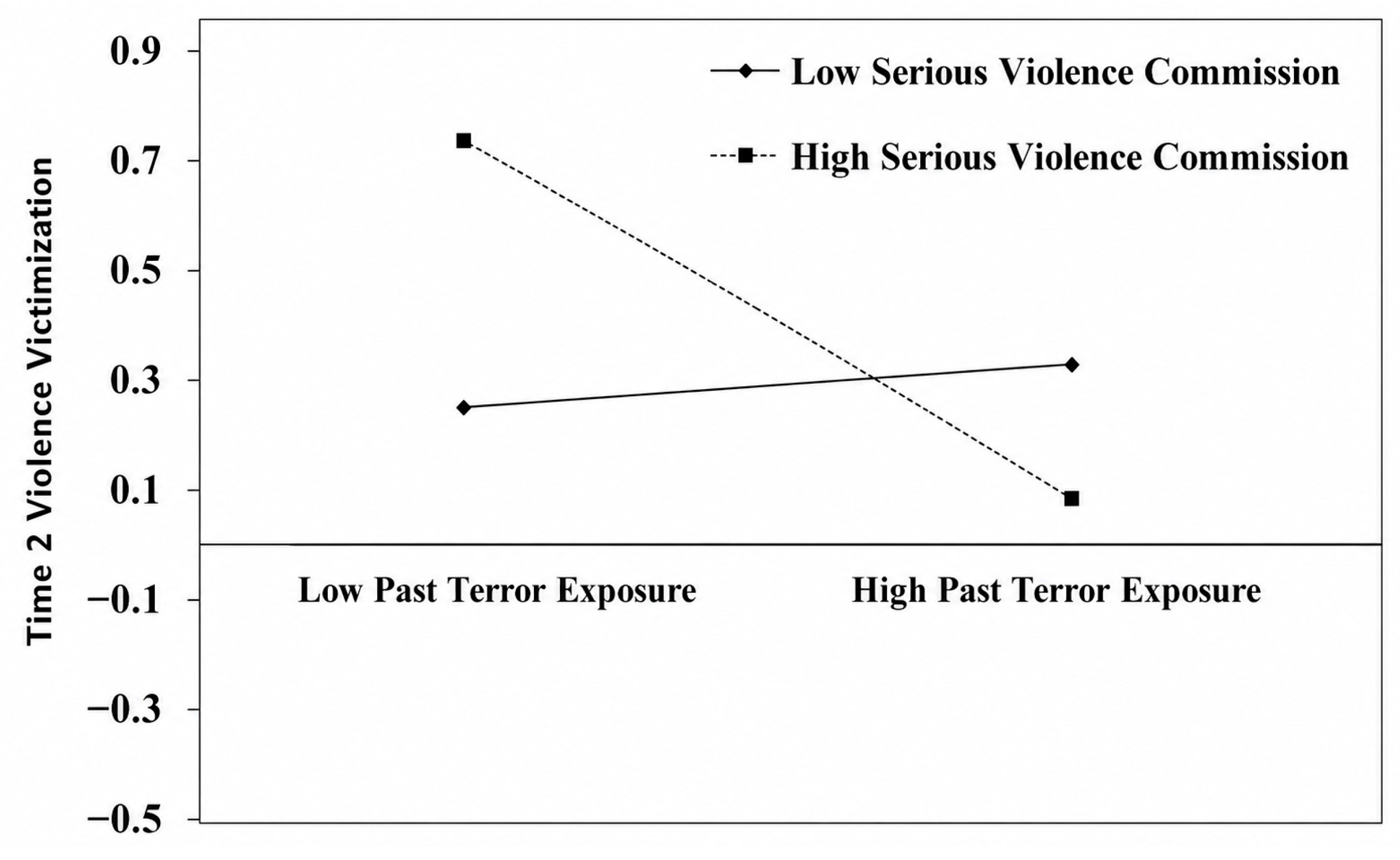
- Associations between terrorism exposure and community violence exposure varied according to aggression and severe violence commission and differed between violence witnessing and violence victimization.
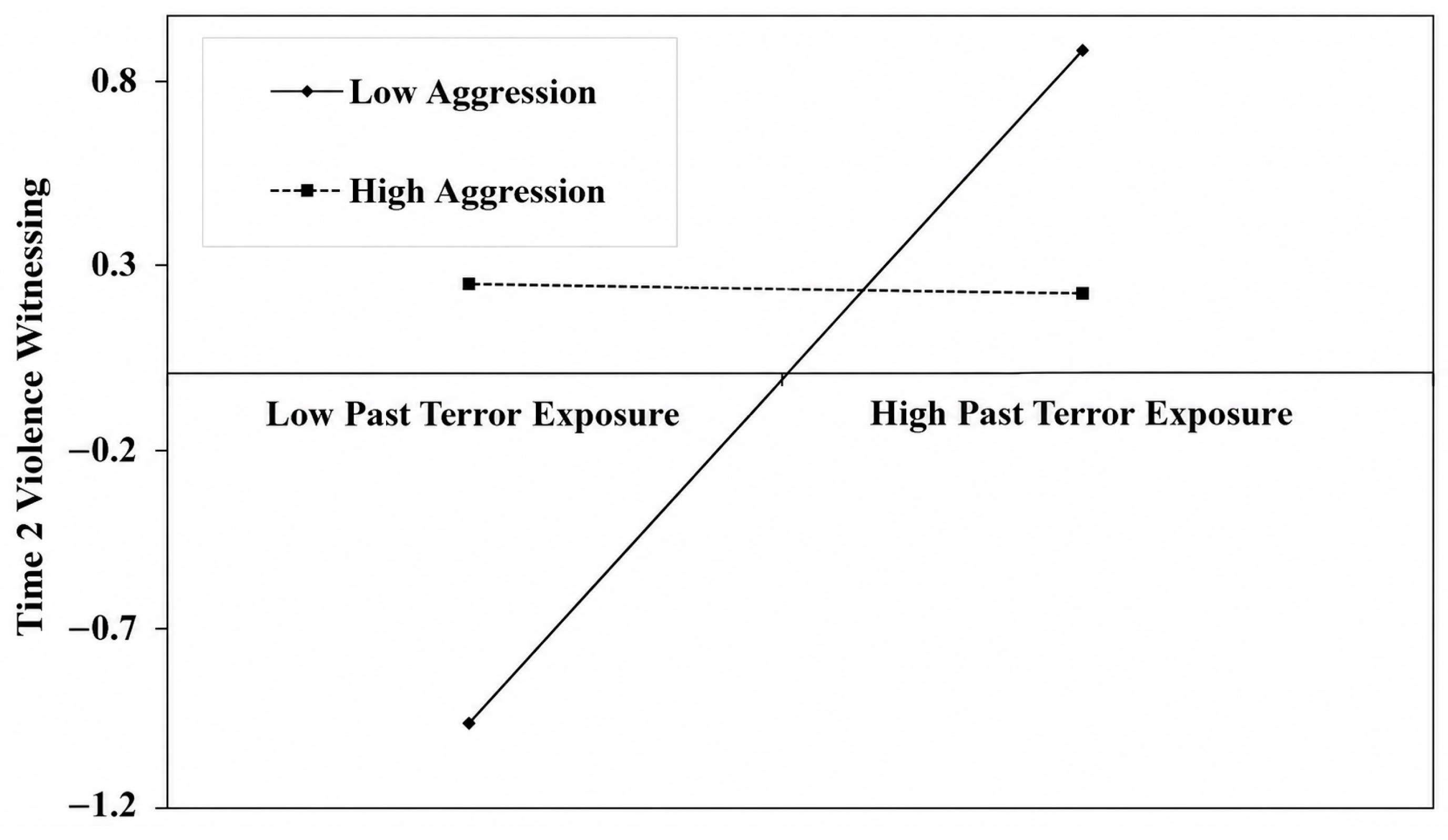
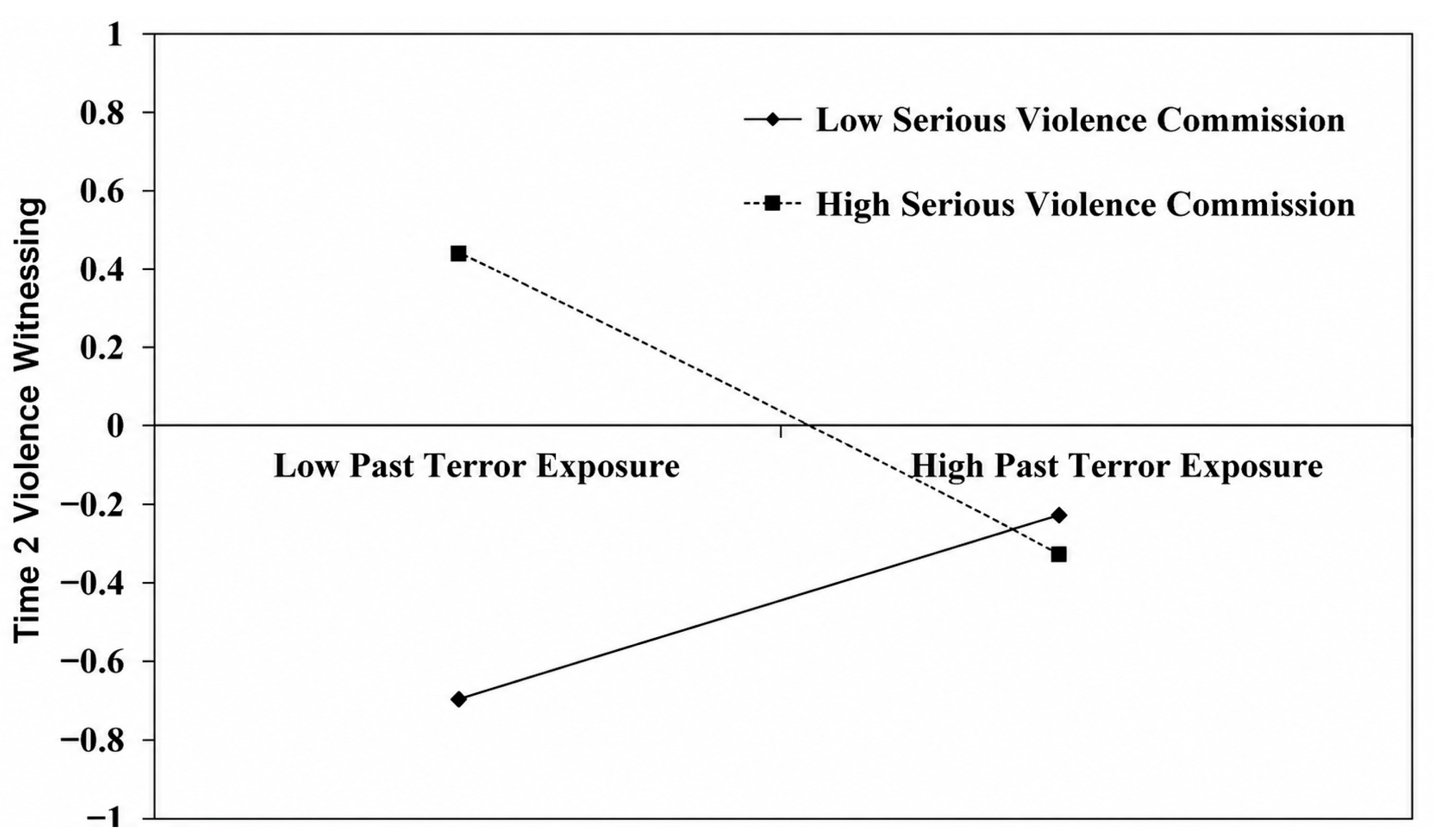
- The pattern was more consistent with dual-vulnerability or rival-vulnerability than with stress-diathesis: positive associations of past terror exposure with later violence witnessing emerged at low levels of aggression or severe violence commission and were attenuated or reversed at higher levels.
- Screening and prevention efforts in chronically threatened communities may benefit from jointly assessing terrorism exposure, aggression, severe violence commission, and community violence exposure.
- Public health responses may benefit from integrating trauma-informed adolescent mental health services with school- and community-based violence prevention while distinguishing violence witnessing from direct victimization.
Abstract
1. Introduction
1.1. Literature Review and Theoretical Framework
1.2. The Present Study and Hypotheses
2. Materials and Methods
2.1. Participants and Study Procedure
2.2. Materials
2.2.1. Past Terror Exposure
2.2.2. Cumulative Kassam Rocket Exposure
2.2.3. Depressive Symptoms
2.2.4. Anxiety Symptoms
2.2.5. Aggression
2.2.6. Severe Violence Commission
2.2.7. Community Violence Exposure: Witnessing and Victimization
2.2.8. Covariates
2.3. Analytic Strategy
3. Results
3.1. Stage 1: Descriptive Statistics
3.2. Stage 2: SEMs
3.2.1. Main Effects Model
3.2.2. Aggression as a Focal Moderator
3.2.3. Severe Violence Commission as a Focal Moderator
4. Discussion
4.1. Clinical Implications
4.2. Public Health Implications
4.3. Limitations and Future Directions
5. Conclusions
Author Contributions
Funding
Institutional Review Board Statement
Informed Consent Statement
Data Availability Statement
Acknowledgments
Conflicts of Interest
References
- Henrich, C.C.; Shahar, G. Social support buffers the effects of terrorism on adolescent depression: Findings from Sderot, Israel. J. Am. Acad. Child Adolesc. Psychiatry 2008, 47, 1073–1076. [Google Scholar] [CrossRef] [PubMed]
- Henrich, C.C.; Shahar, G. Effects of exposure to rocket attacks on adolescent distress and violence: A 4-year longitudinal study. J. Am. Acad. Child Adolesc. Psychiatry 2013, 52, 619–627. [Google Scholar] [CrossRef] [PubMed]
- Bleich, A.; Gelkopf, M.; Solomon, Z. Exposure to terrorism, stress-related mental health symptoms, and coping behaviors among a nationally representative sample in Israel. J. Am. Med. Assoc. 2003, 290, 612–620. [Google Scholar] [CrossRef] [PubMed]
- Chemtob, C.M.; Pat-Horenczyk, R.; Madan, A.; Pitman, S.R.; Wang, Y.; Doppelt, O.; Burns, K.D.; Abramovitz, R.; Brom, D. Israeli adolescents with ongoing exposure to terrorism: Suicidal ideation, posttraumatic stress disorder, and functional impairment. J. Trauma. Stress 2011, 24, 756–759. [Google Scholar] [CrossRef] [PubMed]
- Pat-Horenczyk, R.; Abramovitz, R.; Peled, O.; Brom, D.; Daie, A.; Chemtob, C.M. Adolescent exposure to recurrent terrorism in Israel: Posttraumatic distress and functional impairment. Am. J. Orthopsychiatry 2007, 77, 76–85. [Google Scholar] [CrossRef] [PubMed]
- Pat-Horenczyk, R.; Peled, O.; Miron, T.; Brom, D.; Villa, Y.; Chemtob, C.M. Risk-taking behaviors among Israeli adolescents exposed to recurrent terrorism: Provoking danger under continuous threat? Am. J. Psychiatry 2007, 164, 66–72. [Google Scholar] [CrossRef] [PubMed]
- Shahar, G.; Cohen, G.; Grogan, K.E.; Barile, J.P.; Henrich, C.C. Terrorism-related perceived stress, adolescent depression, and social support from friends. Pediatrics 2009, 124, e235–e240. [Google Scholar] [CrossRef] [PubMed]
- Shahar, G.; Henrich, C.C. Perceived family social support buffers against the effects of exposure to rocket attacks on adolescent depression, aggression, and severe violence. J. Fam. Psychol. 2016, 30, 163–168. [Google Scholar] [CrossRef] [PubMed]
- Schiff, M.; Zweig, H.H.; Benbenishty, R.; Hasin, D.S. Exposure to terrorism and Israeli youths’ cigarette, alcohol, and cannabis use. Am. J. Public Health 2007, 97, 1852–1858. [Google Scholar] [CrossRef] [PubMed]
- Even-Chen, M.S.; Itzhaky, H. Exposure to terrorism and violent behavior among adolescents in Israel. J. Community Psychol. 2006, 35, 43–55. [Google Scholar] [CrossRef]
- Gorman-Smith, D.; Tolan, P. The role of exposure to community violence and developmental problems among inner-city youth. Dev. Psychopathol. 1998, 10, 101–116. [Google Scholar] [CrossRef] [PubMed]
- Gorman-Smith, D.; Henry, D.B.; Tolan, P.H. Exposure to community violence and violence perpetration: The protective effects of family functioning. J. Clin. Child Adolesc. Psychol. 2004, 33, 439–449. [Google Scholar] [CrossRef] [PubMed]
- Brookmeyer, K.A.; Henrich, C.C.; Cohen, G.; Shahar, G. Israeli Adolescents Exposed to Community and Terror Violence: The Protective Role of Social Support. J. Early Adolesc. 2010, 31, 577–603. [Google Scholar] [CrossRef]
- Mrug, S.; Windle, M. Prospective effects of violence exposure across multiple contexts on early adolescents’ internalizing and externalizing problems. J. Child Psychol. Psychiatry 2010, 51, 953–961. [Google Scholar] [CrossRef] [PubMed]
- Farrell, A.D.; Thompson, E.L.; Curran, P.J.; Sullivan, T.N. Bidirectional Relations between Witnessing Violence, Victimization, Life Events, and Physical Aggression among Adolescents in Urban Schools. J. Youth Adolesc. 2020, 49, 1309–1327. [Google Scholar] [CrossRef] [PubMed]
- Cicchetti, D.; Lynch, M. Toward an ecological/transactional model of community violence and child maltreatment: Consequences for children’s development. Psychiatry 1993, 56, 96–118. [Google Scholar] [CrossRef] [PubMed]
- Dubow, E.F.; Boxer, P.; Huesmann, L.R.; Shikaki, K.; Landau, S.; Gvirsman, S.D.; Ginges, J. Exposure to conflict and violence across contexts: Relations to adjustment among Palestinian children. J. Clin. Child Adolesc. Psychol. 2010, 39, 103–116. [Google Scholar] [CrossRef] [PubMed]
- Cummings, E.M.; Merrilees, C.E.; Schermerhorn, A.C.; Goeke-Morey, M.C.; Shirlow, P.; Cairns, E. Political violence and child adjustment: Longitudinal tests of sectarian antisocial behavior, family conflict, and insecurity as explanatory pathways. Child Dev. 2012, 83, 461–468. [Google Scholar] [CrossRef] [PubMed]
- Niwa, E.Y.; Boxer, P.; Dubow, E.; Huesmann, L.R.; Shikaki, K.; Landau, S.; Gvirsman, S.D. Growing Up Amid Ethno-Political Conflict: Aggression and Emotional Desensitization Promote Hostility to Ethnic Outgroups. Child Dev. 2016, 87, 1479–1492. [Google Scholar] [CrossRef] [PubMed]
- Huesmann, L.R.; Dubow, E.F.; Boxer, P.; Landau, S.F.; Gvirsman, S.D.; Shikaki, K. Children’s exposure to violent political conflict stimulates aggression at peers by increasing emotional distress, aggressive script rehearsal, and normative beliefs favoring aggression. Dev. Psychopathol. 2017, 29, 39–50. [Google Scholar] [CrossRef] [PubMed]
- Docherty, M.; Decrop, R.; McManamon, B.; Boxer, P.; Dubow, E.F.; Huesmann, L.R. Exposure to violence predicts callous-unemotional traits and aggression in adolescence in the context of persistent ethnic-political conflict and violence. Aggress. Behav. 2023, 49, 655–668. [Google Scholar] [CrossRef] [PubMed]
- Boxer, P.; Dubow, E.; Docherty, M.; Huesmann, L.R.; Landau, S.; Shikaki, K.; Algrim, K. Impact of Chronic Multi-Context Violence on Post-Traumatic Stress and Aggression Among Israeli and Palestinian Youth. J. Clin. Child Adolesc. Psychol. 2026, 1–14. [Google Scholar] [CrossRef] [PubMed]
- Monroe, S.M.; Simons, A.D. Diathesis-stress theories in the context of life stress research: Implications for the depressive disorders. Psychol. Bull. 1991, 110, 406–425. [Google Scholar] [CrossRef] [PubMed]
- Henrich, C.C.; Shahar, G. Moderators of the effect of peer victimization during fifth grade on subsequent symptoms of (anxious) depression: The roles of engagement in bullying and baseline symptomatology. Prev. Sci. 2014, 15, 888–896. [Google Scholar] [CrossRef] [PubMed]
- Shahar, G.; Henrich, C.C. Role of adolescent exposure to rockets in the links between personality vulnerability and psychopathology. Dev. Psychopathol. 2019, 31, 1367–1380. [Google Scholar] [CrossRef] [PubMed]
- Weissman, M.M.; Orvaschel, H.; Padian, N. Children’s symptom and social functioning self-report scales. Comparison of mothers’ and children’s reports. J. Nerv. Ment. Dis. 1980, 168, 736–740. [Google Scholar] [CrossRef] [PubMed]
- Spielberger, C.D. Current trends in theory and research on anxiety. In Anxiety: Current Trends in Theory and Research; Spielberger, C.D., Ed.; Academic Press: New York, NY, USA, 1972; Volume 1, pp. 3–19. [Google Scholar]
- Teichman, Y.; Melnik, H. The State-Trait Anxiety Inventory: A Hebrew Guide; Tel-Aviv University: Ramat-Aviv, Israel, 1968. [Google Scholar]
- Orpinas, P.; Frankowski, R. The Aggression Scale. J. Early Adolesc. 2001, 21, 50–67. [Google Scholar] [CrossRef]
- Brookmeyer, K.A.; Henrich, C.C.; Schwab-Stone, M. Adolescents who witness community violence: Can parent support and prosocial cognitions protect them from committing violence? Child Dev. 2005, 76, 917–929. [Google Scholar] [CrossRef] [PubMed]
- Richters, J.E.; Martinez, P. The NIMH community violence project: I. Children as victims of and witnesses to violence. Psychiatry 1993, 56, 7–21. [Google Scholar] [CrossRef] [PubMed]
- O’Donnell, D.A.; Schwab-Stone, M.E.; Muyeed, A.Z. Multidimensional resilience in urban children exposed to community violence. Child Dev. 2002, 73, 1265–1282. [Google Scholar] [CrossRef] [PubMed]
- Arbuckle, J.L. IBM SPSS Amos 29 User’s Guide; IBM: Armonk, NY, USA, 2022. [Google Scholar]
- Slone, M.; Mann, S. Effects of War, Terrorism and Armed Conflict on Young Children: A Systematic Review. Child Psychiatry Hum. Dev. 2016, 47, 950–965. [Google Scholar] [CrossRef] [PubMed]



| Variable | Time | M | Variance | SD |
|---|---|---|---|---|
| Past terror exposure | T1 | 1.823 | 1.472 | 1.213 |
| Cumulative Kassam rocket exposure | 2008–2010 | 3.633 | 5.768 | 2.402 |
| Depressive symptoms | T1 | 17.036 | 97.073 | 9.853 |
| Anxiety symptoms | T1 | 2.053 | 0.579 | 0.761 |
| Aggression | T1 | 1.252 | 1.426 | 1.194 |
| Severe violence commission | T1 | 0.334 | 0.635 | 0.797 |
| Violence witnessing | T1 | 1.461 | 2.544 | 1.595 |
| Violence victimization | T1 | 0.309 | 0.556 | 0.746 |
| Violence witnessing | T2 | 1.016 | 2.088 | 1.445 |
| Violence victimization | T2 | 0.224 | 0.048 | 0.219 |
| Variable | 1 | 2 | 3 | 4 | 5 | 6 | 7 | 8 | 9 | 10 | 11 | 12 |
|---|---|---|---|---|---|---|---|---|---|---|---|---|
| 1. Past terror exposure (T1) | — | |||||||||||
| 2. Cumulative Kassam rocket exposure (2008–2010) | 0.37 *** | — | ||||||||||
| 3. Depressive symptoms (T1) | 0.19 ** | 0.12 | — | |||||||||
| 4. Anxiety symptoms (T1) | 0.17 ** | 0.21 ** | 0.60 *** | — | ||||||||
| 5. Aggression (T1) | 0.27 *** | 0.01 | 0.31 *** | 0.22 ** | — | |||||||
| 6. Severe violence commission (T1) | 0.20 ** | −0.07 | 0.15 | 0.05 | 0.53 *** | — | ||||||
| 7. Violence witnessing (T1) | 0.20 ** | 0.02 | 0.22 ** | 0.23 *** | 0.43 *** | 0.53 *** | — | |||||
| 8. Violence victimization (T1) | −0.08 | −0.08 | 0.07 | 0.06 | 0.28 *** | 0.44 *** | 0.42 *** | — | ||||
| 9. Violence witnessing (T2) | 0.13 ** | −0.02 | 0.15 * | 0.08 | 0.30 *** | 0.30 *** | 0.45 *** | 0.22 ** | — | |||
| 10. Violence victimization (T2) | −0.04 | 0.08 | 0.11 | 0.03 | 0.25 *** | 0.35 *** | 0.15 * | 0.26 ** | 0.37 *** | — | ||
| 11. Sex | 0.08 | −0.07 | −0.18 ** | −0.25 *** | 0.20 ** | 0.22 ** | 0.13 | 0.18 ** | 0.18 ** | 0.18 ** | — | |
| 12. Locality | 0.19 ** | 0.15 * | −0.05 | 0.05 | 0.00 | 0.11 | 0.17 ** | 0.07 | 0.11 | −0.02 | 0.03 | — |
| 13. Grade | 0.03 | −0.01 | 0.18 ** | 0.15 * | 0.04 | 0.05 | 0.10 | 0.07 | 0.09 | −0.02 | −0.08 | 0.05 |
Disclaimer/Publisher’s Note: The statements, opinions and data contained in all publications are solely those of the individual author(s) and contributor(s) and not of MDPI and/or the editor(s). MDPI and/or the editor(s) disclaim responsibility for any injury to people or property resulting from any ideas, methods, instructions or products referred to in the content. |
© 2026 by the authors. Licensee MDPI, Basel, Switzerland. This article is an open access article distributed under the terms and conditions of the Creative Commons Attribution (CC BY) license.
Share and Cite
Shahar, G.; Besser, A.; Henrich, C.C. Longitudinal Associations of Past and Cumulative Terrorism Exposure with Community Violence Exposure Among Israeli Adolescents: Aggression and Severe Violence Commission as Moderators. Int. J. Environ. Res. Public Health 2026, 23, 1004. https://doi.org/10.3390/ijerph23081004
Shahar G, Besser A, Henrich CC. Longitudinal Associations of Past and Cumulative Terrorism Exposure with Community Violence Exposure Among Israeli Adolescents: Aggression and Severe Violence Commission as Moderators. International Journal of Environmental Research and Public Health. 2026; 23(8):1004. https://doi.org/10.3390/ijerph23081004
Chicago/Turabian StyleShahar, Golan, Avi Besser, and Christopher C. Henrich. 2026. "Longitudinal Associations of Past and Cumulative Terrorism Exposure with Community Violence Exposure Among Israeli Adolescents: Aggression and Severe Violence Commission as Moderators" International Journal of Environmental Research and Public Health 23, no. 8: 1004. https://doi.org/10.3390/ijerph23081004
APA StyleShahar, G., Besser, A., & Henrich, C. C. (2026). Longitudinal Associations of Past and Cumulative Terrorism Exposure with Community Violence Exposure Among Israeli Adolescents: Aggression and Severe Violence Commission as Moderators. International Journal of Environmental Research and Public Health, 23(8), 1004. https://doi.org/10.3390/ijerph23081004