Influence of the GSTP1 rs1695 Polymorphism on Mercury Levels and Memory Performance in the Suruí Indigenous from the Brazilian Amazon
 ,
,  , ,
, ,  ,
,  ,
, 

Highlights
- Mercury exposure from artisanal and small-scale gold mining remains a major public health concern in the Amazon, affecting Indigenous populations with high fish consumption and limited access to health services.
- This study investigates mercury exposure, neurological outcomes, and genetic susceptibility in Paiter-Suruí Indigenous people, addressing an important environmental health issue in vulnerable populations.
- Our findings demonstrate that higher mercury levels are associated with neurological alterations, including impaired memory and reduced muscle strength, highlighting the ongoing health impact of mercury exposure in Amazonian Indigenous communities.
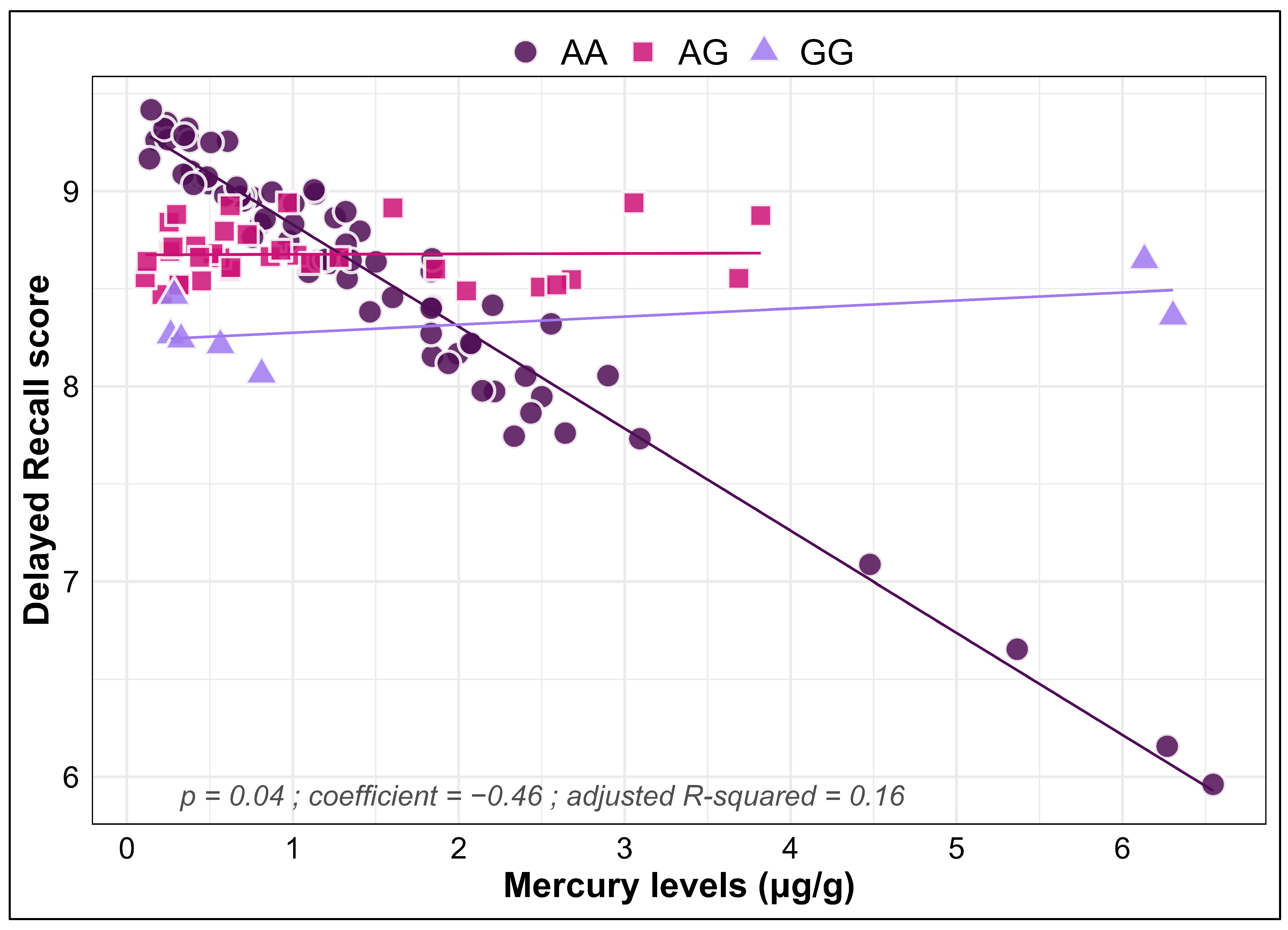
- The GSTP1 rs1695 polymorphism influenced mercury levels and modified the relationship between mercury exposure and cognitive outcomes, suggesting that genetic variability contributes to individual susceptibility to mercury neurotoxicity.
- Identifying genetic factors associated with mercury susceptibility may help prioritize high-risk groups for monitoring, prevention strategies, and targeted public health interventions in exposed populations.
- These findings reinforce the need for stronger environmental policies to reduce mercury contamination from gold mining and support health surveillance programs in Indigenous territories.
Abstract
1. Introduction
2. Materials and Methods
2.1. Study Design and Ethical Approval
2.2. Study Area and Population
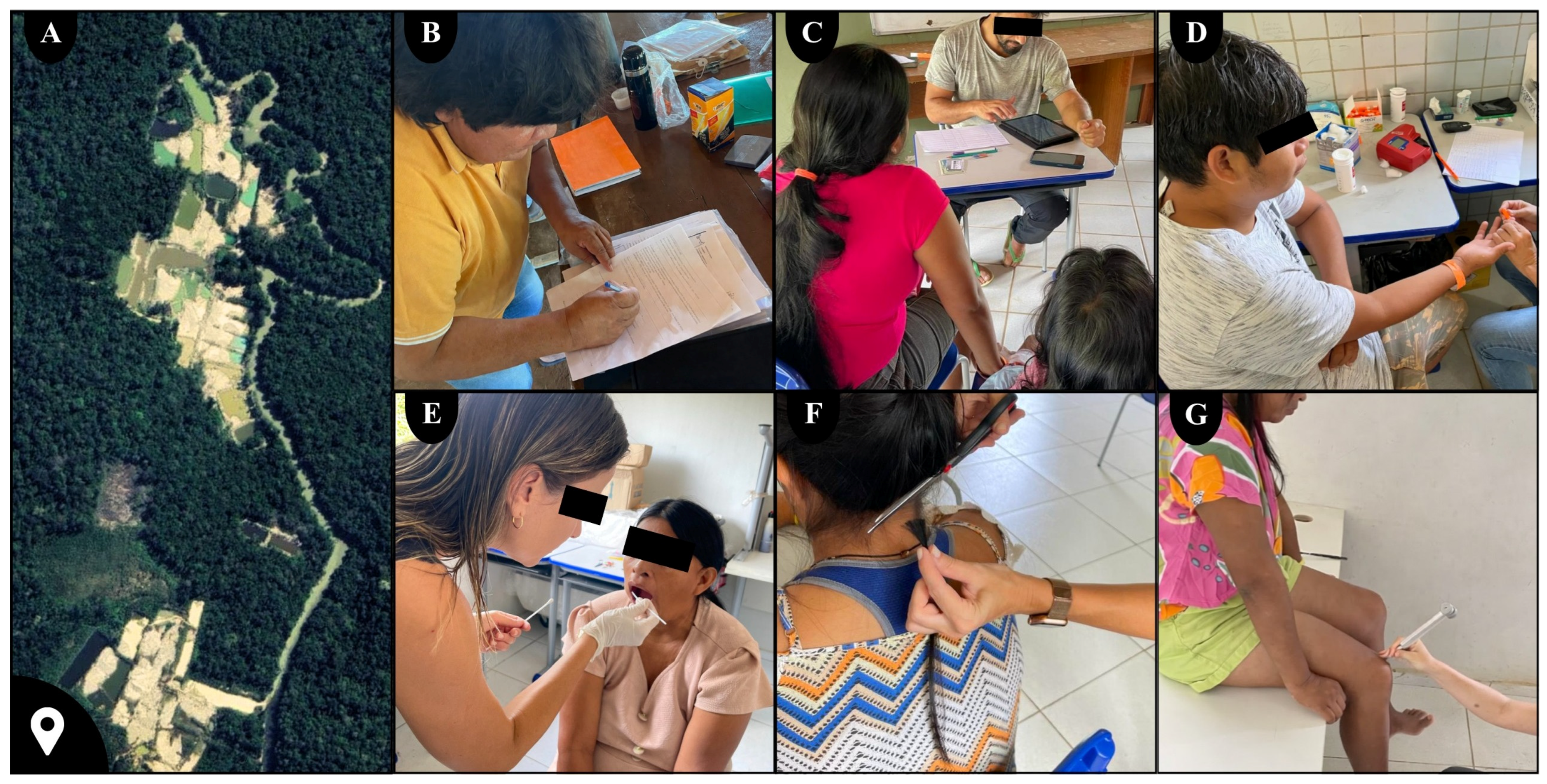
2.3. Fieldwork and Data Collection
2.4. Clinical and Neurological Assessment
2.5. Biological Samples Collection
2.6. Hair Mercury Analysis
2.7. DNA Extraction and GSTP1 Polymorphism Genotyping
2.8. Variables and Statistical Analysis
3. Results
4. Discussion
5. Conclusions
Supplementary Materials
Author Contributions
Funding
Institutional Review Board Statement
Informed Consent Statement
Data Availability Statement
Acknowledgments
Conflicts of Interest
References
- Rice, K.M.; Walker, E.M.; Wu, M.; Gillette, C.; Blough, E.R. Environmental Mercury and Its Toxic Effects. J. Prev. Med. Public Health 2014, 47, 74–83. [Google Scholar] [CrossRef]
- Lacerda, L.D.; Costa, B.G.B.C.; Lopes, D.N.; Oliveira, K.; Bezerra, M.F.; Bastos, W.R. Mercury in Indigenous, Introduced and Farmed Fish from the Semiarid Region of the Jaguaribe River Basin, NE Brazil. Bull. Environ. Contam. Toxicol. 2014, 93, 31–35. [Google Scholar] [CrossRef] [PubMed]
- Siqueira-Gay, J.; Sánchez, L.E. The Outbreak of Illegal Gold Mining in the Brazilian Amazon Boosts Deforestation. Reg. Environ. Change 2021, 21, 28. [Google Scholar] [CrossRef]
- de Vasconcellos, A.C.S.; Barrocas, P.R.G.; Ruiz, C.M.V.; de Souza Mourão, D.; de Souza Hacon, S. Burden of Mild Mental Retardation Attributed to Prenatal Methylmercury Exposure in Amazon: Local and Regional Estimates. Ciênc. Saúde Coletiva 2018, 23, 3535–3545. [Google Scholar] [CrossRef] [PubMed]
- de Oliveira, R.A.A.; Pinto, B.D.; Rebouças, B.H.; de Andrade, D.C.; de Vasconcellos, A.C.S.; Basta, P.C. Neurological Impacts of Chronic Methylmercury Exposure in Munduruku Indigenous Adults: Somatosensory, Motor, and Cognitive Abnormalities. Int. J. Environ. Res. Public Health 2021, 18, 10270. [Google Scholar] [CrossRef]
- Rebouças, B.H.; Kubota, G.T.; Oliveira, R.A.A.; Pinto, B.D.; Cardoso, R.M.; Vasconcellos, A.C.S.; Basta, P.C. Long-Term Environmental Methylmercury Exposure Is Associated with Peripheral Neuropathy and Cognitive Impairment among an Amazon Indigenous Population. Toxics 2024, 12, 212. [Google Scholar] [CrossRef]
- Al-Saleh, I.; Elkhatib, R.; Al-Rouqi, R.; Abduljabbar, M.; Eltabache, C.; Al-Rajudi, T.; Nester, M. Alterations in Biochemical Markers Due to Mercury (Hg) Exposure and Its Influence on Infant’s Neurodevelopment. Int. J. Hyg. Environ. Health 2016, 219, 898–914. [Google Scholar] [CrossRef]
- Pinheiro, M.D.C.N.; Luiz Martins Do Nascimento, J.; Carlos De Lima Silveira, L.; Batista Teixeira Da Rocha, J.; Aschner, M. Mercury and Selenium—A Review on Aspects Related to the Health of Human Populations in the Amazon. Environ. Bioindic. 2009, 4, 222–245. [Google Scholar] [CrossRef]
- Raymond, L.J.; Ralston, N.V.C. Mercury: Selenium Interactions and Health Implications. Neurotoxicology 2020, 81, 294–299. [Google Scholar] [CrossRef]
- Basta, P.C.; Viana, P.V.d.S.; Vasconcellos, A.C.S.d.; Périssé, A.R.S.; Hofer, C.B.; Paiva, N.S.; Kempton, J.W.; Ciampi de Andrade, D.; de Oliveira, R.A.A.; Achatz, R.W.; et al. Mercury Exposure in Munduruku Indigenous Communities from Brazilian Amazon: Methodological Background and an Overview of the Principal Results. Int. J. Environ. Res. Public Health 2021, 18, 9222. [Google Scholar] [CrossRef]
- Lozano, M.; Murcia, M.; Soler-Blasco, R.; González, L.; Iriarte, G.; Rebagliato, M.; Lopez-Espinosa, M.-J.; Esplugues, A.; Ballester, F.; Llop, S. Exposure to Mercury among 9-Year-Old Children and Neurobehavioural Function. Environ. Int. 2021, 146, 106173. [Google Scholar] [CrossRef]
- Parajuli, R.P.; Goodrich, J.M.; Chan, H.M.; Lemire, M.; Ayotte, P.; Hegele, R.A.; Basu, N. Variation in Biomarker Levels of Metals, Persistent Organic Pollutants, and Omega-3 Fatty Acids in Association with Genetic Polymorphisms among Inuit in Nunavik, Canada. Environ. Res. 2021, 200, 111393. [Google Scholar] [CrossRef]
- Sirivarasai, J.; Chaisungnern, K.; Panpunuan, P.; Chanprasertyothin, S.; Chansirikanjana, S.; Sritara, P. Role of MT1A Polymorphism and Environmental Mercury Exposure on the Montreal Cognitive Assessment (MoCA). Neuropsychiatr. Dis. Treat. 2021, 17, 2429–2439. [Google Scholar] [CrossRef]
- Medina Pérez, O.M.; Flórez-Vargas, O.; Rincón Cruz, G.; Rondón González, F.; Rocha Muñoz, L.; Sánchez Rodríguez, L.H. Glutathione-Related Genetic Polymorphisms Are Associated with Mercury Retention and Nephrotoxicity in Gold-Mining Settings of a Colombian Population. Sci. Rep. 2021, 11, 8716. [Google Scholar] [CrossRef]
- Perini, J.A.; Silva, M.C.; de Vasconcellos, A.C.S.; Viana, P.V.S.; Lima, M.O.; Jesus, I.M.; Kempton, J.W.; Oliveira, R.A.A.; Hacon, S.S.; Basta, P.C. Genetic Polymorphism of Delta Aminolevulinic Acid Dehydratase (ALAD) Gene and Symptoms of Chronic Mercury Exposure in Munduruku Indigenous Children within the Brazilian Amazon. Int. J. Environ. Res. Public Health 2021, 18, 8746. [Google Scholar] [CrossRef]
- Silva, M.C.D.; Oliveira, R.A.A.D.; Vasconcellos, A.C.S.D.; Rebouças, B.H.; Pinto, B.D.; Lima, M.D.O.; Jesus, I.M.D.; Machado, D.E.; Hacon, S.S.; Basta, P.C.; et al. Chronic Mercury Exposure and GSTP1 Polymorphism in Munduruku Indigenous from Brazilian Amazon. Toxics 2023, 11, 138. [Google Scholar] [CrossRef]
- Silva, M.C.d.; Basta, P.C.; Hofer, C.B.; Oliveira, M.A.F.d.; Kempton, J.W.; de Oliveira, R.A.A.; de Vasconcellos, A.C.S.; Perini, J.A. The GSTP1 Rs1695 Polymorphism Is Associated with Mercury Levels and Neurodevelopmental Delay in Indigenous Munduruku Children from the Brazilian Amazon. Toxics 2024, 12, 441. [Google Scholar] [CrossRef] [PubMed]
- Perini, J.A.; Cardoso, J.V.; Knesse, A.D.O.; Pessoa-Silva, F.O.; Vasconcellos, A.C.S.D.; Machado, D.E.; Basta, P.C. Single-Nucleotide Polymorphisms Associated with Mercury Levels and Neurological Symptoms: An Overview. Toxics 2024, 12, 226. [Google Scholar] [CrossRef] [PubMed]
- Custodio, H.M.; Broberg, K.; Wennberg, M.; Jansson, J.-H.; Vessby, B.; Hallmans, G.; Stegmayr, B.; Skerfving, S. Polymorphisms in Glutathione-Related Genes Affect Methylmercury Retention. Arch. Environ. Health Int. J. 2004, 59, 588–595. [Google Scholar] [CrossRef] [PubMed]
- Lu, S.C. Glutathione Synthesis. Biochim. Biophys. Acta (BBA)—Gen. Subj. 2013, 1830, 3143–3153. [Google Scholar] [CrossRef]
- Ballatori, N.; Clarkson, W. Biliary Secretion of Glutathione and of Glutathione-Metal Complexes. Fundam. Appl. Toxicol. 1985, 16, 816–831. [Google Scholar] [CrossRef]
- Strange, R.C.; Jones, P.W.; Fryer, A.A. Glutathione S-Transferase: Genetics and Role in Toxicology. Toxicol. Lett. 2000, 112–113, 357–363. [Google Scholar] [CrossRef] [PubMed]
- Suzuki, T.; Coggan, M.; Shaw, D.C.; Board, P.G. Electrophoretic and Immunological Analysis of Human Glutathione S-Transferase Isozymes. Ann. Human. Genet. 1987, 51, 95–106. [Google Scholar] [CrossRef] [PubMed]
- Wahlberg, K.; Love, T.M.; Pineda, D.; Engström, K.; Watson, G.E.; Thurston, S.W.; Yeates, A.J.; Mulhern, M.S.; McSorley, E.M.; Strain, J.J.; et al. Maternal Polymorphisms in Glutathione-Related Genes Are Associated with Maternal Mercury Concentrations and Early Child Neurodevelopment in a Population with a Fish-Rich Diet. Environ. Int. 2018, 115, 142–149. [Google Scholar] [CrossRef] [PubMed]
- Parajuli, R.P.; Goodrich, J.M.; Chou, H.-N.; Gruninger, S.E.; Dolinoy, D.C.; Franzblau, A.; Basu, N. Genetic Polymorphisms Are Associated with Hair, Blood, and Urine Mercury Levels in the American Dental Association (ADA) Study Participants. Environ. Res. 2016, 149, 247–258. [Google Scholar] [CrossRef]
- Goodrich, J.M.; Basu, N. Variants of Glutathione S-Transferase Pi 1 Exhibit Differential Enzymatic Activity and Inhibition by Heavy Metals. Toxicol. In Vitro 2012, 26, 630–635. [Google Scholar] [CrossRef]
- Pappiani, A.; Lacerda, I. Histórias do Começo e do Fim do Mundo: O Contato do Povo Paiter Suruí; Ikore: São Paulo, Brazil, 2016; Available online: https://ikore.com.br/publicacoes/historias-do-comeco-e-do-fim-do-mundo-2/ (accessed on 11 June 2025).
- Mindlin, B. Os Suruí Da Rondônia: Entre a Floresta e a Colheita (Mindlin 1985). Rev. Antropol. 1985, 27–28, 203–211. Available online: http://www.etnolinguistica.org/biblio:mindlin-1985-surui (accessed on 12 June 2025).
- Koenigsmark, F.; Weinhouse, C.; Berky, A.; Morales, A.; Ortiz, E.; Pierce, E.; Pan, W.; Hsu-Kim, H. Efficacy of Hair Total Mercury Content as a Biomarker of Methylmercury Exposure to Communities in the Area of Artisanal and Small-Scale Gold Mining in Madre de Dios, Peru. Int. J. Environ. Res. Public Health 2021, 18, 13350. [Google Scholar] [CrossRef]
- Berglund, M.; Lind, B.; Björnberg, K.A.; Palm, B.; Einarsson, Ö.; Vahter, M. Inter-Individual Variations of Human Mercury Exposure Biomarkers: A Cross-Sectional Assessment. Environ. Health 2005, 4, 20. [Google Scholar] [CrossRef]
- Cruz, F.O.; da Saúde, M.; Ministério dos Povos Indígenas. Manual Técnico Para o Atendimento de Indígenas Expostos ao Mercúrio no Brasil; Ministério da Saúde: Brasília, DF, Brazil, 2025.
- Welch, J.R.; Ferreira, A.A.; Souza, M.C.D.; Coimbra, C.E.A. Food Profiles of Indigenous Households in Brazil: Results of the First National Survey of Indigenous Peoples’ Health and Nutrition. Ecol. Food Nutr. 2021, 60, 4–24. [Google Scholar] [CrossRef]
- Baldoni, N.R.; Aquino, J.A.; Alves, G.C.S.; Sartorelli, D.S.; Franco, L.J.; Madeira, S.P.; Dal Fabbro, A.L. Prevalence of Overweight and Obesity in the Adult Indigenous Population in Brazil: A Systematic Review with Meta-Analysis. Diabetes Metab. Syndr. Clin. Res. Rev. 2019, 13, 1705–1715. [Google Scholar] [CrossRef] [PubMed]
- Garcia, H.M.; de Garcia Alves Feitosa, G.; de Menezes, H.L.; Figueiredo, T.M.R.; Alves, R.N.P.; Lima, N.N.R.; Reis, A.O.A.; Araújo, J.E.B.; de Carvalho, S.M.F.; Machado, S.S.F.; et al. Pandemic of Hunger: The Severe Nutritional Deficiency That Kills Yanomami Ethnic Children. J. Pediatr. Nurs. 2022, 65, e1–e2. [Google Scholar] [CrossRef] [PubMed]
- dos Santos, C.P.; Braga-Pereira, F.; Borges, A.K.M.; van Vliet, N.; Alves, R.N. Consumption and Preferences for Wild and Domestic Meat in Indigenous Communities in the Brazilian Atlantic Forest. Front. Ecol. Evol. 2022, 10, 900398. [Google Scholar] [CrossRef]
- Pamphlett, R. The Prevalence of Inorganic Mercury in Human Cells Increases during Aging but Decreases in the Very Old. Sci. Rep. 2021, 11, 16714. [Google Scholar] [CrossRef]
- Tollefson, L.; Cordle, F. Methylmercury in Fish: A Review of Residue Levels, Fish Consumption and Regulatory Action in the United States. Environ. Health Perspect. 1986, 68, 203–208. [Google Scholar] [CrossRef]
- Walker, E.V.; Yuan, Y.; Girgis, S.; Goodman, K.J. Patterns of Fish and Whale Consumption in Relation to Methylmercury in Hair among Residents of Western Canadian Arctic Communities. BMC Public Health 2020, 20, 1073. [Google Scholar] [CrossRef]
- Ashe, K. Elevated Mercury Concentrations in Humans of Madre de Dios, Peru. PLoS ONE 2012, 7, e33305. [Google Scholar] [CrossRef]
- Pope, Q.; Rand, M.D. Variation in Methylmercury Metabolism and Elimination in Humans: Physiological Pharmacokinetic Modeling Highlights the Role of Gut Biotransformation, Skeletal Muscle, and Hair. Toxicol. Sci. 2021, 180, 26–37. [Google Scholar] [CrossRef]
- Santos-Sacramento, L.; Arrifano, G.P.; Lopes-Araújo, A.; Augusto-Oliveira, M.; Albuquerque-Santos, R.; Takeda, P.Y.; Souza-Monteiro, J.R.; Macchi, B.M.; do Nascimento, J.L.M.; Lima, R.R.; et al. Human Neurotoxicity of Mercury in the Amazon: A Scoping Review with Insights and Critical Considerations. Ecotoxicol. Environ. Saf. 2021, 208, 111686. [Google Scholar] [CrossRef]
- Nitrini, R.; Bucki, S.M.D.; Yassuda, M.S.; Fichman, H.C.; Caramelli, P. The Figure Memory Test: Diagnosis of Memory Impairment in Populations with Heterogeneous Educational Background. Dement. Neuropsychol. 2021, 15, 173–185. [Google Scholar] [CrossRef] [PubMed]



| Characteristics | Overall |
|---|---|
| (n = 113) | |
| Sex | n (%) |
| Female | 65 (57.5) |
| Male | 48 (42.5) |
| Age (mean ± SD) a | 32.73 (16.3) |
| Age group a | n (%) |
| 12–15 | 12 (10.6) |
| 16–20 | 17 (15.0) |
| 21–30 | 36 (31.9) |
| 31–40 | 17 (15.0) |
| 41 or older | 31 (27.4) |
| BMI b | n (%) |
| Malnutrition | 2 (1.8) |
| Normal weight | 37 (33.3) |
| Overweight/Obesity | 72 (64.9) |
| Marital status c | n (%) |
| Married | 66 (58.9) |
| Single | 39 (34.8) |
| Widowed | 4 (3.6) |
| Separated | 3 (2.7) |
| Education level d | n (%) |
| Fundamental | 30 (32.3) |
| High school | 54 (58.1) |
| Higher education | 9 (9.7) |
| Income (mean ± SD) e | 2292.48 (1648.6) |
| Monthly income e | n (%) |
| 0–1500 BRL | 48 (42.5) |
| 1501–7200 BRL | 65 (57.5) |
| Fish consumption | n (%) |
| Daily | 23 (20.4) |
| Weekly | 71 (62.8) |
| Monthly | 19 (16.8) |
| Brazil nut consumption | n (%) |
| Daily | 23 (20.4) |
| Weekly | 71 (62.8) |
| Monthly | 19 (16.8) |
| Characteristics | Median (IQR) | p-Value (Univariate Analysis) | Multivariable Analysis a | |||
|---|---|---|---|---|---|---|
| Estimate (β) | Standard Error | 95% CI | p-Value | |||
| Sex | ||||||
| Male | 1.29 (1.49) | 0.13 | 0.61 | 0.25 | 0.12; 1.10 | 0.02 |
| Age (years) | 1.00 (1.43) | <0.01 | 0.05 | 0.01 | 0.02; 0.07 | <0.01 |
| BMI (Kg/m2) | ||||||
| Undernutrition | 0.45 (0.17) | 0.30 | −1.14 | 0.82 | −2.77; 0.50 | 0.17 |
| Overweight/Obesity | 1.11 (1.47) | 0.74 | −0.61 | 0.31 | −1.25; 0.01 | 0.05 |
| Marital status | ||||||
| Single | 0.62 (0.89) | 0.01 | 0.20 | 0.83 | −1.45; 1.84 | 0.81 |
| Widower | 1.99 (0.47) | 0.93 | 0.07 | 0.31 | −0.55; 0.68 | 0.83 |
| Separated | 0.98 (0.51) | 0.35 | −0.35 | 1.14 | −2.61; 1.91 | 0.76 |
| Education level | ||||||
| Primary | 1.11 (1.39) | <0.01 | 0.38 | 0.27 | −0.16; 0.92 | 0.17 |
| Higher education | 0.84 (0.52) | 0.92 | −0.52 | 0.46 | −1.43; 0.40 | 0.27 |
| Monthly income | ||||||
| 0–1500 BRL | 1.00 (1.43) | 0.40 | 0.27 | 0.25 | −0.23; 0.78 | 0.29 |
| Fish consumption b | ||||||
| Yes | 1.01 (1.45) | 0.41 | 1.0 | 0.98 | −0.91; 2.97 | 0.29 |
| Brazil nut consumption | ||||||
| Weekly | 1.22 (1.95) | 0.02 | 0.74 | 0.39 | −0.03; 1.50 | 0.06 |
| Monthly | 1.13 (1.40) | 0.01 | 0.44 | 0.30 | −0.17; 1.04 | 0.15 |
| Signs | n (%) | Multivariable Analysis a | |||
|---|---|---|---|---|---|
| (n = 113) | Estimate (β) | Standard Error | 95% CI | p-Value | |
| Cognitive function | |||||
| Verbal fluency | 26 (24.1) | 0.14 | 0.27 | −0.39; 0.67 | 0.59 |
| Memory | 1 (0.9) | 4.39 | 1.11 | 2.18; 6.60 | <0.01 |
| Stick test | 19 (17.8) | −0.25 | 0.35 | −0.95; 0.44 | 0.47 |
| Cognition | 46 (42.6) | 0.23 | 0.24 | −0.24; 0.71 | 0.33 |
| Motor function | |||||
| Muscle strength | 5 (4.7) | 1.24 | 0.54 | 0.16; 2.32 | 0.02 |
| Muscle rigidity | 3 (2.8) | 0.09 | 0.73 | −1.35; 1.55 | 0.89 |
| Toe amyotrophy | 1 (0.9) | −1.44 | 1.20 | −3.82; 0.94 | 0.23 |
| Bradykinesia | 3 (3.1) | 0.46 | 0.70 | −0.93; 1.86 | 0.51 |
| Deep tendon reflexes | 25 (24.0) | −0.01 | 0.31 | −0.62; 0.59 | 0.95 |
| Gait | 1 (1.0) | −0.53 | 1.21 | −2.94; 1.88 | 0.66 |
| Somatosensory function | |||||
| Tactile sensitivity | 5 (4.9) | −0.28 | 0.57 | −1.41; 0.84 | 0.62 |
| Deep sensitivity | 15 (13.8) | −0.06 | 0.40 | −0.85; 0.72 | 0.87 |
| Thermal sensitivity | 19 (17.4) | −0.34 | 0.30 | −0.93; 0.26 | 0.27 |
| Nociception | 17 (15.6) | −0.50 | 0.31 | −1.12; 0.12 | 0.11 |
| Visual field | 2 (1.8) | −0.95 | 0.84 | −2.61; 0.71 | 0.26 |
| GSTP1 rs1695 A>G | Median (IQR) | Multivariable Analysis | |||
|---|---|---|---|---|---|
| Estimate (β) | Standard Error | 95% CI | p-Value a | ||
| AA | 1.21 (1.36) | ||||
| AG | 0.62 (1.18) | −0.20 | 0.24 | −0.68; 0.28 | 0.41 |
| GG | 0.56 (3.17) | 0.94 | 0.46 | 0.03; 1.84 | 0.04 |
| AA + AG | 1.02 (1.39) | ||||
| GG | 0.56 (3.17) | 1.00 | 0.45 | 0.11; 1.89 | 0.03 |
| A | 1.13 (1.43) | ||||
| G | 0.62 (1.35) | 0.17 | 0.18 | −0.19; 0.54 | 0.36 |
| Characteristics | Overall |
|---|---|
| (n = 26) | |
| Sex | n (%) |
| Female | 14 (53.8) |
| Male | 12 (46.2) |
| Age (mean ± SD) a | 48.85 (16.42) |
| Age group a | n (%) |
| 16–20 | 2 (7.7) |
| 21–30 | 3 (11.5) |
| 31–40 | 3 (11.5) |
| 41 or older | 18 (69.2) |
| BMI b | n (%) |
| Normal weight | 8 (32.0) |
| Overweight/Obesity | 17 (68.0) |
| Marital status | n (%) |
| Married | 21 (80.8) |
| Single | 3 (11.5) |
| Widowed | 2 (7.7) |
| Education level c | n (%) |
| Fundamental | 7 (58.3) |
| High school | 5 (41.7) |
| Income (mean ± SD) d | 2207.7 (1776.5) |
| Monthly income d | n (%) |
| 0–1500 BRL | 12 (46.2) |
| 1501–7200 BRL | 14 (53.8) |
| Fish consumption e | n (%) |
| No | 0 (0.0) |
| Yes | 26 (100.0) |
| Fish consumption | n (%) |
| Daily | 2 (7.7) |
| Weekly | 7 (26.9) |
| Monthly | 17 (65.4) |
| Brazil nut consumption | n (%) |
| Daily | 23 (20.4) |
| Weekly | 71 (62.8) |
| Monthly | 19 (16.8) |
| GSTP1 313 A>G | n (%) |
| AA | 17 (65.4) |
| AG | 7 (26.9) |
| GG | 2 (7.7) |
| Neurological findings f | n (%) |
| None | 3 (11.5) |
| 1 to 3 | 13 (50.0) |
| 4 or more | 10 (38.5) |
Disclaimer/Publisher’s Note: The statements, opinions and data contained in all publications are solely those of the individual author(s) and contributor(s) and not of MDPI and/or the editor(s). MDPI and/or the editor(s) disclaim responsibility for any injury to people or property resulting from any ideas, methods, instructions or products referred to in the content. |
© 2026 by the authors. Licensee MDPI, Basel, Switzerland. This article is an open access article distributed under the terms and conditions of the Creative Commons Attribution (CC BY) license.
Share and Cite
Silva, M.C.d.; Basta, P.C.; Pinto, B.D.; Machado, D.E.; Pessoa-Silva, F.O.; de Oliveira, R.A.A.; de Vasconcellos, A.C.S.; Perini, J.A. Influence of the GSTP1 rs1695 Polymorphism on Mercury Levels and Memory Performance in the Suruí Indigenous from the Brazilian Amazon. Int. J. Environ. Res. Public Health 2026, 23, 793. https://doi.org/10.3390/ijerph23060793
Silva MCd, Basta PC, Pinto BD, Machado DE, Pessoa-Silva FO, de Oliveira RAA, de Vasconcellos ACS, Perini JA. Influence of the GSTP1 rs1695 Polymorphism on Mercury Levels and Memory Performance in the Suruí Indigenous from the Brazilian Amazon. International Journal of Environmental Research and Public Health. 2026; 23(6):793. https://doi.org/10.3390/ijerph23060793
Chicago/Turabian StyleSilva, Mayara Calixto da, Paulo Cesar Basta, Bruna Duarte Pinto, Daniel Escorsim Machado, Felipe Oliveira Pessoa-Silva, Rogério Adas Ayres de Oliveira, Ana Claudia Santiago de Vasconcellos, and Jamila Alessandra Perini. 2026. "Influence of the GSTP1 rs1695 Polymorphism on Mercury Levels and Memory Performance in the Suruí Indigenous from the Brazilian Amazon" International Journal of Environmental Research and Public Health 23, no. 6: 793. https://doi.org/10.3390/ijerph23060793
APA StyleSilva, M. C. d., Basta, P. C., Pinto, B. D., Machado, D. E., Pessoa-Silva, F. O., de Oliveira, R. A. A., de Vasconcellos, A. C. S., & Perini, J. A. (2026). Influence of the GSTP1 rs1695 Polymorphism on Mercury Levels and Memory Performance in the Suruí Indigenous from the Brazilian Amazon. International Journal of Environmental Research and Public Health, 23(6), 793. https://doi.org/10.3390/ijerph23060793