


Contextualizing Evaluation in Research Consortia: A Reflective Case Study from the Research Centers in Minority Institutions (RCMIs) Program


 , ,
, , 
Highlights
- By expanding consortium-wide evaluation to include non-quantitative approaches, institutions focused on building research capacity can generate meaningful, contextually grounded evidence needed to advance health disparities research.
- Understanding how research capacity is built and evaluated determines the quality and relevance of public health science.
- Non-quantitative evaluation approaches provide explanatory insight into mechanisms of change within complex systems, strengthening the effectiveness and sustainability of health disparities research programs.
- Combining quantitative benchmarks with qualitative strategies provides a better understanding of program impact across consortium sites.
- This integrated approach helps evaluators refine programs and enables funding agencies to assess return on investment.
Abstract
1. Introduction
1.1. Evaluating Research Capacity Building (RCB) and Impact
1.2. Evaluation Frameworks
1.3. Consortium-Based Evaluation Approaches
1.4. Common Data Elements (CDEs) and Common Metrics
1.5. Purpose of This Paper
2. Materials and Methods
2.1. Methodological Approach and Theoretical Framework
2.2. Definitions
2.3. Project Development
2.4. Reflecting on Evaluation Practice: Guiding Questions
- (1)
- What evaluation questions or lessons learned document or describe RCMI impact or outcomes beyond quantitative metrics and measures?
- (2)
- Share any challenges and/or successes related (directly) to the evaluation work you described in the first question. Define success for your respective site based on the evaluation approaches you discussed in question 1 (not the results/findings from that evaluation work).
- (3)
- Are there any missing primary targets that should be added (building on the Sy et al. 2020 paper [5])? What non-quantitative evaluation outcomes would you recommend for each new item you proposed?
2.5. Analysis
- Question 1: What evaluation questions or lessons learned document/describe RCMI impact or outcomes beyond quantitative metrics and measures?
- Question 2: Share any challenges and/or successes related (directly) to the evaluation work you described in the first question. Define success for your respective site based on the evaluation approaches you discussed in question 1.
- Question 3: Are there any missing primary or secondary targets that should be added? What qualitative (non-quantitative) evaluation outcomes would you recommend for each new item you proposed?
3. Results
3.1. Identifying and Contextualizing Non-Quantitative RCMI Evaluation Approaches (Guiding Question 1)
3.1.1. Scientific Productivity (Primary Target 1)
3.1.2. Scientific Collaborations (Primary Target 2)
3.1.3. Professional Growth (Primary Target 3)
3.1.4. Research Resources (Primary Target 4)
3.2. Utilization of Non-Quantitative Approaches: Challenges and Successes (Guiding Question 2)
3.2.1. Successes

| Successes (Themes) | Examples |
|---|---|
| Strengthening Evaluation Infrastructure Centralized Systems | Improved accuracy, consistency, and efficiency; better tracking of service requests and resource use |
| Mixed-Methods and Narrative Approaches | Combining quantitative and non-quantitative data deepens interpretation; exit and follow-up interviews provide contextualized insights into individual, institutional and community impacts |
| Systematic Tracking of Research Productivity and Collaboration | Coding publications and grants beyond tallies (i.e., for research foci) provides more descriptive impact; longitudinal tracking of impact is possible; selected strategies reveal collaboration patterns not just that collaborations exist |
| Documenting Community-Engaged Collaborations | Mixed-methods tools capture partnership development and community capacity-building outcomes |
| Data-Driven Program Improvements | Responses from surveys with open-ended items, interviews, and narratives directly inform program changes and strategic decisions |
| Structured Use of IDPs and Mentorship Evaluations | Systematic tools provide insight into professional growth and mentoring quality |
Strengthening Evaluation Infrastructure Through Centralized Data Systems and Tracking Tools
Using Mixed-Methods and Narrative Approaches to Deepen Evaluation Insights
Systematic Tracking of Research Productivity and Collaboration Patterns
Documenting Community-Engaged Collaborations
Data-Driven Program Improvements
Structured Use of IDPs and Mentorship Evaluations to Improve Research Readiness and Competitiveness
3.2.2. Challenges
| Challenges (Themes) | Examples |
|---|---|
| Limited Capacity and Resources for Non-Quantitative and Traditional Qualitative Methods | Insufficient training, staffing, and time; labor-intensive strategies; extensive data cleaning and interpretation needs |
| Low Engagement and Participation | Low survey response rates; inconsistent participation in tracking systems; low response to evaluation tools to assess mentorship and IDPs |
| Misalignment and Inconsistency in Data Collection | Variation across RP, PPP, and supplements; dispersed sources of collaboration data; lack of standardized indicators for collaborations and partnerships |
| Technical and Infrastructure Limitations | Limited access to utilization data; lack of specialized expertise required for some strategies; lack of centralized systems from which to review contextual data |
| Timing and Recruitment Challenges | Timing of data collection misaligned with reporting cycles; difficulty identifying participants post-program; need for early planning and integration of evaluation |
Limited Capacity and Resources for Qualitative and Non-Quantitative Methods
Low Engagement and Participation in Surveys, Tracking Systems, and Mentorship Tools
Misalignment and Inconsistency in Data Collection Across Programs, Collaborations, and Community Partnerships
Technical and Infrastructure Limitations, Including SNA and Utilization Data
Timing and Recruitment Challenges for Post-Program Evaluation or Follow-Up
3.3. Recommendations for the Expansion of the Primary and Secondary Targets (Guiding Question 3)
3.3.1. Identification of New Primary Targets and Qualitative/Non-Quantitative Metrics
3.3.2. Qualitative Refinement of Existing Secondary Targets
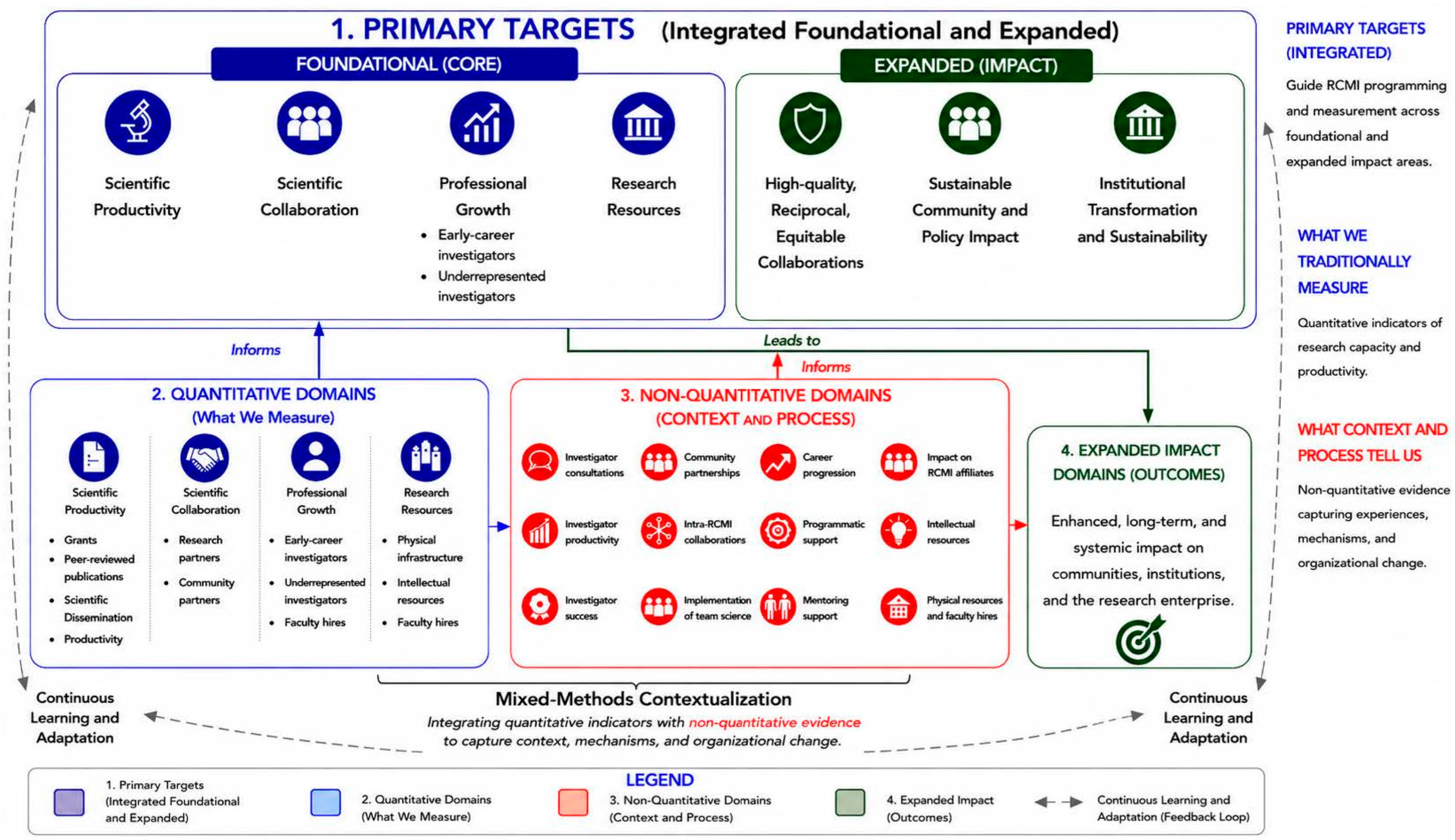
Conceptual Map of Foundational and Expanded Domains to Inform RCMI Evaluation
4. Discussion
4.1. Approaches to Advance RCMI Consortium-Based Evaluation
4.2. Non-Quantitative Evaluation Successes and Challenges
4.3. Expansion of the Primary Evaluation Targets
4.4. Integrating Theory and Reflective Methods to Inform Evaluation Practice
4.5. Study Implications
- 1.
- Standardization is essential.Shared definitions for ROI, CDEs, and collaboration metrics would improve comparability and reduce burden. Although the types of non-quantitative information collected tended to cluster around similar themes (as shown in Table 1, Table 2, Table 3 and Table 4), it is noteworthy that evaluators utilized several different methods to collect information within each respective domain. For example, five different approaches (milestone reviews, longitudinal tracking, collaborative assessment, IDP reviews of progress, and surveys) were implemented to measure various aspects of career progression. It is unclear whether the data collected via such varying methodologies are comparable. To provide a report on the overall impact of the RCMI network, standardized approaches to non-quantitative evaluation should be adopted.
- 2.
- Qualitative capacity must be expanded.Training, templates, and analytic tools are needed to support evaluators with limited non-quantitative experience.
- 3.
- Mixed-methods approaches should be institutionalized.Embedding open-ended items, reflection surveys, and success story frameworks into routine data collection could enhance our understanding of program impact.
- 4.
- Centralized data systems improve sustainability planning.REDCap, publication databases, and grant management systems reduce burden and strengthen data quality. However, non-quantitative approaches are needed to fully understand the qualitative contents of entries in these repositories and to further illuminate RCMIs’ impact.
- 5.
- Professional growth evaluation should extend beyond pilot investigators.Systematic tracking of career progression and the research climate would provide a fuller picture of capacity building for junior and senior investigators.
- 6.
- Resource evaluation requires institutional commitment.Sustainable evaluation models depend on alignment between evaluation teams, core leadership, and institutional administration.
4.6. Limitations
5. Conclusions
Supplementary Materials
Author Contributions
Funding
Institutional Review Board Statement
Informed Consent Statement
Data Availability Statement
Acknowledgments
Conflicts of Interest
Abbreviations
| AI | Artificial Intelligence |
| CAB | Community Advisory Board (for an RCMI CEC) |
| CCPS | Community Campus Partnership Support (of an RCMI CEC) |
| CDC | Centers for Disease Control and Prevention |
| CDEs | Common Data Elements (set of metrics collected across programs) |
| CEB | Community Expert Board (of an RCMI CEC) |
| CEC | Community Engagement Core (of an RCMI) |
| CES | Community Engagement Studio (of an RCMI CEC) |
| CFIR | Consolidated Framework for Implementation Research |
| CoP | Community of Practice |
| CTR | Clinical and Translational Research |
| CTSA | Clinical and Translational Science Award (NIH grant program) |
| CV | Curriculum Vitae |
| ESI | Early-Stage Investigator (NIH designation for researcher status based on degree or clinical training completed within no more than 10 years) |
| IDP | Individual Development Plan (individualized mentoring plan in RCMIs) |
| K-series | NIH Awards for Career Development Programs (e.g., K-01, K, 08, K-99, etc.) |
| K99/R00 | NIH Pathway to Independence Award (mentored research with a K99 followed by independent research with an R00) |
| NCATS | National Center for Advancing Translational Sciences (at NIH) |
| NIH | National Institutes of Health |
| NIMHD | National Institute on Minority Health and Health Disparities (NIH) |
| PPP | Pilot Project Program (of an RCMI) |
| RCB | Research Capacity Building |
| RCC | Research Capacity Core (of an RCMI) |
| RCMIs | Research Centers in Minority Institutions (sites funded by NIMHD grants) |
| RCMI-CC | RCMI Coordinating Center (helps NIMHD and RCMI achieve collectively) |
| RE-AIM | Reach, Effectiveness, Adoption, Implementation, and Maintenance |
| REDCap | Research Electronic Data Capture (browser-based data collection system) |
| RePORTER | Research Portfolio Online Reporting Tools (NIH repository of grants) |
| RPs | Research Projects funded through the RCMI that receive support from all cores |
| ROI | Return on Investment (tangible and intangible benefits of an RCMI grant) |
| SNA | Social Network Analysis (research method to understand interactions) |
| TCCs | Transdisciplinary Collaborative Centers |
| TSBM | Translational Science Benefits Model (evaluation framework to demonstrate impact of research in real world) |
| UR | Underrepresented Researcher scholar |
References
- Behar-Horenstein, L.S.; Suiter, S.; Snyder, F.; Laurila, K. Consensus Building to Inform Common Evaluation Metrics for the Comprehensive Partnerships to Advance Cancer Health Equity (CPACHE) Program. J. Cancer Educ. 2023, 38, 231–239. [Google Scholar] [CrossRef] [PubMed]
- Roberts, K.J.; Ogbagiorgis, W.; Sy, A.; Williams-Blangero, S.; Stewart, L.V.; Manusov, E.; Fernandez, S.B.; Clarke, R.D.; Madden, E.B. Increasing the Genomic Workforce through Research Capacity Building: Designing Evaluation Plans for Maximum Impact. Am. J. Hum. Genet. 2025, 112, 967–974. [Google Scholar] [CrossRef] [PubMed]
- Schaller, M.D. Efficacy of Centers of Biomedical Research Excellence (CoBRE) Grants to Build Research Capacity in Underrepresented States. FASEB J. 2024, 38, e23560. [Google Scholar] [CrossRef]
- Giancola, S.; Stevenson, J.F.; Philibert, I. Meta-Evaluative Practices of Clinical and Translational Research Evaluators. J. Clin. Transl. Sci. 2025, 9, e193. [Google Scholar] [CrossRef]
- Sy, A.; Hayes, T.; Laurila, K.; Noboa, C.; Langwerden, R.J.; Hospital, M.M.; Andújar-Pérez, D.A.; Stevenson, L.; Cunningham, S.M.R.; Rollins, L.; et al. Evaluating Research Centers in Minority Institutions: Framework, Metrics, Best Practices, and Challenges. Int. J. Environ. Res. Public Health 2020, 17, 8373. [Google Scholar] [CrossRef] [PubMed]
- CDC. CDC Approach to Program Evaluation: About Evaluation Standards; Centers for Disease Control and Prevention: Atlanta, GA, USA, 2024.
- Trochim, W.M.; Rubio, D.M.; Thomas, V.G.; Evaluation Key Function Committee of the CTSA Consortium. Evaluation Guidelines for the Clinical and Translational Science Awards (CTSAs). Clin. Transl. Sci. 2013, 6, 303–309. [Google Scholar] [CrossRef]
- Molzhon, A.; Dillon, P.M.; DiazGranados, D. Leveraging the Translational Science Benefits Model to Enhance Planning and Evaluation of Impact in CTSA Hub-Supported Research. Front. Public Health 2025, 13, 1593920. [Google Scholar] [CrossRef]
- Padek, M.; Mudaranthakam, D.P.; Pepper, S.; Mays, M.P.; Ellis, S.D. Building an Evaluation Infrastructure to Capture Process and Progress within a Clinical and Translational Science Awards Hub. J. Clin. Transl. Sci. 2025, 9, e136. [Google Scholar] [CrossRef]
- Oortwijn, W.; Reijmerink, W.; Bussemaker, J. How to Strengthen Societal Impact of Research and Innovation? Lessons Learned from an Explanatory Research-on-Research Study on Participatory Knowledge Infrastructures Funded by the Netherlands Organization for Health Research and Development. Health Res. Policy Syst. 2024, 22, 81. [Google Scholar] [CrossRef]
- Boyd, A.; Cole, D.C.; Cho, D.-B.; Aslanyan, G.; Bates, I. Frameworks for Evaluating Health Research Capacity Strengthening: A Qualitative Study. Health Res. Policy Syst. 2013, 11, 46. [Google Scholar] [CrossRef]
- Zhu, E.M.; Buljac-Samardžić, M.; Ahaus, K.; Huijsman, R. Transforming Dementia Research into Practice: A Multiple Case Study of Academic Research Utilization Strategies in Dutch Alzheimer Centres. Health Res. Policy Syst. 2025, 23, 3. [Google Scholar] [CrossRef] [PubMed]
- Sperling, J.; Ghanem, E.; Quenstedt, S.; Saxena, T. Taking the Translational Science Benefits Model from Concept to Operationalization: Opportunities and Challenges in Defining Impact Using the Translational Science Benefits Model. Front. Public Health 2025, 13, 1612590. [Google Scholar] [CrossRef]
- Luke, D.A.; Sarli, C.C.; Suiter, A.M.; Carothers, B.J.; Combs, T.B.; Allen, J.L.; Beers, C.E.; Evanoff, B.A. The Translational Science Benefits Model: A New Framework for Assessing the Health and Societal Benefits of Clinical and Translational Sciences. Clin. Transl. Sci. 2018, 11, 77–84. [Google Scholar] [CrossRef]
- Emmons, K.M.; Brownson, R.C.; Luke, D.A. Extending the Translational Science Benefits Model to Implementation Science for Cancer Prevention and Control. J. Clin. Transl. Sci. 2024, 8, e211. [Google Scholar] [CrossRef]
- Reardon, C.M.; Damschroder, L.J.; Ashcraft, L.E.; Kerins, C.; Bachrach, R.L.; Nevedal, A.L.; Domlyn, A.M.; Dodge, J.; Chinman, M.; Rogal, S. The Consolidated Framework for Implementation Research (CFIR) User Guide: A Five-Step Guide for Conducting Implementation Research Using the Framework. Implement. Sci. 2025, 20, 39. [Google Scholar] [CrossRef]
- Holtrop, J.S.; Estabrooks, P.A.; Gaglio, B.; Harden, S.M.; Kessler, R.S.; King, D.K.; Kwan, B.M.; Ory, M.G.; Rabin, B.A.; Shelton, R.C.; et al. Understanding and Applying the RE-AIM Framework: Clarifications and Resources. J. Clin. Transl. Sci. 2021, 5, e126. [Google Scholar] [CrossRef]
- Do-Golden, B.; Wolfe, N.; Maccalla, N.M.G.; Settles, J.; Kipke, M.D. Operationalizing Community Engagement Evaluation: A Structured and Scalable Approach Using the RE-AIM Framework and Net Effects Diagrams. J. Clin. Transl. Sci. 2025, 9, e255. [Google Scholar] [CrossRef]
- Glasgow, R.E.; Battaglia, C.; McCreight, M.; Ayele, R.; Maw, A.M.; Fort, M.P.; Holtrop, J.S.; Gomes, R.N.; Rabin, B.A. Use of the Reach, Effectiveness, Adoption, Implementation, and Maintenance (RE-AIM) Framework to Guide Iterative Adaptations: Applications, Lessons Learned, and Future Directions. Front. Health Serv. 2022, 2, 959565. [Google Scholar] [CrossRef]
- Trasi, R.; Angelone, C.; Hounkanrin, G. Designing and Implementing the Adaptive Learning Meeting Cycle: The (Re)Solve Project Experience in Burkina Faso. Glob. Health Sci. Pract. 2023, 11, e2200217. [Google Scholar] [CrossRef]
- Viswanath, K.; Agha, S. Adaptive Interventions to Promote Change in the 21st Century: The Responsive Feedback Approach. Glob. Health Sci. Pract. 2023, 11, e2300450. [Google Scholar] [CrossRef] [PubMed]
- Zakaria, S.; Grant, J.; Luff, J. Fundamental Challenges in Assessing the Impact of Research Infrastructure. Health Res. Policy Syst. 2021, 19, 119. [Google Scholar] [CrossRef]
- Abudu, R.; Oliver, K.; Boaz, A. What Funders Are Doing to Assess the Impact of Their Investments in Health and Biomedical Research. Health Res. Policy Syst. 2022, 20, 88. [Google Scholar] [CrossRef]
- Lloyd, N.; Hyett, N.; Kenny, A. Barriers and Enablers to Evaluating Outcomes From Public Involvement in Health Service Design: An Interpretive Description. Qual. Health Res. 2023, 33, 983–994. [Google Scholar] [CrossRef]
- Zhang, L.; Gurkan, U.A.; Qua, K.; Swiatkowski, S.; Hemphill, S.; Pelfrey, C.M. Demonstrating Public Health Impacts of Translational Science at the Clinical and Translational Science Collaborative (CTSC) of Northern Ohio: A Mixed-Methods Approach Using the Translational Science Benefits Model. Front. Public Health 2025, 13, 1560751. [Google Scholar] [CrossRef]
- Scarinci, I.C.; Moore, A.; Benjamin, R.; Vickers, S.; Shikany, J.; Fouad, M. A Participatory Evaluation Framework in the Establishment and Implementation of Transdisciplinary Collaborative Centers for Health Disparities Research. Eval. Program Plan. 2017, 60, 37–45. [Google Scholar] [CrossRef]
- Rollins, L.; Lawrence, T.Z.; Akintobi, T.H.; Hopkins, J.; Banerjee, A.; De La Rosa, M. A Participatory Evaluation Framework for the Implementation of a Transdisciplinary Center for Health Disparities Research. Ethn. Dis. 2019, 29, 385–392. [Google Scholar] [CrossRef] [PubMed]
- NIH. Clinical and Translational Science Awards (CTSA); National Institutes of Health: Bethesda, MD, USA, 2024.
- Hoyo, V.; Nehl, E.; Dozier, A.; Harvey, J.; Kane, C.; Perry, A.; Samuels, E.; Schmidt, S.; Hunt, J. A Landscape Assessment of CTSA Evaluators and Their Work in the CTSA Consortium, 2021 Survey Findings. J. Clin. Transl. Sci. 2024, 8, e79. [Google Scholar] [CrossRef] [PubMed]
- NIMHD. Research Centers in Minority Institutions (RCMI) U54—Clinical Trial Optional) RFA-MD-24-001. Available online: https://grants.nih.gov/grants/guide/rfa-files/RFA-MD-24-001.html (accessed on 20 November 2025).
- Ofili, E.O.; Sarpong, D.; Yanagihara, R.; Tchounwou, P.B.; Fernández-Repollet, E.; Malouhi, M.; Idris, M.Y.; Lawson, K.; Spring, N.H.; Rivers, B.M. The Research Centers in Minority Institutions (RCMI) Consortium: A Blueprint for Inclusive Excellence. Int. J. Environ. Res. Public Health 2021, 18, 6848. [Google Scholar] [CrossRef] [PubMed]
- Ofili, E.O.; Malouhi, M.; Sarpong, D.F.; Tchounwou, P.B.; Fernandez-Repollet, E.; Chang, S.P.; Gordon, T.K.; Mubasher, M.; Quarshie, A.; Strekalova, Y.; et al. The NIH Research Centers in Minority Institutions (RCMI): National and Public Health Impact as Measured by Collaborative Scientific Excellence, Investigator Development, and Community Engagement. Int. J. Environ. Res. Public Health 2025, 22, 1650. [Google Scholar] [CrossRef]
- Sarpong, D.F.; Liu, C.Y.; Gordon, T.K.; Sy, A.; Mancera, B.; Alhassan, M.; RCMI Community Engagement Consortium. Engaging Communities and Empowering Research: Lessons from a Network of Community Engagement Cores. Int. J. Environ. Res. Public Health 2025, 22, 1661. [Google Scholar] [CrossRef]
- Welch, L.C.; Tomoaia-Cotisel, A.; Chang, H.; Mendel, P.; Etchegaray, J.M.; Qureshi, N.; Fenwood-Hughes, M.; Parajulee, A.; Selker, H.P. Do Common Metrics Add Value? Perspectives from NIH Clinical and Translational Science Awards (CTSA) Consortium Hubs. J. Clin. Transl. Sci. 2020, 5, e68. [Google Scholar] [CrossRef] [PubMed]
- Kane, C.T.; Lipschitz, E.E.; Abedin, Z.; Muhammad, K.; Nickerson, B.J.; Rhim, G.; Lechuga, C.; Tobin, J.N.; Neville-Williams, M.N.; Lyu, C.; et al. Bridging Barriers, Integrating Insights: The Gotham Approach to CTSA Collaborative Evaluation. J. Clin. Transl. Sci. 2025, 9, e262. [Google Scholar] [CrossRef] [PubMed]
- Welch, L.C.; Tomoaia-Cotisel, A.; Noubary, F.; Chang, H.; Mendel, P.; Parajulee, A.; Fenwood-Hughes, M.; Etchegaray, J.M.; Qureshi, N.; Chandler, R.; et al. Evaluation of Initial Progress to Implement Common Metrics across the NIH Clinical and Translational Science Awards (CTSA) Consortium. J. Clin. Transl. Sci. 2020, 5, e25. [Google Scholar] [CrossRef]
- Ahmadi, N.; Zoch, M.; Kelbert, P.; Noll, R.; Schaaf, J.; Wolfien, M.; Sedlmayr, M. Methods Used in the Development of Common Data Models for Health Data: Scoping Review. JMIR Med. Inform. 2023, 11, e45116. [Google Scholar] [CrossRef]
- Stacey, S.K.; Steiner-Sherwood, M.; Crawford, P.; LeMaster, J.W.; McCarty, C.; Chowdhury, T.T.; Weidner, A.; Seidenberg, P.H. Measuring Research Capacity: Development of the PACER Tool. J. Am. Board Fam. Med. JABFM 2025, 37, S173–S184. [Google Scholar] [CrossRef] [PubMed]
- Kilmarx, P.H.; Maitin, T.; Adam, T.; Aslanyan, G.; Cheetham, M.; Cruz, J.; Eigbike, M.; Gaye, O.; Jones, C.M.; Kupfer, L.; et al. Increasing Effectiveness and Equity in Strengthening Health Research Capacity Using Data and Metrics: Recent Advances of the ESSENCE Mechanism. Ann. Glob. Health 2023, 89, 38. [Google Scholar] [CrossRef]
- Kerimoğlu, E.; Ülker, M.N.Ö.; Berk, Ş. How to Conduct a Metaevaluation?: A Metaevaluation Practice. Can. J. Program Eval. 2023, 38, 57–78. [Google Scholar] [CrossRef]
- Allen, K.-A.; Kern, M.L.; Rozek, C.S.; McInereney, D.; Slavich, G.M. Belonging: A Review of Conceptual Issues, an Integrative Framework, and Directions for Future Research. Aust. J. Psychol. 2021, 73, 87–102. [Google Scholar] [CrossRef]
- Greene, J.C.; Caracelli, V.J.; Graham, W.F. Toward a Conceptual Framework for Mixed-Method Evaluation Designs. Educ. Eval. Policy Anal. 1989, 11, 255–274. [Google Scholar] [CrossRef]
- Creswell, J.; Klassen, A.; Clark, V.P.; Smith, K.C. Best Practices for Mixed Methods Research in the Health Sciences; National Institute of Health, Office of Behavioral and Social Science Research: Bethesda, MD, USA, 2011. Available online: https://obssr.od.nih.gov/sites/g/files/mnhszr296/files/Best_Practices_for_Mixed_Methods_Research.pdf (accessed on 21 March 2026).
- Gallo, J.J.; Guetterman, T.C.; Taylor, J.L.; Jenkins, E.; Murray, S.M. Applying Mixed Methods to Enhance Health Equity in Research on Dementia and Cognitive Impairment. J. Aging Health 2025, 37, 104S–113S. [Google Scholar] [CrossRef]
- MacDonald, G.; Bamkole, O.; Theodorou, L.; Rahman, F.; Richard, M.; Johnson, S. What Is Reflective Practice and Why Is It Important to Us as Individuals and Evaluators? AEA 365. 2025. Available online: https://aea365.org/blog/what-is-reflective-practice-and-why-is-it-important-to-us-as-individuals-and-evaluators-by-goldie-macdonald-omoshalewa-bamkole-lea-theodorou-fardin-rahman-midjina-richard-and-stephanie-johnson/ (accessed on 1 May 2026).
- Tovey, T.L.S.; Skolits, G.J. Conceptualizing and Engaging in Reflective Practice: Experienced Evaluators’ Perspectives. Am. J. Eval. 2022, 43, 5–25. [Google Scholar] [CrossRef]
- Stufflebeam, D.L. The Metaevaluation Imperative. Am. J. Eval. 2001, 22, 183–209. [Google Scholar] [CrossRef]
- AEA Guiding Principles. Available online: https://www.eval.org/About/Guiding-Principles (accessed on 9 March 2026).
- Scriven, M. Meta-Evaluation Revisited. J. Multidiscip. Eval. 2009, 6, iii–viii. [Google Scholar] [CrossRef]
- Mills, A.; Durepos, G.; Wiebe, E. Encyclopedia of Case Study Research; Sage Publishing: Thousand Oaks, CA, USA, 2009. [Google Scholar]
- Ahmed, S.K. The Pillars of Trustworthiness in Qualitative Research. J. Med. Surg. Public Health 2024, 2, 100051. [Google Scholar] [CrossRef]
- Israel, T.; Farrow, H.; Joosten, Y.; Vaughn, Y. Community Engagement Studio Toolkit 2.0; Vanderbilt Institute for Clinical and Translational Research: Nashville, TN, USA, 2019. [Google Scholar]
- Fleming, M.; House, S.; Hanson, V.S.; Yu, L.; Garbutt, J.; McGee, R.; Kroenke, K.; Abedin, Z.; Rubio, D.M. The Mentoring Competency Assessment: Validation of a New Instrument to Evaluate Skills of Research Mentors. Acad. Med. 2013, 88, 1002–1008. [Google Scholar] [CrossRef]
- US Centers for Disease Control and Prevention. How to Develop a Success Story; US Department of Health and Human Services: Atlanta, GA, USA, 2008.
- Damschroder, L.J.; Reardon, C.M.; Opra Widerquist, M.A.; Lowery, J. Conceptualizing Outcomes for Use with the Consolidated Framework for Implementation Research (CFIR): The CFIR Outcomes Addendum. Implement. Sci. 2022, 17, 7. [Google Scholar] [CrossRef] [PubMed]
| Non-Quantitative RCMI Evaluation Domains | Approaches |
|---|---|
| Investigator productivity (n = 3) ** | |
| Scholarly products resulting from community research studios | Vignette (individual example) |
| Descriptions of community/professional conference dissemination efforts, honors/awards, and promotions | Productivity reports |
| Co-developed core milestones that guide and contextualize productivity goals | REDCap (research electronic data capture) for formative, progress, post-assessment, and exit surveys |
| Investigator consultations (n = 2) ** | |
| Grant preparation activities such as consultations, development, resubmissions, and reviewer feedback | Longitudinal tracking |
| Descriptions of reasons for the studio consultations (advice/guidance on any research related issue) | Vignette (individual example) |
| Investigator success (n = 2) * | |
| Profiles of “productive” Pilot Program Project (PPP) investigators describing their subsequent productivity/success | Profiles (individual example) |
| PPP submissions/outcomes, dissemination activities that generate preliminary data, and increased research visibility | Secondary data from Community Engagement Core (CEC) |
| Non-Quantitative RCMI Evaluation Domains | Approaches |
|---|---|
| Community partnerships (n = 13) * | |
| Types of external partners working across the RCMI (research projects), relationship building, nature of the collaboration, and strengthened relationships |
|
| CEC Community Campus Partnership Support (CCPS) feedback to improve the program; how did participation build capacity to engage in health disparities research with community/university partners? |
|
| CEC Community Engagement Studio (CES) community expert-driven changes to the research project that resulted; new community partnerships; strengthened partnerships |
|
| Did the RCMI strengthen investigators’ ability to develop and sustain relationships with community partners? |
|
| Did Community Expert Board (CEB) participation benefit CEB members’ organizations or the populations they serve? |
|
| Intra-RCMI Collaborations (n = 6) * | |
| Inter-core collaboration an indicator of institutional research capacity |
|
| Expansion of scientific collaborations among faculty across career stages; pilot project collaborations |
|
| Collaborations that emerge/what facilitates them/barriers encountered; shared activities, co-developed outputs from interdisciplinary and community–academic partnerships |
|
| Implementation of team science (n = 5) * | |
| Whether/how the RCMI expanded investigators’ network of health disparities research collaborators; how has the RCMI impacted your ability to successfully engage in team science? |
|
| Collaborative networks, assessed diversity, and connectivity among investigators, disciplines, and institutions; jointly developed proposals, co-authored manuscripts, and new teams |
|
| Non-Quantitative RCMI Evaluation Domains | Approaches |
|---|---|
| Career progression (n = 9) * | |
| Identify barriers, facilitators, and opportunities for targeted interventions |
|
| Document and monitor promotion and tenure changes among RCMI-affiliated faculty/postdocs, awards, student trainee outcomes—current position |
|
| Grant/publication preparation (consultations, draft development, resubmissions, and reviewer feedback) |
|
| Assess goal attainment, identify support needs, and guide mentoring discussions |
|
| Programmatic supports (n = 9) * | |
| Interest in professional development opportunities; identify needs/assess perceptions of available support |
|
| Open-ended questions to gain insights into the PPP application process and scientific review/feedback |
|
| What resources were available to accomplish goals/activities? What activities resulted from the use of resources? What are the immediate results of these activities? |
|
| Revisiting professional growth goals to ensure alignment with the RCMI’s mission and goals |
|
| Mentoring supports (n = 8) * | |
| Satisfaction of PPP leaders with various center-sponsored professional development activities |
|
| Contextual factors: challenges/solutions; facilitators of progress and success; factors that influenced/impeded progress; suggestions for improvement |
|
| Community Engagement Studio (CES) outcomes: changes in investigators’ perspectives about community feedback or changes to study design/dissemination plans |
|
| Factors that helped PPP investigators participate in individualized mentoring; self-reported skill enhancement; changes in self-efficacy/career readiness |
|
| Mentor accessibility, feedback, support for independence, contributions to scholarly productivity |
|
| Describe whether the program strengthened investigators’ ability to mentor early-stage investigators (ESIs) |
|
| Impact of RCMI on affiliates (n = 4) * | |
| Contextualize return on investment (ROI) calculation with success stories |
|
| Impact of the RCMI on affiliated faculty, staff, students, recharge users, community partners, and volunteers; ways (if any) in which affiliates’ involvement in the RCMI impacted their career; impact of collaborative efforts; impact on institutional capacity |
|
| Non-Quantitative RCMI Evaluation Domains | Approaches |
|---|---|
| Intellectual resources (n = 7) * | |
| Awareness/use of available support and resources to advance research skills |
|
| Changes (individual/researcher capacity) because of RCMI activities (grounded by inner settings based on attributes from implementation science) |
|
| How RCC consultations (study design, statistical methods, data analysis, grant development) lead to improved proposals, manuscripts, and analytic rigor |
|
| Applicants identify institutional barriers and support for writing PPP grant proposals |
|
| Identify barriers and assets to individual and institutional research readiness and inform RCMI programming |
|
| Development of new research methodologies, consultations, and training in analytic techniques |
|
| Physical resources (n = 5) * | |
| Changes (research infrastructure enhancements) because RCMI activities are grounded by outer settings based on attributes from implementation science |
|
| Resources available, support needs, expanded analytic capabilities, gaps in equipment or infrastructure |
|
| Monitoring progress on equipment acquisition, laboratory improvements, and other resource expansion efforts |
|
| Faculty hires (n = 2) * | |
| Recruitment core retention of new investigators hired |
|
| Feedback from investigators about new resources and improved research efficiency resulting from faculty hires |
|
| Theme | Key Findings and Recommendations |
|---|---|
| Structural Evolution | Observed that 2020 targets currently serve as broad domains rather than specific metrics; recommended alignment with RCMI Coordinating Center efforts to operationalize variables consortium-wide. |
| New Primary Target: Equitable Collaborations | Proposed new target: High-Quality, Reciprocal, and Equitable Collaborations. Recommended in-depth interviews with leads to document power distribution and mutual resource exchange. |
| New Primary Target: Sustainable Impact | Proposed new target: Sustainable Community and Policy Impact. Recommended semi-structured interviews with CAB members to identify longitudinal shifts in practice and policy, documenting policy changes and community-level indicators (e.g., improved population health) resulting from RCMI-supported work, and community co-authorship on RCMI products. |
| Refinement of Secondary Targets | Emphasized robust longitudinal tracking for grants and publications. Identified the use of approximately 15 distinct coding items to track ESI/UR status, core engagement, and “institutional firsts” (e.g., NIH K99/R00 awards). |
Disclaimer/Publisher’s Note: The statements, opinions and data contained in all publications are solely those of the individual author(s) and contributor(s) and not of MDPI and/or the editor(s). MDPI and/or the editor(s) disclaim responsibility for any injury to people or property resulting from any ideas, methods, instructions or products referred to in the content. |
© 2026 by the authors. Licensee MDPI, Basel, Switzerland. This article is an open access article distributed under the terms and conditions of the Creative Commons Attribution (CC BY) license.
Share and Cite
Laurila, K.A.; Randolph Cunningham, S.M.; Stevenson, L.; Tarasenko, M.; Ramsey, L.M.; Noboa-Ramos, C.; Matos, K.; Dania, A.; Sy, A. Contextualizing Evaluation in Research Consortia: A Reflective Case Study from the Research Centers in Minority Institutions (RCMIs) Program. Int. J. Environ. Res. Public Health 2026, 23, 747. https://doi.org/10.3390/ijerph23060747
Laurila KA, Randolph Cunningham SM, Stevenson L, Tarasenko M, Ramsey LM, Noboa-Ramos C, Matos K, Dania A, Sy A. Contextualizing Evaluation in Research Consortia: A Reflective Case Study from the Research Centers in Minority Institutions (RCMIs) Program. International Journal of Environmental Research and Public Health. 2026; 23(6):747. https://doi.org/10.3390/ijerph23060747
Chicago/Turabian StyleLaurila, Kelly A., Suzanne M. Randolph Cunningham, Lakesha Stevenson, Melissa Tarasenko, Lauren M. Ramsey, Carlamarie Noboa-Ramos, Katherine Matos, Akash Dania, and Angela Sy. 2026. "Contextualizing Evaluation in Research Consortia: A Reflective Case Study from the Research Centers in Minority Institutions (RCMIs) Program" International Journal of Environmental Research and Public Health 23, no. 6: 747. https://doi.org/10.3390/ijerph23060747
APA StyleLaurila, K. A., Randolph Cunningham, S. M., Stevenson, L., Tarasenko, M., Ramsey, L. M., Noboa-Ramos, C., Matos, K., Dania, A., & Sy, A. (2026). Contextualizing Evaluation in Research Consortia: A Reflective Case Study from the Research Centers in Minority Institutions (RCMIs) Program. International Journal of Environmental Research and Public Health, 23(6), 747. https://doi.org/10.3390/ijerph23060747

