1. Introduction
It is well established that the healthcare sector has a profound impact on the environment [
1,
2]. The U.S. healthcare sector accounts for approximately 8.5% of national greenhouse gas emissions, reaching 1692 kgCO
2e per capita in 2018—the highest rate among industrialized nations [
3,
4]. Current literature has established that healthcare with high resource utilization, such as intensive care units, can generate more than double the emissions compared to lower levels of care [
5,
6]. Although this example represents a growing understanding of the carbon intensity of some specific clinical services, there remains a wide swath of healthcare services and pathways that have poorly characterized carbon footprints.
With this understanding, environmental stewardship has become an increasing area of focus in healthcare delivery systems. In pediatrics, the impact of climate change on children’s health has brought increasing attention to this topic [
7,
8,
9]. However, environmental stewardship efforts among children’s hospitals remain in their infancy. One recent analysis identified that <15% of children’s hospitals are publicly tracking and reporting at least one suggested mitigation metric [
10]. This gap between appreciating healthcare’s significant carbon footprint and improving the sustainability of healthcare practices motivates targeted, service-level environmental analyses of the kind reported here. The analyses highlighted in this report were the first of their kind performed at our facility, representing an effort to close the gap on sustainability within our own healthcare system.
One of the primary obstacles to assessing the environmental impact of healthcare practices is in reliable measurement and reporting of data [
11,
12]. In most instances the healthcare sector has borrowed existing methodologies from other industries to calculate carbon footprints. To date, efforts to quantify the carbon footprint of healthcare typically target high-level estimates, focusing on the breadth of healthcare and general utilization practices [
1]. These existing efforts are largely reliant on Economic Input–Output (EEIO) analysis to determine carbon footprints [
13]. In these analyses, a conversion factor is used to translate dollar amounts directly into an emissions value [
13]. These conversion factors are usually sourced from governing bodies or environmental organizations (such as the EPA) [
14]. While the output of these analyses can be helpful in understanding system-level impact, such methodology is not precise enough to facilitate understanding of the environmental impact of specific clinical practices [
15].
In order to obtain data on specific clinical practices, the healthcare sector must utilize an alternate and more specific methodology known as Life Cycle Assessments (LCAs). LCAs are “cradle to grave” analyses that attempt to quantify all the emissions associated with the lifespan of a specific product or process [
16]. These studies determine which specific elements of a process render the greatest impact on emissions. The number of LCAs performed in the healthcare sector has increased in the past five years; however, these analyses remain limited [
17,
18,
19,
20,
21]. The granular data resulting from these LCAs may drive change within the healthcare system. For example, solid waste generation and its implications within the healthcare system has been previously assessed [
22,
23,
24]. It is established that healthcare systems in high-income nations rely substantially on linear supply chains composed of single-use disposable medical devices, contributing to escalating clinical waste volumes and supply-chain emissions [
25]. Service-level LCAs are foundational to this transformation, providing the precise data required to identify where single-use practices generate disproportionate environmental impact relative to clinical benefit. Additionally, there is the potential for service-level LCA data to support the development of environmental impact as a new domain of quality evaluation of clinical programs and services.
At our institution, a novel program was developed in 2020 to facilitate the transition of care for some appropriate neonates in the Neonatal Intensive Care Unit (NICU) to the home setting despite an ongoing need for medical equipment. Known as “Hope Grows at Home” (HGaH), this program has been in continuous operation since its inception, enrolling 150 patients and demonstrating positive clinical outcomes [
26]. Conceptually, the HGaH program represented an alternative, service-level healthcare practice that could be compared to an existing, resource-intensive healthcare standard (care in the NICU). We therefore asked: Does this structured, home-based care program produce lower greenhouse gas emissions than equivalent NICU care, and which inventory categories drive any observed differences? We hypothesized that home-based care would yield a lower carbon footprint. To answer this question, we convened an interdisciplinary clinician–engineer team to perform a comprehensive LCA of the HGaH program against routine NICU care, using ISO 14040/44 methodology [
27,
28]. Secondary to testing our hypothesis, we also convened this interdisciplinary team with the aim of increasing cross-campus collaboration at our academic medical center that might support future LCA work.
2. Materials and Methods
2.1. Study Population
The HGaH program offers enrollment to premature infants between 35 and 39 weeks post-menstrual age requiring no respiratory support who remain admitted primarily for nasogastric feeding. To be eligible, infants must have completed an apnea countdown (if applicable), demonstrated stable thermoregulation out of an isolette for 48 h, and be taking >20% of feeds by mouth. Specific exclusion criteria include transfer from outside facilities, central venous access, serious congenital anomalies, chromosomal anomalies, and child protective services custody. Patients are considered on a case-by-case basis with these criteria as a guide. Parents (and/or guardians) have final determination on joining the proposed program.
2.2. Study Team
To achieve our aims, we first established an interdisciplinary team. Three physicians from our Pediatric Department interested in the intersection of healthcare quality and environmental health (T.W., third-year pediatric resident; T.H., attending Neonatologist; and S.A.H., attending Pediatric Hospitalist and Quality and Safety lead) developed a project outline and approached professors (E.M.) with known involvement in climate-related research at our academically affiliated school of engineering to consider collaboration opportunities. Engineering faculty proposed collaboration via a senior-level engineering course in which student teams select project proposals from outside organizations around which they are interested in developing solutions. Our clinicians crafted a formal proposal to perform an LCA on the HGaH program. As part of this proposal, the student team would be able to perform “in the field” observations of NICU care, therefore creating an opportunity to simultaneously learn about healthcare practices and LCA processes. This proposal was subsequently chosen by one of the student teams. The accepting team consisted of 4 senior-level engineering students (C.K., I.R.-A., S.M., W.C.), who were advised by industry experts in the fields of sustainability, environmental engineering and analysis. This course spanned two academic quarters (approximately six months).
2.3. Team Engagement and Communication
After the establishment of our team, student members led LCA performance with input from our clinician team and their faculty advisors. We held bi-weekly meetings throughout the duration of the course; meetings were augmented by regular communication via email and messaging.
In order to gain familiarity with the relevant clinical environment, the student team made multiple site visits to tour our NICU. During these visits the students were able to observe bedside care and unit processes, interview nursing staff, and perform inventory on materials and devices to inform LCA performance.
2.4. LCA Methodology
LCAs were conducted on two distinct patient populations: (1) neonates receiving traditional care in the NICU throughout the duration of their equipment requirements and (2) infants receiving care through the HGaH program. The infant care that was performed in the NICU was matched as closely as possible with infants who were eligible for HGaH programming (i.e., infants who met the criteria but whose families opted out of the optional program).
We developed our LCA model and analysis by following guidelines set out in the International Organization for Standardization (ISO) standards for LCAs, specifically ISO 14040 and 14044 [
27,
28]. In coordination with these guidelines, our LCAs were performed with a four-part methodology: goal and scope definition, inventory analysis, impact assessment, and interpretation of results. Our inventorying processes included direct, in-field observations. These direct observations were carried out with a two-fold objective: to obtain the most granular data possible on the healthcare practices being assessed, and so all members of the interdisciplinary team would have full comprehension of the processes being analyzed. Inventory and impact-assessment calculations were performed in spreadsheet format (Microsoft Excel) using emission factors from the public sources detailed in
Appendix C; commercial LCA software with proprietary life cycle inventory databases was not used. This approach is consistent with comparable peer-reviewed home-care LCAs and is appropriate given the project scope and the absence of a U.S. healthcare-specific life cycle inventory database [
29].
2.4.1. Goal and Scope
Setting a goal and a scope for an LCA creates a specific framework for analysis. This framework is defined by the functional unit to be studied and by developing system boundaries. The functional unit acts as a common denominator between LCAs. For this study our functional unit was defined as kilograms of CO
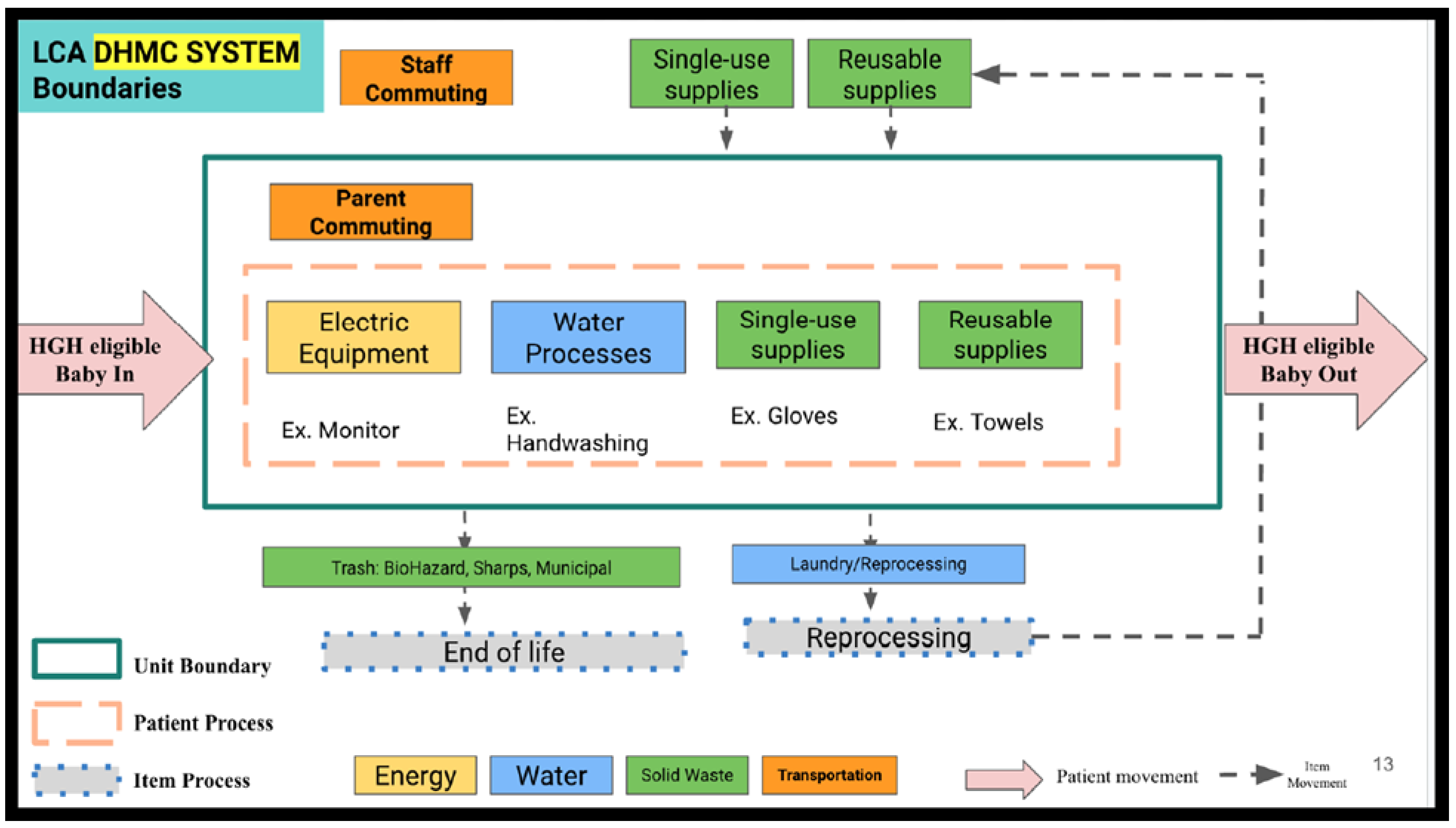
2 emissions per infant. Because the average duration of supplemental feeding in the HGaH program was 14 days, we used this as the time bounds of our functional unit. Our system boundaries, which define the extent of processes to be included in the LCA, were defined to capture four fundamental categories for the scope of care of the infants in both groups: energy, water, solid waste, and transportation. System boundaries are further demonstrated in
Figure 1 and
Table 1.
2.4.2. Inventory Analysis
Inventory analysis was completed by touring and inventorying NICU facilities, direct observation of infant care, interviewing nurses and clinical staff (
Appendix A), carrying out a literature review, and referring to equipment manuals and specifications. Detailed inventory was completed by category, as briefly explained in
Table 1 (complete inventory processing can be found in
Appendix B). An additional component in the inventory process of this LCA was in the inclusion of “newborn cares” frequency. “Cares” are defined as the regular activities performed in the care of the newborn. “Cares” are performed in the NICU every 3 h during the 24 h day, resulting in 8 instances of cares per day. This resulted in all inventory assessments utilizing an 8×/day factor in their quantifications.
Table 1.
Inventory analysis by impact category.
Table 1.
Inventory analysis by impact category.
| Impact Category | Included | Examples |
|---|
| Energy | Energy inventory included all direct care items with a connection to an outlet/power source. | Vital sign monitor Milk warmer
|
| Water | Water inventory assessed all care activities that required water usage. | Handwashing Bathing Formula mixing
|
| Solid waste | Solid waste inventory included all single-use items that are used in the care of an infant. | Diapers Gloves Feeding syringes
|
| Transportation | Transportation inventory included caregiver transportation to and from the hospital during a neonate’s time in either the HGaH program or in the NICU after they reach HGaH eligibility. | |
2.4.3. Impact Assessment
Impact assessment is the process through which the environmental impact of inventory is determined. In this analysis the inventory of each impact category was converted into the chosen impact value, kilograms of carbon dioxide emissions (kgCO
2e). These calculations are reliant on conversion factors, which are primarily created by governmental agencies and academic institutions (
Appendix C, [
14,
30,
31,
32,
33,
34,
35,
36,
37]). Impact-assessment calculations were performed in spreadsheet format (Microsoft Excel); commercial LCA software with proprietary life cycle inventory databases was not used. This approach is consistent with comparable peer-reviewed home-care LCAs [
29]. An example of a specific impact assessment is provided in
Table 2 (all other impact assessment data and calculations may be found in
Appendix B). After completing impact assessments on the individual components of an impact category (e.g., all the components that constituted “solid waste”), the totals were summed to create cumulative impact values. We utilized both high and low estimates in our calculations. In our final interpretation of results, we averaged these values to obtain a final emissions value.
This table represents the impact assessment for syringes used in nasogastric feeds of NICU newborns. Syringes were collected from the hospital and weighed in order to obtain an average weight (0.025 kg). We utilized conversion factors for both material use and waste disposal in forming a cumulative emissions factor (
Appendix C). Emissions per day were then calculated by multiplying the weight per day by the conversion factor. In order to account for the entirety of our functional unit, daily emissions were multiplied by 14 (the duration of HGaH enrollment in days).
2.4.4. Interpretation
Interpretation of impacts was completed by comparing the carbon emissions attributed to routine NICU care vs. the HGaH program by domain. As the interpretation component of our LCA is largely synonymous with results, the interpretation will be covered in the results portion of this article.
3. Results
In this LCA, care provided in the NICU produced an average of 338.19 kg of CO
2e/eligible baby over the 14-day time period. The breakdown by impact category revealed that energy accounted for 18.91 kg of CO
2e (5.59%), water accounted for 0.31 kg of CO
2e (0.09%), solid waste accounted for 26.97 kg of CO
2e (7.97%), and transportation accounted for 292 kg of CO
2e (86.34%). Care in the HGaH program produced an average of 77.15 kg of CO
2e emissions over a 14-day period. Inspecting the breakdown by scope revealed that energy accounted for 16.34 kg of CO
2e (21.18%), water accounted for 0.66 kg of CO
2e (0.86%), solid waste accounted for 1.74 kg of CO
2e (2.26%), and transportation accounted for 58.4 kg of CO
2e (75.71%). These results are further displayed in
Table 3.
Solid waste generated in the NICU amounted to a total of 15.11 kg per term. The HGaH program generated 5.97 kg of solid waste per term. Solid waste in this analysis was characterized by item type and weight rather than by regulated waste stream (regulated medical waste, sharps, municipal solid waste), and disposal pathway emissions (incineration, autoclave sterilization, landfill) were not modeled separately.
4. Discussion
This LCA of a novel home-care program for neonates identified that routine NICU care produced more than four-fold the carbon emissions of supported home care. For both cohorts, transportation was the major contributor to CO
2 emissions, likely impacted by our rural location. The dominance of transportation in both care models is consistent with current state-of-the-science reviews, which identified travel, facilities, and consumables as the principal carbon contributors across 151 hospital services and care pathways spanning multiple medical specialties [
38]. Per-term transport savings observed in this study (approximately 234 kgCO
2e) fall within the 0.70–372 kgCO
2e per-consultation range reported across telemedicine LCAs [
39], suggesting the magnitude of benefit is consistent with comparable home-care and remote-care interventions despite differences in clinical context.
Travel demands can be a limiting factor in a family’s ability to regularly visit, and care for, preterm newborns in a NICU setting [
40]. Without this regular interaction, infants may be missing a foundational component of newborn care [
41]. This presents an obvious challenge for families and their newborns. In addition to these clinical and social concerns, our data support the notion that there is an environmental impact here as well. One of the primary impressions from this analysis is the potential environmental benefit of remote patient care, in the form of telehealth and/or remote patient monitoring. In cases where clinical outcomes can remain constant [
42,
43,
44], a care-at-home model may represent a mode of healthcare delivery that is healthy for patients, fiscally responsible, and good for the planet.
In addition to our transportation findings, there was a notable difference in the carbon footprint of solid waste for the two care environments. This is likely attributable to the NICU’s practice of disposing plastic bottles and syringes with each use, while the home setting allows for reuse of supplies. Given that hospitals must uphold high standards of infection prevention, and therefore utilize many single-use materials and processes, this was not a particularly surprising finding. However, there are some well-known examples of healthcare delivery decreasing its waste output while maintaining care outcomes (such as the NHS’s “Gloves Off” campaign) [
45]. Our LCAs highlight that there are further opportunities for the healthcare sector to examine, and potentially alter, longstanding single-use practices. Concrete waste-reduction strategies that could be evaluated for the NICU setting include extending reuse protocols for feeding syringes and milk-warmer liners where infection-prevention standards allow, reviewing single-use device decisions through a circular-economy lens in collaboration with infection-prevention and supply-chain leadership, and evaluating reprocessable alternatives for current single-use items [
23,
25].
An impactful aspect of this work is that these analyses were performed on significantly different levels of healthcare service provided. We do not know of a specific, comprehensive analysis of NICU care, but by extrapolating findings from other intensive care units we postulate that NICU care is similarly resource intensive [
5,
6,
38]. There is some literature to suggest greener NICU infrastructure, but little to none on greener NICU services and pathways [
46]. The HGaH program offers an alternative to the resource-intensive care in the NICU. Therefore, the HGaH program represents a creative solution in which standards of care can be maintained while significantly reducing the carbon intensity. This supports the continued re-evaluation of care practices and development of alternative care models.
Taking a broader perspective, performing this analysis demonstrated the necessity of developing and utilizing an interdisciplinary study team. One of the secondary aims of this project was to increase interdisciplinary collaboration across our academic campus. We found that the creation of our interdisciplinary team was paramount to the completion of this novel analysis at our facility. Performing these LCAs was a robust educational opportunity for our team, and the knowledge gained via our collaboration was a highly valued outcome by all involved. Our hope is that these initial LCAs will provide a framework for our institution to perform further, and more refined, analyses, with the ultimate objective being that continued collaboration may lead to more sustainable practices at our healthcare facility. Overall, this experience supports what other recent publications have highlighted: the importance of creating interdisciplinary sustainability teams [
10,
21]. By fully leveraging the interdisciplinary capacities of an academic medical center, establishing sustainability teams creates a robust methodology to advance sustainability initiatives across the healthcare sector.
Several limitations should be noted. First, our carbon footprint estimates were informed by direct observation, nursing interviews, and assumptions about routine care patterns rather than prospectively captured patient-level activity logs. The precision of these estimates is therefore constrained by the absence of per-patient daily data across the 14-day functional unit.
Second, while many healthcare LCAs apply commercial software paired with proprietary life cycle inventory databases (e.g., SimaPro with ecoinvent, GaBi, OpenLCA), this analysis used a process-based inventory paired with publicly available emission factors from governmental and peer-reviewed sources, including the U.S. Environmental Protection Agency, the UK Department for Energy Security and Net Zero, and peer-reviewed life cycle literature (
Appendix C). This approach has direct precedent in recent peer-reviewed home-care and telemedicine LCAs conducted under ISO 14040/44 and is consistent with the methodologies documented across 76 hospital LCA studies in the most recent state-of-the-science review [
29,
38,
39]. Several of the factors applied—including those for plastics waste and home laundry water use—were derived from data sets outside the U.S. healthcare sector and may not perfectly represent device-, supplier-, or region-specific impacts. As previously stated, despite these constraints, the magnitude and directionality of our findings align with the state-of-the-science review of hospital carbon footprints, which identified travel, facilities, and consumables as the principal contributors to carbon footprint [
38]. Additionally, our per-term transport savings (~234 kgCO
2e) fall within the 0.70–372 kgCO
2e per-consultation range reported across telemedicine LCAs [
39]. System boundaries in any LCA are inherently subjective and shaped by feasibility; we set boundaries based on standard care patterns, and individual infants whose care deviated from those patterns may not be fully represented. Future analyses applying alternative emission-factor sources, including supplier-specific data and regional U.S. grid-specific electricity factors, will be valuable in further refining the environmental case for hospital-at-home models in pediatric and neonatal care.
Additionally, there is a limitation in our assessment of solid waste generation. We focused our assessment on one output metric (kgCO2e) in hopes of creating a framework for analysis that could be easily extrapolated to other healthcare services and pathways. However, this may have oversimplified our interpretation of waste generation. Solid waste in this analysis was characterized by item type and weight rather than by regulated waste stream (regulated medical waste, sharps, municipal solid waste), and disposal pathway emissions (incineration, autoclave sterilization, landfill) were not modeled separately. Hospital waste streams have distinct end-of-life carbon intensities, and future LCAs would benefit from stream-stratified inventory paired with facility-specific disposal-pathway emission factors.
Finally, the overall rigor of our analyses may have been influenced by two overarching components. First, the project was completed within a pre-defined engineering course at our academic center. Secondly, these analyses were the first of their kind conducted at our healthcare facility. Given this context, there were inherent limitations on time and expertise, with engineering students performing the majority of the analysis while under expert supervision. Although this framework introduced limitations, the structure of this educational course was also the catalyst for the development of our interdisciplinary team, therefore creating the opportunity to actually complete these LCAs. In spurring interdisciplinary collaboration at our facility, these initial limitations may have built the groundwork for future, and improved, analyses.




 ,
,