
Building a Resilience Ecosystem to Improve Employee Mental Health and Wellbeing in Canadian High-Stress Low-Control Occupations

 , , , , ,
Highlights
- Public safety professionals have high rates of post-traumatic stress injury.
- Findings underscore the value of implementing sustained, tailored mental health strategies that include a broader conceptualization of resilience that recognizes factors beyond the individual (including family and workplace), and those guided by recognized frameworks such as the Canadian Standard for Psychological Health and Safety in the Workplace.
- Higher levels of work engagement and resilience were associated with lower extended health costs, suggesting potential pathways toward enhanced performance and reduced psychological service expenditures.
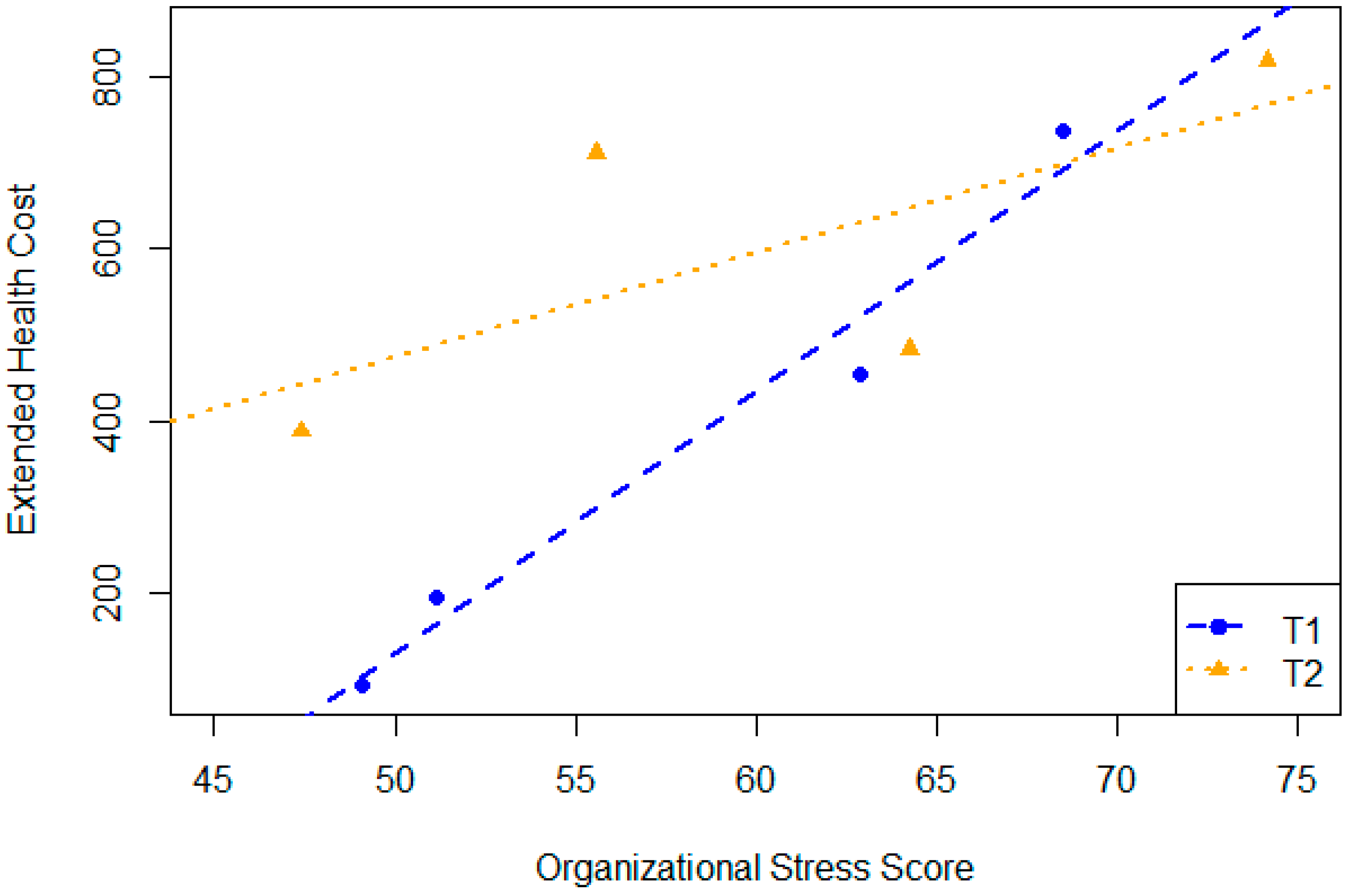
- Psychological stress within the organization is a key driver of health benefit utilization, as higher levels of perceived stress were strongly associated with increased extended health costs.
- A National Standard for Psychological Health and Safety in the Workplace can serve as a framework for improving workplace health and safety when integrated with multi-modal action plans and structured resilience programs.
- Fundamental to the longitudinal success of implemented programs is a commitment to Integrated Knowledge Transfer addressing knowledge users’ real-world problems through the co-creation of knowledge and its application.
Abstract
1. Introduction
1.1. Resilience
An Ecological Model of Resilience
1.2. The Standard
1.3. Purpose
2. Materials and Methods
- Examining and addressing gaps in organizational policies and procedures related to psychological health and safety;
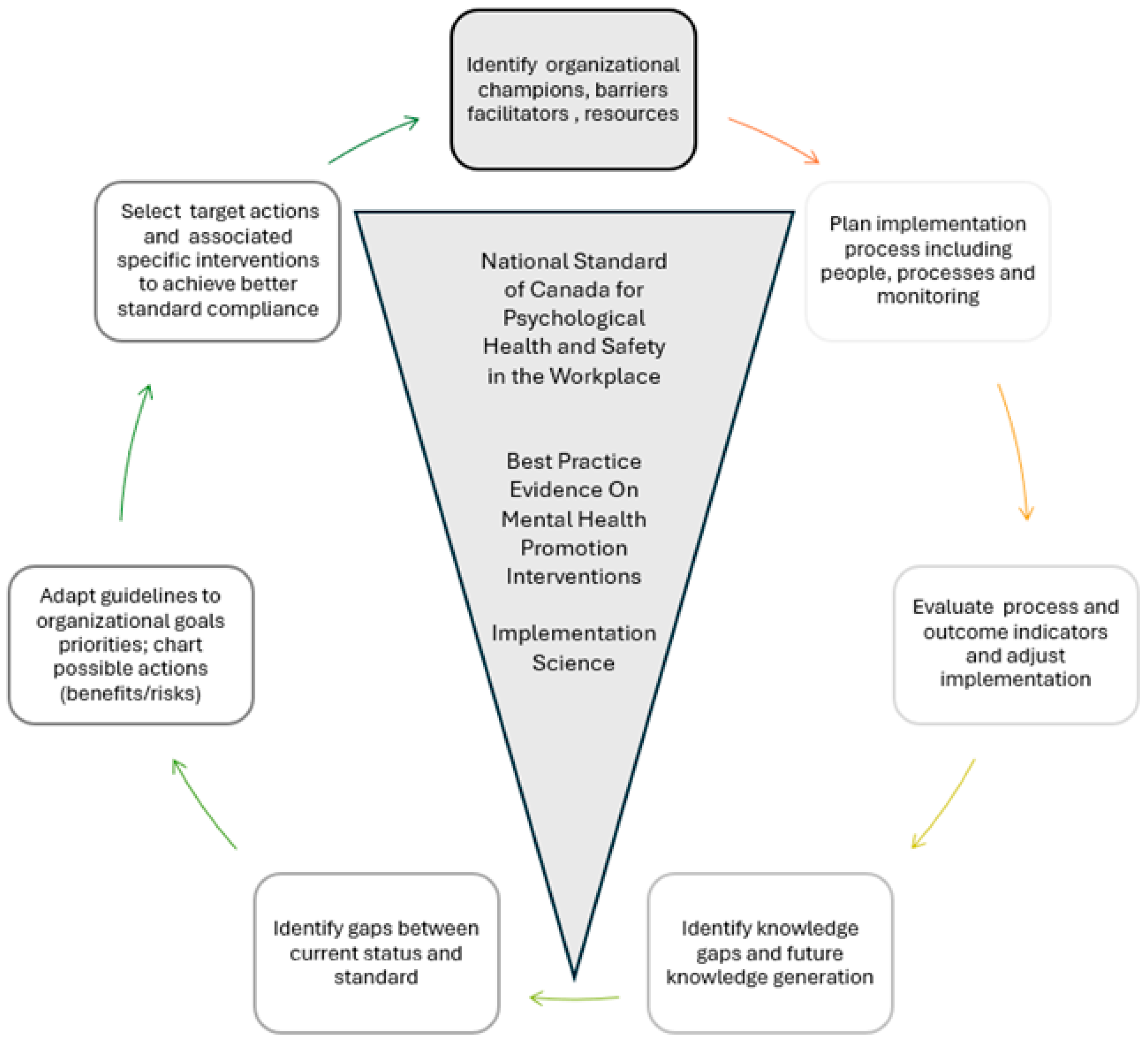
- Supporting the familiarization and implementation of the Canadian Standard for Psychological Health and Safety in the Workplace;
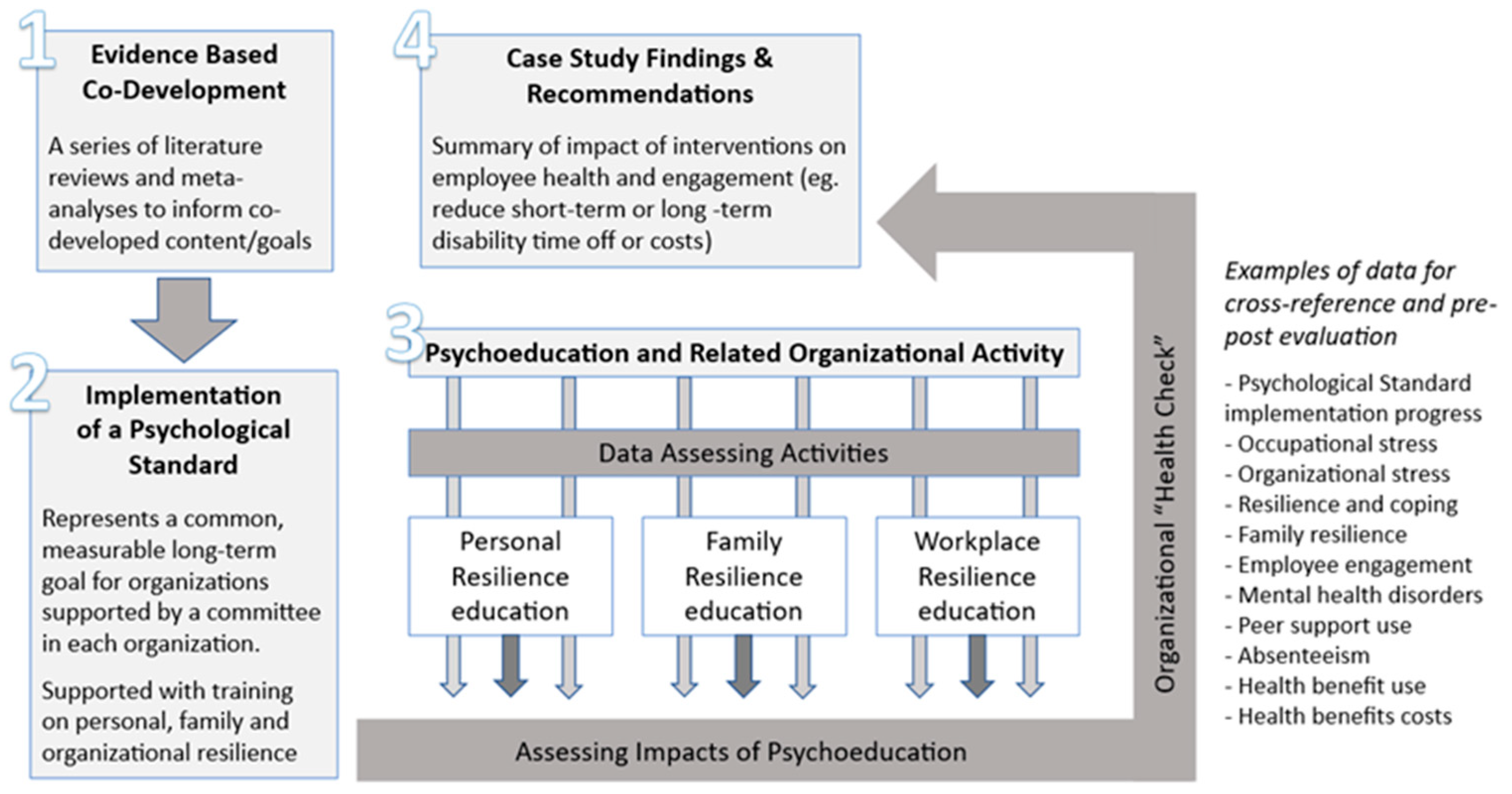
- Developing and delivering psychoeducational training tailored to public safety personnel, civilians, and leadership, structured around the three pillars of resilience: individual, family, and workplace.
- Psychological health and well-being surveys: Administered at baseline and approximately two years post-training, these surveys assessed changes in employee well-being and perceived organizational culture.
- Psychoeducational training courses: Three online training modules—Individual Resilience (Course 1), Family Resilience (Course 2), and Organizational Resilience (Course 3)—were delivered across all participating organizations. Standardized psychological instruments were used to evaluate course-specific outcomes before and after training.
- Organizational records: Human resources and operational data were collected to explore organizational-level trends in absenteeism, benefits usage, and other indicators relevant to workplace stress and wellness.
- Psychological standard implementation gap analysis: The Guarding Minds at Work survey was used to look at the 13 psychological factors present in the National Standard. This survey includes 28 recommended practice areas (sections) comprising 68 statements about common work experiences covering work responsibilities, relationships, and leadership that can be directly mapped back to the psychological factors present in the National Standard. Each question was answered with not implemented (0), partially implemented (1) and fully implemented (2). For each recommended section, the score was calculated as a percentage of the total statement scores relative to the maximum possible score if all items were fully implemented.
2.1. Psychological Health and Well-Being Survey
2.2. Organizational Records
2.3. Data Cleaning of PHW Responses
- More than 80% of symptom items scored as zero;
- Two or more low inter-scale correlations between PHQ-9, GAD-7, and PCL-5 (defined as correlation outliers using the 1.5 × IQR rule);
- Outlier scores on more than two psychological scales (also based on the 1.5 × IQR rule).
2.4. Potential Associations Among Survey Responses and Organizational Outcomes
2.5. Data Sources and Aggregation
2.6. Analytic Approach: Rank-Based Correlations
- T1 (pre-intervention);
- T2 (post-intervention);
- T2 − T1 change scores (i.e., shifts over the intervention period).
3. Results
3.1. PHW Survey Results
3.2. Training Outcomes
3.3. Correlation Analysis
4. Discussion
Limitations
5. Conclusions
Author Contributions
Funding
Institutional Review Board Statement
Informed Consent Statement
Data Availability Statement
Conflicts of Interest
References
- Di Nota, P.M.; Bahji, A.; Groll, D.; Carleton, R.N.; Anderson, G.S. Proactive psychological programs designed to mitigate posttraumatic stress injuries among at-risk workers: A systematic review and meta-analysis. BMC Syst. Rev. 2021, 10, 126. [Google Scholar] [CrossRef] [Scilit]
- Lopez, A. Posttraumatic stress disorder and occupational performance: Building resilience and fostering occupational adaptation. Work A J. Prev. Assess. Rehabil. 2011, 38, 33–38. [Google Scholar] [CrossRef] [Scilit]
- Van Breda, A.D. A critical review of resilience theory and its relevance for social work. Soc. Work/Maatskaplike Werk 2018, 54, 1–18. [Google Scholar] [CrossRef] [Scilit]
- Heber, A.; Testa, V.; Groll, D.; Ritchie, K.; Tam-Seto, L.; Mulligan, A.; Sullo, E.; Schick, A.; Bose, E.; Jabbari, Y.; et al. Glossary of terms: A shared understanding of the common terms used to describe psychological trauma, version 3.0. Health Promot. Chronic Dis. Prev. Can. Res. Policy Pract. 2023, 43, S1. [Google Scholar]
- Carleton, R.N.; Afifi, T.O.; Turner, S.; Taillieu, T.; Duranceau, S.; LeBouthillier, D.M.; Sareen, J.; Ricciardelli, R.; MacPhee, R.S.; Groll, D.; et al. Mental disorder symptoms among public safety personnel in Canada. Can. J. Psychiatry 2018, 63, 54–64. [Google Scholar] [CrossRef] [Scilit]
- Hatcher, S.; Sinyor, M.; Edgar, N.E.; Schaffer, A.; MacLean, S.E.; Carleton, R.N.; Colman, I.; Jayakumar, N.; Ward, B.; Zaheer, R.A. A comparison of suicides in public safety personnel with suicides in the general population in Ontario, 2014 to 2018. Crisis J. Crisis Interv. Suicide Prev. 2024, 45, 355–363. [Google Scholar] [CrossRef] [Scilit] [PubMed]
- Public Safety Canada. 2019 Supporting Canada’s Public Safety Personnel: An Action Plan on Post-Traumatic Stress Injuries. Available online: https://www.publicsafety.gc.ca/cnt/rsrcs/pblctns/2019-ctn-pln-ptsi/index-en.aspx (accessed on 17 February 2026).
- Carleton, R.N. Collaborating to support the mental health of public safety personnel: The Canadian Institute for Public Safety Research and Treatment. Can. Psychol. 2021, 62, 167–173. [Google Scholar] [CrossRef] [Scilit]
- Ontario Coroner’s Office. Staying Visible-Staying Connected, for Life: Report of the Expert Panel on Police Officer Deaths by Suicide September 2019. 2019. Available online: https://hsjcc.on.ca/wp-content/uploads/Staying-Connected-Report.pdf (accessed on 17 February 2026).
- Bronfenbrenner, U. Ecological models of human development. Int. Encycl. Educ. 1994, 3, 37–43. [Google Scholar]
- Lepore, S.J.; Revenson, T.A. Resilience and posttraumatic growth: Recovery, resistance, and reconfiguration. In Handbook of Posttraumatic Growth, Research and Practice; Calhoun, L.G., Tedeschi, R.G., Eds.; Routledge: Mahwah, NJ, USA, 2006; pp. 24–46. [Google Scholar]
- Hartling, L.M. Strengthening resilience in a risky world: It’s all about relationships. Women Ther. 2008, 31, 51–70. [Google Scholar] [CrossRef] [Scilit]
- Masten, A.S. Global perspectives on resilience in children and youth. Child Dev. 2014, 85, 6–20. [Google Scholar] [CrossRef] [Scilit] [PubMed]
- Herman, A.A. Community Health Workers and Integrated Primary Health Care Teams in the 21st Century. J. Ambul. Care Manag. 2011, 34, 354–361. [Google Scholar] [CrossRef] [Scilit] [PubMed]
- Ungar, M. A constructionist discourse on resilience: Multiple contexts, multiple realities among at-risk children and youth. Youth Soc. 2004, 35, 341–365. [Google Scholar] [CrossRef] [Scilit]
- Crawford, M. Ecological Systems theory: Exploring the development of the theoretical framework as conceived by Bronfenbrenner. J. Pub. Health Issue Pr. 2020, 4, 170. [Google Scholar] [CrossRef] [Scilit]
- Stokols, D. Translating social ecological theory into guidelines for community health promotion. Am. J. Health Promot. 1996, 10, 282–298. [Google Scholar] [CrossRef] [Scilit]
- Windle, G.; Bennett, K.M.; Noyes, J. A methodological review of resilience measurement scales. Health Qual. Life Outcomes 2011, 9, 8–18. [Google Scholar] [CrossRef] [Scilit]
- Rutter, M.L. Psychosocial adversity and child psychopathology. Br. J. Psychiatry 1999, 174, 480–493. [Google Scholar] [CrossRef] [Scilit] [PubMed]
- Baptist, J.; Barros, P.; Cafferky, B.; Johannes, E. Resilience building among adolescents from National Guard families: Applying a developmental contextual model. J. Adolesc. Res. 2015, 30, 306–334. [Google Scholar] [CrossRef] [Scilit]
- Anderson, G.S.; Di Nota, P.M.; Groll, D.; Carleton, R.N. Peer support and crisis-focused psychological interventions designed to mitigate post-traumatic stress injuries among public safety and frontline healthcare personnel: A systematic review. Int. J. Environ. Res. Public Health 2020, 17, 7645. [Google Scholar] [CrossRef] [Scilit]
- Jackson, D.; Firtko, A.; Edenborough, M. Personal resilience as a strategy for surviving and thriving in the face of workplace adversity: A literature review. J. Adv. Nurs. 2007, 60, 1–9. [Google Scholar] [CrossRef] [Scilit]
- Dobson, K.S.; Szeto, A.; Knaak, S.; Krupa, T.; Kirsh, B.; Luong, D.; McLean, R.; Pietrus, M. Mental health initiatives in the workplace: Models, methods, and results from the Mental Health Commission of Canada. World Psychiatry 2018, 17, 370–371. [Google Scholar] [CrossRef] [Scilit]
- Kohll, A. The Role Managers Play in Shaping Employee Well-Being. Forbes 2017, 3. Available online: https://www.forbes.com/sites/alankohll/2017/10/03/the-role-managers-play-in-shaping-employee-well-being/#6e02ebca79ed (accessed on 17 February 2026).
- CAN/CSA-Z1003-13/BNQ 9700-803/2013; Psychological Health and Safety in the Workplace-Prevention, Promotion, and Guidance to Staged Implementation. Canadian Standards Association: Toronto, ON, Canada, 2013. Available online: https://www.csagroup.org/store/product/2421865/ (accessed on 17 February 2026).
- Canadian Standards Association. Psychological Health and Safety in the Paramedic Service Organization (CSA Z1003.1:18 (R2022)). 2018. Available online: https://www.csagroup.org/article/z1003-1-18/ (accessed on 17 February 2026).
- Australian Psychological Society. Evidence-Based Psychological Interventions in the Treatment of Mental Disorders. A Review of the Literature, 4th ed.; Australian Psychological Society: Melbourne, Australia, 2018; 175p, Available online: https://www.psychology.org.au/getmedia/23c6a11b-2600-4e19-9a1d-6ff9c2f26fae/Evidence-based-psych-interventions.pdf (accessed on 17 February 2026).
- Leppin, A.L.; Gionfriddo, M.R.; Sood, A.; Montori, V.M.; Erwin, P.J.; Zeballos-Palacios, C.; Bora, P.R.; Dulohery, M.M.; Brito, J.P.; Boehmer, K.R.; et al. The efficacy of resilience training programs: A systematic review protocol. Syst. Rev. 2014, 3, 20. [Google Scholar] [CrossRef] [Scilit]
- Anderson, G.S.; Vaughan, A.; Mills, S. Building personal resilience in paramedic students. J. Community Saf. Well-Being 2017, 2, 51–53. [Google Scholar] [CrossRef] [Scilit]
- Carleton, R.N.; Afifi, T.O.; Turner, S.; Taillieu, T.; Vaughan, A.D.; Anderson, G.S.; Ricciardelli, R.; MacPhee, R.S.; Cramm, H.A.; Czarnuch, S.; et al. Mental health training, attitudes toward support, and screening positive for mental disorders. Cogn. Behav. Ther. 2019, 49, 55–73. [Google Scholar] [CrossRef] [Scilit]
- Hawley, D.R.; DeHaan, L. Toward a definition of family resilience: Integrating life-span and family perspectives. Fam. Process 1996, 35, 283–298. [Google Scholar] [CrossRef] [Scilit]
- Cox, M.; Norris, D.; Cramm, H.; Richmond, R.; Anderson, G.S. Public Safety Personnel Family Resilience: A Narrative Review. Int. J. Environ. Res. Public Health 2022, 19, 5224. [Google Scholar] [CrossRef] [Scilit]
- Walsh, F. A family resilience framework: Innovative practice applications. Fam. Relat. 2002, 51, 130–137. [Google Scholar] [CrossRef] [Scilit]
- Henry, C.S.; Sheffield Morris, A.; Harrist, A.W. Family resilience: Moving into the third wave. Fam. Relat. 2015, 64, 22–43. [Google Scholar] [CrossRef] [Scilit]
- Patterson, J.M.; Mccubbin, H.I. The impact of family life events and changes on the health of a chronically III child. Fam. Relat. 1983, 32, 255–264. [Google Scholar] [CrossRef] [Scilit]
- Rinne, G.R.; Mahrer, N.E.; Guardino, C.M.; Shalowitz, M.U.; Ramey, S.L.; Dunkel Schetter, C. Childhood family stress modifies the association between perinatal stressful life events and depressive symptoms. J. Fam. Psychol. 2023, 37, 432. [Google Scholar] [CrossRef] [Scilit]
- Bowen, G.L.; Martin, J.A. The resiliency model of role performance for service members, veterans, and their families: A focus on social connections and individual assets. J. Hum. Behav. Soc. Environ. 2011, 21, 162–178. [Google Scholar] [CrossRef] [Scilit]
- Duxbury, L.; Higgins, C.; Halinski, M. Identifying the Antecedents of Work-Role Overload in Police Organizations. Crim. Justice Behav. 2014, 42, 361–381. [Google Scholar] [CrossRef] [Scilit]
- McCreary, D.R.; Thompson, M.M. Development of two reliable and valid measures of stressors in policing: The operational and organizational police stress questionnaires. Int. J. Stress Manag. 2006, 13, 494–518. [Google Scholar] [CrossRef] [Scilit]
- Carleton, R.N.; Afifi, T.O.; Taillieu, T.; Turner, S.; Mason, J.E.; Ricciardelli, R.; McCreary, D.R.; Vaughan, A.D.; Anderson, G.S.; Krakauer, R.L.; et al. Assessing the relative impact of diverse stressors among public safety personnel. Int. J. Environ. Res. Public Health 2020, 17, 1234. [Google Scholar] [CrossRef] [Scilit]
- Ip, E.; Srivastava, R.; Lentz, L.; Jasinoski, S.; Anderson, G.S. Antecedents of Workplace Psychological Safety in Public Safety and Frontline Healthcare: A Scoping Review. Int. J. Environ. Res. Public Health 2025, 22, 820. [Google Scholar] [CrossRef] [Scilit]
- Mancini, J.A.; Bowen, G.L. Community resilience: A social organization theory of action and change. In Pathways of Human Development: Explorations of Change; Mancini, J.A., Roberto, K.A., Eds.; Lexington Books: New York, NY, USA, 2009; pp. 245–265. [Google Scholar]
- Harrison, D.; Laliberté, L. Gender, the military, and military family support. In Wives and Warriors: Women and the Military in the United States and Canada; Bloomsbury Academic: London, UK, 1997; pp. 35–53. [Google Scholar]
- Torche, F.; Valenzuela, E. Trust and reciprocity: A theoretical distinction of the sources of social capital. Eur. J. Soc. Theory 2011, 14, 181–198. [Google Scholar] [CrossRef] [Scilit]
- Graham, I.D.; Kothari, A.; McCutcheon, C. Moving knowledge into action for more effective practice, programmes and policy: Protocol for a research programme on integrated knowledge translation. Implement. Sci. 2018, 13, 22. [Google Scholar] [CrossRef] [Scilit]
- Sinden, K.; MacDermid, J.C. Does the knowledge-to-action (KTA) framework facilitate physical demands analysis development for firefighter injury management and return-to-work planning? J. Occup. Rehabil. 2014, 24, 146–159. [Google Scholar] [CrossRef] [Scilit]
- Mental Health Commission of Canada. Case Study Research Project Findings; Mental Health Commission of Canada: Ottawa, ON, Canada, 2017; Available online: https://www.mentalhealthcommission.ca/wp-content/uploads/drupal/2017-03/case_study_research_project_findings_2017_eng.pdf (accessed on 17 February 2026).
- Lawrence, L.M.; Bishop, A.; Curran, J. Integrated knowledge translation with public health policy makers: A scoping review. Healthc. Policy 2019, 14, 55. [Google Scholar] [CrossRef] [Scilit]
- Szeto, A.; Dobson, K.S.; Luong, D.; Krupa, T.; Kirsh, B. Workplace antistigma programs at the Mental Health Commission of Canada: Part 2. Lessons learned. Can. J. Psychiatry 2019, 64, 13S–17S. [Google Scholar] [CrossRef] [Scilit]
- McCreary, D.R.; Fong, I.; Groll, D.L. Measuring policing stress meaningfully: Establishing norms and cut-off values for the Operational and Organizational Police Stress Questionnaires. Police Pract. Res. 2017, 18, 612–623. [Google Scholar] [CrossRef] [Scilit]
- Schaufeli, W.B.; Bakker, A.B.; Salanova, M. The measurement of work engagement with a short questionnaire: A cross-national study. Educ. Psychol. Meas. 2006, 66, 701–716. [Google Scholar] [CrossRef] [Scilit]
- Blevins, C.A.; Weathers, F.W.; Davis, M.T.; Witte, T.K.; Domino, J.L. The posttraumatic stress disorder checklist for DSM-5 (PCL-5): Development and initial psychometric evaluation. J. Trauma. Stress 2015, 28, 489–498. [Google Scholar] [CrossRef] [Scilit]
- Spitzer, R.L.; Kroenke, K.; Williams, J.B.W.; Löwe, B. A Brief measure for assessing Generalized Anxiety Disorder: The GAD-7. Arch. Intern. Med. 2006, 166, 1092. [Google Scholar] [CrossRef] [Scilit]
- Kroenke, K.; Spitzer, R.L.; Williams, J.B.W. The PHQ-9: Validity of a brief depression severity measure. J. Gen. Intern. Med. 2001, 16, 606–613. [Google Scholar] [CrossRef] [Scilit]
- Carleton, R.N.; Collimore, K.C.; Asmundson, G.J.G.; McCabe, R.E.; Rowa, K.; Antony, M.M. Refining and validating the Social Interaction Anxiety Scale and the Social Phobia Scale. Depress. Anxiety 2009, 26, E71–E81. [Google Scholar] [CrossRef] [Scilit]
- Curran, P.G. Methods for the detection of carelessly invalid responses in survey data. J. Exp. Soc. Psychol. 2016, 66, 4–19. [Google Scholar] [CrossRef] [Scilit]
- Huang, J.L.; Curran, P.G.; Keeney, J.; Poposki, E.M.; DeShon, R.P. Detecting and deterring insufficient effort responding to surveys. J. Bus. Psychol. 2012, 27, 99–114. [Google Scholar] [CrossRef] [Scilit]
- Gache, P.; Michaud, P.; Landry, U.; Accietto, C.; Arfaoui, S.; Wenger, O.; Daeppen, J.B. The Alcohol Use Disorders Identification Test (AUDIT) as a screening tool for excessive drinking in primary care: Reliability and validity of a French version. Alcohol. Clin. Exp. Res. 2005, 29, 2001–2007. [Google Scholar] [CrossRef] [Scilit] [PubMed]
- Friborg, O. Validation of [a] Scale to Measure Resilience in Adults; Department of Psychology, Faculty of social Sciences, University of Tromsø: Tromosø, Norway, 2005. [Google Scholar]
- Edmondson, A. Psychological safety and learning behavior in work teams. Adm. Sci. Q. 1999, 44, 350–383. [Google Scholar] [CrossRef] [Scilit]
- Vaughan, A.; Stoliker, B.; Anderson, G.S. Building Personal Resilience in Primary Care Paramedic Students, and Subsequent Skill Decay. Australas. J. Paramed. 2020, 17, 1–8. [Google Scholar] [CrossRef] [Scilit]
- Carleton, R.N.; Kratzig, G.P.; Sauer-Zavala, S.; Neary, J.P.; Lix, L.M.; Fletcher, A.J.; Afifi, T.O.; Brunet, A.; Martin, R.; Hamelin, K.S.; et al. Study protocol-the Royal Canadian Mounted Police (RCMP) study: Protocol for a prospective investigation of mental health risk and resilience factors. Health Promot. Chronic Dis. Prev. Can. Res. Policy Pract. 2022, 42, 319. [Google Scholar] [CrossRef] [Scilit]
- Hadjistavropoulos, H.D.; McCall, H.C.; Thiessen, D.L.; Huang, Z.; Carleton, R.N.; Dear, B.F.; Titov, N. Initial outcomes of transdiagnostic internet-delivered cognitive behavioral therapy tailored to public safety personnel: Longitudinal observational study. J. Med. Internet Res. 2021, 23, e27610. [Google Scholar] [CrossRef] [Scilit] [PubMed]
- Reid, N.S.; Oberthier, S.; Cramm, H.; Beahm, J.D.; Reiser, S.J.; Cox, M.; Dena, I.; Hadjistavropoulos, H.D. PSPNET Families Wellbeing Hub: A preliminary evaluation of online upstream supports for public safety personnel families. J. Mil. Veteran Fam. Health 2024, 10, 150–158. [Google Scholar] [CrossRef] [Scilit]
- Harder, H.G.; Rash, J.A.; Wagner, S.L. Mental Illness in the Workplace: Psychological Disability Management; Routledge: Abingdon, UK, 2016. [Google Scholar] [CrossRef] [Scilit]
- Knapp, M.; McDaid, D.; Parsonage, M. Mental Health Promotion and Mental Illness Prevention: The Economic Case; Department of Health: London, UK, 2011; p. 43. [Google Scholar]
- Azadeyaei, H.; Zhang, Y.; Song, Y.; Anderson, G.S. Economic evaluation of proactive PTSI mitigation programs for Public Safety Personnel and Frontline Healthcare Professionals: A meta-analysis of return on investment and effectiveness. Int. J. Environ. Res. Public Health 2025, 22, 809. [Google Scholar] [CrossRef] [Scilit]
- Wagner, S.; Di Nota, P.M.; Groll, D.; Lentz, L.; Shields, R.E.; Carleton, R.N.; Cramm, H.; Wei Lin, B.; Anderson, G.S. Mental health risk factors related to COVID-19 among Canadian public safety professionals. Psychiatry Int. 2022, 4, 1–11. [Google Scholar] [CrossRef] [Scilit]



| Instrument | Construct Measured | Score Range | Interpretation |
|---|---|---|---|
| Opening Minds Scale for Workplace Attitudes (OMS-WA) | Attitudes toward stigma in the workplace [46] | 11–55 | Higher scores indicate higher attitudes toward stigma in the workplace |
| Operational Stress Questionnaire (PSQ-Op) | Operational stress (e.g., shift work) [39,47] | 20–140 | Higher scores reflect greater operational stress |
| Organizational Stress Questionnaire (PSQ-Org) | Organizational stress (e.g., leadership) [39,47] | 20–140 | Higher scores reflect greater organizational stress |
| Utrecht Work Engagement Scale (UWES-9) | Work Engagement [48] | 0–54 | Higher scores indicate increased work engagement |
| PTSD Checklist for DSM-5 (PCL-5) | Post-traumatic stress disorder symptoms [49] | 0–80 | Higher scores reflect greater PTSD symptom severity |
| Generalized Anxiety Disorder Scale (GAD-7) | Anxiety symptoms [50] | 0–21 | Higher scores indicate higher levels of anxiety |
| Patient Health Questionnaire (PHQ-9) | Depression symptoms [51] | 0–27 | Higher scores indicate more severe depressive symptoms |
| Social Interaction Phobia Scale (SIP-S) | Social anxiety [52] | 0–56 | Higher scores indicate increased fear of social interaction |
| Alcohol Use Disorders Identification Test (AUDIT) | Risk of alcohol misuse or dependence [53] | 0–40 | Higher scores indicate increased risk of alcohol use problems |
| Resilience Scale for Adults (RSA) | Resilience score [54] | 33–165 | Higher scores indicate higher levels of protective resilience factors |
| Team Psychological Safety (TPS) | Team Safety [55] | 7–49 | Higher scores indicate shared belief that the team is a safe environment for interpersonal risk-taking |
| Data Category | Specific Metrics | Notes |
|---|---|---|
| Geographic context | Population served (annual); jurisdiction area (sq km) | Reported annually for both police and fire |
| Staffing | Authorized and actual staff numbers by role | Police: sworn, civilian, executive; fire: suppression, prevention/education, training, exempt |
| Human resources records | Overtime hours; sick leave hours; long-term leave hours | Reported annually by staff category |
| WorkSafe BC claims | Number of claims, type of claim (e.g., mental disorder vs. other), claim cost, days lost, return-to-work | Available for police only; not consistently reported for fire departments |
| Extended health benefits | Annual cost of health services by category | Includes prescription drugs, paramedical services, and psychological care; reported for both police and fire |
| Post-incident support | Number of peer support sessions, debriefings, and check-ins (including deployment-related) | Applicable only to police |
| Critical/incident reports | SBOR reports, assault PO files, PCMVI | Police-specific indicators of frontline stress exposure |
| Oversight activity | External investigations (e.g., IIO, OPCC) | Applicable only to police |
| Calls for service | Annual number of calls (total and by type) | Police: general occurrence reports, CAD cleared reports; fire: medical and non-medical calls |
| Mean (SD) | T1 n = 372 | T2 n = 207 | Cohen’s d | p-Value |
|---|---|---|---|---|
| Stigma [49] | 20.39 (6.36) | 21.38 (6.74) | 0.15 | 0.084 |
| Operational stress [39,50] | 59.54 (21.60) | 57.45 (22.63) | −0.10 | 0.285 |
| Organizational stress [39,50] | 55.80 (22.61) | 58.72 (24.11) | 0.13 | 0.160 |
| Work engagement [41] | 34.64 (8.22) | 34.06 (8.16) | −0.07 | 0.420 |
| PTSD symptoms [52] | 16.55 (14.78) | 16.15 (15.11) | −0.03 | 0.764 |
| Anxiety symptoms [53] | 5.81 (4.67) | 4.68 (4.40) | −0.25 | 0.005 ** |
| Depression symptoms [54] | 5.10 (5.08) | 5.16 (5.03) | 0.01 | 0.900 |
| Social interaction phobia [55] | 7.49 (8.88) | 10.18 (10.33) | 0.29 | 0.002 ** |
| Alcohol use disorder [58] | 5.99 (4.90) | 4.61 (3.98) | −0.30 | <0.001 ** |
| Individual resilience [59] | 130.98 (17.02) | 126.38 (18.00) | −0.26 | 0.020 * |
| Team psychological safety [60] | 31.33 (7.26) | 35.44 (8.02) | 0.53 | <0.001 ** |
| Time Point | Sample Size | Metric 1 Mean (SD) | Metric 2 Mean (SD) | Metric 3 Mean (SD) | Total Score Mean (SD) | |
|---|---|---|---|---|---|---|
| Individual resilience | T1 | 131 | RSA: 96.66 (7.23) | CSI.E: 22.79 (4.02) | CSI.D: 27.99 (3.40) | — |
| T2 | 15 | RSA: 97.00 (3.32) | CSI.E: 23.40 (4.36) | CSI.D: 27.07 (1.87) | — | |
| T3 | 18 | RSA: 92.61 (15.59) | CSI.E: 22.39 (5.03) | CSI.D: 27.11 (5.88) | — | |
| Family resilience | T1 | 31 | Belief: 43.68 (10.75) | Org.: 32.94 (7.15) | Comm.: 36.45 (9.06) | 113.06 (25.80) |
| T3 | 12 | Belief: 50.33 (7.76) | Org.: 36.00 (6.09) | Comm.: 40.00 (6.55) | 126.33 (18.52) |
| Extended Health Cost | Sick Leave Hours | ||
|---|---|---|---|
| T1 | Operational stress | 0.67 | — |
| Organizational stress | 1.0 | — | |
| Depression | −0.67 * | — | |
| T2 | Organizational stress | 0.67 | — |
| Engagement | −0.67 | — | |
| PTSD | 0.67 | — | |
| Anxiety | 0.67 | — | |
| Depression | 0.67 | — | |
| Social phobia | 0.67 | — | |
| Resilience | −0.67 | — | |
| Team psych. safety | 0.67 * | — | |
| T2 − T1 | Avg. Extended Health Cost | Avg. Sick Leave Hours | |
| Organizational stress | 0.67 | — | |
| Engagement | −0.67 | — | |
| PTSD | 0.67 | — | |
| Anxiety | 1.00 | — | |
| Depression | 0.67 | — | |
| Social phobia | 0.67 | — | |
| Resilience | −0.67 | — | |
| Team psych. safety | 0.67 * | — |
Disclaimer/Publisher’s Note: The statements, opinions and data contained in all publications are solely those of the individual author(s) and contributor(s) and not of MDPI and/or the editor(s). MDPI and/or the editor(s) disclaim responsibility for any injury to people or property resulting from any ideas, methods, instructions or products referred to in the content. |
© 2026 by the authors. Licensee MDPI, Basel, Switzerland. This article is an open access article distributed under the terms and conditions of the Creative Commons Attribution (CC BY) license.
Share and Cite
Anderson, G.S.; Song, Y.; Ricciardelli, R.; MacDermid, J.C.; Cramm, H.; Norris, D.; Carleton, R.N. Building a Resilience Ecosystem to Improve Employee Mental Health and Wellbeing in Canadian High-Stress Low-Control Occupations. Int. J. Environ. Res. Public Health 2026, 23, 669. https://doi.org/10.3390/ijerph23050669
Anderson GS, Song Y, Ricciardelli R, MacDermid JC, Cramm H, Norris D, Carleton RN. Building a Resilience Ecosystem to Improve Employee Mental Health and Wellbeing in Canadian High-Stress Low-Control Occupations. International Journal of Environmental Research and Public Health. 2026; 23(5):669. https://doi.org/10.3390/ijerph23050669
Chicago/Turabian StyleAnderson, Gregory S., Yan Song, Rosemary Ricciardelli, Joy C. MacDermid, Heidi Cramm, Deborah Norris, and R. Nicholas Carleton. 2026. "Building a Resilience Ecosystem to Improve Employee Mental Health and Wellbeing in Canadian High-Stress Low-Control Occupations" International Journal of Environmental Research and Public Health 23, no. 5: 669. https://doi.org/10.3390/ijerph23050669
APA StyleAnderson, G. S., Song, Y., Ricciardelli, R., MacDermid, J. C., Cramm, H., Norris, D., & Carleton, R. N. (2026). Building a Resilience Ecosystem to Improve Employee Mental Health and Wellbeing in Canadian High-Stress Low-Control Occupations. International Journal of Environmental Research and Public Health, 23(5), 669. https://doi.org/10.3390/ijerph23050669