Influence of Social Media on Self-Medication Behavior: A Study on Ozempic Use Among Emirati University Students

 , , and
Highlights
- This study sheds light on the rising issue of students using weight-loss medications without medical supervision, a behaviour increasingly influenced by social media.
- It draws attention to how online body image pressures are contributing to the non-prescribed use of Ozempic among university students in the UAE.
- The findings show a clear link between heavy social media use, increased concern about body weight, and the likelihood of self-medicating for weight loss.
- By grounding the research in the Self-Medication Theory, the study helps explain how emotional distress and appearance-related pressures may push students toward unsafe health choices.
- There is a need for stronger awareness efforts within universities that promote healthy weight management and critical thinking about health information shared online.
- Health authorities and policymakers should reinforce regulations and educational campaigns to reduce the misuse of prescription medications for cosmetic weight loss.
Abstract
1. Introduction
2. Literature Review
2.1. Ozempic (Semaglutide) for Weight Loss—Trends and Challenges
2.2. The Self-Medication Theory
3. Materials and Methods
3.1. Study Instrument and Measures
- i.
- Social Media Usage
- ii.
- Social Media Usage for Self-Medication
- iii.
- Weight Loss Obsession
- iv.
- Intention to Use Ozempic (semaglutide) for Weight Loss Purposes
3.2. Population and Sampling
3.3. Data Analysis
3.4. Research Ethics
4. Analysis and Findings
4.1. Descriptive Analysis
4.2. Measurement Model Analysis
4.3. Structural Model Analysis
5. Discussion on Results
5.1. Policy Implications
5.2. Conclusions
5.3. Limitations and Future Research
Author Contributions
Funding
Institutional Review Board Statement
Informed Consent Statement
Data Availability Statement
Acknowledgments
Conflicts of Interest
References
- Al-Azzam, S.; Al-Husein, B.; Alzoubi, F.; Masadeh, M.; Al-Horani, M. Self-Medication with Antibiotics in Jordanian Population. Int. J. Occup. Med. Environ. Health 2007, 20, 373–380. [Google Scholar] [CrossRef]
- Bennadi, D. Self-Medication: A Current Challenge. J. Basic Clin. Pharm. 2013, 5, 19–23. [Google Scholar] [CrossRef]
- Lukovic, J.A.; Miletic, V.; Pekmezovic, T.; Trajkovic, G.; Ratkovic, N.; Aleksic, D.; Grgurevic, A. Self-Medication Practices and Risk Factors for Self-Medication among Medical Students in Belgrade, Serbia. PLoS ONE 2014, 9, e114644. [Google Scholar] [CrossRef] [PubMed]
- Ali, S.; Pasha, S.A.; Khalid, A. COVID-19, Vaccination, and Conspiracies: A Micro-Level Qualitative Study in Islamabad, Pakistan. Yale J. Biol. Med. 2022, 15, 177–190. [Google Scholar]
- Carneiro, J.; Tsunoda, D.; Giacomitti, R. Social Media and Self-Medication for Weight Loss: Insights from Facebook in Brazil. Int. J. Eng. Res. Appl. 2017, 7, 26–36. [Google Scholar] [CrossRef]
- Gezer, C.; Yalvaç, M. The Relation between Eating Behaviours and Obsession among University Students. Prog. Nutr. 2018, 20, 429–437. [Google Scholar] [CrossRef]
- Fan, M.; Jin, Y. The Effects of Weight Perception on Adolescents’ Weight-Loss Intentions and Behaviors: Evidence from the Youth Risk Behavior Surveillance Survey. Int. J. Environ. Res. Public Health 2015, 12, 14640–14668. [Google Scholar] [CrossRef]
- Rogerson, D.; Soltani, H.; Copeland, R. The Weight-Loss Experience: A Qualitative Exploration. BMC Public Health 2016, 16, 371. [Google Scholar] [CrossRef]
- Jeri-Yabar, A.; Sanchez-Carbonel, A.; Tito, K.; Ramirez-delCastillo, J.; Torres-Alcantara, A.; Denegri, D.; Carreazo, Y. Association between Social Media Use (Twitter, Instagram, Facebook) and Depressive Symptoms: Are Twitter Users at Higher Risk? Int. J. Soc. Psychiatry 2019, 65, 14–19. [Google Scholar] [CrossRef]
- Aksar, I.A.; Firdaus, A.; Anwar Pasha, S. Virtual vs. Real Self: Gendered Presentation and Everyday Performance of Virtual Selfhood—A Case Study of Pakistan. J. Commun. Inq. 2022, 47, 84–114. [Google Scholar] [CrossRef]
- Kim, S.; Kim, M. Weight-Loss Diets among Female Korean Adolescents: A Pilot Study Based on a Social Media Platform. Br. Food J. 2022, 124, 2629–2648. [Google Scholar] [CrossRef]
- Suh, J.J.; Ruffins, S.; Robins, C.E.; Albanese, M.J.; Khantzian, E.J. Self-Medication Hypothesis: Connecting Affective Experience and Drug Choice. Psychoanal. Psychol. 2008, 25, 518–532. [Google Scholar] [CrossRef]
- Novo Nordisk Pharmaceuticals. Ozempic® (Semaglutide) Solution for Injection; Novo Nordisk Pharmaceuticals: Sydney, Australia, 2020. [Google Scholar]
- Ojeniran, M.; Dube, B.; Paige, A. Semaglutide for Weight Loss. Can. Fam. Physician 2021, 67, 842. [Google Scholar] [CrossRef] [PubMed]
- Singh, G.; Krauthamer, M.; Bjalme-Evans, M. Wegovy (Semaglutide): A New Weight Loss Drug for Chronic Weight Management. J. Investig. Med. 2022, 70, 5–13. [Google Scholar] [CrossRef] [PubMed]
- Wilding, J.P.H.; Batterham, R.L.; Calanna, S. Once-Weekly Semaglutide in Adults with Overweight or Obesity. N. Engl. J. Med. 2021, 384, 989–1002. [Google Scholar] [CrossRef]
- Khantzian, E.J. The Self-Medication Hypothesis of Substance Use Disorders: A Reconsideration and Recent Applications. Harv. Rev. Psychiatry 1997, 4, 231–244. [Google Scholar] [CrossRef] [PubMed]
- Khantzian, E.J. The Self-Medication Hypothesis of Addictive Disorders: Focus on Heroin and Cocaine Dependence. In Proceedings of the The Cocaine Crisis; Allen, D.F., Ed.; Springer: Boston, MA, USA, 1987; pp. 65–74. [Google Scholar]
- Fetting, M. Perspectives on Substance Use, Disorders, and Addiction: With Clinical Cases; SAGE Publications, Inc.: Thousand Oaks, CA, USA, 2016; ISBN 978-1-4833-7775-9. [Google Scholar]
- Darden, M.; Papageorge, N.W. Rational Self-Medication. Econ. Hum. Biol. 2024, 53, 101350. [Google Scholar] [CrossRef] [PubMed]
- Lotfi, K.; Hassanzadeh Keshteli, A.; Saneei, P.; Afshar, H.; Esmaillzadeh, A.; Adibi, P. A Body Shape Index and Body Roundness Index in Relation to Anxiety, Depression, and Psychological Distress in Adults. Front. Nutr. 2022, 9, 843155. [Google Scholar] [CrossRef]
- Sardahaee, F.S.; Kvaløy, K. Cross-Sectional Study of BMI, Weight Concern, Body Size Perception, Dieting and Mental Distress in Adolescents: The HUNT Study. BMJ Open 2022, 12, e045962. [Google Scholar] [CrossRef]
- Guerrini-Usubini, A.; Cattivelli, R.; Scarpa, A.; Musetti, A.; Varallo, G.; Franceschini, C.; Castelnuovo, G. The Interplay between Emotion Dysregulation, Psychological Distress, Emotional Eating, and Weight Status: A Path Model. Int. J. Clin. Health Psychol. 2023, 23, 100338. [Google Scholar] [CrossRef]
- Abduelkarem, A.R.; Othman, A.M.; Abuelkhair, Z.M.; Ghazal, M.M.; Alzouobi, S.B.; El Zowalaty, M.E. Prevalence of Self-Medication with Antibiotics Among Residents in United Arab Emirates. Infect. Drug Resist. 2019, 12, 3445–3453. [Google Scholar] [CrossRef] [PubMed]
- Marie-Armillo, C.; Jomerlynn-Salarda-Corsiga, A.; Mae-Gotam-Enriquez, R.; Denver-Libang, J.; Miguel-Paredes-Lucban, J.; Angelo-Matias-Roxas, M.; Angela-Olang-Santos, K.; Mae-Gonzaga-Sernat, Z.; Mae-Torres-Supan, N.; Andal, M.S.; et al. Level of Self-Medication Awareness to Internet Usage among Selected, Non-Medical Students in Centro Escolar University-Manila during COVID-19 Pandemic. GSC Biol. Pharm. Sci. 2022, 20, 152–163. [Google Scholar] [CrossRef]
- Hawks, J.R.; Madanat, H.; Walsh-Buhi, E.R.; Hartman, S.; Nara, A.; Strong, D.; Anderson, C. Narrative Review of Social Media as a Research Tool for Diet and Weight Loss. Comput. Hum. Behav. 2020, 111, 106426. [Google Scholar] [CrossRef]
- Napolitano, M.A.; Whiteley, J.A.; Mavredes, M.N.; Faro, J.; DiPietro, L.; Hayman, L.L.; Neighbors, C.J.; Simmens, S. Using Social Media to Deliver Weight Loss Programming to Young Adults: Design and Rationale for the Healthy Body Healthy U (HBHU) Trial. Contemp. Clin. Trials 2017, 60, 1–13. [Google Scholar] [CrossRef]
- Böhmer, J.F. Social Media Use and Its Relationship with Well-Being. Bachelor’s Thesis, University of Twente, Enschede, The Netherlands, 2022. [Google Scholar]
- Nasir, T. Impact of Fitspiration Images on Social Media and Body Image Comparisons Among Youth. J. Res. Soc. Pak. 2023, 60, 35–49. [Google Scholar]
- Moty, N.; Somanah, J.; Putteeraj, M. Perceived Body Image towards Disordered Eating Behaviors and Supplement Use: A Study of Mauritian Gym-Goers. Psych 2023, 5, 80–101. [Google Scholar] [CrossRef]
- de Carvalho e Martins, M.D.C.; de Souza Filho, M.D.; Moura, F.S.; de Carvalho, J.D.S.R.; Müller, M.C.; Neves, R.V.; Mousinho, P.C.; Lima, I.P. Use of Anti-Obesity Drugs among College Students. Rev. Assoc. Med. Bras. 1992, 57, 570–576. [Google Scholar] [CrossRef][Green Version]
- Hasan, T.; Ganesh, K. Weight Lowering Medications to Alter Morphological Indices: A Cross-Sectional Study among Saudi Females. J. Biol. Todays World 2020, 9, 1–8. [Google Scholar]
- Al Ain University. Facts and Figures. Available online: https://aau.ac.ae/en/facts-and-figures (accessed on 22 May 2023).
- Krejcie, R.V.; Morgan, D.W. Determining Sample Size for Research Activities. Educ. Psychol. Meas. 1970, 30, 607–610. [Google Scholar] [CrossRef]
- Rasoolimanesh, S.M. Discriminant Validity Assessment in PLS-SEM: A Comprehensive Composite-Based Approach. Data Anal. Perspect. J. 2022, 3, 1–8. [Google Scholar]
- Abasaeed, A.; Vlcek, J.; Abuelkhair, M.; Kubena, A. Self-Medication with Antibiotics by the Community of Abu Dhabi Emirate, United Arab Emirates. J. Infect. Dev. Ctries. 2009, 3, 491–497. [Google Scholar] [CrossRef]
- Alghanim, S.A. Self-Medication Practice among Patients in a Public Health Care System. East. Mediterr. Health J. 2011, 17, 409–416. [Google Scholar] [CrossRef]
- Khalifeh, M.M.; Moore, N.D.; Salameh, P.R. Self-medication Misuse in the Middle East: A Systematic Literature Review. Pharmacol. Res. Perspect. 2017, 5, e00323. [Google Scholar] [CrossRef]
- Shehnaz, S.I.; Khan, N.; Sreedharan, J.; Issa, K.J.; Arifulla, M. Self-Medication and Related Health Complaints among Expatriate High School Students in the United Arab Emirates. Pharm. Pract. 2013, 11, 211–218. [Google Scholar] [CrossRef] [PubMed]
- Sharif, S.I.; Ibrahim, O.H.M.; Mouslli, L.; Waisi, R. Evaluation of Self-Medication Among Pharmacy Students. Am. J. Pharmacol. Toxicol. 2012, 7, 135–140. [Google Scholar] [CrossRef]
- Alzoubi, A.; Nasor, E.M.; Suliman, E.M.; AlQaderi, N.; AbbasTanira, S.H.; Abdi, S.A.H.; Mustafa, S.; Kheirallah, K. A Comparative Piloting of Determinants of Self-Medication Among University Students in the MENA Region; UAE and Jordan as an Example. Patient Prefer. Adherence 2023, 17, 699–709. [Google Scholar] [CrossRef] [PubMed]
- Burki, T. Social Media and Misinformation in Diabetes and Obesity. Lancet Diabetes Endocrinol. 2022, 10, 845. [Google Scholar] [CrossRef]


| # | Scale Items | Source(s) |
|---|---|---|
| 1. | For me, social media usage is important to avail health-related information. | [28] |
| 2. | For me, social media usage is important to attain information about healthcare-related events. | |
| 3. | For me, social media usage is important to avail healthcare advice. | |
| 4. | For me, social media usage is important for reading interesting information about healthcare and well-being. | |
| 5. | Social media usage is important for me as I can judge my and others’ physical appearance. |
| # | Scale Items | Source(s) |
|---|---|---|
| 1. | I take drugs/remedies for self-medication that I read on websites. | [25] |
| 2. | I frequently browse social media to find information about medicines. | |
| 3. | I frequently take information about medications from social media without a doctor’s suggestion/prescription. | |
| 4. | I consider information on social media poses no risk regarding self-medication. | |
| 5. | I consider the available information to help me to manage my healthcare condition. | |
| 6. | I purchase medicines from the community pharmacy easily. |
| # | Scale Items | Source(s) |
|---|---|---|
| 1. | I consider social media to accelerate fitness trends among users. | [29,30] |
| 2. | I consider social media as affecting my diet-taking habits. | |
| 3. | I consider social media to encourage thin bodies as a part of a healthy lifestyle. | |
| 4. | I feel the urge to lose weight after watching individuals on social media. | |
| 5. | I compare my body with those who appear on social media. | |
| 6. | I feel pressure to lose weight by using medications available on the market. |
| # | Scale Items | Source(s) |
|---|---|---|
| 1. | I believe in the importance of medicines for weight loss purposes. | [31,32] |
| 2. | I prefer using anti-obesity drugs available online. | |
| 3. | I am aware of the use of Ozempic (semaglutide) for losing weight. | |
| 4. | I believe Ozempic(semaglutide) is effective in losing weight. | |
| 5. | I believe online information about Ozempic (semaglutide) is reliable. | |
| 6. | I believe Ozempic (semaglutide) can be taken without a doctor’s suggestion/prescription. | |
| 7. | I believe I can take Ozempic (semaglutide)to lose weight in the future. | |
| 8. | I believe online information about Ozempic (semaglutide). |
| Constructs | Categorization | N | % | Bootstrap 95% Confidence Interval | |
|---|---|---|---|---|---|
| Lower | Upper | ||||
| Gender | Male | 46 | 18.5 | 14.1 | 23.8 |
| Female | 201 | 81.0 | 75.8 | 85.5 | |
| Prefer Not to Say | 1 | 0.4 | 0.0 | 1.2 | |
| Age | Less than 20 years | 17 | 6.9 | 4.0 | 10.1 |
| 21–24 years | 60 | 24.2 | 19.0 | 29.4 | |
| 25–29 years | 52 | 21.0 | 15.7 | 25.8 | |
| 30 years or above | 119 | 48.0 | 42.3 | 54.0 | |
| Educational Level | Undergraduate | 128 | 51.6 | 45.2 | 57.3 |
| Graduate | 71 | 28.6 | 23.4 | 33.9 | |
| Postgraduate | 38 | 15.3 | 11.3 | 19.8 | |
| Doctorate | 11 | 4.4 | 2.0 | 7.3 | |
| Variable | M | SD | Range | Bootstrap | |
|---|---|---|---|---|---|
| 95% Confidence Interval | |||||
| Lower | Upper | ||||
| Social Media Usage | 4.0131 | 0.70105 | 3.25 | 3.9254 | 4.1048 |
| Self-Medication | 3.7944 | 0.80739 | 4.00 | 3.6946 | 3.8942 |
| Weight Loss Obsession | 4.1277 | 0.76254 | 3.33 | 4.0256 | 4.2285 |
| Intention to Use Ozempic (semaglutide) | 4.137 | 0.82812 | 3.40 | 4.0259 | 4.2387 |
| Social Media Usage | Self-Medication | Weight Loss Obsession | Intention to Use Ozempic (Semaglutide) | |
|---|---|---|---|---|
| Social Media Usage | 0.799 | |||
| Self-Medication | 0.121 | 0.810 | ||
| Weight Loss Obsession | 0.47 | 0.379 | 0.785 | |
| Intention to Use Ozempic (semaglutide) | 0.462 | 0.501 | 0.56 | 0.815 |
| Constructs | Heterotrait-Monotrait Ratio (HTMT) |
|---|---|
| Self-Medication ↔ Intention to Use Ozempic (semaglutide) | 0.199 |
| Social Media Usage ↔ Intention to Use Ozempic (semaglutide) | 0.562 |
| Social Media Usage ↔ Self-Medication | 0.439 |
| Weight Loss Obsession ↔ Intention to Use Ozempic (semaglutide) | 0.56 |
| Weight Loss Obsession ↔ Self-Medication | 0.63 |
| Weight Loss Obsession ↔ Social Media Usage | 0.687 |
| Strength | R2 | Sign |
|---|---|---|
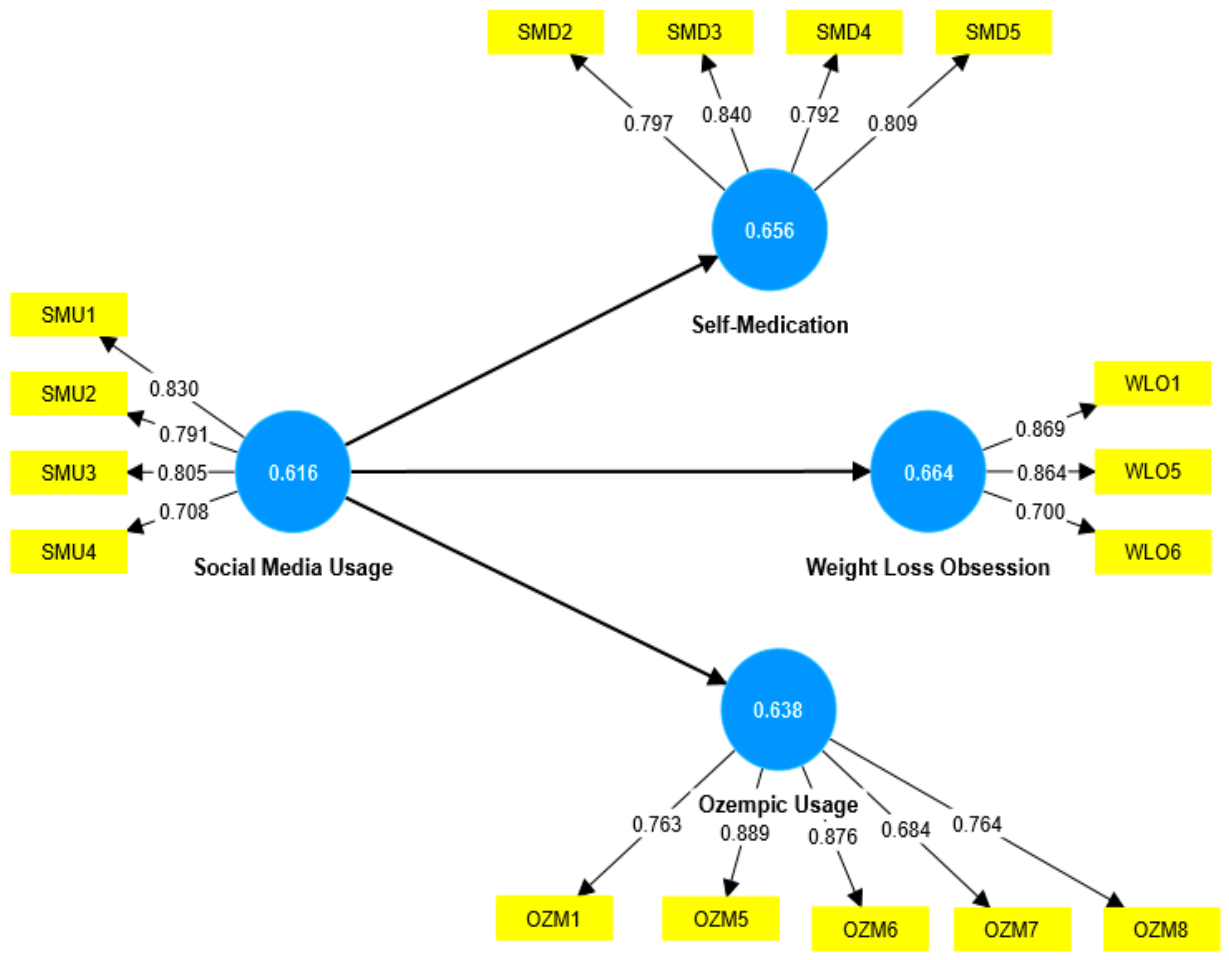
| Social Media Usage → Self-Medication | 0.456 | 0.000 |
| Social Media Usage → Weight Loss Obsession | 0.695 | 0.000 |
| Social Media Usage → Intention to Use Ozempic (semaglutide) | 0.567 | 0.000 |
| Path Coefficients | STDE | t Statistics | Confidence Intervals | Sign | ||
|---|---|---|---|---|---|---|
| 2.5% | 97.5% | |||||
| Social Media Usage → Self-Medication | 0.456 | 0.053 | 11.513 | 0.307 | 0.621 | 0.000 |
| Social Media Usage → Weight Loss Obsession | 0.695 | 0.054 | 10.424 | 0.564 | 0.824 | 0.000 |
| Social Media Usage → Intention to Use Ozempic (semaglutide) | 0.567 | 0.061 | 7.846 | 0.419 | 0.704 | 0.000 |
Disclaimer/Publisher’s Note: The statements, opinions and data contained in all publications are solely those of the individual author(s) and contributor(s) and not of MDPI and/or the editor(s). MDPI and/or the editor(s) disclaim responsibility for any injury to people or property resulting from any ideas, methods, instructions or products referred to in the content. |
© 2026 by the authors. Licensee MDPI, Basel, Switzerland. This article is an open access article distributed under the terms and conditions of the Creative Commons Attribution (CC BY) license.
Share and Cite
Jeljeli, R.; Farhi, F.; El-Dahiyat, F.; Alsbou, M.; Babar, Z.-U.-D. Influence of Social Media on Self-Medication Behavior: A Study on Ozempic Use Among Emirati University Students. Int. J. Environ. Res. Public Health 2026, 23, 638. https://doi.org/10.3390/ijerph23050638
Jeljeli R, Farhi F, El-Dahiyat F, Alsbou M, Babar Z-U-D. Influence of Social Media on Self-Medication Behavior: A Study on Ozempic Use Among Emirati University Students. International Journal of Environmental Research and Public Health. 2026; 23(5):638. https://doi.org/10.3390/ijerph23050638
Chicago/Turabian StyleJeljeli, Riadh, Faycal Farhi, Faris El-Dahiyat, Mohammed Alsbou, and Zaheer-Ud-Din Babar. 2026. "Influence of Social Media on Self-Medication Behavior: A Study on Ozempic Use Among Emirati University Students" International Journal of Environmental Research and Public Health 23, no. 5: 638. https://doi.org/10.3390/ijerph23050638
APA StyleJeljeli, R., Farhi, F., El-Dahiyat, F., Alsbou, M., & Babar, Z.-U.-D. (2026). Influence of Social Media on Self-Medication Behavior: A Study on Ozempic Use Among Emirati University Students. International Journal of Environmental Research and Public Health, 23(5), 638. https://doi.org/10.3390/ijerph23050638