Evolving Cancer Characteristics Among World Trade Center Survivors: An Updated Analysis from the WTC Environmental Health Center

 , , ,
, , ,
Highlights
- World Trade Center (WTC) survivors were exposed to complex mixtures of carcino genic environmental agents following the 9/11 disaster, representing a unique large-scale environmental health event.
- This study characterizes the evolving cancer burden in a diverse civilian population with WTC exposure, addressing an important gap beyond responder-focused research.
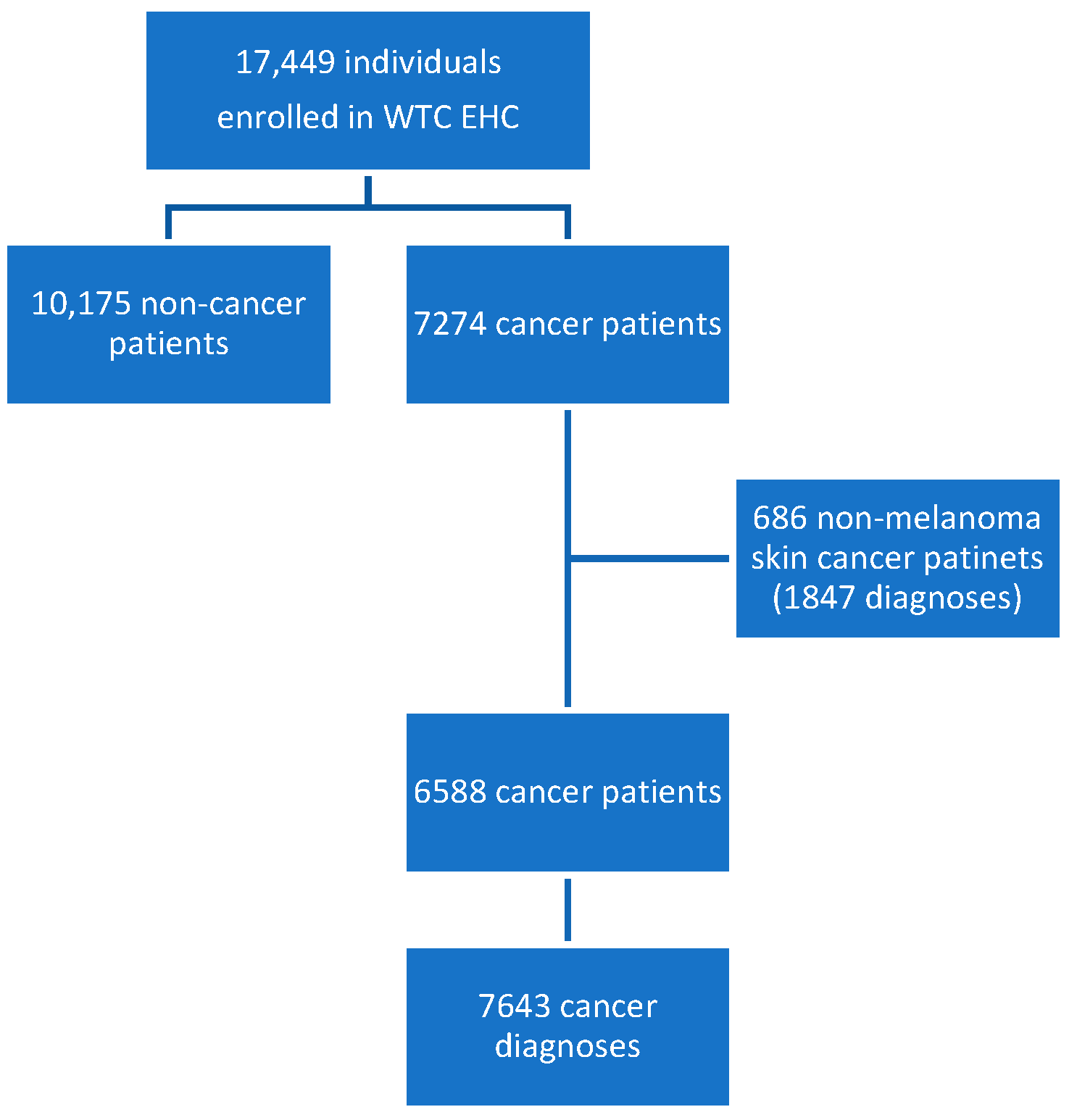
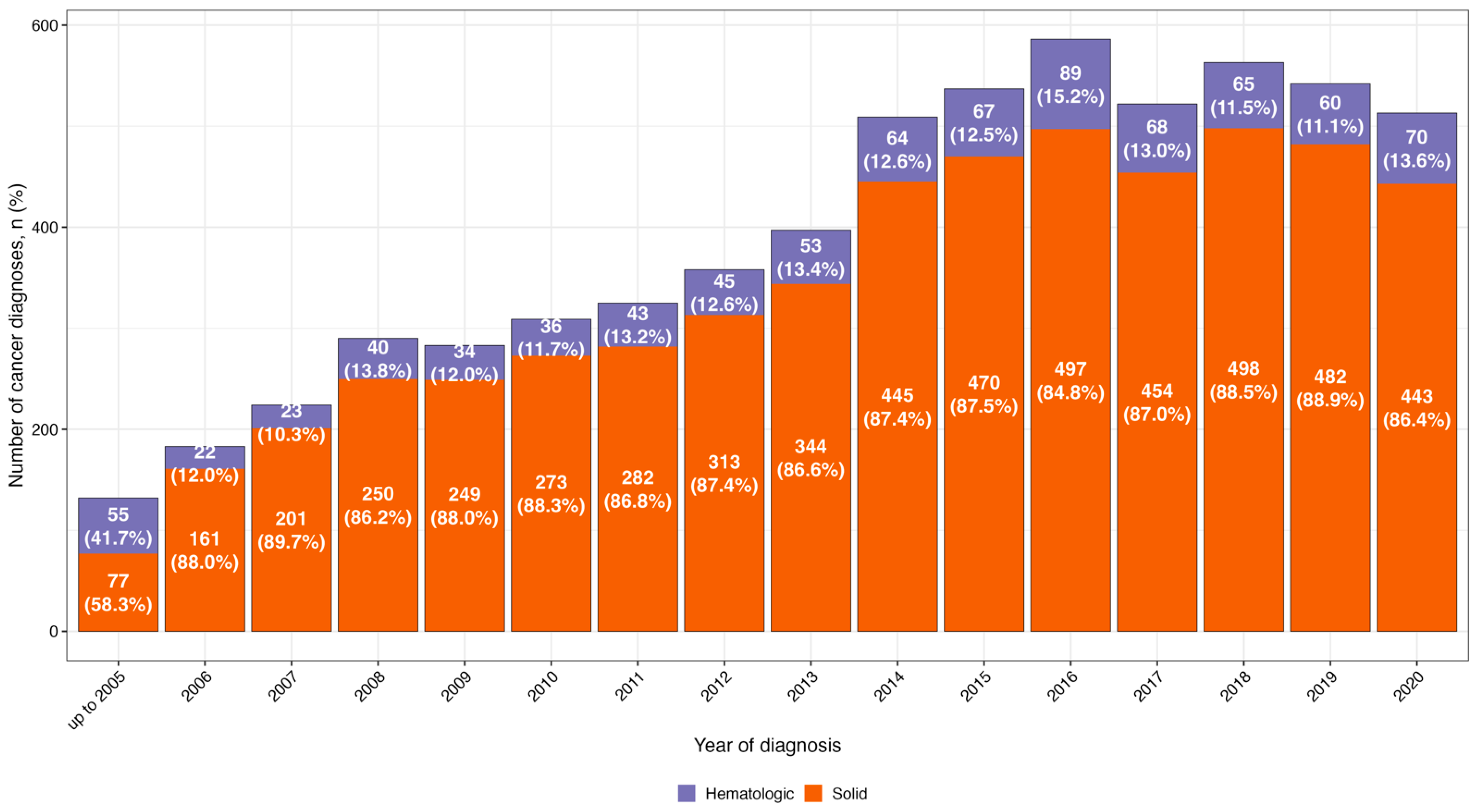
- The number of certified cancers among WTC survivors has increased 2.5-fold over the last five years, highlighting a major cancer burden 25 years after 9/11.
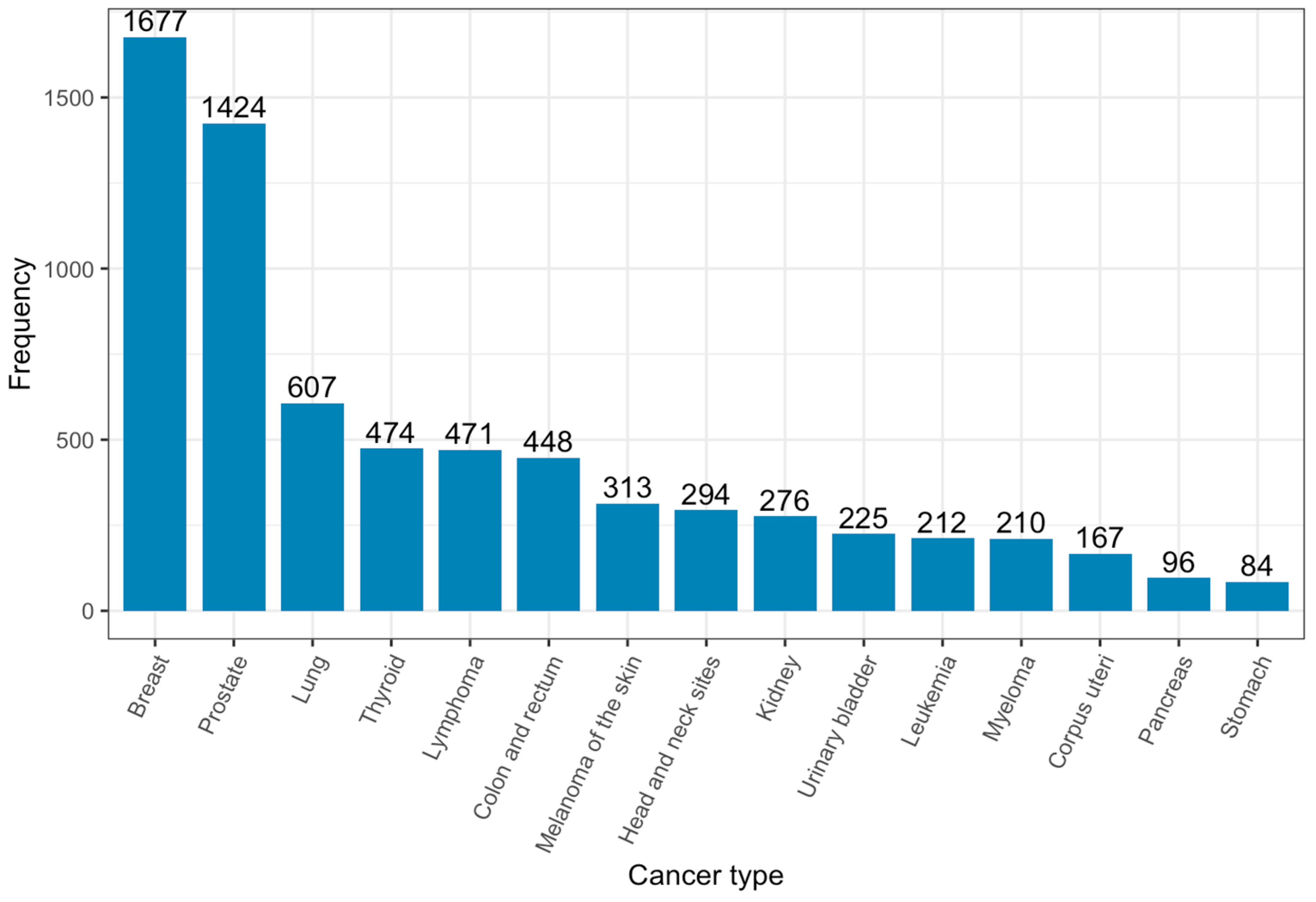
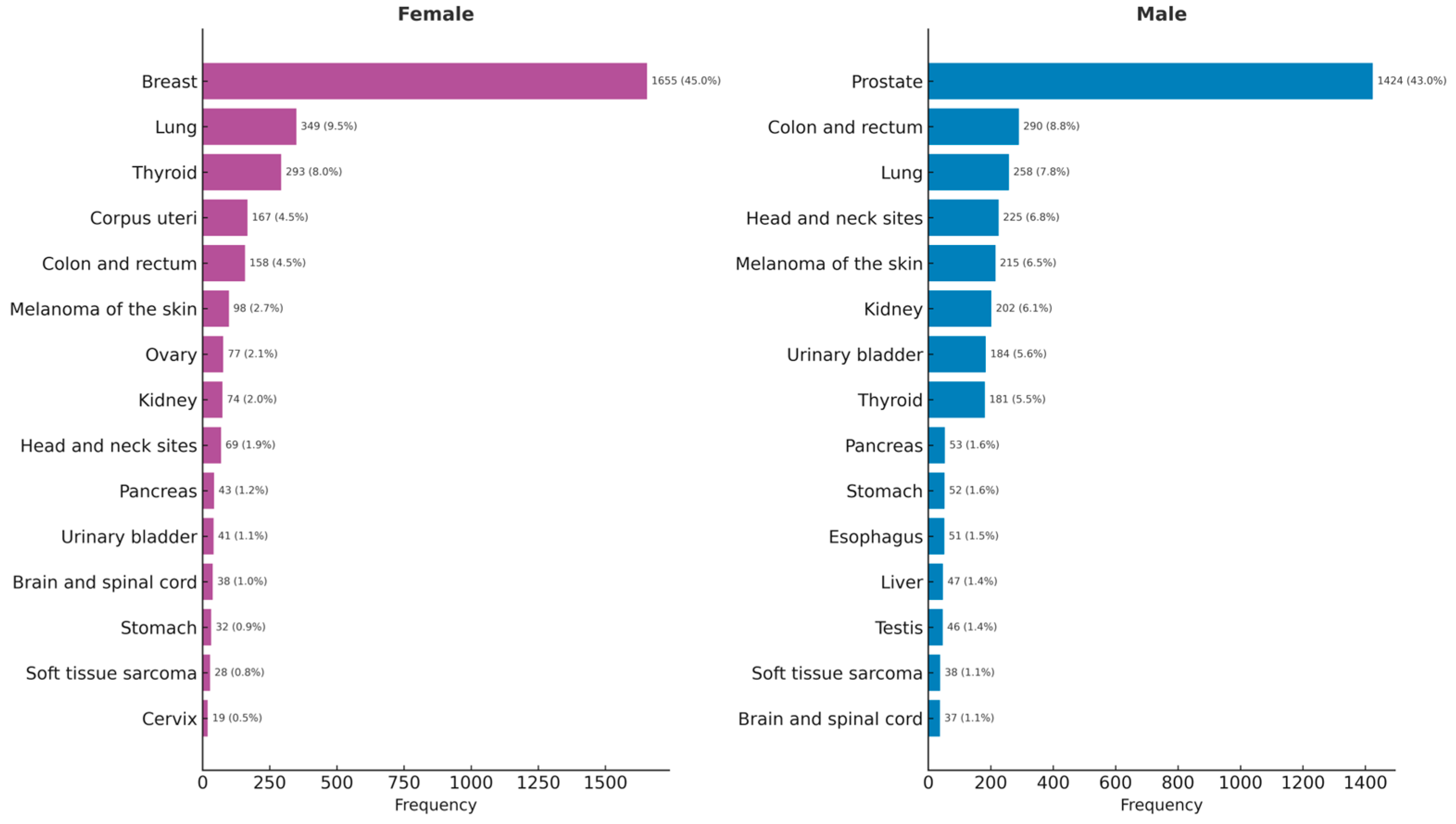
- Distinct cancer patterns, including elevated frequencies of melanoma of the skin and urinary bladder cancer, underscore the need to understand exposure-related and surveillance-related influences in this WTC affected urban civilian population.
- Evidence-based strategies for sustained surveillance and targeted cancer screening are essential for high-quality healthcare and research in an aging population exposed to environmental disasters.
- Study findings support the need for continued epidemiologic and mechanistic research to clarify exposure–cancer risk and outcomes relationships and inform future public health policy.
Abstract
1. Introduction
2. Materials and Methods
2.1. WTC EHC and Study Participants
2.2. Exposure Assessment
2.3. WTC Pan Cancer Database
2.4. Statistical Analysis
3. Results
3.1. Participants
3.2. Cancer Distribution
3.3. Distribution of Solid Cancer Diagnoses in Female and Male Patients
3.4. Age of Cancer and Latency from 11 September 2001
3.5. Distribution of Lymphoproliferative and Hematopoietic Malignancies
3.6. Cancer Multiplicity
4. Discussion
5. Conclusions
Supplementary Materials
Author Contributions
Funding
Institutional Review Board Statement
Informed Consent Statement
Data Availability Statement
Acknowledgments
Conflicts of Interest
References
- Landrigan, P.J.; Lioy, P.J.; Thurston, G.; Berkowitz, G.; Chen, L.C.; Chillrud, S.N.; Gavett, S.H.; Georgopoulos, P.G.; Geyh, A.S.; Levin, S.; et al. Health and environmental consequences of the World Trade Center disaster. Environ. Health Perspect. 2004, 112, 731–739. [Google Scholar] [CrossRef]
- Lioy, P.J.; Weisel, C.P.; Millette, J.R.; Eisenreich, S.; Vallero, D.; Offenberg, J.; Buckley, B.; Turpin, B.; Zhong, M.; Cohen, M.D. Characterization of the dust/smoke aerosol that settled east of the World Trade Center (WTC) in lower Manhattan after the collapse of the WTC 11 September 2001. Environ. Health Perspect. 2002, 110, 703–714. [Google Scholar] [CrossRef]
- Lippmann, M.; Cohen, M.D.; Chen, L.-C. Health effects of World Trade Center (WTC) Dust: An unprecedented disaster with inadequate risk management. Crit. Rev. Toxicol. 2015, 45, 492–530. [Google Scholar] [CrossRef]
- Reibman, J.; Liu, M.; Cheng, Q.; Liautaud, S.; Rogers, L.; Lau, S.; Berger, K.I.; Goldring, R.M.; Marmor, M.; Fernandez-Beros, M.E.; et al. Characteristics of a residential and working community with diverse exposure to World Trade Center dust, gas, and fumes. J. Occup. Environ. Med. 2009, 51, 534–541. [Google Scholar] [CrossRef] [PubMed]
- Reibman, J.; Levy-Carrick, N.; Miles, T.; Flynn, K.; Hughes, C.; Crane, M.; Lucchini, R.G. Destruction of the World Trade Center Towers. Lessons Learned from an Environmental Health Disaster. Ann. Am. Thorac. Soc. 2016, 13, 577–583. [Google Scholar] [CrossRef]
- Lin, S.; Reibman, J.; Bowers, J.A.; Hwang, S.A.; Hoerning, A.; Gomez, M.I.; Fitzgerald, E.F. Upper respiratory symptoms and other health effects among residents living near the World Trade Center site after September 11, 2001. Am. J. Epidemiol. 2005, 162, 499–507. [Google Scholar] [CrossRef]
- Reibman, J.; Lin, S.; Hwang, S.A.; Gulati, M.; Bowers, J.A.; Rogers, L.; Berger, K.I.; Hoerning, A.; Gomez, M.; Fitzgerald, E.F. The World Trade Center residents’ respiratory health study: New-onset respiratory symptoms and pulmonary function. Environ. Health Perspect. 2005, 113, 406–411. [Google Scholar] [CrossRef] [PubMed]
- Cohen, B.S.; Heikkinen, M.S.A.; Hazi, Y. Airborne Fine and Ultrafine Particles Near the World Trade Center Disaster Site. Aerosol Sci. Technol. 2004, 38, 338–348. [Google Scholar] [CrossRef]
- Horii, Y.; Jiang, Q.; Hanari, N.; Lam, P.K.; Yamashita, N.; Jansing, R.; Aldous, K.M.; Mauer, M.P.; Eadon, G.A.; Kannan, K. Polychlorinated dibenzo-p-dioxins, dibenzofurans, biphenyls, and naphthalenes in plasma of workers deployed at the World Trade Center after the collapse. Environ. Sci. Technol. 2010, 44, 5188–5194. [Google Scholar] [CrossRef] [PubMed]
- Litten, S.; McChesney, D.J.; Hamilton, M.C.; Fowler, B. Destruction of the World Trade Center and PCBs, PBDEs, PCDD/Fs, PBDD/Fs, and chlorinated biphenylenes in water, sediment, and sewage sludge. Environ. Sci. Technol. 2003, 37, 5502–5510. [Google Scholar] [CrossRef]
- McGee, J.K.; Chen, L.C.; Cohen, M.D.; Chee, G.R.; Prophete, C.M.; Haykal-Coates, N.; Wasson, S.J.; Conner, T.L.; Costa, D.L.; Gavett, S.H. Chemical analysis of World Trade Center fine particulate matter for use in toxicologic assessment. Environ. Health Perspect. 2003, 111, 972–980. [Google Scholar] [CrossRef] [PubMed]
- Offenberg, J.H.; Eisenreich, S.J.; Chen, L.C.; Cohen, M.D.; Chee, G.; Prophete, C.; Weisel, C.; Lioy, P.J. Persistent organic pollutants in the dusts that settled across lower Manhattan after September 11, 2001. Environ. Sci. Technol. 2003, 37, 502–508. [Google Scholar] [CrossRef]
- Olson, D.A.; Norris, G.A.; Landis, M.S.; Vette, A.F. Chemical Characterization of Ambient Particulate Matter near the World Trade Center: Elemental Carbon, Organic Carbon, and Mass Reconstruction. Environ. Sci. Technol. 2004, 38, 4465–4473. [Google Scholar] [CrossRef]
- Pleil, J.D.; Vette, A.F.; Johnson, B.A.; Rappaport, S.M. Air levels of carcinogenic polycyclic aromatic hydrocarbons after the World Trade Center disaster. Proc. Natl. Acad. Sci. USA 2004, 101, 11685–11688. [Google Scholar] [CrossRef]
- Rayne, S.; Ikonomou, M.G.; Butt, C.M.; Diamond, M.L.; Truong, J. Polychlorinated dioxins and furans from the World Trade Center attacks in exterior window films from lower Manhattan in New York City. Environ. Sci. Technol. 2005, 39, 1995–2003. [Google Scholar] [CrossRef]
- Rosati, J.A.; Bern, A.M.; Willis, R.D.; Blanchard, F.T.; Conner, T.L.; Kahn, H.D.; Friedman, D. Multi-laboratory testing of a screening method for world trade center (WTC) collapse dust. Sci. Total Environ. 2008, 390, 514–519. [Google Scholar] [CrossRef]
- Swartz, E.; Stockburger, L.; Vallero, D.A. Polycyclic aromatic hydrocarbons and other semivolatile organic compounds collected in New York City in response to the events of 9/11. Environ. Sci. Technol. 2003, 37, 3537–3546. [Google Scholar] [CrossRef]
- Yiin, L.M.; Millette, J.R.; Vette, A.; Ilacqua, V.; Quan, C.; Gorczynski, J.; Kendall, M.; Chen, L.C.; Weisel, C.P.; Buckley, B.; et al. Comparisons of the dust/smoke particulate that settled inside the surrounding buildings and outside on the streets of southern New York City after the collapse of the World Trade Center, September 11, 2001. J. Air Waste Manag. Assoc. 2004, 54, 515–528. [Google Scholar] [CrossRef]
- Koshy, T.T.; Attina, T.M.; Ghassabian, A.; Gilbert, J.; Burdine, L.K.; Marmor, M.; Honda, M.; Chu, D.B.; Han, X.; Shao, Y.; et al. Serum perfluoroalkyl substances and cardiometabolic consequences in adolescents exposed to the World Trade Center disaster and a matched comparison group. Environ. Int. 2017, 109, 128–135. [Google Scholar] [CrossRef] [PubMed]
- Liu, R.; Santiago-Colón, A.; Butturini, E.; Kubale, T.L.; Reibman, J. Characteristics of survivors enrolled in the World Trade Center Health Program. Arch. Environ. Occup. Health 2024, 79, 185–198. [Google Scholar] [CrossRef] [PubMed]
- Howard, J. Minimum Latency & Types or Categories of Cancer; Centers for Disease Control and Prevention: Atlanta, GA, USA, 2015. [Google Scholar]
- CDC. Covered Conditions. Available online: https://www.cdc.gov/wtc/conditions.html (accessed on 31 December 2025).
- Zeig-Owens, R.; Webber, M.P.; Hall, C.B.; Schwartz, T.; Jaber, N.; Weakley, J.; Rohan, T.E.; Cohen, H.W.; Derman, O.; Aldrich, T.K.; et al. Early assessment of cancer outcomes in New York City firefighters after the 9/11 attacks: An observational cohort study. Lancet 2011, 378, 898–905. [Google Scholar] [CrossRef] [PubMed]
- Solan, S.; Wallenstein, S.; Shapiro, M.; Teitelbaum, S.L.; Stevenson, L.; Kochman, A.; Kaplan, J.; Dellenbaugh, C.; Kahn, A.; Biro, F.N.; et al. Cancer incidence in world trade center rescue and recovery workers, 2001–2008. Environ. Health Perspect. 2013, 121, 699–704. [Google Scholar] [CrossRef]
- Li, J.; Cone, J.E.; Kahn, A.R.; Brackbill, R.M.; Farfel, M.R.; Greene, C.M.; Hadler, J.L.; Stayner, L.T.; Stellman, S.D. Association Between World Trade Center Exposure and Excess Cancer Risk. JAMA-J. Am. Med. Assoc. 2012, 308, 2479–2488. [Google Scholar] [CrossRef] [PubMed]
- Li, J.; Yung, J.; Qiao, B.; Takemoto, E.; Goldfarb, D.G.; Zeig-Owens, R.; Cone, J.E.; Brackbill, R.M.; Farfel, M.R.; Kahn, A.R.; et al. Cancer Incidence in World Trade Center Rescue and Recovery Workers: 14 Years of Follow-Up. J. Natl. Cancer Inst. 2022, 114, 210–219. [Google Scholar] [CrossRef]
- Boffetta, P.; Zeig-Owens, R.; Wallenstein, S.; Li, J.H.; Brackbill, R.; Cone, J.; Farfel, M.; Holden, W.; Lucchini, R.; Webber, M.P.; et al. Cancer in World Trade Center responders: Findings from multiple cohorts and options for future study. Am. J. Ind. Med. 2016, 59, 96–105. [Google Scholar] [CrossRef]
- Boffetta, P.; Hall, C.B.; Todd, A.C.; Goldfarb, D.G.; Schymura, M.J.; Li, J.; Cone, J.E.; Zeig-Owens, R. Cancer risk among World Trade Center rescue and recovery workers: A review. CA Cancer J. Clin. 2022, 72, 308–314. [Google Scholar] [CrossRef]
- Azofeifa, A.; Martin, G.R.; Santiago-Colón, A.; Reissman, D.B.; Howard, J. World Trade Center Health Program-United States, 2012–2020. MMWR Surveill. Summ. 2021, 70, 1–21. [Google Scholar] [CrossRef] [PubMed]
- van Gerwen, M.A.G.; Tuminello, S.; Riggins, G.J.; Mendes, T.B.; Donovan, M.; Benn, E.K.T.; Genden, E.; Cerutti, J.M.; Taioli, E. Molecular Study of Thyroid Cancer in World Trade Center Responders. Int. J. Environ. Res. Public Health 2019, 16, 1600. [Google Scholar] [CrossRef]
- Goldfarb, D.G.; Zeig-Owens, R.; Kristjansson, D.; Li, J.; Brackbill, R.M.; Farfel, M.R.; Cone, J.E.; Yung, J.; Kahn, A.R.; Qiao, B.; et al. Temporal association of prostate cancer incidence with World Trade Center rescue/recovery work. Occup. Environ. Med. 2021, 78, 699–706. [Google Scholar] [CrossRef]
- Hashim, D.; Boffetta, P.; Galsky, M.; Oh, W.; Lucchini, R.; Crane, M.; Luft, B.; Moline, J.; Udasin, I.; Harrison, D.; et al. Prostate cancer characteristics in the World Trade Center cohort, 2002–2013. Eur. J. Cancer Prev. 2018, 27, 347–354. [Google Scholar] [CrossRef]
- Clouston, S.A.P.; Meliker, J.; Mann, F.D.; Kuan, P.-F.; Yang, Y.; Trina, F.M.; Sampson, L.; Boffetta, P.; Edelman, N.H.; Luft, B.J. Lung Cancer Incidence After September 11, 2001, Among World Trade Center Responders. JAMA Netw. Open 2025, 8, e2536655. [Google Scholar] [CrossRef] [PubMed]
- Farfel, M.; DiGrande, L.; Brackbill, R.; Prann, A.; Cone, J.; Friedman, S.; Walker, D.J.; Pezeshki, G.; Thomas, P.; Galea, S.; et al. An overview of 9/11 experiences and respiratory and mental health conditions among World Trade Center Health Registry enrollees. J. Urban Health 2008, 85, 880–909. [Google Scholar] [CrossRef]
- Li, J.; Brackbill, R.M.; Liao, T.S.; Qiao, B.; Cone, J.E.; Farfel, M.R.; Hadler, J.L.; Kahn, A.R.; Konty, K.J.; Stayner, L.T.; et al. Ten-year cancer incidence in rescue/recovery workers and civilians exposed to the September 11, 2001 terrorist attacks on the World Trade Center. Am. J. Ind. Med. 2016, 59, 709–721. [Google Scholar] [CrossRef] [PubMed]
- Durmus, N.; Shao, Y.; Arslan, A.A.; Zhang, Y.; Pehlivan, S.; Fernandez-Beros, M.E.; Umana, L.; Corona, R.; Smyth-Giambanco, S.; Abbott, S.A.; et al. Characteristics of Cancer Patients in the World Trade Center Environmental Health Center. Int. J. Environ. Res. Public Health 2020, 17, 7190. [Google Scholar] [CrossRef]
- Shao, Y.; Durmus, N.; Zhang, Y.; Pehlivan, S.; Fernandez-Beros, M.E.; Umana, L.; Corona, R.; Addessi, A.; Abbott, S.A.; Smyth-Giambanco, S.; et al. The Development of a WTC Environmental Health Center Pan-Cancer Database. Int. J. Environ. Res. Public Health 2021, 18, 1646. [Google Scholar] [CrossRef]
- Durmus, N.; Pehlivan, S.; Zhang, Y.; Shao, Y.; Arslan, A.A.; Corona, R.; Henderson, I.; Sterman, D.H.; Reibman, J. Lung Cancer Characteristics in the World Trade Center Environmental Health Center. Int. J. Environ. Res. Public Health 2021, 18, 2689. [Google Scholar] [CrossRef] [PubMed]
- Arslan, A.A.; Zhang, Y.; Durmus, N.; Pehlivan, S.; Addessi, A.; Schnabel, F.; Shao, Y.; Reibman, J. Breast Cancer Characteristics in the Population of Survivors Participating in the World Trade Center Environmental Health Center Program 2002–2019. Int. J. Environ. Res. Public Health 2021, 18, 7555. [Google Scholar] [CrossRef] [PubMed]
- Yilmaz, M.E.; Rashidfarokhi, M.; Pollard, K.; Durmus, N.; Keserci, S.; Sterman, D.H.; Arslan, A.A.; Shao, Y.; Reibman, J. Mesothelioma Cases in the World Trade Center Survivors. Ann. Case Rep. 2024, 9, 10–29011. [Google Scholar] [CrossRef]
- Florsheim, R.L.; Zhang, Q.; Durmus, N.; Zhang, Y.; Pehlivan, S.; Arslan, A.A.; Shao, Y.; Reibman, J. Characteristics of Cancers in Community Members Exposed to the World Trade Center Disaster at a Young Age. Int. J. Environ. Res. Public Health 2022, 19, 15163. [Google Scholar] [CrossRef]
- WTC Health Program. Minimum Latency & Types or Categories of Cancer. Available online: https://www.cdc.gov/wtc/pdfs/policies/WTCHP-Minimum-Cancer-Latency-Policy-040925-508.pdf (accessed on 31 December 2025).
- Department of Health and Human Services. World Trade Center (WTC) Health Program; Addition of Uterine Cancer to the List of WTC-Related Health Conditions; Department of Health and Human Services: Washington, DC, USA, 2013. [Google Scholar]
- CDC. Regulations; Title 42, Part 88 of the Code of Federal Regulations (42 C.F.R. Part 88); Eligibility Criteria—WTC Survivors. Available online: https://www.cdc.gov/wtc/regulations2.html (accessed on 3 May 2026).
- Jack, A.; Percy, C.; Sobin, L.; Fritz, A.G.; Shanmugaratnam, K.; Parkin, D.M.; Whelan, S. International Classification of Diseases for Oncology ICD-O; WHO: Geneva, Switzerland, 2000. [Google Scholar]
- Boffetta, P.; Goldfarb, D.G.; Zeig-Owens, R.; Kristjansson, D.; Li, J.; Brackbill, R.M.; Farfel, M.R.; Cone, J.E.; Yung, J.; Kahn, A.R.; et al. Temporal Aspects of the Association between Exposure to the World Trade Center Disaster and Risk of Cutaneous Melanoma. JID Innov. 2022, 2, 100063. [Google Scholar] [CrossRef]
- Howlader, N.; Noone, A.M.; Krapcho, M.; Miller, D.; Brest, A.; Yu, M.; Ruhl, J.; Tatalovich, Z.; Mariotto, A.; Lewis, D.R.; et al. (Eds.) SEER Cancer Statistics Review, 1975–2018; National Cancer Institute: Bethesda, MD, USA, 2021. [Google Scholar]
- Shum, E.; Durmus, N.; Pehlivan, S.; Lu, Y.; Zhang, Y.; Arslan, A.A.; Shao, Y.; Reibman, J. Characteristics of Women with Lung Adenocarcinoma in the World Trade Center Environmental Health Center. Int. J. Environ. Res. Public Health 2022, 19, 7618. [Google Scholar] [CrossRef]
- Arslan, A.A.; Tuminello, S.; Yang, L.; Zhang, Y.; Durmus, N.; Snuderl, M.; Heguy, A.; Zeleniuch-Jacquotte, A.; Shao, Y.; Reibman, J. Genome-Wide DNA Methylation Profiles in Community Members Exposed to the World Trade Center Disaster. Int. J. Environ. Res. Public Health 2020, 17, 5493. [Google Scholar] [CrossRef]
- Tuminello, S.; Ashebir, Y.A.; Schroff, C.; Ramaswami, S.; Durmus, N.; Chen, Y.; Snuderl, M.; Shao, Y.; Reibman, J.; Arslan, A.A. Genome-wide DNA methylation profiles and breast cancer among World Trade Center survivors. Environ. Epidemiol. 2024, 8, e313. [Google Scholar] [CrossRef]
- Tuminello, S.; Durmus, N.; Snuderl, M.; Chen, Y.; Shao, Y.; Reibman, J.; Arslan, A.A.; Taioli, E. DNA Methylation as a Molecular Mechanism of Carcinogenesis in World Trade Center Dust Exposure: Insights from a Structured Literature Review. Biomolecules 2024, 14, 1302. [Google Scholar] [CrossRef]
- Tuminello, S.; Nguyen, E.; Durmus, N.; Alptekin, R.; Yilmaz, M.; Crisanti, M.C.; Snuderl, M.; Chen, Y.; Shao, Y.; Reibman, J.; et al. World Trade Center Exposure, DNA Methylation Changes, and Cancer: A Review of Current Evidence. Epigenomes 2023, 7, 31. [Google Scholar] [CrossRef]
- Tuminello, S.; Zhang, Y.; Yang, L.; Durmus, N.; Snuderl, M.; Heguy, A.; Zeleniuch-Jacquotte, A.; Chen, Y.; Shao, Y.; Reibman, J.; et al. Global DNA Methylation Profiles in Peripheral Blood of WTC-Exposed Community Members with Breast Cancer. Int. J. Environ. Res. Public Health 2022, 19, 5104. [Google Scholar] [CrossRef]
- Tuminello, S.; Ashebir, Y.A.; Schroff, C.; Ramaswami, S.; Durmus, N.; Chen, Y.; Snuderl, M.; Shao, Y.; Reibman, J.; Arslan, A.A. Epigenetic aging acceleration among World Trade Center-exposed community members. Sci. Rep. 2025, 15, 33942. [Google Scholar] [CrossRef] [PubMed]
- Gong, Y.; Wang, L.; Yu, H.; Alpert, N.; Cohen, M.D.; Prophete, C.; Horton, L.; Sisco, M.; Park, S.H.; Lee, H.W.; et al. Prostate Cancer in World Trade Center Responders Demonstrates Evidence of an Inflammatory Cascade. Mol. Cancer Res. 2019, 17, 1605–1612. [Google Scholar] [CrossRef] [PubMed]
- Yu, H.; Tuminello, S.; Alpert, N.; van Gerwen, M.; Yoo, S.; Mulholland, D.J.; Aaronson, S.A.; Donovan, M.; Oh, W.K.; Gong, Y.; et al. Global DNA methylation of WTC prostate cancer tissues show signature differences compared to non-exposed cases. Carcinogenesis 2022, 43, 528–537. [Google Scholar] [CrossRef]
- Jasra, S.; Giricz, O.; Zeig-Owens, R.; Pradhan, K.; Goldfarb, D.G.; Barreto-Galvez, A.; Silver, A.J.; Chen, J.; Sahu, S.; Gordon-Mitchell, S.; et al. High burden of clonal hematopoiesis in first responders exposed to the World Trade Center disaster. Nat. Med. 2022, 28, 468–471. [Google Scholar] [CrossRef] [PubMed]
- Wu, K.; Li, L.; Thakur, C.; Lu, Y.; Zhang, X.; Yi, Z.; Chen, F. Proteomic Characterization of the World Trade Center dust-activated mdig and c-myc signaling circuit linked to multiple myeloma. Sci. Rep. 2016, 6, 36305. [Google Scholar] [CrossRef] [PubMed]




| Level | Overall | Non-Cancer | Cancer | |
|---|---|---|---|---|
| n | 16,763 | 10,175 | 6588 | |
| Sex, n (%) | Female | 8425 (50.3) | 5295 (52.1) | 3130 (47.5) |
| Male | 8318 (49.7) | 4861 (47.9) | 3457 (52.5) | |
| Age on 9/11 (years) (median [range]) | 43.0 [0.0, 89.0] | 41.0 [0.0, 89.0] | 45.0 [0.0, 81.0] | |
| Race/Ethnicity (%) | Hispanic | 3222 (19.2) | 2498 (24.6) | 724 (11.0) |
| NH *-White | 6657 (39.8) | 3625 (35.7) | 3032 (46.0) | |
| NH *-Black | 3302 (19.7) | 2065 (20.3) | 1237 (18.8) | |
| Asian | 2314 (13.8) | 1435 (14.1) | 879 (13.3) | |
| Native American | 7 (0.0) | 5 (0.0) | 2 (0.0) | |
| Other/Unknown | 1237 (7.4) | 523 (5.2) | 714 (10.8) | |
| BMI **, n (%) | Normal weight (<25) | 2986 (30.7) | 1787 (31.1) | 1199 (30.2) |
| Overweight (25–30) | 3475 (35.8) | 2007 (34.9) | 1468 (37.0) | |
| Obese (≥30) | 3257 (33.5) | 1958 (34.0) | 1299 (32.8) | |
| Individual Income, n (%) | Equal or less than $30,000/year | 7075 (50.5) | 4522 (54.9) | 2553 (44.3) |
| More than $30,000/year | 6591 (47.1) | 3718 (45.1) | 2873 (49.9) | |
| Do not know/Refused | 331 (2.4) | 0 (0.0) | 331 (5.7) | |
| Education, n (%) | Equal or less than high school | 4403 (29.3) | 2830 (30.8) | 1573 (27.0) |
| More than high school | 10,628 (70.7) | 6367 (69.2) | 4261 (73.0) | |
| No Answer/Never Record/Refused | 7 (0.0) | 5 (0.1) | 2 (0.0) | |
| Exposure information | ||||
| Dust cloud exposure, n (%) | No | 7721 (48.2) | 4734 (47.0) | 2987 (50.3) |
| Yes | 8299 (51.8) | 5346 (53.0) | 2953 (49.7) | |
| Smoking status (%) | Current smoker | 1323 (8.2) | 1014 (10.0) | 309 (5.2) |
| Former smoker | 4537 (28.1) | 2639 (25.9) | 1898 (31.8) | |
| Never smoker | 10,137 (62.8) | 6421 (63.1) | 3716 (62.3) | |
| Unknown | 143 (0.9) | 101 (1.0) | 42 (0.7) | |
| Smoking pack year, n (%) | ≤5 p-y *** | 10,243 (71.8) | 6468 (75.1) | 3775 (66.8) |
| >5 p-y *** | 4014 (28.2) | 2140 (24.9) | 1874 (33.2) | |
| All (6983) | Male (3675) | Female (3308) | |||||||
|---|---|---|---|---|---|---|---|---|---|
| n (%) | Age at Diagnosis (Median [IQR]) | Latency Year (Median [IQR]) | n (%) | Age at Diagnosis (Median [IQR]) | Latency Year (Median [IQR]) | n (%) | Age at Diagnosis (Median [IQR]) | Latency Year (Median [IQR]) | |
| Breast | 1677 (24.0) | 56.8 [49.3, 64.7] | 14.4 [10.2, 17.8] | 22 (0.6) | 63.6 [52.6, 66.6] | 15.8 [10.0, 16.6] | 1655 (50.0) | 56.7 [49.2, 64.6] | 14.4 [10.2, 17.8] |
| Prostate | 1424 (20.4) | 63.4 [58.1, 69.1] | 15.0 [10.8, 18.5] | 1424 (38.7) | 63.4 [58.1, 69.1] | 15.0 [10.8, 18.5] | - | - | - |
| Lung | 607 (8.7) | 65.9 [59.6, 72.1] | 16.1 [12.8, 19.1] | 258 (7.0) | 66.9 [61.5, 73.1] | 16.0 [12.8, 19.1] | 349 (10.6) | 64.8 [58.4, 71.3] | 16.1 [12.9, 19.0] |
| Thyroid | 474 (6.8) | 52.2 [44.5, 60.4] | 13.4 [8.8, 16.9] | 181 (4.9) | 53.0 [45.3, 61.9] | 13.6 [8.5, 17.0] | 293 (8.9) | 51.5 [43.1, 58.6] | 13.2 [8.9, 16.8] |
| Lymphoma | 471 (6.7) | 58.4 [49.7, 66.2] | 13.8 [9.0, 17.1] | 302 (8.2) | 58.0 [49.5, 66.1] | 13.8 [8.7, 17.1] | 169 (5.1) | 59.5 [50.0, 66.2] | 13.8 [9.3, 17.3] |
| Colon and rectum | 448 (6.4) | 59.9 [52.2, 68.4] | 15.1 [11.8, 18.5] | 290 (7.9) | 59.7 [52.0, 68.5] | 15.6 [12.3, 18.8] | 158 (4.8) | 60.2 [52.6, 68.3] | 14.6 [10.9, 18.1] |
| Melanoma of the skin | 313 (4.5) | 62.2 [52.7, 70.6] | 14.3 [10.0, 18.3] | 215 (5.9) | 63.5 [54.4, 70.9] | 14.2 [10.3, 17.8] | 98 (3.0) | 59.3 [47.0, 69.4] | 14.6 [9.3, 18.8] |
| Head and neck sites | 294 (4.2) | 59.5 [52.3, 66.6] | 14.0 [10.3, 17.7] | 225 (6.1) | 59.5 [52.8, 67.3] | 14.1 [9.8, 17.8] | 69 (2.1) | 59.5 [51.5, 64.4] | 13.6 [11.3, 16.8] |
| Kidney | 276 (4.0) | 60.6 [51.2, 67.9] | 15.2 [11.5, 18.5] | 202 (5.5) | 61.0 [52.3, 67.9] | 15.1 [11.5, 18.5] | 74 (2.2) | 59.2 [46.8, 67.8] | 15.5 [10.7, 18.5] |
| Urinary bladder | 225 (3.2) | 65.9 [59.1, 71.3] | 15.1 [11.0, 18.0] | 184 (5.0) | 65.7 [59.3, 70.7] | 15.1 [10.8, 18.0] | 41 (1.2) | 66.3 [56.8, 74.7] | 14.4 [11.8, 17.9] |
| Leukemia | 212 (3.0) | 61.4 [51.3, 67.6] | 13.9 [9.9, 16.8] | 142 (3.9) | 61.3 [51.3, 66.9] | 12.9 [9.6, 16.0] | 70 (2.1) | 61.6 [52.1, 68.1] | 15.9 [12.5, 18.8] |
| Myeloma | 210 (3.0) | 61.2 [54.8, 67.6] | 15.4 [12.2, 18.4] | 122 (3.3) | 61.8 [56.4, 68.1] | 15.3 [11.7, 18.3] | 88 (2.7) | 60.2 [51.1, 67.0] | 15.7 [12.5, 18.4] |
| Corpus uteri | 167 (2.4) | 60.8 [55.2, 66.5] | 15.3 [11.4, 18.9] | - | - | - | 167 (5.0) | 60.8 [55.2, 66.5] | 15.3 [11.4, 18.9] |
| Pancreas | 96 (1.4) | 63.2 [54.8, 70.8] | 16.2 [12.6, 19.1] | 53 (1.4) | 66.6 [55.6, 72.6] | 16.6 [12.6, 19.6] | 43 (1.3) | 60.3 [51.1, 67.2] | 16.1 [13.2, 18.5] |
| Stomach | 84 (1.2) | 58.9 [53.0, 66.8] | 14.3 [11.8, 16.9] | 52 (1.4) | 58.0 [52.6, 65.7] | 13.9 [11.7, 16.1] | 32 (1.0) | 59.6 [54.1, 68.8] | 14.8 [11.9, 20.2] |
| Year 2024 | Year 2019 | |||
|---|---|---|---|---|
| Number of Cancers | n | % | n | % |
| 1 | 5644 | 85.7 | 2256 | 86.9 |
| 2 | 842 | 12.8 | 299 | 11.7 |
| 3 or more | 102 | 1.5 | 36 | 1.4 |
| Total | 6588 | 100 | 2561 | 100 |
| Sex * | Age at First Diagnosis * | Smoking * | Overall | ||||
|---|---|---|---|---|---|---|---|
| Number of Cancers | Female | Male | <50 | >=50 | Ever Smoker | Never Smoker | All Patients |
| 1 | 2699 (86.2%) | 2944 (85.2%) | 1173 (87.7%) | 4416 (85.0%) | 1831 (83.0%) | 3257 (87.6%) | 5644 (85.7%) |
| 2 | 382 (12.2%) | 460 (13.3%) | 152 (11.4%) | 688 (13.2%) | 332 (15.0%) | 416 (11.2%) | 842 (12.8%) |
| 3 or more | 49 (1.6%) | 53 (1.5%) | 12 (0.9%) | 90 (1.7%) | 44 (2.0%) | 43 (1.2%) | 102 (1.5%) |
| Total patients | 3130 | 3457 | 1337 | 5194 | 2207 | 3716 | 6588 |
Disclaimer/Publisher’s Note: The statements, opinions and data contained in all publications are solely those of the individual author(s) and contributor(s) and not of MDPI and/or the editor(s). MDPI and/or the editor(s) disclaim responsibility for any injury to people or property resulting from any ideas, methods, instructions or products referred to in the content. |
© 2026 by the authors. Licensee MDPI, Basel, Switzerland. This article is an open access article distributed under the terms and conditions of the Creative Commons Attribution (CC BY) license.
Share and Cite
Durmus, N.; Wang, Z.; Arslan, A.A.; Goren, E.; Alptekin, R.; Lou, Y.; Shao, A.; Athar, N.; Ashebir, Y.A.; Shi, Y.; et al. Evolving Cancer Characteristics Among World Trade Center Survivors: An Updated Analysis from the WTC Environmental Health Center. Int. J. Environ. Res. Public Health 2026, 23, 625. https://doi.org/10.3390/ijerph23050625
Durmus N, Wang Z, Arslan AA, Goren E, Alptekin R, Lou Y, Shao A, Athar N, Ashebir YA, Shi Y, et al. Evolving Cancer Characteristics Among World Trade Center Survivors: An Updated Analysis from the WTC Environmental Health Center. International Journal of Environmental Research and Public Health. 2026; 23(5):625. https://doi.org/10.3390/ijerph23050625
Chicago/Turabian StyleDurmus, Nedim, Ziyue Wang, Alan A. Arslan, Emre Goren, Ramazan Alptekin, Yujia Lou, Andrew Shao, Nida Athar, Yibeltal A. Ashebir, Yidan Shi, and et al. 2026. "Evolving Cancer Characteristics Among World Trade Center Survivors: An Updated Analysis from the WTC Environmental Health Center" International Journal of Environmental Research and Public Health 23, no. 5: 625. https://doi.org/10.3390/ijerph23050625
APA StyleDurmus, N., Wang, Z., Arslan, A. A., Goren, E., Alptekin, R., Lou, Y., Shao, A., Athar, N., Ashebir, Y. A., Shi, Y., Wilson, L., Reibman, J., & Shao, Y. (2026). Evolving Cancer Characteristics Among World Trade Center Survivors: An Updated Analysis from the WTC Environmental Health Center. International Journal of Environmental Research and Public Health, 23(5), 625. https://doi.org/10.3390/ijerph23050625