


Highlights
Public health relevance—How does this work relate to a public health issue?
- Virtual maternity care is increasingly used worldwide to improve access, efficiency, and continuity of antenatal services, making women’s experiences a critical public health concern.
- Understanding how virtual care shapes perceived safety, engagement, and equity is essential as health systems scale digital models beyond pandemic contexts.
Public health significance—Why is this work of significance to public health?
- This metasynthesis provides a conceptually rich synthesis of women’s experiences, identifying relational continuity, technological reliability, and hybrid care as central to safe and acceptable virtual maternity services.
- The findings highlight how poorly designed virtual models risk exacerbating existing health inequities, particularly for women experiencing digital exclusion or psychosocial vulnerability.
Public health implications—What are the key implications or messages for practitioners, policy makers and/or researchers in public health?
- Public health strategies should prioritise hybrid models of maternity care that integrate virtual services with relationship-based, in-person support to promote safety, equity, and engagement.
- Policy and research must explicitly address digital inclusion, workforce capability, and relational care to ensure virtual maternity care strengthens rather than fragments public health systems.
Abstract
The adoption of Virtual Maternity Care (VMC) in antenatal settings is increasing, propelled by technological advancements that facilitate remote communication and telemonitoring. A spectrum of care models exists globally, ranging from fully virtual to hybrid approaches. This review seeks to synthesise the qualitative evidence on women’s experiences of antenatal VMC in high-income countries, developing a conceptually rich understanding of factors that facilitate or hinder engagement and perceived safety. In June 2025, four databases were searched for peer-reviewed literature published in English between January 2010 and June 2025. After screening for quality and eligibility, 21 articles were included. Four core themes were identified: Virtual Care Worked Well, Seeking Good Connections, Empowerment and Safety Through Virtual Care Monitoring, and Feeling Disconnected and Unsafe. Women described feeling empowered through active participation and shared responsibility in their care (Empowerment and Safety Through Virtual Care Monitoring), particularly when relational care and continuity were present (Seeking Good Connections). Flexibility, convenience, and access to daily telehealth and reliable technologies were highly valued (Virtual Care Worked Well). Hybrid models were generally preferred; in contrast, exclusively remote models sometimes inhibited quality care and heightened feelings of insecurity (Feeling Disconnected and Unsafe), particularly for women with previous pregnancy loss, experiences of intimate partner violence, mental health concerns, or those facing language barriers, digital poverty, financial hardship, or low health literacy. In conclusion, women’s perspectives underscore priorities for designing and scaling high-quality, accessible virtual midwifery care: relational continuity, technological reliability, flexible delivery, and hybrid models integrating virtual and in-person care.
1. Introduction
The use of Virtual Maternity Care (VMC) in antenatal settings is expanding rapidly worldwide, driven by innovations in technology that support remote communication and telemonitoring. The implementation of VMC in antenatal settings has evolved into a spectrum of models that reflect varying degrees of virtual engagement. At one end of this spectrum are fully virtual models, where antenatal care is delivered exclusively through telehealth platforms [1]. These models rely on phone or video consultations and may include remote monitoring technologies, allowing some or all routine antenatal visits to be conducted virtually. Such approaches are particularly beneficial for women who face barriers to accessing in-person care, whether due to geography, mobility, or personal circumstances [2]. In contrast, hybrid models blend virtual and face-to-face care [3,4]. These models typically involve scheduled in-person visits, either at home, in clinics, or hospital settings, complemented by virtual consultations. The hybrid approach aims to maintain clinical safety while offering flexibility and convenience, often reserving in-person care for physical assessments or when complex clinical needs arise [5].
Within both fully virtual and hybrid models, remote monitoring plays a central role. Two distinct forms of monitoring are commonly used: remote self-monitoring and telemonitoring. Remote self-monitoring requires women to use home-based equipment to track specific clinical parameters such as blood pressure, heart rate, temperature, and glucose levels. These measurements are then shared with care providers, either during live consultations or through asynchronous communication channels such as secure messaging or smart application uploads [6]. Telemonitoring involves the use of integrated digital systems that automatically transmit clinical data to healthcare providers. This method enables continuous or scheduled monitoring of maternal and fetal health indicators, including blood pressure, glucose levels, maternal heart rate, fetal heart rate patterns, and uterine activity. The seamless transmission of data supports timely clinical decision-making and enhances the responsiveness of care [7].
The implementation of antenatal VMC varies globally, shaped by differing health system structures, policies, and technological capacities. During the COVID-19 pandemic, many virtual healthcare models were rapidly introduced in response to social distancing requirements and heightened infection control measures [8]. There is value in examining the impact of these models on women’s experiences, particularly for health organisations seeking to develop and implement sustainable antenatal VMC. While existing reviews have examined the uptake, effectiveness, and clinical outcomes of digital or virtual antenatal care, these have predominantly focused on feasibility, implementation, and service-level outcomes rather than synthesising women’s lived experiences across models of care [9]. At the time of the review, no published metasyntheses could be identified that consolidated qualitative literature on women’s experiences of antenatal VMC.
The aim of this metasynthesis was to interpret and synthesise qualitative evidence on women’s experiences of virtual maternity care in high-income countries to develop a conceptually rich understanding of the factors that facilitate or hinder engagement and perceived safety.
In this manuscript, “virtual maternity care” (VMC) is used as an umbrella term to describe digitally mediated models of antenatal care, encompassing telehealth consultations, remote self-monitoring, and telemonitoring systems. Where possible, more specific terms are used to reflect the modality being discussed.
2. Methodology
This study was theoretically grounded in an interpretivist perspective, recognising that meaning is constructed through context and interpretation, rather than being reducible to isolated findings. A qualitative synthesis of the literature was conducted using the meta-ethnography approach developed by Noblit and Hare [10]. This method has been widely applied to synthesise qualitative research in maternity care [11,12] and across other health disciplines [13], supporting the development of high-quality evidence to inform healthcare interventions and models of care. To support conceptual transferability within comparable care contexts, the synthesis focused on high-income health systems with similar digital infrastructure and maternity service organisation, while recognising this as a limitation for global generalisation.
2.1. Reporting Standards
This systematic review and qualitative metasynthesis was conducted and reported in accordance with the Preferred Reporting Items for Systematic Reviews and Meta-Analyses (PRISMA) 2020 guidelines [14]. The PRISMA 2020 checklist is provided in Supplementary File S1. The review protocol was not prospectively registered, as protocol registration is not mandatory for qualitative metasyntheses and the review adopted an iterative, inductive analytic approach; to support transparency, all methodological decisions are reported in full.
2.2. Search Strategy
The literature search was conducted in June 2025 by two authors, OA and JG, with support from an expert university librarian. Peer-reviewed literature published in English between 1 January 2010, and 3 June 2025 was sought. The aim was to identify studies that provided qualitative data from women who had experienced virtual maternity care in high income countries. Medline, EMBASE, CINAHL and Scopus databases were searched, using key terms grouped under four main headings including ‘virtual’, ‘maternity care’, ‘experience’ and ‘women/pregnant people’. The full electronic search strategies, including all search terms and combinations used for each database, are provided in Supplementary File S2.
2.3. Inclusion and Exclusion Criteria
Studies published in English that reported qualitative findings on women’s experiences of VMC during pregnancy were included. Studies conducted in low- and middle-income countries (LMICs) were excluded, not due to a lack of relevance or importance, but to support conceptual coherence and analytic depth within the meta-ethnographic synthesis. Virtual maternity care is shaped by health-system infrastructure, digital connectivity, workforce configuration, and models of antenatal service delivery, which differ markedly across economic and policy contexts. Meta-ethnography requires comparison across studies with sufficient contextual similarity to allow meaningful translation of concepts; combining LMIC and high-income country studies risked masking structurally driven differences and producing over-generalised interpretations. Focusing on high-income settings therefore enabled more rigorous conceptual synthesis, while recognising that women’s experiences of virtual maternity care in LMIC contexts warrant dedicated, context-specific synthesis in future research. Studies focusing on the perspectives of healthcare professionals or women’s family members were also excluded, as the aim of this synthesis was to centre the voices and experiences of women themselves.
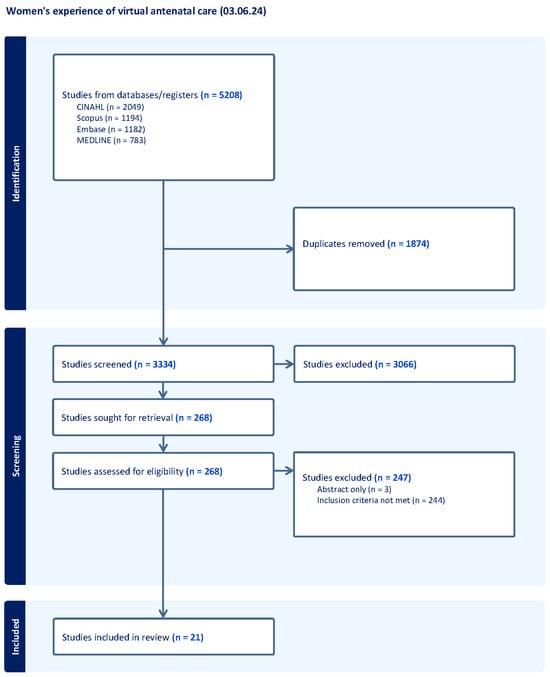
The initial database search revealed 5208 studies. Covidence systematic review software (2025) [15] was utilised to store the search records and manage the collaborative screening process across the co-authorship team. After duplicates were removed, 3334 studies were screened for eligibility based on the criteria listed above, resulting in 268 studies for abstract and full-text review. This process was conducted by seven authors with 247 articles excluded. Study quality was independently assessed by two reviewers using the Critical Appraisal Skills Programme (CASP) qualitative checklist, with discrepancies resolved through discussion. All 21 studies were retained. The Preferred Reporting Items for Systematic Reviews and Meta-Analyses (PRISMA) guidelines informed the process of reporting the search strategy [14]. Figure 1 outlines the search strategy using the PRISMA diagram.
Figure 1.
PRISMA 2020 flow diagram illustrating the study selection process. The diagram was generated using Covidence systematic review software.
2.4. Data Characteristics
Table 1 summarises the characteristics of the 21 included studies, detailing their method, design, setting, participant numbers, and application of virtual maternity care. This table supported the translation of concepts across studies and provided context for the synthesis of women’s experiences and concepts raised in the authors analyse.
The total of 21 included studies represented the perspectives of 369 women who had experienced VMC during pregnancy. Fourteen were qualitative studies, and seven were mixed methods studies from which only the qualitative findings were extracted. Seven studies were conducted in the United States (US) [16,17,18,19,20,21,22], six in the United Kingdom [5,23,24,25,26,27], four in Scandinavia [7,28,29,30], two in The Netherlands [31,32] and two in Australia [4,33]. One study collected data across both Northern Ireland and the Republic of Ireland [23].
Each study contained its own terminology for discussing the various applications of VMC, many terms are used interchangeably. Table 2 Glossary provides a list of definitions that have been adopted for this project.
The studies included in this review applied VMC in various ways within antenatal outpatient settings (clinical visits via telehealth throughout pregnancy) or antenatal inpatient/Hospital at Home settings (monitoring of pregnancy complications as an alternative to admission to hospital). Table 3 provides details of the different settings described.
Table 1.
Characteristics of included studies.
Table 2.
Glossary.
Table 3.
Variations in VMC Provision.
2.5. Data Synthesis
Data were extracted from the 21 studies and analysed using seven-phase meta-ethnography approach of [10]. Three members of the author team independently read and re-read each study to enable deep immersion in the data and identify key first-order (participant accounts) and second-order (author interpretations) constructs. Studies were then examined comparatively to determine how their key concepts and themes related to one another, including identifying recurring metaphors, patterns, and interpretive constructs across the dataset.
Reflexive discussions were held across the multidisciplinary author team to challenge assumptions, compare interpretations, and ensure that no single study or disciplinary perspective disproportionately shaped the synthesis. Where differences in interpretation arose, these were resolved through return to the original study texts, explicit comparison of alternative interpretations, and assessment of conceptual fit across studies, rather than by consensus alone. The author team’s professional backgrounds, primarily in midwifery, maternity care, and maternal and child health, alongside one obstetrician, informed sensitivity to relational care, safety, and equity, while reflexive dialogue was used to critically examine how these professional lenses influenced analytic decisions.
Through a process of reciprocal translation, concepts from each study were compared and reinterpreted in the context of others, preserving their original meanings while enabling cross-study integration. Translated concepts were synthesised to generate high-order interpretations by reinforcing shared understandings (reciprocal synthesis), highlighting contradictions (refutational synthesis), or constructing a broader interpretive framework (line-of-argument synthesis). This process produced a coherent conceptual narrative that extends beyond individual studies, offering a deeper understanding of how pregnant women experience VMC models of antenatal care.
3. Results
Following quality appraisal using the Critical Appraisal Skills Programme (CASP) qualitative checklist, all 21 included studies were judged to demonstrate sufficient methodological rigour to contribute meaningfully to the interpretive synthesis and were retained for analysis.
The synthesis of qualitative studies found that women’s experiences with virtual maternity care are complex, shaped by service design and delivery. Four main themes were synthesised from the authors’ analyses and participant data included in the papers: ‘Virtual Care Worked Well’, ‘Seeking Good Connections’, ‘Empowerment and Safety Through Virtual Care Monitoring’, and ‘Feeling Disconnected and Unsafe: When Virtual Care Failed to Support’.
These findings highlight both the benefits and the risks of virtual maternity models, which are explored in detail below.
3.1. Virtual Care Worked Well
The first theme, ‘Virtual Care Worked Well’, captures how many women experienced virtual maternity care as positive and beneficial for themselves and their families [4,5,18,19,22,23,25,26,29,33]. Across studies, women framed virtual care as enabling not simply because it replaced in-person visits, but because it reduced the practical and emotional labour associated with accessing antenatal services. Convenience and flexibility were the dominant qualities underpinning these positive experiences.
Virtual care was consistently valued for minimising time and effort, allowing women to integrate pregnancy care more easily into daily life [4,18,19,23,26,33]. Avoiding travel, time away from work, and waiting rooms offered a sense of freedom and control over how care was accessed. As one participant described, virtual appointments were simply, “quick, easy, fast” [17] (p. 643), while another reflected that “the days when I don’t have to go to the hospital. I have a little more freedom” [29] (Catherin, p. 7). Technologies that were intuitive and reliable further supported these experiences, particularly cellular-enabled devices that did not rely on home internet access and could be used, “I was able to take it everywhere with me” [20] (p. 1195).
Flexibility emerged as a key enabler of access, particularly for women balancing paid work, family responsibilities, and health needs [4,5,17,19,22,25,29,30,33]. The ability to schedule appointments around other commitments, attend consultations during work hours, or switch between video and telephone modalities reduced missed visits and increased engagement with care. For some women, this flexibility was critical to participation, as one Hispanic/LatinX participant explained, “There are moms that sometimes don’t have the possibility to go… and they can ask permission at work to make a phone call and they tell them, ‘of course’” [17] (p. 651).
The cumulative effect of convenience and flexibility translated into tangible savings in time, money, and energy [19,22,23,25,28,29,33]. Women described reduced travel costs, less reliance on childcare, and fewer disruptions to employment, making antenatal care feel more sustainable over the course of pregnancy. As one woman noted, “Honestly, I probably would opt for virtual care, just because I mean, gas prices are going up” [19] (p. 3). Beyond individual benefits, these efficiencies extended to partners and families, reducing disruption to routines and supporting overall wellbeing [7,29,32].
Virtual care was also associated with enhanced perceptions of safety, particularly during the COVID-19 pandemic, when women sought to minimise exposure to infection in clinical settings [4,27]. Remaining at home provided both physical and psychological reassurance, with one participant describing telemedicine as offering “a security… I can stay at home with my own germs” [7] (Participant 14, p. 4). Psychological safety was also important, with women reporting greater ease discussing sensitive issues in familiar surroundings [22,29]. For some accessing perinatal mental health support, telephone consultations were preferred over video, offering a sense of privacy and emotional comfort: “I found it easy to speak to her [the psychologist] over the phone… freedom to speak freely without feeling judged” [26] (Participant 1, p. 7).
3.2. Seeking Good Connections
The second theme, ‘Seeking Good Connections’, describes how important it was for women to experience a sense of connection when accessing care virtually [4,5,16,18,21,22,23,24,26,27,32,33]. Firstly, this included the woman’s ability to confidently use the technology. In-person training played a vital role in building this confidence, helping women understand how to operate, manage, and troubleshoot devices [4,27,29,32]. Face-to-face instruction allowed women to ask questions and feel assured in their ability to use the equipment correctly: “When they first gave me the kit to do it at home, we spent quite a while going through how to put the cuff on, so I feel very confident that I’m doing it correctly” [27] (Participant 15, p. 10). Trust in the technology itself was also crucial. Women valued accurate and reliable devices, which enhanced their sense of safety and engagement with care. “I find it quite reassuring… I’ve found it quite a positive experience and I think it is quite good” [25] (Participant S12). In contrast, unreliable equipment undermined confidence: “If the machine [cellular blood pressure cuff] was accurate, then I would feel more comfortable taking readings, but I stopped using it because it wasn’t accurate” [21] (Participant, p. 161).
Beyond technological reliability, feeling personally connected to the healthcare team was central to women’s sense of safety and trust in virtual care. Several constructs were important here, beginning with the understanding that pregnancy was viewed by women as a deeply personal, meaningful, and unique life event [4,18,32]. Therefore, virtual care models that supported continuity and fostered relationships were preferred [4,5,27,32]. Continuity of care frameworks enhanced satisfaction and trust, particularly when women had ongoing relationships with known caregivers [5,29,30,33]: “It felt very safe… They know who I am, they have my journal… The whole bit can be a stress otherwise” [30] (Woman no 7, p. 4). Frequent, responsive communication further strengthened trust in the care team: “I really appreciated the daily phone calls… the midwife functioned as a sympathising listener… They were really helpful” [32] (TM01, p. 6). In virtual care settings, personalised and relational approaches helped women feel seen, heard, and entitled to care, particularly important for those navigating complex or marginalised circumstances [4,24,28]. Similarly, the negotiation of candidacy that occurs between women, their caregivers and the healthcare system throughout the remote care process, enabled women to feel equally involved in navigating their pregnancy care [24].
3.3. Empowerment and Safety Through Virtual Care Monitoring
When virtual care was tailored to women’s individual needs, supported by trusted clinicians, and enabled meaningful engagement with health data, it fostered a sense of safety, autonomy, and control [21,23,27,29,31,32]. Central to women’s experiences of virtual antenatal care was the balance between clinical oversight and personal responsibility. Seamless access to trusted care providers was a critical factor underpinning women’s confidence in assuming monitoring responsibilities [7,21,27,29,31]. The reassurance provided by clinician oversight was highlighted by the following woman: “I’m not a professional… therefore it’s very nice that I submit the information and they [the clinicians] can log on a computer and see it,” [7] (P1, p. 4). Similarly, access to a 24 h pregnancy advice line enhanced communication and responsiveness: “Wherever I’ve had a worry I’ve been able to call that number” [5] (W35, p. 7). When remote self-monitoring (woman collects and reports their own measurements) was framed as a collaborative activity, women reported feeling supported and safe [7,23,31]. Many appreciated the opportunity to share responsibility for monitoring their health with trusted care providers, contributing to a sense of security and confidence, a feeling described by one participant as “peace of mind” [23] (Participant A9, p. 884).
Engaging directly with health data through remote monitoring fostered deeper understanding of physical conditions and health needs [21,31]. Many women found objective data more reliable than symptomatic assessments: “It provided objective information to really judge it… I find it difficult to determine what is the matter, simply by how I feel” [31] (Participant 8, p. 9). Others described how monitoring helped them recognise subtle changes, such as: “It helped me to monitor my numbers to make sure that everything was OK and it was helping me to kind of keep a gauge on my blood pressure” [21] (p. 160). This increased awareness helped women feel more in control and better equipped to manage their pregnancies [7,21,25,27,29]. Importantly, women’s sense of safety and confidence was not derived from self-monitoring alone, but from the knowledge that readings were reviewed by clinicians, supported by clear escalation pathways and access to timely professional advice when concerns arose. As women gained knowledge through monitoring, many described becoming more competent in managing their health, with increased confidence and self-efficacy [7,18,21,23,27,29,31]. Women managing conditions such as hypertension or gestational diabetes reported being able to identify triggers and make informed lifestyle changes, sometimes leading to lasting behaviour change, “Because I was able to monitor it myself, I could kind of pinpoint what I needed to eat and what I didn’t need to eat for that day. So that takes a lot of stress off too” [21] (p. 160).
For women experiencing pregnancy complications, virtual care also offered a sense of normalcy and control that helped reduce feelings of stigma and shame. Managing their condition from home contributed to a more positive perception of pregnancy: “Not going to the hospital so often makes me regain a feeling of having a normal pregnancy” [29] (Catharin, p. 8). In the face of uncertainty, virtual care helped women feel more in control: “There’s so much in pregnancy that you’re not in control of… it’s quite nice to be in control of that” [27] (Participant 15, p. 10/Appendix 4).
3.4. Feeling Disconnected and Unsafe: When Virtual Care Failed to Support
When virtual maternity care was poorly implemented, women described feeling isolated, anxious, and unsupported. Inconsistent data accuracy made women feel that they could not trust the care they were receiving, “It gave three quite wildly different readings so I felt like I couldn’t trust it” [25] (Participant S49). Slow transmissions inhibited quality of care, ease and convenience of use [23]. Those that struggled with technology found that it decreased their confidence in their virtual care delivery. If the technology failed, women became anxious and experienced a loss of control, as one participant expressed, “When some of the measurements disappeared, I could feel that, uh, my heart rate went up sky high and I just thought ́really, what the hell is going on?” [7] (P4, p. 5).
Poor reception and connection dropouts in some locations restricted women’s access to quality interactions during appointments [23,26,33], for example, “… if it cuts in and out while you’re trying to have a meaningful conversation, it can be frustrating” [19] (p. 4). This impacted women in some rural and remote areas who regularly experienced interruptions to their internet service [5,22,29]. One participant shared, “I sometimes have to stand in the middle of the street for a signal which isn’t ideal when talking about private issues” [33] (p. 425).
Digital poverty and/or financial barriers limited women’s access to technology, preventing their connection with and inclusion in models of virtual care. Groups that were especially vulnerable were those who were digitally excluded through lack of internet access (often occurring for women in rural areas), lack of hardware or mobile data or those who had low levels of digital literacy [24]. The studies clearly highlighted that virtual care did not necessarily make quality care more accessible to all women, generating the potential to increase inequities in care [4,5,22,33].
In studies conducted during the rapid implementation of virtual maternity care during the COVID-19 pandemic, many women reported feeling disconnected from their care providers and unsupported by the system, often feeling “forgotten” [33] (No. 2, p. 422) and as if they were navigating their pregnancy care alone. Poorly integrated services and fragmented communication left women feeling as though they had to “DIY” their care, generating anxiety about the potential consequences for their unborn baby if something important was missed. A common issue across these settings was the lack of interoperability between maternity systems, creating siloed communication between providers. Incompatibilities between software platforms and incomplete digitisation of medical records meant that women often had to take on administrative and technological responsibility for tracking their own health information [24]. In many cases, women held more up-to-date information than their clinicians could access, shifting the burden onto them to flag concerns and share relevant data: “I keep a separate […] paper diary, where I just log all of my appointments, and test results that I’ve got access to and, so I can just keep track of everything in one place as well” [24] (W05, p. 227). This breakdown in system coordination made it difficult for some women to advocate for themselves or negotiate their care. Authors described this as a challenge to “assert candidacy” [24] (p. 225). The following two participant extracts from the work of [24] support this assumption: “I didn’t want to sound paranoid just to call them and say I’m really worried I haven’t seen anyone… I just tried to keep calm but it’s hard” (W30, p. 225) and “Because I was always wondering if I was missing something, should I have made an appointment, should I have done this, should I have done that” (W20, p. 225).
The burden of self-monitoring without adequate support was another major concern. Women who received equipment such as blood pressure monitors or Dopplers without accompanied training often felt ill-equipped to use them, fearing they might misinterpret results or overlook signs of complications [18,25,33], “So, they gave me a blood pressure monitor and a Doppler. So, I guess, I’m going to be in charge of doing those things, which is making me nervous” [18] (G1, Patient 2, p. 5).
Studies undertaken during the COVID-19 pandemic provided insight into the inhibitors or barriers to facilitating team connections. Virtual care that lacked relationality or felt rushed was problematic [4,5,16,24,33]. When virtual care appointments were hurried, women reported feeling ignored or “brushed over” [5] (W29, p. 6). Consequently, many women perceived they were not receiving the level of care they deserved during pregnancy. Authors in [33] described this as “feeling let down by the maternity care system” (p. 425). Some women described their virtual care experiences as feeling too formal, “like a business interaction” [5] (W94, p. 7) or, as noted by [26], “less personal” (p. 6). Women also reported feeling like their telehealth (synchronous or asynchronous consultations delivered via phone or video) appointments were perfunctory; “I sometimes feel like it’s just kind of checking those boxes off” [16] (C2, p. 46). Some interactions were described as transactional, and protocol driven, rather than therapeutic [5,16,24]. Focusing solely on the clinical aspects of care at the expense of the relational qualities left women feeling disconnected [4].
Finally, when women using telemonitoring (defined here as the automatic transmission of physiological data to clinicians) at home experienced delays in receiving feedback from their virtual care team regarding the outcome of their readings their anxiety was heightened [7,29]; “I am simply afraid of putting my phone away or on silent” [29] (Catherin, p. 9). Another woman described the experience of long waiting times for reassurance as being in “no man’s land” [29] (Tanja, p. 9).
4. Discussion
This metasynthesis draws on 21 qualitatively appraised studies synthesising women’s experiences of virtual maternity care across antenatal settings in high-income countries. While reporting depth and methodological transparency varied, all studies demonstrated sufficient rigour to inform interpretive synthesis, with considerations of quality guiding reflexive interpretation rather than exclusion. Accordingly, the deliberate distinction between telehealth, remote self-monitoring, and telemonitoring in this metasynthesis reflects women’s differing experiences of interaction, responsibility, and relational support across virtual care modalities, rather than interchangeable technological functions.
The findings of this metasynthesis demonstrated that virtual antenatal care can be either empowering or problematic. While many included studies were conducted during the COVID-19 pandemic, the synthesis distinguishes pandemic-specific disruptions from enduring relational, technological, and equity considerations relevant to post-pandemic virtual maternity care. Virtual models can greatly enhance access, convenience, and the woman’s engagement, often improving clinical outcomes and efficiency, so long as they are implemented in a way that preserves relationship-based care and equitable inclusion. The implication is that health systems should embrace virtual care as a complementary part of maternity services while investing in strategies to maintain personal connection, support maternal self-efficacy, and avoid digital exclusion.
Women valued the convenience of virtual antenatal care, the reduced travel time, avoidance of waiting rooms, and feeling safer at home [17,22,33]. These findings align with the work of others who have shown that virtual antenatal care can improve access to care and reduce burdens on women and health systems without compromising quality [52]. For example, in the Netherlands, Bekker, et al. found that high-risk pregnant women using home telemonitoring had similar or better clinical outcomes to those admitted for in-hospital monitoring, with greater satisfaction and lower costs [2].
Likewise, a 2025 scoping review of 126 studies noted high acceptance, satisfaction and positive outcomes with digital antenatal interventions, including improved management of conditions like diabetes and hypertension, fewer in-person visits, and substantial cost savings for women and providers [9]. These findings underscore that virtual care, when properly implemented, works well not just as a pandemic stopgap but as a sustainable model to enhance efficiency and access in maternity care.
A key finding from this metasynthesis was that human connection, via both technological connectivity and caregiver relationships, is at the heart of quality maternity care. Feeling known, understood, and supported by care providers was closely tied to women’s sense of safety and trust [31,32]. Virtual models that fostered continuity, particularly when built on existing in-person relationships, were more likely to be experienced as reassuring and effective [4,5,32]. Hybrid models, which blend virtual and face-to-face interactions, were consistently preferred, as they allowed women to establish rapport, ask questions comfortably, and feel confident in their care. These findings strongly resonate with the results of an extensive scoping review of digital technologies in antenatal care undertaken by [9]. These authors concluded that hybrid models, where digital technologies were complementary to standard care, allowed services to adapt to individual needs while maintaining continuity and emotional safety, making them a critical component of equitable and effective virtual care design. This supports the wider evidence that relationship-based care is pivotal in maternity services. Research on continuity of midwifery care, for example, shows that having the same midwife or small team of midwives throughout pregnancy leads to better outcomes and experiences, including higher rates of vaginal birth, lower intervention rates, and greater satisfaction [53]. Importantly, the reliance on relational continuity and hybrid flexibility observed here may represent a comparatively advantaged experience; in contexts of digital exclusion, linguistic barriers, or psychosocial vulnerability, the absence of in-person options and consistent caregiver relationships may further compound inequities in virtual maternity care access and safety. In virtual settings, maintaining a personal rapport requires deliberate effort. Professional bodies, such as [54] emphasise that virtual care should complement, not replace, in-person woman centred care.
Women described feeling empowered when they could actively participate in monitoring their own and their baby’s health and wellbeing (for example, checking their blood pressure or baby’s heart rate at home) with oversight from clinicians [21,27,29,31]. This speaks to a broader trend in healthcare: engaging women as partners can improve outcomes [55,56] and shows, like others, that remote monitoring programs in pregnancy not only make women feel more in control but can objectively improve clinical management [57]. For instance, telehealth interventions have helped women with gestational diabetes and hypertension achieve better disease control with fewer clinic visits, by enabling daily home measurements and timely adjustments to therapy [2]. Likewise, Mohamed et al. [9] found that digital health interventions in pregnancy were consistently associated with improved maternal understanding of health and the promotion of healthier behaviours. In their scoping review, engagement with telehealth platforms and mobile applications was linked to improved recognition of warning signs and higher levels of maternal health literacy, findings that align closely with those of the present metasynthesis. Importantly, women often translated this increased knowledge into positive actions, such as improved diet, appropriate weight gain, and adherence to care recommendations. Similarly, in the UK, women who self-monitored their blood pressure (BP) at home consistently reported that tracking their own BP readings gave them a much deeper understanding of their condition [58]. Women learned how their blood pressure fluctuated with daily activities and stressors, an insight they would not have gained from infrequent clinic checks. This ‘embodied knowledge’ made women more confident in managing their pregnancy health. This approach is particularly useful for women who experience hypertensive disorders of pregnancy, as these conditions are associated with substantially increased long-term risks of cardiovascular, renal, and metabolic disease [59,60]. However, structured follow-up beyond the immediate postnatal period is frequently limited due to fragmented models of care, inconsistent awareness among women and healthcare providers regarding long-term cardiometabolic risk, and uncertainty about responsibility for ongoing monitoring and prevention [61,62,63]. As a result, opportunities for timely surveillance and preventive health interventions are often missed, despite well-established evidence that pregnancy complications mark increased future risk of cardiovascular and metabolic disease and warrant risk-informed follow-up.
Consistent with our metasynthesis, studies [61,62,63] show that women using telehealth or mobile platforms during antenatal care demonstrated improved recognition of warning signs and higher health literacy. While evidence of sustained long-term disease prevention remains limited, these findings highlight the potential for pregnancy-based learning to act as a foundation for later health-protective behaviours, supporting growing calls to conceptualise pregnancy as a critical window for engaging women in life-course cardiovascular and metabolic risk awareness.
Overall, research suggests that integrating self-monitoring and education with technology in prenatal care can inform, empower and motivate women to take charge of their own health, while maintaining similar clinical outcomes to traditional care [9]. However, the literature also cautions that such empowerment works best when there is responsive clinical support behind it [64]. Women derive ‘peace of mind’ knowing that in an event of a concerning reading, a midwife or doctor is immediately available to provide guidance; essentially sharing responsibility for safety. Across the studies included in this metasynthesis, this reliance on timely clinical backup was evident in both emergency pandemic implementation and more established models of virtual care, although disruptions to continuity and responsiveness were more pronounced during periods of rapid, crisis-driven rollout. The findings of the metasynthesis demonstrated that it is this combination of maternal autonomy and known provider backup that makes remote monitoring a confidence-building rather than anxiety-provoking experience.
Not all experiences with virtual maternity care were positive; some women, particularly those with prior pregnancy loss, mental health issues, or intimate partner violence, felt isolated, anxious, or poorly cared for in fully virtual models [26,28]. These concerns are echoed in broader discourse: experts caution that certain signals and needs can be missed when care is remote, and that virtual care can inadvertently exacerbate disparities if not implemented carefully [9]. For instance, in telehealth encounters it may be harder to pick up non-verbal cues of distress or to conduct private screening for domestic violence. A controlling partner might be just off-screen, making it challenging for providers to ensure the woman’s safety [28,65]. Likewise, women with limited English proficiency, low digital literacy, or no internet access may find virtual care alienating or inaccessible [4,33,66]. These digital divide issues are well documented: lack of reliable internet or comfort with technology disproportionately affects older, lower-income, and minority women, potentially widening healthcare gaps if virtual care becomes the default [9,67]. Simply put, a ‘one-size-fits-all’ fully virtual model could leave vulnerable woman feeling disconnected and underserved, exactly the opposite of providing quality woman centred maternity care.
4.1. Implications
4.1.1. Theoretical Implications
The findings of this metasynthesis contribute to socio-technical theories of digital health by demonstrating that virtual maternity care is experienced by women not as a neutral technological intervention, but as a relational practice embedded within specific models of care. Consistent with Greenhalgh and colleagues’ conceptualisation of digital health as a socially and technically mediated form of care, women’s perceptions of safety, reassurance, and quality were shaped less by the technology itself and more by how virtual tools were integrated into relational midwifery models [34,68]. From this perspective, safety is not an inherent property of digital platforms, but an emergent feature of socio-technical systems in which relationships, organisational arrangements, and technologies interact.
The findings also extend theories of continuity of care, particularly relational continuity, which has long been identified as central to trust, sense-making, and perceived safety over time [68]. Drawing on this framework and its later extension in digital contexts [69] the metasynthesis illustrates that virtual models may preserve informational and management continuity while simultaneously placing relational continuity at risk when care becomes fragmented or episodic. Women’s accounts suggest that continuity is experienced not merely as consistency of personnel, but as an ongoing relational process through which safety and reassurance are negotiated. In this way, the metasynthesis advances continuity theory by illustrating how continuity is felt and enacted by women within virtual maternity care, rather than simply organisationally achieved.
4.1.2. Implications for Virtual Maternity Care Practice
To ensure continuity in virtual care, it is important to assign every woman a dedicated midwife or small team who remains consistent throughout their care. Early in-person visits can build trust before transitioning to virtual formats. Providers need training in ‘webside manner’, and women benefit from onboarding sessions to build confidence with devices and apps. Reliable, user-friendly platforms and access to equipment (for example, loaned devices, data plans) are essential for maintaining connection and inclusion.
Women should be equipped with home monitoring tools and clear guidance in relation to receiving their results. Clinicians can help women understand health patterns and make lifestyle changes. Safety protocols, like automatic alerts and 24/7 contact lines, ensure women are never left alone with concerning data. Remote monitoring must be supported by staffing, liability coverage, and integration with medical records.
Finally, hybrid models (virtual and in-person) are preferable for most pregnancies. Care plans should be tailored; some women need more in-person support due to clinical or psychosocial risks. Technology access must be addressed through device loans, data support, and flexible communication options. Ongoing evaluation and feedback mechanisms are vital to ensure that virtual maternity care remains safe, equitable, and responsive to the evolving needs of women. This approach supports a high-quality service that adapts to feedback and continues to improve in line with women’s experiences and expectations.
4.2. Strengths and Limitations
This metasynthesis offers a rich, interpretive synthesis of women’s experiences with virtual maternity care, drawing on 21 qualitative studies conducted across high-income health system settings. The use of meta-ethnography enabled deep conceptual integration while preserving the nuance and contextual specificity of individual accounts. By centring women’s voices, the synthesis foregrounds relational, emotional, and practical dimensions of virtual care that are often under-examined in service evaluations focused primarily on efficiency or clinical outcomes.
However, the findings are limited by the exclusion of studies from low-resource settings and by the underrepresentation of women experiencing digital exclusion, cultural and linguistic marginalisation, or structural disadvantage within the primary studies themselves. The exclusion of low- and middle-income countries was a deliberate methodological decision to support conceptual coherence within the meta-ethnographic synthesis, given that virtual maternity care is strongly shaped by health-system infrastructure, digital connectivity, workforce configuration, and models of service delivery that differ substantially across economic and policy contexts. These limitations are not merely methodological constraints but shape how the findings should be interpreted, particularly in relation to equity and access within emerging virtual maternity care systems.
Variability in terminology, service configuration, and the rapid implementation of virtual care models, particularly during the COVID-19 pandemic, may also have influenced interpretation across studies. Importantly, these limitations do not negate the findings but instead illuminate persistent gaps in the evidence base, underscoring the need for future research that explicitly centres equity, inclusion, and the relational dimensions of virtual maternity care in diverse contexts.
5. Conclusions
This metasynthesis demonstrates that Virtual Maternity Care can support women’s engagement, autonomy, and perceived safety when models are thoughtfully designed and implemented. Women valued the convenience and flexibility of virtual care, particularly when it was underpinned by relational continuity, reliable technology, and access to trusted clinicians. However, poorly integrated or exclusively virtual models risk undermining safety and amplifying inequities, especially for women experiencing psychosocial vulnerability or digital exclusion. These findings highlight the importance of hybrid, relationship-centred models of virtual maternity care that prioritise equity, continuity, and responsiveness. Healthcare leaders and policymakers should ensure that digital innovation in maternity services strengthens, rather than fragments, care, by embedding relational practice, inclusive design, and flexible delivery within evolving virtual care systems.
Supplementary Materials
The following supporting information can be downloaded at: https://www.mdpi.com/article/10.3390/ijerph23050607/s1, File S1: PRISMA Checklist; File S2: Search Strategy.
Author Contributions
J.F.: Literature screening and quality appraisal, writing—original draft preparation, writing—review and editing; O.A.: Literature searching, screening and quality appraisal, writing—original draft preparation, writing—review and editing; J.G.: Literature searching, screening and quality appraisal, writing—review and editing; V.S. and H.R.: Literature screening and quality appraisal, writing—review and editing; K.B. and H.B.: writing—review and editing; D.F.: Conceptualization, literature screening and quality appraisal, writing—original draft preparation, writing—review and editing. All authors have read and agreed to the published version of the manuscript.
Funding
This research was funded by the School of Nursing and Midwifery at the University of Technology Sydney, Australia. The funders had no role in the design of the study; in the collection, analyses, or interpretation of data; in the writing of the manuscript; or in the decision to publish the results.
Institutional Review Board Statement
Not applicable.
Informed Consent Statement
Not applicable.
Data Availability Statement
This article is a metasynthesis of published literature, no new data were created in this study, hence, data sharing is not applicable.
Acknowledgments
The literature search was conducted with the assistance of the librarians at the University of Technology Sydney. During the preparation of this manuscript, the authors used Microsoft 365 Copilot powered by GPT-5 large language model) to support language refinement, clarity, and manuscript structuring. The authors critically reviewed and edited all AI-assisted content and take full responsibility for the integrity, accuracy, and interpretation of the work.
Conflicts of Interest
The authors declare no conflicts of interest.
References
- World Health Organization. Recommendations on Digital Interventions for Health System Strengthening; WHO: Geneva, Switzerland, 2019. [Google Scholar]
- Bekker, M.N.; Koster, M.P.H.; Keusters, W.R.; Ganzevoort, W.; de Haan-Jebbink, J.M.; Deurloo, K.L.; Seeber, L.; van der Ham, D.P.; Zuithoff, N.P.A.; Frederix, G.W.J.; et al. Home telemonitoring versus hospital care in complicated pregnancies in The Netherlands: A randomised, controlled non-inferiority trial (HoTeL). Lancet. Digit. Health 2023, 5, e116–e124. [Google Scholar] [CrossRef] [Scilit]
- Sun, C.-A.; Parslow, C.; Gray, J.; Koyfman, I.; Hladek, M.d.; Han, H.R. Home-based primary care visits by nurse practitioners. J. Am. Assoc. Nurse Pract. 2022, 34, 802–812. [Google Scholar] [CrossRef] [Scilit]
- Kozica-Olenski, S.L.; Soldatos, G.; Marlow, L.; Cooray, S.D.; Boyle, J.A. Exploring the acceptability and experience of receiving diabetes and pregnancy care via telehealth during the COVID-19 pandemic: A qualitative study. BMC Pregnancy Childbirth 2022, 22, 932. [Google Scholar] [CrossRef] [Scilit]
- Hinton, L.; Dakin, F.H.; Kuberska, K.; Boydell, N.; Willars, J.; Draycott, T.; Winter, C.; McManus, R.J.; Chappell, L.C.; Chakrabarti, S.; et al. Quality framework for remote antenatal care: Qualitative study with women, healthcare professionals and system- level stakeholders. BMJ Qual. Saf. 2024, 33, 301–313. [Google Scholar] [CrossRef] [Scilit]
- Culmer, N.; Smith, T.B.; Stager, C.; Wright, A.; Fickel, A.; Tan, J.; Clark, C.T.; Meyer, H.; Grimm, K. Asynchronous Telemedicine: A Systematic Literature Review. Telemed. Rep. 2023, 4, 366–386. [Google Scholar] [CrossRef] [Scilit]
- Bendix, J.M.; Heinsen, M.; Backhausen, M.G. “But I’m not a professional”—How women with high-risk pregnancies voice the experiences of home-based telemonitoring; a qualitative interview study. Sex. Reprod. Healthc. 2024, 41, 101015. [Google Scholar] [CrossRef] [Scilit] [PubMed]
- Paul, J. Innovative healthcare digital transformations during and after the COVID-19 pandemic crisis. Med. Res. Arch. 2024, 12, 5. [Google Scholar] [CrossRef] [Scilit]
- Mohamed, H.; Ismail, A.; Sutan, R.; Rahman, R.A.; Juval, K. A scoping review of digital technologies in antenatal care: Recent progress and applications of digital technologies. BMC Pregnancy Childbirth 2025, 25, 153. [Google Scholar] [CrossRef] [Scilit] [PubMed]
- Noblit, G.W.; Hare, R.D. Meta-Ethnography: Synthesizing Qualitative Studies; SAGE: Thousand Oaks, CA, USA, 1988. [Google Scholar]
- Fox, D.; Sheehan, A.; Homer, C. Experiences of women planning a home birth who require intrapartum transfer to hospital: A metasynthesis of the qualitative literature. Int. J. Childbirth 2014, 4, 103–119. [Google Scholar] [CrossRef] [Scilit]
- Frank, G.D.; Fox, D.; Njue, C.; Dawson, A. The maternity experiences of women seeking asylum in high-income countries: A meta-ethnography. Women Birth 2021, 34, 531–539. [Google Scholar] [CrossRef] [Scilit]
- France, E.F.; Uny, I.; Ring, N.; Turley, R.L.; Maxwell, M.; Duncan, E.A.S.; Jepson, R.G.; Roberts, R.J.; Noyes, J. A methodological systematic review of meta-ethnography conduct to articulate the complex analytical phases. BMC Med. Res. Methodol. 2019, 19, 35. [Google Scholar] [CrossRef] [Scilit]
- Page, M.J.; McKenzie, J.E.; Bossuyt, P.M.; Boutron, I.; Hoffmann, T.C.; Mulrow, C.D.; Shamseer, L.; Tetzlaff, J.M.; Akl, E.A.; Brennan, S.E.; et al. The PRISMA 2020 statement: An updated guideline for reporting systematic reviews. BMJ 2021, 372, n71. [Google Scholar] [CrossRef] [Scilit] [PubMed]
- Veritas Health Innovation. Covidence Systematic Review Software; Veritas Health Innovation: Melbourne, Australia, 2025.
- Altman, M.R.; Mohammed, S.A.; Eagen-Torkko, M.K.; Kantrowitz-Gordon, I.; Gavin, A.R. Losing connection: Experiences of virtual pregnancy and postpartum care during the COVID-19 pandemic. J. Perinat. Neonatal Nurs. 2023, 37, 44–49. [Google Scholar] [CrossRef] [Scilit]
- Bachiller, K.; Devera, J.L.; Zapata, L.P.; Zimmerman, M.; Hall, T.A.; Casey, S.M.; Pierre-Joseph, N.; Perkins, R.B. Attitudes towards telemedicine among pregnant people and parents of toddlers in an urban safety-net setting. J. Health Care Poor Underserved 2024, 35, 636–657. [Google Scholar] [CrossRef] [Scilit]
- Farrell, R.; Collart, C.; Craighead, C.; Pierce, M.; Chien, E.; Frankel, R.; Tucker Edmonds, B.; Perni, U.; Coleridge, M.; Ranzini, A.C.; et al. The successes and challenges of implementing telehealth for diverse patient populations requiring prenatal care during COVID-19: Qualitative study. JMIR Form. Res. 2022, 6, e32791. [Google Scholar] [CrossRef] [Scilit] [PubMed]
- Howard, A.; Wang, S.; Adachi, J.; Yadama, A.; Bhat, A. Facilitators of and barriers to perinatal telepsychiatry care: A qualitative study. BMJ Open 2023, 13, e071084. [Google Scholar] [CrossRef] [Scilit]
- Jones, R.D.; Allison, M.K.; Moody, H.; Peng, C.; Eswaran, H. Use of cellular-enabled remote patient monitoring device for hypertension management in pregnant women: A feasibility study. Matern. Child Health J. 2023, 27, 1191–1198. [Google Scholar] [CrossRef] [Scilit]
- Jones, R.D.; Peng, C.; Jones, C.D.; Long, B.; Helton, V.; Eswaran, H. Cellular-enabled remote patient monitoring for pregnancies complicated by hypertension. Cardiovasc. Digit. Health J. 2024, 5, 156–163. [Google Scholar] [CrossRef] [Scilit] [PubMed]
- Kissler, K.; Thumm, E.B.; Smith, D.C.; Anderson, J.L.; Wood, R.E.; Johnson, R.; Roberts, M.; Carmitchel-Fifer, A.; Patterson, N.; Amura, C.R.; et al. Perinatal telehealth: Meeting patients where they are. J. Midwifery Women’s Health 2024, 69, 9–16. [Google Scholar] [CrossRef] [Scilit]
- Given, J.E.; Bunting, B.P.; O’Kane, M.J.; Dunne, F.; Coates, V.E. Tele-Mum: A feasibility study for a randomized controlled trial exploring the potential for telemedicine in the diabetes care of those with gestational diabetes. Diabetes Technol. Ther. 2015, 17, 880–888. [Google Scholar] [CrossRef] [Scilit]
- Hinton, L.; Kuberska, K.; Dakin, F.; Boydell, N.; Martin, G.; Draycott, T.; Winter, C.; McManus, R.J.; Chappell, L.; Chakrabarti, S.; et al. A qualitative study of the dynamics of access to remote antenatal care through the lens of candidacy. J. Health Serv. Res. Policy 2023, 28, 222–232. [Google Scholar] [CrossRef] [Scilit]
- Paterson, C.; Jack, E.; McKinstry, B.; Whyte, S.; Denison, F.C.; Cheyne, H. Qualitative evaluation of rapid implementation of remote blood pressure self-monitoring in pregnancy during COVID-19. PLoS ONE 2023, 18, e0278156. [Google Scholar] [CrossRef] [Scilit]
- Pilav, S.; Easter, A.; Silverio, S.A.; De Backer, K.; Sundaresh, S.; Roberts, S.; Howard, L.M. Experiences of perinatal mental health care among minority ethnic women during the COVID-19 pandemic in London: A aualitative study. Int. J. Environ. Res. Public Health 2022, 19, 1975. [Google Scholar] [CrossRef] [Scilit] [PubMed]
- Wilson, H.; Tucker, K.L.; Chisholm, A.; Hodgkinson, J.; Lavallee, L.; Mackillop, L.; Cairns, A.E.; Hinton, L.; Podschies, C.; Chappell, L.C.; et al. Self-monitoring of blood pressure in pregnancy: A mixed methods evaluation of a national roll-out in the context of a pandemic. Pregnancy Hypertens 2022, 30, 7–12. [Google Scholar] [CrossRef] [Scilit] [PubMed]
- Andreasen, K.; Rasch, V.; Dokkedahl, S.; Schei, B.; Linde, D.S. Facilitators and barriers for digital screening and a supportive intervention within antenatal care among danish pregnant women facing intimate partner violence: A qualitative study nested in the STOP study. Sex. Reprod. Healthc. 2024, 42, 101046. [Google Scholar] [CrossRef] [Scilit]
- Jepsen, I.; Nielsen, J.H.; Eriksen, S.A.; Maimburg, R.D. How pregnant women with diabetes experience telemonitoring of the fetal heart rate—An interview study. Eur. J. Obstet. Gynecol. Reprod. Biol. 2024, 298, 123–127. [Google Scholar] [CrossRef] [Scilit] [PubMed]
- Nääs, K.L.; Johansson, M.; Wiklund, I.; Hildingsson, I. Women’s experiences of participating in a digital continuity of care model designed for fear of birth in a rural setting. Sex. Reprod. Healthc. 2025, 44, 101081. [Google Scholar] [CrossRef] [Scilit]
- Jongsma, K.R.; van den Heuvel, J.F.M.; Rake, J.; Bredenoord, A.L.; Bekker, M.N. User experiences with and recommendations for mobile health technology for hypertensive disorders of pregnancy: Mixed methods study. JMIR Mhealth Uhealth 2020, 8, e17271. [Google Scholar] [CrossRef] [Scilit]
- van den Heuvel, J.F.M.; Teunis, C.J.; Franx, A.; Crombag, N.M.T.H.; Bekker, M.N. Home-based telemonitoring versus hospital admission in high risk pregnancies: A qualitative study on women’s experiences. BMC Pregnancy Childbirth 2020, 20, 77. [Google Scholar] [CrossRef] [Scilit]
- Collins, E.; Keedle, H.; Jackson, M.; Lequertier, B.; Schmied, V.; Boyle, J.; Kildea, S.; Dahlen, H.G. Telehealth use in maternity care during a pandemic: A lot of bad, some good and possibility. Women Birth 2024, 37, 419–427. [Google Scholar] [CrossRef] [Scilit]
- Greenhalgh, T.; Wherton, J.; Papoutsi, C.; Lynch, J.; Hughes, G.; A’Court, C.; Hinder, S.; Fahy, N.; Procter, R.; Shaw, S. Beyond adoption: A new framework for theorizing and evaluating nonadoption, abandonment, and challenges to the scale-up, spread, and sustainability of health and care technologies. J. Med. Internet Res. 2017, 19, e367. [Google Scholar] [CrossRef] [Scilit]
- Agency for Clinical Innovation. About Virtual Care. 2021. Available online: https://aci.health.nsw.gov.au/virtual-care-in-practice/about (accessed on 17 March 2026).
- Agency for Clinical Innovation. Artificial Intelligence Living Evidence 2024. Available online: https://aci.health.nsw.gov.au/statewide-programs/critical-intelligence-unit/artificial (accessed on 17 March 2026).
- NSW Health. Bring Your Own Device and NSW Health Smart Devices; NSW Health: Sydney, Australia, 2022.
- Australian Institute of Health and Welfare. Digital Health 2024. Available online: https://www.aihw.gov.au/reports/australias-health/digital-health#:~:text=in%20new%20window%20.-,Telehealth,connected%20care%20for%20all%20Australians (accessed on 17 March 2026).
- UNESCO What You Need to Know About Literacy 2025. Available online: https://www.unesco.org/en/literacy/need-know (accessed on 17 March 2026).
- Agency for Clinical Innovation. Glossary 2021. Available online: https://aci.health.nsw.gov.au/virtual-care-in-practice/glossary (accessed on 17 March 2026).
- Agency for Clinical Innovation. FAQ and Glossary. Available online: https://aci.health.nsw.gov.au/statewide-programs/virtual-care/me-and-my-family/faq-glossary (accessed on 17 March 2026).
- Monash University. IT vs ICT—Understanding the Key Differences. Available online: https://www.monash.edu.my/news-and-events/trending/it-vs-ict-key-differences (accessed on 17 March 2026).
- Australian Digital Health Agency. Interoperability 2025. Available online: https://www.digitalhealth.gov.au/healthcare-providers/initiatives-and-programs/interoperability (accessed on 17 March 2026).
- World Health Organization; World Health Organization. mHealth: New horizons for health through mobile technologies: Second global survey on eHealth. In Global Observatory for eHealth; WHO: Geneva, Switzerland, 2011. [Google Scholar]
- Australian Digital Health Agency. Secure Messaging 2025. Available online: https://www.digitalhealth.gov.au/healthcare-providers/initiatives-and-programs/secure-messaging (accessed on 17 March 2026).
- Gerits, M.-L.; Bielen, S.; Lanssens, D.; Luyten, J.; Gyselaers, W.; on behalf of the PREMOM II-consortium. Experience counts: Unveiling patients’ willingness to pay for remote monitoring and patient self-measurement. Value Health 2024, 27, 1270–1279. [Google Scholar] [CrossRef] [Scilit]
- NSW Government. Glossary 2026. Available online: https://www.digital.nsw.gov.au/strategy/glossary#t (accessed on 17 March 2026).
- Stoltzfus, M.; Kaur, A.; Chawla, A.; Gupta, V.; Anamika, F.N.U.; Jain, R. The role of telemedicine in healthcare: An overview and update. Egypt. J. Intern. Med. 2023, 35, 49. [Google Scholar] [CrossRef] [Scilit]
- Vallée, A.; Arutkin, M. The transformative power of virtual hospitals for revolutionising healthcare delivery. Public Health Rev. 2024, 45, 1606371. [Google Scholar] [CrossRef] [Scilit] [PubMed]
- Norman, G.; Bennett, P.; Vardy, E.R.L.C. Virtual wards: A rapid evidence synthesis and implications for the care of older people. Age Ageing 2023, 52, afac319. [Google Scholar] [CrossRef] [Scilit]
- NSW Health. Future of Work: Understanding the Impacts of Technology on the Healthcare Workforce, Final; Ministry of Health NSW: Sydney, Australia, 2020.
- Rogers, C.C.; Jang, S.S.; Tidwell, W.; Shaughnessy, S.; Milburn, J.; Hauck, F.R.; Williams, I.C.; Valdez, R.S. Designing mobile health to align with the social determinants of health. Front. Digit. Health 2023, 5, 1193920. [Google Scholar] [CrossRef] [Scilit]
- Sandall, J.; Fernandez Turienzo, C.; Devane, D.; Soltani, H.; Gillespie, P.; Gates, S.; Jones, L.V.; Shennan, A.H.; Rayment-Jones, H. Midwife continuity of care models versus other models of care for childbearing women. Cochrane Database Syst. Rev. 2024, 2024, CD004667. [Google Scholar] [CrossRef] [Scilit]
- Australian College of Midwives. MBS Review Advisory Committee Telehealth Post-Implementation Review; ACM: Canberra, Australia, 2023. [Google Scholar]
- Alruwaili, T.A.; Crawford, K.; Jahanfar, S.; Hampton, K.; Fooladi, E. Pregnant persons and birth partners’ experiences of shared decision-making during pregnancy and childbirth: An umbrella review. Patient Educ. Couns. 2023, 114, 107832. [Google Scholar] [CrossRef] [Scilit]
- Waddell, A.; Spassova, G.; Sampson, L.; Jungbluth, L.; Dam, J.; Bragge, P. Co-designing a theory-informed intervention to increase shared decision-making in maternity care. Health Res. Policy Syst. 2023, 21, 15. [Google Scholar] [CrossRef] [Scilit]
- van den Heuvel, J.F.M.; Groenhof, T.K.; Veerbeek, J.H.; van Solinge, W.W.; Lely, A.T.; Franx, A.; Bekker, M.N. eHealth as the next-generation perinatal care: An overview of the literature. J. Med. Internet Res. 2018, 20, e202. [Google Scholar] [CrossRef] [Scilit] [PubMed]
- Chisholm, A.; Tucker, K.L.; Crawford, C.; Green, M.; Greenfield, S.; Hodgkinson, J.; Lavallee, L.; Leeson, P.; Mackillop, L.; McCourt, C.; et al. Self-monitoring blood pressure in pregnancy: Evaluation of women’s experiences of the BUMP trials. BMC Pregnancy Childbirth 2024, 24, 800. [Google Scholar] [CrossRef] [Scilit] [PubMed]
- Magee, L.A.; Brown, M.A.; Hall, D.R.; Gupte, S.; Hennessy, A.; Karumanchi, S.A.; Kenny, L.C.; McCarthy, F.; Myers, J.; Poon, L.C.; et al. The 2021 International Society for the Study of Hypertension in Pregnancy classification, diagnosis & management recommendations for international practice. Pregnancy Hypertens 2022, 27, 148–169. [Google Scholar] [CrossRef] [Scilit]
- Wang, W.; Xie, X.; Yuan, T.; Wang, Y.; Zhao, F.; Zhou, Z.; Zhang, H. Epidemiological trends of maternal hypertensive disorders of pregnancy at the global, regional, and national levels: A population-based study. BMC Pregnancy Childbirth 2021, 21, 364. [Google Scholar] [CrossRef] [Scilit]
- Green, J.E.; Ang, N.; Harris-Roxas, B.; Baird, K.; Roth, H.; Henry, A. Exploring Australian knowledge and practice for maternal postnatal transition of care between hospital and primary care: A scoping review. Women Birth 2025, 38, 101852. [Google Scholar] [CrossRef] [Scilit]
- Roth, H.; Henry, A.; Roberts, L.; Hanley, L.; Homer, C.S.E. Exploring education preferences of Australian women regarding long-term health after hypertensive disorders of pregnancy: A qualitative perspective. BMC Women’s Health 2021, 21, 384. [Google Scholar] [CrossRef] [Scilit]
- Roth, H.; Morcos, V.; Roberts, L.M.; Hanley, L.; Homer, C.S.E.; Henry, A. Preferences of Australian healthcare providers regarding education on long-term health after hypertensive disorders of pregnancy: A qualitative study. BMJ Open 2022, 12, e055674. [Google Scholar] [CrossRef] [Scilit] [PubMed]
- DeNicola, N.; Grossman, D.; Marko, K.; Sonalkar, S.; Butler Tobah, Y.S.; Ganju, N.; Witkop, C.T.; Henderson, J.T.; Butler, J.L.; Lowery, C. Telehealth Interventions to Improve Obstetric and Gynecologic Health Outcomes: A Systematic Review. Obstet. Gynecol. 2020, 135, 371–382. [Google Scholar] [CrossRef] [Scilit]
- MacMillan, H.L.; Kimber, M.; Stewart, D.E. Intimate Partner Violence: Recognizing and Responding Safely. JAMA J. Am. Med. Assoc. 2020, 324, 1201–1202. [Google Scholar] [CrossRef] [Scilit]
- Hofmann, G.; Hampanda, K.; Harrison, M.S.; Fasano, M.; Nacht, A.; Yeoman, M. Virtual Prenatal and Postpartum Care Acceptability Among Maternity Care Providers. Matern. Child Health J. 2022, 26, 1401–1408. [Google Scholar] [CrossRef] [Scilit]
- Dakin, F.H.; Rybczynska-Bunt, S.; Rosen, R.; Clarke, A.; Greenhalgh, T. Access and triage in contemporary general practice: A novel theory of digital candidacy. Soc. Sci. Med. 2024, 349, 116885. [Google Scholar] [CrossRef] [Scilit] [PubMed]
- Haggerty, J.L.; Reid, R.J.; Freeman, G.K.; Starfield, B.H.; Adair, C.E.; McKendry, R. Continuity of care: A multidisciplinary review. BMJ 2023, 327, 1219–1221. [Google Scholar] [CrossRef] [Scilit]
- Ladds, E.; Greenhalgh, T.; Byng, R.; Rybczynska-Bunt, S.; Kalin, A.; Shaw, S. A contemporary ontology of continuity in general practice: Capturing its multiple essences in a digital age. Soc. Sci. Med. 2023, 332, 116112. [Google Scholar] [CrossRef] [Scilit] [PubMed]
Disclaimer/Publisher’s Note: The statements, opinions and data contained in all publications are solely those of the individual author(s) and contributor(s) and not of MDPI and/or the editor(s). MDPI and/or the editor(s) disclaim responsibility for any injury to people or property resulting from any ideas, methods, instructions or products referred to in the content. |
© 2026 by the authors. Licensee MDPI, Basel, Switzerland. This article is an open access article distributed under the terms and conditions of the Creative Commons Attribution (CC BY) license.