Wastewater Treatment Challenges and Circular Reuse for One Health Sustainability: A Review
Highlights
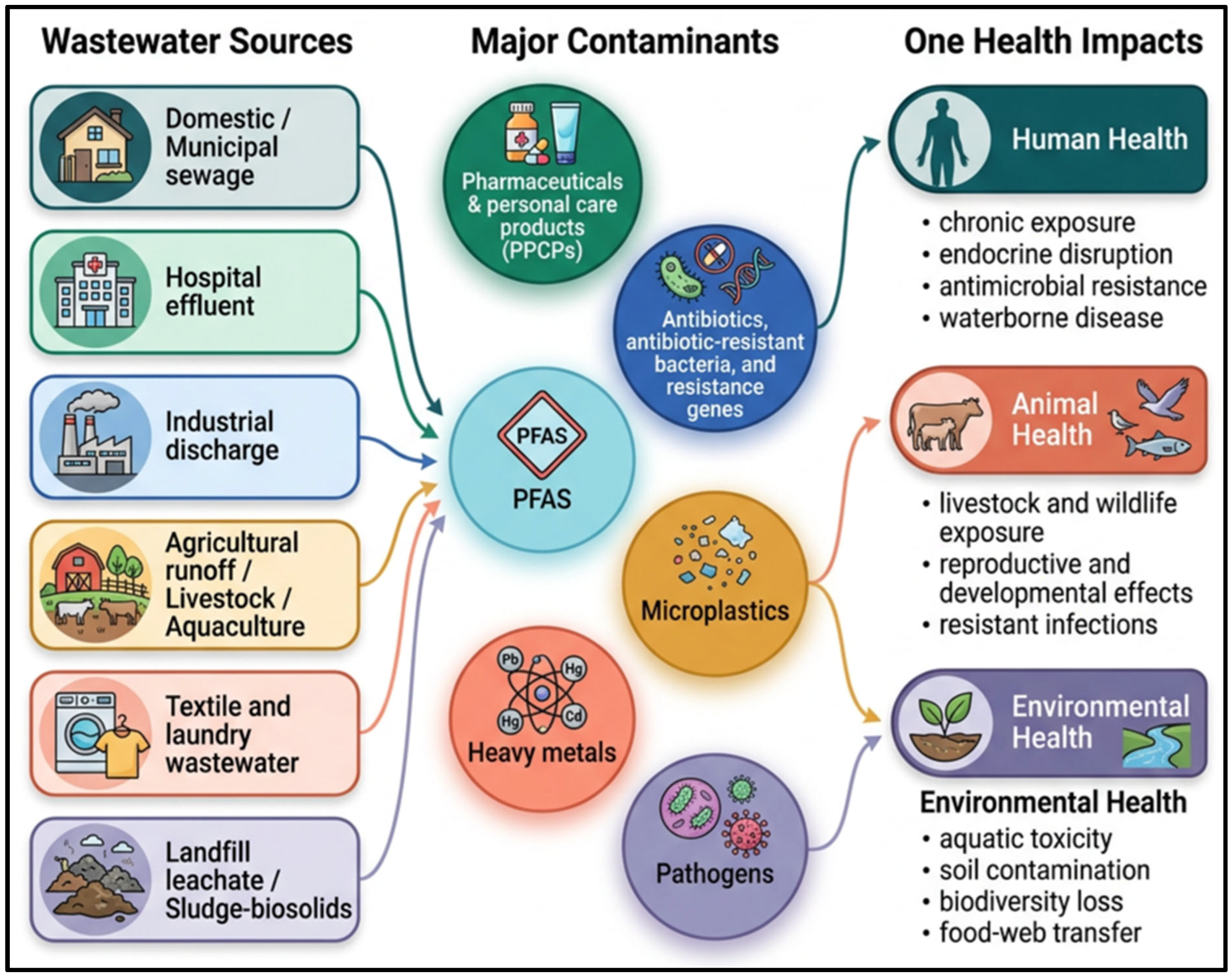
- Wastewater spreads pathogens, AMR, and emerging environmental contaminants.
- WBE and multi-omics help track public health risks in One Health systems.
- Wastewater monitoring improves detection and management of health risks.
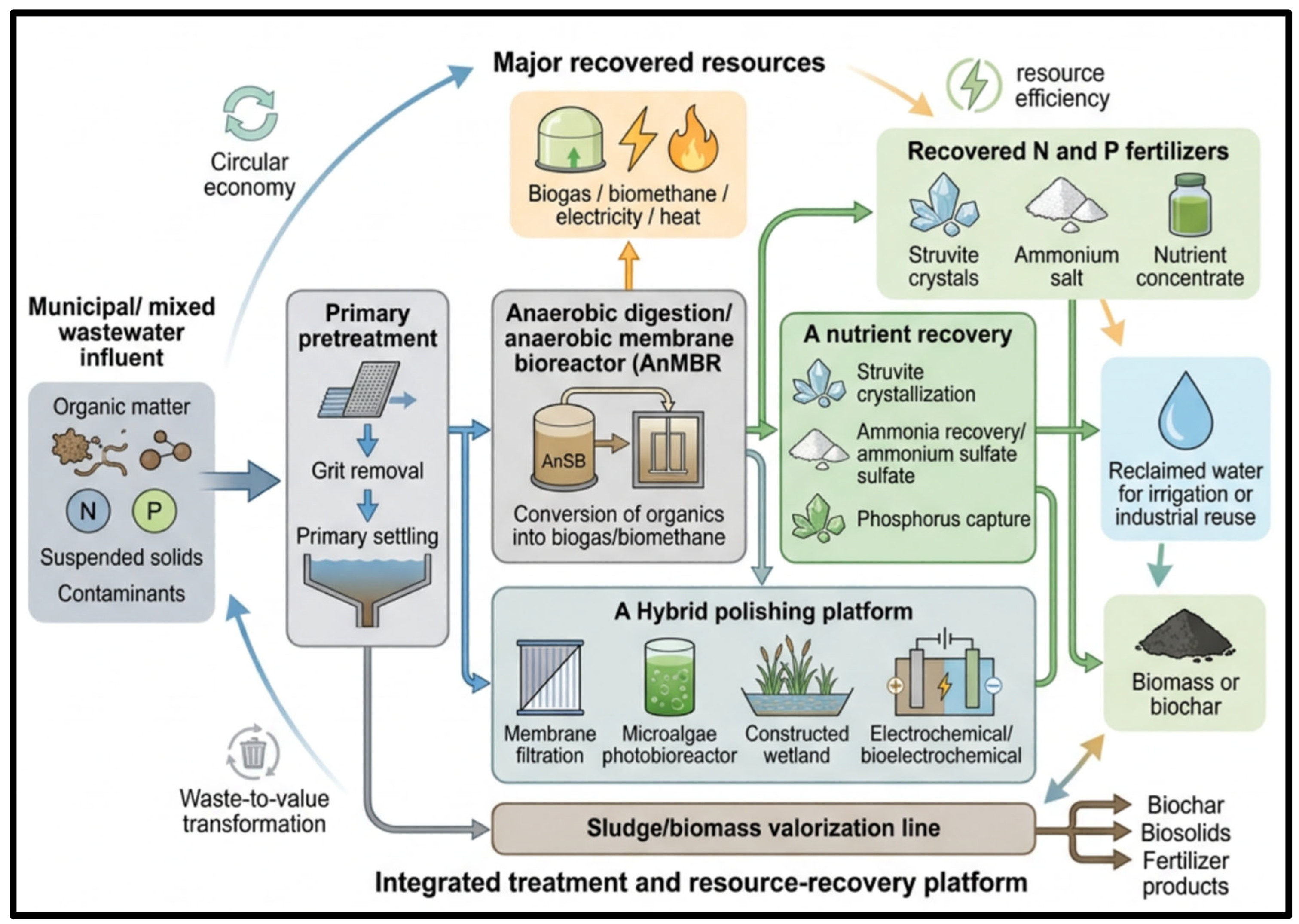
- Circular reuse supports water safety, nutrient recovery, and pollution control.
- Wastewater monitoring should be included in One Health policy frameworks.
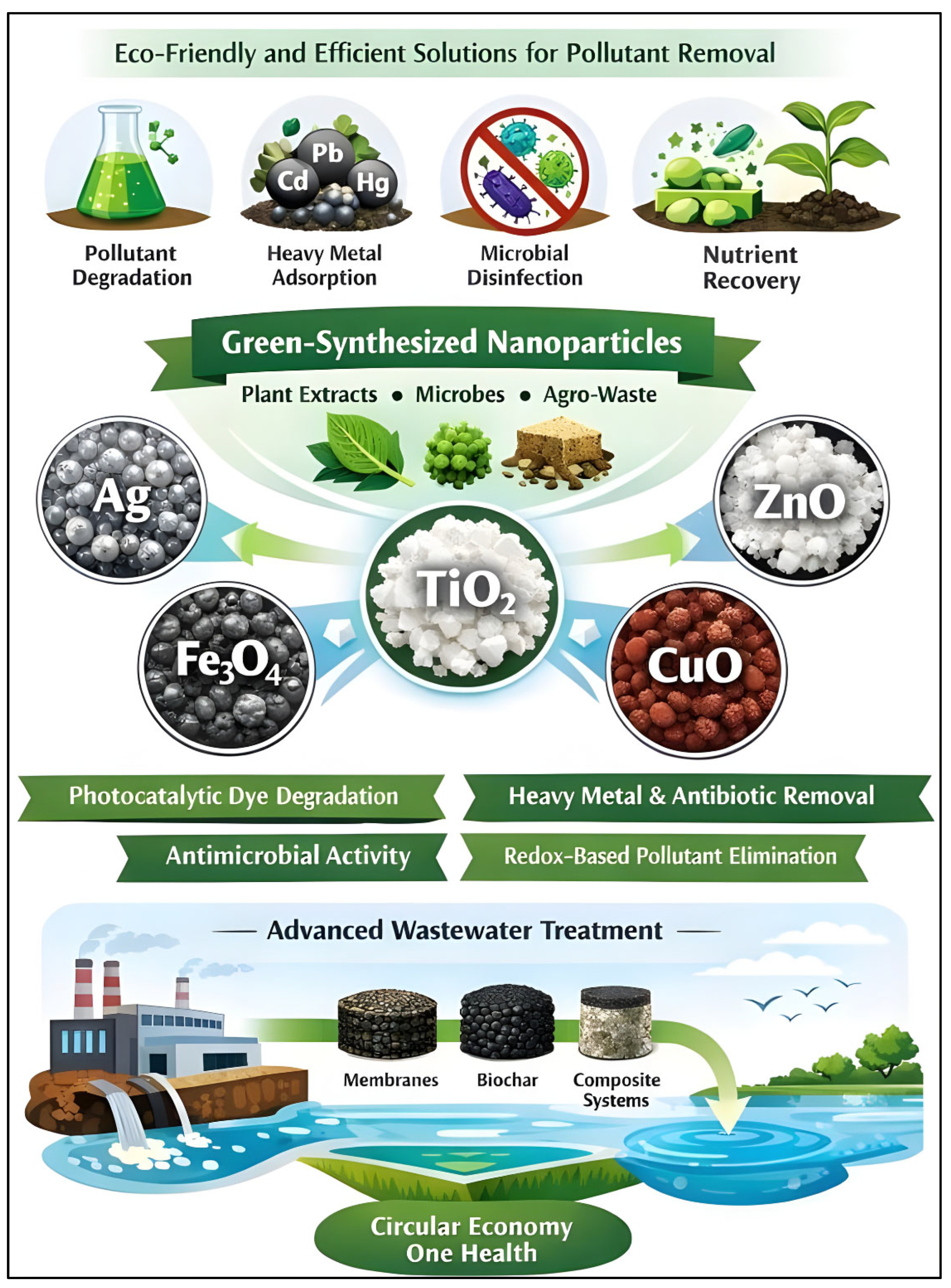
- Green and circular technologies reduce long-term public health risks.
Abstract
1. Introduction
2. Review Methodology
2.1. Study Design and Scope
2.2. Databases and Information Sources
2.3. Search Strategy and Keywords
2.4. Time Window and Updating Strategy
2.5. Inclusion and Exclusion Criteria
2.6. Study Screening and Selection Process
2.7. Quality Assessment and Bias Control
2.8. Data Extraction and Synthesis
2.9. Limitations of the Methodology
3. The One Health Burden of Wastewater: Contaminants and Sources
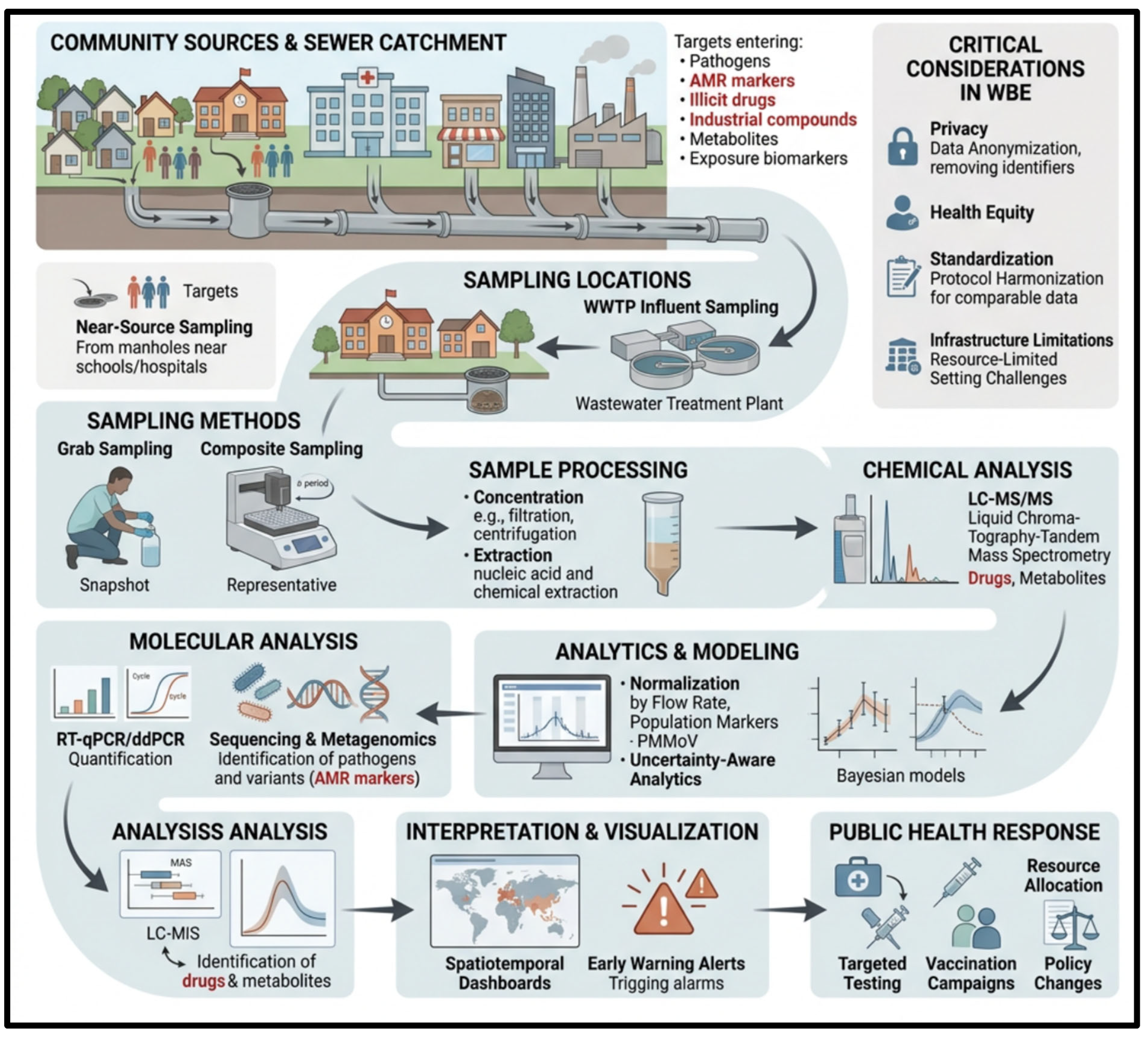
4. Monitoring, Analytics, and Wastewater-Based Epidemiology
5. Advances in Wastewater Treatment Technologies: Nature-Based, Biological, and Advanced Approaches

| Method | Green Principle | Wastewater Type/Scale | Key Findings (Typical) | References |
|---|---|---|---|---|
| Constructed wetlands (horizontal/vertical/hybrid) | Plant–microbe systems; passive treatment, low chemicals | Municipal/domestic; pilot → full scale | High BOD/TSS/N/P removal; robust seasonal performance; scalable designs exist | [76] |
| Floating treatment wetlands (FTW) | Emergent plants on floating mats; roots support biofilm | Stormwater/retention ponds; field | Significant TN/TP reductions; species & harvest timing affect removal | [77] |
| Duckweed/Lemnaceae systems | Rapid plant uptake; biomass valorization | Municipal/agricultural; pilot | Very high N & P uptake; harvestable protein/starch biomass | [78] |
| High-rate algal ponds (HRAP)/algal raceways | Algal-bacterial photosymbiosis; solar O2 | Domestic/municipal; pilot → hectare scale | Good nutrient removal + biomass for energy/fertilizer; low energy input in sunny climates | [79] |
| Vermifiltration/biofilters (earthworm-assisted) | Earthworm–microbe synergism; physical filtration | Domestic/agricultural; pilot → full scale | COD/BOD and pathogen reductions; low sludge production; low energy | [80] |
| Bioflocculants (microbial biopolymers) | Microbial polymers replace chemical flocculants | Industrial/municipal; lab → pilot | Efficient solids & metal removal; biodegradable alternatives to alum/Fe salts | [81] |
| Immobilized enzymes (e.g., laccase) | Biocatalysis for dyes/phenols; immobilization for reuse | Textile/pharma; lab → continuous packed bed pilot | High decolorization; long operational stability in immobilized form | [82] |
| Integrated multitrophic aquaculture (IMTA) | Multi-trophic uptake (algae, plants, animals) | Aquaculture; pilot | Nutrient removal + co-product biomass (fish, seaweed) | [83] |
| Bioelectrochemical systems/Microbial Fuel Cells (MFCs) | Microbial oxidation produces electrons (electricity) + treatment | Domestic/organic waste; lab → pilot | Simultaneous COD removal & electricity generation (low power); scaling challenges | [84] |
| Mycoremediation (fungal bioreactors/fungal biosorption) | Fungi (white-rot, marine) produce ligninolytic enzymes; biosorption | Dye/industrial/tough organics; lab → pilot | Effective degradation of dyes, phenolics, and some POPs; good biosorption of metals | [85] |
| Bivalve (oyster/mussel) bioremediation/bioextraction | Filter feeding + biodeposition increases denitrification & harvest removal | Coastal/estuarine; restoration & aquaculture scale | Oysters can remove/transform nitrogen via assimilation, denitrification enhancement, and harvest | [86] |
| Intermittent sand filters (ISF)/soil aquifer treatment (SAT) | Physical filtration + biofilm nitrification/denitrification in soil | Decentralized municipal community | High BOD/TSS removal; robust pathogen reduction; mature technology | [87] |
| Rotating biological contactors (RBC) & biofilm reactors | Attached-growth biofilms on media; low energy | Municipal/industrial; full scale | Reliable BOD/N removal; compact footprint; used worldwide | [88] |
| Phycoremediation—photobioreactors & Rotating Algal Biofilm (RAB) | Algal biofilm cultivation (attached) for nutrient uptake | Industrial/municipal; pilot | Easier harvesting vs. suspended algae; good nutrient capture | [89] |
5.1. Comparison of Conventional and Advanced Wastewater Treatment Technologies
5.2. Bioenergy and Resource Recovery Approaches in Wastewater Treatment
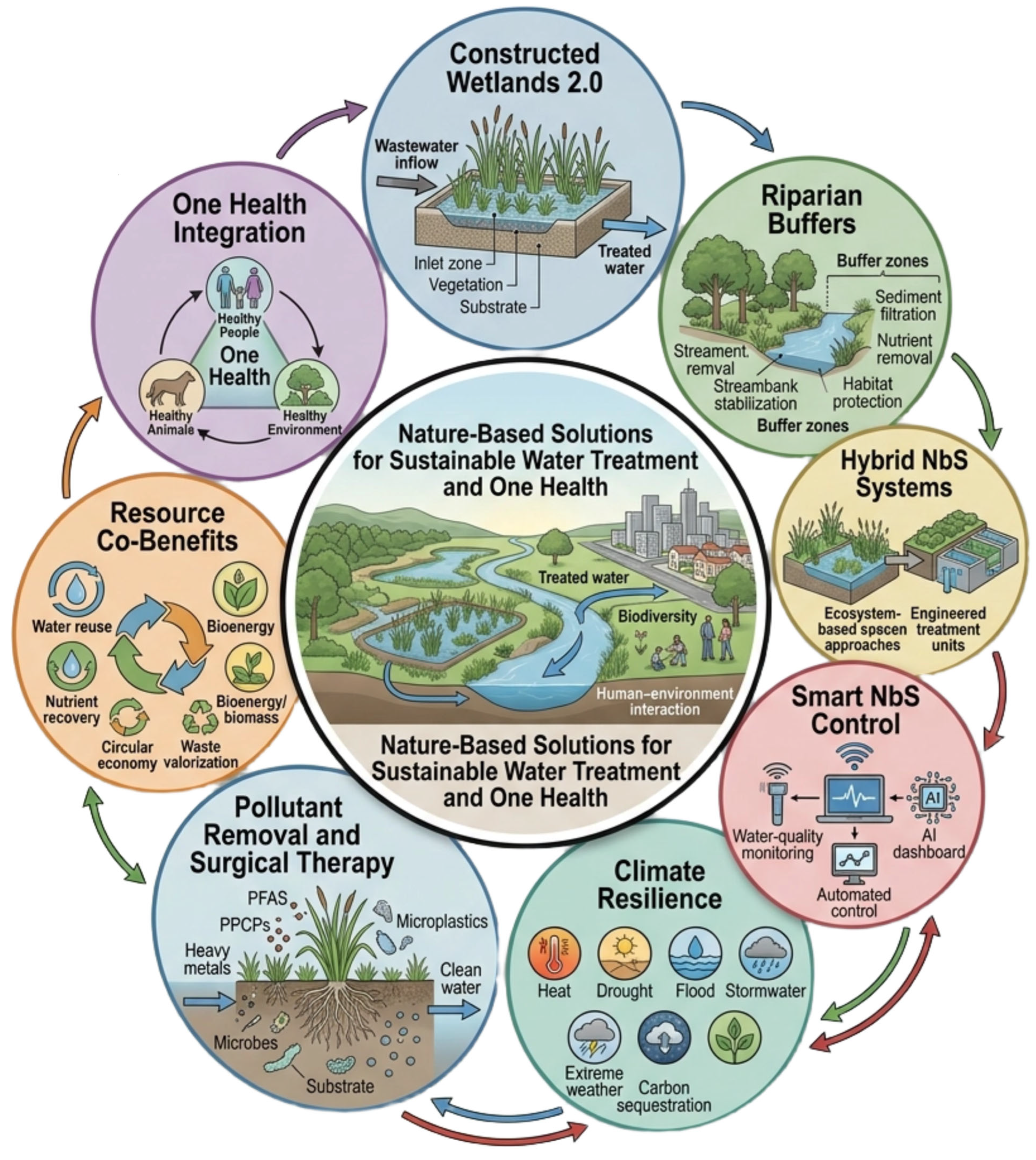
6. Nature-Based Systems (NbS) with Modern Upgrades
7. Nanobiotechnological Breakthroughs and Green-Synthesized Nanoparticles for Wastewater Treatment
7.1. Green Nanocomposites and Photocatalytic Membrane Technologies
7.2. Nano-Bio Hybrids and Renewable-Energy-Driven Advanced Processes
8. Green Nanomaterials for Water and Wastewater Treatment: One Health Perspectives, Cancer Prevention Potential, and Toxicological Insights into Lead (Pb) and Chromium (Cr) Carcinogenicity
9. Future Directions
10. Conclusions
Author Contributions
Funding
Institutional Review Board Statement
Informed Consent Statement
Data Availability Statement
Acknowledgments
Conflicts of Interest
References
- Howard, G.; Bartram, J.; Brocklehurst, C.; Colford, J.M., Jr.; Costa, F.; Cunliffe, D.; Dreibelbis, R.; Eisenberg, J.N.S.; Evans, B.; Girones, R. COVID-19: Urgent actions, critical reflections and future relevance of ‘WaSH’: Lessons for the current and future pandemics. J. Water Health 2020, 18, 613–630. [Google Scholar] [CrossRef]
- Water, U. Progress on Change in Water-Use Efficiency: Global Status and Acceleration Needs for SDG Indicator 6.4. 1, 2021; Food & Agriculture Organization: Rome, Italy, 2021. [Google Scholar]
- Islam, S.D.-U.; Mondal, P.K.; Ojong, N.; Bodrud-Doza, M.; Siddique, M.A.B.; Hossain, M.; Mamun, M.A. Water, sanitation, hygiene and waste disposal practices as COVID-19 response strategy: Insights from Bangladesh. Environ. Dev. Sustain. 2021, 23, 11953–11974. [Google Scholar] [CrossRef] [PubMed]
- Qadir, M.; Drechsel, P.; Jiménez Cisneros, B.; Kim, Y.; Pramanik, A.; Mehta, P.; Olaniyan, O. Global and regional potential of wastewater as a water, nutrient and energy source. Nat. Resour. Forum 2020, 44, 40–51. [Google Scholar] [CrossRef]
- Mateo-Sagasta, J.; Zadeh, S.M.; Turral, H. More People, More Food, Worse Water? A Global Review of Water Pollution from Agriculture; FAO: Rome, Italy, 2018. [Google Scholar]
- Prüss-Ustün, A.; Wolf, J.; Bartram, J.; Clasen, T.; Cumming, O.; Freeman, M.C.; Gordon, B.; Hunter, P.R.; Medlicott, K.; Johnston, R. Burden of disease from inadequate water, sanitation and hygiene for selected adverse health outcomes: An updated analysis with a focus on low-and middle-income countries. Int. J. Hyg. Environ. Health 2019, 222, 765–777. [Google Scholar] [CrossRef]
- Hendriksen, R.S.; Munk, P.; Njage, P.; Van Bunnik, B.; McNally, L.; Lukjancenko, O.; Röder, T.; Nieuwenhuijse, D.; Pedersen, S.K.; Kjeldgaard, J. Global monitoring of antimicrobial resistance based on metagenomics analyses of urban sewage. Nat. Commun. 2019, 10, 1124. [Google Scholar] [CrossRef]
- van Dobben, H.; de Vries, W. Relation between forest vegetation, atmospheric deposition and site conditions at regional and European scales. Environ. Pollut. 2010, 158, 921–933. [Google Scholar] [CrossRef] [PubMed]
- Medema, G.; Heijnen, L.; Elsinga, G.; Italiaander, R.; Brouwer, A. Presence of SARS-Coronavirus-2 RNA in sewage and correlation with reported COVID-19 prevalence in the early stage of the epidemic in the Netherlands. Environ. Sci. Technol. Lett. 2020, 7, 511–516. [Google Scholar] [CrossRef]
- Anthonj, C.; Setty, K.E.; Ferrero, G.; Yaya, A.-M.A.; Poague, K.I.H.M.; Marsh, A.J.; Augustijn, E.-W. Do health risk perceptions motivate water-and health-related behaviour? A systematic literature review. Sci. Total Environ. 2022, 819, 152902. [Google Scholar] [CrossRef] [PubMed]
- Vymazal, J. Constructed wetlands for wastewater treatment: Five decades of experience. Environ. Sci. Technol. 2011, 45, 61–69. [Google Scholar] [CrossRef]
- Logan, B.E.; Rossi, R.; Ragab, A.a.; Saikaly, P.E. Electroactive microorganisms in bioelectrochemical systems. Nat. Rev. Microbiol. 2019, 17, 307–319. [Google Scholar] [CrossRef]
- Mehrtens, A.; Freund, W.; Lüdeke, P.; Licha, T.; Burke, V. Understanding flow patterns from the field–controlled laboratory experiments on the transport behavior of veterinary antibiotics in the presence of liquid manure. Sci. Total Environ. 2022, 821, 153415. [Google Scholar] [CrossRef] [PubMed]
- Rahman, S.; Sadaf, S.; Hoque, M.E.; Mishra, A.; Mubarak, N.M.; Malafaia, G.; Singh, J. Unleashing the promise of emerging nanomaterials as a sustainable platform to mitigate antimicrobial resistance. RSC Adv. 2024, 14, 13862–13899. [Google Scholar] [CrossRef]
- Grant, M.J.; Booth, A. A typology of reviews: An analysis of 14 review types and associated methodologies. Health Inf. Libr. J. 2009, 26, 91–108. [Google Scholar] [CrossRef] [PubMed]
- Page, M.J.; McKenzie, J.E.; Bossuyt, P.M.; Boutron, I.; Hoffmann, T.C.; Mulrow, C.D.; Shamseer, L.; Tetzlaff, J.M.; Akl, E.A.; Brennan, S.E. The PRISMA 2020 statement: An updated guideline for reporting systematic reviews. BMJ 2021, 372, n71. [Google Scholar] [CrossRef] [PubMed]
- Li, W.-W.; Yu, H.-Q.; Rittmann, B.E. Chemistry: Reuse water pollutants. Nature 2015, 528, 29–31. [Google Scholar] [CrossRef]
- World Health Organization. Environmental Surveillance for SARS-CoV-2 to Complement Other Public Health Surveillance; World Health Organization: Geneva, Switzerland, 2023. [Google Scholar]
- Rajagopal, R.; Bohnes, F.; Kukic, P.; Rigarlsford, G.; Vandenbossche-Goddard, E.; Campos, B.; Davies, C.; Malcomber, I.; Maxwell, G.; Sim, S. Optimizing the implementation of safe and sustainable by design to better enable sustainable innovation. iScience 2025, 28, 113116. [Google Scholar] [CrossRef]
- Alamanos, A.; Mcgrath, T.; Linnane, S. Treatment of Domestic WasteWater and Opportunities from Nature-Based Solutions for Small Communities: A Preliminary Assessment. Backgr. Rep. 2022. [Google Scholar] [CrossRef]
- Greenhalgh, T.; Peacock, R. Effectiveness and efficiency of search methods in systematic reviews of complex evidence: Audit of primary sources. BMJ 2005, 331, 1064–1065. [Google Scholar] [CrossRef]
- Haddaway, N.R.; Collins, A.M.; Coughlin, D.; Kirk, S. The role of Google Scholar in evidence reviews and its applicability to grey literature searching. PLoS ONE 2015, 10, e0138237. [Google Scholar] [CrossRef]
- Dehghani Tafti, A.; Houweling, D.; Perron, J.-M.; Bencsik, D.; Johnson, T.; Vanrolleghem, P.A.; Comeau, Y. Towards a modelling framework for nature-based solutions in wastewater treatment. Water Sci. Technol. 2024, 90, 758–776. [Google Scholar] [CrossRef]
- Arabzadeh, V.; Frank, R. A Four-Dimensional Analysis of Explainable AI in Energy Forecasting: A Domain-Specific Systematic Review. Mach. Learn. Knowl. Extr. 2025, 7, 153. [Google Scholar] [CrossRef]
- Frampton, G.; Whaley, P.; Bennett, M.; Bilotta, G.; Dorne, J.-L.C.; Eales, J.; James, K.; Kohl, C.; Land, M.; Livoreil, B. Principles and framework for assessing the risk of bias for studies included in comparative quantitative environmental systematic reviews. Environ. Evid. 2022, 11, 12. [Google Scholar] [CrossRef]
- Committee, E.S.; More, S.; Bampidis, V.; Benford, D.; Bragard, C.; Hernandez-Jerez, A.; Bennekou, S.H.; Koutsoumanis, K.; Lambré, C.; Machera, K. Scientific Committee guidance on appraising and integrating evidence from epidemiological studies for use in EFSA’s scientific assessments. EFSA J. 2024, 22, e8866. [Google Scholar]
- Kümmerer, K.; Clark, J.H.; Zuin, V.G. Rethinking chemistry for a circular economy. Science 2020, 367, 369–370. [Google Scholar] [CrossRef]
- Kogler, A.; Farmer, M.; Simon, J.A.; Tilmans, S.; Wells, G.F.; Tarpeh, W.A. Systematic evaluation of emerging wastewater nutrient removal and recovery technologies to inform practice and advance resource efficiency. ACS EST Eng. 2021, 1, 662–684. [Google Scholar] [CrossRef]
- Aboagye, E.A. A Systems Approach to Process Design and Sustainability-Synergy via Pollution Prevention, Control, and Source Reduction. Ph.D. Thesis, Rowan University, Glassboro, NJ, USA, 2023. [Google Scholar]
- Nakagawa, S.; Yang, Y.; Macartney, E.L.; Spake, R.; Lagisz, M. Quantitative evidence synthesis: A practical guide on meta-analysis, meta-regression, and publication bias tests for environmental sciences. Environ. Evid. 2023, 12, 8. [Google Scholar] [CrossRef]
- Costa, E.P.; Starling, M.C.V.M.; Amorim, C.C. Simultaneous removal of emerging contaminants and disinfection for municipal wastewater treatment plant effluent quality improvement: A systemic analysis of the literature. Environ. Sci. Pollut. Res. 2021, 28, 24092–24111. [Google Scholar] [CrossRef]
- van der Drift, A.-M.R.; Welling, A.; Arntzen, V.; Nagelkerke, E.; van der Beek, R.F.; de Roda Husman, A.M. Wastewater surveillance studies on pathogens and their use in public health decision-making: A scoping review. Sci. Total Environ. 2025, 993, 179982. [Google Scholar] [CrossRef] [PubMed]
- Greaves, R.; Kricka, L.; Gruson, D.; Ferrari, M.; Martin, H.; Loh, T.P.; Bernardini, S.; Division, I.E.T. Toolkit for emerging technologies in laboratory medicine. Clin. Chem. Lab. Med. (CCLM) 2023, 61, 2102–2114. [Google Scholar] [CrossRef] [PubMed]
- Bowes, D.A. Towards a precision model for environmental public health: Wastewater-based epidemiology to assess population-level exposures and related diseases. Curr. Epidemiol. Rep. 2024, 11, 131–139. [Google Scholar] [CrossRef]
- Kasprzyk-Hordern, B.; Béen, F.; Bijlsma, L.; Brack, W.; Castiglioni, S.; Covaci, A.; Martincigh, B.S.; Mueller, J.F.; van Nuijs, A.L.; Oluseyi, T. Wastewater-based epidemiology for the assessment of population exposure to chemicals: The need for integration with human biomonitoring for global One Health actions. J. Hazard. Mater. 2023, 450, 131009. [Google Scholar] [CrossRef]
- Akter, T.; Protity, A.T.; Shaha, M.; Al Mamun, M.; Hashem, A. The impact of textile dyes on the environment. In Nanohybrid Materials for Treatment of Textiles Dyes; Springer: Berlin/Heidelberg, Germany, 2023; pp. 401–431. [Google Scholar]
- Rajendran, S.; Kalairaj, A.; Senthilvelan, T. A comprehensive review on enzymatic decolorization of various azo dyes using laccase for the abatement of industrial pollution. Biomass Convers. Biorefinery 2025, 15, 13079–13101. [Google Scholar] [CrossRef]
- Ehrlich, V.; Bil, W.; Vandebriel, R.; Granum, B.; Luijten, M.; Lindeman, B.; Grandjean, P.; Kaiser, A.-M.; Hauzenberger, I.; Hartmann, C. Consideration of pathways for immunotoxicity of per-and polyfluoroalkyl substances (PFAS). Environ. Health 2023, 22, 19. [Google Scholar] [CrossRef]
- Tancreda, G.; Campisi, L.; Sarti, M.; Pozzo, L.; Vornoli, A. Perfluoroalkyl Substances (PFAS) and Lipid Metabolism in Experimental Animal Models: A Scoping Review on the Mechanisms Behind the Induced Hepatotoxicity. Curr. Issues Mol. Biol. 2025, 47, 944. [Google Scholar] [CrossRef]
- Tian, M.; He, X.; Feng, Y.; Wang, W.; Chen, H.; Gong, M.; Liu, D.; Clarke, J.L.; van Eerde, A. Pollution by antibiotics and antimicrobial resistance in livestock and poultry manure in China, and countermeasures. Antibiotics 2021, 10, 539. [Google Scholar] [CrossRef] [PubMed]
- La Rosa, M.C.; Maugeri, A.; Favara, G.; La Mastra, C.; Magnano San Lio, R.; Barchitta, M.; Agodi, A. The impact of wastewater on antimicrobial resistance: A scoping review of transmission pathways and contributing factors. Antibiotics 2025, 14, 131. [Google Scholar] [CrossRef] [PubMed]
- Drane, K.; Sheehan, M.; Whelan, A.; Ariel, E.; Kinobe, R. The role of wastewater treatment plants in dissemination of antibiotic resistance: Source, measurement, removal and risk assessment. Antibiotics 2024, 13, 668. [Google Scholar] [CrossRef]
- Ahmad, T.; Gul, S.; Peng, L.; Mehmood, T.; Huang, Q.; Ahmad, A.; Ali, H.; Ali, W.; Souissi, S.; Zinck, P. Microplastic mitigation in urban stormwater using green infrastructure: A review. Environ. Chem. Lett. 2025, 23, 999–1024. [Google Scholar] [CrossRef]
- Pazda, M.; Kumirska, J.; Stepnowski, P.; Mulkiewicz, E. Antibiotic resistance genes identified in wastewater treatment plant systems—A review. Sci. Total Environ. 2019, 697, 134023. [Google Scholar] [CrossRef]
- Akdemir, T. Trace element concentrations in effluent of municipal wastewater treatment plants along the Turkish coasts and assessment of human health risk. Front. Mar. Sci. 2024, 11, 1521449. [Google Scholar] [CrossRef]
- Rasmussen, L.A.; Iordachescu, L.; Tumlin, S.; Vollertsen, J. A complete mass balance for plastics in a wastewater treatment plant-macroplastics contributes more than microplastics. Water Res. 2021, 201, 117307. [Google Scholar] [CrossRef]
- Yaseen, D.A.; Scholz, M. Textile dye wastewater characteristics and constituents of synthetic effluents: A critical review. Int. J. Environ. Sci. Technol. 2019, 16, 1193–1226. [Google Scholar] [CrossRef]
- Etana, R.; Angassa, K.; Getu, T. Dye removal from textile wastewater using scoria-based vertical subsurface flow constructed wetland system. Sci. Rep. 2025, 15, 949. [Google Scholar] [CrossRef]
- Iordachescu, L.; Papacharalampos, K.; Barritaud, L.; Denieul, M.-P.; Plessis, E.; Baratto, G.; Julien, V.; Vollertsen, J. Microplastics in an advanced wastewater treatment plant: Sustained and robust removal rates unfazed by seasonal variations. Microplast. Nanoplast. 2024, 4, 18. [Google Scholar] [CrossRef]
- Edo, C.; González-Pleiter, M.; Leganés, F.; Fernández-Piñas, F.; Rosal, R. Fate of microplastics in wastewater treatment plants and their environmental dispersion with effluent and sludge. Environ. Pollut. 2020, 259, 113837. [Google Scholar] [CrossRef] [PubMed]
- Peccia, J.; Zulli, A.; Brackney, D.E.; Grubaugh, N.D.; Kaplan, E.H.; Casanovas-Massana, A.; Ko, A.I.; Malik, A.A.; Wang, D.; Wang, M. Measurement of SARS-CoV-2 RNA in wastewater tracks community infection dynamics. Nat. Biotechnol. 2020, 38, 1164–1167. [Google Scholar] [CrossRef]
- Lubliner, B.; Redding, M.B.; Ragsdale, D. Pharmaceuticals and Personal Care Products in Municipal Wastewater and Their Removal by Nutrient Treatment Technologies; Washington State Department of Ecology: Spokane, WA, USA, 2010.
- Thompson, K.A.; Mortazavian, S.; Gonzalez, D.J.; Bott, C.; Hooper, J.; Schaefer, C.E.; Dickenson, E.R. Poly-and perfluoroalkyl substances in municipal wastewater treatment plants in the United States: Seasonal patterns and meta-analysis of long-term trends and average concentrations. ACS EST Water 2022, 2, 690–700. [Google Scholar] [CrossRef]
- Zhang, W.; Tooker, N.B.; Mueller, A.V. Enabling wastewater treatment process automation: Leveraging innovations in real-time sensing, data analysis, and online controls. Environ. Sci. Water Res. Technol. 2020, 6, 2973–2992. [Google Scholar] [CrossRef]
- Kinnunen, J. On-Site Wastewater Treatment in Northern Conditions: Real World Performance, Pollutant Load and Fate; University of Oulu: Oulu, Finland, 2024. [Google Scholar]
- Lahav, O.; Artzi, E.; Tarre, S.; Green, M. Ammonium removal using a novel unsaturated flow biological filter with passive aeration. Water Res. 2001, 35, 397–404. [Google Scholar] [CrossRef]
- González-Gaya, B.; Dachs, J.; Roscales, J.L.; Caballero, G.; Jiménez, B. Perfluoroalkylated substances in the global tropical and subtropical surface oceans. Environ. Sci. Technol. 2014, 48, 13076–13084. [Google Scholar] [CrossRef]
- Dhillon, G.S.; Kaur, S.; Pulicharla, R.; Brar, S.K.; Cledón, M.; Verma, M.; Surampalli, R.Y. Triclosan: Current status, occurrence, environmental risks and bioaccumulation potential. Int. J. Environ. Res. Public Health 2015, 12, 5657–5684. [Google Scholar] [CrossRef]
- Gibert, O.; De Pablo, J.; Cortina, J.L.; Ayora, C. Sorption studies of Zn (II) and Cu (II) onto vegetal compost used on reactive mixtures for in situ treatment of acid mine drainage. Water Res. 2005, 39, 2827–2838. [Google Scholar] [CrossRef] [PubMed]
- Kolpin, D.W.; Furlong, E.T.; Meyer, M.T.; Thurman, E.M.; Zaugg, S.D.; Barber, L.B.; Buxton, H.T. Pharmaceuticals, hormones, and other organic wastewater contaminants in US streams, 1999–2000: A national reconnaissance. Environ. Sci. Technol. 2002, 36, 1202–1211. [Google Scholar] [CrossRef]
- Parkins, M.D.; Lee, B.E.; Acosta, N.; Bautista, M.; Hubert, C.R.; Hrudey, S.E.; Frankowski, K.; Pang, X.-L. Wastewater-based surveillance as a tool for public health action: SARS-CoV-2 and beyond. Clin. Microbiol. Rev. 2024, 37, e00103-00122. [Google Scholar] [CrossRef]
- Gahlot, P.; Alley, K.D.; Arora, S.; Das, S.; Nag, A.; Tyagi, V.K. Wastewater surveillance could serve as a pandemic early warning system for COVID-19 and beyond. Wiley Interdiscip. Rev. Water 2023, 10, e1650. [Google Scholar] [CrossRef]
- World Health Organization. Compendium of WHO and Other UN Guidance in Health and Environment, 2024 Update; World Health Organization: Geneva, Switzerland, 2024. [Google Scholar]
- Jeannot, C.; Macorps, N.; Le Bizec, B.; Parinet, J.; Dervilly, G. Advancing PFASs monitoring in food: From targeted SPE-LC-MS/MS to non-targeted QuEChERS-LC-HRMS approaches. Food Chem. X 2025, 29, 102674. [Google Scholar] [CrossRef]
- Davis, B.C.; Brown, C.; Gupta, S.; Calarco, J.; Liguori, K.; Milligan, E.; Harwood, V.J.; Pruden, A.; Keenum, I. Recommendations for the use of metagenomics for routine monitoring of antibiotic resistance in wastewater and impacted aquatic environments. Crit. Rev. Environ. Sci. Technol. 2023, 53, 1731–1756. [Google Scholar] [CrossRef]
- Kabir, M.P. Advancement of Sampling Methods and Genomic Analyses for SARS-CoV-2 Wastewater and Environmental Monitoring. Ph.D. Thesis, Université d’Ottawa/University of Ottawa, Ottawa, ON, Canada, 2025. [Google Scholar]
- Ugolini, V. Antimicrobial Resistance in On-Site Sewage Facilities; Swedish University of Agricultural Sciences: Uppsala, Sweden, 2025. [Google Scholar]
- Aarestrup, F.M.; Woolhouse, M.E. Using sewage for surveillance of antimicrobial resistance. Science 2020, 367, 630–632. [Google Scholar] [CrossRef]
- Langenfeld, K.; Arts, P.; Monahan, A.; Criswell, A.; Wigginton, K.R.; Duhaime, M.B. Novel Machine Learning-based Approach to Identify Viral Biomarkers of Human Respiratory Emissions from Oral and Nasal Metagenomes. bioRxiv 2025. bioRxiv:2025.09.26.678930. [Google Scholar]
- Samira, R. Identification of Transcriptional Factor that Contributes in Stress Tolerance of Jute. Master’s Thesis, University of Dhaka, Dhaka, Bangladesh, 2025. [Google Scholar]
- Kalebaila, N.; Hlophe-Ginindza, S. Evolution of Water Research in South Africa from Legacy Pollutants to Contaminants of Emerging Concern: Successes and Opportunities. In Emerging Pollutants: Protecting Water Quality for the Health of People and the Environment; Springer Nature: Cham, Switzerland, 2025; pp. 131–158. [Google Scholar]
- Zieliński, B.; Miądlicki, P.; Przepiórski, J. Development of activated carbon for removal of pesticides from water: Case study. Sci. Rep. 2022, 12, 20869. [Google Scholar] [CrossRef]
- Mastropietro, T.F.; Bruno, R.; Pardo, E.; Armentano, D. Reverse osmosis and nanofiltration membranes for highly efficient PFASs removal: Overview, challenges and future perspectives. Dalton Trans. 2021, 50, 5398–5410. [Google Scholar] [CrossRef] [PubMed]
- Michalopoulos, S.M.; Kalavrouziotis, I.K. Treated wastewater reuse practices, under a holistic approach at the city scale. Oper. Res. 2025, 25, 65. [Google Scholar] [CrossRef]
- Kosek, K.; Luczkiewicz, A.; Fudala-Książek, S.; Jankowska, K.; Szopińska, M.; Svahn, O.; Tränckner, J.; Kaiser, A.; Langas, V.; Björklund, E. Implementation of advanced micropollutants removal technologies in wastewater treatment plants (WWTPs)-Examples and challenges based on selected EU countries. Environ. Sci. Policy 2020, 112, 213–226. [Google Scholar] [CrossRef]
- Vymazal, J. Removal of nutrients in various types of constructed wetlands. Sci. Total Environ. 2007, 380, 48–65. [Google Scholar] [CrossRef] [PubMed]
- Tanner, C.C.; Headley, T.R. Components of floating emergent macrophyte treatment wetlands influencing removal of stormwater pollutants. Ecol. Eng. 2011, 37, 474–486. [Google Scholar] [CrossRef]
- Chen, G.; Fang, Y.; Huang, J.; Zhao, Y.; Li, Q.; Lai, F.; Xu, Y.; Tian, X.; He, K.; Jin, Y. Duckweed systems for eutrophic water purification through converting wastewater nutrients to high-starch biomass: Comparative evaluation of three different genera (Spirodela polyrhiza, Lemna minor and Landoltia punctata) in monoculture or polyculture. RSC Adv. 2018, 8, 17927–17937. [Google Scholar] [CrossRef]
- Park, J.; Craggs, R.; Shilton, A. Wastewater treatment high rate algal ponds for biofuel production. Bioresour. Technol. 2011, 102, 35–42. [Google Scholar] [CrossRef]
- Gutiérrez, V.; Monsalves, N.; Gómez, G.; Vidal, G. Performance of a full-scale vermifilter for sewage treatment in removing organic matter, nutrients, and antibiotic-resistant bacteria. Sustainability 2023, 15, 6842. [Google Scholar] [CrossRef]
- Ayangbenro, A.S.; Babalola, O.O.; Aremu, O.S. Bioflocculant production and heavy metal sorption by metal resistant bacterial isolates from gold mining soil. Chemosphere 2019, 231, 113–120. [Google Scholar] [CrossRef]
- Chhabra, M.; Mishra, S.; Sreekrishnan, T.R. Immobilized laccase mediated dye decolorization and transformation pathway of azo dye acid red 27. J. Environ. Health Sci. Eng. 2015, 13, 38. [Google Scholar] [CrossRef] [PubMed]
- Mnyoro, M.S. The status of recirculating aquaculture systems in Africa: A review. Int. J. Fish. Aquat. Stud. 2025, 13, 279–293. [Google Scholar] [CrossRef]
- Liu, H.; Ramnarayanan, R.; Logan, B.E. Production of electricity during wastewater treatment using a single chamber microbial fuel cell. Environ. Sci. Technol. 2004, 38, 2281–2285. [Google Scholar] [CrossRef] [PubMed]
- Aiken, B.S.; Logan, B.E. Degradation of pentachlorophenol by the white rot fungus Phanerochaete chrysosporium grown in ammonium lignosulphonate media. Biodegradation 1996, 7, 175–182. [Google Scholar] [CrossRef]
- Rose, J.M.; Bricker, S.B.; Deonarine, S.; Ferreira, J.G.; Getchis, T.; Grant, J.; Kim, J.K.; Krumholz, J.S.; Kraemer, G.P.; Stephenson, K. Nutrient bioextraction. In Encyclopedia of Sustainability Science and Technology; Springer: Berlin/Heidelberg, Germany, 2015; pp. 1–33. [Google Scholar]
- Zuniga, K.; Baird, C.; Burgess, S.; Clark, R.; Heckel, S.; Stanley, H.; Towler, C.; Webster, K. ‘Would you; could you; on a boat?’ Wait-time and travel-time activities during river ferry journeys and their relationship to overall satisfaction in Brisbane, Queensland. In Proceedings of the Australasian Transport Research Forum 2013 Proceedings; ATRF: Sydney, Australia, 2013; pp. 1–14. [Google Scholar]
- Fitch, M.W.; Lam, A.; Segar, R. Biological fixed film systems. Water Environ. Res. 2000, 72, 516–575. [Google Scholar] [CrossRef]
- Sreeharsha, R.V.; Venkata Mohan, S. Methods in photosynthetic physiology, cultivation and harvesting of photosynthetic microbes. In Microbial Photosynthesis: From Basic Biology to Artificial Cell Factories and Industrial Applications; Springer: Berlin/Heidelberg, Germany, 2024; pp. 57–80. [Google Scholar]
- Lettinga, G.; Van Velsen, A.; Hobma, S.d.; De Zeeuw, W.; Klapwijk, A. Use of the upflow sludge blanket (USB) reactor concept for biological wastewater treatment, especially for anaerobic treatment. Biotechnol. Bioeng. 1980, 22, 699–734. [Google Scholar] [CrossRef]
- Giménez, J.; Robles, A.; Carretero, L.; Durán, F.; Ruano, M.; Gatti, M.N.; Ribes, J.; Ferrer, J.; Seco, A. Experimental study of the anaerobic urban wastewater treatment in a submerged hollow-fibre membrane bioreactor at pilot scale. Bioresour. Technol. 2011, 102, 8799–8806. [Google Scholar] [CrossRef] [PubMed]
- Pronk, M.; De Kreuk, M.; De Bruin, B.; Kamminga, P.; Kleerebezem, R.v.; Van Loosdrecht, M. Full scale performance of the aerobic granular sludge process for sewage treatment. Water Res. 2015, 84, 207–217. [Google Scholar] [CrossRef]
- Cao, Y.; van Loosdrecht, M.C.; Daigger, G.T. Mainstream partial nitritation–anammox in municipal wastewater treatment: Status, bottlenecks, and further studies. Appl. Microbiol. Biotechnol. 2017, 101, 1365–1383. [Google Scholar] [CrossRef]
- Alayu, E.; Leta, S. Post treatment of anaerobically treated brewery effluent using pilot scale horizontal subsurface flow constructed wetland system. Bioresour. Bioprocess. 2021, 8, 8. [Google Scholar] [CrossRef]
- Linvill, C.; Butkus, M.; Bennett, E.; Wait, M.; Pytlar, A.; Pfluger, A. Energy balances for proposed complete full-scale anaerobic wastewater treatment facilities. Environ. Eng. Sci. 2023, 40, 482–493. [Google Scholar] [CrossRef]
- Korres, N.E.; O’Kiely, P.; Benzie, J.A.; West, J.S. Bioenergy Production by Anearobic Digestion; Routledge: Abingdon, UK, 2013. [Google Scholar]
- Huang, H.; Zhang, X.; Du, Q.; Gao, F.; Wang, Z.; Wu, G.; Guo, W.; Ngo, H.H. Assessing the Long-Term performance of an integrated microbial fuel Cell-Anaerobic membrane bioreactor for swine wastewater treatment. Chem. Eng. J. 2024, 493, 152772. [Google Scholar] [CrossRef]
- Hashmat, A.J.; Afzal, M.; Iqbal, S.; Amin, I.; Arias, C.A.; Brix, H.; Zafar, I.; Riaz, S.; Rehman, R.u.; Salamatullah, A.M. Nutrients, surfactants, and aeration in constructed wetlands affect bacterial persistence and metabolic activity during the remediation of crude oil-contaminated water. Bioresour. Bioprocess. 2024, 11, 40. [Google Scholar] [CrossRef]
- Bashir, N.; Afzaal, M.; Khan, A.L.; Nawaz, R.; Irfan, A.; Almaary, K.S.; Dabiellil, F.; Bourhia, M.; Ahmed, Z. Green-synthesized silver nanoparticle-enhanced nanofiltration mixed matrix membranes for high-performance water purification. Sci. Rep. 2025, 15, 1001. [Google Scholar] [CrossRef] [PubMed]
- Alamier, W.M.; DY Oteef, M.; Bakry, A.M.; Hasan, N.; Ismail, K.S.; Awad, F.S. Green synthesis of silver nanoparticles using Acacia ehrenbergiana plant cortex extract for efficient removal of rhodamine B cationic dye from wastewater and the evaluation of antimicrobial activity. Acs Omega 2023, 8, 18901–18914. [Google Scholar] [CrossRef]
- Rambabu, K.; Bharath, G.; Banat, F.; Show, P.L. Green synthesis of zinc oxide nanoparticles using Phoenix dactylifera waste as bioreductant for effective dye degradation and antibacterial performance in wastewater treatment. J. Hazard. Mater. 2021, 402, 123560. [Google Scholar] [CrossRef]
- Alprol, A.E.; Eleryan, A.; Abouelwafa, A.; Gad, A.M.; Hamad, T.M. Green synthesis of zinc oxide nanoparticles using Padina pavonica extract for efficient photocatalytic removal of methylene blue. Sci. Rep. 2024, 14, 32160. [Google Scholar] [CrossRef]
- Yitagesu, G.B.; Leku, D.T.; Workneh, G.A. Green synthesis of TiO2 using Impatiens rothii hook. f. leaf extract for efficient removal of methylene blue dye. ACS Omega 2023, 8, 43999–44012. [Google Scholar] [CrossRef] [PubMed]
- Sethy, N.K.; Arif, Z.; Mishra, P.K.; Kumar, P. Green synthesis of TiO2 nanoparticles from Syzygium cumini extract for photo-catalytic removal of lead (Pb) in explosive industrial wastewater. Green Process. Synth. 2020, 9, 171–181. [Google Scholar] [CrossRef]
- Rathore, C.; Yadav, V.K.; Amari, A.; Meena, A.; Chinedu Egbosiuba, T.; Verma, R.K.; Mahdhi, N.; Choudhary, N.; Sahoo, D.K.; Chundawat, R.S. Synthesis and characterization of titanium dioxide nanoparticles from Bacillus subtilis MTCC 8322 and its application for the removal of methylene blue and orange G dyes under UV light and visible light. Front. Bioeng. Biotechnol. 2024, 11, 1323249. [Google Scholar] [CrossRef]
- Ansari, A.; Siddiqui, V.U.; Rehman, W.U.; Akram, M.K.; Siddiqi, W.A.; Alosaimi, A.M.; Hussein, M.A.; Rafatullah, M. Green synthesis of TiO2 nanoparticles using Acorus calamus leaf extract and evaluating its photocatalytic and in vitro antimicrobial activity. Catalysts 2022, 12, 181. [Google Scholar] [CrossRef]
- Lakshmaiya, N.; Surakasi, R.; Nadh, V.S.; Srinivas, C.; Kaliappan, S.; Ganesan, V.; Paramasivam, P.; Dhanasekaran, S. Tanning wastewater sterilization in the dark and sunlight using psidium guajava leaf-derived copper oxide nanoparticles and their characteristics. ACS Omega 2023, 8, 39680–39689. [Google Scholar] [CrossRef] [PubMed]
- Jabeen, S.; Siddiqui, V.U.; Bala, S.; Mishra, N.; Mishra, A.; Lawrence, R.; Bansal, P.; Khan, A.R.; Khan, T. Biogenic synthesis of copper oxide nanoparticles from aloe vera: Antibacterial activity, molecular docking, and photocatalytic dye degradation. ACS Omega 2024, 9, 30190–30204. [Google Scholar] [CrossRef] [PubMed]
- Prakruthi, R.; Deepakumari, H.N. CuO nanoparticles: Green combustion synthesis, applications to antioxidant, photocatalytic and sensor studies. RSC Adv. 2024, 14, 28703–28715. [Google Scholar] [CrossRef]
- Eid, A.M.; Fouda, A.; Hassan, S.E.-D.; Hamza, M.F.; Alharbi, N.K.; Elkelish, A.; Alharthi, A.; Salem, W.M. Plant-based copper oxide nanoparticles; biosynthesis, characterization, antibacterial activity, tanning wastewater treatment, and heavy metals sorption. Catalysts 2023, 13, 348. [Google Scholar] [CrossRef]
- Aroob, S.; Carabineiro, S.A.; Taj, M.B.; Bibi, I.; Raheel, A.; Javed, T.; Yahya, R.; Alelwani, W.; Verpoort, F.; Kamwilaisak, K. Green synthesis and photocatalytic dye degradation activity of CuO nanoparticles. Catalysts 2023, 13, 502. [Google Scholar] [CrossRef]
- Nzilu, D.M.; Madivoli, E.S.; Makhanu, D.S.; Wanakai, S.I.; Kiprono, G.K.; Kareru, P.G. Green synthesis of copper oxide nanoparticles and its efficiency in degradation of rifampicin antibiotic. Sci. Rep. 2023, 13, 14030. [Google Scholar] [CrossRef]
- Wang, T.; Jin, X.; Chen, Z.; Megharaj, M.; Naidu, R. Green synthesis of Fe nanoparticles using eucalyptus leaf extracts for treatment of eutrophic wastewater. Sci. Total Environ. 2014, 466, 210–213. [Google Scholar] [CrossRef]
- Yang, J.; Wang, S.; Xu, N.; Ye, Z.; Yang, H.; Huangfu, X. Synthesis of montmorillonite-supported nano-zero-valent iron via green tea extract: Enhanced transport and application for hexavalent chromium removal from water and soil. J. Hazard. Mater. 2021, 419, 126461. [Google Scholar] [CrossRef] [PubMed]
- Yang, X.; Yang, K.; Cui, T.; Chen, M.; He, L. A study of text vectorization method combining topic model and transfer learning. Processes 2022, 10, 350. [Google Scholar] [CrossRef]
- Abdelfatah, A.M.; Fawzy, M.; Eltaweil, A.S.; El-Khouly, M.E. Green synthesis of nano-zero-valent iron using ricinus communis seeds extract: Characterization and application in the treatment of methylene blue-polluted water. ACS Omega 2021, 6, 25397–25411. [Google Scholar] [CrossRef]
- Singh, K.; Senapati, K.; Sarma, K. Synthesis of superparamagnetic Fe3O4 nanoparticles coated with green tea polyphenols and their use for removal of dye pollutant from aqueous solution. J. Environ. Chem. Eng. 2017, 5, 2214–2221. [Google Scholar] [CrossRef]
- Adhikari, A.; Chhetri, K.; Acharya, D.; Pant, B.; Adhikari, A. Green synthesis of iron oxide nanoparticles using Psidium guajava L. leaves extract for degradation of organic dyes and anti-microbial applications. Catalysts 2022, 12, 1188. [Google Scholar] [CrossRef]
- Liew, C.Y.; Wu, J. Green finance and environmental, social, and governance: Evidence from Chinese listed companies. Green finance and environmental, social, and governance: Evidence from Chinese listed companies. Environ. Sci. Pollut. Res. 2023, 30, 110499–110514. [Google Scholar]
- Shalaby, S.M.; Madkour, F.F.; El-Kassas, H.Y.; Mohamed, A.A.; Elgarahy, A.M. Green synthesis of recyclable iron oxide nanoparticles using Spirulina platensis microalgae for adsorptive removal of cationic and anionic dyes. Environ. Sci. Pollut. Res. 2021, 28, 65549–65572. [Google Scholar] [CrossRef] [PubMed]
- Mohamed, A.; Atta, R.; Kotp, A.A.; Abo El-Ela, F.I.; Abd El-Raheem, H.; Farghali, A.; Alkhalifah, D.H.M.; Hozzein, W.N.; Mahmoud, R. Green synthesis and characterization of iron oxide nanoparticles for the removal of heavy metals (Cd2+ and Ni2+) from aqueous solutions with Antimicrobial Investigation. Sci. Rep. 2023, 13, 7227. [Google Scholar] [CrossRef]
- Extross, A.; Waknis, A.; Tagad, C.; Gedam, V.; Pathak, P. Adsorption of congo red using carbon from leaves and stem of water hyacinth: Equilibrium, kinetics, thermodynamic studies. Int. J. Environ. Sci. Technol. 2023, 20, 1607–1644. [Google Scholar] [CrossRef]
- Subramanian, H.; Krishnan, M.; Mahalingam, A. Photocatalytic dye degradation and photoexcited anti-microbial activities of green zinc oxide nanoparticles synthesized via Sargassum muticum extracts. RSC Adv. 2022, 12, 985–997. [Google Scholar] [CrossRef]
- Batra, V.; Kaur, I.; Pathania, D.; Chaudhary, V. Efficient dye degradation strategies using green synthesized ZnO-based nanoplatforms: A review. Appl. Surf. Sci. Adv. 2022, 11, 100314. [Google Scholar] [CrossRef]
- Mahajan, M.; Kumar, S.; Gaur, J.; Kaushal, S.; Dalal, J.; Singh, G.; Misra, M.; Ahlawat, D.S. Green synthesis of ZnO nanoparticles using Justicia adhatoda for photocatalytic degradation of malachite green and reduction of 4-nitrophenol. RSC Adv. 2025, 15, 2958–2980. [Google Scholar] [CrossRef]
- Elbadawy, H.A.; Elhusseiny, A.F.; Hussein, S.M.; Sadik, W.A. Sustainable and energy-efficient photocatalytic degradation of textile dye assisted by ecofriendly synthesized silver nanoparticles. Sci. Rep. 2023, 13, 2302. [Google Scholar] [CrossRef] [PubMed]
- Xu, Z.; Zada, N.; Habib, F.; Ullah, H.; Hussain, K.; Ullah, N.; Bibi, M.; Bibi, M.; Ghani, H.; Khan, S. Enhanced photocatalytic degradation of malachite green dye using silver–manganese oxide nanoparticles. Molecules 2023, 28, 6241. [Google Scholar] [CrossRef]
- Barani, A.; Alizadeh, S.R.; Ebrahimzadeh, M.A. A comprehensive review on catalytic activities of green-synthesized selenium nanoparticles on dye removal for wastewater treatment. Water 2023, 15, 3295. [Google Scholar] [CrossRef]
- Haidri, I.; Shahid, M.; Hussain, S.; Shahzad, T.; Mahmood, F.; Hassan, M.U.; Al-Khayri, J.M.; Aldaej, M.I.; Sattar, M.N.; Rezk, A.A.-S. Efficacy of biogenic zinc oxide nanoparticles in treating wastewater for sustainable wheat cultivation. Plants 2023, 12, 3058. [Google Scholar] [CrossRef]
- Rasheed, A.; Hussain, S.; Mushtaq, W.; Zubair, M.; Siddique, K.; Attia, K.; Khan, N.; Fiaz, S.; Azeem, F.; Chen, Y. Application of silver nanoparticles synthesized through varying biogenic and chemical methods for wastewater treatment and health aspects. Environ. Sci. Pollut. Res. 2023, 1–18. [Google Scholar] [CrossRef]
- El-Maraghy, C.M.; Saleh, S.S.; Ibrahim, M.S.; El-Naem, O.A. Green wastewater treatment of repurposed COVID-19 therapy (levofloxacin) using synthesized magnetite pectin nanoparticles, comparison with mesoporous silica nanoparticles. BMC Chem. 2023, 17, 134. [Google Scholar] [CrossRef]
- Das, C.; Sen, S.; Singh, T.; Ghosh, T.; Paul, S.S.; Kim, T.W.; Jeon, S.; Maiti, D.K.; Im, J.; Biswas, G. Green synthesis, characterization and application of natural product coated magnetite nanoparticles for wastewater treatment. Nanomaterials 2020, 10, 1615. [Google Scholar] [CrossRef]
- Dlamini, N.G.; Basson, A.K.; Pullabhotla, R.V. Wastewater treatment by a polymeric bioflocculant and iron nanoparticles synthesized from a bioflocculant. Polymers 2020, 12, 1618. [Google Scholar] [CrossRef]
- Khan, J.; Fayyaz, M.; Aslam, M.M.; Gillani, S.R.; Masood, S.; Jahangir, M.S.; Rehman, M.; Ullah, F.; Jamil, M.; Saud, S. Fabrication of filter paper with green synthesized iron nanoparticles for heavy metals contaminated wastewater treatment. J. Umm Al-Qura Univ. Appl. Sci. 2025, 11, 251–258. [Google Scholar] [CrossRef]
- Darwesh, O.M.; Li, H.; Matter, I.A. Nano-bioremediation of textile industry wastewater using immobilized CuO-NPs myco-synthesized by a novel Cu-resistant Fusarium oxysporum OSF18. Environ. Sci. Pollut. Res. 2023, 30, 16694–16706. [Google Scholar] [CrossRef] [PubMed]
- Mahmoud, A.E.D.; Al-Qahtani, K.M.; Alflaij, S.O.; Al-Qahtani, S.F.; Alsamhan, F.A. Green copper oxide nanoparticles for lead, nickel, and cadmium removal from contaminated water. Sci. Rep. 2021, 11, 12547. [Google Scholar] [CrossRef]
- Taher, H.S.; Sayed, R.; Loutfi, A.; Abdulla, H. Construction of a domestic wastewater disinfection filter from biosynthesized and commercial nanosilver: A comparative study. Ann. Microbiol. 2022, 72, 31. [Google Scholar] [CrossRef]
- Bui, Q.M.; Vu, T.Q.; Vuong, X.T.; Nguyen, V.D.; Nguyen, L.T.; Le, H.T.; Nguyen, H.T.; Nguyen, V.P. Removal of fluoroquinolone antibiotics by chitosan–magnetite from aqueous: Single and binary adsorption. Processes 2023, 11, 2396. [Google Scholar] [CrossRef]
- El-Borady, O.M. Wastewater Treatment using Innovative Green-Synthesized rGO, TiO2NPs, and rGO/TiO2 Nanocomposite: Structural, Morphological, Spectroscopic, Thermal, and Photocatalytic Studies. Water Air Soil Pollut. 2025, 236, 75. [Google Scholar] [CrossRef]
- Luo, C.; Yao, W.; Gao, X. Degradation of a Reactive Orange 16 in textile wastewater treatment using CuO/ZnO nanocomposite as photocatalyst. Int. J. Electrochem. Sci. 2022, 17, 220732. [Google Scholar] [CrossRef]
- Reyes-Pérez, J.; Roa-Morales, G.; De Leon-Condes, C.A.; Balderas-Hernández, P. Nanocomposites from spent coffee grounds and iron/zinc oxide: Green synthesis, characterization, and application in textile wastewater treatment. Water Sci. Technol. 2023, 88, 1547–1563. [Google Scholar] [CrossRef] [PubMed]
- Fulciniti, M.; Amodio, N.; Bandi, R.; Cagnetta, A.; Samur, M.; Acharya, C.; Prabhala, R.; D’Aquila, P.; Bellizzi, D.; Passarino, G. miR-23b/SP1/c-myc forms a feed-forward loop supporting multiple myeloma cell growth. Blood Cancer J. 2016, 6, e380. [Google Scholar] [CrossRef]
- Oviedo-García, M.Á. Journal citation reports and the definition of a predatory journal: The case of the Multidisciplinary Digital Publishing Institute (MDPI). Res. Eval. 2021, 30, 405–419a. [Google Scholar] [CrossRef]
- Hamd, A.; Shaban, M.; AlMohamadi, H.; Dryaz, A.R.; Ahmed, S.A.; Abu Al-Ola, K.A.; Abd El-Mageed, H.R.; Soliman, N.K. Novel wastewater treatment by using newly prepared green seaweed–zeolite nanocomposite. ACS Omega 2022, 7, 11044–11056. [Google Scholar] [CrossRef]
- Farouz, M.; El-Dek, S.; ElFaham, M.M.; Eldemerdash, U. Ecofriendly sustainable synthetized nano-composite for removal of heavy metals from aquatic environment. Appl. Nanosci. 2022, 12, 1585–1600. [Google Scholar] [CrossRef]
- Williams, M.E.; Raboczyj, S.; Little, D.; Wathen-Dunn, K. Abstracts of the 19th Transgenic Technology Meeting (TT2025). Transgenic Res. 2025, 34, 19. [Google Scholar] [CrossRef] [PubMed]
- Ramzan, M.; Obodo, R.M.; Shahzad, M.; Mukhtar, S.; Ilyas, S.; Mahmood, T. Green synthesis of Cu@ TiO2 via cedrus deodara leaf extract: A novel composite with high photocatalytic and antibacterial activity. Curr. Res. Green Sustain. Chem. 2021, 4, 100137. [Google Scholar] [CrossRef]
- Dey, S.; Manna, K.; Pradhan, P.; Sarkar, A.N.; Roy, A.; Pal, S. Review of polymeric nanocomposites for photocatalytic wastewater treatment. ACS Appl. Nano Mater. 2024, 7, 4588–4614. [Google Scholar] [CrossRef]
- Negash, A.; Mohammed, S.; Weldekirstos, H.D.; Ambaye, A.D.; Gashu, M. Enhanced photocatalytic degradation of methylene blue dye using eco-friendly synthesized rGO@ ZnO nanocomposites. Sci. Rep. 2023, 13, 22234. [Google Scholar] [CrossRef]
- Goudarzi, S.; Sajjadi, M.; Ghaffarinejad, A. Green preparation of reusable Pd@ magnetic lignosulfonate nanocomposite for hydrogen evolution reaction in all pHs. Int. J. Biol. Macromol. 2025, 287, 138656. [Google Scholar] [CrossRef]
- Lin, J.; Yu, Y.; Zhou, Y.; Zhou, Z.; Shi, X. How many preprints have actually been printed and why: A case study of computer science preprints on arXiv. Scientometrics 2020, 124, 555–574. [Google Scholar] [CrossRef]
- Day, M.L.; Hamza, M.A.; Evans, J.D.; Shearer, C.J. Excess Al Reduces Photocatalytic Activity of Al-Doped SrTiO3 Nanostructures. ACS Appl. Nano Mater. 2026, 9, 1748–1759. [Google Scholar] [CrossRef]
- Sun, C.; Du, D.; Liu, Z.; Xu, G.; Hao, Z.; Guo, X. Performance Evaluation of Deepseek-R1 in Understanding And Designing Al2O3 Porous Ceramics with The Sacrificial Biomass Template Method. Ceram.–Silikáty 2025, 69, 389–403. [Google Scholar] [CrossRef]
- Mousa, S.A.; Wissa, D.; Hassan, H.; Ebnalwaled, A.; Khairy, S. Enhanced photocatalytic activity of green synthesized zinc oxide nanoparticles using low-cost plant extracts. Sci. Rep. 2024, 14, 16713. [Google Scholar] [CrossRef]
- Mousa, S.A.; Abdallah, H.; Khairy, S. The use of green synthesized TiO2/MnO2 nanoparticles in solar power membranes for pulp and paper industry wastewater treatment. Sci. Rep. 2025, 15, 2102. [Google Scholar] [CrossRef]
- Mousa, S.A.; Abdallah, H.; Khairy, S. Low-cost photocatalytic membrane modified with green heterojunction TiO2/ZnO nanoparticles prepared from waste. Sci. Rep. 2023, 13, 22150. [Google Scholar] [CrossRef]
- Xie, J.; Lin, R.; Liang, Z.; Zhao, Z.; Yang, C.; Cui, F. Effect of cations on the enhanced adsorption of cationic dye in Fe3O4-loaded biochar and mechanism. J. Environ. Chem. Eng. 2021, 9, 105744. [Google Scholar] [CrossRef]
- Rana, H.; Anamika; Sareen, D.; Goswami, S. Nanocellulose-Based Ecofriendly Nanocomposite for Effective wastewater Remediation: A study on its process optimization, improved swelling, adsorption, and thermal and mechanical behavior. ACS Omega 2024, 9, 8904–8922. [Google Scholar] [CrossRef] [PubMed]
- Das, G.S.; Shim, J.P.; Bhatnagar, A.; Tripathi, K.M.; Kim, T. Biomass-derived carbon quantum dots for visible-light-induced photocatalysis and label-free detection of Fe (III) and ascorbic acid. Sci. Rep. 2019, 9, 15084. [Google Scholar] [PubMed]
- Ashley, A.; Thrope, B.; Choudhury, M.R.; Pinto, A.H. Emerging investigator series: Photocatalytic membrane reactors: Fundamentals and advances in preparation and application in wastewater treatment. Environ. Sci. Water Res. Technol. 2022, 8, 22–46. [Google Scholar]
- De la Cruz, N.; Esquius, L.; Grandjean, D.; Magnet, A.; Tungler, A.; De Alencastro, L.; Pulgarín, C. Degradation of emergent contaminants by UV, UV/H2O2 and neutral photo-Fenton at pilot scale in a domestic wastewater treatment plant. Water Res. 2013, 47, 5836–5845. [Google Scholar]
- Pavón-Silva, T.B.; Romero-Tehuitzil, H.; Munguia del Rio, G.; Huacuz-Villamar, J. Photovoltaic Energy-Assisted Electrocoagulation of a Synthetic Textile Effluent. Int. J. Photoenergy 2018, 2018, 7978901. [Google Scholar] [CrossRef]
- Reasad, M.; Sumaiya, S.; Rahman Khan, M.A. Nanomaterial-enhanced composite membranes for sustainable water treatment: Advances, challenges, and future prospects. Int. J. Energy Water Resour. 2026, 10, 31. [Google Scholar]
- Liu, J.; Li, Y.; Lou, Z. Recent advancements in MOF/biomass and Bio-MOF multifunctional materials: A review. Sustainability 2022, 14, 5768. [Google Scholar] [CrossRef]
- Priyadarsini, A.; Mohanty, C.; Nanda, S.; Mishra, A.; Das, N.; Swain, N.; Dash, M.; Jena, P.K. Synergistic cobalt oxide/reduced graphene oxide/biochar nano-composite catalyst: Harnessing the power of the catalyst for sustainable remediation of organic dyes and chromium (VI). RSC Adv. 2024, 14, 10089–10103. [Google Scholar]
- Lee, K.H.; Arshad, Z.; Dahshan, A.; Alshareef, M.; Alsulami, Q.A.; Bibi, A.; Lee, E.-J.; Nawaz, M.; Zubair, U.; Javid, A. Porous aerogel structures as promising materials for photocatalysis, thermal insulation textiles, and technical applications: A review. Catalysts 2023, 13, 1286. [Google Scholar] [PubMed]
- Almutairi, S.T. Fabrication and catalytic activity of TiO2/Fe3O4 and Fe3O4/β-cyclodextrin nanocatalysts for safe treatment of industrial wastewater. Heliyon 2024, 10, e35400. [Google Scholar]
- Yusof, M.Z.; Cherrie, J.W.; Samsuddin, N.; Semple, S. Mosquito control workers in Malaysia: Is lifetime occupational pesticide exposure associated with poorer neurobehavioral performance? Ann. Work Expo. Health 2022, 66, 1044–1055. [Google Scholar] [CrossRef]
- Khoshakhlagh, A.H.; Mohammadzadeh, M.; Gruszecka-Kosowska, A. The preventive and carcinogenic effect of metals on cancer: A systematic review. BMC Public Health 2024, 24, 2079. [Google Scholar] [CrossRef]
- Balali-Mood, M.; Naseri, K.; Tahergorabi, Z.; Khazdair, M.R.; Sadeghi, M. Toxic mechanisms of five heavy metals: Mercury, lead, chromium, cadmium, and arsenic. Front. Pharmacol. 2021, 12, 643972. [Google Scholar] [CrossRef] [PubMed]
- Lipworth, L.; Panko, J.M.; Allen, B.C.; Mumma, M.T.; Jiang, X.; Vincent, M.J.; Bare, J.L.; Antonijevic, T.; Vivanco, S.N.; Marano, D.E. Lung cancer mortality among aircraft manufacturing workers with long-term, low-level, hexavalent chromium exposure. J. Occup. Environ. Hyg. 2025, 22, 214–227. [Google Scholar] [CrossRef] [PubMed]
- Wang, P.-S.; Liu, Z.; Sweef, O.; Saeed, A.F.; Kluz, T.; Costa, M.; Shroyer, K.R.; Kondo, K.; Wang, Z.; Yang, C. Hexavalent chromium exposure activates the non-canonical nuclear factor kappa B pathway to promote immune checkpoint protein programmed death-ligand 1 expression and lung carcinogenesis. Cancer Lett. 2024, 589, 216827. [Google Scholar] [CrossRef]
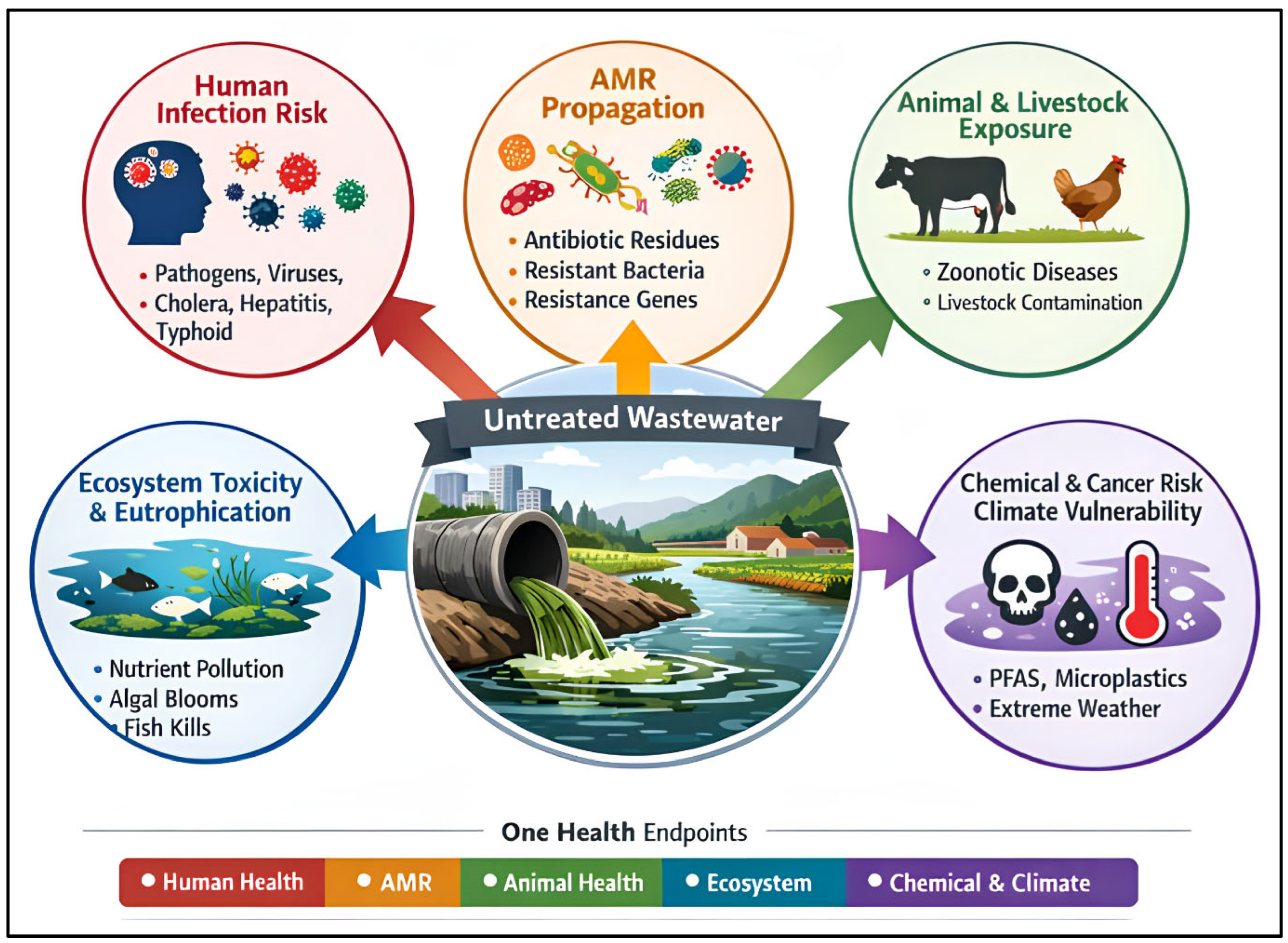



| Contaminant Class | Representative Materials | Typical Occurrence in Wastewater | Why It Matters | Citations |
|---|---|---|---|---|
| Heavy metals/metalloids | Al, Ni, Pb, Cr, Hg, Cu, Zn, As, Cd, Li | Municipal WWTP effluents (Türkiye, 15 plants): Hg ND–0.42 µg/L (mean 0.12), Pb 0.02–28.93 µg/L, Ni 0.07–123.41 µg/L (mean 15.63), Al 11.51–1804.33 µg/L, Cr ND–44.02 µg/L; seasonal totals up to 326.09 mg/L at one station. | Toxicity, bioaccumulation; Cr/Ni low carcinogenic risk at some sites. | [45] |
| Plastics (macro to micro, total load) | Mixed polymers (PE, PP, PS, PET, PVC, etc.) | Mass balance in a WWTP: plastics of all sizes tracked; macroplastics contributed more to total plastic mass than microplastics in the plant; total plastic mass flux quantified across screenings, sludge, and effluent. | Macro items dominate mass; operational implications for screening/sludge handling. | [46] |
| Synthetic dyes (textile effluents) | Reactive Black 5 (RB5), Reactive Blue 19; Direct Blue 71 (examples) | Real textile effluent (Tanzania): RB5 measured ~377.6 mg/L in raw wastewater before treatment. General textile wastewater characteristics: dye concentrations frequently 10–200 mg/L, depending on process/season (collated from plant measurements). | Color, toxicity; inhibits photosynthesis; treatment challenging. | [47,48] |
| Microplastics (MPs) | Fibers & fragments (PE, PP, PET, PS, PA, etc.) | Advanced WWTP (France): influent 109–1583 particles L−1 (≈61.5–100 µg L−1 by mass); removal 99.1–99.9%; effluent typically ~1–2 particles L−1 after tertiary steps. Year-long effluent analysis (Germany, 2 WWTPs): persistent MP detection in effluents (FTIR/Py-GC/MS, counts per L reported across seasons). | MPs pass conventional treatment in small numbers; sludge is a major sink. | [49,50] |
| Pathogens (microbes & viral RNA) | Enteric viruses (e.g., SARS-CoV-2 RNA), bacteria (e.g., E. coli, Enterococcus), protozoa | Municipal wastewater time-series: SARS-CoV-2 RNA consistently detected; wastewater concentration trends mirrored clinical case dynamics in the community (New Haven, USA). | Public health surveillance: infection risk in untreated flows & CSOs. | [51] |
| Pharmaceuticals & personal-care products (PPCPs) | Antibiotics (ciprofloxacin, sulfamethoxazole), analgesics (ibuprofen, diclofenac), beta-blockers, anticonvulsants | Municipal WWTPs (global review of original studies): typical ng/L–µg/L in influents; partial removal; residues in effluents. | Ecotoxicity, antibiotic resistance selection. | [52] |
| PFAS (per- & polyfluoroalkyl substances) | PFOA, PFOS, PFHxA, PFBS, 6:2 FTS (examples) | Meta-analysis of WWTPs: effluent medians generally range from tens to hundreds of ng/L (compound-specific); WWTPs act as sources for many PFAS to surface waters. | Very persistent; bioaccumulation & toxicity concerns; hard to remove. | [53] |
| Nutrients | Ammonium (NH4+-N), Total Nitrogen (TN), Total Phosphorus (TP), phosphate | Typical municipal influent (example dataset): COD~420 mg/L, cBOD5~200 mg/L, NH4-N~24 mg N/L, PO4-P~2.5 mg P/L (pre-treatment). | Eutrophication and oxygen depletion: core drivers of algal blooms. | [54] |
| Petroleum hydrocarbons/surfactants | LAS (linear alkylbenzene sulfonates), nonylphenol ethoxylates; TPH | (Values vary widely by catchment/industry; mg/L levels for surfactants in strong domestic/industrial influent are reported across plants; effluents are typically lower after biological treatment.) | Toxic to aquatic life; endocrine activity (nonylphenols). | [55] |
| Nitrilotriacetic acid (NTA) | NTA (chelating agent in detergents) | Germany, full-scale WWTP influents: NTA detected at 40–400 µg/L, effluents 10–80 µg/L; removal efficiency 70–90%. | Strong chelator; mobilizes heavy metals in the environment. | [56] |
| Bisphenol A (BPA) | BPA (plasticizer, epoxy resins) | WWTPs in Spain: influent 0.06–7.1 µg/L, effluent 0.01–0.5 µg/L, ~90% removal. | Endocrine disruptor; persistent in sludge. | [57] |
| Triclosan (TCS) | Triclosan (antimicrobial in soaps, toothpaste) | U.S. municipal WWTPs: influent 1.8–5.3 µg/L, effluent 0.1–0.5 µg/L (90–95% removal; sorption to sludge major sink). | Antimicrobial resistance driver; toxic to algae. | [58] |
| Phenols/alkylphenols | Phenol, 4-nonylphenol (4-NP), octylphenol | Europe WWTP survey: nonylphenol in influents 0.2–10 µg/L, effluents 0.1–3 µg/L; also, phenol itself detected at µg/L levels. | Estrogenic activity; aquatic toxicity. | [59] |
| Pesticides | Atrazine, diazinon, chlorpyrifos, imidacloprid, glyphosate (examples) | U.S. WWTP influents (EPA survey): pesticides generally <1 µg/L, often ng/L range; diazinon up to 0.3 µg/L; atrazine 20–200 ng/L; imidacloprid 30–150 ng/L. | Chronic aquatic toxicity; endocrine disruption. | [60] |
| Technology Group | Main Role/Target Pollutants | Typical Strength | Maturity Level | Relative Cost | Main Limitation | Best Use Context |
|---|---|---|---|---|---|---|
| Conventional biological treatment | BOD, COD, TSS, routine nutrient removal | Strong for bulk pollutants; weak for PFAS, many pharmaceuticals, and ARGs | High | Low–Medium | Limited for persistent micropollutants | Core municipal treatment |
| Tertiary polishing | Residual solids, pathogens, and partial micropollutant control | Improves discharge and reuse quality | High | Medium | Carbon regeneration, by-products, and chemical demand | Post-secondary polishing |
| Membrane systems (MBR/NF/RO) | Fine particles, pathogens, salts, PFAS, reuse-quality water | Very high separation efficiency | Medium–High | High | Fouling, brine/concentrate disposal, energy demand | High-quality reuse and PFAS control |
| Advanced oxidation processes | Recalcitrant organics, pharmaceuticals, dyes, EDCs | High degradation potential | Medium | High | Energy use, oxidant demand, and possible toxic by-products | Targeted micropollutant polishing |
| Nature-based systems | Nutrients, solids, pathogens, some organics | Good low-energy removal with ecological co-benefits | Medium–High | Low | Land requirement, climate/season sensitivity, variable trace-contaminant control | Decentralized and low-resource settings |
| Bioenergy/resource-recovery systems | COD removal with methane/nutrient recovery | Strong circular-economy potential | Medium–High | Medium–High | Process control and polishing are often still needed | Plants seeking energy or nutrient recovery |
| Nano-enabled systems | Dyes, metals, antibiotics, and difficult micropollutants | Often excellent lab/pilot removal | Low | Medium–High | Scale-up uncertainty, leaching risk, lifecycle concerns | Specialized polishing, mainly pilot/research |
| Hybrid multi-barrier systems | Broad-spectrum pollutant control | Most robust overall performance | Medium | Medium–High | Greater design and operating complexity | Best where high effluent quality is required |
| Method | Green Principle | Wastewater Type/Scale | Key Findings (Typical) | Citations |
|---|---|---|---|---|
| Upflow Anaerobic Sludge Blanket (UASB) | High-rate anaerobic digestion with granular sludge → methane (biogas) production | High-strength industrial & municipal; full-scale, widely deployed | Compact footprint; high COD removal for soluble wastes; strong methane recovery; granule formation critical for performance | [90] |
| Anaerobic Membrane Bioreactor (AnMBR) | Anaerobic digestion + membrane separation (retains biomass)—methane + high quality effluent | Municipal/industrial; pilot → demonstration | Very high COD removal, methane recovery; great for energy recovery and reuse-quality water; membrane fouling and temperature are key constraints | [91] |
| Aerobic granular sludge (AGS; Nereda® technology, Royal HaskoningDHV, Amersfoort, the Netherlands) | Dense, fast-settling aerobic granules that combine simultaneous C/N/P removal in compact reactors | Municipal & industrial; full-scale Nereda installations exist | Compact footprint, reduced aeration/energy per load vs. conventional AS, simultaneous nutrient removal; now mature at full scale (Nereda®) | [92] |
| Mainstream Partial Nitritation–Anammox (PN/A) | Shortcut nitrogen removal—convert NH4+ → NO2− (partial nitritation) then Anammox to N2 (autotrophic) | Municipal mainstream (low-strength)—pilot & demonstration | Very low external C demand and major aeration savings if stable; mainstream (low temp, variable load) remains challenging, but pilots show promise | [93] |
| Microbial Fuel Cells (MFC)/bioelectric systems | Microbes oxidize organics and generate electrons—electricity + treatment | Domestic/industrial; lab → small pilots | Demonstrated COD removal with low-power electricity generation; promising for decentralized low-energy systems; scale & power density remain limiting | [84] |
| Hybrid AnMBR + Constructed Wetland (CW)/AnMBR polishing | High-rate anaerobic energy recovery + nature-based polishing (CW) for nutrients & solids | Municipal/industrial; pilot → field demonstrations | AnMBR provides COD reduction + methane; constructed wetland polishes residual nutrients, solids, and micropollutants—attractive for decentralized/low-cost reuse chains | [94] |
| Mainstream anaerobic + partial aerobic staged treatment (Anoxic/Anammox hybrids) | Process intensification by staging (anaerobic for energy + aerobic/partial aeration for polishing) | Municipal; pilot/demonstration | Integrating anaerobic pre-treatment (AnMBR/UASB) reduces loading to the aerobic stage, increases net energy recovery; often followed by PN/A polishing or a constructed wetland | [95] |
| Anaerobic co-digestion/high-rate digesters + resource capture | Co-treat organic waste/wastewater to increase methane yield & stabilize organics | Industrial/agro + municipal co-digestion; full/pilot | Increased biogas yield and improved carbon balance; attention to inhibition (LCFAs, ammonia) and mixing/hydrodynamics needed | [96] |
| Bioelectro-anMBR/MFC-AnMBR hybrids (bioelectric intensification) | Couple bioelectrochemical cells with anaerobic reactors to enhance degradation/accelerate start-up | Agricultural/domestic pilots; lab → pilot | Reported faster start-up, improved COD removal, and combined energy recovery in pilot tests; integration technical complexity is increasing | [97] |
| Method/Category | Main Advantages | Main Disadvantages/Challenges | Typical Performance Parameters | Best-Suited Wastewater Type/Scale | Key Sustainability Aspects | Why/When to Choose Next Step |
|---|---|---|---|---|---|---|
| Constructed Wetlands (CW) (H/V/Hybrid) | Low-cost, nature-based, robust; good nutrient & pathogen removal; landscape integration | Requires a large land area; performance fluctuates with season/climate; limited micropollutant removal | BOD/COD: 70–90%; TSS: 80–90%; TN: 40–70%; TP: 30–60% | Municipal, domestic, peri-urban communities | Low O&M, ecosystem co-benefits | Choose when land is available, long-term, low-cost, and ecological co-benefits are desired |
| Floating Treatment Wetlands (FTW) | Easy retrofit in ponds/lakes; high N/P uptake; adds aesthetics | Root clogging; limited for high-strength wastewater; requires harvest | TN removal: 40–70%; TP: 30–60% | Stormwater, small ponds, polishing | Ecosystem integration | Choose for polishing stormwater or ponds where conventional plants are impractical |
| Duckweed/Lemna Systems | Fast growth, biomass valorization (feed, bioethanol); high nutrient uptake | Sensitive to temperature, predators, toxins; monoculture risk | TN: up to 70–90%; TP: 60–80% | Agricultural runoff, digestate, and small-scale municipal | Circular economy (feed/biofuel) | Choose when nutrient valorization and circular economy are priorities |
| High-Rate Algal Ponds (HRAP) | Low-cost, O2 self-generation, biomass for biofuels; high N & P removal | Requires high sunlight and temperature control; algal harvesting is costly | COD/BOD: 60–80%; TN: 50–70%; TP: 40–60% | Domestic/municipal; warm climates | Biofuel co-production | Choose when solar resource is high & algal biomass recovery is possible |
| Vermifiltration | Earthworms + microbes; high BOD/COD and pathogen removal; simple O&M | Sensitive to toxins, temperature extremes | BOD/COD: 70–90%; Pathogen ↓ 2–3 log | Domestic/agro-industrial | Low-cost, decentralised | Choose small-scale decentralized wastewater, especially in rural areas |
| Bioflocculants | Biodegradable, replaces chemical alum/PAC | Large-scale production is not yet cost-effective | Turbidity/SS removal > 80% | Industrial & municipal | Avoids chemical sludge | Choose when the eco-friendly coagulant demand is high |
| Immobilized Enzymes (e.g., laccase) | High specificity for dyes/phenols; reusability | Enzyme cost, stability, and immobilization challenges | Color removal: >90%; phenols ↓ | Textile, pharma | Green catalytic degradation | Choose for industrial effluents rich in recalcitrant organics |
| UASB (Anaerobic Digestion) | Energy recovery (biogas); compact footprint; low sludge | Lower nutrient removal; requires polishing | COD removal: 70–90%; CH4 yield: 0.2–0.3 m3/kg COD | High-strength industrial, municipal (warm climates) | Energy-positive, low sludge | Choose when high-strength wastewater + biogas recovery is desired |
| AnMBR | Produces clean water + methane; compact; high COD removal | Membrane fouling, cost, requires skilled O&M | COD removal > 95%; methane recovery high | Municipal/industrial | Energy recovery + water reuse | Choose when high effluent quality & reuse is a priority |
| Aerobic Granular Sludge (AGS) | Compact, simultaneous N/P removal; energy-efficient vs. CAS | Startup time requires controlled operation | COD/BOD: 80–90%; TN: >70%; TP: >70% | Municipal full-scale | Energy-saving, smaller footprint | Choose modern urban WWTPs with land/energy constraints |
| PN/A (Partial Nitritation-Anammox) | Low O2 & no external C; huge energy saving for N removal | Requires stable conditions; sensitivity to temp/DO | N removal efficiency 70–90% | Municipal & industrial | Low-carbon N removal | Choose for N-rich, C-poor wastewater with stable operation |
| MFCs (Microbial Fuel Cells) | Simultaneous COD removal + electricity | Low power density; scaling issues | COD: 60–80%; Power: 0.1–2 W/m2 | Lab/pilot only | Energy recovery + sensing | Choose for niche: remote sensing + polishing |
| Hybrid AnMBR + CW | Combines high COD removal + polishing; energy balance | Larger footprint; more complex design | COD removal > 95% + nutrients ↓ | Municipal/industrial | Integrative sustainability | Choose when energy recovery + natural polishing are both needed |
| Green Nanoparticles (Ag, ZnO, TiO2) | High reactivity; effective at low doses; solar-driven | Nanotoxicity concerns: cost of scaling | Dye/phenol removal > 90%; antibacterial action | Textile, pharma, lab → pilot | Green chemistry, photocatalysis | Choose for industrial recalcitrant effluents, if safe disposal is ensured |
| Magnetic Biochar/Graphene/Carbon Dots | Renewable feedstock; recyclable adsorbents/catalysts | Stability/recovery costs; possible leaching | Adsorption q_max: 100–500 mg/g; photocatalysis visible-light active | Industrial, dye/metal wastewater | Waste-to-resource | Choose when adsorbent regeneration and the circular economy are desired |
| Photocatalytic Membranes/Solar AOPs | Combine filtration & degradation; sunlight use | High capital cost; requires clear water for AOPs | COD/Pharma removal: 80–95% | Municipal/industrial polishing | Renewable-driven | Choose for micropollutant removal in advanced treatment |
| Renewable-Powered EC (solar-EC) | Uses PV or solar-thermal; reduced CO2 | Dependence on solar; electrode fouling | Turbidity/metal removal > 90% | Textile/industrial | Energy + treatment synergy | Choose when solar potential is high + industrial wastewater with metals/dyes |
| Title | Nanoparticle | Green Source | Target Pollutant(s) | Matrix | Citations |
|---|---|---|---|---|---|
| Green-synthesized AgNP-enhanced nanofiltration membranes for oily wastewater | Ag | Hibiscus extract | Oil, salts, dyes | Oily wastewater | [99] |
| Green synthesis of AgNPs using Acacia ehrenbergiana for RhB removal | Ag | Acacia cortex | Rhodamine B | Dye solution | [100] |
| Green ZnO NPs using Phoenix dactylifera waste for dye degradation | ZnO | Date waste | Textile dyes, bacteria | Wastewater | [101] |
| Green ZnO from algae (Padina pavonica) for MB removal | ZnO | Algae | Methylene blue | Dye solution | [102] |
| Green synthesis of TiO2 using Impatiens rothii extract | TiO2 | Impatiens leaves | Dyes (RhB) | Dye solution | [103] |
| TiO2 NPs from Syzygium cumini for Pb removal | TiO2 | Syzygium cumini | Pb (II) | Industrial wastewater | [104] |
| Bacillus subtilis-mediated TiO2 NPs for dye removal | TiO2 | Bacillus subtilis | Dyes | Dye solution | [105] |
| Green TiO2 via Acorus calamus for RhB degradation | TiO2 | Acorus calamus | Rhodamine B | Dye solution | [106] |
| CuO NPs for tanning wastewater sterilization & dye removal | CuO | Plant extract | Microbes, dyes | Tanning wastewater | [107] |
| Aloe vera-derived CuO NPs for contaminants | CuO | Aloe vera | Dyes/contaminants | Model solutions | [108] |
| CuO via green combustion for dye degradation | CuO | Plant extract | Dyes | Dye solution | [109] |
| Plant-based CuO NPs for tanning wastewater | CuO | Plant extract | Metals, microbes | Tanning wastewater | [110] |
| CuO from Seriphidium oliverianum for dyes | CuO | Seriphidium | Dyes | Dye solution | [111] |
| CuO via Parthenium hysterophorus for rifampicin | CuO | Parthenium | Rifampicin (antibiotic) | Antibiotic solution | [112] |
| nZVI from eucalyptus leaves for eutrophic wastewater | nZVI (Fe0) | Eucalyptus | Nutrients, organics | Wastewater | [113] |
| Montmorillonite-supported nZVI via green tea for Cr (VI) | nZVI | Green tea | Cr (VI) | Water & soil | [114] |
| Tea-leaf-derived nZVI for dye Fenton degradation | nZVI | Tea leaves | Mixed dyes | Dye solution | [115] |
| Ricinus communis-based nZVI for MB removal | nZVI | Ricinus communis | Methylene blue | Dye solution | [116] |
| Fe3O4 via tea polyphenols for dye removal | Fe3O4 | Green tea | Dyes | Dye solution | [117] |
| Fe oxide NPs via Psidium guajava leaves | Fe2O3/Fe3O4 | Psidium guajava | Dyes, pathogens | Dye solution | [118] |
| Magnetic Fe3O4 via Cordia myxa extract | Fe3O4 | Cordia myxa | Dyes, metals | Model solution | [119] |
| Spirulina-based iron oxide NPs for dyes | Fe oxide | Spirulina platensis | Crystal violet, methyl orange | Real effluent | [120] |
| Clove/coffee-extract Fe oxide NPs for Cd/Ni | Fe oxide | Clove & coffee | Cd (II), Ni (II) | Aqueous solutions | [121] |
| Biosynthesized AgNPs using Cestrum nocturnum for dye degradation | Ag | Cestrum nocturnum | MB, Congo Red, 4-NP, 4-NA | Dye solution | [122] |
| Green ZnO NPs via Sargassum muticum (marine brown algae) | ZnO | Sargassum muticum | MB, bacteria | Aqueous solution | [123] |
| Review: Efficient dye degradation using green ZnO-based nanoplatforms | ZnO (review) | Various | Dyes | - | [124] |
| Green synthesis of ZnO using Justicia adhatoda for MG & 4-NP degradation | ZnO | Justicia adhatoda | Malachite Green, 4-NP | Dye solution | [125] |
| Eco-friendly AgNPs + TiO2/ZnO mix for textile dye degradation | Ag + TiO2/ZnO | Chitosan biopolymer | Acid Red 37 | Dye solution | [126] |
| Ag–Mn oxide NPs for malachite green degradation | Ag–Mn oxide | Wet chemical | Malachite Green | Dye solution | [127] |
| Review: Catalytic dye removal by green-synthesized SeNPs | SeNPs (review) | Various | Dyes | - | [128] |
| Biogenic ZnO-NPs for municipal wastewater & wheat cultivation | ZnO | Shewanella sp. | Nutrients, COD, phosphate | Municipal wastewater | [129] |
| Biogenic AgNPs for textile wastewater | AgNPs | Conocarpus + Pseudomonas | Reactive Black 5, Reactive Red 120 | Textile wastewater | [130] |
| Magnetite-pectin nanoparticles for levofloxacin removal | Fe3O4 | Citrus pectin | Levofloxacin | Wastewater | [131] |
| Natural product-coated magnetite NPs for mixed wastewater | Fe3O4 | Jatropha curcas, C. tamala | Dyes, metals, bacteria | Mixed wastewater | [132] |
| FeNPs from bioflocculant for coal-mine wastewater | Fe NPs | Bioflocculant (Actinomycete) | BOD, COD | Coal mine wastewater | [133] |
| Filter paper fabricated with green-tea Fe NPs | Fe NPs | Green tea | Heavy metals | Industrial wastewater | [134] |
| Nano-bioremediation of textile wastewater using myco-CuO-NPs | CuO | Fusarium oxysporum | Dyes, Pb, Cr, Ni | Textile wastewater | [135] |
| Green CuO NPs for Pb, Ni, Cd removal | CuO | Mint & orange peel | Pb, Ni, Cd | Industrial water | [136] |
| Domestic wastewater disinfection filter—biosynthesised AgNPs | AgNPs | Streptomyces sp. | Microbes (coliforms) | Domestic wastewater | [137] |
| Chitosan–magnetite composite for fluoroquinolone removal | Fe3O4 + chitosan | Chitosan | Ciprofloxacin, levofloxacin | Aquaculture wastewater | [138] |
| Title | Nanocomposite/Composition | Application/Pollutant | Citations |
|---|---|---|---|
| Green-synthesized rGO/TiO2 nanocomposite using carob extract for heavy metal and dye removal | rGO + TiO2 (green, carob extract) | Adsorption of Zn2+, Ni2+, Pb2+, Cd2+; photocatalytic degradation of methylene blue | [139] |
| CuO@A-TiO2/Ro-TiO2 nanocomposite (green synthesis) for photocatalytic degradation of dye in textile wastewater | CuO + Anatase-TiO2 + Rod-TiO2 | Photocatalytic elimination of Reactive Orange 16 in actual textile wastewater | [140] |
| Nanocomposites from spent coffee grounds with FeO/ZnO nanoparticles (green) | FeO + ZnO supported on spent coffee grounds | Treatment of textile wastewater (dye removal, etc.) | [141] |
| Green synthesis of CuO/PANI nanocomposite for Pb(II) removal from contaminated water | CuO nanoparticles in Polyaniline (PANI) | Adsorption of Pb2+ ions from water | [142] |
| MMT/Ag (montmorillonite–silver) nanocomposite synthesized via weed extract for dye removal | Montmorillonite clay + Ag NPs | Adsorption of methylene blue dye from aqueous solution | [143] |
| Novel wastewater treatment by using newly prepared green seaweed–zeolite nanocomposite | Seaweed (bio-waste) + Zeolite | Removal of organic/inorganic contaminants in wastewater | [144] |
| Eco-friendly, sustainable, synthesised nanocomposite (corn leaves + ZnO) for heavy metal removal | Corn leaves + ZnO | Removal of Fe2+ and Ni2+ from water | [145] |
| Metal-based green-valorised nanocomposites for dye remediation (e.g., ZnO/biochar, nano-zerovalent manganese/biochar) | ZnO/biochar, Mn0/biochar | Adsorptive removal of dyes (e.g., Congo red) from water | [146] |
| Synthesis of hybrid nanostructures by green methods (e.g., Cu@TiO2 leaf extract composites) for wastewater remediation | Cu@TiO2 via Cedrus deodara; Ni@Fe3O4 and CuO NPs via Euphorbia extract | Photocatalytic degradation of organic pollutants in wastewater | [147] |
| Review of polymeric nanocomposites for photocatalytic wastewater treatment | Various polymer-based nanocomposites | Photocatalytic degradation of dyes and organic pollutants | [148] |
| ZnO/rGO nanocomposites synthesized using red rice husk extract for dye photodegradation | ZnO + reduced graphene oxide (rGO) via red rice husk extract | Photocatalytic degradation of malachite green | [149] |
| Pd/Fe3O4 nanocomposite via Hibiscus extract for reductive catalysis of Cr(VI) and 4-nitrophenol | Pd on Fe3O4, green Hibiscus extract synthesis | Catalytic reduction of Cr(VI) and 4-NP in water | [150] |
| Chitosan-based nanocomposite gel with TiO2 and silica for dye removal | Chitosan + silica + TiO2 NPs | Adsorption of methylene blue; Cr(VI) adsorption potential | [151] |
| ZnO/NiFe2O4 nanocomposite synthesized via green route for dye degradation | ZnO (green) + NiFe2O4 | Photocatalytic degradation of methylene blue in wastewater | [152] |
| MgO/graphene nanoplatelet nanocomposite for photocatalytic wastewater purification | MgO + graphene nanoplatelets | Photocatalytic degradation of pollutants in industrial wastewater | [153] |
| Method | Green Principle | Wastewater Type/Scale | Key Findings | Citations |
|---|---|---|---|---|
| Green-synthesized Ag nanoparticles | Plant/biomass extracts act as reducing/stabilizing agents; antimicrobial + catalytic dye reduction | Textile dye, hospital effluent; lab → pilot | Rapid dye reduction, strong antibacterial action, and easy synthesis from waste plant extracts | [100] |
| Green ZnO nanoparticles | Phytosynthesis of ZnO NPs; visible/UV photocatalysis | Dye wastewater; lab | High photocatalytic degradation under sunlight/UV; bandgap tuning via extracts | [154] |
| Green TiO2/MnO2 heterojunctions (biogenic) | Plant-extract reduction/templating → heterojunction photocatalyst; solar-driven | Industrial (pulp & paper) effluent; pilot membrane tests | Strong sunlight-driven photocatalysis + membrane separation; large COD reduction in trials | [155] |
| Green ZnO–TiO2/other mixed oxide composites | Biogenic doping/heterojunctions → reduced recombination, visible response | Dyes, pharmaceuticals; lab/pilot | Faster pollutant mineralization under solar irradiation vs. single oxide | [156] |
| Magnetic biochar nanocomposites (Fe3O4@biochar) | Biomass-derived adsorbent + Fe3O4 for magnetic recovery | Dye/metal wastewater; batch/column pilot | High adsorption capacity; easy magnetic separation & reusability | [157] |
| Nanocellulose membranes/adsorbents | Renewable cellulose → high-surface, mechanically robust membranes/adsorbents | Dye/heavy metal; lab → pilot | Exceptional mechanical strength, tunable surface chemistry, and high flux/selectivity | [158] |
| Biomass-derived carbon dots/carbon quantum dots (CDs/CQDs) | Hydrothermal transformation of agrowaste → photoluminescent photocatalysts & sensors | Dye & micropollutant lab tests | Visible-light photocatalysis, low-toxicity sensors, and facile synthesis from waste | [159] |
| Photocatalytic membranes (green NP-embedded)/Photocatalytic membrane reactors (PMR) | Embed green NP photocatalysts in membranes → filtration + degradation | Tertiary polishing; pilot | Simultaneous particle removal and decomposition of organics; reduced fouling via photocatalysis | [160] |
| Solar-driven AOPs (solar photo-Fenton, solar/UV-H2O2, solar/persulfate) | Use sunlight to activate oxidants/photocatalysts → minimal grid energy/chemicals | Municipal effluent/industrial recalcitrant wastewater; pilot | High removal of micropollutants & pathogens in pilot trials; pH/iron management matters | [161] |
| Renewable-powered electrocoagulation (PV-EC/solar-EC) | Photovoltaic electricity drives EC cells—coagulation without grid fossil electricity | Textile/dye, municipal; pilot | Effective turbidity/dye/metal removal; favourable LCA if PV sized appropriately; battery-less direct-PV schemes possible | [162] |
| Green-synthesized CuO/Cu2O nanoparticles & nanocomposites | Plant-assisted Cu-oxide NPs: low cost, strong photocatalysis & Fenton-like activity | Dye/antibiotic wastewater; lab | Good visible-light activity and bactericidal properties; Cu-leaching management required | [163] |
| Bio-MOFs/biomass-templated porous materials | Biomass templates → metal–organic frameworks/activated MOF-like structures for adsorption & catalysis | Pharmaceuticals, dyes; lab/pilot | Extremely high surface area & tunable functionality; selective adsorption of pharmaceuticals/metal ions | [164] |
| Graphene oxide/reduced GO from biomass & composites | Convert agrowaste → GO/rGO for adsorption, catalytic composite supports | Dye/metal wastewater; lab/column | High adsorption & excellent electron transfer when combined with photocatalysts; regeneration possible | [165] |
| Photocatalytic aerogels & 3D porous photocatalysts | Low-density 3D structures with immobilized green NPs → high contact area | Industrial effluents; lab/pilot | High throughput, easier recovery than slurry photocatalysts; good sunlight utilization | [166] |
| Magnetic photocatalysts (Fe-doped TiO2, Fe3O4-TiO2) | Magnetic recovery + photocatalysis (green synthesis pathways exist) | Dye/aqueous organics; lab → pilot | Combine high photocatalytic rates with straightforward magnetic separation | [167] |
| (A) | |||||||
| Green Nanomaterial | Source/Synthesis | Water/Wastewater Application | One Health Relevance | Cancer Link | |||
| Chitosan nanoparticles | Derived from crustacean shells, green synthesis | Adsorption of heavy metals (As, Pb, Cd) | Reduces toxic metals in water, protecting humans, animals, and ecosystems | Removes arsenic and lead, linked to skin, bladder, and lung cancers | |||
| Silver nanoparticles (AgNPs) | Plant extract-mediated synthesis | Antimicrobial treatment of wastewater | Reduces pathogenic bacteria and AMR spread | Potential for anticancer therapy via selective cytotoxicity | |||
| Zinc oxide nanoparticles (ZnO NPs) | Plant-based or microbial synthesis | Photocatalytic degradation of organic pollutants (dyes, pesticides) | Minimises chemical pollution in ecosystems | Degrades carcinogenic dyes, reducing exposure risk | |||
| Gold nanoparticles (AuNPs) | Green synthesis using plant extracts | Targeted removal of pollutants or drug delivery | Non-toxic, safe for environmental and biomedical use | Can deliver anticancer drugs or induce apoptosis in tumour cells | |||
| Graphene oxide/Carbon dots | Biomass or food waste | Adsorption of dyes, heavy metals, and pharmaceutical residues | Reduces persistent pollutants, protecting environmental and animal health | Some carbon-based nanomaterials exhibit anticancer activity in vitro | |||
| Titanium dioxide nanoparticles (TiO2 NPs) | Plant-mediated green synthesis | Photocatalytic degradation of organic pollutants and disinfectants | Reduces chemical and microbial contamination in water | Removes carcinogenic dyes and toxins from water | |||
| Copper nanoparticles (CuNPs) | Microbial or plant extract synthesis | Antimicrobial treatment of wastewater | Helps control pathogens, reducing risk to humans and animals | Potential cytotoxic effects on cancer cells in research studies | |||
| (B) | |||||||
| Metal | Cancer Types | Affected Genes/Proteins | Reference | ||||
| Lead (Pb) | Lung cancer | IL-1β, TNF-α, IL-6; oxidative-stress markers; pathways linked to DNA damage/repair disruption | [168] | ||||
| Lead (Pb) | Breast cancer | BCL2, p53; markers of genomic instability (MSI, TMB); epigenetic alterations (DNA methylation, histone changes) | [169] | ||||
| Lead (Pb) | Kidney (renal) cancer | δ-ALA dehydratase (δ-ALAD), ferrochelatase; oxidative-stress and heme-biosynthesis disruption | [170] | ||||
| Chromium (Cr, hexavalent Cr(VI)) | Lung cancer (incidence & mortality) | p53, MLH1, MSH2, BCL2, VEGF; activation of NF-κB pathways; DNA-protein crosslinks and oxidative DNA damage | [171] | ||||
| Chromium (Cr, hexavalent Cr(VI)) | Lung—mechanistic (preclinical + human bioinformatics) | ABHD11-AS1 (lncRNA), USP15, TRAF3, RelB, PD-L1 (CD274), IL-6/JAK-STAT3; non-canonical NF-κB activation | [172] | ||||
| Chromium (Cr) | Larynx, bladder, kidney, testicular, bone, thyroid cancers (associations reported) | ATM, ERK, c-MYC, XPF, Bcl-X; genes involved in DNA repair, apoptosis, and cell-cycle regulation | [169] | ||||
| Chromium (Cr) | Gastric & colorectal cancers (limited/weak evidence) | Genes/pathways related to oxidative stress and DNA-repair disruption (epigenetic changes also reported) | [169] | ||||
Disclaimer/Publisher’s Note: The statements, opinions and data contained in all publications are solely those of the individual author(s) and contributor(s) and not of MDPI and/or the editor(s). MDPI and/or the editor(s) disclaim responsibility for any injury to people or property resulting from any ideas, methods, instructions or products referred to in the content. |
© 2026 by the authors. Licensee MDPI, Basel, Switzerland. This article is an open access article distributed under the terms and conditions of the Creative Commons Attribution (CC BY) license.
Share and Cite
Zafar, I.; Shafiq, S.; Khan, M.S. Wastewater Treatment Challenges and Circular Reuse for One Health Sustainability: A Review. Int. J. Environ. Res. Public Health 2026, 23, 563. https://doi.org/10.3390/ijerph23050563
Zafar I, Shafiq S, Khan MS. Wastewater Treatment Challenges and Circular Reuse for One Health Sustainability: A Review. International Journal of Environmental Research and Public Health. 2026; 23(5):563. https://doi.org/10.3390/ijerph23050563
Chicago/Turabian StyleZafar, Imran, Shaista Shafiq, and Muhammad Sohail Khan. 2026. "Wastewater Treatment Challenges and Circular Reuse for One Health Sustainability: A Review" International Journal of Environmental Research and Public Health 23, no. 5: 563. https://doi.org/10.3390/ijerph23050563
APA StyleZafar, I., Shafiq, S., & Khan, M. S. (2026). Wastewater Treatment Challenges and Circular Reuse for One Health Sustainability: A Review. International Journal of Environmental Research and Public Health, 23(5), 563. https://doi.org/10.3390/ijerph23050563