Applications of Artificial Intelligence (AI) in Breast Cancer Care Delivery and Education: A Scoping Review

 , , ,
, , ,  , and
, and 
Highlights
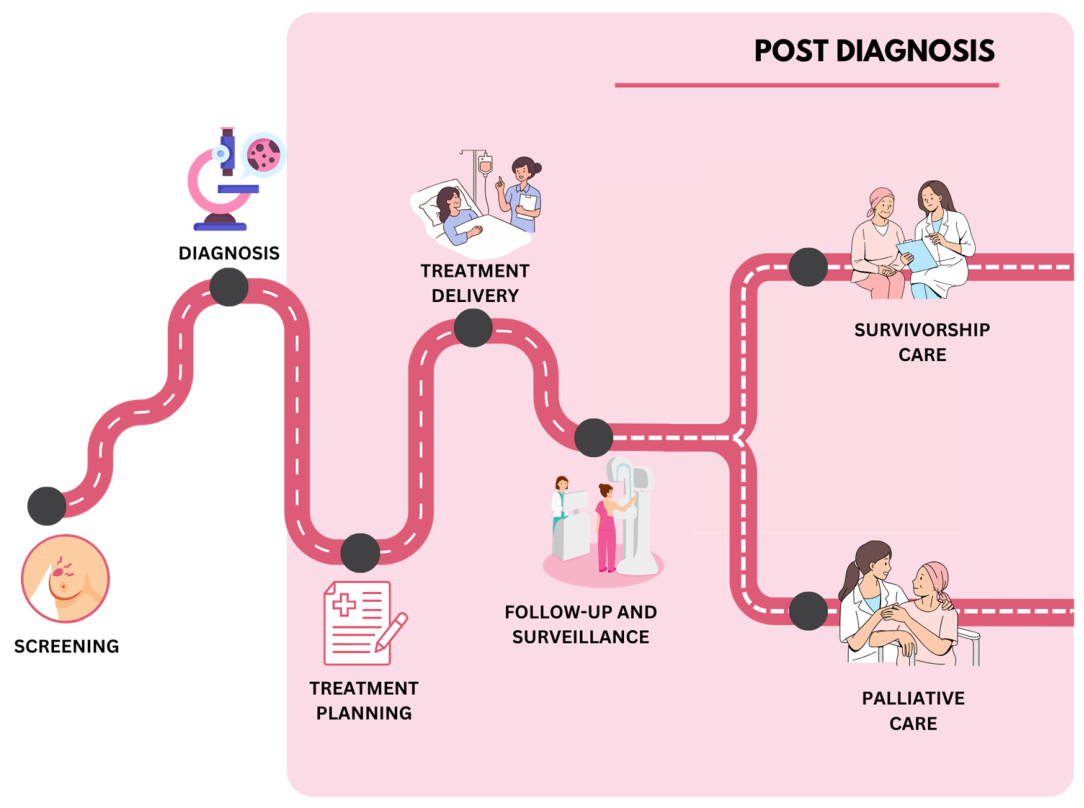
- Breast cancer is the most commonly diagnosed cancer among women worldwide, and AI technologies are increasingly being developed to support care after diagnosis. Yet, no comprehensive map exists of how these tools are applied across the post-diagnosis care pathway.
- The rapid growth of generative AI tools such as ChatGPT has created new pathways for patients to independently access cancer-related health information, with uncertain implications for safety and equity.
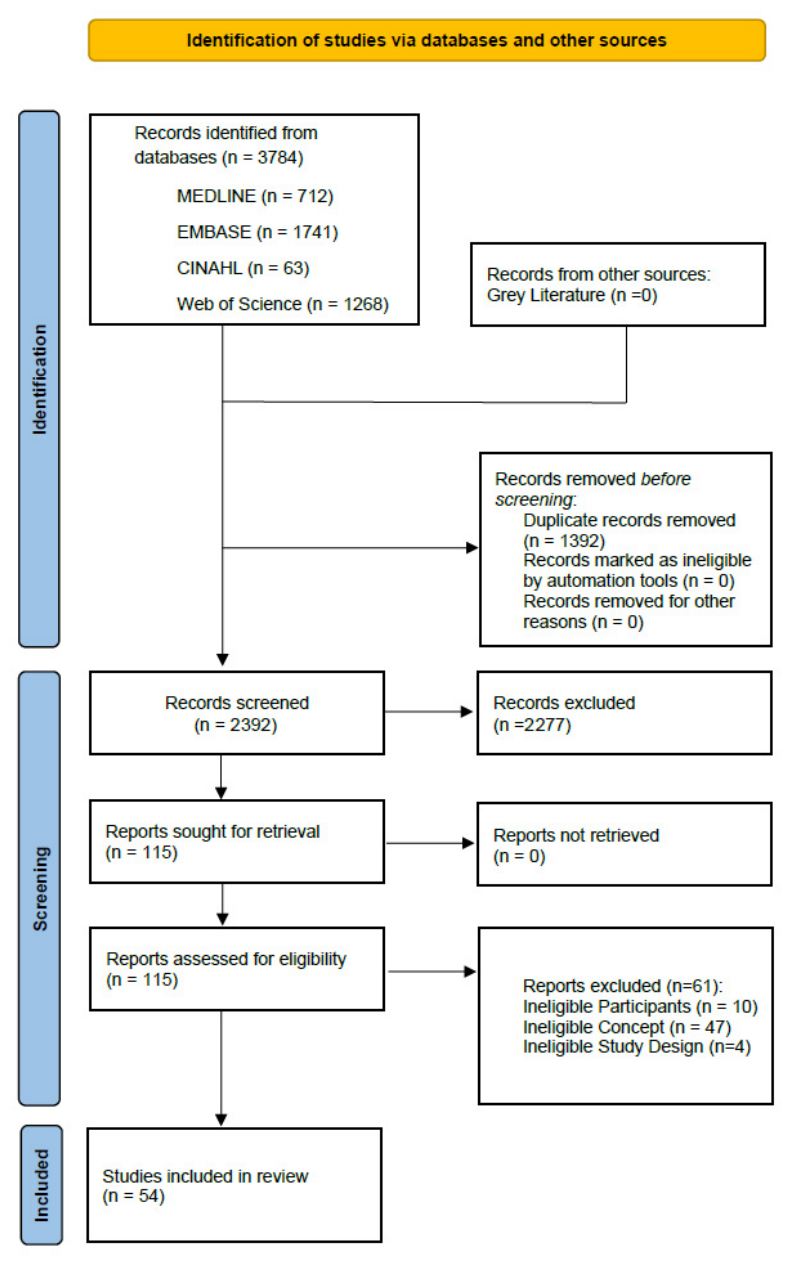
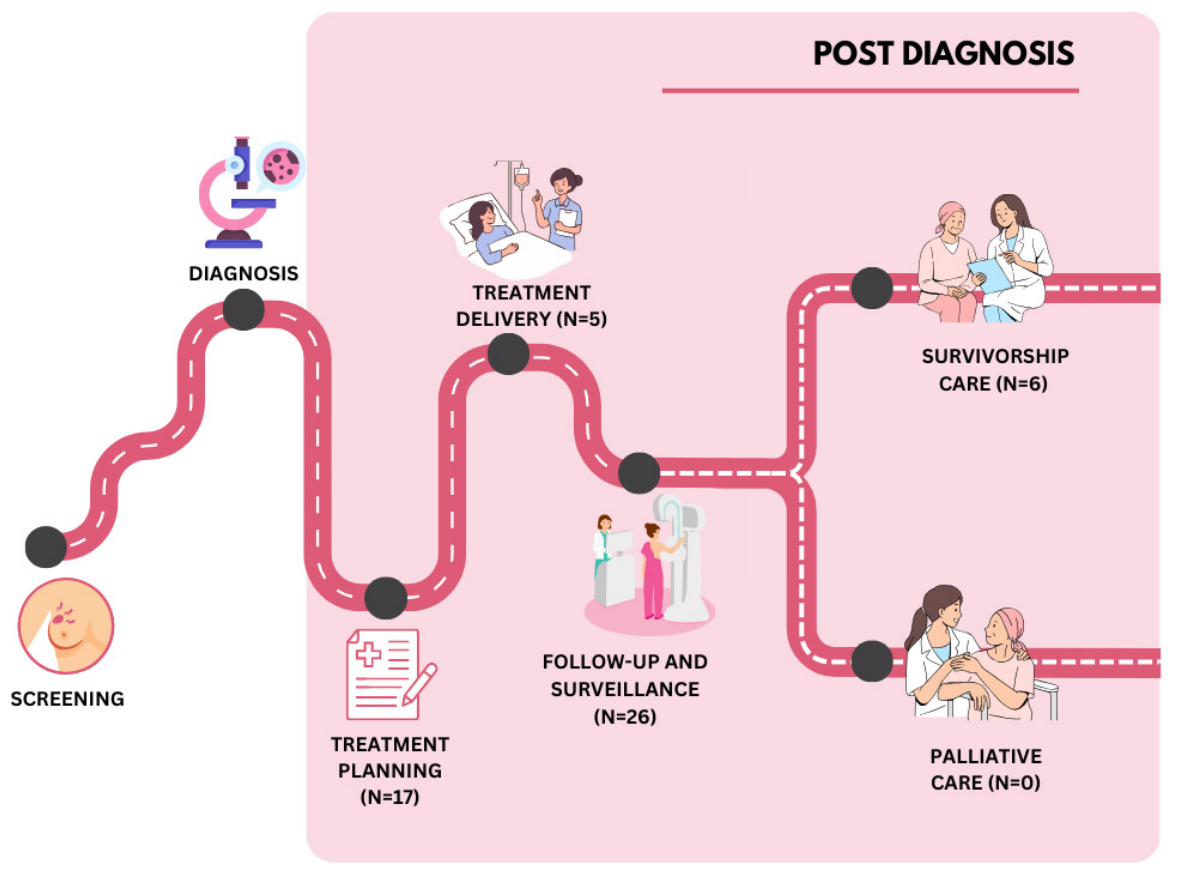
- This scoping review identifies 54 studies across four post-diagnosis care stages, revealing that 83% of AI applications are provider-focused and concentrated in recurrence prediction, while patient-facing tools and palliative care remain largely unaddressed.
- The evidence base is dominated by retrospective designs from high-income countries, raising concerns about the generalisability and equitable implementation of AI tools across diverse populations and healthcare settings.
- Policymakers and health systems should distinguish between clinically integrated conversational agents and unsupervised generative AI when developing governance frameworks for AI in cancer care.
- Future research should prioritise prospective evaluation of AI tools in real-world clinical workflows, patient experience studies, and the development of AI applications in underserved care stages such as survivorship and palliative care.
Abstract
1. Introduction
2. Materials and Methods
2.1. Eligibility Criteria
2.1.1. Participants
- Patients with a confirmed diagnosis of breast cancer, regardless of age, gender, or socioeconomic status, who are currently receiving or have previously received treatment;
- Healthcare providers who use, deliver, or implement AI technologies in the post-diagnosis phase of breast cancer care.
2.1.2. Concept
2.1.3. Context
2.1.4. Types of Sources
2.2. Search Strategy
2.3. Selection of Sources of Evidence
2.4. Data Charting Process
2.5. Data Analysis and Presentation
3. Results
3.1. Source of Evidence Inclusion
3.2. Characteristics of Included Studies
3.3. Review Findings
3.3.1. AI for Treatment Planning
3.3.2. AI for Treatment Delivery
3.3.3. AI for Patient Follow-Up and Surveillance
3.3.4. AI for Survivorship Care
3.3.5. AI for Palliative Care
4. Discussion
4.1. Summary of Evidence
4.1.1. AI in Prognostic Modelling and Clinical Workflows
4.1.2. Patient-Facing AI: Conversational Agents and Generative AI
4.1.3. Growth in Interest and Versatility of AI for Breast Cancer Care Delivery
4.1.4. Disparities in the Use of AI for Breast Cancer Care
4.2. Study Limitations
4.3. Comparison with Existing Literature
4.4. Implications for Future Research and Practice
5. Conclusions
Supplementary Materials
Author Contributions
Funding
Institutional Review Board Statement
Informed Consent Statement
Data Availability Statement
Conflicts of Interest
Abbreviations
| AI | Artificial Intelligence |
| ML | Machine Learning |
| NLP | Natural Language Processing |
| LLM | Large Language Model |
References
- Sung, H.; Ferlay, J.; Siegel, R.L.; Laversanne, M.; Soerjomataram, I.; Jemal, A.; Bray, F. Global Cancer Statistics 2020: GLOBOCAN Estimates of Incidence and Mortality Worldwide for 36 Cancers in 185 Countries. CA Cancer J. Clin. 2021, 71, 209–249. [Google Scholar] [CrossRef]
- World Health Organization. Breast Cancer Statistics. 2024. Available online: https://www.who.int/news-room/fact-sheets/detail/breast-cancer (accessed on 20 October 2025).
- Łukasiewicz, S.; Czeczelewski, M.; Forma, A.; Baj, J.; Sitarz, R.; Stanisławek, A. Breast Cancer-Epidemiology, Risk Factors, Classification, Prognostic Markers, and Current Treatment Strategies-An Updated Review. Cancers 2021, 13, 4287. [Google Scholar] [CrossRef]
- Shang, C.; Xu, D. Epidemiology of Breast Cancer. Oncologie 2022, 24, 649–663. [Google Scholar] [CrossRef]
- Taskindoust, M.; Thomas, S.M.; Sammons, S.L.; Fayanju, O.M.; DiLalla, G.; Hwang, E.S.; Plichta, J.K. Survival Outcomes Among Patients with Metastatic Breast Cancer: Review of 47,000 Patients. Ann. Surg. Oncol. 2021, 28, 7441–7449. [Google Scholar] [CrossRef] [PubMed]
- Bergerot, C.; Bergerot, P.G.; Maués, J.; Segarra-Vazquez, B.; Mano, M.S.; Tarantino, P. Is Cancer Back? Psychological Issues Faced by Survivors of Breast Cancer. Ann. Palliat. Med. 2024, 13, 1229–1234. [Google Scholar] [CrossRef] [PubMed]
- Secinaro, S.; Calandra, D.; Secinaro, A.; Muthurangu, V.; Biancone, P. The Role of Artificial Intelligence in Healthcare: A Structured Literature Review. BMC Med. Inform. Decis. Mak. 2021, 21, 125. [Google Scholar] [CrossRef]
- Panch, T.; Szolovits, P.; Atun, R. Artificial Intelligence, Machine Learning and Health Systems. J. Glob. Health 2018, 8, 020303. [Google Scholar] [CrossRef]
- Kourou, K.; Exarchos, T.P.; Exarchos, K.P.; Karamouzis, M.V.; Fotiadis, D.I. Machine Learning Applications in Cancer Prognosis and Prediction. Comput. Struct. Biotechnol. J. 2015, 13, 8–17. [Google Scholar] [CrossRef] [PubMed]
- Shah, S.M.; Khan, R.A.; Arif, S.; Sajid, U. Artificial Intelligence for Breast Cancer Analysis: Trends and Directions. Comput. Biol. Med. 2022, 142, 105221. [Google Scholar] [CrossRef]
- Khurana, D.; Koli, A.; Khatter, K.; Singh, S. Natural Language Processing: State of the Art, Current Trends and Challenges. Multimed. Tools Appl. 2023, 82, 3713–3744. [Google Scholar] [CrossRef]
- Sarella, P.N.K.; Mangam, V.T. AI-Driven Natural Language Processing in Healthcare: Transforming Patient-Provider Communication. Indian J. Pharm. Pract. 2024, 17, 21–26. [Google Scholar] [CrossRef]
- Wu, W.-T.; Li, Y.-J.; Feng, A.-Z.; Li, L.; Huang, T.; Xu, A.-D.; Lyu, J. Data Mining in Clinical Big Data: The Frequently Used Databases, Steps, and Methodological Models. Mil. Med. Res. 2021, 8, 44. [Google Scholar] [CrossRef]
- Alpers, L.M. Distrust and Patients in Intercultural Healthcare: A Qualitative Interview Study. Nurs. Ethics 2018, 25, 313–323. [Google Scholar] [CrossRef]
- Chaix, B.; Bibault, J.-E.; Pienkowski, A.; Delamon, G.; Guillemasse, A.; Nectoux, P.; Brouard, B. When Chatbots Meet Patients: One-Year Prospective Study of Conversations Between Patients with Breast Cancer and a Chatbot. JMIR Cancer 2019, 5, e12856. [Google Scholar] [CrossRef]
- Bayley, E.M.; Liu, H.Y.; Bonetti, M.A.; Egro, F.M.; Diego, E.J. ChatGPT as Valuable Patient Education Resource in Breast Cancer Care. Ann. Surg. Oncol. 2024, 32, 653–655. [Google Scholar] [CrossRef]
- Gummadi, R.; Dasari, N.; Kumar, S.D.; Pindiprolu, S.K.S. Evaluating the Accuracy of Large Language Model (ChatGPT) in Providing Information on Metastatic Breast Cancer. Adv. Pharm. Bull. 2024, 14, 499–503. [Google Scholar] [CrossRef] [PubMed]
- Liu, Y.H.; Bonetti, A.M.; Jeong, T.; Pandya, S.; Nguyen, V.T.; Egro, M.F. Dr. ChatGPT Will See You Now: How Do Google and ChatGPT Compare in Answering Patient Questions on Breast Reconstruction? J. Plast. Reconstr. Aesthetic. Surg. 2023, 85, 488–497. [Google Scholar] [CrossRef] [PubMed]
- Pan, A.; Musheyev, D.; Bockelman, D.; Loeb, S.; Kabarriti, A.E. Assessment of Artificial Intelligence Chatbot Responses to Top Searched Queries About Cancer. JAMA Oncol. 2023, 9, 1437–1440. [Google Scholar] [CrossRef]
- Haug, C.J.; Drazen, J.M. Artificial Intelligence and Machine Learning in Clinical Medicine, 2023. N. Engl. J. Med. 2023, 388, 1201–1208. [Google Scholar] [CrossRef] [PubMed]
- Sidey-Gibbons, J.A.M.; Sidey-Gibbons, C.J. Machine Learning in Medicine: A Practical Introduction. BMC Med. Res. Methodol. 2019, 19, 64. [Google Scholar] [CrossRef] [PubMed]
- Pan, L.; Wu, X.; Lu, Y.; Zhang, H.; Zhou, Y.; Liu, X.; Liu, S.; Yan, Q. Artificial Intelligence Empowered Digital Health Technologies in Cancer Survivorship Care: A Scoping Review. Asia Pac. J. Oncol. Nurs. 2022, 9, 100127. [Google Scholar] [CrossRef]
- Bi, W.L.; Hosny, A.; Schabath, M.B.; Giger, M.L.; Birkbak, N.J.; Mehrtash, A.; Allison, T.; Arnaout, O.; Abbosh, C.; Dunn, I.F.; et al. Artificial Intelligence in Cancer Imaging: Clinical Challenges and Applications. CA Cancer J. Clin. 2019, 69, 127–157. [Google Scholar] [CrossRef]
- Chia, J.L.L.; He, G.S.; Ngiam, K.Y.; Hartman, M.; Ng, Q.X.; Goh, S.S.N. Harnessing Artificial Intelligence to Enhance Global Breast Cancer Care: A Scoping Review of Applications, Outcomes, and Challenges. Cancers 2025, 17, 197. [Google Scholar] [CrossRef]
- Peters, M.D.J.; Marnie, C.; Colquhoun, H.; Garritty, C.M.; Hempel, S.; Horsley, T.; Langlois, E.V.; Lillie, E.; O’bRien, K.K.; Tunçalp, O.; et al. Scoping Reviews: Reinforcing and Advancing the Methodology and Application. Syst. Rev. 2021, 10, 263. [Google Scholar] [CrossRef]
- Tricco, A.C.; Lillie, E.; Zarin, W.; O’Brien, K.K.; Colquhoun, H.; Levac, D.; Moher, D.; Peters, M.D.J.; Horsley, T.; Weeks, L.; et al. PRISMA Extension for Scoping Reviews (PRISMA-ScR): Checklist and Explanation. Ann. Intern. Med. 2018, 169, 467–473. [Google Scholar] [CrossRef]
- Seripenah, P.; Prudence, I.; Oni, G.; Polotto, S.; Leonardi-Bee, J.; Morling, J.; Joseph, T.; Koboto, D.; Dhungana, S.; Emery, H.; et al. Use of Artificial Intelligence (AI) in Breast Patient Care: A Scoping Review Protocol. OSF Preprints. 2023. Available online: https://osf.io/a2vgj (accessed on 20 October 2025).
- World Health Organization. Ethics and Governance of Artificial Intelligence for Health; World Health Organization: Geneva, Switzerland, 2021; ISBN 978-92-4-002920-0. Available online: https://www.who.int/publications/i/item/9789240029200 (accessed on 20 October 2025).
- Topol, E.J. High-Performance Medicine: The Convergence of Human and Artificial Intelligence. Nat. Med. 2019, 25, 44–56. [Google Scholar] [CrossRef]
- Perez, K.; Wisniewski, D.; Ari, A.; Lee, K.; Lieneck, C.; Ramamonjiarivelo, Z. Investigation into Application of AI and Telemedicine in Rural Communities: A Systematic Literature Review. Healthcare 2025, 13, 324. [Google Scholar] [CrossRef] [PubMed]
- Al-Allak, A.; Intabli, L.; Bertelli, G.; Lewis, P. Artificial intelligence: A new generation of intelligent predictive models to guide adjuvant treatment decisions for patients with breast cancer? Eur. J. Surg. Oncol. 2017, 43, 2239–2240. [Google Scholar] [CrossRef]
- Badwe, R.; Thaker, P.; Begum, F.; Acherjee, M.; Srivastava, G.; Ramarajan, N.; Nag, S.; Gupta, S.; Gulia, S.; Ghosh, J.; et al. Abstract PO4-10-10: NAVYA-AI enabled intervention to increase real-world guideline compliant care: Improving NGS testing in breast cancer. Cancer Res. 2024, 84, PO4-10-10. [Google Scholar] [CrossRef]
- Bakx, N.; Bluemink, H.; Hagelaar, E.; van Gruijthuijsen, D.; van der Leer, J.; van Nunen, T.; van der Sangen, M.; Theuws, J.; Hurkmans, C. Evaluation of the Clinical Use of a Deep Learning Model for Breast Cancer Treatment Plan Generation. Radiother. Oncol. 2023, 182, S262–S263. [Google Scholar] [CrossRef]
- Banks, P.; Cavedon, L.; Verspoor, K.; Pitson, G. Content Analysis of Clinical Letters for Breast Cancer Patients in the Adjuvant Setting: The First Step Toward Automated Extraction of Clinical Data. Asia Pac. J. Clin. Oncol. 2016, 12, 144. [Google Scholar] [CrossRef]
- Bayram, E.; Basaran, G.; Gokmen, E.; Mandel, N.M.; Oyan, B.; Uskent, N.; Karagoz, B.; Yildirim, Y.; Karaaslan, S.; Guler, E.N.; et al. Artificial Intelligence Algorithms for Recurrence Risk Score Prediction in Early-Stage Breast Cancer: A Multicenter Study of 437 Cases. J. Clin. Oncol. 2024, 42, 545. [Google Scholar] [CrossRef]
- Chetlen, A.; Artrip, R.; Drury, B.; Arbaiza, A.; Moore, M. Novel Use of Chatbot Technology to Educate Patients Before Breast Biopsy. J. Am. Coll. Radiol. 2019, 16, 1305–1308. [Google Scholar] [CrossRef]
- D’Onofrio, G.; D’Amore, A.; Onofaro, F.; Caputi, E.; Napoli, A.; Triassi, M.; Marino, M.R. Prediction of Hospital Length of Stay for Patients Undergoing Mastectomy. Stud. Health Technol. Inform. 2023, 305, 261–264. [Google Scholar] [CrossRef] [PubMed]
- Fiandra, C.; Cattani, F.; Leonardi, M.C.; Comi, S.; Zara, S.; Rossi, L.; Jereczek-Fossa, B.; Ricardi, U.; Heijmen, B. Machine Learning to Predict the Quality of a Left-Sided Whole Breast Radiotherapy Treatment Plan. Int. J. Radiat. Oncol. Biol. Phys. 2022, 114, e577–e578. [Google Scholar] [CrossRef]
- Ozgür, E.G.; Ulgen, A.; Uzun, S.; Bekiroglu, G.N. Evaluation of Risk Factors and Survival Rates of Patients with Early-Stage Breast Cancer with Machine Learning and Traditional Methods. Int. J. Med. Inform. 2024, 190, 105548. [Google Scholar] [CrossRef]
- Pfob, A.; Mehrara, B.; Nelson, J.; Wilkins, E.G.; Pusic, A.; Sidey-Gibbons, C. Towards Data-Driven Decision-Making for Breast Cancer Patients Undergoing Mastectomy and Reconstruction: Prediction of Individual Patient-Reported Outcomes at Two-Year Follow-Up Using Machine Learning. J. Clin. Oncol. 2020, 38, 520. [Google Scholar] [CrossRef]
- Ren, J.; Li, Y.; Zhou, J.; Yang, T.; Jing, J.; Xiao, Q.; Duan, Z.; Xiang, K.; Zhuang, Y.; Li, D.; et al. Developing Machine Learning Models for Personalized Treatment Strategies in Early Breast Cancer Patients Undergoing Neoadjuvant Systemic Therapy Based on SEER Database. Sci. Rep. 2024, 14, 22055. [Google Scholar] [CrossRef]
- Romo-Bucheli, D.; Janowczyk, A.; Gilmore, H.; Romero, E.; Madabhushi, A. A Deep Learning Based Strategy for Identifying and Associating Mitotic Activity with Gene Expression Derived Risk Categories in Estrogen Receptor Positive Breast Cancers. Cytom. A 2017, 91, 566–573. [Google Scholar] [CrossRef]
- Stathonikos, N.; Aubreville, M.; de Vries, S.; Wilm, F.; Bertram, C.A.; Veta, M.; van Diest, P.J. Breast Cancer Survival Prediction Using an Automated Mitosis Detection Pipeline. J. Pathol. Clin. Res. 2024, 10, e70008. [Google Scholar] [CrossRef]
- Le Thien, M.-A.; Redjdal, A.; Bouaud, J.; Seroussi, B. Deep Learning, a Not so Magical Problem Solver: A Case Study with Predicting the Complexity of Breast Cancer Cases. Stud. Health Technol. Inform. 2021, 287, 144–148. [Google Scholar] [CrossRef]
- Wheeler, S.B.; Spees, L.; Biddell, C.B.; Rotter, J.; Trogdon, J.G.; Birken, S.A.; Mayer, D. Development of a Personalized Follow-Up Care Algorithm for Medicare Breast Cancer Survivors. J. Clin. Oncol. 2020, 38, 204. [Google Scholar] [CrossRef]
- Yang, Q.; Luo, T.; Zhang, W.; Zhong, X.; He, P.; Zheng, H. Data-Driven Treatment Pathways Mining for Early Breast Cancer Using cSPADE Algorithm and System Clustering. Int. J. Health Plann. Manag. 2022, 37, 2569–2584. [Google Scholar] [CrossRef]
- Zarean Shahraki, S.; Azizmohammad Looha, M.; Mohammadi Kazaj, P.; Aria, M.; Akbari, A.; Emami, H.; Asadi, F.; Akbari, M.E. Time-Related Survival Prediction in Molecular Subtypes of Breast Cancer Using Time-to-Event Deep-Learning-Based Models. Front. Oncol. 2023, 13, 1147604. [Google Scholar] [CrossRef]
- DeWees, T.A.; Golafshar, M.A.; Bhangoo, R.S.; Thorpe, C.S.; Vern-Gross, T.Z.; McGee, L.A.; Wong, W.; Halyard, M.; Keole, S.; Vargas, C. Artificial Neural Networks Utilizing Standardly Collected Electronic Healthcare Data Provide Clinically Interpretable Predictions of Patient-Reported Adverse Events for Breast Cancer. Int. J. Radiat. Oncol. Biol. Phys. 2020, 108, e766–e767. [Google Scholar] [CrossRef]
- Hassan, M.A.; Biaggi, P.A.; Asaad, M.; Andejani, F.D.; Liu, J.; Offodile, A.C.; Selber, J.C.; Butler, C.E. Development and Assessment of Machine Learning Models for Individualized Risk Assessment of Mastectomy Skin Flap Necrosis. Ann. Surg. 2023, 278, e123–e130. [Google Scholar] [CrossRef] [PubMed]
- Johnson, H.; Ali, A.; Zhang, X.; Wang, T.; Simoulis, A.; Wingren, A.G.; Persson, J.L. K-RAS Associated Gene-Mutation-Based Algorithm for Prediction of Treatment Response of Patients with Subtypes of Breast Cancer and Especially Triple-Negative Cancer. Cancers 2022, 14, 5322. [Google Scholar] [CrossRef] [PubMed]
- Ma, D.C.; Potters, L.; Lee, L.; Bloom, B.F.; Andrews, J.Z.; Chen, W.; Teckie, S. Patient-Reported Outcomes Using Automated Chatbot for Breast Cancer Patients Receiving Radiation Therapy. Int. J. Radiat. Oncol. Biol. Phys. 2021, 111, e96. [Google Scholar] [CrossRef]
- Tawfik, E.; Ghallab, E.; Moustafa, A. A Nurse versus a Chatbot: The Effect of an Empowerment Program on Chemotherapy-Related Side Effects and the Self-Care Behaviors of Women Living with Breast Cancer: A Randomized Controlled Trial. BMC Nurs. 2023, 22, 102. [Google Scholar] [CrossRef] [PubMed]
- Banerjee, I.; Bozkurt, S.; Caswell-Jin, L.J.; Kurian, A.W.; Rubin, D.L. Natural Language Processing Approaches to Detect the Timeline of Metastatic Recurrence of Breast Cancer. JCO Clin. Cancer Inform. 2019, 3, 1–12. [Google Scholar] [CrossRef]
- Boeri, C.; Chiappa, C.; Galli, F.; De Berardinis, V.; Bardelli, L.; Carcano, G.; Rovera, F. Machine Learning Techniques in Breast Cancer Prognosis Prediction: A Primary Evaluation. Cancer Med. 2020, 9, 3234–3243. [Google Scholar] [CrossRef]
- Calabrese, A.; Santucci, D.; Gravina, M.; Faiella, E.; Cordelli, E.; Soda, P.; Iannello, G.; Sansone, C.; Zobel, B.B.; Catalano, C.; et al. 3T-MRI Artificial Intelligence in Patients with Invasive Breast Cancer to Predict Distant Metastasis Status: A Pilot Study. Cancers 2022, 15, 36. [Google Scholar] [CrossRef] [PubMed]
- Chae, E.Y.; Jung, M.R.; Cha, J.H.; Shin, H.J.; Choi, W.J.; Kim, H.H. A Predictive Model Using MRI and Clinicopathologic Features for Breast Cancer Recurrence in Young Women Treated with Upfront Surgery. Eur. Radiol. 2024, 34, 7092–7103. [Google Scholar] [CrossRef] [PubMed]
- Deutsch, M.T.; Pfob, A.; Brusniak, K.; Riedel, F.; Bauer, A.; Dijkstra, T.; Engler, T.; Brucker, S.Y.; Hartkopf, A.D.; Schneeweiss, A.; et al. Machine Learning and Patient-Reported Outcomes for Longitudinal Monitoring of Disease Progression in Metastatic Breast Cancer: A Multicenter, Retrospective Analysis. Eur. J. Cancer 2023, 188, 111–121. [Google Scholar] [CrossRef]
- Donovan, M.J.; Meurs, C.J.C.; Fernandez, G.; Madduri, A.S.; Feliz, A.; Zeineh, J.; DeAngel, R.; Westenend, P. AI-Enabled Digital Test to Predict Disease Recurrence for Patients with Early-Stage Invasive Breast Cancer and Performance in a MammaPrint Low-Risk Cohort from the Netherlands with a Median 6-Year Follow-Up. J. Clin. Oncol. 2024, 42, 1569. [Google Scholar] [CrossRef]
- Donovan, M.J.; Westenend, P.; Meurs, C.; Fernandez, G.; Zeineh, J.; Madduri, A.S.; Feliz, A.; Shtabsky, A.; Zhang, X.; Veremis, B.; et al. External Validation of an AI-Enabled Digital Test (PreciseDx Breast) to Predict Breast Cancer Recurrence within 6-Years Exhibited Good Independent Performance on a Comparable Early-Stage Cohort from the Netherlands. Ann. Oncol. 2024, 35, S335. [Google Scholar] [CrossRef]
- Donovan, M.; Fernandez, G.; Zeineh, J.; Madduri, S.A.; Scott, R.; Prastawa, M. Clinical Validation of an Artificial-Intelligent (AI) Enabled Digital Test Using the Patient’s Diagnostic Breast Biopsy to Predict Invasive Breast Cancer Recurrence within 6-Years. Eur. J. Cancer 2024, 200, 113832. [Google Scholar] [CrossRef]
- Du, Y.; Zhou, X.; Gao, Q.; Yang, C.; Huang, T. A Deep Reinforcement Learning-Based Feature Selection Method for Invasive Disease Event Prediction Using Imbalanced Follow-Up Data. IEEE J. Biomed. Health Inform. 2025, 29, 1472–1483. [Google Scholar] [CrossRef] [PubMed]
- Fernandez, G.; Prastawa, M.; Madduri, S.A.; Scott, R.; Marami, B.; Shpalensky, N.; Cascetta, K.; Sawyer, M.; Chan, M.; Koll, G.; et al. Development and Validation of an AI-Enabled Digital Breast Cancer Assay to Predict Early-Stage Breast Cancer Recurrence within 6 Years. Breast Cancer Res. 2022, 24, 93. [Google Scholar] [CrossRef]
- Gonzalez-Castro, L.; Chavez, M.; Duflot, P.; Bleret, V.; Martin, A.G.; Zobel, M.; Nateqi, J.; Lin, S.; Pazos-Arias, J.J.; Del Fiol, G.; et al. Machine Learning Algorithms to Predict Breast Cancer Recurrence Using Structured and Unstructured Sources from Electronic Health Records. Cancers 2023, 15, 2741. [Google Scholar] [CrossRef]
- Izci, H.; Macq, G.; Tambuyzer, T.; De Schutter, H.; Wildiers, H.; Duhoux, F.P.; de Azambuja, E.; Taylor, D.; Staelens, G.; Orye, G.; et al. Machine Learning Algorithm to Estimate Distant Breast Cancer Recurrence at the Population Level with Administrative Data. Clin. Epidemiol. 2023, 15, 559–568. [Google Scholar] [CrossRef] [PubMed]
- Kim, J.-Y.; Lee, S.Y.; Yu, J.; Park, Y.; Lee, K.S.; Lee, M.; Lee, J.E.; Kim, S.W.; Nam, S.J.; Park, Y.H.; et al. Deep Learning-Based Prediction Model for Breast Cancer Recurrence Using Adjuvant Breast Cancer Cohort in Tertiary Cancer Center Registry. Front. Oncol. 2021, 11, 596364. [Google Scholar] [CrossRef]
- Lötsch, J.; Ultsch, A.; Kalso, E. Prediction of Persistent Post-Surgery Pain by Preoperative Cold Pain Sensitivity: Biomarker Development with Machine-Learning-Derived Analysis. Br. J. Anaesth. 2017, 119, 821–829. [Google Scholar] [CrossRef]
- Lou, S.-J.; Hou, M.-F.; Chang, H.-T.; Chiu, C.-C.; Lee, H.-H.; Yeh, J.S.C.; Shi, H.-Y. Machine Learning Algorithms to Predict Recurrence within 10 Years after Breast Cancer Surgery: A Prospective Cohort Study. Cancers 2020, 12, 3817. [Google Scholar] [CrossRef]
- Moreau, N.; Rousseau, C.; Fourcade, C.; Santini, G.; Ferrer, L.; Lacombe, M.; Guillerminet, C.; Campone, M.; Colombie, M.; Rubeaux, M.; et al. Deep Learning Approaches for Bone and Bone Lesion Segmentation on 18FDG PET/CT Imaging in the Context of Metastatic Breast Cancer. Annu. Int. Conf. IEEE Eng. Med. Biol. Soc. 2020, 2020, 1532–1535. [Google Scholar] [CrossRef]
- Murata, T.; Yoshida, M.; Shiino, S.; Ogawa, A.; Watase, C.; Satomi, K.; Jimbo, K.; Maeshima, A.; Iwamoto, E.; Takayama, S.; et al. A Prediction Model for Distant Metastasis after Isolated Locoregional Recurrence of Breast Cancer. Breast Cancer Res. Treat. 2023, 199, 57–66. [Google Scholar] [CrossRef] [PubMed]
- Prastawa, M.; Madduri, S.A.; Veremis, B.; Shtabsky, A.; Marami, B.; Zeineh, J.; Donovan, M.J.; Fernandez, G. The Application of Machine Learning Techniques to Standardize Breast Cancer Grading and Develop Multivariate Risk Outcome Models. Cancer Res. 2020, 80, P3-08-11. [Google Scholar] [CrossRef]
- Rong, R.Y.; Shen, Y.K.; Wu, S.N.; Xu, S.H.; Hu, J.Y.; Zou, J.; He, L.; Chen, C.; Kang, M.; Ying, P.; et al. Prediction Model for Ocular Metastasis of Breast Cancer: Machine Learning Model Development and Interpretation Study. BMC Cancer 2024, 24, 1472. [Google Scholar] [CrossRef]
- Shin, D.S.; Lee, J.; Cheun, J.H.; Lee, J.H.; Shin, Y.; Bae, J.S.; Kang, E.; Kwon, S.; Lee, H.-B.; Ryu, J.M.; et al. Machine Learning-Based Risk Prediction for Late Distant Recurrence in Young Women with Estrogen Receptor-Positive/Human Epidermal Growth Factor 2-Negative Breast Cancer. Cancer Res. 2024, 84, PO5-26-05. [Google Scholar] [CrossRef]
- Syleouni, M.-E.; Karavasiloglou, N.; Manduchi, L.; Wanner, M.; Korol, D.; Rohrmann, S. Predicting Second Breast Cancer among Women with Primary Breast Cancer Using Machine Learning Algorithms, a Population-Based Observational Study. Int. J. Cancer 2023, 153, 932–941. [Google Scholar] [CrossRef] [PubMed]
- Tseng, Y.-J.; Huang, C.-E.; Wen, C.-N.; Lai, P.-Y.; Wu, M.-H.; Sun, Y.-C.; Wang, H.-Y.; Lu, J.-J. Predicting Breast Cancer Metastasis by Using Serum Biomarkers and Clinicopathological Data with Machine Learning Technologies. Int. J. Med. Inform. 2019, 128, 79–86. [Google Scholar] [CrossRef]
- Vaidya, V.P.; Agrawal, S.; Nagdewani, S.; Chandrashekaraiah, P.; Bhardwaj, T.; Narayanan, B. Development of an Artificial Intelligence Model to Dynamically Predict Metastatic Recurrence of Early-Stage Breast Cancer Patients. J. Clin. Oncol. 2020, 38, e13078. [Google Scholar] [CrossRef]
- Varma, G.; Yenukoti, R.K.; Kumar, M.P.; Ashrit, B.S.; Purushotham, K.; Subash, C.; Ravi, S.K.; Kurien, V.; Aman, A.; Manoharan, M.; et al. A Deep Learning-Enabled Workflow to Estimate Real-World Progression-Free Survival in Patients with Metastatic Breast Cancer. J. Clin. Oncol. 2024, 42, 11176. [Google Scholar] [CrossRef]
- Zeng, L.; Liu, L.; Chen, D.; Lu, H.; Xue, Y.; Bi, H.; Yang, W. The Innovative Model Based on Artificial Intelligence Algorithms to Predict Recurrence Risk of Patients with Postoperative Breast Cancer. Front. Oncol. 2023, 13, 1117420. [Google Scholar] [CrossRef]
- Zhen, M.; Chen, H.; Lu, Q.; Li, H.; Yan, H.; Wang, L. Machine Learning-Based Predictive Model for Mortality in Female Breast Cancer Patients Considering Lifestyle Factors. Cancer Manag. Res. 2024, 16, 1253–1265. [Google Scholar] [CrossRef]
- Oh, S.; Shim, J.Y. Development and Validation of a Deep Learning-Based Cardiovascular Disease Risk Prediction Model for Long-Term Breast Cancer Survivors. J. Clin. Oncol. 2024, 42, 12023. [Google Scholar] [CrossRef]
- Pfob, A.; Mehrara, J.B.; Nelson, A.J.; Wilkins, E.G.; Pusic, A.L.; Sidey-Gibbons, C. Machine Learning to Predict Individual Patient-Reported Outcomes at 2-Year Follow-Up for Women Undergoing Cancer-Related Mastectomy and Breast Reconstruction (INSPiRED-001). Breast 2021, 60, 111–122. [Google Scholar] [CrossRef]
- Senthilmahesh, H.; Nagappan, M.P.; Shekhar, S.N.C.; Pandian, A.A.; Kumar, P.S.V.V.S.R.; Tumaati, R. Advancing Oncology Care with AI-Powered Virtual Assistants and Chatbots: A Qualitative Exploration of Future Potential and Challenges. Eurasian J. Med. Oncol. 2025, 9, 115–132. [Google Scholar] [CrossRef]
- Lawson McLean, A.; Hristidis, V. Evidence-Based Analysis of AI Chatbots in Oncology Patient Education: Implications for Trust, Perceived Realness, and Misinformation Management. J. Cancer Educ. 2025, 40, 482–489. [Google Scholar] [CrossRef] [PubMed]
- Roustan, D.; Bastardot, F. The Clinicians’ Guide to Large Language Models: A General Perspective with a Focus on Hallucinations. Interact. J. Med. Res. 2025, 14, e59823. [Google Scholar] [CrossRef] [PubMed]
- Chen, S.; Kann, B.H.; Foote, M.B.; Aerts, H.J.W.L.; Savova, G.K.; Mak, R.H.; Bitterman, D.S. Use of Artificial Intelligence Chatbots for Cancer Treatment Information. JAMA Oncol. 2023, 9, 1459–1462. [Google Scholar] [CrossRef] [PubMed]
- Rajkomar, A.; Hardt, M.; Howell, M.D.; Corrado, G.; Chin, M.H. Ensuring Fairness in Machine Learning to Advance Health Equity. Ann. Intern. Med. 2018, 169, 866–872. [Google Scholar] [CrossRef] [PubMed]
- Gianfrancesco, M.A.; Tamang, S.; Yazdany, J.; Schmajuk, G. Potential Biases in Machine Learning Algorithms Using Electronic Health Record Data. JAMA Intern. Med. 2018, 178, 1544–1547. [Google Scholar] [CrossRef]
- Akhtar, Z.B. Unveiling the Evolution of Generative AI (GAI): A Comprehensive and Investigative Analysis toward LLM Models (2021–2024) and Beyond. J. Electr. Syst. Inf. Technol. 2024, 11, 22. [Google Scholar] [CrossRef]
- Wang, B.; Asan, O.; Mansouri, M. What May Impact Trustworthiness of AI in Digital Healthcare: Discussion from Patients’ Viewpoint. Proc. Int. Symp. Hum. Factors Ergon. Health Care 2023, 12, 5–10. [Google Scholar] [CrossRef]
- Khullar, D.; Casalino, L.P.; Qian, Y.; Lu, Y.; Krumholz, H.M.; Aneja, S. Perspectives of Patients About Artificial Intelligence in Health Care. JAMA Netw. Open 2022, 5, e2210309. [Google Scholar] [CrossRef] [PubMed]


Disclaimer/Publisher’s Note: The statements, opinions and data contained in all publications are solely those of the individual author(s) and contributor(s) and not of MDPI and/or the editor(s). MDPI and/or the editor(s) disclaim responsibility for any injury to people or property resulting from any ideas, methods, instructions or products referred to in the content. |
© 2026 by the authors. Licensee MDPI, Basel, Switzerland. This article is an open access article distributed under the terms and conditions of the Creative Commons Attribution (CC BY) license.
Share and Cite
Seripenah, P.N.; Ikechukwu, P.; Oni, G.; Polotto, S.; Adeboye, W.; Leonardi-Bee, J.; Jordan, C.; Morling, J.; Aiyelabegan, F.; Dhungana, S.; et al. Applications of Artificial Intelligence (AI) in Breast Cancer Care Delivery and Education: A Scoping Review. Int. J. Environ. Res. Public Health 2026, 23, 545. https://doi.org/10.3390/ijerph23050545
Seripenah PN, Ikechukwu P, Oni G, Polotto S, Adeboye W, Leonardi-Bee J, Jordan C, Morling J, Aiyelabegan F, Dhungana S, et al. Applications of Artificial Intelligence (AI) in Breast Cancer Care Delivery and Education: A Scoping Review. International Journal of Environmental Research and Public Health. 2026; 23(5):545. https://doi.org/10.3390/ijerph23050545
Chicago/Turabian StyleSeripenah, Princella Ntumwine, Prudence Ikechukwu, Georgette Oni, Susanna Polotto, William Adeboye, Jo Leonardi-Bee, Chloe Jordan, Joanne Morling, Fatimah Aiyelabegan, Surakshya Dhungana, and et al. 2026. "Applications of Artificial Intelligence (AI) in Breast Cancer Care Delivery and Education: A Scoping Review" International Journal of Environmental Research and Public Health 23, no. 5: 545. https://doi.org/10.3390/ijerph23050545
APA StyleSeripenah, P. N., Ikechukwu, P., Oni, G., Polotto, S., Adeboye, W., Leonardi-Bee, J., Jordan, C., Morling, J., Aiyelabegan, F., Dhungana, S., Emery, H., Martello, E., Stewart-Evans, J., Evans, C., Taggar, J., & Wilson, E. (2026). Applications of Artificial Intelligence (AI) in Breast Cancer Care Delivery and Education: A Scoping Review. International Journal of Environmental Research and Public Health, 23(5), 545. https://doi.org/10.3390/ijerph23050545