The Influence of Social Determinants of Health, Environmental, and Healthcare Resources on Life Expectancy in the Organization of Islamic Cooperation (OIC) Countries: A Systematic Review

 , ,
, ,  , , , and
Highlights
- Life expectancy (LE) is a fundamental indicator for assessing the performance and effectiveness of public health systems.
- Persistent gaps in LE between and within countries now mirror broader social and environmental inequalities rather than purely biomedical risks.
- Cross-country studies have examined determinants of LE globally; however, in some Organization of Islamic Cooperation (OIC) member states, existing evidence remains fragmented.
- No systematic review exists that collates and critically appraises quantitative evidence on how social determinants of health, environmental conditions, and healthcare resources jointly influence LE across OIC member countries.
- Higher gross domestic product per capita, better education, stronger employment, and greater health expenditure are consistently associated with longer LE, whereas poverty, inequality, air pollution, and limited health resources tend to shorten lives or slow progress.
- These findings indicate that improving LE in OIC countries will require coordinated multisectoral policies rather than isolated interventions, and that future research should prioritize stronger causal designs and improved country- and subnational-level data to clarify mechanisms and support more targeted interventions.
Abstract
1. Introduction
2. Materials and Methods
2.1. Search Strategies
2.2. Inclusion and Exclusion Criteria
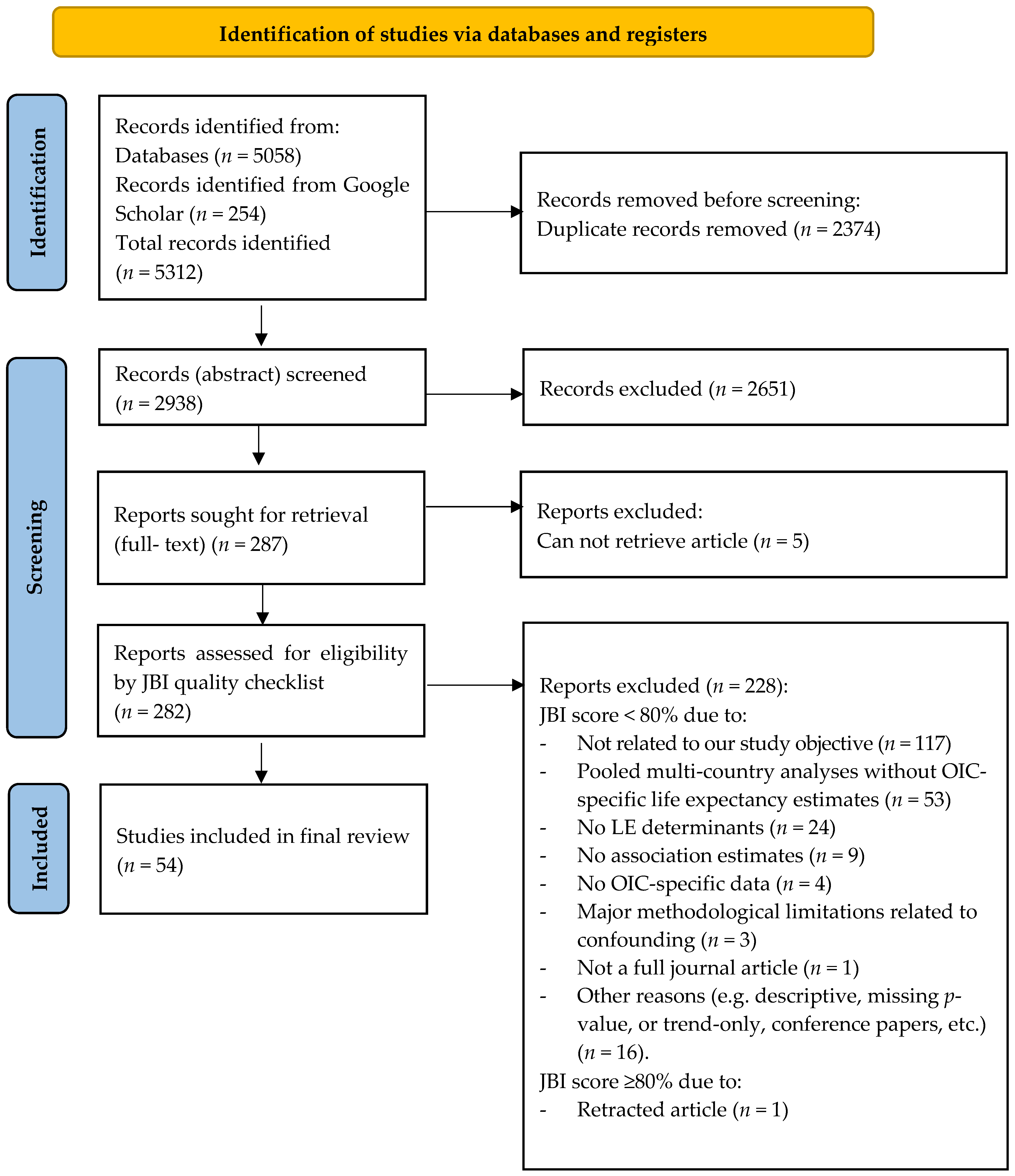
2.3. Study Selection
2.4. Evaluation of the Quality of Reports on the Studies
2.5. Data Extraction
3. Data Analysis
4. Results
4.1. Study Characteristics

| Article | Study | Q1 | Q2 | Q3 | Q4 | Q5 | Q6 | Q7 | Q8 | Q9 | Q10 | Q11 | Score (%) |
|---|---|---|---|---|---|---|---|---|---|---|---|---|---|
| Dare et al., 2024 [25] | Longitudinal Time series (observational) | Y | Y | Y | Y | Y | Y | Y | Y | NA | NA | NA | 100 |
| Onwube et al., 2021 [26] | Longitudinal Time series (observational) | Y | Y | Y | Y | Y | Y | Y | Y | NA | NA | NA | 100 |
| Lawanson & Umar, 2021 [27] | Ecological time-series (country-level) | Y | Y | Y | Y | Y | Y | Y | Y | NA | NA | NA | 100 |
| Bahuli et al., 2025 [28] | Time series | Y | Y | Y | Y | Y | Y | Y | Y | NA | NA | NA | 100 |
| Popoola & Mohammed, 2024 [29] | Time series econometric study | Y | Y | Y | Y | Y | Y | Y | Y | NA | NA | NA | 100 |
| Susanto et al., 2025 [30] | Time series | Y | Y | Y | Y | Y | Y | Y | Y | NA | NA | NA | 100 |
| Gilligan & Skrepnek, 2015 [31] | Cross-sectional time series | Y | Y | Y | Y | Y | Y | Y | Y | NA | NA | NA | 100 |
| Wirayuda et al., 2023 [32] | Ecological study | Y | Y | Y | Y | Y | Y | Y | Y | NA | NA | NA | 100 |
| Ali & Ahmad, 2014 [33] | Time series | Y | Y | Y | Y | Y | Y | Y | Y | NA | NA | NA | 100 |
| Wirayuda et al., 2024 [34] | Ecological retrospective study | Y | Y | Y | Y | Y | Y | Y | Y | NA | NA | NA | 100 |
| Wirayuda et al., 2025 [35] | Longitudinal ecological study | Y | Y | Y | Y | Y | Y | Y | Y | NA | NA | NA | 100 |
| Azam et al., 2022 [36] | Ecological/time-series econometric study | Y | Y | Y | Y | Y | Y | Y | Y | NA | NA | NA | 100 |
| ur Rehman et al., 2023 [37] | Time series | Y | Y | Y | Y | Y | Y | Y | Y | NA | NA | NA | 100 |
| Sabra, 2022 [38] | Time series | Y | Y | Y | Y | Y | Y | Y | Y | NA | NA | NA | 100 |
| Jarallah et al., 2024 [39] | Ecological study/Time series | Y | Y | Y | Y | Y | Y | Y | Y | NA | NA | NA | 100 |
| Aziz et al., 2025 [40] | Time series | Y | Y | Y | Y | Y | Y | Y | Y | NA | NA | NA | 100 |
| Mohamed, 2020 [41] | Time series | Y | Y | Y | Y | Y | Y | Y | Y | NA | NA | NA | 100 |
| Karma, 2023 [42] | Time series | Y | Y | Y | Y | Y | Y | Y | Y | Y | Y | Y | 100 |
| Javanshirova, 2024 [43] | Time series | Y | Y | Y | Y | Y | Y | Y | Y | Y | Y | Y | 100 |
| Wirayuda et al., 2022 [11] | Time series | Y | Y | Y | Y | Y | Y | Y | Y | Y | Y | Y | 100 |
| Xiang et al., 2025 [44] | Time series | Y | Y | Y | Y | Y | Y | Y | Y | Y | Y | Y | 100 |
| Panzabekova & Digel, 2020 [45] | Ecological/panel (longitudinal) study | Y | Y | Y | Y | Y | Y | Y | Y | NA | NA | NA | 100 |
| Hasan et al., 2023 [46] | Time series econometric study | Y | Y | Y | Y | Y | Y | Y | Y | Y | Y | Y | 100 |
| Akintunde et al., 2024 [47] | Time series | Y | Y | Y | Y | Y | Y | Y | Y | Y | Y | Y | 100 |
| Audi & Ali, 2016 [48] | Time series | Y | Y | Y | Y | Y | Y | Y | Y | NA | NA | NA | 100 |
| Redzwan & Ramli, 2024 [49] | Time series | Y | Y | Y | Y | Y | Y | Y | Y | NA | NA | NA | 100 |
| Boutayeb & Serghini, 2006 [50] | Ecological cross-sectional, multi-country comparative study | Y | Y | Y | Y | Y | Y | Y | Y | NA | NA | NA | 100 |
| Chan & Kamala Devi, 2015 [51] | Ecological study/Time series | Y | Y | Y | Y | Y | Y | Y | Y | NA | NA | NA | 100 |
| Fikri & Mo-hamed, 2024 [52] | Time series econometric study | Y | Y | Y | Y | Y | Y | Y | Y | NA | NA | NA | 100 |
| Bala et al., 2025 [53] | Ecological/time series econometric study | Y | Y | Y | Y | Y | Y | Y | Y | NA | NA | NA | 100 |
| Senturk & Ali, 2021 [54] | Time series | Y | Y | Y | Y | Y | Y | Y | Y | NA | NA | NA | 100 |
| Gulcan, 2020 [55] | Time series | Y | Y | Y | Y | Y | Y | Y | Y | NA | NA | NA | 100 |
| Çavmak et al., 2024 [56] | Longitudinal Time series | Y | Y | Y | Y | Y | Y | Y | Y | UC | UC | Y | 100 |
| Hamidi et al., 2018 [57] | Ecological Time series | Y | Y | Y | Y | Y | Y | Y | Y | Y | Y | Y | 100 |
| Saidmamatov et al., 2024 [58]. | Panel data econometric study | Y | Y | Y | Y | Y | Y | Y | Y | NA | NA | NA | 100 |
| Kristanto et al., 2019 [59] | Subnational panel regression | Y | Y | Y | Y | Y | Y | Y | Y | NA | NA | NA | 100 |
| Pourshahri et al., 2022 [60] | Population-based cross-sectional study | Y | Y | Y | Y | Y | Y | Y | Y | NA | NA | NA | 100 |
| Esmaeili et al., 2011 [61] | Cross-sectional (cross-country) | Y | Y | Y | Y | Y | Y | Y | Y | NA | NA | NA | 100 |
| Nathaniel & Khan, 2020 [62] | Time series econometric study | Y | Y | Y | Y | Y | Y | Y | Y | NA | NA | NA | 100 |
| Agbanike et al., 2019 [63] | Ecological Time series | Y | Y | Y | Y | Y | Y | Y | Y | NA | NA | NA | 100 |
| Aalipour et al., 2023 [64] | Time series econometric study | Y | Y | Y | Y | Y | Y | Y | Y | NA | NA | NA | 100 |
| Kanat et al., 2023 [65] | Time series econometric study | Y | Y | Y | Y | Y | Y | Y | Y | NA | NA | NA | 100 |
| Igbinedion, 2019 [66] | Ecological Time series econometric study | UC | Y | Y | Y | Y | Y | Y | Y | NA | NA | NA | 87.5 |
| Okogor, 2022 [67] | Ecological Time series econometric study | Y | Y | Y | Y | UC | Y | Y | Y | NA | NA | NA | 87.5 |
| Awan et al., 2024 [68] | Ecological study/Time series | Y | Y | Y | Y | UC | Y | Y | Y | NA | NA | NA | 87.5 |
| M. Arafat et al., 2022 [69] | Time series econometric study | Y | Y | Y | Y | UC | Y | Y | Y | NA | NA | NA | 87.5 |
| Abbas et al., 2024 [70] | Ecological study/Time series | Y | Y | Y | Y | UC | Y | Y | Y | NA | NA | NA | 87.5 |
| Omri et al., 2022 [71] | Ecological study/Time series | UC | Y | Y | Y | Y | Y | Y | Y | NA | NA | NA | 87.5 |
| Hussein et al., 2024 [72] | Ecological study/Time series | UC | Y | Y | Y | Y | Y | Y | Y | NA | NA | NA | 87.5 |
| Nandi et al., 2023 [73] | Ecological study/Time series | Y | Y | Y | Y | UC | Y | Y | Y | NA | NA | NA | 87.5 |
| Setiawan et al., 2023 [74] | Ecological study/Time series | Y | Y | Y | Y | UC | Y | Y | Y | NA | NA | NA | 87.5 |
| Ghaedrahmati & Hajilou, 2022 [75] | Ecological study/Time series | Y | Y | Y | Y | UC | Y | Y | Y | NA | NA | NA | 87.5 |
| Adeshina et al., 2019 [76] | Ecological study/Time series | Y | Y | Y | Y | Y | UC | Y | Y | NA | NA | NA | 87.5 |
| Wirayuda, Jaju, et al., 2022 [77] | Ecological study/Time series | Y | Y | Y | Y | UC | Y | Y | Y | NA | NA | NA | 87.5 |
| Authors | Year of Publication | Study Design | Country | Economy (World Bank) | Study Period (Years) | Study Population | Sample Size | Determinant/ Factors Category | Determinants/Factors | Measure of Association |
|---|---|---|---|---|---|---|---|---|---|---|
| Dare et al., 2024 [25] | 2024 | Longitudinal Time series (observational) | Nigeria | Lower-Middle income economies ($1136 to $4495) | 2012–2022 (11) | Nigerian | 11 annual observations | Social Environmental Economic/finance (globalization & green finance) | Trade openness: (TROP) Net foreign domestic product: (NFDI) Net foreign portfolio investment: (NFPI) Green bonds (GREB) Renewable energy investment (RENI) Credit to agriculture (CRAG) Gross domestic product (GRDP) | Crude TROP r = −0.48861 NFDI r = −0.82638 NFPI r = 0.68488 GREB r = −0.54214 RENI r = 0.03774 CRAG r = 0.44827 GRDP r = 0.74412 Adjusted aTROP β = −0.129393 (p = 0.2772) aNFDI β = −0.001728 (p = 0.1427) aNFPI β = 1.35 × 10⁻⁵ (p = 0.0002) aGREB β = −0.000289 (p = 0.6602) aRENI β = −0.611983 (p = 0.2002) aCRAG β = 1.97 × 10⁻⁶ (p = 0.0032) aGRDP β = 0.000861 (p = 0.2079) |
| Onwube et al., 2021 [26] | 2021 | Longitudinal Time series (observational) | Nigeria | Lower-Middle income economies ($1136 to $4495) | 1981–2017 (37) | Nigerian | 37 annual observations | Social Economic (macroeconomic determinants) | GDP per capita (constant 2010 US$): RGDPPC Inflation rate, consumer prices (annual %): INFR Imports of goods and services (per capita constant 2010 US$): Imports Household final consumption expenditure (per capita constant 2010 US$): HCExp General government final consumption expenditure (Per capita constant 2010 US$): GCExp Official exchange rate (LCU per US$, period average): EXR | Adjusted RGDPPC β = 0.100954 (p = 0.0009) INFR β = −0.034493 (p = 0.0001) Import β = −0.068840 (p < 0.001) HCE β = 0.021552 (p = 0.1667) GCE β = −0.024102 (p = 0.0004) EXR β = 0.017021 (p < 0.001) |
| Lawanson & Umar, 2021 [27] | 2021 | Ecological time series (country-level) | Nigeria | Lower-Middle income economies ($1136 to $4495) | 1980–2018 (39) | Nigerian | 38 annual observations | Health status Education Economic Poverty Governance-finance | Per capita gross domestic product: PCGDP Poverty: Poverty headcount: PHC Poverty gap: PGAP Squared poverty gap: SPGAP | PCGDP β = 0.140123, p = 0.0001 Poverty: PHC: β = −0.1672, p = 0.0006 PGAP: β = −0.1401, p = 0.0011 SPGAP: β = −0.1223, p = 0.0026 |
| Bahuli et al., 2025 [28] | 2025 | Time series | Nigeria | Lower-Middle income economies ($1136 to $4495) | 1990–2022 (33) | Nigerian | 33 annual observations | Environmental Economic Demographic Investment/Globalization | CO2 emissions: CO2 GDP per capita: GDP Population growth rate: POP Foreign direct investment inflow: FDI | CO2 β = −2.185889 (p = 0.3629) FDI β = −0.070688 (p = 0.0644) GDP β = −1.19 × 10⁻⁵ (p = 0.9992) POP β = 5.085600 (p = 0.0001) |
| Popoola & Mohammed, 2024 [29] | 2024 | Time series econometric study | Nigeria | Lower-Middle income economies ($1136 to $4495) | 1986–2022 (37) | Nigerian | 37 annual observations | Macroeconomic Socio-demographic | Domestic debt: DD External debt: ED Real GDP per capita: RGDP Household consumption expenditure: CEH Population growth rate: PGR | Adjusted DD β = −0.3520, p = 0.2411 ED β = −0.0106, p = 0.0902 RGDP β = 0.4132, p = 0.0150 CEH β = −0.2458, p = 0.2501 PGR β = 4.1052, p = 0.0006 |
| Susanto et al., 2025 [30] | 2025 | Time series | Indonesia | Upper-Middle-income economies ($4496 to $13,935) | 2010–2018 (9) | 46 OIC member states: Benin, Burkina Faso, Chad, Djibouti, Gambia, Guinea, Guinea-Bissau, Comoros, Mali, Mauritania, Mozambique, Niger, Senegal, Sierra Leone, Somalia, Sudan, Togo, Uganda, Afghanistan, Bangladesh, Yemen, Indonesia, Kazakhstan, Kyrgyzstan, Azerbaijan, Bahrain, Brunei Darussalam, Lebanon, Maldives, Malaysia, Oman, Pakistan, Syria, Tajikistan, Turkmenistan, Uzbekistan and Jordan, Albania, Turkey, Guyana, Suriname, Cameroon, Morocco, Egypt, Ivory Coast and Tunisia, Saudi Arabia, United Arab Emirates, Iraq, Kuwait, Iran, Qatar, Nigeria, Algeria, Libya, Gabon | 46 countries × 9 years = 414 country-years | Social Healthcare resources Behavioural | GDP per capita, log: LN_GDP Health expenditure %GDP: HEXP Mean years of schooling: SCH Income inequality: GINI Unemployment rate: UNEP Smoking prevalence: SMOKE | Adjusted LN_GDP β = 6.019235 (p = 0.0000) HEXP β = 0.132586 (p = 0.0400) SCH β = 0.575393 (p = 0.0000) GINI β = 0.012648 (p = 0.5264) UNEP β = −0.009166 (p = 0.8055) SMOKE β = −0.220921 (p = 0.0000) |
| Gilligan & Skrepnek, 2015 [31] | 2015 | Cross-sectional time series | Eastern Mediterranean Region (21 countries) | Mixed | 1995–2010 (16) | 21 countries: Afghanistan, Kuwait, Saudi Arabia, Bahrain, Lebanon, Somalia, Djibouti Libyan, Sudan, Egypt, Morocco, Syria, Iran, Oman, Tunisia, Iraq, Pakistan, United Arab Emirates, Jordan, Qatar, Yemen | 21 countries (panel across 1995–2010; up to ~336 country-years) | Social/Economic Healthcare resources Environmental/living conditions | GDP per capita: GDP Health expenditure: HE Physician density: PHYS Vaccination average: VACC Adult literacy: LIT Safe water access: WATER Urbanization: URBAN Undernourishment: UNOURISH | Adjusted GDP β = 0.0229 (p = 0.011) HE β = −0.0049 (p = 0.387) PHYS β = 0.0079 (p = 0.266) VACC β = 0.0018 (p = 0.026) LIT β = 0.0001 (p = 0.889) WATER β = 0.0012 (p = 0.097) URBAN β = 0.0021 (p = 0.026) UNOURISH β = −0.0009 (p = 0.520) |
| Wirayuda et al., 2023 [32] | 2023 | Ecological study | Oman | High-income economies ($13,935 or more) | 1990–2020 (31) | Country-level (Oman & Qatar) | 31 annual observations per country (1990–2020 = 31 years) | Macroeconomic (ME) Sociodemographic (SD) Health Status & Resources (HSR) | Gross National Income (GNI) per capita: GNIpc Employment to population ratio: Employment Oil production: Fuel Pre-Primary School Enrolment: PPSE Primary School Enrolment: PSE Secondary School Enrolment: SSE Diphtheria, Pertussis, and Tetanus (DPT) Immunization: DPTI Measles Immunization: MI Food production index: Food | Oman HSR → LE (direct): β = 0.839 (95% CI 0.717–0.894) SD → LE (indirect via HSR): β = 0.653 (95% CI 0.450–0.754) ME → LE (indirect via SD and HSR): β = 0.602 (95% CI 0.407–0.709) Qatar HSR → LE (direct): β = 0.904 (95% CI 0.707–0.956) SD → LE (indirect via HSR): β = 0.759 (95% CI 0.550–0.885) ME → LE (indirect via SD and HSR): β = 0.676 (95% CI 0.438–0.845) |
| Ali & Ahmad, 2014 [33] | 2014 | Time series | Oman | High-income economies ($13,935 or more) | 1970–2012 (43) | Omanis | 43 annual observations | Social/Economic Environmental Food/Nutrition | Food production index: FI School enrolment-primary: ED/EE Inflation: INF Population growth: POPg GDP per capita growth: PCg CO2 emissions: CO2 | Adjusted FI β = 0.115652 (p = 0.000) INF β = −0.005085 (p = 0.133) POPg β = −0.245641 (p = 0.027) Ee β = 0.154537 (p = 0.000) PCg β = −0.001035 (p = 0.961) CO2 β = 0.216793 (p = 0.736) |
| Wirayuda et al., 2024 [34] | 2024 | Ecological retrospective study | Oman | Mixed | 1980–2020 (41) | Omanis and Indonesians | 41 annual observations per country | Macroeconomic: ME Sociodemographic: SD Health Status–Resources: HSR | ME: GDP: Gross Domestic Product per capita CI: Capital Investment EP: Electricity Production SD: PrE: Pre-Primary School Enrolment SE: Secondary School Enrolment TE: Tertiary School Enrolment HSR: DPT: Diphtheria, Pertussis, and Tetanus Immunization MI: Measles Immunization FPI: Food production index | Indonesia ME → LE (total): β = 0.737 (95% CI 0.527–0.904) SD → LE (total): β = 0.675 (95% CI 0.493–0.824) (indirect via HSR) HSR → LE (direct): β = 0.823 (95% CI 0.653–0.946) Oman ME → LE (total): β = 0.848 (95% CI 0.784–0.899) SD → LE (total): β = 0.755 (95% CI 0.613–0.918) HSR → LE (direct): β = 0.335 (95% CI 0.047–0.525 |
| Wirayuda et al., 2025 [35] | 2025 | Longitudinal ecological study | Oman | High-income economies ($13,935 or more) | 1990–2020 (31) | GCC Countries: Bahrain, Kuwait, Oman, Qatar, Saudi Arabia, UAE | 6 countries × 31 years = 186 country-years | Macroeconomic: ME Sociodemographic: SD Health Resources: HR | ME: ME1: Gross Domestic Product (GDP) per capita ME2: Electricity Production SD: SD1: Pre-primary School Enrolment SD2: Secondary School Enrolment HR: HR1: Diphtheria, Pertussis, and Tetanus Immunization HR2: Measles Immunization HR3: Food production index | Crude Pooled (all GCC): ME-LE r = 0.9000 *; SD-LE r = 0.7640 *; HR-LE r = 0.8940 * Bahrain: ME-LE r = 0.9699 *; SD-LE r = 0.9742 *; HR-LE r = 0.9389 * UAE: ME-LE r = 0.9550 *; SD-LE r = 0.9394 *; HR-LE r = 0.8528 * Kuwait: ME-LE r = 0.7856 *; SD-LE r = 0.4240 *; HR-LE r = 0.8777 * Oman: ME-LE r = 0.9535 *; SD-LE r = 0.9364 *; HR-LE r = 0.8387 * Qatar: ME-LE r = 0.9230 *; SD-LE r = 0.9299 *; HR-LE r = 0.9497 * Saudi Arabia: ME-LE r = 0.8223 *; SD-LE r = 0.4430 *; HR-LE r = 0.8754 * Adjusted Pooled “general” SEM (all GCC countries combined) HR → LE: β = 0.468 (p < 0.001) ME → LE: β = 0.510 (p < 0.001) Country-specific total effects on LE (separate for each GCC/OIC country) Bahrain: HR → LE 0.3427 *, ME → LE 0.6747 *, SD → LE 0.9530 * UAE (Emirate): HR → LE 0.3746 *, ME → LE 0.6831 *, SD → LE 0.9258 * Kuwait: HR → LE 0.5858 (ns), ME → LE 0.2942 (ns), SD → LE 0.5693 * Oman: HR → LE 0.2213 (ns), ME → LE 0.7225 *, SD → LE 0.8373 * Qatar: HR → LE 0.5709 *, ME → LE 0.4518 *, SD → LE 0.9024 * Saudi Arabia: HR → LE 0.6052 *, ME → LE 0.3270 *, SD → LE 0.2572 (ns) Significant values are presented with an asterisk (*) at a 5% level. |
| Azam & Adeleye, 2022 [36] | 2022 | Ecological/time series econometric study | Pakistan | Lower-Middle income economies ($1136 to $4495) | 1975–2020 (46) | Pakistanis | 46 annual observations | Environmental Economic Food/agriculture Demographic Health system Education | CO2 Carbon emissions PCI Per capita income FPI Food production index POPG Population growth BR Birth rate DR Death rate IMF Infant mortality rate The Health expenditure INF Inflation EDU Education | ARDL CO2 emissions: β = −0.046395 (p = 0.0007) Per capita income: β = 0.001144 (p = 0.8812) Food production index: β = −0.010727 (p = 0.0890) Population growth: β = 0.008288 (p = 0.0512) Birth rate: β = 0.466607 (p = 0.0000) Death rate: β = −0.911756 (p = 0.0000) Infant mortality rate: β = 0.178382 (p = 0.0091) Health expenditure: β = 0.000215 (p = 0.0295) Inflation: β = −0.002072 (p = 0.0354) Education: β = 0.02002 (p = 0.0514) Robustness checks: FMOLS & DOLS FMOLS: CO2: β = −0.007595 (p = 0.0530) Per capita income: β = 0.024526 (p = 0.0000) Food production index: β = −0.006692 (p = 0.0302) Population growth: β = 0.00634 (p = 0.0000) Birth rate: β = 0.167738 (p = 0.0000) Death rate: β = −0.342165 (p = 0.0000) Infant mortality rate: β = 0.029426 (p = 0.0000) Health expenditure: β = 0.001703 (p = 0.0000) Inflation: β = −0.000541 (p = 0.0005) Education: β = 0.002470 (p = 0.0024) DOLS: CO2: β = −0.013032 (p = 0.0289) Per capita income: β = 0.019516 (p = 0.0532) Food production index: β = −0.014553 (p = 0.0209) Population growth: β = 0.002284 (p = 0.0949) Birth rate: β = 0.165772 (p = 0.0035) Death rate: β = 0.378559 (p = 0.0004) Infant mortality rate: β = 0.015604 (p = 0.0778) Health expenditure: β = 0.000372 (p = 0.4076) Inflation: β = −0.001049 (p = 0.0347) Education: β = 0.001664 (p = 0.0501) |
| ur Rehman et al., 2023 [37] | 2023 | Time series | Pakistan | Lower-Middle income economies ($1136 to $4495) | 1980–2020 (41) | Pakistanis | 41 annual observations | Social (income inequality) Economic (income) Health resources | GINI: income inequality GDPPC/GPC: GDP per capita HE: Health expenditure | Adjusted GINI β = −0.25060 (p = 0.0044) HE β = −0.92628 (p = 0.3703) GDPPC β = 0.02238 (p = 0.0000) |
| Sabra, 2022 [38] | 2022 | Time series | Palestine | Lower-Middle income economies ($1136 to $4495) | 2000–2019 (20) | Algeria, Egypt, Lebanon, Morocco, and Tunisia | 6 countries × 20 years = 120 country-years | Economic Environmental Demographic Health resources | Total Population: POP Gross Domestic Product: GDP Current health expenditure per capita: CHE Fertility rate, births per woman: Fertility CO2 emission: CO | POP β = 0.003 (p < 0.01) CHE β = 0.002 (p < 0.01) GDP β = −0.0012 (p < 0.01) CO2 β = −0.003 (p < 0.01) Fertility β = −0.005 (p < 0.01) |
| Jarallah et al., 2024 [39] | 2024 | Ecological study/Time series | Qatar | High-income economies ($13,935 or more) | 2000–2020 (21) | GCC countries (Bahrain, Kuwait, Oman, Qatar, Saudi Arabia, UAE) | 126 country-year observations (6 countries × 21 years) | Environmental Socioeconomic Health resources Technology | Ecological footprint deficit: ECOLDEF Urbanization: URB Unemployment: UNEMP Health expenditure per capita: CURHEPC GDP deflator/inflation proxy: GDPDEF Technological Achievement Index: TAI A composite index of mobile, fixed telephone, and internet subscriptions: ICTINDEX Carbon dioxide emission: CO2 | Crude URB: r = 0.3934 UNEMP: r = −0.6023 CO2: r = −0.2287 ICTINDEX: r = 0.5596 CURHEPC: r = 0.4604 GDPDEF: r = −0.2267 ECOLDEF: r = −0.6269 TAI: r = 0.6413 Adjusted Pooled (GCC) adjusted associations with LE UNEMP: β = −7.0681 (p = 0.011) CURHEPC: β = −0.0083 (p = 0.041) GDPDEF: β = 0.0143 (p = 0.669) (ns) ECOLDEF: β = −2.5654 (p = 0.034) TAI: β = 88.9262 (p = 0.015) Country-specific adjusted effects Bahrain URB: β = −0.4393 (p = 0.0000); UNEMP: β = −0.0108 (p = 0.2320); CURHEPC: β = 0.0000 (p = 0.0670); GDPDEF: β = −0.0001 (p = 0.4500); ECOLDEF: β = −0.0028 (p = 0.0010); TAI: β = 0.1734 (p = 0.0100) Kuwait URB: β = 0.0209 (p = 0.4760); UNEMP: β = 0.0668 (p = 0.0030);m CURHEPC: β = −0.0001 (p = 0.0680); GDPDEF: β = −0.0013 (p = 0.0000); ECOLDEF: β = 0.0107 (p = 0.1950); TAI: β = 1.0148 (p = 0.0010) Oman URB: β = −0.0170 (p = 0.4100); UNEMP: β = −0.0481 (p = 0.0080); CURHEPC: β = −0.0001 (p = 0.0780); GDPDEF: β = −0.0002 (p = 0.3460); ECOLDEF: β = −0.0144 (p = 0.0300); TAI: β = −1.7191 (p = 0.0060) Qatar URB: β = 0.3385 (p = 0.0000); UNEMP: β = 0.0303 (p = 0.1400); CURHEPC: β = 0.0000 (p = 0.0170); GDPDEF: β = 0.0000 (p = 0.7230); ECOLDEF: β = 0.0028 (p = 0.2220); TAI: β = 0.0250 (p = 0.8880) Saudi Arabia URB: β = 6.5084 (p = 0.0110); UNEMP: β = 0.0644 (p = 0.0000); CURHEPC: β = 0.0000 (p = 0.9560); GDPDEF: β = −0.0007 (p = 0.0540); ECOLDEF: β = 0.0116 (p = 0.3700); TAI: β = 0.5573 (p = 0.1940) United Arab Emirates URB: β = 0.2862 (p = 0.0000); UNEMP: β = 0.0025 (p = 0.5440); CURHEPC: β = 0.0000 (p = 0.6740); GDPDEF: β = 0.0000 (p = 0.8090); ECOLDEF: β = 0.0020 (p = 0.2690); TAI: β = −0.0194 (p = 0.8390) |
| Aziz et al., 2025 [40] | 2025 | Time series | Saudi Arabia | High-income economies ($13,935 or more) | 1980–2020 (41) | Saudi Arabia | 41 annual observations | Environmental Economic Health resources | Economic growth: EG Health expenditure: HE Ecological footprint: EFP CO2 emissions: Carbon Particulate matter 2.5: PM2.5 | Crude: EG (GDP): r = 0.716 HE: r = 0.792 EFP: r = 0.507 Carbon (CO2): r = 0.654 PM2.5: r = 0.542 Adjusted (pre-Vision 2030) EG β = 0.523 (p < 0.001) HE β = 0.671 (p < 0.005) EFP β = 1.204 (p > 0.010) Carbon β = 0.631(p < 0.001) PM2.5 β = 0.095 (p < 0.005) (post-Vision 2030) EG β = 0.523 (p < 0.005) HE β = 0.481(p < 0.001) EFP β = 1.190 (p > 0.010) Carbon β = 0.501(p < 0.005) PM2.5 β = 0.084 (p < 0.005) |
| Mohamed, 2020 [41] | 2020 | Time series | Sudan | Low-income economies ($1135 or less) | 1970–2017 (48) | Sudanese | 48 annual observations | Economic Social Environmental | GDP (outcome) Investment: INV Youth unemployment: YUN Life expectancy: LE Education: EDU Access to sanitation: ASF Access to safe water: ASW Access to electricity: ELC CO2 per capita: CO2P Trade openness: TOP | Crude GDP: r = 0.90 INV: r = 0.22 YUN: r = −0.29 EDU: r = 0.97 ASF: r = −0.48 ASW: r = 0.91 ELC: r = 0.93 CO2P: r = 0.44 TOP: r = 0.10 Adjusted GDP β = 19.44 (p < 0.000) |
| Karma, 2023 [42] | 2023 | Time series | Albania | Upper-Middle-income economies ($4496 to $13,935) | 2000–2019 (20) | Southeastern Europe (SEE), including Albania | 20 annual observations | Economic Social Environmental | Health expenditure: HE GDP per capita: GDP Out-of-pocket health expenditure %: OPEH Education: EDU Marriages/1000: MS Fertility rate: FER CO2 per capita: CO2 Urban population %: URB | HE β = 0.02 EDU β = −0.01 GDP β = 0.03 MS = β = 0.03 * OPEH β = −0.04 FER β = −0.02 CO2 β = 0.01 URB β = −0.04 (* indicates p < 0.50; others not significant) |
| Javanshirova, 2024 [43] | 2024 | Time series | Azerbaijan | Upper-Middle-income economies ($4496 to $13,935) | 1974–2022 (49) | Azerbaijanis/Azeris | 49 annual observations | Environmental | Air pollution/climate: CO2 | Crude CO2 (r = −0.8102) Adjusted CO2 β = −0.1577 (p < 0.001) |
| Wirayuda et al., 2022 [11] | 2022 | Time series | Bahrain | High-income economies ($13,935 or more) | 1971–2020 (50) | Bahrainis | 50 annual observations | Macroeconomic: ME Sociodemographic: SD Health Status & Resources: HSR | Pre-primary education: PPE Primary education: PE Tertiary education: TE Gross Domestic Product: GDP GDP per capita: GDPpc Fossil-fuel electricity: FF Measles immunization: MI DPT immunization: DPTI | Adjusted PLS-SEM path coefficients ME → LE β = 0.463 (p < 0.00) HSR → LE β = 0.595 (p < 0.001) ME → SD → HSR → LE indirect β = 0.488 (p < 0.001) SD → HSR → LE indirect β = 0.496 (p < 0.001) ME → SD β = 0.984 (p < 0.001) SD → HSR β = 0.835 (p < 0.001) ME total effect on LE β = 0.95 (p < 0.001) |
| Xiang et al., 2025 [44] | 2025 | Time series | Bangladesh | Lower-Middle income economies ($1136 to $4495) | 2000–2022 (23) | Bangladeshis | 23 annual observations | Healthcare resources Economic Financial Demographic Shock | Public Health Expenditure (% of GDP): PHE GDP per Capita (current US$): GDPPC Domestic Credit to Private Sector (% GDP): DC Population Growth Rate (%): POPGR | Non-adjusted model (no COVID) PHE (L0): β = −0.042, p > 0.10 PHE (L1): β = 0.0252, p > 0.10 GDPPC (L0): β = 0.0002, p > 0.10 GDPPC (L1): β = −0.0011, p < 0.01 DC (L0): β = 0.0603, p < 0.05 POPGR (L0): β = −1.5289, p > 0.10 POPGR (L1): β = 1.0497, p > 0.10 Adjusted model includes COVID PHE (L0): β = −0.038 (p > 0.10) PHE (L1): β = 0.01 (p > 0.10) GDPPC (L0): β = 0.0003 (p > 0.10) GDPPC (L1): β = −0.0012 (p < 0.01) DC (L0): β = 0.055 (p < 0.05) POPGR (L0): β = −1.40 (p > 0.10) POPGR (L1): β = 0.964 (p > 0.10) COVID dummy (2020–22): β = −0.213 (p < 0.10) |
| Panzabekova & Digel, 2020 [45] | 2020 | Ecological/panel (longitudinal) study | Kazakhstan | Upper-Middle-income economies ($4496 to $13,935) | 2001–2018 (18) | Kazakh/Kazakhstanis | 18 annual observations | Economic Demographic/social Health system Medical/morbidity Crime | Nominal monetary income: NMI Subsistence minimum: SM Income-to-subsistence ratio: NISM Poverty: p Unemployment: U Divorces per 1000 marriages: DpM Health workers: HW Cancer morbidity: CMR Blood diseases: BD Substance-induced mental disorders: MD Circulatory system diseases: CSD respiratory diseases: RD Crime rate: CR | Crude (regional base) Akmola: DpM 0.958; MD −0.954; U −0.928; SM 0.914; NMI 0.904; p −0.888; NISM 0.867; CR 0.831; RD 0.743; CSD 0.713 Aktobe: NMI 0.977; SM 0.973; p −0.959; U −0.955; NISM 0.916; RD −0.909; MD −0.832; HW 0.818; CMR −0.784 Almaty region: MD −0.907; SM 0.885; HW 0.884; DpM 0.884; NMI 0.883; p −0.879; CR 0.854; NISM 0.849; CSD 0.789; CR 0.768 Atyrau: NMI 0.953; SM 0.948; p −0.936; U −0.893; HW 0.885; NISM 0.879; DpM 0.854; MD −0.802 West Kazakhstan region: NMI 0.964; SM 0.949; p −0.938; U −0.930; MD −0.892; NISM 0.865; CR 0.865; DpM 0.826; CSD 0.770 Jambyl: CMR 0.924; SM 0.907; NMI 0.888; DpM 0.866; U −0.861; RD 0.856; HW 0.845; p −0.825; NISM 0.800; CR 0.700 Karaganda: MD −0.921; SM 0.918; DpM 0.903; NMI 0.902; p −0.890; U −0.872; CSD 0.826; BD −0.815; BD −0.776; CR 0.697 Kostanay: MD −0.920; DpM 0.902; SM 0.876; U −0.874; NMI 0.872; p −0.829; CMR 0.819; NISM 0.803 Kyzylorda: DpM 0.937; p −0.910; SM 0.907; U −0.898; NMI 0.894; MD −0.847; HW 0.831; NISM 0.824; RD 0.854; CSD 0.737 Mangistau: U −0.979; MD −0.978; SM 0.975; NMI 0.969; HW 0.948; p −0.945; p −0.895; CSD 0.869; RD 0.808; DpM 0.843; CR 0.765 Pavlodar: MD −0.971; NMI 0.929; CMR 0.928; SM 0.920; U −0.912; NISM 0.908; MD −0.842; CMR 0.836 Turkestan + Shymkent: SM 0.927; NMI 0.903; DpM 0.887; p −0.877; U −0.871; NISM 0.782; CSD 0.765; MD −0.763; DpM 0.725 East Kazakhstan: CSD 0.965; U −0.937; NMI 0.907; SM 0.906; NISM 0.882; BD −0.873; p −0.862; MD −0.739 Nur-Sultan: NMI 0.978; HW 0.975; SM 0.974; U −0.960; p −0.852; CMR 0.827; CR 0.699; CSD 0.698 City of Almaty: SM 0.927; NMI 0.918; U −0.911; HW 0.894; p −0.843; CSD 0.827; CR 0.796; NISM 0.757 Adjusted Akmola: β0 = 3.69, DpM β1 = 0.11, MD β2 = −0.03 Aktobe: β0 = 3.5, NMI β1 = 0.05, SM β2 = 0.02 Almaty region: β0 = 3.9, MD β1 = −0.04, DpM β2 = 0.80 Atyrau: β0 = 3.36, NMI β1 = 0.041, DpM β2 = 0.074 West Kazakhstan: β0 = 3.38, NMI β1 = 0.04, CR β2 = 0.075 Jambyl: β0 = 3.59, SM β1 = 0.03, DpM β2 = 0.065 Karaganda: β0 = 4, MD β1 = −0.03, SM β2 = 0.04 Kostanay: β0 = 3.6, MD β1 = −0.04, DpM β2 = 0.13 Kyzylorda: β0 = 3.8, DpM β1 = 0.08, U β2 = −0.04 Mangistau: β0 = 4.64, U β1 = −0.09, MD β2 = −0.04 Pavlodar: β0 = 4.09, MD β1 = −0.035, DpM β2 = 0.056 Northern Kazakhstan: β0 = 3.62, DpM β1 = 0.12, MD β2 = −0.028 Turkestan + Shymkent: β0 = 3.66, SM β1 = 0.13, NMI β2 = −0.06 East Kazakhstan: β0 = 3.83, CSD β1 = 0.12, BD β2 = −0.07 Nur-Sultan (one-factor model): β0 = 3.83, NMI β1 = 0.039 (no X2) City of Almaty: β0 = 2.73, SM β1 = 0.039, HW β2 = 0.012 |
| Hasan et al., 2023 [46] | 2023 | Time series econometric study | Bangladesh | Lower-Middle income economies ($1136 to $4495) | 1990–2019 (30) | Bangladeshis | 30 annual observations | Environmental Social/Health Social/Education Technology/Innovation | CO2 emissions: lnCO2 Secondary school enrolment: lnEDU Total patents/innovation proxy: lnTI | Adjusted GDP β = 4.22, p < 0.05 |
| Akintunde et al., 2024 [47] | 2024 | Ecological-time series | Nigeria | Lower-Middle income economies ($1136 to $4495) | 1980–2020 (41) | Nigerians | 41 annual observations | Environmental Socioeconomic Economic Healthcare resources | CO2 emissions Income inequality: Gini/INC GDP per capita: LGDPC Govt expenditure on health: LGEXH Unemployment: UNEM Gross capital formation: LGCF | CO2 emissions: β = −45.0359, p = 0.0066 Gini/INC: β = −0.1946, p = 0.0293 LGDPC: β = 0.0027, p = 0.0847 LGEXH: β = −0.0789, p = 0.0659 UNEM: β = −9.4608, p = 0.0680 LGCF: β = 0.0023, p = 0.1929 |
| Audi & Ali, 2016 [48] | 2017 | Time series | Lebanon | Lower-Middle income economies ($1136 to $4495) | 1971–2014 (42) | Lebanese | 42 observations | Socioeconomic Environmental Education Economic Demographic | Availability of food index: FOOD CO2 emissions: CO2 Secondary school enrolment: SSE GDP per capita: GDPPC Population growth: POPG | FOOD: β = 0.056465 (p = 0.0000) CO2: β = −1.072773 (p = 0.0024) SSE: β = 2.38 × 10⁻⁵ (p = 0.0169) GDPP: β = 0.001062 (p = 0.0000) POPG: β = 0.285793 (p = 0.0163) |
| Redzwan & Ramli, 2024 [49] | 2024 | Time series | Malaysia | Upper-Middle-income economies ($4496 to $13,935) | 1997–2021 (25) | Malaysians | 25 annual observations | Environmental Health resources Economic | CO2 emissions per capita: lnCO2 Health expenditure per capita: lnHE GDP per capita: lnGDP | HE: β = −0.2229 (p = 0.6609) GDP: β = 0.26132 (p = 0.6282) CO2: β = 0.0227 (p = 0.8438) |
| Boutayeb & Serghini, 2006 [50] | 2006 | Ecological cross-sectional, multi-country comparative study | 19 Arab countries (all OIC): Algeria, Bahrain, Comoros, Djibouti, Egypt, Jordan, Kuwait, Lebanon, Libya, Mauritania, Morocco, Oman, Qatar, Saudi Arabia, Sudan, Syria, Tunisia, UAE, Yemen | Mixed | Mixed indicator years (mainly 1990–2003: LEB 2002; IMR 2002; literacy 2002; enrolment 2001/02; physicians 1990–2003) | Country-level indicators | 19 countries (Iraq, Palestine, and Somalia excluded due to missing data) | Health outcomes; Health services Maternal/child health Nutrition Education | Infant Mortality Rate per 1000 live births 2002: IMR Maternal Mortality Ratio per 100,000–2000: MMR Expectation of lost healthy male/female 2002: ELHf/ELHm Delivery attended by skilled attendant 1996 (%): DASA Pregnant women who received prenatal care in 1996 (%): PWRP Children underweight % of <5 years old 1995–2002: CUW Physicians Per 100,000 People 1990–2003: PPP Literacy male/female (%) 2002: Lm/Lf Enrolment male/female (%) 2002: Enm/Enf | Female life expectancy at birth (LEBf) ELHf: r = −0.59 ELHm: r = −0.65 MMR: r = −0.94 DASA: r = 0.43 PWRP: r = 0.49 CUW: r = −0.60 IMR: r = −0.95 PPP: r = 0.75 Lm: r = 0.65 Lf: r = 0.68 Enm: r = 0.81 Enf: r = 0.87 Male life expectancy at birth (LEBm) ELHf: r = −0.56 ELHm: r = −0.63 MMR: r = −0.94 DASA: r = 0.42 PWRP: r = 0.47 CUW: r = −0.59 IMR: r = −0.95 PPP: r = 0.74 Lm: r = 0.67 Lf: r = 0.69 Enm: r = 0.80 Enf: r = 0.85 |
| Chan & Kamala Devi, 2015 [51] | 2015 | Ecological study/Time series | Malaysia | Upper-Middle-income economies ($4496 to $13,935) | 1980–2008 (29) | Malaysians | 29 annual observations | Socioeconomic Demographic Health resources | Gross national income per capita: GDP Inflation rate: IR Literacy rate: LR Tuberculosis deaths/100k: Tuberculosis Doctors/10k: Doctors Per-capita govt health expenditure: Expenditure | Crude Doctor: r = 0.75 p < 0.05) Expenditure: r = 0.81 (p < 0.05) LR: r = 0.69 (p < 0.05) Tuberculosis: r = −0.71 (p < 0.05) IR: r = 0.84 (p < 0.05) GDP: r = 0.68 (p < 0.05) Adjusted Direct effect on LE: Health resources → LE β = 0.47 (p < 0.05) Indirect structure (predictors of “Health resources”) Socioeconomic status → Health resources β = 0.57 (p < 0.05) Demographic → Health resources β = 0.56, (p < 0.05) Socioeconomic status → Demographic β = 0.58, (p < 0.05) |
| Fikri & Mohamed, 2024 [52] | 2024 | Time series econometric study | Morocco | Lower-Middle income economies ($1136 to $4495) | 2000–2022 (23) | Moroccans | 23 annual observations | Health/human capital Education/human capital Labour market | Life expectancy at birth: LE School enrolment, tertiary (% gross): SET Labour force participation rate (% ages 15+): LAB Gross capital production: GDP (outcome) | Coefficients with GDP per capita (log) as outcome: LE (current) β = 10.84694 (p = 0.0183) LE (lag 1) β = −3.86640 (p = 0.2001) |
| Bala et al., 2025 [53] | 2025 | Ecological/time series econometric study | Nigeria | Lower-Middle income economies ($1136 to $4495) | 1992–2021 (30) | Nigerian | 30 annual observations | Macroeconomic Environment Health status Education/socio-demographic | Gross domestic production: GDP Environment sustainability: ENV Mortality rate: MOR Literacy rate: LIT | Adjusted GDP: β = 0.047, p = 0.225 (not significant) ENV: β = 0.161, p < 0.001 MOR: β = −1.844, p = 0.010 LIT: β = 0.232, p = 0.022 |
| Senturk & Ali, 2021 [54] | 2021 | Time series | Turkey | Upper-Middle-income economies ($4496 to $13,935) | 1971–2017 (47) | Turks | 47 annual observations | Education Environment Economic/purchasing power Economic development Demographic | Education (SSE): Secondary enrolment (overall) Environment (SUS): CO2 emissions (environmental degradation) Economic/purchasing power (INF): Inflation Economic development (ECOD): GDP per capita growth Demographic (PG): Population growth | Crude SSE r = 0.989707 (p < 0.001) SUS r = 0.992322 (p < 0.001) INF r = −0.215419 (p > 0.005) ECOD r = 0.951445 (p < 0.001) PG r = −0.92861 (p < 0.001) Adjusted SSE β = 0.176652 (p < 0.001) SUS β = −0.008789 (p > 0.005) INF β = 0.000641(p > 0.005) ECOD β = −0.135435(p > 0.005) PG β = 0.004655 (p > 0.005) |
| Gulcan, 2020 [55] | 2020 | Time series | Turkey | Upper-Middle-income economies ($4496 to $13,935) | 1975–2014 (40) | Turks | 40 annual observations | Economic Environmental | GDP per capita (constant 2010 US$): Gdppc Food production index: Fpi Urbanization (% of total population): Urb CO2 emissions (kt): Co2 | Adjusted Gdppc β = 0.327965 (p = 0.04354) Fpi β = −0.341322 (p = 0.08344) Urb β = 0.110738 (p = 0.01440) Co2 β = −0.167716 (p = 0.04266) |
| Çavmak et al., 2024 [56] | 2024 | Longitudinal Time series | Turkey | Upper-Middle-income economies ($4496 to $13,935) | 2000–2019 (20) | Turks | 20 annual observations | Social Economic Healthcare access/financing Behavioural | Gross domestic product: GDP Enrolment rate in tertiary education: HE Out-of-pocket health expenditure: OOPHE Tobacco consumption (grams per capita): TC | Adjusted GDP β = 0.212 (p < 0.01) HE β = 0.129 (p < 0.01) OOPHE β = 0.073 (p < 0.01) TC β = −0.005 (p < 0.01) |
| Hamidi et al., 2018 [57] | 2018 | Ecological Time series–Panel data | 18 MENA countries (all are OIC members: Algeria, Bahrain, Djibouti, Egypt, Iran, Iraq, Jordan, Kuwait, Lebanon, Morocco, Oman, Qatar, Saudi Arabia, Syria, Tunisia, Turkey, UAE, and Yemen) | Mixed | 1995–2009 (15) | Country–year national indicators | 270 country-year observations (18 × 15) | Economic Health/disease burden Environmental/infrastructure Health system resources Urbanization Education/human capital | GDP per capita: PPP Tuberculosis incidence Improved water source (% access) Hospital beds (per 1000) Urban population (%) Educational attainment | GDP: Model 6: 0.0166 (p < 0.001); Model 7: 0.0159 (p < 0.01); Model 8: 0.0241 (p < 0.001); Model 9: 0.0190 (p < 0.001); Model 10: 0.0223 (p < 0.001) TB incidence: Model 6: −0.0110 (p ≥ 0.05); Model 7: −0.0096 (p ≥ 0.05); Model 8: −0.0099 (p ≥ 0.05);; Model 9: −0.0094 (p ≥ 0.05); Model 10: −0.0097 (p ≥ 0.05) Improved water: Model 6: 0.1060 (p < 0.001); Model 7: 0.1198 (p < 0.001); Model 8: 0.1227 (p < 0.001); Model 9: 0.1252 (p < 0.001); Model 10: 0.1203 (p < 0.001) Hospital beds: Model 6: 0.0107 (p < 0.05); Model 7: 0.0113 (p < 0.05); Model 8: 0.0046 (p ≥ 0.05); Model 9: 0.0083 (p ≥ 0.05); Model 10: 0.0061 (p ≥ 0.05) Urban population: Model 6: 0.0360 (p ≥ 0.05); Model 7: 0.0891 (p < 0.05); Model 8: 0.1160 (p < 0.01); Model 9: 0.1216 (p < 0.01); Model 10: 0.1200 (p < 0.01) Education attainment Men 25–34 (Model 6): 0.1429 (p < 0.001); Men ≥ 25 (Model 7): 0.0737 (p < 0.001) Women 25–34 (Model 8): 0.0393 (p < 0.001); Women ≥ 25 (Model 9): 0.0336 (p < 0.001); Women 15–44 (Model 10): 0.0426 (p < 0.001) |
| Saidmamatov et al., 2024 [58] | 2024 | Panel data econometric study | Aral Sea Basin countries include OIC members (Uzbekistan, Tajikistan, Turkmenistan, Afghanistan, Iran, Kazakhstan, and Kyrgyz Republic) | Mixed | 2002–2020 (19) | Country–year national indicators | Panel observations: 133 for most variables; regression uses 108–111 observations (missingness, esp. human capital) | Environment Health system/financing Economic development Water/resources Agriculture/food system Urbanization/settlement Energy Energy transition Education/human capital | CO2 emissions (metric tons per capita): CO2 Health expenditure (% of GDP): Health Economic growth proxied by GDP: Gdp Water productivity (hectares per person): Water Agricultural value added (% of GDP): Agr Urbanization rate (%): Urb Total energy consumption (kWh): Eng Renewable energy consumption (% of total energy consumed): Re Human capital proxied by primary school enrolment percentage (gross): Hc | Crude CO2 r = 0.7341 Health r = 0.8072 Gdp r = 0.5274 Water r = 0.5734 Agr r = −0.5195 Urb r = 0.7513 Energy r = 0.8516 Renew r = −0.4843 Hc r = 0.2319 Adjusted CO2: OLS β = −0.0509 (p < 0.01), FMOLS β = −0.0465 (p < 0.01), DOLS β = −0.0483 (p < 0.05), CCR β = −0.047 (p < 0.01), Driscoll-Kraay β = −0.0509 (p < 0.01) Health: OLS β = 0.0321 (p < 0.01), FMOLS β = 0.0534 (p < 0.01), DOLS β = 0.0772 (p < 0.01), CCR β = 0.0532 (p < 0.01), Driscoll–Kraay β = 0.0321 (p < 0.01) GDP: OLS β = 0.00188 (p ≥ 0.10), FMOLS β = 0.0141 (p < 0.10), DOLS β = 0.0332 (p ≥ 0.10), CCR β = 0.0138 (p ≥ 0.10), Driscoll–Kraay β = 0.00188 (p ≥ 0.10) Water: OLS β = 0.0344 (p < 0.01), FMOLS β = 0.0250 (p < 0.05), DOLS β = 0.00356 (p ≥ 0.10), CCR β = 0.0254 (p < 0.10), Driscoll–Kraay β = 0.0344 (p < 0.05) Agr: OLS β = 0.0208 (p < 0.05), FMOLS β = 0.0179 (p < 0.05), DOLS β = −0.00468 (p ≥ 0.10), CCR β = 0.0177 (p < 0.10), Driscoll–Kraay β = 0.0208 (p < 0.01) Urb: OLS β = 0.0666 (p < 0.10), FMOLS β = −0.0306 (p ≥ 0.10), DOLS β = −0.0515 (p ≥ 0.10), CCR β = −0.0284 (p ≥ 0.10), Driscoll–Kraay β = 0.0666 (p < 0.10) Energy: OLS β = 0.0524 (p < 0.01), FMOLS β = 0.0576 (p < 0.01), DOLS β = 0.0441 (p < 0.01), CCR β = 0.0575 (p < 0.01), Driscoll-Kraay β = 0.0524 (p < 0.01) Renew: OLS β = 0.00298 (p ≥ 0.10), FMOLS β = 0.000570 (p ≥ 0.10), DOLS β = 0.00273 (p ≥ 0.10), CCR β = 0.000355 (p ≥ 0.10), Driscoll-Kraay β = 0.00298 (p ≥ 0.10) Hc: OLS β = 0.103 (p < 0.10), FMOLS β = 0.233 (p < 0.01), DOLS β = 0.0716 (p ≥ 0.10), CCR β = 0.226 (p < 0.01), Driscoll-Kraay β = 0.103 (p < 0.10) |
| Kristanto et al., 2019 [59] | 2019 | Subnational panel regression | Indonesia | Upper-Middle-income economies ($4496 to $13,935) | 2010–2016 (7) | Indonesians | 238 province-year observations (34 × 7) | Health infrastructure Socio-economic status | Health personnel Health facilities Health insurance Dependency ratio Income inequality Poverty | Adjusted Health personnel: β = 0.005832 (p < 0.01) Health facilities: β = 0.005164 (p = 0.3570) Health insurance: β = 0.005259 (p < 0.01) Dependency ratio: β = −0.030217 (p < 0.01) Income inequality: β = −0.000990 (p = 0.8091) Poverty: β = −0.026126 (p < 0.01) |
| Pourshahri et al., 2022 [60] | 2022 | Population-based cross-sectional study | Iran | Upper-Middle-income economies ($4496 to $13,935) | Feb 2021-Apr 2022 (1.25) | General population residents aged 15–70 years | 300 participants | Demographic Education Economic status Household risk context Social Health status Behavioural Occupation COVID severity COVID status | Age Sex (Female vs. Male) Education (Secondary vs. Primary) Education (University vs. Primary) Income (Below Sufficient vs. Sufficient) Income (More than sufficient vs. Sufficient) High-risk at home (Elderly vs. Child) High-risk at home (Underlying-disease person vs. Child) High-risk at home (None vs. Child) Single vs. Married Underlying disease (Yes vs. No) Smoking (Yes vs. No) Employee vs. Other Student vs. Other No hospital admission vs. Yes admission No COVID history vs. COVID history | Unadjusted (Crude) Demographic Age: B = −0.12 (p < 0.001) Sex: Female vs. Male: B = −0.59 (p = 0.38) Education Secondary vs. Primary: B = −1.86 (p = 0.18) University vs. Primary: B = 0.37 (p = 0.68) Income Below sufficient vs. Sufficient: B = −3.07 (p < 0.001) More than sufficient vs. Sufficient: B = 3.77 (p = 0.002) Household risk context High-risk at home: Elderly vs. Child: B = −4.62 (p < 0.001) Underlying-disease person vs. Child: B = −2.99 (p = 0.003) High-risk at home: None vs. Child: B = −1.52 (p = 0.069) Social Single vs. Married: B = 1.24 (p = 0.087) Health status Underlying disease: Yes vs. No: B = −4.27 (p < 0.001) Behavioral Smoking: Yes vs. No: B = −4.84 (p < 0.001) Occupation Employee vs. Other (housewife/unemployed/retired): B = −0.36 (p = 0.65) Student vs. Other (housewife/unemployed/retired): B = 1.42 (p = 0.088) COVID severity No hospital admission vs. Yes admission: B = 2.7 (p = 0.16) COVID status No COVID history vs. COVID history: B = 3.41 (p < 0.001) Adjusted Demographic Age: B = −0.26 (p = 0.59) Income Below sufficient vs. Sufficient: B = −1.27 (p = 0.15) More than sufficient vs. Sufficient: B = 4.86 (p < 0.001) High-risk at home Elderly vs. Child: B = −1.69 (p = 0.069) Underlying-disease person vs. Child: B = −1.37 (p = 0.14) None vs. Child: B = 1.53 (p = 0.062) Social Single vs. Married: B = 0.42 (p = 0.66) Health status Underlying disease: Yes vs. No: B = −3.47 (p < 0.001) Behavioral Smoking: Yes vs. No: B = −2.85 (p = 0.022) Occupation Employee vs. Other: B = 0.03 (p = 0.96) Student vs. Other: B = −0.87 (p = 0.39) COVID status No COVID history vs. COVID history: B = 2.95 (p < 0.001) |
| Esmaeili et al., 2011 [61] | 2011 | Cross sectional (cross-country) | 24 Islamic/OIC countries: Egypt, Gambia, Guyana, Indonesia, Iran, Jordan, Kazakhstan, Kyrgyzstan, Malaysia, Mali, Mauritania, Morocco, Mozambique, Niger, Nigeria, Uzbekistan, Pakistan, Senegal, Tajikistan, Tunisia, Turkmenistan, Turkey, Uganda, Yemen | Mixed | 1996–2004 (9) | Country-level national indicators | 24 countries | Prosperity Income Education level Environment factors Health care Women’s role | Prosperity: (GDP) Income: (Gini) Environmental factors: Percentage of urban population (Urban) Healthcare/expenditure: (Health) Education: Enrolment ratio in high school (High) Enrolment ratio in university (Univ) Adult literacy rate (Lit) Women’s role: Share of females in the working population (Female) | Adjusted (Model-based) GDP: Equation (4): β = 0.005 (p = 0.01); Equation (3): β = −0.8 (ns); Equation (6): β = 0.001 (ns) Gini: Equation (3): β = 0.003 (p = 0.01); Equation (1): β = −0.46 (ns); Equation (6): β = −0.32 (ns) High: Equation q(3): β = 0.33 (p = 0.01); Equation (6): β = 0.48 (p = 0.05) Univ: Equation (6): β = 0.69 (p = 0.05) Urban: Equation (6): β = 0.36 (p = 0.05) Health: Equation (4): β = −0.27 (ns) Lit: Equation (4): β = 0.11 (ns) Female: Equation (4): β = −0.14 (ns) |
| Nathaniel & Khan, 2020 [62] | 2020 | Time series econometric study | Nigeria | Lower-Middle income economies ($1136 to $4495) | 1970–2014 (45) | Nigerian | 45 annual observations | Environment Urbanization Public finance/health system Economic | CO2 emissions (metric tons per capita): CO2 Urbanization (% of total population): UBP Public health expenditure: PHE Per-capita income (constant 2010 USD): PCI | Crude CO2: r = 0.745 PCI: r = 0.459 UBP: r = 0.926 PHE: r = 0.809 Adjusted CO2: β = −0.0378 (ns) PCI: β = 0.0483 (ns) UBP: β = −0.3726 (p < 0.01) PHE: β = 0.0155 (p < 0.05) |
| Agbanike et al., 2019 [63] | 2019 | Ecological study/Time series | Nigeria | Lower-Middle income economies ($1136 to $4495) | 1971–2014 (44) | Nigerian | 44 annual observations | Environmental Economic Oil sector Financial development Macroeconomic stability Demographic Trade Structural breaks | CO2 emissions: CO2 GDP per capita: Rgdpc Values of petroleum exports (m $): VPet Daily crude oil production (average): Crdoilp Private credit by deposit money banks to GDP (%): Pcrd Domestic credit to private sector (% of GDP): Dcrd Population Growth (Annual %): Popgrt Inflation, consumer prices (annual %): Infrt Trade (Export + Import % of GDP): Trd | Adjusted: Model 1 (includes VPet, Pcrd, Popgrt) Rgdpc: Total LE β = 0.1663 (p < 0.01), LEM β = 0.1151 (ns), LEF β = 0.2528 (p < 0.01) CO2: Total LE β = −0.0438 (p < 0.01), LEM β = −0.0596 (p < 0.05), LEF β = −0.0262 (p < 0.10) VPet: Total LE β = 0.0714 (p < 0.01), LEM β = 0.1076 (p < 0.05), LEF β = 0.0457 (p < 0.01) Pcrd: Total LE β = 0.0831 (p < 0.01), LEM β = 0.0698 (p < 0.05), LEF β = 0.0912 (p < 0.01) Infrt: Total LE β = −0.0094 (ns), LEM β = −0.0281 (ns), LEF β = 0.0013 (ns) Popgrt: Total LE β = 0.0069 (ns), LEM β = 0.1176 (ns), LEF β = −0.0552 (ns) Model 2 (includes Crdoilp, Dcrd, Trd) Rgdpc: Total LE β = 0.3021 (p < 0.01), LEM β = 0.3069 (p < 0.01), LEF β = 0.3006 (p < 0.01) CO2:Total LE β = −0.0674 (p < 0.05), LEM β = −0.0784 (p < 0.05), LEF β = −0.0346 (p < 0.01) Crdoilp: Total LE β = −0.1276 (p < 0.10), LEM β = −0.1426 (p < 0.10), LEF β = −0.0782 (p < 0.01) Dcrd: Total LE β = 0.1020 (p < 0.01), LEM β = 0.1151 (p < 0.01), LEF β = 0.0905 (p < 0.01) lnInfrt: Total LE β = −0.0261 (p < 0.10), LEM β = −0.0432 (p < 0.05), LEF β = −0.0077 (ns) Trd: Total LE β = −0.0283 (ns), LEM β = −0.0274 (ns), LEF β = −0.0304 (p < 0.01) |
| Aalipour et al., 2023 [64] | 2023 | Time series econometric study | Iran | Upper-Middle-income economies ($4496 to $13,935) | 1981–2020 (40) | Iranians | 40 annual observations | Economic Investment/health financing Education Health burden Urbanization Macroeconomic Financial/policy rate | Gross domestic production: GDP foreign direct investment: FDI Literacy rate: LR Health burden: HIV Urbanization: URBEN Real exchange rate: EXR Inflation: INF Interest rate: IR | Adjusted GDP: β = 0.089229 (p = 0.067) FDI: β = 0.76302 (p = 0.067) LR: β = 1.0230 (p = 0.000) HIV: β = −1.7498 (p = 0.012) URBEN: β = 2.8264 (p = 0.023) INF: β = −0.011868 (p = 0.459) IR: β = 0.14316 (p = 0.183) |
| Kanat et al., 2023 [65] | 2024 | Time series econometric study | Kazakhstan | Upper-Middle-income economies ($4496 to $13,935) | 1990–2022 (33) | Kazakh/Kazakhstanis | 33 annual observations | Energy use Air pollution/air quality proxy Economic growth Health expenditure Population | Energy use (EU) Air pollution (AP) Economic growth (EG) Health expenditure (HEXP) Population (POP) | Crude EU: r = 0.5300 AP: r = 0.4397 EG: r = 0.4727 HEXP: r = 0.3915 POP: r = 0.5251 Adjusted EU: β = −0.0942 (p = 0.0070) AP: β = −0.1294 (p = 0.0134) EG: β = 0.04445 (p = 0.0213) HEXP: β = 0.01343 (p = 0.3932) POP: β = 0.8799 (p = 0.0000) |
| Igbinedion, 2019 [66] | 2019 | Ecological study/Time series econometric study | Nigeria | Lower-Middle income economies ($1136 to $4495) | 1990–2016 (27) | Nigerian | 27 annual observations | Environmental Water & sanitation Health financing Mortality/health burden | Carbon dioxide emissions per capita (CDE) Improved sanitation facilities (IMS) Government health expenditure (TGHE) Mortality rate (MRATE) | Crude CDE: r = 0.2081 TGHE: r = 0.2602 IMS: r = −0.3709 MRATE: r = −0.1423 Adjusted CDE: β = −0.968 (p = 0.034) IMS: β = 3.279 (p = 0.015) HEXP: β = 0.328 (p = 0.006) MRATE: β = 52.286 (p = 0.000) ECM: β = −0.468 (p = 0.034) |
| Okogor, 2022 [67] | 2022 | Ecological study/Time series econometric study | Nigeria | Lower-Middle income economies ($1136 to $4495) | 1990–2015 (26) | Nigerian | 26 annual observations | Environment/pollution Water access Sanitation access Water + sanitation Economic Demographic | CO2 emissions per capita (CO2) Access to improved water source (AIWS) Access to improved sanitary facility (AISF) Linear combination/average of improved water + sanitation (AIWSISF) GDP per capita (PGDP) Population growth (POP_GRT) | CO2: β = −0.009257 (p = 0.0117) AIWS: β = −0.845205 (p = 0.0001) AISF: β = −0.727756 (p = 0.0000) AIWSISF: β = 3.149383 (p = 0.0000) PGDP: β = 0.083608 (p = 0.0011) POP_GRT: β = 0.108341 (p = 0.3409) (ns) |
| Awan et al., 2024 [68] | 2024 | Ecological study/Time series | Pakistan | Lower-Middle income economies ($1136 to $4495) | 2000 Q1–2020 Q4 (25) | Pakistanis | 84 quarters | Environment (land/forests) Climate Environment (air pollution) Demographic/urban context | Deforestation (DEF; tree cover loss) Temperature (TEM) Rainfall (RF) CO2 emissions per capita (CO2) Urbanization (URB; % urban population) | Crude DEF: r = 0.0729 (p ≥ 0.05; ns) TEM: r = 0.0015 (p ≥ 0.05; ns) RF: r = 0.2773 (p < 0.01) CO2: r = 0.3828 (p < 0.01) URB: r = 0.3550 (p < 0.01) Adjusted DEF: β = 0.0056 (p = 0.0347) TEM: β = 0.0042 (p = 0.0632) RF: β = 0.0070 (p = 0.0354) CO2: β = 0.0148 (p = 0.0000) URB: β = 0.6846 (p = 0.0000) |
| M. Arafat et al., 2022 [69] | 2022 | Time series econometric study | Pakistan | Lower-Middle income economies ($1136 to $4495) | 1965–2019 (55) | Pakistanis | 55 annual observations | Energy Environmental Financial | Energy consumption (EC) Environmental degradation (ED) Financial development (FD) | EC: β = 2.05 (p < 0.01); DOLS β = 0.32 (p < 0.01) ED: β = −1.77 (p < 0.01); DOLS β = −0.23 (p < 0.01) FD: β = 0.65 (p < 0.01); DOLS β = 0.05 (p < 0.01) |
| Abbas et al., 2024 [70] | 2024 | Ecological study/Time series | Pakistan | Lower-Middle income economies ($1136 to $4495) | 1965–2020 (56) | Pakistanis | 56 annual observations | Environmental (air pollution) Economic Health financing/fiscal | CO2 emissions (CO2) GDP per capita (GDPpc) Current health expenditure per capita (CHE) | Crude CO2: r = 0.9293 (p < 0.01) GDPpc: r = 0.8790 (p < 0.01) CHE: r = 0.9504 (p < 0.01) Adjusted CO2: β = −2.150 (p ≥ 0.1) GDPpc: β = 7.730 (p < 0.01) CHE: β = 0.040 (p ≥ 0.1) |
| Omri et al., 2022 [71] | 2022 | Ecological study/Time series | Saudi Arabia | High-income economies ($13,935 or more) | 2000–2018 (19) | Saudi Arabia | 19 annual observations | Health financing Research/innovation Environment Socioeconomic Energy & trade | Government health expenditure (HE, % GDP) R&D expenditure (RDexp, % GDP) Environmental-related patents (PET) CO2 indicators (COpc) (per capita) Electricity/heat (COehp) Liquid fuel (COlfc) CO2 intensity (COint) GDP per capita (Y) Tertiary enrolment (Edu) Energy use (EC) Trade openness (Tr) | HE: β = 0.144 (p = 0.011) RDexp: β = 0.074 (p = 0.023) Edu: β = 0.303 (p = 0.000) Y (GDPpc): β = 0.197 (p = 0.000) COpc: β = 0.123 (p = 0.118) (ns) COehp: β = 0.102 (p = 0.156) (ns) COlfc: β = 0.072 (p = 0.209) (ns) COint: β = 0.105 (p = 0.1325) (ns) |
| Hussein et al., 2024 [72] | 2024 | Ecological study/Time series | Somalia | Low-income economies ($1135 or less) | 1990–2020 (31) | Somalis | 31 annual observations | Environmental/pollution Trade/openness Demographic Capital/investment Economic growth (outcome) | CO2 emissions, kilotons (CO2) Trade openness: (TO) Population growth (PG) Gross capital formation (CAPITAL) Real GDP per capita (RGDPC) | LE: β = 0.809 (p = 0.031) |
| Nandi et al., 2023 [73] | 2023 | Ecological study/Time series | Bangladesh | Lower-Middle income economies ($1136 to $4495) | 1991–2019 (29) | Bangladeshis | 29 annual observations | Economic Labor market Demographic | Gross National Income (GNI, current US$) Unemployment rate (% of total labor force) Employment rate (% of total employment) Population growth rate (annual %) Age dependency ratio (% of working-age population) | Crude GNI: r = 0.436 (p < 0.01) Unemployment: r = −0.411 (p < 0.05) Employment: r = 0.558 (p < 0.01) Population growth: r = −0.443 (p < 0.01) Age dependency: r = −0.393 (p < 0.05) Adjusted GNI: β = 0.436 (p < 0.01) Unemployment: β = −0.411 (p < 0.05) Employment: β = 0.558 (p < 0.01) Population growth: β = −0.443 (p < 0.01) Age dependency: β = −0.393 (p < 0.05) |
| Setiawan et al., 2023 [74] | 2023 | Ecological study/Time series | Indonesia | Upper-Middle-income economies ($4496 to $13,935) | 1990–2021 (32) | Indonesians | 32 annual observations | Economic Health financing Environment/emissions Mortality/health burden Socioeconomic | Economic growth (EG = GDP per capita) Health expenditure (Hex) Carbon emission per capita (Emc) Mortality rate (Mor) Poverty rate (Pov) | Adjusted EG: β = 0.002944 (p < 0.05) Hex: β = 3.982365 (p < 0.01) Emc: β = −2.673902 (p > 0.05; ns) Mor: β = −1.767353 (p > 0.05; ns) Pov: β = −6.820181 (p < 0.05) |
| Ghaedrahmati & Hajilou, 2022 [75] | 2022 | Ecological study/Time series | Iran | Upper-Middle-income economies ($4496 to $13,935) | 2000–2020 (21) | Iranians (Tehran city) | 21 annual observations | Air pollution | PM10, PM2.5, CO, O3, SO2, NO2 | Crude CO: r = −0.944, p = 0.000 O3: r = 0.504, p = 0.012 NO2: r = 0.945, p = 0.000 SO2: r = −0.821, p = 0.000 PM10: r = −0.255, p = 0.132 PM2.5: r = −0.879, p = 0.000 Adjusted CO: B = −0.022; β = −0.140; p = 0.000; 95% CI [−0.098, 0.053] O3: B = 0.046; β = 0.218; p = 0.000; 95% CI [−0.030, 0.122] NO2: B = 0.036; β = 0.248; p = 0.000; 95% CI [−0.083, 0.155] SO2: B = −0.094; β = −0.803; p = 0.000; 95% CI [−0.440, 0.252] PM10: B = −0.225; β = −0.773; p = 0.000; 95% CI [−0.734, 0.285] PM2.5: B = 0.107; β = 0.861; p = 0.000; 95% CI [−0.361, 0.574] |
| Adeshina et al., 2019 [76] | 2019 | Ecological study/Time series | Nigeria | Lower-Middle income economies ($1136 to $4495) | 1981–2017 (37) | Nigerian | 37 annual observations | Fiscal policy/public spending Monetary policy/financial sector Fiscal policy/debt Macroeconomic stability | Total public capital expenditure (LNTPCE) Financial deepening (FD = MS/GDP) Domestic debt (LNDD) Inflation rate (INF) | OLS LNTPCE: β = −0.017968 (p = 0.0135) FD: β = 0.007637 (p = 0.0000) LNDD: β = 0.029406 (p = 0.0005) INF: β = −0.000589 (p = 0.0031) ARDL LNTPCE: β = −0.066068 (p = 0.0008) FD: β = 0.012776 (p = 0.0002) LNDD: β = 0.062764 (p = 0.0004) INF: β = 0.002022 (p = 0.0860) (ns) |
| Wirayuda, Jaju et al., 2022 [77] | 2022 | Ecological study/Time series | Oman | High-income economies ($13,935 or more) | 1978–2018 (41) | Omanis | 41 annual observations | Sociodemographic (SD) Macroeconomic (ME) Health status & resources (HSR) | Infant mortality rate (IMR) Fertility rate (FR) Adult mortality—female (AM(f)) GDP per capita (GDP) Dependency ratio (DR) Capital investment (CI) CO2 emissions (CO2E) Mental & substance use disorders (MSU) Obesity prevalence—female (O(f)) Obesity prevalence—male (O(m)) | Sociodemographic (SD) Primary school enrolment (PSE) PSE: r = 0.99 (p < 0.01) Crude SSE: r = 0.99 (p < 0.01) IMR: r = 0.99 (p < 0.01) FR: r = −0.97 (p < 0.01) AM(f): r = −0.94 (p < 0.01) GDP: r = 0.79 (p < 0.01) DR: r = −0.95 (p < 0.01) CI: r = −0.76 (p < 0.01) CO2E: r = 0.62 (p < 0.01) MSU: r = 0.42 (p < 0.01) O(f): r = 0.39 (p < 0.05) O(m): r = 0.72 (p < 0.01) Adjusted SD → LE: β = −0.92 (p < 0.001) ME → LE: β = −0.15 (p < 0.001) HSR → LE: β = 0.23 (p < 0.001) |
4.2. Macroeconomic and Economic Determinants
4.3. Social and Sociodemographic Determinants
4.4. Environmental Determinants
4.5. Health-System Resources, Health Burden, and Related Factors
5. Discussion
5.1. Economic Development and Macro-Financial Conditions
5.2. Social Determinants
5.3. Environmental Degradation and Air Pollution
5.4. Health-System Resources, Expenditure, and Disease Burden
6. Strengths and Limitations
7. Conclusions
Supplementary Materials
Author Contributions
Funding
Institutional Review Board Statement
Informed Consent Statement
Data Availability Statement
Acknowledgments
Conflicts of Interest
References
- Duque, A.M.; Peixoto, M.V.; Lima, S.V.; Goes, M.A.O.; Santos, A.D.; Araújo, K.C.G.M.; Nunes, M.A.P. Analysis of the relationship between life expectancy and social determinants in a north-eastern region of Brazil, 2010-2017. Geospat. Health 2018, 13. [Google Scholar] [CrossRef]
- Ritchie, H. 12 Key Metrics to Understand the State of the World. Our World in Data. 2019. Available online: https://archive.ourworldindata.org/20260402-173937/12-key-metrics.html (accessed on 23 November 2025).
- Heuveline, P. Global and National Declines in Life Expectancy: An End-of-2021 Assessment. Popul. Dev. Rev. 2022, 48, 31–50. [Google Scholar] [CrossRef]
- Roffia, P.; Bucciol, A.; Hashlamoun, S. Determinants of life expectancy at birth: A longitudinal study on OECD countries. Int. J. Health Econ. Manag. 2023, 23, 189–212. [Google Scholar] [CrossRef]
- Aytemiz, L.; Sart, G.; Bayar, Y.; Danilina, M.; Sezgin, F.H. The long-term effect of social, educational, and health expenditures on indicators of life expectancy: An empirical analysis for the OECD countries. Front. Public Health 2024, 12, 1497794. [Google Scholar] [CrossRef]
- OICSHPA. Health Situation in OIC Countries. 2018. Available online: https://www.oichealth.org/files/health-situation-in-oic-countries_oic-health-portal.pdf?utm_source=chatgpt.com (accessed on 5 October 2025).
- SESRIC. OIC in Key Figures Pocketbook. Statistical Economic and Social Research and Training Centre for Islamic Countries. 2025. Available online: https://sesricdiag.blob.core.windows.net/sesric-site-blob/files/article/886.pdf?utm_source=chatgpt.com (accessed on 25 September 2025).
- SESRIC. State of Elderly in OIC Member Countries 2023. 5 June 2023. Available online: https://www.sesric.org/publications-detail.php?id=572&utm_source=chatgpt.com (accessed on 11 October 2025).
- COMCEC. CCO BRIEF ON POVERTY ALLEVIATION. Cooperation for Development. October 2019. Available online: https://www.comcec.org/wp-content/uploads/2021/07/POVERTY-BRIEF-eng-16.11.2019.pdf?utm_source=chatgpt.com (accessed on 11 January 2026).
- World Health Organization [WHO]. Social Determinants of Health. World Health Organization. 6 May 2025. Available online: https://www.who.int/news-room/fact-sheets/detail/social-determinants-of-health (accessed on 3 February 2026).
- Wirayuda, A.A.B.; Al-Mahrezi, A.; Chan, M.F. Factors Impacting Life Expectancy in Bahrain: Evidence from 1971 to 2020 Data. Int. J. Health Serv. Plan. Adm. Eval. 2022, 53, 74–84. [Google Scholar] [CrossRef]
- State of Global Air. Impact of Air Pollution on Life Expectancy. State of Global Air. 2020. Available online: https://www.stateofglobalair.org/health/life-expectancy?utm_source=chatgpt.com (accessed on 9 August 2025).
- Lelieveld, J.; Pozzer, A.; Pöschl, U.; Fnais, M.; Haines, A.; Münzel, T. Loss of life expectancy from air pollution compared to other risk factors: A worldwide perspective. Cardiovasc. Res. 2020, 116, 1910–1917. [Google Scholar] [CrossRef]
- Balkhi, B.; Alshayban, D.; Alotaibi, N.M. Impact of Healthcare Expenditures on Healthcare Outcomes in the Middle East and North Africa (MENA) Region: A Cross-Country Comparison, 1995–2015. Front. Public Health 2021, 8, 624962. [Google Scholar] [CrossRef] [PubMed]
- Azimi, M.N.; Rahman, M.M. Unveiling the health consequences of air pollution in the world’s most polluted nations. Sci. Rep. 2024, 14, 9856. [Google Scholar] [CrossRef] [PubMed]
- Varbanova, V.; Hens, N.; Beutels, P. Determinants of life-expectancy and disability-adjusted life years (DALYs) in European and Organisation for Economic Co-operation and Development (OECD) countries: A longitudinal analysis (1990–2019). SSM—Popul. Health 2023, 24, 101484. [Google Scholar] [CrossRef]
- Page, M.J.; McKenzie, J.E.; Bossuyt, P.M.; Boutron, I.; Hoffmann, T.C.; Mulrow, C.D.; Shamseer, L.; Tetzlaff, J.M.; Akl, E.A.; Brennan, S.E.; et al. The PRISMA 2020 statement: An updated guideline for reporting systematic reviews. BMJ 2021, 372, n71. [Google Scholar] [CrossRef] [PubMed]
- Marmot, M.; Allen, J.; Boyce, T.; Goldblatt, P.; Morrison, J. Marmot review 10 years on. Report 2/2020. Institute of Health Equity. Available online: https://www.instituteofhealthequity.org/resources-reports/marmot-review-10-years-on (accessed on 21 February 2026).
- Murray, C.J.L.; Aravkin, A.Y.; Zheng, P.; Abbafati, C.; Abbas, K.M.; Abbasi-Kangevari, M.; Abd-Allah, F.; Abdelalim, A.; Abdollahi, M.; Abdollahpour, I.; et al. Global burden of 87 risk fac-tors in 204 countries and territories, 1990–2019: A systematic analysis for the Global Burden of Disease Study 2019. Lancet 2020, 396, 1223–1249. [Google Scholar] [CrossRef]
- Zotero. Duplicate Detection. Zotero. 25 November 2017. Available online: https://www.zotero.org/support/duplicate_detection (accessed on 8 June 2025).
- Joanna Briggs Institute [JBI]. JBI Critical Appraisal Tools. 2020. Available online: https://jbi.global/critical-appraisal-tools (accessed on 15 July 2025).
- Kankaew, S.; Srichalerm, T.; Saehoong, S. Effectiveness of hospital-based developmental care interventions for improving neurodevelopmental outcomes in preterm infants during the first 2 years at corrected age: A systematic review protocol. JBI Evid. Evid. Synth. 2025, 24, 367–374. [Google Scholar] [CrossRef]
- Leinum, L.R.; Krogsgaard, M.; Tantholdt-Hansen, S.; Gögenur, I.; Baandrup, A.O.; Azawi, N. Quality of fluid balance charting and interventions to improve it: A systematic review. BMJ Open Qual. 2023, 12, e002260. [Google Scholar] [CrossRef]
- The World Bank. World Bank Country and Lending Groups. 2026. Available online: https://datahelpdesk.worldbank.org/knowledgebase/articles/906519-world-bank-country-and-lending-groups (accessed on 24 December 2025).
- Edet, I.V.; Udo, E.; Jack, A.E.; Abner, I.P. Green finance and sustainable development nexus in Sub-Saharan Africa. FWU J. Soc. Sci. 2024, 18, 78–90. Available online: https://ojs.sbbwu.edu.pk/fwu-journal/index.php/ojss/issue/view/18 (accessed on 24 December 2025). [CrossRef]
- Onwube, O.; Chukwu, A.B.; Ahamba, K.; Emenekwe, C.; Enyoghasim, M. Determinants of life expectancy in Nigeria: An autoregressive distributed lag approach. J. Sustain. Sci. Manag. 2021, 16, 177–192. [Google Scholar] [CrossRef]
- Lawanson, O.I.; Umar, D.I. The life expectancy–economic growth nexus in Nigeria: The role of poverty reduction. SN Bus. Econ. 2021, 1, 127. [Google Scholar] [CrossRef]
- Bahuli, A.S.; Okwanya, I.; Orshio, T.R. Foreign Direct Investment, Environmental Pollution and Life Expectancy in Nigeria. Front. Digit. Twin Urban Ecosyst. 2025, 1, 37–43. [Google Scholar]
- Popoola, T.O.; Mohammed, O.A. Macroeconomic and Socio-Demographic Determinants of Longevity in Nigeria. Lapai J. Econ. 2024, 8, 23–33. [Google Scholar] [CrossRef]
- Susanto, A.; Irfany, M.I.; Camara, B.; Haq, D.A. The Impact of Socioeconomic and Behavioral Factors on Health Indicators in OIC Countries. AL-MUZARA’AH—J. Islam. Econ. Financ. 2025, 13, 27–46. [Google Scholar] [CrossRef]
- Gilligan, A.M.; Skrepnek, G.H. Determinants of life expectancy in the Eastern Mediterranean Region. Health Policy Plan. 2015, 30, 624–637. [Google Scholar] [CrossRef] [PubMed]
- Wirayuda, A.A.B.; Al-Mahrezi, A.; Alsamara, M.; Barkat, K.; Chan, M.F. Unlocking the Secrets of Longevity: Exploring the Impact of Socioeconomic Factors and Health Resources on Life Expectancy in Oman and Qatar. Inquiry 2023, 60, 00469580231212224. [Google Scholar] [CrossRef]
- Ali, A.; Ahmad, K. The impact of socio-economic factors on life expectancy for sultanate of Oman: An empirical analysis. Middle-East J. Sci. Res. 2014, 22, 218–224. [Google Scholar]
- Wirayuda, A.A.B.; Otok, B.W.; Chan, M.F. Comparing Life Expectancy Determinants Between Indonesia and Oman from 1980 to 2020. J. Cross-Cult. Gerontol. 2024, 40, 29–48. [Google Scholar] [CrossRef] [PubMed]
- Wirayuda, A.A.B.; Al-Mahrezi, A.; Al-Azri, M.; Chan, M.F. Comparison of life expectancy determinants among Gulf Cooperation Council members. BMC Public Health 2025, 25, 161. [Google Scholar] [CrossRef]
- Azam, M.; Uddin, I.; Saqib, N. The determinants of life expectancy and environmental degradation in Pakistan: Evidence from ARDL bounds test approach. Environ. Sci. Pollut. Res. 2022, 30, 2233–2246. [Google Scholar] [CrossRef]
- ur Rehman, J.; Ahmad, K.; Saeed, J. Income Inequality and Public Health Status: The Role of Government Expenditures of Pakistan. J. Asian Dev. Stud. 2023, 12, 624–640. [Google Scholar]
- Sabra, M.M. Health expenditure, life expectancy, fertility rate, CO2 emissions and economic growth Do public, private and external health expenditure matter? Theor. Appl. Econ. 2022, 29, 89–102. [Google Scholar] [CrossRef]
- Jarallah, S.; Wirayuda, A.A.B.; Alsamara, M.; Barkat, K.; Al-Mahrezi, A.; Chan, M.F. Examining the impact of ecological deficit on life expectancy in GCC countries: A nonlinear panel data investigation. Environ. Dev. Sustain. 2024, 28, 7557–7593. [Google Scholar] [CrossRef]
- Aziz, G.; Waheed, R.; Sarwar, S.; Alsaggaf, M.I.; Khan, M.S. Addressing life expectancy and healthy life expectancy through environmental indicators: Novel dynamic autoregressive distributed lag estimation. Nat. Resour. Forum 2025, 49, 2687–2714. [Google Scholar] [CrossRef]
- Mohamed, E. Economic, social, and environmental dimensions of development in Sudan. In Perspectives on Eco-nomic Development-Public Policy, Culture, and Economic Development; IntechOpen: London, UK, 2020. [Google Scholar] [CrossRef][Green Version]
- Karma, E. Socioeconomic Determinants of Life Expectancy: Southeastern European Countries. Eur. J. Sustain. Dev. 2023, 12, 25. [Google Scholar] [CrossRef]
- Javanshirova, Z. The effect of Carbon Emissions on Life Expectancy: Evidence from Azerbaijan. J. Sustain. Dev. Issues 2024, 2, 67–75. [Google Scholar] [CrossRef]
- Xiang, X.; He, S.; Abid, A. Toward SDG 3 in a developing nation: The role of health expenditure, financial development, and population growth in shaping health outcomes. Front. Public Health 2025, 13, 1657624. [Google Scholar] [CrossRef]
- Panzabekova, A.Z.; Digel, I.E. Factors affecting life expectancy in Kazakhstan. R-Econ. 2020, 6, 261–270. [Google Scholar] [CrossRef]
- Hasan, M.A.; Mahjabin, T.; Hossain, M.A.; Kibria, M.G.; Haseeb, M.; Hossain, M.E. Towards green economy and sustainable development in Bangladesh: Assessing the role of social and environmental indicators. Environ. Sci. Pollut. Res. 2023, 30, 110324–110339. [Google Scholar] [CrossRef] [PubMed]
- Akintunde, T.S.; Adedokun, D.; Aribatise, A. The Effect of Air Quality and Income Inequality on Health Status in Nigeria (1980–2020). Acta Univ. Danub. Econ. 2024, 20, 73–87. [Google Scholar]
- Audi, M.; Ali, A. Socio-Economic Status and Life Expectancy in Lebanon: An Empirical Analysis; MPRA Paper 72900; University Library of Munich: Munich, Germany, 2016. [Google Scholar]
- Redzwan, N.; Ramli, R. Carbon emissions, health expenditure, and economic effects on life expectancy in Malaysia. World 2024, 5, 588–602. [Google Scholar] [CrossRef]
- Boutayeb, A.; Serghini, M. Health indicators and human development in the Arab region. Int. J. Health Geogr. 2006, 5, 61. [Google Scholar] [CrossRef][Green Version]
- Chan, M.F.; Kamala Devi, M. Factors affecting life expectancy: Evidence from 1980-2009 data in Singapore, Malaysia, and Thailand. Asia Pac. J. Public Health 2015, 27, 136–146. [Google Scholar] [CrossRef] [PubMed]
- Fikri, Y.; Mohamed, R. Impact of Education, Life Expectancy, and Labour Force on Economic Growth: The Case of Morocco. Int. J. Relig. Politics Sociol. Cult. 2024, 5, 6348–6358. [Google Scholar] [CrossRef]
- Bala, H.; Shaheen, R.; Cura, F.; Yola, A.T.; Khatoon, G. Examining goal 3 of the sustainable development agenda: Socio-demographic vs. Macroeconomic influences on health and social well-being. Environ. Dev. Sustain. 2025. [Google Scholar] [CrossRef]
- Şenturk, İ.; Ali, A. Socioeconomic Determinants of Gender-Specific Life Expectancy in Turkey: A Time Se-ries Analysis. Sosyoekonomi 2021, 29, 85–111. [Google Scholar] [CrossRef]
- Gulcan, C. A study on life expectancy in Turkey. EMU J. Pharm. Sci. 2020, 3, 86–96. [Google Scholar]
- Çavmak, D.; Sipahi, F.B.B.; Söyler, S. Predictors of life expectancy at birth in Türkiye: A longitudinal study. Turk. J. Public Health 2024, 22, 125–135. [Google Scholar] [CrossRef]
- Hamidi, S.; Alzouebi, K.; Akinci, F.; Zengul, F.D. Examining the association between educational attainment and life expectancy in MENA region: A panel data analysis. Int. J. Health Plan. Manag. 2018, 33, e1124–e1136. [Google Scholar] [CrossRef]
- Saidmamatov, O.; Saidmamatov, O.; Sobirov, Y.; Marty, P.; Ruzmetov, D.; Berdiyorov, T.; Karimov, J.; Ibadullaev, E.; Matyakubov, U.; Day, J. Nexus between life expectancy, CO2 emissions, economic development, water, and agriculture in Aral sea basin: Empirical assessment. Sustainability 2024, 16, 2647. [Google Scholar] [CrossRef]
- Kristanto, E.; Daerobi, A.; Samudro, B.R. Indonesian life expectancy: Role of health infrastructure and socio-economic status. Signifikan J. Ilmu Ekon. 2019, 8, 159–178. [Google Scholar] [CrossRef]
- Pourshahri, E.; Bazeli, J.; Najafi, S.; Khajavian, N.; Mohammadpour, A. Life expectancy and COVID-19 infec-tion: A population-based cross-sectional study. Curr. Res. Med. Sci. 2022, 6, 39–47. [Google Scholar] [CrossRef]
- Esmaeili, A.; Mansouri, S.; Moshavash, M. Income inequality and population health in Islamic countries. Public Health 2011, 125, 577–584. [Google Scholar] [CrossRef] [PubMed]
- Nathaniel, S.; Khan, S. Public health financing, environmental quality, and the quality of life in Nigeria. J. Public Aff. 2020, 20, e2103. [Google Scholar] [CrossRef]
- Agbanike, T.F.; Nwani, C.; Uwazie, U.I.; Uma, K.E.; Anochiwa, L.I.; Igberi, C.O.; Enyoghasim, M.O.; Uwajumogu, N.R.; Onwuka, K.O.; Ogbonnaya, I.O. Oil, environmental pollution and life expectancy in Nigeria. Appl. Ecol. Environ. Res. 2019, 17, 11143–11162. [Google Scholar] [CrossRef]
- Aalipour, A.; Hassanvand, D.; Gharavi, M.Z.; Behzadifar, M. The Effect of Foreign Direct Investment on Improving the Life Expectancy Index in Iran. Health Technol. Assess. Action 2023, 7, 13818. [Google Scholar] [CrossRef]
- Kanat, O.; Yan, Z.; Erum, N.; Asghar, M.M.; Zaidi, S.A.H.; Said, J. How do air quality, economic growth and energy use affect life expectancy in the Republic of Kazakhstan? Air Qual. Atmos. Health 2023, 17, 513–523. [Google Scholar] [CrossRef]
- Igbinedion, S.O. Environmental emissions and life expectancy nexus: Further evidence from Nigeria. Ann. Univ. Petrosani Econ. 2019, 19, 115–128. [Google Scholar]
- Okogor, C. Effects of Environmental Quality on Human Health Status in Nigeria. Acta Univ. Danub. Acon. 2022, 18, 228–240. [Google Scholar]
- Awan, A.M.; Khan, M.A.; Khan, S. Estimating the health production function for Pakistan: Do environmental factors matter? Rev. Dev. Econ. 2024, 28, 216–241. [Google Scholar] [CrossRef]
- Arafat, W.M.M.; Haq, I.U.; Mehmed, B.; Abbas, A.; Gamage, S.K.N.; Gasimli, O. The Causal Nexus among Energy Consumption, Environmental Degradation, Financial Development and Health Outcome: Em-pirical Study for Pakistan. Energies 2022, 15, 1859. [Google Scholar] [CrossRef]
- Abbas, H.S.M.; Azhar, A.; Gul, A.A. Impact of environmental and economic determinants on life expectancy: A sustainable development exploration in Sino-Pak from 1965 to 2020. Int. J. Environ. Sustain. Dev. 2024, 23, 40–56. [Google Scholar] [CrossRef]
- Omri, A.; Kahouli, B.; Afi, H.; Kahia, M. Environmental quality, healthcare and research and development in Saudi Arabia. Environ. Sci. Pollut. Res. 2022, 29, 63709–63721. [Google Scholar] [CrossRef]
- Hussein, H.A.; Warsame, A.A.; Ahmed, M.Y.; Abdullahi, A.M. Fostering economic growth in Somalia: The role of life expectancy and environmental degradation. Discov. Sustain. 2024, 5, 342. [Google Scholar] [CrossRef]
- Nandi, D.C.; Hossain, M.F.; Roy, P.; Ullah, M.S. An investigation of the relation between life expectancy & socioeconomic variables using path analysis for Sustainable Development Goals (SDG) in Bangladesh. PLoS ONE 2023, 18, e0275431. [Google Scholar] [CrossRef]
- Setiawan, A.B.; Yusuf, M.; Yudistira, D.; Nugroho, A.D. Determining economic growth and life expectancy linkages in Indonesia: A simultanous equation model. J. Pendidik. Ekon. Dan Bisnis (JPEB) 2023, 11, 12–25. [Google Scholar] [CrossRef]
- Ghaedrahmati, S.; Hajilou, M. Analyzing the effects of air pollution on life expectancy in Tehran, Iran. Int. J. Environ. Sci. Technol. 2022, 19, 7009–7018. [Google Scholar] [CrossRef]
- Adeshina, K.F.; Nwabuisi, O.; Adetutu, O.A. Macroeconomic policies and health status in Nigeria. Asian J. Econ. Bus. Account. 2019, 12, 153. [Google Scholar] [CrossRef]
- Wirayuda, A.A.B.; Jaju, S.; Alsaidi, Y.; Chan, M.F. A structural equation model to explore sociodemographic, macroeconomic, and health factors affecting life expectancy in Oman. Pan Afr. Med. J. 2022, 41, 75. [Google Scholar] [CrossRef]
- The World Bank. Poverty and Shared Prosperity 2020: Reversals of Fortune; World Bank: Washington, DC, USA, 2020. [Google Scholar] [CrossRef]
- Azam, M.; Adeleye, B.N. Impact of carbon emissions sources on life expectancy in Asia and the Pacific region. Nat. Resour. Forum 2024, 48, 35–57. [Google Scholar] [CrossRef]
- Irandoust, K.; Daroudi, R.; Tajvar, M.; Yaseri, M. Global and regional impact of health determinants on life expectancy and health-adjusted life expectancy, 2000–2018: An econometric analysis based on the Global Burden of Disease study 2019. Front. Public Health 2025, 13, 1566469. [Google Scholar] [CrossRef]
- Li, X.; Zhu, J.; Man Park, J.; Mitchell, J. Unravelling the determinants of life expectancy during and after the COVID-19 pandemic: A qualitative comparative analysis. J. Glob. Health 2025, 15, 4126. [Google Scholar] [CrossRef]
- Özsaban, A.; Uslu, E.; Bayram, A. The Effect of Social Determinants of Health on Life Expectancy: A Retrospective Study. Akdeniz Hemşirelik Derg. 2024, 3, 44–51. [Google Scholar] [CrossRef]
- Altaee, H.H.; Rahim, F.; Dzhusupov, K.; Toguzbaeva, K. Impact of CO2 emissions, income, and urbanization on health status in GCC countries: A moderating role of energy consumption. Glob. Transit. 2025, 7, 211–222. [Google Scholar] [CrossRef]
- Park, S.; Dieleman, J.L.; Kim, R.; Subramanian, S.V. Association of Health and Social Spending with Health Outcomes in OECD Countries. Health Serv. Res. 2025, 60, e14660. [Google Scholar] [CrossRef]
- OECD. Health at a Glance 2021 OECD INDICATORS. 2021. Available online: https://www.oecd.org/en/publications/2021/11/health-at-a-glance-2021_cc38aa56.html (accessed on 24 October 2025).

Disclaimer/Publisher’s Note: The statements, opinions and data contained in all publications are solely those of the individual author(s) and contributor(s) and not of MDPI and/or the editor(s). MDPI and/or the editor(s) disclaim responsibility for any injury to people or property resulting from any ideas, methods, instructions or products referred to in the content. |
© 2026 by the authors. Licensee MDPI, Basel, Switzerland. This article is an open access article distributed under the terms and conditions of the Creative Commons Attribution (CC BY) license.
Share and Cite
Aimaq, R.; AlSumri, H.; Malehi, A.S.; Al-Zadjali, Z.M.; Al-Alawi, K.S.; Al-Saadi, L.S.; Ibrahim, R.; Al Aamri, S.; Husien, R.M.B.; Wirayuda, A.A.B.; et al. The Influence of Social Determinants of Health, Environmental, and Healthcare Resources on Life Expectancy in the Organization of Islamic Cooperation (OIC) Countries: A Systematic Review. Int. J. Environ. Res. Public Health 2026, 23, 531. https://doi.org/10.3390/ijerph23040531
Aimaq R, AlSumri H, Malehi AS, Al-Zadjali ZM, Al-Alawi KS, Al-Saadi LS, Ibrahim R, Al Aamri S, Husien RMB, Wirayuda AAB, et al. The Influence of Social Determinants of Health, Environmental, and Healthcare Resources on Life Expectancy in the Organization of Islamic Cooperation (OIC) Countries: A Systematic Review. International Journal of Environmental Research and Public Health. 2026; 23(4):531. https://doi.org/10.3390/ijerph23040531
Chicago/Turabian StyleAimaq, Ruhina, Hana AlSumri, Amal S. Malehi, Zainab M. Al-Zadjali, Kouthar S. Al-Alawi, Laila S. Al-Saadi, Rawan Ibrahim, Sumaiya Al Aamri, Rabab Mohammed Bedawi Husien, Anak Agung Bagus Wirayuda, and et al. 2026. "The Influence of Social Determinants of Health, Environmental, and Healthcare Resources on Life Expectancy in the Organization of Islamic Cooperation (OIC) Countries: A Systematic Review" International Journal of Environmental Research and Public Health 23, no. 4: 531. https://doi.org/10.3390/ijerph23040531
APA StyleAimaq, R., AlSumri, H., Malehi, A. S., Al-Zadjali, Z. M., Al-Alawi, K. S., Al-Saadi, L. S., Ibrahim, R., Al Aamri, S., Husien, R. M. B., Wirayuda, A. A. B., & Chan, M. F. (2026). The Influence of Social Determinants of Health, Environmental, and Healthcare Resources on Life Expectancy in the Organization of Islamic Cooperation (OIC) Countries: A Systematic Review. International Journal of Environmental Research and Public Health, 23(4), 531. https://doi.org/10.3390/ijerph23040531