Burden and Determinants of Anemia Among Rural Adolescent Girls in Andhra Pradesh, India: A Mixed-Methods Study on Nutritional Status, KAP and Stakeholder Insights

 ,
,
Highlights
- Addresses the high prevalence of anemia and malnutrition among rural adolescent girls in schools from three rural districts of Andhra Pradesh, India, which are a critical and persistent public health concern.
- Utilizes the KAP (knowledge–attitude–practice) framework to uncover gaps in health education, dietary practices, and stakeholder engagement.
- Provides comprehensive insights into multifactorial determinants of anemia and nutrition, combining quantitative and qualitative perspectives.
- Highlights the perspectives and roles of key stakeholders, informing culturally sensitive and context-specific interventions.
- Urges the integration of targeted educational programs and participatory approaches to improve adolescent girls’ nutritional outcomes.
- Recommends policy and programmatic shifts to strengthen community involvement and address barriers identified through stakeholder views.
Abstract
1. Introduction
2. Methods
2.1. Study Population and Design
2.2. Data Collection Tools and Procedures
2.2.1. Quantitative Data
- Socio-demographic profile: Included age, class, school type, family income, mother’s education and occupation, and dietary preference.
- Knowledge, attitudes, and practices (KAP) on anemia: Assessed knowledge (causes, symptoms, and prevention), attitudes (perceptions and beliefs about anemia and iron supplementation), and practices (dietary habits and IFA tablet use).
- Food Frequency Questionnaire (FFQ): Evaluated dietary patterns and frequency of consumption of iron-rich foods and anemia-related foods.
- Anthropometric measurements: Height, weight and mid upper arm circumference (MUAC) were measured by using a portable stadiometer, a digital weighing scale and United Nations Children’s Fund (UNICEF) color-coded MUAC tape. Body Mass Index (BMI) was calculated and classified according to WHO guidelines: normal (18.5–24.9), underweight (<18.5), and overweight (>25). WHO MUAC cutoffs were used to determine nutritional risk and malnutrition.
- Hemoglobin estimation: Hemoglobin levels were measured using a standardized hemoglobinometer (TrueHb) following aseptic finger-prick procedures. Anemia was classified using WHO cutoff values for adolescent girls (<12 g/dL).
2.2.2. Scoring and Categorization
2.2.3. Qualitative Data
2.3. Statistical Analysis
3. Results
3.1. Socio-Demographic Characteristics
3.2. Anemia Prevalence
3.3. Knowledge, Attitude, and Practices Regarding Anemia
3.4. Dietary Patterns
3.5. Anthropometric and Hemoglobin Parameters
3.6. Associations Among KAP, Socio-Demographics, and Health Measures
3.7. Socio-Demographic Factors
3.8. Biological and Nutritional Measures
3.9. Multivariable Logistic Regression Analysis
3.10. Focus Group Discussions: Stakeholders’ Perspectives
- Theme 1: Knowledge and Perceptions of Anemia:
“Many parents think weakness is normal in girls at this age and don’t perceive anemia as a disease”.(health worker)
“Yes, we see girls looking weak and inattentive, especially after lunch or during sports periods”.(teacher)
- Theme 2: Dietary Practices and Challenges with the School Midday Meal:
“Students knew about unhealthy foods (chips and noodles), but not about iron rich foods like leafy vegetables,”noted a teacher
“We want to give fruits and meat, but they are expensive and not always available in our village,”explained one parent
“Between school fees and food, we afford what we can,”added a father
“The same rice and curry every day make children lose interest in midday meals; iron-rich foods are rarely included,”a teacher remarked
- Theme 3: Barriers and facilitators of anemia prevention:
“Parents usually bring girls only when symptoms become severe”.(health worker)
“Girls throw away the tablets or complain of nausea or bitter taste”.(another health worker)
- Theme 4: Role of schools, health programs, and community engagement:
“Some schools are supportive, while others are too focused on academics.”(Health supervisor)
- Theme 5: Cultural norms, myths, and social influences:
“Families hesitate to talk about girls’ health or think it’s not important”.(community elder)
“We spend half the time just convincing them that tablets are safe”.(healthcare worker)
- Theme 6: Structural challenges and systemic barriers:
“We are not given proper content or sessions to teach about health education”.(teacher)
- Theme 7: Recommendations and suggestions by stakeholders:
4. Discussion
5. Limitations
6. Summary, Recommendations and Conclusions
- Strengthen behavior-focused nutrition education to close the knowledge–practice gap: School-based education should incorporate practical demonstrations, peer-led activities, and locally relevant examples emphasizing iron-rich foods, enhancers of iron absorption, and reduction in inhibitors, given the identified inadequate dietary diversity.
- Enhance maternal health literacy and parental engagement: Since maternal education strongly influenced adolescent KAP, community-based learning sessions and parent–teacher engagement activities focused on anemia prevention, dietary practices, and healthy behavior may meaningfully improve outcomes.
- Improve school-level supervision and counseling for IFA supplementations: Irregular IFA intake reported by participants indicates the need for stronger monitoring, supportive counselling, and myth-busting conversations among teachers and health workers to encourage consistent adherence.
- Address cultural misconceptions and strengthen community awareness: Misconceptions identified through qualitative findings highlight the need for culturally tailored awareness initiatives led by trusted community members to shift norms and improve acceptance of preventive practices.
- Promote consumption of locally available, affordable iron-rich foods: Given the low intake of iron-rich foods, coordinated efforts involving parents, teachers and health workers such as cooking demonstrations and home-based nutrition initiatives can improve diet quality within the constraints of local affordability and accessibility.
- Improve program implementation through regular monitoring, teacher training, and intersectoral coordination: Inconsistencies in program delivery suggest the need for strengthened oversight, enhanced teacher training on adolescent nutrition and anemia, and better coordination between schools, health workers, and community organizations.
Author Contributions
Funding
Institutional Review Board Statement
Informed Consent Statement
Data Availability Statement
Acknowledgments
Conflicts of Interest
References
- Chandrasekhar, M.; Vishakantamurthy, D.G.; Prasannakumar, D.R.; Mohan, A.M. A study to assess the Knowledge of Adolescent Girls Regarding the Prevention of Iron Deficiency Anemia in Selected Rural Areas of Mysore with a View to Develop an Information Booklet on Prevention and Management of Iron Deficiency Anemia. Asian J. Nurs. Educ. Res. 2016, 6, 74. [Google Scholar] [CrossRef]
- Ghimire, M.; Bhandari, S.; Rajbanshi, M. Prevalence of anemia and its associated factors among school-going adolescent girls in schools of Dhankuta municipality, Nepal. PLoS Glob. Public Health 2024, 4, e0003684. [Google Scholar] [CrossRef] [PubMed]
- Ahmed, A.; Mohammed, A. Anemia and its associated factor among adolescent school girls in GODEY and DEGEHABUR council Somali region, eastern Ethiopia. BMC Nutr. 2022, 8, 55. [Google Scholar] [CrossRef]
- Gupta, A.; Lal, P.R.; Sharma, L.K. Understanding the Determinants of Anemia amongst Indian Adolescents. Int. J. Health Sci. Res. 2021, 11, 213–235. [Google Scholar] [CrossRef]
- Rathi, N.; Kansal, S.; Raj, A.; Pedapanga, N.; Joshua, I.; Worsley, A. Indian adolescents’ perceptions of anaemia and its preventive measures: A qualitative study. J. Nutr. Sci. 2024, 13, e9. [Google Scholar] [CrossRef]
- Chandrakumari, A.; Sinha, P.; Singaravelu, S.; Jaikumar, S. Prevalence of anemia among adolescent girls in a rural area of Tamil Nadu, India. J. Fam. Med. Prim. Care 2019, 8, 1414. [Google Scholar] [CrossRef]
- Dagnaw, M.; Belay, D.G.; Degu, T.; Angaw, D.A.; Tsheten, T. Prevalence of Anemia Among Adolescent Girls in Sub-Saharan Africa: Systematic Review and Meta-Analysis. Public Health Rev. 2025, 46, 1608303. [Google Scholar] [CrossRef]
- Singh, S.K.; Lhungdim, H.; Shekhar, C.; Dwivedi, L.K.; Pedgaonkar, S.; James, K.S. Key drivers of reversal of trend in childhood anaemia in India: Evidence from Indian demographic and health surveys, 2016–2021. BMC Public Health 2023, 23, 1574. [Google Scholar] [CrossRef]
- Nguyen, P.H.; Scott, S.; Avula, R.; Tran, L.M.; Menon, P. Trends and drivers of change in the prevalence of anaemia among 1 million women and children in India, 2006 to 2016. BMJ Glob. Health 2018, 3, e001010. [Google Scholar] [CrossRef]
- Ibirogba, D.; Menon, V.B.; Olickal, J.; Thankappan, K.R.; Kr, T. Trends in Prevalence and Predictors of Anemia in Adolescents Between the Ages of 15 and 19 Years in India and Its States: Evidence From the National Family Health Survey 2015–16 and 2019–21. Cureus 2024, 16, e70733. [Google Scholar] [CrossRef] [PubMed]
- Kapil, U.; Kapil, R.; Gupta, A. Prevention and Control of Anemia Amongst Children and Adolescents: Theory and Practice in India. Indian J. Pediatr. 2019, 86, 523–531. [Google Scholar] [CrossRef]
- Malhotra, S.; Yadav, K.; Kusuma, Y.S.; Sinha, S.; Yadav, V.; Pandav, C.S. Challenges in scaling up successful public health interventions: Lessons learnt from resistance to a nationwide roll-out of the weekly iron-folic acid supplementation programme for adolescents in India. Natl. Med. J. India 2015, 28, 81–85. [Google Scholar] [PubMed]
- Nair, A.; Doibale, M.K. Prevalence of Anemia among Adolescent Girls in Rural Area of a District of Maharashtra. Indian J. Community Health 2023, 35, 21–26. [Google Scholar] [CrossRef]
- Upadrasta, V.P.; Ponna, S.N.; Bathina, H.; Bharathi, S.; Kapu, A.K.R.; Sadasivuni, R.; Mitaigiri, C. Knowledge, attitudes and practices of adolescent school girls regarding prevention of iron deficiency anaemia. Int. J. Community Med. Public Health 2019, 6, 2694–2699. [Google Scholar]
- Patel, S.; Dhuppar, P.; Bhattar, A. Nutritional Anemia Status in Adolescent Girls in Rural Schools of Raipur, India. Med. Chem. 2017, 7, 853–856. [Google Scholar] [CrossRef]
- Ajgaonkar, V.; Shaikh, N.; Shyam, R.; Karandikar, N.; Patni, P.; Rajan, S.; Jayaraman, A. Addressing adolescent anaemia in vulnerable urban Indian communities: A qualitative exploration. Health Educ. J. 2021, 80, 401–412. [Google Scholar] [CrossRef]
- Gillespie, B.; Katageri, G.; Salam, S.; Ramadurg, U.; Patil, S.; Mhetri, J.; Charantimath, U.; Goudar, S.; Dandappanavar, A.; Karadiguddi, C.; et al. Attention for and awareness of anemia in adolescents in Karnataka, India: A qualitative study. PLoS ONE 2023, 18, e0283631. [Google Scholar] [CrossRef]
- Lakshmi Prasanna, P.A.; Sreedevi, B.; Rajashekar Reddy, J. District Level Child and Women Nutritional Status in Andhra Pradesh State of India-Food Based Intervention Options for Improvement and Associated Issues. Eur. J. Nutr. Food Saf. 2024, 16, 31–45. [Google Scholar] [CrossRef]
- Let, S.; Chakrabarty, M.; Tiwari, S. Investigating anaemia vulnerability: Determinants and changes in prevalence among adolescent girls in aspirational districts of India. Humanit. Soc. Sci. Commun. 2025, 12, 268. [Google Scholar] [CrossRef]
- Rai, A.; Chan, M.T.; Nambiar, S. Social and ecological disparities in anaemia among adolescent girls 15–19 years old in Nepal. Public Health Nutr. 2023, 26, 2973–2981. [Google Scholar] [CrossRef] [PubMed]
- Awuah, R.B.; Colecraft, E.K.; Wilson, M.L.; Adjorlolo, L.K.; Lambrecht, N.J.; Nyantakyi-Frimpong, H.; Jones, A.D. Perceptions and beliefs about anaemia: A qualitative study in three agroecological regions of Ghana. Matern. Child Nutr. 2021, 17, e13181. [Google Scholar] [CrossRef] [PubMed]
- Tümen Akyildiz, S.; Ahmed, K.H. An Overview of Qualitative Research and Focus Group Discussion. Int. J. Acad. Res. Educ. 2021, 7, 1–15. [Google Scholar] [CrossRef]
- Verma, S.K.; Khanum, R.S.; Kumar, S.D.; Narayanmurthy, M.R. Knowledge, attitude and practices towards anemia among late adolescent girls of JSS schools and colleges of Mysuru, India: A cross-sectional survey. Int. J. Community Med. Public Health 2021, 8, 4919. [Google Scholar]
- Krosuru, C.; Theresa, P.L. A Study to Assess the Knowledge of Adolescent Girls Regarding Iron Deficiency Anaemia in Selected School at Mangalagiri, Guntur District, Andhra Pradesh. Asian J. Nurs. Educ. Res. 2020, 10, 219. [Google Scholar] [CrossRef]
- Fautsch Macías, Y.; Glasauer, P. Guidelines for Assessing Nutrition-Related Knowledge, Attitudes and Practices: KAP Manual; FAO: Rome, Italy, 2014; p. 180. [Google Scholar]
- Khanal, A.; Paudel, R.; Wagle, C.N.; Subedee, S.; Pradhan, P.M.S. Prevalence of anemia and its associated factors among adolescent girls on Weekly Iron Folic Acid supplementation (WIFAS) implemented and non-implemented schools at Tokha municipality, Kathmandu. PLoS Glob. Public Health 2024, 4, e0002515. [Google Scholar] [CrossRef] [PubMed]
- Sari, P.; Herawati, D.M.D.; Dhamayanti, M.; Hilmanto, D. Anemia among Adolescent Girls in West Java, Indonesia: Related Factors and Consequences on the Quality of Life. Nutrients 2022, 14, 3777. [Google Scholar] [CrossRef]
- Gebreyesus, S.H.; Endris, B.S.; Beyene, G.T.; Farah, A.M.; Elias, F.; Bekele, H.N. Anaemia among adolescent girls in three districts in Ethiopia. BMC Public Health 2019, 19, 92. [Google Scholar] [CrossRef]
- Gedefaw, L.; Tesfaye, M.; Yemane, T.; Adisu, W.; Asres, Y. Anemia and iron deficiency among school adolescents: Burden, severity, and determinant factors in southwest Ethiopia. Adolesc. Health Med. Ther. 2015, 6, 189–196. [Google Scholar]
- Abidoye, R.O.; Darkwa, T.A. Incidence of Nutritional Anaemia in Adolescents (Girls Approved School and Girls Remand Home), Lagos. Int. J. Adolesc. Youth 1991, 2, 315–328. [Google Scholar] [CrossRef]
- Dittakavi, S.N.; Savitha, R.S.; Kumar, S.K.; Kumari, P. Assessing the Knowledge, Attitudes, and Practices of Key Stakeholders in Anaemia Management among Adolescent Girls in Social Welfare Schools. Foundry J. 2025, 28, 31–45. [Google Scholar]
- Huong, C.; Chua, J.L.; Ng, R.Y.; Panse, D.K.; Misra, S.; Sumera, A. Knowledge, attitude and practices (KAP) towards anaemia among female university students in Malaysia: A cross-sectional survey. Malays. J. Nutr. 2022, 28, 203–215. [Google Scholar] [CrossRef]
- Pareek, P.; Hafiz, A. A study on anemia related knowledge among adolescent girls. Int. J. Nutr. Food Sci. 2015, 4, 273–276. [Google Scholar] [CrossRef]
- Ragini, D.E.; Waghray, K.; Sriswan, R. Evaluation of Prevalence and Knowledge about Anaemia and Their Determinants Among Adolescent Girls. Int. J. Health Sci. Res. 2023, 13, 138–148. [Google Scholar]
- Agustina, R.; Wirawan, F.; Sadariskar, A.A.; Setianingsing, A.A.; Nadiya, K.; Prafiantini, E.; Asri, E.K.; Purwanti, T.S.; Kusyuniati, S.; Karyadi, E.; et al. Associations of Knowledge, Attitude, and Practices toward Anemia with Anemia Prevalence and Height-for-Age Z-Score among Indonesian Adolescent Girls. Food Nutr. Bull. 2021, 42, S92–S108. [Google Scholar] [CrossRef] [PubMed]
- Bayen, P.; Krishna, N.; Pal, J.; Ghosh, M.; Chawale, S.V. Anemia-Related Knowledge and Practices Among Mid-adolescents in Government Schools of Nadia District, West Bengal: A Cross-Sectional Study. Cureus 2026, 18, e104694. [Google Scholar] [CrossRef]
- Anand, T.; Rahi, M.; Sharma, P.; Ingle, G.K. Issues in prevention of iron deficiency anemia in India. Nutrition 2014, 30, 764–770. [Google Scholar] [CrossRef] [PubMed]
- Das, J.K.; Salam, R.A.; Thornburg, K.L.; Prentice, A.M.; Campisi, S.; Lassi, Z.S.; Koletzko, B.; Bhutta, Z.A. Nutrition in adolescents: Physiology, metabolism, and nutritional needs. Ann. N. Y. Acad. Sci. 2017, 1393, 21–33. [Google Scholar] [CrossRef]



| Variable | Category | Frequency (n) | Percentage (%) |
|---|---|---|---|
| Type of School | Government School | 279 | 50.5 |
| Private School | 274 | 49.5 | |
| Age of Students | 14–15 years | 176 | 31.8 |
| 16–17 years | 189 | 34.2 | |
| 18–19 years | 188 | 34.0 | |
| Grade | 10th Class | 188 | 34.0 |
| 11th Class | 178 | 32.2 | |
| 12th Class | 187 | 33.8 | |
| Mother’s Education | No Formal Education | 232 | 42.0 |
| Primary/High School | 271 | 49.0 | |
| Graduate | 50 | 9.0 | |
| Mother’s Occupation | Housewife | 344 | 62.2 |
| Skilled Worker | 98 | 17.7 | |
| Unskilled Worker | 85 | 15.4 | |
| Professional | 26 | 4.7 | |
| Family Annual Income | <₹50,000 (<$550) | 46 | 8.3 |
| ₹50,000–₹100,000 ($550–1100) | 257 | 46.5 | |
| ₹100,001–₹200,000 ($1100–2200) | 193 | 34.9 | |
| ₹200,001–₹500,000 ($2200–5500) | 54 | 9.8 | |
| ₹500,001–₹1,000,000 ($5500–110,000) | 3 | 0.5 | |
| Dietary Preference | Vegetarian | 157 | 28.4 |
| Non-Vegetarian | 396 | 71.6 |
| Variable | Category | Frequency (n) | Percentage (%) |
|---|---|---|---|
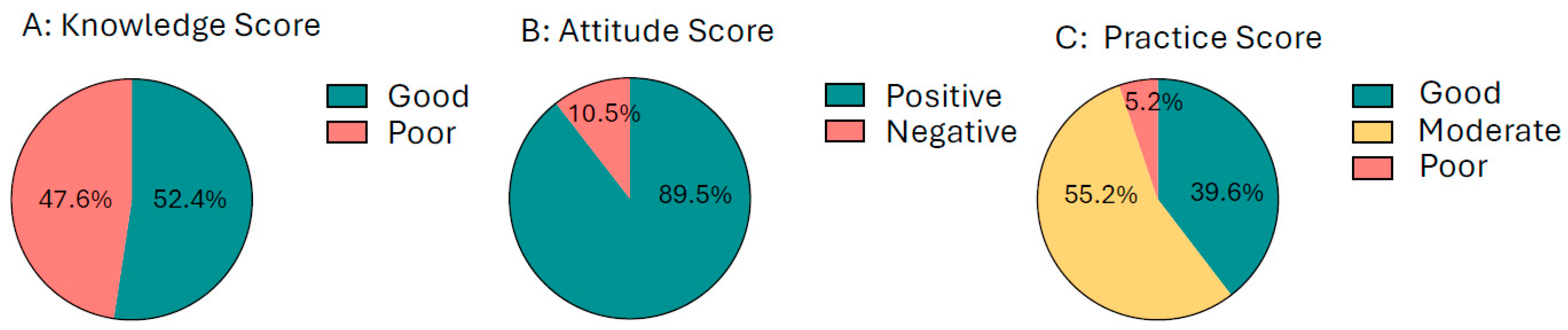
| Knowledge Score | Poor | 263 | 47.6% |
| Good | 290 | 52.4% | |
| Attitude Score | Negative | 58 | 10.5% |
| Positive | 495 | 89.5% | |
| Practice Score | Poor | 29 | 5.2% |
| Moderate | 305 | 55.2% | |
| Good | 219 | 39.6% | |
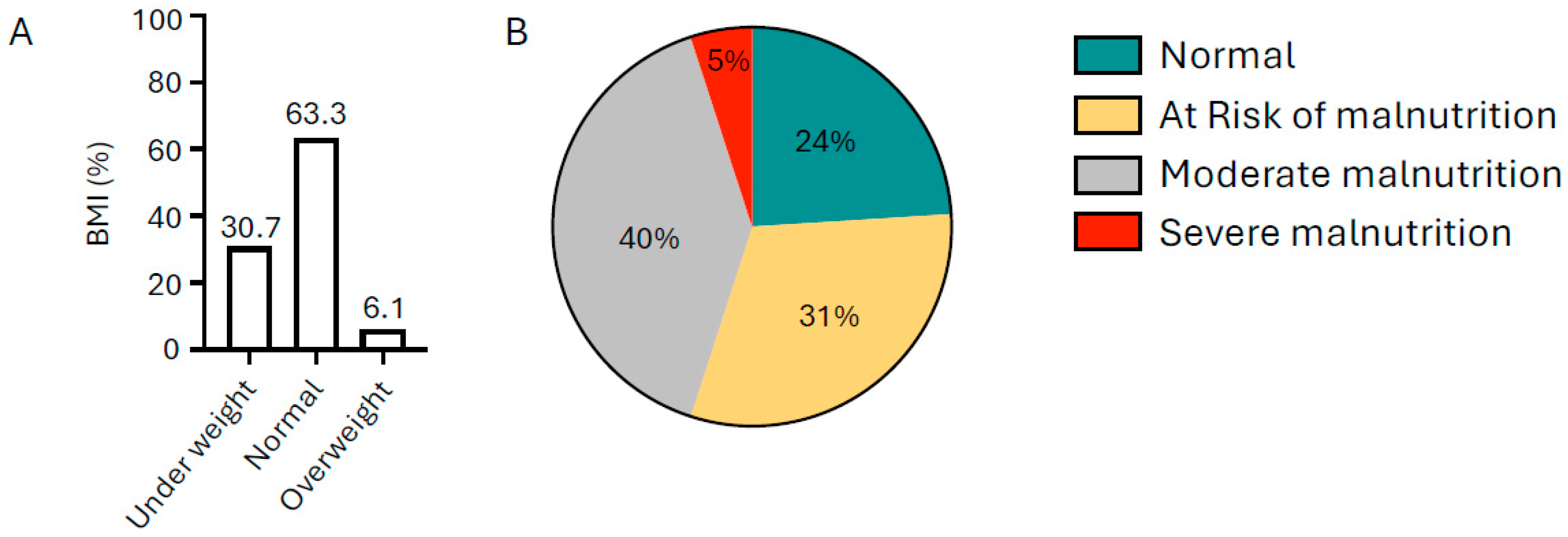
| BMI (n = 551) | Underweight | 170 | 30.7% |
| Normal | 349 | 63.3% | |
| Overweight | 34 | 6.0% | |
| MUAC Score | Normal | 131 | 23.7% |
| At risk of malnutrition | 224 | 40.5% | |
| Moderate malnutrition | 169 | 30.6% | |
| Severe malnutrition | 29 | 5.2% | |
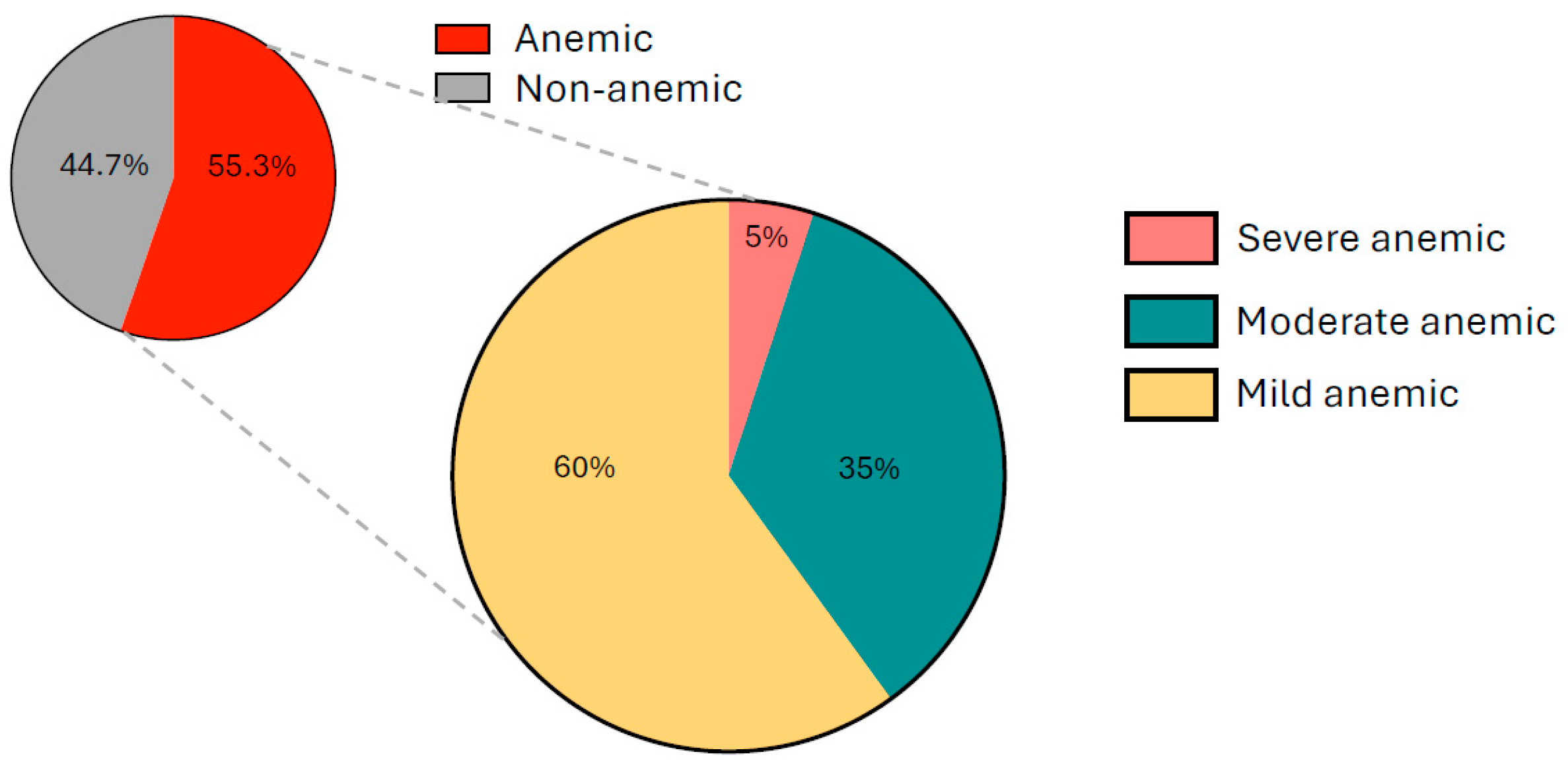
| Hemoglobin Status | Anemic | 306 | 55.3% |
| Non-anemic | 247 | 44.7% | |
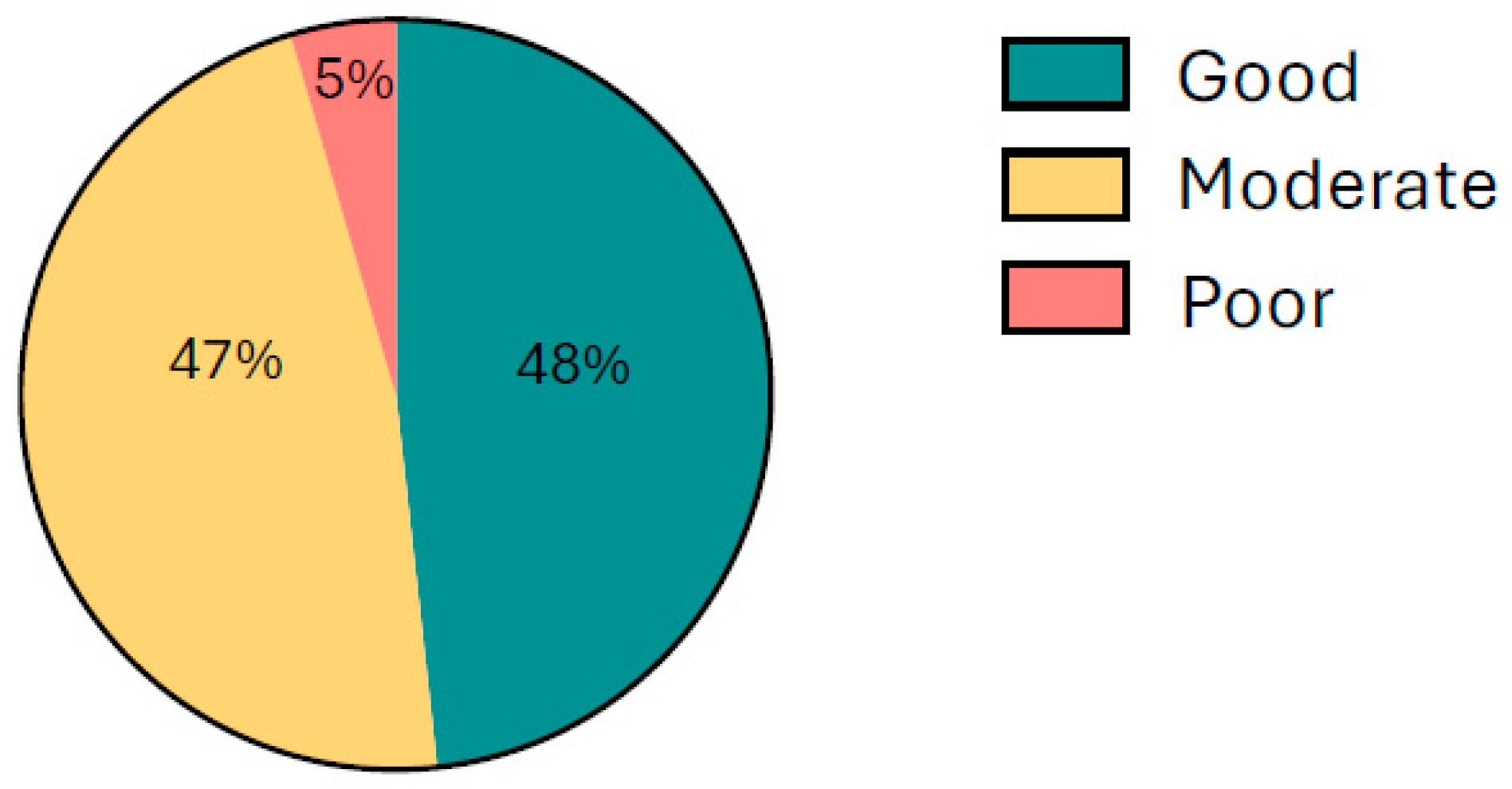
| Dietary Score | Poor | 25 | 4.5% |
| Moderate | 261 | 47.2% | |
| Good | 267 | 48.3% | |
| Overall KAP Score | Moderate KAP | 210 | 38.0% |
| Good KAP | 343 | 62.0% |
| Variable | Category | Moderate n (%) | Good n (%) | Chi-Square (df) | p-Value |
|---|---|---|---|---|---|
| Age Group | 14–15 years | 77 (43.8%) | 99 (56.2%) | χ2 = 4.15 (2) | 0.125 |
| 16–17 years | 70 (37.0%) | 119 (63.0%) | |||
| 18–19 years | 63 (33.5%) | 125 (66.5%) | |||
| School Type | Govt. school | 66 (23.7%) | 213 (76.3%) | χ2 = 49.02 (1) | <0.001 *** |
| Private school | 144 (52.6%) | 130 (47.4%) | |||
| Grade Level | 10th class | 83 (44.1%) | 105 (55.9%) | χ2 = 4.81 (2) | 0.090 |
| 11th class | 64 (36.0%) | 114 (64.0%) | |||
| 12th class | 63 (33.7%) | 124 (66.3%) | |||
| Mother’s Education | No formal education | 126 (54.3%) | 106 (45.7%) | χ2 = 46.82 (2) | <0.001 *** |
| Primary/High School | 67 (24.7%) | 204 (75.3%) | |||
| Graduate | 17 (34.0%) | 33 (66.0%) | |||
| Mother’s Occupation | Housewife | 146 (42.4%) | 198 (57.6%) | χ2 = 10.03 (3) | 0.018 * |
| Skilled worker | 25 (25.5%) | 73 (74.5%) | |||
| Unskilled worker | 31 (36.5%) | 54 (63.5%) | |||
| Professional | 8 (30.8%) | 18 (69.2%) | |||
| Family Annual income | <₹50,000 (<$550) | 15 (32.6%) | 31 (67.4%) | χ2 = 6.44 (4) | 0.168 |
| ₹50k–1 lakh ($550–1100) | 90 (35.0%) | 167 (65.0%) | |||
| ₹1–2 lakhs ($1100–2200) | 79 (40.9%) | 114 (59.1%) | |||
| ₹2–5 lakhs ($2200–5500) | 26 (48.1%) | 28 (51.9%) | |||
| ₹5–10 lakhs ($5500–11,000) | 0 (0.0%) | 3 (100.0%) | |||
| Dietary Preference | Vegetarian | 39 (24.8%) | 118 (75.2%) | χ2 = 16.06 (1) | <0.001 *** |
| Non-vegetarian | 171 (43.2%) | 225 (56.8%) |
| Variable | Category | Moderate n (%) | Good n (%) | Chi-Square (df) | p-Value |
|---|---|---|---|---|---|
| BMI | Underweight | 43 (25.3%) | 127 (74.7%) | χ2 = 18.76 (2) | <0.001 *** |
| Normal | 156 (44.7%) | 193 (55.3%) | |||
| Overweight/obese | 11 (32.4%) | 23 (67.6%) | |||
| MUAC | Normal | 49 (37.4%) | 82 (62.6%) | χ2 = 0.16 (3) | 0.984 |
| At risk of malnutrition | 85 (37.9%) | 139 (62.1%) | |||
| Moderate malnutrition | 64 (37.9%) | 105 (62.1%) | |||
| Severe malnutrition | 12 (41.4%) | 17 (58.6%) | |||
| Hemoglobin Status | Anemic | 150 (49.0%) | 156 (51.0%) | χ2 = 35.48 (1) | <0.001 *** |
| Non-anemic | 60 (24.3%) | 187 (75.7%) | |||
| Diet Score | Poor | 12 (48.0%) | 13 (52.0%) | χ2 = 5.10 (2) | 0.078 |
| Moderate | 109 (41.8%) | 152 (58.2%) | |||
| Good | 89 (33.3%) | 178 (66.7%) |
| Predictor | B | SE | Wald | df | p-Value | OR (Exp[B]) | 95% CI for OR |
|---|---|---|---|---|---|---|---|
| Age of students | 0.344 | 0.631 | 0.297 | 1 | 0.586 | 1.411 | 0.409–4.863 |
| Type of school (private) | −1.057 | 0.217 | 23.640 | 1 | <0.001 | 0.347 | 0.227–0.532 |
| Study grade | −0.001 | 0.620 | 0.000 | 1 | 0.999 | 0.999 | 0.296–3.371 |
| Mother’s education | 0.828 | 0.171 | 23.438 | 1 | <0.001 | 2.289 | 1.637–3.201 |
| Mother’s occupation | −0.048 | 0.123 | 0.156 | 1 | 0.693 | 0.953 | 0.749–1.211 |
| Family annual income | −0.001 | 0.131 | 0.000 | 1 | 0.994 | 0.999 | 0.773–1.291 |
| Dietary preference | −1.011 | 0.255 | 15.764 | 1 | <0.001 | 0.364 | 0.221–0.599 |
| BMI category | −0.561 | 0.201 | 7.824 | 1 | 0.005 | 0.571 | 0.385–0.845 |
| MUAC category | −0.180 | 0.123 | 2.131 | 1 | 0.144 | 0.835 | 0.656–1.064 |
| Hemoglobin status | 1.014 | 0.214 | 22.399 | 1 | <0.001 | 2.757 | 1.812–4.197 |
| Diet score | 0.567 | 0.190 | 8.963 | 1 | 0.003 | 1.764 | 1.216–2.557 |
| Constant | 0.497 | 0.963 | 0.267 | 1 | 0.605 | 1.645 | – |
Disclaimer/Publisher’s Note: The statements, opinions and data contained in all publications are solely those of the individual author(s) and contributor(s) and not of MDPI and/or the editor(s). MDPI and/or the editor(s) disclaim responsibility for any injury to people or property resulting from any ideas, methods, instructions or products referred to in the content. |
© 2026 by the authors. Licensee MDPI, Basel, Switzerland. This article is an open access article distributed under the terms and conditions of the Creative Commons Attribution (CC BY) license.
Share and Cite
Vidyapogu, Y.; Golime, R.; Talabattula, V.A.N.; Nadella, V. Burden and Determinants of Anemia Among Rural Adolescent Girls in Andhra Pradesh, India: A Mixed-Methods Study on Nutritional Status, KAP and Stakeholder Insights. Int. J. Environ. Res. Public Health 2026, 23, 424. https://doi.org/10.3390/ijerph23040424
Vidyapogu Y, Golime R, Talabattula VAN, Nadella V. Burden and Determinants of Anemia Among Rural Adolescent Girls in Andhra Pradesh, India: A Mixed-Methods Study on Nutritional Status, KAP and Stakeholder Insights. International Journal of Environmental Research and Public Health. 2026; 23(4):424. https://doi.org/10.3390/ijerph23040424
Chicago/Turabian StyleVidyapogu, Yeswanth, RamaRao Golime, Venkata Ajay Narendra Talabattula, and Vinod Nadella. 2026. "Burden and Determinants of Anemia Among Rural Adolescent Girls in Andhra Pradesh, India: A Mixed-Methods Study on Nutritional Status, KAP and Stakeholder Insights" International Journal of Environmental Research and Public Health 23, no. 4: 424. https://doi.org/10.3390/ijerph23040424
APA StyleVidyapogu, Y., Golime, R., Talabattula, V. A. N., & Nadella, V. (2026). Burden and Determinants of Anemia Among Rural Adolescent Girls in Andhra Pradesh, India: A Mixed-Methods Study on Nutritional Status, KAP and Stakeholder Insights. International Journal of Environmental Research and Public Health, 23(4), 424. https://doi.org/10.3390/ijerph23040424