Mood Monitoring in Schools: A Promising Alternative to Single-Time-Point Screening


Highlights
- School-based mental health screening is widely used to identify young people who may require early support, yet it typically relies on single-time-point assessments.
- Emotional well-being fluctuates across weeks, raising important public health questions about the stability and accuracy of threshold-based screening decisions.
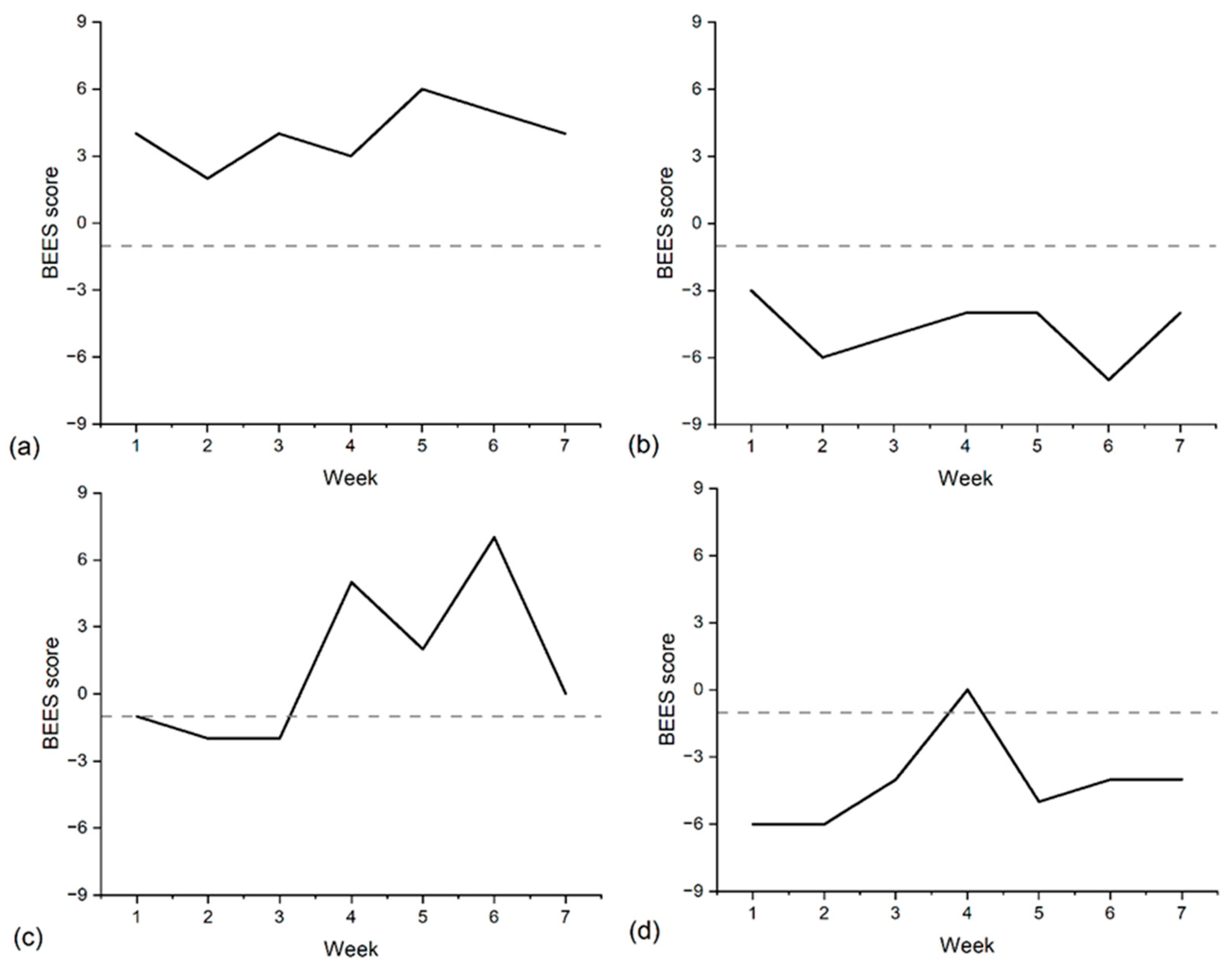
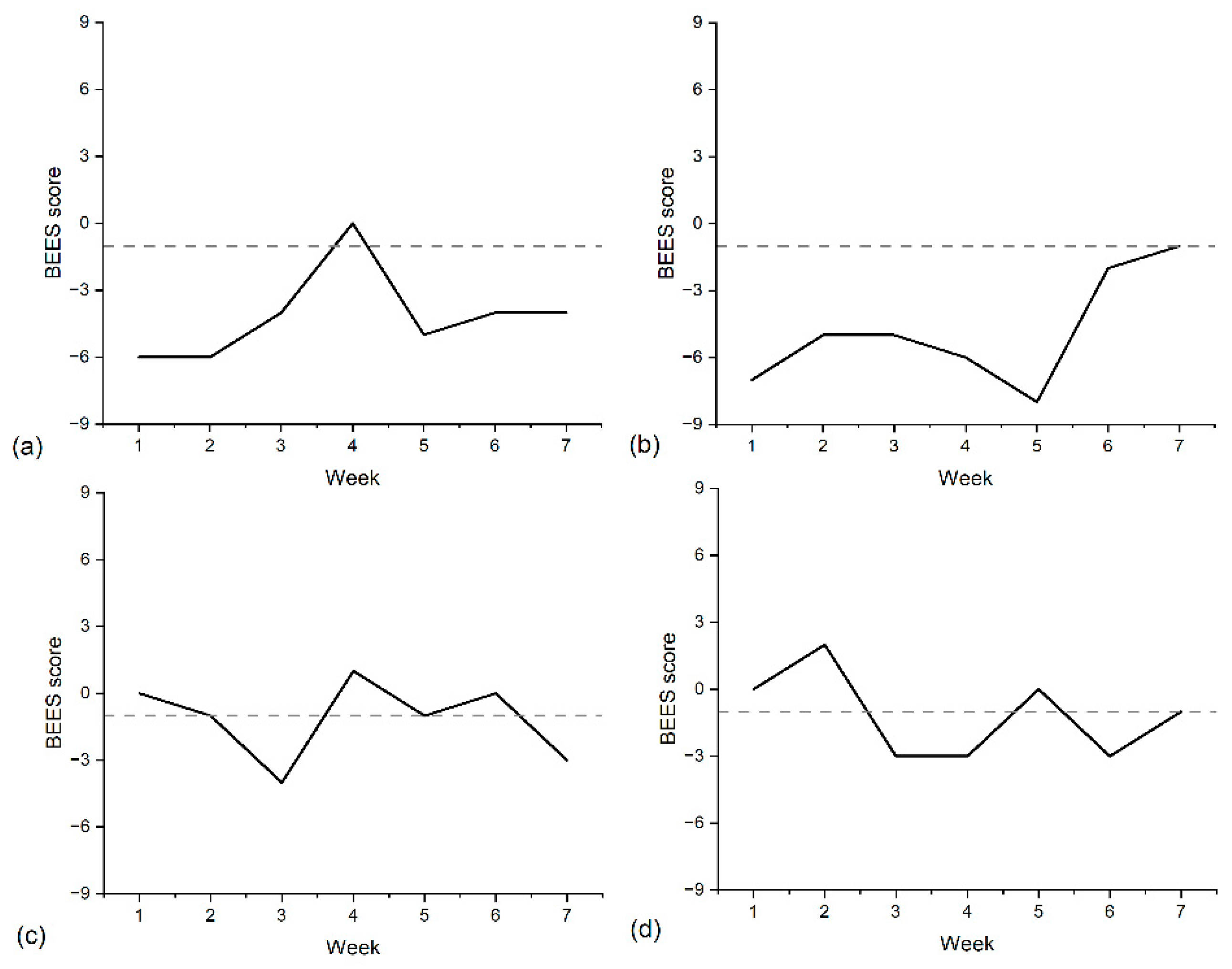
- Nearly one in five students showed classification changes across repeated assessments, indicating that screening outcomes can depend on when measurement occurs.
- While single-time-point and averaged-score classifications showed high agreement, a conservative stability-based criterion identified substantially fewer students for follow-up.
- Repeated mood monitoring provides additional temporal context for interpreting screening classifications and may reduce reliance on single assessment snapshots.
- Public health implementation of school-based screening should carefully consider how repeated data are aggregated, as decision rules directly influence identification outcomes.
Abstract
1. Introduction
1.1. School-Based Mental Health Screening
1.2. Limitations of Single-Time-Point Screening
1.3. The Case for a Mood Monitoring Approach to Screening
1.4. The Present Study
2. Materials and Methods
2.1. Study Design
2.2. Participants
2.3. Measures
2.3.1. The Brief Emotional Experience Scale (BEES)
2.3.2. Student Feedback on the Monitoring Experience
2.4. Procedure
2.5. Analytic Strategy
3. Results
3.1. Patterns of Stability and Fluctuation in Emotional Well-Being Classifications
3.2. Flagging Students Under Alternative Classification Approaches
3.3. Student-Reported Experiences of the Mood Monitoring Process
4. Discussion
4.1. Fluctuation in Emotional Well-Being Classifications over Time
4.2. Flagging Students Under Repeated Mood Monitoring
4.3. Student-Reported Experiences of Mood Monitoring
4.4. Limitations and Directions for Future Research
5. Conclusions
Author Contributions
Funding
Institutional Review Board Statement
Informed Consent Statement
Data Availability Statement
Acknowledgments
Conflicts of Interest
Abbreviations
| BEES | Brief Emotional Experience Scale |
References
- WHO. Adolescent Mental Health. Available online: https://www.who.int/news-room/fact-sheets/detail/adolescent-mental-health (accessed on 30 October 2025).
- Polanczyk, G.V.; Salum, G.A.; Sugaya, L.S.; Caye, A.; Rohde, L.A. Annual Research Review: A meta-analysis of the worldwide prevalence of mental disorders in children and adolescents. J. Child Psychol. Psychiatry 2015, 56, 345–365. [Google Scholar] [CrossRef] [PubMed]
- Kieling, C.; Buchweitz, C.; Caye, A.; Silvani, J.; Ameis, S.H.; Brunoni, A.R.; Cost, K.T.; Courtney, D.B.; Georgiades, K.; Merikangas, K.R.; et al. Worldwide Prevalence and Disability From Mental Disorders Across Childhood and Adolescence: Evidence From the Global Burden of Disease Study. JAMA Psychiatry 2024, 81, 347–356. [Google Scholar] [CrossRef] [PubMed]
- Scheiner, C.; Grashoff, J.; Kleindienst, N.; Beuerger, A. Mental disorders at the beginning of adolescence: Prevalence estimates in a sample aged 11–14 years. Public Health Pract. 2022, 4, 100348. [Google Scholar] [CrossRef]
- Anderson, T.L.; Valiauga, R.; Tallo, C.; Hong, C.B.; Manoranjithan, S.; Domingo, C.; Paudel, M.; Untaroiu, A.; Barr, S.; Goldhaber, K. Contributing Factors to the Rise in Adolescent Anxiety and Associated Mental Health Disorders: A Narrative Review of Current Literature. J. Child Adolesc. Psychiatr. Nurs. 2024, 38, e70009. [Google Scholar] [CrossRef]
- Psychogiou, L.; Navarro, M.C.; Orri, M.; Cote, S.M.; Ahun, M.N. Childhood and Adolescent Depression Symptoms and Young Adult Mental Health and Psychosocial Outcomes. JAMA Netw. Open 2024, 7, e2425987. [Google Scholar] [CrossRef] [PubMed]
- Smith, N.R.; Marshall, L.; Albakri, M.; Smuk, M.; Hagell, A.; Stansfeld, S. Adolescent mental health difficulties and educational attainment: Findings from the UK household longitudinal study. BMJ Open 2021, 11, e046792. [Google Scholar] [CrossRef]
- Long, E.; Gardani, M.; McCann, M.; Sweeting, H.; Tranmer, M.; Moore, L. Mental health disorders and adolescent peer relationships. Soc. Sci. Med. 2020, 253, 112973. [Google Scholar] [CrossRef]
- Villarreal, V.; Peterson, L.S. Mental health screening: Recommendations from an integrated literature review. Contemp. Sch. Psychol. 2024, 29, 250–260. [Google Scholar] [CrossRef]
- Hoover, S.; Bostic, J. Schools as a vital component of the child and adolescent mental health system. Psychiatr. Serv. 2021, 72, 37–48. [Google Scholar] [CrossRef]
- Soneson, E.; Burn, A.-M.; Anderson, J.K.; Humphrey, A.; Jones, P.B.; Fazel, M.; Ford, T.; Howarth, E. Determining stakeholder priorities and core components for school-based identification of mental health difficulties: A Delphi study. J. Sch. Psychol. 2022, 91, 209–227. [Google Scholar] [CrossRef]
- Connors, E.H.; Moffa, K.; Carter, T.; Crocker, J.; Bohenkamp, J.H.; Lever, N.A.; Hoover, S.A. Advancing mental health screening in schools: Innovative, field-tested practices and observed trends during a 15-month learning collaborative. Psychol. Sch. 2022, 59, 1135–1157. [Google Scholar] [CrossRef]
- Anderson, J.K.; Ford, T.; Soneson, E.; Coon, J.T.; Humphrey, A.; Rogers, M.; Moore, S.A.; Jones, P.B.; Clarke, E.; Howarth, E. A systematic review of effectiveness and cost-effectiveness of school-based identification of children and young people at risk of, or currently experiencing mental health difficulties. Psychol. Med. 2018, 49, 9–19. [Google Scholar] [CrossRef]
- Dvorsky, M.R.; Girio-Herrera, E.; Owens, J.S. School-Based Screening for Mental Health in Early Childhood. In Handbook of School Mental Health; Weist, M., Lever, N.A., Bradshaw, C., Owens, J.S., Eds.; Springer: Boston, MA, USA, 2014. [Google Scholar]
- Moffa, K.; Wagle, R.; Dowdy, E.; Palikara, O.; Castro, S.; Dougherty, D.; Furlong, M.J. The Me and My School Questionnaire: Examining the cross-cultural validity of a children’s self-report mental health measure. Int. J. Sch. Educ. Psychol. 2019, 9, 31–41. [Google Scholar] [CrossRef]
- Hume, L.E.; Cibrian, E.; Drew, C. The use of the MIND screener, a computerized assessment of mental health treatment needs, in a public school district. Contemp. Sch. Psychol. 2022, 26, 398–409. [Google Scholar] [CrossRef]
- Kim, J.; Kim, D.; Kamphaus, R. Early Detection of Mental Health Through Universal Screening at Schools. Ga. Educ. Res. 2022, 19, 62. [Google Scholar] [CrossRef]
- Moore, S.A.; Widales-Benitez, O.; Carnazzo, K.W.; Kim, E.K.; Moffa, K.; Dowdy, E. Conducting Universal Complete Mental Health Screening via Student Self-Report. Contemp. Sch. Psychol. 2015, 19, 253–267. [Google Scholar] [CrossRef]
- Porter, A.; d’Apice, K.; Albers, P.; Woodrow, N.; Fairbrother, H.; Breheny, K.; Mills, C.; Tebbett, S.; De Vocht, F. The impact of the newly developed schoolbased ‘Digital Health Contact’—Evaluating a health and wellbeing screening tool for adolescents in England. PLoS ONE 2024, 19, e0297016. [Google Scholar] [CrossRef]
- Villarreal, V. Considerations for Mental Health Screening and Referrals: Implications from a School-University Case Study. J. Appl. Sch. Psychol. 2024, 40, 62–82. [Google Scholar] [CrossRef]
- Wood, B.J.; Cooper-Secrest, K.R.; Kirk, M.; Walter, S. Universal mental health screening in schools: A primer for principals. J. Educ. Leadersh. Policy Stud. 2021, 5, n1. [Google Scholar]
- Lustig, S.; Kaess, M.; Schnyder, N.; Michel, C.; Brunner, R.; Tubiana, A.; Kahn, J.-P.; Sarchiapone, M.; Hoven, C.W.; Barzilay, S.; et al. The impact of school-based screening on service use in adolescents at risk for mental health problems and risk-behaviour. Eur. Child Adolesc. Psychiatry 2022, 32, 1745–1754. [Google Scholar] [CrossRef] [PubMed]
- Russell, M.A.; Gajos, J.M. Annual Research Review: Ecological Momentary Assessment Studies in Child Psychology and Psychiatry. J. Child Adolesc. Psychiatry 2020, 61, 376–394. [Google Scholar] [CrossRef]
- Asscheman, J.S.; Zanolie, K.; Bexkens, A.; Bos, M.G.N. Mood Variability Among Early Adolescents in Times of Social Constraints: A Daily Diary Study During the COVID-19 Pandemic. Front. Psychol. 2021, 12, 722494. [Google Scholar] [CrossRef]
- Walsh, R.J.; van Buuren, M.; Hollarek, M.; Sijtsma, H.; Lee, N.C.; Krabbendam, L. Social Contexts, Momentary Mood and Affective Variability in Early Adolescence: An Exploratory Ecological Momentary Assessment Study. J. Early Adolesc. 2024, 44, 59–95. [Google Scholar] [CrossRef]
- Nelis, S.; Bukowski, W.M. Daily Affect and Self-Esteem in Early Adolescence: Correlates of Mean Levels and Within-Person Variability. Psychol. Belg. 2019, 59, 96–115. [Google Scholar] [CrossRef]
- Kouros, C.D.; Keller, P.S.; Martin-Pinon, O.; El-Sheikh, M. Bidirectional associations between nightly sleep and daily happinessand negative mood in adolescents. Child Dev. 2022, 93, e547–e562. [Google Scholar] [CrossRef]
- Shen, L.; Nicolazzo, J.; Sletten, T.L.; Anderson, C.; Yap, Y.; Wiley, J.F.; Bei, B. Daily fluctuations in adolescents’ sleep predict nextday attention, sleepiness, and fatigue: An ecological momentary assessment study over 28 days. J. Child Psychol. Psychiatry 2025, 66, 686–696. [Google Scholar] [CrossRef] [PubMed]
- Fuligni, A.J.; Hardway, C. Daily Variation in Adolescents’ Sleep, Activities, and Psychological Well-Being. J. Res. Adolesc. 2006, 16, 353–378. [Google Scholar] [CrossRef]
- Hellstrom, L.; Sjoman, M.; Enskar, K. Conceptualizing adolescents’ everyday stressors to underscore areas for support. Front. Educ. 2024, 9, 1370791. [Google Scholar] [CrossRef]
- Braund, T.A.; Baker, S.T.E.; Subotic-Kerry, M.; Tilman, G.; Evans, N.J.; Mackinnon, A.; Christensen, H.; O’Dea, B. Potential mental health-related harms associated with the universal screening of anxiety and depressive symptoms in Australian secondary schools. Child Adolesc. Psychiatry Ment. Health 2024, 18, 46–59. [Google Scholar] [CrossRef]
- Levitt, J.M.; Saka, N.; Romanelli, L.H.; Hoagwood, K. Early identification of mental health problems in schools: The status of instrumentation. J. Sch. Psychol. 2007, 45, 163–191. [Google Scholar] [CrossRef]
- Husky, M.M.; Kaplan, A.; McGuire, L.; Flynn, L.; Chrostowski, C.; Olfson, M. Identifying adolescents at risk through voluntary school-based mental health screening. J. Adolesc. 2011, 34, 505–511. [Google Scholar] [CrossRef]
- Songco, A.; Francis, D.A.; McDermott, E.A.; Lim, C.Y.S.; Allsop, A.; Croguennec, J.; Sicouri, G.; Mackinnon, A.; Hudson, J.L. The impact of universal mental health screening on stigma in primary schools. Child Adolesc. Psychiatry Ment. Health 2025, 19, 5. [Google Scholar] [CrossRef]
- Rapee, R.M.; Kuhnert, R.; Bowsher, I.; Burns, J.; Dixon, J.; Lourey, C.; McLellan, L.F.; Prendergast, T.; Wuthrich, V. Stakeholder attitudes toward the implementation of school-based, universal, mental health screening: Student, caregiver, and teacher perspectives. Int. J. Environ. Res. Public Health 2025, 22, 1825. [Google Scholar] [CrossRef]
- Trull, T.J.; Ebner-Priemer, U. Ambulatory assessment. Annu. Rev. Clin. Psychol. 2013, 9, 151–176. [Google Scholar] [CrossRef]
- Bolger, N.; Davis, A.; Rafaeli, E. Diary methods: Capturing life as it is lived. Annu. Rev. Psychol. 2003, 54, 579–616. [Google Scholar] [CrossRef]
- Beames, J.R.; Kikas, K.; Werner-Seidler, A. Prevention and early intervention of depression in young people: An integrated narrative review of affective awareness and Ecological Momentary Assessment. BMC Psychol. 2021, 9, 113. [Google Scholar] [CrossRef] [PubMed]
- Thomson, A.; Lawrence, E.; Sharxhi, E.; Oliver, B.; Wright, B.; Hosang, G. Self-directed digital interventions for the improvement of emotion regulation—Acceptability and feasibility for adolescents: Systematic review. BJPsych Open 2025, 11, e270. [Google Scholar] [CrossRef]
- Kuppens, P.; Oravecz, Z.; Tuerlinckx, F. Feelings change: Accounting for individual differences in the temporal dynamics of affect. J. Personal. Soc. Psychol. 2010, 99, 1042–1060. [Google Scholar] [CrossRef]
- Durlak, J.A.; Mahoney, J.L.; Boyle, A.E. What we know, and what we need to find out about universal, school-based social and emotional learning programs for children and adolescents: A review of meta-analyses and directions for future research. Psychol. Bull. 2022, 148, 765–782. [Google Scholar] [CrossRef]
- Jones, S.M.; McGarrah, M.W.; Kahn, J. Social and emotional learning: A principled science of human development in context. Educ. Psychol. 2019, 54, 129–143. [Google Scholar] [CrossRef]
- Burns, J.R.; Rapee, R.M. From barriers to implementation: Advancing universal mental health screening in schools. J. Psychol. Couns. Sch. 2021, 31, 172–183. [Google Scholar] [CrossRef]
- Rogers, S.L.; Brown, N.; Goulding, M.; Campbell, K.; Mills, B.; Hollett, R.; Cruickshank, T.; Nosaka, K. Reliability and Validity of the Brief Emotional Experience Scale (BEES) as a Measure of Emotional Well-Being. Behav. Sci. 2025, 15, 643. [Google Scholar] [CrossRef]
- Rogers, S.L.; Cruickshank, T.; Nosaka, K. Reliability and validity of the Brief Emotional Experience Scale (BEES) for mood monitoring. PsyArXiv 2021. [Google Scholar] [CrossRef]
- Shore, L.; Toumbourou, J.W.; Lewis, A.J.; Kremer, P. Review: Longitudinal trajectories of child and adolescent depressive symptoms and their predictors—A systematic review and meta-analysis. Child Adolesc. Ment. Health 2018, 23, 107–120. [Google Scholar] [CrossRef]
- Weavers, B.; Heron, J.; Thapar, A.K.; Stephens, A.; Lennon, J.; Jones, R.B.; Eyre, O.; Anney, R.J.L.; Collishaw, S.; Thapar, A.; et al. The antecedents and outcomes of persistent and remitting adolescent depressive symptom trajectories: A longitudinal, population-based English study. Lancet Psychiatry 2021, 8, 1053–1061. [Google Scholar] [CrossRef]
- Dai, Y.; Shen, L.; Wu, Z.; Zhang, J.; Li, Q.; Xiao, J. Trajectories and Influences of Depression in Adolescents: A Latent Profile Transition Analysis Study. Stress Health 2025, 41, e3528. [Google Scholar] [CrossRef]
- Yoon, Y.; Eisenstadt, M.; Lereya, S.T.; Deighton, J. Gender difference in the change of adolescents’ mental health and subjective wellbeing trajectories. Eur. Child Adolesc. Psychiatry 2022, 32, 1569–1578. [Google Scholar] [CrossRef] [PubMed]
- Marie, R.; Journault, A.-A.; Cernik, R.; Welch, P.; Lupien, S.; McDermott, B.; Moxon, J.V.; Sarnyai, Z. A Cross-Sectional Study Investigating Canadian and Australian Adolescents’ Perceived Experiences of COVID-19: Gender Differences and Mental Health Implications. Int. J. Environ. Res. Public Health 2022, 19, 4407. [Google Scholar] [CrossRef]
- Blake, J.A.; Farugia, T.L.; Andrew, B.; Malacova, E.; Lawrence, D.; Thomas, H.J.; Scott, J.G. The Kessler Psychological Distress Scale in Australian adolescents: Analysis of the second Australian Child and Adolescent Survey of Mental Health and Wellbeing. Aust. N. Z. J. Psychiatry 2024, 58, 345–354. [Google Scholar] [CrossRef] [PubMed]
- Keyes, K.M.; Platt, J.M. Annual Research Review: Sex, gender, and internalizing conditions among adolescents in the 21st century—Trends, causes, consequences. J. Child Psychol. Psychiatry 2024, 64, 384–407. [Google Scholar] [CrossRef]
- Plant, M.Z.; Clark, K.N. Universal Screening for Student Mental Health: Selection of Norming Group. Assess. Eff. Interv. 2024, 50, 3–15. [Google Scholar] [CrossRef]
- Soneson, E.; Childs-Fegredo, J.; Anderson, J.K.; Stochl, J.; Fazel, M.; Ford, T.; Humphrey, A.; Jones, P.B.; Howarth, E. Acceptability of screening for mental health difficulties in primary schools: A survey of UK parents. BMC Public Health 2018, 18, 1404. [Google Scholar] [CrossRef] [PubMed]
- Palmer, C.; Kane, J.; Patterson, P.; Tuomainen, H. Universal Mental Health Screening in Schools: How Acceptable is this to Key Stakeholders? A Systematic Review. J. Child Fam. Stud. 2025, 34, 366–380. [Google Scholar] [CrossRef]
- Burns, J.R.; Rapee, R.M. Barriers to Universal Mental Health Screening in Schools: The Perspective of School Psychologists. J. Appl. Sch. Psychol. 2022, 38, 223–240. [Google Scholar] [CrossRef]



| Averaged Score | First Response Only | All Monitoring Points | |
|---|---|---|---|
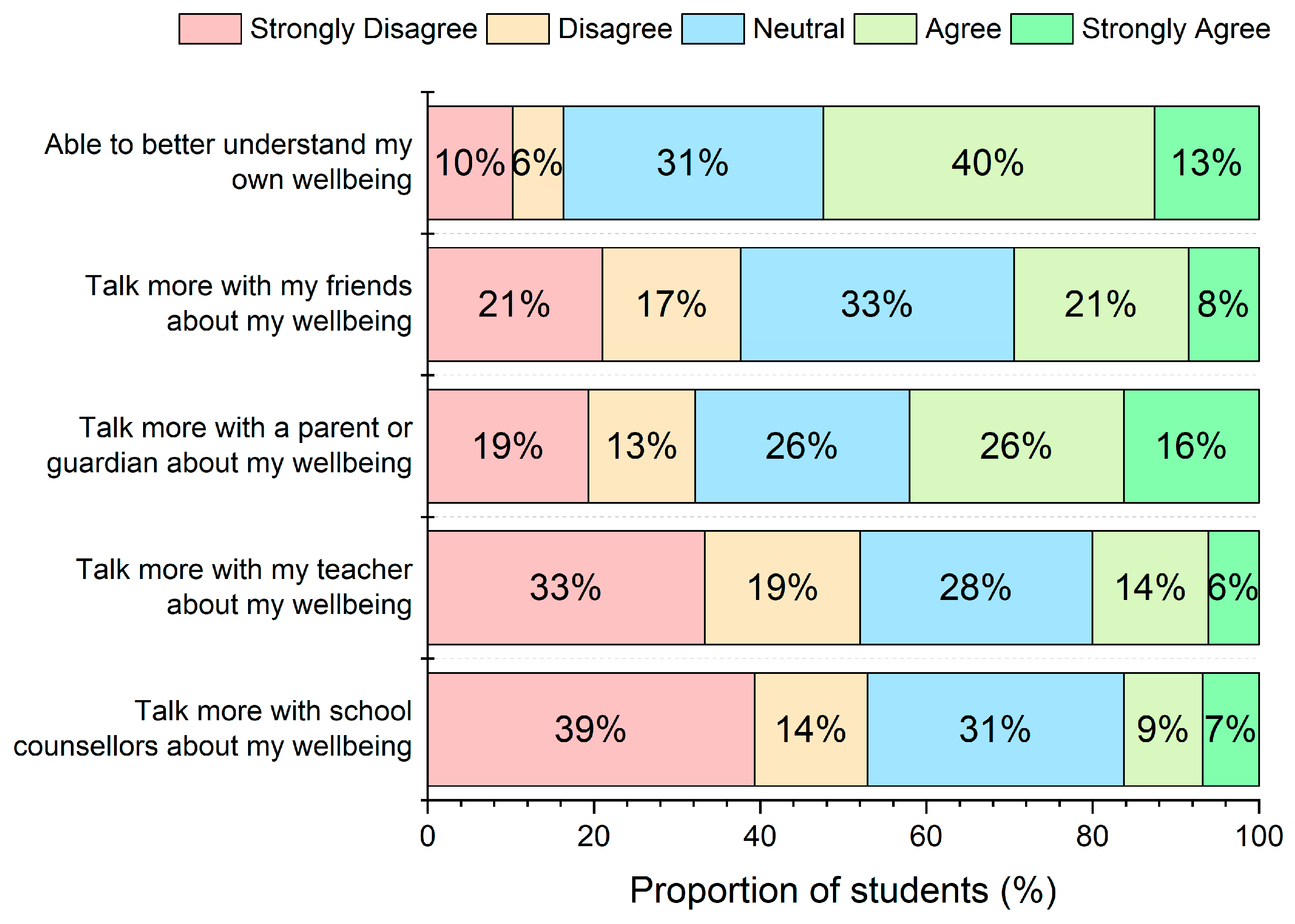
| Total (n = 767) | L: 12% M: 39% H: 49% | L: 14% M: 40% H: 46% | CB: 5% MX: 17% CA: 78% |
| Females (n = 378) | L: 18% M: 48% H: 34% | L: 20% M: 48% H: 31% | CB: 7% MX: 24% CA: 69% |
| Males (n = 389) | L: 6% M: 29% H: 64% | L: 8% M: 32% H: 60% | CB: 2% MX: 11% CA: 87% |
Disclaimer/Publisher’s Note: The statements, opinions and data contained in all publications are solely those of the individual author(s) and contributor(s) and not of MDPI and/or the editor(s). MDPI and/or the editor(s) disclaim responsibility for any injury to people or property resulting from any ideas, methods, instructions or products referred to in the content. |
© 2026 by the authors. Licensee MDPI, Basel, Switzerland. This article is an open access article distributed under the terms and conditions of the Creative Commons Attribution (CC BY) license.
Share and Cite
Rogers, S.L.; Brown, N.; Campbell, K.; Goulding, M. Mood Monitoring in Schools: A Promising Alternative to Single-Time-Point Screening. Int. J. Environ. Res. Public Health 2026, 23, 423. https://doi.org/10.3390/ijerph23040423
Rogers SL, Brown N, Campbell K, Goulding M. Mood Monitoring in Schools: A Promising Alternative to Single-Time-Point Screening. International Journal of Environmental Research and Public Health. 2026; 23(4):423. https://doi.org/10.3390/ijerph23040423
Chicago/Turabian StyleRogers, Shane L., Nicole Brown, Kathryn Campbell, and Matthew Goulding. 2026. "Mood Monitoring in Schools: A Promising Alternative to Single-Time-Point Screening" International Journal of Environmental Research and Public Health 23, no. 4: 423. https://doi.org/10.3390/ijerph23040423
APA StyleRogers, S. L., Brown, N., Campbell, K., & Goulding, M. (2026). Mood Monitoring in Schools: A Promising Alternative to Single-Time-Point Screening. International Journal of Environmental Research and Public Health, 23(4), 423. https://doi.org/10.3390/ijerph23040423