Systematic Review and Meta-Analysis of Work-Related Musculoskeletal Disorder Prevalence Among European Surgeons: Effect of Demographic, Economic, and Quality-of-Life Indicators



Highlights
- WMSDs are ubiquitous among healthcare professionals.
- Knowledge of prevalence and the factors that cause them is essential for good health at work and maintaining the effectiveness of interventions by surgeons.
- To have data on the general prevalence and by body area among surgeons in Europe for the development of new health policies (recommendations and education).
- This study investigates new parameters such as HDI and SBS as risk factors underlying WMSD.
- For practitioners: to carry out their activities in the best working conditions while protecting their health.
- Improved quality of life for surgeons.
Abstract
1. Introduction
2. Materials and Methods
2.1. Search Strategy
2.2. Inclusion and Exclusion Criteria
2.3. Quality and Risk of Bias Assessment
2.4. Data Extraction
2.5. Certainty Assessment
2.6. Statistical Analysis
2.7. Registration and Report
3. Results
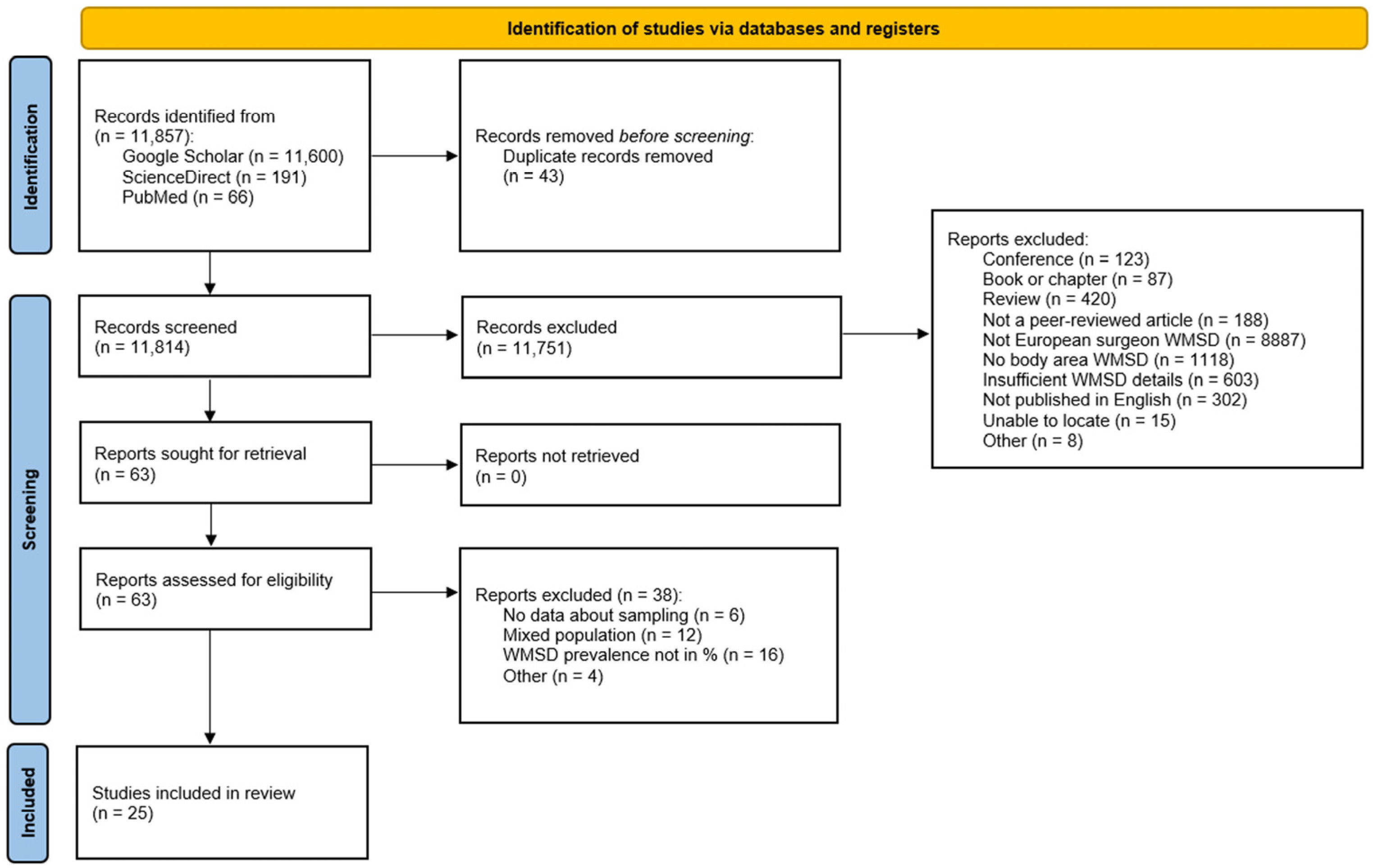
3.1. Search Results
3.2. Study Characteristics
3.3. Quality Appraisal and Risk of Bias
3.4. Meta-Analysis of WMSD Prevalence
3.5. Subgroup Meta-Analyses
3.6. Publication Bias Tests
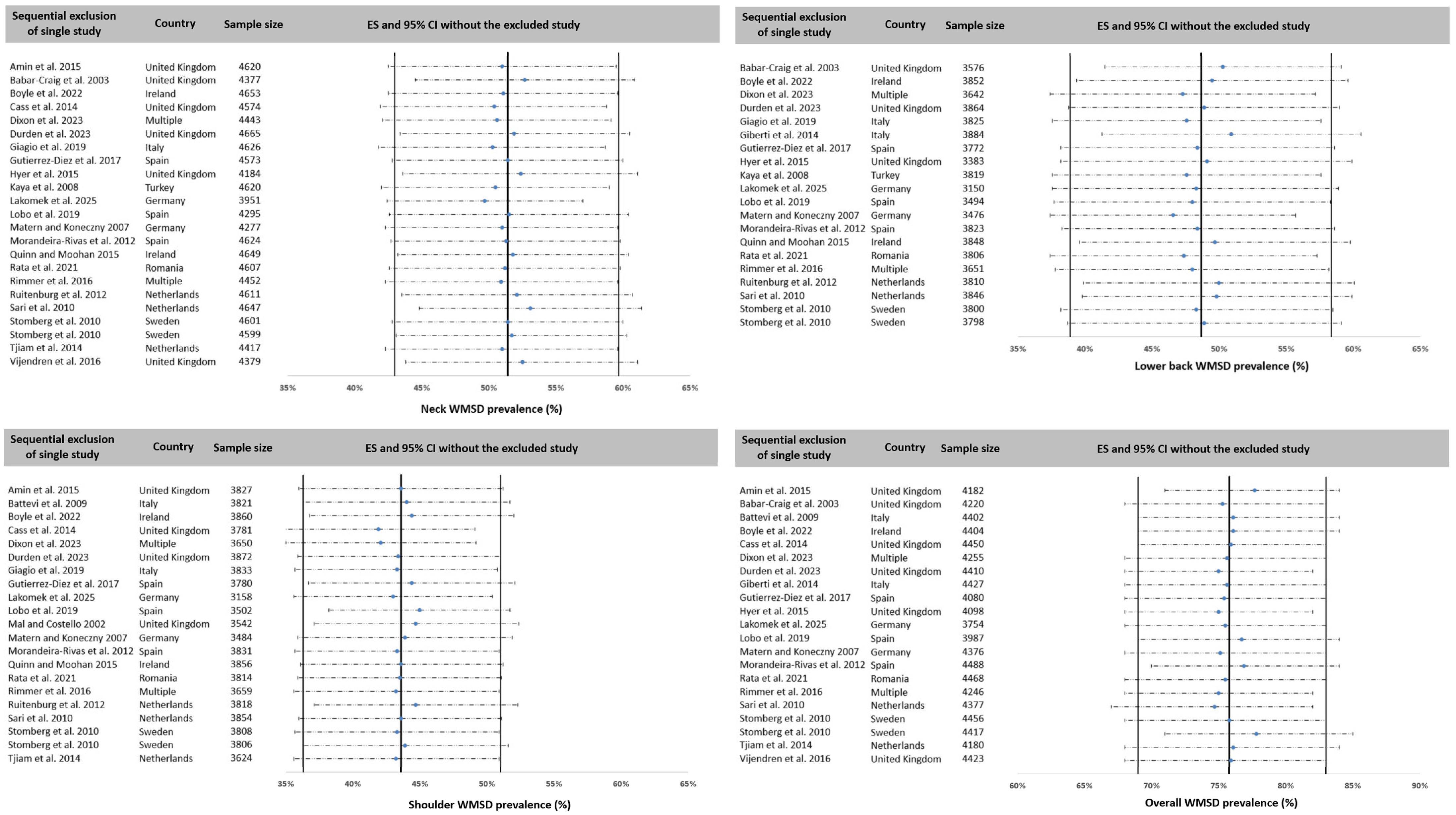
3.7. Sensitivity Analysis
3.8. Level of Evidence
4. Discussion
4.1. WMSD Prevalence
4.2. Demographic Parameters and WMSD Prevalence
4.3. GDP, HDI and WMSD Prevalence
4.4. SBS Ratio and WMSD Prevalence
4.5. Limitations
5. Conclusions
Supplementary Materials
Author Contributions
Funding
Institutional Review Board Statement
Informed Consent Statement
Data Availability Statement
Conflicts of Interest
Abbreviations
| AXIS | Tool for evaluating cross-sectional studies |
| BMI | Body mass index |
| GDP | Gross Domestic Product |
| HDI | Human Development Index |
| NMQ | Nordic Musculoskeletal Disorders Questionnaire |
| PECO | Population, Exposure, Comparator, and Outcomes guidelines |
| PRISMA | Preferred Reporting Items for Systematic reviews and Meta-Analyses |
| SBS | Surgery by Surgeon |
| WMSDs | Work-related musculoskeletal disorders |
Appendix A. AXIS

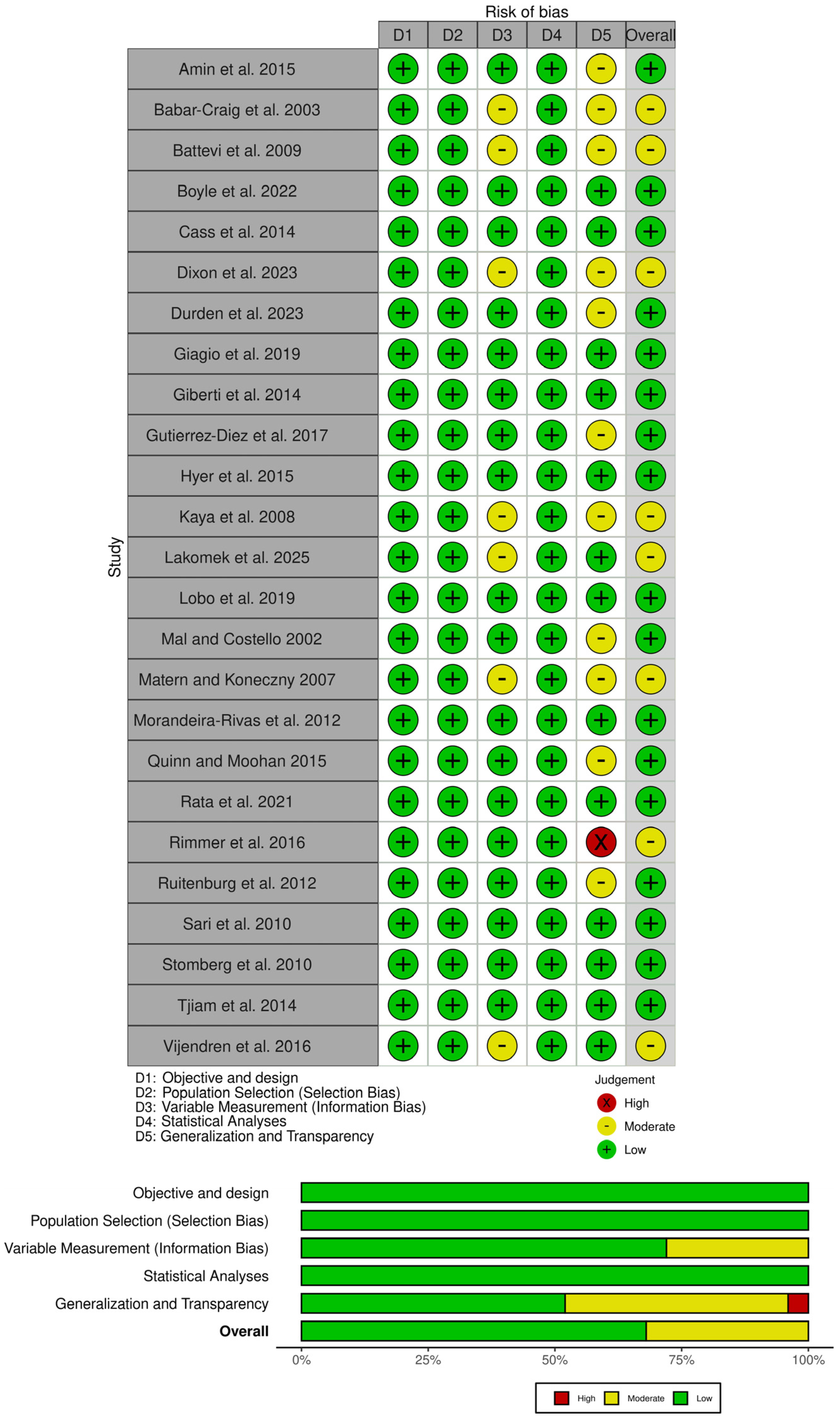
| 1. Were the Aims/Objectives of the Study Clear? | 2. Was the Study Design Appropriate for the Stated Aim(s)? | 3. Was the Sample Size Justified? | 4. Was the Target/Reference Population Clearly Defined? (Is it Clear Who the Research Was About?) | 5. Was the Sample Frame Taken from an appropriate Population Base so That It Closely Represented the Target/Reference Population Under Investigation? | 6. Was the Selection Process Likely to Select Subjects/Participants that Were Representative of the Target/Reference Population Under Investigation? | 7. Were Measures Undertaken to Address and Categorize Non-Responders? | 8. Were the Risk Factor and Outcome Variables Measured Appropriate to the Aims of the Study? | 9. Were the Risk Factor and Outcome Variables Measured Correctly Using Instruments/Measurements that Had Been Trialed, Piloted or Published Previously? | 10. Is it Clear What Was Used to Determined Statistical Significance and/or Precision Estimates? (e.g., p Values, cis) | 11. Were the Methods (Including Statistical Methods) Sufficiently Described to Enable Them to Be Repeated? | 12. Were the Basic Data Adequately Described? | 13. Does the Response Rate Raise Concerns About Non-Response Bias? | 14. If Appropriate, Was information About Non-Responders Described? | 15. Were the Results Internally Consistent? | 16. Were the Results for the Analyses Described in the Methods, Presented? | 17. Were the Authors’ Discussions and Conclusions Justified by the Results? | 18. Were the Limitations of the Study Discussed? | 19. Were There Any Funding Sources or Conflicts of Interest That May Affect the Authors’ Interpretation of The Results? * | 20. Was Ethical Approval or Consent of Participants Attained? | |
|---|---|---|---|---|---|---|---|---|---|---|---|---|---|---|---|---|---|---|---|---|
| Amin et al., 2015 [63] | Yes | Yes | No | Yes | Yes | Yes | No | Yes | Yes | Yes | Yes | Yes | No | NA | Yes | Yes | Yes | Yes | No | No |
| Babar-Craig et al., 2003 [64] | Yes | Yes | No | Yes | Yes | Yes | No | Yes | Yes | No | Yes | Yes | No | NA | Yes | Yes | Yes | No | No | Yes |
| Battevi et al., 2009 [55] | Yes | Yes | No | Yes | Yes | Yes | No | Yes | Yes | No | Yes | Yes | No | NA | Yes | Yes | Yes | No | No | Yes |
| Boyle et al., 2022 [53] | Yes | Yes | No | Yes | Yes | Yes | No | Yes | Yes | Yes | Yes | Yes | No | NA | Yes | Yes | Yes | Yes | No | Yes |
| Cass et al., 2014 [26] | Yes | Yes | No | Yes | Yes | Yes | No | Yes | Yes | Yes | Yes | Yes | No | NA | Yes | Yes | Yes | Yes | No | Yes |
| Dixon et al., 2023 [68] | Yes | Yes | No | Yes | Yes | Yes | No | Yes | Yes | No | Yes | Yes | No | NA | Yes | Yes | Yes | Yes | No | No |
| Durden et al., 2023 [65] | Yes | Yes | No | Yes | Yes | Yes | No | Yes | Yes | Yes | Yes | Yes | No | NA | Yes | Yes | Yes | Yes | No | No |
| Giagio et al., 2019 [33] | Yes | Yes | Yes | Yes | Yes | Yes | No | Yes | Yes | Yes | Yes | Yes | No | NA | Yes | Yes | Yes | Yes | No | Yes |
| Giberti et al., 2014 [56] | Yes | Yes | No | Yes | Yes | Yes | No | Yes | Yes | Yes | Yes | Yes | No | NA | Yes | Yes | Yes | Yes | No | Yes |
| Gutierrez-Diez et al., 2017 [60] | Yes | Yes | No | Yes | Yes | Yes | No | Yes | Yes | Yes | Yes | Yes | No | NA | Yes | Yes | Yes | No | No | Yes |
| Hyer et al., 2015 [66] | Yes | Yes | No | Yes | Yes | Yes | No | Yes | Yes | Yes | Yes | Yes | No | NA | Yes | Yes | Yes | Yes | No | Yes |
| Kaya et al., 2008 [62] | Yes | Yes | No | Yes | Yes | Yes | No | Yes | Yes | No | Yes | Yes | No | NA | Yes | Yes | Yes | No | No | Yes |
| Lakomek et al., 2025 [52] | Yes | Yes | No | Yes | Yes | Yes | No | Yes | Yes | No | Yes | Yes | No | NA | Yes | Yes | Yes | Yes | No | Yes |
| Lobo et al., 2019 [61] | Yes | Yes | No | Yes | Yes | Yes | No | Yes | Yes | Yes | Yes | Yes | No | NA | Yes | Yes | Yes | Yes | No | Yes |
| Mal and Costello, 2002 [7] | Yes | Yes | No | Yes | Yes | Yes | No | Yes | Yes | Yes | Yes | Yes | No | NA | Yes | Yes | Yes | No | No | Yes |
| Matern and Koneczny, 2007 [20] | Yes | Yes | No | Yes | Yes | Yes | No | Yes | Yes | No | Yes | Yes | No | NA | Yes | Yes | Yes | No | No | Yes |
| Morandeira-Rivas et al., 2012 [22] | Yes | Yes | No | Yes | Yes | Yes | No | Yes | Yes | Yes | Yes | Yes | No | NA | Yes | Yes | Yes | Yes | No | Yes |
| Quinn and Moohan, 2015 [54] | Yes | Yes | No | Yes | Yes | Yes | No | Yes | Yes | Yes | Yes | Yes | No | NA | Yes | Yes | Yes | No | No | Yes |
| Rata et al., 2021 [18] | Yes | Yes | No | Yes | Yes | Yes | No | Yes | Yes | Yes | Yes | Yes | No | NA | Yes | Yes | Yes | Yes | No | Yes |
| Rimmer et al., 2016 [69] | Yes | Yes | No | Yes | Yes | Yes | No | Yes | Yes | Yes | Yes | Yes | No | NA | Yes | Yes | Yes | No | No | No |
| Ruitenburg et al., 2012 [57] | Yes | Yes | No | Yes | Yes | Yes | No | Yes | Yes | Yes | Yes | Yes | No | NA | Yes | Yes | Yes | No | No | Yes |
| Sari et al., 2010 [58] | Yes | Yes | No | Yes | Yes | Yes | No | Yes | Yes | Yes | Yes | Yes | No | NA | Yes | Yes | Yes | Yes | No | Yes |
| Stomberg et al., 2010 [51] | Yes | Yes | No | Yes | Yes | Yes | No | Yes | Yes | Yes | Yes | Yes | No | NA | Yes | Yes | Yes | Yes | No | Yes |
| Tjiam et al., 2014 [59] | Yes | Yes | No | Yes | Yes | Yes | No | Yes | Yes | Yes | Yes | Yes | No | NA | Yes | Yes | Yes | Yes | No | Yes |
| Vijendren et al., 2016 [67] | Yes | Yes | No | Yes | Yes | Yes | No | Yes | Yes | No | Yes | Yes | No | NA | Yes | Yes | Yes | Yes | No | Yes |
Appendix B
| Body Area | Number of Studies | Certainty Assessment | Effect | Overall Quality | |||||||
|---|---|---|---|---|---|---|---|---|---|---|---|
| Study Design | Publication Bias (Egger Test) | Indirectness | Inconsistency | Imprecision | Risk of Bias | n | Event Rate | (95% CI) | |||
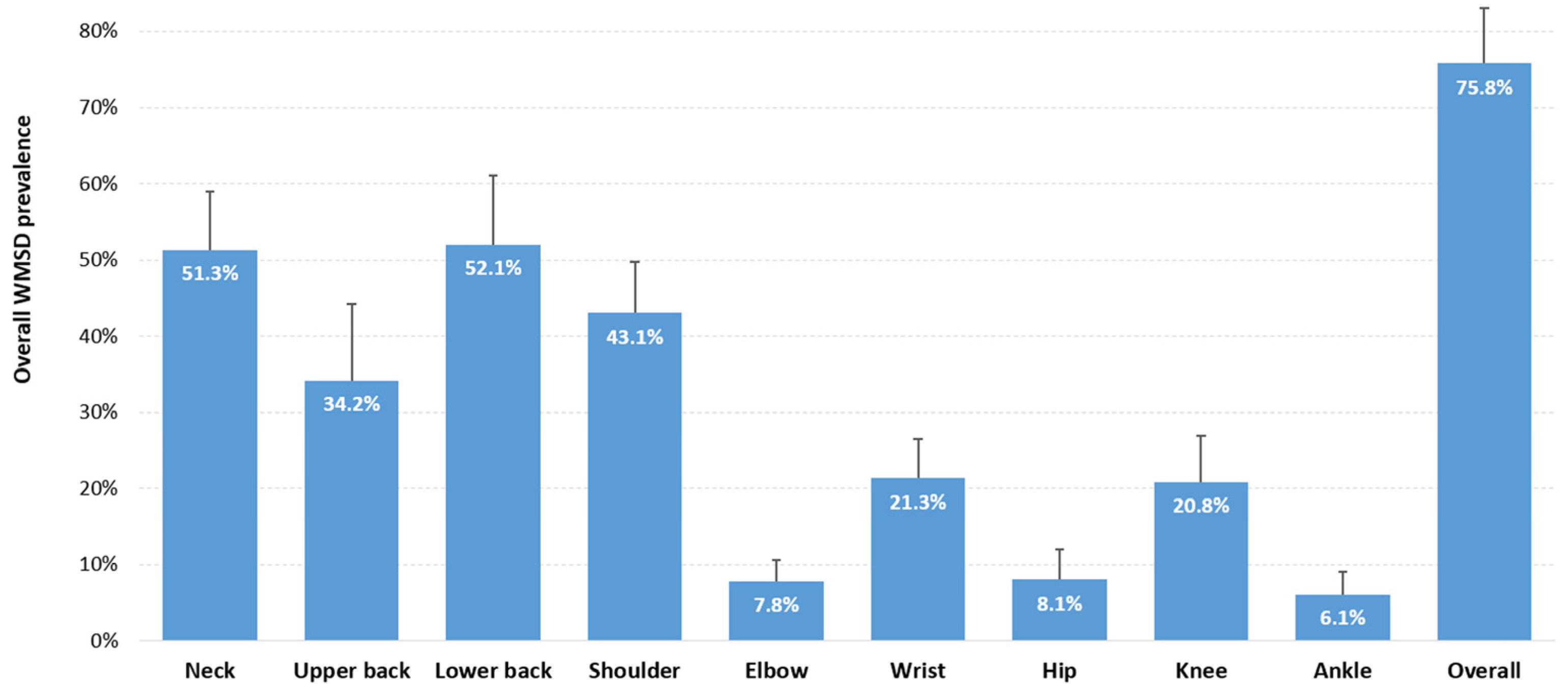
| Neck | 23 | Observational | Not serious (p = 0.145) | Not serious | Serious (I2 = 91.81%) | Not serious | Not serious | 4797 | 51.3% | (43.7–58.9) | Very low ⬤◯◯◯ |
| Upper back | 13 | Observational | Serious (p = 0.006) | Not serious | Serious (I2 = 96.02%) | Serious | Not serious | 2440 | 34.2% | (24.2–44.1) | Very low ⬤◯◯◯ |
| Lower back | 20 | Observational | Not serious (p = 0.173) | Not serious | Serious (I2 = 92.78%) | Not serious | Not serious | 3996 | 52.1% | (43.1–61.0) | Very low ⬤◯◯◯ |
| Shoulder | 21 | Observational | Not serious (p = 0.067) | Not serious | Serious (I2 = 89.33%) | Not serious | Not serious | 4004 | 43.1% | (36.4–49.8) | Very low ⬤◯◯◯ |
| Elbow | 12 | Observational | Serious (p < 0.001) | Not serious | Serious (I2 = 90.47%) | Serious | Not serious | 1461 | 7.8% | (5.0–10.6) | Very low ⬤◯◯◯ |
| Wrist | 18 | Observational | Serious (p < 0.001) | Not serious | Serious (I2 = 94.67%) | Not serious | Not serious | 2729 | 21.3% | (16.1–26.5) | Very low ⬤◯◯◯ |
| Hip | 7 | Observational | Serious (p = 0.030) | Not serious | Serious (I2 = 92.73%) | Serious | Not serious | 1453 | 8.1% | (4.1–12.0) | Very low ⬤◯◯◯ |
| Knee | 12 | Observational | Serious (p = 0.003) | Not serious | Serious (I2 = 92.23%) | Serious | Not serious | 2038 | 20.8% | (14.7–27.0) | Very low ⬤◯◯◯ |
| Ankle | 8 | Observational | Serious (p = 0.010) | Not serious | Serious (I2 = 91.98%) | Serious | Not serious | 1506 | 6.1% | (3.1–9.0) | Very low ⬤◯◯◯ |
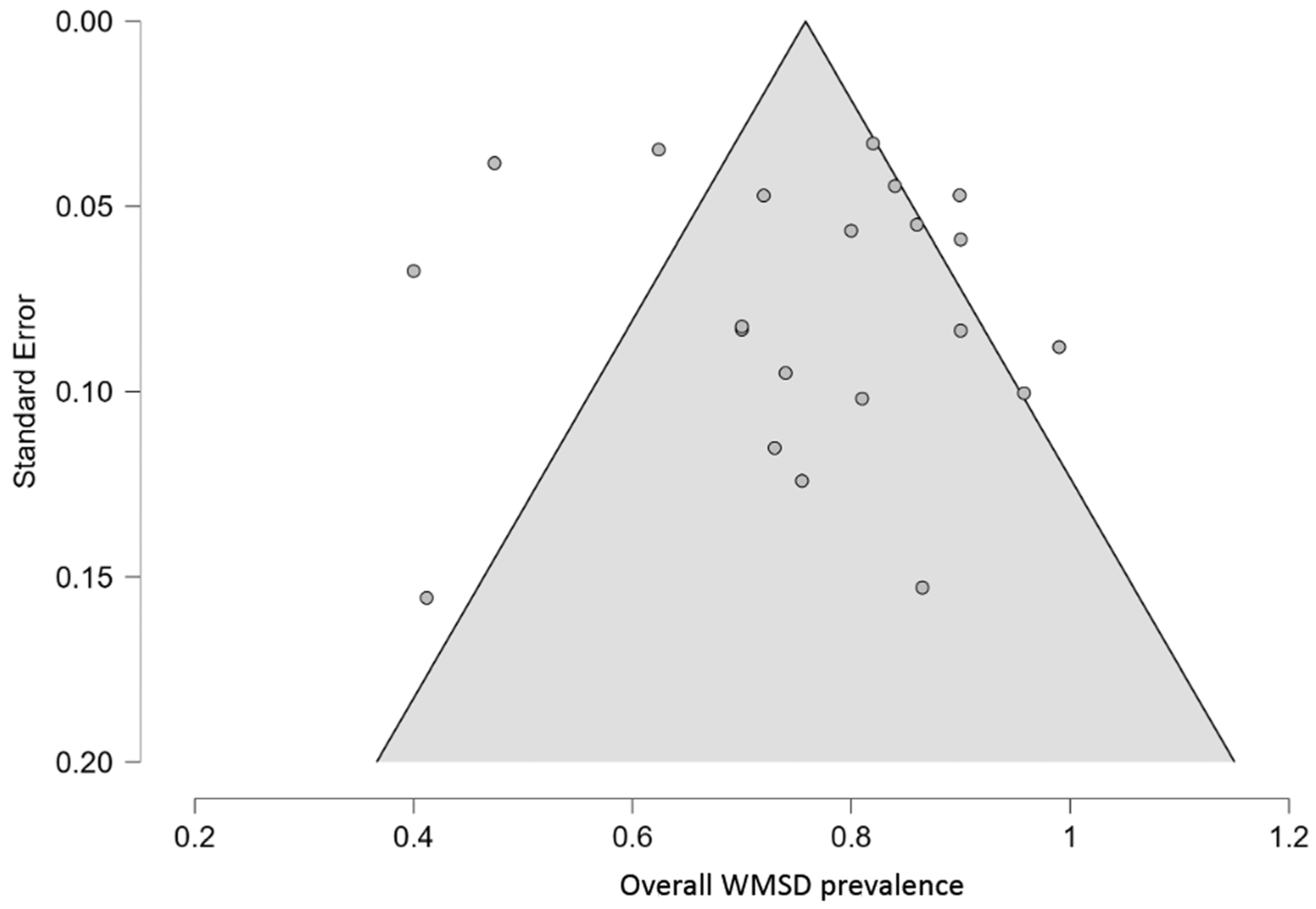
| Overall | 21 | Observational | Not serious (p = 0.506) | Not serious | Serious (I2 = 86.03%) | Not serious | Not serious | 4505 | 75.8% | (68.6–83.1) | Very low ⬤◯◯◯ |
References
- Droeze, E.; Jonsson, H. Evaluation of ergonomic interventions to reduce musculoskeletal disorders of dentists in the Netherlands. Work 2005, 25, 211–220. [Google Scholar] [CrossRef]
- Berguer, R.; Rab, G.T.; Abu-Ghaida, H.; Alarcon, A.; Chung, J. A comparison of surgeons’ posture during laparoscopic and open surgical procedures. Surg. Endosc. 1997, 11, 139–142. [Google Scholar] [CrossRef] [PubMed]
- Amirthanayagam, A.; O’Neill, S.; Goss, C.; Moss, E.L. Physical and psychological impact of surgery on the operating surgeon. Int. J. Gynecol. Cancer 2024, 34, 459–467. [Google Scholar] [CrossRef] [PubMed]
- Alexopoulos, E.; Stathi, I.C.; Charizani, F. Prevalence of musculoskeletal disorders in dentists. BMC Musculoskelet. Disord. 2004, 5, 16. [Google Scholar] [CrossRef] [PubMed]
- Punnett, L.; Wegman, D.H. Work-related musculoskeletal disorders: The epidemiologic evidence and the debate. J. Electromyogr. Kinesiol. 2004, 14, 13–23. [Google Scholar] [CrossRef]
- Auerbach, J.D.; Weidner, Z.D.; Milby, A.H.; Diab, M.; Lonner, B.S. Musculoskeletal disorders among spine surgeons: Results of a survey of the Scoliosis Research Society membership. Spine 2011, 36, E1715–E1721. [Google Scholar] [CrossRef]
- Mal, R.K.; Costello, C.H. Is shoulder impingement syndrome a problem in otolaryngologists? Clin. Otolaryngol. Allied Sci. 2002, 27, 44–47. [Google Scholar] [CrossRef]
- Capone, A.C.; Parikh, P.M.; Gatti, M.E.; Davidson, B.J.; Davison, S.P. Occupational injury in plastic surgeons. Plast. Reconstr. Surg. 2010, 125, 1555–1561. [Google Scholar] [CrossRef]
- Gorce, P.; Jacquier-Bret, J. Global trends in research of Work-related musculoskeletal disorders among surgeons: Bibliometric analysis and visualization from 1991 to 2024. F1000Research 2024, 13, 1311. [Google Scholar] [CrossRef]
- Gorce, P.; Jacquier-Bret, J. Work-related musculoskeletal disorders among surgeons: A bibliometric analysis from 1982 to 2024. Explor. Musculoskelet. Dis. 2024, 2, 317–335. [Google Scholar] [CrossRef]
- Jacquier-Bret, J.; Gorce, P. Prevalence of Body Area Work-Related Musculoskeletal Disorders among Healthcare Professionals: A Systematic Review. Int. J. Environ. Res. Public Health 2023, 20, 841. [Google Scholar] [CrossRef] [PubMed]
- Gorce, P.; Jacquier-Bret, J. Continental Umbrella Review and Meta-Analysis of Work-Related Musculoskeletal Disorders Prevalence Among Healthcare Professionals. Theor. Appl. Ergon. 2025, 1, 7. [Google Scholar] [CrossRef]
- Aremu, A.B.; Afolabi, I.B.; Odongo, O.A.; Shehzad, S.; Khan, K.S. Prevalence of musculoskeletal disorders among healthcare professionals in Africa: A systematic review and meta-analysis. Res. Sq. 2023, 1–11. [Google Scholar] [CrossRef]
- Szeto, G.P.Y.; Ho, P.; Ting, A.C.W.; Poon, J.T.C.; Cheng, S.W.K.; Tsang, R.C.C. Work-related musculoskeletal symptoms in surgeons. J. Occup. Rehabil. 2009, 19, 175–184. [Google Scholar] [CrossRef]
- Liang, C.A.; Levine, V.J.; Dusza, S.W.; Hale, E.K.; Nehal, K.S. Musculoskeletal disorders and ergonomics in dermatologic surgery: A survey of Mohs surgeons in 2010. Dermatol. Surg. 2012, 38, 240–248. [Google Scholar] [CrossRef]
- Gorce, P.; Jacquier-Bret, J. Continental Assessment of Work-Related Musculoskeletal Disorders Prevalence Among Surgeons: Systematic Review and Meta-Analysis. J. Funct. Morphol. Kinesiol. 2025, 10, 221. [Google Scholar] [CrossRef]
- Bolduc-Bégin, J.; Prince, F.; Christopoulos, A.; Ayad, T. Work-related musculoskeletal symptoms amongst Otolaryngologists and Head and Neck surgeons in Canada. Eur. Arch. Oto-Rhino-Laryngol. 2017, 275, 261–267. [Google Scholar] [CrossRef]
- Rata, A.; Sorin, B.; Garleanu, L.; Onofrei, R.R. Work-Related Musculoskeletal Complaints in Surgeons. Healthcare 2021, 9, 1482. [Google Scholar] [CrossRef]
- Cavanagh, J.; Brake, M.; Kearns, D.; Hong, P. Work environment discomfort and injury: An ergonomic survey study of the American Society of Pediatric Otolaryngology members. Am. J. Otolaryngol. 2012, 33, 441–446. [Google Scholar] [CrossRef]
- Matern, U.; Koneczny, S. Safety, hazards and ergonomics in the operating room. Surg. Endosc. 2007, 21, 1965–1969. [Google Scholar] [CrossRef]
- Franasiak, J.; Ko, E.M.; Kidd, J.; Secord, A.A.; Bell, M.; Boggess, J.F.; Gehrig, P.A. Physical strain and urgent need for ergonomic training among gynecologic oncologists who perform minimally invasive surgery. Gynecol. Oncol. 2012, 126, 437–442. [Google Scholar] [CrossRef] [PubMed]
- Morandeira-Rivas, A.; Millán-Casas, L.; Moreno-Sanz, C.; Herrero-Bogajo, M.L.; Tenías-Burillo, J.M.; Giménez-Salillas, L. Ergonomics in Laparoendoscopic Single-Site Surgery: Survey Results. J. Gastrointest. Surg. 2012, 16, 2151–2159. [Google Scholar] [CrossRef] [PubMed]
- Gorce, P.; Jacquier-Bret, J. Effect of Assisted Surgery on Work-Related Musculoskeletal Disorder Prevalence by Body Area among Surgeons: Systematic Review and Meta-Analysis. Int. J. Environ. Res. Public Health 2023, 20, 6419. [Google Scholar] [CrossRef] [PubMed]
- Epstein, S.; Sparer, E.H.; Tran, B.N.; Ruan, Q.Z.; Dennerlein, J.T.; Singhal, D.; Lee, B.T. Prevalence of Work-Related Musculoskeletal Disorders Among Surgeons and Interventionalists: A Systematic Review and Meta-analysis. JAMA Surg. 2018, 153, e174947. [Google Scholar] [CrossRef]
- Alqahtani, S.M.; Alzahrani, M.M.; Bicknell, R.; Pichora, D. Prevalence and factors of work-related musculoskeletal disorders among hand surgeons. World J. Orthop. 2022, 3, 465–471. [Google Scholar] [CrossRef]
- Cass, G.K.; Vyas, S.; Akande, V. Prolonged laparoscopic surgery is associated with an increased risk of vertebral disc prolapse. J. Obstet. Gynaecol. 2014, 34, 74–78. [Google Scholar] [CrossRef]
- Dianat, I.; Bazazan, A.; Souraki Azad, M.A.; Salimi, S.S. Work-related physical, psychosocial and individual factors associated with musculoskeletal symptoms among surgeons: Implications for ergonomic interventions. Appl. Ergon. 2018, 67, 115–124. [Google Scholar] [CrossRef]
- El Boghdady, M.; Ewalds-Kvist, B.M. General surgeons’ occupational musculoskeletal injuries: A systematic review. Surgeon 2024, 22, 322–331. [Google Scholar] [CrossRef]
- Yizengaw, M.A.; Mustofa, S.Y.; Ashagrie, H.E.; Zeleke, T.G. Prevalence and factors associated with work-related musculoskeletal disorder among health care providers working in the operation room. Ann. Med. Surg. 2021, 10, 102989. [Google Scholar] [CrossRef]
- Eurostat. Healthcare Expenditure Statistics—Overview. Available online: https://ec.europa.eu/eurostat/statistics-explained/index.php?title=Healthcare_expenditure_statistics_-_overview (accessed on 2 December 2025).
- World Health Organization. Human Development Index. Available online: https://www.who.int/data/nutrition/nlis/info/human-development-index (accessed on 2 December 2025).
- Külekçioğlu, S.; Dilektaşlı, E. The role of ergonomics training and posture exercises in surgeons’ musculoskeletal system disorders. Turk. J. Surg. 2024, 40, 204–211. [Google Scholar] [CrossRef]
- Giagio, S.; Volpe, G.; Pillastrini, P.; Gasparre, G.; Frizziero, A.; Squizzato, F. A Preventive Program for Work-related Musculoskeletal Disorders Among Surgeons: Outcomes of a Randomized Controlled Clinical Trial. Ann. Surg. 2019, 270, 969–975. [Google Scholar] [CrossRef] [PubMed]
- Abedini, R.; Choobineh, A.; Hasanzadeh, J. Musculoskeletal Load Assessment in Hospital Nurses with Patient Transfer Activity. Int. J. Occup. Hyg. 2015, 5, 39–45. [Google Scholar]
- Gorce, P.; Jacquier-Bret, J. Is there an effect of anthropometric data, environmental parameters and temporal trend on prevalence? Worldwide systematic review and meta-analysis of work-related musculoskeletal disorders among nurses. Work 2025, 10519815251388969. [Google Scholar] [CrossRef]
- Gorce, P.; Jacquier-Bret, J. Work-Related Musculoskeletal Disorders Prevalence among American, Asian, and European Surgeons during Robotic/Video-Assisted Surgery. Int. J. Phys. Med. Rehabil. 2023, 11, 689. [Google Scholar]
- Morgan, R.L.; Whaley, P.; Thayer, K.A.; Schünemann, H.J. Identifying the PECO: A framework for formulating good questions to explore the association of environmental and other exposures with health outcomes. Environ. Int. 2018, 121, 1027–1031. [Google Scholar] [CrossRef]
- Kuorinka, I.; Jonsson, B.; Kilbom, A.; Vinterberg, H.; Biering-Sørensen, F.; Andersson, G. Standardised Nordic questionnaires for the analysis of musculoskeletal symptoms. Appl. Ergon. 1987, 18, 233–237. [Google Scholar] [CrossRef]
- Downes, M.J.; Brennan, M.L.; Williams, H.C.; Dean, R.S. Development of a critical appraisal tool to assess the quality of cross-sectional studies (AXIS). BMJ Open 2016, 6, e011458. [Google Scholar] [CrossRef]
- McGuinness, L.A.; Higgins, J.P.T. Risk-of-bias VISualization (robvis): An R package and Shiny web app for visualizing risk-of-bias assessments. Res. Syn. Meth. 2020, 12, 55–61. [Google Scholar] [CrossRef]
- Worldometer. Countries in the World by Population. 2025. Available online: https://www.worldometers.info/world-population/population-by-country (accessed on 2 December 2025).
- Statista. Gross Domestic Product at Current Market Prices of Selected European Countries in 2024. Available online: https://www.statista.com/statistics/685925/gdp-of-european-countries/?srsltid=AfmBOooi2cBDxs2T9TmmURo4oXvyBDOM8fGRZCsoW1KHA4KA4d2cGLuF (accessed on 2 December 2025).
- World Population Review. Human Development Index (HDI) by Country. 2025. Available online: https://worldpopulationreview.com/country-rankings/hdi-by-country (accessed on 2 December 2025).
- World Bank Group. Number of Surgical Procedures (per 100,000 Population). Available online: https://data.worldbank.org/indicator/SH.SGR.PROC.P5 (accessed on 2 December 2025).
- Neyeloff, J.L.; Fuchs, S.C.; Moreira, L.B. Meta-analyses and Forest plots using a microsoft excel spreadsheet: Step-by-step guide focusing on descriptive data analysis. BMC Res. Notes 2012, 5, 52. [Google Scholar] [CrossRef]
- CochraneTraining. Cochrane Handbook for Systematic Reviews of Interventions. 2019. Available online: https://training.cochrane.org/handbook/archive/v6/chapter-10#section-10-10-2 (accessed on 2 February 2022).
- Gadjradj, P.S.; Ogenio, K.; Voigt, I.; Harhangi, B.S. Ergonomics and Related Physical Symptoms Among Neurosurgeons. World Neurosurg. 2020, 134, e432–e441. [Google Scholar] [CrossRef]
- Yasobant, S.; Rajkumar, P. Work-related musculoskeletal disorders among health care professionals: A cross-sectional assessment of risk factors in a tertiary hospital, India. Indian J. Occup. Environ. Med. 2014, 18, 75–81. [Google Scholar] [CrossRef] [PubMed]
- Harris, J.D.; Quatman, C.E.; Manring, M.M.; Siston, R.A.; Flanigan, D.C. How to Write a Systematic Review. Am. J. Sports Med. 2014, 42, 2761–2768. [Google Scholar] [CrossRef] [PubMed]
- Page, M.J.; McKenzie, J.E.; Bossuyt, P.M.; Boutron, I.; Hoffmann, T.C.; Mulrow, C.D.; Shamseer, L.; Tetzlaff, J.M.; Akl, E.A.; Brennan, S.E.; et al. The PRISMA 2020 statement: An updated guideline for reporting systematic reviews. BMJ 2021, 372, n71. [Google Scholar] [CrossRef] [PubMed]
- Stomberg, M.W.; Tronstad, S.E.; Hedberg, K.; Bengtsson, J.; Jonsson, P.; Johansen, L.; Lindvall, B. Work-related musculoskeletal disorders when performing laparoscopic surgery. Surg. Laparosc. Endosc. Percutan Tech. 2010, 20, 49–53. [Google Scholar] [CrossRef] [PubMed]
- Lakomek, A.; Eichler, T.; Janßen, T.; Meyer, M.; Höing, B.; Shiraliyev, K.; Lang, S.; Schmidt, B.; Arweiler-Harbeck, D. Work-related musculoskeletal symptoms among ear, nose and throat physicians in Germany: A National survey. Eur. Arch. Oto-Rhino-Laryngol. 2025, 282, 5857–5864. [Google Scholar] [CrossRef]
- Boyle, S.; Fitzgerald, C.; Conlon, B.J.; Vijendren, A. A national survey of workplace-related musculoskeletal disorder and ergonomic practices amongst Irish otolaryngologists. Ir. J. Med. Sci. 2022, 191, 623–628. [Google Scholar] [CrossRef]
- Quinn, D.; Moohan, J. The trainees’ pain with laparoscopic surgery: What do trainees really know about theatre set-up and how this impacts their health. Gynecol. Surg. 2015, 12, 71–76. [Google Scholar] [CrossRef]
- Battevi, N.; Menoni, O.; Cosentino, F.; Vitelli, N. Digestive endoscopy and risk of upper limb biomechanical overload. Med. Lav. 2009, 100, 171–177. [Google Scholar]
- Giberti, C.; Gallo, F.; Francini, L.; Signori, A.; Testa, M. Musculoskeletal disorders among robotic surgeons: A questionnaire analysis. Arch. Ital. Urol. Androl. 2014, 86, 95–98. [Google Scholar] [CrossRef]
- Ruitenburg, M.M.; Frings-Dresen, M.H.; Sluiter, J.K. Physical job demands and related health complaints among surgeons. Int. Arch. Occup. Environ. Health 2013, 86, 271–279. [Google Scholar] [CrossRef]
- Sari, V.; Nieboer, T.E.; Vierhout, M.E.; Stegeman, D.F.; Kluivers, K.B. The operation room as a hostile environment for surgeons: Physical complaints during and after laparoscopy. Minim. Invasive Ther. Allied Technol. 2010, 19, 105–109. [Google Scholar] [CrossRef] [PubMed]
- Tjiam, I.M.; Goossens, R.H.; Schout, B.M.; Koldewijn, E.L.; Hendrikx, A.J.; Muijtjens, A.M.; Scherpbier, A.J.; Witjes, J.A. Ergonomics in endourology and laparoscopy: An overview of musculoskeletal problems in urology. J. Endourol. 2014, 2, 605–611. [Google Scholar] [CrossRef] [PubMed]
- Gutierrez-Diez, M.C.; Benito-Gonzalez, M.A.; Sancibrian, R.; Gandarillas-Gonzalez, M.A.; Redondo-Figuero, C.; Manuel-Palazuelos, J.C. A study of the prevalence of musculoskeletal disorders in surgeons performing minimally invasive surgery. Int. J. Occup. Saf. Ergon. 2018, 24, 111–117. [Google Scholar] [CrossRef] [PubMed]
- Lobo, D.; Gandarillas, M.A.; Sánchez-Gómez, S.; Megía, R. Work-related musculoskeletal symptoms in otorhinolaryngology and their relationship with physical activity. A nationwide survey. J. Laryngol. Otol. 2019, 133, 713–718. [Google Scholar] [CrossRef]
- Kaya, O.I.; Moran, M.; Ozkardes, A.B.; Taskin, E.Y.; Seker, G.E.; Ozmen, M.M. Ergonomic problems encountered by the surgical team during video endoscopic surgery. Surg. Laparosc. Endosc. Percutan Tech. 2008, 18, 40–44. [Google Scholar] [CrossRef]
- Amin, M.; Rimmer, J.; Swift, A.; White, P.; Lund, V.J. FESS, fingers and other things—You are not alone! Rhinology 2015, 53, 116–121. [Google Scholar] [CrossRef] [PubMed]
- Babar-Craig, H.; Banfield, G.; Knight, J. Prevalence of back and neck pain amongst ENT consultants: National survey. J. Laryngol. Otol. 2003, 117, 979–982. [Google Scholar] [CrossRef]
- Durden, A.A.; Newton, C. Musculoskeletal injuries in cross-speciality surgeons: A survey of UK-based doctors. J. Robot. Surg. 2023, 17, 1797–1802. [Google Scholar] [CrossRef]
- Hyer, J.N.; Lee, R.M.; Chowdhury, H.R.; Smith, H.B.; Dhital, A.; Khandwala, M. National survey of back & neck pain amongst consultant ophthalmologists in the United Kingdom. Int. Ophthalmol. 2015, 35, 769–775. [Google Scholar] [CrossRef]
- Vijendren, A.; Yung, M.; Sanchez, J.; Duffield, K. Occupational musculoskeletal pain amongst ENT surgeons—Are we looking at the tip of an iceberg? J. Laryngol. Otol. 2016, 130, 490–496. [Google Scholar] [CrossRef]
- Dixon, F.; Vitish-Sharma, P.; Khanna, A.; Keeler, B.D. Work-related musculoskeletal pain and discomfort in laparoscopic surgeons: An international multispecialty survey. Ann. R. Coll. Surg. Engl. 2023, 105, 734–738. [Google Scholar] [CrossRef] [PubMed]
- Rimmer, J.; Amin, M.; Fokkens, W.J.; Lund, V.J. Endoscopic sinus surgery and musculoskeletal symptoms. Rhinology 2016, 54, 105–110. [Google Scholar] [CrossRef] [PubMed]
- Daruwalla, A.C.; Patel, B. An Analysis into the Prevalence of Work-Related Musculoskeletal Disorders Affecting Surgeons: A Systematic Review. Br. J. Surg. 2022, 109, znac269.417. [Google Scholar] [CrossRef]
- Hess, P.; Athanasiadis, D.; Lee, N.K.; Monfared, S.; Cleveland, P.M.; Stefanidis, D. Preventing Surgeon Work-Related Musculoskeletal Disorders: A Pilot Study of the Comprehensive Operating Room Ergonomics (CORE) Program. Am. J. Occup. Ther. 2024, 78, 7805205090. [Google Scholar] [CrossRef]
- Mohr, C.J.; Nadzam, G.S.; Curet, M.J. Totally Robotic Roux-en-Y Gastric Bypass. Arch. Surg. 2005, 140, 779–786. [Google Scholar] [CrossRef]
- Craven, R.; Franasiak, J.; Mosaly, P.; Gehrig, P.A. Ergonomic Deficits in Robotic Gynecologic Oncology Surgery: A Need for Intervention. J. Minim. Invasive Gynecol. 2013, 20, 648–655. [Google Scholar] [CrossRef]
- Park, A.E.; Lee, G.I.; Seagull, F.J.; Meenaghan, N.; Dexter, D. Patients benefit while surgeons suffer: An impending epidemic. J. Am. Coll. Surg. 2010, 210, 306–313. [Google Scholar] [CrossRef]
- Vasireddi, N.; Vasireddi, N.; Shah, A.; Moyal, A.; Ng, M.; Seshadri, D.; Gould, H.P.; Poelstra, K.; Cheng, C.W.; Voos, J.; et al. Prevalence of work-related musculoskeletal disorders among orthopedic surgeons: A systematic review and meta-analysis. Spine J. 2023, 23, S32. [Google Scholar] [CrossRef]
- Dabholkar, T.Y.; Yardi, S.S.; Dabholkar, Y.G. Prevalence of work-related musculoskeletal symptoms in surgeons performing minimally invasive surgery: A review of literature. Int. Surg. J. 2016, 3, 1028–1034. [Google Scholar] [CrossRef]
- Al-Mohrej, O.A.; Elshaer, A.K.; Al-Dakhil, S.S.; Sayed, A.I.; Aljohar, S.; AlFattani, A.A.; Alhussainan, T.S. Work-related musculoskeletal disorders among Saudi orthopedic surgeons: A cross-sectional study. Bone Jt. Open 2020, 1, 47–54. [Google Scholar] [CrossRef]
- Perry, M.C.; Carville, S.F.; Smith, I.C.H.; Rutherford, O.M.; Newham, D.J. Strength, power output and symmetry of leg muscles: Effect of age and history of falling. Eur. J. Appl. Physiol. 2007, 100, 553–561. [Google Scholar] [CrossRef] [PubMed]
- Michael, S.; Mintz, Y.; Brodie, R.; Assalia, A. Minimally invasive surgery and the risk of work-related musculoskeletal disorders: Results of a survey among Israeli surgeons and review of the literature. Work 2022, 71, 779–785. [Google Scholar] [CrossRef]
- Ghasemi, F.; Rahmani, R.; Behmaneshpour, F.; Fazli, B. Quality of work life among surgeons and its association with mus-culoskeletal complaints. Cogent. Psychol. 2021, 8, 1880256. [Google Scholar] [CrossRef]
- Jacquier-Bret, J.; Gorce, P. Do Demographic, Economic, and Quality-of-Life Indicators Have an Effect on the Prevalence of WMSDs Among African Nurses? A Systematic Review and Meta-Analysis. Theor. Appl. Ergon. 2025, 1, 13. [Google Scholar] [CrossRef]
- Erivan, R.; Rigolot, B.; Villatte, G.; Dartus, J.; Descamps, S.; Boisgard, S. Orthopaedic and trauma surgery in France: Do patterns differ across healthcare institution types (public community, public university, private not-for-profit, and private for-profit)? Orthop. Traumatol. Surg. Res. 2022, 108, 103402. [Google Scholar] [CrossRef]
- Plerhoples, T.A.; Hernandez-Boussard, T.; Wren, S.M. The aching surgeon: A survey of physical discomfort and symptoms following open, laparoscopic, and robotic surgery. J. Robot. Surg. 2012, 6, 65–72. [Google Scholar] [CrossRef]
- Adams, S.; Hacker, M.; McKinney, J.; Elkadry, E.; Rosenblatt, P. Musculoskeletal Pain in Gynecologic Surgeons. J. Minim. Invasive Gynecol. 2013, 20, 656–660. [Google Scholar] [CrossRef]
- Nawaz, M.; Waqar, S.H.; Jamal, Z.; Shahzad, F. Surgeons’ awareness about ergonomics in the operation theatre. J. Shalamar Med. Dent. Coll. 2024, 5, 95–100. [Google Scholar] [CrossRef]
- Dhimitri, K.; McGwin, G.; McNeal, S.; Lee, P.; Morse, P.; Patterson, M.; Wertz, F.; Marx, J. Symptoms of musculoskeletal disorders in ophthalmologists. Am. J. Ophthalmol. 2005, 139, 179–181. [Google Scholar] [CrossRef]
- Filisetti, C.; Cho, A.; Riccipetitoni, G.; Saxena, A.K. Analysis of Hand Size and Ergonomics of Instruments in Pediatric Minimally Invasive Surgery. Surg. Laparosc. Endosc. Percutan Tech. 2015, 25, e159–e162. [Google Scholar] [CrossRef]
- Liang, B.; Qi, L.; Yang, J.-r.; Cao, Z.; Zu, X.; Liu, L.; Wang, L. Ergonomic Status of Laparoscopic Urologic Surgery: Survey Results from 241 Urologic Surgeons in China. PLoS ONE 2013, 8, e70423. [Google Scholar] [CrossRef]
- Lee, G.I.; Lee, M.R.; Green, I.; Allaf, M.; Marohn, M.R. Surgeons’ physical discomfort and symptoms during robotic surgery: A comprehensive ergonomic survey study. Surg. Endosc. 2017, 31, 1697–1706. [Google Scholar] [CrossRef]
- Yang, L.; Money, S.R.; Morrow, M.M.; Lowndes, B.R.; Weidner, T.K.; Fortune, E.; Davila, V.J.; Meltzer, A.J.; Stone, W.M.; Hallbeck, M.S. Impact of Procedure Type, Case Duration, and Adjunctive Equipment on Surgeon Intraoperative Musculoskeletal Discomfort. J. Am. Coll. Surg. 2020, 230, 554–560. [Google Scholar] [CrossRef]
- Kuwabara, T.; Urabe, Y.; Hiyama, T.; Tanaka, S.; Shimomura, T.; Oko, S.; Yoshihara, M.; Chayama, K. Prevalence and impact of musculoskeletal pain in Japanese gastrointestinal endoscopists: A controlled study. World J. Gastroenterol. 2011, 17, 1488–1493. [Google Scholar] [CrossRef]
- Gorce, P.; Jacquier-Bret, J. Continental effect on work-related musculoskeletal disorders prevalence among nurses: Systematic review and meta-analysis. BMC Nurs. 2025, 24, 1335. [Google Scholar] [CrossRef]


| Authors | Country | Sample Size | Questionnaire | Specialty | Male/Female (%) | Age * (Year) | BMI | Experience * (Year) | Working Hour (h per Week) | Case Load * (Case per Week) | Case Load * (h per Week) |
|---|---|---|---|---|---|---|---|---|---|---|---|
| Amin et al., 2015 [63] | United Kingdom | 82 | Self | Otorhinolaryngology | 47.9 | 15.04 | |||||
| Babar-Craig et al., 2003 [64] | United Kingdom | 325 | Self | Otorhinolaryngology | |||||||
| Battevi et al., 2009 [55] | Italy | 88 | Self | Gastroenterologist | 68.2/31.8 | 42.8 | 15.1 | ||||
| Boyle et al., 2022 [53] | Ireland | 49 | Self | Otorhinolaryngology | 73.5/26.5 | ||||||
| Cass et al., 2014 [26] | United Kingdom | 128 | Self | Gynecologic | |||||||
| Dixon et al., 2023 [68] | Multiple (Europe) | 259 | Self | Multiple | |||||||
| Durden et al., 2023 [65] | United Kingdom | 37 | NMQ | Multiple | 48 | ||||||
| Giagio et al., 2019 [33] | Italy | 76 | NMQ | Multiple | 65.8/34.2 | 37.7 ± 12.1 | 10.4 ± 11.3 | 16.1 | 18.9 | ||
| Giberti et al., 2014 [56] | Italy | 17 | NMQ | Multiple | 94.1/5.9 | 51.3 | 3 | 6.0 | |||
| Gutierrez-Diez et al., 2017 [60] | Spain | 129 | NMQ | Multiple | 61.2/38.8 | 42.0 ± 12.3 | 16 ± 12 | 17.0 ± 9.7 | |||
| Hyer et al., 2015 [66] | United Kingdom | 518 | Self | Ophthalmologists | 74.5/25.5 | 48.7 | 8.78 | ||||
| Kaya et al., 2008 [62] | Turkey | 82 | Self | Multiple | |||||||
| Lakomek et al., 2025 [52] | Germany | 751 | Self | Otorhinolaryngology | 47.3/52.7 | 51 ± 11 | 24.0 ± 5.0 | 23.87 ± 11.0 | 40.33 ± 12.0 | 4.08 ± 7.0 | |
| Lobo et al., 2019 [61] | Spain | 407 | Self | Otorhinolaryngology | 51.5/48.5 | 44.9 ± 11.4 | 24.55 ± 3.2 | 17.1 ± 11.1 | |||
| Mal and Costello, 2002 [7] | United Kingdom | 367 | Self | Otorhinolaryngology | 51.2 | ||||||
| Matern and Koneczny, 2007 [20] | Germany | 425 | Self | Multiple | 75.0/25.0 | ||||||
| Morandeira-Rivas et al., 2012 [22] | Spain | 78 | Self | Multiple | 87.0/13.0 | 44.06 | 1.3 | ||||
| Quinn and Moohan, 2015 [54] | Ireland | 53 | Self | Gynecologic | 36.0/64.0 | 30.4 | 4.5 | ||||
| Rata et al., 2021 [18] | Romania | 95 | NMQ | Multiple | 62.1/37.9 | 37.56 ± 8.74 | 25.44 ± 5.04 | 10.09 ± 8.41 | 41.03 ± 14.62 | 7.56 ± 3.73 | 13.07 ± 7.27 |
| Rimmer et al., 2016 [69] | Multiple (Europe) | 250 | Self | Otorhinolaryngology | 78.8/21.2 | ||||||
| Ruitenburg et al., 2012 [57] | The Netherlands | 91 | Self | General | 55.0/45.0 | 41.0 ± 10.8 | |||||
| Sari et al., 2010 [58] | The Netherlands | 55 | Self | Multiple | 65.4/34.6 | 39.5 ± 7.3 | 8.75 ± 6.07 | 6 | |||
| Stomberg et al., 2010 [51] | Sweden | 101 | Self | Gynecologic | 36.6/63.4 | 48.2 ± 10.2 | 14.5 ± 10.4 | 1.9 | |||
| Stomberg et al., 2010 [51] | Sweden | 103 | Self | General | 82.2/17.8 | 43.3 ± 9.1 | 8.7 ± 5.1 | 3.0 | |||
| Tjiam et al., 2014 [59] | The Netherlands | 285 | Self | Urologic | 93.0/7.0 | 46 | 12.9 | 6.45 | |||
| Vijendren et al., 2016 [67] | United Kingdom | 323 | Self | Otorhinolaryngology | 18.7 |
| Country | Country Population (Million) | GDP * (Billion €) | HDI | Surgery per 100,000 Inhabitants | Surgeons per 100,000 Inhabitants | SBS Ratio |
|---|---|---|---|---|---|---|
| Germany | 84.1 | 4305.3 | 0.959 | 19,124 | 108.0 | 177.1 |
| Ireland | 5.3 | 562.8 | 0.972 | 3053 | 72.0 | 42.4 |
| Italy | 59.2 | 2192.2 | 0.915 | 6918 | 142.4 | 48.6 |
| The Netherlands | 18.3 | 1122.5 | 0.955 | 16,639 | 49.0 | 339.8 |
| Romania | 18.9 | 353.8 | 0.845 | - | 60.5 | - |
| Spain | 47.9 | 1591.6 | 0.918 | 6953 | 79.9 | 87.0 |
| Sweden | 10.6 | 559.1 | 0.959 | 14,380 | 113.1 | 127.1 |
| Turkey | 87.7 | 1220.3 | 0.853 | 11,911 | 47.6 | 250.1 |
| United Kingdom | 69.5 | 3281.6 | 0.946 | 10,847 | 133.3 | 81.4 |
| Authors | Country | Sample Size | Specialty | WMSD Prevalence by Body Area | Overall WMSD Prevalence | ||||||||
|---|---|---|---|---|---|---|---|---|---|---|---|---|---|
| Neck | Upper Back | Lower Back | Shoulder | Elbow | Wrist | Hip | Knee | Ankle | |||||
| Amin et al., 2015 [63] | United Kingdom | 82 | Otorhinolaryngology | 60.0% | 45.0% | 17.0% | 74.0% | ||||||
| Babar-Craig et al., 2003 [64] | United Kingdom | 325 | Otorhinolaryngology | 24.0% | 29.% | 19.0% | 72.0% | ||||||
| Battevi et al., 2009 [55] | Italy | 88 | Gastroenterology | 36.4% | 17.0% | 25.0% | 40.0% | ||||||
| Boyle et al., 2022 [53] | Ireland | 49 | Otorhinolaryngology | 59.2% | 34.7% | 32.6% | 28.0% | 10.0% | 18.0% | 1.5% | 9.5% | 7.5% | 75.5% |
| Cass et al., 2014 [26] | United Kingdom | 128 | Gynecology | 73.4% | 80.5% | 69.5% | 99.0% | ||||||
| Dixon et al., 2023 [68] | Multiple (Europe) | 259 | Multiple | 67.6% | 73.7% | 70.7% | 26.6% | 59.8% | 17.0% | 27.0% | 20.1% | 90.0% | |
| Durden et al., 2023 [65] | United Kingdom | 37 | Multiple | 37.8% | 32.4% | 43.2% | 48.7% | 5.4% | 27.0% | 16.2% | 21.6% | 8.1% | 86.5% |
| Giagio et al., 2019 [33] | Italy | 76 | Multiple | 78.9% | 55.3% | 71.1% | 51.3% | 3.9% | 26.3% | 14.5% | 18.4% | 18.4% | |
| Giberti et al., 2014 [56] | Italy | 17 | Multiple | 29.4% | 5.9% | 41.2% | |||||||
| Gutierrez-Diez et al., 2017 [60] | Spain | 129 | Multiple | 51.0% | 44.0% | 54.0% | 29.0% | 12.0% | 28.0% | 90.0% | |||
| Hyer et al., 2015 [66] | United Kingdom | 518 | Ophthalmology | 31.8% | 15.4% | 41.7% | 62.4% | ||||||
| Kaya et al., 2008 [62] | Turkey | 82 | Multiple | 72.0% | 70.0% | ||||||||
| Lakomek et al., 2025 [52] | Germany | 751 | Otorhinolaryngology | 81.6% | 55.1% | 55.9% | 54.5% | 20.7% | 22.4% | 17.0% | 82.0% | ||
| Lobo et al., 2019 [61] | Spain | 407 | Otorhinolaryngology | 48.9% | 60.2% | 18.8% | 16.3% | 89.9% | |||||
| Mal and Costello, 2002 [7] | United Kingdom | 367 | Otorhinolaryngology | 24.0% | |||||||||
| Matern and Koneczny, 2007 [20] | Germany | 425 | Multiple | 60.0% | 85.0% | 39.0% | 84.0% | ||||||
| Morandeira-Rivas et al., 2012 [22] | Spain | 78 | Multiple | 54.0% | 53.0% | 51.0% | 49.0% | 22.0% | 81.0% | ||||
| Quinn and Moohan, 2015 [54] | Ireland | 53 | Gynecology | 41.5% | 28.3% | 28.3% | 43.4% | 15.1% | 20.8% | 37.7% | 20.8% | ||
| Rata et al., 2021 [18] | Romania | 95 | Multiple | 55.8% | 46.3% | 74.7% | 46.3% | 17.7% | 16.8% | 11.6% | 31.6% | 4.2% | 95.8% |
| Rata et al., 2021 [18] | Romania | 6 | General surgery | 83.3% | 33.3% | 100.0% | 33.3% | 33.3% | 0.0% | 33.3% | 66.7% | 0.0% | |
| Rata et al., 2021 [18] | Romania | 10 | Vascular surgery | 30.0% | 80.0% | 80.0% | 40.0% | 0.0% | 10.0% | 30.0% | 10.0% | 0.0% | |
| Rata et al., 2021 [18] | Romania | 14 | Plastic surgery | 71.4% | 71.4% | 71.4% | 14.3% | 0.0% | 28.6% | 14.3% | 28.6% | 14.3% | |
| Rata et al., 2021 [18] | Romania | 21 | Neurosurgery | 52.4% | 47.6% | 90.5% | 38.1% | 47.6% | 14.3% | 0.0% | 23.8% | 0.0% | |
| Rata et al., 2021 [18] | Romania | 12 | Orthopedic surgery | 50.0% | 50.0% | 66.7% | 66.7% | 0.0% | 33.3% | 16.7% | 33.3% | 0.0% | |
| Rata et al., 2021 [18] | Romania | 8 | Urology | 100.0% | 50.0% | 25.0% | 50.0% | 0.0% | 25.0% | 0.0% | 50.0% | 25.0% | |
| Rata et al., 2021 [18] | Romania | 8 | Cardiac surgery | 50.0% | 25.0% | 75.0% | 75.0% | 0.0% | 0.0% | 0.0% | 50.0% | 0.0% | |
| Rata et al., 2021 [18] | Romania | 8 | Thoracic surgery | 25.0% | 25.0% | 75.0% | 25.0% | 0.0% | 0.0% | 0.0% | 0.0% | 0.0% | |
| Rata et al., 2021 [18] | Romania | 8 | Gynecology | 50.0% | 0.0% | 75.0% | 100.0% | 25.0% | 25.0% | 25.0% | 50.0% | 0.0% | |
| Rimmer et al., 2016 [69] | Multiple (Europe) | 250 | Otorhinolaryngology | 60.3% | 59.8% | 50.8% | 17.9% | 10.6% | 80.0% | ||||
| Ruitenburg et al., 2012 [57] | The Netherlands | 91 | General surgery | 35.0% | 19.0% | 24.0% | 23.0% | 4.0% | 15.0% | 4.0% | 2.0% | 2.0% | |
| Sari et al., 2010 [58] | The Netherlands | 55 | Multiple | 15.0% | 26.0% | 45.0% | 73.0% | ||||||
| Stomberg et al., 2010 [51] | Sweden | 101 | Gynecology | 50.0% | 24.0% | 55.0% | 51.0% | 6.0% | 14.0% | 27.0% | 70.0% | ||
| Stomberg et al., 2010 [51] | Sweden | 103 | General surgery | 44.0% | 21.0% | 44.0% | 38.0% | 7.0% | 26.0% | 26.0% | 70.0% | ||
| Tjiam et al., 2014 [59] | The Netherlands | 285 | Urology | 59.3% | 51.2% | 26.0% | 21.4% | 86.0% | |||||
| Vijendren et al., 2016 [67] | United Kingdom | 323 | Otorhinolaryngology | 29.7% | 9.0% | 47.4% | |||||||
| Body Area | Age < 45 Years | Age > 45 Years | Evolution Profile | ||||||||||
|---|---|---|---|---|---|---|---|---|---|---|---|---|---|
| N | S. Size | I2 | ES | 95% CI | Model | N | S. Size | I2 | ES | 95% CI | Model | ||
| Neck | 8 | 680 | 85.56 | 46.0% | (33.0–58.9) | Random | 7 | 2181 | 96.07 | 53.0% | (36.6–69.4) | Random |  |
| Upper back | 6 | 547 | 83.20 | 34.7% | (23.0–46.4) | Random | 5 | 1424 | 97.40 | 31.3% | (10.1–52.5) | Random |  |
| Lower back | 8 | 680 | 85.76 | 46.1% | (33.0–59.1) | Random | 6 | 1831 | 93.38 | 43.9% | (30.4–57.5) | Random | |
| Shoulder | 9 | 768 | 59.33 | 38.9% | (32.0–45.8) | Random | 7 | 2030 | 95.97 | 41.3% | (27.4–55.1) | Random | |
| Elbow | 7 | 635 | 69.62 | 9.8% | (5.6–14.0) | Random | 3 | 423 | 93.45 | 12.5% | (0.0–26.0) | Random | |
| Wrist | 8 | 713 | 62.96 | 24.6% | (18.6–30.5) | Random | 5 | 912 | 11.26 | 17.6% | (14.9–20.4) | Fixed |  |
| Hip | 3 | 262 | 70.18 | 9.3% | (2.6–16.0) | Random | 2 | 788 | 0.0 | 20.4% | (0.0–23.6) | Fixed | |
| Knee | 6 | 496 | 92.83 | 22.2% | (9.1–35.3) | Random | 3 | 889 | 0.0 | 22.8% | (19.7–25.9) | Fixed | |
| Ankle | 4 | 315 | 82.91 | 9.2% | (2.2–16.1) | Random | 2 | 788 | 69.50 | 13.7% | (5.2–22.1) | Random | |
| Overall | 6 | 548 | 85.01 | 74.4% | (56.0–92.9) | Random | 8 | 2198 | 80.89 | 75.9% | (66.2–85.6) | Random | |
| Body Area | Experience < 10 Years | Experience > 10 Years | Evolution Profile | ||||||||||
|---|---|---|---|---|---|---|---|---|---|---|---|---|---|
| N | S. Size | I2 | ES | 95% CI | Model | N | S. Size | I2 | ES | 95% CI | Model | ||
| Neck | 3 | 211 | 86.16 | 32.9% | (12.5–53.4) | Random | 9 | 2249 | 94.48 | 56.8% | (43.2–70.5) | Random | |
| Upper back | 3 | 173 | 0.0 | 23.5% | (16.3–30.7) | Fixed | 5 | 1152 | 87.63 | 44.7% | (31.6–57.7) | Random | |
| Lower back | 4 | 228 | 84.36 | 25.9% | (9.5–42.3) | Random | 6 | 1559 | 26.80 | 58.3% | (54.5–62.0) | Fixed | |
| Shoulder | 3 | 211 | 0.0 | 40.9% | (32.3–49.6) | Fixed | 9 | 2014 | 94.19 | 42.3% | (30.2–54.4) | Random | |
| Elbow | 2 | 156 | 46.22 | 8.6% | (4.0–13.2) | Fixed | 6 | 774 | 88.38 | 13.5% | (6.3–20.7) | Random | |
| Wrist | 2 | 156 | 0.0 | 24.0% | (16.3–31.6) | Fixed | 9 | 1586 | 76.51 | 18.4% | (13.9–22.9) | Random | |
| Hip | - | - | - | - | - | 3 | 922 | 69.20 | 16.3% | (10.0–22.6) | Random | - | |
| Knee | 2 | 156 | 29.60 | 29.1% | (20.6–37.5) | Fixed | 4 | 1023 | 21.38 | 23.0% | (20.1–26.0) | Fixed | |
| Ankle | - | - | - | - | - | 3 | 922 | 92.24 | 12.8% | (3.0–22.7) | Random | - | |
| Overall | 3 | 175 | 36.29 | 66.4% | (54.3–78.4) | Fixed | 9 | 2261 | 92.31 | 74.7% | (61.2–88.1) | Random | |
| Body Area | SBS Ratio < 125 | SBS Ratio > 125 | Evolution Profile | ||||||||||
|---|---|---|---|---|---|---|---|---|---|---|---|---|---|
| N | S. Size | I2 | ES | 95% CI | Model | N | S. Size | I2 | ES | 95% CI | Model | ||
| Neck | 12 | 2205 | 89.58 | 47.5% | (38.7–56.3) | Random | 8 | 1893 | 95.04 | 52.1% | (36.1–68.1) | Random | |
| Upper back | 8 | 1204 | 87.06 | 32.8% | (22.8–42.7) | Random | 4 | 1046 | 96.23 | 30.0% | (9.6–50.4) | Random | |
| Lower back | 10 | 1689 | 93.82 | 40.4% | (27.8–52.9) | Random | 7 | 1608 | 94.26 | 51.4% | (34.9–67.8) | Random | |
| Shoulder | 11 | 1494 | 89.34 | 40.1% | (30.6–49.6) | Random | 7 | 1811 | 84.88 | 43.1% | (34.4–51.8) | Random | |
| Elbow | 6 | 432 | 56.44 | 9.8% | (5.3–14.2) | Random | 4 | 580 | 92.40 | 10.6% | (1.7–19.5) | Random | |
| Wrist | 11 | 1450 | 90.21 | 26.6% | (18.7–34.4) | Random | 4 | 580 | 45.28 | 19.0% | (15.4–22.5) | Fixed | |
| Hip | 3 | 162 | 82.17 | 9.7% | (0.0–20.5) | Random | 2 | 842 | 97.44 | 12.4% | (0.0–28.8) | Random | |
| Knee | 5 | 293 | 59.83 | 20.2% | (12.1–28.3) | Random | 4 | 1046 | 96.94 | 18.9% | (4.9–33.0) | Random | |
| Ankle | 4 | 215 | 47.20 | 12.1% | (7.4–16.7) | Fixed | 2 | 842 | 98.02 | 9.5% | (0.0–24.2) | Random | |
| Overall | 12 | 2181 | 88.65 | 71.4% | (60.2–82.6) | Random | 6 | 1720 | 7.07 | 81.1% | (76.9–85.4) | Fixed | |
| Body Area | GDP | HDI | Case Load (Hour per Week) | Year of Publication | ||||
|---|---|---|---|---|---|---|---|---|
| Pearson’s r | p-Value | Pearson’s r | p-Value | Pearson’s r | p-Value | Pearson’s r | p-Value | |
| Neck | −0.007 | 0.971 | −0.240 | 0.202 | 0.257 | 0.539 | 0.392 | 0.064 |
| Upper back | −0.049 | 0.829 | −0.326 | 0.139 | 0.530 | 0.358 | 0.624 | 0.023 |
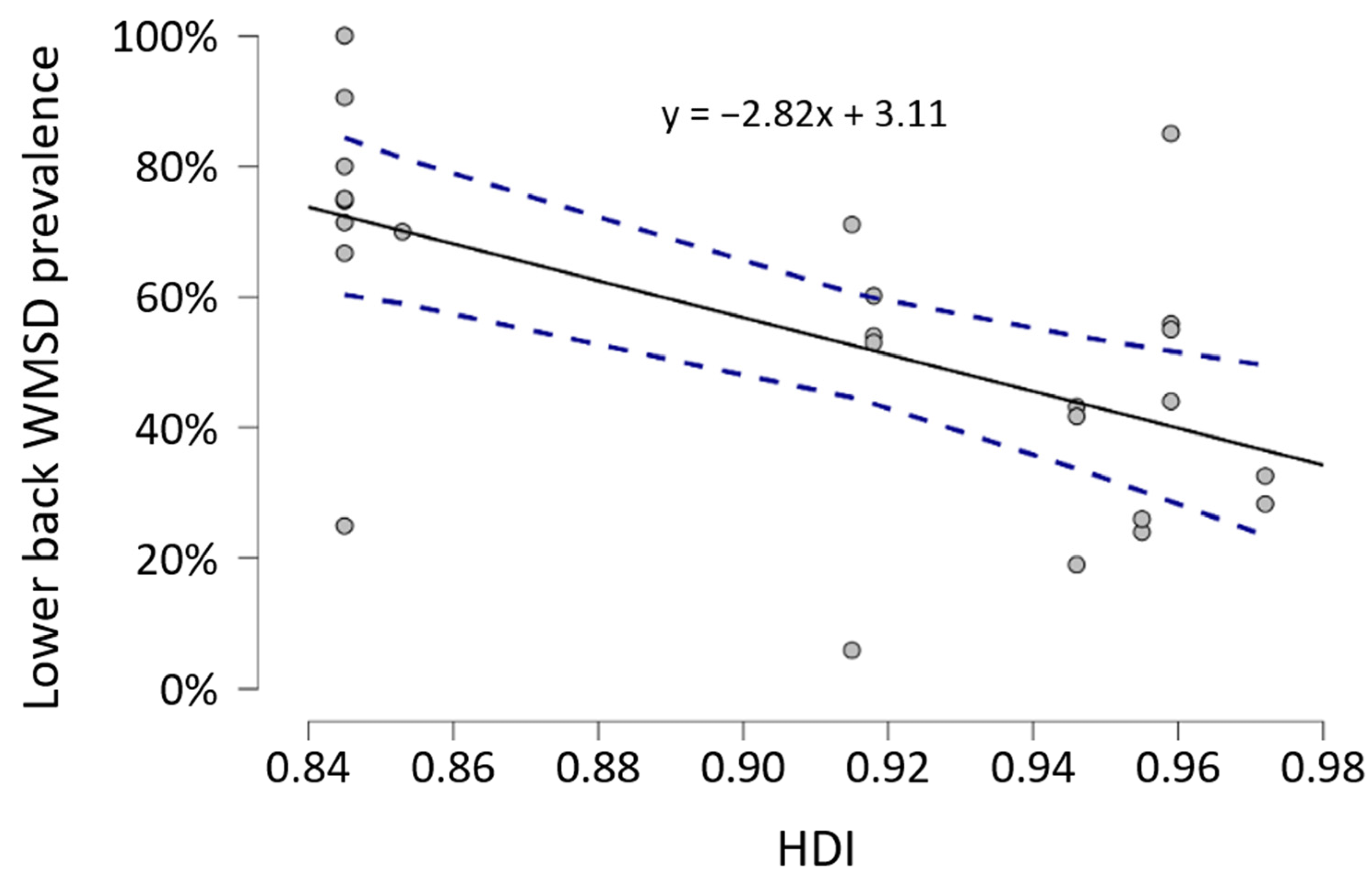
| Lower back | −0.219 | 0.272 | −0.603 | <0.001 | 0.587 | 0.221 | 0.228 | 0.333 |
| Shoulder | 0.024 | 0.902 | −0.148 | 0.452 | −0.286 | 0.583 | 0.281 | 0.218 |
| Elbow | −0.084 | 0.724 | −0.061 | 0.797 | −0.524 | 0.476 | 0.169 | 0.600 |
| Wrist | 0.393 | 0.052 | 0.267 | 0.196 | 0.288 | 0.638 | 0.073 | 0.774 |
| Hip | 0.190 | 0.499 | −0.107 | 0.704 | − | − | 0.618 | 0.139 |
| Knee | −0.248 | 0.305 | −0.380 | 0.109 | −0.983 | 0.118 | 0.034 | 0.917 |
| Ankle | 0.370 | 0.159 | 0.421 | 0.104 | − | − | 0.212 | 0.614 |
| Overall | −0.074 | 0.764 | −0.096 | 0.696 | 0.540 | 0.269 | 0.469 | 0.043 |
| Body Area | Studies with NMQ | Studies Without NMQ | Absolute Difference | ||||||||||
|---|---|---|---|---|---|---|---|---|---|---|---|---|---|
| N | S. Size | I2 | ES | 95% CI | Model | N | S. Size | I2 | ES | 95% CI | Model | ||
| Neck | 4 | 337 | 65.92 | 55.5% | (41.4–69.5) | Random | 19 | 4365 | 94.97 | 50.5% | (41.3–59.8) | Random | 5.0% |
| Upper back | 5 | 354 | 13.61 | 43.8% | (36.9–50.7) | Fixed | 8 | 1991 | 95.6 | 28.3% | (16.3–40.2) | Random | 15.5% |
| Lower back | 5 | 354 | 93.72 | 49.4% | (21.6–77.2) | Random | 15 | 3547 | 95.46 | 48.5% | (37.6–59.4) | Random | 0.9% |
| Shoulder | 4 | 337 | 64.62 | 42.2% | (30.0–54.5) | Random | 17 | 3572 | 93.62 | 43.8% | (35.3–52.2) | Random | 1.6% |
| Elbow | 4 | 337 | 71.45 | 9.3% | (3.3–15.2) | Random | 8 | 1029 | 89.74 | 13.8% | (7.0–20.6) | Random | 4.5% |
| Wrist | 4 | 337 | 22.14 | 23.2% | (18.1–28.3) | Fixed | 14 | 2297 | 92.67 | 25.9% | (19.0–32.9) | Random | 2.7% |
| Hip | 3 | 208 | 0 | 13.2% | (8.3–18.2) | Fixed | 4 | 1150 | 96.26 | 10.8% | (0.8–20.8) | Random | 2.4% |
| Knee | 3 | 208 | 35.66 | 23.5% | (16.9–30.1) | Fixed | 8 | 1485 | 94.56 | 21.0% | (11.6–30.4) | Random | 2.5% |
| Ankle | 3 | 208 | 72.05 | 9.4% | (1.2–17.6) | Random | 5 | 1203 | 94 | 13.1% | (4.5–21.7) | Random | 3.7% |
| Overall | 4 | 278 | 68.22 | 80.9% | (60.4–101.4) | Random | 17 | 4227 | 87.64 | 74.9% | (67.1–82.7) | Random | 6.0% |
Disclaimer/Publisher’s Note: The statements, opinions and data contained in all publications are solely those of the individual author(s) and contributor(s) and not of MDPI and/or the editor(s). MDPI and/or the editor(s) disclaim responsibility for any injury to people or property resulting from any ideas, methods, instructions or products referred to in the content. |
© 2026 by the authors. Licensee MDPI, Basel, Switzerland. This article is an open access article distributed under the terms and conditions of the Creative Commons Attribution (CC BY) license.
Share and Cite
Gorce, P.; Jacquier-Bret, J. Systematic Review and Meta-Analysis of Work-Related Musculoskeletal Disorder Prevalence Among European Surgeons: Effect of Demographic, Economic, and Quality-of-Life Indicators. Int. J. Environ. Res. Public Health 2026, 23, 398. https://doi.org/10.3390/ijerph23030398
Gorce P, Jacquier-Bret J. Systematic Review and Meta-Analysis of Work-Related Musculoskeletal Disorder Prevalence Among European Surgeons: Effect of Demographic, Economic, and Quality-of-Life Indicators. International Journal of Environmental Research and Public Health. 2026; 23(3):398. https://doi.org/10.3390/ijerph23030398
Chicago/Turabian StyleGorce, Philippe, and Julien Jacquier-Bret. 2026. "Systematic Review and Meta-Analysis of Work-Related Musculoskeletal Disorder Prevalence Among European Surgeons: Effect of Demographic, Economic, and Quality-of-Life Indicators" International Journal of Environmental Research and Public Health 23, no. 3: 398. https://doi.org/10.3390/ijerph23030398
APA StyleGorce, P., & Jacquier-Bret, J. (2026). Systematic Review and Meta-Analysis of Work-Related Musculoskeletal Disorder Prevalence Among European Surgeons: Effect of Demographic, Economic, and Quality-of-Life Indicators. International Journal of Environmental Research and Public Health, 23(3), 398. https://doi.org/10.3390/ijerph23030398