Development and Psychometric Testing of an Infectious Disease Knowledge Questionnaire in a Convenience Sample


Highlights
- This study addresses the need for a valid and reliable tool to assess the general population’s knowledge of infectious diseases, which is critical for designing effective public health interventions.
- By measuring community-level knowledge, the Infectious Diseases Knowledge Questionnaire (IDKQ) contributes to understanding public awareness gaps, which is essential for targeting prevention efforts and controlling disease transmission.
- The development of the IDKQ is significant because it fills a gap in the availability of standardized tools for assessing infectious disease knowledge, particularly at the community level.
- With the rise of emerging infectious diseases, a tool that helps evaluate public knowledge can significantly inform health education initiatives and policies aimed at improving prevention and response strategies.
- For practitioners and policymakers, the IDKQ can serve as a practical instrument to evaluate the effectiveness of health education programs and identify areas where public knowledge needs improvement.
- Researchers can utilize the tool to assess community-level awareness across diverse populations, supporting global efforts to enhance public health preparedness and response to infectious disease outbreaks.
Abstract
1. Introduction
2. Materials and Methods
2.1. Setting and Participants
2.2. Data Collection
2.3. Measures
2.4. Ethical Considerations
2.5. Data Analysis
3. Results
3.1. Reliability
3.2. Validity
3.2.1. Content Validity
3.2.2. Construct Validity
4. Discussion
5. Conclusions
Supplementary Materials
Author Contributions
Funding
Institutional Review Board Statement
Informed Consent Statement
Data Availability Statement
Acknowledgments
Conflicts of Interest
Abbreviations
| IDKQ | Infectious Diseases Knowledge Questionnaire |
| EFA | Exploratory Factor Analysis |
| CFA | Confirmatory Factor Analysis |
| KR-20 | Kuder-Richardson 20 |
| ICC | Intraclass Correlation Coefficients |
| SPSS | Statistical Package for the Social Sciences |
| AMOS | Analysis of Moment Structures |
| RMSR | Root Mean Square Residual |
| RMSEA | Root Mean Square Error of Approximation |
| CFI | Comparative Fit Index |
| GFI | Goodness of Fit Index |
| AGFI | Adjusted Goodness of Fit Index |
| PCA | Principal Component Analysis |
| KMO | Kaiser Meyer Olkin |
| CVI | Content Validity Index |
References
- Bloom, D.E.; Cadarette, D. Infectious disease threats in the twenty-first century: Strengthening the global response. Front. Immunol. 2019, 10, 549. [Google Scholar] [CrossRef]
- Lucero-Prisno, D.E., III; Shomuyiwa, D.O.; Kouwenhoven, M.B.N.; Dorji, T.; Adebisi, Y.A.; Odey, G.O.; George, N.S.; Ajayi, O.T.; Ekerin, O.; Manirambona, E.; et al. Top 10 Public Health Challenges for 2024: Charting a New Direction for Global Health Security. Public Health Chall. 2024, 4, e70022. [Google Scholar] [CrossRef]
- Tulchinsky, T.H.; Varavikova, E.A. Communicable Diseases. In The New Public Health; Elsevier: Amsterdam, The Netherlands, 2014; pp. 214–215. [Google Scholar] [CrossRef]
- WHO. The Top 10 Causes of Death. 2024. Available online: https://www.who.int/news-room/fact-sheets/detail/the-top-10-causes-of-death (accessed on 11 August 2025).
- WHO. Impact of COVID-19 on People’s Livelihoods, Their Health and Our Food Systems. 2020. Available online: https://www.who.int/news/item/13-10-2020-impact-of-covid-19-on-people’s-livelihoods-their-health-and-our-food-systems (accessed on 11 August 2025).
- Sağlık Bakanlığı Halk Sağlığı Genel Müdürlüğü. Bulaşici Hastaliklar İle Mücadele Rehberi. 2018. Available online: https://hsgm.saglik.gov.tr/depo/birimler/bulasici-hastaliklar-ve-erken-uyari-db/Birimler/Saha_Epidemiyolojisi_ve_Erken_Uyari/Bulasici_Hastaliklar_ile_Mucadele_Rehberi_Ustyazi.pdf (accessed on 11 August 2025).
- T.C.Sağlık Bakanlığı Türkiye Halk Sağlığı Genel Müdürlüğü. COVID-19 (SARS-CoV2 Enfeksiyonu) Genel Bilgiler, Epidemiyoloji ve Tanı. 2020. Available online: https://solunum.org.tr/TusadData/userfiles/file/COVID-19_RehberiV5-1232020.pdf (accessed on 11 August 2025).
- WHO. Infectious Diseases. 2025. Available online: https://www.emro.who.int/health-topics/infectious-diseases/index.html (accessed on 11 August 2025).
- Grobusch, L.C.; Grobusch, M.P. A hot topic at the environment–health nexus: Investigating the impact of climate change on infectious diseases. Int. J. Infect. Dis. 2022, 116, 7–9. [Google Scholar] [CrossRef]
- Uwishema, O.; Masunga, D.S.; Naisikye, K.M.; Bhanji, F.G.; Rapheal, A.J.; Mbwana, R.; Nazir, A.M.; Wellington, J. Impacts of environmental and climatic changes on future infectious diseases. Int. J. Surg. 2023, 109, 167–170. [Google Scholar] [CrossRef] [PubMed]
- Chakarova, B.; Kichukova, K. Human Behaviour and the Role of the Environment for the Outbreak of Pandemics. Trakia J. Sci. 2021, 19, 106–112. [Google Scholar]
- T.C. Çevre ve Şehircilik Bakanlığı. Türkiye’nin İklim Değişikliği Uyum Stratejisi ve Eylem Planı 2011–2023. 2012. Available online: https://webdosya.csb.gov.tr/db/iklim/editordosya/uyum_stratejisi_eylem_plani_TR.pdf (accessed on 11 August 2025).
- Topluoglu, S.; Taylan-Ozkan, A.; Alp, E. Impact of wars and natural disasters on emerging and re-emerging infectious diseases. Front. Public Health 2023, 11, 1215929. [Google Scholar] [CrossRef] [PubMed]
- Saatchi, M.; Khankeh, H.R.; Shojafard, J.; Barzanji, A.; Ranjbar, M.; Nazari, N.; Mahmodi, M.A.; Ahmadi, S.; Farrokhi, M. Communicable diseases outbreaks after natural disasters: A systematic scoping review for incidence, risk factors and recommendations. Prog. Disaster Sci. 2024, 23, 100334. [Google Scholar] [CrossRef]
- United Nations Turkiye. Our Work on the Sustainable Development Goals in Turkiye. 2024. Available online: https://turkiye.un.org/tr/sdgs (accessed on 11 August 2025).
- World Health Statistics. 2024. Available online: https://iris.who.int/bitstream/handle/10665/376869/9789240094703-eng.pdf?sequence=1 (accessed on 11 August 2025).
- Rebmann, T.; Smith, B.A.; Douglas, P.; McInnis-Cole, T.; Schweon, S.J. Association for Professionals in Infection Control and Epidemiology (APIC). Infection Prevention and Control for Shelters During Disasters. 2023. Available online: https://apic.org/wp-content/uploads/2023/12/2023-10-IP-for-shelters4x.pdf (accessed on 11 August 2025).
- Center for Disease Control and Prevention (CDC). Infection Control Guidance for Community Evacuation Centers Following Disasters. 2017. Available online: https://archive.cdc.gov/www_cdc_gov/disasters/commshelters.html (accessed on 11 August 2025).
- Kınıklı, S.; Cesur, S. Afetlerde enfeksiyon kontrol önlemleri. Uluslararası Mod. Sağlık Bilim. Derg. 2020, 1, 15–23. [Google Scholar]
- Kouadio, I.K.; Aljunid, S.; Kamigaki, T.; Hammad, K.; Oshitani, H. Infectious diseases following natural disasters: Prevention and control measures. Expert Rev. Anti-Infect. Ther. 2012, 10, 95–104. [Google Scholar] [CrossRef]
- Siddiquea, B.N.; Shetty, A.; Bhattacharya, O.; Afroz, A.; Billah, B. Global epidemiology of COVID-19 knowledge, attitude and practice: A systematic review and meta-analysis. BMJ Open 2021, 11, e051447. [Google Scholar] [CrossRef]
- WHO. Core Competencies for Infection Prevention and Control Professionals. Infection Prevention and Control Education and Training. 2020. Available online: https://iris.who.int/bitstream/handle/10665/335821/9789240011656-eng.pdf?ua=1 (accessed on 11 August 2025).
- Solehuddin, M. Community-Based Health Education for Infectious Disease Prevention in Ulu Bawang Barat District. Pengabdi. J. Abdimas 2024, 2, 197–206. [Google Scholar] [CrossRef]
- Wang, M.; Han, X.; Fang, H.; Xu, C.; Lin, X.; Xia, S.; Yu, W.; He, J.; Jiang, S.; Tao, H. Impact of health education on knowledge and behaviors toward infectious diseases among students in Gansu Province, China. BioMed Res. Int. 2018, 2018, 6397340. [Google Scholar] [CrossRef] [PubMed]
- Hammoud, S.; Amer, F.; Lohner, S.; Kocsis, B. Patient education on infection control: A systematic review. Am. J. Infect. Control 2020, 48, 1506–1515. [Google Scholar] [CrossRef] [PubMed]
- Ener, D.; Seyfeli, Y.; Çetinkaya, F.A. Scale Development and Validation Study: Communicable Diseases Risk Awareness and Protection Scale. J. Istanb. Fac. Med. 2022, 85, 258–269. [Google Scholar] [CrossRef]
- Gökmen, B.D.; Bakan, A.B.; Yildiz, G.N.; Okanlı, A. Development of the Perceptions About Infectious Diseases Scale. J. Nurs. Meas. 2022, 30, 645–661. [Google Scholar] [CrossRef]
- Boateng, G.O.; Neilands, T.B.; Frongillo, E.A.; Melgar-Quiñonez, H.R.; Young, S.L. Best Practices for Developing and Validating Scales for Health, Social, and Behavioral Research: A Primer. Front. Public Health 2018, 6, 149. [Google Scholar] [CrossRef]
- Comrey, A.L.; Lee, H.B. A First Course in Factor Analysis, 2nd ed.; Psychology Press: East Sussex, UK, 1992. [Google Scholar] [CrossRef]
- Najafi, S.; Rezayat, A.A.; Beyzaei, S.F.; Shahriari, Z.; Tabar, M.T.; Nour, M.G.; Mosaed, R.; Khadem-Rezaiyan, M.; Farahani, R.H. Incidence of infectious diseases after earthquakes: A systematic review and meta-analysis. Public Health 2022, 202, 131–138. [Google Scholar] [CrossRef]
- DeVellis, R.F.; Thorpe, C.T. Scale Development: Theory and Applications; Sage Publications: Thousand Oaks, CA, USA, 2022. [Google Scholar]
- Tezbaşaran, A.A. Likert-Type Scale Development Guide; Turkish Psychologists Association: Ankara, Turkey, 1996. [Google Scholar]
- Seçer, İ. Psychological Test Development and Adaptation Process, 3rd ed.; Ani Publishing: Ankara, Turkey, 2021; pp. 45–59. [Google Scholar]
- Szabó, P.; Bíró, É.; Kósa, K. Readability and comprehension of printed patient education materials. Front. Public Health 2021, 9, 725840. [Google Scholar] [CrossRef]
- Ateşman, E. Measuring readability in Turkish. AU Tömer Lang. J. 1997, 58, 171–174. [Google Scholar]
- Buyukozturk, S. Data Analysis Hand Book for Social Sciences, 31st ed.; Cantekin Printing Houses Pegem Publishing: Ankara, Turkey, 2024. [Google Scholar]
- Çam, M.O.; Baysan-Arabacı, L. Qualitative and Quantitative Steps in Preparing an Attitude Scale. Hemşirelikte Araştırma Geliştirme Derg. 2010, 12, 64–71. [Google Scholar]
- Erkuş, A. Measurement and Scale Development in Psychology-I: Basic Concepts and Procedures; Pegem Akademi Publishing: Ankara, Turkey, 2016; pp. 30–64. [Google Scholar]
- Soğuksu, Y.B.; Alıcı, D. Examining Split-Half Reliability for Sample Sizes In Different Homogeneity Levels According to Test Length, Split-Half Methods And Reliability Estimation Techniques. Mersin Univ. J. Fac. Educ. 2016, 12, 237–252. [Google Scholar] [CrossRef]
- Tavakol, M.; Dennick, R. Making sense of Cronbach’s alpha. Int. J. Med. Educ. 2011, 2, 53–55. [Google Scholar] [CrossRef] [PubMed]
- Evans, J.D. Straightforward Statistics for the Behavioral Sciences; Brooks/Cole Publishing: Pacific Grove, CA, USA, 1996. [Google Scholar]
- Koo, T.K.; Li, M.Y. A Guideline of Selecting and Reporting Intraclass Correlation Coefficients for Reliability Research. J. Chiropr. Med. 2016, 15, 155–163, Erratum in J. Chiropr. Med. 2016, 16, 346. [Google Scholar] [CrossRef] [PubMed]
- Çakmur, H. Araştırmalarda ölçme-güvenilirlik-geçerlilik. TAF Prev. Med. Bull. 2012, 11, 339–344. [Google Scholar] [CrossRef]
- Davis, L.L. Instrument review: Getting the most from a panel of experts. Appl. Nurs. Res. 1992, 5, 194–197. [Google Scholar] [CrossRef]
- Shrestha, N. Factor analysis as a tool for survey analysis. Am. J. Appl. Math. Stat. 2021, 9, 4–11. [Google Scholar] [CrossRef]
- Kaiser, H.F. An index of factorial simplicity. Psychometrika 1974, 39, 31–36. [Google Scholar] [CrossRef]
- Field, A. Discovering Statistics Using IBM SPSS Statistics, 4th ed.; Sage Publications: Thousand Oaks, CA, USA, 2013. [Google Scholar]
- Tabachnick, B.G.; Fidell, L.S. Using Multivariate Statistics, 6th ed.; Pearson Education: London, UK, 2013. [Google Scholar]
- Piedmont, R.L. Eigenvalues. In Encyclopedia of Quality of Life and Well-Being Research; Michalos, A.C., Ed.; Springer: Dordrecht, The Netherlands, 2014. [Google Scholar] [CrossRef]
- Simon, D.; Kriston, L.; Loh, A.; Spies, C.; Scheibler, F.; Wills, C.; Härter, M. Confirmatory factor analysis and recommendations for improvement of the Autonomy-Preference-Index (API). Health Expect. Int. J. Public Particip. Health Care Health Policy 2010, 13, 234–243. [Google Scholar] [CrossRef]



| Characteristics | Mean ± SD | |
|---|---|---|
| Age (Years) | 33.59 ± 11.27 (18–71) | |
| n | % | |
| Gender | ||
| Female | 349 | 65.5 |
| Male | 184 | 34.5 |
| Educational status | ||
| Literate but no formal schooling | 16 | 3.0 |
| Elementary school graduate | 45 | 8.4 |
| Middle school graduate | 35 | 6.6 |
| High school graduate | 154 | 28.9 |
| University | 254 | 47.7 |
| Master’s/PhD graduate | 29 | 5.4 |
| Marital status | ||
| Married | 272 | 51.0 |
| Single | 230 | 43.2 |
| Widowed/divorced | 31 | 5.8 |
| Employment status | ||
| Employed | 302 | 56.7 |
| Not employed | 231 | 43.3 |
| Income status | ||
| Very poor | 17 | 3.2 |
| Poor | 78 | 14.6 |
| Moderate | 338 | 63.4 |
| Good | 92 | 17.3 |
| Very good | 8 | 1.5 |
| Health assessment | ||
| Very poor | 7 | 1.3 |
| Poor | 20 | 3.8 |
| Average | 199 | 37.3 |
| Good | 281 | 52.7 |
| Very good | 26 | 4.9 |
| Sub-Dimensions | Mean ± SD | Median | Min–Max | KR-20 |
|---|---|---|---|---|
| Infectious Diseases and Misinformation | 2.63 ± 1.54 | 3 | 0 | 0.620 |
| Personal and Environmental Hygiene | 4.5 ± 0.84 | 5 | 0 | 0.548 |
| Immunization and Personal Protection | 2.84 ± 0.5 | 3 | 0 | 0.625 |
| Water and Vector-borne Diseases | 3.25 ± 0.96 | 4 | 0 | 0.545 |
| IDKQ Total | 13.23 ± 2.74 | 14 | 0–17 | 0.735 |
| Sub-Dimensions | Pre-Test Mean ± SD | Post-Test Mean ± SD | Z | p | r | p | ICC |
|---|---|---|---|---|---|---|---|
| Infectious Diseases and Misinformation | 2.28 ± 1.41 | 2.62 ± 1.44 | −1.519 | 0.129 | 0.492 | 0.001 | 0.625 |
| Personal and Environmental Hygiene | 4.59 ± 0.55 | 4.74 ± 0.50 | −1.897 | 0.058 | 0.479 | 0.002 | 0.722 |
| Immunization and Personal Protection | 2.92 ± 0.27 | 2.92 ± 0.27 | 0.000 | 1.000 | 0.639 | 0 | 0.780 |
| Water and Vector-borne Diseases | 3.49 ± 0.88 | 3.46 ± 0.91 | −0.302 | 0.763 | 0.687 | 0 | 0.902 |
| IDKQ Total | 13.28 ± 2.20 | 13.74 ± 2.09 | −1.819 | 0.069 | 0.604 | 0 | 0.781 |
| Items | Factor Loadings | |||
|---|---|---|---|---|
| Factor 1 | Factor 2 | Factor 3 | Factor 4 | |
| Item 25—A single dose of rabies vaccine is sufficient after animal bites such as those from cats or dogs. | 0.614 | |||
| Item 20—Crimean-Congo hemorrhagic fever (CCHF) is transmitted by cat bites and can be fatal. | 0.613 | |||
| Item 30—The clothes of a person with scabies should be washed at 40 °C. | 0.607 | |||
| Item 28—Antibiotics must always be used to treat infectious diseases. | 0.581 | |||
| Item 29—In scabies, it is sufficient to treat only the infected person. | 0.518 | |||
| Item 4—Sharing items such as towels, pillows, and bedding can transmit infectious diseases. | 0.391 | |||
| Item 8—There is no need to wash hands if there is no visible dirt. | 0.698 | |||
| Item 21—Garbage bags can be left open until the garbage is disposed of. | 0.636 | |||
| Item 9—Tap water is safe to drink after a natural disaster. | 0.633 | |||
| Item 19—Cats and dogs do not transmit infectious diseases unless they bite. | 0.557 | |||
| Item 31—To maintain a strong immune system, daily sleep duration should be 6–8 h. | 0.778 | |||
| Item 27—The nose and mouth should be covered with a tissue or the inside of the elbow when coughing or sneezing. | 0.751 | |||
| Item 24—Childhood vaccinations are necessary to protect against diseases such as measles, chickenpox, and hepatitis. | 0.635 | |||
| Item 10—Unclean drinking or tap water can cause diseases such as diarrhea, typhoid, and cholera. | 0.720 | |||
| Item 17—Malaria and West Nile virus are transmitted by mosquitoes. | 0.670 | |||
| Item 26—Fluid intake should be increased in cases of diarrhea and vomiting. | 0.455 | |||
| Item 16—Consumption of raw milk and unpasteurized dairy products can lead to brucellosis. | 0.446 | |||
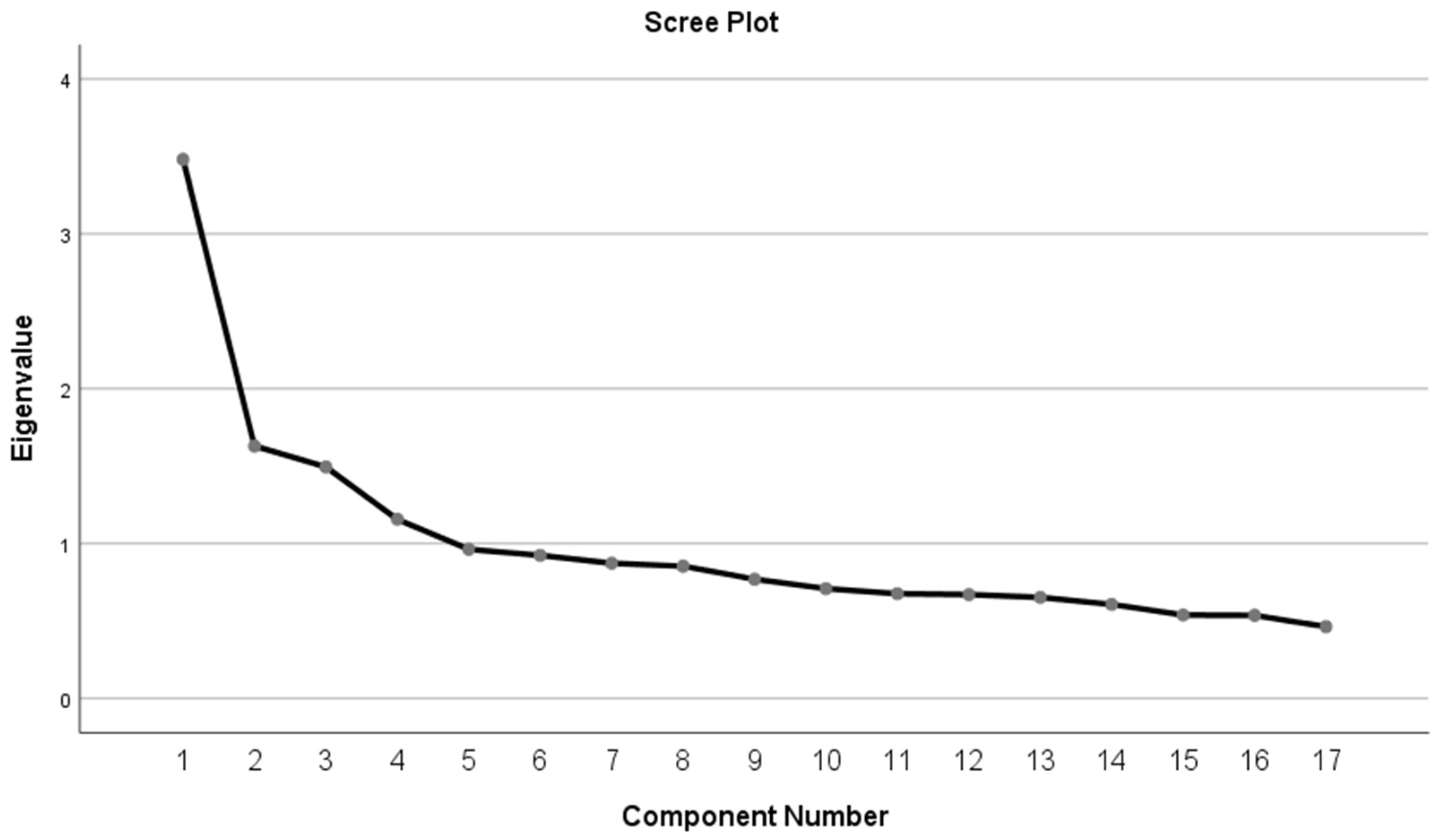
| Eigenvalue | 3.481 | 1.63 | 1.495 | 1.157 |
| Explained variance (%) | 12.735 | 11.915 | 11.033 | 9.978 |
| Total explained variance (%) | 45.661 | |||
| KMO | 0.784 | |||
| Bartlett’s χ2 (p) | 1292.770 (p < 0.001) | |||
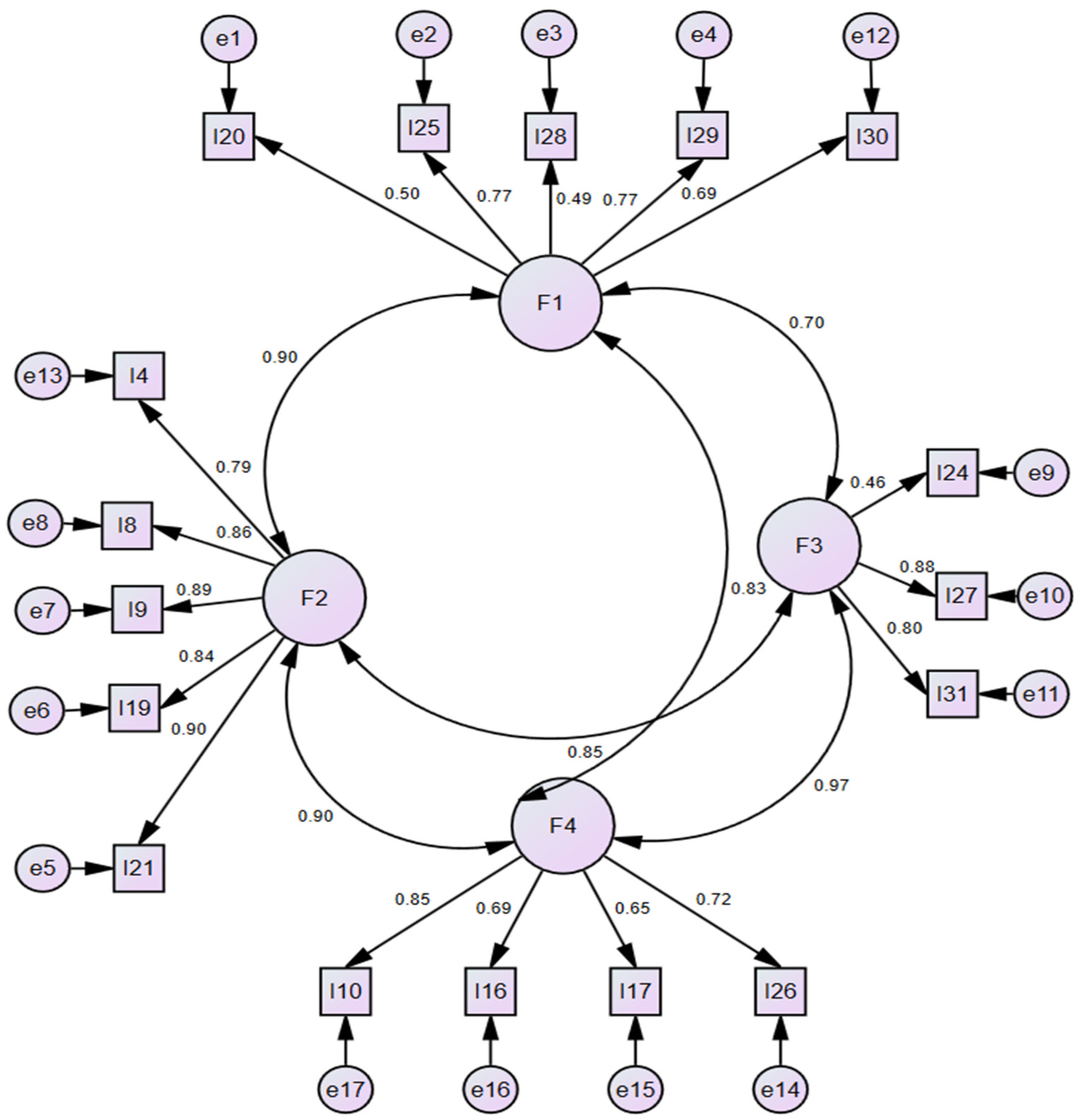
| Model | χ2/df | RMSEA | CFI | AGFI | GFI | RMSR |
| 2.329 | 0.074 | 0.946 | 0.847 | 0.887 | 0.045 |
Disclaimer/Publisher’s Note: The statements, opinions and data contained in all publications are solely those of the individual author(s) and contributor(s) and not of MDPI and/or the editor(s). MDPI and/or the editor(s) disclaim responsibility for any injury to people or property resulting from any ideas, methods, instructions or products referred to in the content. |
© 2026 by the authors. Licensee MDPI, Basel, Switzerland. This article is an open access article distributed under the terms and conditions of the Creative Commons Attribution (CC BY) license.
Share and Cite
Seçginli, S.; İlhan, N.; Torun, G.; Yaş, M.A.; Bolat, S.D. Development and Psychometric Testing of an Infectious Disease Knowledge Questionnaire in a Convenience Sample. Int. J. Environ. Res. Public Health 2026, 23, 356. https://doi.org/10.3390/ijerph23030356
Seçginli S, İlhan N, Torun G, Yaş MA, Bolat SD. Development and Psychometric Testing of an Infectious Disease Knowledge Questionnaire in a Convenience Sample. International Journal of Environmental Research and Public Health. 2026; 23(3):356. https://doi.org/10.3390/ijerph23030356
Chicago/Turabian StyleSeçginli, Selda, Nesrin İlhan, Gizemnur Torun, Merve Altıner Yaş, and Seda Doğru Bolat. 2026. "Development and Psychometric Testing of an Infectious Disease Knowledge Questionnaire in a Convenience Sample" International Journal of Environmental Research and Public Health 23, no. 3: 356. https://doi.org/10.3390/ijerph23030356
APA StyleSeçginli, S., İlhan, N., Torun, G., Yaş, M. A., & Bolat, S. D. (2026). Development and Psychometric Testing of an Infectious Disease Knowledge Questionnaire in a Convenience Sample. International Journal of Environmental Research and Public Health, 23(3), 356. https://doi.org/10.3390/ijerph23030356