Article

Sentinel Physicians for the Environment: A Chilean Perspective to Address Global Health and Climate Resilience


by
Paolo Lauriola
1,2,3,*,
Jaime Sepúlveda Cisternas
4,5,
Lisa De Pasquale
2,3,6,
Francesco Saverio Apruzzese
2,3,
Xavier Maldonado
7,
Olivia J. Brathwaite Dick
8 and
Yuri Carvajal
5
1
European Public Health Alliance (EPHA), Rue de Trèves 49, 1040 Brussels, Belgium
2
International Society of Doctors for the Environment (ISDE), 52100 Arezzo, Italy
3
Department of ISDE/FNOMCeO, Rete Italiana Medici Sentinella per l’Ambiente (RIMSA), 52100 Arezzo, Italy
4
Department of Servicio de Salud Talcahuano, Talcahuano 4260000, Chile
5
Departamento de Medio Ambiente, Colegio Médico de Chile, Temuco 4780000, Chile
6
Department of Biomedical, Metabolic and Neural Sciences, Faculty of Medicine, University of Modena and Reggio Emilia, Via Campi 287, 41125 Modena, Italy
7
Facultad de Ciencias Médicas, Universidad Central del Ecuador, Quito 170521, Ecuador
8
Departamento de Enfermedades Transmisibles, Oficina de la Organización Panamericana de la Salud/Organización Mundial de la Salud, Santiago de Chile 7630412, Chile
*
Author to whom correspondence should be addressed.
Int. J. Environ. Res. Public Health 2026, 23(3), 283; https://doi.org/10.3390/ijerph23030283

Submission received: 28 September 2025 / Revised: 7 January 2026 / Accepted: 6 February 2026 / Published: 25 February 2026
(This article belongs to the Special Issue Climate Change and Medical Responses)

Abstract

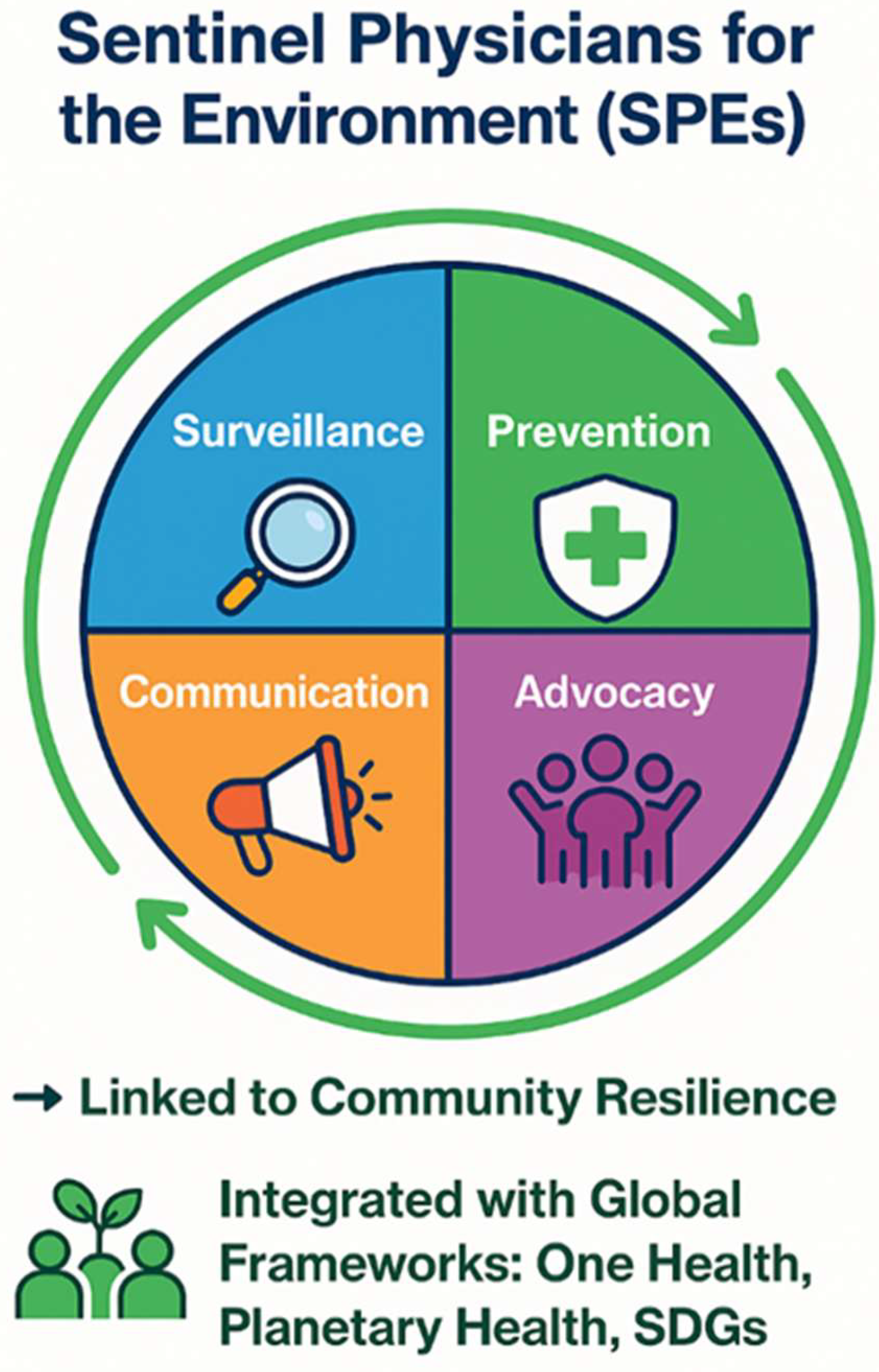
Climate change and environmental degradation are intensifying health risks across Latin America, placing increasing pressure on primary health care (PHC) systems. Physicians working at community level are often the first to observe climate- and environment-related health effects, yet operational models that link clinical practice, environmental surveillance and community engagement remain insufficiently defined. This article adopts a policy-oriented narrative synthesis approach, drawing on peer-reviewed literature, policy documents, institutional records, memoranda of understanding, and outputs from professional seminars and stakeholder meetings conducted between 2024 and 2025 to develop an evaluable operational framework. Chile is examined as a case study, while the proposed framework is situated within a broader Latin American perspective. We conceptualise the model of Sentinel Physicians for the Environment (SPEs) as an operational framework embedded within PHC, structured around four core pillars: surveillance, prevention, communication and advocacy. The model clarifies how SPEs can contribute in practical terms to addressing major climate-related health threats, including heatwaves, air pollution, wildfires, vector-borne diseases, migration-related vulnerability, antimicrobial resistance and zoonotic risks. The Chilean experience illustrates feasible implementation pathways, distinguishing actions already undertaken, initiatives under development and proposed future steps. The SPE model offers a pragmatic and scalable approach to strengthening climate-resilient primary health care in Latin America. By leveraging existing PHC structures and community trust, SPEs can enhance early detection, risk communication and preparedness without requiring complex technologies or high financial investment, providing a transferable contribution to public health practice and policy, with clear implications for future evaluation.
Keywords: sentinel surveillance; sentinel physicians for the environment; primary health care; climate change and health; One Health; Planetary Health; health equity; Latin America and Caribbean sentinel surveillance; sentinel physicians for the environment; primary health care; climate change and health; One Health; Planetary Health; health equity; Latin America and Caribbean