Exploring Emerging Trends in Climate Change’s Impacts on the Cardiopulmonary Health of Adults Living in the Canton of Valais, Switzerland: Preliminary Autumn and Winter Results from a Pilot Study

 ,
,  and
and
Highlights
- This study provides preliminary evidence that short-term variations in temperature and air pollution are associated with fluctuations in cardiopulmonary emergency department admissions, highlighting the vulnerability of aging and chronically ill populations in climate-sensitive alpine regions.
- By demonstrating the feasibility of linking real-time environmental data with healthcare utilization, this work informs public health surveillance, early-warning systems, and climate-resilient healthcare planning aimed at anticipating demand for emergency care and reducing preventable morbidity under changing climatic conditions.
- This study strengthens the evidence base on how environmental exposures related to climate change influence emergency department demand, thereby supporting population-level risk assessment and informing strategies to protect vulnerable groups from climate-related health impacts.
- Its significance lies in its potential to support proactive public health action by integrating environmental and health system data, enabling earlier detection of climate-sensitive health effects and guiding preventive, adaptive, and resource-allocation strategies within healthcare systems.
- For public health practitioners and policymakers, these findings underscore the need to integrate environmental and climatic indicators into routine health surveillance and emergency preparedness planning to anticipate climate-sensitive fluctuations in healthcare.
- For researchers, this study highlights the value of interdisciplinary, data-linkage approaches combining environmental monitoring and health service utilization, supporting further longitudinal and multi-site research to inform evidence-based climate adaptation strategies within health systems.
Abstract
1. Introduction
2. Materials and Methods
2.1. Study Design
2.2. Population, Sample, and Recruitment
2.3. Procedures
2.4. Data Analysis
3. Ethics Considerations
4. Results
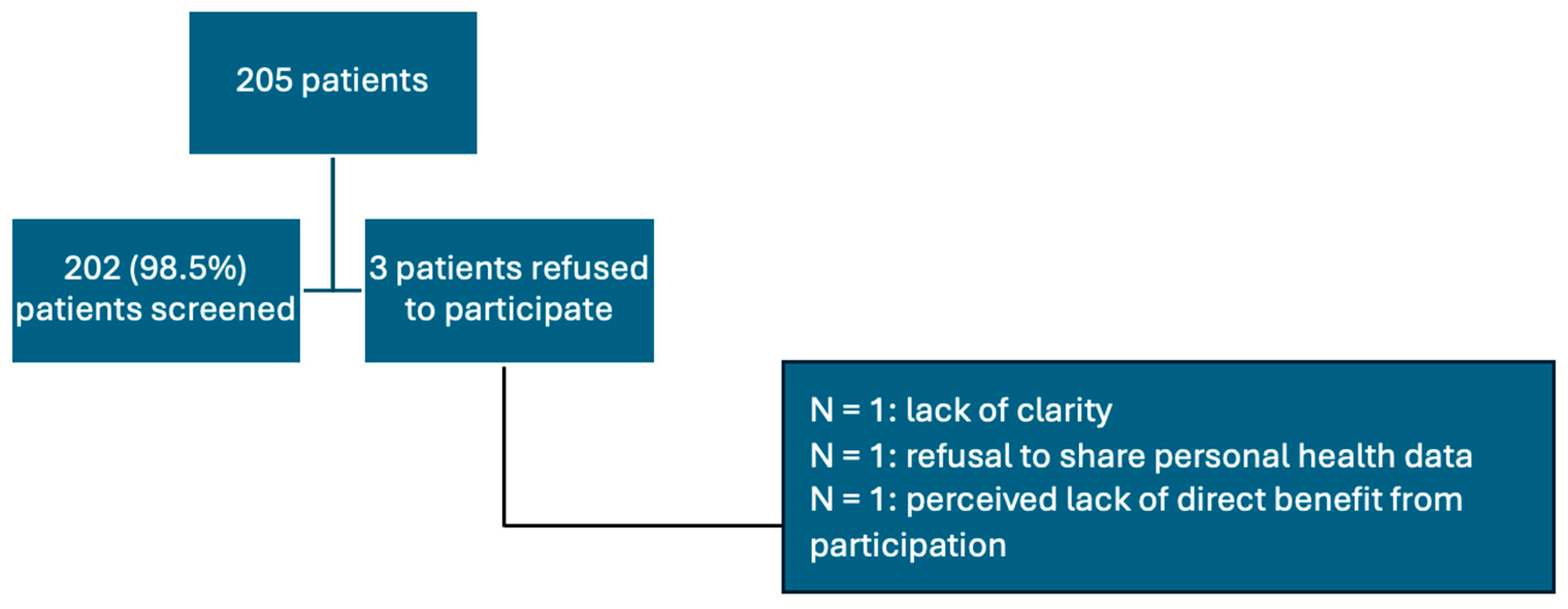
4.1. Patient Participation
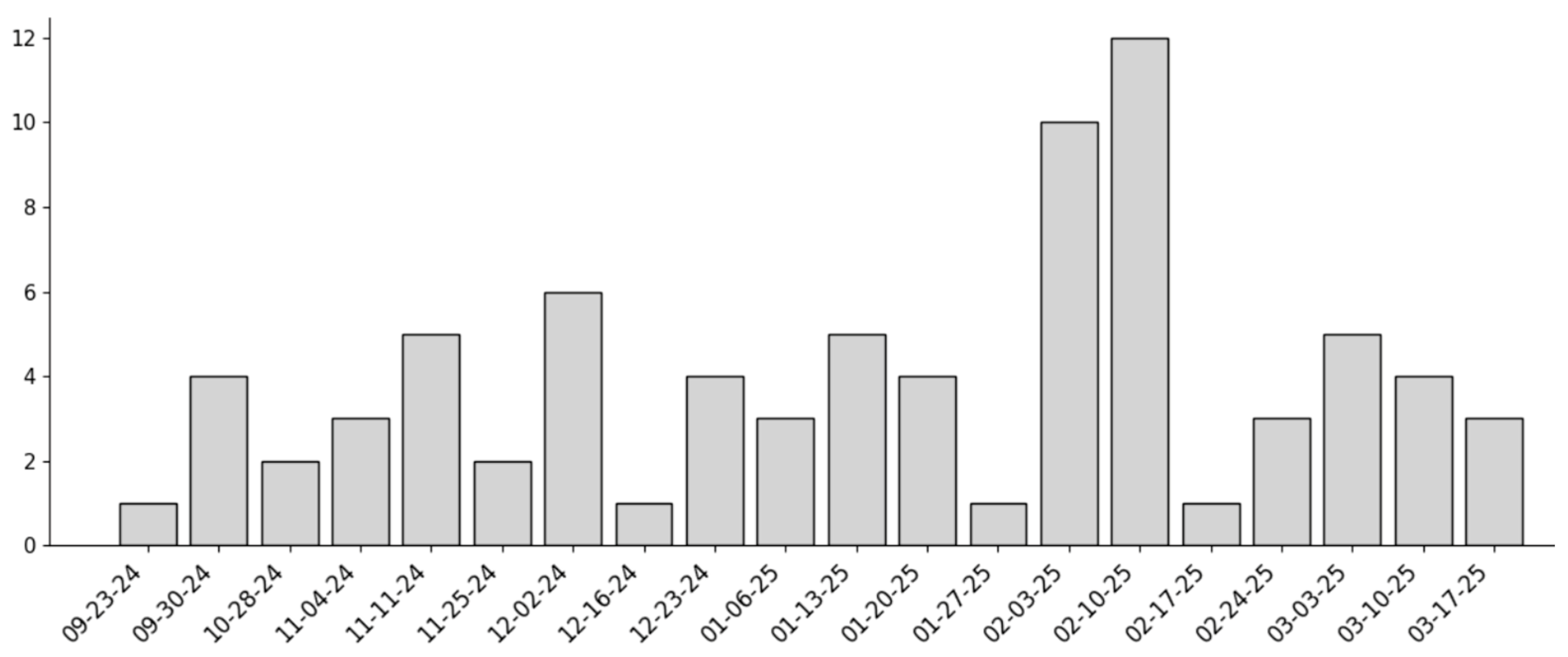
4.2. Sociodemographic Characteristics, Health Status, and Reasons for Emergency Visits
4.3. Descriptive, Associative, and Inferential Analysis of the Collected Data
4.3.1. Data Aggregation
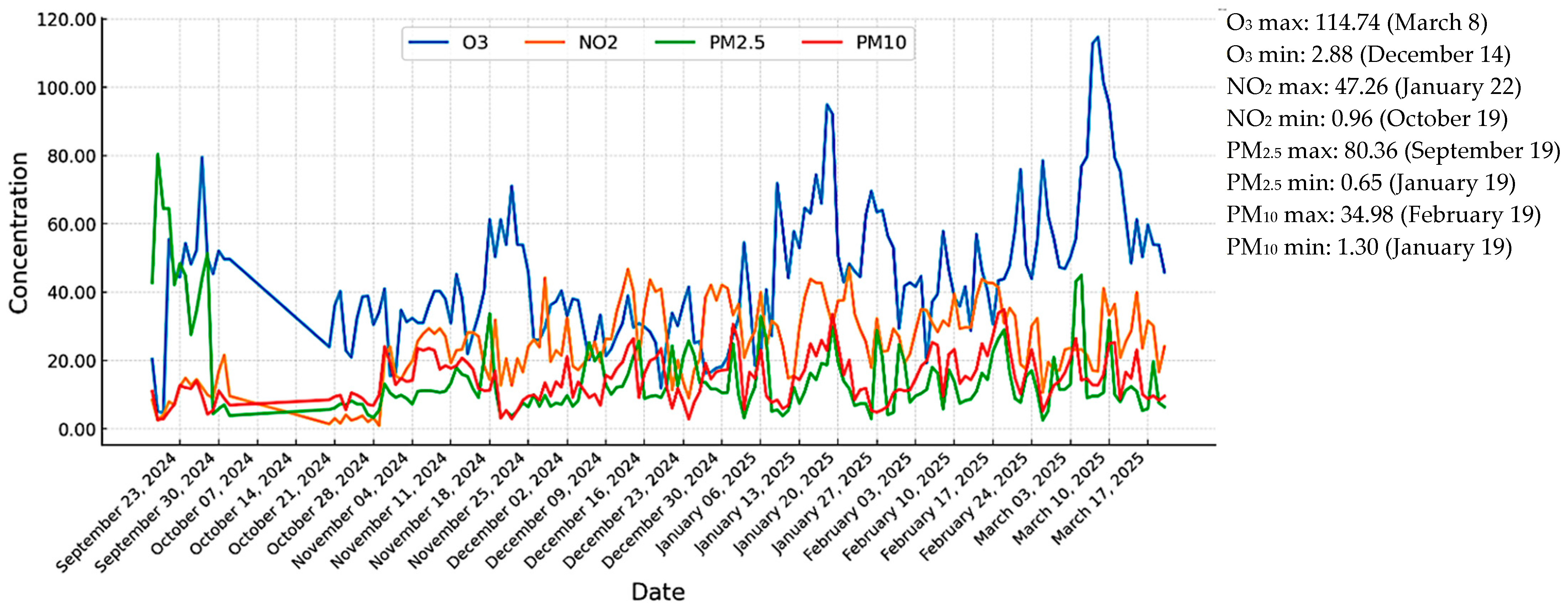
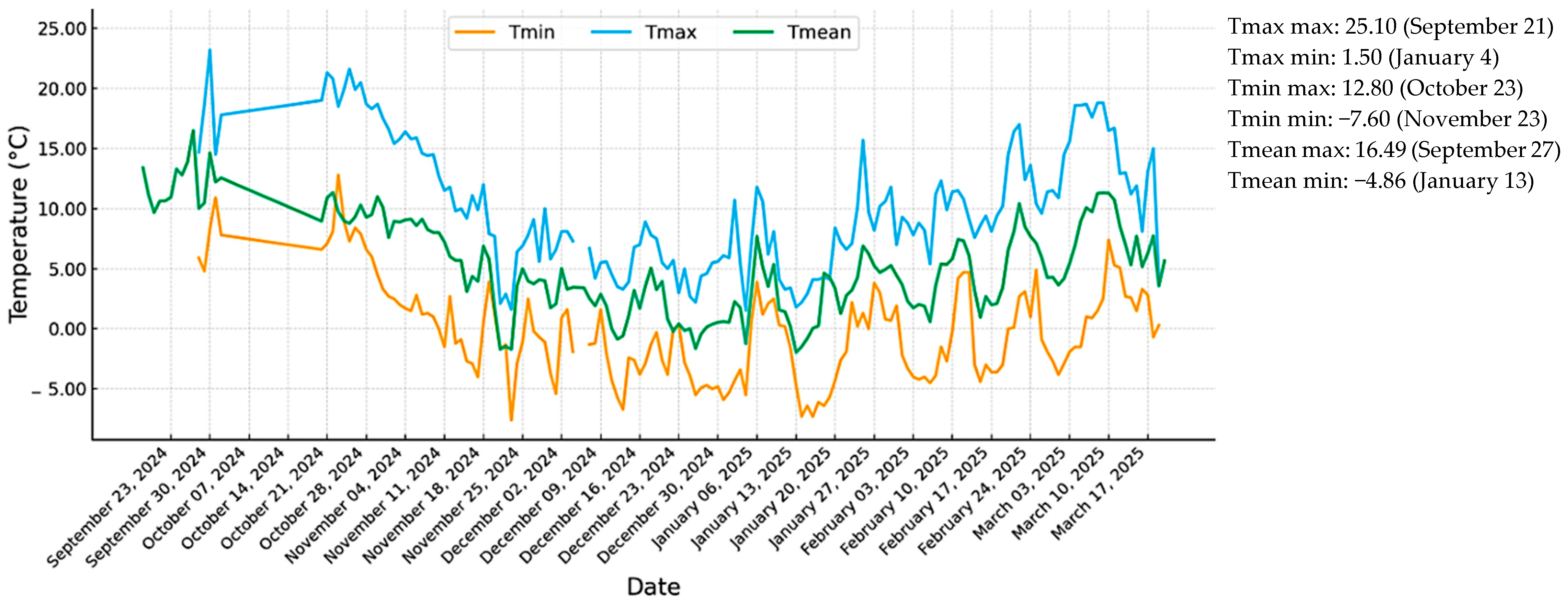
4.3.2. Longitudinal Description of the Evolution of Atmospheric Pollutants and Temperatures
4.3.3. Regression Analysis
5. Discussion
5.1. Recommendations for Research
5.2. Recommendations for Teaching
5.3. Recommendations for Practice
5.4. Strengths and Limitations
6. Conclusions
7. Patients
Author Contributions
Funding
Institutional Review Board Statement
Informed Consent Statement
Data Availability Statement
Acknowledgments
Conflicts of Interest
References
- Levett-Jones, T.; Catling, C.; Cheer, S.; Fields, L.; Foster, A.; Maguire, J.; Mcintyre, E.; Oam, T.M.; Pich, J.; Pitt, V.; et al. Achieving consensus on the essential knowledge and skills needed by nursing students to promote planetary health and sustainable healthcare: A Delphi study. J. Adv. Nurs. 2025, 81, 8281–8299. [Google Scholar] [CrossRef] [Scilit] [PubMed]
- Vicedo-Cabrera, A.M.; de Schrijver, E.; Schumacher, D.L.; Ragettli, M.S.; Fischer, E.M.; Seneviratne, S.I. The footprint of human-induced climate change on heat-related deaths in the summer of 2022 in Switzerland. Environ. Res. Lett. 2023, 18, 074037. [Google Scholar] [CrossRef] [Scilit]
- Watts, N.; Amann, M.; Arnell, N.; Ayeb-Karlsson, S.; Beagley, J.; Belesova, K.; Boykoff, M.; Byass, P.; Cai, W.; Campbell-Lendrum, D.; et al. The 2020 report of The Lancet Countdown on health and climate change: Responding to converging crises. Lancet 2021, 397, 129–170. [Google Scholar] [CrossRef] [Scilit]
- Rojas-Rueda, D.; Morales-Zamora, E.; Alsufyani, W.A.; Herbst, C.H.; AlBalawi, S.M.; Alsukait, R.; Alomran, M. Environmental Risk Factors and Health: An Umbrella Review of Meta-Analyses. Int. J. Environ. Res. Public Health 2021, 18, 704. [Google Scholar] [CrossRef] [Scilit]
- Fussell, J.C.; Kelly, F.J. Mechanisms underlying the health effects of desert sand dust. Environ. Int. 2021, 157, 106790. [Google Scholar] [CrossRef] [Scilit]
- Chung, C.Y.; Yang, J.; Yang, X.; He, J. Long-term effects of ambient air pollution on lung cancer and COPD mortalities in China: A systematic review and meta-analysis of cohort studies. Environ. Impact Assess. Rev. 2022, 97, 106865. [Google Scholar] [CrossRef] [Scilit]
- Alari, A.; Letellier, N.; Benmarhnia, T. Effect of different heat wave timing on cardiovascular and respiratory mortality in France. Sci. Total Environ. 2023, 892, 164543. [Google Scholar] [CrossRef] [Scilit] [PubMed]
- Tuholske, C.; Caylor, K.; Funk, C.; Verdin, A.; Sweeney, S.; Grace, K.; Peterson, P.; Evans, T. Global urban population exposure to extreme heat. Proc. Natl. Acad. Sci. USA 2021, 118, e2024792118. [Google Scholar] [CrossRef] [Scilit] [PubMed]
- Singh, N.; Areal, A.T.; Breitner, S.; Zhang, S.; Agewall, S.; Schikowski, T.; Schneider, A. Heat and Cardiovascular Mortality: An Epidemiological Perspective. Circ. Res. 2024, 134, 1098–1112. [Google Scholar] [CrossRef] [Scilit]
- Alahmad, B.; Khraishah, H.; Royé, D.; Vicedo-Cabrera, A.M.; Guo, Y.; Papatheodorou, S.I.; Achilleos, S.; Acquaotta, F.; Armstrong, B.; Bell, M.L.; et al. Associations Between Extreme Temperatures and Cardiovascular Cause-Specific Mortality: Results from 27 Countries. Circulation 2023, 147, 35–46. [Google Scholar] [CrossRef] [Scilit]
- Hu, J.; Zhou, M.; Qin, M.; Tong, S.; Hou, Z.; Xu, Y.; Zhou, C.; Xiao, Y.; Yu, M.; Huang, B.; et al. Long-term exposure to ambient temperature and mortality risk in China: A nationwide study using the difference-in-differences design. Environ. Pollut. 2022, 292, 118392. [Google Scholar] [CrossRef] [Scilit]
- Moghadamnia, M.T.; Ardalan, A.; Mesdaghinia, A.; Keshtkar, A.; Naddafi, K.; Yekaninejad, M.S. Ambient temperature and cardiovascular mortality: A systematic review and meta-analysis. PeerJ 2017, 5, 3574. [Google Scholar] [CrossRef] [Scilit]
- Bauer, V.M.; Scherrer, S.C. The observed evolution of sub-daily to multi-day heavy precipitation in Switzerland. Atmospheric Sci. Lett. 2024, 25, e1240. [Google Scholar] [CrossRef] [Scilit]
- Bujosa Mateu, A.; Alegre Latorre, L.; Comas, M.V.; Salom, J.; Gasalla, M.G.; Bibiloni, L.P.; Timoner, J.O.; Angoiti, J.M. Impact of heat waves on human morbidity and hospital admissions in a city of the western mediterranean area. Int. Arch. Occup. Environ. Health 2024, 97, 757–765. [Google Scholar] [CrossRef] [Scilit]
- Carron, P.N.; Desmettre, T. Au secours les urgences débordent! Rev. Med. Suisse 2024, 20, 1387–1388. [Google Scholar] [CrossRef] [Scilit]
- Le Recours Aux Services D’urgence Ambulatoires. Obsan. Available online: https://www.obsan.admin.ch/fr/publications/2024-le-recours-aux-services-durgence-ambulatoires (accessed on 17 January 2025).
- Thabane, L.; Lancaster, G. A guide to the reporting of protocols of pilot and feasibility trials. Pilot Feasibility Stud. 2019, 5, 37. [Google Scholar] [CrossRef] [Scilit] [PubMed]
- Price, M.F.; Arnesen, T.; Gløersen, E.; Metzger, M.J. Mapping mountain areas: Learning from Global, European and Norwegian perspectives. J. Mt. Sci. 2018, 16, 1–15. [Google Scholar] [CrossRef] [Scilit]
- Valais. Available online: https://www.nccs.admin.ch/nccs/en/home/regions/kantone/wallis.html (accessed on 16 December 2025).
- Bhaskaran, K.; Gasparrini, A.; Hajat, S.; Smeeth, L.; Armstrong, B. Time series regression studies in environmental epidemiology. Int. J. Epidemiol. 2013, 42, 1187–1195. [Google Scholar] [CrossRef] [Scilit]
- Babyak, M.A. What you see may not be what you get: A brief, nontechnical introduction to overfitting in regression-type models. Psychosom. Med. 2004, 66, 411–421. [Google Scholar]
- Newman, T.B.; Browner, W.S. In defense of standardized regression coefficients. Epidemiology 1991, 2, 383–386. [Google Scholar] [CrossRef] [Scilit]
- Temperature-Related Mortality Burden to Worsen in Europe—The Joint Research Centre: EU Science Hub. Available online: https://joint-research-centre.ec.europa.eu/jrc-news-and-updates/temperature-related-mortality-burden-worsen-europe-2024-08-22_en?utm_source=chatgpt.com (accessed on 3 November 2025).
- Li, M.; Gu, S.; Bi, P.; Yang, J.; Liu, Q. Heat Waves and Morbidity: Current Knowledge and Further Direction-A Comprehensive Literature Review. Int. J. Environ. Res. Public Health 2015, 12, 5256–5283. [Google Scholar] [CrossRef] [Scilit] [PubMed]
- Li, M.H.; Fan, L.C.; Mao, B.; Yang, J.W.; Choi, A.M.; Cao, W.J.; Xu, J.F. Short-term exposure to ambient fine particulate matter increases hospitalizations and mortality in COPD: A systematic review and meta-analysis. Chest 2016, 149, 447–458. [Google Scholar] [CrossRef] [Scilit] [PubMed]
- DeVries, R.; Kriebel, D.; Sama, S. Outdoor Air Pollution and COPD-Related Emergency Department Visits, Hospital Admissions, and Mortality: A Meta-Analysis. COPD 2017, 14, 113–121. [Google Scholar] [CrossRef] [Scilit]
- Liu, J.; Varghese, B.M.; Hansen, A.; Zhang, Y.; Driscoll, T.; Morgan, G.; Dear, K.; Gourley, M.; Capon, A.; Bi, P. Heat exposure and cardiovascular health outcomes: A systematic review and meta-analysis. Lancet Planet. Health 2022, 6, e484–e495. [Google Scholar] [CrossRef] [Scilit]
- Wan, K.; Feng, Z.; Hajat, S.; Doherty, R.M. Temperature-related mortality and associated vulnerabilities: Evidence from Scotland using extended time-series datasets. Environ. Health 2022, 21, 99. [Google Scholar] [CrossRef] [Scilit]
- Rojas-Rueda, D.; Nieuwenhuijsen, M.J.; Gascon, M.; Perez-Leon, D.; Mudu, P. Green spaces and mortality: A systematic review and meta-analysis of cohort studies. Lancet Planet. Health 2019, 3, e469–e477. [Google Scholar] [CrossRef] [Scilit] [PubMed]



| Variable | Description | Unit | Source |
|---|---|---|---|
| Tmax | Daily maximum air temperature measured at ~2 m above ground level | °C | MétéoSuisse (Sion weather station only) |
| Tmin | Daily minimum air temperature measured at ~2 m above ground level | ||
| Tmean | Daily mean air temperature measured at ~2 m above ground level | RESIVAL (Les Giettes, Massongex, Sion, Saxon, Montana) | |
| O3 | Daily average concentration of ozone | µg/m3 | RESIVAL (Les Giettes, Massongex, Sion, Saxon, Montana) |
| PM10 | Daily average concentration of particulate matter ≤ 10 µm | ||
| PM2.5 | Daily average concentration of particulate matter ≤ 2.5 µm | ||
| NO2 | Daily average concentration of nitrogen dioxide |
| Autumn (27 September 2024–20 December 2024) (n = 30) | Winter (21 December 2024–20 March 2025) (n = 61) | Total | |
|---|---|---|---|
| Sex, n (%) | |||
| Male | 13 (43.3%) | 25 (41.0%) | 38 (41.8%) |
| Female | 17 (56.7%) | 36 (59.0%) | 91 (58.2%) |
| Areas of Valais, n (%) | |||
| Central Valais | 17 (85.0%) | 29 (82.9%) | 46 (50.5%) |
| Upper Valais | 0 (0%) | 1 (2.9%) | 1 (1.1%) |
| Lower Valais | 3 (15.0%) | 5 (14.3%) | 8 (8.8%) |
| RESIVAL weather station, n (%) | |||
| Sion | 25 (83.3%) | 38 (62.3%) | 63 (69.2%) |
| Saxon | 3 (10.0%) | 11 (18.0%) | 14 (15.4%) |
| Montana | 2 (6.7%) | 11 (18.0%) | 13 (14.3%) |
| Massongex | 0 (0%) | 1 (1.6%) | 1 (1.1%) |
| Marital status, n (%) | |||
| Married | 14 (46.7%) | 36 (59.0%) | 50 (54.9%) |
| Single | 6 (20.0%) | 11 (18.0%) | 17 (18.7%) |
| Divorced | 6 (20.0%) | 5 (8.2%) | 11 (12.1%) |
| Widowed | 4 (13.3%) | 9 (14.8%) | 13 (14.3%) |
| Reason for consultation, n (%) | |||
| Dyspnea/Respiratory disorders | 8 (26.7%) | 23 (37.7%) | 31 (34.1%) |
| Thoracic/Cardiovascular pain | 10 (33.3%) | 21 (34.4%) | 31 (34.1%) |
| Abdominal/Digestive pain | 2 6.7%) | 3 (4.9%) | 5 (5.5%) |
| Neurological | 5 (16.7%) | 11 (18.0%) | 16 (17.6%) |
| Trauma/Fractures | 1 (3.3%) | 1 (1.6%) | 2 (2.2%) |
| Urinary retention | 0 (0%) | 1 (1.6%) | 1 (1.1%) |
| Hemorrhages | 3 (10.0%) | 1 (1.6%) | 4 (4.4%) |
| Skin infection/other diagnoses | 1 (3.3%) | 0 (0%) | 1 (1.1%) |
| Medical and surgical history | |||
| Cardiac history, n (%) | 21 (70%) | 44 (71.2%) | 65 (71.4%) |
| Blood pressure disorders | 9 (42.9%) | 14 (31.8%) | 23 (35.5%) |
| Dyslipidemia | 4 (19.0%) | 7 (15.9%) | 11 (16.9%) |
| Cardiopathy | 19 (90.5%) | 17 (38.6%) | 36 (55.4%) |
| Heart failure | 6 (28.6%) | 3 (6.8%) | 9 (13.8%) |
| Thromboembolic disorders | 8 (38.1% | 7 (15.9%) | 10 (15.4%) |
| Heart transplant | 1 (4.8%) | 0 (0%) | 1 (1.5%) |
| Respiratory history, n (%) | 14 (46.7%) | 23 (37.7%) | 37 (40.7%) |
| COPD | 9 (64.3%) | 5 (21.7%) | 14 (37.8%) |
| OSAS | 4 (28.6) | 6 (26.1%) | 10 (27.0%) |
| Allergic respiratory disease | 3 (21.4%) | 3 (13.0%) | 6 (16.2%) |
| Thromboembolic events | 0 (0%) | 5 (21.7%) | 5 (5.5%) |
| Infectious respiratory diseases | 1 (7.1%) | 4 (17.4%) | 5 (5.5%) |
| Airway structural disorders | 1 (7.1%) | 3 (13.0%) | 4 (4.4%) |
| Smoking status, n (%) | |||
| Yes | 16 (53.3%) | 23 (37.7%) | 39 (42.9%) |
| No | 14 (46.7%) | 38 (62.3%) | 52 (57.1%) |
| Former smoker | 14 (46.7%) | 13 (21.3%) | 27 (29.7%) |
| Diabetes status, n (%) | |||
| Yes | 4 (13.3% | 14 (23.0%) | 18 (19.8%) |
| No | 26 (86.7%) | 47 (77.0%) | 73 (80.2%) |
| Comorbidities, n (%) | |||
| Yes | 13 (43.3%) | 35 (57.4%) | 48 (52.7%) |
| Hepatobiliary/Digestive | 2 (15.4%) | 10 (28.6%) | 12 (25.0%) |
| Vascular | 2 (15.4%) | 4 (11.4%) | 6 (12.5%) |
| Metabolic/Endocrine | 4 (30.8%) | 12 (34.3%) | 16 (33.3%) |
| Oncological | 3 (23.1%) | 11 (31.4%) | 14 (29.2%) |
| Genitourinary | 4 (30.8%) | 12 (34.3%) | 16 (33.3%) |
| Musculoskeletal/Orthopedic | 3 (23.1%) | 7 (20.0%) | 10 (20.8%) |
| Neurological | 3 (23.1%) | 4 (11.4%) | 7 (14.6%) |
| Psychiatric | 0 (0%) | 2 (5.7%) | 2 (4.2%) |
| Hematological/Allergies/Immunological | 1(7.7%) | 3 (8.6%) | 4 (8.4%) |
| No | 17 (56.7%) | 26 (42.6%) | 43 (47.3%) |
| ED readmissions, n (%) | |||
| Yes | 11 (36.7%) | 21 (34.4%) | 32 (35.2%) |
| No | 19 (63.3%) | 40 (65.6%) | 59 (64.8%) |
| Age [years], mean (SD) | 68.7 (18.2) | 66.9 (18.5) | 67.5 (18.2) |
| Age [years], min–max | 20–91 | 25–94 | 20–94 |
| Pack-years, mean (SD) | 33.8 (32.6) | 32.9 (23.5) | 33.3 (28.4) |
| Pack-years, min–max | 1–100 | 1–82.5 | 1–100 |
| Base_ Cos | Cos_ Risk | Cos_ O3 | Cos-PM10 | Cos_ PM2.5 | Cos_ NO2 | Cos_ Tmean | |
|---|---|---|---|---|---|---|---|
| Intercept | 1.407 *** (0.160) | 0.855 ** (0.361) | 0.975 *** (0.302) | 1.713 *** (0.393) | 1.434 *** (0.323) | 1.583 *** (0.327) | 1.777 *** (0.301) |
| 10_day_cos | −0.436 ** (0.180) | −0.334 * (0.172) | −0.484 ** (0.191) | −0.411 ** (0.199) | −0.434 ** (0.195) | −0.441 ** (0.185) | −0.481 ** (0.188) |
| Risk_mean | 1.195 (0.766) | ||||||
| O3_mean | 0.014 * (0.008) | ||||||
| PM10_mean | −0.023 (0.029) | ||||||
| PM2.5_mean | −0.002 (0.018) | ||||||
| NO2_mean | −0.008 (0.013) | ||||||
| Tmean | −0.080 * (0.046) | ||||||
| N | 21 | 21 | 21 | 21 | 21 | 21 | 21 |
| AIC | 104.1 | 103.8 | 102.4 | 104.7 | 106.1 | 105.1 | 100.4 |
| BIC | 106.2 | 106.9 | 105.6 | 107.8 | 109.3 | 108.8 | 103.5 |
| Log-Likelihood | −50.072 | −48.886 | −48.224 | −49.331 | −50.060 | −49.856 | −47.183 |
| Dispersion | 2.103 | 2.050 | 2.020 | 2.209 | 2.212 | 2.210 | 1.714 |
| Base_ Sin | Sin_ Risk | Sin_ O3 | Sin_ PM10 | Sin_ PM2.5 | Sin_ NO2 | Sin_ Tmean | |
|---|---|---|---|---|---|---|---|
| Intercept | 1.438 *** (0.177) | 0.328 (0.371) | 1.110 *** (0.290) | 1.963 *** (0.577) | 1.508 *** (0.416) | 1.682 *** (0.497) | 1.689 *** (0.380) |
| 10_day_sin | 0.275 (0.292) | 0.396 (0.289) | 0.276 (0.283) | 0.366 (0.273) | 0.265 (0.285) | 0.313 (0.293) | 0.164 (0.312) |
| Risk_mean | 2.315 *** (0.766) | ||||||
| O3_mean | 0.011 (0.008) | ||||||
| PM10_mean | −0.041 (0.038) | ||||||
| PM2.5_mean | −0.005 (0.030) | ||||||
| NO2_mean | −0.0011 (0.018) | ||||||
| Tmean | −0.051 (0.0453) | ||||||
| N | 21 | 21 | 21 | 21 | 21 | 21 | 21 |
| AIC | 110.5 | 102.6 | 110.1 | 108.2 | 112.4 | 111.7 | 110.4 |
| BIC | 112.6 | 105.7 | 113.3 | 111.3 | 115.5 | 114.8 | 113.5 |
| Log-Likelihood | −53.272 | −48.292 | −52.066 | −51.084 | −53.182 | −52.857 | −52.188 |
| Dispersion | 2.455 | 1.965 | 2.462 | 2.203 | 2.600 | 2.488 | 2.325 |
Disclaimer/Publisher’s Note: The statements, opinions and data contained in all publications are solely those of the individual author(s) and contributor(s) and not of MDPI and/or the editor(s). MDPI and/or the editor(s) disclaim responsibility for any injury to people or property resulting from any ideas, methods, instructions or products referred to in the content. |
© 2026 by the authors. Licensee MDPI, Basel, Switzerland. This article is an open access article distributed under the terms and conditions of the Creative Commons Attribution (CC BY) license.
Share and Cite
Portela Dos Santos, O.; Selz Amaudruz, F.; Pereira Alves, P.J.; Verloo, H. Exploring Emerging Trends in Climate Change’s Impacts on the Cardiopulmonary Health of Adults Living in the Canton of Valais, Switzerland: Preliminary Autumn and Winter Results from a Pilot Study. Int. J. Environ. Res. Public Health 2026, 23, 274. https://doi.org/10.3390/ijerph23020274
Portela Dos Santos O, Selz Amaudruz F, Pereira Alves PJ, Verloo H. Exploring Emerging Trends in Climate Change’s Impacts on the Cardiopulmonary Health of Adults Living in the Canton of Valais, Switzerland: Preliminary Autumn and Winter Results from a Pilot Study. International Journal of Environmental Research and Public Health. 2026; 23(2):274. https://doi.org/10.3390/ijerph23020274
Chicago/Turabian StylePortela Dos Santos, Omar, Florence Selz Amaudruz, Paulo Jorge Pereira Alves, and Henk Verloo. 2026. "Exploring Emerging Trends in Climate Change’s Impacts on the Cardiopulmonary Health of Adults Living in the Canton of Valais, Switzerland: Preliminary Autumn and Winter Results from a Pilot Study" International Journal of Environmental Research and Public Health 23, no. 2: 274. https://doi.org/10.3390/ijerph23020274
APA StylePortela Dos Santos, O., Selz Amaudruz, F., Pereira Alves, P. J., & Verloo, H. (2026). Exploring Emerging Trends in Climate Change’s Impacts on the Cardiopulmonary Health of Adults Living in the Canton of Valais, Switzerland: Preliminary Autumn and Winter Results from a Pilot Study. International Journal of Environmental Research and Public Health, 23(2), 274. https://doi.org/10.3390/ijerph23020274