Strengthening Civil Registration Through Grassroots Health Institutions in India


Highlights
- Civil registration is a foundational state function that ensures people’s legal identity, which is essential for children to access public health services, immunization programs, and rights protection.
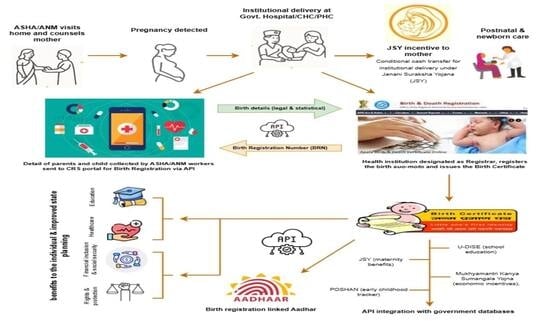
- This study examines how the expansion of grassroots health infrastructure, specifically primary health centres (PHCs) and community health centres (CHCs), can be leveraged to achieve universal birth registration in India.
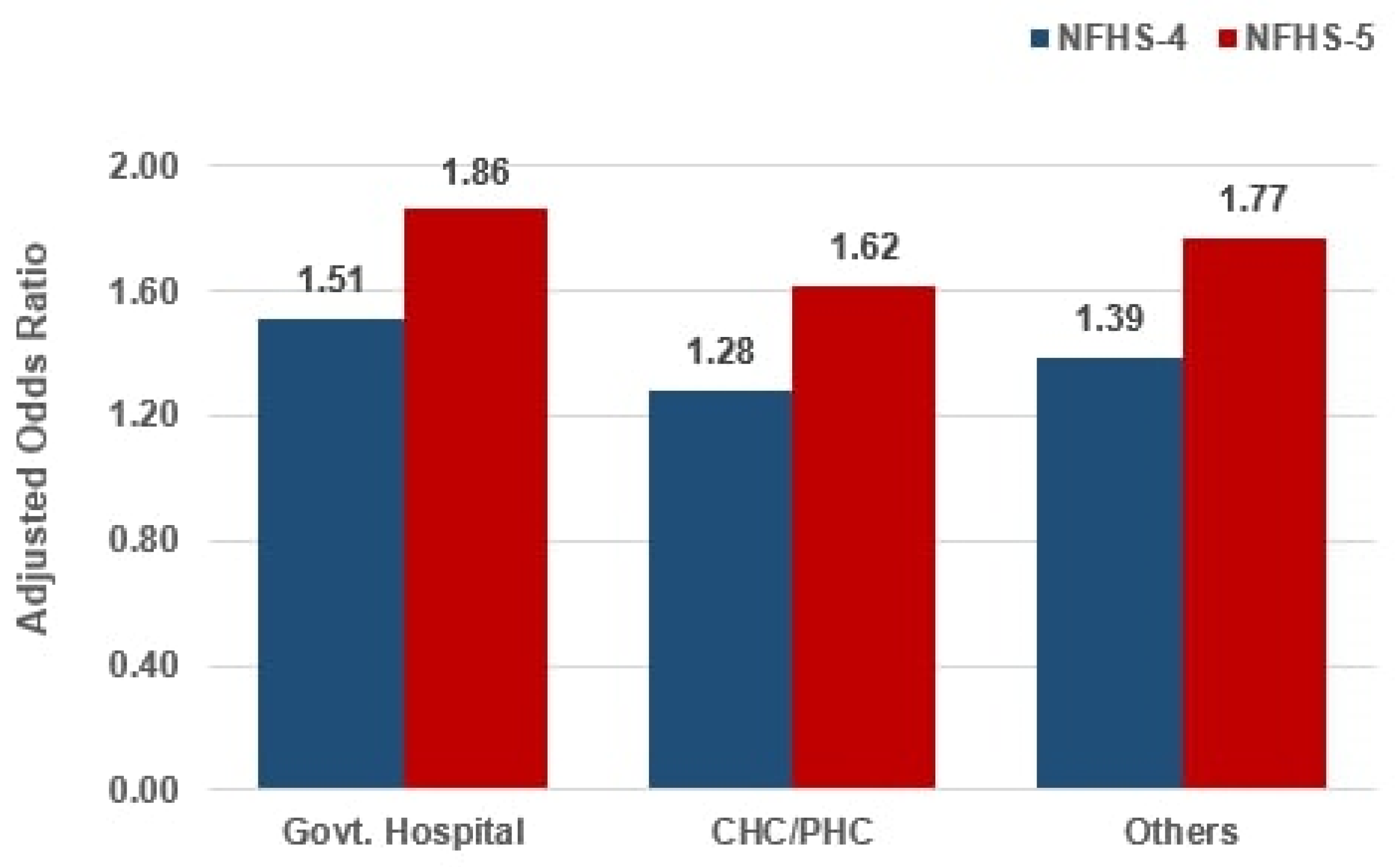
- This study provides nationally representative evidence showing that births occurring in PHCs/CHCs have significantly higher odds of registration compared to private facilities.
- The findings highlight the role of decentralized public health infrastructure in reducing registration gaps among rural and socio-economically disadvantaged populations.
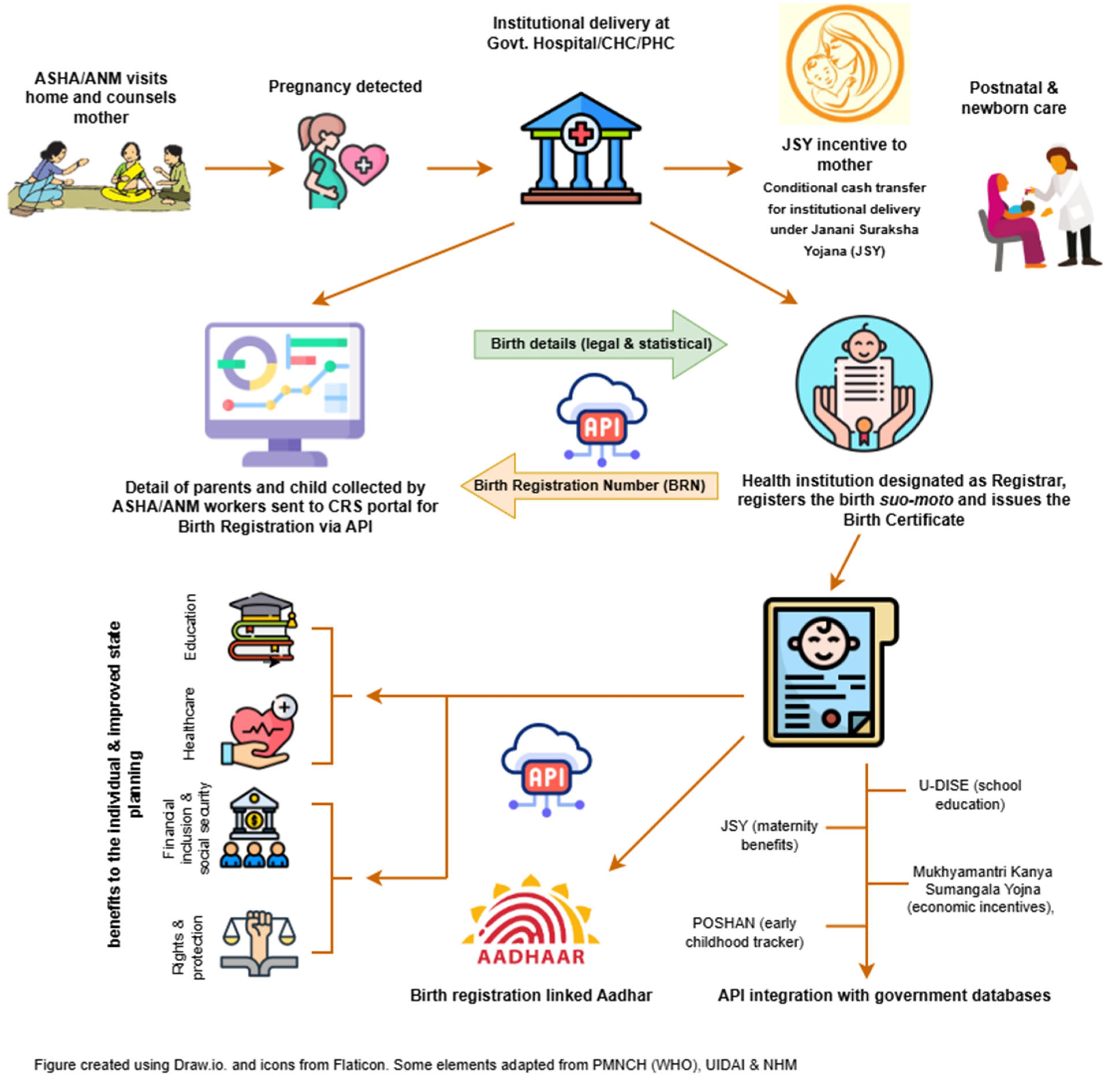
- Integrating civil registration functions within primary healthcare facilities can accelerate progress toward universal legal identity and SDG.
- Future policy should focus on deepening the digital integration between health service touchpoints and civil registration systems to reduce the administrative burden on frontline health workers while ensuring no child remains unregistered.
Abstract
1. Introduction
2. Materials and Methods
2.1. Study Variables
2.2. Statistical Analysis
3. Results
4. Discussion
Supplementary Materials
Author Contributions
Funding
Institutional Review Board Statement
Informed Consent Statement
Data Availability Statement
Acknowledgments
Conflicts of Interest
References
- Mills, S.; Lee, J.K.; Rassekh, B.M. Benefits of linking civil registration and vital statistics with identity management systems for measuring and achieving Sustainable Development Goal 3 indicators. J. Health Popul. Nutr. 2019, 38, 18. [Google Scholar] [CrossRef]
- Suthar, A.B.; Khalifa, A.; Yin, S.; Wenz, K.; Fat, D.M.; Mills, S.L.; Nichols, E.; AbouZahr, C.; Mrkic, S. Evaluation of approaches to strengthen civil registration and vital statistics systems: A systematic review and synthesis of policies in 25 countries. PLOS Med. 2019, 16, e1002929. [Google Scholar] [CrossRef] [PubMed]
- Verma, S.; Dwivedi, L.K.; Kamal, R. Impact of Institutionalisation of Births on Health Policies and Birth Registration in India. Ann. Glob. Health 2024, 90, 53. [Google Scholar] [CrossRef] [PubMed]
- United Nations. Transforming Our World: The 2030 Agenda for Sustainable Development; United Nations: New York, NY, USA, 2015. [Google Scholar]
- Hereward, M.; Williams, C.; Petrowski, N.; Cappa, C. Universal birth registration by 2030: Progress and challenges. Lancet 2019, 394, 2211–2212. [Google Scholar] [CrossRef] [PubMed]
- Bera, O.P.; Aggarwal, P.; Venkatesh, U.; Joshi, K.; Shah, V. Strengthening Civil Registration and Vital Statistics (CRVS) Systems in India: An Investment Case for Governance, Public Health, and Socio-economic Development. Indian J. Community Health 2024, 36, 758–763. [Google Scholar] [CrossRef]
- Singh, A.; Vellakkal, S.; Mishra, A.K. A population-level impact assessment of the National Health Mission on maternal and child health outcomes in India. J. Public Health Policy 2025, 46, 359–374. [Google Scholar] [CrossRef]
- Sangwan, G.; Lakshmi, P.V.M.; Goel, A.; Gupta, M.; Prinja, S.; Kumar, R. Evaluation of the impact of National Health Mission on maternal health outcomes. Int. J. Epidemiol. 2021, 50, dyab168.579. [Google Scholar] [CrossRef]
- Ministry of Health and Family Welfare. Funds Allocated and Key Achievements Made Under National Health Mission; Ministry of Health and Family Welfare: New Delhi, India, 2021. [Google Scholar]
- Montagu, D.; Landrian, A.; Kumar, V.; Phillips, B.S.; Singhal, S.; Mishra, S.; Singh, S.; Cotter, S.Y.; Singh, V.P.; Kajal, F.; et al. Patient-experience during delivery in public health facilities in Uttar Pradesh, India. Health Policy Plan. 2019, 34, 574–581. [Google Scholar] [CrossRef]
- Saha, R.; Paul, P. Institutional deliveries in India’s nine low performing states: Levels, determinants and accessibility. Glob. Health Action 2021, 14, 2001145. [Google Scholar] [CrossRef]
- Kar, R.; Wasnik, A.P. Determinants of public institutional births in India: An analysis using the National Family Health Survey (NFHS-5) factsheet data. J. Fam. Med. Prim. Care 2024, 13, 1408–1420. [Google Scholar] [CrossRef]
- Ministry of Health & Family Welfare. Rural Health Statistics, 2020–2021; Ministry of Health & Family Welfare: New Delhi, India, 2021. [Google Scholar]
- Office of Registrar General India. The Registration of Births and Deaths Act, 1969; Office of Registrar General India: New Delhi, India, 1969. [Google Scholar]
- Office of Registrar General India. The Registration of Births and Deaths (Amendment) Act, 2023; Office of Registrar General India: New Delhi, India, 2023. [Google Scholar]
- World Health Organization & United Nations Children’s Fund (UNICEF). Health Sector Contributions Towards Improving the Civil Registration of Births and Deaths in Low-Income Countries: Guidance for Health Sector Managers, Civil Registrars and Development Partners. 2021. Available online: https://iris.who.int/handle/10665/341911 (accessed on 18 August 2025).
- United Nations. Guidelines on the Legislative Framework for Civil Registration, Vital Statistics and Identity Management; United Nations: New York, NY, USA, 2019. [Google Scholar]
- Sachdeva, S.; Nagar, M.; Tyagi, A.; Sachdeva, R.; Kumar, V. Early birth registration at a center in rural India. J. Fam. Med. Prim. Care 2013, 2, 234–237. [Google Scholar] [CrossRef] [PubMed]
- Singh, P.; Kaur, M.; Jaswal, N.; Kumar, R. Impact of policy initiatives on civil registration system in Haryana. Indian J. Community Med. 2012, 37, 122–125. [Google Scholar] [CrossRef] [PubMed]
- International Institute of Population Sciences (IIPS). National Family Health Survey (NFHS-4), 2015–2016: India; International Institute of Population Sciences (IIPS): Mumbai, India, 2017. [Google Scholar]
- International Institute of Population Sciences (IIPS). National Family Health Survey (NFHS-5), 2019–2021; International Institute of Population Sciences (IIPS): Mumbai, India, 2021. [Google Scholar]
- Tripathi, S.; Pathak, V.K.; Lahariya, C. Key findings from NFHS-5 India report: Observing trends of health indicators between NFHS-4 and NFHS-5. J. Fam. Med. Prim. Care 2023, 12, 1759–1763. [Google Scholar] [CrossRef] [PubMed]
- Mohanty, I.; Gebremedhin, T.A. Maternal autonomy and birth registration in India: Who gets counted? PLoS ONE 2018, 13, e0194095. [Google Scholar] [CrossRef]
- Kumar, K.; Saikia, N. Determinants of birth registration in India: Evidence from NFHS 2015–16. PLoS ONE 2021, 16, e0257014. [Google Scholar] [CrossRef]
- Aboagye, R.G.; Okyere, J.; Seidu, A.A.; Ahinkorah, B.O.; Budu, E.; Yaya, S. Determinants of birth registration in sub-Saharan Africa: Evidence from demographic and health surveys. Front. Public Health 2023, 11, 1193816. [Google Scholar] [CrossRef]
- Onagoruwa, A.; Wodon, Q. Correlates of birth registrations in East and Southern Africa and implications for civil registration and vital statistics systems. Public Health 2021, 195, 70–75. [Google Scholar] [CrossRef]
- Balogun, O.O.; Bhandari, A.K.; Tomo, C.K.; Tchicondingosse, L.; Aoki, A.; Aiga, H.; Takehara, K. Association of sociodemographic and maternal healthcare factors with birth registration in Angola. Public Health 2023, 223, 94–101. [Google Scholar] [CrossRef]
- StataCorp. Stata Statistical Software: Release 18; StataCorp LLC: College Station, TX, USA, 2023. [Google Scholar]
- Lorenz, M.; Aisch, G.; Kokkelink, D. Datawrapper: Create Charts and Maps [Software]. 2012. Available online: https://www.datawrapper.de/ (accessed on 20 October 2024).
- Ministry of Health and Family Welfare (MOHFW). Janani Suraksha Yojana (JSY). 2017. Available online: https://nhm.gov.in/index1.php%3Flang%3D1%26level%3D3%26lid%3D309%26sublinkid%3D841 (accessed on 20 October 2024).
- Gopal, M.K.; Boerma, T.; Ram, U. Exemplars in Global Health. India’s Public Health System: Delivering Remarkable Improvements for Maternal and Newborn Health. 2023. Available online: https://nhsrcindia.org/sites/default/files/2023-08/Exemplars%20National%20Report_Web.pdf (accessed on 20 October 2024).
- Bhushan, H.; Ram, U.; Scott, K.; Blanchard, A.K.; Kumar, P.; Agarwal, R.; Washington, R.; Ramesh, B.M. Making the health system work for over 25 million births annually: Drivers of the notable decline in maternal and newborn mortality in India. BMJ Glob. Health 2024, 9, e011411. [Google Scholar] [CrossRef]
- Mohan, P.; Ramanathan, S. Effective, Respectful and Affordable Care: A call for Decentralized Maternal Care. Indian J. Community Med. 2023, 48, 377–378. [Google Scholar] [CrossRef]
- Ministry of Electronics and Information Technology. API Setu—Digital India Initiative; Ministry of Electronics and Information Technology: New Delhi, India, 2024. [Google Scholar]
- India Today Information Desk. Centre launches new app for easy birth & death registration: Here’s how it works. India Today, 30 October 2024. [Google Scholar]
- Jain, I. Uttar Pradesh begins online verification of birth, death certificates. The Times of India, 30 June 2022. [Google Scholar]
- Jeong, J.; Bhatia, A.; Fink, G. Associations between birth registration and early child growth and development: Evidence from 31 low- and middle-income countries. BMC Public Health 2018, 18, 673. [Google Scholar] [CrossRef]


Disclaimer/Publisher’s Note: The statements, opinions and data contained in all publications are solely those of the individual author(s) and contributor(s) and not of MDPI and/or the editor(s). MDPI and/or the editor(s) disclaim responsibility for any injury to people or property resulting from any ideas, methods, instructions or products referred to in the content. |
© 2026 by the authors. Licensee MDPI, Basel, Switzerland. This article is an open access article distributed under the terms and conditions of the Creative Commons Attribution (CC BY) license.
Share and Cite
Verma, S.; Jana, S.; Kamal, R.; Dwivedi, L.K.; Halli, S.S. Strengthening Civil Registration Through Grassroots Health Institutions in India. Int. J. Environ. Res. Public Health 2026, 23, 257. https://doi.org/10.3390/ijerph23020257
Verma S, Jana S, Kamal R, Dwivedi LK, Halli SS. Strengthening Civil Registration Through Grassroots Health Institutions in India. International Journal of Environmental Research and Public Health. 2026; 23(2):257. https://doi.org/10.3390/ijerph23020257
Chicago/Turabian StyleVerma, Sheetal, Somnath Jana, Ritul Kamal, Laxmi Kant Dwivedi, and Shiva S. Halli. 2026. "Strengthening Civil Registration Through Grassroots Health Institutions in India" International Journal of Environmental Research and Public Health 23, no. 2: 257. https://doi.org/10.3390/ijerph23020257
APA StyleVerma, S., Jana, S., Kamal, R., Dwivedi, L. K., & Halli, S. S. (2026). Strengthening Civil Registration Through Grassroots Health Institutions in India. International Journal of Environmental Research and Public Health, 23(2), 257. https://doi.org/10.3390/ijerph23020257