


Highlights
Public health relevance—How does this work relate to a public health issue?
- Indigenous Australians experience a disproportionate burden of type 2 diabetes and cardiovascular disease, with earlier onset, higher prevalence, and greater complications than other Australians, reflecting the profound impacts of colonization and ongoing structural inequities.
- Limited peer-reviewed evidence exists on culturally adapted exercise interventions co-designed with Indigenous Australians living with type 2 diabetes; substantial gaps remain in transparent reporting of Indigenous governance, cultural adaptation processes, and behavioral mechanisms.
Public health significance—Why is this work of significance to public health?
- This study advances the transparent documentation of systematic cultural adaptation through Indigenous-governed co-design, applying structured frameworks (CHRI Model, MADI, CREATE Quality Appraisal Tool, COM-B model) to address critical gaps in reproducibility and knowledge translation.
- Indigenous-governed co-design processes centered Indigenous knowledges and leadership beyond what consultation-based approaches achieve, demonstrating how behavior change mechanisms can be operationalized in culturally congruent ways that honor Indigenous epistemologies while maintaining evidence-based effectiveness.
Public health implications—What are the key implications or messages for practitioners, policy makers and/or researchers in public health?
- Health services seeking to develop culturally safe exercise interventions can use the PrIDE co-design methodology as a model, with transparent MADI documentation providing detailed guidance for systematic cultural adaptation and the Success Plan demonstrating the integration of clinical yarning into routine practice.
- Researchers and policymakers should prioritize Indigenous leadership and governance in systematic cultural adaptation using established frameworks, recognizing that documenting development processes is as critical as evaluating outcomes for achieving cultural safety, community trust, and scalability of health interventions.
Abstract
Indigenous Australians experience a disproportionate burden of type 2 diabetes mellitus and cardiovascular disease. While clinician-led, community-based exercise programs are effective in general populations, limited peer-reviewed evidence is available describing culturally adapted exercise interventions with Indigenous Australians that transparently reports governance, cultural adaptation, and theoretical design. This paper reports the co-design and development of tools for the Preventing Indigenous Cardiovascular Disease and Diabetes through Exercise (PrIDE) study, an adaptation of the Beat It program that incorporates wearable technology. Using the Co-design Health Research and Innovation Model, four tools were developed with Indigenous governance through a Consumer Advisory Group and a project-specific Consumer User Panel. Three tools were culturally adapted—the PrIDE Exercise Program, the Strong Spirit Strong Self self-efficacy assessment, and Keep Your Heart Strong educational materials—and a newly developed tool, the Success Plan. Cultural adaptations were prospectively documented using the Model for Adaptation Design and Impact, and all tools were assessed using the Aboriginal and Torres Strait Islander Quality Appraisal Tool. Behavior change mechanisms were mapped using the COM-B model. This paper provides transparent documentation of culturally adapted theory-informed tool development to support reproducibility and knowledge translation. The evaluation of effectiveness, acceptability, and psychometric properties will be reported following PrIDE implementation.
1. Introduction
Aboriginal and Torres Strait Islander peoples (hereafter referred to as Indigenous Australians) belong to the world’s oldest continuing cultures, with deep knowledge systems and strong community connections that have sustained health and wellbeing for millennia. However, the impacts of colonization and ongoing structural inequities have resulted in a disproportionate burden of type 2 diabetes (T2DM) and cardiovascular disease (CVD), characterized by earlier onset, higher prevalence, and greater complications than other Australians [1,2,3,4]. These disparities reflect the profound impact of social, cultural, historical, and structural determinants of health [5]. Addressing these health inequities through culturally safe, community-led approaches is essential for advancing health equity and honoring Aboriginal and Torres Strait Islander peoples’ right to health and self-determination [6,7,8].
Regular, structured exercise is central to T2DM management and CVD prevention [9,10]. Clinician-led, community-based group exercise interventions have improved glycemic control, physical function, cardiovascular risk factors, and psychosocial outcomes in adults with T2DM, indicating effectiveness in general populations [10,11]. However, this evidence cannot be assumed to transfer directly to Indigenous populations [12,13,14]. A systematic review of community-based exercise interventions with Indigenous peoples from high-income colonized countries managing T2DM identified limited published evidence, with substantial heterogeneity in design, delivery, and reporting [15].
International evidence is limited but suggests promise. In one supervised group exercise intervention with Indigenous Polynesian adults with T2DM, participants demonstrated improvements in cardiometabolic outcomes and quality of life [16,17]. However, this study emphasized outcomes rather than documenting development processes, Indigenous governance, or cultural adaptation approaches, limiting reproducibility and knowledge translation to other Indigenous populations. This scarcity is reinforced by a systematic review of exercise-based interventions for Indigenous adults, which – although focused on chronic lung disease rather than T2DM—identified only one eligible study and highlighted inconsistent reporting of Indigenous governance, engagement, and cultural safety processes [18]. These findings suggest that limited transparency in co-design and governance is a broader issue in Indigenous exercise intervention research, extending beyond specific disease contexts.
Several exercise programs involving Indigenous Australians are described in the gray literature; however, few report peer-reviewed outcomes or provide sufficiently detailed, repeatable methods to support replication [19,20]. One notable exception is the Ironbark Program [21,22,23], a community-based fall prevention intervention for older Indigenous Australians incorporating group exercise and yarning. The program demonstrated improvements in physical function and high acceptability. While Ironbark provides an important example of culturally safe exercise delivery, its primary focus was feasibility and outcomes rather than systematic documentation of Indigenous-governed cultural adaptation processes or behavior change mechanisms. Together, this literature highlights a critical gap in exercise interventions developed with Indigenous Australians living with T2DM, where transparent, replicable documentation of cultural adaptation processes—particularly when grounded in behavioral theory—remains largely absent.
Against this background, the national Beat It program provided a strong evidence base for cultural adaptation. The Diabetes Australia program represents one of Australia’s most established evidence-based exercise interventions for adults with T2DM. Delivered as an eight-week supervised program by Accredited Exercise Physiologists (AEPs), the Beat It program has been found to improve physical function, strength, and psychosocial outcomes [24], with benefits maintained at 12-month follow-up [25]. The program has proven adaptable across diverse contexts, including online delivery [26] and cultural adaptation for Mandarin-speaking Chinese Australians [27]. Qualitative research identified core mechanisms supporting program success: clinician supervision, group cohesion, capability building, individualized adaptation, and delivery flexibility [28]. This body of work establishes Beat It as a mature, evidence-based program with well-articulated mechanisms.
Co-design has emerged as an effective method for developing culturally safe, acceptable, and effective health interventions [29]. Recent T2DM initiatives demonstrate the value of privileging Indigenous knowledge systems, lived experience, and governance throughout program development [30,31]. Internationally the OL@-OR@ mHealth program co-designed with Māori and Pasifika communities demonstrated that transparent Indigenous-governed co-design enhanced acceptability, engagement, and trust, even when short-term clinical effects were modest [32]. This finding highlights an important principle: documenting development processes matters as much as evaluating outcomes, because cultural safety and community trust are prerequisites for effectiveness and scalability [6,7]. A systematic review of Indigenous health interventions found frequent claims of cultural adaptation; however, Indigenous leadership, governance, and deep participation in intervention design were uncommon, with many studies relying on consultation rather than shared decision-making [14].
Despite these advances, substantial gaps remain. Many interventions labeled “co-designed” provide limited methodological detail on cultural adaptation decisions, how Indigenous governance shaped content, or how Indigenous knowledge systems informed theoretical mechanisms [29], a limitation also noted in a recent systematic review of Indigenous health intervention research [14]. The Preventing Indigenous CVD and Diabetes through Exercise (PrIDE) study was developed to address these gaps. The PrIDE study represents a co-designed adaptation of Beat It incorporating wearable technology for T2DM prevention and management and CVD risk reduction [33].
This paper reports the co-design and development of four PrIDE tools: the culturally adapted PrIDE Exercise Program, the Strong Spirit Strong Self self-efficacy assessment, Keep Your Heart Strong educational materials, and the Success Plan. In the PrIDE study protocol, these tools were identified as Phase 1 outputs (1, 3, and 5) [33]. By providing transparent documentation of cultural adaptation processes and theory-informed design decisions, this work offers practical guidance for operationalizing co-design of evidence-based exercise interventions with Indigenous Australians.
2. Materials and Methods
2.1. Study Design and Governance
This study employed a co-design approach underpinned by the Co-design Health Research and Innovation (CHRI) model [34], which emphasizes collective impact, power sharing, and resource sharing throughout the research process. The CHRI model privileges Indigenous perspectives and knowledges, recognizes community contributions meaningfully, and considers sustainability from the outset [34].
Indigenous governance was established at two levels. First, the CHRI Consumer Advisory Group (CAG), chaired by Associate Professor Cara Cross, a Worimi/Biripai (North Coast of New South Wales) Indigenous Australian woman, provided overarching governance across all CHRI research projects, meeting quarterly to review research plans and ensure consumer-focused, accessible, and meaningful research. Second, a project-specific Consumer User Panel (CUP) was established to provide dedicated cultural oversight and community voice specifically for the PrIDE study. The CUP comprised four Aboriginal and/or Torres Strait Islander members with deep community connections, representing diverse nations and bringing varied perspectives across age, gender, and health experiences. The CUP provided cultural guidance throughout tool development, including input into design, review of materials for clarity and cultural safety, and ensuring local cultural and community perspectives were centered.
2.2. The CHRI Model of Co-Design
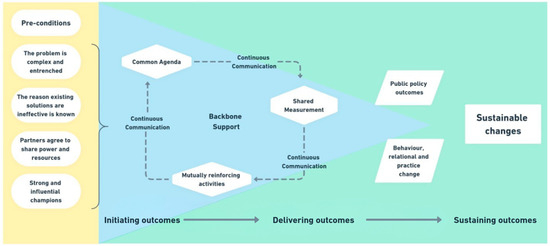
The CHRI model (Figure 1) requires four pre-conditions to be met: the problem is complex and entrenched, the reason that existing solutions are ineffective is known, partners agree to share power and resources, and strong and influential champions are present. The model emphasizes the collective rather than individuals or hierarchies, aligns with respectful engagement and decision-making with Indigenous Elders and communities, enabling significant and measurable improvement to complex health challenges [34]. Adapted from collective impact [35], the CHRI model incorporates five conditions for collective impact: common agenda, backbone support, continuous communication, shared measurement, and mutually reinforcing activities. These conditions support progression through three phases: initiating outcomes, delivering outcomes, and sustaining outcomes. The model ultimately aims to achieve sustainable changes through public policy outcomes and behavior, relational, and practice change [34].
Figure 1.
The CHRI model of co-design.
For the PrIDE tool development, the pre-conditions were established through recognition of the complex and entrenched nature of T2DM and CVD in Indigenous Australian communities, understanding the barriers to the existing interventions, an agreement to share power and resources through the CUP governance structure, and leadership from Indigenous investigators and community champions. The tool development phase focused on initiating outcomes through establishing a common agenda for culturally adapted and newly developed tools, providing backbone support through the CHRI infrastructure, maintaining continuous communication through yarning circles, implementing shared measurement through the Aboriginal and Torres Strait Islander Quality Appraisal Tool, and engaging in mutually reinforcing activities across the co-design team. The delivering and sustaining outcomes phases will occur during program implementation and evaluation.
The CHRI model recognizes community contributions in meaningful and significant ways, including opportunities to participate as co-authors on publications and creating local employment opportunities such as Indigenous research assistants [34].
2.3. Indigenous Research Methodologies
Yarning circles were used as the primary method for knowledge sharing and co-design. Yarning, an Indigenous research methodology, is a conversational method that involves storytelling and knowledge sharing, emphasizing the establishment of a level platform for knowledge exchange between all participants, recognizing each individual as expert in their own right, and promoting open sharing of experiences and ideas [36]. Between 3 and 5 yarning sessions were conducted for each tool. CUP yarning sessions were held in Bidjigal Country (Sydney, NSW, Australia) or online in 2025.
2.4. Ethical Approval
Ethics approval was obtained from the Aboriginal Health and Medical Research Council of NSW (AHMRC) (Approval #2479/25). The study was conducted in accordance with the National Health and Medical Research Council (NHMRC) guidelines for ethical research with Indigenous communities [37].
2.5. Tool Development Process
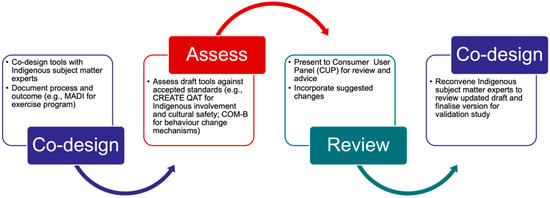
Four tools were developed using the CHRI co-design model in parallel: three culturally adapted tools (the PrIDE Exercise Program, the Strong Spirit Strong Self health self-efficacy assessment tool, and Keep Your Heart Strong educational materials) and one newly developed tool (Success Plan). Both the Strong Spirit Strong Self self-efficacy questionnaire and the Success Plan tool utilize clinical yarning as the delivery method. Clinical yarning is a culturally safe communication approach frequently used in health care, facilitating shared discussion between the research assistant or accredited exercise physiologist and the participant [36,38]. It progresses through interconnected phases: social yarning establishes rapport and trust, diagnostic yarning explores the topic through story-sharing, and management yarning facilitates collaborative planning [36,38]. This structured yet flexible approach is open-ended, story-based, and participant-led, creating space for self-expression and shared understanding. Clinical yarning is culturally centered; shows respect towards Indigenous Australians, privileging Indigenous ways of knowing and communicating; and allows these tools to function as collaborative conversations rather than formal assessments [36,38]. Each tool followed this cycle, with cultural adaptations documented using MADI [39] and all tools reviewed by the CUP for cultural safety and appropriateness. Tool development followed an iterative co-design, assessment, and review cycle, summarized in Figure 2.
Figure 2.
Iterative co-design, assessment, and review cycle used to develop and refine PrIDE tools.
2.6. PrIDE Exercise Program
The cultural adaptation of the Beat It program was led by an Indigenous accredited exercise physiologist (AEP) from the research team (author BBD), a Bundjalung/Gumbaynggirr (Mid-North Coast region of New South Wales) Indigenous Australian man, with Beat It Program content expertise. The cultural adaptation was systematically documented using the Model for Adaptation Design and Impact (MADI) framework [39], with BBD leading the adaptation process collaboratively with the CHRI co-design team. The completed MADI outlines the specific adaptations made across key program areas including AEP preparation, participant resources, assessment procedures, and program delivery methods. The PrIDE Exercise Program incorporates a combination of aerobic, resistance, balance, and flexibility training, with individualized progression prescribed and supervised by accredited exercise physiologists. Exercise prescription is consistent with contemporary clinical guidelines for adults with T2DM and national physical activity recommendations, including combined aerobic and resistance training and a reduction in sedentary behavior [9,40,41,42].
2.7. Strong Spirit Strong Self Health Self-Efficacy Assessment Tool
The 10-item New General Self-Efficacy (NGSE) scale [43] was culturally adapted for assessing health self-efficacy with Indigenous Australians managing T2DM. The adaptation was led by author KC, a Noongar researcher from the Whadjuk clan, in collaboration with author CT, a Whadjuk Noongar Elder. Yarning sessions were conducted with CT, a second Noongar Elder with deep community and cultural knowledge, and an Aboriginal health and community worker with frontline perspectives and expertise from the Champion Centre on Whadjuk/Noongar Country (Perth, WA, Australia).
Multiple yarning sessions allowed for reflection, clarification, and shared understanding to ensure the adapted tool was culturally grounded, practical, and aligned with community expectations and experiences. The adapted tool was renamed “Strong Spirit Strong Self” to reflect its cultural grounding and was subsequently reviewed by the CUP for cultural safety and appropriateness.
2.8. Keep Your Heart Strong Educational Materials
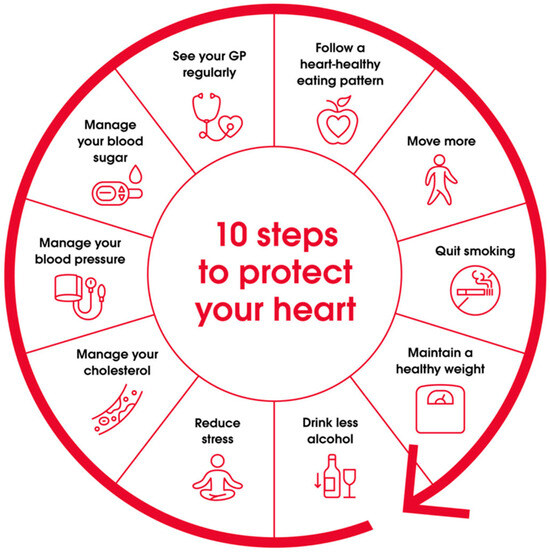
Heart health educational materials were culturally adapted from the National Heart Foundation’s “10 Steps to Protect Your Heart” resource. The National Heart Foundation is the peak body for heart disease prevention and support in Australia, working to improve heart health outcomes for all Australians through research, advocacy, public awareness campaigns, and accessible resources [44]. The Heart Foundation’s “10 Steps to Protect Your Heart” resource is available on their dedicated Indigenous Australians health webpage [45] (Figure 3 shows the original resource).
Figure 3.
The Australian National Heart Foundation “10 Steps to Protect Your Heart” resource for Indigenous Australians [45].
The adaptation was led by an Indigenous team member and AEP (author BBD), who reviewed the resource and identified opportunities to enhance accessibility by replacing clinical terminology with everyday language and streamlining content. Working collaboratively with the CHRI co-design team, culturally adapted educational materials were created in two formats: a brochure featuring Markeeta’s (Wemba Wemba) artwork “Paths You Take,” and an animation with voice-over narration by BBD.
2.9. The Success Plan
The Success Plan is a newly developed tool designed to facilitate exercise program selection and goal setting in a culturally safe manner. The tool was led and co-developed by an Indigenous AEP (author BBD) in collaboration with the co-design research team. The Success Plan comprises five sequential questions that guide participants through values identification, goal setting, preference assessment, strategy planning, and program selection. The tool reframes traditional pre-exercise questionnaires using simple, strengths-based language that considers the Indigenous Australian context while maintaining important clinical information. The tool was reviewed by the CUP, with feedback leading to refinements in language, tone, and framing, and the inclusion of Elders as role models within the tool to ensure relevance across age groups and cultural contexts.
2.10. Assessment of Cultural Appropriateness
All four tools were assessed using the Aboriginal and Torres Strait Islander Quality Appraisal Tool (CREATE) [46] to ensure that they met best practice standards for Indigenous health research. The 14-item CREATE tool assesses domains including community need and consultation, Indigenous leadership and governance, cultural protocols, intellectual property, research paradigm, a strengths-based approach, capacity strengthening, and reciprocal learning opportunities.
2.11. Behavior Change Mechanism Analysis
All four tools were analyzed using the COM-B model (Capability, Opportunity, Motivation—Behavior) [47,48,49] to map how tool features align with determinants of behavior change. The COM-B model, a component of the Behavior Change Wheel, posits that behavior occurs when individuals have the capability (physical and psychological), opportunity (social and physical), and motivation (reflective and automatic) to perform it [49]. Each tool component was mapped to the six COM-B domains to assess comprehensive coverage of behavior change mechanisms and to examine how cultural adaptation reconceptualizes these mechanisms in Indigenous contexts. The COM-B analysis presented below reflects an interpretive mapping of behavior change mechanisms as operationalized through co-design in PrIDE, rather than a claim of universal applicability or demonstrated effectiveness.
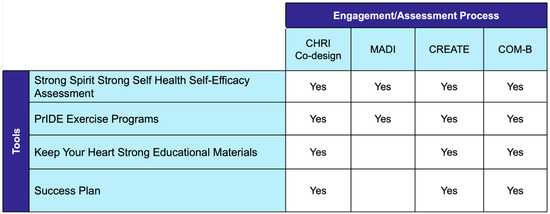
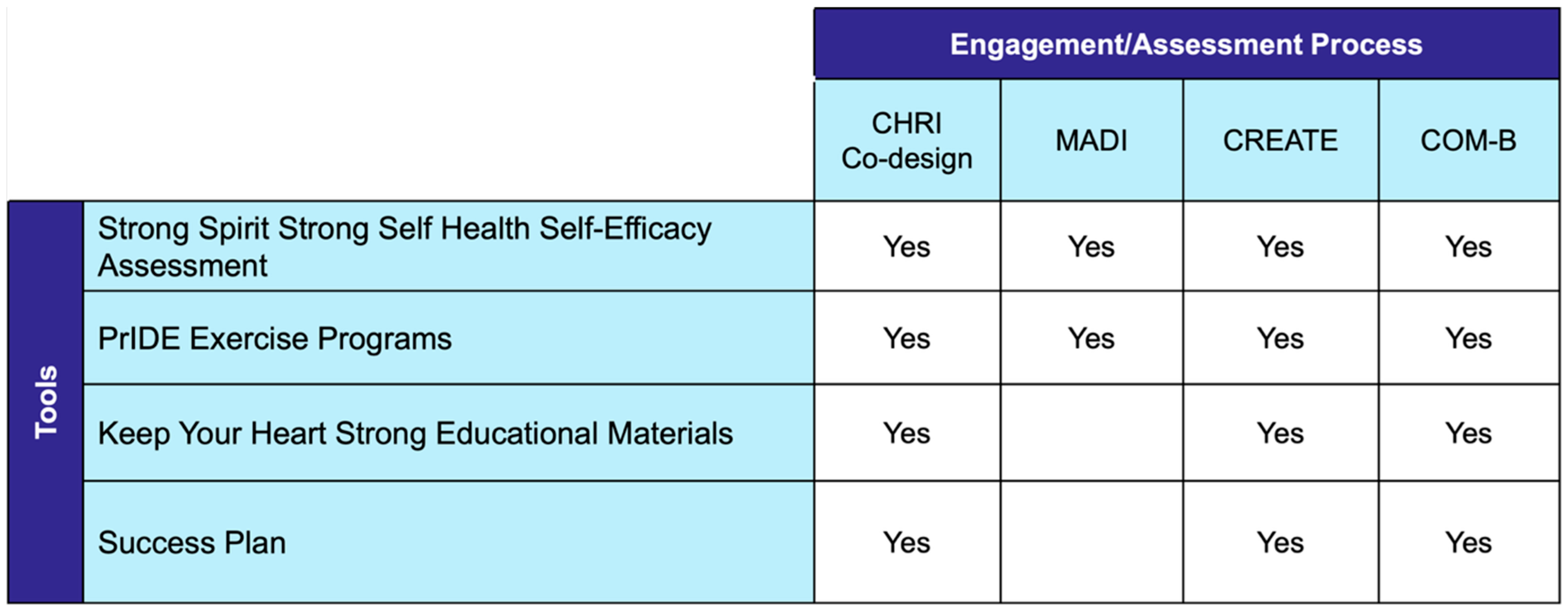
Figure 4 summarizes the engagement, adaptation, quality appraisal, and behavior change analysis processes applied to each tool.
Figure 4.
Overview of the engagement and assessment processes applied during PrIDE tool development, indicating which tools underwent co-design, adaptation documentation using the Model for Adaptation Design and Impact (MADI), quality appraisal using the CREATE Quality Appraisal Tool for Indigenous health research, and behavior change analysis using the Capability, Opportunity, Motivation–Behavior (COM-B) model.
2.12. Data Management
Tool development processes were documented following principles of Indigenous data sovereignty, with community ownership of knowledge ensuring research outcomes were meaningful and culturally relevant to Indigenous Australian communities and researchers [37].
This paper reports the co-design and development phase only; evaluation of effectiveness, acceptability, and psychometric properties will be undertaken and reported following the implementation of the PrIDE study.
3. Results
3.1. Overview of Tools Developed
Four tools were successfully developed through the co-design process: three culturally adapted tools (the PrIDE Exercise Program, the Strong Spirit Strong Self health self-efficacy assessment tool, and Keep Your Heart Strong educational materials), and one newly developed tool (Success Plan).
3.2. Cultural Appropriateness Assessment
All tools met requirements across key domains of the Aboriginal and Torres Strait Islander Quality Appraisal Tool. Items related to intellectual property agreements and translation to policy/practice and community benefit were marked as “not applicable” as these tools are in the design phase and have not yet been implemented in community settings. Full results are presented in Table 1.
Table 1.
Aboriginal and Torres Strait Islander Quality Appraisal Tool (CREATE) assessment results for PrIDE Tools.
3.3. PrIDE Exercise Program Adaptations
The cultural adaptation of the Beat It program preserved core evidence-based mechanisms while enhancing cultural safety, participant engagement, and program accessibility. Adaptations were systematically documented across nine key areas using the MADI framework. The full documentation is presented in Table 2.
Table 2.
Model for Adaptation Design and Impact (MADI)—initial cultural adaptation of Beat It program.
3.4. Strong Spirit Strong Self Health Self-Efficacy Tool
The cultural adaptation of the NGSE scale preserved core self-efficacy theory while integrating cultural enhancements that reflect Indigenous worldviews and ways of being. The adaptation maintained the 10-item structure to allow for equivalent comprehensiveness and direct comparison with the original tool. Response-scale language was adapted from formal academic terms to everyday language to increase clarity and accessibility. The administration method was adapted from self-administered questionnaire to conversational administration by the research assistant using clinical yarning [36,38].
Content validity was established through yarning with Elders and the community in Nyoongar Country (Perth, WA, Australia). Face validity was established through the co-design process and CUP review. Psychometric validation will be conducted through the PrIDE study, assessing internal consistency reliability, sensitivity to change, convergent validity, known-groups validity, and exploratory factor analysis to examine dimensionality. The full MADI documentation is presented in Table 3.
Table 3.
Model for Adaptation Design and Impact (MADI)—Strong Spirit Strong Self (self-efficacy assessment tool).
3.5. Keep Your Heart Strong Educational Materials
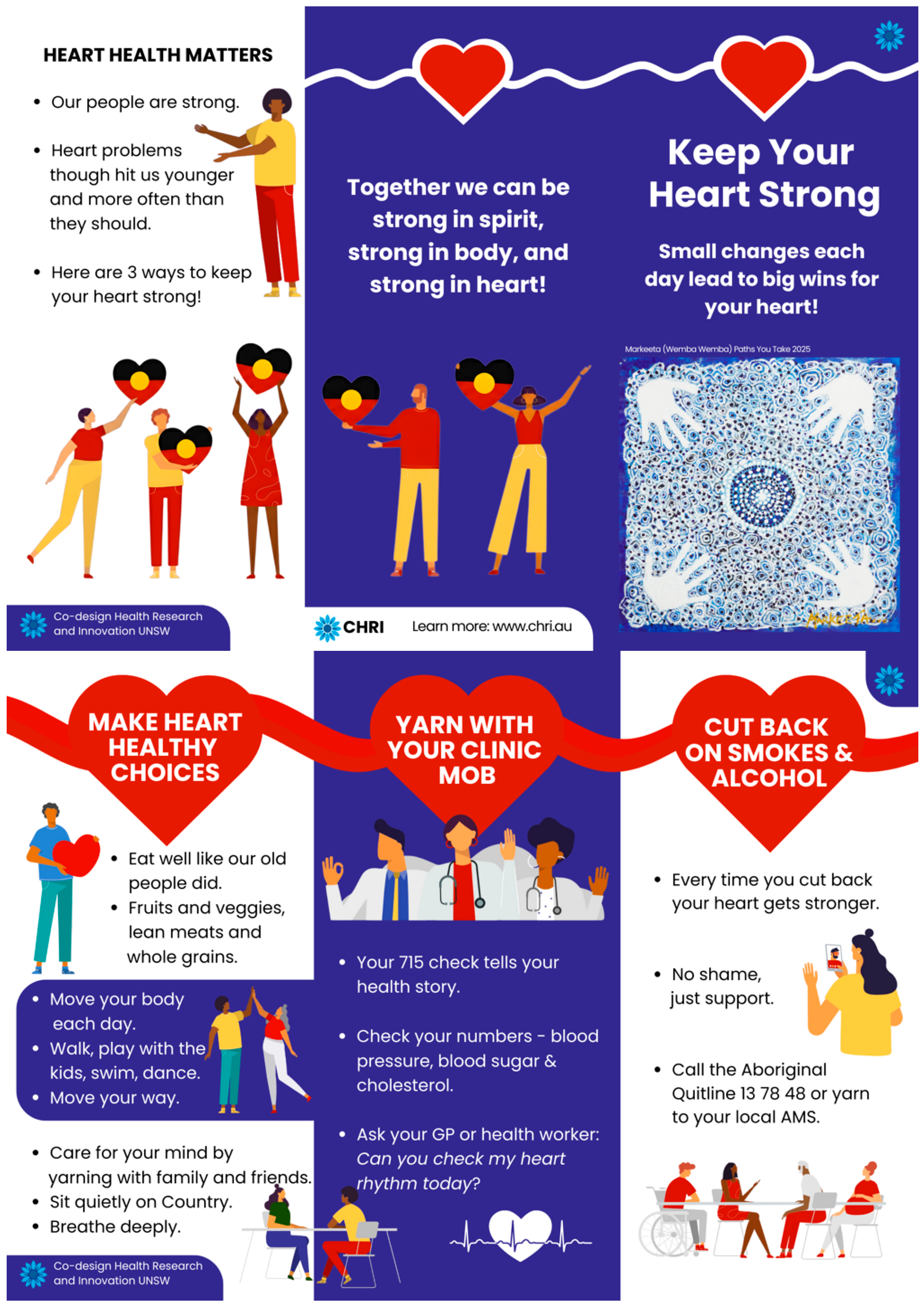
Heart health educational materials were culturally adapted from the National Heart Foundation’s evidence-based “10 Steps to Protect Your Heart” resource (Figure 3). The adaptation enhanced accessibility by streamlining ten steps to three essential messages delivered through strengths-based framing: (1) make heart-healthy choices, (2) yarn with your clinic mob, and (3) cut back on smokes and alcohol. For the first two messages, framing statements are directly supported by specific, actionable examples provided within the materials to ensure clarity and practical relevance. The adaptation replaced clinical terminology (e.g., “manage your cholesterol”) with everyday language and actionable guidance that resonates with community ways of communicating about health.
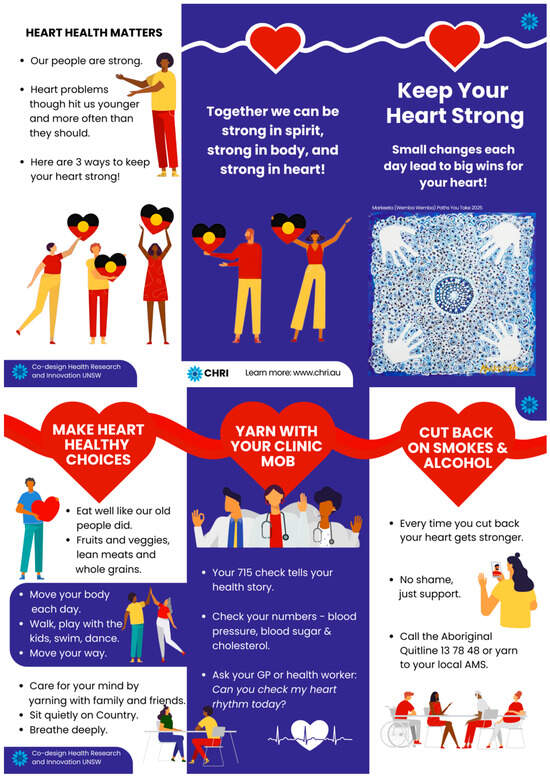
The Keep Your Heart Strong brochure and animation feature Markeeta’s artwork “Paths You Take” and include voice-over narration by BBD. CUP feedback was highly positive, with members highlighting the culturally appropriate color palette, integration of Indigenous artwork and visual elements, simplicity of messaging, and use of accessible language. The brochure (Figure 5) will be distributed at program registration and the animation shared on the study’s social media platform.
Figure 5.
Keep Your Heart Strong three-fold brochure, co-designed for the PrIDE study featuring licensed artwork “Paths You Take” by Markeeta (Wemba Wemba).
3.6. The Success Plan
The Success Plan integrates multiple theoretical frameworks to support culturally safe, participant-centered decision-making. The tool comprises five sequential questions delivered through clinical yarning. The theoretical rationale for each tool component is presented in Table 4.
Table 4.
PrIDE Success Plan—theoretical rationale.
3.7. Behavior Change Mechanisms: COM-B Analysis
COM-B analysis identified how tool features align with behavior change domains. The PrIDE Exercise Program maps to all six components through its comprehensive adaptations. Strong Spirit Strong Self corresponds to psychological capability and reflective motivation through culturally appropriate assessment that reconceptualizes the capability to include collective, cultural, and spiritual dimensions. Keep Your Heart Strong educational materials align with psychological capability through accessible health information, social and physical opportunity through multiple distribution channels and social connection framing, and both reflective and automatic motivation through strengths-based messaging and culturally resonant visual elements. The Success Plan integrates features that map across all components through a process that corresponds to psychological capability for planning, opportunity assessment through constraint identification and strategy planning, and reflective and automatic motivation. The complete COM-B mapping for all four PrIDE tools is presented in Supplementary Table S1.
3.8. CUP Feedback and Iterative Refinement
The CUP provided substantive feedback across all four tools, resulting in 1–3 rounds of revision for each tool. Primary improvements included adjustments to language, tone, and framing to ensure accessibility, cultural appropriateness, and respectful communication across age groups and literacy levels. For example, a CUP review of the Success Plan led to the addition of “Be a role-model for my community” as a program goal option; the removal of “I will” prefixes from barrier-planning options, as CUP members identified this phrasing as pressuring rather than supportive; and the substitution of “family” with “mob” to better reflect community language and collective responsibility. Elder perspectives were integrated throughout tools to reflect intergenerational knowledge and support structures. The CUP provided guidance on integration of licensed artwork throughout materials and refinement of delivery methods to ensure cultural safety and participant comfort.
4. Discussion
4.1. Principal Findings
This study developed four tools for the Preventing Indigenous CVD and Diabetes through Exercise (PrIDE) study [33] using co-design following best practice frameworks: three culturally adapted tools (the PrIDE Exercise Program from Beat It, the Strong Spirit Strong Self from NGSE, the Keep Your Heart Strong from Heart Foundation resources) and one newly developed tool (the Success Plan). All tools met Indigenous health research quality standards via the Aboriginal and Torres Strait Islander Quality Appraisal Tool [46], were governed through Indigenous leadership structures (CAG and CUP), and utilized Indigenous research methodologies, primarily yarning [36].
Indigenous leadership throughout the development process ensured that cultural knowledges and Indigenous epistemologies shaped tool design from inception rather than through consultation. This approach aligns with emerging diabetes co-design initiatives in Australia that privilege Indigenous governance and lived experience [30,31], and extends them by embedding structured adaptation and theory mapping within an exercise intervention context.
MADI documentation provides transparent, prospective recording of adaptation decisions while preserving core evidence-based mechanisms and enhancing cultural safety, addressing a gap where cultural adaptations are often reported superficially, limiting replication. COM-B analysis revealed how co-design reconceptualized the operationalization of behavior change mechanisms: psychological capability was conceptualized to include collective, cultural, and spiritual dimensions; social opportunity was understood as requiring deliberate creation through Indigenous leadership and trusted relationships; and motivation was operationalized holistically and relationally. The evaluation of effectiveness, acceptability, and scalability will be reported following PrIDE implementation.
4.2. Comparison with Prior Work
The published evidence on culturally adapted exercise interventions for Indigenous Australians with T2DM remains limited [15]. Previous reviews have noted not only the paucity of Indigenous exercise interventions, but also the limited reporting of development processes and Indigenous governance, constraining reproducibility and translation to other communities [18]. International evidence is sparse; one supervised community-based group exercise intervention with Indigenous Polynesian adults demonstrated improvements in quality of life and cardiometabolic outcomes [16,17]. However, this evidence focused primarily on outcome evaluation and provided limited detail on program development processes, governance structures, or systematic cultural adaptation approaches, constraining reproducibility and transferability to other Indigenous populations. PrIDE extends this evidence base by pairing an established, evidence-based exercise program with Indigenous governance and explicitly documenting cultural adaptation using structured frameworks, responding to calls for greater transparency, Indigenous leadership, and methodological rigor in co-designed health interventions [34]. While specific cultural adaptations are necessarily locally determined, the process framework—combining Indigenous-governed co-design (CHRI model), structured adaptation documentation (MADI), quality appraisal (CREATE), and theory mapping (COM-B)—is transferable to exercise intervention development with Indigenous peoples in other high-income colonized countries. Critically, this study positions cultural adaptation processes and theory-informed design decisions as primary objects of inquiry rather than implicit background activity.
4.3. Tool-Specific Contributions
Strong Spirit Strong Self addresses a recognized gap in Indigenous health research regarding culturally appropriate measurement. Western self-efficacy instruments privilege individualistic constructs that may be misaligned with Indigenous worldviews [7,66]. While Bandura [67] acknowledged that efficacy beliefs operate through both personal and collective agency, standard self-efficacy questionnaires typically operationalize the construct within individualistic frameworks. Yet self-efficacy—belief in one’s capability to take action—is strengthened, supported, and sustained through relationships and social context for all people [68]. For Indigenous Australians, this relational foundation is particularly salient, with family, Elders, community, and culture recognized as essential sources of strength that lift and sustain the individual [7]. Strong Spirit Strong Self preserves the theoretical core of self-efficacy while reconceptualizing its sources to include family, Elders, culture, spirit, and community, reflecting relational and collective dimensions of capability.
The Success Plan demonstrates how traditional intake processes can be reframed through strengths-based language and clinical yarning for culturally safe decision-making while maintaining clinical utility. By positioning barrier navigation as proactive coping drawing on collective resources, it integrates behavioral theory with Indigenous relational values.
Keep Your Heart Strong illustrates that even resources targeting Indigenous audiences benefit from Indigenous-led adaptation. Indigenous review identified barriers in clinical language, framing, and information density. Streamlining content and reframing through strengths-based language enhanced the accessibility while maintaining evidence-based content.
4.4. Co-Design and Behavior Change Mechanisms
COM-B analysis revealed how co-design reshaped the operationalization and interpretation of behavior change mechanisms. Psychological capability was conceptualized to include collective efficacy, cultural knowledge, and spiritual strength, positioning family, Elders, and community as intrinsic capability resources rather than external supports—challenging individualistic assumptions in Western self-efficacy models [7,66].
Social opportunity was conceptualized as a prerequisite for engagement rather than optional enhancement. Historical trauma, ongoing racism, and institutional mistrust necessitate deliberate creation of social opportunity through Indigenous leadership, culturally congruent communication, and trusted intermediaries [34]. Analysis revealed that PrIDE incorporated features mapping to social opportunity through governance structures, recruitment strategies, and delivery approaches.
Motivation was conceptualized holistically and relationally, with goals anchored in family and community responsibilities rather than solely individual outcomes, extending autonomy-focused theories to include culturally congruent autonomy grounded in interdependence [51]. COM-B mapping identified that Keep Your Heart Strong’s integration of Indigenous artwork, voice-over, and relational framing (“yarn with your clinic mob”) aligns with automatic motivation through cultural resonance while streamlined content corresponds to psychological capability.
These findings demonstrate how co-design informs application of established behavior change frameworks in culturally congruent ways, advancing the understanding of theory operationalization in Indigenous health contexts.
4.5. Strengths and Limitations
A key strength of this work is the use of structured co-design and adaptation frameworks alongside Indigenous governance and research methodologies. The integration of the CHRI model, MADI framework, and Aboriginal and Torres Strait Islander Quality Appraisal Tool provided methodological rigor while centering Indigenous leadership and accountability.
Several limitations should be noted. Psychometric validation of Strong Spirit Strong Self is pending and will be conducted during PrIDE implementation. Tool effectiveness and acceptability have not yet been evaluated and will be reported separately. Tool development occurred with specific communities and may not generalize across the diversity of Indigenous Australian nations, languages, and cultural practices; further adaptation may be required in new contexts.
4.6. Implications for Practice and Research
Health services can use PrIDE as a model for implementing exercise interventions for Indigenous Australians with T2DM, with MADI documentation providing detailed adaptation guidance. Strong Spirit Strong Self provides a culturally appropriate self-efficacy instrument for Indigenous populations; researchers should prioritize culturally adapted outcome measures over standard Western instruments. The Success Plan demonstrates clinical yarning integration into routine practice for culturally safe assessment and shared decision-making, applicable beyond exercise interventions. Keep Your Heart Strong demonstrates value in review of existing resources to enhance accessibility. Sustainability has been considered within the design of the PrIDE tools through alignment with routine accredited exercise physiologist practice and existing service workflows, supporting ongoing use beyond the research phase.
For researchers, this body of work demonstrates feasibility of systematic cultural adaptation using established frameworks. The CHRI model and MADI framework combination provides methodological rigor while centering Indigenous knowledge, leadership, and community control. Indigenous-governed work ensures cultural authenticity unachievable through consultation-based approaches. Future research should prioritize Indigenous leadership in systematic adaptations for chronic disease prevention and management interventions.
Implementation in remote and rural communities will provide evidence on effectiveness, acceptability, and scalability. Evaluation will examine improvements in cardiovascular risk factors, physical fitness, and self-efficacy, and whether improvements are sustained. Process evaluation will identify implementation facilitators and barriers, informing scale-up planning and policy.
5. Conclusions
This research demonstrates systematic adaptation and development of tools for Indigenous health through Indigenous-governed co-design processes honoring Indigenous knowledge systems while maintaining evidence-based mechanisms. The three culturally adapted tools and newly developed Success Plan address evidence gaps in interventions with Indigenous Australians. MADI documentation and theoretical rationale provide a model for future cultural adaptation and development of research. PrIDE study implementation will provide evidence on effectiveness, acceptability, and scalability to inform practice, policy, and research aimed at improving health equity with Indigenous Australians.
Supplementary Materials
The following supporting information can be downloaded at https://www.mdpi.com/article/10.3390/ijerph23020252/s1, Table S1: COM-B Analysis: How PrIDE Tools Address Behavior Change Mechanisms.
Author Contributions
Conceptualization, K.G., C.H. and M.K.; methodology, K.G., C.H., M.K., B.B.-D., K.C. and C.T.; validation, K.G., C.H., M.K., B.B.-D., K.C. and C.T.; formal analysis, K.G., C.H., M.K., B.B.-D., K.C. and C.T.; investigation, K.G., C.H., M.K., B.B.-D., K.C. and C.T.; resources, K.G., C.H. and M.K.; writing—original draft preparation, M.K.; writing—review and editing, K.G., C.H., M.K., B.B.-D., K.C., C.T., N.C. and D.M.; visualization, K.G., C.H., M.K. and B.B.-D.; supervision, K.G., C.H. and M.K.; project administration, M.K.; funding acquisition, K.G. and C.H. All authors have read and agreed to the published version of the manuscript.
Funding
This research has been funded by the Australian Medical Research Future Fund, Preventative and Public Health Research Initiative 2023 Targeted Translation Research Accelerator, Cardiovascular Disease and Diabetes Mechanisms Grant Opportunity (MRFCDDM000030).
Institutional Review Board Statement
Ethical approval for the PrIDE study has been obtained from the Aboriginal Health and Medical Research Council of NSW (AHMRC) approval number: 2479/25, 28 November 2025. The study will be conducted in accordance with the Declaration of Helsinki and the National Health and Medical Research Council (NHMRC) guidelines for ethical research with Indigenous communities.
Informed Consent Statement
This methods paper describes the co-design and development phase of intervention tools only. No participant data collection or implementation occurred during this phase. The study involved consultation with Indigenous community members, Elders, and the Consumer User Panel (CUP) as co-designers and governance partners rather than research participants. Informed consent for participation in governance and co-design activities was obtained verbally in accordance with Indigenous research methodologies and cultural protocols. Evaluation of effectiveness, acceptability, and psychometric properties will be undertaken and reported following implementation of the PrIDE study, at which point written informed consent will be obtained from all participants.
Data Availability Statement
All data generated during this methods paper are included in this article. Qualitative data from co-design yarning sessions are not publicly available due to Indigenous data sovereignty principles and participant privacy protections.
Acknowledgments
The authors respectfully acknowledge the Traditional Custodians of the unceded lands we are privileged to work upon. We honor the Elders of these Nations past and present, and acknowledge their ongoing connection to culture, community, and Country. We thank the Consumer Advisory Group and Consumer User Panel members for their guidance throughout the research design process, and the Aboriginal Community-Controlled Health Organizations and community members who partnered with us in developing this methods paper. We also thank Hiram Brooke for his input on the Success Plan.
Conflicts of Interest
The authors declare no conflicts of interest.
Abbreviations
The following abbreviations are used in this manuscript:
| AEP | Accredited exercise physiologist |
| ACCHO | Aboriginal Community-Controlled Health Organization |
| AHMRC | Aboriginal Health and Medical Research Council |
| AMS | Aboriginal Medical Service |
| CAG | Consumer Advisory Group |
| CHRI | Co-design Health Research and Innovation |
| COM-B | Capability, Opportunity, Motivation—Behavior (model) |
| CREATE | Aboriginal and Torres Strait Islander Quality Appraisal Tool |
| CUP | Consumer User Panel |
| CVD | Cardiovascular disease |
| MADI | Model for Adaptation Design and Impact |
| NGSE | New General Self-Efficacy (scale) |
| NHMRC | National Health and Medical Research Council |
| NSW | New South Wales |
| PrIDE | Preventing Indigenous Cardiovascular Disease and Diabetes through Exercise |
| RA | Research assistant |
| SDT | Self-Determination Theory |
| T2DM | Type 2 diabetes mellitus |
| TGA | Therapeutic Goods Administration |
| UDL | Universal Design for Learning |
References
- Brown, A.; Carrington, M.J.; McGrady, M.; Lee, G.; Zeitz, C.; Krum, H.; Rowley, K.; Stewart, S. Cardiometabolic Risk and Disease in Indigenous Australians: The Heart of the Heart Study. Int. J. Cardiol. 2014, 171, 377–383. [Google Scholar] [CrossRef] [Scilit]
- Australian Institute of Health and Welfare. Aboriginal and Torres Strait Islander Health Performance Framework—Summary Report; Leading Causes of Mortality; Australian Institute of Health and Welfare: Canberra, Australia, 2024.
- Australian Institute of Health and Welfare. Australian Burden of Disease Study: Impact and Causes of Illness and Death in Aboriginal and Torres Strait Islander People 2018; Australian Burden of Disease Study Series No. 26; Australian Institute of Health and Welfare: Canberra, Australia, 2022.
- Australian Institute of Health and Welfare. Rural and Remote Health. Available online: https://www.aihw.gov.au/reports/rural-remote-australians/rural-and-remote-health (accessed on 20 May 2025).
- Brown, A.; Kritharides, L. Overcoming Cardiovascular Disease in Indigenous Australians. Med. J. Aust. 2017, 206, 10–12. [Google Scholar] [CrossRef] [Scilit]
- Bainbridge, R.; McCalman, J.; Clifford, A.; Tsey, K. Cultural Competency in the Delivery of Health Services for Indigenous People; Australian Institute of Family Studies; Australian Institute of Health and Welfare: Canberra, Australia, 2015; ISBN 978-1-74249-766-2.
- Dudgeon, P.; Harris, J.; Newnham, K.; Brideson, T.; Cranney, J.; Darlaston-Jones, D.; Hammond, S.W.; Herbert, H.; Homewood, J.; Page, S.; et al. Working Together: Aboriginal and Torres Strait Islander Mental Health and Wellbeing Principles and Practice, 2nd ed.; Dudgeon, P., Milroy, H., Walker, R., Eds.; Kulunga Research Network: West Perth, WA, USA, 2014; ISBN 978-0-9579494-4-7. [Google Scholar]
- De Zilva, S.; Walker, T.; Palermo, C.; Brimblecombe, J. Culturally Safe Health Care Practice for Indigenous Peoples in Australia: A Systematic Meta-Ethnographic Review. J. Health Serv. Res. Policy 2022, 27, 74–84. [Google Scholar] [CrossRef] [Scilit]
- American Diabetes Association Professional Practice Committee. Introduction and Methodology: Standards of Care in Diabetes—2024. Diabetes Care 2024, 47, S1–S4. [Google Scholar] [CrossRef] [Scilit]
- Umpierre, D.; Ribeiro, P.A.B.; Kramer, C.K.; Leitão, C.B.; Zucatti, A.T.N.; Azevedo, M.J.; Gross, J.L.; Ribeiro, J.P.; Schaan, B.D. Physical Activity Advice Only or Structured Exercise Training and Association With HbA1c Levels in Type 2 Diabetes: A Systematic Review and Meta-Analysis. JAMA 2011, 305, 1790. [Google Scholar] [CrossRef] [Scilit] [PubMed]
- White, L.; Kirwan, M.; Christie, V.; Hurst, L.; Gwynne, K. The Effectiveness of Clinician-Led Community-Based Group Exercise Interventions on Health Outcomes in Adults with Type 2 Diabetes Mellitus: A Systematic Review and Meta-Analysis. Int. J. Environ. Res. Public Health 2024, 21, 601. [Google Scholar] [CrossRef] [Scilit] [PubMed]
- Gracey, M.; King, M. Indigenous Health Part 1: Determinants and Disease Patterns. Lancet 2009, 374, 65–75. [Google Scholar] [CrossRef] [Scilit]
- Marmot, M.; Friel, S.; Bell, R.; Houweling, T.A.; Taylor, S.; on behalf of the Commission on Social Determinants of Health. Closing the Gap in a Generation: Health Equity through Action on the Social Determinants of Health. Lancet 2008, 372, 1661–1669. [Google Scholar] [CrossRef] [Scilit] [PubMed]
- Vincze, L.; Barnes, K.; Somerville, M.; Littlewood, R.; Atkins, H.; Rogany, A.; Williams, L.T. Cultural Adaptation of Health Interventions Including a Nutrition Component in Indigenous Peoples: A Systematic Scoping Review. Int. J. Equity Health 2021, 20, 125. [Google Scholar] [CrossRef] [Scilit] [PubMed]
- Hurst, L.; Kirwan, M.; Christie, V.; Cross, C.; Baylis, S.; White, L.; Gwynne, K. The Effect of Community-Based Exercise on Health Outcomes for Indigenous Peoples with Type 2 Diabetes: A Systematic Review. Int. J. Environ. Res. Public Health 2024, 21, 290. [Google Scholar] [CrossRef] [Scilit]
- Sukala, W.R.; Page, R.; Lonsdale, C.; Lys, I.; Rowlands, D.; Krebs, J.; Leikis, M.; Cheema, B.S. Exercise Improves Quality of Life in Indigenous Polynesian Peoples With Type 2 Diabetes and Visceral Obesity. J. Phys. Act. Health 2013, 10, 699–707. [Google Scholar] [CrossRef] [Scilit]
- Sukala, W.R.; Page, R.; Rowlands, D.S.; Krebs, J.; Lys, I.; Leikis, M.; Pearce, J.; Cheema, B.S. South Pacific Islanders Resist Type 2 Diabetes: Comparison of Aerobic and Resistance Training. Eur. J. Appl. Physiol. 2012, 112, 317–325. [Google Scholar] [CrossRef] [Scilit]
- Meharg, D.P.; Gwynne, K.; Gilroy, J.; Alison, J.A. Exercise-Based Interventions for Indigenous Adults with Chronic Lung Disease in Australia, Canada, New Zealand, and USA: A Systematic Review. J. Thorac. Dis. 2020, 12, 7442–7453. [Google Scholar] [CrossRef] [Scilit]
- Kelly, R. Too Deadly For Diabetes. Available online: https://toodeadlyfordiabetes.com.au/ (accessed on 20 November 2025).
- Australian Indigenous HealthInfoNet. Physical Activity—Programs. Available online: https://healthinfonet.ecu.edu.au/learn/determinants-of-health/health-behaviours/physical-activity/programs-and-projects/ (accessed on 20 November 2025).
- Gidgup, M.J.R.; Kickett, M.; Hill, K.D.; Francis-Coad, J.; Weselman, T.; Coombes, J.; Ivers, R.; Bowser, N.; Palacios, V.; Hill, A. Connecting and Reconnecting to a Community, with a Sense of Belonging—Exploring Aboriginal Elders’ Perspectives of Engaging in a Physical Activity Program. Health Promot. J. Aust. 2022, 33, 138–149. [Google Scholar] [CrossRef] [Scilit]
- Lukaszyk, C.; Coombes, J.; Sherrington, C.; Tiedemann, A.; Keay, L.; Mackean, T.; Clemson, L.; Cumming, R.; Broe, T.; Ivers, R. The Ironbark Program: Implementation and Impact of a Community-based Fall Prevention Pilot Program for Older Aboriginal and Torres Strait Islander People. Health Promot. J. Aust. 2018, 29, 189–198. [Google Scholar] [CrossRef] [Scilit]
- Ivers, R.; Coombes, J.; Sherrington, C.; Mackean, T.; Tiedemann, A.; Hill, A.-M.; Keay, L.; Clemson, L.; Simpson, J.; Ryder, C.; et al. Healthy Ageing among Older Aboriginal People: The Ironbark Study Protocol for a Cluster Randomised Controlled Trial. Inj. Prev. 2020, 26, 581–587. [Google Scholar] [CrossRef] [Scilit]
- Kirwan, M.; Chiu, C.L.; Hay, M.; Laing, T. Community-Based Exercise and Lifestyle Program Improves Health Outcomes in Older Adults with Type 2 Diabetes. Int. J. Environ. Res. Public Health 2021, 18, 6147. [Google Scholar] [CrossRef] [Scilit]
- Kirwan, M.; Gwynne, K.; Laing, T.; Hay, M.; Chowdhury, N.; Chiu, C.L. Can Health Improvements from a Community-Based Exercise and Lifestyle Program for Older Adults with Type 2 Diabetes Be Maintained? A Follow up Study. Diabetology 2022, 3, 348–354. [Google Scholar] [CrossRef] [Scilit]
- Kirwan, M.; Chiu, C.L.; Laing, T.; Chowdhury, N.; Gwynne, K. A Web-Delivered, Clinician-Led Group Exercise Intervention for Older Adults With Type 2 Diabetes: Single-Arm Pre-Post Intervention. J. Med. Internet Res. 2022, 24, e39800. [Google Scholar] [CrossRef] [Scilit] [PubMed]
- Kirwan, M.; Chiu, C.L.; Fermanis, J.; Allison, K.; Laing, T.; Gwynne, K. Culturally Adapted, Clinician-Led, Bilingual Group Exercise Program for Older Migrant Adults: Single-Arm Pre–Post-Intervention. Int. J. Environ. Res. Public Health 2025, 22, 888. [Google Scholar] [CrossRef] [Scilit] [PubMed]
- Kirwan, M.; Chiu, C.L.; Henson, C.; Laing, T.; Fermanis, J.; Scott, L.; Janszen, J.; Gwynne, K. Empowering Through Group Exercise: Beat It Trainers’ Views on Successful Implementation of a Diabetes Management Program Online and In-Person. Diabetology 2024, 5, 667–676. [Google Scholar] [CrossRef] [Scilit]
- Lowitja Institute. Co-Design Versus Faux-Design of Aboriginal and Torres Strait Islander Health Policy: A Critical Review; Lowitja Institute: Collingwood, Australia, 2025. [Google Scholar]
- Kirkham, R.; Puszka, S.; Titmuss, A.; Freeman, N.; Weaver, E.; Morris, J.; Mack, S.; O’Donnell, V.; Boffa, J.; Dowler, J.; et al. Codesigning Enhanced Models of Care for Northern Australian Aboriginal and Torres Strait Islander Youth with Type 2 Diabetes: Study Protocol. BMJ Open 2024, 14, e080328. [Google Scholar] [CrossRef] [Scilit] [PubMed]
- Cameron, D.; Wilson, A.; Mendham, A.E.; Wingard, S.; Kropinyeri, R.; Scriven, T.; Kerrigan, C.; Spaeth, B.; Stranks, S.; Kaambwa, B.; et al. Knowledge Interface Co-Design of a Diabetes and Metabolic Syndrome Initiative with and for Aboriginal People Living on Ngarrindjeri Country. Public Health Pract. 2024, 7, 100496. [Google Scholar] [CrossRef] [Scilit]
- Ni Mhurchu, C.; Te Morenga, L.; Tupai-Firestone, R.; Grey, J.; Jiang, Y.; Jull, A.; Whittaker, R.; Dobson, R.; Dalhousie, S.; Funaki, T.; et al. A Co-Designed mHealth Programme to Support Healthy Lifestyles in Māori and Pasifika Peoples in New Zealand (OL@-OR@): A Cluster-Randomised Controlled Trial. Lancet Digit. Health 2019, 1, e298–e307. [Google Scholar] [CrossRef] [Scilit]
- Kirwan, M.; Henson, C.; Bancroft-Duroux, B.; Meharg, D.; Christie, V.; Capes-Davis, A.; Boney, S.; Tully, B.; McCowen, D.; Ward, K.; et al. Preventing Indigenous Cardiovascular Disease and Diabetes through Exercise (PrIDE) Study Protocol: A Co-Designed Wearable-Based Exercise Intervention with Indigenous Peoples in Australia. Diabetology 2026, 7, 9. [Google Scholar] [CrossRef] [Scilit]
- Gwynne, K.; Rambaldini, B.; Christie, V.; Meharg, D.; Gwynn, J.; Dimitropoulos, Y.; Parter, C.; Skinner, J. Applying Collective Impact in Aboriginal Health Services and Research: Three Case Studies Tell an Important Story. Public Health Res. Pract. 2022, 32, 3222215. [Google Scholar] [CrossRef] [Scilit]
- Kania, J.; Kramer, M.; Juster, J.; Ide, S. Collective Impact. In International Encyclopedia of Civil Society; List, R.A., Anheier, H.K., Toepler, S., Eds.; Springer Nature: Cham, Switzerland, 2022; pp. 1–8. ISBN 978-3-319-99675-2. [Google Scholar]
- Bessarab, D.; Ng’andu, B. Yarning About Yarning as a Legitimate Method in Indigenous Research. Int. J. Crit. Indig. Stud. 2010, 3, 37–50. [Google Scholar] [CrossRef] [Scilit]
- National Health and Medical Research Council. Ethical Guidelines for Research with Aboriginal and Torres Strait Islander Peoples. Available online: https://www.nhmrc.gov.au/research-policy/ethics/ethical-guidelines-research-aboriginal-and-torres-strait-islander-peoples (accessed on 22 May 2025).
- Lin, I.; Green, C.; Bessarab, D. ‘Yarn with Me’: Applying Clinical Yarning to Improve Clinician–Patient Communication in Aboriginal Health Care. Aust. J. Prim. Health 2016, 22, 377–382. [Google Scholar] [CrossRef] [Scilit] [PubMed]
- Kirk, M.A.; Moore, J.E.; Wiltsey Stirman, S.; Birken, S.A. Towards a Comprehensive Model for Understanding Adaptations’ Impact: The Model for Adaptation Design and Impact (MADI). Implement. Sci. 2020, 15, 56. [Google Scholar] [CrossRef] [Scilit]
- Australian Government; Department of Health, Disability and Ageing. Collection of Physical Activity and Sedentary Behaviour Guidelines for All Ages. Available online: https://www.health.gov.au/resources/collections/collection-of-physical-activity-and-sedentary-behaviour-guidelines-for-all-ages (accessed on 20 November 2025).
- Liguori, G.; American College of Sports Medicine. ACSM’s Guidelines for Exercise Testing and Prescription, 11th ed.; American College of Sports Medicine, Liguori, G., Feito, Y., Fountaine, C.J., Roy, B., Eds.; Wolters Kluwer: Alphen aan den Rijn, The Netherlands, 2022; ISBN 978-1-9751-5018-1. [Google Scholar]
- Colberg, S.R.; Sigal, R.J.; Yardley, J.E.; Riddell, M.C.; Dunstan, D.W.; Dempsey, P.C.; Horton, E.S.; Castorino, K.; Tate, D.F. Physical Activity/Exercise and Diabetes: A Position Statement of the American Diabetes Association. Diabetes Care 2016, 39, 2065–2079. [Google Scholar] [CrossRef] [Scilit] [PubMed]
- Chen, G.; Gully, S.M.; Eden, D. Validation of a New General Self-Efficacy Scale. Organ. Res. Methods 2001, 4, 62–83. [Google Scholar] [CrossRef] [Scilit]
- The Heart Foundation. Together, We Can Make Heart Disease History. Available online: https://www.heartfoundation.org.au/ (accessed on 20 November 2025).
- The Heart Foundation. Looking After Your Heart. Available online: https://www.heartfoundation.org.au/your-heart/aboriginal-health-risk-of-heart-disease (accessed on 20 November 2025).
- Harfield, S.; Pearson, O.; Morey, K.; Kite, E.; Canuto, K.; Glover, K.; Gomersall, J.S.; Carter, D.; Davy, C.; Aromataris, E.; et al. Assessing the Quality of Health Research from an Indigenous Perspective: The Aboriginal and Torres Strait Islander Quality Appraisal Tool. BMC Med. Res. Methodol. 2020, 20, 79. [Google Scholar] [CrossRef] [Scilit] [PubMed]
- Michie, S.; Atkins, L.; West, R. The Behaviour Change Wheel: A Guide to Designing Interventions; Silverback Publishing: London, UK, 2014; ISBN 978-1-912141-00-5. [Google Scholar]
- Michie, S.; Richardson, M.; Johnston, M.; Abraham, C.; Francis, J.; Hardeman, W.; Eccles, M.P.; Cane, J.; Wood, C.E. The Behavior Change Technique Taxonomy (v1) of 93 Hierarchically Clustered Techniques: Building an International Consensus for the Reporting of Behavior Change Interventions. Ann. Behav. Med. 2013, 46, 81–95. [Google Scholar] [CrossRef] [Scilit] [PubMed]
- Michie, S.; Van Stralen, M.M.; West, R. The Behaviour Change Wheel: A New Method for Characterising and Designing Behaviour Change Interventions. Implement. Sci. 2011, 6, 42. [Google Scholar] [CrossRef] [Scilit]
- Teixeira, P.J.; Carraça, E.V.; Markland, D.; Silva, M.N.; Ryan, R.M. Exercise, Physical Activity, and Self-Determination Theory: A Systematic Review. Int. J. Behav. Nutr. Phys. Act. 2012, 9, 78. [Google Scholar] [CrossRef] [Scilit]
- Ryan, R.M.; Deci, E.L. Self-Determination Theory and the Facilitation of Intrinsic Motivation, Social Development, and Well-Being. Am. Psychol. 2000, 55, 68–78. [Google Scholar] [CrossRef] [PubMed]
- Department of the Prime Minister and Cabinet. National Strategic Framework for Aboriginal and Torres Strait Islander Peoples’ Mental Health and Social and Emotional Wellbeing 2017–2023; Department of the Prime Minister and Cabinet: Canberra, Australia, 2017; ISBN 978-1-925362-82-4. [Google Scholar]
- Locke, E.A.; Latham, G.P. Building a Practically Useful Theory of Goal Setting and Task Motivation: A 35-Year Odyssey. Am. Psychol. 2002, 57, 705–717. [Google Scholar] [CrossRef]
- Koestner, R.; Lekes, N.; Powers, T.A.; Chicoine, E. Attaining Personal Goals: Self-Concordance plus Implementation Intentions Equals Success. J. Pers. Soc. Psychol. 2002, 83, 231–244. [Google Scholar] [CrossRef]
- Gollwitzer, P.M.; Sheeran, P. Implementation Intentions and Goal Achievement: A Meta-analysis of Effects and Processes. In Advances in Experimental Social Psychology; Elsevier: Amsterdam, The Netherlands, 2006; Volume 38, pp. 69–119. ISBN 978-0-12-015238-4. [Google Scholar]
- Fogarty, W. Deficit Discourse and Strengths-Based Approaches: Changing the Narrative of Aboriginal and Torres Strait Islander Health and Wellbeing; The Lowitja Institute: Victoria, Australia, 2018. [Google Scholar]
- Gwynne, K.; Jeffries, T.; Lincoln, M. Improving the Efficacy of Healthcare Services for Aboriginal Australians. Aust. Health Rev. 2019, 43, 314–322. [Google Scholar] [CrossRef] [Scilit]
- Ng, J.Y.Y.; Ntoumanis, N.; Thøgersen-Ntoumani, C.; Deci, E.L.; Ryan, R.M.; Duda, J.L.; Williams, G.C. Self-Determination Theory Applied to Health Contexts: A Meta-Analysis. Perspect. Psychol. Sci. 2012, 7, 325–340. [Google Scholar] [CrossRef] [Scilit]
- Gollwitzer, P.M. Implementation Intentions: Strong Effects of Simple Plans. Am. Psychol. 1999, 54, 493–503. [Google Scholar] [CrossRef]
- Aspinwall, L.G.; Taylor, S.E. A Stitch in Time: Self-Regulation and Proactive Coping. Psychol. Bull. 1997, 121, 417–436. [Google Scholar] [CrossRef]
- Tsey, K.; Whiteside, M.; Haswell-Elkins, M.; Bainbridge, R.; Cadet-James, Y.; Wilson, A. Empowerment and Indigenous Australian Health: A Synthesis of Findings from Family Wellbeing Formative Research. Health Soc. Care Community 2010, 18, 169–179. [Google Scholar] [CrossRef] [Scilit] [PubMed]
- Sherwood, J.; Edwards, T. Decolonisation: A Critical Step for Improving Aboriginal Health. Contemp. Nurse 2006, 22, 178–190. [Google Scholar] [CrossRef] [Scilit]
- Charles, C.; Gafni, A.; Whelan, T. Shared Decision-Making in the Medical Encounter: What Does It Mean? (Or It Takes at Least Two to Tango). Soc. Sci. Med. 1997, 44, 681–692. [Google Scholar] [CrossRef] [Scilit]
- CAST. Universal Design for Learning Guidelines Version 3.0. Available online: https://udlguidelines.cast.org (accessed on 20 November 2025).
- Nash, S.; Arora, A. Interventions to Improve Health Literacy among Aboriginal and Torres Strait Islander Peoples: A Systematic Review. BMC Public Health 2021, 21, 248. [Google Scholar] [CrossRef] [Scilit] [PubMed]
- Le Grande, M.; Ski, C.F.; Thompson, D.R.; Scuffham, P.; Kularatna, S.; Jackson, A.C.; Brown, A. Social and Emotional Wellbeing Assessment Instruments for Use with Indigenous Australians: A Critical Review. Soc. Sci. Med. 2017, 187, 164–173. [Google Scholar] [CrossRef] [Scilit]
- Bandura, A. Exercise of Human Agency Through Collective Efficacy. Curr. Dir. Psychol. Sci. 2000, 9, 75–78. [Google Scholar] [CrossRef] [Scilit]
- McLeroy, K.R.; Bibeau, D.; Steckler, A.; Glanz, K. An Ecological Perspective on Health Promotion Programs. Health Educ. Q. 1988, 15, 351–377. [Google Scholar] [CrossRef] [Scilit]

Disclaimer/Publisher’s Note: The statements, opinions and data contained in all publications are solely those of the individual author(s) and contributor(s) and not of MDPI and/or the editor(s). MDPI and/or the editor(s) disclaim responsibility for any injury to people or property resulting from any ideas, methods, instructions or products referred to in the content. |
© 2026 by the authors. Licensee MDPI, Basel, Switzerland. This article is an open access article distributed under the terms and conditions of the Creative Commons Attribution (CC BY) license.