Sleep Quality in Shift-Working Nurses: Subjective and Objective Evaluation

 , , , , , ,
Highlights
- Highlights the growing burden of sleep disturbances among nurses, a workforce essential for maintaining patient safety and healthcare quality.
- Addresses the impact of shift work on circadian health, an important determinant of long-term wellbeing and occupational functioning.
- Demonstrates a clear discrepancy between subjective and objectively measured sleep quality, underscoring the need for reliable assessment tools in occupational health.
- Provides evidence that shift work is associated with objectively poorer sleep, supporting public health efforts aimed at improving working conditions for healthcare workers.
- Calls for targeted interventions and organizational changes to improve sleep health among shift-working nurses, which may enhance performance and reduce fatigue-related errors.
- Emphasizes the importance of integrating wearable technology into routine occupational health monitoring to better detect and address sleep-related risks.
Abstract
1. Introduction
2. Materials and Methods
2.1. Study Design and Participants
2.2. Sleep Quality Questionnaire—Pittsburgh Sleep Quality Index (PSQI)
2.3. Sleep Monitoring Using the Fitbit Charge 3 Smartwatch
2.4. Ethical Considerations
2.5. Data Analysis
3. Results
4. Discussion
4.1. Implications for Practice, Education, and Future Research
4.2. Research Limitations
5. Conclusions
Author Contributions
Funding
Institutional Review Board Statement
Informed Consent Statement
Data Availability Statement
Acknowledgments
Conflicts of Interest
References
- Scott, A.J.; Webb, T.L.; Martyn-St James, M.; Rowse, G.; Weich, S. Improving sleep quality leads to better mental health: A meta-analysis of randomised controlled trials. Sleep Med. Rev. 2021, 60, 101556. [Google Scholar] [CrossRef]
- Lee, S.; Kim, J.H.; Chung, J.H. The association between sleep quality and quality of life: A population-based study. Sleep Med. 2021, 84, 121–126. [Google Scholar] [CrossRef]
- Shah, A.S.; Pant, M.R.; Bommasamudram, T.; Nayak, K.R.; Roberts, S.S.H.; Gallagher, C.; Vaishali, K.; Edwards, B.J.; Tod, D.; Davis, F.; et al. Effects of sleep deprivation on physical and mental health outcomes: An umbrella review. Am. J. Lifestyle Med. 2025, 15598276251346752. [Google Scholar] [CrossRef] [PubMed]
- Svensson, T.; Inoue, M.; Saito, E.; Sawada, N.; Iso, H.; Mizoue, T.; Goto, A.; Yamaji, T.; Shimazu, T.; Iwasaki, M.; et al. The association between habitual sleep duration and mortality according to sex and age: The Japan public health center-based prospective study. J. Epidemiol. 2021, 31, 109–118. [Google Scholar] [CrossRef]
- Kudrnáčová, M.; Kudrnáč, A. Better sleep, better life? Testing the role of sleep on quality of life. PLoS ONE 2023, 18, e0282085. [Google Scholar] [CrossRef] [PubMed]
- Costa, G. Shift work and health: Current problems and preventive actions. Saf. Health Work 2010, 1, 112–123. [Google Scholar] [CrossRef]
- Kecklund, G.; Axelsson, J. Health consequences of shift work and insufficient sleep. BMJ 2016, 355, i5210. [Google Scholar] [CrossRef] [PubMed]
- Åkerstedt, T. Shift work and disturbed sleep/wakefulness. Occup. Med. 2003, 53, 89–94. [Google Scholar] [CrossRef] [PubMed]
- Kang, J.; Noh, W.; Lee, Y. Sleep quality among shift-work nurses: A systematic review and meta-analysis. Appl. Nurs. Res. 2020, 52, 151227. [Google Scholar] [CrossRef] [PubMed]
- Di Muzio, M.; Diella, G.; Di Simone, E.; Novelli, L.; Alfonsi, V.; Scarpelli, S.; Annarumma, L.; Salfi, F.; Pazzaglia, M.; Giannini, A.M.; et al. Nurses and night shifts: Poor sleep quality exacerbates psychomotor performance. Front. Neurosci. 2020, 14, 579938. [Google Scholar] [CrossRef] [PubMed]
- Scott-Marshall, H.K. Safe limits on work hours for the nursing profession: A rapid evidence review. Front. Glob. Women's Health 2024, 5, 1455422. [Google Scholar] [CrossRef] [PubMed]
- Xiaolan, M.; Duan, Z.; Niu, Z.; Jiang, J.; Wei, X.; Chen, X. Non-linear associations between night shifts and adverse events in nursing staff: A restricted cubic spline analysis. BMC Nurs. 2024, 23, 602. [Google Scholar] [CrossRef] [PubMed]
- Lo, W.Y.; Chiou, S.T.; Huang, N.; Chien, L.Y. Long work hours and chronic insomnia are associated with needlestick and sharps injuries among hospital nurses in Taiwan: A national survey. Int. J. Nurs. Stud. 2016, 64, 130–136. [Google Scholar] [CrossRef] [PubMed]
- Boudreau, P.; Dumont, G.A.; Boivin, D.B. Circadian adaptation to night shift work influences sleep, performance, mood and the autonomic modulation of the heart. PLoS ONE 2013, 8, e70813. [Google Scholar] [CrossRef] [PubMed]
- Chen, Y.; Zhou, E.; Wang, Y.; Wu, Y.; Xu, G.; Chen, L. The past, present, and future of sleep quality assessment and monitoring. Brain Res. 2023, 1810, 148333. [Google Scholar] [CrossRef] [PubMed]
- Buysse, D.J.; Reynolds, C.F., III; Monk, T.H.; Berman, S.R.; Kupfer, D.J. The Pittsburgh Sleep Quality Index: A new instrument for psychiatric practice and research. Psychiatry Res. 1989, 28, 193–213. [Google Scholar] [CrossRef] [PubMed]
- Rundo, J.V.; Downey, R., III. Polysomnography. Handb. Clin. Neurol. 2019, 160, 381–392. [Google Scholar] [CrossRef] [PubMed]
- Fekedulegn, D.; Andrew, M.E.; Shi, M.; Violanti, J.M.; Knox, S.; Innes, K.E. Actigraphy-based assessment of sleep parameters. Ann. Work Expo. Health 2020, 64, 350–367. [Google Scholar] [CrossRef] [PubMed]
- Smith, M.T.; McCrae, C.S.; Cheung, J.; Martin, J.L.; Harrod, C.G.; Heald, J.L.; Carden, K.A. Use of actigraphy for the evaluation of sleep disorders and circadian rhythm sleep–wake disorders: An American Academy of Sleep Medicine systematic review, meta-analysis, and GRADE assessment. J. Clin. Sleep Med. 2018, 14, 1209–1230. [Google Scholar] [CrossRef]
- Chinoy, E.D.; Cuellar, J.A.; Huwa, K.E.; Jameson, J.T.; Watson, C.H.; Bessman, S.C.; Hirsch, D.A.; Cooper, A.D.; Drummond, S.P.A.; Markwald, R.R. Performance of seven consumer sleep-tracking devices compared with polysomnography. Sleep 2021, 44, zsaa291. [Google Scholar] [CrossRef] [PubMed]
- Park, J.E.; Ahn, E.K.; Yoon, K.; Kim, J. Performance of Fitbit devices as tools for assessing sleep patterns and associated factors. J. Sleep Med. 2024, 21, 59–64. [Google Scholar] [CrossRef]
- Chang, H.E. Sleep quality and hours of nurses according to shift type and schedule: A cross-sectional study. Chronobiol. Int. 2024, 41, 1591–1599. [Google Scholar] [CrossRef]
- Wang, L.; Wu, Y.X.; Lin, Y.Q.; Wang, L.; Zeng, Z.N.; Xie, X.L.; Chen, Q.Y.; Wei, S.C. Reliability and validity of the Pittsburgh Sleep Quality Index among frontline COVID-19 health care workers using classical test theory and item response theory. J. Clin. Sleep Med. 2022, 18, 541–551. [Google Scholar] [CrossRef] [PubMed]
- Shadzi, M.R.; Rahmanian, M.; Heydari, A.; Salehi, A. Structural validity of the Pittsburgh Sleep Quality Index among medical students in Iran. Sci. Rep. 2024, 14, 1538. [Google Scholar] [CrossRef] [PubMed]
- Lusic Kalcina, L.; Valic, M.; Pecotic, R.; Pavlinac Dodig, I.; Dogas, Z. Good and poor sleepers among OSA patients: Sleep quality and overnight polysomnography findings. Neurol. Sci. 2017, 38, 1299–1306. [Google Scholar] [CrossRef]
- Popević, M.B.; Milovanović, A.P.S.; Milovanović, S.; Nagorni-Obradović, L.; Nešić, D.; Velaga, M. Reliability and validity of the Pittsburgh Sleep Quality Index–Serbian translation. Eval. Health Prof. 2018, 41, 67–81. [Google Scholar] [CrossRef] [PubMed]
- Curcio, G.; Tempesta, D.; Scarlata, S.; Marzano, C.; Moroni, F.; Rossini, P.M.; Ferrara, M.; De Gennaro, L. Validity of the Italian version of the Pittsburgh Sleep Quality Index (PSQI). Neurol. Sci. 2013, 34, 511–519. [Google Scholar] [CrossRef] [PubMed]
- Sohn, S.I.; Kim, D.H.; Lee, M.Y.; Cho, Y.W. The reliability and validity of the Korean version of the Pittsburgh Sleep Quality Index. Sleep Breath 2012, 16, 803–812. [Google Scholar] [CrossRef] [PubMed]
- Jerković, A.; Mikac, U.; Matijaca, M.; Košta, V.; Ćurković Katić, A.; Dolić, K.; Vujović, I.; Šoda, J.; Đogaš, Z.; Pavelin, S.; et al. Psychometric properties of the Pittsburgh Sleep Quality Index (PSQI) in patients with multiple sclerosis: Factor structure, reliability, correlates, and discrimination. J. Clin. Med. 2022, 11, 2037. [Google Scholar] [CrossRef] [PubMed]
- Mollayeva, T.; Thurairajah, P.; Burton, K.; Mollayeva, S.; Shapiro, C.M.; Colantonio, A. The Pittsburgh Sleep Quality Index as a screening tool for sleep dysfunction in clinical and non-clinical samples: A systematic review and meta-analysis. Sleep Med. Rev. 2016, 25, 52–73. [Google Scholar] [CrossRef] [PubMed]
- Schyvens, A.M.; Peters, B.; Van Oost, N.C.; Aerts, J.M.; Masci, F.; Neven, A.; Dirix, H.; Wets, G.; Ross, V.; Verbraecken, J. A performance validation of six commercial wrist-worn wearable sleep-tracking devices for sleep stage scoring compared to polysomnography. Sleep Adv. 2025, 6, zpaf021. [Google Scholar] [CrossRef]
- de Zambotti, M.; Goldstein, C.; Cook, J.; Menghini, L.; Altini, M.; Cheng, P.; Robillard, R. State of the science and recommendations for using wearable technology in sleep and circadian research. Sleep 2024, 47, zsad325. [Google Scholar] [CrossRef] [PubMed]
- Schyvens, A.M.; Van Oost, N.C.; Aerts, J.M.; Masci, F.; Peters, B.; Neven, A.; Dirix, H.; Wets, G.; Ross, V.; Verbraecken, J. Accuracy of Fitbit Charge 4, Garmin Vivosmart 4, and WHOOP versus polysomnography: Systematic review. JMIR mHealth uHealth 2024, 12, e52192. [Google Scholar] [CrossRef] [PubMed]
- Haghayegh, S.; Khoshnevis, S.; Smolensky, M.H.; Diller, K.R.; Castriotta, R.J. Accuracy of wristband Fitbit models in assessing sleep: Systematic review and meta-analysis. J. Med. Internet Res. 2019, 21, e16273. [Google Scholar] [CrossRef] [PubMed]
- Lee, T.; Cho, Y.; Cha, K.S.; Jung, J.; Cho, J.; Kim, H.; Kim, D.; Hong, J.; Lee, D.; Keum, M.; et al. Accuracy of 11 wearable, nearable, and airable consumer sleep trackers: Prospective multicenter validation study. JMIR mHealth uHealth 2023, 11, e50983. [Google Scholar] [CrossRef] [PubMed]
- Daniel, W.W. Biostatistics: A Foundation for Analysis in the Health Sciences; John Wiley & Sons, Inc.: Hoboken, NJ, USA, 2012. [Google Scholar]
- Flo, E.; Pallesen, S.; Magerøy, N.; Moen, B.E.; Grønli, J.; Nordhus, I.H.; Bjorvatn, B. Shift work disorder in nurses—Assessment, prevalence and related health problems. PLoS ONE 2012, 7, e33981. [Google Scholar] [CrossRef] [PubMed]
- Alshahrani, S.M.; Baqays, A.A.; Alenazi, A.A.; AlAngari, A.M.; AlHadi, A.N. Impact of shift work on sleep and daytime performance among health care professionals. Saudi Med. J. 2017, 38, 846–851. [Google Scholar] [CrossRef] [PubMed]
- Gómez-García, T.; Ruzafa-Martínez, M.; Fuentelsaz-Gallego, C.; Madrid, J.A.; Rol, M.A.; Martínez-Madrid, M.J.; Moreno-Casbas, T.; SYCE and RETICEF Group. Nurses’ sleep quality, work environment, and quality of care in the Spanish National Health System: Observational study among different shifts. BMJ Open 2016, 6, e012073. [Google Scholar] [CrossRef] [PubMed]
- Zhang, L.; Sun, D.M.; Li, C.B.; Tao, M.F. Influencing factors for sleep quality among shift-working nurses: A cross-sectional study in China using 3-factor Pittsburgh Sleep Quality Index. Asian Nurs. Res. 2016, 10, 277–282. [Google Scholar] [CrossRef] [PubMed]
- Xiao, Q.; Huang, X.; Yang, T.; Huang, L.; Li, N.; Wang, J.; Huang, J.; Huang, Y.; Huang, H.; Wang, Y. Determinants of sleep quality and their impact on health outcomes: A cross-sectional study on night-shift nurses. Front. Psychiatry 2024, 15, 1506061. [Google Scholar] [CrossRef]
- Qiu, D.; Yu, Y.; Li, R.Q.; Li, Y.L.; Xiao, S.Y. Prevalence of sleep disturbances in Chinese healthcare professionals: A systematic review and meta-analysis. Sleep Med. 2020, 67, 258–266. [Google Scholar] [CrossRef] [PubMed]
- Lim, H.; Kim, S.H. Navigating night shifts: A qualitative study of exploring sleep experiences and coping strategies among nurses. BMC Nurs. 2025, 24, 385. [Google Scholar] [CrossRef] [PubMed]
- Min, A.; Seo, J.; Kang, M.; Hong, H.C. Sleep deprivation and fatigue among nurses working consecutive night shifts: A prospective observational study. J. Korean Acad. Nurs. 2024, 54, 139–150. [Google Scholar] [CrossRef] [PubMed]
- Haluza, D.; Schmidt, V.M.; Blasche, G. Time course of recovery after two successive night shifts: A diary study among Austrian nurses. J. Nurs. Manag. 2019, 27, 190–196. [Google Scholar] [CrossRef]
- Jacobs, A.C.; Lourens, M. Emotional challenges faced by nurses when taking care of children in a private hospital in South Africa. Afr. J. Nurs. Midwifery 2016, 18, 196–210. [Google Scholar] [CrossRef]
- Babapour, A.R.; Gahassab-Mozaffari, N.; Fathnezhad-Kazemi, A. Nurses’ job stress and its impact on quality of life and caring behaviors: A cross-sectional study. BMC Nurs. 2022, 21, 75. [Google Scholar] [CrossRef] [PubMed]
- Membrive-Jiménez, M.J.; Gómez-Urquiza, J.L.; Suleiman-Martos, N.; Velando-Soriano, A.; Ariza, T.; De la Fuente-Solana, E.I.; Cañadas-De la Fuente, G.A. Relation between burnout and sleep problems in nurses: A systematic review with meta-analysis. Healthcare 2022, 10, 954. [Google Scholar] [CrossRef] [PubMed]
- Chowdhury, R.; Shah, D.; Payal, A.R. Healthy worker effect phenomenon: Revisited with emphasis on statistical methods—A review. Indian J. Occup. Environ. Med. 2017, 21, 2–8. [Google Scholar] [CrossRef] [PubMed]
- Huang, Q.; Tian, C.; Zeng, X.-T. Poor sleep quality in nurses working or having worked night shifts: A cross-sectional study. Front. Neurosci. 2021, 15, 638973. [Google Scholar] [CrossRef]
- Chang, W.-P.; Peng, Y.-X. Influence of rotating shifts and fixed night shifts on sleep quality of nurses of different ages: A systematic literature review and meta-analysis. Chronobiol. Int. 2021, 38, 1384–1396. [Google Scholar] [CrossRef] [PubMed]
- Hafycz, J.; Morley, K.; Melanson, S.; Stankewicz, H. Analyzing sleep by shift recorded on Fitbit devices worn by emergency medicine residents. Ann. Emerg. Med. 2021, 78, S62. [Google Scholar] [CrossRef]
- Roveda, E.; Castelli, L.; Galasso, L.; Mulè, A.; Cè, E.; Condemi, V.; Banfi, G.; Montaruli, A.; Esposito, F. Differences in daytime activity levels and daytime sleep between night and day duty: An observational study in Italian orthopedic nurses. Front. Physiol. 2021, 12, 628231. [Google Scholar] [CrossRef] [PubMed]
- Korsiak, J.; Tranmer, J.; Leung, M.; Borghese, M.M.; Aronson, K.J. Actigraph measures of sleep among female hospital employees working day or alternating day and night shifts. J. Sleep Res. 2018, 27, e12579. [Google Scholar] [CrossRef] [PubMed]
- Shin, S.; Kim, S. Rotating between day and night shifts: Factors influencing sleep patterns of hospital nurses. J. Clin. Nurs. 2021, 30, 3182–3193. [Google Scholar] [CrossRef] [PubMed]
- Knap, M.; Maciąg, D.; Trzeciak-Bereza, E.; Knap, B.; Czop, M.; Krupa, S. Sleep disturbances and health consequences induced by the specificity of nurses’ work. Int. J. Environ. Res. Public Health 2022, 19, 9802. [Google Scholar] [CrossRef] [PubMed]
- Ishinuki, T.; Goda, E.; Tatsumi, H.; Kutomi, G.; Ohyanagi, T.; Ohnishi, H.; Masuda, Y.; Hui, T.T.; Mizuguchi, T. Utility of a wearable tracker to assess sleep quality in nurses and their spouses: A prospective cohort study. SAGE Open Nurs. 2025, 11, 23779608241267079. [Google Scholar] [CrossRef] [PubMed]
- Silva, I.; Costa, D. Consequences of shift work and night work: A literature review. Healthcare 2023, 11, 1410. [Google Scholar] [CrossRef] [PubMed]



| Gender [n (%)] | |
| Male | 25 (17.9) |
| Female | 115 (82.1) |
| Age (years) [Median (IQR)] | 44 (34–51) |
| Level of education [n (%)] | |
| Secondary nursing school | 67 (47.9) |
| Undergraduate nursing degree | 38 (27.1) |
| Graduate nursing degree | 35 (25.0) |
| Length of work experience [n (%)] | |
| 0–5 years | 30 (21.4) |
| 6–10 years | 12 (8.6) |
| 11–20 years | 31 (22.1) |
| 21–30 years | 33 (23.6) |
| More than 30 years | 34 (24.3) |
| Rotating shift work [n (%)] | |
| No | 70 (50) |
| Yes | 70 (50) |
| Variable | Nurses Working Rotating Shifts | Nurses Working Day Shifts |
|---|---|---|
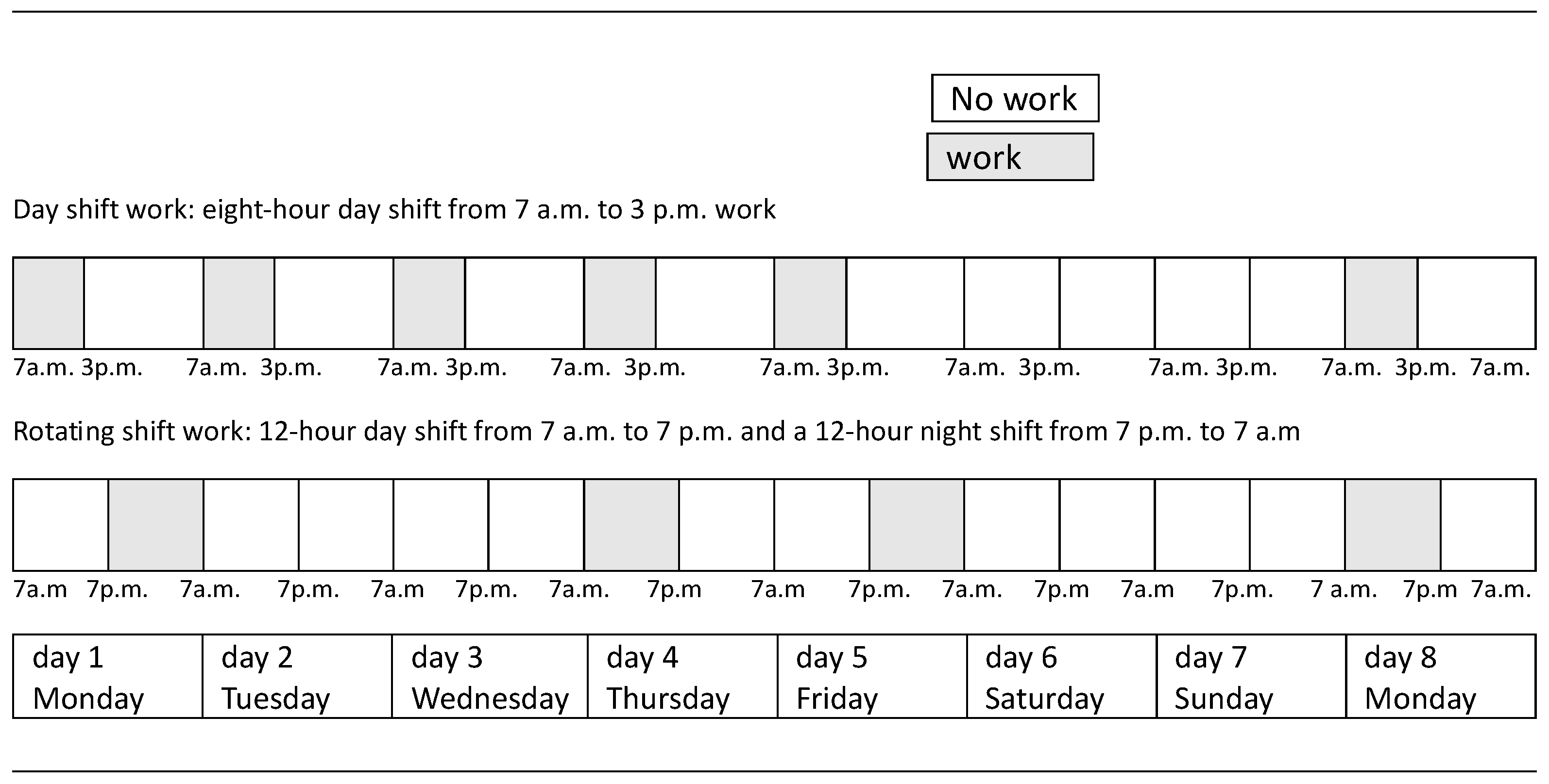
| Number of sleep sessions (bouts of sleep) | 8 sleep sessions | 8 sleep sessions |
| Number of hours worked (labor hours) | 12 h × 4 shifts = 48 h | 8 h × 6 shifts = 48 h |
| Days of work | 4 days | 6 days |
| Years of nursing experience [n (%)] | ||
| 0–5 years | 15 (21.4) | 15 (21.4) |
| 6–10 years | 8 (11.4) | 4 (5.7) |
| 11–20 years | 14 (20) | 17 (24.2) |
| 21–30 years | 16 (22.8) | 17 (24.2) |
| More than 30 years | 17 (24.2) | 17 (24.2) |
| Median (Interquartile Range) | Difference | 95 % Confidence Interval | p * | ||
|---|---|---|---|---|---|
| Nurses Working Day Shifts | Nurses Working Rotating Shifts | ||||
| Age (years) | 45 (38–51) | 40 (26–48) | −4 | −10 to 0 | 0.04 |
| Body mass index (kg/m2) | 25.51 (23.72–301.0) | 24.81 (22.47–27.68) | −0.85 | −2.26 to 0.48 | 0.21 |
| Domains PSQI Questionnaire | Number (%) of Respondents | p | |||
|---|---|---|---|---|---|
| Nurses Working Day Shifts | Nurses Working Rotating Shifts | Total | |||
| Unable to fall asleep within 30 min/latency | Less than once a week | 48 (69) | 40 (57) | 88 (63) | 0.16 * |
| Once or twice a week | 22 (31) | 30 (43) | 52 (37) | ||
| Sleep duration | >7 h | 11 (16) | 18 (26) | 29 (21) | 0.22 * |
| 6–7 h | 32 (46) | 21 (30) | 53 (38) | ||
| 5–6 h | 19 (27) | 20 (29) | 39 (28) | ||
| <5 h | 8 (11) | 11 (16) | 19 (14) | ||
| Sleep efficiency | ≥85% | 58 (83) | 44 (63) | 102 (73) | 0.002 ** |
| 75–84% | 9 (13) | 18 (26) | 27 (19) | ||
| 65–74% | 0 | 7 (10) | 7 (5) | ||
| <65% | 3 (4) | 1 (1) | 4 (3) | ||
| Sleep disturbance/frequency of problems | 0 | 1 (1) | 0 | 1 (1) | 0.78 ** |
| 1–9 | 44 (63) | 41 (59) | 85 (61) | ||
| 10–18 | 23 (33) | 26 (37) | 49 (35) | ||
| 19–27 | 2 (3) | 3 (4) | 5 (4) | ||
| Medication use | No in the last month | 2 (3) | 0 | 2 (1) | 0.50 ** |
| Less than once a week | 13 (19) | 17 (24) | 30 (21) | ||
| Once or twice a week | 31 (44) | 27 (39) | 58 (41) | ||
| Three or more times a week | 24 (34) | 26 (37) | 50 (36) | ||
| Daytime sleepiness/frequency of problems | No problems | 0 | 0 | 0 | >0.99 ** |
| 1–2 | 3 (4.3) | 4 (5.7) | 7 (5) | ||
| 3–4 | 0 | 0 | 0 | ||
| 5–6 | 67 (95.7) | 66 (94.3) | 133 (95) | ||
| Median (Interquartile Range) | Difference (95% Confidence Range) | p * | ||
|---|---|---|---|---|
| Nurses Working Day Shifts | Nurses Working Rotating Shifts | |||
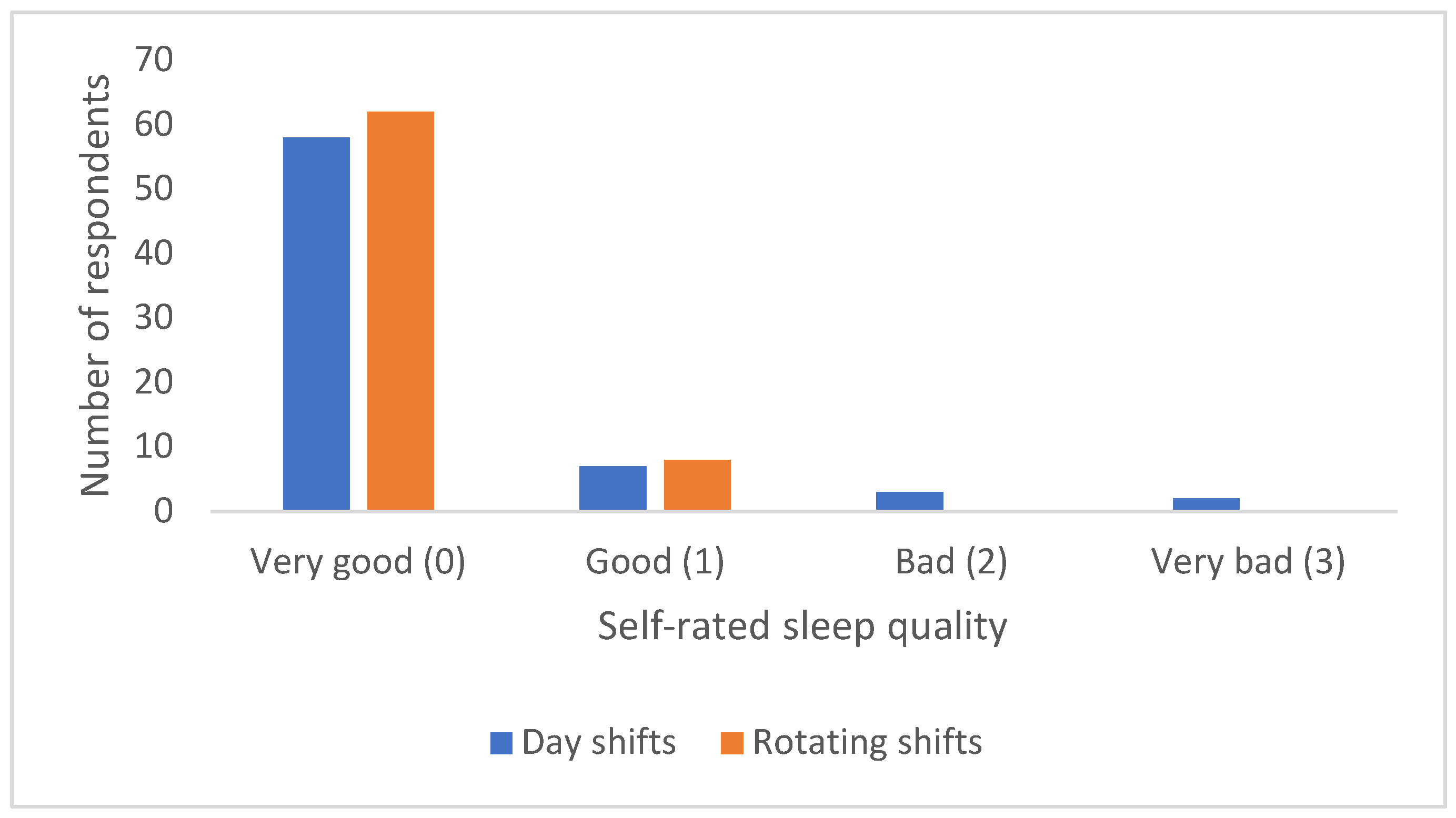
| Subjective sleep quality score | 0 (0–0) | 0 (0–0) | 0 (0 to 0) | 0.27 |
| Total sleep quality index (PSQI) | 9 (8–11) | 10 (8–12) | 0 (−1 to 1) | 0.55 |
| Median (Interquartile Range) | Difference (95% Confidence Range) | p * | ||
|---|---|---|---|---|
| Nurses Working Day Shifts | Nurses Working Rotating Shifts | |||
| Total sleep time (hours) | 6.4 (6.3–7.1) | 5.5 (5.2–6.2) | −1 (−1.2 to −0.9) | <0.001 |
| Sleep score | 77 (75–80) | 73 (68–76) | −5 (−7 to −3) | <0.001 |
| Deep sleep (hours) | 1.11 (1.01–1.22) | 1.02 (0.52–1.14) | −0.1 (−0.22 to −0.02) | 0.01 |
| Light sleep (hours) | 3.8 (3.3–4.3) | 3.3 (3.1–3.6) | −0.5 (−0.85 to −0.18) | <0.001 |
| REM phase (hours) | 1.25 (1.07–1.41) | 1.12 (0.59–1.28) | −0.15 (−0.28 to −0.05) | 0.003 |
| Step count | 7295 (6254–9823) | 10,662 (7992–12,321) | 2556 (1516 to 3619) | <0.001 |
| Number (%) of Respondents | Total | p * | ||
|---|---|---|---|---|
| Nurses Working Day Shifts | Nurses Working Rotating Shifts | |||
| Poor sleep quality | 0 | 6 (9) | 6 (4) | <0.001 |
| Moderate sleep quality | 47 (67) | 57 (81) | 104 (74) | |
| Good sleep quality | 23 (33) | 7 (10) | 30 (21) | |
Disclaimer/Publisher’s Note: The statements, opinions and data contained in all publications are solely those of the individual author(s) and contributor(s) and not of MDPI and/or the editor(s). MDPI and/or the editor(s) disclaim responsibility for any injury to people or property resulting from any ideas, methods, instructions or products referred to in the content. |
© 2025 by the authors. Licensee MDPI, Basel, Switzerland. This article is an open access article distributed under the terms and conditions of the Creative Commons Attribution (CC BY) license.
Share and Cite
Dujmić, Ž.; Mikšić, Š.; Barać, I.; Samardžić, J.; Maršić, L.; Samardžić, P.; Gvozdanović, Z.; Jelinčić, I.; Kljajić Bukvić, B.; Barišić, M.; et al. Sleep Quality in Shift-Working Nurses: Subjective and Objective Evaluation. Int. J. Environ. Res. Public Health 2026, 23, 64. https://doi.org/10.3390/ijerph23010064
Dujmić Ž, Mikšić Š, Barać I, Samardžić J, Maršić L, Samardžić P, Gvozdanović Z, Jelinčić I, Kljajić Bukvić B, Barišić M, et al. Sleep Quality in Shift-Working Nurses: Subjective and Objective Evaluation. International Journal of Environmental Research and Public Health. 2026; 23(1):64. https://doi.org/10.3390/ijerph23010064
Chicago/Turabian StyleDujmić, Željka, Štefica Mikšić, Ivana Barać, Josip Samardžić, Lea Maršić, Petar Samardžić, Zvjezdana Gvozdanović, Ivana Jelinčić, Blaženka Kljajić Bukvić, Marija Barišić, and et al. 2026. "Sleep Quality in Shift-Working Nurses: Subjective and Objective Evaluation" International Journal of Environmental Research and Public Health 23, no. 1: 64. https://doi.org/10.3390/ijerph23010064
APA StyleDujmić, Ž., Mikšić, Š., Barać, I., Samardžić, J., Maršić, L., Samardžić, P., Gvozdanović, Z., Jelinčić, I., Kljajić Bukvić, B., Barišić, M., Čavar-Lovrić, D., Mrkonjić, R., Mihaljević, I., & Farčić, N. (2026). Sleep Quality in Shift-Working Nurses: Subjective and Objective Evaluation. International Journal of Environmental Research and Public Health, 23(1), 64. https://doi.org/10.3390/ijerph23010064