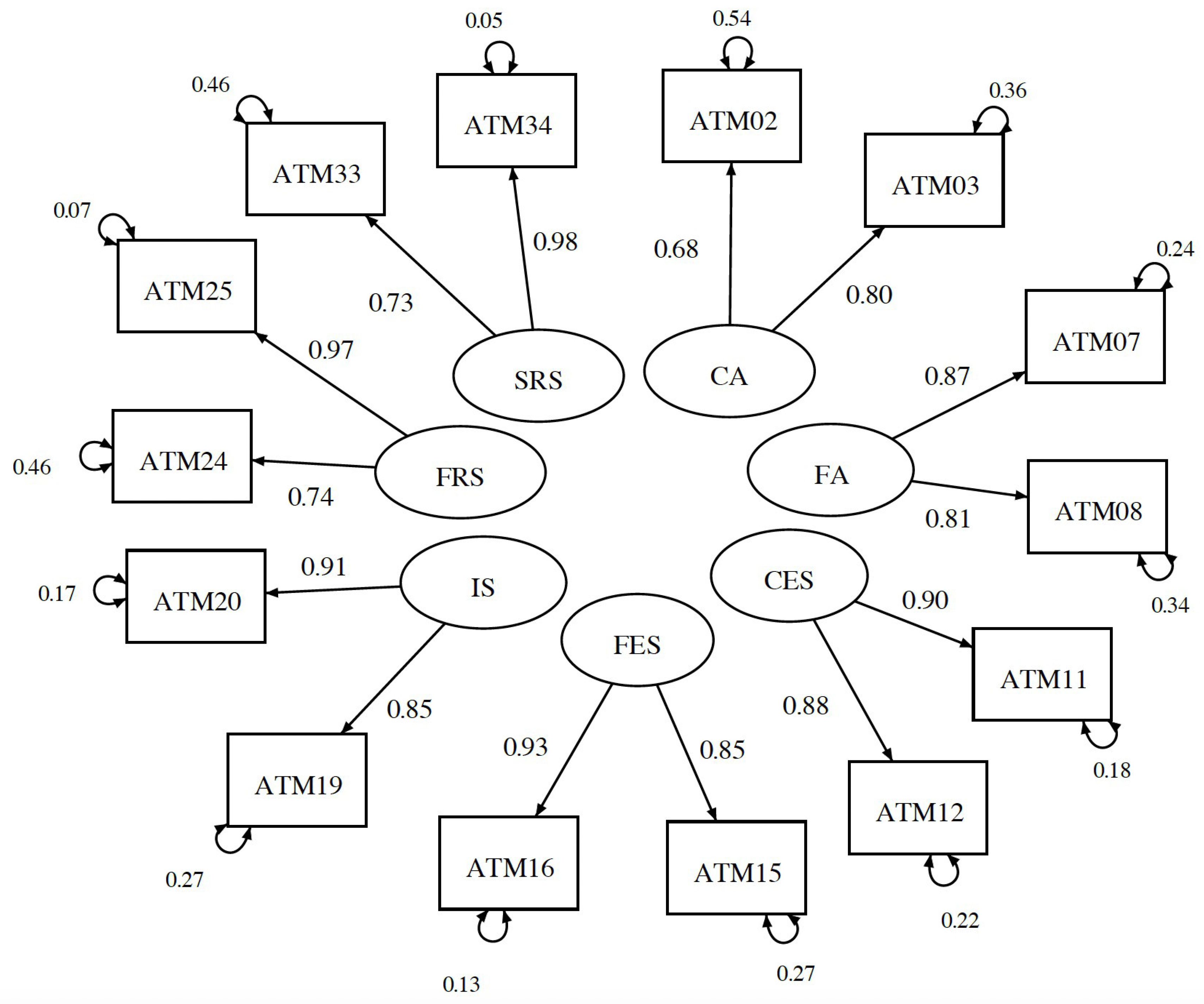
Validating the Nepalese Short Attitudes Toward Mental Health Problems Scale (N-SATMHPS): A Culturally Sensitive Tool for Assessing Mental Health Stigma




Highlights
- Negative attitudes toward mental health hinder help-seeking in Nepal.
- Cultural factors such as shame and family honor influence public mental health perceptions.
- Provides a validated tool to measure mental health attitudes in Nepal.
- Identifies culturally specific dimensions of stigma relevant to collectivist societies.
- Can guide culturally tailored stigma-reduction programs and mental health interventions.
- Useful for monitoring public attitudes and evaluating mental health policies in Nepal.
Abstract
1. Introduction
1.1. Measuring ATMHP
1.2. Conceptual Framework of ATMHP Scale
1.3. Study Gap
1.4. Study Aim
2. Materials and Methods
2.1. Research Design
2.2. Participants and Procedures
2.3. Instruments
2.4. Ethical Consideration
2.5. Data Analysis
3. Results
3.1. Dataset Overview
3.2. Confirmation of Background Factors
3.3. Extraction of Two Questions for Correlation Analysis for N-SATMHPS
3.4. The Performance Evaluation of the Developed N-SATMHPS
3.5. Validation
3.6. Discriminant Validity
4. Discussion
4.1. Model Fit
4.2. Correlation Analyses
4.3. Cultural Considerations and Implications
4.4. Limitations
5. Conclusions
Supplementary Materials
Author Contributions
Funding
Institutional Review Board Statement
Informed Consent Statement
Data Availability Statement
Acknowledgments
Conflicts of Interest
Abbreviations
| ATMHP | Attitudes Towards Mental Health Problems |
| CFA | Confirmatory Factor Analysis |
| CFI | Comparative Fit Index |
| df | Degrees of Freedom |
| J-SATMHPS | Japanese Shorter Version of Attitudes Towards Mental Health Problems Scale |
| MHLQ–YA | Mental Health Literacy Questionnaire—Young Adult |
| N-SATMHPS | Nepalese Shorter Version of Attitudes towards Mental Health Problems Scale |
| RMSEA | Root Mean Square Error of Approximation |
| SATMHPS | Shorter Version of the Attitudes Towards Mental Health Problems |
| SD | Standard Deviation |
| SRMR | Standardized Root Mean Square Residual |
| TLI | Tucker–Lewis Index |
Appendix A

References
- Corrigan, P. How stigma interferes with mental health care. Am. Psychol. 2004, 59, 614–625. [Google Scholar] [CrossRef] [PubMed]
- Gurung, D.; Poudyal, A.; Wang, Y.L.; Neupane, M.; Bhattarai, K.; Wahid, S.S.; Aryal, S.; Heim, E.; Gronholm, P.; Thornicroft, G.; et al. Stigma against mental health disorders in Nepal conceptualised with a “what matters most” framework: A scoping review. Epidemiol. Psychiatr. Sci. 2022, 31, e11. [Google Scholar] [CrossRef] [PubMed]
- Henderson, C.; Evans-Lacko, S.; Thornicroft, G. Mental illness stigma, help seeking, and public health programs. Am. J. Public Health 2013, 103, 777–780. [Google Scholar] [CrossRef] [PubMed]
- Acharya, S. Exploring Student’s Attitudes towards Mental Health Problems in Chitwan, Nepal. Int. Res. J. MMC 2025, 6, 158–172. [Google Scholar] [CrossRef]
- Maharjan, S.; Panthee, B. Prevalence of self-stigma and its association with self-esteem among psychiatric patients in a Nepalese teaching hospital: A cross-sectional study. BMC Psychiatry 2019, 19, 347. [Google Scholar] [CrossRef]
- Poudel, D.B.; Sharif, L.S.; Acharya, S.; Mahsoon, A.; Sharif, K.; Wright, R. Mental health literacy and attitudes towards mental health problems among college students, Nepal. Behav. Sci. 2024, 14, 1189. [Google Scholar] [CrossRef]
- Poudel, D.B.; Dhakal, S.; Khatri, B.B. Review Articles Attitudes Towards Mental Health Problems: A Scoping Review. Birat J. Helath Sci. 2025, 9, 3–13. [Google Scholar]
- Rai, Y.; Gurung, D.; Gautam, K. Insight and challenges: Mental health services in Nepal. BJPsych Int. 2021, 18, E5. [Google Scholar] [CrossRef]
- Thornicroft, G.; Kassam, A. Public attitudes, stigma and discrimination against people with mental illness. In Society and Psychosis; Morgan, C., McKenzie, K., Fearon, P., Eds.; Cambridge University Press: Cambridge, UK, 2008; pp. 179–197. [Google Scholar]
- Adewuya, A.O.; Oguntade, A.A. Doctors’ attitude towards people with mental illness in Western Nigeria. Soc. Psychiatry Psychiatr. Epidemiol. 2007, 42, 931–936. [Google Scholar] [CrossRef]
- Jalan, R. Attitudes of Undergraduate Medical Students towards the Persons with Mental Illness in a Medical College of Western Region of Nepal. J. Nepalgunj Med. Coll. 2018, 16, 48–53. [Google Scholar] [CrossRef]
- Neupane, D.; Dhakal, S.; Thapa, S.; Bhandari, P.M.; Mishra, S.R. Caregivers’ attitude towards people with mental illness and perceived stigma: A cross- sectional study in a tertiary hospital in Nepal. PLoS ONE 2016, 11, e0158113. [Google Scholar] [CrossRef] [PubMed]
- Sahile, Y.; Yitayih, S.; Yeshanew, B.; Ayelegne, D.; Mihiretu, A. Primary health care nurses attitude towards people with severe mental disorders in Addis Ababa, Ethiopia: A cross sectional study. Int. J. Ment. Health Syst. 2019, 13, 26. [Google Scholar] [CrossRef] [PubMed]
- Tungchama, F.P.; Egbokhare, O.; Omigbodun, O.; Ani, C. Health workers’ attitude towards children and adolescents with mental illness in a teaching hospital in north-central Nigeria. J. Child Adolesc. Ment. Health 2019, 31, 125–137. [Google Scholar] [CrossRef] [PubMed]
- Gilbert, P.; Bhundia, R.; Mitra, R.; McEwan, K.; Irons, C.; Sanghera, J. Cultural differences in shame-focused attitudes towards mental health problems in Asian and non-Asian student women. Ment. Health Relig. Cult. 2007, 10, 127–141. [Google Scholar] [CrossRef]
- Kotera, Y.; Sheffield, D.; Green, P.; Asano, K. Cross-cultural comparison of mental health shame: Negative attitudes, external, internal and reflected shame about mental health in Japanese and UK workers. In Shame 4.0; Mayer, C.H., Vanderheiden, E., Wong, P., Eds.; Springer: New York, NY, USA, 2021; pp. 55–71. [Google Scholar]
- Ahad, A.A.; Sanchez-Gonzalez, M.; Junquera, P. Understanding and addressing mental health stigma acrosscCultures for improving psychiatric care: A narrative review. Cureus 2023, 15, e39549. [Google Scholar]
- Brohan, E.; Thornicroft, G. Stigma and discrimination of mental health problems: Workplace implications. Occup. Med. 2010, 60, 414–415. [Google Scholar] [CrossRef]
- Girma, E.; Tesfaye, M.; Froeschl, G.; Möller-Leimkühler, A.M.; Müller, N.; Dehning, S. Public stigma against people with mental illness in the Gilgel Gibe Field Research Center (GGFRC) in Southwest Ethiopia. PLoS ONE 2013, 8, e82116. [Google Scholar] [CrossRef]
- Yang, L.H.; Kleinman, A. ‘Face’ and the embodiment of stigma in China: The cases of schizophrenia and AIDS. Soc. Sci. Med. 2008, 67, 398–408. [Google Scholar] [CrossRef]
- Nepal Health Research Counsil (NHRC). Report of National Mental Health Survey 2020. Vol. 5, Goverment of Nepal, Nepal Health Research Council. 2021. Available online: https://nhrc.gov.np/wp-content/uploads/2022/10/National-Mental-Health-Survey-Report2020.pdf (accessed on 15 April 2025).
- Worldbank. World Bank Country and Lending Groups. Datahelpdesk.worldbank.org. 2025. Available online: https://datahelpdesk.worldbank.org/knowledgebase/articles/906519-world-bank-country-and-lending-groups?utm_source=chatgpt.com (accessed on 15 April 2025).
- Lindisfarne, N. Gender, shame, and culture: An anthropological perspective. In Shame: Interpersonal Behavior, Psychopathology, and Culture; Gilbert, P., Andrews, B., Eds.; Oxford University Press: Oxford, UK, 1998; pp. 246–260. [Google Scholar]
- Cabral Master, J.M.; Carvalho, C.M.d.O.B.; Motta, C.D.; Sousa, M.C.; Gilbert, P. Attitudes towards mental health problems scale: Confirmatory factor analysis and validation in the Portuguese population. Am. J. Psychiatr. Rehabil. 2016, 19, 206–222. [Google Scholar] [CrossRef]
- Kotera, Y.; Taylor, E.; Wilkes, J.; Veasey, C.; Maybury, S.; Jackson, J.; Lieu, J.; Asano, K. Construction and factorial validation of a short version of the Attitudes Towards Mental Health Problems Scale (SATMHPS). Ment. Health Relig. Cult. 2023, 1–10. [Google Scholar] [CrossRef]
- Kotera, Y.; Asano, K.; Jones, J.; Colman, R.; Taylor, E.; Aledeh, M.; Barnes, K.; Golbourn, L.-M.; Kishimoto, K. The development of the Japanese version of the full and short form of Attitudes Towards Mental Health Problems Scale (J-(S) ATMHPS). Ment. Health Relig. Cult. 2023. [Google Scholar] [CrossRef]
- Netto, G.; Gaag, S.; Thanki, M.; Bondi, L.; Munro, M. A Suitable Space: Improving Counselling Services for Asian People, 1st ed.; Islam Zeitschrift Für Geschichte Und Kultur Des Islamischen Orients; Policy Press: Bristol, UK, 2001; p. 48. Available online: https://www.amazon.com/suitable-space-Improving-counselling-services/dp/1861343175 (accessed on 15 April 2025).
- Hsiao, F.H.; Klimidis, S.; Minas, H.; Tan, E.S. Cultural attribution of mental health suffering in Chinese societies: The views of Chinese patients with mental illness and their caregivers. J. Clin. Nurs. 2006, 15, 998–1006. [Google Scholar] [CrossRef] [PubMed]
- Fernando, D.S.; Keating, F. (Eds.) Mental Health in a Multi-Ethnic Society: A Multidisciplinary Handbook, 2nd ed.; Routledge: London, UK, 2008; p. 320p. [Google Scholar]
- Rao, A.V. Indian and Western Psychiatry: A Comparison. In Transcultural Psychiatry, 1st ed.; Cox, J.L., Ed.; Routledge: London, UK, 1986; p. 15. Available online: https://www.taylorfrancis.com/chapters/edit/10.4324/9780429447464-17/indian-western-psychiatry-comparison-venkoba-rao (accessed on 15 April 2025).
- Stanhope, V. Culture, control, and family involvement: A comparison of psychosocial rehabilitation in India and the United States. Psychiatr. Rehabil. J. 2002, 25, 273–280. [Google Scholar] [CrossRef] [PubMed]
- Gilbert, P.; Gilbert, J.; Sanghera, J. A focus group exploration of the impact of izzat, shame, subordination and entrapment on mental health and service use in South Asian women living in Derby. Ment. Health Relig. Cult. 2004, 7, 109–130. [Google Scholar] [CrossRef]
- Kassam, N. (Ed.) Telling it Like it is: Young Asian Women Talk (Livewire). In Livewire Books for Teenagers; Womens Pr Ltd.: London, UK, 1997; pp. 192p. Available online: https://www.amazon.co.uk/Telling-Like-Young-Asian-Livewire/dp/0704349418 (accessed on 15 April 2025).
- Chew-Graham, C.; Bashir, C.; Chantier, K.; Burman, E.; Batsleer, J. South Asian women, psychological distress and self-harm: Lessons for primary care trusts. Health Soc. Care Community 2002, 10, 339–347. [Google Scholar] [CrossRef]
- Gilbert, P.; Andrews, B. Shame: Interpersonal Behavior, Psychopathology, and Culture; Oxford University Press: Oxford, UK, 1998. [Google Scholar] [CrossRef]
- Gilbert, P.; Miles, J. (Eds.) Body Shame: Conceptualisation, Research and Treatment; Routledge: London, UK, 2002; p. 320p. Available online: https://www.taylorfrancis.com/books/edit/10.4324/9781315820255/body-shame-paul-gilbert-jeremy-miles (accessed on 15 April 2025).
- Nathanson, D.L. (Ed.) Knowing Feeling: Affect, Script, and Psychotherapy, 1st ed.; W. W. Norton & Company: New York, NY, USA, 1996; p. 425. Available online: https://www.amazon.com/Knowing-Feeling-Psychotherapy-Professional-Hardcover/dp/0393702146 (accessed on 15 April 2025).
- Babu, B.; Sinha, A. Attitude towards mental health problems and seeking professional help. Int. J. Indian. Psychol. 2023, 11, 1338–1348. [Google Scholar]
- Joji, S. Attitude Towards Mental Health Problems: A Survey Among College Students. J. Inf. Comput. Sci. 2020, 10, 581–588. [Google Scholar]
- Kumar, R.S.; Pathak, A. Gender-based shame-focused attitude of general public toward mental illness: Evidence from Jharkhand, India. J. Ment. Health Hum. Behav. 2021, 26, 132–138. [Google Scholar] [CrossRef]
- Andrade, G.; Bedewy, D.; Elamin, A.B.A.; Abdelmonem, K.Y.A.; Teir, H.J.; Alqaderi, N. Attitudes towards mental health problems in a sample of United Arab Emirates’ residents. Middle East Curr. Psychiatry 2022, 29, 2–6. [Google Scholar] [CrossRef]
- Hamid, A.; Furnham, A. Factors affecting attitude towards seeking professional help for mental illness: A UK Arab perspective. Ment. Health Relig. Cult. 2013, 16, 741–758. [Google Scholar] [CrossRef]
- Dias, P.; Campos, L.; Almeida, H.; Palha, F. Mental health literacy in young adults: Adaptation and psychometric properties of the mental health literacy questionnaire. Int. J. Environ. Res. Public Health 2018, 15, 1318. [Google Scholar] [CrossRef] [PubMed]
- Cochran, W.G. Sampling Techniques, 2nd ed.; John Wiley & Sons: Hoboken, NJ, USA, 1963; p. 413p. Available online: https://books.google.com.np/books/about/Sampling_techniques_2nd_edition.html?id=Y-SxXwAACAAJ&redir_esc=y (accessed on 15 April 2025).
- Lange, R.S.; Pascarella, T.; Terenzin, P. How College Affects Students, A Third decade of Research (2nd ed.) San Francisco: Jossey-Bass. J. Stud. Aff. Afr. 2014, 2, 47–50. [Google Scholar]
- Peterson, R.A.; Merunka, D.R. Convenience samples of college students and research reproducibility. J. Bus. Res. 2014, 67, 1035–1041. [Google Scholar] [CrossRef]
- Association, W.M. World medical association declaration of Helsinki ethical principles for medical research involving human subjects. JAMA 2013, 310, 2191–2194. [Google Scholar]
- Mai, Y.; Xu, Z.; Zhang, Z.; Yuan, K.H. An open-source WYSIWYG web application for drawing path diagrams of structural equation models. Struct. Equ. Model. 2023, 30, 328–335. [Google Scholar] [CrossRef]
- Hu, L.; Bentler, P.M.; Hu, L. Cutoff Criteria for Fit Indexes in Covariance Structure Analysis: Conventional Criteria Versus New Alternatives. Struct. Equ. Model. Multidiscip. J. 2009, 6, 1–15. [Google Scholar] [CrossRef]
- Meade, A.W.; Craig, S.B. Identifying careless responses in survey data. Psychol. Methods 2012, 17, 437–455. [Google Scholar] [CrossRef]
- Lee, H.Y.; Hwang, J.; Ball, J.G.; Lee, J.; Yu, Y.; Albright, D.L. Mental health literacy affects mental health attitude: Is there a gender difference? Am. J. Health Behav. 2020, 44, 283–291. [Google Scholar] [CrossRef]
- Riffel, T.; Chen, S.P. Exploring the knowledge, attitudes, and behavioural responses of healthcare students towards mental illnesses—A qualitative study. Int. J. Environ. Res. Public Health 2019, 17, 25. [Google Scholar] [CrossRef]
- Schröder, R.; Hamer, T.; Suhr, R.; König, L. Attitudes toward Psychotherapeutic treatment and health literacy in a large sample of the general population in germany: Cross-sectional study. JMIR Public Health Surveill. 2025, 11, e67078. [Google Scholar] [CrossRef]
- Kotera, Y.; Lieu, J.; Kirkman, A.; Barnes, K.; Liu, G.H.T.; Jackson, J.; Wilkes, J.; Riswani, R. Mental wellbeing of Indonesian students: Mean comparison with UK students and relationships with self-compassion and academic engagement. Healthcare 2022, 10, 1439. [Google Scholar] [CrossRef]
- Kotera, Y.; Ronaldson, A.; Takhi, S.; Felix, S.; Namasaba, M.; Lawrence, S.; Kellermann, V.; Kapka, A.; Hayes, D.; Dunnett, D.; et al. Cultural influences on fidelity components in recovery colleges: A study across 28 countries and territories. Gen. Psychiatry 2025, 38, e102010. [Google Scholar] [CrossRef]
- Kotera, Y. De-stigmatising self-care: Impact of self-care webinar during COVID-19. Int. J. Spa Wellness 2021, 4, 213–217. [Google Scholar] [CrossRef]
- Asano, K.; Tsuchiya, M.; Ishimura, I.; Lin, S.; Matsumoto, Y.; Miyata, H.; Kotera, Y.; Shimizu, E.; Gilbert, P. The development of fears of compassion scale Japanese version. PLoS ONE 2017, 12, e0185574. [Google Scholar] [CrossRef]
- Kotera, Y.; Tsuda-Mccaie, F.; Edwards, A.M.; Bhandari, D.; Williams, D.; Neary, S. Mental Health Shame, Caregiver Identity, and Self-Compassion in UK Education Students. Healthcare 2022, 10, 584. [Google Scholar] [CrossRef]
- Bornstein, M.H.; Jager, J.; Putnick, D.L. Sampling in developmental science: Situations, shortcomings, solutions, and standards. Dev. Rev. 2013, 33, 357–370. [Google Scholar] [CrossRef]
- Kotera, Y.; Hara, A.; Newby, C.; Miyamoto, Y.; Ozaki, A.; Ali, Y.; Clinton, P.; Felix, S.; John, C.; Inta, N.; et al. Development and evaluation of a mental health recovery priority measure for cross-cultural research: Global INSPIRE. Chest 2025, 60, 2695–2706. [Google Scholar] [CrossRef]
- N-SATMHPS. Available online: https://reach-global.org/our-developed-scales (accessed on 15 April 2025).

| Variables | n (%) |
|---|---|
| Age (Mean, SD) | 20.7 (1.7) |
| Gender (Female) | 236 (61.6) |
| Caste/Ethnicity (Brahmin/Kshetri) | 269 (70.6) |
| Religion (Hindu) | 344 (89.6) |
| Districts (Chitwan) | 348 (90.4) |
| Marital Status (Unmarried) | 369 (95.8) |
| Academic Qualification (Bachelor’s Degree) | 325 (84.4) |
| Variables | n (%) | Missing (n) |
|---|---|---|
| Age (Mean, SD) | 27.9 (8.7) | 21 |
| Gender (Female) | 351 (44.4) | 12 |
| Caste/Ethnicity (Brahmin/Kshetri) | 524 (66.0) | 9 |
| Religion (Hindu) | 660 (84.0) | 17 |
| Districts (Chitwan) | 247 (32.1) | 34 |
| Marital Status (Unmarried) | 489 (61.6) | 9 |
| Academic Qualification (Bachelor’s Degree) | 352 (44.7) | 15 |
| Working Status (Student) | 287 (36.0) | 6 |
| Community Attitudes | |||||||
|---|---|---|---|---|---|---|---|
| Item01 | Item02 | Item03 | Item04 | ||||
| Item01 | — | ||||||
| Item02 | 0.52 | — | |||||
| Item03 | 0.47 | 0.55 | — | ||||
| Item04 | 0.45 | 0.37 | 0.54 | — | |||
| Family Attitudes | |||||||
| Item05 | Item06 | Item07 | Item08 | ||||
| Item05 | — | ||||||
| Item06 | 0.57 | — | |||||
| Item07 | 0.51 | 0.57 | — | ||||
| Item08 | 0.48 | 0.55 | 0.71 | — | |||
| Community External Shame | |||||||
| Item09 | Item10 | Item11 | Item12 | Item13 | |||
| Item09 | — | ||||||
| Item10 | 0.71 | — | |||||
| Item11 | 0.65 | 0.75 | — | ||||
| Item12 | 0.61 | 0.70 | 0.80 | — | |||
| Item13 | 0.58 | 0.65 | 0.67 | 0.74 | — | ||
| Family External Shame | |||||||
| Item14 | Item15 | Item16 | Item17 | Item18 | |||
| Item14 | — | ||||||
| Item15 | 0.73 | — | |||||
| Item16 | 0.69 | 0.80 | — | ||||
| Item17 | 0.55 | 0.59 | 0.64 | — | |||
| Item18 | 0.63 | 0.66 | 0.71 | 0.70 | — | ||
| Internal Shame | |||||||
| Item19 | Item20 | Item21 | Item22 | Item23 | |||
| Item19 | — | ||||||
| Item20 | 0.77 | — | |||||
| Item21 | 0.46 | 0.45 | — | ||||
| Item22 | 0.60 | 0.65 | 0.45 | — | |||
| Item23 | 0.54 | 0.56 | 0.39 | 0.65 | — | ||
| Family-Reflected Shame | |||||||
| Item24 | Item25 | Item26 | Item27 | Item28 | Item29 | Item30 | |
| Item24 | — | ||||||
| Item25 | 0.71 | — | |||||
| Item26 | 0.58 | 0.57 | — | ||||
| Item27 | 0.59 | 0.60 | 0.57 | — | |||
| Item28 | 0.33 | 0.33 | 0.40 | 0.42 | — | ||
| Item29 | 0.37 | 0.39 | 0.38 | 0.46 | 0.70 | — | |
| Item30 | 0.36 | 0.37 | 0.40 | 0.51 | 0.54 | 0.69 | — |
| Self-Reflected Shame | |||||||
| Item31 | Item32 | Item33 | Item34 | Item35 | |||
| Item31 | — | ||||||
| Item32 | 0.66 | — | |||||
| Item33 | 0.67 | 0.70 | — | ||||
| Item34 | 0.68 | 0.67 | 0.72 | — | |||
| Item35 | 0.61 | 0.58 | 0.59 | 0.67 | — |
| N-SATMHPS Items | Subscale | Correlation Coefficients | p |
|---|---|---|---|
| 2 | Community Attitudes | 0.59 | <0.001 |
| 3 | Community Attitudes | 0.65 | <0.001 |
| 7 | Family Attitudes | 0.71 | <0.001 |
| 8 | Family Attitudes | 0.69 | <0.001 |
| 11 | Community External Shame | 0.83 | <0.001 |
| 12 | Community External Shame | 0.82 | <0.001 |
| 15 | Family External Shame | 0.80 | <0.001 |
| 16 | Family External Shame | 0.82 | <0.001 |
| 19 | Internal Shame | 0.73 | <0.001 |
| 20 | Internal Shame | 0.76 | <0.001 |
| 24 | Family-Reflected Shame | 0.63 | <0.001 |
| 25 | Family-Reflected Shame | 0.64 | <0.001 |
| 33 | Self-Reflected Shame | 0.78 | <0.001 |
| 34 | Self-Reflected Shame | 0.80 | <0.001 |
| Mean | SD | α | ||||
|---|---|---|---|---|---|---|
| ATMHPS | N-SATMHPS | ATMHPS | N-SATMHPS | ATMHPS | N-SATMHPS | |
| Community Attitudes | 1.60 | 1.64 | 0.81 | 0.88 | 0.79 | 0.71 |
| Family Attitudes | 0.65 | 0.54 | 0.73 | 0.79 | 0.84 | 0.83 |
| Community External Shame | 1.21 | 1.26 | 0.92 | 1.03 | 0.92 | 0.89 |
| Family External Shame | 0.45 | 0.39 | 0.67 | 0.70 | 0.91 | 0.89 |
| Internal Shame | 0.73 | 0.60 | 0.74 | 0.83 | 0.86 | 0.87 |
| Family-Reflected Shame | 1.11 | 0.71 | 0.76 | 0.82 | 0.87 | 0.83 |
| Self-Reflected Shame | 1.11 | 1.11 | 0.92 | 1.00 | 0.90 | 0.84 |
| r | |
|---|---|
| Community Attitudes | 0.90 |
| Family Attitudes | 0.90 |
| Community External Shame | 0.94 |
| Family External Shame | 0.93 |
| Internal Shame | 0.89 |
| Family-Reflected Shame | 0.79 |
| Self-Reflected Shame | 0.94 |
| Factors | α | |
|---|---|---|
| ATMHPS | N-SATMHPS | |
| Community Attitudes | 0.84 | 0.74 |
| Family Attitudes | 0.87 | 0.84 |
| Community External Shame | 0.94 | 0.91 |
| Family External Shame | 0.94 | 0.92 |
| Internal Shame | 0.89 | 0.89 |
| Family-Reflected Shame | 0.91 | 0.91 |
| Self-Reflected Shame | 0.93 | 0.89 |
| r | |
|---|---|
| Community Attitudes | 0.94 |
| Family Attitudes | 0.91 |
| Community External Shame | 0.96 |
| Family External Shame | 0.96 |
| Internal Shame | 0.90 |
| Family-Reflected Shame | 0.85 |
| Self-Reflected Shame | 0.95 |
| MHLQ-YA Factor 1 Knowledge of Mental Health Problems | MHLQ-YA Factor 2 Erroneous Beliefs/Stereotypes | MHLQ-YA Factor 3 First Aid Skills and Help-Seeking Behavior | MHLQ-YA Factor 4 Self-Help Strategies | MHLQ-YA Total Score | |
|---|---|---|---|---|---|
| Correlation Coefficients | Correlation Coefficients | Correlation Coefficients | Correlation Coefficients | Correlation Coefficients | |
| N-SATMHPS Community Attitudes | 0.19 ** | −0.07 | −0.03 | −0.06 | 0.04 |
| N-SATMHPS Family Attitudes | 0.07 | −0.13 * | −0.14 ** | −0.05 | −0.08 |
| N-SATMHPS Community External Shame | 0.12 * | 0.01 | −0.06 | 0.01 | 0.04 |
| N-SATMHPS Family External Shame | 0.03 | −0.11 * | −0.12 * | 0.00 | −0.07 |
| N-SATMHPS Internal Shame | 0.05 | −0.04 | −0.13 ** | 0.03 | −0.03 |
| N-SATMHPS Family-Reflected Shame | 0.06 | −0.04 | −0.03 | −0.01 | 0.01 |
| N-SATMHPS Self-Reflected Shame | −0.03 | −0.13 * | −0.09 | 0.04 | −0.09 |
| N-SATMPHS Total Score | 0.11 * | −0.10 * | −0.13 * | −0.00 | −0.04 |
Disclaimer/Publisher’s Note: The statements, opinions and data contained in all publications are solely those of the individual author(s) and contributor(s) and not of MDPI and/or the editor(s). MDPI and/or the editor(s) disclaim responsibility for any injury to people or property resulting from any ideas, methods, instructions or products referred to in the content. |
© 2025 by the authors. Licensee MDPI, Basel, Switzerland. This article is an open access article distributed under the terms and conditions of the Creative Commons Attribution (CC BY) license (https://creativecommons.org/licenses/by/4.0/).
Share and Cite
Poudel, D.B.; Yoshioka, T.; Colman, R.; Kotera, Y. Validating the Nepalese Short Attitudes Toward Mental Health Problems Scale (N-SATMHPS): A Culturally Sensitive Tool for Assessing Mental Health Stigma. Int. J. Environ. Res. Public Health 2025, 22, 1884. https://doi.org/10.3390/ijerph22121884
Poudel DB, Yoshioka T, Colman R, Kotera Y. Validating the Nepalese Short Attitudes Toward Mental Health Problems Scale (N-SATMHPS): A Culturally Sensitive Tool for Assessing Mental Health Stigma. International Journal of Environmental Research and Public Health. 2025; 22(12):1884. https://doi.org/10.3390/ijerph22121884
Chicago/Turabian StylePoudel, Dev Bandhu, Takashi Yoshioka, Rory Colman, and Yasuhiro Kotera. 2025. "Validating the Nepalese Short Attitudes Toward Mental Health Problems Scale (N-SATMHPS): A Culturally Sensitive Tool for Assessing Mental Health Stigma" International Journal of Environmental Research and Public Health 22, no. 12: 1884. https://doi.org/10.3390/ijerph22121884
APA StylePoudel, D. B., Yoshioka, T., Colman, R., & Kotera, Y. (2025). Validating the Nepalese Short Attitudes Toward Mental Health Problems Scale (N-SATMHPS): A Culturally Sensitive Tool for Assessing Mental Health Stigma. International Journal of Environmental Research and Public Health, 22(12), 1884. https://doi.org/10.3390/ijerph22121884