Abstract
Engagement in physical activity (PA) has been considered to be influenced by multiple psychosocial factors (such as mental health, motivation and social support). However, current interventions often neglect these complex interactions. The Social Ecological Model (SEM) highlights the need for context-specific strategies addressing individual, social, environmental, and public engagement domains to enhance student PA. Therefore, this study aimed to develop strategies and recommendations to enhance the PA levels of undergraduate university students by using a SEM Approach. A co-creative consensus workshop, held between July and August 2024, was employed. The stakeholder group (n = 25) comprised undergraduate university students, professors and academic doctors specialising in PA and health-related disciplines. Data generated from the workshop were uploaded into Atlas Ti. V8 and thematically analysed. The co-created strategies underscore the importance of a multi-level approach to enhancing PA participation among undergraduate students. A total of 32 strategies were developed, reflecting the interconnected influence of psychosocial factors across the levels of the SEM. These include strategies related to PA (9), mental health (7), motivation (9), and social support (7). By developing context-specific strategies and recommendations that address individual, social, physical, and public engagement levels, the research offers practical, student-centred solutions to enhance PA participation. The co-created strategies hold the potential to foster long-term behavioural change and promote active, healthier lifestyles within the South African university context.
1. Introduction
Physical activity (PA) is associated with a reduced risk of all-cause mortality, cardiovascular disease, type-2 diabetes, hypertension, breast cancer, colon cancer, gestational diabetes, ischemic heart disease, and ischemic stroke [,]. Physical activity has also been associated with a range of psychological health benefits, including reduced risk of depression, anxiety and stress, as well as improved mood, motivation and social support []. The World Health Organisation (WHO) suggested that young adults, such as undergraduate university students, do at least 150 min per week of moderate intensity aerobic PA, or at least 75 min of vigorous intensity aerobic PA throughout the week, or an equivalent combination of moderate and vigorous intensity activities []. However, inadequate levels of PA among this population have been consistently reported across global contexts [,]. In response to the widespread issue of sedentarism, previous studies have explored various strategies aimed at enhancing PA levels among university students.
A review by García-Álvarez and Faubel [] identified eight key strategies and nine data collection tools to enhance PA among university students, with validated questionnaires as the most common assessment method. Educational health promotion, delivered online or in-person, was the most frequently used strategy. Despite promising outcomes, the review highlighted limitations, including a small number of studies, methodological differences across contexts, and follow-up challenges []. Similarly, Johannes et al. [] found that interventions using social media, mobile apps, web platforms, and in-person sessions were effective in increasing PA engagement. The use of digital tools, especially social media, was emphasised as a best practice aligned with student trends []. However, while both reviews offer valuable insight into intervention strategies, it does not adequately address the psychosocial factors (mental health, motivation and social support) that shape PA behaviour among students. Additionally, they fall short in considering the broader contextual environments (such as individual, social, environmental, and public engagement dimensions) that shape PA behaviour.
To understand this PA decline, researchers have studied psychosocial determinants of health that influence PA engagement, such as mental health [], motivation [] and social support []. Previous research has indicated that the mental health of university students is considered among the most pressing public health areas in South Africa. For instance, the past 5 years have seen unprecedented incidents of suicide acts and attempts among university students across the country []. The increasingly tragic events on campuses, associated with mental health, have led many experts to suspect that we may be experiencing a mental illness epidemic among university students []. This suggests that supportive efforts focused on intervention programmes may be helpful []. Nevertheless, research showed that the motivation to exercise barriers and exercise preferences were significantly associated with PA levels [,]. Physical activity (PA) habits are a key factor in lifelong health behaviour among college students and a direct driver of their motivation. The acquisition of external social support can cause the PA habits of college students to be successfully generated []. Therefore, PA interventions for university students should consider the different possible sources and types of social support []. While it is essential to consider psychosocial factors such as mental health, motivation, and social support in shaping PA behaviours, it is equally important to account for the broader contextual environments from which these factors emerge and interact. One way of understanding these layered influences is through the Social Ecological Model (SEM).
Social Ecological Model Approach
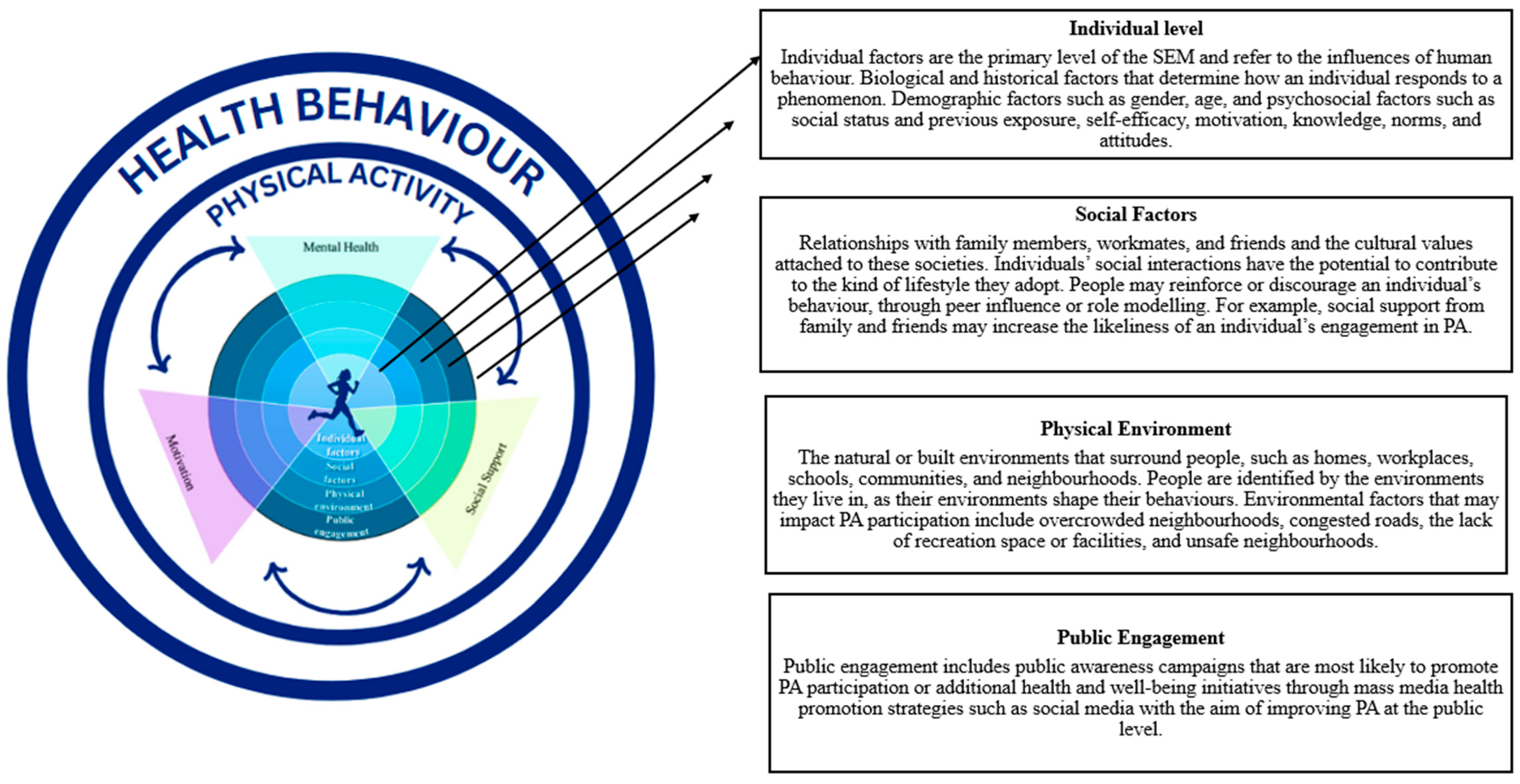
This study utilised the SEM as a conceptual framework as it is a comprehensive approach that considers multiple levels that influence behaviour [,]. This model comprises four levels, namely, individual factors, social factors, the physical environment and public policy. However, previous research has considered the term public engagement more applicable since public policy has been driven by technology []. Previous authors have indicated that technological sources that enable mass media communication practices, such as social networking sites, play an influential role in PA participation, as this ultimately influences what young adults view and their corresponding actions in terms of health behaviour [,]. Hence, for the purpose of this study, public policy was revised to public engagement on the basis that social media has been reported as a critical factor in shaping and disseminating policies, creating public health promotion and awareness campaigns as well as influencing public opinion []. Creating effective PA and context-specific strategies for undergraduate university students requires a holistic approach that not only considers the physical aspects of an individual but also the psychosocial factors that influence decision-making and behaviour as well [,]. Incorporating psychosocial factors such as mental health, motivation and social support in PA strategies according to the SEM approach is vital for placing focus on the interconnectedness of various factors that influence PA participation [,]. By integrating psychosocial factors into the SEM framework, the strategies become comprehensive and effective in promoting sustained PA engagement []. The adapted version of the SEM (Figure 1) delineates four interrelated levels of influence: individual, social, physical environment, and public engagement. Central to the model is PA, depicted as an encompassing construct that is both shaped by and reflective of broader behavioural determinants. PA engagement is not solely a function of personal choice but rather the outcome of complex, dynamic interactions among key psychosocial factors, namely, mental health, motivation, and social support. These factors operate synergistically across SEM levels to influence students’ behavioural patterns, underscoring the multifactorial and context-dependent nature of PA participation within the undergraduate university population [].
Figure 1.
Framework of the SEM to incorporate psychosocial factors that influence PA health behaviours [].
Despite the growing body of literature on PA interventions among university students, many existing studies have predominantly focused on isolated strategies or single-level determinants, often neglecting the complex, interrelated factors that influence PA behaviour []. Previous research has rarely explored how psychosocial factors such as mental health, motivation, and social support operate within broader environmental and structural contexts []. Moreover, there is limited evidence of studies adopting a holistic framework that integrates multiple levels of influence to guide the development of PA strategies. This study addresses these critical gaps by using the SEM as a guiding framework to develop context-specific strategies and recommendations aimed at enhancing PA levels among undergraduate university students. This paper builds on a previous systematic review of global PA best practices [] by contributing new empirical data co-created with stakeholders using the SEM framework. Its novelty lies in the incorporation of diverse perspectives from stakeholders, while directly addressing the psychosocial realities that shape student behaviour. As such, this research offers a more comprehensive and contextually grounded approach, making it a relevant and timely contribution to the field of health promotion and student well-being in higher education. Thus, there is a critical need for PA interventions in the university context that are not only multi-level but also explicitly designed to address these acute psychosocial challenges, for which a co-creative, SEM-based approach is ideally suited. Therefore, taking into consideration these factors and gaps in the literature, this study aimed to develop strategies and recommendations to enhance the PA levels of undergraduate university students by using a SEM Approach. This adapted Social Ecological Model provides a contemporary and comprehensive framework, aligning the study with current research while guiding the development of effective, multi-level strategies to promote physical activity among undergraduate students.
2. Materials and Methods
2.1. Development of the Strategies
Prior to the commencement of the co-creative consensus workshop, preliminary, evidence-based strategies derived from the foundational systematic review [] and a mixed-methodological approach employing a sequential explanatory design were implemented to establish a robust foundation for conceptualising the workshop and to elucidate the PA levels, preferences, and psychosocial determinants among undergraduate university students []. In Stage 1, quantitative data were collected via questionnaires administered to a cohort of 534 undergraduate students [], while Stage 2 involved in-depth qualitative interviews with a purposively selected sample of 18 participants. The empirical insights garnered from this dual-phase investigation critically informed the formulation of evidence-based PA strategies, which were subsequently refined and validated during the consensus workshop to ensure their applicability and efficacy within the target demographic. While these strategies were previously introduced in a previous study that focused primarily on the methodological approach used to co-create them (formally referred to as guidelines) [], the current study shifts the focus to a detailed description of the strategies themselves, along with actionable recommendations.
2.2. Study Design
The consensus workshop constituted a co-creative, qualitative research process, recognised in the literature as an important approach for engaging stakeholders in collaborative inquiry []. This design supports critical interrogation of proposed ideas, encourages equitable participation, and mitigates power imbalances by ensuring that no single voice dominates the deliberations. Through structured dialogue, guided facilitation, and repeated opportunities for refinement, the workshop format is able to generate a shared understanding of priorities and reach agreement on key strategies. This innovative participatory method facilitates structured group discussions, ensuring that all participants actively contribute and collectively shape the outcomes of a unified dialogue. The consensus workshop framework used in this study follows an iterative, multi-round structure that enables participants to move from individual reflection to collective synthesis. Following the workshop, discussions were systematically analysed and synthesised []. This method was specifically chosen for the present study to achieve consensus among stakeholders, critically evaluate the proposed strategies, and ascertain their contextual relevance, validity, and alignment with the study’s objectives. A notable strength of this approach is its capacity to preserve anonymity, enabling stakeholders to express their perspectives openly and candidly without social pressures, thereby enhancing the integrity of the deliberative process []. The multi-round structure strengthened the rigour of the process by providing opportunities for revision, validation, and re-assessment of stakeholder input until consensus was achieved.
2.3. Study Setting and Participants
This study employed a purposive sampling strategy, engaging stakeholders from a single university in South Africa’s Western Cape Province to ensure depth and contextual specificity. Participants included undergraduate students and expert scholars spanning disciplines such as PA, public health, sports sciences, psychology, and student support services. By focusing on a singular institutional setting, the research facilitated a comprehensive exploration of university-specific dynamics, thereby amplifying the contextual relevance and strategic applicability of the findings. The current research adhered to established consensus workshop methodologies, which suggest an optimal participant range to balance inclusivity with deliberative efficacy. While research posits that such workshops may accommodate up to 40 stakeholders [], empirical evidence [] indicates that larger cohorts often diminish feedback quality and consensus coherence. To mitigate this, the current study limited participation to 20 stakeholders, ensuring robust engagement while preserving the co-creative integrity of the workshop process. Undergraduate university students were included based on the following criteria: of all genders who were registered for degree programmes at a university in the Western Cape Province of South Africa and aged 18 years or older. Students registered for non-degree purposes, enrolled for only one semester, under the age of 18, or did not provide consent were excluded. Additionally, academic doctors and professors based in South Africa with expertise in PA, sports science, or public health were included and provided informed consent. Experts outside South Africa, those without relevant specialisation, or those who did not consent were excluded.
The study utilised a two-round co-creative consensus workshop designed to iteratively refine strategic insights through collaborative stakeholder engagement. In round 1 (initial stakeholder engagement), the primary research facilitator invited twelve (12) academic stakeholders from a Western Cape university via email, ensuring alignment with the study’s inclusion criteria regarding professional expertise. The sample size accounted for potential attrition while maintaining methodological rigour. Two recruitment emails were issued, yielding participation from eight (8) stakeholders, who contributed to the co-construction of preliminary strategies. In round 2 (expanded stakeholder involvement), to enhance the robustness and inclusivity of the co-creative process, an invitation was sent to a broader participant pool, involving thirty (30) academic physicians and professors, alongside twenty-two (22) undergraduate students. Five (5) email invitations and reminders were distributed to optimise engagement. Seventeen (17) stakeholders voluntarily participated, further refining the emergent strategies through structured deliberation. Across both rounds, the co-creative workshop engaged a total of twenty-five (25) stakeholders, ensuring diverse perspectives in the development of contextually grounded strategies.
2.4. Data Collection Process
The consensus workshop was conducted online in English, the institution’s primary language of instruction, and comprised two rounds: Round 1 in July 2024 and Round 2 in August 2024, each lasting approximately 3.5 h. Hosted via Google Meet to engage with stakeholders irrespective of where they were located, the sessions were audio-recorded with participants’ consent. Following Charlton’s [] structured consensus workshop framework, the primary researcher facilitated the proceedings, beginning with an introductory overview of the workshop’s aims and procedures. An icebreaker activity, in which participants defined PA in one word, was employed to stimulate engagement, establish a collaborative atmosphere, and allow the facilitator to gauge collective perceptions of PA []. Stakeholders were then directed to a shared Google Excel spreadsheet containing draft strategies, which they reviewed and debated within themed breakout rooms (4–5 participants per room): Room 1 addressed PA, Room 2 mental health, Room 3 motivation, and Room 4 social support. A technical assistant ensured seamless breakout room operations. The facilitator synthesised stakeholder suggestions, merging overlapping themes and mediating discrepancies to foster consensus. Voting was conducted via the spreadsheet, with participants selecting ‘Agree with the strategy’ or ‘Disagree with the strategy’; in Round 2, consensus was achieved when ≥75% of responses endorsed a strategy [,]. Post-workshop, transcripts were emailed to participants for verification, with three reminders issued over 15 days to confirm accuracy or solicit additions. The finalised strategies, ratified through this process, informed the subsequent data analysis phase.
This study adopted an inductive thematic analysis approach to explore qualitative data, enabling the identification, analysis, and organisation of patterns and relationships within the dataset []. Thematic analysis was deemed suitable as it facilitated the extraction of meaningful insights aligned with the study’s objectives. Interview recordings were transcribed verbatim by the lead researcher and imported into ATLAS. Ti (Version 8) for qualitative data management. Thematic development followed Constas’ [] and Vaismoradi et al.’s [] four-phase framework: initialisation, construction, rectification, and finalisation. During the initialisation phase, transcripts were thoroughly reviewed, with significant meaning units highlighted, coded, and abstracted, accompanied by reflective memo-writing to capture analytical insights. The construction phase involved data classification and comparison, where emergent codes and themes were labelled, defined, and contextualised. In the rectification phase, iterative cycles of immersion and distancing were employed to refine interpretations, ensuring thematic coherence and alignment with established scholarship. Finally, the finalisation phase synthesised the thematic findings into a cohesive narrative, integrating them with existing literature to advance understanding of the phenomenon under investigation. Themes and subthemes were continuously read, updated and merged in terms of similarity. Thereafter, the final themes were agreed upon by the primary and co- researchers [,].
2.5. Trustworthiness
Qualitative research must uphold rigorous standards of validity and trustworthiness to maintain ethical integrity and methodological reliability [,]. Grounded in the framework of Lincoln and Guba [], trustworthiness is operationalised through four key criteria: credibility, transferability, dependability, and confirmability. Each criterion was systematically addressed in this study through deliberate methodological strategies []. Credibility was established through methodological triangulation, incorporating multiple data sources and analytical approaches to corroborate findings []. Additionally, member checking was employed, wherein participants reviewed transcriptions, descriptions, and preliminary interpretations to verify accuracy. Participants were provided a two-week period to provide corrections or feedback, ensuring the fidelity of the data representation []. To enhance transferability, the study employed thick description [], providing exhaustive contextual details regarding the research setting, participant demographics, and methodological procedures. This approach enables readers to evaluate the applicability of findings to analogous contexts or populations []. Dependability (or consistency) was ensured by anchoring interpretations in the data itself, rather than relying on researcher predispositions []. The analytical process was rigorously documented, allowing for reproducibility. Confirmability was achieved through reflexivity and transparency []. Researchers explicitly acknowledged their epistemological positions and potential biases while maintaining a comprehensive audit trail. This trail documented all analytical decisions, procedural iterations, and data management protocols, permitting external scrutiny and verification [].
2.6. Ethics Considerations
Ethical approval and permission from the university were obtained prior to the commencement of the study (Reference No: HS21/10/24). All stakeholders who voluntarily participated in the consensus workshop provided informed consent and signed a confidentiality agreement. At the start of the workshop, stakeholders were reminded that participation was voluntary and that they could withdraw at any time without penalty. To ensure confidentiality and anonymity, participants’ names were replaced with pseudonyms.
3. Results
3.1. Demographic Information of Stakeholders
Round 1 engaged eight institutional staff members, predominantly female (n = 5). Diverse professional roles spanned multiple disciplines: social work, health informatics education, student-athlete support, sports psychology, child and family studies, health professions education, medical biosciences, and sport management. Round 2 involved eight undergraduate students, again with a female majority (n = 5), primarily from the Community and Health Sciences faculty (n = 6) and in their third academic year (n = 5). This student cohort represented diverse academic specialisations including commerce, law, sports, recreation and exercise sciences, social work, and physiotherapy. Additionally, the second round included nine staff participants (female, n = 6). Their interdisciplinary expertise encompassed physiotherapy, sports sciences, sports management, biokinetics, recreation and leisure studies, disability studies, high-performance sport, exercise physiology, sports sociology, and mental/public health.
3.2. Overview of Strategies
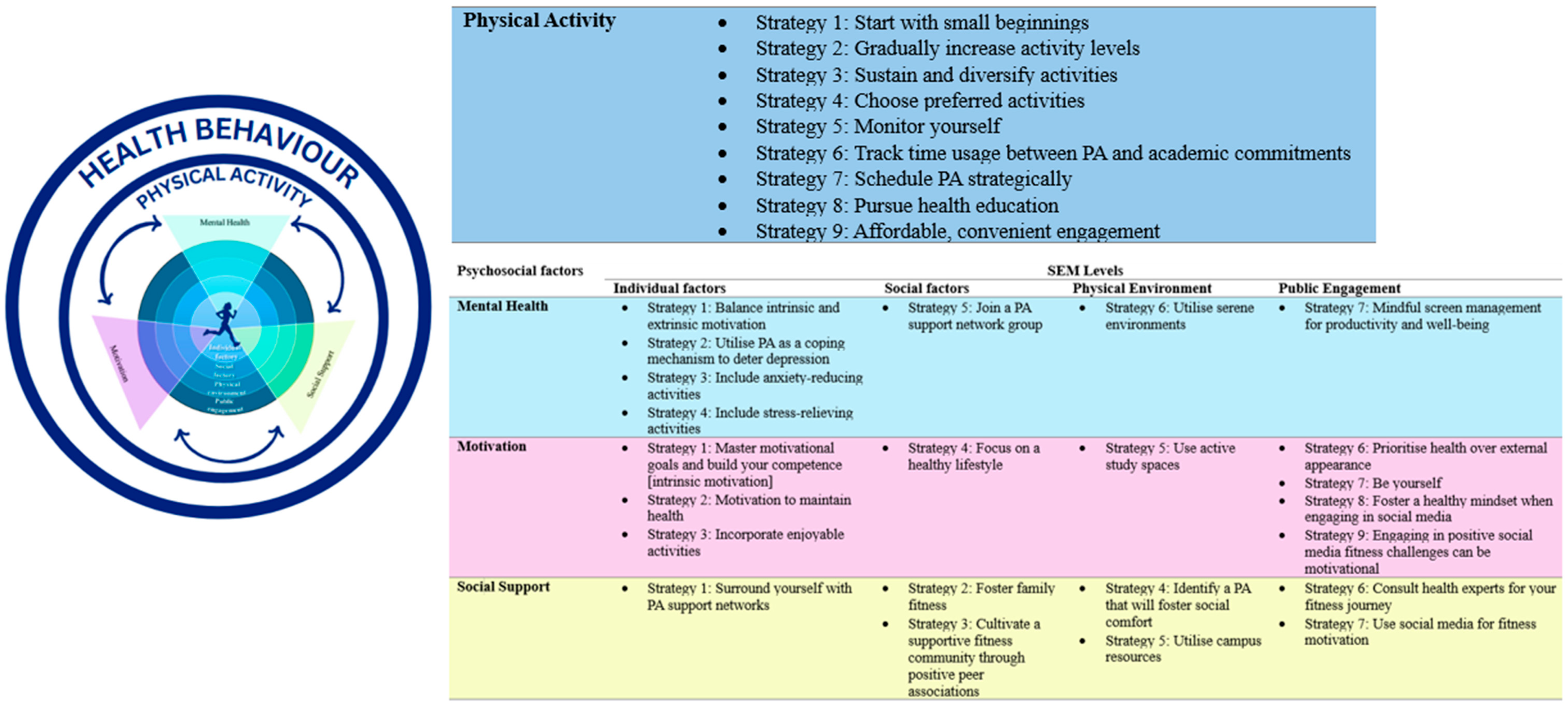
Utilising the SEM, the current study developed a comprehensive set of strategies to enhance PA among undergraduate students, spanning four domains (Figure 2): PA, mental health, motivation, and social support. Key strategies encourage students to “start small,” gradually increase engagement, diversify activities, choose preferred exercises, and strategically schedule and track PA, while utilising accessible campus resources. Mental health strategies emphasise supportive environments, using PA as a coping mechanism, fostering intrinsic and extrinsic motivation, and mindful screen use. Motivational strategies focus on goal-setting, health-oriented mindsets, enjoyable activities, and positive social media influences. Social support strategies highlight the role of peers, family, faculty, and institutional networks in sustaining activity. Across domains, cross-cutting themes underscore the importance of practical guidance, psychosocial support, and context-sensitive approaches to promote sustainable, student-centred active lifestyles.
Figure 2.
Strategies to enhance the physical activities of undergraduate university students according to the SEM.
3.3. Physical Activity Strategies
Table 1 provides a comprehensive overview of strategies designed to enhance PA participation among undergraduate university students, organised according to the levels of the SEM. The table categorises strategies into four domains: PA, mental health, motivation, and social support. Each domain includes targeted interventions at the individual, social, physical environment, and public engagement levels. A total of 32 strategies are presented, offering practical, student-centred approaches that address both personal and environmental factors influencing PA.
Table 1.
Description of PA strategies according to the SEM.
Table 1 (created by the primary researcher) presents nine PA strategies developed through a consensus-driven, stakeholder-informed process. The table positions PA strategies as the overarching approach for promoting active lifestyles among university students. These strategies focus on starting small, gradually increasing PA engagement, diversifying activities, choosing preferred activities, monitoring, tracking time utilization, scheduling PA strategically, pursuing health education and accessing affordable and convenient engagement locations.
Table 2 (constructed by the primary researcher) outlines seven mental health strategies designed to support PA engagement among undergraduate students. Each strategy is categorised according to the SEM, demonstrating how mental health can be addressed across multiple levels of influence. The strategies emphasise the importance of creating psychologically supportive environments to facilitate sustained PA. These strategies focus on intrinsic and extrinsic motivation to change students’ mindsets, PA as a coping mechanism, support networks, utilising serene environments and being mindful of screentime.
Table 2.
Description of mental health strategies across the SEM levels.
Table 3 (created by the primary researcher) features nine motivational strategies aimed at enhancing students’ drive to participate in PA. These are structured within the SEM to reflect various sources of influence, from personal beliefs to broader community messaging. The strategies are designed to activate both intrinsic and extrinsic motivation in a context-sensitive manner. These strategies include motivational goals, maintaining health, incorporating enjoyable activities, focusing on a healthy lifestyle, utilising active study spaces, focusing on health over appearance, health mindsets, and identifying positive social media influences.
Table 3.
Description of motivational strategies according to the SEM levels.
Table 4 (constructed by the primary researcher) highlights seven social support strategies that facilitate PA engagement. The strategies are mapped across the SEM, capturing key support systems such as peers, family, faculty, and institutional structures. These strategies show the value of connectedness and interpersonal encouragement in sustaining active behaviours. These strategies focus on PA support networks, incorporating family fitness, identifying positive peer associations, social comfort, utilising campus resources, consulting health experts and focusing on positive fitness motivation on social media.
Table 4.
Description of social support strategies according to the SEM levels.
4. Discussion
This study aimed to develop strategies and recommendations to enhance the PA levels of undergraduate university students by using a SEM Approach. The co-created strategies underscore the importance of a multi-level approach to enhancing PA participation among undergraduate students. A total of 32 strategies were developed, reflecting the interconnected influence of psychosocial factors across the levels of the SEM. These include strategies related to PA (9), mental health (7), motivation (9), and social support (7). Importantly, the strategies illustrate the value of integrating psychosocial considerations into PA promotion, emphasising that enhancing motivation, fostering supportive social networks and addressing mental health are critical components for sustaining active behaviours among undergraduate students [,,,]. In alignment with previous research, these findings provide a comprehensive, context-specific framework for universities seeking to implement effective interventions that promote holistic well-being through increased PA participation [,,].
Globally, physical inactivity has been considered a growing public health concern and the fourth leading cause of mortality [,]. Regarding international practices, the strategies from this current study are similar to those presented in the PA Guidelines for Americans, 2nd Edition, released in 2018 []. This framework is the authoritative federal guidance on PA for individuals aged 3 years and older []. The focus of the American version of the PA guidelines was research-based, centering on health benefits related to brain well-being, active adults, risks of sedentary behaviour and long-term benefits of the emotional state of individuals. The current strategies content from this study aligns with the American PA framework. These strategies attempt to provide a solution based on co-creative collaborations among stakeholders. Therefore, the strategies proposed in this study are specifically tailored for undergraduate students in the South African context, addressing the critical need for improving health and well-being within the university environment.
Similarly to previous studies, using the SEM as a conceptual framework to enhance PA among students has been proven to be a comprehensive approach for understanding holistic well-being [,]. Therefore, the development of the context-specific PA strategies from our study is aligned and theoretically grounded to support undergraduate students by addressing the multiple layers of influence on their PA behaviour, including individual factors, social factors, the physical environment and public engagement []. Furthermore, this theory posits that a student’s behaviour is shaped by a dynamic interplay of psychosocial factors that operate at various levels within the SEM [,,]. Thus, each psychosocial factor at every level of the SEM must be considered in order to effectively promote and sustain behavioural change such as enhancing PA levels []. As such, the development of the strategies from the current study takes into account the various psychosocial factors at each level of the SEM, ensuring a comprehensive approach that addresses individual needs, fosters social support and creates an environment conducive to enhancing PA among students [].
Furthermore, the findings derived from this study emphasise the alignment of the context-specific PA guidelines with several Sustainable Development Goals (SDGs) []. Results from this study are aligned with previous authors focusing on the psychological aspects of university students’ health [,]. By incorporating psychosocial factors such as mental health, motivation and social support, the guidelines directly contribute to achieving SDG3: Good Health and Well-Being, by promoting both the physical and mental health of undergraduate students. These strategies recognise that well-being is multidimensional, acknowledging that PA alone is insufficient without addressing the psychological and social contexts that influence students’ health behaviours. Secondly, the research-based guidelines support SDG4: Quality Education, by fostering a campus environment that encourages not only academic success but also the holistic development of students. By integrating structured PA with strategies that enhance motivation and social connectedness, the guidelines create conditions conducive to sustained learning, engagement and academic achievement.
Thirdly, by promoting inclusivity, equitable access to PA opportunities and reducing health disparities, these context-specific guidelines contribute to SDG10: Reduced Inequalities. In conjunction to previous research [,], these strategies ensure that students from diverse backgrounds, including those historically marginalised or facing socio-economic barriers, can participate in activities that enhance their well-being. Fourthly, at the broader community level, the guidelines support SDG11: Sustainable Cities and Communities, by advocating for healthier and more accessible campus environments. By creating spaces that encourage active lifestyles and social interaction, the guidelines contribute to sustainable, health-promoting infrastructures within the university setting.
Lastly, by actively involving key stakeholders, including students, faculty and community partners, in co-creating and implementing the guidelines, the initiative supports SDG17: Partnerships for the Goals []. Previous research suggested that cross-sector and multidisciplinary partners are essential for promoting PA []. Thus, this collaborative approach in the current study ensured that the strategies were contextually relevant, feasible and reflective of diverse perspectives. Moreover, the co-creative method employed in this study aligns closely with principles of participatory action research [] and empowerment theory []. By actively involving students, faculty, and other stakeholders in the development of PA strategies, the process fostered a sense of ownership and agency among participants. This participatory engagement not only facilitated the identification of contextually relevant strategies but also functioned as an intervention in itself, enhancing motivation and commitment to implementation. The collaborative approach thus strengthens the likelihood that the strategies will be adopted and sustained, demonstrating that co-creation can be both a method and a mechanism for behavioural and environmental change.
In terms of utilising the SEM for this current study, the adapted ‘Public Engagement’ level highlights the value of actively involving the broader community in promoting PA []. This innovation reflects the modern reality of health promotion, where engagement extends beyond policy and institutional frameworks to include digital platforms, social media, and community-driven initiatives [,]. By incorporating public engagement, the model captures real-world influences on behaviour and differentiates itself from traditional, policy-centric SEM approaches, emphasising the importance of collective participation in sustaining health-promoting practices [].
Collectively, these guidelines exemplify how integrating psychosocial factors in PA strategies not only advances the holistic health and well-being of university students but also contributes meaningfully to global sustainable development, aligning with previous studies that underscore the intersection between health promotion and sustainable development outcomes [,]. The findings of this study address existing research gaps by providing context-specific insights into how psychosocial factors influence undergraduate students’ engagement in PA, offering empirical evidence that complements and extends previous studies which predominantly focused on generalised or non-university populations [,,], while critically highlighting both consistencies and divergences with earlier research regarding the interplay between PA and holistic well-being [,].
Strengths and Limitations of the Study
This study exhibits several notable strengths in its approach to developing PA strategies for undergraduate students. The research employed the SEM as a theoretical framework, facilitating a comprehensive, multi-level exploration of factors influencing PA behaviours. The innovative co-creative consensus workshop methodology successfully engaged a diverse range of stakeholders, including both students and academic experts across relevant disciplines, ensuring the developed strategies benefited from both professional expertise and student perspectives. This enhanced the practical applicability of the resulting 32 strategies, which were systematically organised across four key domains: PA, mental health, motivation, and social support. Importantly, the study’s alignment with both South Africa’s NDP for 2030 and the United Nations SDGs demonstrates its policy relevance and potential for wider implementation. Nevertheless, some limitations should be acknowledged when considering this study’s findings. The research sample was drawn exclusively from a single higher education institution in the Western Cape province, potentially limiting the transferability of findings to other university contexts within South Africa or internationally. Future research should consider broadening similar research to additional universities, locally and internationally. Methodologically, the time-constrained workshop format, while effective for consensus-building, may not have allowed for in-depth exploration of more complex issues. Thus, researchers should explore a face-to-face workshop approach to enhance collaborative dialogue and stakeholder engagement.
5. Conclusions
Results from this study contribute to a deeper understanding of the multilayered factors, such as mental health, motivation, and social support, that influence PA among undergraduate students, using a SEM approach. A total of 32 strategies were co-created, reflecting the interconnected influence of psychosocial factors across the levels of the SEM. These include strategies related to PA (9), mental health (7), motivation (9), and social support (7). By developing context-specific strategies and recommendations that address individual, social, physical, and public engagement levels, the research offers practical, student-centred solutions to enhance physical activity participation. These strategies are aligned with South Africa’s NDP 2023 and the United Nations Sustainable Development Goals, supporting broader national and global efforts to improve health and well-being. The strategies have the potential to foster long-term behavioural change and promote active, healthier lifestyles within the South African university context.
6. Recommendations
The following set of recommendations is intended to guide a diverse group of stakeholders, undergraduate university students, health professionals, researchers, and policymakers, by providing evidence-informed, context-specific strategies to support, implement, and promote PA at multiple levels (i.e., individual, social, physical and public engagement layers). These recommendations aim to foster a more active student population, inform institutional health initiatives, and contribute to the development of sustainable, inclusive policies that align with national and global health priorities.
6.1. Undergraduate University Students
For undergraduate university students, the following recommendations are provided. Firstly, become vocal by actively participating in university discussions and forums related to health and wellness: use your voice to advocate for the integration of PA and wellness programmes into campus life. Provide feedback on existing health initiatives and suggest areas for improvement based on a student’s perspective. Simultaneously, participate in campus health and wellness interventions that focus on PA awareness. Secondly, lead by example by becoming health peer leaders: demonstrate the benefits of PA by incorporating health and wellness into your lifestyle. Your commitment to PA may inspire others to follow the same pursuit. Share your experiences by becoming a health peer leader. Student health peer leaders should be actively engaged and collaborate in opportunities where their voices and opinions are valued. Be a student representative and advocate for health initiatives that are suitable, appropriate and relevant to the student body. Thirdly, use technology to your advantage: university students are considered to be digitally inclined to social networking sites and additional digital platforms. Take advantage of this familiarity to enhance your PA levels and inspire your peers through similar digital channels. Communicate, seek assistance and share resources related to PA among peers. This would enhance your understanding and encourage healthy and supportive networks.
6.2. Health Professionals and Experts
For health professionals and experts, the following recommendations are suggested. Firstly, health professionals should strive to enhance student wellness through an interdisciplinary approach. Sports scientists, psychologists, student societies, campus clinics, and recreational administrators should collaborate and co-create initiatives that not only enhance PA participation but focus on holistic support for mental health, motivation, and social support as well. Secondly, sports psychologists may assist with behaviour change techniques to promote PA and reduce sedentarism among undergraduate students. It is recommended that future research examine the effectiveness of these collaborative and co-creation initiatives to deliver successful strategies that may address physical inactivity. Thirdly, health experts working in the context of health and PA should obtain a deeper understanding of the unique experiences and needs of undergraduate students’ sand thereby provide initiatives that are context-specific in terms of mental health, motivation and social support. Fourthly, to encourage PA participation among undergraduate students, a holistic approach is needed. This may involve collaborative efforts with support services and a focus on diversifying PA initiatives, introducing peer-led programmes to track PA levels. Next, mental health professionals could reinforce PA as a coping strategy and an outlet. Workshops could be implemented to promote the relationship between mental health and PA. Additionally, health experts should be sensitive to each student who seeks advice and would like to begin with their health journey. One size does not fit all in this case. Therefore, the guidelines may be used as a foundation for assisting students who would like to commence and enhance their PA levels. Health experts are therefore recommended to tailor these guidelines according to the students’ needs, preferences and their context. Lastly, the Fourth Industrial Revolution is permeating the realm of education and teaching and learning practices. Academics should explore innovative methods of imparting and co-constructing knowledge by using various online teaching methods. Therefore, PA initiatives should incorporate digital technology such as social media practices, as this is a convenient way of delivering visually appealing information that is relevant to undergraduate students. Furthermore, this would provide a safe space that is affordable and convenient for regular PA participation.
6.3. Future Research
Regarding future research, the following recommendations are provided. Further research with a larger cohort including postgraduate students is recommended. Additional universities and educational contexts within South Africa should be investigated to enhance the generalizability. Additionally, longitudinal studies may be warranted to track and monitor PA behaviours and levels of students. Researchers may consider assessing the effectiveness of innovative PA education and health promotional strategies, utilising social network sites to motivate and enhance PA levels. This could involve utilising sites that are frequently explored such as social networking sites, websites and mobile phone applications. By investigating the effectiveness of these interventions, researchers could design and assess context-specific PA campaigns tailored to contemporary students. Regarding monitoring and evaluation, research initiatives may focus on effective monitoring and evaluation procedures to measure the effectiveness of the PA intervention. Physical activity (PA) levels are known to fluctuate or decrease at various points in a university student’s journey. It is therefore crucial to monitor when PA levels fluctuate and when students are at risk of leading sedentary lifestyles. Lastly, future research should now focus on implementing and evaluating the real-world effectiveness of these co-created strategies. This includes studying the barriers and facilitators to their adoption, their impact on actual PA levels and mental health metrics over time, and their cost-effectiveness.
6.4. Policymakers
In terms of policymakers, the following recommendations are suggested. It is recommended that PA be prioritised at the university level by implementing PA interventions and programmes that are suitable and relevant to the contemporary student. Additionally, universities should integrate the developed context-specific PA guidelines into their existing health and wellness policies. This integration could incorporate PA into the fabric of campus life, creating incentives for participation and promoting the benefits of PA through campus-wide campaigns. Universities could incentivise participation through credit systems, integrate ‘movement breaks’ into long lecture schedules, and ensure PA is a core component of first-year orientation programmes. The Department of Health and Higher Health should utilise these guidelines as a foundational framework to develop targeted campus-based initiatives that foster collaboration between health professionals and tertiary institutions to ensure effective implementation. The Department of Higher Education and Training (DHET) should reinforce that universities should incorporate PA into the academic curriculum that not only focuses on theoretical aspects but the physical components of PA as well. This would serve as a proactive approach to enhance PA, which ultimately contributes to achieving Sustainable Development Goal 3, which focuses on ensuring healthy lives and promoting well-being. It is important to necessitate co-creation and collaborative efforts between universities and students to develop student-tailored PA initiatives that would be suitable and relevant. Thus, students should be involved in policy and mandate creation. This would provide a student perspective that reflects their everyday experiences. Having student representatives in a steering committee for advancing health within the university setting is crucial to ensuring that health interventions are student-tailored. These representatives could provide valuable insights, advocate for student interests and preferences and ultimately facilitate health programmes. This would result in a more health-conscious campus community.
Author Contributions
Conceptualization, C.J.; methodology, C.J. and N.V.R.; software, C.J.; validation, C.J.; formal analysis, C.J.; investigation, C.J.; resources, C.J.; data curation, C.J.; writing—original draft preparation, C.J.; writing—review and editing, C.J., N.V.R., S.O.O., S.T. and L.L.; visualization, C.J.; supervision, N.V.R., S.O.O., S.T. and L.L.; project administration, C.J.; funding acquisition, C.J. All authors have read and agreed to the published version of the manuscript.
Funding
This research was funded by the Sasakawa Young Leaders Fellowship Fund (Sylff) from the Tokyo Foundation (grant number: N/A), the Ernst and Ethel Trust (grant number: N/A), as well as the University of the Western Cape: Deputy Vice-Chancellor Research and Innovation (grant number: N/A).
Institutional Review Board Statement
This study was conducted in accordance with the Declaration of Helsinki, and approved by the Institutional Ethics Committee of University of the Western Cape (Humanities and Social Sciences Research Ethics Committee reference number: HS21/10/24, ending December 2024).
Informed Consent Statement
Informed consent was obtained from all subjects involved in the study.
Data Availability Statement
Restrictions apply to the dataset. Data is unavailable due to privacy and ethical restrictions.
Acknowledgments
The participating stakeholders are thanked for their contribution.
Conflicts of Interest
The authors declare no conflicts of interest. The funders had no role in the design of the study; in the collection, analyses, or interpretation of data; in the writing of the manuscript; or in the decision to publish the results.
Abbreviations
The following abbreviations are used in this manuscript:
| DHET | Department of Higher Education and Training |
| PA | Physical Activity |
| NDP | National Development Plan |
| SDGs | Sustainable Development Goals |
| SEM | Social Ecological Model |
| WHO | World Health Organisation |
References
- Burton, N.W.; Barber, B.L.; Khan, A. A qualitative study of barriers and enablers of physical activity among female Emirati university students. Int. J. Environ. Res. Public Health 2021, 18, 3380. [Google Scholar] [CrossRef]
- Adi, S. Benefits of Sports Activities with FITT Principles During the COVID-19 Pandemic in a “New Normal” Life for Health. In 4th International Conference on Sports Sciences and Health (ICSSH 2020); Atlantis Press: Dordrecht, The Netherlands, 2021; Volume 36, pp. 121–126. [Google Scholar]
- Johannes, C.; Roman, N.V.; Onagbiye, S.O.; Titus, S.; Leach, L.L. Relationship between Psychosocial Factors and Physical Activity among Undergraduate Students from a South African University. Int. J. Environ. Res. Public Health 2024, 21, 441. [Google Scholar] [CrossRef] [PubMed]
- WHO. 2020 WHO guidelines on physical activity and sedentary behavior. Sports Medicine and Health Science 2020. Available online: https://www.who.int/publications/i/item/9789240015128 (accessed on 17 April 2024).
- Fruehwirth, J.C.; Mazzolenis, M.E.; Pepper, M.A.; Perreira, K.M. Perceived stress, mental health symptoms, and deleterious behaviors during the transition to college. PLoS ONE 2023, 18, e0287735. [Google Scholar] [CrossRef]
- Thomas, K.; Nilsson, E.; Festin, K.; Henriksson, P.; Lowén, M.; Löf, M.; Kristenson, M. Associations of psychosocial factors with multiple health behaviors: A population-based study of middle- aged men and women. Int. J. Environ. Res. Public Health 2020, 17, 1239. [Google Scholar] [CrossRef] [PubMed]
- García-álvarez, D.; Faubel, R. Strategies and measurement tools in physical activity promotion interventions in the university setting: A systematic review. Int. J. Environ. Res. Public Health 2020, 17, 6526. [Google Scholar] [CrossRef]
- Johannes, C.; Onagbiye, S.O.; Roman, N.V.; Leach, L.L. Strategies and Best Practices That Enhance the Physical Activity Levels of Undergraduate University Students: A Systematic Review. Int. J. Environ. Res. Public Health 2024, 21, 173. [Google Scholar] [CrossRef]
- Herbert, C.; Meixner, F.; Wiebking, C.; Gilg, V. Regular Physical Activity, Short-Term Exercise, Mental Health, and Well-Being Among University Students: The Results of an Online and a Laboratory Study. Front. Psychol. 2020, 11, 1–23. [Google Scholar] [CrossRef]
- Brand, R.; Timme, S.; Nosrat, S. When Pandemic Hits: Exercise Frequency and Subjective Well-Being During COVID-19 Pandemic. Front. Psychol. 2020, 11, 1–10. [Google Scholar] [CrossRef]
- van Zyl, P.M.; LMetz, L.M.; Joubert, G.; Francis, C.; Du Plooy, F.; Jadhunandan, S.; Fredericks, F.; Bowen, E. Depression, anxiety, stress and substance use in medical students in a 5-year curriculum. Afr. J. Health Prof. Educ. 2017, 9, 67–72. Available online: https://journals.co.za/doi/pdf/10.7196/AJHPE.2017.v9i2.705 (accessed on 17 April 2024).
- Makhubela, M. Suicide and depression in university students: A possible epidemic. S. Afr. J. Psychol. 2021, 51, 3–5. [Google Scholar] [CrossRef]
- Rousseau, K.L.; Thompson, S.; Pileggi, L.A.; Henry, M.; Thomas, K.G.F. Trends in the prevalence and severity of depressive symptoms among undergraduate students at a South African University, 2016–2019. S. Afr. J. Psychol. 2021, 51, 67–80. [Google Scholar] [CrossRef]
- Othman, M.S.; Mat Ludin, A.F.; Chen, L.L.; Hossain, H.; Abdul Halim, I.I.; Sameeha, M.J.; Tahir, A.R.M. Motivations, barriers and exercise preferences among female undergraduates: A need assessment analysis. PLoS ONE 2022, 17, e0264158. [Google Scholar] [CrossRef]
- Niu, L.; Xu, J.; Yiting, E. Physical Activity and Habitus: Parental Support or Peer Support? Int. J. Environ. Res. Public Health 2023, 20, 2180. [Google Scholar] [CrossRef] [PubMed]
- Van Luchene, P.; Delens, C. The influence of social support specific to physical activity on physical activity among college and university students: A systematic review. J. Phys. Act. Health 2021, 18, 737–747. [Google Scholar] [CrossRef]
- Lee, Y.; Park, S. Understanding of Physical Activity in Social Ecological Perspective: Application of Multilevel Model. Front. Psychol. 2021, 12, 1–8. [Google Scholar] [CrossRef]
- Stokols, D. Translating social ecological theory into guidelines for community health promotion. Am. J. Health Promot. 1996, 10, 282–298. [Google Scholar] [CrossRef] [PubMed]
- Johannes, C.; Roman, N.V.; Onagbiye, S.O.; Titus, S.; Leach, L. Consensus in Action: Context-Specific Physical Activity Guidelines for Undergraduate Students at a South African University. Int. J. Environ. Res. Public Health 2024, 21, 1651. [Google Scholar] [CrossRef]
- Mindu, T.; Mutero, I.T.; Ngcobo, W.B.; Musesengwa, R.; Chimbari, M.J. Digital Mental Health Interventions for Young People in Rural South Africa: Prospects and Challenges for Implementation. Int. J. Environ. Res. Public Health 2023, 20, 1453. [Google Scholar] [CrossRef]
- Gelius, P.; Messing, S.; Goodwin, L.; Schow, D.; Abu-Omar, K. What are effective policies for promoting physical activity? A systematic review of reviews. Prev. Med. Rep. 2020, 18, 101095. [Google Scholar] [CrossRef] [PubMed]
- da Rocha Morgado, F.F.; do Vale, W.D.S.; Lopes, C.S.; Neto, G.D.A.M.; Lattari, E.; Mediano, M.F.F.; Rostila, M.; Griep, R.H.; Machado, S.; Penna, T.A.; et al. Psychosocial determinants of physical activity among workers: An integrative review. Rev. Bras. Med. Trab. 2020, 18, 472–487. [Google Scholar] [CrossRef]
- Nazar, N. The ecosystem approach in health social work. Ment. Health Glob. Chall. J. 2020, 4, 16–18. [Google Scholar] [CrossRef]
- Caperon, L.; Saville, F.; Ahern, S. Developing a socio-ecological model for community engagement in a health programme in an underserved urban area. PLoS ONE 2022, 17, e0275092. [Google Scholar] [CrossRef]
- Zhang, T.; Lee, J.; Zhang, X.; Gu, X. Social-Ecological Factors Predict College Students’ Physical Activities and Sedentary Behavior. Sustainability 2022, 14, 12873. [Google Scholar] [CrossRef]
- Johannes, C.; Roman, N.; Onagbiye, S.; Titus, S.; Leach, L. Physical Activity is Personal: A Mixed-Methods Study of Undergraduate Students at a South African University. Phys. Act. Health 2024, 8, 116–136. [Google Scholar] [CrossRef]
- Charlton, H. Using Consensus Workshop in the Classroom: Promoting Participation and Collaboration in Large Group Settings. Manag. Teach. Rev. 2017, 3, 346–353. [Google Scholar] [CrossRef]
- Donohoe, H.M.; Needham, R.D. Moving best practice forward: Delphi characteristics, advantages, potential problems, and solutions. Int. J. Tour. Res. 2009, 11, 415–437. [Google Scholar] [CrossRef]
- Tan, E.; Cleland, J. Using time wisely–Aligning ice breakers with the objective of a session. Med. Teach. 2022, 44, 942–943. [Google Scholar] [CrossRef]
- Nigg, C.R.; Fuchs, R.; Gerber, M.; Jekauc, D.; Koch, T.; Krell-Roesch, J.; Lippke, S.; Mnich, C.; Novak, B.; Ju, Q.; et al. Assessing physical activity through questionnaires—A consensus of best practices and future directions. Psychol. Sport Exerc. 2020, 50, 101715. [Google Scholar] [CrossRef]
- Davids, R.; Roman, N.; Schenck, C. The co-development of a framework to support parents of children with a hearing loss: Using a consensus workshop. Soc. Work./Maatskaplike Werk 2022, 59, 24–41. [Google Scholar] [CrossRef]
- Braun, V.; Clarke, V. One size fits all? What counts as quality practice in (reflexive) thematic analysis? Qual. Res. Psychol. 2021, 18, 328–352. [Google Scholar] [CrossRef]
- Constas, M.A. Qualitative Analysis as a Public Event: The Documentation of Category Development Procedures. Am. Educ. Res. J. 1992, 29, 253–266. [Google Scholar] [CrossRef]
- Vaismoradi, M.; Jones, J.; Turunen, H.; Snelgrove, S. Theme development in qualitative content analysis and thematic analysis. J. Nurs. Educ. Pract. 2016, 6. [Google Scholar] [CrossRef]
- Nyirenda, L.; Kumar, M.B.; Theobald, S.; Sarker, M.; Simwinga, M.; Kumwenda, M.; Johnson, C.; Hatzold, K.; Corbett, E.L.; Sibanda, E.; et al. Using research networks to generate trustworthy qualitative public health research findings from multiple contexts. BMC Med. Res. Methodol. 2020, 20, 13. [Google Scholar] [CrossRef]
- Janis, I. Strategies for Establishing Dependability between Two Qualitative Intrinsic Case Studies: A Reflexive Thematic Analysis. Field Methods 2022, 34, 240–255. [Google Scholar] [CrossRef]
- Lincoln, Y.S.; Guba, E.G. Paradigmatic controversies, contradictions and emerging confluences. In Handbook of Qualitative Research, 2nd ed.; SAGE: Los Angeles, CA, USA, 2000; pp. 163–189. [Google Scholar]
- Harrison, R.L.; Reilly, T.M.; Creswell, J.W. Methodological Rigor in Mixed Methods: An Application in Management Studies. J. Mix Methods Res. 2020, 14, 473–495. Available online: https://search.ebscohost.com/login.aspx?direct=true&db=eric&AN=EJ1267783&site=ehost-live&scope=site (accessed on 15 May 2024). [CrossRef]
- Creswell, J.; Creswell, J. Research Design: Qualitative, Quantitiative and Mixed Methods Approaches, 5th ed.; Sage Publications Inc.: London, UK, 2018; Volume 22, p. 1. [Google Scholar]
- Ahmed, S.K. The pillars of trustworthiness in qualitative research. J. Med. Surg. Public Health 2024, 2, 1–4. [Google Scholar] [CrossRef]
- Gratton, C.; Jones, I. Research Methods for Sports Studies, 2nd ed.; Research Methods for Sports Studies; Routledge: London, UK; New York, NY, USA, 2010; pp. 247–249. [Google Scholar]
- Newson, J.J.; Sukhoi, O.; Thiagarajan, T.C. MHQ: Constructing an aggregate metric of population mental wellbeing. Popul. Health Metr. 2024, 22, 1–14. [Google Scholar] [CrossRef] [PubMed]
- WHO. Comprehensive Mental Health Action Plan 2013–2023. Geneva. 2021. Available online: https://www.ptonline.com/articles/how-to-get-better-mfi-results (accessed on 20 April 2024).
- Urhahne, D.; Wijnia, L. Theories of Motivation in Education: An Integrative Framework. In Educational Psychology Review; Springer USA: New York, NY, USA, 2023; Volume 35, pp. 1–35. [Google Scholar] [CrossRef]
- Pérez-de la Cruz, S.; Gonzalez-Gerez, J.J.; Arellano de León, Ó.; Vargas Rodriguez, A. Spanish Validation of the PALMS (Physical Activity and Leisure Motivation Scale). Int. J. Environ. Res. Public Health 2022, 19, 10064. [Google Scholar] [CrossRef]
- Zeigler-Hill, V.; Wallace, M. Self-esteem Instability and Psychological Adjustment. Self Identity 2012, 11, 317–342. [Google Scholar] [CrossRef]
- Cobo-Rendón, R.; López-Angulo, Y.; Pérez-Villalobos, M.V.; Díaz-Mujica, A. Perceived Social Support and Its Effects on Changes in the Affective and Eudaimonic Well-Being of Chilean University Students. Front. Psychol. 2020, 11, 1–12. [Google Scholar] [CrossRef]
- Lee, I.M.; Shiroma, E.J.; Lobelo, F.; Puska, P.; Blair, S.N.; Katzmarzyk, P.T. Effect of physical inactivity on major non-communicable diseases worldwide: An analysis of burden of disease and life expectancy. Lancet 2012, 380, 219–229. [Google Scholar] [CrossRef] [PubMed]
- Van Biljon, A.; McKune, A.J.; Dubose, K.D.; Kolanisi, U.; Semple, S.J. Physical activity levels in urban-based South African learners: A cross-sectional study of 7348 participants. S. Afr. Med. J. 2018, 108, 126–131. [Google Scholar] [CrossRef]
- Piercy, K.L.; Troiano, R.P. Physical Activity Guidelines for Americans From the US Department of Health and Human Services. Circ. Cardiovasc. Qual. Outcomes 2018, 11, e005263. [Google Scholar] [CrossRef]
- Cleland, V.J.; Ball, K.; Crawford, D. Is a perceived supportive physical environment important for self-reported leisure time physical activity among socioeconomically disadvantaged women with poor psychosocial characteristics? An observational study. BMC Public Health 2013, 13, 280. [Google Scholar] [CrossRef]
- Rawal, L.B.; Smith, B.J.; Quach, H.; Renzaho, A.M.N. Physical Activity among Adults with Low Socioeconomic Status Living in Industrialized Countries: A Meta-Ethnographic Approach to Understanding Socioecological Complexities. J. Environ. Public Health 2020, 2020, 4283027. [Google Scholar] [CrossRef] [PubMed]
- Zhou, G.; He, C. The Inner Relationship between Students’ Psychological Factors and Physical Exercise Based on Structural Equation Model (SEM). Appl. Math. Nonlinear Sci. 2022, 8, 247–256. [Google Scholar] [CrossRef]
- United Nations. SDG Good Practices: A Compilation of Success Stories and Lessons Learned in SDG Implementation. 2022. Available online: https://sdgs.un.org/publications/sdg-good-practices-2nd-edition-2022 (accessed on 21 June 2024).
- Chen, M.; Jeronen, E.; Wang, A. Toward environmental sustainability, health, and equity: How the psychological characteristics of college students are reflected in understanding sustainable development goals. Int. J. Environ. Res. Public Health 2021, 18, 8217. [Google Scholar] [CrossRef]
- Cachero, C.; Grao-Gil, O.; Pérez-delHoyo, R.; Ordóñez-García, M.C.; Andújar-Montoya, M.D.; Lillo-Ródenas, M.Á.; Torres, R. Perception of the Sustainable Development Goals among university students: A multidisciplinary perspective. J. Clean. Prod. 2023, 429, 139682. [Google Scholar] [CrossRef]
- Otterbein, M. Physical Activity & The Sustainable Development Goals: A Public Health Approach Towards Advancing the Power of Movement. J. Emerg. Sports Stud. 2020, 3, 1–29. [Google Scholar] [CrossRef]
- Kolovou, V.; Bolton, N.; Crone, D.; Willis, S.; Walklett, J. Systematic review of the barriers and facilitators to cross-sector partnerships in promoting physical activity. Perspect. Public Health 2024, 144, 369–380. [Google Scholar] [CrossRef] [PubMed]
- Cornish, F.; Breton, N.; Moreno-Tabarez, U.; Delgado, J.; Rua, M.; de-Graft Aikins, A.; Hodgetts, D. Participatory action research. Nat. Rev. Methods Primers 2023, 3, 34. [Google Scholar] [CrossRef]
- Joseph, R. The theory of empowerment: A critical analysis with the theory evaluation scale. J. Hum. Behav. Soc. Environ. 2019, 30, 138–157. [Google Scholar] [CrossRef]
- Baena-Morales, S.; Ferriz-Valero, A. What about physical education and Sustainable Development Goals? A scoping review. Phys. Educ. Sport Pedagog. 2025, 30, 200–217. [Google Scholar] [CrossRef]
- Guthold, R.; Stevens, G.A.; Riley, L.M.; Bull, F.C. Global trends in insufficient physical activity among adolescents: A pooled analysis of 298 population-based surveys with 1·6 million participants. Lancet Child Adolesc. Health 2020, 4, 23–35. [Google Scholar] [CrossRef] [PubMed]
Disclaimer/Publisher’s Note: The statements, opinions and data contained in all publications are solely those of the individual author(s) and contributor(s) and not of MDPI and/or the editor(s). MDPI and/or the editor(s) disclaim responsibility for any injury to people or property resulting from any ideas, methods, instructions or products referred to in the content. |
© 2025 by the authors. Licensee MDPI, Basel, Switzerland. This article is an open access article distributed under the terms and conditions of the Creative Commons Attribution (CC BY) license (https://creativecommons.org/licenses/by/4.0/).