


Policy, Price, and Perception: A Phenomenological Qualitative Study of the Rural Food Environment Among Latina Households

Abstract
1. Introduction
2. Materials and Methods
2.1. Study Design
2.2. Participants and Setting
2.3. Data Collection
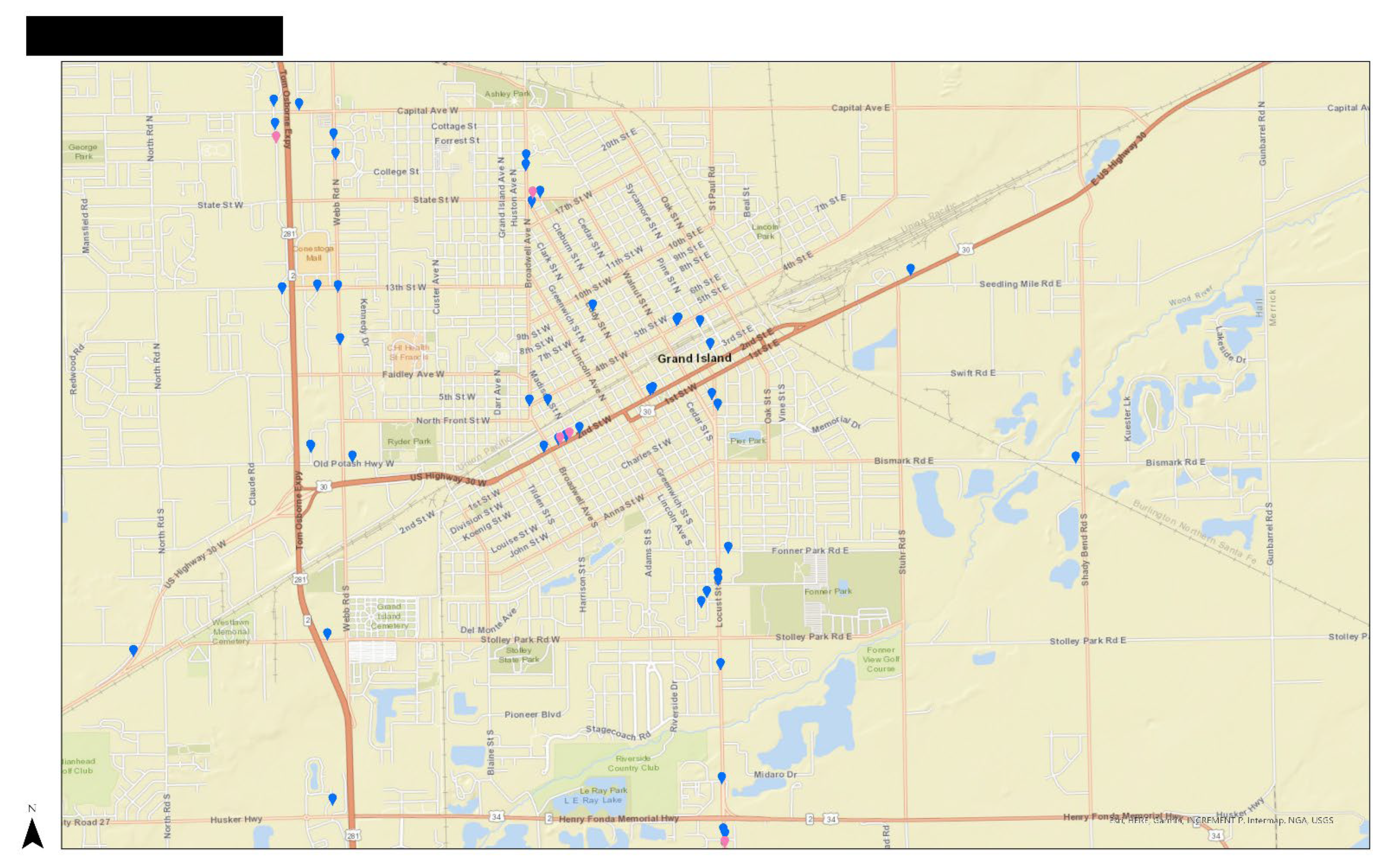
2.3.1. Step 1: Maps
2.3.2. Step 2: Semi-Structured Interviews
2.3.3. Step 3: Demographic Survey
2.4. Data Analysis
2.5. Maps
2.6. Semi-Structured Interviews
3. Results
3.1. Participant Characteristics
3.2. Interview Themes
3.2.1. Availability
“it’s not like I often shop there [ethnic store] either, almost never. It’s only on special occasions that I go there to buy something. But the stores I usually frequent the most are [3 CS] and [2 dollar stores]”(Participant 5)
“Yeah, that is good. I like the stores that are running, they’re pretty good. Each one has their own…thing about them, you know. So Co-op’s my main go-to, but [I go to CS] Fridays for their sales, and [other CS] for whatever they don’t have, I go there.”(Participant 6)
“no, no, [ethnic store] is not my main shopping trip because we only go for pan dulce once a week… My main stores are [3 CS]”(Participant 1)
“I mean [city] is growing so…we definitely need more stores because they’re all kind of like right here, like in the middle.”(Participant 8)
“… there’s nothing there but a gas station and a dollar store. And, well, there’s nothing there, there’s nothing there that tastes good.”(Participant 10)
“Well, if you get to talk to [store], tell them they need lactose-free milk.”(Participant 4)
3.2.2. Accessibility
“Sometimes many people do what I’ve seen is [drive to multiple stores searching for cheaper prices]… I don’t like going from place to place… I don’t like to spend gas all the way to [CS] for a packet of cilantro.”(Participant 5)
“I feel bad for everybody else… I mean, unless you like call an Uber, but like somebody’s 60 year old Mexican grandma is not going to call Uber to take them to wherever you know or like Uber eats or something like, you know. So there’s like no public transportation.”(Participant 3)
“Yeah, a lot of it’s like carpool. You know, that’s it being an issue is because if someone has to go home and we ask them right away, do you carpool? And they’re like, “yeah”, so they can’t leave unless they’re carpool. It’s the same thing with the stores, “hey, when are you going to the store? Well, I’m not going for another two days”(Participant 2)
“…once a woman died years ago… she was walking. And about two years ago, someone else died… that was around 5:00 in the morning, the man ran her over, and it was a little dark. I don’t know why, but it does [worry] me a little bit.”(Participant 6)
3.2.3. Acceptability
“And if there’s something like avocados, [avocados from chain stores are] not as good as [ethnic store]… Like seasoned meat. If my kids are feeling fancy, we grab it from [ethnic store] too.”(Participant 4)
“I think chiles and pepitas, they do sell them at [CS], but I don’t know why, like it’s just different. They’re better from the Mexican store.”(Participant 8)
“And then sometimes the products are not even like up to quality. Because one time, I went to [ethnic store] to buy chorizo, and that thing was expired, and I didn’t even check it. So, I was like, “Oh my God…oh, this tastes funky” … then I looked up expiration date and it had expired 3 days ago… I literally spent six bucks on this chorizo for no reason… Never again, yeah. That’s why I don’t go to those stores anymore”(Participant 11)
3.2.4. Accommodation
“When I first came here [in 2000], you couldn’t find beans, you couldn’t find tortillas, the pumpkin seeds, the ones used to make tamales, my banana leaf. Nothing… I remember maybe in 2005 or 2006, none of that was seen. But now, thank God, it’s over. Everything, everything, everything, everything. It’s easy now… Yes, now [CS] and [LS] carry more products, and it’s nothing like before.”(Participant 2)
“I think in [city] we definitely need more variety of stores like, mas tiendas. [CS] has the essential foods for every meal that you want to prepare. But if you want to stay cooking in your roots and your healthy way—we don’t have resources in [city] to buy our foods like that unless we go to the Mexican store, but everything is so expensive.”(Participant 9)
“When we go to [city], there are one or two Mexican stores that are very well stocked, they are nothing like the ones here, so we take advantage of the opportunity to visit that Mexican store in [city]. And well, there’s a [CS] [here], but since there are more Hispanic people there, you can find more products at [their] [CS], like the local tortilla brand… In fact, lately, there’s been a lot, a lot of Latinos [working in the store], and that’s what helps you feel more confident.”(Participant 13)
3.2.5. Affordability
“Honestly, I don’t [shop at the Mexican store] because I feel like their prices are more expensive than they are at just regular stores.”(Participant 11)
“Yes, because I like it, because I have to keep an eye on where it’s best for me. Because [at the Mexican store, squash] is about $1 a pound. And if I buy at [CS], it’s more expensive. Yeah, so that’s why I go [to the Mexican store] and I like papaya, so can I get papaya there, and vegetables. I also like to buy lemons because they’re not as fresh, [but it’s good enough for the price].”(Participant 6)
“I like [CS], but when it doesn’t have those things, I have to go [to ethnic store] because I need them. So even if I pay more, I’ll still get those things.”(Participant 14)
3.2.6. Micro-Level Factors
“So for me, it’s super important to just cook at home, and it’s like ‘oh I’m cooking like my mom’s cooking’, you know, it reminds me of home. Or it reminds me when I was little, and it’s comforting. For me that’s important… even though I’m here now, and I grew up here, I went to school and everything. But it’s still, I’m still home when I eat those foods. That’s important.”(Participant 9)
“I got on Social Security because I had a mental breakdown…with my daughter that’s diabetic…. I had two jobs at that time. And with taking time off traveling to [doctor appointments in other states] in the winter… I think I did overwhelm myself and it just… killed my brain, I guess.”(Participant 16)
“I’m fine because I grew up in Mexico. I know how to live with little… The only thing is my illness. But we’re…fine… We know how to save, we know how to take care of others, there are no vices. No, I don’t even go to bingo anymore…”(Participant 18)
“Well, I don’t think [people know about those nutrition assistance programs]. I didn’t know about the card until it arrived at my house. And in fact, it arrived, and it took me about 23 months to find out what it was until a teacher told me,”(Participant 13)
“Almost all the Hispanic people I know use the free school lunch program.”(Participant 1)
“Word of mouth, [social media], sometimes pastors will go out and they’ll talk to the people. Like this pastor that we used to have. He would actually go out, drive around, and just try to reach people and just invite them to the church’s [food pantry].”(Participant 16)
3.2.7. Macro-Level Factors
“I feel like there’s a lot of help out there in that regard for nutrition. It’s just like, take away your fear, your shame, and if you need it, just go find it.”(Participant 13)
“We never really qualify for food stamps when I came here. So, we kind of struggled and we would survive on food pantries… We would go to food pantries and it was good food. We would get vegetables, fruit, meat, chicken. You know good for the month—not like for the whole month—but good to give us some food in the meantime. But now… [the food pantries] are not very good like they used to be in the past… I think it’s just after COVID everything kind of changed. So, a lot of things are more expensive now and there’s not a lot of resource.”(Participant 9)
“There is not a healthy option in [the food pantry], and also with the mobile pantries—bless their hearts—because they’re helping us in the end, but it’s like a lot of canned items and prepackaged stuff or processed stuff… There are some that have some fresh produce in it, but not all. I wish there was more healthier options when people need assistance for food.”(Participant 4)
3.2.8. Federal Assistance
“Last week they sent out school cards. That was a huge help for me, a huge help that you might not is enough… but that’s been enough for me for two weeks. When the pandemic started they started sending out the EBT cards to each parent, because the kids, depending on what they were eating at home, that was going to help the parents.”(Participant 2)
“They have a summer lunch program for kids. And that helps a lot because the kids get to eat lunch for free and I do know for some of the families that I’ve worked with they weren’t even sure that they would have dinner, but at least they had the peace of mind that they would have lunch… So, I really think that’s a great program, at least to make sure that our kids have lunch…”(Participant 4)
“So I recently got a raise at work. That wiped all my benefits. I was getting SNAP for my kiddos and that was a big blessing. As soon as I got my raise, it was more of a pay cut because all my benefits were wiped away… And when I got the last phone call, they told me my income was $2.18 over the limit and that’s why they wiped away all my benefits… You need a roof over your kids’ heads, so I wish they would take all that into account when they see their standards and they’re like ‘oh, you make too much’.”(Participant 4)
“[My daughter] applied for Section 8. They saw [her paycheck], and they said that she earned a lot… so she doesn’t qualify anymore. A house came up for [rent] but [Section 8] didn’t take her because [the rent] was too much. But how is she going to pay for everything? And what happens to her saving her money to continue studying? Who knows if she’ll be able to continue studying this coming year.”(Participant 7)
“… I have a good paying job, but I still feel like it’s not enough, because even though it’s just me and my daughter, I don’t qualify for EBT, I don’t qualify for Medicaid. I don’t qualify for any type of assistance. And there’s just times where it does get rough. … I’ll stay at my job; probably get a second job, see if that’ll help. But then if I get a second job, I’m losing time with my daughter, and I don’t want to do that.”(Participant 11)
3.2.9. General Themes
“We have a student that is undocumented, or the family is undocumented… We refer them to places that they can go and apply for food pantries, they get food every month. Like we would tell them [about WIC and the food stamp application]. ‘Hey, there’s this [federal] program, but you unfortunately don’t qualify for it,’ but we do have to tell them about the different programs that there is, you know. So even if they don’t have papers, we still provide the information”(Participant 9)
“…But the problem is like us, Latinos, many of us don’t have papers, so to get a [job at the local employer] you need Social Security, so we don’t have that, and that’s the hardest thing for someone who would like to work, but doesn’t have Social Security… if I want to have a Social Security, I would have to apply to a lawyer. But lawyers also charge a lot of money…What I can do, when I’m able, is to go clean houses, but with people I know.”(Participant 6)
“Some wives I know are biologists, some are nutritionists, I’m a nurse… But that’s how they hold us in their hands, so we’re dependent. But it is difficult, and there are many, many women who can’t work professionally…I have certain benefits that I can acquire because I have [legal] immigration status. But for us to be able to work so we can do other things, which is really what we want, no… No, we can’t. We can’t have vehicles in our names… So, yes, of course. This is an impact that would benefit food… many things in the house, like clothing, food, things we [could have] if we had been working. But we can’t work.”(Participant 15)
“I feel like nobody’s hiring. I always hear people like, oh, “I need a job”. Like nobody’s hiring. So where do I get a job, you know? And we only have, like, so many places here to work without going out of town.”(Participant 3)
“Prices are going up so bad where you can’t afford to have just one person working right now. I just feel like everything went crazy, expensive and the jobs stayed like, the pay is not enough for how the prices went up… I’m in the process of trying to apply for WIC and food stamps. But right now, we’re just struggling.”(Participant 8)
“I feel overwhelmed. Because it’s just me, you know, I’m doing everything by myself. I’m trying to provide for my daughter and, get us ahead in life, and at least try to live comfortably. But sometimes when all the bills come up—especially like hospital bills… how do you guys expect me to pay this while I’m still paying for rent and for groceries and for gas and insurance?”(Participant 11)
4. Discussion
4.1. Availability
4.2. Accessibility
4.3. Acceptability
4.4. Accommodation
4.5. Affordability
4.6. Micro-Level Factors
4.7. Macro-Level Factors
4.8. Federal Assistance
4.9. General Themes
4.10. Strengths & Limitations
4.11. Future Work
5. Conclusions
Author Contributions
Funding
Institutional Review Board Statement
Informed Consent Statement
Data Availability Statement
Acknowledgments
Conflicts of Interest
Abbreviations
| CHWs | Community Health Workers |
| EBT | Electronic Benefit Transfer |
| GIS | Geographic Information System |
| NEMS-P | Perceived Nutrition Environment Measures Survey |
| PGIS | Participatory Geographic Information System |
| RDS | Respondent-Driven Sampling |
| SEM | Social Ecological Model |
| SNAP | Supplemental Nutrition Assistance Program |
| US | United States |
| USDA | United States Department of Agriculture |
| WIC | Special Supplemental Nutrition Program for Women, Infants, and Children |
References
- Pérez-Ferrer, C.; Auchincloss, A.H.; de Menezes, M.C.; Kroker-Lobos, M.F.; Cardoso, L.d.O.; Barrientos-Gutierrez, T. The food environment in Latin America: A systematic review with a focus on environments relevant to obesity and related chronic diseases. Public Health Nutr. 2019, 22, 3447–3464. [Google Scholar] [CrossRef] [PubMed]
- OMH. Hispanic/Latino Health. 2025. Available online: https://minorityhealth.hhs.gov/hispaniclatino-health (accessed on 15 September 2025).
- Rabbitt, M.P.; Hales, L.J.; Reed-Jones, M. Food Security in the U.S.—Key Statistics & Graphics. 2025. Available online: https://www.ers.usda.gov/topics/food-nutrition-assistance/food-security-in-the-us/key-statistics-graphics (accessed on 18 January 2025).
- Gustafson, A.; Hankins, S.; Jilcott, S. Measures of the consumer food store environment: A systematic review of the evidence 2000–2011. J. Community Health 2012, 37, 897–911. [Google Scholar] [CrossRef] [PubMed]
- Coughlin, S.S.; Clary, C.; Johnson, J.A.; Berman, A.; Heboyan, V.; Benevides, T.; Moore, J.; George, V. Continuing Challenges in Rural Health in the United States. J. Environ. Health Sci. 2019, 5, 90–92. [Google Scholar] [PubMed]
- Farrigan, T.; Genetin, B.; Sanders, A.; Pender, J.; Thomas, K.L.; Winkler, R.L.; Cromartie, J. Rural America at a Glance, 2024 ed.; Economic Research Service; U.S. Department of Agriculture: Washington, DC, USA, 2024.
- Kirby, J.B.; Yabroff, K.R. Rural-Urban Differences in Access to Primary Care: Beyond the Usual Source of Care Provider. Am. J. Prev. Med. 2020, 58, 89–96. [Google Scholar] [CrossRef]
- Stone, G.A.; Fernandez, M.; DeSantiago, A. Rural Latino health and the built environment: A systematic review. Ethn. Health 2022, 27, 1–26. [Google Scholar] [CrossRef]
- Bronfenbrenner, U. Toward an experimental ecology of human development. Am. Psychol. 1977, 32, 513. [Google Scholar] [CrossRef]
- Shanks, C.B.; Andress, L.; Hardison-Moody, A.; Pitts, S.J.; Patton-Lopez, M.; Prewitt, T.E.; Dupuis, V.; Wong, K.; Kirk-Epstein, M.; Engelhard, E.; et al. Food Insecurity in the Rural United States: An Examination of Struggles and Coping Mechanisms to Feed a Family among Households with a Low-Income. Nutrients 2022, 14, 5250. [Google Scholar] [CrossRef]
- Caspi, C.E.; Sorensen, G.; Subramanian, S.; Kawachi, I. The local food environment and diet: A systematic review. Health Place 2012, 18, 1172–1187. [Google Scholar] [CrossRef]
- Caspi, C.E.; Kawachi, I.; Subramanian, S.; Adamkiewicz, G.; Sorensen, G. The relationship between diet and perceived and objective access to supermarkets among low-income housing residents. Soc. Sci. Med. 2012, 75, 1254–1262. [Google Scholar] [CrossRef]
- Stokols, D. Establishing and maintaining healthy environments. Toward a social ecology of health promotion. Am. Psychol. 1992, 47, 6–22. [Google Scholar] [CrossRef]
- Rhone, A. Food Access Research Atlas—Documentation. Food Access Research Atlas 2025. 1/5/2025. Available online: https://www.ers.usda.gov/data-products/food-access-research-atlas/documentation (accessed on 5 January 2025).
- Ashby, S.; Kleve, S.; McKechnie, R.; Palermo, C. Measurement of the dimensions of food insecurity in developed countries: A systematic literature review. Public Health Nutr. 2016, 19, 2887–2896. [Google Scholar] [CrossRef] [PubMed]
- Penchansky, R.; Thomas, J.W. The concept of access: Definition and relationship to consumer satisfaction. Med. Care 1981, 19, 127–140. [Google Scholar] [CrossRef] [PubMed]
- FAO. Suite of Food Security Indicators. FAOstat 2025. 27 March 2025. 6/12/2025. Available online: https://www.fao.org/faostat/en/#data/FS (accessed on 12 June 2025).
- Andress, L. Using a social ecological model to explore upstream and downstream solutions to rural food access for the elderly. Cogent Med. 2017, 4, 1393849. [Google Scholar] [CrossRef]
- Alber, J.M.; Green, S.H.; Glanz, K. Perceived and Observed Food Environments, Eating Behaviors, and BMI. Am. J. Prev. Med. 2018, 54, 423–429. [Google Scholar] [CrossRef]
- McKinnon, R.A.; Reedy, J.; Morrissette, M.A.; Lytle, L.A.; Yaroch, A.L. Measures of the Food Environment: A Compilation of the Literature, 1990–2007. Am. J. Prev. Med. 2009, 36 (Suppl. 4), S124–S133. [Google Scholar] [CrossRef]
- Glanz, K.; Fultz, A.K.; Sallis, J.F.; Clawson, M.; McLaughlin, K.C.; Green, S.; Saelens, B.E. Use of the Nutrition Environment Measures Survey: A Systematic Review. Am. J. Prev. Med. 2023, 65, 131–142. [Google Scholar] [CrossRef]
- Parks, C.A.; Carpenter, L.R.; Sullivan, K.R.; Clausen, W.; Gargano, T.; Wiedt, T.L.; Doyle, C.; Kashima, K.; Yaroch, A.L. A Scoping Review of Food Insecurity and Related Factors among Cancer Survivors. Nutrients 2022, 14, 2723. [Google Scholar] [CrossRef]
- Aviles, J.; DaCosta Neto, M.H. Regional Disparities in Hispanic/Latino Health Outcomes: A Comparative Analysis of the Midwest and Top Hispanic Population States. Wright State University. Dayton, Ohio. 2024. Available online: https://corescholar.libraries.wright.edu/scholarship_medicine_all/129/ (accessed on 5 October 2025).
- Jilcott, S.B.; Laraia, B.A.; Evenson, K.R.; Ammerman, A.S. Perceptions of the Community Food Environment and Related Influences on Food Choice Among Midlife Women Residing in Rural and Urban Areas: A Qualitative Analysis. Women Health 2009, 49, 164–180. [Google Scholar] [CrossRef]
- Ko, L.K.; Enzler, C.; Perry, C.K.; Rodriguez, E.; Mariscal, N.; Linde, S.; Duggan, C. Food availability and food access in rural agricultural communities: Use of mixed methods. BMC Public Health 2018, 18, 634. [Google Scholar] [CrossRef]
- Duea, S.R.; Zimmerman, E.B.; Vaughn, L.M.; Dias, S.; Harris, J. A Guide to Selecting Participatory Research Methods Based on Project and Partnership Goals. J. Particip. Res. Methods 2022, 3. [Google Scholar] [CrossRef]
- Corbett, J.M.; Keller, C.P. An Analytical Framework to Examine Empowerment Associated with Participatory Geographic Information Systems (PGIS). Cartographica 2005, 40, 91–102. [Google Scholar] [CrossRef]
- Van Manen, M. Phenomenology of Practice: Meaning-Giving Methods in Phenomenological Research and Writing; Routledge: London, UK, 2023. [Google Scholar]
- Tong, A.; Sainsbury, P.; Craig, J. Consolidated criteria for reporting qualitative research (COREQ): A 32-item checklist for interviews and focus groups. Int. J. Qual. Health Care 2007, 19, 349–357. [Google Scholar] [CrossRef] [PubMed]
- Santos, N.; Abadi, A.; Silva, F. Mapping Community Vulnerability to Food Insecurity; American Public Health Association: Minneapolis, MN, USA, 2024. [Google Scholar]
- Rabbitt, M.P.; Reed-Jones, M.; Hales, L.J.; Burke, M.P. Household Food Security in the United States in 2023; U.S. Department of Agriculture (USDA), Economic Research Service (ERS): Washington, DC, USA, 2024.
- Heckathorn, D.D. Encyclopedia of Survey Research Methods; SAGE Publications: Thousand Oaks, CA, USA, 2008. [Google Scholar]
- Gilbert, P.A.; Haines, H.; Baquero, B.; Parker, E.A. Respondent-Driven Sampling to Recruit Latinos in a Midwest Micropolitan Area: Lessons Learned and Recommendations for Translational Work. J. Clin. Transl. Sci. 2018, 2, 245–248. [Google Scholar] [CrossRef] [PubMed]
- Mayne, F.; Howitt, C. The Narrative Approach to Informed Consent: Empowering Young Children’s Rights and Meaningful Participation; Routledge: Abingdon/Oxford, UK, 2022. [Google Scholar]
- Denwood, T.; Huck, J.J.; Lindley, S. Participatory Mapping: A Systematic Review and Open Science Framework for Future Research. Ann. Am. Assoc. Geogr. 2022, 112, 2324–2343. [Google Scholar] [CrossRef]
- Cope, M.; Elwood, S. Qualitative GIS: A Mixed Methods Approach; SAGE Publications: Thousand Oaks, CA, USA, 2009. [Google Scholar]
- King, S. GIS as a Bridge Across the Digital Divide: Engaging Participatory Methods to Build Capacity in Research Communities. Pract. Anthropol. 2021, 43, 35–40. [Google Scholar] [CrossRef]
- Ginossar, T.; Nelson, S. Reducing the health and digital divides: A model for using community-based participatory research approach to e-health interventions in low-income Hispanic communities. J. Comput. Mediat. Commun. 2010, 15, 530–551. [Google Scholar] [CrossRef]
- Bickel, G.; Nord, M.; Price, C.; Hamilton, W.; Cook, J. Guide to Measuring Household Food Security, N. Office of Analysis, and Evaluation, 2000, ed.; Economic Research Service; USDA: Washington, DC, USA, 2000.
- Green, S.H.; Glanz, K. Development of the Perceived Nutrition Environment Measures Survey. Am. J. Prev. Med. 2015, 49, 50–61. [Google Scholar] [CrossRef]
- Hutton, N.S.; McLeod, G.; Allen, T.R.; Davis, C.; Garnand, A.; Richter, H.; Chavan, P.P.; Hoglund, L.; Comess, J.; Herman, M.; et al. Participatory mapping to address neighborhood level data deficiencies for food security assessment in Southeastern Virginia, USA. Int. J. Health Geogr. 2022, 21, 17. [Google Scholar] [CrossRef]
- Fagerholm, N.; Raymond, C.M.; Olafsson, A.S.; Brown, G.; Rinne, T.; Hasanzadeh, K.; Broberg, A.; Kyttä, M. A methodological framework for analysis of participatory mapping data in research, planning, and management. Int. J. Geogr. Inf. Sci. 2021, 35, 1848–1875. [Google Scholar] [CrossRef]
- Shannon, J.; Reese, A.M.; Ghosh, D.; Widener, M.J.; Block, D.R. More Than Mapping: Improving Methods for Studying the Geographies of Food Access. Am. J. Public Health 2021, 111, 1418–1422. [Google Scholar] [CrossRef]
- Alves, T.F.; Tourinho, F.S.V.; Almeida, F.A.; Andrade, S.R.; Barbosa, S.S.; Brito, F.A. Idealizing Information Systems for the Brazilian Unified Health System: Perspectives of Health Professionals. Sage Open 2023, 13, 21582440231218124. [Google Scholar] [CrossRef]
- Regmi, K.; Naidoo, J.; Pilkington, P. Understanding the Processes of Translation and Transliteration in Qualitative Research. Int. J. Qual. Methods 2010, 9, 16–26. [Google Scholar] [CrossRef]
- Yunus, N.; Hartman, T.O.; Lucassen, P.; Barton, C.; Russell, G.; Altun, A.; Sturgiss, E. Reporting of the Translation Process in Qualitative Health Research: A Neglected Importance. Int. J. Qual. Methods 2022, 21, 160940692211452. [Google Scholar] [CrossRef]
- Vahabi, M.; Damba, C. Perceived barriers in accessing food among recent Latin American immigrants in Toronto. Int. J. Equity Health 2013, 12, 1. [Google Scholar] [CrossRef]
- Zhang, Y.; Xu, D. The bus is arriving: Population growth and public transportation ridership in rural America. J. Rural Stud. 2022, 95, 467–474. [Google Scholar] [CrossRef]
- Chen, X.; Kwan, M.-P. Contextual Uncertainties, Human Mobility, and Perceived Food Environment: The Uncertain Geographic Context Problem in Food Access Research. Am. J. Public Health 2015, 105, 1734–1737. [Google Scholar] [CrossRef]
- Fielding-Singh, P.; Cooper, M. The emotional management of motherhood: Foodwork, maternal guilt, and emotion work. J. Marriage Fam. 2023, 85, 436–457. [Google Scholar] [CrossRef]
- Gloria, C.T.; A Steinhardt, M. Texas nutrition environment assessment of retail food stores (TxNEA-S): Development and evaluation. Public Health Nutr. 2010, 13, 1764–1772. [Google Scholar] [CrossRef][Green Version]
- Baier, J.L.; Palmer, S.M.; Winham, D.M.; Shelley, M.C. Development of a Nutrition Environment Assessment Tool for Latino Ethnic Stores. Int. J. Environ. Res. Public Health 2022, 19, 1860. [Google Scholar] [CrossRef]
- Ayala, G.X.; Baquero, B.; A Laraia, B.; Ji, M.; Linnan, L. Efficacy of a store-based environmental change intervention compared with a delayed treatment control condition on store customers’ intake of fruits and vegetables. Public Health Nutr. 2013, 16, 1953–1960. [Google Scholar] [CrossRef]
- Decker, C.S.; Schulz, S.; Erickson, J. Determinants of Rural Migration Intent in Nebraska: Evidence from Rural Survey Data. Rev. Reg. Stud. 2024, 53, 247–258. [Google Scholar]
- CSPI. Customers Want Healthier Options at Dollar Stores; C.f.S.i.t.P. Interest: Washington, DC, USA, 2023. [Google Scholar]
- Kavilanz, P.; Trangle, S. Hispanics Spend Trillions of Dollars in the U.S. Something is Different This Year; Investopedia: New York, NY, USA, 2025. [Google Scholar]
- Collaborative, L.D. The 2024 Official LDC U.S. Latino GDP Report ™; Latino Donor Collaborative: Beverly Hills, CA, USA, 2024. [Google Scholar]
- Zimmerman, J.N.; Rignall, K.; McAlister, C. The Enduring Price of Place: Revisiting the Rural Cost of Living. Rural Sociol. 2023, 88, 252–280. [Google Scholar] [CrossRef]
- Pacas, J.D.; Rothwell, D.W. Rothwell, Why is poverty higher in rural America according to the supplemental poverty measure? An investigation of the geographic adjustment. Popul. Res. Policy Rev. 2020, 39, 941–975. [Google Scholar] [CrossRef]
- Alves, T.F.; Santos, N.; Squarcini, C.; Marta, F.; Eisenhauer, C.; Almeida, F.; Brito, F. Relevance and Acceptability of a Technology-delivered Childhood Obesity Intervention for Hispanic/Latino Families in Rural Nebraska: A Qualitative Approach. J. Prim. Care Community Health 2025, 16, 21501319251338544. [Google Scholar] [CrossRef] [PubMed]
- Rivera, Y.M.; Corpuz, K.; Karver, T.S. Engagement with and use of health information on social media among US Latino individuals: National Cross-Sectional survey study. J. Med. Internet Res. 2025, 27, e59387. [Google Scholar] [CrossRef] [PubMed]
- Rabbitt, M.; Smith, M.D.; Coleman-Jensen, A. Food Security Among Hispanic Adults in the United States, 2011–2014; U.S. Department of Agriculture (USDA): Washington, DC, USA, 2016.
- Dewey, A.; Hilvers, J.; Dawes, S.; Harris, V.; Hake, M.; Engelhard, E. Map the Meal Gap: A Report of Local Food Insecurity and Food Costs in the United States in 2023; F.A.N. Organization: Whitehorse, Australia, 2025. [Google Scholar]
- Long, M.A.; Gonçalves, L.; Stretesky, P.B.; Defeyter, M.A. Food insecurity in advanced capitalist nations: A review. Sustainability 2020, 12, 3654. [Google Scholar] [CrossRef]
- van der Velde, L.A.; Schuilenburg, L.A.; Thrivikraman, J.K.; Numans, M.E.; Kiefte-de Jong, J.C. Needs and perceptions regarding healthy eating among people at risk of food insecurity: A qualitative analysis. Int. J. Equity Health 2019, 18, 184. [Google Scholar]
- Anderson, T.; Coffey, A.; Daly, H.; Hahn, H.; Maag, E.; Werner, K. Balancing at the Edge of the Cliff; Urban Institute: Washington, DC, USA, 2022. [Google Scholar]
- Ilin, E.; Sanchez, A. Mitigating Benefits Cliffs for Low-Income Families: District of Columbia Career Mobility Action Plan as a Case Study; FRB Atlanta Community and Economic Development Discussion Paper 2023-01; Federal Reserve Bank of Atlanta: Atlanta, GA, USA, 2023. [Google Scholar]
- USDA FNS. SNAP Eligibility. 2025; 2 June 2025. Available online: https://www.fns.usda.gov/snap/recipient/eligibility#:~:text=SNAP%20Excess%20Shelter%20Costs%20Deduction,Taxes%20on%20the%20home (accessed on 14 June 2025).
- Sano, Y.; Garasky, S.; Greder, K.A.; Cook, C.C.; Browder, D.E. Understanding Food Insecurity Among Latino Immigrant Families in Rural America. J. Fam. Econ. Issues 2011, 32, 111–123. [Google Scholar] [CrossRef]
- Carney, M.A.; Krause, K.C. Immigration/migration and healthy publics: The threat of food insecurity. Palgrave Commun. 2020, 6, 93. [Google Scholar] [CrossRef]
- Beach, M.C.; Hill-Briggs, F.; Cooper, L.A. Racial and Ethnic Differences in Receipt and Use of Health Information in Encounters Between Patients and Physicians. Med. Care 2006, 44, 97–99. [Google Scholar] [CrossRef]
- Fielding-Singh, P.; Oleschuk, M. Unequal foodwork: Situating the sociology of feeding within diet and nutrition disparities. Sociol. Compass 2023, 17, e13067. [Google Scholar] [CrossRef]
- IRC. Behind the Headlines: Temporary Protected Status; National Immigration Forum: Washington, DC, USA, 2025. [Google Scholar]
- Thomas, C.R.; Collette, E. Barring Survivors of Domestic Violence from Food Security: The Unintended Consequences of 1996 Welfare and Immigration Reform. Drexel L. Rev. 2016, 9, 353. [Google Scholar]
- Weaver, L.J.; Fasel, C.B. A systematic review of the literature on the relationships between chronic diseases and food insecurity. Food Nutr. Sci. 2018, 9, 519. [Google Scholar] [CrossRef]
- Nagata, J.M.; Palar, K.; Gooding, H.C.; Garber, A.K.; Bibbins-Domingo, K.; Weiser, S.D. Food insecurity and chronic disease in US young adults: Findings from the National Longitudinal Study of Adolescent to Adult Health. J. Gen. Intern. Med. 2019, 34, 2756–2762. [Google Scholar] [CrossRef] [PubMed]
- Sandoval, V.S.; Jackson, A.; Saleeby, E.; Smith, L.; Schickedanz, A. Associations Between Prenatal Food Insecurity and Prematurity, Pediatric Health Care Utilization, and Postnatal Social Needs. Acad. Pediatr. 2021, 21, 455–461. [Google Scholar] [CrossRef]
- Overcash, F.; Reicks, M. Diet Quality and Eating Practices among Hispanic/Latino Men and Women: NHANES 2011–2016. Int. J. Environ. Res. Public Heal. 2021, 18, 1302. [Google Scholar] [CrossRef]


| Dimensions | Definition | Assessment Tool | Level of Influence |
|---|---|---|---|
| Availability | Adequacy of the supply of healthy food (i.e., Store types, frequency) | PGIS | Community |
| Accessibility | Relationship between the point of interest and the target audience (i.e., Geographic location, ease of access, distance) | PGIS | Community Individual |
| Affordability | Food prices and people’s perceptions of worth relative to the cost (i.e., food prices, regional price indices) | Interviews | Consumer |
| Accommodation | How well local food sources accept and adapt to local residents’ needs (i.e., selling culturally relevant foods based on clientele) | Interviews | Community Consumer |
| Acceptability | People’s attitudes about the attributes of their local food environment, and whether or not the given supply of products meets their personal standards | Interviews | Individual |
| Q# | Questions and Probes |
|---|---|
| Q1 | I created a map of the area that you live in. The dots that you see are grocery stores that I found online and stores that other people me about. Can you find your home on this map? (collect address) |
| Q2 | Do you shop in any of the stores that are on this map? Can you draw how you get to these stores from your house or work? |
| Q3 | Are there any other stores that you shop at that are not included in this map? Can you draw where they are, or you can tell me and we can look it up together. |
| Q4 | Can you tell me more about these stores?
|
| Q5 | Can you tell me more about how you get to these stores?
|
| Q6 | Is there a favorite or traditional dish you like to prepare? Where do you find ingredients to make that? |
| Q7 | Would you change anything about these stores or your community and how you are able to buy foods? Like I mentioned in the beginning, I’m trying to understand more about how Latinos in rural areas access food. I’ve asked about places where you shop and how you get there and what you think about their products. |
| Q8 | What do you think are the challenges that families or you face in feeding your families? |
| Q9 | How do you or other families get help to feed their families?
|
| Q10 | Could you suggest anyone else that might be able to help me with my study and answer these questions? |
| Q11 | Do you have any questions about what we talked about today the activities that we did or what this study is about? |
| Variables | n | % |
|---|---|---|
| Marital Status | ||
| Married | 11 | 61.1 |
| Living as a couple | 1 | 5.6 |
| Divorced | 2 | 11.1 |
| Widower | 1 | 5.6 |
| Single, never married | 3 | 16.7 |
| Employment Status | ||
| Full-time | 6 | 33.3 |
| Part-time | 1 | 5.6 |
| Unemployed * | 2 | 11.1 |
| Not employed * | 9 | 50 |
| Education | ||
| 8th grade or less | 4 | 22.2 |
| Grades 9–12 (some high school) | 2 | 11.1 |
| High school graduate or GED | 1 | 5.6 |
| Some college or technical school | 4 | 22.2 |
| College graduate | 7 | 38.9 |
| mean | (SD) | |
| Age | 38.06 | 10.1 |
| Adults in the household | 1.89 | 0.9 |
| Children in the household | 2.28 | 1.5 |
| Vehicles in the household | 1.89 | 0.8 |
| Benefits ** | n | % |
| SNAP | 5 | 27.8 |
| WIC | 5 | 27.8 |
| Government Cash Assistance *** | 2 | 11.1 |
| NB †: not eligible | 6 | 33.3 |
| NB †: Eligible | 4 | 22.2 |
| NB †: Don’t know | 1 | 5.6 |
| In the last 12 months… | n | % |
| Worried food would run out | ||
| Often true | 2 | 11.1 |
| Sometimes true | 11 | 61.1 |
| Never true | 5 | 27.8 |
| Food didn’t last, didn’t have money to buy more | ||
| Often true | 2 | 11.1 |
| Sometimes true | 10 | 55.6 |
| Never true | 6 | 33.3 |
| Couldn’t afford to eat a variety of nutritious meals | ||
| Often true | 2 | 11.1 |
| Sometimes true | 10 | 55.6 |
| Never true | 6 | 33.3 |
| Household yearly income | n | % |
| $0–20,000 | 3 | 16.7 |
| $20,001–50,000 | 13 | 72.2 |
| $50,001–75,000 | 2 | 11.1 |
| Chain Stores (CS) | Local Stores (LS) | Ethnic Stores (ES) | Other Stores (OS) * | Total | |
|---|---|---|---|---|---|
| Store identification method | |||||
| Stores in the original study dataset | 13 | 5 | 10 | 6 | 34 |
| New stores identified via PGIS | 0 | 3 | 7 | 6 | 16 |
| Total unique stores (Dataset + New) | 13 | 8 | 17 | 12 | 50 |
| Participant shopping choices | |||||
| Participants reporting shopping in each store type | 18 | 7 | 8 | 7 | N/A ** |
Disclaimer/Publisher’s Note: The statements, opinions and data contained in all publications are solely those of the individual author(s) and contributor(s) and not of MDPI and/or the editor(s). MDPI and/or the editor(s) disclaim responsibility for any injury to people or property resulting from any ideas, methods, instructions or products referred to in the content. |
© 2025 by the authors. Licensee MDPI, Basel, Switzerland. This article is an open access article distributed under the terms and conditions of the Creative Commons Attribution (CC BY) license (https://creativecommons.org/licenses/by/4.0/).
Share and Cite
Santos, N.B.; Alves, T.F.; Fernandez, T.; Abresch, C. Policy, Price, and Perception: A Phenomenological Qualitative Study of the Rural Food Environment Among Latina Households. Int. J. Environ. Res. Public Health 2025, 22, 1800. https://doi.org/10.3390/ijerph22121800
Santos NB, Alves TF, Fernandez T, Abresch C. Policy, Price, and Perception: A Phenomenological Qualitative Study of the Rural Food Environment Among Latina Households. International Journal of Environmental Research and Public Health. 2025; 22(12):1800. https://doi.org/10.3390/ijerph22121800
Chicago/Turabian StyleSantos, Natalia B., Thais F. Alves, TinaMaria Fernandez, and Chad Abresch. 2025. "Policy, Price, and Perception: A Phenomenological Qualitative Study of the Rural Food Environment Among Latina Households" International Journal of Environmental Research and Public Health 22, no. 12: 1800. https://doi.org/10.3390/ijerph22121800
APA StyleSantos, N. B., Alves, T. F., Fernandez, T., & Abresch, C. (2025). Policy, Price, and Perception: A Phenomenological Qualitative Study of the Rural Food Environment Among Latina Households. International Journal of Environmental Research and Public Health, 22(12), 1800. https://doi.org/10.3390/ijerph22121800

