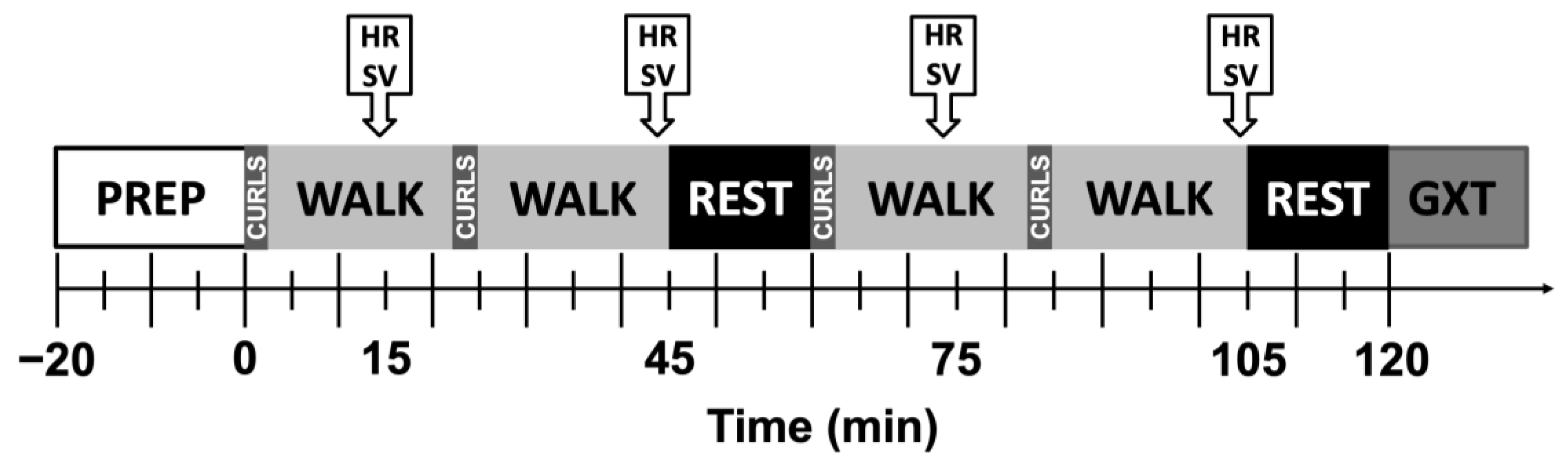
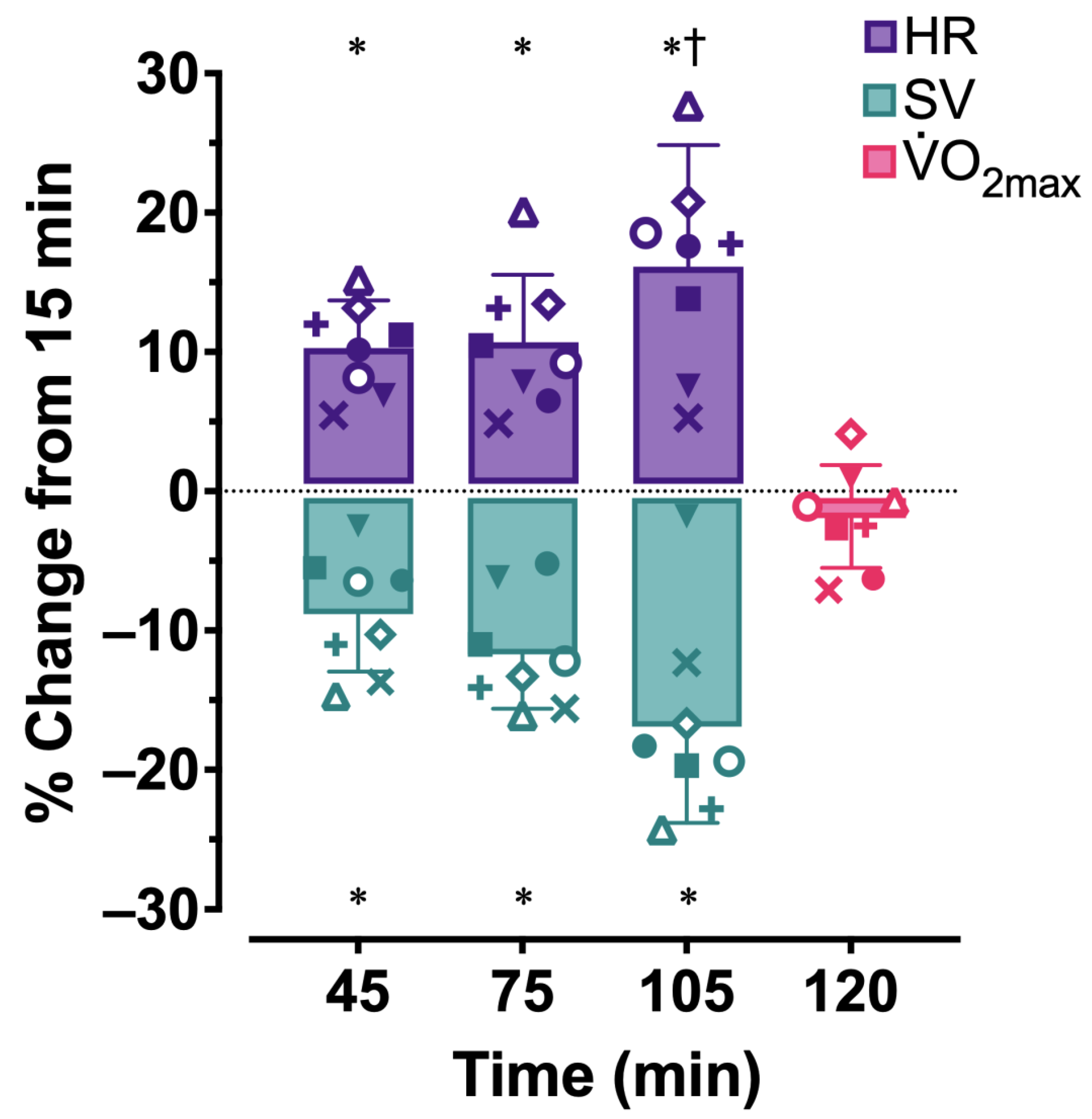
Effect of Work-to-Rest Cycles on Cardiovascular Strain and Maximal Oxygen Uptake during Heat Stress

Abstract
1. Introduction
2. Materials and Methods
3. Results
3.1. Responses during Submaximal Exercise and Rest Intervals
3.2. Responses to Maximal Exercise
4. Discussion
5. Conclusions
Author Contributions
Funding
Institutional Review Board Statement
Informed Consent Statement
Data Availability Statement
Acknowledgments
Conflicts of Interest
References
- Maresh, C.M.; Sökmen, B.; Armstrong, L.E.; Dias, J.C.; Pryor, J.L.; Creighton, B.C.; Muñoz, C.X.; Apicella, J.M.; Casa, D.J.; Lee, E.C.; et al. Repetitive box lifting performance is impaired in a hot environment: Implications for altered work-rest cycles. J. Occup. Environ. Hyg. 2014, 11, 460–468. [Google Scholar] [CrossRef] [Scilit]
- Schlader, Z.J.; Simmons, S.E.; Stannard, S.R.; Mündel, T. The independent roles of temperature and thermal perception in the control of human thermoregulatory behavior. Physiol. Behav. 2011, 103, 217–224. [Google Scholar] [CrossRef] [Scilit]
- Cheuvront, S.N.; Kenefick, R.W.; Montain, S.J.; Sawka, M.N. Mechanisms of aerobic performance impairment with heat stress and dehydration. J. Appl. Physiol. 2010, 109, 1989–1995. [Google Scholar] [CrossRef] [Scilit] [PubMed]
- Wingo, J.E.; Lafrenz, A.J.; Ganio, M.S.; Edwards, G.L.; Cureton, K.J. Cardiovascular drift is related to reduced maximal oxygen uptake during heat stress. Med. Sci. Sports Exerc. 2005, 37, 248–255. [Google Scholar] [CrossRef] [Scilit] [PubMed]
- Flouris, A.D. Functional architecture of behavioural thermoregulation. Eur. J. Appl. Physiol. 2010, 111, 1–8. [Google Scholar] [CrossRef] [Scilit]
- Foster, J.; Hodder, S.G.; Lloyd, A.B.; Havenith, G. Individual responses to heat stress: Implications for hyperthermia and physical work capacity. Front. Physiol. 2020, 11, 541483. [Google Scholar] [CrossRef] [Scilit]
- Lafrenz, A.J.; Wingo, J.E.; Ganio, M.S.; Cureton, K.J. Effect of ambient temperature on cardiovascular drift and maximal oxygen uptake. Med. Sci. Sports Exerc. 2008, 40, 1065–1071. [Google Scholar] [CrossRef] [Scilit]
- Jacklitsch, B.; Williams, J.; Musolin, K.; Coca, A.; Kim, J.H.; Turner, N. NIOSH Criteria for a Recommended Standard: Occupational Exposure to Heat and Hot Environments. Department of Health and Human Services; Centers for Disease Control and Prevention, National Institute for Occupational Safety and Health: Washington, DC, USA, 2016; pp. 2016–2106.
- Wingo, J.E.; Cureton, K.J. Body cooling attenuates the decrease in maximal oxygen uptake associated with cardiovascular drift during heat stress. Eur. J. Appl. Physiol. 2006, 98, 97–104. [Google Scholar] [CrossRef] [Scilit]
- Ganio, M.S.; Wingo, J.E.; Carroll, C.E.; Thomas, M.K.; Cureton, K.J. Fluid ingestion attenuates the decline in VO2peak associated with cardiovascular drift. Med. Sci. Sports Exerc. 2006, 38, 901–909. [Google Scholar] [CrossRef] [Scilit]
- Gliner, J.A.; Raven, P.B.; Horvath, S.M.; Drinkwater, B.L.; Sutton, J.C. Man’s physiologic response to long-term work during thermal and pollutant stress. J. Appl. Physiol. 1975, 39, 628–632. [Google Scholar] [CrossRef] [Scilit] [PubMed]
- Åstrand, P.O.; Cuddy, T.E.; Saltin, B.; Stenberg, J. Cardiac output during submaximal and maximal work. J. Appl. Physiol. 1964, 19, 268–274. [Google Scholar] [CrossRef] [Scilit] [PubMed]
- Hess, H.W.; Tarr, M.L.; Baker, T.B.; Hostler, D.; Schlader, Z.J. Ad libitum drinking prevents dehydration during physical work in the heat when adhering to occupational heat stress recommendations. Temperature 2022, 9, 292–302. [Google Scholar] [CrossRef] [Scilit] [PubMed]
- Stone, T.; Earley, R.L.; Burnash, S.G.; Wingo, J.E. Menstrual cycle effects on cardiovascular drift and maximal oxygen uptake during exercise heat stress. Eur. J. Appl. Physiol. 2021, 121, 561–572. [Google Scholar] [CrossRef] [Scilit] [PubMed]
- Budd, G.M. Wet-bulb globe temperature (WBGT)—Its history and its limitations. J. Sci. Med. Sport 2008, 11, 20–32. [Google Scholar] [CrossRef] [Scilit] [PubMed]
- National Weather Service. Observed Weather Reports, Tuscaloosa County. Available online: https://w2.weather.gov/climate/index.php?wfo=bmx (accessed on 18 February 2018).
- ACGIH. Heat Stress and Strain: TLV Physical Agents Documentation, 7th ed.; ACGIH Signature Publications: Cincinnati, OH, USA, 2017. [Google Scholar]
- Reneau, P.D.; Bishop, P.A.; Ashley, C.D. A comparison of physiological responses to two types of particle barrier, vapor permeable clothing ensembles. Am. Ind. Hyg. Assoc. J. 1999, 60, 495–501. [Google Scholar] [CrossRef] [Scilit]
- Faul, F.; Erdfelder, E.; Lang, A.; Buchner, A. G*Power 3: A flexible statistical power analysis program for the social, behavioral, and biomedical sciences. Behav. Res. Methods 2007, 39, 175–191. [Google Scholar] [CrossRef] [Scilit]
- U.S. Department of Health and Human Services. Physical Activity Guidelines for Americans; U.S. Department of Health and Human Services: Washington, DC, USA, 2018.
- Sawka, M.N.; Burke, L.M.; Eichner, E.R.; Maughan, R.J.; Montain, S.J.; Stachenfeld, N.S. American College of Sports Medicine position stand. Exercise and fluid replacement. Med. Sci. Sports Exerc. 2007, 39, 377–390. [Google Scholar] [CrossRef] [Scilit]
- Jackson, A.S.; Pollock, M.L. Practical assessment of body composition. Phys. Sportsmed. 1985, 13, 76–90. [Google Scholar] [CrossRef] [Scilit]
- Borg, G.A. Psychophysical bases of perceived exertion. Med. Sci. Sports Exerc. 1982, 14, 377–381. [Google Scholar] [CrossRef] [Scilit]
- U.S. Army Research Institute of Environmental Medicine. Cooling Different Body Surfaces during Upper-and-Lower Body Exercise; U.S. Army Research Institute of Environmental Medicine: Natick, MA, USA, 1986.
- Poole, D.C.; Jones, A.M. Measurement of the maximum oxygen uptake O2max: O2peak is no longer acceptable. J. Appl. Physiol. 2017, 122, 997–1002. [Google Scholar] [CrossRef] [Scilit]
- Jones, N.L. Mixed Venous pCO2 and the Measurement of Cardiac Output. In Clinical Exercise Testing; W.B. Saunders Company: Philadelphia, PA, USA, 1975; pp. 57–62. [Google Scholar]
- Byrne, C.; Lim, C.L. The ingestible telemetric body core temperature sensor: A review of validity and exercise applications. Br. J. Sports Med. 2007, 41, 126–133. [Google Scholar] [CrossRef] [Scilit] [PubMed]
- Ramanathan, N.L. A new weighting system for mean surface temperature of the human body. J. Appl. Physiol. 1964, 19, 531–533. [Google Scholar] [CrossRef] [Scilit] [PubMed]
- Stolwijk, J.A.J.; Hardy, J.D. Partitional calorimetric studies of responses of man to thermal transients. J. Appl. Physiol. 1965, 21, 967–977. [Google Scholar] [CrossRef] [Scilit] [PubMed]
- Dill, D.B.; Costill, D.L. Calculation of percentage changes in volumes of red blood cells and plasma in dehydration. J. Appl. Physiol. 1974, 37, 247–248. [Google Scholar] [CrossRef] [Scilit]
- Montain, S.J.; Coyle, E.F. Influence of graded dehydration on hyperthermia and cardiovascular drift during exercise. J. Appl. Physiol. 1992, 73, 1340–1350. [Google Scholar] [CrossRef] [Scilit]
- Kenny, G.P.; Jay, O. Thermometry, calorimetry, and mean body temperature during heat stress. Compr. Physiol. 2013, 3, 1689–1719. [Google Scholar] [CrossRef] [Scilit]
- Miles, D.S.; Sawka, M.N.; Glaser, R.M.; Petrofsky, J.S. Plasma volume shifts during progressive arm and leg exercise. J. Appl. Physiol. 1983, 54, 491–495. [Google Scholar] [CrossRef] [Scilit]
- Katch, V.L.; Sady, S.S.; Freedson, P. Biological variability in maximum aerobic power. Med. Sci. Sports Exerc. 1982, 14, 21–25. [Google Scholar] [CrossRef] [Scilit]
- Wingo, J.E.; Cureton, K.J. Maximal oxygen uptake after attenuation of cardiovascular drift during heat stress. Aviat. Space Environ. Med. 2006, 77, 687–694. [Google Scholar]
- Nybo, L.; Nielsen, B. Hyperthermia and central fatigue during prolonged exercise in humans. J. Appl. Physiol. 2001, 91, 1055–1060. [Google Scholar] [CrossRef] [Scilit]
- Nielsen, B.; Nybo, L. Cerebral changes during exercise in the heat. Sports Med. 2003, 33, 1–11. [Google Scholar] [CrossRef] [Scilit] [PubMed]
- Saltin, B.; Stenberg, J. Circulatory response to prolonged severe exercise. J. Appl. Physiol. 1964, 19, 833–838. [Google Scholar] [CrossRef] [Scilit] [PubMed]
- Vuksanović, V.; Sheppard, L.W.; Stefanovska, A. Nonlinear relationship between level of blood flow and skin temperature for different dynamics of temperature change. Biophysical. J. 2008, 94, L78–L80. [Google Scholar] [CrossRef] [Scilit] [PubMed]
- González-Alonso, J.; Calbet, J.A. Reductions in systemic and skeletal muscle blood flow and oxygen delivery limit maximal aerobic capacity in humans. Circulation 2003, 107, 824–830. [Google Scholar] [CrossRef] [Scilit]
- Aoyagi, Y.; McLellan, T.M.; Shephard, R.J. Interactions of physical training and heat acclimation. Sports Med. 1997, 23, 173–210. [Google Scholar] [CrossRef] [Scilit]



| Trial | Dry-Bulb Temperature (°C) | Relative Humidity (%) | WBGTin (°C) | Wind Speed (m·s−1) |
|---|---|---|---|---|
| INITIAL | 23.1 ± 0.8 | 44.3 ± 10.4 | 18.1 ± 1.2 | 0.4 ± 0.6 |
| 15MIN | 34.5 ± 0.6 | 54.3 ± 3.4 | 29.0 ± 0.7 | 1.4 ± 0.1 |
| 120MIN | 34.3 ± 0.4 | 55.9 ± 2.5 | 29.0 ± 0.4 | 1.4 ± 0.1 |
| A. Responses during treadmill walking (mean ± SD) | ||||
| 15 min | 45 min | 75 min | 105 min | |
| O2 (L·min−1) ** | 1.05 ± 0.05 | 1.08 ± 0.04 * | 1.07 ± 0.05 | 1.10 ± 0.06 *‡ |
| %INITIAL O2max ** | 34.9 ± 9.2 | 36.1 ± 9.3 * | 35.7 ± 8.8 | 36.5 ± 9.2 *‡ |
| (L·min−1) ** | 7.8 ± 0.6 | 7.9 ± 0.6 | 7.6 ± 0.6 | 7.5 ± 0.6 |
| HR (beats·min−1) ** | 110 ± 22 | 122 ± 24 * | 122 ± 24 * | 128 ± 26 *‡ |
| SV (mL) ** | 73.1 ± 14.2 | 66.9 ± 15.1 * | 64.9 ± 15.5 * | 60.7 ± 13.3 * |
| Tgi−sk (°C) | 1.3 ± 0.4 | 1.5 ± 0.7 | 1.7 ± 0.8 | 1.7 ± 0.9 |
| b (°C) ** | 36.9 ± 0.4 | 37.2 ± 0.4 * | 37.2 ± 0.4 | 37.4 ± 0.4 *†‡ |
| RPE ** | 10 ± 2 | 12 ± 2 | 11 ± 2 | 12 ± 3 * |
| RTS ** | 5.5 ± 0.5 | 6.0 ± 0.5 | 6.0 ± 0.5 | 6.0 ± 0.5 |
| B. Responses during the final minute of rest intervals (mean ± SD) | ||||
| Baseline | 60 min | 120 min | ||
| HR (beats·min−1) ** | 68 ± 10 | 83 ± 11 § | 91 ± 15 §^ | |
| Tgi−sk (°C) ** | 1.6 ± 0.4 | 2.1 ± 1.1 | 2.2 ± 1.1 | |
| b (°C) ** | 36.7 ± 0.3 | 37.0 ± 0.4 § | 37.1 ± 0.3 § | |
| RTS ** | 4.6 ± 0.3 | 5.4 ± 0.6 § | 5.4 ± 0.6 § | |
| Initial | 15MIN | 120MIN | |
|---|---|---|---|
| O2 (L·min−1) | 3.20 ± 0.90 | 3.22 ± 0.95 | 3.16 ± 0.92 |
| O2 (mL·kg−1·min−1) | 42.0 ± 5.7 | 42.3 ± 6.3 | 41.5 ± 6.1 |
| RER** | 1.16 ± 0.06 | 1.12 ± 0.07 | 1.10 ± 0.08 * |
| HR (beats·min−1) ** | 191 ± 5 | 188 ± 6 | 189 ± 5 * |
| Tgi (°C) | – | 37.6 ± 0.3 | 37.7 ± 0.3 |
| RPE | 19 ± 1 | 19 ± 1 | 19 ± 1 |
| RTS | – | 7.0 ± 0.5 | 7.0 ± 0.5 |
| Blood lactate (mmol·L−1) | 6.3 ± 1.4 | 5.9 ± 2.0 | 6.0 ± 3.1 |
| Treadmill grade (%) | 11.1 ± 1.5 | 11.1 ± 2.8 | 10.8 ± 2.7 |
| Speed (km·h−1) | 8.2 ± 0.8 | 8.3 ± 0.8 | 8.3 ± 0.8 |
| GXT duration (s) ** | 480 ± 66 | 400 ± 66 | 321 ± 88 *† |
Disclaimer/Publisher’s Note: The statements, opinions and data contained in all publications are solely those of the individual author(s) and contributor(s) and not of MDPI and/or the editor(s). MDPI and/or the editor(s) disclaim responsibility for any injury to people or property resulting from any ideas, methods, instructions or products referred to in the content. |
© 2023 by the authors. Licensee MDPI, Basel, Switzerland. This article is an open access article distributed under the terms and conditions of the Creative Commons Attribution (CC BY) license (https://creativecommons.org/licenses/by/4.0/).
Share and Cite
Mulholland, A.M.; Yoder, H.A.; Wingo, J.E. Effect of Work-to-Rest Cycles on Cardiovascular Strain and Maximal Oxygen Uptake during Heat Stress. Int. J. Environ. Res. Public Health 2023, 20, 4580. https://doi.org/10.3390/ijerph20054580
Mulholland AM, Yoder HA, Wingo JE. Effect of Work-to-Rest Cycles on Cardiovascular Strain and Maximal Oxygen Uptake during Heat Stress. International Journal of Environmental Research and Public Health. 2023; 20(5):4580. https://doi.org/10.3390/ijerph20054580
Chicago/Turabian StyleMulholland, Anne M., Hillary A. Yoder, and Jonathan E. Wingo. 2023. "Effect of Work-to-Rest Cycles on Cardiovascular Strain and Maximal Oxygen Uptake during Heat Stress" International Journal of Environmental Research and Public Health 20, no. 5: 4580. https://doi.org/10.3390/ijerph20054580
APA StyleMulholland, A. M., Yoder, H. A., & Wingo, J. E. (2023). Effect of Work-to-Rest Cycles on Cardiovascular Strain and Maximal Oxygen Uptake during Heat Stress. International Journal of Environmental Research and Public Health, 20(5), 4580. https://doi.org/10.3390/ijerph20054580