Article

The Toxicological Risk Assessment of Dermal Exposure of Patients Exposed to Lead and Cadmium Due to Application of Ointments with Marjoram Herb Extract (Majoranae herbae extractum)

by
Kamil Jurowski
1,2,* and
Mirosław Krośniak
3
1
Laboratory of Innovative Toxicological Research and Analyses, Institute of Medical Studies, Medical College, Rzeszów University, Al. mjr. W. Kopisto 2a, 35-959 Rzeszow, Poland
2
Department of Regulatory and Forensic Toxicology, Institute of Medical Expertises, Łódź, ul. Aleksandrowska 67/93, 91-205 Łódź, Poland
3
Department of Food Chemistry and Nutrition, Medical College, Jagiellonian University, Medyczna 9, 30-688 Kraków, Poland
*
Author to whom correspondence should be addressed.
Int. J. Environ. Res. Public Health 2023, 20(3), 2701; https://doi.org/10.3390/ijerph20032701

Submission received: 28 December 2022 / Revised: 28 January 2023 / Accepted: 31 January 2023 / Published: 2 February 2023
(This article belongs to the Special Issue Exposure, Toxicity, and Health Impacts of Potentially Toxic Metals)

Abstract

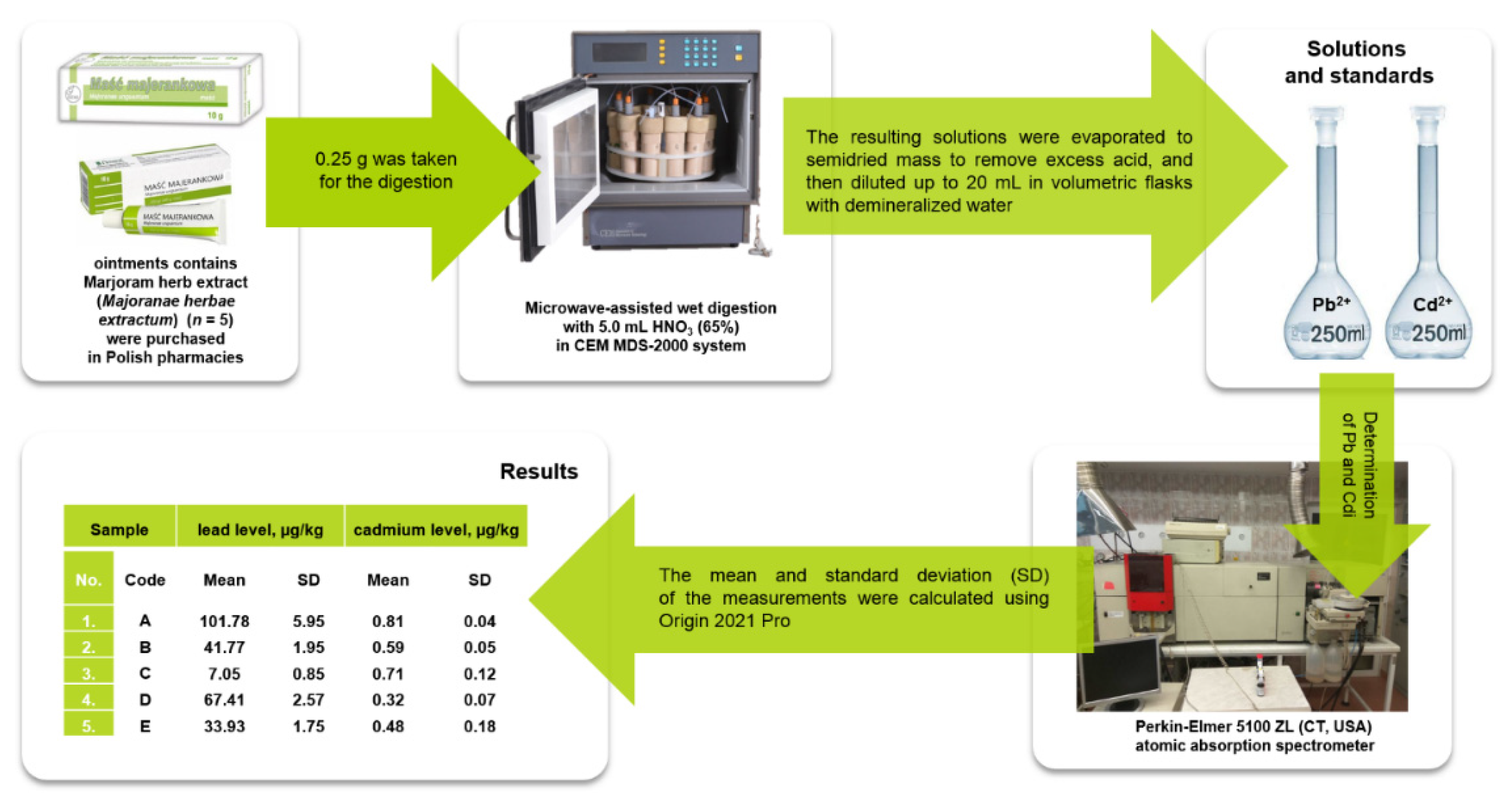
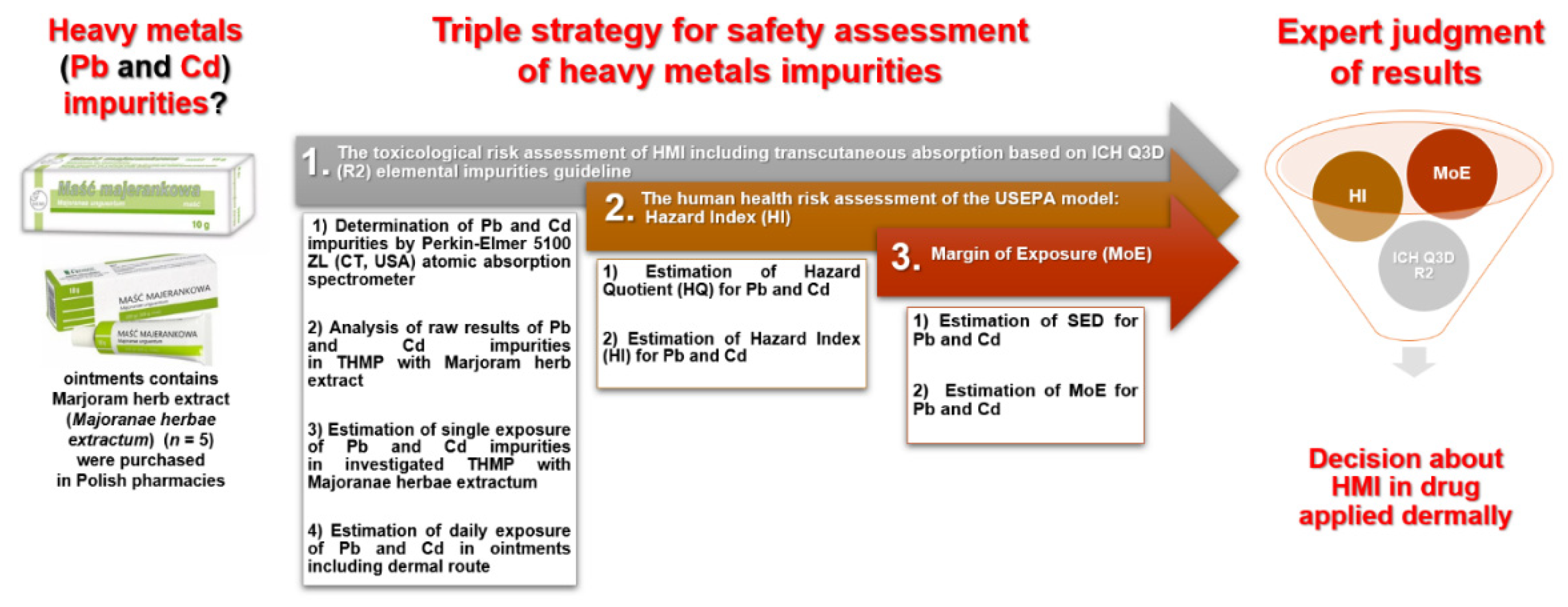
Potential heavy metal impurities (HMI) in pharmaceuticals/pharmaceutical products/drugs based on plant raw materials (e.g., herbs) are an important problem in the pharmaceutical industry; however, there is a lack of scientific articles on the comprehensive toxicological risk assessment of HMI in ointment applied dermally. To make the appropriate toxicological risk assessment, we consider: (1) the raw results of the levels of lead and cadmium in the ointments (metal per kg of mass), (2) one-time administration of the applied ointment, (3) daily exposure of Pb and Cd in the applied ointments according to the maximum daily dose of applied pharmaceuticals, including transcutaneous penetration, (4) human health risk assessment based on the USEPA model, and 5) the margin of exposure (MoE). The raw results indicated that lead (7.05–101.78 µg/kg) and cadmium (0.32–0.81 µg/kg) were present in all samples. The levels of analyzed HMI (independently of the producer and declared composition) were similar. Pb and Cd contamination associated with daily doses met the standards of the ICH Q3D (R2) guide on elemental impurities in pharmaceuticals, including the cutaneous route of administration. Taking into account the daily amount of lead and cadmium (ointment, ug/day) the results were satisfactory, confirming the safety of marjoram herb extract ointments available in Polish pharmacies according to the ICH guideline Q3D (R2) on elemental impurities. The HQ values obtained for Pb and Cd in all samples were less than 1; therefore, exposure to these HMI would not cause a health risk based on the USEPA model strategy. Furthermore, the obtained values of MoE for Pb and Cd in ointments were above 100, so exposure to these elements would not cause a health risk based on the MoE-based strategy. The original contribution of this work is that this is the first study on the triple approach strategy to evaluate the safety of heavy metal impurities in traditional herbal medicinal products applied dermally in solid form (ointments with marjoram herb extract). The research is novel and has not been previously published; The proposed procedure includes transcutaneous penetration of heavy metal (Pb and Cd) impurities described for the first time in the literature.
Keywords: heavy metals; toxicological risk assessment; marjoram herb; ICH Q3D (R2) heavy metals; toxicological risk assessment; marjoram herb; ICH Q3D (R2)